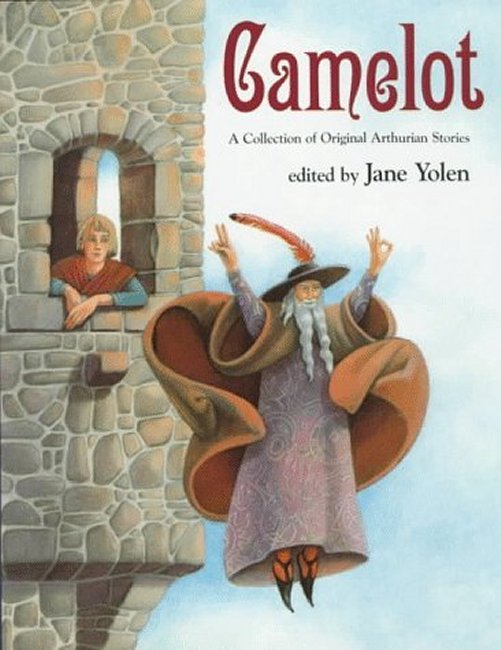
Camelot – Edited by Jane Yolen

This collection of new short stories was published in 1995 by Philomel Books which is now a children’s imprint of Penguin Books but at the time was a division of the Putnam and Grosset Group, Philomel does seem to have had a varied history of owners over the years since it was formed by Ann Beneduce in 1980 taking the poetic name for a nightingale and has always specialised in children’s titles which I hadn’t realised when I picked it off the shelves to read. Frankly the only reason I own the book is that it contains the first printing of the Terry Pratchett story ‘Once and Future’, I used to buy various anthologies just to track down Pratchett short stories but since 2012 when ‘A Blink of the Screen’ was published which gathered presumably all his fiction short stories together in one volume I’ve stopped the hunt. Pratchett’s story tells the tale of the pulling of a sword from the stone only in his version it’s controlled by a time traveller who has built an electromagnet into the rock so that he could control who succeeded, needless to say his plan doesn’t work out a expected. Interestingly in ‘A Blink of The Screen’ Pratchett states:

There’s a lot more of this deep on a hard drive somewhere. It may yet become a novel, but it started as a short story in Camelot, edited by Jane Yolen, in 1995. I’d wanted to write it for nearly ten years, I really ought to dig out those old discs again…

Sadly he didn’t live to have another go at it.

Of the nine other stories, and one song by Jane Yolen, the only other author I have heard of is Anne McCaffrey, famous for her Dragon Riders of Pern series of novels, and her offering ‘Black Horses for a King’ is probably the best of the collection, closely followed by Pratchett. Frankly the McCaffrey story is strong partly because she largely ignored the brief and simply wrote a good short story with nothing to make it Camelot apart from the leader of the warriors being called Lord Artos, which is probably close enough to Arthur to be included. The story is actually the first part of the novel ‘Black Horses for a King’ by McCaffrey which came out in 1996 so either she was inspired to continue the tale, and develop it into the story of the early days of British cavalry, in a way that Pratchett considered doing with his contribution or she was already working on the novel and simply extracted part of it when asked to supply something for this collection.

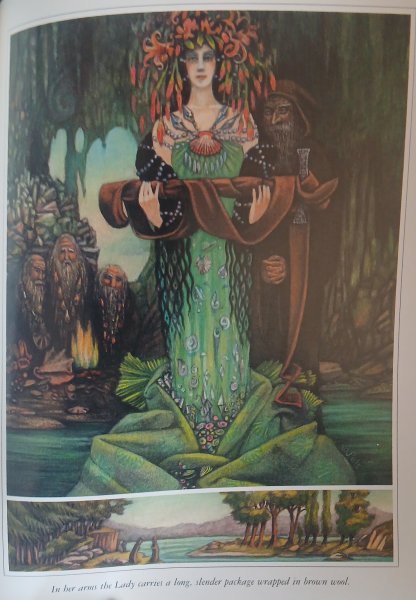
The real joy in the book are the lovely illustrations by Winslow Pels who has just the right amount of mystical whimsy for the book. The one above is for ‘Excalibur’ by Anne E Crompton who was sixty five when she wrote this story and a well established writer of children’s stories although this is the only example of her work I own, I quite enjoyed it but not enough to seek out any of her other works.

The other stories included along with Amesbury Song by Jane Yolen and Adam Stemple are:

  • The Changing of the Shrew by Kathleen Kudlinski
  • Wild Man by Diana L Paxton
  • Gwenbwyfar by Lynne Pledger
  • Holly and Ivy by Jaes D Macdonald and Debra Doyle
  • The Raven by Nancy Springer
  • All the Iron of Heaven by Mark W Tiedemann
  • Our Hour of Need by Greg Costikyan

I cannot find any examples of this book being reprinted after coming out in 1995, so I’m guessing it wasn’t a great seller and as the best parts are available elsewhere it has probably had its day.

J R R Tolkien and C S Lewis in Puffin

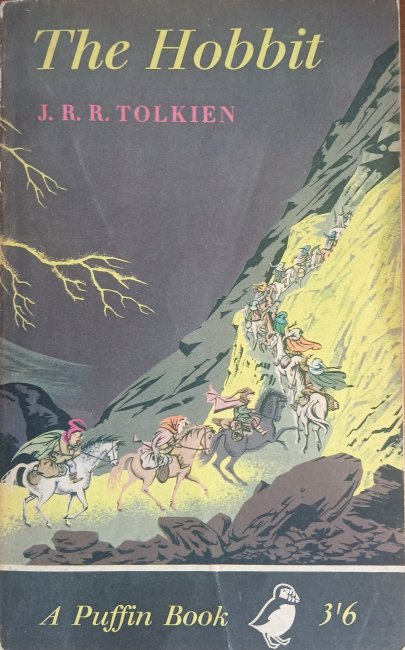
This blog is coming out a day earlier than usual, on Monday the 11th May 2026, to mark the exact anniversary, one hundred years ago, since Tolkien and Lewis first met. To celebrate the occasion I have chosen to look at the very different histories of the two authors famous children’s books with relation to the best known publisher of paperbacks aimed at this market, Puffin Books an imprint of Penguin Books. Although Lewis was the first of the two to appear in Puffin, for reasons that will soon become clear I’m going to start with Tolkien and Puffin Story Book PS161 published October 1961 with a lovely cover by Pauline Baynes which wraps round the whole book, but without most of the pictures from the Allen & Unwin hardback. The only image retained was the map and that was at the insistence of Tolkien who felt that it would be difficult to follow without its assistance, but the omission of most of the illustrations wasn’t to be the biggest problem with this publication.

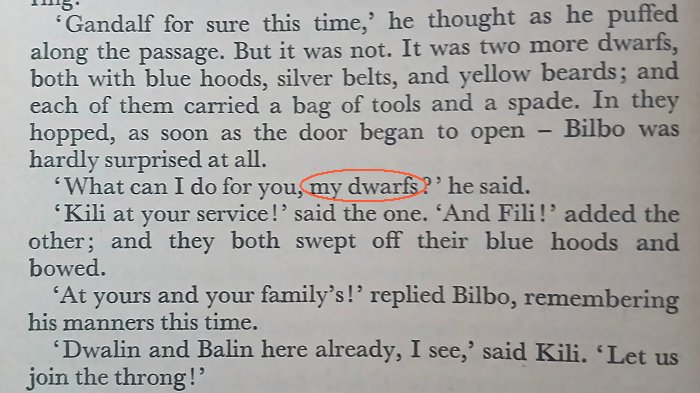
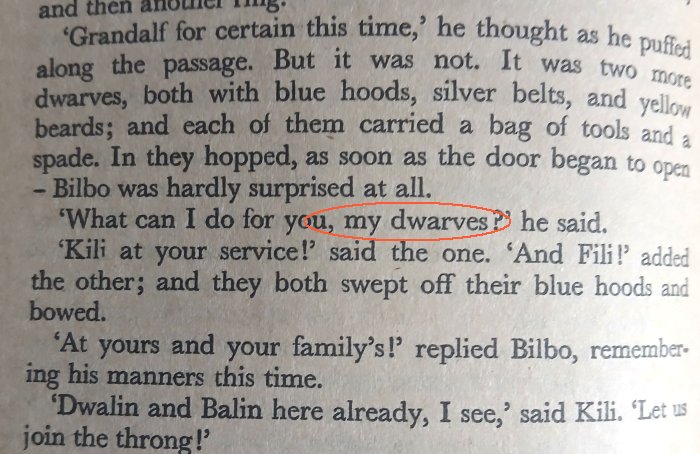
Allen & Unwin didn’t have a paperback imprint of their own that that could publish Tolkien in the 1960’s but they were also worried about devaluing the brand as they were making good money selling Tolkien in hardback but after talking with the author they decided on a limited run of 35,000 copies to test the market for a paperback. Puffin duly published the book and as usual five copies were sent to the author requesting one to be signed and sent back for Sir Allen Lane’s personal collection, this Tolkien duly did, it was only a few months later that he noticed what would become a deal breaker. First I will show an early passage from the 1961 Puffin edition:

and now the same section from the 1966 Unwin paperback:

The original dwarves has become dwarfs, checking revealed dwarfish rather than dwarvish and elfish replaced elvish, Tolkien was not happy to say the least but it was too late to do anything about it. It appears that the printers, Cox and Wyman, had made the changes and quoted The Oxford English Dictionary as their authority, unfortunately for them Tolkien was Merton Professor of English Language and Literature at Oxford University and had worked on the OED so he was even less impressed by this argument. Tolkien did not allow Puffin to reprint ‘The Hobbit’ or indeed publish any others of his works and Sir Allen Lane’s copy in the Penguin Archive in Bristol is believed to be the only signed example, as he would apparently refuse to sign any Puffin copies put before him. A lot of this I knew but for extra details, including the last bit regarding signed copies, or lack thereof I am indebted to the article by Jules Burt in Penguin Collectors Newsletter 100.

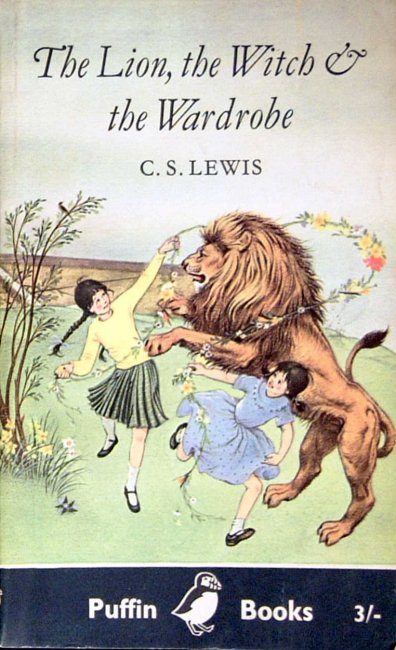
Now let’s move on to Lewis and his Narnia series of seven books, these were all published by Puffin although like Tolkien none of his other works were published by Penguin Books, but not because he refused publication, unlike Tolkien the Narnia books went through multiple reprints at Puffin. Pauline Baynes had illustrated the original hardbacks and provided new covers for the Puffin editions which also ties these books nicely to ‘The Hobbit’.

Oddly as can be seen from the lists below Puffin didn’t publish the Narnia books in order, the Puffin list first:

  • PS132 – The Lion, the Witch and the Wardrobe – October 1959
  • PS173 – Prince Caspian – April 1962
  • PS192 – The Magician’s Nephew – June 1963
  • PS205 – The Last Battle – January 1964
  • PS229 – The Voyage of the Dawn Treader – March 1965
  • PS240 – The Silver Chair – June 1965
  • PS244 – The Horse and His Boy – September 1965

Actual first publication sequence and probable correct reading order

  • The Lion, the Witch and the Wardrobe – published by Geoffrey Bles 1950
  • Prince Caspian – published by Geoffrey Bles 1951
  • The Voyage of the Dawn Treader – published by Geoffrey Bles 1952
  • The Silver Chair – published by Geoffrey Bles 1953
  • The Horse and His Boy – published by Geoffrey Bles 1954
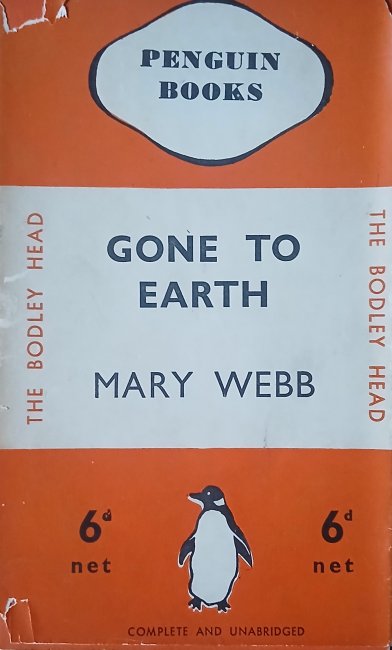
  • The Magician’s Nephew – published by The Bodley Head 1955
  • The Last Battle – published by The Bodley Head 1956

There is a good argument that ‘The Magician’s Nephew’ should be read first as it covers events well before any of the other books, also ‘The Horse and His Boy’ is actually set towards the end of ‘The Lion, the Witch and the Wardrobe’. One thing is absolutely clear however and that is that ‘The Last Battle’ should not be read fourth as it is definitely the last book in the series.

Tolkien and Lewis were the ‘star’ members of a literary group called The Inklings who met regularly at The Eagle and Child public house in Oxford to discuss their ongoing works. Tolkien was rather dismissive of Lewis’s overly Christian allegorical novels, such as the Narnia series, as he didn’t regard them as serious literary works unlike his own output which he slaved over for years. But despite disagreements the two men remained friends for decades with Tolkien regularly visiting Lewis before his death in 1963. Tolkien survived him by ten years.

The Narnia books are now published by Harper Collins rather then Puffin, but still have the original, and iconic, Pauline Baynes illustrations inside them over seventy five years since they first appeared.

Everyday Life is Full of Math – Jun Mitani

I have recently been introduced to the excellent series of recreational mathematics books from A K Peters/CRC Press and I thought I would start with the one that I have which is aimed at young adult readers, so aged fourteen upwards, to introduce maths pupils to concepts that their school would probably not cover, but which are thought provoking additions to the syllabus. Mitani is a professor of Information and Systems at the University of Tsukuba, Japan specialising in geometric modelling techniques for computer graphics and he does cover some to the basic concepts of this work in one of the chapters. But this book grew out of posts he was making on X (twitter) on everyday maths which have been expanded to make each chapter but even then they are not long. There are thirty three chapters covering a wide selection of topics in just 187 pages so no individual section is daunting for somebody using this book as their first venture into recreational mathematics. The book is also heavily illustrated which makes the probably unfamiliar concepts explored within it more understandable to those first dipping their toes into maths for fun. Hopefully they also have inspiring maths teachers like I did, thank you Mr. Braybrooke, Mr. Roberts and Mr. Jones.

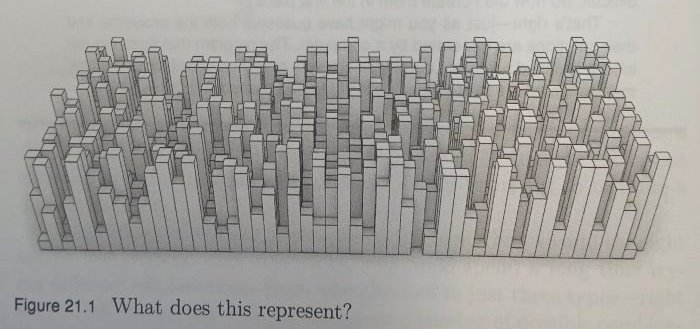
Some of the ways of looking at what for me are well known mathematical ideas are new to me and are fascinating because of their fresh approach, for example the chart above is actually the first thousand digits of pi after the decimal point. You read it from left to right then front to back so the front row represents the first fifty digits which I have split into five blocks of ten digits for ease of display in this blog i.e. 1415926535 8979323846 2643383279 5028841971 6939937510. Unfortunately the question below the chart is somewhat given away by the title of the chapter ‘Looking at Pi’ but the diagram beautifully illustrates the randomness of this irrational number, and also makes it easy to spot the Feynman Point (near the back left) where unexpectedly you have six consecutive nines from position 762.

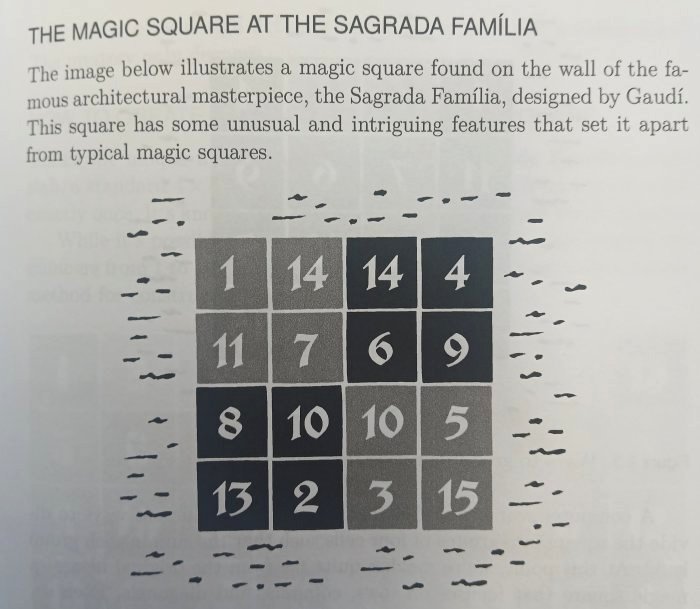
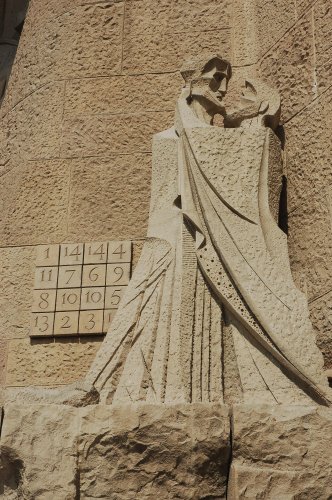
No book introducing recreational mathematics could possibly avoid magic squares but again Mitani has an unusual spin on the idea, yes he explains ‘normal’ magic squares where all the row, columns and both diagonals add up to the same value but he then goes on to examine the example of the one inscribed on the Passion facade of Sagrada Familia in Barcelona. My photo of that magic square can be seen below, note the absence of 12 and 16 and the duplication of 10 and 14 but this allows for an even greater number of combinations. Here not only do all rows and columns along with the diagonals add up to 33 but so do the four shaded 2×2 squares, the centre 2×2 square, the four corners, opposite sides (14+14+2+3) and (11+8+9+5) and the diagonal opposites (11+14+3+5) and (14+9+8+2). A truly special magic square on a truly special building.

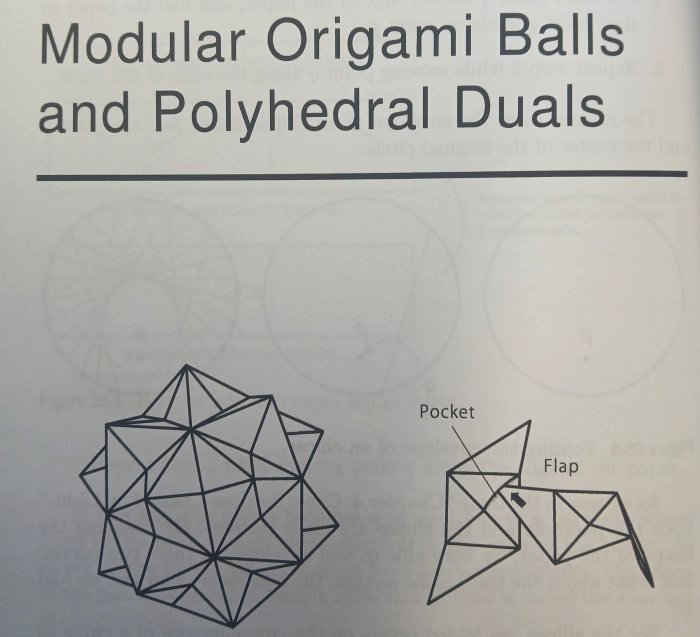
But you really notice the country of origin for this book when you find chapters on origami, the art of paper folding. One of the notes on the rear cover includes “Introduces math found in real life, like origami”, a more Japanese statement it’s difficult to imagine. There are four chapters dealing with aspects of paper folding, one of which, shown below, is specifically origami and is no where near as complex as the chapter tile implies at first sight, but does allow explorations in the field of topology.

The final chapter I want to highlight is even more Japanese specific as it relates to the seating pattern on the iconic bullet trains, the first really successful high speed train network in the world. The maths here is actually very simple but neatly explained and other chapters include aspects of a famous combinations puzzle, the Tower of Hanoi, Pascal’s Triangle and my favourite the still unproven Collatz Conjecture which would lead to a prize of $830,000 if you could prove it. The best thing about Collatz Conjecture is it is so easy to understand, but why does it apparently always work, you could win the prize either for proving that it does always work or alternatively finding an example where it doesn’t. I remember getting obsessed by Fermat’s Theorem when I was the age this book is aimed at, again a very simple concept with a huge financial prize for the person who solved it. That however has now been done, which is possibly why Mitani doesn’t have a chapter on that.

The book is available from Routledge. My one, very minor, criticism is that although the book is clearly print on demand no attempt has been made to run the file through a spell checker to convert from American to English spellings when printing in the UK, although this would have been a simple exercise to do. Having said that, the book is otherwise excellent and I wish it had been available when I was thirteen or fourteen and starting to get interested in the neglected corners of mathematics.that aren’t covered at school.