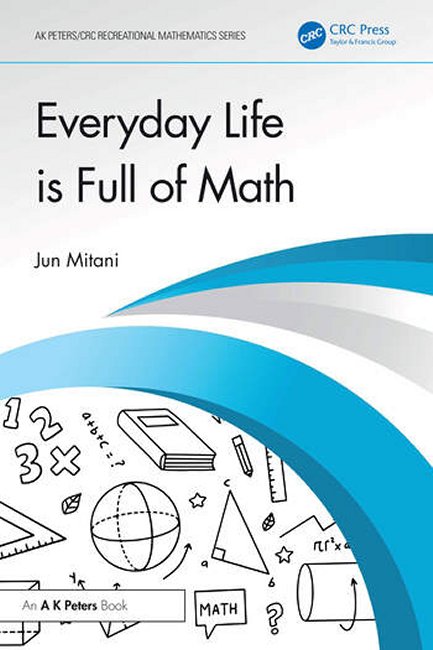
I have recently been introduced to the excellent series of recreational mathematics books from A K Peters/CRC Press and I thought I would start with the one that I have which is aimed at young adult readers, so aged fourteen upwards, to introduce maths pupils to concepts that their school would probably not cover, but which are thought provoking additions to the syllabus. Mitani is a professor of Information and Systems at the University of Tsukuba, Japan specialising in geometric modelling techniques for computer graphics and he does cover some to the basic concepts of this work in one of the chapters. But this book grew out of posts he was making on X (twitter) on everyday maths which have been expanded to make each chapter but even then they are not long. There are thirty three chapters covering a wide selection of topics in just 187 pages so no individual section is daunting for somebody using this book as their first venture into recreational mathematics. The book is also heavily illustrated which makes the probably unfamiliar concepts explored within it more understandable to those first dipping their toes into maths for fun. Hopefully they also have inspiring maths teachers like I did, thank you Mr. Braybrooke, Mr. Roberts and Mr. Jones.
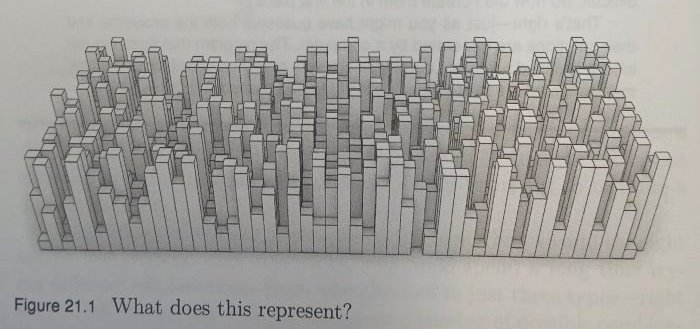
Some of the ways of looking at what for me are well known mathematical ideas are new to me and are fascinating because of their fresh approach, for example the chart above is actually the first thousand digits of pi after the decimal point. You read it from left to right then front to back so the front row represents the first fifty digits which I have split into five blocks of ten digits for ease of display in this blog i.e. 1415926535 8979323846 2643383279 5028841971 6939937510. Unfortunately the question below the chart is somewhat given away by the title of the chapter ‘Looking at Pi’ but the diagram beautifully illustrates the randomness of this irrational number, and also makes it easy to spot the Feynman Point (near the back left) where unexpectedly you have six consecutive nines from position 762.
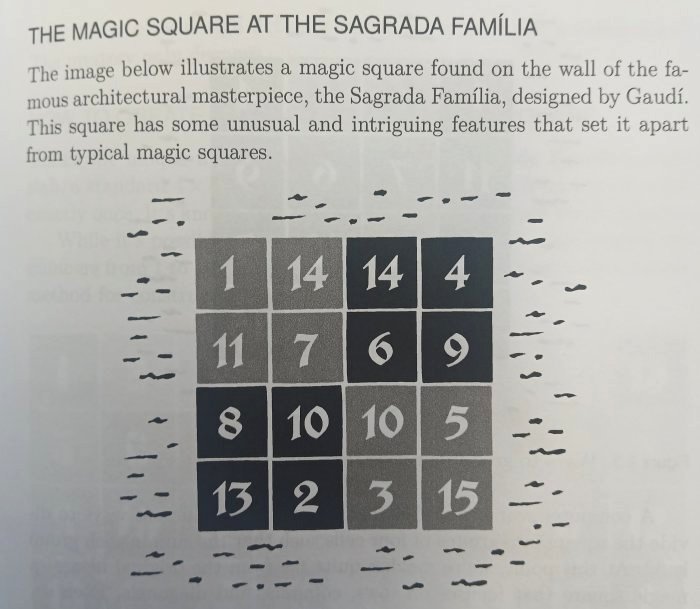
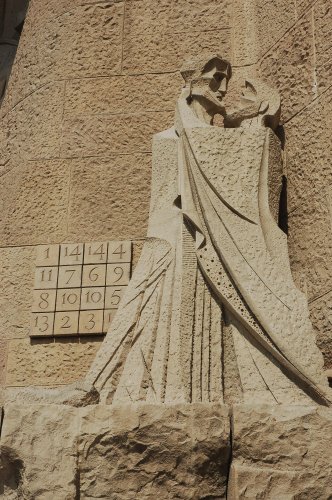
No book introducing recreational mathematics could possibly avoid magic squares but again Mitani has an unusual spin on the idea, yes he explains ‘normal’ magic squares where all the row, columns and both diagonals add up to the same value but he then goes on to examine the example of the one inscribed on the Passion facade of Sagrada Familia in Barcelona. My photo of that magic square can be seen below, note the absence of 12 and 16 and the duplication of 10 and 14 but this allows for an even greater number of combinations. Here not only do all rows and columns along with the diagonals add up to 33 but so do the four shaded 2×2 squares, the centre 2×2 square, the four corners, opposite sides (14+14+2+3) and (11+8+9+5) and the diagonal opposites (11+14+3+5) and (14+9+8+2). A truly special magic square on a truly special building.
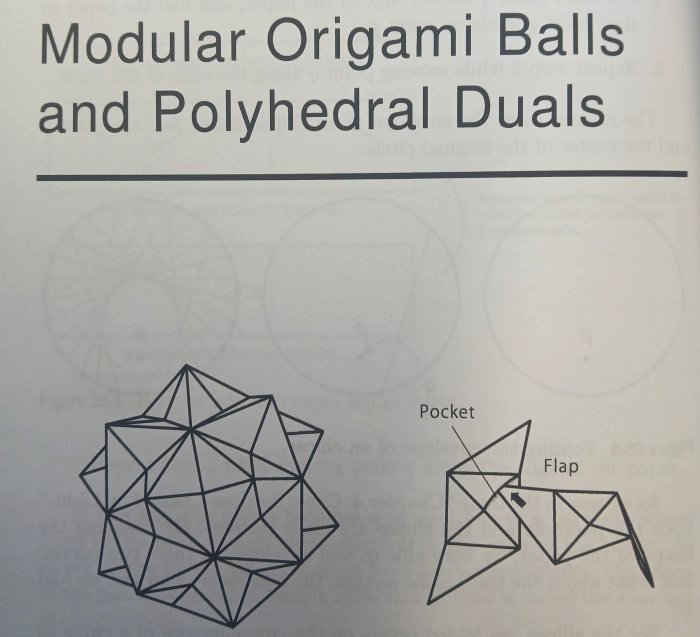
But you really notice the country of origin for this book when you find chapters on origami, the art of paper folding. One of the notes on the rear cover includes “Introduces math found in real life, like origami”, a more Japanese statement it’s difficult to imagine. There are four chapters dealing with aspects of paper folding, one of which, shown below, is specifically origami and is no where near as complex as the chapter tile implies at first sight, but does allow explorations in the field of topology.
The final chapter I want to highlight is even more Japanese specific as it relates to the seating pattern on the iconic bullet trains, the first really successful high speed train network in the world. The maths here is actually very simple but neatly explained and other chapters include aspects of a famous combinations puzzle, the Tower of Hanoi, Pascal’s Triangle and my favourite the still unproven Collatz Conjecture which would lead to a prize of $830,000 if you could prove it. The best thing about Collatz Conjecture is it is so easy to understand, but why does it apparently always work, you could win the prize either for proving that it does always work or alternatively finding an example where it doesn’t. I remember getting obsessed by Fermat’s Theorem when I was the age this book is aimed at, again a very simple concept with a huge financial prize for the person who solved it. That however has now been done, which is possibly why Mitani doesn’t have a chapter on that.

The book is available from Routledge. My one, very minor, criticism is that although the book is clearly print on demand no attempt has been made to run the file through a spell checker to convert from American to English spellings when printing in the UK, although this would have been a simple exercise to do. Having said that, the book is otherwise excellent and I wish it had been available when I was thirteen or fourteen and starting to get interested in the neglected corners of mathematics.that aren’t covered at school.


Pingback: The Four Corners of Mathematics – Thomas Waters – Ramblings on my bookshelves