Vietnam! Vietnam! – Felix Greene

This post is being published on the 29th April 2025, the day before the fiftieth anniversary of the surrender of South Vietnam and the ending of the Vietnam war, the Vietnamese by the way refer to it as the American war. The choice of this book amongst several that I have on the conflict was pretty well certain as over half the book consists of photojournalism and the balance a series of essays detailing in chronological order what led up to the war and the first ten years of the fighting. Even though Greene was a British journalist the book was first published in 1965 in America, with still eight more years of American involvement and beyond that two years of the slow push down the country by the North until they finally prevailed. That this book was written roughly half way through the war would have horrified its author who, at least partly, hoped that exposing just what was going on might have hurried the end. My copy is the 1967 British paperback edition by Penguin Books.

By going back to the French Indochina colonies pre WWII and taking the story of how America came to be fighting there the twenty two essays that make up the second half of the book largely follow a historical progression. So how did America get into this mess? Well it turns out that when the French were kicked out by the invading Japanese during WWII they were determined to regain control of their colonies just as the Vietnamese, along with the populations of Cambodia and Laos for that matter, saw an opportunity to gain independence at the end of the war. There was a short lived declaration of independence for all of Vietnam but the French did re-invade in 1946, however they needed American assistance, which was forthcoming as part of the anti-communist sentiment in American politics through the 1950’s and this led to them supporting the extremely unpopular puppet president Diem with ever increasing military power initially in the guise of ‘advisers’ and ‘trainers’. The French eventually gave up and left leaving the Americans, who by then were financing roughly three quarters of the military push and supplying arms despite the Geneva accords of 1954 which said that foreign forces should not be in Vietnam and there should be elections within two years leading to reunification of Vietnam. America and France, despite being signatories to these agreements had no intention of allowing them to happen.

Picture by Kyoichi Sawada – United Photo Industries (UPI)

And so we ended up with America fighting the Vietnamese under the guise of preventing North Vietnam gaining control of the south but in fact the National Liberation Front, known outside of the country as the Vietcong, set up in 1960 was entirely composed of people from the south who wanted the foreign forces out of their country and the weapons they used were almost entirely from deserters from the American backed Vietnamese troops.

I have been selective in which photos to use from the book as a lot of them are far more shocking than the example of American torture shown above and include the famous picture of the monk, Thich Quang Duc, sitting and burning in the road as he set fire to himself in protest at the ongoing conflict in June 1963. In truth the photographs are far more telling than the essays, especially when juxtaposed with quotes which clearly don’t match the images such as the destroyed houses below.

Photo by Felix Greene

There are clearly books that look back on the war with the benefit of hindsight which I could have reviewed but I was drawn to this work written during the middle of the conflict. It may not be the most dispassionate summary of what was going on but Greene was trying to make sense of what he witnessed whilst reporting and for that it is a fascinating book.

Top photo by Bob Ibrahim UPI, bottom photo un-credited UPI

I travelled the length of Vietnam in 2007-8 and was lucky to have three very different guides which could provide alternate viewpoints. Starting in the south the guide was an older gentleman who had lived through the defeat of the south a a civilian and could talk about the pulling out of the American forces and the advance of the troops from the north leading to the surrender. In central Vietnam our guide was an ex Vietcong fighter who still walked with a limp from a war injury sustained in Hue, whilst the north was explained by a man in his early twenties who had never known anything other than a unified country. I doubt it is possible to have such an interesting selection of guides nowadays fifty years on from the end of the conflict and I’m glad I went when I did.

Revolution Day – Rageh Omaar

This book, Rageh Omaar’s first, starts with him being the first BBC journalist allowed into Iraq after five years in September 1997. He had become the BBC Middle East correspondent that summer and had straight away applied for a visa for Iraq not really expecting it to be granted as anyone from the BBC was persona non grata in the country since the end of the Gulf War in 1991. But Omaar is not the white middle class reporter expected by the regime, rather he was born in Mogadishu, Somalia and speaks fluent Arabic so amazingly they let him in. The book would be fascinating enough if it just dealt with the next six years whilst Omaar gets to know Baghdad and develops friendships with not just his team but ordinary Iraqis, finds a regular tea shop and chats to locals providing an insight to daily life in a country few of us have had a chance to visit. Of course during that time Omaar only spent a few weeks or months at a time in Iraq, he had the entire Middle East to cover and in 2001 and 2002 he was in Afghanistan reporting on the fall of the Taliban, I’d love to read a book by him about that time as well. But at the end of 2002 he was back in Iraq as US President George Bush Jr and British Prime Minister Tony Blair falsely accused Saddam Hussain of having weapons of mass destruction that he would be willing to use and decided on regime change in Iraq as part of the Global War on Terror started following the attack on the Twin Towers in New York in September 2001, which Iraq had nothing to do with.

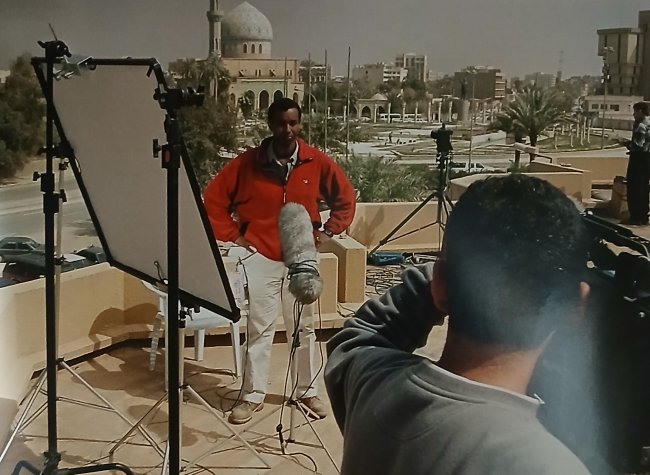
As 2003 began it became clear that despite the lack of a UN resolution supporting such action America was going to lead a coalition force including Britain in invading Iraq and journalists and their teams were given the opportunity to get out of the country. Despite it clearly being highly dangerous, especially for news teams from countries involved in the invasion, Omaar and a much reduced team decided to stay. The picture above is of them filming on top of the Palestine hotel in central Baghdad with the 14th of Ramadan mosque behind him during the invasion, just three days later they would be in the same place when the Americans bombed the hotel, the impact knocking them flat and killing at least one member of another news team. This is despite the much vaunted precision guided weaponry in use in the conflict and the location of the hotel and the use it was being made of by a lot of journalists still in the country being clearly flagged to the invading forces.

The descriptions of just how the news reports were made and transmitted from the middle of a conflict zone are really interesting and Omaar’s continuing ‘normal’ life in Baghdad interacting with ordinary people, still going to his favourite tea room etc. adds greatly to the story he is telling. I remember hearing him being interviewed from London on a satellite phone as bombs and missiles rained down around him but it is the calls made on the same phone to his wife and family afterwards to assure them he was OK that bring home the fragility of his and his crews existence at the time.

The book has an epilogue where he goes back to Iraq a few months after the invasion and speaks to Iraqi’s about how they are surviving after the conflict and the mismanagement of the country by the victors, who didn’t seem to have a plan for what to do afterwards, is well worth reading, as of course the whole book is.

The Coronation of Haile Selassie – Evelyn Waugh

I’m planning on reading ‘Scoop’, Evelyn Waugh’s comic novel about the life of a foreign journalist in the coming months but remembered I had on the shelves an example of Waugh’s own time as a foreign reporter, namely his account of attending the coronation of Emperor Haile Selassie in Abyssinia, now Ethiopia. This occurred in 1930, eight years before he wrote ‘Scoop’ during which he was submitting stories for several newspapers in a freelance capacity. The main inspiration for ‘Scoop’ was when he was back in Abyssinia in 1935, this time on behalf of the Daily Mail covering the second Italo-Abyssinian war. Whilst he was not a great war reporter he did get plenty of material for his subsequent novel. But this link does make reading his stories about reporting in 1930 an ideal prelude to tackling ‘Scoop’.

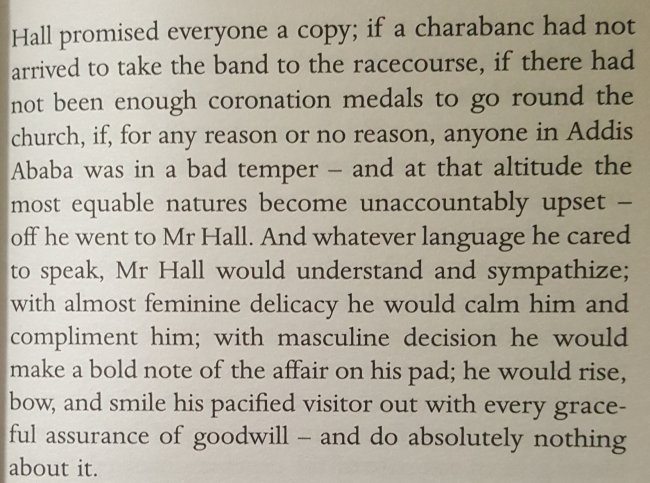
This Penguin 70 book is actually a couple of extracts from his 1931 travelogue ‘Remote People’, a book I’m now keen to track down to read more fully, but for now the two sections included here regarding the coronation and the apparently interminable journey to get home from it are all I have and I have loved the dry humour and observation of detail that are a trademark of his writing. He starts off by introducing a few of the people he has dealings with or are directly involved with the coronation or in several cases both in particular who was originally in Abyssinia as a trader but had somehow ended up as chief, and apparently only member of the bureau of foreign affairs and had an office in the centre of Addis Ababa, the country’s capital. Described as extremely handsome of German and Abyssinian descent he was also an excellent linguist and could apparently arrange anything even finding copies of the apparently non-existent coronation service…

In this last statement Mr Hall appears to be no different to anyone else Waugh has to deal with or indeed just observes. Addis had been the capital for almost forty years by then but large parts of it was still under construction. The hotel the British Marine band had been quartered in lacked a roof and building work all over the city was making very little progress as the workmen would apparently simply stop if they weren’t under constant supervision. Throw into this chaos the organisation of a coronation and the consequent arrival of foreign dignitaries along with the world media to cover it and the difficulties of communication both inside and outside the country and it’s a wonder anything progressed to any sort of a plan. This is where Waugh had an advantage over his fellow representatives of the press he didn’t have a daily newspaper to serve that needed something all the time he could wait and write accurately what happened unlike others he derided such as Associated Press which sent in totally fictitious accounts of the ceremony because of time constraints needing copy before it had even started. Mind you those members of the press that waited to get at least accurate reports of the first part of what turned out to be an interminable event discovered that the only telegraph office in the city had closed for the day so they couldn’t send their reports anyway.

The book doesn’t have any of Waugh’s actual reports in it, rather it is a diary of his experiences both in the lead up to and being at the coronation and the six days of feasting and celebration that followed for the royal family and the numerous tribal leaders that attended and it is at times both an important historical document and also extremely funny. The second account included in the book is entitled ‘First Nightmare’ and describes how Waugh attempted to get at least part way home with ships and trains being either cancelled, not turning up even when expected or even taken over by a Princess and her retinue who could just bounce all the passengers who had managed to find seats out of Abyssinia back out of them again. In all Waugh takes four days to go from Harar to Aden, a distance of 311 miles (500km) with numerous hold ups and false hopes of possible means of moving forward and you can feel his frustration building. At the time Aden was part of the British Empire and regular ships travelled back to the UK all he had to do was get there but it proved incredibly difficult.

I’ve really enjoyed this short book and am now looking forward to reading ‘Scoop’, probably early next year by the look of the planned reading list I already have for the rest of 2023.

Hugh Fearlessly Eats It All – Hugh Fearnley-Whittingstall

It has been said that I will eat anything. This is, of course, nonsense. Medium Density Fibreboard soaked in paraffin served between two discs of foam rubber has never got me salivating (which is why I steer clear of McDonalds).

Start of chapter two

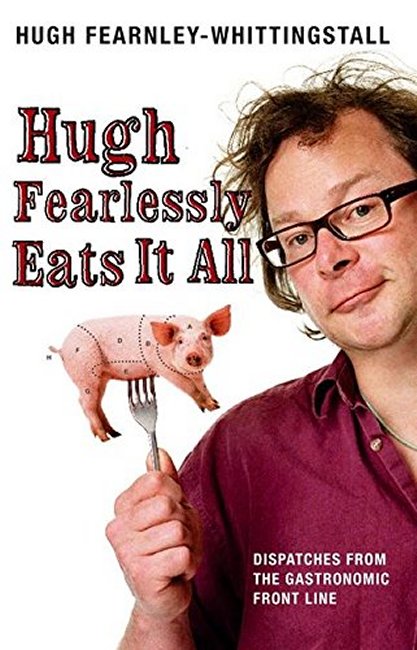
Hugh gained the sobriquet of Hugh Fearlessly Eats It All from a review of one of his books where he advocated eating as much of an animal as possible, no discarding of offal, if a pig has been killed to provide the diner with pork chops the least people can do is eat the rest of it with as little waste as can be managed. I am very much in agreement with him and regard most offal as a treat due to the flavours and textures that you would otherwise miss. I haven’t gone as far as Hugh’s keenness for brains and frankly his descriptions of the texture, which for him makes the dish, are quite off-putting to me.

This book, unlike the others I have by Hugh, is a collection of his journalism and whilst some of the articles are campaigning for various issues, especially regarding ‘nose to tail’ eating, others are very funny and even self deprecating. His own personal food business ‘River Cottage‘ barely gets a mention and whilst there are some recipes in the book they appear only rarely and always to illustrate a point in the article they are attached to. This is worth pointing out as most of his books are cookbooks, and one is my favourite which is his Meat book, nothing I have ever cooked from that book has failed to work or indeed been so complicated that I was immediately put off trying it. Having said that the journalism is a delight and being short articles it makes this a great book to dip into pretty well at random. Hugh started out as a sous chef in the kitchen of the famous River Island restaurant in Hammersmith, London but didn’t last long as a need to cut costs led to him being fired about eight months after joining them, he has never looked back, or indeed worked seriously in a professional kitchen since that date in August 1989. He moved to River Cottage in 1997 and presented his first TV series from there two years later and nowadays it is River Cottage rather than his journalism that most people think of, which is a pity because as I said earlier it’s very good.

The book is split into six sections with articles gathered thematically so for example the first part ‘Hard to Swallow’ includes pieces about McDonalds and Kentucky Fried Chicken, bemoaning the quality of their products and the Atkins diet pointing out the dangerous side effects of that regime. There are also articles about the poor standard of food in first class on Eurostar and other other similar topics. These sound like they could be hard work to read but rather they are quite entertaining, especially when he tries to replicate a Big Mac at home. Later sections dwell on travelling to try new foods and also his home life from childhood to his current family life at River Cottage, he is a very good writer, short articles are notoriously difficult to do especially if you are also raising an important point such as intensive farming without just banging on about it. No everybody can’t live the way he does and eat fresh home produced vegetables and meat but we can try to do the best we can afford’ Hugh has the advantage of coming from a wealthy family and sometimes he can be somewhat divorced from the realities of how most people live but having said that he comes over as a very likeable person and at some point I will get down to River Cottage to do one of his cookery courses.

One thing I think that is missing is which publication the articles originally appeared in, you get the month and year but not where. He had regular columns in Punch magazine and the Evening Standard and Sunday Times newspapers so I guess most are from those but it seems a strange omission.

The Great Beanie Baby Bubble – Zac Bissonnette

20181106 Beanie Baby 1

The subtitle on the cover of this 2015 Penguin hardback first edition is no longer featured on the current paperback edition as can be seen below. The change of illustration to a bald eagle toy shot with an arrow is, if anything, more disturbing than the staring bear on the original cover.  I miss the line about mass delusion though as it really sums up the book in just eight words.

Although I now own one of the largest specialist teddy bear shops in the UK I first discovered the world of collectable bears right at the end of the Beanie craze and never started collecting them, as I was far more interested in the products of the Steiff company at the time. I do have a small number, but only of penguins, puffins and a pelican to sit on the shelves with the book series of the same names. This book therefore was an instant purchase when it came out, I knew some of the history but really wanted to know what and how it happened. How could a $5 toy sell for $10000 just a few short months after it was released? Talking to my staff members who had worked in the shop for many years before I took over and remembered the queues outside if word got round there was a delivery there was clearly something special, a self perpetuating dream that here was an investment for all as the initial outlay could be so small.

Bissonnette does a remarkable job in following the history from right at the beginning and tells the story of Ty Warner, a man who can genuinely be called a self made billionaire and who is still the sole owner of Ty Inc. and his rise from failed actor to a man worth in excess of $2.4 billion. Warner himself is notoriously difficult to approach and will not give interviews but Bissonnette has managed to talk to a wide range of people ranging from his estranged sister to ex-girlfriends along with people who worked at Ty Inc. and numerous significant collectors. What shines through is a ruthless perfectionist never happy with anything that he doesn’t personally totally approve. All the designs were by Ty and he would go through huge amounts of fabric, eyes, etc. to get the look he wanted. Checking the posture of a cuddly to get it sitting just right and rejecting anything that was not to his high standards. The reason why Beanie Babies took off initially was down to this attention to detail they really were very well made, especially for the price.

20181106 Beanie Baby 2

The problems began when collectors started to deal in a secondary market and convinced themselves that what they had was an ever appreciating asset. This has happened before, the most famous example being Tulip Mania in the Netherlands in the 1630’s. Individual bulbs would sell for more than the price of a house at the height of the bubble but the only thing holding them at that price was the bubble itself and when enough people realised this and stopped buying in March 1637 it suddenly collapsed. Much the same happened with Beanies, there was no real reason for the high prices, yes some were limited but there was still a lot of them around and Ty Inc. stoked the fever by creating artificial shortages to boost the price. Stock would be held back from one part of the world creating demand for what was seen as a rare item only for the blockage to be released and the market flooded. They did this several times and this contributed to the crash as people stopped believing in rarities so were not willing to pay the high prices.

A lot of people lost a significant amount of money, especially those who got caught up in the craze just before it all fell apart at the start of the year 2000, some people did make money from the early days and if they got out in time they did OK. The only person to make a lot of money was Ty Warner. He later would plead guilty to tax evasion and be fined $53 million but as he personally made over $1 billion from the business I doubt that bothered him particularly and as Bissonnette points out in the book the day after the judgement there were workmen painting the gates to his $150 million mansion gold.

This is a really good book, not just of interest to bear collectors but for anyone with an interest in boom and bust economics or just human psychology. The story of Ty Warner himself is fascinating and very well written in this account.

How to Avoid Being Killed in a War Zone

20180703 War zone 01

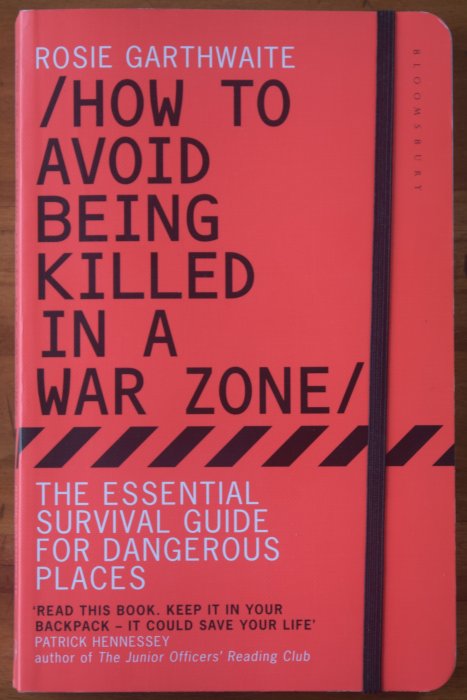
Rosie Garthwaite’s book sounds like it should be one of those parodies that are all too common nowadays but in fact it is deadly serious and has to be the one example on my bookshelves which legitimately uses the tag “It Could Save Your Life”. Mine is the first edition from 2011 published by Bloomsbury and is still available.

Of course for most people the best way to avoid being killed in a war zone is to make sure you never go to one however the book covers so much more that it becomes a highly entertaining and indeed useful addition to any bookshelf. Split into 15 sections which cover everything from planning, preparing and arriving on your trip through first aid and emergency medicine, keeping fit and surviving kidnapping amongst other things. It is part survival guide and part filled with anecdotes which illustrate the topic being covered. The range of people Rosie has spoken to in compiling the book is huge and covers top war reporters, members of the military, charity workers, a former Somali pirate and, in the case of kidnapping, Terry Waite who was a hostage negotiator in Lebanon for years before being kidnapped and held for hostage himself for almost 5 years.

Some things in the book you hope you will never need, like how to put on a flak jacket correctly, others like some of the tips on keeping safe in a crowd could be useful at any time, as she says

The best advice is to avoid street protests at all costs. Of course, that’s not always possible, sometimes they run into you. And sometimes you might join a small peaceful protest that turns into a riot. You might be in an ambulance waiting to deal with the fallout nearby. You might be involved as a protester when it all goes wrong.

You don’t need to be in a war zone, sometimes the streets of your home city can become surprisingly dangerous.

Anyone who has read books written by war reporters about their lives on the job would enjoy the anecdotes in this volume, Rosie herself works for Al Jazeera and recounts many stories of her journeys for work, mainly in Iraq, and a lot of the other reporters she quotes also work or have worked for that news organisation. There are also a good smattering of BBC, Sky, CNN and various (mainly British) newspaper writers along with people from Médecins Sans Frontières who also tend to be on the front line. It is interesting to read the different opinions of the journalists on how to survive, some like to blend in with the locals others prefer to stand out, there are advantages and disadvantages to both viewpoints. Blend in and you may get closer to the story but risk being mistaken for a spy, stand out and everyone knows who you are so you can get further up the chain of command, but you are also obvious if somebody is looking for a high profile target to attack.

The first aid section is particularly good and at 45 pages also the longest part, it takes you through a basic medical kit to pack if going somewhere where the local medical service may not be the best or if heading into wild country. A lot of this I have packed in the past, put it in a clearly marked container in your pack and make sure other people you are with know it’s there. There is no point carrying sterile medical items if they don’t get used because nobody knew and you can’t tell them for whatever reason at the time. It then has an A to Z of medical issues and what to do until somebody who really knows what they are doing arrives, CPR, recovery positions, slings, tourniquets, treating burns, dislocations, frostbite and sunburn amongst many others. One I really, really hope I don’t ever need is how to deliver a baby but you definitely don’t need to be in a war zone for that one.

I’m not a war correspondent and frankly wouldn’t want their job but I’ve been through armed official and unofficial checkpoints set up on strategic roads in Libya and Lebanon. One of the people who boarded the bus in Lebanon in 1996 with an AK-47 over his shoulder appeared to only be about 14, you just have to keep calm. I’ve also been very aware of being watched to see where I was going in Libya, Syria and Iran amongst other countries, bribed my way into Ceaușescu’s Romania back in 1987 as I didn’t have a visa and also used dollar bills in my passport on several borders where it simply made getting the right paperwork processed faster. I just wish Rosie had written this book 20 years earlier.

The Devil’s Dictionary

20180327 Devil's Dictionary

Although now recognised as an American classic The Devil’s Dictionary by Ambrose Bierce was never originally intended to even become a book and certainly not intended to be read like one. It is, as the title implies, a dictionary; but full of alternative definitions, normally humorous, often satirical and sometimes it has to be said just plain strange at least to modern readers. But before looking at the book itself it is a good idea to know something about Bierce himself and how it came to be written and that is not as simple a task as it sounds as implied by the first sentence of the book summary in my copy.

The life of Ambrose Bierce is a tissue of facts embroidered with legend.

Normally at least birth and death dates of a well known journalist and author such as Ambrose Bierce would at least be known but although we know that he was born in 1842 the best that can be done for his death is ‘probably 1914’ when he went to Mexico during the revolution and was never heard of again.

But lets backtrack over what is known. In 1861 he enlisted in the 9th Indiana Infantry and fought in the American Civil War apparently with distinction and it was thought that he would go to a military academy after the war and make that his career but he was already interested in writing. So in 1866 he apparently ‘tossed a coin to decide whether to stay in the army or become a journalist. Journalism won the toss.’ By this time his army career had brought him to San Francisco, and that is where he started to teach himself what he needed to know; and started writing pieces some of which made it to print. In 1868 he got his first regular journalistic job and in a roundabout way this was to lead to the book I have. The job wasn’t journalism as such in that it didn’t involve factual reporting of news, instead it was a page in the San Francisco News Letter entitled ‘Town Crier’ which was a humorous and satirical view of life in the city and Bierce was set on his path to fame. He would over much of the rest of his life continue to write satire for numerous publications and by 1869 he had included his first multiple definition entry of what would eventually be a book although at the time it was probably just a useful space filler for the Town Crier page.

Over the ensuing thirty plus years Bierce continued his definitions in his various columns in publications not just in America but also in England where he lived for 3½ years in the 1870’s. They became increasingly popular and also much copied with Bierce sometimes entitling them The Devil’s Dictionary or later on The Cynic’s Dictionary until the idea of combining them into a book came to him in 1903. By the time of publication however not only had his idea been stolen but even the title of his column had been used by a competitor to publish their own set of definitions so he was forced to use the title The Cynic’s Word Book when it came out in 1906. Oddly it only included 521 definitions for the letters A to L with an intention to have a second volume covering M to Z later on, however it didn’t sell well enough for this plan to be realised.

And so it stayed as an unfinished work until 1911 when Bierce was working on his collected works and volume 7 was entitled The Devil’s Dictionary, this time covering the entire alphabet and with 1000 definitions, some of which were specially written for the book especially at the end of the alphabet because over all of his columns Bierce had only reached the word shoddy.

Shoddy: n. (vulgus) A term that expresses the status of a large part of our society, and furnishes a weakly page of matter to many of our time-serving dailies.

*Weakly is as written and implies a certain disdain for many of his less talented rivals producing similar columns for other newspapers.

The collected works was also a financial failure but The Devils Dictionary was recognised as probably his finest work and after his death went on to be published as a standalone volume by several companies and establish itself as a major work of American humour.

We then leap forward to 1963 when Ernest Jerome Hopkins, after a long career as a journalist, became Professor Emeritus of Journalism at Arizona State University and after discovering that the title didn’t actually come with any specific work decided to have another look at The Devils Dictionary and some strange gaps in the words chosen. It rapidly became clear that by no means all of the definitions Bierce had written for his various columns had made it into the published book, almost certainly because at the time of compiling he had been living on the Eastern seaboard of America and a lot of the early material was 3000 miles away in California and no copies would have existed in reference libraries where he was. Over the next few years Hopkins unearthed a further 851 definitions left out of the 1911 book and in 1967 the Enlarged Dictionary was published. My copy is the Penguin Classics edition, first issued under this imprint in 1985 although Penguin printed their first edition in 1971 in their main series.

To conclude let’s have a few definitions taken at random from the book, I have literally just opened the book and picked a word for each of these so it should give a flavour of the work as a whole, some are funny, some are sharp and some are odd, I’ll let you decide which are which. In the case of long definitions I have just included the first part, some go on a lot longer than others.

Edible: adj. Good to eat and wholesome to digest, as a worm to a toad, a toad to a snake, a snake to a pig, a pig to a man, and a man to a worm.


Bald: adj. Destitute of hair from hereditary or accidental causes – never from age.


Riddle: n. Who elects our rulers?


Miss: n. A title with which we brand unmarried women to indicate that they are in the market.


Insurance: n. An ingenious modern game of chance in which the player is permitted to enjoy the comfortable conviction that he is beating the man who keeps the table.


Dice: n. Small polka-dotted cubes of ivory, constructed like a lawyer to lie on any side, but commonly on the wrong one.


Fauna: n. A general name for the various beasts infesting any locality exclusive of domestic animals, travelling menageries and Democratic politicians.


Road: n. A strip of land along which one may pass from where it is too tiresome to be to where it is futile to go.