Murder in the Basement – Anthony Berkeley

After the awful MC Beaton of a couple of weeks ago I felt that a decent murder mystery was called for. I normally only read a mystery and crime story about once every three months or so but Something Borrowed, Someone Dead was so dreadful I don’t think it counts so back to the heyday of crime novels, the 1930’s. I have several books by Anthony Berkeley Cox who wrote not only as Anthony Berkeley but as Francis Iles, A Monmouth Platts and A B Cox, but it is as Anthony Berkeley that he is, if at all nowadays, best known, especially for the ten amateur detective Roger Sheringham novels of which this is the eighth, first published in 1932. I chose it as it was the only Berkeley novel on my shelves I had not already read, although this is the first of his I have blogged about. He was one of the founders of The Detection Club, a group of then famous mystery writers including Agatha Christie and Dorothy L Sayers amongst others who use the meet for regular dinners, sadly several of the early members are largely forgotten including Berkeley whose books nowadays seem to be only reprinted by the British Library Crime Classics series which exists to spread the word regarding such authors.

Murder in the Basement is a classic of the genre in that the discovery of a body in the cellar of a newly occupied house in south London reveals that it was a woman, probably between twenty and thirty years old, five months pregnant but otherwise no distinguishing features as she had been buried for several months and decomposition had set in. The police then spend several chapters not really achieving very much until the chance discovery that a metal plate used to repair her femur after a break some years back was of an experimental type of which only a hundred or so were used before the material it was made from was abandoned as not really suitable for the job. This eventually leads to an identification of the body, as the only person to have that plate fitted that the police couldn’t locate but even then more work was needed to find more about her as she had changed her name to conceal her time in prison for theft. It is at this point that Roger Sheringham appears in the story, but not as the amateur detective but rather as somebody who had for a short while worked with the victim whilst doing a supply teacher role at a boys preparatory school just outside London where she had been the school secretary. The police want him to go back to the school and try to work out what had happened but Sheringham refuses to have anything to do with the case as he had made friends there and didn’t want to be working against his then colleagues.

The police soon decide on their suspect, one of the masters at the school, but cannot prove a case against him no matter how hard they try and they do trawl up some potentially damning but insufficient evidence for court. Sheringham stays out of the case but is kept up to date by the police in case he can be useful and ultimately solves the crime, but again without positive evidence that could be used in court. The lack of a suspect that can be prosecuted is unusual in a mystery novel but because of the way Berkeley concludes the book it is oddly a satisfying ending despite this.

I really enjoyed the book, as I have with the other Berkeley novels I’ve read and it’s a pity that he is so neglected nowadays. My copy is the 1947 Penguin Books first edition, I think Penguin published all of the Sheringham novels between 1936 and 1947 with several of them being extremely rare.

Something Borrowed Someone Dead – M C Beaton

Marion Chesney wrote 157 books between 1979 and her death in 2019, 72 of which were as M C Beaton which was the name she used mainly for her mystery romances featuring Hamish Macbeth (35 titles) and Agatha Raisin (33 titles plus a companion volume). She also wrote under the names of Ann Fairfax, Jennie Tremaine, Helen Crampton, Charlotte Ward, Sarah Chester and even 64 books (mainly historical romances) under her real name. Something Borrowed, Someone Dead was first published in 2013 as the 24th Agatha Raisin story. As can be seen from the sheer number of books published she is extremely popular but this is the first one of her books, and certainly the last, I have read, and I wouldn’t have picked up this one except that I spotted it in a charity shop for £2 and having heard the name decided to find out if she was any good. I knew the local secondhand bookshop sells out of her works almost as fast as they come in, so I thought they must have something to recommend them.

OK lets start with the positive point. The book is set in the fictional Cotswold village of Piddlebury and I can definitely believe that the Cotswolds (a region in south west central England) would have a place called Piddlebury after all they have Stow in the Wold, Moreton in the Marsh, Upper Slaughter and Lower Slaughter so why not Piddlebury. That however was the last thing I believed in throughout the book, the characters introduced for this novel are mere cyphers with no depth to them, the plot is so ridiculous as to be safely ignored and it frankly felt like a formulaic box ticking exercise on behalf of the author. Lots of random characters that have appeared before so readers recognise them even if they have nothing to do within the story – tick. No explanation as to who the hell these characters are for the benefit of anyone who hasn’t read their way through the previous 23 novels – tick. Doomed romance, in this case an odd romantic entanglement between the lead characters’ ex husband and her much younger member of staff who gets mistaken for his daughter when he takes her on holiday to Barcelona – tick. Lead character in constant desperate need for a romantic involvement with any apparently available male (a la the worst of Mills and Boon from the nineteen seventies and eighties) – tick.

I thought for a while that if I ignored the dreadful ‘romance’ part of the book the mystery would get my attention but as it became less and less believable as a possible real situation I frankly lost interest and only finished the book because I was writing this blog. Thank goodness it was only 198 pages long and at no point did I need to engage my brain in understanding what was going on as it was all so superficial. It’s quite possible, and indeed almost certain, that I am the wrong demographic for M C Beaton and I’m glad to say that the book has already been passed on the the secondhand bookshop that does have customers that want to read it.

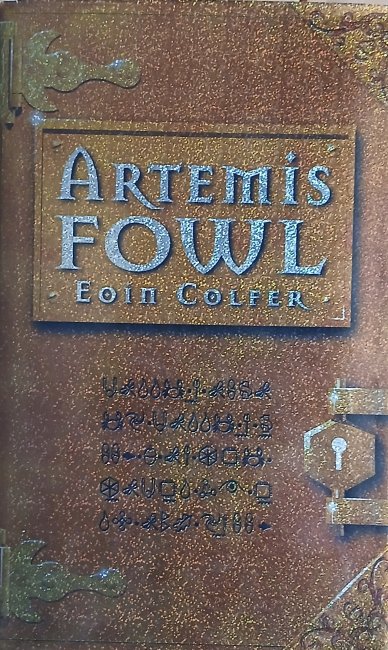
The Hamish Macbeth and Agatha Raisin books are still being written, and are now credited to M C Beaton and R W Green who is Rod Green, husband of Chesney’s publisher Krystyna Green, see here for how he came to take on the mantle of these characters. Other fiction titles that have been continued after the authors death, such as the James Bond novels by various authors including Sebastian Faulks and Anthony Horowitz amongst others, The Hitch-hikers Guide to The Galaxy sixth book by Eoin Colfer, Peter Rabbit by Emma Thompson and many other examples have not continued the odd and somewhat creepy fiction of the original author being involved. It would be much more honest to simply give the author as R W Green as clearly M C Beaton has no input having been dead for almost four years, so equally clearly the publisher doesn’t feel the characters are strong enough to continue on their own without the Beaton tag.

The Club of Queer Trades – G K Chesterton

The Club of Queer Trades is an organisation that only admits members who earn their living from a unique perspective. Having come up with this concept Chesterton wrote six excellent short stories based around a narrator called Charlie “Cherub” Swinburne, his friend, and retired judge, Basil Grant and Basil Grant’s younger brother Rupert Grant who is a private detective. Between them they experience several odd encounters with The Club.

In the individual reviews below I’m just going to set up the unusual story in each one to avoid giving away the queer trade and the denouement of each tale.

The Tremendous Adventures of Major Brown

Major Brown is a perfectly respectable retired military gentleman whose passion is growing ever increasing varieties of pansies so when he is encouraged by a vendor of such plants to look over a wall near where he lives and sees spelt out in a bed of pansies “Death to Major Brown” he is more than a little perturbed. He enters the house, finds a rather unusually decorated room and speaks for a while with a somewhat enigmatic woman before hearing a noise and confronting a large man in the cellar, they fight and Major Brown comes away with the mans coat as the man himself escapes. Totally confused by his experiences the Major comes to consult Rupert Grant, who suggests that they should go to the address found on an envelope in one of the coats pockets. When they do this, instead of the confrontation expected by Rupert, the Major is simply presented with an invoice.

The Painful Fall of a Great Reputation

This story is quite a bit simpler than the first in that it revolves around a character called Mr Wimpole who has developed a reputation as a great wit at dinner parties in London if a rather cruel one as witnessed by Basil and Charlie when they pay a call on Lord Beaumont one evening. They are still in the hallway when after a gale of laughter from the dining room Sir Walter Cholmondeliegh emerges.

“Now, my dear chap,” began Lord Beaumont hastily.

“I tell you, Beaumont, I won’t stand it,” exploded the large old gentleman. “I won’t be made game of by a twopenny literary adventurer like that. I won’t be made a guy. I won’t—”

Upon being calmed down and re-entering the dining room it is clear from another bout of laughter that Cholmondeliegh had been made a fool of again.

But what is really going on here? It’s not what it seems to be.

The Awful Reason of the Vicar’s Visit

Rupert was dressing for dinner, for he was due to go out with Basil when the Reverend Ellis Shorter unexpectedly called on him, apparently at the suggestion of Major Brown. He had a very strange tale of being set upon and forcibly being dressed as an old woman and made to commit a crime at gun point by a group of five apparently old women who were in reality cross dressed younger men. The vicar was bald headed and with substantial whiskers but these were concealed by the poke bonnet he was forced to wear, the abduction was apparently carefully planned. He had only finally escaped from them when they walked past a policemen and he pretended to be drunk so that the officer would take an interest in what was going on.

All this took a long time to explain as the Rev. Shorter was very unlike his name and was surprisingly long winded in telling his tale so that there was no chance for Rupert to go to his acquaintances home for dinner and indeed Basil would probably be already back at his home so he suggested going to see him only to find that he had also not made it to the meal as he had been called on by an elderly vicar with an unbelievable tale. Just what was going on? Basil had already worked it out.

The Singular Speculation of the House-Agent

Lieutenant Drummond Keith was an interesting character and like Major Brown a retired military man but not as successful in rising through the ranks as the Major, this means that he is also quite poor and like a lot of the poor moved around London from rented property to rented property struggling to find one he can both afford and enjoy. He had few possessions indeed we are introduced to him by means of this small collection of items.

He carried from house to house and from parish to parish a kit which consisted practically of five articles. Two odd-looking, large-bladed spears, tied together, the weapons, I suppose, of some savage tribe, a green umbrella, a huge and tattered copy of the Pickwick Papers, a big game rifle, and a large sealed jar of some unholy Oriental wine. These always went into every new lodging, even for one night; and they went in quite undisguised, tied up in wisps of string or straw, to the delight of the poetic gutter boys in the little grey streets.

I had forgotten to mention that he always carried also his old regimental sword. But this raised another odd question about him. Slim and active as he was, he was no longer very young. His hair, indeed, was quite grey, though his rather wild almost Italian moustache retained its blackness, and his face was careworn under its almost Italian gaiety. To find a middle-aged man who has left the Army at the primitive rank of lieutenant is unusual and not necessarily encouraging. With the more cautious and solid this fact, like his endless flitting, did the mysterious gentleman no good.

We meet the Lieutenant as he calls on and also borrows £100 from Basil who seems to regard him as a good friend, and he then says he is heading to his house agent. Rupert however is not convinced that Drummond is all that he seems and insists on going to the agent with him much to the irritation of Drummond who nevertheless acquiesces. After a short meeting with Mr Montmorency regarding his new property they leave and Drummond is caught up in a street brawl which Rupert incorrectly accuses him of instigating. The policeman who takes his address later reports that there is no such house as The Elms, Buxton Common, near Purley, Surrey. So where is our mysterious Lieutenant? Basil is sure he can find him.

The Noticeable Conduct of Professor Chadd

This story is an outlier, as I fail to see how Professor Chadd would raise an income from his eccentricity so he cannot be regarded as a member of The Club. Indeed the professor had invented a new language where he expressed himself via dance, nowadays interpretive dance is well known but this may be the first time it is described in literature.

The Eccentric Seclusion of the Old Lady

In this final tale Rupert and Charlie are walking along a quiet road in London when they hear a female voice from a basement saying “When shall I get out? When shall I get out? Will they ever let me out?” Upon being rebuffed by the gentlemen living in the house they determine to return with Basil who doesn’t seem in the least concerned regarding the lady in the cellar and appears to strike up friendly terms with the two homeowners. Rupert and Charlie are concerned however and decide to take the men prisoner whilst they rescue the woman. This they duly due in an unintentionally comic manner with Basil assisting in the conflict but when they make their way down to the basement the lady refuses to leave her captivity and it is only when Basil also descends that she agrees to go.

This story has a surprise ending, set several months after the apparent end of the tale where it is finally revealed whose queer trade had led to the locking up of the old lady and the reason for her initial refusal to be rescued. I loved this final twist so I’m not about to give it away here.

The short stories originally appeared in Harpers Weekly between December 1903 and July 1904 before being first published as a collection by Harper and Brothers in 1905. My copy is the Penguin Books first edition from October 1946 which is in remarkably good condition for a paperback book that is approaching its 77th birthday and which is printed on the fairly poor paper stock still in use this close to the end of the war. I have previously reviewed one of Chesterton’s earliest novels ‘The Napoleon of Notting Hill‘ written in 1904 but which was set in 1984 and which inspired George Orwell to also set his classic dystopian novel published in 1948 in the same year. Almost a hundred years after its first publication The Club of Queer Trades is still in print which I suggest says a lot for its quality and I have to agree. Chesterton wrote many superb books along with hundreds of short stories, several of which have disappeared out of print over the years but his best are still easily available. At some point in the future I will cover the five volumes, plus a few uncollected tales, of Father Brown short stories for which he is nowadays most famous but I recommend him as one of those rare authors where if ever you encounter one of his books it is almost certainly worth reading. Oh and as for Professor Chick and his own new trade, he is never mentioned again after the introduction so I have no idea what he did.
Ten Minute Alibi – Anthony Armstrong and Herbert Shaw

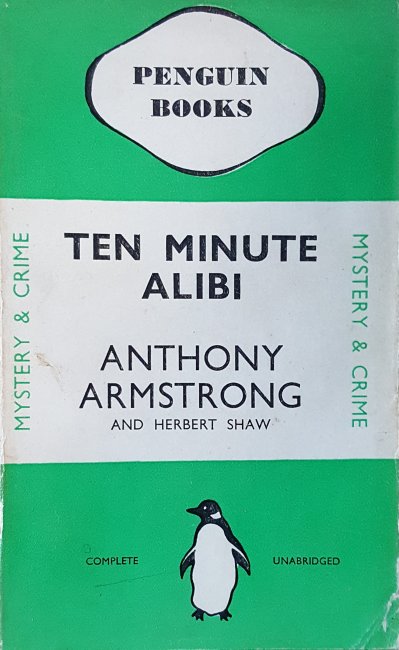
First published as a novel in 1934 ‘Ten Minute Alibi’ is based on the play of the same name by Anthony Armstrong and has presumably been adapted as a novel some time during its run in London by Herbert Shaw. I have to say presumably because there is nothing in the book to say what role Herbert Shaw had in writing it, or indeed any biographical details for him. The play was very successful playing across America and on Broadway it had 89 performances (from 17th October 1933 to January 1934) whilst in London’s West End, it had 857 performances (from 2nd January 1933 to 23rd February 1935) but having read it I can definitely say that the novel is less than riveting so not a good transformation by Shaw, I think I would have preferred to read the original play.

The plot however is interesting, Philip Sevilla appears to be a well to do club owner in London but he has a much more lucrative sideline in people trafficking, specifically innocent English women with few remaining family members whom he seduces before packing them off to South America to be forced to work as prostitutes. The way his operation works is spelled out with an example at the start of the book where we witness the downfall of Muriel Cartney. Having established that she has only a small number of people that would be particularly concerned if she disappeared Sevilla works his charms on her telling her that he is married but that his wife is in an insane asylum so he is desperately lonely and would marry her if he could get a divorce but that is unlikely due to his wife’s medical condition. Finally he persuades her to give up her job and rented apartment to join him in Paris where they can live, apparently as man and wife, without any of their London acquaintances being around to spot the lie and ruin her reputation.

Once in Paris he then appears to ‘accidentally’ run into his ‘friend’, in reality his business partner in the trafficking operation Jose Garcia, and starts to arrange the handover of Muriel. At first all is well and they stay in a lovely hotel in Paris apparently whilst he looks for something more permanent, this he would normally do for two to four weeks enjoying the nights with his victim before claiming that pressing business issues with the club means that he has to return to London to sort these out, Assuring Muriel that he would be back in a few days and that Garcia would look after her whilst he was away he would leave and never return just sending increasing worrying, and false, messages that the people he had put in charge of the club had ruined him and she was on her own but he had no money left to support her. Unwilling to return to England as a woman who had been living in sin Garcia then suggests that he has contacts in Buenos Aires where Muriel could get a new career on the stage and effectively start again and he would willingly accompany her there to see her settled in. Once in Argentina she would be handed over to the gangsters and pimps that would then keep her prisoner and force her into sex work. Sevilla meanwhile would pocket at least a thousand pounds for delivery of another victim.

This sounds all too modern, although nowadays it is women from poorer nations falsely promised legitimate work in the West only to arrive and be told that they need to pay back the enormously inflated cost of transporting them by working in the sex industry. I was surprised to see roughly the same process in a book written in the 1930’s, I’ve never seen it as a plot line in any other contemporary work and I can see why the shocking nature of the story would have generated publicity for the original play. Having spent the first twenty or so pages detailing the story of Muriel and through that Sevilla’s real means of earning big money we then move on to his planned next victim, Betty Findon and this is where the book really starts as Betty has a man who secretly loves her, trainee barrister Colin Derwent, and he will do anything to thwart Sevilla’s plans.

However this is also where the book started to lose my interest, the ongoing scenes between Betty and Sevilla, Sevilla and Colin, Sevilla and his manservant and other two handers would clearly work well on a stage but it’s all too bitty for a book. The dream sequence after Sevilla drugs Colin to prevent him seeing Betty to try to warn her again feels odd, and the means of how to kill Sevilla and still have an alibi by altering clocks so that he could be seen to be elsewhere at the same time revealed to Colin in his dream is all too complicated to work as it needs split second timing involving people who don’t know it involves split second timing. The plan involves Colin catching Sevilla at home and alone before taking Betty to Paris to replicate his previous modus operandi. However when Sevilla needs to be home for the first part of Colin’s alibi to work he’s out and when he does return it’s with Betty and the manservant is also there, both of which are not visible when Colin finally arrives to carry out his plan which involves claiming to have £1,500 to pay off Sevilla but in reality shooting him and staging it as a suicide.

I’m not going to go further into what happens in this review in case anyone fancies braving the rather clunky text for what is actually quite an unusual plotted story especially for the period. Maybe however see if you can find the play script rather than the novel. My copy is the 1938 Penguin first edition and whilst there may have been a reprint in the 1940’s this appears to be the last time the novel was published in English, which I think speaks volumes for its popularity. The play is actually easier, and cheaper, to find in various 1930’s anthologies.

Dirk Gently’s Holistic Detective Agency – Douglas Adams

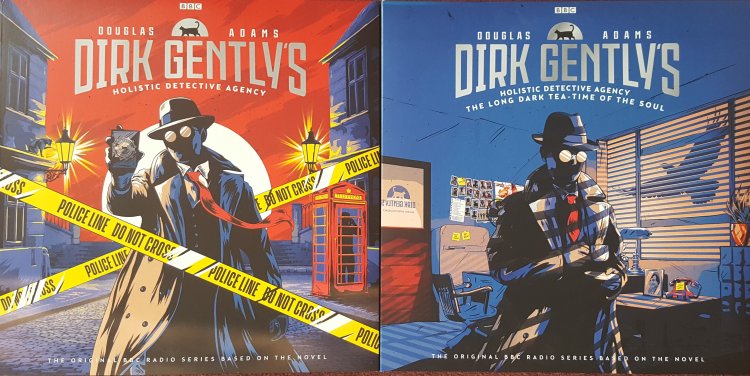
This is the 275th entry in this blog so by way of something different this is not so much a ramble along my bookshelves as a wander through my record collection. But it does concern two books, specifically the two Dirk Gently novels by Douglas Adams in the form of the wonderful adaptations done by Dirk Maggs and John Langdon for B.B.C. radio in 2007 and 2008 and first released on vinyl by Demon Records in 2020 and 2021. Each is a triple album with an episode a side so a total of six hours of listening pleasure and boy is it a pleasure. Dirk Gently is a Holistic detective in that he uses apparently unrelated objects and experiences in order to solve his cases, the stories are also very funny. The pressings are high quality coloured vinyl which along with the design of the sleeves and liners add considerably to the joy when I first unpacked them.

The cast is also superb with Harry Enfield playing Dirk Gently, Olivia Colman is Janice his long suffering secretary, Billy Boyd is Richard MacDuff and Jim Carter is Detective Sergeant Gilks. These four appear on both sets of records with other cast members including Andrew Sachs, John Fortune, Jan Ravens and Peter Davison to name just a few. There are also several stalwarts of the Hitch-Hikers Guide to the Galaxy radio series, the original scripts of which I reviewed here, such as Stephen Moore, Michael Fenton Stevens and Philip Pope who also wrote the incidental music for both Dirk Gently series. By the very nature of cutting both books down to three hours each when the Audible recordings of the books being read are just short of eight hours each clearly a lot has been lost, but this is true of any dramatisation and frankly I largely prefer the audio dramatisations to the books, especially The Long Dark Tea-Time of the Soul for reasons I will explore when I get to that section.

Dirk Gently’s Holistic Detective Agency

This was probably originally Douglas’s attempt to get some use out of a script he had written for Doctor Who called Shada which had been abandoned shortly after filming had started due to a strike by B.B.C. technicians. The similarities between the two works are obvious and whilst Douglas removed the specific Doctor Who references and merged in part of the plot of City of Death, another Doctor Who serial he wrote, the central character of Cambridge professor Chronotis having a time machine and living for centuries remains the same. In Shada he was a Time Lord, in Dirk Gently it is never explained who or what he is but they do use his time machine, which is actually his rooms in college, to travel to an ancient spaceship orbiting the Earth and back in time four billion years to the start of life on the planet. The new material concerns a character Gordon Way who is killed right at the start but continues to appear as a ghost trying to contact the living and explain what happened and it is his death that Dirk Gently ultimately solves in proving that his client Richard MacDuff didn’t do it and Way was actually killed by an ancient and malfunctioning robot from the orbiting spaceship.

This adaptation is pretty faithful to the original book, which can not be said of the second recording for reasons explained below.

The Long Dark Tea-Time of the Soul

The title of this book comes from another of Douglas’s works, the third of the Hitch-Hikers books, and is said of Wowbagger the Infinitely Prolonged, an immortal character who was not born to immortality and was therefore not prepared for it.

In the end, it was the Sunday afternoons he couldn’t cope with, and that terrible listlessness which starts to set in at about 2:55, when you know that you’ve had all the baths you can usefully have that day, that however hard you stare at any given paragraph in the papers you will never actually read it, or use the revolutionary new pruning technique it describes, and that as you stare at the clock the hands will move relentlessly on to four o’clock, and you will enter the long dark teatime of the soul.

Life, The Universe and Everything – Douglas Adams

The original book is somewhat complicated and jumps around rather a lot as Douglas keeps track of the various characters and this meant that Dirk Maggs had to do a severe rewrite in order to produce something that would work in six episodes without completely confusing the listener. He also brought back Richard MacDuff, who doesn’t appear in the book, and made him a character in this version, there are also a lot of added Hitch-Hikers Guide to the Galaxy references as Dirk had recently adapted books three, four and five of that series into radio productions. It also features a fridge that has not been cleaned for months and eats the person who first tries to do so. A client for Dirk is later found ‘listening’ to an album but unfortunately it is jumping mainly because the arm is bouncing off his severed head which is now on top of the turntable. There are also major character appearances for Odin and Thor and the explanation as to where Asgard can be found in modern London and how Janice, now an innocent Heathrow airport check in clerk, became cursed and turned into a drinks machine.

Douglas Adams had been working on and off on a third Dirk Gently book intended to be called The Salmon of Doubt up until he died, and this work, along with other unfinished pieces was eventually published as The Salmon of Doubt in 2002. Dirk Maggs originally intended to dramatise this as well but plans were shelved by the B.B.C. before any work was done on this.

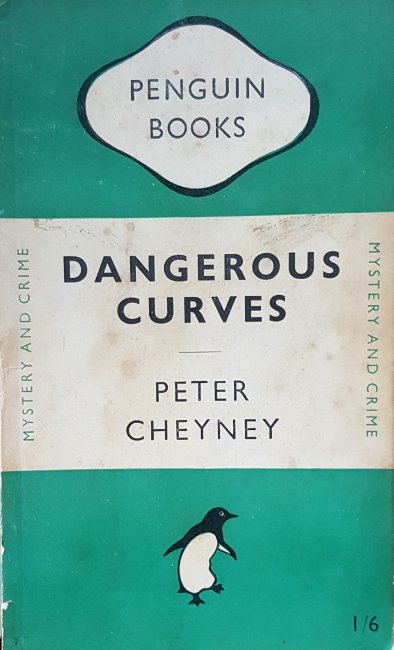
Dangerous Curves – Peter Cheyney

It’s three months since I last reviewed a crime book so definitely time for another one. In August 1949 Penguin Books published five of British writer’s Peter Cheyney crime books, of which I have four. This apparent keenness however clearly didn’t pay off as they don’t seem to have ever published any more of the at least forty more works by him and the five they did publish are long out of print. As I own four books but have never opened any of them it is definitely time to see what they are like and it turns out they chose across his styles, two books about American private detective Lemmy Caution, two about a London based private investigator named Slim Callaghan and one from what is known as his ‘Dark’ series which features various different lead characters. The first one I picked up was ‘Can Ladies Kill?’ one of the Lemmy Caution books but after around thirty pages I gave up on it. Caution is a cut price Philip Marlowe written in a poor version of ‘ American’ slang and consequently almost unreadable’

I like Raymond Chandler’s Marlowe stories and this was so obviously a bad knock-off that I almost gave up on Cheyney all together but decided to give him another chance and next on the shelf was ‘Dangerous Curves’ and this time it was a Slim Callaghan novel. Now Callaghan is still very much a Philip Marlowe character but transplanted into London so the terrible Americanish language of the Caution books is dropped, although women are habitually referred to as ‘dames’ and other Americanisms keep appearing. The change of language style makes it somewhat more a bearable read but despite his obvious popularity from the mid 1930’s until the 1950’s (Cheyney died in 1951 and his books largely died with him) Cheyney is not a great writer, being seemingly stuck in formulaic styles both in language and plots. I did however finish ‘Dangerous Curves’.

This time I stuck at it and was glad I did. Yes the characters are mainly ciphers based on the works of better writers but the plot was certainly original and had enough twists and turns to make the 256 pages it takes up worth reading. One thing that should be pointed out from the start though is the misogynistic nature of Cheyney’s writing. With the possible sole exception of Effe, Callaghan’s long suffering secretary and office receptionist, all the female characters are treated as dumb beings merely there for Callaghan to twist round his fingers and to do what he wants with. Effe does seem however to have some independence of character but even she is at Callaghans’ beck and call seemingly no matter what hour of day he needs her. The story line of ‘Dangerous Curves’ is quite complex and I’m not about to reveal it here but Callaghan definitely feels more like an American private investigator out of place in London but with all the contacts that you would expect to be in his home town. Who has been taking ‘The Mug’ for all his money and feeding him cocaine and heroin to keep him quiet whilst doing so? Eighty thousand pounds in the 1930’s was a huge sum to lose so no wonder The Mug’s father was interested in finding out, then all of a sudden The Mug (yes that is how he is referred to throughout the book) is found on a boat shot through the lung with the man who has been bleeding his bank balance dry dead at the desk opposite. What happened and why? And equally important when? These are the questions Callaghan needs to solve quickly and with enough proof to hand it over to Scotland Yard. As for the title of the book, the Dangerous Curves are those of The Mug’s young stepmother which so attract Callaghan that he also plans to bed her whilst sorting out the case. I told you Cheyney had a downer on his female characters…

Peter Cheyney has, mainly deservedly, been long out of print but in 2022 Dean Street Press published twenty four of his titles with 1940’s/50’s pulp paperback style covers. I can’t say I recommend them however, especially not the Lemmy Caution ones, there are far better crime writers than Cheyney and if you want the hard-boiled American detective just read the original and best, Raymond Chandler.

The Strange Case of the Sixth Penguin Book

The first ten Penguin books were all published together in July 1935 with an edition size of 20,000 books per title and launched a publishing phenomena. being a fraction of the cost of any other books available at the time, but there was to be a problem with book number six. It soon became clear that Penguin Books might not have the rights to publish a paperback version of ‘The Mysterious Affair at Styles’ by Agatha Christie so despite it’s popularity, it was reprinted twice in 1935, the book was pulled from the list of available titles leaving a gap in the neat numbering system. What to do? Well by early 1936 Penguin definitely had the rights to another book by Agatha Christie, ‘The Murder on the Links’ and in March that year this replaced ‘The Mysterious Affair at Styles’ but numbered 6A, see below.

Using an A to differentiate between the two books looked odd so in September 1936 the A was quietly dropped and ‘The Murder on the Links’ became number six. In the meantime however Penguin had sorted out the rights over ‘The Mysterious Affair at Styles’ but this couldn’t go back to being book six without renumbering ‘The Murder on the Links’ and causing even more confusion so in June 1936 ‘The Mysterious Affair at Styles’ was published again, this time as number sixty one. ‘The Mysterious Affair at Styles’ as number sixty one is relatively easy to find but the book as number six is extremely rare despite the original print run. I have collected Penguin Books for over thirty years and only obtained a copy of this version in the last few days and fortunately didn’t have to pay the £750 that a similar condition copy apparently recently sold for. All of Christie’s first five books were published by The Bodley Head which at the time of publication was the home of Penguin Books whilst its Managing Director, Allen Lane, got Penguin started before leaving to run Penguin as a separate entity at the start of 1937. This interconnection between the two businesses is probably the cause of the confusion over rights.

So let’s look at the two books:

The Mysterious Affair at Styles

Originally published in 1920 this was Agatha Christie’s first book and introduced her most famous creation Hercule Poirot to the world. It was only when flicking through the book when it arrived that I realised that I hadn’t actually read it before, which was a considerable surprise. When we first meet Poirot he is with a group of other Belgian refugees from the First World War living in a house in Styles St Mary, a small village near the grand house of Styles Court. The man who would be Poirot’s chronicler and friend, Arthur Hastings, was staying at Styles Court whilst recuperating from being invalided out of the war. He is greatly surprised to find Poirot, whom he had met in Belgium before the war living so close and when Emily Inglethorp, the elderly owner of the manor house, dies, apparently of strychnine poisoning, he suggests getting Poirot involved in solving the case. The plot is surprising well constructed for a first novel and numerous family members and other guests at the house are suspected before Poirot explains the true solution in the final chapter. According to the rear flap of the dust wrapper the book was a result of a bet that Christie couldn’t write a detective story where the reader only discovered the true murderer in the last chapter. I have to say the final twist is most ingenious and yet the reader cannot say that any clues were not available to them in trying to solve the case themselves.

Poirot and Hastings would return to Styles Court in his last appearance, ‘Curtain’, only this time the house is no longer a family home but has been turned into a guest house.

And now for the second number six, this is one of only two times two completely different Penguin books shared the same catalogue number that I have been able to find in the almost ninety years Penguin Books have been publishing, the other being number 305 which was allocated to the first two volumes of Penguin New Writing before that was spun off into its own series. There are however several examples of books by that publisher being re-issued under a different number to that originally assigned so six becoming sixty one, whilst it is unusual and is the first such renumbering at Penguin is certainly not unique.

The Murder on the Links

Agatha Christie’s third book and the second to feature Hercule Poirot must presumably have been already planned for publication by Penguin before it suddenly appeared as 6A, the book had been first published in 1923 and like ‘The Mysterious Affair at Styles’ had gone through numerous editions before appearing in Penguin. This time Poirot and Hastings are trying to solve a murder in northern France, in the imaginary small coastal town of Merlinville-sur-Mer which is apparently an up and coming destination and is constructing a golf course and casino in order to attract more wealthy visitors. Poirot had received a letter from Paul Renauld at his home in London, showing a considerable step up from his shared refugee home in Styles St Mary, which requested his urgent assistance in France so off they both go only to discover when they arrive that Paul Renauld was murdered the previous night. The plot has the addition of humour with Inspector Giraud, a modern detective from the Sûreté in Paris, whose methods amuse Poirot and the obvious resentment Giraud has for Poirot leads to a rivalry in which a five hundred franc bet is made between the two detectives as to who will solve the case. The case is more complicated than Poirot’s first appearance showing a growth in confidence by Christie after the very positive reception of her first two novels and I enjoyed this book more than the first.

Poirot and Hastings are so often seen as a double act, clearly based on Holmes and Watson, that it is perhaps surprising that of the further twenty Poirot novels Christie would write Hastings is only in five of them and she would later rewrite two of those removing Hastings as she did so. Indeed she is clearly trying to get rid of him in this book as he meets his future wife during this case and subsequently moves to Argentina to run a ranch with her. I like Hastings, although he can be a bit irritating but I have definitely enjoyed reading the two number sixes from Penguins catalogue.

Case for Three Detectives – Leo Bruce

Leo Bruce was the crime writing pseudonym of amazingly prolific writer Rupert Croft-Cooke who wrote well over a hundred books under his own name from 1920 until 1975, along with over thirty crime novels as Leo Bruce and numerous short stories under both names. This is the first of his crime novels and along with it being a really fun parody of other writers it introduced his plain speaking Sergeant Beef who has no time for the amateur detective so beloved of so many other authors. Indeed the three detectives in this book are very thinly disguised famous other detectives Lord Simon Plimsoll is clearly Dorothy L Sayer’s Lord Peter Wimsey, Monsieur Amer Picon is Agatha Christie’s Hercule Poirot and Monsignor Smith is Father Brown by G K Chesterton, this will be the first, and presumably last, time all three will work on the same case but they do not work together.

The crime occurs in a large country house, home of Dr. Thurston and his wife Mary who are hosting a group of their friends for the weekend. After the evening meal, which had featured a discussion about murder mysteries, Mrs Thurston goes to bed at about eleven o’clock. Shortly afterwards there are some screams heard, the guests rush upstairs to the Thurston’s room and discovering it bolted break down the door and inside find Mrs Thurston lying on the bed with blood all over the pillow. A brief search is made but nothing relevant found so how was she killed inside a locked room? A car is sent for the local village police sergeant along with the Dr Tate the village’s general practitioner as the phone line to the house is cut, the doctor confirms that Mrs Thurston is definitely dead from a cut throat and Sergeant Beef checks the scene and states that he knows who did the murder but being just the local copper is completely ignored by everyone else. The book is written in the first person as though by one of the guests to the house party.

Quite early the next morning those indefatigably brilliant private investigators, who seem to be always handy when a murder has been committed, began to arrive. I had some knowledge of their habits and guessed at once what had happened to bring them here. One had probably been staying in the district, another was a friend of Dr Tate’s, while a third, perhaps, had already been asked to stay with the Thurstons. At any rate it was not long before the house seemed to be alive with them, crawling about on floors, applying lenses to the paint-work and asking the servants the most unexpected questions.

First paragraph of chapter five

The three detectives seem a little put out at first that all of them were there but agree to apply their own methods to solving the case, having a good look round not only the house and grounds but spreading their investigations to neighbouring villages as well. they convene that evening to question the guests and the servants at the end of which all three claim to be on their way having theories about solving the case and Sergeant Beef is getting more and more exasperated as he explains that the ain’t got a theory as he don’t need one as he knows who did it. Everyone continues to ignore and dismiss him as he is just a lowly village sergeant so what would he know?

On the second evening the group gather again to hear the three detectives explain how the murderer go in and out of a locked room and whom it was, why they did it and the name of their accomplice that was needed in order to effect an escape via ropes that were found secreted in the water tank in one of the top rooms of the house. Each solution is more and more ingenious and of course the three detectives give completely different solutions and alternative suspects, all of which fit the clues as we know them, whilst ruling out their compatriots reasoning. In the following confusion it is finally down to Sergeant Beef to explain what really happened.

The book is great fun especially if you are familiar with the three detectives being parodied here as their mannerisms and styles are so well sent up. I had no knowledge of Rupert Croft-Cooke aka Leo Bruce before reading the book and didn’t know I was in for a very funny parody when I got the volume off the shelf, it was a green (therefore crime) Penguin book and that was what I felt the need for at the time and expected a much more serious tale but I loved it.

The Greek Coffin Mystery – Ellery Queen

As a lover of mystery and crime novels it is perhaps surprising that this was my first time reading Ellery Queen and the fact that I have started at the fourth book is due entirely to this being the only Ellery Queen that I possess. Let’s get the somewhat complicated back story of the authorship out of the way first and then dive into this surprisingly long (363 pages) crime novel. Ellery Queen is given as the author as well as the name of the private detective featuring in the book, in fact it is the work of two cousins, Frederic Dannay and Manfred Bennington Lee, who also individually wrote crime novels under those names. To add to the confusion both those names are also pseudonyms; Frederic Dannay’s real name was Daniel Nathan whilst his cousin Manfred Bennington Lee was really Emanuel Benjamin Lepofsky. Between them they wrote over thirty Ellery Queen novels and collections of short stories and there were also a few later books which were ghostwritten by various other authors and supervised by Lee.

What to make of this book though? It features Detective Inspector Richard Queen and his private detective son Ellery, who improbably gets to sit in on all meetings and interviews, along with visiting crime scenes just as if he was an actual member of the police force, he can even apparently make arrests. Indeed it took me some time to realise that Ellery Queen was, unlike his father, not actually an official part of the police. The story initially is simply the case of a missing will following the death of an elderly art dealer in New York. When it is worked out that the only place the will could have been put in the short time available from when it was last seen to when it was discovered to be missing is in Georg Khalkis’s coffin before the lid was screwed down an exhumation is ordered. The coffin being opened however is found to have two bodies in it, Khalkis and a mystery corpse and the case becomes murder and the problem is not just who killed the unknown victim but who are they… With thirty nine characters (including the police and Ellery) it can get complicated and I was glad of the list of people at the front of the book when trying to sort out the different relationships between them all.

The story is split up into two books, the first ending with the arrest of yet another incorrect suspect but with the police apparently satisfied that this time they have got their man. The second book details the collapse of the case against the arrested person and the slow discovery of the clues leading to the true murderer and thief. One thing I really liked was at the end of the thirtieth chapter where there is a break in the story for Ellery Queen to speak directly to the reader and make clear that at this point you have read all the clues needed to solve the case and that there is only one solution that fits everything you know. With almost sixty pages still to go it provided a break where I could go back in my mind over what has happened in the first three hundred pages and try to solve it. I have to admit that the actual solution was so surprising that I didn’t get it but yes everything fitted once you knew who did it.

This edition of The Greek Coffin Mystery was published as part of the Penguin Drop Caps series of twenty six books each with an author starting with a different letter and it is particularly appropriate for this to be Ellery Queen book chosen for Q as the chapters in this one are titled as an acrostic spelling out the titles and author. First published in 1932, the first Penguin Books edition came out in May 1957, this hardback was published in 2013 for the American and Canadian market only.

As I said at the start this was my first Ellery Queen mystery and whilst I enjoyed it I did find the character of Ellery Queen rather annoying. Reading about later books in the series he apparently does calm down a lot as the series progresses with far fewer irritating build ups to an incorrect accusation than occurs in this story. Maybe I ought to read one of the later books to see if I like him better.

Rivers of London – Ben Aaronovitch

Well that was a fun read. First published in 2011 and clearly intended to be contemporary, the book starts out appearing to be a modern police procedural set in the Charing Cross police station of The Metropolitan Police (London’s police force) following the end of the probationary period for two trainee police officers, Peter Grant and Lesley May. Lesley is expected to do well in the police, her career looks bright and interesting in total contrast to that of Peter who appears to be heading for a life of doing the paperwork for the more go getting officers who are doing ‘real policing’ so haven’t got time for the boring bits. All this is about to change however following a particularly grisly murder that night at Covent Garden. When all the experienced officers have done what they can, but it is still too dark to do a proper search of the square the two most junior constables, Peter and Lesley, are called in to ‘protect the crime scene’ basically standing around on a freezing February night making sure nobody crosses the tape marking the edge of the area until dawn when the experienced officers will come back. At 5am Lesley goes off to get them both coffee and whilst he is alone Peter encounters a witness to the murder, the main problem with this witness is that although he did indeed see everything he is in fact dead and is a ghost haunting St. Peter’s church which is on the piazza. I’m really not giving much away here, this is all in the first few pages.

Going back the next night to try to find his ‘witness’ again Peter encounters Detective Chief Inspector Thomas Nightingale whom on discovering that Peter is ghost hunting and recognising a basic talent decides to take him on in his section of the Metropolitan Police, the magical part. As well as being a senior police officer Nightingale is the last wizard in Britain and so the whole plot swings away from ‘normal’ policing to encounters with magical beings all of which live unnoticed by the general public within modern London. As well as helping to solve what turns into a series of murders Peter is charged with resolving a dispute between Mother Thames and Father Thames, both river spirits who have taken responsibility for the tidal and freshwater parts of London’s major river respectively but whose territorial limits were being disputed. Nightingale not only takes Peter on as a Constable in his tiny division (which up until then had just consisted of him) but also as an apprentice wizard teaching him basic spells along with Latin as it turns out that all the textbooks are in this ancient language.

The book runs these two story lines in parallel and this I suspect led to one poor review when it first came out that the novel had inconsistent pacing. It is certainly the case that the sections on the murders are faster paced than the more bucolic dealings with Mamma and Father Thames and the positively erotically charged parts with one of Mamma Thames’s daughters Beverley Brook and her dealings with Peter and Lesley. I greatly enjoyed the book and look forward to reading more as there are eight novels so far in the series, with a ninth due out next month along with three novellas. Aaronovitch demonstrates an almost encyclopedic knowledge of London throughout the book so I suspect that an enormous amount of research went into the novel and I loved the use of the names of the various rivers that become tributaries of the Thames for characters, Beverley Brook for instance is a short river, only 14.3km long, in south east London. There is also Tyburn, Fleet, Ash, Lea, Brent and several others all characters in the book and rivers of London. For some odd reason Rivers of London was renamed ‘Midnight Riot’ when it was published in America which somewhat lost this point.

I met Ben Aaronovitch at the 2014 Discworld Convention where I was helping to run an event which was loosely based on the hit BBC TV programme QI which for copyright reasons we had called Strangely Fascinating (I was the scorer). It turned out that Ben was a definite Terry Pratchett fan and thoroughly enjoyed his time at the convention and didn’t mind being roped in as one of the contestants for our quiz. He is in the photo below, on the left, next to Pat Harkin who at the time was still working at Leeds Institute of Medical Education where he had been, amongst various jobs, lecturer in pathology.