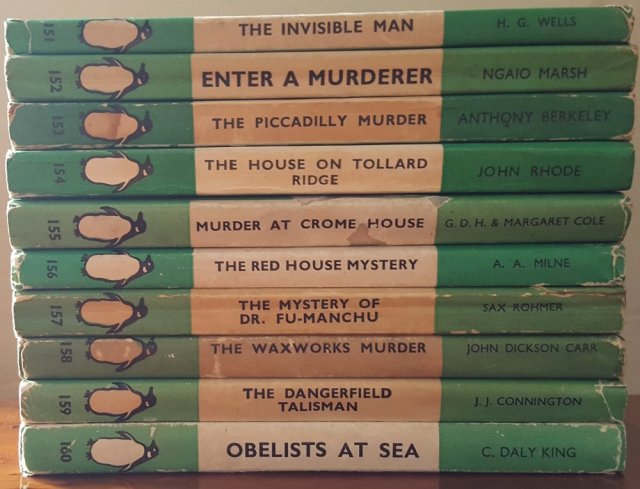
This continues a marathon reading session of all 10 of these books printed eighty years ago this month. I started late (the evening of the 12th) so I have less than a couple of days to read each book and write a short review. Part 1 covered books 151, 152 and 153 and can be seen here. As I read each book I’ll write a review on this blog and post on Tuesday next week as far as I’ve managed to get.
154 – The House on Tollard Ridge – John Rhode
Before reading this book I knew nothing about John Rhode and apart from a small black and white photograph of a man in late middle age smoking a pipe and a couple of glowing comments regarding his ability from two magazines printed on the dust wrapper there is nothing on the book to give me any idea about him. I decided to finish the book before finding out anything about the author.
The story was quite enjoyable although I was deeply suspicious of the person who turned out to be the murderer very early on in the book and none of the rather obvious red herrings put me off that train of thought as there was really only one person who could have controlled the events as they did. The main oddity of the book was that although it is 248 pages long Rhode’s amateur detective doesn’t appear until page 98 and up until then it reads as though Superintendent King from the local police force is the main character. When Dr Priestley does appear in the book it is only for a short while whilst explaining the case to him gives the author a chance to sum up what he has told us so far and it isn’t until page 172 that Priestley really comes into his own and starts to take apart the case made by Superintendent King. It is also at this point that it becomes clear that this isn’t Rhode’s first book about Priestley as other cases are mentioned, I’m guessing that the only other book by Rhode that was published by Penguin ‘The Murders in Praed Street’ is going to be one of them, I don’t own a copy and won’t be rushing to get it.
Finally looking up John Rhode, he turns out to be the pseudonym of Cecil John Charles Street MC OBE and from his Wikipedia entry he wrote a huge number of detective stories under several pseudonyms so he obviously had a readership in his day but he’s not for me.
155 – Murder at Crome House – G.D.H. and Margaret Cole
Now this should be interesting, I do have other books by G.D.H. Cole but they aren’t fiction, on my shelves are ‘Practical Economics’, ‘Socialism in Evolution’ and a couple of copies of ‘Persons and Periods’. Working with his wife however they jointly wrote crime novels and although I only have this one example and they were nowhere near as prolific as Cecil Street I was already aware of the existence of several other titles before I start reading this one.
Having now finished the book I can say that it is much better written than the previous example and considerably better at hiding the murderer until near the end, The tale is quite complex with more information about each of the possible suspects being revealed piecemeal as you follow the various parallel investigations with up to five people all going down different paths in trying to solve the crime and comparing notes regularly. At one point I had even half thought one of the people apparently investigating the murder was actually involved in the crime himself as each time he reported back his tales as to what had been done became more fantastic. Now that would have been an interesting twist, I wonder if there is a detective novel where the investigator turns out to be the murderer and is covering their tracks by apparently looking into the case?
I don’t have any other crime novels by the Cole’s but they don’t appear to have been ‘series writers’ with each book having different detectives however this is difficult to check as I cannot find any of their 29 joint works still in print. This is also the only one of their works to have been printed by Penguin so I’m not going to come across another as my collection of those increases. It is a pity that they have disappeared, maybe one of their books needs to be included in the excellent British Library series of crime stories that have been largely forgotten nowadays.
156 – The Red House Mystery – A.A. Milne
Yes that A.A. Milne, famous for Winnie the Pooh and the other characters from the Hundred Acre Wood, this is his only crime story and the only book in this block of ten that I have read before this exercise.
The story is well written and the denouement is properly hidden with enough clues to give it away when you re-read the book but not on first reading. Once you know what is happening then you get a different perspective and appreciate how well Milne was trying to help the reader in solving the murder but first time round you can guess but are unlikely to work it out. I loved the book as written by an author who knew how to write and could string his readers along as you slowly but surely reach the solution and the final twist is so good. If any of my readers are looking for a sadly now largely unknown detective novel in the true English country house murder style and have not read The Red House then I urge you to do so.
As a good counterpoint to this reading marathon Milne wrote a really good introduction to the 1926 edition, he wrote the book back in 1922 before he wrote any children’s books and was at the time best known as a playwright (and frankly he would have rather been known that way all his life).
I prefer that a detective story should be written in English. I remember reading one in which a peculiarly fascinating murder had been committed, and there was much speculation as to how the criminal had broken into the murdered man’s library. The detective however (said the author) “…was more concerned how the murderer had effected an egress.” It is, to me, a distressing thought that in nine-tenths of the detective stories of the world murderers are continually effecting egresses when they might just as well go out. The sleuth, the hero, the many suspected all use this strange tongue, and we may be forgiven for feeling that neither the natural excitement of killing the right man, nor the strain of suspecting the wrong one, is sufficient excuse for so steady a flow of bad language.
Of the great Love question opinions may be divided, but for myself I will have none of it. A reader, all agog to know whether the white substance on the muffins was arsenic or face powder, cannot be held up while Roland clasps Angela’s hand “a moment longer than the customary usages of society dictate.” Much might have happened in that moment, properly spent; footprints made or discovered; cigarette ends picked up and put in envelopes. By all means have Roland have a book to himself in which to clasp anything he likes, but in a detective story he must attend strictly to business.
For the detective himself I demand first that he be an amateur. In real life, no doubt, the best detectives are the professional police, but then in real life the best criminals are professional criminals.
He continues in much this vein for a while complaining that a man with a microscope is no detective at least not in fiction because he can see things his readers cannot and also explaining that ‘a Watson’ is invaluable. As perforce a literary detective has to run though the facts as they stand at various points and a conversation is much better than a speech and far better than everything being sorted out in the last few pages. I have to agree with all of his points and he also manages to ensure that in his only detective story he holds to his principles, it’s definitely the best book so far.







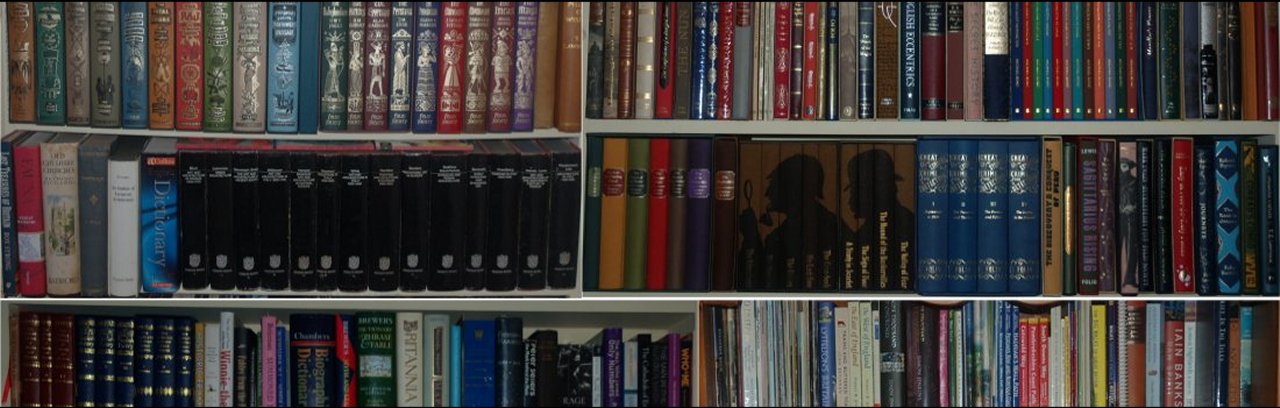
 Ramblings on my bookshelves