The Prose Edda – Snorri Sturluson

Snorri Sturluson (1179–1241) was born in western Iceland, the son of an upstart Icelandic chieftain. In the early thirteenth century Snorri rose to become Iceland’s richest and, for a time, its most powerful leader. Twice he was elected law-speaker at the Althing, Iceland’s national assembly, and twice he went abroad to visit Norwegian royalty. An ambitious and sometimes ruthless leader, Snorri was also a man of learning, with deep interests in the myth, poetry and history of the Viking Age. He has long been assumed to be the author of some of medieval Iceland’s greatest works, including the Prose Edda and Heimskringla, the latter a saga history of the kings of Norway.

This version of the Prose Edda is not complete. as although The Prologue is all there, as is Gylfaginning, only a selection of ten tales from Skáldskaparmál are included and the lists giving word definitions and origins at the end of this section are omitted entirely as is The Háttatal which is a discussion on the composition of traditional poetry, which is more of a technical handbook on this verse structure and is quite commonly left out of translations. This abridgement of the Prose Edda is therefore a more readable text than the full scholarly manuscripts believed to be composed by Sturluson. The name ‘The Prose Edda’ is used to distinguish this work from the earlier verse forms of similar material known as ‘The Poetic Edda’.

It is probably best to look at the three sections separately beginning with ‘The Prologue’. This was a real surprise to me as it initially reads like a variant of the Old Testament with Adam and Eve along with Noah’s ark referred to in the first page and there is a lot of naming of sons of sons of sons to illustrate how the generations have passed. We then suddenly leave the Old Testament in favour of Homer as Odin is named as coming from Troy and travelling north from that city and Asia or at least that part of the continent known at the time and specifically Turkey is seen as the origin point for the Norse gods and name of the Æsir, which is the main group of these that reside in Asgard, is implied to be derived from Asia which is a concept I have not come across before. ‘The Prologue’ is short but full of surprising elements like this.

On to the Gylfaginning (Old Icelandic for ‘The tricking of Gylfi’). This is in the style of a conversation between the Swedish King Gylfi and three men on thrones in Asgard called High, Just-As-High, and Third. Gylfi asks many questions of the three men on the history and future of the Æsir and from this we learn the names and attributes of the gods and goddesses with tales of their exploits, some of which I knew and others were new to me. The tales start with the creation of the Earth and all that live on it along with the rise of the gods and take us right through to Ragnarok, the great battle and the death of most of the Æsir along with those that had opposed them such as the world girdling Midgard serpent. The text quotes extensively from The Sybil’s Prophesy which I take to refer to Völuspá, a Norse poem which forms part of The Poetic Edda, and there are other poetic sections quoted in Gylfaginning which are also to be found in this ancient collection of verse.

Then finally the Skáldskaparmál (Old Icelandic for ‘The language of poetry’), The ten stories included in this selection are extremely bloodthirsty with barely a page between the death of one or more characters but it was interesting and unexpected to find the basis for Wagner’s retelling of the Ring of the Nibelung which I read recently. There is the Valkyrie Brunhilde, the fire surrounding her which could only be crossed by a hero and Sigurd who is clearly the basis of Siegfried. There is also Fafner, although here a serpent rather than a dragon although these are largely interchangeable in Norse sagas, the Rhinegold hoard and a ring which brings doom to all that possess it.

Anyone interested in the Icelandic Saga tradition should definitely read ‘The Prose Edda’ and I’m surprised it has taken me so long to get round to doing so. This book is from the Penguin Archive collection of ninety books to celebrate Penguin Books ninetieth birthday in 2025.

The Ring of the Nibelung – Richard Wagner

Back in March 2021 I reviewed a book about the trials and tribulations of staging the magnificent four opera series of the Ring Cycle by Richard Wagner, see here. Soon after that I purchased this magnificent cloth bound volume from The Folio Society, which is the full libretto in parallel text with Wagner’s original German alongside the superb translation by Stewart Spencer. This was first published by Thames and Hudson back in 1993 as ‘Wagner’s Ring of the Nibelung; A Companion’, but the Folio version, published in 2020, is much larger at 289 × 205 × 41 mm, and has added illustrations by John Vernon Lord. As can be imagined as the four operas in the 1991 Barenboim recording I have play for a grand total of 15 hours and 5 minutes the libretto runs for well over three hundred pages with an extra seventy pages of authoritative essays on the development of the opera cycle at the beginning along with extensive notes at the end making a total of over four hundred pages of text with seventeen unnumbered leaves of plates. All in all a comprehensive guide to this greatest of Wagner’s operatic works. It should be pointed out that whilst the words sung are all in both languages the stage directions are only in English, this didn’t bother me but if you were looking for a ‘full’ parallel text then bear in mind that these parts are missing.

Wagner is unusual in writing his own libretto, it is much more common to either set an existing work or work with a librettist. For the most part he combined Norse with Old German mythologies in developing his story, these are closely related anyway with much the same characters only with different names, Odin becomes Wotan and Thor becomes Donner for example, but there are also echoes of the ancient Greek especially Homer’s Iliad. Occasionally he merges two characters from different origins into one such as Freia (this is how Wagner spells her name, more usually Freya or Freyja) a Norse goddess of fertility and in this version also the one who looks after the golden apples that confer everlasting life to the gods; she is also referred to as Holde, a similar but different character from German folk tales. Wagner also adds to the mythology with his own concepts such as carving important contracts in runes on Wotan’s staff, the staff exists in the mythologies but not the binding contracts. This melding of the various myths and new ideas make the reading of the libretto so fascinating, especially if you have a reasonable knowledge of the original mythologies, and whilst I have picked up some of this whilst listening to the operas it was only when reading the text at my own pace rather than moving rapidly on as you do in a performance that I more deeply appreciated the complex weaving of stories that Wagner achieved. Certainly the librettos can be read as a long poem without any deeper knowledge of the operas but I found myself adding the music in my mind as I read the words especially in parts I knew well.

The book is really lovely to read, as can be seen above in this section of the third opera ‘Siegfried’ shown with an engraving of the sword Northung being repaired by Siegfried. The sword had belonged to his father Siegmund but was shattered by Wotan during Siegmund’s fight with Hunding in the previous opera ‘Die Walkure’ (The Valkyrie) as Wotan’s wife, Fricka, had demanded that he die as punishment for his incestuous relationship with his sister Sieglinde which had left her pregnant with Siegfried. The illustrations deliberately do not include any of the characters but are rather of important objects within the opera cycle, which I think is an interesting choice as John Vernon Lord explains in his note on the illustrations:

I thought that the words and music together would be best for conveying the ‘appearance’ of the various characters. At the outset, I felt that the inclusion of people would detract from the symbolic nature of what I wanted to express.

It is later in this opera, in fact in the final scene, that we get one of the few ‘humorous’ lines although this was not intended as such by Wagner but I always smile when we reach the ‘This is not a man’ line when Siegfried discovers and wakes the Valkyrie Brunnhilde from where she has been left in a magical trance by Wotan.

It should be realised that Siegfried has never seen a woman before, being brought up by Mime in a secluded location away from all others, but even so ‘Das ist kein Mann!’ is not Wagner’s finest hour.

I have really enjoyed having a deeper dive into the text of the operas and will have a much greater understanding the next time I listen to or watch them, being able to look back over previous sections to refresh my memory has proved to be well worth the cost of purchasing the book especially as it is such a fine edition.

The Hills of Adonis – Colin Thubron

First published in 1968, Colin Thubron’s second book finds him still in the Middle East, his first book from the previous year ‘Mirror to Damascus’ covered his travels in Syria and for his third which came out in 1969 he stayed in the same geographical region with a book set in Israel entitled ‘Jerusalem’. None of these early works are particularly well known today, especially compared to his more recent travelogues, indeed the most recent publication of ‘The Hills of Adonis’ I can find is from fifteen years ago, whilst my copy was published in 1987 during the last few years of the Lebanese Civil War. Thubron spent four months walking around Lebanon, a country of just 4,036 square miles (10,452 square km) so slightly less than half the size of Wales or for Americans roughly the size of the two smallest states combined (Delaware and Rhode Island) so it was possible to cover most of the sights in the country on foot in this time frame.

Thubron weaves his way up the country from the southern border with Israel, which even in the mid 1960’s was already a dangerous place to be, up to the northern border with Syria visiting most of the significant places on the way. The first part of the book however is also concerned with a breakdown of the mythology prevailing ancient Lebanon and for me this was convoluted and unnecessary in the amount of detail and number of pages dedicated to it. Fortunately after the first few chapters Thubron largely drops the subject and proceeds to describe the history, geography and most importantly the people of this tiny but extremely culturally diverse country. This is where the book really gets into its stride although it can be difficult at times to determine if he is writing about the near or ancient history of a place, he does rather bounce around a lot. But the people he meets are fascinating and because he includes tiny villages as well as the metropolitan centres you start to get a feel for the various peoples, the Maronites and Druze, the remains of ancient and isolated monastic orders, the agricultural people of the mountains and the largely more prosperous people of the coastal regions especially as he moves further north.

In the late 1960’s, at the time Thubron was travelling in Lebanon, it was a place largely at peace. This was before the civil war which would destroy large parts of the country and kill around 150,000 people in the fifteen years from 1975 and Lebanon was still seen as a significant tourist destination in the region. This is what initially drew me to the book, a snapshot of a now long vanished time and place and whilst I was in Lebanon just six years after the civil war ended, the destruction of its once beautiful capital was all too evident when I was there and it would have been impossible to replicate Thubron’s journey as the south of the country was still occupied by Israel and would be until the year 2000. Reading the book and seeing what Lebanon was like, and unfortunately has no obvious way of getting back to, is depressing but at least here is a record of what has been lost.

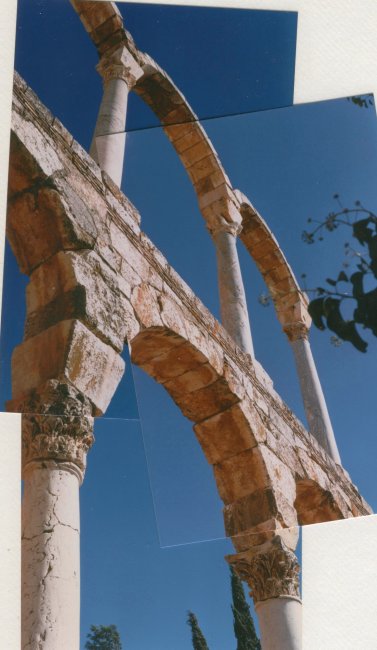
The cover picture, by Mark Entwhistle, is of the ruins of the palace in Anjar in the Bekaa region of Lebanon, which I photographed in September 1996, although from the opposite side of this particular surviving section. When Thubron got there the people were clutching radios tuned to Radio Cairo and waiting for war and he was deeply troubled by his experience there far from the peaceful scene depicted on the cover. Far from ‘driving the Israelis into the sea’ which is what everyone told him would happen the conflict that actually occurred turned out to be Six Days War where Israel defeated most of its neighbours in a series of decisive air strikes largely destroying the air forces of Egypt, Jordan and Syria in one day. But before then Thubron had left Lebanon and was presumably working on this book, which with all its faults is still an interesting read. Below are a couple of my pictures from Anjar.

a closer view of the arches

Longhand – Andy Hamilton

Andy Hamilton is best known as a comedy script writer and actor for TV and radio and his shows have been a constant favourite of mine since he started in the 1970’s especially the BBC Radio 4 long running series Old Harry’s Game which he writes and stars in as Satan. Not a particularly obvious subject for humour but as always with Hamilton he finds a new way of looking at the character and that is what imbues him with comedy. In this book, his second novel, he takes another mythological character and brings him to life in a surprising way telling his story and allowing him to debunk a lot of the myth around him.

We first meet our hero, for hero he is even if he doesn’t like it and for reasons that swiftly become clear he shuns publicity as much as he can, frantically writing a very long letter to the woman he loves because he has to leave her and for the first time in thousands of years feels that he has to tell her why. As you can see below the joy of the book is that we get the letter, the whole book, all 349 pages of it, is handwritten, with crossings out and edits just as Malcolm would have written it.

The reader finds out almost immediately that Malcolm is actually Heracles and has lived for thousands of years always having to move on as firstly he never ages so starts to look odd to people who know him for a long time but secondly, and as it turns out more importantly, Zeus is determined he will never be happy and has tormented him throughout the millennia. The letter he writes to his darling Bess over a period of three days is funny yet also tragic; it is without doubt a love letter but also a confession and Hamilton handles the emotional roller coaster perfectly. I found myself reading late into the night as I simply didn’t want to stop finding out more about Malcolm and Bess and the ways that he tries to disguise his enormous strength and immortality from all those around them.

I have read many versions of the Greek myths so knew Heracles’s story but it isn’t necessary to know any of that before reading this book, Hamilton takes us right through the tales mainly so Malcolm can explain why they are so wrong and what really happened. It’s a brilliant idea and, to me at least, a completely original approach to mythological story telling, Malcolm is so ordinary because he has to be but his back story is one of wanton destruction and tragedy, he so despises that aspect of his early life and just wants to be ‘normal’. With Bess he has found that normality he craves but as the letter explains he is being forced to abandon the happiness he now has and at a truly awful point in time.

By the end of the book you are totally invested in the tragic love story of Malcolm and Bess, a tale that fit right in with the classical Greek mythology that Hamilton has mined for his characters’ source. We never hear from Bess in the whole book, other characters are reported verbatim but Bess is always heard through the medium of Malcolm’s letter as he explains what had just happened in the hope that she will forgive him. Fortunately we know right from the beginning that she does and that she still loves him as there is one other letter included right at the front and that is typewritten ostensibly from a firm of solicitors to the publisher. I read this first as that is where it is placed but rereading it after finishing Malcolm’s letter you understand it better.

The book is published by Unbound, a crowd funded publishing house, and I subscribed to it before Andy Hamilton even started to write, based partly on the pitch that he made on the site but also as a fan of his work over many decades I knew that he would produce something well worth reading and he has certainly delivered. As a subscriber I received a signed copy on publication and my name is in the list of around five hundred people who supported the work through to publication.

Persian Poets

In 1997 I was in Iran and in the Tehran museum saw fabulous hand painted pages from the great classics of Persian literature some of which were 1000 years old, so were contemporary with the great early medieval illuminated manuscripts produced by the monks in Western Europe that I was already familiar with. However these pages were on a different level being more miniature paintings surrounded by text rather than marginal images, a complete book would be a wonder of any age but few have survived intact.

The great epic poem Shahnameh by Ferdosi (also Ferdowsi, Firdusi etc. Persian to English isn’t a precise transliteration) was one of the stars of the exhibition with several wonderful pages on display and at over 100,000 lines it is the longest poem ever written by one author. Written and revised between 997 and 1010AD the 1000 year old poem tells the tale of Persia from a mythological start and the creation of the world, through a time of legendary heroes to historical accounts up to around 750AD and the fall of the Sassanid rulers of Persia. Despite the age of the text it is still perfectly readable to modern Iranians whereas Geoffrey Chaucer (who lived roughly 400 years later) is about as far back in English that you can go and  have a reasonable chance of being able to understand the meaning. Regrettably I don’t read Persian so the text is beyond me but the illustrations made me yearn for a copy for myself. So along with a couple of rugs my souvenirs of Iran included a book in tribute to this great work and the ancient illustrations that so fascinated me on first seeing them.

20180220 Ferdosi 01

20180220 Ferdosi 10

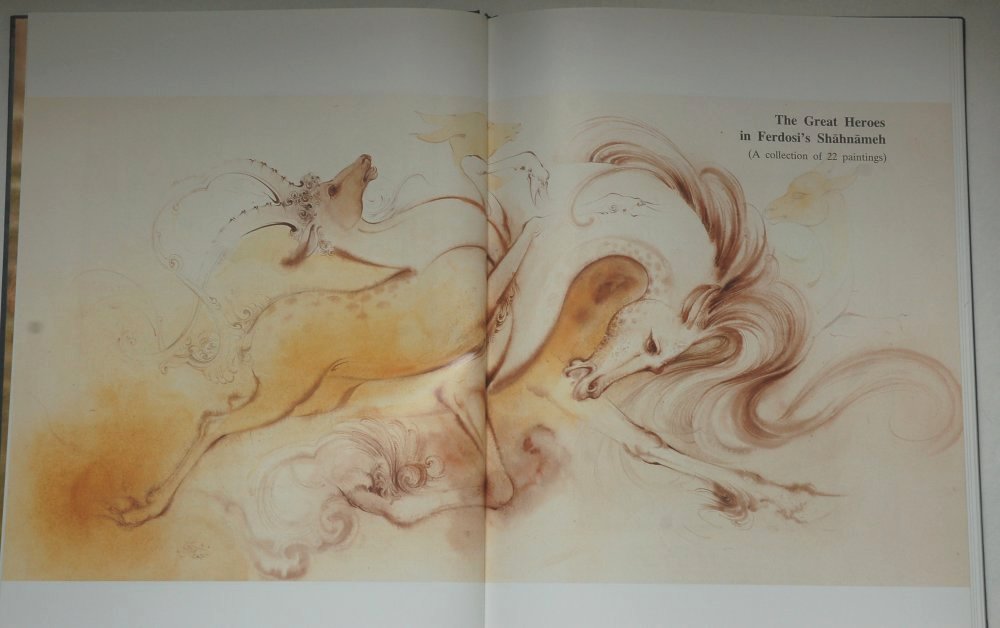
The book was printed in 1991 and describes itself as a commemoration of the millennium of composing Shahnameh by Ferdosi. It was a few years early but the 1000 years have now passed and I’m glad it was early or I may not have been able to obtain this lovely, if somewhat large (42cm x 30cm), volume. The basic premise of the book is that 22 paintings by Mahmoud Farshchian done in the old style of Persian miniature art that I so admired would be used to illustrate sections from the heroic phase of the poem, it is written mainly in Persian with some English to explain the paintings.  The introductory pages are truly beautiful

and then we get into the main work which is the 22 modern interpretations of pages from the ancient works, I love the way that the pictures reach out beyond the frame. Click on the pictures to access full screen versions.

I have chosen 5 pages from the book to illustrate it and these are:

  • In his third labour, Rostam slays the dragon
  • Sohrab launches an offensive against Persia
  • Siavosh undergoes the ordeal by fire which Keykavus has arranged
  • Rostam sets Bijan free from the well where he has been imprisoned by order of the Turanian ruler
  • View of the Hunting Ground, with Bahram Gur talking to the harpist maiden

Ferdosi is not by any means the most famous of the Persian poets, that honour probably goes to Hafez and the annual Hafez festival was on when I arrived in his birthplace of Shiraz. He lived from 1315 to 1390 and like Ferdosi his name is more of an honorific, the difference is that we don’t know the real name of Ferdosi but Hafez was Khwāja Shams-ud-Dīn Muḥammad. Being called Hafez indicates somebody who has memorised the Koran, which apparently he did at a remarkably early age and that is the name with which he has gone down in posterity. Also on my bookshelves is the programme for the event.

20180220 Hafez 6

and I took several photographs at his mausoleum which is where recitals and singing of his poems were taking place. He is a much loved poet in Iran which is odd when you consider that most of his poems involve wine, love or the beauty of women; hardly the subjects that are approved of in conservative Iran.

There are fortunately several good English translations including Penguin paperbacks of Hafez’s works, and now Ferdosi has also been included in Penguin Classics so let us leave this blog post with some words by Hafez from The Penguin Little Black Classic “The nightingales are drunk”

With wine beside a gently flowing brook – this is best;

Withdrawn from sorrow in some quiet nook – this is best;

Our life is like a flower’s that blooms for ten short days

Bright laughing lips, a friendly fresh-faced look – this is best.


Norse Mythology – Neil Gaiman

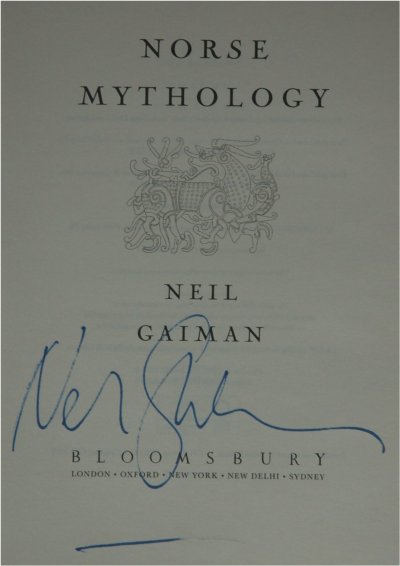
20170206 Norse mythology 1

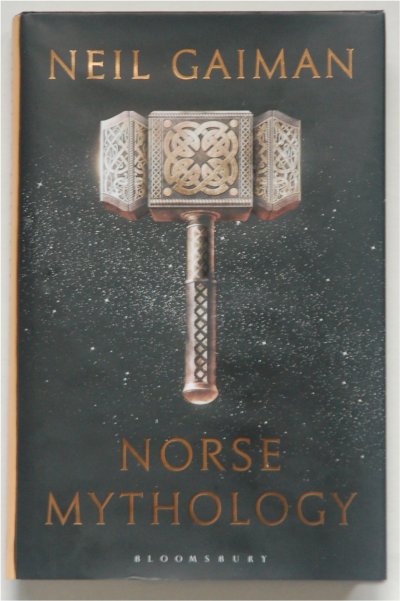
Neil Gaiman’s Norse Mythology is a retelling of the Old Norse myths in a straightforward style aimed at the young adult market. He begins with a brief introduction to Odin, Thor and Loki and then the other characters that populate the myths are explained as we meet them.  The book has had a small number of poor reviews on Amazon, but mainly by people who were expecting a Neil Gaiman story rather than an introduction to the Norse mythology and were therefore disappointed not to find one. For me however it took me back to my childhood in the 1960’s and 70’s reading childrens’ magazines such as Look and Learn and World of Wonder, both of which regularly dipped into mythologies from around the world for features or retellings.

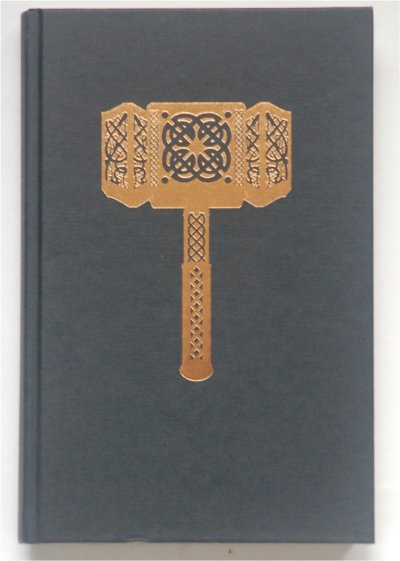
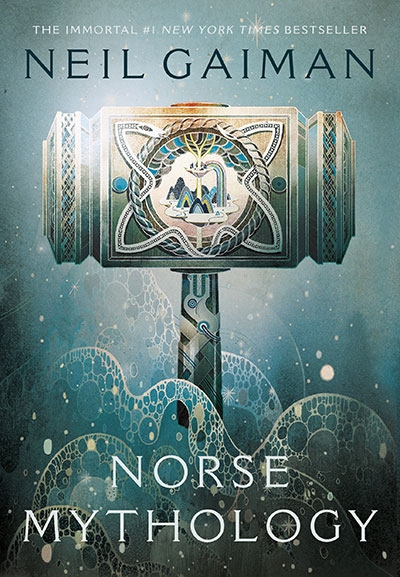
The dustwrapper is beautiful, featuring Thor’s hammer Mjollnir against a background of stars but how many people have taken this off to find the hammer again on the cover of the book

20170206 Norse mythology 2

There are 15 tales included, ranging in length from 3 to 23 pages, so this can be dipped into as a quick read over a period of a few days, but equally it doesn’t take long to read the whole thing. They are easily approachable, avoiding the temptation to explain everything with additional notes which can be a failing in editions aimed at adults which can fall into a scholastic tone. As Neil himself says in his introduction

As I retold these myths, I tried to imagine myself a long time ago, where the stories were first told, during the long winter nights perhaps, under the glow of the Northern Lights, or sitting outside in the small hours, awake in the unending daylight of midsummer, with an audience of people who wanted to know what else Thor did, and what the rainbow was, and how to live their lives, and where bad poetry comes from.

And that I think is the essence of Neil’s book, they feel like they are tales as told to an audience rather than pinned to the page like a specimen butterfly, they have a narrative flow and it doesn’t matter that Yggdrasil and the nine worlds is only 3 pages long, it tells you what you need to know and that information will illuminate later tales.

The book is of course just a brief introduction to the huge body of Norse tales and it would be nice to think that readers today will be inspired, as I was all those years ago with the magazines, to explore further and then maybe try some of the Icelandic sagas which I have enjoyed over the intervening years. More of those I think in a later blog. So thank you Neil for reminding me of the pleasure I got when I first encountered the Norse myths when I was 6 or 7 years old and the joy they still give me.

20170206 Norse mythology 3

Footnote: I thought the UK hardback cover was beautiful and then saw the American paperback due out next month…

20170206 Norse mythology 4