Foundation and Empire – Isaac Asimov

Continuing my reading of the Foundation trilogy by Isaac Asimov we have reached the second volume, my review of the first book can be found here.

This book consists of a longish short story (just over 50 pages) and a novella (113 pages) and continues the story of the Foundation on Terminus, both were first published in Astounding Science Fiction before being combined in this book in 1952.

The General (originally published in April 1945 as Dead Hand) – Set roughly 40 years after the end of the first book so 205 years after the creation of the Foundation on Terminus this short story reveals that the Galactic Empire is still considerably stronger than the Foundation believes it to be and is even now capable of launching an all out attack. Two men hope to stop them and they are prisoners of the Empire, Lathan Devers, a reckless trader and Ducern Barr, son of Onum Barr who had met Master Trader Hober Mallow on his investigations of the dangers of the Korell republic in the story The Merchant Princes.

The Mule (originally published in two parts November and December 1945) – It is now 300 years since the Foundation on Terminus was established and 80 years after the death of Lathan Devers and the trader planets are more or less independent of The Foundation which has come under a despotic ruling family. The Mule is an unknown, a mutant who has apparently effortlessly built himself a fleet and an empire and now threatens The Foundation. This story highlights why Asimov never became a mystery writer (although he did have a go at the genre), there is supposed to be a major twist at the end but I had guessed it within a couple of pages of the character being introduced right at the beginning of the novella. For all that though it is an entertaining story with a strong female lead character, which was somewhat unusual in 1940’s science fiction.

Coming to the end of the second book in the trilogy I realised something else about Asimov’s science fiction and that is the almost complete lack of aliens in any of his writing. The Foundation trilogy covers the entire galaxy but nowhere is there an alien species; it is covered instead in humanity that has spread out from a semi-mythical home planet millennia ago. I have read dozens of his books and apart from one short story, written for Playboy, and the much later novel The Gods Themselves (written in 1972) I cannot remember there ever being an alien species referenced and this is odd. Asimov was a professor of biochemistry at Boston University so was certainly aware that where life can exist it will, at least on Earth, why did he not then extend this to encompass life on other planets? It is suggested in the Wikipedia article about him that when he was starting out an early story was rejected for having aliens more powerful than humans so he decided to not write about them at all, but I don’t buy that explanation as other authors had powerful aliens so maybe we’ll never know the true reason for his humanocentric universe.

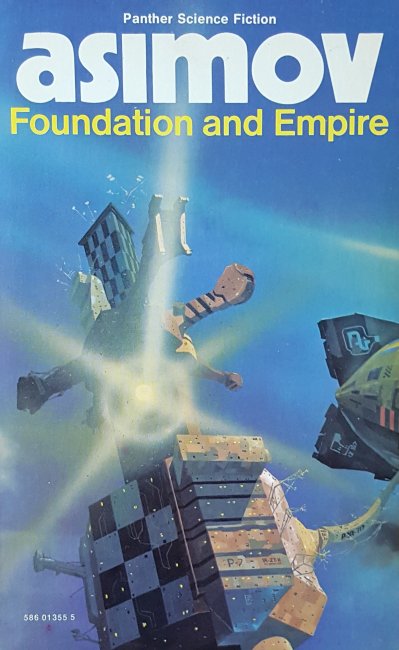
As teased in the first review the covers join together to make a whole image, with the first two books it is less obvious but if you follow the smoke and light trails you can see that we are looking at two thirds of one painting. It must have been tricky to select this as each cover has to work on its own whilst also being part of the whole thing.

The House of the Seven Gables – Nathaniel Hawthorne

It’s thirty five years since I first read this book and it has definitely stayed on the shelf since then. I remember writing to the person who sent it to me and recommended I read it that the most remarkable thing was that it contained it’s own review in the opening line of chapter fifteen.

Several days passed over the Seven Gables, heavily and drearily enough.

Still maybe thirty five years have changed my opinion…

Well I enjoyed the book more than the last time but it is interminably slow, taking at one point nineteen pages to talk about a dead body sitting in the chair where he expired and in the 363 pages that the novel takes very little happens that couldn’t have been told in half that. The novel starts by describing the wrong committed against Mathew Maule by Colonel Pyncheon who under the pretence of calling him out as a wizard, for this was the times of the Salem witch trials, took his house and land to build his own mansion on, the eponymous House of the Seven Gables. Maule curses the Colonel as he is on the gallows that he shall die and very specifically

“God” said the dying man, pointing his finger, with a ghastly look, at the undismayed countenance of his enemy; – “God will give him blood to drink!”

When, on the very first day of the house being completed and open to guests the Colonel is nowhere to be seen and is later discovered sitting at his desk with a great gout of blood on his chest which had gushed from his mouth the curse of Mathew Maule is remembered and the descendants of Pyncheon are reckoned to be likewise cursed. The book then leaps forward to the present day, or at least to the late 1840’s (it was written in 1851) and we are slowly introduced to our small cast of characters. Hepzibah Pyncheon is an old maid and now sole occupier of the house apart from the lodger Holgrave who inhabits one of the gables, cut off from the main property by a bolted door. She is agitated when we first meet her as she is about to do something that if it wasn’t the poverty that she had been reduced to she would never have attempted and that is to open a small shop in part of the house, Hepzibah is not cut out for trade. On the first day she meets her cousin Judge Pyncheon who is most upset with her opening the shop and bringing, as he sees it, disrepute on the family name. There is clearly animosity between Hepzibah and the distinguished judge, but the root of what it is we won’t find out for over three hundred pages.

Fortunately for Hepzibah the next day her cousin Phoebe arrives from the country and proves very good at running the shop and then a little later the household is completed by the arrival of Hepzibah’s brother Clifford who is aged and apparently simple minded, but has also apparently been the cause of scandal and has been away for thirty years. From the hostility Clifford shows to his cousin the judge it is clear that there is bad blood between them. And there the book remains, dealing with minor household triumphs and tragedies for a couple of hundred pages whilst the reader is left wondering when Hawthorne is actually going to get round to doing anything significant with these characters he has assembled. Ironically just after my original quote about dreariness the plot suddenly speeds up as a crisis brings everything to a head but by which time we are well after page 275 and I have to wonder how many readers have given up before then.

Despite Hawthorne’s statements in the preface of the novel that there is no specific locality where the story is set other than a generic ‘New England’ he was actually inspired to write after visiting a 1666 colonial property owned by some relatives of his in Salem, Massachusetts. The house at the time had been remodelled and only had three gables but when it became a museum, in the early part of the 20th century, another four gables were added along with a representation of Hepzibah’s cent shop which had never previously existed. I visited the house in 1986 which was the reason for reading the book in the first place. It has taken 35 years for me to pick it up again and I might have another go in another 35 years but I can’t really see me making the effort somehow even assuming I’m still around to do so.

The copy I have is a very tatty copy of The Pocket Library ninth edition from 1959, originally published by them in 1954 so it must have been popular. The Pocket Library was a very short lived imprint from Pocket Books lasting as it did from 1953 to 1959.

Porterhouse Blue – Tom Sharpe

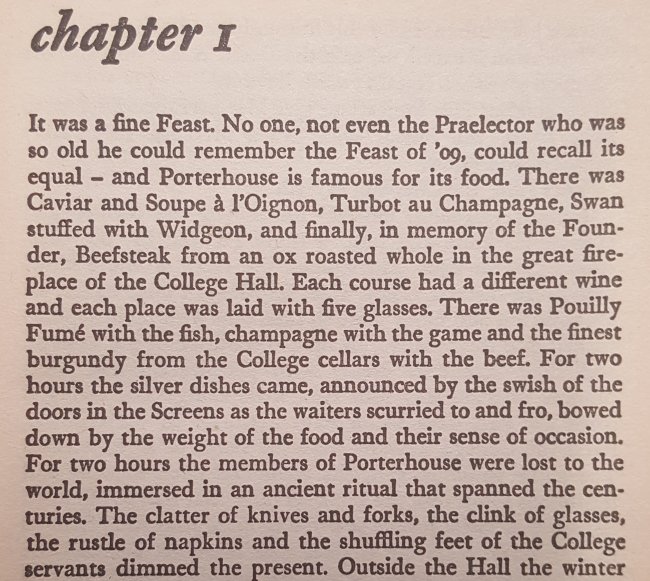
Porterhouse Blue was Tom Sharpe’s third novel and the first set in England after two mocking the apartheid regime in South Africa where he had lived from 1951 before being deported for sedition in 1961. Before going any further with the review however it is important to take note of the language used in a couple of early chapters and one later one, which can euphemistically be referred to as ‘of its time’ especially of the early 1970’s by a white person who had spent a decade in South Africa. It also probably goes some way to explaining why the book does not appear to have been in print for the best part of two decades in the UK. These three paragraphs aside the book is a fun read, with the conflicts, and other relations, between the characters driving forward the story. The opening paragraph sets the scene as the hidebound, male only, Porterhouse College with it’s tradition of big dinners, sporting prowess and low academic achievement has no idea what is about to hit it with the appointment of a new Master of College.

The new Master, Sir Godber Evans, has plans to shake up the old ways in this bastion of maleness; for a start he wants to be co-educational, start accepting students on the basis of academic qualifications rather than muscle for the rugby team and rowing crews, and horror of horrors turn the dining hall into a self service cafeteria run by outside caterers. More disastrous plans come to light, disastrous at least in the eyes of the senior faculty who quite like the big dinners, fine wines and a laissez-faire attitude to educational success that has characterised Porterhouse College for centuries. He must be stopped but how?

Another bastion of the traditions of the college is Skullion, the Head Porter, a role he has held for 45 years. It’s a job he is ideally suited for calling as it does for a total deference to ‘his betters’, i.e. the faculty, at least to their faces, a mindless application of the college rules especially where students are concerned and limited ambition. All these traits he gained in the lower ranks of the army along with fastidious attention to the shine on his shoes which he polishes daily as part of his fixed routine and which serves as a calming influence whenever he is upset. Being upset is going to be his standard position from the arrival of the new Master onwards and often with good reason. It is Skullion we follow more than any other character as the plot unfurls as he seeks to thwart the new masters plans with the help of former pupils known to himself as Skullions Scholars who he has helped pass their degrees by hiring capable students from other colleges to write essays or at the last resort sit the final exams for them.

There is another plot line, which barely touches on the main plot, and that is of Zipser, Porterhouse’s only research student, and the lustful feelings he has for Mrs Biggs his bedder, or servant who cleans and tidies his rooms in college. Mrs Biggs is a lady of mature years and large figure who not only realises Zipser’s desire but determines to reciprocate, Mr Biggs having passed away many years earlier. Zipser and Mrs Biggs storyline however reaches its climax just over halfway through the novel and only the aftermath is dealt with following that.

It’s worth pointing out the origins of the title. A Blue at Cambridge or Oxford is a person who has represented the university in a sporting event between the two universities and as Porterhouse is depicted as a sporting college then students from there would clearly be represented amongst the Cambridge Blues. But a Porterhouse Blue has another meaning as well and is down to the huge meals consumed there regularly and refers to the likely stroke that people with high blood pressure, cholesterol levels, obesity and probable diabetes brought on by such an unhealthy diet are likely to suffer from.

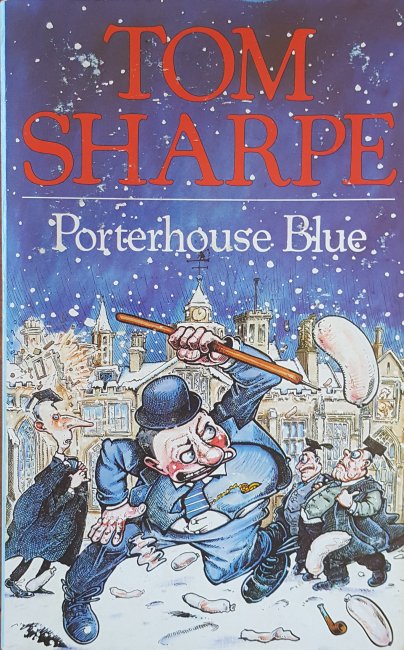
The book was adapted by Malcolm Bradbury as a four part TV series in 1986 starring David Jason as Skullion and Ian Richardson as Sir Godber Evans and that is how I first came across it. My copy is the 1976 first paperback edition with a cover illustration by Paul Sample which I bought second hand probably soon after the TV series was broadcast. The cover depicts one of the funniest scenes in the book as Skullion attempts to rid the college grounds of over 200 gas filled and highly slippery condoms in the middle of the night in a snowstorm. There is no way I’m explaining how they came to be there or the circumstances of their removal you’ll just have to read the book.

Foundation – Isaac Asimov

With the imminent release on Apple TV of a blockbuster adaptation of Isaac Asimov’s Foundation trilogy it seemed appropriate to reread these books that I haven’t picked up since I was a teenager and I’m going to do one a month rather than block out the rest of September. Fortunately I still have the copies I bought back in 1979 with their wonderful covers by Chris Foss that drew me to them in the first place. Panther Science Fiction used a lot of Foss’s paintings for their Asimov covers and as you will see as the months go on the covers on this trilogy are a little special.

Foundation was first published in book form in 1951 and tells the story of the collapse of the Galactic Federation or more accurately the plan of one man, Hari Seldon, to reduce the impact of that failure from 30,000 years of anarchy to a mere 1,000 years. He has predicted the collapse using a branch of mathematics invented by Asimov called psycho-history which takes statistical analysis of crowd behaviour to the nth degree and allows predictions to be made on populations with a trackable degree of accuracy. Seldon ostensibly formed his Foundation to write an Encyclopedia Galactica which would be a repository of all knowledge with a plan to have copies supplied to all the inhabited worlds of the galaxy and right at the beginning of the book engineers their exile to a planet on the furthest reaches of empire where the rulers consider them away from disturbing the peace with stories of empire collapse but where Seldon knows they will be left alone to further his master plan. Here on Terminus his researchers would form a nucleus of science in the increasing barbarism of the surrounding planetary systems as their understanding of technology melts away.

Seldon never makes it to Terminus himself, after less than thirty pages into the book he is dead and this is going to be the major challenge of any TV adaptation, the cast is going to need to be constantly changing as the centuries roll past, in Foundation alone 155 years pass from the first page to the last with major characters rising and then disappearing into history. Seldon alone can re-appear, as a hologram, but only to confirm that what becomes known as Seldon Crisis’s have been successfully negotiated and these are timed events and only occur twice in the first book of the trilogy so how will they maintain a following audience if the characters are never the same from one episode to another?

The major figure in Foundation is the mayor of Terminus fifty years after the settlement of the planet, Salvor Hardin, and if I was going to be persnickety about the book then having the two biggest names being so similar (Salvor Hardin and Hari Seldon) is the one lack of imagination shown by Asimov in what is otherwise a excellent exercise in world building with a truly believable back story and development of characters and technologies. It isn’t to the depth of Iain M Banks’ Culture series (1987 to 2012) but he was writing over forty years earlier and for a very different audience, teenagers and early twenties who were avid consumers of the science fiction pulp magazines of the day as 80% of the book had been published in Astounding Science Fiction between 1942 and 1944, Asimov added the introductory section for the 1951 book publication. The great historical leaps between the five sections is largely explained by the fact that it is a collection of short stories which were originally published separately but we go from an isolated exile planet to Terminus controlling the surrounding star systems and slowly spreading its technological know how with at each step a problem from aggressive neighbours being solved without using force themselves.

The five short stories that make up the book are as follows:

The Psychohistorians – This was written specifically for the book and serves as an introduction to the series, it is the only part where Hari Seldon is actually alive and tries to explain what psycho-history is so that it makes more sense in the stories that follow.

The Encyclopedists (Originally published in May 1942 as Foundation) – Fifty years after the settlement of Terminus and their first crisis as one of the surrounding star systems tries to take over what is still a planet dedicated to the production of the Encyclopedia Galactica. The aggressors plan is thwarted by the young mayor Salvor Hardin and a hologram of Hari Seldon reveals that all is not what it seems on Terminus.

The Mayors (Originally published in June 1942 as Bridle and Saddle) – Thirty more years have passed and Hardin is still mayor of Terminus and again faces aggression from a neighbouring star system although this time a far more powerful one. The Foundation have used the intervening years however to spread atomic power to the surrounding systems but kept the technical details as to how it works to themselves hiding the methods behind a mystical religious belief system where only the priests have access to the controls.

The Traders (Originally published in October 1944 as The Wedge) – Another 55 years have passed and the religious cult behind atomics has slightly waned as traders have started to take over the spreading of the Foundations power in their corner of the Galaxy. This is a fairly simple tale of one trader going a bit too far but getting away with it and is sort of a fill in tale written after The Big and the Little to explain the leap between that and Bridle and Saddle.

The Merchant Princes (Originally published in August 1944 as The Big and the Little) – Twenty years after The Traders so 155 years after The Psychohistorians this introduces Master Trader Hober Mallow who is sent on a mission to investigate unusually technically advanced equipment in the planetary republic of Korell. It turns out that the Galactic Empire is not quite as dead as expected.

The immense popularity of the books in the 1960’s and 70’s can be gauged by the list of reprints, and remember this is just the UK paperback edition.

I suspect that Asimov is no longer as popular as he was but the Apple TV series should hopefully put that right and bring to the fore a writer who was producing what must now be called Young Adult fiction decades before that term was even invented.

Voyages to the Moon and the Sun – Cyrano de Bergerac

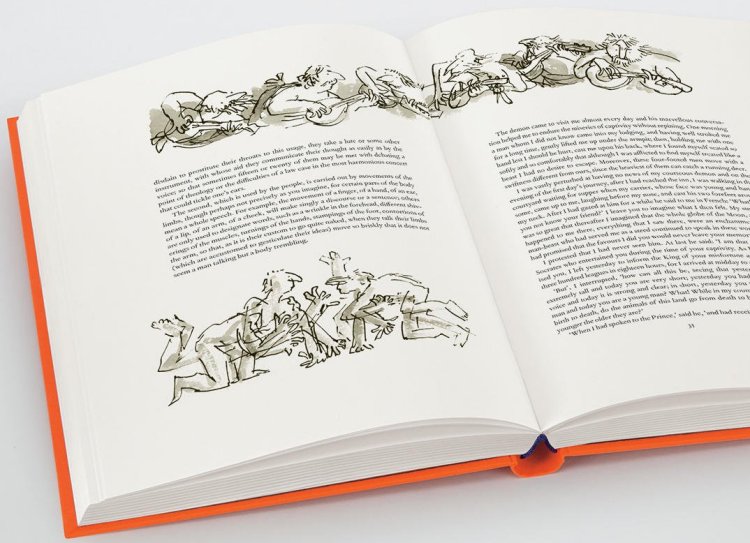
For a long time I believed that the author of this book wasn’t a real person but had been made up in some obscure French novel and that the character had lived on beyond the original work, so to find that Cyrano de Bergerac was not only real but an author as well as the famous soldier and duellist was a pleasant surprise. His life is however poorly documented, but this work can be dated reasonably well as it mentions the death of the philosopher Descartes, which happened in 1650 and de Bergerac himself died in 1654. My copy is the Folio Society edition published in 2018, illustrated by Quentin Blake and rounds off my selection of works translated from French that I have been reading throughout August. The illustrations to this blog were taken from the Folio Society web site entry on the book.

The book is in three sections so I’ll review it in the same way:

Journey to The Moon

The time that de Bergerac was writing in was a period of considerable scientific advancement as people moved away from the ancient Greek science towards the start of physics as we know it but there was much that was still up for debate such as if the Earth was the centre of the universe with everything else revolving around it. It is clear right from the start that de Bergerac had moved on from this notion and he understood that the Earth rotated, that the Moon orbited the Earth and that together they orbited the Sun. Journey to the Moon starts with the hero trying to reach the Moon by means of dew collected in jam jars. The reasoning is fair, dew rises in the morning so if you could collect enough of it and attach it to your body then it should take you with it, this he duly does and rises up into the air from Paris one morning. After a few hours he decides to land, releases the dew and is surprised to find it is still morning and he is in Canada as the Earth has rotated underneath him, de Bergerac didn’t consider that the atmosphere also rotates with the land beneath. Later he builds another machine this time powered by fireworks which does lift him to the Moon, leaving from Quebec.

The Moon he arrives at is however unrecognisable from the one we know as he finds the Garden of Eden there along with several old testament prophets and here the book starts to fail as he indulges in pages of theological arguments which drag the pace so much that I almost gave up at this point and began searching for another book to read, however I’m glad I persevered. Ultimately he leaves religion behind and goes on a fantastical exploration of his version of the Moon before returning to Earth by catching hold of the Devil on his way to deposit an inhabitant of the Moon to Hell and of course he has to pass the Earth on the way.

Journey to The Sun

For a long time it looked as if Journey to the Sun wasn’t actually going to get there, for the first twenty five pages it covers being persuaded to write up and publish Journey to the Moon and his subsequent denouncement as a sorcerer. Which leads to him being jailed, escaping and undertaking a very funny chase sequence which results in him accidentally running full circle and seeking shelter from his pursuers through the back door of the very jail he had escaped from. Eventually he builds a contraption which uses the power of sunlight via lenses to build up lift so that he can escape again, however he misjudges the power of his invention and instead of just rising and then landing again he is drawn all the way to the Sun and aims to land on a sun spot which he takes to be an area of land floating on the sun’s surface. The Sun in the book is not the flaming ball of gas that we understand but simply a larger globe that it is perfectly possible to traverse.

Eventually he meets a tiny king who with his subjects can transform themselves into anything they wish either singly or as a group to make something as large as a tree and in this tree is a Nightingale who leads him to the Kingdom of the Birds.

Story of the Birds

On arrival in the Kingdom of the Birds he is arrested and put on trial for the heinous crime of being a man and therefore a destroyer and killer of birds. Here de Bergerac demonstrates his ecological credentials and tries our hero for the damage mankind has done to the Earth and the wanton killing of bird life. He is ultimately sentenced to be eaten to death by insects but is reprieved when a parrot that he once set free from its cage speaks up in his defence.

Various adventures follow his release as he travels towards the Kingdom of Philosophers, although again de Bergerac gets distracted and spends pages retelling Greek myths without progressing with the story. Eventually this rather tedious section finishes and the hero continues on his way, meeting people from the Kingdom of Truth and the Kingdom of Lovers before the book suddenly finishes mid paragraph.

Overall I enjoyed the book but the large sections of ‘philosophising’ I could definitely have done without.

The Nun – Denis Diderot

The story behind this book is as fascinating as the novel itself and it would probably be good to start there, because it all grew out of an elaborate practical joke which was based on a real incident. In 1758 a young nun, Marguerite Delamarre, tried to get herself extricated from the vows she had taken in a Paris convent and returned to the outside world. However it was almost impossible for this to happen at the time and she duly failed but not before it had become the talk of the city. She ended up living her entire life, presumably unhappily, in the convent. Her story suggested itself to Diderot and a group of his friends as a means of persuading another of their company who had retired to the countryside to come back to Paris. They duly started a correspondence with him in 1759 pretending to be Suzanne Simonin, a nun who had escaped the cloister but needed assistance to avoid being forcibly taken back. They also included fake letters from Madame Madin, who was known to both parties and was supposedly sheltering the girl. Unfortunately for the friends of M. de Croismare he fell for the story rather too well and offered Suzanne a place in his household, even going so far as to try to arrange transport for her. They were forced to claim she was ill and then when he became more insistent that he wanted to help her they made the illness more severe and killed her off.

In a postscript, eight years later M. de Croismare did come to Paris and met Madame Madin and was surprised to find that she knew nothing of the whole episode. The story should have ended as a practical joke but Diderot had by now been so fascinated by their tale of woe that he decided to write Suzanne’s autobiography from childhood to how she ended up in the convent and then to her escape and he worked on it through most of 1760 although with no intent to publish, however once he found out that the joke was exposed he did finally publish in 1770.

To provide a reason for Suzanne to be shut up in a convent from the age of sixteen she had two slightly older sisters but it was becoming clear that potential suitors for them were getting more interested in Suzanne so she was put out of the way. This decision by her father was driven more by his (correct) suspicion that he was not actually her biological father and he wanted to prevent her having any call on the families money. He therefore determined that she should be got rid of in the most convenient way and as the story of Marguerite Delamarre proved it was almost impossible in 18th century France for a girl to leave a convent once she had been made to take her vows. However at the first convent she was sent to Suzanne refused to take her vows and created a scene in the church for which she was punished and later taken to a second convent.

At this second convent she was persuaded to take her vows despite protesting she had no vocation to become a nun and so started a horrific experience of neglect, beatings, sleep deprivation, etc. as the Mother Superior had a sadistic side and was determined to beat and torture a vocation into the young girl. Several of the illustrations in the book are based around these episodes and it is the one failing of this edition that the artist appears to be mainly interested in the voyeuristic depictions of a naked and half naked Suzanne than a more balanced view of the plot and the other sufferings she endures at the hands of this Mother Superior and her coterie of similarly sadistic senior nuns.

Eventually she is assisted to go to a third convent and here although the beatings and humiliation are not present she becomes the object of affection of the lesbian Mother Superior much to the confusion of the innocent Suzanne. Diderot appears keen to heap all the exploitative possibilities of a cloistered group of women some of whom are driven half mad by the regime and being locked away from the outside world from such a young age. It is not an easy book to read as it is written entirely from Suzanne’s viewpoint, but I’m glad this session of French works has persuaded me to get it off the shelves.

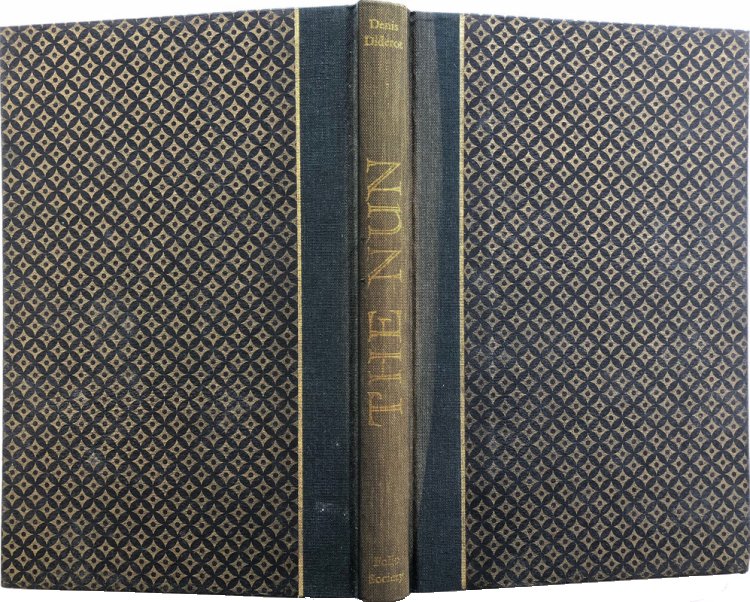
My copy is the Folio Society edition from 1972 and is notorious for its fading cloth spine, all copies I have ever seen are this badly faded, the rest of the book being protected by a slipcase. It is illustrated by Charles Mozley and translated by Leonard Tancock and is the fourth in my selection of books translated from French for August 2021.

Clochemerle – Gabriel Chevallier

Just possibly the most fun book I have read this year, it is delightfully written with the author taking the role of narrator and introducing us to the small Beaujolais town of Clochmerle and it’s comical inhabitants in the way of a consummate storyteller. Every character and place is beautifully described, and at length, so that you can fully realise in your minds eye each and every one of them. It is the third in my August book theme of ‘translated from French’ and it has been an absolute joy to read even though it clocks in at 320 pages.

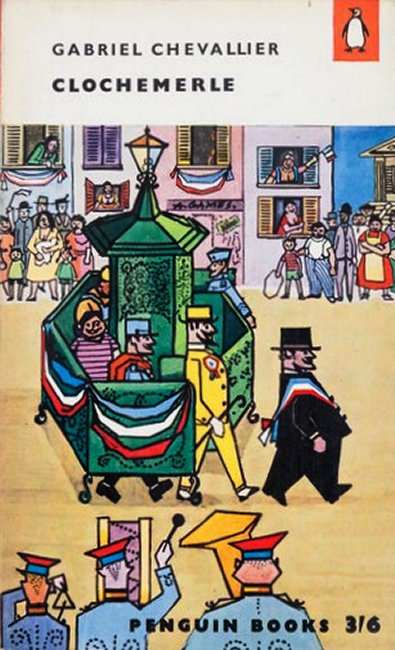
It all starts with the decision of the local mayor to bring progress to his sleepy town by building a public urinal and due to the odd geography of the place the best location is half way up the main street which places it firmly outside the church. Although not as indicated on the cover of this Penguin edition as it is placed not in the centre of a square but up against a wall adjacent to the Beaujolais Stores on an alley leading up to the church itself. To get a feel for the wonderful descriptions in the book let’s look at page one and the two men walking down the road from the square to where the urinal is to be situated.

One of these men, past fifty years of age, tall, far-haired, of sanguine complexion, could have been taken as a typical descendent of the Burgundians who formally inhabited the department of the Rhone. His face, the skin of which was dented by exposure to sun and wind, owed its expression almost entirely to his small, light grey eyes, which were surrounded by tiny wrinkles, and which he was perpetually blinking; this gave him an air of roguishness, harsh at times and at others friendly. His mouth which might have given indications of character that could not be read in his eyes, was entirely hidden by his drooping moustache, beneath which was thrust the stem of a short black pipe, smelling of a mixture of tobacco and of dried grape-skins, which he chewed at rather than smoked. Thin and gaunt, with long, straight legs, and a slight paunch which was more the outcome of lack of exercise than a genuine stoutness, the man gave the impression of a powerful physique. Although carelessly dressed from his comfortable, well-polished shoes, the good quality of the cloth of his coat, and the collar which he wore with natural ease on a week-day, you guessed that he was respected and well-to-do. His voice, and his sparing use of gesture were those of a man accustomed to rule.

And there we have a perfect pen-portrait of Barthélemy Piéchut, mayor of the town, a man of ambition to go far in the party and for which mayorality of a small provincial town was to be just a stepping stone. His fellow walker is Ernest Tafardel the schoolmaster and a far more devout republican than his friend although not destined to rise any higher than his current role. Against these two redoubtable men of the Third Republic there is the powerful Catholic Church although represented in Clochemerle by the Curé Ponosse a man who joined the priesthood for a quiet life and is definitely not the man for the crisis to come. However there is also the old maid, Mademoiselle Putet, full of religious fervour with nothing else to drive her forward now it had become quite clear she was destined to remain a Mademoiselle and untouched by the male sex rather than a married Madame. She it is that stirs up the trouble between the church and the state, initially over the urinal which as she lives by the church at the end of the alley where it is placed she sees as a personal affront to her dignity, but later as she interferes in the various goings on of the population.

The stage is set for a farcical ‘war’ between to two sides which is reflected in another conflict also in the location of the urinal between the two most attractive women in the town who run the Beaujolais Stores in the case of Judith and the bar of Torbayon in the case of Adéle which are directly opposite one another. Judith is well known for being free with her charms so to speak and Adéle flaunts hers rather than directly engaging in extra-marital affairs unlike Judith but this all changes when Judith’s particular favourite, who is staying at the Torbayon Inn, is taken ill and nursed by Adéle who takes advantage of his bed ridden state to discover exactly what she is missing in her own marriage. All this takes place in the long, hot summer of 1923 when tempers are getting frayed due to the heat and the annual fete is the cause of excessive drinking on all sides. The cast of minor characters is beautifully drawn and all have part to play in the ultimate fiasco and its resultant tragedy from the washerwomen of the lower town to the baroness in her chateau above the town, through the government officials more interested in cars and their private dealings and the military who can’t be bothered to intervene.

The book ends with an overview ten years after the calamities of 1923 by bringing us up to date with the happenings to most of the protagonists since then and all is well with most of them and the town now boasts three urinals, a great step forward indeed. There are apparently two sequels 1951’s Clochemerle Babylone and from 1963 Clochemerle-les-Bains both of which at least were available in Penguin so I can definitely see me hunting these out for future reading even if they are out of print which they appear to be.

Candide – Voltaire

What on Earth have I just read? I don’t really know what I was expecting from the fourth book issued in the Penguin Classics series, maybe a serious French novel, but it certainly wasn’t this surreal fantasy adventure. Penguin Classics started in 1946 with Homer’s Odyssey and then followed that with a collection of short stories by Guy de Maupassant and then the Theban plays by Sophocles, all solid classics as expected and then came this truly bizarre narrative at the end of 1947. This is the second of the blogs making up my August theme for 2021 which is ‘translated from French’, as I have already featured Boule de Suif and Other Stories by Maupassant I selected this book as the second French book in the Penguin Classics without knowing anything at all about it before I started reading this week.

The only book I can think of that has such fantastical episodes is Jonathan Swift’s Gulliver’s Travels and like that other classic this is a satirical parody, however unlike Swift’s book which is set in various fantasy lands Voltaire has set his amongst contemporary events and real people. The problem with both books is that they are over two hundred and fifty years old so the politics and philosophies they are parodying are long gone and the messages that would have been clear to readers at the time are obscure at best or completely lost to the modern reader. This if anything makes them even stranger. Still on with the review of the book in hand, which was first published in 1759.

As is my usual practice with books which have an introduction I didn’t read it first but after I had completed the novel. As usual I’m glad I did as the introduction not only gives away large parts of the plot whilst trying to explain the references it also totally reveals the ending. However the introduction is essential after reading the book because it answers so many questions the modern reader has, such as why does Professor Pangloss teach that this is “the best of all possible worlds” and anything that happens must ultimately be for the best despite the continuous disasters that surround him and his pupil Candide; including in Pangloss’s case being hung as part of a Portuguese auto-de-fe following the 1755 Lisbon earthquake which killed tens of thousands of people. It turns out that Voltaire was mercilessly sending up the Theodicy by Gottfried Leibniz which takes as it central premise that exact philosophy.

The book starts with Candide and Pangloss at the Baron Thunder-ten-tronckh’s country seat in Westphalia along with the Baron’s family, especially his seventeen year old daughter Cunégonde who Candide is madly in love with, all is well with the world. Cunégonde sees Pangloss making love with one of the maids and decides to entice Candide but this is seen by the Baron who kicks Candide out of the house before he can make a move. Candide is then captured by the Prussian army, press-ganged into service, flogged almost to death, made to fight in a war with the French and nearly executed before escaping to Holland, Here he meets Jacques the Anabaptist and then runs into Pangloss who is now a beggar with syphilis which he caught from the maid and who informs Candide that soon after he left the castle was over-run by the Prussians, Cunégonde was raped before her and all other inhabitants of the place were killed. Pangloss is cured of syphilis by Jacques, losing an eye and an ear during the treatment. We are now on page ELEVEN. The frenetic pace continues through the rest of the book along with the rapidly rising death toll and never ending coincidences and disasters surrounding the characters. Throughout it all Candide and Pangloss maintain the Leibnizian philosophy of this is the best of all worlds.

The other protagonists in the book are increasingly strange especially the ‘old woman’ whose tale is the most bizarre of all and acts as a balance to Candide as she certainly doesn’t believe that this is the best of all worlds after the life she has had. Starting as the illegitimate daughter of Pope Urban X and ending as a servant in Lisbon by the time she meets Candide, on the way seeing her mother drawn and quartered, becoming a slave and having a buttock cut off to feed starving Janissaries during a siege amongst other experiences. The surreal happenings to all the characters continue throughout the book which travels to South America and back to Europe via El Dorado dropping in at England just long enough to witness the execution of Admiral Byng for failing to prevent the fall of Minorca to the French and deciding that England was just too crazy a place to stay, which bearing in mind the things that had already befallen them by then was a pretty damning indictment.

I think I need to read Candide again in a few months just to fully resolve in my mind all that happens but if you like books at a mad pace then Candide is for you. I also have a copy as part of the Penguin Drop Caps series, translated by Theo Cuffe.

Memoirs of Prince Alexy Haimatoff – Thomas Jefferson Hogg

This book is quite possibly unique in the annals of publishing in that the first review of it is far more famous than the book itself and that review has also been reprinted many more times than the book it was reviewing. This however is not difficult as following the first edition in 1813 (reprinted 1825) the next edition appears to be this one by The Folio Society in 1952 which has never been reprinted and apart from some modern ‘print on demand’ publishers offering it, as they offer most out of copyright works, that appears to be the sum total of published editions. So what about the review? Well that was written by Hogg’s friend Percy Bysshe Shelley and first appeared in The Critical Review in 1814. Hogg and Shelley had met at University College, Oxford where they were fellow undergraduates, one was destined to become a London barrister and the other one of the great romantic poets but if Hogg is remembered for anything nowadays it is his unfinished biography of Shelley which he was still working on when he died in 1862 forty years after the untimely death of his subject. The two nineteenth century printings of Memoirs of Prince Alexy Haimatoff are both extremely rare. Worldcat, the international library catalogue, lists one copy of each, both of which are in the British Library in London, there is also one copy of the 1825 reprint currently for sale in San Francisco. Regular readers of my blog will know that I sometimes include a link to out of copyright books at Project Gutenberg but I can’t do it for this book because it doesn’t even exist on that site.

Shelley’s review has however been reprinted many times either as a very short stand alone booklet or in collected editions of Shelley’s works, it is also included at the back of this Folio Society edition. It is 9½ pages long, which as it includes large chunks of the original book to illustrate his points is not very long at all but the real surprise is that The Critical Review published such a lengthy review by an unknown critic of a book that sold so badly that it has virtually vanished without trace.

But lets look at the book itself, the Folio Society edition is beautifully bound in quarter buckram with marbled boards and has eight wood engravings by well known Scottish artist Douglas Percy Bliss who was then Director of the Glasgow School of Art. It also has an interesting introduction written by Sidney Scott which looks not just at the novel but the friendship between Hogg and Shelley, they had collaborated a couple of times at university including on a pamphlet entitled ‘A Necessity of Atheism’ which, although published anonymously, was soon traced to the two friends who were both summarily rusticated, never to return to their studies. Hogg continued this idea of hiding the true author through to this book as the Memoirs were originally published as though it was a genuine translation from the original Latin by a mysterious John Brown and it was many years before Hogg was identified as the actual author.

Meeting the Sultana – Wood engraving by Douglas Percy Bliss

You may feel that I’m taking a long time to get to the novel itself. There is a very good reason for that and it is the same reason that the book is so rarely published and that is that it isn’t actually very good. The narrative is disjointed and whilst there are passages that are beautifully written these are soon let down by huge gaps where much has clearly happened but it is covered in just a line or two with no explanation as to how we have moved from one position to another. At one point after escaping from the clutches of the Sultana in Constantinople, who intends to poison him if he leaves her, he wishes to replace his desire for her by bizarrely buying a female slave that reminds him of the Sultana. We spend several pages at the slave dealer but then after getting her to Naples she bears him two sons before dying along with the children of smallpox within a few lines. This is not the only occasion where the treatment of women is reprehensible but serves as a good example of the whole. The extremely odd German cult that Haimatoff joins is just plain strange and it really isn’t clear why he would have committed himself to it which includes being locked in a room for three months with no human contact or any means of passing the time such as books or pen and paper. I have categorised this blog as a book tale not a review as the story of how the book appeared and disappeared is actually more interesting than the plot. The Folio Society edition is almost seventy years old now and I can’t imagine any publisher setting out to publish it again but it was interesting to read such a rare book, if you want to then the Folio edition is easily found secondhand online for just a few pounds. The 1825 copy I found in San Francisco is over £3000.

I will leave this with the final two paragraphs of Percy Byssche Shelley’s review which I think sums up the book quite well even if he was being overly generous to a friend.

In the delineation of the more evanescent feelings and uncommon instances of strong and delicate passion we conceive the author to have exhibited new and unparalleled powers. He has noticed some peculiarities of female character, with a delicacy and truth singularly exquisite. We think that the interesting subject of sexual relations requires for its successful development the application of a mind thus organised and endowed. Yet even here how great the deficiencies ; this mind must be pure from the fashionable superstitions of gallantry, must be exempt from the sordid feelings which with blind idolatry worship l the image and blaspheme the deity, reverence the type, and degrade the reality of which it is an emblem.

We do not hesitate to assert that the author of this volume is a man of ability. His great though indisciplinable energies and fervid rapidity of conception embodies scenes and situations, and of passions affording inexhaustible food for wonder and delight. The interest is deep and irresistible. A moral enchanter seems to have conjured up the shapes of all that is beautiful and strange to suspend the faculties in fascination and astonishment.

Percy Byssche Shelly in The Critical Review 1814

There is an extremely badly formatted version of Shelley’s review available online here. If anyone knows of a better version I would love to hear of it so I can replace this link.

Silas Marner – George Eliot

I’ve made a few attempts at reading Middlemarch and have failed miserably each time but do feel there must be something to George Eliot to explain her popularity so when on lithub.com I came across the following ‘recommendation’

George Eliot, Silas Marner (1861) : Like MiddlemarchSilas Marner is exquisitely written and ecstatically boring. Unlike Middlemarch, it is quite short.

I felt I had to make a go of it and I have a 1944 first Penguin Books edition on the shelves, so Silas Marner here we come…

Like several of her contemporaries Mary Anne Evans used a male pseudonym for her novels although unlike the Bronte sisters for example this was not how she was first published as she used her own name for her earlier translations, nevertheless it is as George Eliot that she is best known. She took the male name to avoid being pigeonholed as a romantic writer which would have undoubtedly have been the case in mid Victorian England and she wanted to write far more serious novels. Having finished, and enjoyed Silas Marner I have to say that the above quote that prompted me to pick up the book is extremely unfair. Yes there are some dull parts, especially when the ladies are getting ready for the new years party and seem to spend far too long discussing, and admiring each others dresses but even that had some interest in how they would prepare for a social gathering with outfits sent on in advance so they didn’t have to carry them in the carriage or on horseback.

Whilst the book is specifically split into two parts in reality it more properly falls into three each fifteen to sixteen years apart. The first short section deals with Marner as a young man brought up in a strict religious community in an un-named norther city, where he is falsely accused of stealing the church funds and expelled from chapel. He also loses the love of his life due to his apparent crime to the man that framed him and Marner duly leaves the city to start a new life on the edge of the fictional small village of Raveloe in Warwickshire. All this happens in a flashback during the first chapter of the book to provide some background to his character and why he is such a loner as the rest of Part One deals with his life fifteen years after he came to Raveloe. This is a part of the country well known to George Eliot as she was born in Nuneaton, Warwickshire and whilst the book is set in the early years of the nineteenth century and she was born in 1819 this would still be a familiar territory for her to set the novel in and one of the features of the book is the descriptions of the lives of the various social strata within the village. Marner earns his living as a weaver, in fact the full title of the book is Silas Marner: The Weaver of Raveloe and from this skill he is able to amass quite a substantial sum over the fifteen years he had lived there and was respected for his skill but took no part in village life other than that which was necessary for his trade working at his loom all available hours day in day out. This solitude coupled with his bulging eyes which were rather short sighted, his bent back from hours at the loom and his occasional cataleptic fits which left him motionless for up to an hour at a time when they struck him made him an object of fear amongst the village children and his non-appearance at church a concern for the adults.

There is a parallel tale to that of Marner within the book and that is of the local squire, or more specifically his dissolute sons, the eldest of which had made an unwise secret marriage to an opium addicted poor woman and fathered a daughter whilst the other was of generally bad character thinking nothing of bullying his way around the local populace and wasting money of drink and gambling. Initially it seems that there is no link between the two tales but the two are destined to become entangled with both tragic and happy results. Part two is set sixteen years after part one but the various loose story strands have got no nearer to resolution but everything is about to change and oddly it is the improved draining of the fields that is going to be the catalyst. It is the clever interleaving of the two facets of social life in the village that make the book so enjoyable even whilst I sometimes struggled with the written out dialect when the poorer people are talking amongst themselves. The characters are all believable and the interplay between the gentry (such as they are in such a backwater), the poor and those who see themselves as in between such as the parson, the doctor, the innkeeper and the farrier is very well done.

I felt drawn in to this portrait of rustic middle English life from two centuries ago, maybe it’s time to have another go at Middlemarch…