Memoirs of Prince Alexy Haimatoff – Thomas Jefferson Hogg

This book is quite possibly unique in the annals of publishing in that the first review of it is far more famous than the book itself and that review has also been reprinted many more times than the book it was reviewing. This however is not difficult as following the first edition in 1813 (reprinted 1825) the next edition appears to be this one by The Folio Society in 1952 which has never been reprinted and apart from some modern ‘print on demand’ publishers offering it, as they offer most out of copyright works, that appears to be the sum total of published editions. So what about the review? Well that was written by Hogg’s friend Percy Bysshe Shelley and first appeared in The Critical Review in 1814. Hogg and Shelley had met at University College, Oxford where they were fellow undergraduates, one was destined to become a London barrister and the other one of the great romantic poets but if Hogg is remembered for anything nowadays it is his unfinished biography of Shelley which he was still working on when he died in 1862 forty years after the untimely death of his subject. The two nineteenth century printings of Memoirs of Prince Alexy Haimatoff are both extremely rare. Worldcat, the international library catalogue, lists one copy of each, both of which are in the British Library in London, there is also one copy of the 1825 reprint currently for sale in San Francisco. Regular readers of my blog will know that I sometimes include a link to out of copyright books at Project Gutenberg but I can’t do it for this book because it doesn’t even exist on that site.

Shelley’s review has however been reprinted many times either as a very short stand alone booklet or in collected editions of Shelley’s works, it is also included at the back of this Folio Society edition. It is 9½ pages long, which as it includes large chunks of the original book to illustrate his points is not very long at all but the real surprise is that The Critical Review published such a lengthy review by an unknown critic of a book that sold so badly that it has virtually vanished without trace.

But lets look at the book itself, the Folio Society edition is beautifully bound in quarter buckram with marbled boards and has eight wood engravings by well known Scottish artist Douglas Percy Bliss who was then Director of the Glasgow School of Art. It also has an interesting introduction written by Sidney Scott which looks not just at the novel but the friendship between Hogg and Shelley, they had collaborated a couple of times at university including on a pamphlet entitled ‘A Necessity of Atheism’ which, although published anonymously, was soon traced to the two friends who were both summarily rusticated, never to return to their studies. Hogg continued this idea of hiding the true author through to this book as the Memoirs were originally published as though it was a genuine translation from the original Latin by a mysterious John Brown and it was many years before Hogg was identified as the actual author.

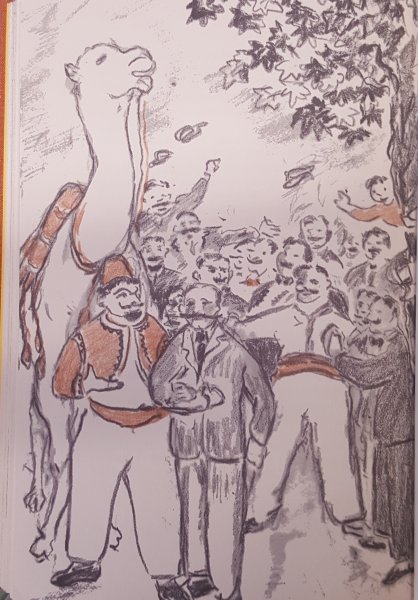
Meeting the Sultana – Wood engraving by Douglas Percy Bliss

You may feel that I’m taking a long time to get to the novel itself. There is a very good reason for that and it is the same reason that the book is so rarely published and that is that it isn’t actually very good. The narrative is disjointed and whilst there are passages that are beautifully written these are soon let down by huge gaps where much has clearly happened but it is covered in just a line or two with no explanation as to how we have moved from one position to another. At one point after escaping from the clutches of the Sultana in Constantinople, who intends to poison him if he leaves her, he wishes to replace his desire for her by bizarrely buying a female slave that reminds him of the Sultana. We spend several pages at the slave dealer but then after getting her to Naples she bears him two sons before dying along with the children of smallpox within a few lines. This is not the only occasion where the treatment of women is reprehensible but serves as a good example of the whole. The extremely odd German cult that Haimatoff joins is just plain strange and it really isn’t clear why he would have committed himself to it which includes being locked in a room for three months with no human contact or any means of passing the time such as books or pen and paper. I have categorised this blog as a book tale not a review as the story of how the book appeared and disappeared is actually more interesting than the plot. The Folio Society edition is almost seventy years old now and I can’t imagine any publisher setting out to publish it again but it was interesting to read such a rare book, if you want to then the Folio edition is easily found secondhand online for just a few pounds. The 1825 copy I found in San Francisco is over £3000.

I will leave this with the final two paragraphs of Percy Byssche Shelley’s review which I think sums up the book quite well even if he was being overly generous to a friend.

In the delineation of the more evanescent feelings and uncommon instances of strong and delicate passion we conceive the author to have exhibited new and unparalleled powers. He has noticed some peculiarities of female character, with a delicacy and truth singularly exquisite. We think that the interesting subject of sexual relations requires for its successful development the application of a mind thus organised and endowed. Yet even here how great the deficiencies ; this mind must be pure from the fashionable superstitions of gallantry, must be exempt from the sordid feelings which with blind idolatry worship l the image and blaspheme the deity, reverence the type, and degrade the reality of which it is an emblem.

We do not hesitate to assert that the author of this volume is a man of ability. His great though indisciplinable energies and fervid rapidity of conception embodies scenes and situations, and of passions affording inexhaustible food for wonder and delight. The interest is deep and irresistible. A moral enchanter seems to have conjured up the shapes of all that is beautiful and strange to suspend the faculties in fascination and astonishment.

Percy Byssche Shelly in The Critical Review 1814

There is an extremely badly formatted version of Shelley’s review available online here. If anyone knows of a better version I would love to hear of it so I can replace this link.

Silas Marner – George Eliot

I’ve made a few attempts at reading Middlemarch and have failed miserably each time but do feel there must be something to George Eliot to explain her popularity so when on lithub.com I came across the following ‘recommendation’

George Eliot, Silas Marner (1861) : Like MiddlemarchSilas Marner is exquisitely written and ecstatically boring. Unlike Middlemarch, it is quite short.

I felt I had to make a go of it and I have a 1944 first Penguin Books edition on the shelves, so Silas Marner here we come…

Like several of her contemporaries Mary Anne Evans used a male pseudonym for her novels although unlike the Bronte sisters for example this was not how she was first published as she used her own name for her earlier translations, nevertheless it is as George Eliot that she is best known. She took the male name to avoid being pigeonholed as a romantic writer which would have undoubtedly have been the case in mid Victorian England and she wanted to write far more serious novels. Having finished, and enjoyed Silas Marner I have to say that the above quote that prompted me to pick up the book is extremely unfair. Yes there are some dull parts, especially when the ladies are getting ready for the new years party and seem to spend far too long discussing, and admiring each others dresses but even that had some interest in how they would prepare for a social gathering with outfits sent on in advance so they didn’t have to carry them in the carriage or on horseback.

Whilst the book is specifically split into two parts in reality it more properly falls into three each fifteen to sixteen years apart. The first short section deals with Marner as a young man brought up in a strict religious community in an un-named norther city, where he is falsely accused of stealing the church funds and expelled from chapel. He also loses the love of his life due to his apparent crime to the man that framed him and Marner duly leaves the city to start a new life on the edge of the fictional small village of Raveloe in Warwickshire. All this happens in a flashback during the first chapter of the book to provide some background to his character and why he is such a loner as the rest of Part One deals with his life fifteen years after he came to Raveloe. This is a part of the country well known to George Eliot as she was born in Nuneaton, Warwickshire and whilst the book is set in the early years of the nineteenth century and she was born in 1819 this would still be a familiar territory for her to set the novel in and one of the features of the book is the descriptions of the lives of the various social strata within the village. Marner earns his living as a weaver, in fact the full title of the book is Silas Marner: The Weaver of Raveloe and from this skill he is able to amass quite a substantial sum over the fifteen years he had lived there and was respected for his skill but took no part in village life other than that which was necessary for his trade working at his loom all available hours day in day out. This solitude coupled with his bulging eyes which were rather short sighted, his bent back from hours at the loom and his occasional cataleptic fits which left him motionless for up to an hour at a time when they struck him made him an object of fear amongst the village children and his non-appearance at church a concern for the adults.

There is a parallel tale to that of Marner within the book and that is of the local squire, or more specifically his dissolute sons, the eldest of which had made an unwise secret marriage to an opium addicted poor woman and fathered a daughter whilst the other was of generally bad character thinking nothing of bullying his way around the local populace and wasting money of drink and gambling. Initially it seems that there is no link between the two tales but the two are destined to become entangled with both tragic and happy results. Part two is set sixteen years after part one but the various loose story strands have got no nearer to resolution but everything is about to change and oddly it is the improved draining of the fields that is going to be the catalyst. It is the clever interleaving of the two facets of social life in the village that make the book so enjoyable even whilst I sometimes struggled with the written out dialect when the poorer people are talking amongst themselves. The characters are all believable and the interplay between the gentry (such as they are in such a backwater), the poor and those who see themselves as in between such as the parson, the doctor, the innkeeper and the farrier is very well done.

I felt drawn in to this portrait of rustic middle English life from two centuries ago, maybe it’s time to have another go at Middlemarch…

Ethan Frome – Edith Wharton

I had the story, bit by bit, from various people, each time it was a different story. If you know Starkfield Massachusetts, you know the post-office.If you know the post-office you must have seen Ethan Frome drive up to it, drop the reins on his hollow-backed bay and drag himself across the brick pavement to the white colonnade: and you must have asked who he was.

The opening of Ethan Frome draws the reader in immediately, who is Ethan Frome? Nobody seems to know yet everybody ‘knows’ him and as a reader you to already want to know about this mysterious character. The narrator seems determined to find out so lets keep reading, further down the first page he is described as “but the ruin of a man” with “lameness checking each step like the jerk of a chain”, what on earth had happened to him? After the opening preface in which the anonymous narrator gets to know a little more about Ethan Frome whilst employing him to drive a sleigh each day to and from the railway station as it is winter and the snow is feet deep. He is about to enter Ethan’s home after finally being defeated by the snow one evening trying to get back to town when suddenly the preface ends and the first chapter leaps back in time. The book drops the narrator and continues in the present tense but this is clearly the present for Ethan of almost two and a half decades ago.

Back then the Frome farm is in a bad way, very little money coming in and what there is being spent on remedies for his ‘ill’ wife. I put the word ill in quotes because it’s fairly clear that a lot of what is wrong with Zeena is psychosomatic although she probably does have some underlying illness but not a severe as she believes. The other occupant of the farmhouse is Mattie, Zeena’s cousin, whom they took in a year ago when her parents died and is supposedly helping around the house although she isn’t very practical. Over the seven years since their marriage Zeena has become more and more sour tempered and nagging and the arrival of Mattie into their household had initially given Ethan some relief from her constant complaints. Over the intervening months however his feelings for her had changed to something far more and it transpires that Mattie’s feelings for Ethan had also grown but it is obvious that Zeena had noticed this and resolves to send Mattie away which leads to the tragedy which is foreshadowed several times during the book. The development of the entirely platonic romantic relationship between Ethan and Mattie in the shadow of the terrible atmosphere at the farm is beautifully written, neither character will admit to their feelings for the other with its implications for Ethan and Zeena’s marriage which frankly had fallen apart years ago and they were only still together due to the impossibility of doing anything else given the dire financial position of the farm.

The final chapter returns to the narrator and what he finds in the Frome household when he enters and all I’m going to say about that is that it isn’t what I expected from the start of the book.

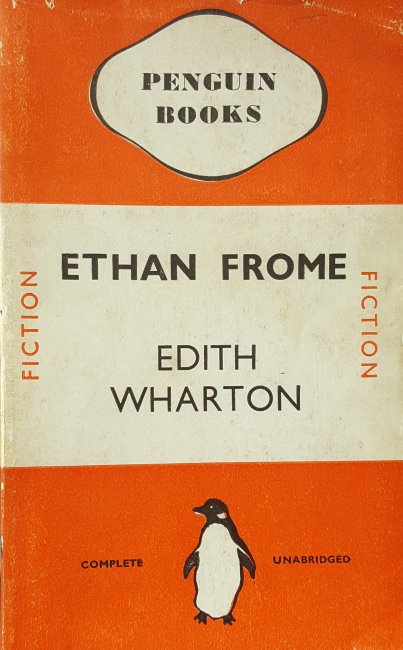
My copy is the first Penguin Books edition from November 1938, the book was first published in 1911 nine years before Wharton won the Pulitzer Prize for easily her best known work ‘The Age of Innocence” but by 1911 she had already published three full length novels, three shorter novellas, a couple of books of poetry, six volumes of short stories and even four non-fiction books, Wharton was clearly an experienced writer and this shows in her confident use of language and entirely believable dialogue in Ethan Frome. The book is now out of copyright and can be read or downloaded as an ebook from Project Gutenburg at this link.

Dodger – Terry Pratchett

Having had my annual read of Charles Dickens’ classic ‘A Christmas Carol‘ I thought I would follow it with a book not written by Dickens but one where he appears as a character. Set in the early years of Victorian London various real people interact with the fictional Dodger and his compatriots including not only Dickens but Disraeli, Gladstone, Robert Peel, Joseph Bazalgette and Henry Mayhew to name but a few. Of these probably the least well known nowadays is Henry Mayhew whose monumental book ‘London Labour and the London Poor’ sits on my shelves just as it did on Terry Pratchett’s. Without this exhaustive, but surprisingly readable, study of the poor in Victorian London which did so much to raise awareness of the problems that beset them and ultimately helped to improve their lot I doubt if Pratchett would have produced such a leap from his ever popular Discworld series. The book is unusually dedicated not just to Terry’s wife Lyn but also to Henry Mayhew.

Dodger, the star of the book is the nickname of a tosher, a person who scours the sewers of London for things that have fallen or been washed down the drains and got caught up in the detritus down there. It was a step up from being a mudlark, someone who similarly looked for lost items or money but along the tidal banks of the Thames, mudlarks still exist but as a hobby rather than a career but toshing stopped after Bazalgette designed the new, more capable, sewer system for London. Right at the beginning of the story Dodger rescues an unknown woman from two men and his adventure, and rapid rise up the social tree begins as his heroism is recognised by Henry Mayhew and Charles Dickens who come along just afterwards. Dodger is an interesting character, clearly based on descriptions in Mayhew’s book but fleshed out by Pratchett in quite a believable way even if his subsequent adventures do stretch the imagination somewhat especially after his encounter with another fictional character from the period Sweeney Todd, the demon barber. It says a lot for Pratchett’s ability as an author that you are quite willing to allow for the speed of the plot and the people he gets to meet so quickly, and improbably for his social class.

The story fairly races along with Dodger and the young woman he rescued being dragged into an international crisis due to her unfortunate background and the reason she was trying to get away. Because of this however it is almost impossible to discuss more of the plot in this review as it would give too much away for future readers but it is a really fun read which I managed in one, fairly long, sitting but I didn’t want to put the book down until I finished. At the end Pratchett provides a short section on his use of actual and fantasy Victorian London

I have to confess ahead of the game that certain tweaks were needed to get people in the right place at the right time … but they are not particularly big tweaks, and besides, Dodger is a fantasy based on a reality. … This is a historical fantasy, and certainly not a historical novel. Simply for the fun of it, and also too, if possible, to get people interested in that era so wonderfully catalogued by Henry Mayhew and his fellows.

Because although I may have tweaked the positions of people and possibly how they might have reacted in certain situations, the grime, squalor and hopelessness of an underclass which nevertheless survived, often by a means of self-help, I have not changed at all. It was also, however, a time without such things as education for all, health and safety, and most of the other rules and impediments that we take for granted today. And there was always room for the sharp and clever Dodgers, male and female.

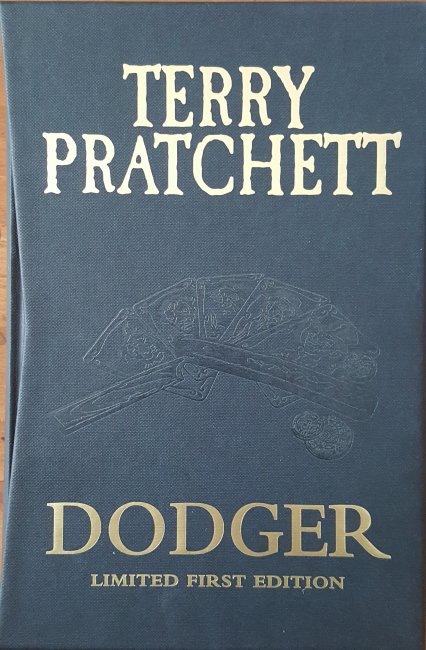
My copy is one of several ‘special editions’ produced when the book was first published on the 13th September 2012, this is the specially bound, stamped & numbered, slipcased edition limited to 3000 and sold exclusively by Waterstones, there was also various un-numbered ‘specials’:

  • 20000 copies exclusive to Waterstones with 500 for Australia with a special jacket and an extra section ‘The Wise Words of Solomon Cohen’ at the end.
  • 30000 copies for W.H. Smith along with 3000 for Easons with a bonus scene at end, Dodger goes to Bedlam to see Sweeney Todd. Both are the same except for different stickers on jacket.
  • 25000 copies exclusive to Tesco with post cards inside the front cover.
  • 6000 copies exclusive to Asda with a map of Dodger’s London at end.

This means that the ‘special editions’ outnumbered the ‘normal editions’ at publication in the UK of which there were 77000 copies. The ‘exclusive’ extra chapter in the edition for W.H. Smith and Easons was subsequently included in the UK paperback when this was published by Corgi on 26th September 2013. The Wise Words of Solomon Cohen do not appear to have been available in any other edition than the Waterstones special, they are not in my copy despite that also being a Waterstones exclusive. Bibliographic details are taken from the website of Terry Pratchett’s long time agent Colin Smythe which is a fount of knowledge on the subject of Terry’s works and is a fascinating read.

Sky Burial – Xinran

This is one of those books that is only on my shelves because it completes a set, in this case the twenty six volumes of Penguin Drop Caps which I have covered as a series right back at the beginning of this blog in early 2018. This does mean that I came to read the book with no preconceptions at all knowing nothing about either it or the author and I have really enjoyed it. Having said that I have a suspicion that Xinran made it into this collection more due to her name beginning with X than for the literary merit of the book. This could be the fault of the translators from the original Chinese, Julia Lovell and Esther Tydesley, as the style is rather flat which considering the subject matter seems odd but as I cannot read the original I have no way of knowing if that is better. I don’t know why Xinran didn’t make the translation as she has lived and worked as a journalist and writer in London since 1997 and this translation was first published in 2004 so presumably she would be more than capable of producing an English version herself.

The conceit of the book is that it is based on the real life story of a Chinese doctor Shu Wen who in 1958 who in 1958 at the height of the Tibetan-Chinese conflict went to Tibet to try to find out what happened to her husband who was a military doctor and ends up stranded there for over thirty years living with the nomads and travelling from camp to camp. According to the introduction Xinran met Shu Wen in Suzhou and talked to her over a period of a couple of days whilst she related her story, Shu Wen then suddenly checked out of her hotel and disappeared. Wikipedia appears to have fallen for this and describes the book as a biography but it is clearly listed as a work of fiction on the publication data page and frankly the idea that an intelligent woman would make no attempt to either continue her search or head back to China and would stay with the nomadic family for three decades is desperately unlikely. The resolution of the novel also stretches credulity to breaking point as a real life case with too many unresolved plot points being sorted out in a relatively short space of time compared to the vast amount of time with no movement on them at all.

Treating it as the novel that it is becomes far more rewarding than looking at it as a dubious biography, the book is 220 pages long in this imprint and I read it at one sitting as you do get drawn into the story. The depiction of Tibetan nomadic life is fascinating and it appears that Xinran did a significant amount of research, so you slowly learn, along with Wen, how the dynamics of family life operate. The book also largely avoids discussing the Chinese takeover of Tibet which has existed since the 1950’s, this is done by completely ignoring the subject by putting Shu Wen away from all contact with other Chinese people and any news of the world outside of the nomadic family she is with for a couple of decades. The exception is at the start where the conflict is acknowledged because that is why Shu Wen’s husband, Kejun, was in Tibet in the first place and also the description of Wen’s journey into Tibet having enlisted in the military and the surprise that her fellow soldiers have that they were not being welcomed with open arms as liberators from the rule of the Dalai Lama. This is where another extremely unlikely event occurs as Wen discusses with a senior officer and gets agreement from him to desert her unit in her search for Kejun. In a novel this is fine, strange things happen in novels, but in real life deserting the Chinese army at the time would have been punished severely.

I have deliberately not written much about the time Wen spends with the nomadic family or how the various issues are resolved as this is the real meat of the novel and any coverage would just be spoilers. Suffice to say that even though there is much that is not as good as it could be the book is a pleasant way of spending a rainy afternoon, just sit back, suspend belief a little, and go with the flow.

Longhand – Andy Hamilton

Andy Hamilton is best known as a comedy script writer and actor for TV and radio and his shows have been a constant favourite of mine since he started in the 1970’s especially the BBC Radio 4 long running series Old Harry’s Game which he writes and stars in as Satan. Not a particularly obvious subject for humour but as always with Hamilton he finds a new way of looking at the character and that is what imbues him with comedy. In this book, his second novel, he takes another mythological character and brings him to life in a surprising way telling his story and allowing him to debunk a lot of the myth around him.

We first meet our hero, for hero he is even if he doesn’t like it and for reasons that swiftly become clear he shuns publicity as much as he can, frantically writing a very long letter to the woman he loves because he has to leave her and for the first time in thousands of years feels that he has to tell her why. As you can see below the joy of the book is that we get the letter, the whole book, all 349 pages of it, is handwritten, with crossings out and edits just as Malcolm would have written it.

The reader finds out almost immediately that Malcolm is actually Heracles and has lived for thousands of years always having to move on as firstly he never ages so starts to look odd to people who know him for a long time but secondly, and as it turns out more importantly, Zeus is determined he will never be happy and has tormented him throughout the millennia. The letter he writes to his darling Bess over a period of three days is funny yet also tragic; it is without doubt a love letter but also a confession and Hamilton handles the emotional roller coaster perfectly. I found myself reading late into the night as I simply didn’t want to stop finding out more about Malcolm and Bess and the ways that he tries to disguise his enormous strength and immortality from all those around them.

I have read many versions of the Greek myths so knew Heracles’s story but it isn’t necessary to know any of that before reading this book, Hamilton takes us right through the tales mainly so Malcolm can explain why they are so wrong and what really happened. It’s a brilliant idea and, to me at least, a completely original approach to mythological story telling, Malcolm is so ordinary because he has to be but his back story is one of wanton destruction and tragedy, he so despises that aspect of his early life and just wants to be ‘normal’. With Bess he has found that normality he craves but as the letter explains he is being forced to abandon the happiness he now has and at a truly awful point in time.

By the end of the book you are totally invested in the tragic love story of Malcolm and Bess, a tale that fit right in with the classical Greek mythology that Hamilton has mined for his characters’ source. We never hear from Bess in the whole book, other characters are reported verbatim but Bess is always heard through the medium of Malcolm’s letter as he explains what had just happened in the hope that she will forgive him. Fortunately we know right from the beginning that she does and that she still loves him as there is one other letter included right at the front and that is typewritten ostensibly from a firm of solicitors to the publisher. I read this first as that is where it is placed but rereading it after finishing Malcolm’s letter you understand it better.

The book is published by Unbound, a crowd funded publishing house, and I subscribed to it before Andy Hamilton even started to write, based partly on the pitch that he made on the site but also as a fan of his work over many decades I knew that he would produce something well worth reading and he has certainly delivered. As a subscriber I received a signed copy on publication and my name is in the list of around five hundred people who supported the work through to publication.

Busman’s Honeymoon – Dorothy L Sayers

20200901 Busmans Honeymoon

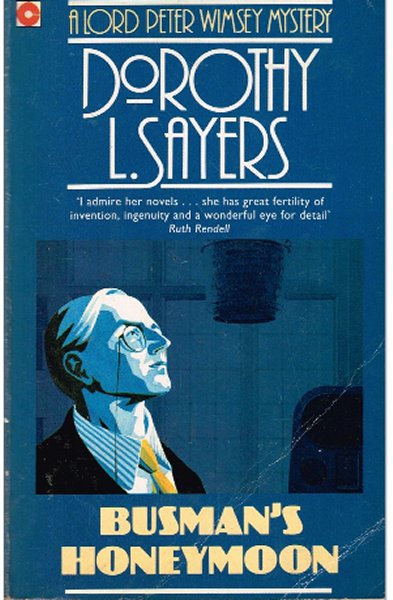
I decided to top and tail the four major science works in August with something lighter, and a couple of detective fiction novels fitted the bill nicely, specifically Murder on the Orient Express by Agatha Christie and this book Busman’s Honeymoon by Dorothy L Sayers. For those people not familiar with the origins of the title a busman’s holiday is where somebody takes a break from work but still ends up being involved in their career in some way for example a bus driver who holidays by taking a coach trip. Whilst Lord Peter Wimsey isn’t a professional detective, being instead an extremely wealthy junior member of the aristocracy with a talent for detection, it was of course inevitable that he would end up solving a crime on his honeymoon.

This book is the eleventh and final novel written by Sayers about Lord Peter and first published in 1937, there would be some later short stories but this is his last outing in a significant work and rounds off nicely the ongoing romance between Lord Peter and Harriet Vane which began in “Strong Poison”. Although Harriet is definitely not interested in getting to know Lord Peter any more than she has to at that time as he manages to prove her innocence on a charge of murder. There follows more novels involving the two characters as he eventually manages to persuade her to accept his proposal of marriage at the end of “Gaudy Night”. As a wedding present he buys her the house Tallboys that she loved as a child and they decide at the last minute to take their honeymoon there. Arrangements are made with the previous owner to collect the keys and retain the furniture for a month until they can replace it with their own but on arrival late in the evening he is nowhere to be found and the house is locked up. The first mystery is therefore where is Noakes?

They eventually get access to the house via some spare keys and spend the night before discovering the body of Noakes in the cellar but not with injuries that he would have received if he had for instance fallen down the stairs, in fact the injury that clearly killed him could not have occurred in the cellar at all so how did he die? Cue a cast of characters several of which could have done the deed or at least have a motive but no obvious murder weapon to be found. There are several twists as Lord Peter and the local police force come up with various options for who? and how?, all of which hit the main problem that the house was locked up from the inside so how would anyone get away after killing him? The book was adapted from a play of the same name first performed in 1936 and it still has set pieces that feel like a stage setting, especially the limited number of locations used and the gathering of the entire cast in the front room for the denouement.

It has to be said that Busman’s Honeymoon is by no means the best of the Lord Peter Wimsey stories, for me that would either be “The Nine Tailors” or “Gaudy Night” but it did fulfil my requirements of a pleasant light read after the heavyweight works over the last few weeks. If you have never encountered Lord Peter Wimsey and Bunter his faithful manservant I heartily recommend them although don’t start here, the first novel is “Whose Body?” written in 1923 which introduces the characters.

Tartarin of Tarascon – Alphonse Daudet

20200721 Tartarin of Tarascon 1

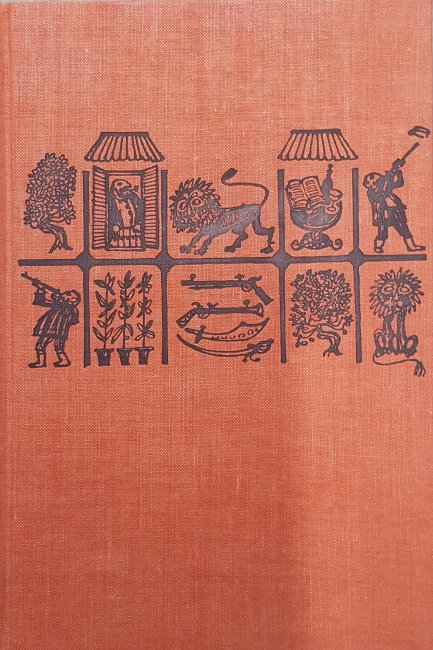
Unusually for books on my shelves I have no memory of acquiring this one, it was printed by the Folio Society in 1968 and I suspect I purchased it with others in a mixed lot of Folio Society volumes when I really wanted some of the others in the collection. It does mean that now that I have come to take it down off the shelves I realise that I have no idea who Alphonse Daudet was and no concept as to what the book will be about. I don’t even know when the book was originally written as the only date inside is that of the translation by J M Cohen which is the same year as publication suggesting that this was an early translation for the Folio Society who up to this time tended to rely on reprinting already translated works.

20200721 Tartarin of Tarascon 2

For reasons that will be explained later this novel took far longer to read than such a short book should have. It was written in 1872 and is clearly set at the same time and the first section takes places in the Provençal town of Tarascon, Daudet was a French novelist and writer of short stories, although his literary output was relatively modest in comparison to his English contemporary Charles Dickens, he has numerous schools and colleges named after him around France which attest to his popularity in his time. Tarascon is depicted in the book as populated by such dedicated hunters that there is no wildlife left in the area and the men of the town go out each week with their guns and shoot their caps which are thrown into the air for the purpose as there is nothing else to fire on. The one who most destroys his cap hangs the remnants on the end of his rifle and leads the parade back into town, this is apparently usually Tartarin. The consequence of this cap shooting makes the most profitable shop in town the hat shop.

Tartarin is, or believes he is, the greatest at all things in the town and as can be seen in the picture above lives surrounded by weaponry of all sorts. He is also convinced that there are secret assassins everywhere and always goes out armed and take circuitous routes to the club in the evening to shake them off. There are other apparent peculiarities regarding the residents of Tarascon such as each family having their own song which they sing each evening and it is unheard of for any other family to sing any others song at any time, apart that is for Tartarin who will join in with all the others at the drop of a hat, or probably the remains of one. The trigger for the plot of the novel is the arrival of a circus with a lion, here at last was an animal worthy of hunting and Tartarin declares in his usual boastful way that he will go to Africa on behalf of the town to hunt.

20200721 Tartarin of Tarascon 3

So far so good, a short comic novel about a real town that Daudet has populated with ridiculous characters doing ridiculous things and initially it appears that the trip to Algeria that Tartarin is eventually shamed into doing after spending months hoping that his boast will be forgotten will be a satire of French colonial attitudes in that country, which it is, but only occasionally. The illustration above shows Tartarin in the outfit he chose for the journey, a very much stereotypical ‘Turk’ costume which he believes would be what everyone in Algeria would be wearing only to be very surprised when he is the only one. But this is where the book starts to fall apart, the clothing choice is clearly a dig at parochial attitudes in provincial France but once the action is in Algeria Daudet allows his racist and specifically anti-Semitic beliefs to come through although also makes comments regarding the colonial status quo. There are several derogatory statements about Jews the milder of which I can repeat below as it illustrates my earlier statement, others I wouldn’t include

Just ask the Arabs. Hark to how they explain the French colonial organisation. ‘On the top,’ they say, ‘is Mossoo, the Governor, with a heavy club to rap the staff; the staff, for revenge, canes the soldier; the soldier clubs the settler, and he hammers the Arab; the Arab smites the Negro, the Negro beats the Jew, and he takes it out of the donkey. The poor bourriquot having nobody to belabour, arches up his back and bears it all.’

Another comment about the Algerians which is also a valid point on colonialism is

A wild and corrupted people whom we are civilising by teaching them our vices

There is also the issue of Tartarin himself, surely nobody could be that naive as he falls for all the cons perpetrated on him but also just where did he get all his money? He is in Algeria for at least four months and is conned out of a significant amount of money on top of the huge amount spent before he leaves France on guns and equipment, but at the end of the book still has

his pocket-book, a good-sized one, full of precious papers and bank-notes

well until it finally gets stolen anyway. He just isn’t believable.

In summary I started off enjoying the story but gradually got more irritated by it and reading got slower as I progressed. If I wasn’t going to write about the novel I would probably have given up before the end.

The Napoleon of Notting Hill – G K Chesterton

Name a British novel written by one of the most celebrated authors of his generation, set (at least at the start) in 1984 where in the future Britain has an government headed by a powerful single ruler telling his populace what to do. No I don’t mean Orwell and his apocalyptic volume written in 1948 and published June 1949, this one was written and published in 1904, was admired by Orwell and one, quite likely, theory for Orwell choosing 1984 as the year of his book was that Chesterton had also used that year for his stab at futurology forty four years earlier.

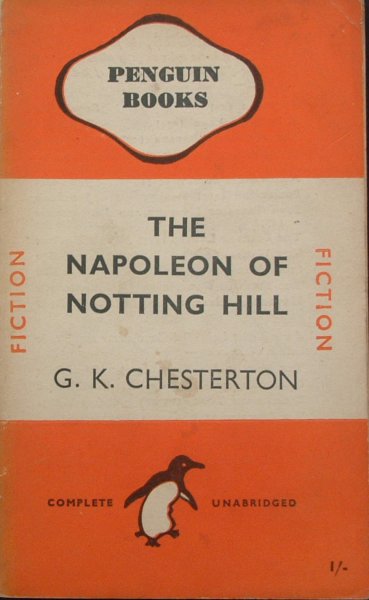
20200331 The Napoleon of Notting Hill

Sadly Chesterton’s brilliant work is now largely unread, unlike Orwell’s more famous book set in the same year. My copy is the Penguin Books first edition and was printed in 1946, before Orwell even started his most famous and final book. But enough about Orwell, this is about G K Chesterton’s first novel, he wrote some poetry and biographies with other people before this from 1900 but this was his first work of significance and what a way to start. The premise of the book is spelled out by Barker, one of the three civil servants that we encounter at the beginning of the book, right at the start whilst he is trying to explain how this future England is governed to of all the people the deposed President of Nicaragua who unexpectedly comes walking down the street.

We have established now in England, the thing towards which all systems have dimly groped, the dull popular despotism without illusions. We want one man at the head of our State, not because he is brilliant or virtuous, but because he is one man and not a chattering crowd. To avoid the possible chance of hereditary diseases or such things, we have abandoned hereditary monarchy. The King of England is chosen like a juryman upon an official rotation list. Beyond that the whole system is quietly despotic, and we have not found it raise a murmur.

The ex-President raises the obvious objections regarding the possible sanity of such a person if there are no checks and balances but these are over-ruled by the three Englishmen he is talking to, all of which will be significant in the unfolding tale. One of which is, if not actually mad, possessed of a very odd sense of humour which I had been struggling with up to this point; it turns out that Chesterton is simply trying to illustrate how odd Mr. Auberon Quin actually is. After leaving the restaurant where they had entertained the ex-President, Quin becomes more and more eccentric in his behaviour until they are approached by two policemen.

Two grave-looking men in quiet uniforms came up the hill towards them. One held a paper in his hand.

“There he is, officer,” said Lambert, cheerfully; “we ain’t responsible for him.”

The officer looked at the capering Mr. Quin with a quiet eye.

“We have not come, gentlemen,” he said, “about what I think you are alluding to. We have come from head-quarters to announce the selection of His Majesty the King. It is the rule, inherited from the old régime, that the news should be brought to the new Sovereign immediately, wherever he is; so we have followed you across Kensington Gardens.”

Barker’s eyes were blazing in his pale face. He was consumed with ambition throughout his life. With a certain dull magnanimity of the intellect he had really believed in the chance method of selecting despots. But this sudden suggestion, that the selection might have fallen upon him, unnerved him with pleasure.

“Which of us,” he began, and the respectful official interrupted him.

“Not you, sir, I am sorry to say. If I may be permitted to say so, we know your services to the Government, and should be very thankful if it were. The choice has fallen….”

“God bless my soul!” said Lambert, jumping back two paces. “Not me. Don’t say I’m autocrat of all the Russias.”

“No, sir,” said the officer, with a slight cough and a glance towards Auberon, who was at that moment putting his head between his legs and making a noise like a cow; “the gentleman whom we have to congratulate seems at the moment—er—er—occupied.”

“Not Quin!” shrieked Barker, rushing up to him; “it can’t be. Auberon, for God’s sake pull yourself together. You’ve been made King!”

And so the catastrophe that will be the reign of King Auberon begins. As you can see this is a very different work to Orwell, full of humour but nevertheless there will be tragedy, warfare and death and also poignancy as each featured character gets swept up in the madness which becomes normality before finally it all collapses thirty five years after the start of the novel in 2019. So what is it that the new King does that causes such upheaval? Well for reasons unknown in the early stages of the book he decides to re-introduce the medieval concept of City States but these are not the cities of London, Manchester, Birmingham etc. no he is far too parochial for that, the book is set entirely in London and he creates City States out of the individual boroughs. Now most modern cities (apart from those artificially created such as Brasilia) are a conglomeration of small towns and villages that gradually became swamped by the city itself and became the merely districts. King Auberon pits each of these against the other along with fanciful histories that he creates for them explaining their names and releases “The Great Proclamation of the Charter of the Free Cities” which will force each borough to effectively step back to medieval times not just in their dealings with himself and the other boroughs but with costumes and banners also designed by the King and militias armed with halberds and swords.

The King was happy all that morning with his cardboard and his paint-box. He was engaged in designing the uniforms and coats-of-arms for the various municipalities of London. They gave him deep and no inconsiderable thought. He felt the responsibility.

“I cannot think,” he said, “why people should think the names of places in the country more poetical than those in London. Shallow romanticists go away in trains and stop in places called Hugmy-in-the-Hole, or Bumps-on-the-Puddle. And all the time they could, if they liked, go and live at a place with the dim, divine name of St. John’s Wood. I have never been to St. John’s Wood. I dare not. I should be afraid of the innumerable night of fir trees, afraid to come upon a blood-red cup and the beating of the wings of the Eagle. But all these things can be imagined by remaining reverently in the Harrow train.”

And he thoughtfully retouched his design for the head-dress of the halberdier of St. John’s Wood, a design in black and red, compounded of a pine tree and the plumage of an eagle. Then he turned to another card. “Let us think of milder matters,” he said. “Lavender Hill! Could any of your glebes and combes and all the rest of it produce so fragrant an idea? Think of a mountain of lavender lifting itself in purple poignancy into the silver skies and filling men’s nostrils with a new breath of life—a purple hill of incense. It is true that upon my few excursions of discovery on a halfpenny tram I have failed to hit the precise spot. But it must be there; some poet called it by its name. There is at least warrant enough for the solemn purple plumes (following the botanical formation of lavender) which I have required people to wear in the neighbourhood of Clapham Junction. It is so everywhere, after all. I have never been actually to Southfields, but I suppose a scheme of lemons and olives represent their austral instincts. I have never visited Parson’s Green, or seen either the Green or the Parson, but surely the pale-green shovel-hats I have designed must be more or less in the spirit. I must work in the dark and let my instincts guide me. The great love I bear to my people will certainly save me from distressing their noble spirit or violating their great traditions.”

All these places are of course within the boundaries of London so no more than a few miles apart and as for forests of fir in St. John’s Wood there probably hasn’t been any forests there since Roman times. The genius of the book is maintaining this ridiculous analogy in all seriousness as it also becomes clear that the King has not done this in madness but simply a a great joke to keep himself amused. And all is strange but well in the land until there rises, ten years later, as Provost of Notting Hill a man who is truly mad in his own singular way and believes totally in the scheme as the only true way for the anywhere to be governed and is prepared to fight to maintain his Notting Hill in all his supposed glory.

This is where the book darkens considerably for there is war to be fought as the surrounding City States of West Kensington, South Kensington, Bayswater etc. are forced into various conflicts with the fiercely independent Adam West, Provost of Notting Hill. It is also where my review will end. To reveal more would give away the book and you do really need to read it. I hope that the extracts I have included will encourage you to do so. Say G K Chesterton to somebody nowadays and if they have heard of him at all it will be the Father Brown detective stories, but there are over eighty books, hundreds of poems, a couple of hundreds short stories and an astonishing more than four thousand essays. He is one of the most prolific writers of all times and to be largely known by the fifty three short stories that make up the Father Brown canon is a great disservice to his legacy.

You can read The Napoleon of Notting Hill on Project Gutenburg here as it seems to have been out of print for quite some time so tracking down a printed copy will need some searching.

Cannery Row – John Steinbeck

Cannery Row in Monterey in California is a poem, a stink, a grating noise, a quality of light, a tone, a habit, a nostalgia, a dream.

20191112 Cannery Row

From the Penguin ‘Drop Caps’ series that I covered last year in a general review of all twenty six books, and I’m amazed that I had never read it before, the quote at the top is the opening line and immediately draws the reader in. What little Steinbeck I have read in the past I have thoroughly enjoyed, he really was a master wordsmith able to conjure totally believable characters with just a few sentences or even a handful of words and what characters he has populating Cannery Row and it was his “keen social perception” that he was awarded the Nobel Prize for Literature in 1962. There is a plot to the narrative but it is definitely secondary to the characterisations deployed. You really get to know marine biologist Doc and his lab/home, Mack and the boys at the Palace Flophouse and Grill (a rather grandly titled abandoned storage shed), Dora and her girls at the Bear Flag Restaurant (in reality a bordello), Lee Chong and his shop which seems to stock everything, albeit totally randomly, and the general human detritus living in whatever shelter they can find along the Row.

The people are poor but making the best of their situation, the time is the 1930’s during the Great Depression and times are hard. The main employers are the sardine canneries that give the area its name although the work depended on the arrival of the boats loaded with fish which also gives the area its distinctive odour. None of the characters are actually in employment at the canneries though, apart from when they need some money which they cannot get some other way. Lee Chong, Dora and Doc all have legitimate businesses in their own right. Lee’s grocery presumably would make money if his customers actually had any, what it mainly makes is debts which do mainly get paid off when he refuses to extend any more credit to somebody unless they actually part with some money to cover the backlog. Doc is the main character of the book, he owns Western Biological Laboratory, and if anyone in the US wanted a specimen of pretty well any sort of animal Doc would get it for them, eventually anyway. Dora as stated above owns the bordello and probably makes more money than any of the other characters but has to hand over large parts of it in ‘charity’ just to ensure that the authorities keep looking the other way. She is genuinely kind hearted though and looks after her staff who can’t work much due to age or infirmity, one breaks her leg during the book and there is no suggestion that because she can’t work she would lose her room or meals each day.

Mack and the boys at the flophouse, which they con Lee Chong out of at the start of the book, don’t work unless they have to, they have developed over the years a sense of contentment about their lives where they can get what little they need to survive somehow, even if it actually belongs to somebody else at the time. What they will do is get creatures for Doc at a fixed price that everybody knows because that’s more of an adventure than ‘working’ for a living. Despite their low grade criminality you can’t help but like them, they are more victims of their schemes than pretty well any one else and they are genuinely remorseful when things go badly wrong.

Even the bit parts are masterful, I particularly enjoyed the regular appearances of the old Chinaman as he wandered down to the sea and back each day; and like a minor character in a West End farce he always failed to interact with any of the major players whilst just walking through the narrative adding nothing to the plot apart from a comic interlude and a sense of wonder. Just what is it he is doing and why? It’s never explained.

The book revolves around Doc, his need for specimens and his love of classical music, his books and a quiet life. The plot, such as it is, involves Mack and the boys wanting to do ‘something nice for Doc’. They decide on a party so then need to raise some money to finance it, how they get the ‘money’ and the form it takes is really funny and the disaster of the party leads to real poignancy as the various characters reflect on how it went so horribly wrong and what to do to try to make it right. The book is brilliant and difficult to put down when you have started you just need to know more about the population of Cannery Row and apparently there is a sequel so I have to get a copy of that.