Orlando – Virginia Woolf – part 2

This blog follows on from Part 1 but goes through the entire plot line so should not be read if you have not previously read the book or do not mind knowing what happens.

The book is split into six chapters and each is effectively a stand alone tale dealing with a specific period in Orlando’s life. The first chapter makes perfect sense as you read it, Orlando is a boy when Queen Elizabeth I visits his fathers’ great house and so captivates Her Majesty that he is invited to court towards the end of her reign, where he grows up to be a young man about town and is still around the court when James I becomes king after the death of Elizabeth. By the end of this chapter you are happily reading a novel set in the time of the Stuarts where Orlando has loved and lost the Russian noblewoman Sasha and you are wondering what will befall him next.

Chapter two has him exiled from court due to the scandal with Sasha and spending time back in the family house attempting to write great works but being unsatisfied with them all and holding parties. This is a not so subtle reference to Virginia’s lover Vita Sackville-West who is also trying to write ‘a great work’ but Virginia doesn’t rate her as an author and doesn’t believe she is capable of achieving this ambition. Orlando also at this time meets Romanian Arch-duchess Harriet who attempts to seduce him but without success. Ultimately Orlando is getting bored stuck at home so that he requests a job from the King and is sent as ambassador to Turkey. This is also a reference to Vita as she lived in Constantinople (as it was then) when her husband was sent to the embassy there from 1912 to 1914.

If you know English history a few comments in the book may be ringing bells by now but the storyline still flows without many issues. The third chapter deals with his time in Turkey initially as ambassador but then the book takes a dramatic swerve. There are a few pages that read like sections of an ancient Greek play, with Purity, Chastity and Modesty introduced as characters parading through his bedroom with trumpet calls and overblown narrative until Orlando finally awakes as a woman. As a plot twist it is certainly unusual and gets odder as people seem relatively unfazed by the change and as the embassy had been attacked during an uprising whilst Orlando slept he/she goes off to live with gypsies for a while. This last part is again a link to Vita who had a highly romanticised view of the Romany people as free living and unconstrained by the pressures of modern life. The book has her living with them for a while and then realising that she is really an interloper and misses the green lands of her home, this is Woolf pointing out to Vita that for all she may fantasise about the gypsy life she would not cope with the reality.

Chapter four has her decide to return to London and her home in Kent where she again meets the Arch-duchess who reveals herself to actually be Arch-duke Harry and this time as a man tries to seduce the now female Orlando with much the same result. Again nobody appears to be surprised by this. She throws herself into London society and meets many famous writers before taking to disguises to explore the seedier side of London to stop life getting too dull. By the end of this chapter the aspect of the book that was ringing bells earlier has now been made explicit but without any explanation, I’ll get to it later.  The fifth chapter takes place entirely in the great house without providing much detail as to what goes on. By the end however the court cases started when she returned from Turkey as a woman and caused all sorts of issues with who owned what and if she really was Orlando are settled although they have used up most of her fortune and she marries somebody she has barely got to know just in time for him to leave to go to sea.

The book ends with her finally finishing her great work “The Oak Tree” and it being praised and even winning a prize before her husband returns to her from foreign climes and she rushes to greet him.

20180529 Orlando 3

This cover is a bit problematic for me as the inclusion of the aircraft gives away the one aspect I left out in the summary above and that is the time travelling aspect of the novel. You start reading the book and it is clearly set at the end of the 1500’s with the reign of Elizabeth I coming to an end. Orlando is mentioned several times lying under the tree so what is the plane doing there?

In fact you slowly become aware of the drift of history through the book. As stated above Orlando was clearly a young man at the end of Elizabeth’s reign and much later on in the book we discover that the poem he has been working on since boyhood is dated 1586, so that would probably place him as born in around 1575, Elizabeth died in 1603 and we know he was at court during her reign for a period of years. The next monarch mentioned is James I (1603 to 1625) during whose time Orlando is largely banished from court after his relationship with Sasha at the frost fair. There were two of these during his reign (1608 and 1621) so Orlando is roughly 33 or 46 at this point. The first of these sounds more likely from his behaviour so let us say he retires to his country house in 1608, this is all quite plausible up to this part of the novel.

The next time period mentioned is when he goes to be Ambassador to Turkey after getting tired of being at home. I’m not surprised he was getting bored by then as the Monarch he asks for the job is King Charles II (he is described as being with his mistress Nell Gwyn so we know which Charles we are talking about). His reign was from 1660 to 1685 and he started his relationship with Gwyn in 1668 so as a minimum Orlando is now 93 and has spent at least the last 60 years holding parties at home. This is the first time that the time-scale appears to have stretched, as up until he goes home in 1608 it is quite believably a tale about a late Elizabethan gentleman, nobody appears to be surprised by this and he is still clearly a young man in the novel. Charles II is still on the throne when Orlando is made a Duke and subsequently changes sex. We then hit her time with the gypsies and this is also clearly several decades. On return to England she sees the dome of the new St Paul’s cathedral (consecrated 1697) and the captain of the ship refers to the late William III (died 1702) so we are now in the reign of Queen Anne (1702 to 1707) and this is explicitly stated later in the book as Orlando enters society as a young and eligible woman at the age of 130!

At last a positive date… Well sort of. There is a mention of 16th June 1712 being a Tuesday, it was actually a Thursday but never mind, it is the first specific date in the novel and this is when Orlando decides to quit society only to decide not to the next day due to an invitation that she really wanted to go to. There she meets Alexander Pope and through him various other writers such as Swift who quotes from Gulliver’s Travels, a book printed in 1726 so time is still moving on apace. She sees Johnson and Boswell (circa 1770’s) and chapter four concludes with the dawning of 1st January 1800 with a dark cloud over London. Chapter five includes a statement that she had been working on the poem “The Oak Tree”

… for close on 300 years now. It was time to make an end.

so that takes us up to the 1860’s. This is another huge leap in the time line of the book as it is only 8 pages into the chapter. It’s an odd chapter, using damp weather as a metaphor for the changes in society through the Victorian age, no more gay parties and bright lights, now the houses are cluttered and cold, the people withdrawn and everything is dark and covered up as society becomes more straight-laced and women are expected to be ‘the little woman at home’ safely married off. It’s also no wonder the court proceedings have used most of her fortune, they would have started in the early 1700’s and concluded roughly 160 years later as Lord Palmerston and Gladstone are mentioned with the court documents and Palmerston died in 1865. It is worth noting however that it does leave Orlando with the house, which as I stated in the previous essay on the book Vita specifically didn’t get as she was a woman so maybe this is a put in as a solace to Vita that although it may take 160 years a woman will eventually inherit what would be hers by right if she had been a man.

The sixth, and final, chapter brings us to the present day, well 1928 which is when the book was written anyway. It begins slightly before then at the end of the Victorian age as she finally gets her poem The Oak Tree published with the help of Nicholas Greene but most of the chapter is set on the 11th October 1928 starting in London with a very confused shopping trip. She drives out of London to the great house in Kent and is there as her husband finally comes home this time by aeroplane whilst she lies under the tree as she used to as a boy centuries earlier

It is not only Orlando who straddles time in the novel, several of the fictional characters fail to grow old with her, the Arch-Duchess/duke is also mentioned in chapter five as married and settled in Romania so he is also as old as Orlando and others survive well beyond a normal lifespan such as Nicholas Greene, the poet and critic who first met Orlando in the Elizabethan age and meets her again in the Victorian. Sasha from the frost fair in 1608 is also glimpsed during the shopping trip in 1928 and is described as late middle aged. Orlando’s husband, Shelmerdine, is also timeless, at least since coming into contact with Orlando, for they meet and marry in the 1860’s when her court cases have completed but he is clearly still only in middle age by 1928.

The book is complex and at times infuriating as it leaps about but still an enjoyable read, I’ve also had quite a bit of fun reading through it again trying to identify all the historical events that can be dated for this essay.

Orlando – Virginia Woolf – part 1

HE – FOR THERE could be no doubt about his sex, though the fashion of the time did something to disguise it – was in the act of slicing at the head of a Moor which swung from the rafters. It was the colour of an old football, and more or less the shape of one save for the sunken cheeks and a strand or two of coarse, dry hair, like the hair of a coconut.

The opening two sentences of Orlando certainly make you want to know more… Just what is going on here?

Virginia Woolf’s best known work is 90 years old this year so it seems appropriate to write about it now. The book is strange reading it now; it must have been extraordinary to readers back in 1928 with it’s bizarre plot twist halfway through. Although for me it’s what Woolf does with the character of Orlando before and after that point that is interesting rather than the twist itself but it must have been quite a jump for the casual reader in 1928. I have split this blog into two because I really want to be able to discuss the plot line and that will require me to include a lot of spoilers so this part talks generally about the book and part two will summarise the plots within it and contain the spoilers, so if you haven’t read Orlando this blog is perfectly safe.

20180529 Orlando 1

Although it is a short novel (just over 200 pages) there is a lot packed into the book and part of the conceit of it is that it claims to be biography. Virginia writes in first person as the biographer and frequently employs the literary equivalent of the theatrical trick of ‘breaking the fourth wall’ by talking directly to the reader about the difficulties of finding material to work from in compiling the biography. There is even a short index at the back as you would expect in such a work. One particular passage near the end of the book sums up this stylistic method rather well.

It was now November. After November comes December. Then January, February, March and April. After April comes May. June, July, August follow. Next is September. Then October, and so behold, here we are back at November again, with a whole year accomplished.

This method of writing biography, though it has its merits, is a little bare, perhaps, and the reader, if we go on with it, may complain that he can recite the calendar for himself and so save his pocket whatever sum the Hogarth Press may think proper to charge for this book.

As can be seen ‘the biographer’ can be quite chatty to the reader but also quite pompous, these brief interludes give you time to absorb wherever the plot has suddenly taken us next, but it is also Virginia’s way of ridiculing historical biographers who she clearly thought took themselves far too seriously.

From the way she writes about it Woolf was clearly also not a fan of ‘Society’, that endless round of functions and engagements that the upper classes seemed so devoted to right up to her time. There are many disparaging passages in the book about this foolish waste of time and money where nothing seems to be done or said that was memorable. She is also less than enamoured by her own profession of writing, or at least the majority of what was being written at the time, one particularly favourite quote of mine from the book is.

For it is rash to walk into a lion’s den unarmed, rash to navigate the Atlantic in a rowing boat, rash to stand on one foot on the top of St. Paul’s, it is still more rash to go home alone with a poet.

The book is definitely an oddity, so many different things happen and great numbers of historical characters are introduced and yet there is the constancy of the huge family house which is used to pull Orlando back to normality when things get too strange only to bore after a while and lead into another adventure. It really becomes one of the characters in the story and is the solid anchor around which the shifting tale is woven.

20180522 Orlando 4

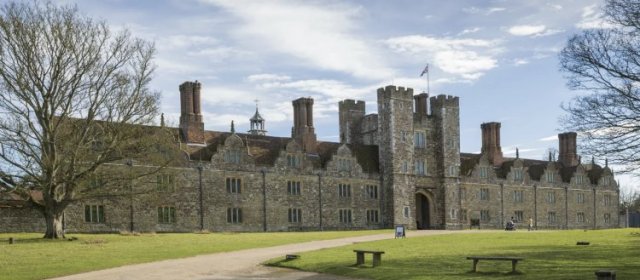
The house featured in the book is clearly based on Knole in Kent, one of the largest houses in England; and one I know well, as it is 17 miles from where I used to live at the end of the 1990’s. It was the family home of Vita Sackville-West and like her house at Sissinghurst it is now owned by the National Trust. I used to go there regularly to explore the 1,000 acre park or wander round the house, it has according to Vita 365 rooms just as Orlando’s vast house does; although she also said that “I do not know that anyone has ever troubled to verify it”. The house was also the source of great sadness for Vita as if she had been born a man she would have inherited it as her parents only child but as a woman she was passed over in favour of her cousin. As explained in my previous blog about Vita, she and Virginia were lovers for many years and there is a lot of Vita’s family history interwoven in the book.

The dig at writers and specifically poets mentioned above was also somewhat aimed at Vita who was clearly not in Virginia’s league and for all that she loved her Virginia really didn’t rate her as a poet or author. There is also, at the start of the final chapter some discussion as to whether it is even proper for a married woman to be a writer. Clearly it is fine for an unmarried female to dabble in writing for her own amusement and also what is marriage anyway…

She was married true: But if one’s husband was always sailing round Cape Horn was it marriage? If one liked him, was it marriage? If one liked other people, was it marriage? And finally, if one still wished, more than anything in the whole world, to write poetry, was it marriage? She had her doubts.

Both Virginia and Vita were married throughout their relationship and Vita in particular took other lovers at the same time both male and female. Orlando was written at what is now recognised as the peak of their love for each other when both were also at their creative best, probably feeding inspiration off each other. It was also a time of female emancipation in Britain, 1928 was not only when this book was written but it was also the year that woman finally gained full voting equality with men and more pointedly a couple of pages later Woolf includes the line…

as long as she thinks of a man, nobody objects to a woman thinking

I struggled initially with the plot of the book (see part 2) but I’m glad I persevered, this is the first of Woolf’s novels I have read although I had read her best known feminist work ‘A Room of One’s Own’ and ‘The Common Reader’ before. Maybe it’s time to get that copy of ‘To The Lighthouse’ off the shelves where it has languished for a few years.

20180529 Orlando 2

Of equal interest, to me at least, is the background to the three copies of the novel that I possess and two of whose covers have punctuated this essay. The top one is the first Penguin Books edition (number 381) from July 1942 and therefore published under wartime restrictions. This meant that fewer copies were printed than might have been the case before the war and also that the paper quality is poor to say the least, making the book quite fragile.

The second cover at first glance look to be the same, but this was printed in Cairo in 1943 for the troops fighting on the African front. This explains the price in piastres printed on the cover. If possible these books, there were 20 titles printed in English and 1 in French as part of this programme, are even more fragile than the ones produced in England at the same time and few have survived their time in the Africa campaign. Books for the troops were in short supply, especially in Africa and as any soldier will tell you a culture of ‘hurry up, and wait’ means that there is a lot of quick movement followed by long periods of not a lot apparently happening so any reading material was eagerly seized upon. Quite what the troops made of this very strange book is not recorded, I can think of many more suitable novels from Penguins extensive catalogue which would have been a lot more popular.

The third copy I have is the American Penguin edition from April 1946 and this being far more capable of surviving having its pages turned is the copy I read for these essays. However as the illustrated cover includes a massive spoiler for the book I have used this in part 2 of my discussion of Orlando. There is also an interesting tale behind this imprint. Penguin wanted to sell books in America during the war but clearly shipping books across the Atlantic was out of the question, as was using up the paper ration that they had been allocated on books which would not then end up on sale in the UK so they sought an agent to produce the books for them. They settled on Ian Ballantine and he originally printed books that looked like their UK equivalent but soon switched to illustrated covers to appeal more to the American reader. In the end under his control over 180 titles were printed in the US as either Penguin or Pelican before in 1948 Penguin Books withdrew from this enterprise as they could now export again. The titles were re-branded as Signet (for the Penguins) and Mentor (for the Pelicans) and Ian Ballantine with his wife Betty continued to publish under those brands before also creating Bantam, New English Library and of course Ballantine books. The Ballantine book group was acquired by Random House in 1973 which in turn merged into Penguin Random House in 2013 thereby bringing the story full circle.

King Penguins

Although the longest essay I have written here so far, this is just a brief introduction to a very attractive series of books produced by Penguin from 1939 to 1959. Covering a vast array of subjects with (for the most part) excellent illustrations in both black and white and colour they make up a mini reference library all on their own.

20180626 King Penguins 01Starting a new series of illustrated hard back books just as war had broken out was clearly just bad timing for Penguin Books, they had been planned for months and the first two were ready to go for November 1939. That the series not only survived the subsequent paper rationing but flourished for a further 74 volumes until 1959 was nothing short of a miracle. Almost all the books have the same format, a monograph on the specialist subject which may also include black and white line illustrations or photographs, followed by a series of colour plates. The monograph averages about 30 pages; although Ur by Sir Leonard Woolley has only 18 and at the extreme opposite A Book Of English Clocks by R.W. Symonds has 74 pages of text. Likewise the colour plates were intended to be on 16 pages, this also varies but by no means as much as the texts as this was easily the most expensive part of each production so costs were closely monitored.
20180626 King Penguins 03

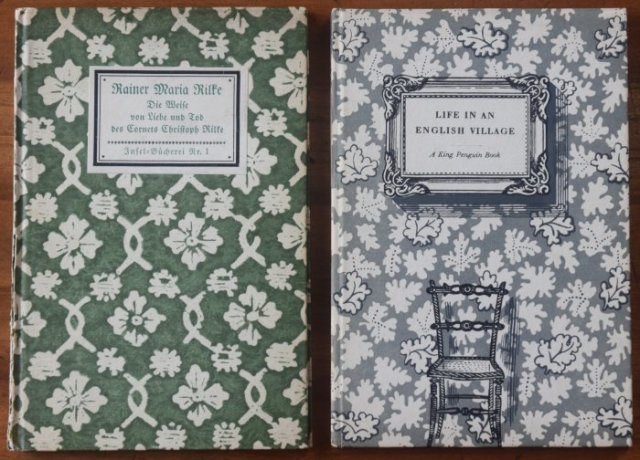
Kings were inspired by the German Insel Bucherei printed by Insel Verlag, these beautiful art books had started in 1912 and by the time Penguin launched their Kings there were roughly 500 Insels already available and their catalogue would eventually reach 1,400 different titles. Fortunately for my bookshelves Kings stop at number 76 although there are a few variations to collect as well but my complete set of the first editions is shown in the picture at the top of this essay. One of the most striking aspects of that picture is the wide variety of covers and the design of these was seen as one of the most important aspects of the series. After all they have to draw the potential purchaser in, especially as these were initially priced at one shilling or twice the price being charged for the normal Penguin paperbacks. Unfortunately this didn’t last very long as the price very quickly doubled as it became clear that they were more expensive to do right that initially anticipated and Alan Lane wanted them to be done as well as Penguin could manage. This meant that they really had to look striking so the original house style on the first five was quickly dropped.

Only seventeen Kings were ever reprinted or revised, so with almost all of them the first edition is the only example available and on average 20,000 were printed of each title, although A Book of Toys sold over 55,000 copies. This means that Kings are not normally particularly rare; but are scarce enough to make the hunt trying to collect them all interesting. Some such as Magic Books From Mexico were recognised as niche interests from the start so the print runs were commensurately smaller. In the case of this book however even these apparently didn’t sell and there is a rumour that a large number of them had their plates removed and put under glass in the type of coffee table very popular in the 1960’s and 70’s.

20180626 King Penguins 04

K1 – British Birds on Lake, River and Stream by Phyllis Barclay-Smith – Nov 1939
K2 – A Book of Roses by John Ramsbottom – Nov 1939
K3 – A Book of Ships by Charles Mitchell – Sept 1941
K4 – Portraits of Christ by Ernst Kitzinger & Elizabeth Senior – Feb 1941
K5 – Caricature by E.H. Gombrich & E. Kris – Feb 1941

The first five Kings produced under the editorship of Elizabeth Senior are highly distinctive, although the actual printing quality is not as good as it might be given the intention to emulate the Insel books. However as you can see from the dates of first publication this was not a time for finesse, wartime restrictions soon caused problems with the series meaning that a large proportion of K3, K4 and K5 were bound in soft card covers cut flush to the internal pages as well as the overlapping boards normally used for Kings. The Book of Ships in the picture above is one of these soft back editions and as can be seen is consequently slightly smaller than the other four. K1 is the first of these volumes to use plates from John Gould‘s famous work The Birds of Great Britain, the other being K19 Garden Birds. A Book of Roses (K2) also makes use of a famous earlier work for the plates, in this case Redouté‘s Les Roses. The other three volumes use 16 colour plates from a mixture of sources and along with these there are several black and white images within the text. K1 and K2 only have the 16 colour plates along with a single black and white portrait of Gould and Redouté respectively.

Sadly Elizabeth Senior was killed in an air raid in 1941 and editorial control of the series passed to Nikolaus Pevsner
20180626 King Penguins 05

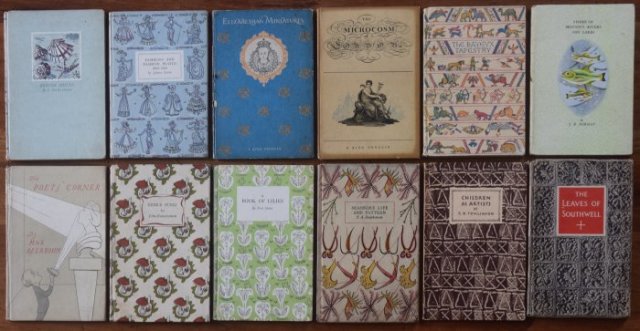
K6 – British Shells by F. Martin Duncan – June 1943
K7 – Fashions and Fashion Plates 1800-1900 by James Laver – June 1943
K8 – Elizabethan Miniatures by Carl Winter – June 1943
K9 – The Microcosm of London by John Summerson – June 1943
K10 – The Bayeux Tapestry by Eric Maclagan – Dec 1943
K11 – Fishes of Britain’s Rivers and Lakes by J.R. Norman – Dec 1943
K12 – The Poets’ Corner by John Rothenstein – Dec 1943
K13 – Edible Fungi by John Ramsbottom – July 1944
K14 – A Book of Lilies by Fred Stoker – Dec 1943
K15 – Seashore Life and Pattern by T.A. Stephenson – July 1944
K16 – Children as Artists by R.R. Tomlinson – Dec 1944
K17 – The Leaves of Southwell by Nikolaus Pevsner – Dec 1945

After the fairly dull cover design of the first five with its fussy white banding round the spine it is a relief to see the variety produced in the next dozen. Half of them have that Insel Bucherei look with the title and author appearing on a reproduction of the paste down labels quite common on quality books from the previous 100 or so years. Unlike Insel books this is actually part of the printed design rather than an extra slip, but it does give a touch of class to the book. The first few are experimenting with alternate cover styles and Fishes of Britain’s Rivers and Lakes is a very attractive design by Charles Paine, I’m less impressed with the cover of Microcosm of London with it’s overly florid text done by Walter Grimmond. Having said that Microcosm is the first of the Ackermann editions in Kings. Rudolph Ackermann was a bookseller and printer in London in the early 1800’s and his books and prints sold well making him known for the quality of his images which captured not only cityscapes like this along with K59 Cambridge and K69 Oxford but also the images documenting the start of the railway age some of which are included in K56 Early British Railways and for further variation K46 Highland Dress, all plates of which were originally printed by Ackermann.

Other notable books in this block of twelve are K10 The Bayeux Tapestry with 8 pages of colour plates and 40 pages of black and white photographs which at the time were some of the best images available in print. K13 Edible Fungi is beautifully illustrated by Rose Ellenby who also did its pair K23 Poisonous Fungi. Like Elizabeth Senior, Nikolaus Pevsner got one of his own titles in this block with K17 The Leaves of Southwell which has 32 pages of lovely black and white photographs of the capitals and columns in the chapter house at the Minster of Southwell in Nottinghamshire.
20180626 King Penguins 06

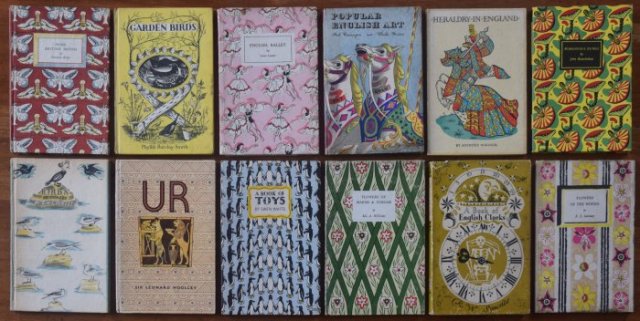
K18 – Some British Moths by Norman Riley – May 1945
K19 – Garden Birds by Phyllis Barclay-Smith – May 1945
K20 – English Ballet by Janet Leeper – Dec 1944
K21 – Popular English Art by Noel Carrington – Dec 1945
K22 – Heraldry in England by Anthony Wagner – Nov 1946
K23 – Poisonous Fungi by John Ramsbottom – Dec 1945
K24 – Birds of the Sea by R.M. Lockley – Dec 1945
K25 – Ur: The First Phases by Sir Leonard Woolley – May 1947
K26 – A Book of Toys by Gwen White – Dec 1946
K27 – Flowers of Marsh and Stream by Iola A. Williams – Nov 1946
K28 – A Book of English Clocks by R.W. Symonds – May 1947
K29 – Flowers of the Woods by Sir E.J. Salisbury – Apr 1947

Apart from the obviously wonderfully choice of getting somebody called Leeper to write a book about ballet this is a delightful mix of titles. K18 British Moths goes back to the first two Kings by using prints from an old classic book on the subject, in this case by Moses Harris from the mid 1700’s. K21 Popular English Art is an eclectic mix from  drawings of Windsor chairs to colour images of a jug, ship’s figurehead and even a pub interior all done by Clarke Hutton who like Noel Carrington who wrote the text is probably best known to Penguin collectors for their work on Puffin Picture books. Birds of the Sea is also illustrated by an artist in Puffin Picture Books, R.B. Talbot Kelly who created the PP52 Paper Birds which was a cut out book now rarely seen in one piece along with the beautiful PP65 Mountain and Moorland Birds.

One of my favourite King Penguins comes next, K26 A Book of Toys by Gwen White, it’s one of the oddities in the range as it deviates from the plan of a monograph and plates being illustrated all the way through much more like a small hardback Puffin Picture Book with the handwritten text drawn directly onto the plates and not typeset; and what is not to like about a cover with dozens of toy penguins. K27 is let down badly by the quality of the printing of the colour plates, K28 is frankly a mess with far too much jammed into the book which would have been better expanded as a Pelican Book and dropped from this series but K29 rescues this block with some lovely if rather flat coloured plates.

20180626 King Penguins 07

K30 – Wood Engravings by Thomas Bewick by John Rayner – Apr 1947
K31 – English Book Illustration 1800-1900 by Philip James – Sept 1947
K32 – A Christmas Carol by Charles Dickens – Dec 1946
K33 – Russian Icons by David Talbot Rice – Oct 1947
K34 – The English Tradition in Design by John Gloag – Oct 1947
K35 – A Book of Spiders by W.S. Bristowe – Sept 1947
K36 – Ballooning by C.H. Gibbs-Smith – Nov 1948
K37 – Wild Flowers of the Chalk by John Gilmour – Dec 1947
K38 – Compliments of the Season by L.D. Ettlinger & R.G. Holloway – Dec 1947
K39 – Woodcuts of Albrecht Durer by T.D. Barlow – Sept 1948
K40 – Edward Gordon Craig by Janet Leeper – Oct 1948
K41 – British Butterflies by E.B. Ford – Oct 1951

The first two of this block make a great pair, they have a similar design with high quality illustrations right through the text as well as the plates at the back and K39 Woodcuts of Durer goes well with the both of them. That brings us to another King Penguin oddity. K32 A Christmas Carol is almost a facsimile of the original first edition of this Dickens classic, it doesn’t count as a true facsimile as the font used is Monotype Modern, it being the closest available to match the original. The very interesting Russian Icons by David Talbot Rice is another book let down by the poor quality of the printing of the plates, it also has a correction slip pasted over credit for the cover illustration. William Grimmond is credited on the page with Enid Marx pasted over the top. The English Tradition in Design has 72 pages of black and white photographs, the cover of this book does tend to fade badly, probably more than any other King Penguin whilst Wild Flowers of the Chalk, Compliments of the Season and British Butterflies all go back to the original internal plan with a monograph followed by 16 plates which was now becoming a rarity in the series, even if only the last one had a suitable cover design.
20180626 King Penguins 08

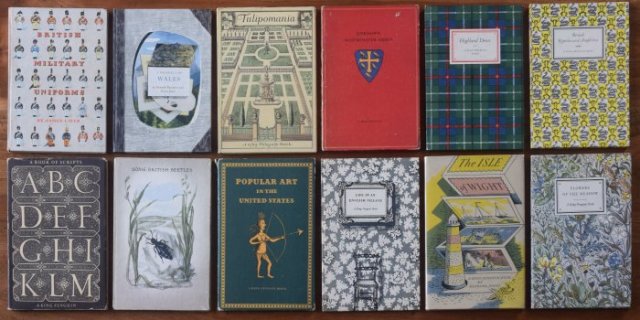
K42 – British Military Uniforms by James Laver – Oct 1948
K43 – A Prospect of Wales by Gwyn Jones – Sept 1948
K44 – Tulipomania by Wilfrid Blunt – Oct 1950
K45 – Unknown Westminster Abbey by Lawrence E. Tanner – Nov 1948
K46 – Highland Dress by George F. Collie – Aug 1948
K47 – British Reptiles and Amphibia by Malcolm Smith – June 1949
K48 – A Book of Scripts by Alfred Fairbank – Nov 1949
K49 – Some British Beetles by Geoffrey Taylor – June 1949
K50 – Popular Art in the United States by Edwin O. Christensen – June 1949
K51 – Life in an English Village by Noel Carrington – June 1949
K52 – The Isle of Wight by Barbara Jones – July 1950
K53 – Flowers of the Meadow by Geoffrey Grigson – June 1950

By now Swiss designer Jan Tschichold was firmly in control of the Penguin house style, he had started with tidying up the look of the major series and setting firm rules not just on typography but also strict design specifications, his influence can now be seen in the Kings. His re-imposition of the original plan of monograph with 16 plates continued with these dozen, just two don’t fit this general structure although the number of plates did get up to 22 for some. The two that don’t fit are K45 Unknown Westminster Abbey along with K48 A Book of Scripts, K45 is very similar in structure to K17 The Leaves of Southwell which makes sense as these are covering much the same field just a different building. A Book of Scripts is another King oddity, concentrating as it does on fine handwriting and to do this it needs lots of illustrations, it also is the only King Penguin to be revised/reprinted four times. Beyond that record it was later greatly enlarged and printed in February 1969 as a large format Pelican (A973) which also went to several reprints.

Largely this gives an idea as to what Kings could have been if there had been more money, better quality printing and greater control on the design from the beginning. The problem was the price that they now had to be sold at. From 1940 to 1949 they had been either 2 or 2½ shillings, by 1952 the price had rocketed and they were just under 4½ shillings and two years later they had reached 5 shillings. They are truly lovely books though, watercolours by Kenneth Rowntree show Wales at its best with K43, Edward Bawden took on the English village (K51) in his distinctive style whilst Barbara Jones not only beautifully illustrated K52 The Isle of Wight but unusually also wrote the monograph. Tulipomania uses plates by Alexander Marshall from a collection from the 1650’s and now in the Royal collection in Windsor. These are some of the most vibrant flower paintings in the King series and makes this a highly desirable book in its own right. The other great joy of this dozen is K49 Some British Beetles illustrated by Vere Taylor.

20180626 King Penguins 09

K54 – Greek Terracottas by T.B.L. Webster – Apr 1951
K55 – Romney Marsh by John Piper – May 1950
K56 – Early British Railways by Christian Barman – May 1950
K57 – A Book of Mosses by Paul W Richards – July 1950
K58 – A Book of Ducks by Phyllis Barclay-Smith – Apr 1951
K59 – Ackermann’s Cambridge by Reginald Ross Williamson – June 1951
K60 – The Crown Jewels by Oliver Warner – June 1951
K61 – John Speed’s Atlas of Tudor England and Wales by E.G.R. Taylor – June 1951
K62 – Medieval Carvings in Exeter Cathedral by C.J.P. Cave – May 1953
K63 – A Book of Greek Coins by Charles Seltman – Nov 1952
K64 – Magic Books from Mexico by C.A. Burland – Feb 1953
K65 – Semi-Precious Stones by N. Wooster – May 1953

Jan Tschichold only lasted a couple of years in his role at Penguin but in that time he completely revolutionised the house style. His replacement was the German Hans Schmoller, he took Tschichold’s templates and refined them further. In this batch we can see the continuation of the original Insel inspired cover designs with fake paste-down label on the majority. The cover of K61 John Speed’s Atlas is based on an old copy which is highly appropriate for this collection of county maps from 1627, the title reflects the usual name for this group of maps although they were not actually by the great Tudor English cartographer but rather his Dutch contemporary Pieter van den Keere. The cover of K63 A Book of Greek Coins is another Walter Grimmond design, he did fifteen in all and only two (K59 Ackermann’s Cambridge and K64 Magic Books from Mexico) come close to looking like the original plan. A further oddity of K63 is one of the coins on the cover, which are intending to show the development of the Britannia figure all the way from an original Greek version to the present day. Grimmond includes a penny with the date 1952 in the bottom left as that was the printing date of the book, however no pennies were actually minted that year as there were plenty already in circulation.

K55 Romney March written and illustrated by the artist John Piper is a very attractive volume, although his sketches illustrating the section on churches in the area are for me more compelling than the 16 colour plates at the back. Also sticking strictly to the 16 plates rule are K57, K58, K60, K64 and K65 with K58 A Book of Ducks and K65 Semi-Precious Stones being particularly fine. K62 Medieval Carvings in Exeter Cathedral continues the style set by the other three books in this sub series of medieval carvings (K17, K45 and K72) all of which have a large collection of black and white photographs, by in this case having 64 pages of them. One extra oddity that should be covered at this point is the soft back Mexican reprint of K64 by Ediciones LARA produced in 1966 to coincide with the Mexico Olympics, although not printed by Penguin it was fully authorised by them as stated  inside.

20180626 King Penguins 10

K66 – Birds of La Plata by W.H. Hudson & R. Curle – Apr 1952
K67 – Mountain Birds by R.A.H. Coombes – Nov 1952
K68 – Animals in Staffordshire Pottery by Bernard Rackham – Sept 1953
K69 – Ackermann’s Oxford by H.M. Colvin – Mar 1954
K70 – The Diverting History of John Gilpin by William Cowper – Nov 1953
K71 – Egyptian Paintings by Nina M Davies – May 1954
K72 – Misericords by M.D. Anderson – Oct 1954
K73 – The Picture of Cricket by John Arlott – May 1955
K74 – Woodland Birds by Phyllis Barclay-Smith – Nov 1955
K75 – Monumental Brasses by James Mann – Nov 1957
K76 – The Sculpture of the Parthenon by P.E. Corbett – July 1959

The final batch of Kings took a long time to come out certainly compared to the rapid fire production of earlier years. K66 Birds of La Plata is the only bird book in the series not to feature British birds but rather those of South America following an interest Sir Allen Lane (the founder of Penguin) had developed during his time in that continent at the end of WWII whilst trying to launch Penguin Books there. K70 John Gilpin has also strong links to Lane as it is a heavily reduced in size version of a book he had privately printed as a limited edition Christmas gift the previous year. To emphasise the unusual nature of K66, K67 Mountain Birds is actually called British Mountain Birds inside.

Again 16 colour plates is the norm with only John Gilpin (as a reprint of an existing book), K72 Misericords with lots of photographs (as noted above to match others in the sub series) and the final two books K75 Monumental Brasses and K76 The Sculpture of the Parthenon not matching that pattern. K71 Egyptian Paintings is a little disappointing, the colours are very muted in the reproductions and don’t have the vibrancy of the original tomb paintings. All three bird books are lovely things and would with their compatriots through the Kings make a very attractive collection on their own with the advantage that with the exception of K66 La Plata they are all quite easy to find. K75 Monumental Brasses was a surprise when I first got a copy, I was expecting more black and white photographs but instead this book is illustrated with drawings that have been coloured a pale yellow and very nice they are too as they are certainly clearer that photographs might have been. This is particularly true of the final book in the set; K76 is a sad end to a great series, the photographs are poorly printed compared to previous works and the text is hardly a gripping read

The animation below showing some of the wonderful plates from various King Penguins was done for a talk on the Gentle Art of Penguin Collecting given by myself and Megan Prince at The 2018 Hay Independence celebrations. I hope this inspires a collector or two out there to take a look at the 76 King’s almost 60 years after the last one was printed, they are well worth dipping into.

20180626 King Penguins 02


Siné – Massacre

As this post goes up onto the blog I will be on my way to Hay on Wye to give a talk on the Gentle Art of Penguin Book Collecting as part of the Hay Independence celebrations for 2018, as part of the talk I’m going to cover the strange story of Siné’s Massacre in it’s only Penguin edition.

20180403 sine1

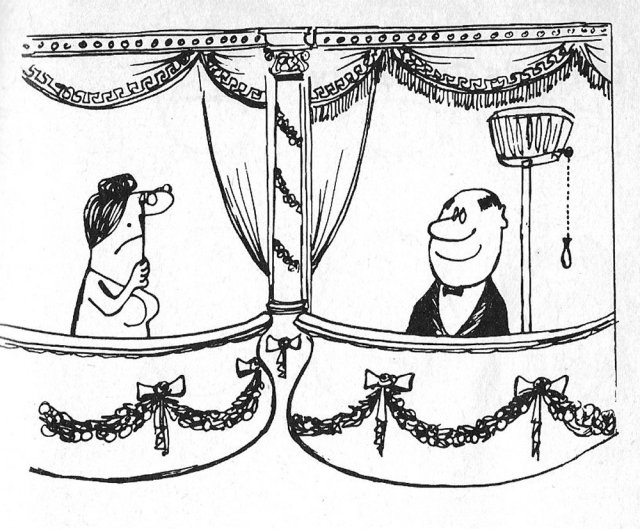
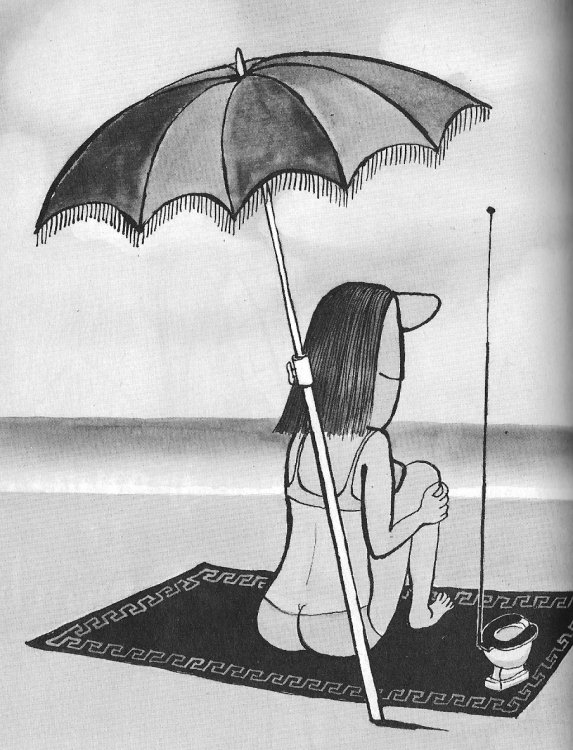
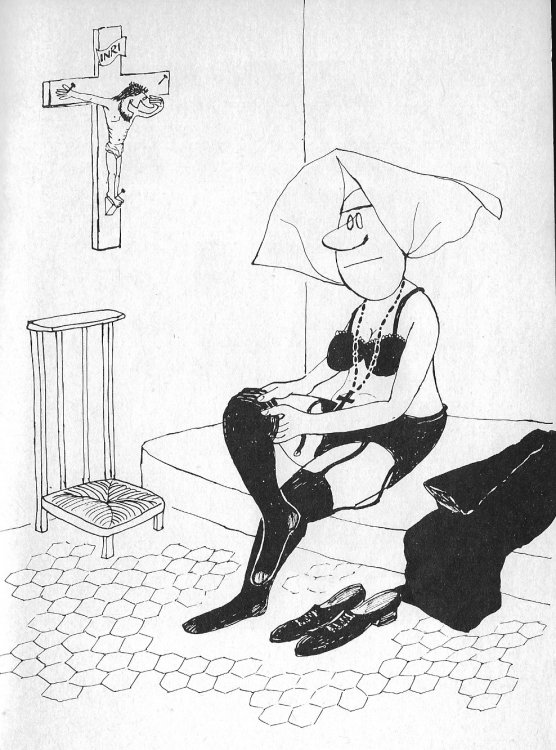
The title of the cartoon on the cover is a sort of pun in French, dessin morbide means morbid drawing but mord translates as belly so the vampire biting the belly of his victim covers both meanings. The fact that this was chosen as the cover and therefore amongst the least controversial of the cartoons included says a lot about the content of the book. Through the rest of this blog I will include other cartoons from the book although I have been careful not to include the most offensive examples, Siné had a fascination with toilets, hangings, amputation, sex and the catholic church sometimes all in one cartoon and I don’t feel many of the cartoons are suitable even now.

20180403 sine6

Given this controversial nature, why was he considered for a Penguin book dedicated to him? Well Penguin had a long history of publishing books of cartoons featuring selections of a particular artist, anything from Thelwell and his little girls at their pony club, through Osbert Lancaster, Peter Arno, Charles Addams (and his famous family) and Gerald Hoffnung with his musical fantasies to name just a few. On 5th October 1966 therefore a Penguin Books board meeting was convened to discuss the advisability of including Siné, as he was regarded as a major French cartoonist and a range that had the gentle work of Thelwell at one end and Siné at the other would definitely appear to be inclusive of all styles. It is worth pointing out that this board meeting would appear to have been very very late in the process, as the books had already been printed and were in the warehouse, orders had been placed but they hadn’t yet been distributed to retailers. So technically the book had not yet been published, but it really was a technicality at this point.

20180403 sine4

Sir Allen Lane, the founder of the business back in 1935, was still chairman of the board at this time although he no longer had total autocratic control of the business as he once had. He had given way long ago to the consensus of the board of directors as he had had to due to the huge increase in the size of the company, which was way beyond the ability of one man to control; however he still thought of Penguin Books as his. Nevertheless the minutes of the meeting show that the overall position was to back Tony Godwin, then Chief Editor and therefore a board member, with some reservations expressed. Backing Godwin was particularly forcefully put by Charles Clark who felt that not doing so at such a late stage would put Godwin in an untenable position; Sir Allen was not happy but, at the meeting at least according to the minutes, backed the decision to publish.

20180403 sine3

A draft press release was prepared announcing the publication on the 1st November 1966 which included a statement that the board were not in full agreement with the publication, however after the internal legal advisor was consulted it was decided to remove references to the disagreement and all was set for 3 weeks time. So far just a tale of a controversial book being prepared for publication, there had been several before at Penguin and there didn’t seem anything to make this different but the story was about to become bizarre…

20180403 sine5

George Nicholls recalled in 1970 (after the death of Sir Allen Lane) the events of a night in October 1966 which is almost certainly unique in the annals of UK publishing. He was in bed, as it was around midnight, when the phone rang and he was summoned to the office. When he got there he found Sir Allen along with 3 other men and he wanted the warehouse unlocking, Nicholls had the keys so they set off. On the way the reason for the late night escapade became clear as Lane explained.

I’ve got Singleton round the back with the farm wagon, I’m going to pinch all those Siné’s … that bloody board outvoted me, but I’ll have my own back on them.

Nicholls was shocked but as he said Sir Allen was “the governor” so he did what he was told. After a while they managed to load all the palletised stock onto the trailer and then realised that there would be boxes ready for shipping in the distribution area so went and found all those as well and loaded them onto the truck. It took a few hours but eventually Nicholls locked up the warehouse again and Allan Lane set off with his cargo after saying to Nicholls that this would be their secret.  What happened next is largely speculation, various accounts say that when Lane got back to his farm near Reading he had a large bonfire, some say the books were buried, others that he composted the lot and eventually spread it on his fields, what is certain is that the printed books were never seen again and Penguin never did officially publish Siné’s Massacre. Allen Lane also briefly vanished from the scene heading off on an impromptu holiday to Spain whilst things quietened down.

20180403 sine2

The odd thing was that there was apparently no hue and cry about the missing books; it all seems to have been quietly ignored, the few orders that had come in were cancelled as the book was ‘out of stock’. I used to design warehouse systems so know that so much stock going astray would definitely be noticed very quickly especially with unfulfilled orders this close to the official publication date but nothing was said. The only copies that survived are the few examples that had been sent to people to get their opinions about publication and some trade samples that had made it to representatives on the road. It all adds up to this being one of the rarest, and consequently most valuable, paperbacks produced by Penguin in the last 60 years. Checking abebooks reveals only one copy available at the time of writing this, across all the dealers on there around the world, and that is priced at £145.

20180403 sine7

The Devil’s Dictionary

20180327 Devil's Dictionary

Although now recognised as an American classic The Devil’s Dictionary by Ambrose Bierce was never originally intended to even become a book and certainly not intended to be read like one. It is, as the title implies, a dictionary; but full of alternative definitions, normally humorous, often satirical and sometimes it has to be said just plain strange at least to modern readers. But before looking at the book itself it is a good idea to know something about Bierce himself and how it came to be written and that is not as simple a task as it sounds as implied by the first sentence of the book summary in my copy.

The life of Ambrose Bierce is a tissue of facts embroidered with legend.

Normally at least birth and death dates of a well known journalist and author such as Ambrose Bierce would at least be known but although we know that he was born in 1842 the best that can be done for his death is ‘probably 1914’ when he went to Mexico during the revolution and was never heard of again.

But lets backtrack over what is known. In 1861 he enlisted in the 9th Indiana Infantry and fought in the American Civil War apparently with distinction and it was thought that he would go to a military academy after the war and make that his career but he was already interested in writing. So in 1866 he apparently ‘tossed a coin to decide whether to stay in the army or become a journalist. Journalism won the toss.’ By this time his army career had brought him to San Francisco, and that is where he started to teach himself what he needed to know; and started writing pieces some of which made it to print. In 1868 he got his first regular journalistic job and in a roundabout way this was to lead to the book I have. The job wasn’t journalism as such in that it didn’t involve factual reporting of news, instead it was a page in the San Francisco News Letter entitled ‘Town Crier’ which was a humorous and satirical view of life in the city and Bierce was set on his path to fame. He would over much of the rest of his life continue to write satire for numerous publications and by 1869 he had included his first multiple definition entry of what would eventually be a book although at the time it was probably just a useful space filler for the Town Crier page.

Over the ensuing thirty plus years Bierce continued his definitions in his various columns in publications not just in America but also in England where he lived for 3½ years in the 1870’s. They became increasingly popular and also much copied with Bierce sometimes entitling them The Devil’s Dictionary or later on The Cynic’s Dictionary until the idea of combining them into a book came to him in 1903. By the time of publication however not only had his idea been stolen but even the title of his column had been used by a competitor to publish their own set of definitions so he was forced to use the title The Cynic’s Word Book when it came out in 1906. Oddly it only included 521 definitions for the letters A to L with an intention to have a second volume covering M to Z later on, however it didn’t sell well enough for this plan to be realised.

And so it stayed as an unfinished work until 1911 when Bierce was working on his collected works and volume 7 was entitled The Devil’s Dictionary, this time covering the entire alphabet and with 1000 definitions, some of which were specially written for the book especially at the end of the alphabet because over all of his columns Bierce had only reached the word shoddy.

Shoddy: n. (vulgus) A term that expresses the status of a large part of our society, and furnishes a weakly page of matter to many of our time-serving dailies.

*Weakly is as written and implies a certain disdain for many of his less talented rivals producing similar columns for other newspapers.

The collected works was also a financial failure but The Devils Dictionary was recognised as probably his finest work and after his death went on to be published as a standalone volume by several companies and establish itself as a major work of American humour.

We then leap forward to 1963 when Ernest Jerome Hopkins, after a long career as a journalist, became Professor Emeritus of Journalism at Arizona State University and after discovering that the title didn’t actually come with any specific work decided to have another look at The Devils Dictionary and some strange gaps in the words chosen. It rapidly became clear that by no means all of the definitions Bierce had written for his various columns had made it into the published book, almost certainly because at the time of compiling he had been living on the Eastern seaboard of America and a lot of the early material was 3000 miles away in California and no copies would have existed in reference libraries where he was. Over the next few years Hopkins unearthed a further 851 definitions left out of the 1911 book and in 1967 the Enlarged Dictionary was published. My copy is the Penguin Classics edition, first issued under this imprint in 1985 although Penguin printed their first edition in 1971 in their main series.

To conclude let’s have a few definitions taken at random from the book, I have literally just opened the book and picked a word for each of these so it should give a flavour of the work as a whole, some are funny, some are sharp and some are odd, I’ll let you decide which are which. In the case of long definitions I have just included the first part, some go on a lot longer than others.

Edible: adj. Good to eat and wholesome to digest, as a worm to a toad, a toad to a snake, a snake to a pig, a pig to a man, and a man to a worm.


Bald: adj. Destitute of hair from hereditary or accidental causes – never from age.


Riddle: n. Who elects our rulers?


Miss: n. A title with which we brand unmarried women to indicate that they are in the market.


Insurance: n. An ingenious modern game of chance in which the player is permitted to enjoy the comfortable conviction that he is beating the man who keeps the table.


Dice: n. Small polka-dotted cubes of ivory, constructed like a lawyer to lie on any side, but commonly on the wrong one.


Fauna: n. A general name for the various beasts infesting any locality exclusive of domestic animals, travelling menageries and Democratic politicians.


Road: n. A strip of land along which one may pass from where it is too tiresome to be to where it is futile to go.

Penguin Drop Caps

In 2012 Penguin Books started a series of books for sale in the USA and Canada and it made use of their extensive back catalogue along with some newer modern classics in a handsome new style hardback binding. The tagline of the set is

It all begins with a letter

and the concept was to produce 26 titles where each letter of the alphabet was represented by the surname of the author. An interesting idea especially over the choice of names for some of the more difficult letters. What made the set a cohesive whole was the decision to have all the letters on the covers designed by one person, Jessica Hische, and for her to create an evocative set of designs. Adding the input of Penguin Art Director Paul Buckley we ended up with a rainbow of classic books which call to you from the shelves and look totally different to anything else I have. Good design has been the hallmark of Penguin Books from their beginning in 1935 and it’s good to see that tradition being respected in a modern set.

20180213 Drop Caps 1

Of course a set like this appeals to the collector part of me, especially when they are not officially available in the UK as I like a challenge, but it also harks back to the very first Penguin Books I initially accumulated, then decided to collect, which was the early (first 125) Penguin Classics.  Buying a set of books forces you to purchase authors you may not have been intending to buy or even to have heard of and once the book is on the shelf it would be remiss not to at least give the book a go. The first title is a case in point; Pride and Prejudice by Jane Austen is not a title that has ever appealed but I have to say that much to my surprise I’m really enjoying it. I have also read Madame Bovary, A Portrait of the Artist as a Young Man, Five Children and It, and Cannery Row so far and I’m looking forward to tackling authors I don’t know at all such as Willa Cather and Sigrid Undset.

The full list is as follows, with links to books reviewed in this blog:

A to F came out in 2012, G to P in 2013 and Q to Z in 2014 although I only started to collect these books towards the end of last year (2017) so the last 5 have only recently arrived and I didn’t buy them in alphabetical order but rather which 4 or 5 a month I could find at a sensible price.  Their official retail price varies on the copies I have between US $23 and $30 although the Canadian prices fluctuate much more widely between $24 and $40. The cheapest I found one in the UK was around £10 and had to spend up to £17 to get the last few I was missing.

20180213 Drop Caps 2

The spines are also attractive and make a bold statement on the shelf next to me as I write this, as can be seen in the picture above the page edges are also coloured to complement the cover and the rear cover has a short quote from the book that Penguin have turned into a parlour game

Mine is from Great Expectations:

Suffering has been stronger than all the other teaching, and has taught me to understand what your heart used to be.

and then A Portrait of the Artist as a Young Man

to forge in the smithy of my soul the uncreated conscience of my race

Not the cheeriest of quotes but I’m not going to let them put me off reading all these as they are lovely books with a clear font (Archer) as you would hope from a series that takes lettering seriously and a pleasure to pull off the shelf and sit down with.

The Things We See

One of the joys of collecting Penguin Books is the wide variety of titles and series that they published over the years and especially exploring the ones that failed to take off.  There are more dead ends and random corners to explore in Penguins first 15 years of publishing than in a M.C. Escher painting. One of these was the well intentioned but ultimately seriously curtailed series The Things We See, book one of which is shown below.  They were assigned the letter code E to distinguish them from other Penguin series so E1 became Indoors and Out.

When I first started collecting Penguin, well before the advent of the internet and its ease of tracking down items around the world, I came to think of these as The Things We Don’t See as I so rarely came across one in a shop on my searches although they are not in fact that scarce and you can certainly pick up examples for £5 to £10 nowadays quite easily.

The Things We See was intended to be a departure from the normal Penguin style. Hardback books each of 64 pages, printed on art paper and significantly larger than their normal paperback production at 220mm tall x 182mm wide and looking at design of everyday objects. This had been touched on via several Pelican books (Penguins factual imprint) but the desire was to produce a series of high quality books on all aspects of the subject. Unfortunately they immediately hit several problems. The main one being the major paper shortage immediately after WWII in 1946 when the series was supposed to start along with the relatively high purchase cost at 3 shillings and sixpence, just over £7 today which sounds good until you realise that it is 3½ times the price of a ‘normal’ Penguin or Pelican at the time. A small number of Indoors and Out did make it on sale in 1946 as a special pre-issue publication but the majority arrived in 1947. It was intended as the introduction to the series and carried an impressive list of titles in preparation to give an idea of the intended scope:

  • Houses by Lionel Brett
  • Furniture by Gordon Russell
  • Radios and other appliances by R.D. Russell
  • Pottery and glass by A.B. Hollowood
  • Lettering and Printing by John Tarr
  • Advertising by Ashley Havinden
  • Shop Windows and exhibitions by Misha Black
  • Gardens by Lady Allen of Hurtwood
  • Public Transport by Christian Barman
  • Private Cars by Humphrey Hague
  • Ships by David Pye
  • Aircraft by Christopher Nicholson

Other projected titles given, but with no author, so presumably not as advanced in production were Toys, Domestic Equipment, Shops and Cinemas, The Things We Wear. This would have given the E series an initial list of 17 titles however only 7 were ever printed, the ones in bold above being the remaining 6 to come out.

1947 was a good year for The Things We See as 3 more titles made it out that year. E4 Pottery and Glass was the next to appear as can be seen from the list of titles on the back which still has E2 and E3 as ‘in preparation’ and the list of titles has already been considerably cut back as it rapidly became clear that a) there was not enough paper and b) they weren’t selling very well. Only E1 was ever produced in hardback all the others are softback editions at the lower price of 2 shilling and sixpence, representing a 28% price cut; although this appears to have been a last minute decision as the old price is blocked out in black and the new overprinted on the inside flap of the dustwrapper. As can be seen on the rear cover of E3 Furniture; shown above; there is a long overprint removing the line

Titles already published:price 3/6 each

The rear of E2 Houses is the same as E3.  So what do the books look like inside? Well lets open E4 Pottery and Glass.

20170130 The Things We See 09

They are very attractive photogravure printed volumes with lots of photographic illustrations, it is clear that these would have been expensive to produce so the dramatic cut in price cannot have helped the viability of the series as a whole.  That these books are still around was down to Penguins policy of just holding onto something until it eventually sold. Unlike a lot of publishers that would probably have pulped a lot of unsold stock to make way for new titles Penguin, under Allen Lane at least, very rarely did this. The next two titles to appear were E5 Public Transport in 1949 and E6 Ships in 1950, both still priced as 2 shillings and sixpence.

20170130 The Things We See 05

These two are probably my favourites from the series, they are very readable and the illustrations invoke the era they come from so well

20170130 The Things We See 10

20170130 The Things We See 12

Ships has a quote from The Architectural Press on the inside of the dustwapper, which turned out to be completely wrong:

To judge from the first few volumes the series called The Things We See ought to prove the most successful of all the contributions made by Penguin Books to visual education. Well designed, well illustrated and well printed they are remarkably cheap by any standard. Moreover the author of each has been given his head, within the limits imposed by considerations of space, and by bringing his heart too has produced a highly readable essay which is all the better for being in some degree a profession of personal faith.

Sadly there was only to be one more title produced and for that we had to wait another 3 years.  1953 saw E7 Gardens by Lady Allen of Hurtwood and Susan Jellicoe. The latter author was not mentioned in the original plan for the book so possibly she was drafted in to make sure this book actually came out.  The price however had doubled to 5 shillings and the eye design cover was abandoned to make the book look more attractive to a post austerity public.

All the titles were relaunched with photographic dustwrappers over the top of the unsold stock dating back up to 6 years. Only E3 Furniture was actually reprinted with revisions for this relaunch all the rest were just what was still sitting in the warehouse so there must have been a highly tedious exercise in removing all the old wrappers and putting new ones on. Only Furniture and Gardens have photographic covers under the wrapper all the others retain the old eye cover.

20170130 The Things We See 08Several illustrations in Furniture were replaced as part of the revised edition and its price was increased to 3 shillings and sixpence alongside E1 Inside and Out which had never been reduced in price, the others stayed at the lower price.

20170130 The Things We See 11

This is from the revised edition, only the birch bed (top left) was in the original 1947 book, the new pictures show a far more contemporary look in order to update the subject.

Presumably the books continued to slowly sell and the relaunch managed to clear some of the backlog of books making the effort of recovering all of the old stock worthwhile. Penguin meanwhile had other ambitious projects to handle by then and The Things We See was left to slowly fade away.  A sad end to what could have been a most interesting set of books.

Why not get hold of some, they are cheap enough, and enjoy, what is after all, a 70 year old series and therefore now significant in studying the history of design not just from their contents but also from the design of the books themselves. Three of the titles E1, E6 and E7 won design awards from the National Book League when they were published so were recognised as significant pieces of work even then.

Welcome

1894 - Lane Christmas Book- The Life of Sir Thomas Bodley- 2 title pageWelcome to my book shelves, home to some 6500 volumes dating back to the mid 1700’s right up to the present day. I’m going to use these as the basis for short essays or reviews not just of these books but where ever they wish to take me.  The aim is to pick a book, or group of books each week and look at its significance, or just tell a tale as to why it has found itself here.

The Life of Sir Thomas Bodley featured with this first article is a good entry point as the Bodliean Library in Oxford takes its name from Sir Thomas who came to its rescue in the 1590’s and put it finally in the secure position it now holds as one of the worlds greatest libraries. So immediately we have a book leading to more books

When John Lane founded his publishing company in 1887 he chose to call it The Bodley Head in honour of Sir Thomas and for Christmas 1894 printed a very small number of copies of Bodley’s autobiography as gifts to friends and people who had helped set up the business.  Very few of these books have survived the intervening 123 years but it’s an interesting work that should perhaps be better known.

I have two copies of ‘The Life’ one still in the original card covers and one rebound in boards and this also includes the original compliments slip from John Lane.

My main interest in The Bodley Head however is in one of his employees in the 1930’s, Allen Lane, who went on to found a far more famous publishing company namely Penguin Books, which now owns The Bodley Head imprint and uses it for non-fiction titles.

Well over 2000 of my books are Penguins and I specialise in the first 10 years of the company 1935 to 1945 which led to some fascinating books and stories about how they came about as the firm struggled with wartime restrictions but also the greater need amongst the population at home and also servicemen/women for something to read.  More to come about those in future entries to this blog…