Celebrating Fifty years of The Penguin Collectors Society Newsletter

Although founded towards the end of 1973 the Penguin Collectors Society didn’t really get going until 1974 with the first meeting of like minded collectors being in the spring of that year and the first newsletter coming soon afterwards in May by which time there were 38 members. Member number one was Tanya Schmoller who had been personal assistant to the founder of Penguin Books, Sir Allen Lane, and number two was her husband Hans Schmoller who was at the time still Head of Typography and Design at Penguin Books. Sadly I never met Hans as he died in 1985 before I joined the society but I remember Tanya fondly for the encouragement she gave to a then relatively new collector when I discovered the society in 1990. By then the newsletters had become professionally printed rather than the typed onto a waxed paper and Gestetner reproduced early examples. There were also some three hundred members including several institutions including The Library of Congress in America, Canterbury College of Art, Manchester Polytechnic and the State Library of Victoria in Melbourne Australia to name just four.

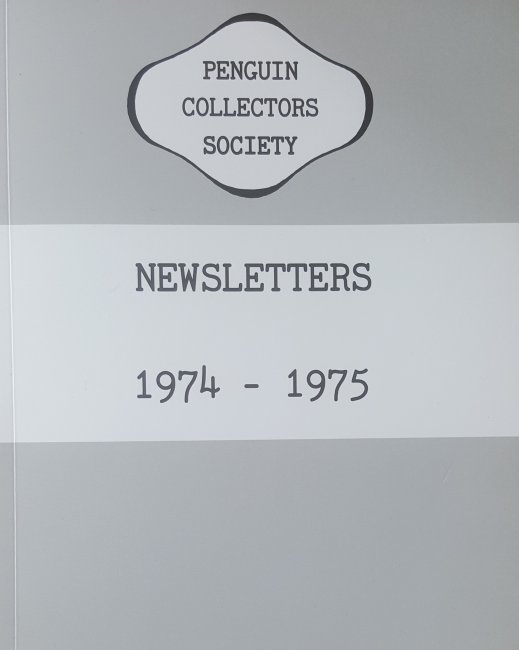
The first page of newsletter number one is reproduced above, taken from the book and possibly the most striking sentence in this age of data protection regulations is “whose names and addresses are included in this issue”, it is difficult to imagine such a thing being done nowadays. The last directory of members was in 1988 and that not only had names and addresses but phone numbers and in many cases their collecting interests and approximate size of collection. Reading through these early issues, which I’d never seen before, was fascinating and I thank whoever came up with the idea of collating them. The society has only ever produced an appropriate number of copies for the members it has plus a small number for new members who want to purchase old editions and with just thirty eight members for issue one and just over a hundred by the time of the fifth and last 1975 edition finding these early newsletters is pretty well impossible.

So what was covered in the first newsletters? Well even the first issue at just thirteen pages, two of which were the directory of members and another two a series of adverts where members were searching for specific titles managed to cover wartime advertisements in Penguin Books, a couple of printing variations on “The Penguin Herodotus” along with “Russian Campaigns”, other early paperback printers and how many titles were printed in various Penguin periodicals. By the time we reach issue five, confusingly called volume 2, number 2, from December 1975 we get an interesting short article regarding the book on the Spanish Civil War entitled “Searchlight on Spain” by the Duchess of Atholl which may be unique in Penguin history as it prompted a second book, published by Hutchinson aimed squarely at refuting the original Penguin and entitled ” Daylight on Spain: The Answer to the Duchess of Atholl”. I had never heard of this second book however the review is not exactly complimentary as it seems solely intent on attacking the original book rather than establishing a cognitive argument so I won’t be searching for a copy. There is also an attempt to sort out the various publications of the early Penguin Handbooks along with a breakdown of the wartime Penguins issued in French. All very interesting.

This collection of early newsletters came with the latest example, June 2024’s number 101

This, as you can see is a very different beast to the early examples, now 112 pages long and illustrated in full colour, with articles as diverse as early days of the society, the development of the railway bookstall, various articles of designing particular books, two of the Allan Lane Christmas books and a couple of articles on translation amongst others. Following an appeal for more material there are also three articles based on entries from this blog:

I was surprised to see all three included as I just sent versions expecting the editor to use one or possibly two and hold the remainder over to a future newsletter. The articles were largely rewritten with new illustrations but you can get a feel for what appeared in this newsletter from myself.

The society can be contacted via its website and if you are remotely interested in Penguin Books or their various offshoots I heartily recommend membership, which by the way now stands at 470 according to the accounts dated December 2023. You don’t just get the newsletter but normally a special volume dedicated to a specific topic or reproducing hard to find items such as: A.S.B. Glover by Tim Graham and White Horses by Eric Ravilious.

Modern Battle – Major Paul W Thompson (WWII Penguin versions)

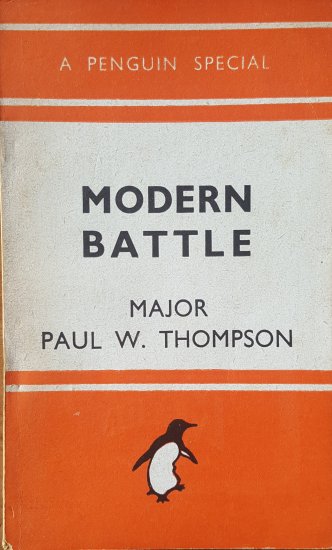
Inspired by the eightieth anniversary of the D-Day landings which was marked earlier this month I thought I’d look back on a book covering the start of the war. This is not a review of Modern Battle by Major Paul W Thompson, although it is a surprisingly interesting book which studies actual engagements between German and Allied troops in the early years of World War II so I will talk about it later in this blog. Rather I am looking at the various editions I have of the book and what these tell us about the war. Starting with The Forces Book Club edition published in October 1942, which is the second most difficult of the four versions to find as it as not sold to the public but rather only as packs supplied under subscription to military units, as described below on the inside front cover of this book. This explains why my copy has “C” Mess handwritten on the cover, sadly there is no further indication as to which battalion the mess (a place where military staff would eat and socialise) was associated with. Several of the other books I have from The Forces Book Club are ink stamped with the battalion or ship which had subscribed.

The rear cover gives a list of the first twenty books to make up, what was intended to be a substantial library for isolated units who otherwise would have little to read. The project however was a failure, partly down to the poor information regarding the existence of The Forces Book Club disseminated by the Ministry of Defence and partly due to the overly worthy choice of titles. The mystery and crime editions such as ‘Panic Party’ or ‘The Murders in Praed Street’ would undoubtably have been voraciously read but I can’t imagine Thomas Sharp’s volume on ‘Town Planning’ would have been as popular. Penguin did produce the 120 books needed to fulfil original subscriptions taken out, but in far lower numbers than expected and a lot of the books were subsequently rebound, initially as books to go to prisoner of war camps in Germany and later in the ‘normal’ covers these books would have had for general sale to the public.

The POW versions have the normal front cover but on the inside of this there is a replacement of the description of The Forces Book Club with some information regarding The Prisoner of War Book Service. Again the overall cost is three pounds for 120 books but this time even the more esoteric titles would probably have been read due to serious shortage of other reading material in the camps. All the remaining FBC titles appear to have been rebound as POW editions but they are all incredibly rare, I have a couple that, whilst popular as reading for the forces would definitely not been acceptable to the Germans i.e. ‘The Escaping Club’ and ‘The Tunnellers of Holzminden’ both of which deal with escapes from POW camps in the First World War and would therefore not pass the censors which probably explains why they have survived. I suspect that the company doing the rebinding simply did all the books without consideration as to the material they contained.

Books that didn’t make it out as FBC or POW editions were potentially rebound again as the main production run, so it is relatively common to find books that inside say they were printed for the Forces Book Club but in the ‘normal’ covers, rather than the one shown at the top of this blog. Speaking of which the first UK edition of the book in the Penguin Special cover from July 1942 can be seen below. All of the editions described so far have identical text inside with a foreword by Tom Wintringham, who had already written a couple of books published by Penguin including ‘English Captain’ and ‘New Ways of War’.

But we now come to a variant text as the book was also printed as a Penguin Special in America in association with The Infantry Journal, a company that already had distribution within the USA military and this has a new introduction by the editors of The Infantry Journal giving some background for their readership. This book was also published in July 1942, so just a few months after the Japanese attack on Pearl Harbour and the direct involvement of USA in the Second World War in December 1941. The original hardback first edition was published by W W Norton’s and Co. of New York earlier during 1941. A brief quote from the introduction to this Penguin American edition.

Modern Battle is based on a variety of source materials mainly from the professional military journals. Some of the accounts come from interviews with actual participants in the engagements described. Much of the background material is German, since the Nazi methods of warfare are those that have been most successful, and those that we need to know best as we work to find methods still better.

The copy I have is the third US edition from November 1942 by which time Paul Thompson had been promoted to Lieutenant Colonel. In the introduction there is an acknowledgement that the numerous included maps are drawn by Captain William H Brown of the US Army, who had also apparently been promoted, as in the July editions he is given as a Warrant Officer for the U.S. Coast Artillery Corps.

Now to the actual book. As alluded to above Thompson had access to German sources, presumably because America was not a combatant in WWII at the time he wrote the book, and these enable him to provide a comprehensive review of the various actions beyond anything available to a UK author. Of particular interest is the account of the aerial attack on Crete in May 1941 which is covered in the final chapter, which has a lot of information from German sources explaining how they went about the invasion which took just eleven days to complete despite the island being around 160 miles long. These alternative sources are evident throughout the book whether it be the German 10th army in Poland or the 1st Panzer division advancing on Aachen in 1940 and it makes the book a fascinating read as I have rarely come across information from outside Allied write ups.

The Big Sleep – Raymond Chandler

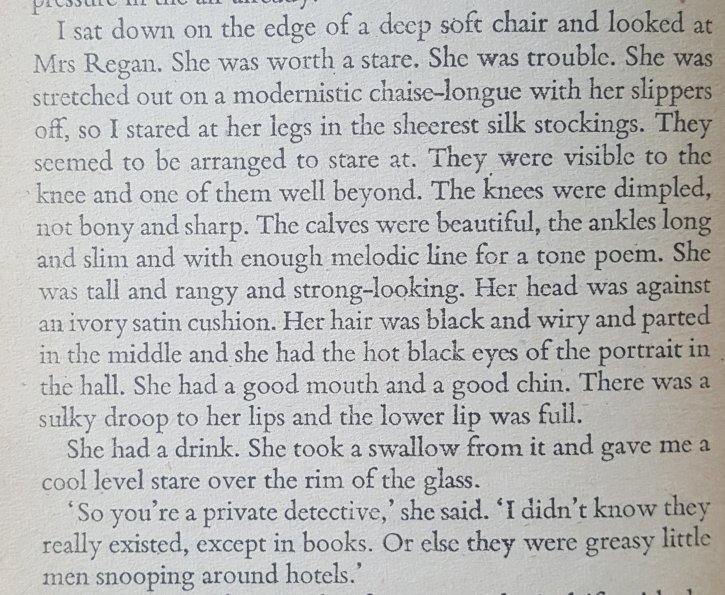
Rightly regarded as one of the finest writers of prose in crime fiction Raymond Chandler was admired by other writers as diverse as W H Auden and Evelyn Waugh. It is his descriptive passages that mark him out and make reading Chandler’s works so much fun even if sometimes his completion of plot lines just isn’t there. In this, his first novel, we never do find out who killed the chauffeur but it doesn’t really matter as the rest of the story is compelling and there are plenty of other crimes that do get fully sorted out. The Big Sleep is a remarkably accomplished work for a first novel, but by the time he wrote it in 1939 he had had short stories published many times over the previous six years, this is also the first appearance of his most famous character Philip Marlowe who appears in the first person so we see everything from his perspective. An example of Chandler’s descriptive writing is shown below, taken from a paperback copy of the novel I also have as I didn’t want to possibly damage the spine of the lovely leather bound edition I was reading.

Chandler was clearly influenced by Dashiell Hammett and his hard-boiled detectives such as Sam Spade in ‘The Maltese Falcon’ . The ‘hard-boiled’ genre is a very specific category of crime fiction featuring a sole detective fighting organised crime, usually in the US prohibition era and whilst this novel isn’t set in prohibition times, definitely not based on the amount of whiskey Marlowe gets through in this book alone, these is definitely organised crime in the shape of casino owner Eddie Mars and his main hit-man Canino. The plot is complex, so I can forgive Chandler not sorting out the chauffeur’s murder, with lots of characters sometimes working together but often double crossing one another. But we start with the elderly General Sternwood, who appears to have only a short time left to live, setting Marlowe on a case to find out about a blackmailer and stop him. Sternwood has two wayward daughters who keep appearing across Marlowe’s tracks in unexpected ways and the final denouement involving the two women was a complete surprise to me. I’m not going to go into any more of the plot which rapidly heads off in all sorts of directions and makes the book one of the most enjoyable I’ve read for a long time as I simply didn’t know what was going to happen next.

In 2005 ‘The Big Sleep’ was included in Time Magazine’s top 100 novels (the list isn’t ranked) and it also came 96th in Le Monde’s 100 books of the century compiled in 1999.

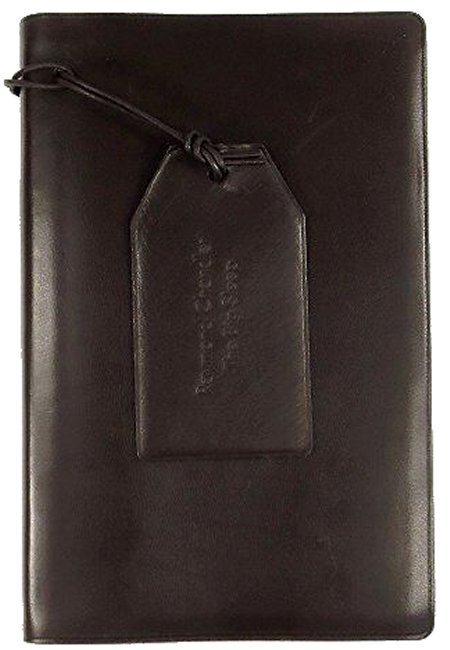
The edition that I read is from a set of six Penguin Classics designed in 2008 by Bill Amberg, the London based leather work studio, each book comes in a sturdy box with a belly band indicating which book is inside. The book itself is fully bound in a soft brown leather with a hole punched right through the cover and all the pages in the top left corner where a leather book mark is attached with the title and author embossed in it. The only thing marking the cover itself is the Penguin Books logo at the base of the spine. It is also incredibly difficult to photograph accurately. The leather cover overlaps the pages by a significant amount making it a yapp binding where over time and repeated reading the leather will fold over to totally encase the book. Each book was published in a limited edition of 1000 and priced at £50 per volume.

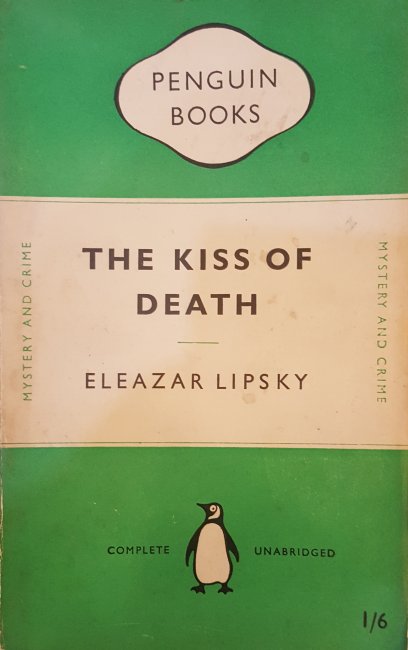
The Kiss of Death – Eleazar Lipsky

A 100-page manuscript by Mr. Lipsky was the basis of the 1947 film “Kiss of Death,” starring Richard Widmark, and the full novel was published by Penguin that same year. 

New York Times obituary – Eleazar Lipsky – February 15, 1993

This is that first edition, published by the USA division of Penguin in August 1947, I also have the first UK Penguin edition, with a significantly less garish cover, from December 1949. see image at the end of this blog. Lipsky was by trade a lawyer and served as an assistant district attorney for Manhattan in the 1940’s, he later had a law practice in Manhattan and amongst other jobs served as legal counsel to the Mystery Writers of America. He was still practising law up to three weeks before his death at the age of eighty one from leukaemia. This solid background in law shows itself in his writing and you can be certain that the trial scenes and interactions with the Manhattan assistant district attorney in the book are procedurally accurate.

It’s an unusual crime novel as it is less concerned with the crime undertaken by Vanni Bianco and his mob then the repercussions of the act. Vanni is quickly captured and in the lead up to his trial D’Angelo, the assistant D.A. tries to persuade him to turn in the other members of his gang to avoid the mandatory thirty year jail sentence he faces for a fourth offence and this time involving a gun although it wasn’t fired during the robbery. Bianco refuses due to a code of honour and determines to do his time leaving his wife and children to be looked after by his gang. This however they fail to do and four years into his sentence word reached Bianco that his wife has died of tuberculosis brought on by cash shortages so she was looking after their daughters as well as she could to the detriment of her own health. The children were admitted into a home. This terrible situation strikes home at Bianco who determines to testify against his fellow criminals in an act of recrimination.

This is where the story totally changes tack as we follow Bianco into a new ‘career’ of stool pigeon being placed in prison cells with criminals where the D.A.’s office had insufficient evidence to see if he could get them to talk to him, an extremely dangerous role which could easily have got Bianco killed if he was suspected. It’s a very interesting aspect to the way of working of the District Attorney’s office and presumably is based on real life examples that Lipsky had during his professional career. I don’t remember reading a book dealing so specifically with the way the District Attorney would handle an informant of the type of Vanni Bianco. However I certainly didn’t see the final twist in the plot coming and it transforms the whole story in a completely believable but totally unexpected way.

As for the film mentioned in the obituary, it doesn’t really star Richard Widmark as claimed, as it was actually his debut. The film actually stars Victor Mature as Bianco and Brian Donlevy as D’Angelo with Widmark playing one of the criminals D’Angelo hopes Bianco will manage to get some more information on. I tried watching some of the movie and frankly wasn’t particularly impressed, unlike the book which was fast moving and a delight to read. It is nowadays sadly out of print but is pretty easy to track down on the second-hand market in either the USA or UK Penguin editions.

When You are Old: Early Poems and Fairy Tales – W B Yeats

This collection of Yeats’ early works is split roughly 50/50 between his poems and other works including the play ‘The Land of Hearts Desire’ and selections from ‘Irish Folk Tales’, ‘The Celtic Twilight’, John Sherman and Dhota’ and ‘Stories of Red Hanrahan’. There are eighty eight poems split into four categories by subject including the work that gives this collection its title, ‘When You are Old’.

When you are old and grey and full of sleep,
And nodding by the fire, take down this book,
And slowly read, and dream of the soft look
Your eyes had once, and of their shadows deep;

How many loved your moments of glad grace,
And loved your beauty with love false or true,
But one man loved the pilgrim soul in you,
And loved the sorrows of your changing face;

And bending down beside the glowing bars,
Murmur, a little sadly, how Love fled
And paced upon the mountains overhead
And hid his face amid a crowd of stars.

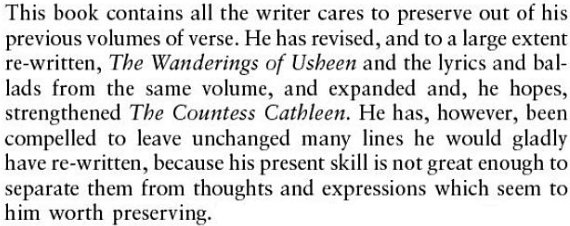
Yeats would come to look back on his early works with distaste as he regarded his more mature works as far superior and in the original preface of this collection he made clear that he thought the works that were cut were not worth retaining.

The first poem mentioned above ‘The Wanderings of Usheen’, more commonly titled ‘The Wanderings of Oisin’ is the longest poem included in the collection and takes up 35 of the 158 pages dedicated to poetry. I love the rhythm of this poem and despite its length it is actually quite an easy read and takes the form of a conversation between the legendary hero Usheen/Oisin and Saint Patrick, the patron saint of Ireland, although it is somewhat one sided with Saint Patrick barely managing to get a word in. It tells the story of Oisin’s journey into the land of Faerie and his wanderings with the fairy princess Niamh there for the last three hundred years. A small extract from the first section of the poem will give some idea of the work.

But now the moon like a white rose shone
In the pale west, and the sun’s rim sank,
And clouds arrayed their rank on rank
About his fading crimson ball:
The floor of Emen’s hosting hall
Was not more level than the sea,
As full of loving phantasy,
And with low murmurs we rode on,
Where many a trumpet-twisted shell
That in immortal silence sleeps
Dreaming of her own melting hues,
Her golds, her ambers, and her blues,
Pierced with soft light the shallowing deeps.
But now a wandering land breeze came
And a far sound of feathery quires;
It seemed to blow from the dying flame,
They seemed to sing in the smouldering fires.

One thing I didn’t realise until I read this collection and recognised the words, is that one of my favourite tracks by Irish band The Chieftains uses one of Yeats’ poems for the lyrics, beautifully read by Brenda Fricker, ‘Never give all the heart‘.

Leaving the poetry behind and delving into the second half of the book took me to totally unfamiliar territory as I had only read Yeats’ poetic works before. The one play included here has us yet again dealing with a character from the land of Faerie, this time the fairy is tempting a newly married woman to join her and leave the mortal realm. Following that is a very short and disappointing because of that, extract from the 1891 ‘Irish Fairy Tales’ which seems to just consist of an introduction and the enjoyable ‘Appendix: Classification of Irish Fairies’ this starts off with the largely friendly Sociable Fairies and then goes deeper into the mainly disagreeable Solitary Fairies. The brevity of this section makes me want to hunt out the complete book and read the actual folk tales told within it.

The next extract from a book, this time ‘The Celtic Twilight’ is at over forty pages quite a bit more representative than the handful of pages given to ‘Irish Fairy Tales’, it consists of a series of essays dealing with fairies, ghosts and other such supernatural characters and their encounters with humans. These essays are quite short, often just a single page but explore the myths of the Irish people with tales either told to Yeats or experienced by him. The selection from ‘John Sherman and Dhoya’ is again very short being just concerned with the story of Dhoya a giant mortal living alone who attracts the attention of a fairy lady who decides to become his companion until she is taken away by a male of her own folk leaving him alone again and inconsolable. Like ‘Irish Fairy Tales’ I’d like to read more of these stories as the taster is too brief. The final selection is actually complete and includes the six short stories concerning Red Hanrahan that were published together in 1897. These tell tales of Hanrahan’s, often ill-fated, encounters with women and supernatural beings.

If you want to get a representative overview of early works by William Butler Yeats then this collection would be a great place to start and like myself you will probably end up wanting more, especially of the prose works. This is the fourth book from the Penguin Drop Caps series I have written about along with a general overview of the series. There are twenty six in total, one author per letter of the alphabet and previously I have covered Ellery Queen, John Steinbeck and Xinran.

The Mystery of Orcival – Emile Gaboriau

Emile Gaboriau is largely forgotten now, especially in English translation, but he was a near contemporary of Sherlock Holmes creator Arthur Conan Doyle and his detective Monsieur Lecoq who appears in five novels and one short story by Gaboriau along with four novels by other writers all produced after Gaboriau’s untimely death at the age of just thirty six in 1873. Indeed Gaboriau was well enough known for Doyle to refer to him directly in the very first appearance of Holmes in the novel ‘A Study in Scarlet’ in 1887.

“Have you read Gaboriau’s works?” I asked. “Does Lecoq come up to your idea of a detective?”

Sherlock Holmes sniffed sardonically. “Lecoq was a miserable bungler,” he said, in an angry voice; “he had only one thing to recommend him, and that was his energy. That book made me positively ill. The question was how to identify an unknown prisoner. I could have done it in twenty-four hours. Lecoq took six months or so. It might be made a text-book for detectives to teach them what to avoid.”

A Study in Scarlet – Arthur Conan Doyle

Watson is upset at having two of his favourite detective writers dismissed as such amateurs, Gaboriau’s Lecoq along with Edgar Allen Poe’s Dupin

I felt rather indignant at having two characters whom I had admired treated in this cavalier style. I walked over to the window, and stood looking out into the busy street. “This fellow may be very clever,” I said to myself, “but he is certainly very conceited.”

A Study in Scarlet – Arthur Conan Doyle

To be fair to Holmes Lecoq is certainly an unusual character even wearing disguises at work so that his enemies, presumably people he has prosecuted and their associates, cannot find him to exact revenge “I have been a detective fifteen years, and no one at the prefecture knows either my true face or the colour of my hair.” He is clearly very intelligent and like Holmes sees inferences in the slightest clue which enables him to leap ahead of the other people on the case, what he lacks is a Watson where the conversations between the two keep the reader up to date with the plot. I enjoyed my first encounter with Lecoq in this his second novel although I also own a copy of his first appearance ‘L’Affaire Lerouge’ so I doubt it will be my only dalliance with this early policeman, and indeed the first time in fiction of a French detective. 

If I have one criticism of the novel it is the sudden appearance of a lot of back story, which in my copy starts on page 109 and runs until page 195, almost a third of the entire novel, and which kills the entertaining narrative up until then, effectively providing a pause in the story. This would probably have been better handled in an earlier part of the novel rather than pull the reader back to a time before the various crimes have been committed and deal with the relationships between the various characters, some of which are already dead by the time this extra information is provided. The sheer length of this section became frustrating as up until then the story had proceeded apace but suddenly we became bogged down in apparently irrelevant details, some of which do prove to be extremely relevant later. Yes we need this information to make full sense of the story but I don’t think it needed to be done in this way. This however is my only criticism of the novel, the various twists, that are revealed are very well done and whilst the reader can congratulate themselves in spotting the main suspect very early on the fact that this is confirmed just ninety pages in shows that you are probably supposed to work out the original protagonists according the provincial justice department were just red herrings.

The story when it eventually restarts at the case in hand is just as fast moving and ingenious as it was previously with Lecoq in control of chasing down the murderer whilst also willing to bend the law to protect the woman he is with, who would surely otherwise be dragged through the courts with her honour besmirched unnecessarily. Apart from the slow mid section of the novel I greatly enjoyed this early detective story from the 1860’s and Gaboriau was clearly an extremely capable pioneer of the genre who deserves to be far better known today than he is.

Haiku & Lips too Chilled – Matsuo Bashō

A Japanese poem of seventeen syllables, in three lines of five, seven, and five, traditionally evoking images of the natural world.

Oxford reference

Almost certainly the master, and certainly the best known outside Japan, of the Japanese poetry style known as haiku is Bashō, a poet who lived from 1644 to 1694 and produced the most elegant works in this form. However as can be seen from the definition of haiku it is an extremely difficult poetic style to translate as in theory to do it properly the translator has not only to render the meaning of the poem but also to express it in the syllable limitations. Which between two such different languages as Japanese and English, or indeed any of the ‘western’ languages, adds an extra level of complexity to the task which frankly could destroy the meaning.

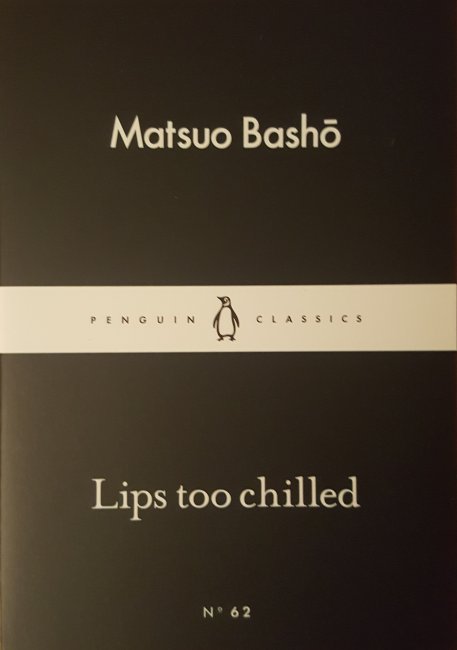
The two short volumes I have of Bashō’s poetry are both by Penguin although published twenty years apart, one to mark sixty years of Penguin Books (in 1995) and the other eighty (2015). They are both extracts from the Penguin Classics volume ‘On Love and Barley: Haiku of Bashō’ originally published in 1985 and translated by Lucian Stryk a Polish born American poet and professor of English at Northern Illinois University. This book has six haiku on each page and has sixty one pages of poetry so just over 360 poems in all. whilst ‘Haiku’ has a wonderful austerity of design with just one poem per page over sixty pages and ‘Lips too Chilled’ has two per page over fifty six pages. There is surprisingly little duplication between the two short books so I have somewhere around 150 haiku by Bashō which admittedly is still well short of half of his output but allows for an appreciation of his work. Stryk does sometimes attempt to stick to the rigid format of haiku but is quite happy to divert from this where the sense of the poem would be lost in translation, which I think is a perfectly fair way to approach the rendering between the two languages as I would much rather appreciate the meaning of the poets words than suffer the pedantic imposition of form. Let’s explore a little of the poets work in the title poem from the 2015 volume:

Lips too chilled
for prattle –
autumn wind

Not perhaps his finest work, I prefer:

Storming over
Lake Nio; whirlwinds
of cherry blossom

As with that I can picture the scene and the paucity of words adds a starkness to the image which would be lost with a longer form. So who was Matsuo Bashō? Well as I mentioned at the beginning he lived in the second half of the 15th century in Japan and as is common in the far east his first name (Matsuo) is his family name. Bashō is not even his real given name as he was born Matsuo Kinsaku, he took the name Bashō from the Japanese banana plant outside the hut built for him by his followers in the later part of 1675 as by then he was already a well known poet and this hut clearly inspired him.

New Year – the Bashō-Tosei
hermitage
a-buzz with haiku

Bashō is also well known in Japan as a traveller making many long walks, usually alone despite the dangers of bandits. But his best known walk, taking 150 days and covering roughly 2,400km (around 1,500 miles) was done in 1689 with one of his students and inspired his great travel book ‘The Narrow Road to the Deep North’, which when it was published posthumously further embellished the master’s fame.

Journey’s end –
still alive, this
autumn evening

A.S.B. Glover – Tim Graham

Subtitled ‘The Unacknowledged Genius of Penguin’ this is part biography and part a collection of correspondence and it is the letters both to and from Glover that give the clearest picture of the character of the man. For those people not familiar with the name A.S.B. Glover, which I suspect is most of the people reading this blog, he was responsible for proof reading and editing several series for Penguin Books over a period of sixteen years especially the factual Pelicans as well as editing various books for other publishers. This was a role that ideally suited this remarkably erudite man who could read and write in multiple languages including Ancient Greek, Latin and Sanskrit and was also a renowned scholar in religious texts and the saints of the various Christian denominations and yet left school with no qualifications. Biographical details regarding Glover are difficult to find, he was born in 1895 as Alan McDougall and changed his name sometime in the 1920’s possibly due to his regular imprisonment during World War I as a conscientious objector under his original name. One thing that I definitely didn’t know about him that Tim mentions is that his body was covered in tattoos, including his face, although these facial ones were later removed leaving some scarring and that he may have earned a living for a time as a tattooed man in circuses. Tim cannot find any evidence of a McDougall or Glover working in such a role but it is entirely possible that he had yet another name that he worked under at the time.

He first came to the attention of the publishing world by sending numerous letters containing corrections to books they had recently published to the extent that Penguin realised that it would probably be cheaper to employ Glover to catch mistakes before they went to print rather than amend books for subsequent publication. I’ve mentioned before that you see more of Glover in his letters and the following example dealing with a matter close to his heart after his years in prison is a case in point.

The book by Trevor Gibbens never saw light of day despite Glover’s repeated attempts to get the author to finish it.

This book however is published in a limited run of just 600 copies by The Penguin Collectors Society and designed to look like a Pelican from the period Glover was in charge. At the time of writing this review it is available from the society for £12 plus postage, follow this link if interested. All in all it is an really good book about a fascinating man, who although he didn’t get on all the time with his colleagues and particularly not his boss, Allan Lane, was nevertheless essential to the accuracy and therefore the authority that Pelican Books established under his control.

À rebours – Joris-Karl Huysmans

It was the strangest book that he had ever read. It seemed to him that in exquisite raiment, and to the delicate sound of flutes, the sins of the world were passing in dumb show before him. Things that he had dimly dreamed of were suddenly made real to him. Things of which he had never dreamed were gradually revealed.

It was a novel without a plot and with only one character, being, indeed, simply a psychological study of a certain young Parisian who spent his life trying to realise in the nineteenth century all the passions and modes of thought that belonged to every century except his own, and to sum up, as it were, in himself the various moods through which the world-spirit had ever passed, loving for their mere artificiality those renunciations that men have unwisely called virtue, as much as those natural rebellions that wise men still call sin.

The Picture of Dorian Gray (chapter 10) – Oscar Wilde

When I recently read ‘The Picture of Dorian Gray‘ I assumed that the book referred to as the inspiration of Gray’s sensual explorations and obsessions was simply a device invented by Wilde, so I was surprised to discover that in fact the book actually existed. Wilde confirmed that À rebours by Huysmans was the book during his failed libel trial against the Marquess of Queensbury in 1895, and I found that not only did it exist but that a copy was already on my shelves, and had been for probably twenty years although sadly neglected, in form of the Penguin Books translation of 1959 with its title translated as ‘Against Nature’, it is also known as ‘Against the Grain’.

Charles-Marie-Georges Huysmans, who wrote as Joris-Karl in a tribute to his father, was a career civil servant, author and art critic living in Paris between 1848 and 1907 and was far from the character of the aesthete, Des Esseintes, who is the ‘hero’ of Against Nature. I put the word hero in quotes advisedly as the Duc Jean Des Esseintes is far from heroic being “a frail young man of thirty, who was anaemic, with hollow cheeks, cold eyes of steely blue, a nose that turned up, but straight, and thin papery hands”. This then is the subject of the book with other characters reduced to mere cyphers as he keeps himself away from all other human contact as far as possible. Even arranging that his two servants rarely see him and they live in a sound deadening apartment in a separate part of the house so that their existence doesn’t impinge on the solitude and quiet so desired by their master. Huysmans is clearly highly educated and very well read as demonstrated by the third chapter of the book, in this edition at least as translations vary between the chapter breaks, which is largely a harangue on the Latin writers from Virgil, just before the Christian era, to the eighth century Anglo-Saxon ecclesiastical authors whilst featuring the Des Esseintes library.

It is only fair to add that, if his admiration for Virgil was anything but excessive, and his enthusiasm for Ovid’s limpid effusions exceptionally discrete, the disgust he felt for the elephantine Horace’s vulgar twaddle, for the stupid patter he keeps up as he simpers at his audience like a painted old clown was absolutely limitless.

Sallust, who is at least no more insipid than the rest, Livy who is pompous and sentimental Seneca who is turgid and colourless, Suetonius who is larval and lymphatic, Tacitus who with his studied concision, is the most virile, the most virile, the most sinewy of them all. In poetry, Juvenal, despite a few vigorous lines, and Persius, for all his mysterious innuendos both left him cold. Leaving aside Tibullus and Propertius, Quintilian and the two Plinies, Statius, Martial of Bilbilous, Terence even and Plautus whose jargon with its plentiful neologisms, compounds and diminutives attracted him, but whose low wit and salty humour repelled hm.

Translation by Robert Baldick – Penguin 1959

Well that just about sums up most of the famous ancient Roman writers and presumably these are not just the supposed opinions of Des Esseintes but that of the author as well, the denigration of the Latin poets and later biblical scholars continues for several more pages as he moves through history. Two more chapters near the end of the book perform similar attacks on French literature but as these concentrate on liturgical authors and what Huysmans himself describes as minor writers I found these far more difficult to read as I wasn’t familiar with the works discussed. Another chapter represents the Des Esseintes art collection where Huysmans has him own Gustave Moreau’s ‘Salome Dancing Before Herod’ and ‘The Apparition’ both of which are described at length along with prints by Dutch artist Jan Luyken of medieval torture scenes along with other works. We are now roughly a third of the way through the book and I can see the fascination that this book must have had for Oscar Wilde, the descriptions are sumptuous, if at times macabre, but the book is so unlike anything else I have read apart from the work that it clearly inspired, that of Dorian Gray. Here we have a character determined to absorb all they can from the great art and literature to the exclusion of anything and anyone else, a man with a fine eye to colour and the effects that different lighting has upon it and a determination to appreciate all that he sees as good. A man who lives almost entirely in artificial light as he wakes in the evening and breakfasts then does as he pleases before dining in the early hours and going to bed as the sun rises so what looks good by candlelight is an essential consideration.

Later chapters cover, amongst many other things, his fascinating, although short lived collection of hot house flowers, deliberately chosen to look fake in texture and colours in contrast to his existing man-made floral displays that are masterpieces of realism. A detailed account of his bedroom also features where again artifice triumphs over nature with fine materials displayed to mimic the austerity of a monks cell such as the yellow silk on the walls to represent the paint on plaster of his original subject. All in all I loved this book and I’m glad I read it after ‘The Picture of Dorian Gray’, its very obscurity up until then had caused me to bypass in my shelves until I was truly ready to read it. I must admit I expected a difficult read and was pleasantly surprised as to how quickly I was absorbed in the work and apart from the previously noted French literature issues the 200+ pages largely flew past. Admittedly with several pauses where I looked up various things such as some of the paintings or flowers itemised by Huysmans which I was not familiar with, but that he had piqued my interest with to make sure I fully appreciated the points he was making and the exactitude of his representations of them,

Tiffany Aching’s Guide to Being a Witch – Rhianna Pratchett & Gabrielle Kent

I’m writing this on Friday 10th November having received my copy of this book on the morning of its publication day, yesterday, and spent several happy hours reading it, finishing around 2:30pm yesterday afternoon. I think that tells you how much I enjoyed this first foray into her father’s literary world made by Rhianna and I hope that there will be more to come. When Sir Terry died Rhianna said that she would definitely not be continuing her father’s Discworld novels, and despite initial appearances this book does indeed stick to that line as it is another of the ancillary Discworld books such as Mrs Bradshaw’s Handbook, The World of Poo, the various atlases, or even the assorted diaries, maps, plays and guides all of which were written by people other than Terry Pratchett but based on his works with his approval and undoubted tinkering. Sadly Terry is no longer with us to give his blessings to this book but I’m sure he would have done so as Rhianna has stepped carefully into her father’s legacy with the assistance of Gabrielle Kent, whom I admit not knowing anything about other than she writes the Alfie Bloom series of childrens books, and the wonderful artwork of Paul Kidby who has signed my copy.

Based on the five ‘young adult’ Tiffany Aching books written by Terry , which include his final novel ‘The Shepherd’s Crown’, the book is beautifully designed as a guide to witchcraft by Tiffany but with apparently hand-written notes by other characters from these books such as witches Esme Weatherwax, Nanny Ogg, Miss Tick and the Feegle Rob Anybody along with additional notes from the witch Mrs Letice Earwig inserted so she can complain. Do you need to have read the books before reading this one? Frankly yes. Not only will you understand better what is being covered in the two hundred pages of this work but it basically consists of a huge number of spoilers for the other five books so you definitely don’t want to start here. Below is one of the pages from the main text (carefully chosen so as not to include any spoilers), all of which are full colour and covered in illustrations by Paul Kidby, it really is a pleasure to read the book and admire the artwork.

If you are intrigued by the illustration of the carved chalk figure behind the Feegle it is an accurate depiction of the 180 feet high (55 metres) Cerne Abbas Giant carefully censored by the appearance of the Feegle head to hide his most obvious feature and keep the book child friendly.

The text does contain a lot of original content but also consists of retelling, from Tiffany’s viewpoint, stories from the five Tiffany novels and also other tales from the Witches series of books going all the way back to the third Discworld title, ‘Equal Rites’ in 1987. Equal Rites told the story of Eskarina Smith, the only female wizard, whilst the forty first and final Discworld novel, ‘The Shepherds Crown’ in 2015, in a neat closing of a vast circle includes Geoffrey Swivel the only male witch, both of these characters feature in the new book. The pictures also go back over the decades with old illustrations intermingled with brand new work, some of the older depictions of the characters come from the now difficult to find calendars and diaries so it is good to see them re-used in a book where they can be appreciated by more people, Paul Kidby first started working with Terry back in 1993 doing artwork for the calendars and diaries and various other books but not the novel covers as these were the work of Josh Kirby, sadly Kirby died in 2001 and Kidby took over as the artist of choice by Terry for the novel covers and almost everything else and it is his depictions of the characters and places that are now most familiar to people.

I hope you enjoy the book as much as I did but make sure to read the five Tiffany Aching books first. These are, in order, ‘The Wee Free Men’ (2003) ‘A Hat Full of Sky’ (2004) ‘Wintersmith’ (2006), ‘I Shall Wear Midnight’ (2010) and ‘The Shepherd’s Crown’ (2015). You don’t need to have read any of the earlier Witches series of books before tackling these but they are good so why not? There is a final joke that I almost missed as it is on the back of the dust wrapper. Feegles will steal anything and here they are making off with the barcode block.