Haiku & Lips too Chilled – Matsuo Bashō

A Japanese poem of seventeen syllables, in three lines of five, seven, and five, traditionally evoking images of the natural world.

Oxford reference

Almost certainly the master, and certainly the best known outside Japan, of the Japanese poetry style known as haiku is Bashō, a poet who lived from 1644 to 1694 and produced the most elegant works in this form. However as can be seen from the definition of haiku it is an extremely difficult poetic style to translate as in theory to do it properly the translator has not only to render the meaning of the poem but also to express it in the syllable limitations. Which between two such different languages as Japanese and English, or indeed any of the ‘western’ languages, adds an extra level of complexity to the task which frankly could destroy the meaning.

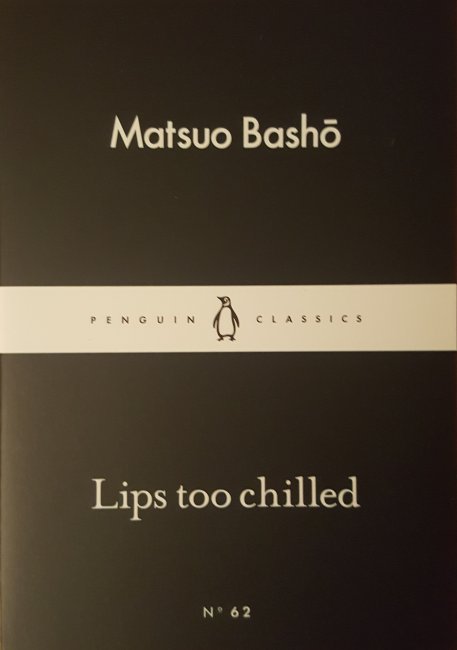
The two short volumes I have of Bashō’s poetry are both by Penguin although published twenty years apart, one to mark sixty years of Penguin Books (in 1995) and the other eighty (2015). They are both extracts from the Penguin Classics volume ‘On Love and Barley: Haiku of Bashō’ originally published in 1985 and translated by Lucian Stryk a Polish born American poet and professor of English at Northern Illinois University. This book has six haiku on each page and has sixty one pages of poetry so just over 360 poems in all. whilst ‘Haiku’ has a wonderful austerity of design with just one poem per page over sixty pages and ‘Lips too Chilled’ has two per page over fifty six pages. There is surprisingly little duplication between the two short books so I have somewhere around 150 haiku by Bashō which admittedly is still well short of half of his output but allows for an appreciation of his work. Stryk does sometimes attempt to stick to the rigid format of haiku but is quite happy to divert from this where the sense of the poem would be lost in translation, which I think is a perfectly fair way to approach the rendering between the two languages as I would much rather appreciate the meaning of the poets words than suffer the pedantic imposition of form. Let’s explore a little of the poets work in the title poem from the 2015 volume:

Lips too chilled
for prattle –
autumn wind

Not perhaps his finest work, I prefer:

Storming over
Lake Nio; whirlwinds
of cherry blossom

As with that I can picture the scene and the paucity of words adds a starkness to the image which would be lost with a longer form. So who was Matsuo Bashō? Well as I mentioned at the beginning he lived in the second half of the 15th century in Japan and as is common in the far east his first name (Matsuo) is his family name. Bashō is not even his real given name as he was born Matsuo Kinsaku, he took the name Bashō from the Japanese banana plant outside the hut built for him by his followers in the later part of 1675 as by then he was already a well known poet and this hut clearly inspired him.

New Year – the Bashō-Tosei
hermitage
a-buzz with haiku

Bashō is also well known in Japan as a traveller making many long walks, usually alone despite the dangers of bandits. But his best known walk, taking 150 days and covering roughly 2,400km (around 1,500 miles) was done in 1689 with one of his students and inspired his great travel book ‘The Narrow Road to the Deep North’, which when it was published posthumously further embellished the master’s fame.

Journey’s end –
still alive, this
autumn evening

A.S.B. Glover – Tim Graham

Subtitled ‘The Unacknowledged Genius of Penguin’ this is part biography and part a collection of correspondence and it is the letters both to and from Glover that give the clearest picture of the character of the man. For those people not familiar with the name A.S.B. Glover, which I suspect is most of the people reading this blog, he was responsible for proof reading and editing several series for Penguin Books over a period of sixteen years especially the factual Pelicans as well as editing various books for other publishers. This was a role that ideally suited this remarkably erudite man who could read and write in multiple languages including Ancient Greek, Latin and Sanskrit and was also a renowned scholar in religious texts and the saints of the various Christian denominations and yet left school with no qualifications. Biographical details regarding Glover are difficult to find, he was born in 1895 as Alan McDougall and changed his name sometime in the 1920’s possibly due to his regular imprisonment during World War I as a conscientious objector under his original name. One thing that I definitely didn’t know about him that Tim mentions is that his body was covered in tattoos, including his face, although these facial ones were later removed leaving some scarring and that he may have earned a living for a time as a tattooed man in circuses. Tim cannot find any evidence of a McDougall or Glover working in such a role but it is entirely possible that he had yet another name that he worked under at the time.

He first came to the attention of the publishing world by sending numerous letters containing corrections to books they had recently published to the extent that Penguin realised that it would probably be cheaper to employ Glover to catch mistakes before they went to print rather than amend books for subsequent publication. I’ve mentioned before that you see more of Glover in his letters and the following example dealing with a matter close to his heart after his years in prison is a case in point.

The book by Trevor Gibbens never saw light of day despite Glover’s repeated attempts to get the author to finish it.

This book however is published in a limited run of just 600 copies by The Penguin Collectors Society and designed to look like a Pelican from the period Glover was in charge. At the time of writing this review it is available from the society for £12 plus postage, follow this link if interested. All in all it is an really good book about a fascinating man, who although he didn’t get on all the time with his colleagues and particularly not his boss, Allan Lane, was nevertheless essential to the accuracy and therefore the authority that Pelican Books established under his control.

À rebours – Joris-Karl Huysmans

It was the strangest book that he had ever read. It seemed to him that in exquisite raiment, and to the delicate sound of flutes, the sins of the world were passing in dumb show before him. Things that he had dimly dreamed of were suddenly made real to him. Things of which he had never dreamed were gradually revealed.

It was a novel without a plot and with only one character, being, indeed, simply a psychological study of a certain young Parisian who spent his life trying to realise in the nineteenth century all the passions and modes of thought that belonged to every century except his own, and to sum up, as it were, in himself the various moods through which the world-spirit had ever passed, loving for their mere artificiality those renunciations that men have unwisely called virtue, as much as those natural rebellions that wise men still call sin.

The Picture of Dorian Gray (chapter 10) – Oscar Wilde

When I recently read ‘The Picture of Dorian Gray‘ I assumed that the book referred to as the inspiration of Gray’s sensual explorations and obsessions was simply a device invented by Wilde, so I was surprised to discover that in fact the book actually existed. Wilde confirmed that À rebours by Huysmans was the book during his failed libel trial against the Marquess of Queensbury in 1895, and I found that not only did it exist but that a copy was already on my shelves, and had been for probably twenty years although sadly neglected, in form of the Penguin Books translation of 1959 with its title translated as ‘Against Nature’, it is also known as ‘Against the Grain’.

Charles-Marie-Georges Huysmans, who wrote as Joris-Karl in a tribute to his father, was a career civil servant, author and art critic living in Paris between 1848 and 1907 and was far from the character of the aesthete, Des Esseintes, who is the ‘hero’ of Against Nature. I put the word hero in quotes advisedly as the Duc Jean Des Esseintes is far from heroic being “a frail young man of thirty, who was anaemic, with hollow cheeks, cold eyes of steely blue, a nose that turned up, but straight, and thin papery hands”. This then is the subject of the book with other characters reduced to mere cyphers as he keeps himself away from all other human contact as far as possible. Even arranging that his two servants rarely see him and they live in a sound deadening apartment in a separate part of the house so that their existence doesn’t impinge on the solitude and quiet so desired by their master. Huysmans is clearly highly educated and very well read as demonstrated by the third chapter of the book, in this edition at least as translations vary between the chapter breaks, which is largely a harangue on the Latin writers from Virgil, just before the Christian era, to the eighth century Anglo-Saxon ecclesiastical authors whilst featuring the Des Esseintes library.

It is only fair to add that, if his admiration for Virgil was anything but excessive, and his enthusiasm for Ovid’s limpid effusions exceptionally discrete, the disgust he felt for the elephantine Horace’s vulgar twaddle, for the stupid patter he keeps up as he simpers at his audience like a painted old clown was absolutely limitless.

Sallust, who is at least no more insipid than the rest, Livy who is pompous and sentimental Seneca who is turgid and colourless, Suetonius who is larval and lymphatic, Tacitus who with his studied concision, is the most virile, the most virile, the most sinewy of them all. In poetry, Juvenal, despite a few vigorous lines, and Persius, for all his mysterious innuendos both left him cold. Leaving aside Tibullus and Propertius, Quintilian and the two Plinies, Statius, Martial of Bilbilous, Terence even and Plautus whose jargon with its plentiful neologisms, compounds and diminutives attracted him, but whose low wit and salty humour repelled hm.

Translation by Robert Baldick – Penguin 1959

Well that just about sums up most of the famous ancient Roman writers and presumably these are not just the supposed opinions of Des Esseintes but that of the author as well, the denigration of the Latin poets and later biblical scholars continues for several more pages as he moves through history. Two more chapters near the end of the book perform similar attacks on French literature but as these concentrate on liturgical authors and what Huysmans himself describes as minor writers I found these far more difficult to read as I wasn’t familiar with the works discussed. Another chapter represents the Des Esseintes art collection where Huysmans has him own Gustave Moreau’s ‘Salome Dancing Before Herod’ and ‘The Apparition’ both of which are described at length along with prints by Dutch artist Jan Luyken of medieval torture scenes along with other works. We are now roughly a third of the way through the book and I can see the fascination that this book must have had for Oscar Wilde, the descriptions are sumptuous, if at times macabre, but the book is so unlike anything else I have read apart from the work that it clearly inspired, that of Dorian Gray. Here we have a character determined to absorb all they can from the great art and literature to the exclusion of anything and anyone else, a man with a fine eye to colour and the effects that different lighting has upon it and a determination to appreciate all that he sees as good. A man who lives almost entirely in artificial light as he wakes in the evening and breakfasts then does as he pleases before dining in the early hours and going to bed as the sun rises so what looks good by candlelight is an essential consideration.

Later chapters cover, amongst many other things, his fascinating, although short lived collection of hot house flowers, deliberately chosen to look fake in texture and colours in contrast to his existing man-made floral displays that are masterpieces of realism. A detailed account of his bedroom also features where again artifice triumphs over nature with fine materials displayed to mimic the austerity of a monks cell such as the yellow silk on the walls to represent the paint on plaster of his original subject. All in all I loved this book and I’m glad I read it after ‘The Picture of Dorian Gray’, its very obscurity up until then had caused me to bypass in my shelves until I was truly ready to read it. I must admit I expected a difficult read and was pleasantly surprised as to how quickly I was absorbed in the work and apart from the previously noted French literature issues the 200+ pages largely flew past. Admittedly with several pauses where I looked up various things such as some of the paintings or flowers itemised by Huysmans which I was not familiar with, but that he had piqued my interest with to make sure I fully appreciated the points he was making and the exactitude of his representations of them,
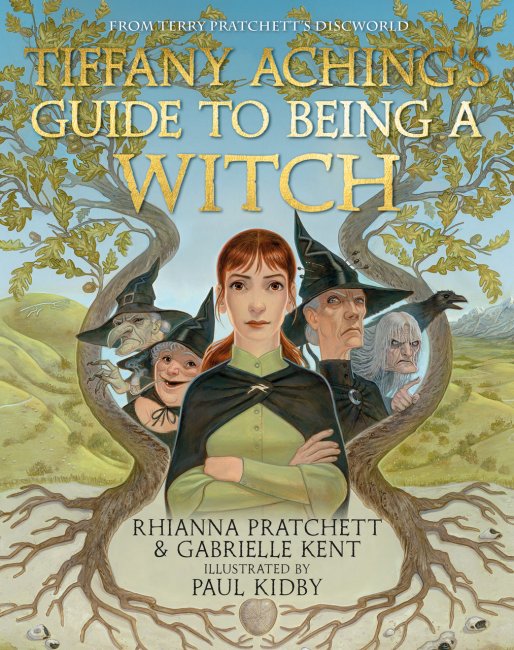
Tiffany Aching’s Guide to Being a Witch – Rhianna Pratchett & Gabrielle Kent

I’m writing this on Friday 10th November having received my copy of this book on the morning of its publication day, yesterday, and spent several happy hours reading it, finishing around 2:30pm yesterday afternoon. I think that tells you how much I enjoyed this first foray into her father’s literary world made by Rhianna and I hope that there will be more to come. When Sir Terry died Rhianna said that she would definitely not be continuing her father’s Discworld novels, and despite initial appearances this book does indeed stick to that line as it is another of the ancillary Discworld books such as Mrs Bradshaw’s Handbook, The World of Poo, the various atlases, or even the assorted diaries, maps, plays and guides all of which were written by people other than Terry Pratchett but based on his works with his approval and undoubted tinkering. Sadly Terry is no longer with us to give his blessings to this book but I’m sure he would have done so as Rhianna has stepped carefully into her father’s legacy with the assistance of Gabrielle Kent, whom I admit not knowing anything about other than she writes the Alfie Bloom series of childrens books, and the wonderful artwork of Paul Kidby who has signed my copy.

Based on the five ‘young adult’ Tiffany Aching books written by Terry , which include his final novel ‘The Shepherd’s Crown’, the book is beautifully designed as a guide to witchcraft by Tiffany but with apparently hand-written notes by other characters from these books such as witches Esme Weatherwax, Nanny Ogg, Miss Tick and the Feegle Rob Anybody along with additional notes from the witch Mrs Letice Earwig inserted so she can complain. Do you need to have read the books before reading this one? Frankly yes. Not only will you understand better what is being covered in the two hundred pages of this work but it basically consists of a huge number of spoilers for the other five books so you definitely don’t want to start here. Below is one of the pages from the main text (carefully chosen so as not to include any spoilers), all of which are full colour and covered in illustrations by Paul Kidby, it really is a pleasure to read the book and admire the artwork.

If you are intrigued by the illustration of the carved chalk figure behind the Feegle it is an accurate depiction of the 180 feet high (55 metres) Cerne Abbas Giant carefully censored by the appearance of the Feegle head to hide his most obvious feature and keep the book child friendly.

The text does contain a lot of original content but also consists of retelling, from Tiffany’s viewpoint, stories from the five Tiffany novels and also other tales from the Witches series of books going all the way back to the third Discworld title, ‘Equal Rites’ in 1987. Equal Rites told the story of Eskarina Smith, the only female wizard, whilst the forty first and final Discworld novel, ‘The Shepherds Crown’ in 2015, in a neat closing of a vast circle includes Geoffrey Swivel the only male witch, both of these characters feature in the new book. The pictures also go back over the decades with old illustrations intermingled with brand new work, some of the older depictions of the characters come from the now difficult to find calendars and diaries so it is good to see them re-used in a book where they can be appreciated by more people, Paul Kidby first started working with Terry back in 1993 doing artwork for the calendars and diaries and various other books but not the novel covers as these were the work of Josh Kirby, sadly Kirby died in 2001 and Kidby took over as the artist of choice by Terry for the novel covers and almost everything else and it is his depictions of the characters and places that are now most familiar to people.

I hope you enjoy the book as much as I did but make sure to read the five Tiffany Aching books first. These are, in order, ‘The Wee Free Men’ (2003) ‘A Hat Full of Sky’ (2004) ‘Wintersmith’ (2006), ‘I Shall Wear Midnight’ (2010) and ‘The Shepherd’s Crown’ (2015). You don’t need to have read any of the earlier Witches series of books before tackling these but they are good so why not? There is a final joke that I almost missed as it is on the back of the dust wrapper. Feegles will steal anything and here they are making off with the barcode block.

The Compleat Angler – Izaak Walton

First published in 1653, so 370 years old this year, my copy is the first Penguin edition from January 1940 and like the first book in the natural history theme for August which was Gilbert White’s ‘The Natural History of Selborne‘, it was intended to be part of the second series of Penguin Illustrated Classics which never happened. Only these two books made it as far as being illustrated, this one with lovely wood engravings by Gertrude Hermes, before the project was cancelled.

Born in Stafford (a town in the English Midlands) in 1593 Izaak Walton originally went into trade as an ironmonger in London and retired in 1644, aged just fifty one, moving back north to Staffordshire where he became a well known countryman and after the publication of this book in 1653 a famous angler. His retirement appears to be linked to the royalist loss in the English civil war as he was a staunch supporter of the King and London was probably uncomfortable for him during the Cromwellian period. Walton would live to be ninety, a remarkable age for the time, and he kept updating The Compleat Angler for a quarter of a century as he came up with things he felt he wanted to add. The book consists of a series of conversations between a Piscator (angler) and a Venator (hunter) along with other characters but these two are the main ones as the Piscator, clearly Walton himself, aims to teach the Venator the noble art of fishing and how to catch the various species of fish in the local rivers. At times the text can be a little tedious if, like myself, you aren’t a fisherman, for example there is a long section which describes various artificial flies used for catching trout and how these should be made, with which feathers, threads and other materials. However the book is largely enjoyable even if you aren’t an angler for its descriptions of country life and the songs and poems that a liberally spread throughout the text.

The Angler’s wish.

I in these flowery meads would be:
These crystal streams should solace me;
To whose harmonious bubbling noise
I with my Angle would rejoice:
  Sit here, and see the turtle-dove
  Court his chaste mate to acts of love:

Or, on that bank, feel the west wind
Breathe health and plenty: please my mind,
To see sweet dew-drops kiss these flowers,
And then washed off by April showers:
  Here, hear my Kenna sing a song;
  There, see a blackbird feed her young.

Or a leverock build her nest:
Here, give my weary spirits rest,
And raise my low-pitch'd thoughts above
Earth, or what poor mortals love:
  Thus, free from law-suits and the noise
  Of princes' courts, I would rejoice:

Or, with my Bryan, and a book,
Loiter long days near Shawford-brook;
There sit by him, and eat my meat,
There see the sun both rise and set:
There bid good morning to next day;
  There meditate my time away,
  And Angle on; and beg to have
  A quiet passage to a welcome grave.

It is these poems and songs along with various descriptive sections that Walton mainly added in his various iterations of the book, the technical sections of how to fish and suggestions as to how prepare the catch for the table are largely unchanged through the published versions. The book is split into five days, the first of which is quite short and is largely an introduction via a four mile walk between the Piscator, Venator and Auceps (a man with hawks) who compare the advantages and pleasures of hunting in water, on land and in the air. This is where the Venator decides to become the Piscator’s pupil therefore leading to the rest of the book however the Auceps is never referred to again after this opening chapter. From day two the lessons on fishing begin and the two men are occasionally joined by the Piscator’s brother, Peter, and his friend Coridon, along with a couple of milkmaids who turn up a couple of times and appear to be there mainly to sing some songs and a few other people who are mentioned just once.

It’s a somewhat odd book, being unsure if it is a technical manual on fishing or a book of songs and poetry with countryside tales. I suspect the first edition was much more the manual but as Walton kept adding to it, taking the book from the original thirteen to the final twenty one chapters over twenty three years it somewhat lost its way. It’s largely an interesting read for the fishing layman and I’m glad I’ve finally read it.

The Coronation of Haile Selassie – Evelyn Waugh

I’m planning on reading ‘Scoop’, Evelyn Waugh’s comic novel about the life of a foreign journalist in the coming months but remembered I had on the shelves an example of Waugh’s own time as a foreign reporter, namely his account of attending the coronation of Emperor Haile Selassie in Abyssinia, now Ethiopia. This occurred in 1930, eight years before he wrote ‘Scoop’ during which he was submitting stories for several newspapers in a freelance capacity. The main inspiration for ‘Scoop’ was when he was back in Abyssinia in 1935, this time on behalf of the Daily Mail covering the second Italo-Abyssinian war. Whilst he was not a great war reporter he did get plenty of material for his subsequent novel. But this link does make reading his stories about reporting in 1930 an ideal prelude to tackling ‘Scoop’.

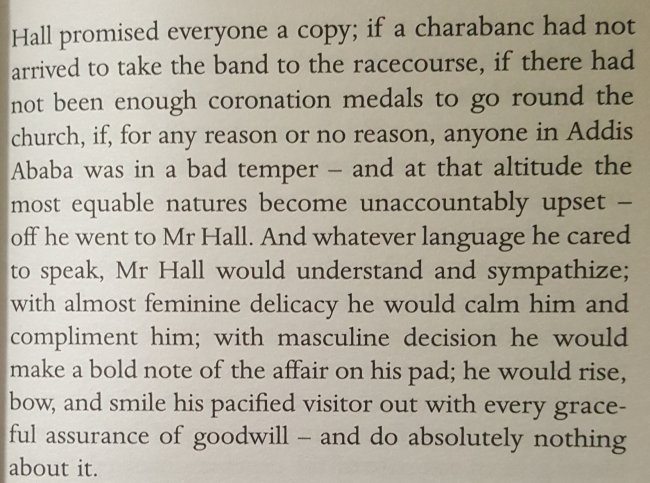
This Penguin 70 book is actually a couple of extracts from his 1931 travelogue ‘Remote People’, a book I’m now keen to track down to read more fully, but for now the two sections included here regarding the coronation and the apparently interminable journey to get home from it are all I have and I have loved the dry humour and observation of detail that are a trademark of his writing. He starts off by introducing a few of the people he has dealings with or are directly involved with the coronation or in several cases both in particular who was originally in Abyssinia as a trader but had somehow ended up as chief, and apparently only member of the bureau of foreign affairs and had an office in the centre of Addis Ababa, the country’s capital. Described as extremely handsome of German and Abyssinian descent he was also an excellent linguist and could apparently arrange anything even finding copies of the apparently non-existent coronation service…

In this last statement Mr Hall appears to be no different to anyone else Waugh has to deal with or indeed just observes. Addis had been the capital for almost forty years by then but large parts of it was still under construction. The hotel the British Marine band had been quartered in lacked a roof and building work all over the city was making very little progress as the workmen would apparently simply stop if they weren’t under constant supervision. Throw into this chaos the organisation of a coronation and the consequent arrival of foreign dignitaries along with the world media to cover it and the difficulties of communication both inside and outside the country and it’s a wonder anything progressed to any sort of a plan. This is where Waugh had an advantage over his fellow representatives of the press he didn’t have a daily newspaper to serve that needed something all the time he could wait and write accurately what happened unlike others he derided such as Associated Press which sent in totally fictitious accounts of the ceremony because of time constraints needing copy before it had even started. Mind you those members of the press that waited to get at least accurate reports of the first part of what turned out to be an interminable event discovered that the only telegraph office in the city had closed for the day so they couldn’t send their reports anyway.

The book doesn’t have any of Waugh’s actual reports in it, rather it is a diary of his experiences both in the lead up to and being at the coronation and the six days of feasting and celebration that followed for the royal family and the numerous tribal leaders that attended and it is at times both an important historical document and also extremely funny. The second account included in the book is entitled ‘First Nightmare’ and describes how Waugh attempted to get at least part way home with ships and trains being either cancelled, not turning up even when expected or even taken over by a Princess and her retinue who could just bounce all the passengers who had managed to find seats out of Abyssinia back out of them again. In all Waugh takes four days to go from Harar to Aden, a distance of 311 miles (500km) with numerous hold ups and false hopes of possible means of moving forward and you can feel his frustration building. At the time Aden was part of the British Empire and regular ships travelled back to the UK all he had to do was get there but it proved incredibly difficult.

I’ve really enjoyed this short book and am now looking forward to reading ‘Scoop’, probably early next year by the look of the planned reading list I already have for the rest of 2023.

The Picture of Dorian Gray – Oscar Wilde

Oscar Wilde’s only novel can famously be summarised as the story of a man who doesn’t appear to grow older, but rather the portrait of him ages on his behalf. But the copy I have is 256 pages long so it must be much more than the twenty word precis just given and indeed it is. I didn’t know what to expect when I pulled this book off the shelf as for some reason I have never read it before despite it being a famous work of literature and my owning this copy for at least fifteen years, but I definitely enjoyed it for it is beautifully written.

Yes the story of the painting ‘ageing’ rather than Dorian is there but that just scratches the surface, the picture shows all the corruption, not only of his increasing age, but also the collapse of his morality and does so in real time. So when he views the portrait, which he does regularly as time goes on even though he has it locked away in an attic so nobody else can see it, he can see the effects of his lifestyle boldly depicted on the canvas. Indeed when he kills a man blood starts to show on his hand in the portrait and appears to be dripping onto the floor within the painting from his fingers.

Dorian Gray is the only child from a very wealthy family so has no need to work instead he can just idle his way through life doing whatever he wants and because he can do this he does, dragging other people along with him. We see evidence of his moral dereliction many times through the book and his effect on his friends and lovers, one of his friends is depicted late in the book in an opium den hopelessly addicted and others commit suicide after being abandoned or blackmailed by him. Dorian however does not care about any of them even the social approbation that comes his way with people leaving rooms if he comes in or otherwise shunning his company means nothing to him for he has retained his youthful looks and that is all that he apparently needs. In his rejection of societal norms he is guided by the hedonistic dandy Lord Henry Wotton, whom he meets right at the beginning of the book at the studio of artist Basil Hallward whilst he is painting the titular full length picture. Henry becomes probably his only life long friend, apparently unconcerned about the depravity of Dorian’s life and loves and equally unfazed by Dorian’s never ending youthful looks or his occasional collecting manias. Due to his vast wealth Dorian can pursue any interest he wishes, collecting rare tapestries, perfumes, musical instruments or even jewels amongst other things, becoming an expert in this or that field before moving on and it is this money and knowledge that enabled him to stay accepted by at least part of London society.

Yes Dorian Gray is a repellent character, one that if he had really existed anyone would do well to avoid the company of, but Oscar Wilde’s writing is in contrast truly lovely. The pages just flew past whilst I was reading the book and as the story developed of Dorian’s spiral into vice the writing seemed to get better. It is. I suppose, part gothic horror and part social commentary upon the idle rich that Wilde spent so much time in the company of both in the city of his birth, Dublin, and London but I loved the book and can’t believe I have managed to not read it before. The final denouement, whilst the reader is expecting something of the sort, still had surprising details so Wilde kept me engrossed to the very last word and there are few books where that could be said.

Murder in the Basement – Anthony Berkeley

After the awful MC Beaton of a couple of weeks ago I felt that a decent murder mystery was called for. I normally only read a mystery and crime story about once every three months or so but Something Borrowed, Someone Dead was so dreadful I don’t think it counts so back to the heyday of crime novels, the 1930’s. I have several books by Anthony Berkeley Cox who wrote not only as Anthony Berkeley but as Francis Iles, A Monmouth Platts and A B Cox, but it is as Anthony Berkeley that he is, if at all nowadays, best known, especially for the ten amateur detective Roger Sheringham novels of which this is the eighth, first published in 1932. I chose it as it was the only Berkeley novel on my shelves I had not already read, although this is the first of his I have blogged about. He was one of the founders of The Detection Club, a group of then famous mystery writers including Agatha Christie and Dorothy L Sayers amongst others who use the meet for regular dinners, sadly several of the early members are largely forgotten including Berkeley whose books nowadays seem to be only reprinted by the British Library Crime Classics series which exists to spread the word regarding such authors.

Murder in the Basement is a classic of the genre in that the discovery of a body in the cellar of a newly occupied house in south London reveals that it was a woman, probably between twenty and thirty years old, five months pregnant but otherwise no distinguishing features as she had been buried for several months and decomposition had set in. The police then spend several chapters not really achieving very much until the chance discovery that a metal plate used to repair her femur after a break some years back was of an experimental type of which only a hundred or so were used before the material it was made from was abandoned as not really suitable for the job. This eventually leads to an identification of the body, as the only person to have that plate fitted that the police couldn’t locate but even then more work was needed to find more about her as she had changed her name to conceal her time in prison for theft. It is at this point that Roger Sheringham appears in the story, but not as the amateur detective but rather as somebody who had for a short while worked with the victim whilst doing a supply teacher role at a boys preparatory school just outside London where she had been the school secretary. The police want him to go back to the school and try to work out what had happened but Sheringham refuses to have anything to do with the case as he had made friends there and didn’t want to be working against his then colleagues.

The police soon decide on their suspect, one of the masters at the school, but cannot prove a case against him no matter how hard they try and they do trawl up some potentially damning but insufficient evidence for court. Sheringham stays out of the case but is kept up to date by the police in case he can be useful and ultimately solves the crime, but again without positive evidence that could be used in court. The lack of a suspect that can be prosecuted is unusual in a mystery novel but because of the way Berkeley concludes the book it is oddly a satisfying ending despite this.

I really enjoyed the book, as I have with the other Berkeley novels I’ve read and it’s a pity that he is so neglected nowadays. My copy is the 1947 Penguin Books first edition, I think Penguin published all of the Sheringham novels between 1936 and 1947 with several of them being extremely rare.

Puffin Picture Books illustrated by Paxton Chadwick

Paxton Chadwick was a well known artist who was born in Manchester in 1903 but after marrying his first wife he moved to Suffolk and took a post of art teacher at Neill’s Summerhill School in Leiston Suffolk which is where he lived for most of the rest of his life. His natural history artworks are justifiably celebrated and this blog looks at the four books he illustrated for Puffin Picture Books, three of which he also wrote. Sadly Chadwick died in 1961 before he completed his fourth title for Puffin Picture Books and so there was a gap in the series at number 116 out of the 120 volumes in the set. Number 116 was eventually published by The Penguin Collectors Society in 1995, see the end of this blog for more details as to how it came about.

Puffin Picture Books was an imprint of Penguin Books originally aimed at children of all ages with counting, spelling and story titles alongside works on shipping, agriculture, nature of all kinds and pastimes such as stamp collecting and building models. Gradually the fiction titles were phased out leaving the educational works, a lot of which would nowadays be categorised as Young Adult for their reading demographic. Starting in 1940 they were the first series of books published by Penguin that were aimed at children but are also excellent illustrated monographs to be read and enjoyed by all ages.

PP81 – Wild Flowers

Written and illustrated by Chadwick this is the first edition printed April 1949 and it was reprinted a further four times making it the most reprinted of the four Paxton Chadwick Puffin Picture Books. As soon as you open the book it is clear why it was so popular, unlike any other Puffin Picture Book this one is almost full colour throughout (pages 2 and 3 which describe the structure of a flower are in black and white), normally half the illustrations would be in black and white and the pictures are beautiful. I particularly like the double page centre spread comparing a Great Mullein and a Foxglove see above. In total there are sixty one different plants illustrated and described giving their flowering season and if they are annual, biennial or perennial species. You also get the common English name along with the Latin and some more information as to how to identify the plant making it the best reference work on British wild flowers published by Penguin up to that point and not superseded until John Hutchinson and Edgar Hahnewald’s Wild Flowers in Colour was published by them in April 1958 which covered five hundred species.

The book won a National Book League (NBL) award for its quality of production.

PP93 – Pond Life

This is the only one of the four books just to be illustrated and not written by Paxton Chadwick, but rather by Jean Gorvett, about whom I can find nothing, this is the only book she appears to have written and I have been unable to find any biographical details on the internet. Regardless of the difficulty of finding information about the author the book was first printed in February 1952, going on to be reprinted twice by Penguin and then re-appeared as a hardback in 1971 under the title of Life in Ponds in the USA by McGraw-Hill with a completely different cover of male and female mallards, which was taken from page 25 of this original softback edition.

We are now back to the normal layout of Puffin Picture Books, after the anomaly of ‘Wild Flowers’, so colour only appears on alternate double page spreads. The text is the same chatty style that was familiar from the books written by Chadwick himself and is clearly aimed at a child from about nine to twelve years of age whom has access to a decent sized pond and is interested in what can be found there and is looking for a beginners guide. The first section ‘How to Enjoy Ponds’ discusses how to catch various creatures and suggests a suitable net, various jars for examining your catches and of course don’t forget your wellington boots. We then go on through plants, molluscs, insects, larger animals, fish and finally birds such as ducks and moorhens that you could expect to encounter. The final section discusses how to stock an aquarium so you can continue your pond life watching on rainy days.

Like Wild Flowers the book received an NBL award despite, in my opinion, the least inspiring cover of any of the Puffin Picture Books but the book itself is excellent.

PP105 – Wild Animals in Britain

Again written and illustrated by Chadwick, Wild Animals in Britain was printed in April 1958 and was never reprinted. This was not uncommon with Puffin Picture books, indeed 66 of the 119 books issued in this series by Penguin were not reprinted, so the fact that his first two books went through multiple printings says a lot for how well received Chadwick’s books were. The title of this one is somewhat inaccurate as the only creatures included are mammals and reptiles but I suppose ‘Wild mammals and Reptiles in Britain’ is a bit wordy for a title. In all forty one species are illustrated, thirty five mammals and six reptiles ranging from the insectivores such as hedgehogs and shrews, through bats, rodents, hares and rabbits along with the bigger mammals such as badgers, foxes and various species of deer. Amongst the reptiles are the two snakes above, and there is a particularly fine painting of a grass snake on the rear cover. It’s a lovely book and the inclusion of brown on the pages that would normally be just black and white (as seen on the page with the snakes) just lifts the book above the normal format Puffin Picture Books.

PP116 – Life Histories

Written and illustrated by Chadwick this book was to be his final work as he died during its production which had started back in 1958 and was nearly complete by his death. Just how complete would become clear when the Penguin Collectors Society approached his widow, Lee Chadwick in the early 1990’s to see what, if anything, still survived. The final agreed text was known to exist in Bristol University archives and Lee confirmed that the plates were at The London College of Printing and when checked were found to be in excellent condition but needing some work before they could be used. This preparation of the plates was done by Sheila Fisher (nee Dorrell) who had been at the Manchester School of Art in the 1930’s when Chadwick had worked there and after the war became his assistant. However there was a further problem, the book needed to be properly designed and typeset in as sympathetic way as possible to the original 1960’s plans and here John Miles stepped in, he had been employed by Penguin back in the 1950’s as assistant to the head designer Hans Schmoller. By getting this remarkable group of people together, all of whom were in their seventies or eighties including Lee Chadwick to do some final editing the book was finally printed March 1996, some thirty five years after it had originally planned to be issued. There were just a thousand copies printed, the first one hundred of which were signed by Lee Chadwick, John Miles and Sheila Fisher. Penguin Books agreed to the edition having the original PP116 number assigned back in 1961. The book came with a twelve page booklet by Steve Hare entitled ‘The Life History of Life Histories’ which details the long gestation of this project and reprints sections of letters between Penguin Books and Paxton Chadwick regarding the work he was doing.

Conscious of the cost pressures that were signalling the end of Puffin Picture Books Chadwick designed the book to just use yellow and blue apart from the black text and line drawings but even so there would be just four more Puffin Picture Books produced after number 116. The creatures featured in this volume tend to be ones that undergo some sort of metamorphosis during their life cycle or have some elusive part of their existence such as eels and their trip to the Sargasso Sea so there is always something different about their entire life span. It makes it a very interesting read and such a pity that it never came out in the sixties for its target audience and that even now you are unlikely to find a copy due to its very limited print run.

The ultimate publication of Life Histories is a fitting tribute to Paxton Chadwick, an artist lost early at just fifty eight years old to an undiagnosed cancer.

The Natural History of Selborne – Gilbert White

To start off my latest August group of books, which this time is focused on natural history, I am beginning with a classic of the genre, Gilbert White’s The Natural History of Selborne first published in 1789, along with his Antiquities of Selborne, which initially was usually included but nowadays is largely omitted leaving just his famous work The Natural History. Both of these books consist of a series of letters, which in the case of Antiquities none of were never actually posted to anyone and in The Natural History several were also not posted but were instead created to match the rest of the content. The ones that were posted are to two different people over a period of almost two decades, but even these have been edited for publication so the whole is rather contrived. Gilbert White was the curate of Selborne on four separate occasions living in what was his grandfathers vicarage and his younger brother John, who is mentioned several times in the book as providing extra information was a vicar in Gibraltar. He is now famous for this book, which was one of the first true natural history volumes based on studies of wild fauna rather than dead examples. That is not to say White didn’t make use of freshly shot birds to complete his analysis but he was rare in studying live animals and how they reacted with the environment to give colour to his studies.

The book starts with forty four letters to the Welsh naturalist Thomas Pennant, the first nine of which were never posted and were written much later to form an introduction to the book when White decided to publish his notes on local wildlife and plants. These describe the village of Selborne and the surrounding countryside and so give a useful if somewhat tedious background to the observations that he then goes on to make. The second batch of sixty six letters are to English lawyer, naturalist and one time Vice President of The Royal Society the Honorable Daines Barrington and again several of these were never posted especially letters fifty six to sixty five, which are concocted from White’s daily journals and provide interesting details of weather extremes he has experienced in the village including winter temperatures of below zero degrees Fahrenheit (-18 degrees Centigrade) with ice forming below the beds in his house. These also include an account of the effect of a massive volcanic eruption in Iceland from June 1783 to February 1784 which killed around a quarter of the population of Iceland and left volcanic ash in the skies over Europe for months.

the peculiar haze, or smoky fog, that prevailed for many weeks in this island, and in every part of Europe, and even beyond its limits, was a most extraordinary appearance, unlike anything known within the memory of man … The sun, at noon, looked as blank as a clouded moon, and shed a rust-coloured ferruginous light on the ground, and floors of rooms; but was particularly lurid and blood-coloured at rising and setting. 

Letter LXV

One of the frequent issues raised in the various letters is the possibility of bird migration, at the time this was merely a suggestion that it might happen with the majority view, including that of Barrington, being that birds that were not seen all year round hibernated through the winter even though no birds had ever been found in such a torpid state. White is in favour of migration but doesn’t believe that something as small and frail as a bird could travel long distances so keeps going back to the hibernation theory and indeed on at least one occasion caused a potential site for ‘sleeping’ birds to be dug up searching for them. Needless to say they found nothing. But his observations and attempts to understand the natural world from them was pioneering and one of the letters regarding the usefulness of earthworms was undoubtedly an influence on Charles Darwin a hundred years later when he wrote his monograph on the subject.

Four of the letters to Daines Barrington are in the form of monographs and were published in the Philosophical Transactions of The Royal Society which is the worlds oldest scientific journal, started in 1665, and still in print. These four letters are by their nature longer and more detailed than the others and concern four related bird species which attracted White’s particular attention. Letter XVI is about House Martins, letter XVIII discusses Swallows, Letter XX details the habits of Sand Martins and letter XXI deals with Swifts. These are excellent articles on the differences and similarities between the four species and were ground breaking observations at the time (December 1773 to September 1774). In my opinion the letters to Barrington tend to be more interesting than the ones to Pennant which are more deferential to the addressee as Pennant had published several books on natural history including a four volume British Zoology. It is noticeable however that although there have been at least three hundred editions of The Natural History of Selborne and it has never been out of print since first coming out in 1789 I cannot find any currently in print editions of any of Thomas Pennant’s works.

My copy is the Penguin Books first edition from March 1941, which was originally planned to be a part of a second set of Penguin Illustrated Classics following the original ten from May 1938 but this set never happened. However this explains why this book, along with Izaak Walton’s The Compleat Angler, which will be covered later this year, has lovely wood engravings within the text, some of which I have included above, unlike other Penguin Main Series books which are just plain text as these two were designed before the continuation of Illustrated Classics was shelved. The engravings in this volume are by the wonderful artist Clare Leighton who despite being born and brought up in England had moved to America by the time she did these pictures for Penguin and where she continued to live for the rest of her life, dying in 1989 at the age of ninety one.