A series of essays inspired by books that I own, talking about their history, some reviews and also how they came to be on my shelves. With over 6,500 books here and several more arriving each week I doubt I'll ever be short of a topic.
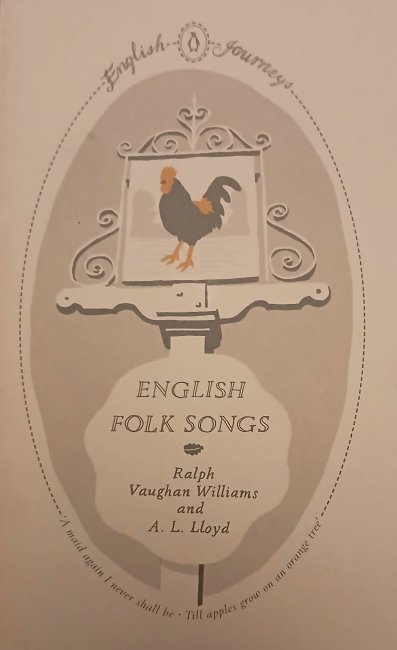
Continuing the bucolic countryside and doomed love themes from last week’s ‘Far From the Madding Crowd’ I was drawn to this book of English folk songs, which was Vaughan Williams’ last book as sadly he died just before it was published. Ralph Vaughan Williams was of course one of the great English composers of the first half of the twentieth century, he died in 1958, and was heavily inspired by English folk songs although he also wrote nine symphonies and four concertos along with his numerous song cycles and choral works. He qualified as a Doctor of Music from Cambridge University and it is as Doctor Vaughan Williams that A L Lloyd refers to him in his ‘Note on the Presentation of the Tunes’ at the start of this book. The selection of songs is quite widespread, although biased toward tunes gathered in the south of England as that was where Vaughan Williams lived so it was easier for him to travel round collecting material in that part of the country although there are a small number from the north. Vaughan Williams was inspired to start collecting English folk songs by contemporaries such as Cecil Sharp and the collections he made helped to preserve a rapidly dying art form as well as influencing his own work.
If I have one criticism of this book it is not in the choice of songs, which provide a spectrum of styles but in the structure of the book itself with the songs in the first part and the accompanying text in the second half which means that you need two bookmarks to keep track of where you are as you continually skip to and fro to read the context and history of the song you have just read. I would have much preferred the descriptions to be interleaved with the music as that would have been far simpler to read.
Before the couple of examples I have chosen, I must explain that the copy I have has a very tight spine and to avoid splitting it I have been forced to hold it open as much as I dared but that has led to somewhat distorted photos of the pages.
Although listed as collected from Somerset, the earliest versions of this song are known from Newcastle Upon Tyne, so the opposite end of the country, and these date back to the late seventeenth century. The lyrics included are a mix of at least three versions into a harmonious whole presumably by Vaughan Williams when collating this book.
The Green Bed follows a theme common with other songs of the period of a sailor who arriving at lodging he has used before claims to have lost all his money in a disaster and is turned away but when he shows that actually he has plenty of money all of a sudden beer and bed are available and the landlady is quite happy to include her daughter in the bed. However the sailor spurns the offer as it is clear that both of them are only interested in the money he has. Again the example comes from the south of England but versions of this song are also known from Warwickshire, in the English Midlands and therefore a long way from the sea.
I really enjoyed this exploration of English folk song and I have various other collections of traditional music which would also be worth exploring at a later date.
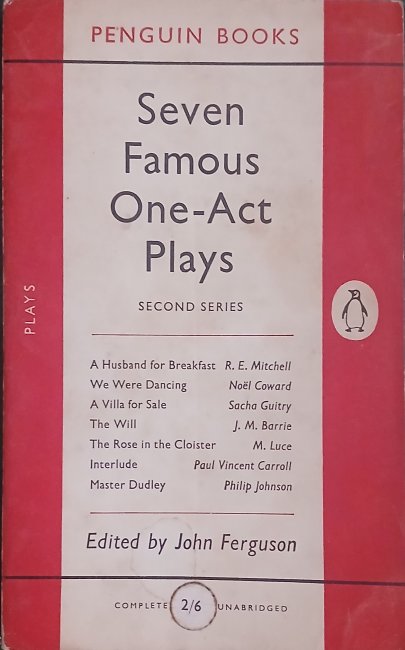
It was a long time between the first collection of one-act plays published by Penguin and this second selection, the first volume was published in November 1937 whilst this one came out in November 1953. Part of the sixteen year gap can of course be explained by the onset of WWII but Penguin wouldn’t publish any more collections of one-act plays until 1965 and the establishment of Penguin Plays as a series of its own. Which is odd if the blurb on the rear of the book is true as this suggests that one-act plays are particularly popular with amateur dramatic associations. Popular or not I’ve largely enjoyed this collection even if, just over seventy years after it came out, I recognise the names of just two of the playwrights of the seven ‘famous’ plays and there are three I would really like to see performed. Taking them in the order they appear in the book, rather than the front cover:
Villa For Sale – Sacha Guitry
A noted French actor, playwright and film maker, Guitry was prolific in both his production of plays and films, often acting, producing and directing in the same film where he also wrote the script and in 1936 he performed all four roles in four separate films. Villa for Sale is translated from the original French, although no translator is given in the book, and it was quite enjoyable as an entree to the collection. However it isn’t really satisfying as a story as the characters are quite lightly painted possibly due to the restrictions of the length of the play but as my favourite of this set is only a little longer I’m less inclined to give Guitry the benefit of the doubt with this. The story concerns a French lady who is trying to sell her villa for 250,000 Francs but would take 200,000 at a pinch, the villa is in an up and coming neighbourhood for the French film industry so should be in demand but has been on the market for a while, however she has a viewer this afternoon. A couple arrive and are welcomed but the husband is clearly bored of looking at villas and doesn’t really want to buy anything. Whilst his wife is upstairs being shown around it becomes clear that this couple are not the expected buyers but have turned up on spec when the real potential purchaser arrives, mistaking the man as the seller of the property she offers 300,000 Francs and provides a cheque straight away as she wants the place immediately ready to start working on a film. She leaves just before the real owners comes back downstairs and the husband writes a cheque for 200,000 Francs to buy the villa. All in all a rather tawdry story and not one I would rush to see performed.
We Were Dancing – Noel Coward
The play that for me has aged least well in the book, this comedy of manners based around a woman who feels that she has suddenly fallen in love with the man she was dancing with despite being married for many years to another man she loved once but over time it has become more habit to be together rather than love. I had high hopes for this as I had never read a play by Noel Coward, and at times the interactions between her husband and her new infatuation did work but frankly for the most part it left me bored and the clip I found of Coward performing the song included in the play does little to improve my opinion of the play.
Master Dudley – Philip Johnson
In third place of the plays I would like to see performed is this one, although the chance of any company even hearing of the play never mind putting it on are very low. Over fifty of Philip Johnson’s one-act plays appeared in the Samuel French catalogue of published plays of 1951 – more than any other author. In the comparable catalogue of 2005, his plays had disappeared without trace. At the start of the play Dudley’s aunt Stella had just arrived from America to provide support to her sister’s family as Dudley was on trial for murder, however as she arrives he is sensationally acquitted, It becomes clear as the play progresses that there has been a grave miscarriage of justice…
Interlude – Paul Vincent Carroll
Irish playwright Paul Carroll was well known in Ireland and wrote many works including for the National Theatre and this almost makes it into my list of plays I would like to see performed as I suspect that done well it would make great entertainment. The play is set in the office of a money lender in a small market town in Northern Ireland, Judy Tippin and her husband have come to Farrelly’s office to try to get an extension on their loan which was actually due to be settled the day before. Judy and Farrelly have history and she is hoping to use this to soften the heart of the famously stern money lender. The use of ‘defective’ electrics in the office which cause the lights to flicker occasionally and then ultimately go out leaving the performance by candlelight for a short-while has Judy almost convincing Farrelly to forget the debt in lieu of happy memories but then the lights come back on and in the harsh light the hard-hearted Farrelly takes her money leaving her and her husband with nothing.
Although Carroll was lauded in both Dublin and New York as a major new theatrical voice, virtually none of his work has been in print since his death in 1968 until Colin Smythe published a significant collection in 2014 as the sixteenth volume in his series of Irish dramatists, with six complete plays (although not including this one) and overviews of many of his other works.
A Husband for Breakfast – Ronald Elwy Mitchell
Top of my list for plays I would like to see performed from this collection is this one, yet annoyingly Mitchell is the author I can find least about on the internet, other than born in Camberwell, Surrey in 1905 and died in Dane County, Wisconsin, USA in 1986. Nothing he wrote appears to still be in print yet from this short play he was clearly an excellent writer. The play, set in a small Welsh village, is full of humour. It starts early morning as Aholibah is starting to prepare breakfast for her and her husband Isiah, who is still asleep, but is surprised by the arrival of a neighbour who is clearly expecting some sort of show. It becomes clear that Isiah had been in the pub the previous night and when it came to his turn to pay for the drinks he hadn’t any money. Trying to think of anything he could sell or barter for his round he was constantly thwarted by people pointing out the items he came up with belonged to Aholibah. Eventually he struck a deal with Moses Roberts to sell Aholibah herself to him for the price of the drinks. Various villagers were therefore descending on Aholibah’s cottage to see how she reacts. Eventually Moses Roberts himself arrives seeking the return of the half a crown he had paid Isiah but Aholibah sensing a way to profit from this instead sets him to work around the house as her new ‘husband’ much to the amusement of the other villagers there. Moses Roberts is then desperate to get out of the bargain as can be seen below and a trade is proposed for Roberts to buy himself out of the ‘contract’ which starts with two bushels of wheat but quickly escalates:
The Rose in the Cloister – Margaret Luce
Later Lady Margaret Luce as her husband was knighted when he became Governor of Aden in 1956 she is also one of the grandmothers of English actress Miranda Hart and wrote a book about her experiences in the Middle East ‘From Aden to Gulf: personal diaries’, which covers 1956 to 1966 and is a book I will definitely be looking out for. The play is well written and is also by far the shortest work in this collection being just nine pages long yet it manages to tell a complete story and even deliver a moral. It starts with a monk just concluding his sermon in the cloister of the monastery during which he points out a rose bush with a single flower and warns that “Only he whose heart is true as steel and without sin may pluck that rose from its stem: if any other dare to make the attempt his hands as they touch the stem will be burned”. This greatly excites his listeners but one resolves to take the rose and give it to his true love in place of the rose he has already brought for her.
The Will – J M Barrie
Second in my list of plays I want to see is this one. Barrie is probably most famous as the creator of Peter Pan and this is beautifully written as we see the effect of the years passing with the simple expedient of altering the set dressing, and presumably some quick changes on behalf of the cast. It is set in a solicitors office and a young couple arrive to set out his will in favour of his new wife. Once this is done the curtain falls ut rises again just ten seconds later to reveal subtle changes such as the portrait of the monarch going from Queen Victoria to King Edward VIII. The couple return, a little older, and revise the will, he is obviously doing much better than anticipated yet the beneficiaries other than his wife are getting less. The curtain falls and rises ten seconds later again, the portrait of the monarch has altered to King George V along with other small changes. The couple return and again revise the will, he is now wealthy but again the changes show even less regard for others. The curtain comes down and back up for a third time and this time just the man arrives as his wife has died, this time he wants to revise to will to pay back those people he had taken advantage of on his way up in society. The play is really well done as not only are the changes in the couple elegantly drawn but the father and son pair of solicitors also evolve over time.
One thing I would have liked included in the book is a brief biography of the various writers, I assume it is missing as they would have been well known at the time, but only Coward and Barrie have lasted the decades as names I recognised so I’ve had to do a little research to identify the authors.
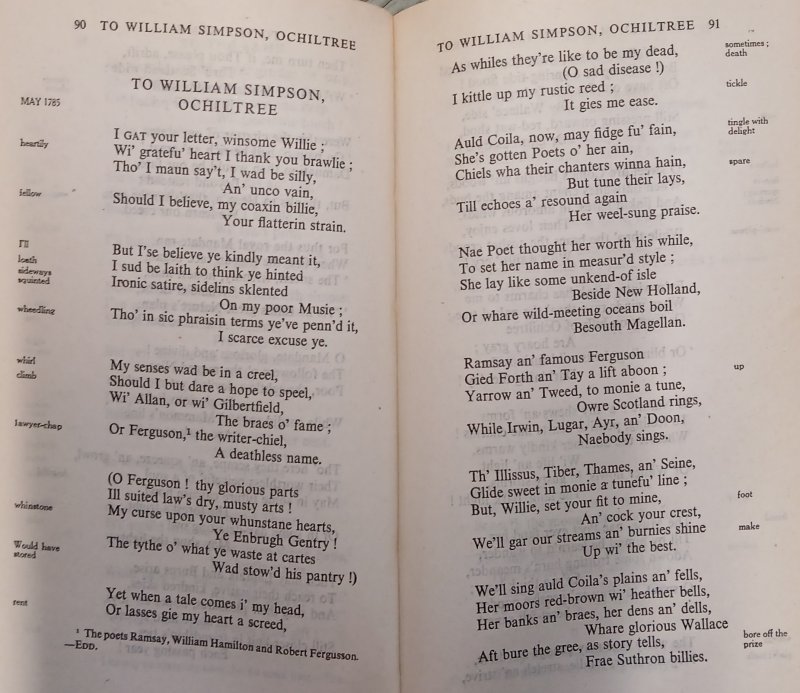
There is one name that comes to mind immediately when you think of New Years Eve and that is Robert Burns due to the international fame of Auld Lang Syne (Old Long Since) a song about a couple of friends enjoying a drink and reminiscing about things they have done in the past. But there is a lot more to Burns than a song that most people know the first verse and chorus to, even if they don’t know any more or what it means and this edition of The Penguin Poets from 1946 is a great introduction. The collection consists of forty three poems and fifty six songs and helpfully for those of us that struggle with the Scots language and dialect there is a single page glossary of common words and translations of lots of others alongside the lines where they occur.
I first came across Burns at school where he was introduced as one of the pioneers of the romantic movement in poetry although we didn’t do much more than the really famous ones including, ‘To a Mouse’, ‘To a Haggis’, ‘A Red, Red Rose’ and the comedic rage expressed in ‘To a Louse’ where Burns gets so annoyed when he sees a louse on a lady’s bonnet in church, all of which are of course in this collection. I really fell in love with the musicality of Burns’ verse however when I was lucky enough to be at The Scotch Malt Whisky Society in Edinburgh for Burns Night and to hear the poems recited with the correct accent made for a wonderful evening which of course included ‘To a Haggis’ and the appropriate, for the venue, ‘Scotch Drink’, the first verse of which (after the initial quote from Solomon’s Proverbs) goes as follows…
Let other Poets raise a fracas ‘Bout vines, an’ wines, an’ drucken Bacchus, An’ crabbit names an’ stories wrack us, An’ grate our lug: I sing the juice Scotch bear can mak us, In glass or jug.
Scotch bear is barley and Burns is of course talking about whisky, the full twenty one verses of the poem can be read here, let no-one say that Burns wasn’t keen to celebrate his national drink. When I first started to read this book for this blog I did have some problems with the unfamiliar Scots dialect but as I progressed through the works I gradually found it easier to understand and found I needed to refer back to the glossary less and less. Interestingly when I have heard Burns recited I have often had far fewer issues with understanding, I guess this is similar to the way I find reading Middle English easier if I read it aloud and it then seems to make more sense than just reading silently.
So let’s finish where we started with Auld Lang Syne. This is the original version from 1788, in 1795 he changed the first line of the chorus to ‘For auld lang syne, my dear’
Should auld acquaintance be forgot, And never brought to mind? Should auld acquaintance be forgot, And auld lang syne?
(Chorus) For auld lang syne, my jo, For auld lang syne, We’ll tak a cup o’ kindness yet, For auld lang syne.
And surely ye’ll be your pint-stowp! And surely I’ll be mine! And we’ll tak a cup o’ kindness yet, For auld lang syne.
We twa hae run about the braes And pu’d the gowans fine; But we’ve wander’d mony a weary foot Sin auld lang syne.
We twa hae paidl’d i’ the burn, Frae mornin’ sun till dine; But seas between us braid hae roar’d Sin auld lang syne.
And there’s a hand, my trusty fiere! And gie’s a hand o’ thine! And we’ll tak a right guid willy waught, For auld lang syne.
As this blog is being published on Christmas eve, I have taken the opportunity to review another of the privately printed Christmas books given by Alan and Richard Lane as gifts, in this case the book for Christmas 1951. I’m not going to attempt to review the gospel itself, this blog is concerned with the new translation, this edition of the translation and this book in particular. Penguin were to publish a new translation of The Four Gospels by E V Rieu a year later in November 1952 so this was a first view of this very readable new translation. It was a little odd to select the gospel of Mark as a Christmas gift as only Matthew and Luke include the birth of Jesus, which you would have thought would have been a consideration, but as you can see below Mark starts with the adult Christ being baptised by John in the River Jordan.
Mark is one of the three synoptic gospels where the same stories are told in much the same sequence and in similar words, indeed three quarters of Mark’s gospel also appears in those of Matthew and Luke whilst the gospel of St John is quite different both in style and content. As I said earlier the big difference is the lack of a nativity story in Mark but you also don’t get the Sermon on the Mount or several parables amongst other items in Mark which is quite a bit shorter than the other three gospels.
Looking at the first page as translated by Dr. Rieu it is clear that it is written as much more of story than the classic King James translation which I grew up with, which for all its magnificent prose can be a little daunting to approach, particularly for a modern reader. By way of contrast this is the same passage in the King James version.
1:1 The beginning of the gospel of Jesus Christ, the Son of God;
1:2 As it is written in the prophets, Behold, I send my messenger before thy face, which shall prepare thy way before thee.
1:3 The voice of one crying in the wilderness, Prepare ye the way of the Lord, make his paths straight.
1:4 John did baptize in the wilderness, and preach the baptism of repentance for the remission of sins.
1:5 And there went out unto him all the land of Judaea, and they of Jerusalem, and were all baptized of him in the river of Jordan, confessing their sins.
1:6 And John was clothed with camel’s hair, and with a girdle of a skin about his loins; and he did eat locusts and wild honey;
1:7 And preached, saying, There cometh one mightier than I after me, the latchet of whose shoes I am not worthy to stoop down and unloose.
1:8 I indeed have baptised you with water: but he shall baptize you with the Holy Ghost.
1:9 And it came to pass in those days, that Jesus came from Nazareth of Galilee, and was baptized of John in Jordan.
1:10 And straightway coming up out of the water, he saw the heavens opened, and the Spirit like a dove descending upon him:
1:11 And there came a voice from heaven, saying, Thou art my beloved Son, in whom I am well pleased.
It is almost forty years since I first read E V Rieu’s translation of the four gospels. I took it, along with a couple of others from the Penguin Classics series, as my in flight reading for the first time I crossed the Atlantic in February 1986. I’m not remotely religious although I did go to a Church of England primary school for my education between the ages of four and eleven, but the way the gospels are presented in this translation means you can read them more like a collection of four novellas and enjoy the stories as they are told. This edition is really beautifully produced with canvas covered boards and terracotta cloth labels blocked in gold. The pages are a lovely grey and compliment the overall design by Hans Schmoller well. The lion design by Reynolds Stone is different to the one, also engraved by him, used for the Penguin Classic when it was finally published.
My copy was given to typographer Ruari McLean (it has his bookplate inside) who had joined Penguin Books in 1946 with specific responsibility for Puffin books and was instrumental in introducing Jan Tschichold to Penguin. By 1949 he had moved on and was working with Rev. Marcus Morris on the design of a new comic for boys he had devised called Eagle, which would go on to massive success in the 1950’s and 60’s. Tschichold would radically redesign Penguin books in the late 1940’s and came up with The Penguin Composition Rules.
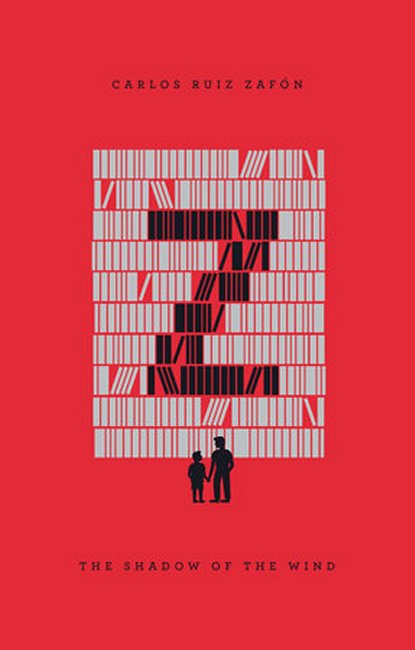
Dawn is breaking in post-war Barcelona when Daniel’s bookseller father guides him through the mist to a mysterious building hidden in the heart of the old city. Here in the Cemetery of Forgotten Books, ten-year-old Daniel is allowed to choose one from the hundreds of thousands of abandoned volumes that line the labyrinthine corridors. Inexplicably drawn to ‘The Shadow of the Wind’ by Julian Carax, the boy clutches the book and he and his father leave. That night Daniel reads through the night totally captivated by the story and the quality of the writing and I know exactly how he felt as although my all night reading sessions are well behind me as I found it difficult to put this remarkable book by Zafón down. Perhaps a longer section than I would normally quote will give an insight into the wonderful descriptive prose and the building tension that is maintained throughout the 511 pages. This passage is very early in the book so doesn’t contain any spoilers and describes the night after Daniel took the book to Don Gustavo Barceló, another bookseller but one who knew more about the rarities of printing than Daniel’s father, for him to have a look at. There he discovered that he may well have the last remaining copy of Carax’s final novel and that all the other copies along with editions of all his other books had been systematically bought or stolen and mysteriously found burned over the years.
I turned off the light and sat in my father’s old armchair. The breeze from the street made the curtains flutter. I was not sleepy, nor did I feel like trying to sleep. I went over to the balcony and looked out far enough to see the hazy glow shed by the streetlamps in Puerta del Angel. A motionless figure stood in a patch of shadow on the cobbled street. The flickering amber glow of a cigarette was reflected in his eyes. He wore dark clothes, with one hand buried in the pocket of his jacket, the other holding the cigarette that wove a web of blue smoke around his profile. He observed me silently, his face obscured by the street lighting behind him. He remained there for almost a minute smoking nonchalantly, his eyes fixed on mine. Then, when the cathedral bells struck midnight, the figure gave a faint nod of the head, followed, I sensed, by a smile that I could not see. I wanted to return the greeting but was paralysed. The figure turned, and I saw the man walking away, with a slight limp. Any other night I would barely have noticed the presence of that stranger, but as soon as I’d lost sight of him in the mist, I felt a cold sweat on my forehead and found it hard to breathe. I had read an identical description of that scene in The Shadow of the Wind. In the story the protagonist would go out onto the balcony every night at midnight and discover that a stranger was watching him from the shadows, smoking nonchalantly. The stranger’s face was always veiled by darkness, and only his eyes could be guessed at in the night, burning like hot coals. The stranger would remain there, his right hand buried in the pocket of his black jacket, and then he would go away, limping. In the scene I had just witnessed, that stranger could have been any person of the night, a figure with no face and no name. In Carax’s novel, that figure was the devil.
The plot flies along at a breakneck speed with multiple clues as well as a few blind alleys as to what is going on as Daniel tries to find out what happened to Julian Carax and how he came to be found shot dead in Barcelona when he should have been safely in Paris and what the wartime thug, murderer and now Inspector of Police Fumero has to do with it, as we progress from 1945 when Daniel first visits the Cemetery of Forgotten Books to the end of 1955 when the story finally reaches its denouement. Along the way a cast of superbly drawn characters are introduced, some of which help but more than a few are there to hinder Daniel’s fascination with Carax and his slowly developing interest in women as he goes through his adolescence. At about two thirds through the book and three days after I started I still hasn’t worked out how everybody was linked and how the various plot strands were connected so took an evening off reading to think through what I knew so far without adding more detail. This proved to be a good idea as I finally realised where the story was going and who the man watching from the shadows was, just in time as Zafón was about to upend the story and make my guess a possibility. I read the remainder of the book the next evening as Zafón neatly tied up all the loose ends in an eminently satisfying way.
Sadly Carlos Ruiz Zafón died of cancer in 2020 aged just 55, robbing the world of a great author well before his time. This English language version of the book is translated by Lucia Graves, daughter of the poet and novelist Robert Graves. She was brought up in Mallorca from the age of three, and according to her memoir ‘A Woman Unknown’ she grew up speaking English at home, Catalan with locals, and Spanish at school and it is she who has translated into English all five of Zafón’s ‘Cemetery of Forgotten’ novels.
it’s a riff on Arthur Machen’s “The Great God Pan,” which is one of the best horror stories ever written. Maybe the best in the English language. Mine isn’t anywhere near that good, but I loved the chance to put neurotic behavior—obsessive/compulsive disorder—together with the idea of a monster-filled macroverse. That was a good combination. As for Machen vs. Lovecraft: sure, Lovecraft was ultimately better, because he did more with those concepts, but “The Great God Pan” is more reader-friendly. And Machen was there first. He wrote “Pan” in 1895, when HPL was five years old.
The above quote is by Stephen King and if anyone can judge a horror story then he is probably the man, it can be found on his website here as part of one of his ‘self interviews’. Sadly I don’t have a copy of ‘The Great God Pan’ as this is the only book I have by Arthur Machen, which is actually the pen name of Welsh fantasy and horror writer Arthur Llewellyn Jones. Even Lovecraft regarded Machen as a great in the horror story genre naming him amongst the four modern masters of the style and he was highly influential in the development of Lovecraft’s Cthulhu stories. This book consists of fourteen short stories which whilst none of them are of the horror genre give a glimpse of the abilities of this popular writer many of whose works are still in print almost eighty years after his death. Indeed several bear the mark of another writer who came later that of Roald Dahl and his ‘Tales of the Unexpected’.
As is often the case with collections of short stories the better examples are the longer ones, especially in this set, the final tale of which, that I will also come to last, is excellent. The stories range from a story about a clergyman who vanishes without trace from his home for six weeks only to re-appear exactly as he was last seen by his housekeeper working at his desk and with no feeling that he had stepped away for more than a few minutes. One story I particularly enjoyed is ‘The Tree of Life’ which tells of a seriously unwell man running the lands of his estate from his sick bed by communicating his wishes via his land agent. The ending of the tale completely upends the story so far but in a completely believable manner. ‘The Bright Boy’ and ‘The Happy Children’ are the closest we get to horror in this collection with the first story of a man with the appearance of a boy and the odd occurrences that happen in the vicinity of the house where he lives with his supposed parents. The happy children tells however of a journalist unexpectedly coming across the spirits of dead children in the streets of a Yorkshire town before they process up to the abbey ruins. There is also the story an unspecified ceremony being performed at a strange stone in the woods that I wish was longer as the atmosphere is so well created and then it stops leaving me wanting more and ‘The Soldiers Rest’ where it gradually becomes clear what sort of rest he is having. All of these are wonderfully written but it is the final story of this collection along with one that is sadly missing that cement Machen in his position as a truly great writer of short stories never mind his horror novels.
The one that is missing is ‘The Bowmen’ which was first published on 14th September 1914 and tells the story of a horde of phantom bowmen from the Battle of Agincourt, five centuries earlier, which came to the aid of British troops at the Battle of Mons. This story, as it was published in The Evening News newspaper which Machen worked for at the time became believed as true and is the foundation of The Angel of Mons and evidence of divine intervention on behalf of the British soldiers. No matter how often Machen tried to say that he made it up he was rarely believed and the tale was spread around the world as fact. The story that completes this set is however ‘The Great Return’ and this is the first published story telling of the existence of the Holy Grail in modern times and the miracles that occur along with its reappearance. The story which along with Machen’s novel taking the same theme ‘The Secret Glory’, which he had already written by then but which wasn’t published until 1922, would clearly influence writers such as Dan Brown in his Da Vinci Code and George Lucas with Indiana Jones amongst others.
You can find out more about Machen via ‘The Friends of Arthur Machen‘ an international literary society dedicated to the works of this remarkable author.
This truly remarkable novel makes use of the ‘unreliable narrator’ literary style and is probably the best version of this particular method of slowly revealing the true aspects of the story I have read. Not for nothing did it come as high as thirteenth in the BBC poll of literary critics for the one hundred greatest English novels. But first let’s address the title, which is not the original given to it by Ford. The book was due to be first published by John Lane: The Bodley Head in 1915, in his later dedication appended to the book in 1927 Ford explains what happened:
The book was originally called by me The Saddest Story, but since it did not appear until the darkest days of the war were upon us Mr. Lane importuned me with letters and telegrams – I was by that time engaged in other pursuits! – to change the title which he said would at that date render the book unsaleable. One day, whilst I was on parade, I received a final wire of appeal from Mr. Lane and the telegraph being reply paid I seized the reply form and wrote in hasty irony ‘Dear Lane, why not The Good Soldier’… To my horror six months later the book appeared under that title.
That the new title was ironic certainly becomes obvious the more you read the book, although initially it appears to be highly suitable. The original title does make its appearance in a few places with Ford having his narrator say several times similar phrases to ‘I call this The Saddest Story’, which is actually the opening line of the final part or ‘THIS is the saddest story I have ever heard’ which is the books’ first sentence. When you start reading however there is no hint of the tragedies still to come as John Dowell, our unreliable narrator, starts off painting a happy friendship between the English couple Edward and Leonora Ashburnham and the Americans John and Florence Dowell set over nine years largely in the German spa resort of Bad Nauheim where the couples regularly meet. Captain Edward Ashburnham is the good soldier of the title and is apparently there for treatment of his heart condition that has effectively invalided him out of his regiment. Florence is also there for treatment of a heart condition, fear of which has prevented her from having sexual relations with John since their marriage began. Apart from that the couples seem ideal, independently wealthy so they can choose to live where they want and largely do what they want all is happiness in this small group of friends.
But that is what John initially wants you to think and it may be what he believes at least at the start of the narrative but gradually he reveals more, almost inadvertently, recalling details that turn the situation on its head and this is where reviewing this book becomes tricky because I really want to encourage you to read the book and discussing what happens is almost impossible without revealing too much. Suffice to say that almost nothing you are told in the first part of the book turns out to be true, instead there is a complex inter-relationship between the characters which is nothing like it first seems and even the reasons for them being in Germany at all is based on a tissue of lies.
The slow reveal of the various facts and of the other tragic characters associated with the ‘good’ Captain show a superb skill in the writing of the book as revelation after revelation come after the barest of hints that all is not right but remain believable and despite John’s bewildered insistence that he is the one steady rock in the narrative the fact that he keeps changing his story leaves the reader wondering just how much of what you come to understand by the end is really what happened and what is still John’s reinterpretation of the story. There is a good reason why this book has remained in print for almost 110 years so far so even if you have never heard of Ford Madox Ford I recommend that you get hold of a copy and read it.
Ludwig Bemelmans is nowadays probably best known as an artist or as the writer and illustrator of the Madeline series of children’s books. In total he wrote over forty books along with several plays and film scripts but my favourites are the three autobiographical memoirs dealing in a humorous way with his time working at the Ritz hotel in New York and when he ran his own restaurant of which this is the second, the first being Life Class and the final collection being Hotel Bemelmans. This book takes us from his first job there as a bus boy (the lowest of the low in the hierarchy of waiting staff) working at the worst tables in the restaurant facing the stairs, therefore draughty, and between the doors to the pantry, whose hinges needed oiling but never were, and the linen closet so waiters were constantly going to and fro serving other customers. The waiter assigned to these tables, Mespoulets, was probably the worst waiter imaginable, quite often ignoring his customers and eventually delivering cold or incorrect meals, sometimes both, to their table. Monsieur Victor, the maitre d’hotel regarded these tables as ideal for all the customers he didn’t like for whatever reason, complainers, poor tippers, anything that he didn’t approve of and so Mespoulets was allowed to continue for years with his appalling treatment of clients.
Gradually our narrator moves up through the ranks until at the end of the book he has made it to Assistant Banquet Manager and effectively moves into the best suite of the hotel which is permanently engaged, although seldom used, by a European multi-millionaire. He does this on the basis that he needs somewhere quiet to sleep as the job often doesn’t finish until six in the morning, even though he starts on duty during the mid afternoon so doesn’t have time to go home and come back and still get some proper rest. That he also works his way through fine wines and cigars is seen as a perk of the job, both by himself and the other staff on the banqueting team. Indeed a lot of the staff seem to make full use of the hotels food and drink especially that left over from banquets on the basis that it would be simply thrown away otherwise. One of the staff, named Kalakobe, even took to bottling the dregs from all the glasses in the dining room and drink this foul concoction the next day whilst resting from his strenuous role of the cleaner of the heavy coppers used in the kitchen.
The book ends with another story about Mespoulets, this time about him finally leaving the hotel but I particularly want to show one of the drawings that adorn the start of each chapter and also include the opening of this section where you can appreciate the word craft of Bemelmans in his description of this fallen figure. The image is a little bent as the book I’m reading is from 1947 and the spine is rather fragile so I was careful not to press too hard on the pages.
Mespoulets is suspected of being the author of death threats posted to Monsieur Victor and the chapter revolves round how best to safely get rid of him after a psychiatrist states baldy that he definitely should not be sacked as that could cause Mespoulets to carry out his threats. Needless to say that after managing to get him on a ship home to France the letters continue to arrive so nobody is any the wiser who the real culprit is.
I loved reading these short stories of the quite often disreputable life of the staff in a major luxury hotel although I doubt very much that I would want to stay there as they all had a ring of truth about them regardless of how outlandish some of them sounded. I’m glad to say that Hotel Splendide along with Hotel Bemelmans are both still in print eighty five years after they first appeared so the talent of Ludwig Bemelmans to entertain is still enjoyed by modern readers.
This has been my 350th weekly blog on the books I share my home with and I look forward to reading and writing about many more.
Although founded towards the end of 1973 the Penguin Collectors Society didn’t really get going until 1974 with the first meeting of like minded collectors being in the spring of that year and the first newsletter coming soon afterwards in May by which time there were 38 members. Member number one was Tanya Schmoller who had been personal assistant to the founder of Penguin Books, Sir Allen Lane, and number two was her husband Hans Schmoller who was at the time still Head of Typography and Design at Penguin Books. Sadly I never met Hans as he died in 1985 before I joined the society but I remember Tanya fondly for the encouragement she gave to a then relatively new collector when I discovered the society in 1990. By then the newsletters had become professionally printed rather than the typed onto a waxed paper and Gestetner reproduced early examples. There were also some three hundred members including several institutions including The Library of Congress in America, Canterbury College of Art, Manchester Polytechnic and the State Library of Victoria in Melbourne Australia to name just four.
The first page of newsletter number one is reproduced above, taken from the book and possibly the most striking sentence in this age of data protection regulations is “whose names and addresses are included in this issue”, it is difficult to imagine such a thing being done nowadays. The last directory of members was in 1988 and that not only had names and addresses but phone numbers and in many cases their collecting interests and approximate size of collection. Reading through these early issues, which I’d never seen before, was fascinating and I thank whoever came up with the idea of collating them. The society has only ever produced an appropriate number of copies for the members it has plus a small number for new members who want to purchase old editions and with just thirty eight members for issue one and just over a hundred by the time of the fifth and last 1975 edition finding these early newsletters is pretty well impossible.
So what was covered in the first newsletters? Well even the first issue at just thirteen pages, two of which were the directory of members and another two a series of adverts where members were searching for specific titles managed to cover wartime advertisements in Penguin Books, a couple of printing variations on “The Penguin Herodotus” along with “Russian Campaigns”, other early paperback printers and how many titles were printed in various Penguin periodicals. By the time we reach issue five, confusingly called volume 2, number 2, from December 1975 we get an interesting short article regarding the book on the Spanish Civil War entitled “Searchlight on Spain” by the Duchess of Atholl which may be unique in Penguin history as it prompted a second book, published by Hutchinson aimed squarely at refuting the original Penguin and entitled ” Daylight on Spain: The Answer to the Duchess of Atholl”. I had never heard of this second book however the review is not exactly complimentary as it seems solely intent on attacking the original book rather than establishing a cognitive argument so I won’t be searching for a copy. There is also an attempt to sort out the various publications of the early Penguin Handbooks along with a breakdown of the wartime Penguins issued in French. All very interesting.
This collection of early newsletters came with the latest example, June 2024’s number 101
This, as you can see is a very different beast to the early examples, now 112 pages long and illustrated in full colour, with articles as diverse as early days of the society, the development of the railway bookstall, various articles of designing particular books, two of the Allan Lane Christmas books and a couple of articles on translation amongst others. Following an appeal for more material there are also three articles based on entries from this blog:
I was surprised to see all three included as I just sent versions expecting the editor to use one or possibly two and hold the remainder over to a future newsletter. The articles were largely rewritten with new illustrations but you can get a feel for what appeared in this newsletter from myself.
The society can be contacted via its website and if you are remotely interested in Penguin Books or their various offshoots I heartily recommend membership, which by the way now stands at 470 according to the accounts dated December 2023. You don’t just get the newsletter but normally a special volume dedicated to a specific topic or reproducing hard to find items such as: A.S.B. Glover by Tim Graham and White Horses by Eric Ravilious.
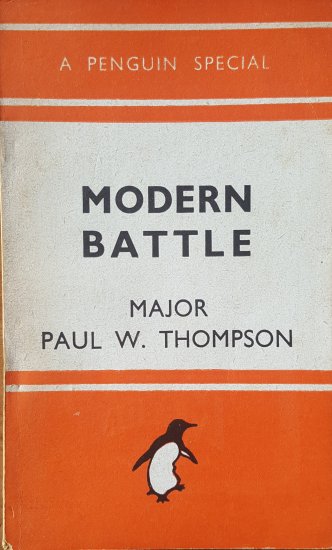
Inspired by the eightieth anniversary of the D-Day landings which was marked earlier this month I thought I’d look back on a book covering the start of the war. This is not a review of Modern Battle by Major Paul W Thompson, although it is a surprisingly interesting book which studies actual engagements between German and Allied troops in the early years of World War II so I will talk about it later in this blog. Rather I am looking at the various editions I have of the book and what these tell us about the war. Starting with The Forces Book Club edition published in October 1942, which is the second most difficult of the four versions to find as it as not sold to the public but rather only as packs supplied under subscription to military units, as described below on the inside front cover of this book. This explains why my copy has “C” Mess handwritten on the cover, sadly there is no further indication as to which battalion the mess (a place where military staff would eat and socialise) was associated with. Several of the other books I have from The Forces Book Club are ink stamped with the battalion or ship which had subscribed.
The rear cover gives a list of the first twenty books to make up, what was intended to be a substantial library for isolated units who otherwise would have little to read. The project however was a failure, partly down to the poor information regarding the existence of The Forces Book Club disseminated by the Ministry of Defence and partly due to the overly worthy choice of titles. The mystery and crime editions such as ‘Panic Party’ or ‘The Murders in Praed Street’ would undoubtably have been voraciously read but I can’t imagine Thomas Sharp’s volume on ‘Town Planning’ would have been as popular. Penguin did produce the 120 books needed to fulfil original subscriptions taken out, but in far lower numbers than expected and a lot of the books were subsequently rebound, initially as books to go to prisoner of war camps in Germany and later in the ‘normal’ covers these books would have had for general sale to the public.
The POW versions have the normal front cover but on the inside of this there is a replacement of the description of The Forces Book Club with some information regarding The Prisoner of War Book Service. Again the overall cost is three pounds for 120 books but this time even the more esoteric titles would probably have been read due to serious shortage of other reading material in the camps. All the remaining FBC titles appear to have been rebound as POW editions but they are all incredibly rare, I have a couple that, whilst popular as reading for the forces would definitely not been acceptable to the Germans i.e. ‘The Escaping Club’ and ‘The Tunnellers of Holzminden’ both of which deal with escapes from POW camps in the First World War and would therefore not pass the censors which probably explains why they have survived. I suspect that the company doing the rebinding simply did all the books without consideration as to the material they contained.
Books that didn’t make it out as FBC or POW editions were potentially rebound again as the main production run, so it is relatively common to find books that inside say they were printed for the Forces Book Club but in the ‘normal’ covers, rather than the one shown at the top of this blog. Speaking of which the first UK edition of the book in the Penguin Special cover from July 1942 can be seen below. All of the editions described so far have identical text inside with a foreword by Tom Wintringham, who had already written a couple of books published by Penguin including ‘English Captain’ and ‘New Ways of War’.
But we now come to a variant text as the book was also printed as a Penguin Special in America in association with The Infantry Journal, a company that already had distribution within the USA military and this has a new introduction by the editors of The Infantry Journal giving some background for their readership. This book was also published in July 1942, so just a few months after the Japanese attack on Pearl Harbour and the direct involvement of USA in the Second World War in December 1941. The original hardback first edition was published by W W Norton’s and Co. of New York earlier during 1941. A brief quote from the introduction to this Penguin American edition.
Modern Battle is based on a variety of source materials mainly from the professional military journals. Some of the accounts come from interviews with actual participants in the engagements described. Much of the background material is German, since the Nazi methods of warfare are those that have been most successful, and those that we need to know best as we work to find methods still better.
The copy I have is the third US edition from November 1942 by which time Paul Thompson had been promoted to Lieutenant Colonel. In the introduction there is an acknowledgement that the numerous included maps are drawn by Captain William H Brown of the US Army, who had also apparently been promoted, as in the July editions he is given as a Warrant Officer for the U.S. Coast Artillery Corps.
Now to the actual book. As alluded to above Thompson had access to German sources, presumably because America was not a combatant in WWII at the time he wrote the book, and these enable him to provide a comprehensive review of the various actions beyond anything available to a UK author. Of particular interest is the account of the aerial attack on Crete in May 1941 which is covered in the final chapter, which has a lot of information from German sources explaining how they went about the invasion which took just eleven days to complete despite the island being around 160 miles long. These alternative sources are evident throughout the book whether it be the German 10th army in Poland or the 1st Panzer division advancing on Aachen in 1940 and it makes the book a fascinating read as I have rarely come across information from outside Allied write ups.