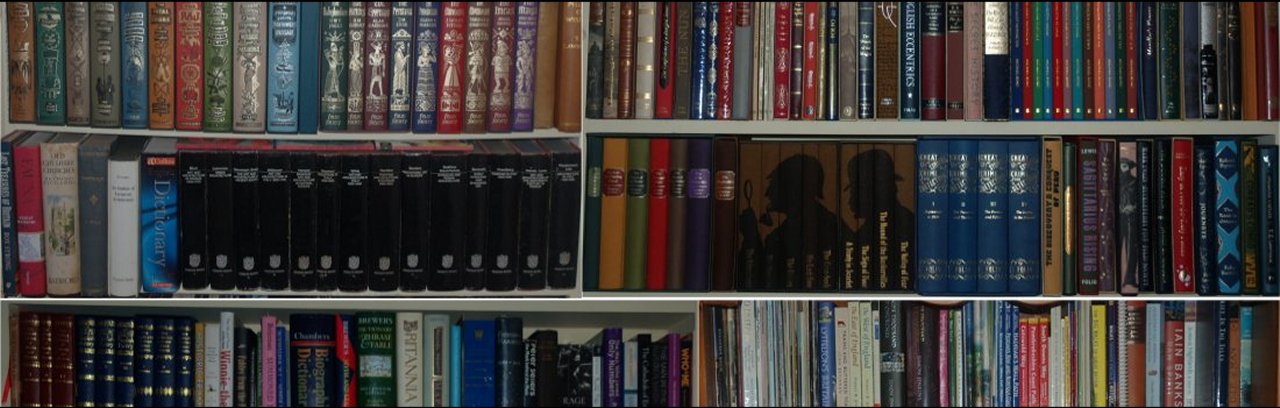
A series of essays inspired by books that I own, talking about their history, some reviews and also how they came to be on my shelves. With over 6,500 books here and several more arriving each week I doubt I'll ever be short of a topic.
Oscar Wilde’s only novel can famously be summarised as the story of a man who doesn’t appear to grow older, but rather the portrait of him ages on his behalf. But the copy I have is 256 pages long so it must be much more than the twenty word precis just given and indeed it is. I didn’t know what to expect when I pulled this book off the shelf as for some reason I have never read it before despite it being a famous work of literature and my owning this copy for at least fifteen years, but I definitely enjoyed it for it is beautifully written.
Yes the story of the painting ‘ageing’ rather than Dorian is there but that just scratches the surface, the picture shows all the corruption, not only of his increasing age, but also the collapse of his morality and does so in real time. So when he views the portrait, which he does regularly as time goes on even though he has it locked away in an attic so nobody else can see it, he can see the effects of his lifestyle boldly depicted on the canvas. Indeed when he kills a man blood starts to show on his hand in the portrait and appears to be dripping onto the floor within the painting from his fingers.
Dorian Gray is the only child from a very wealthy family so has no need to work instead he can just idle his way through life doing whatever he wants and because he can do this he does, dragging other people along with him. We see evidence of his moral dereliction many times through the book and his effect on his friends and lovers, one of his friends is depicted late in the book in an opium den hopelessly addicted and others commit suicide after being abandoned or blackmailed by him. Dorian however does not care about any of them even the social approbation that comes his way with people leaving rooms if he comes in or otherwise shunning his company means nothing to him for he has retained his youthful looks and that is all that he apparently needs. In his rejection of societal norms he is guided by the hedonistic dandy Lord Henry Wotton, whom he meets right at the beginning of the book at the studio of artist Basil Hallward whilst he is painting the titular full length picture. Henry becomes probably his only life long friend, apparently unconcerned about the depravity of Dorian’s life and loves and equally unfazed by Dorian’s never ending youthful looks or his occasional collecting manias. Due to his vast wealth Dorian can pursue any interest he wishes, collecting rare tapestries, perfumes, musical instruments or even jewels amongst other things, becoming an expert in this or that field before moving on and it is this money and knowledge that enabled him to stay accepted by at least part of London society.
Yes Dorian Gray is a repellent character, one that if he had really existed anyone would do well to avoid the company of, but Oscar Wilde’s writing is in contrast truly lovely. The pages just flew past whilst I was reading the book and as the story developed of Dorian’s spiral into vice the writing seemed to get better. It is. I suppose, part gothic horror and part social commentary upon the idle rich that Wilde spent so much time in the company of both in the city of his birth, Dublin, and London but I loved the book and can’t believe I have managed to not read it before. The final denouement, whilst the reader is expecting something of the sort, still had surprising details so Wilde kept me engrossed to the very last word and there are few books where that could be said.
After the awful MC Beaton of a couple of weeks ago I felt that a decent murder mystery was called for. I normally only read a mystery and crime story about once every three months or so but Something Borrowed, Someone Dead was so dreadful I don’t think it counts so back to the heyday of crime novels, the 1930’s. I have several books by Anthony Berkeley Cox who wrote not only as Anthony Berkeley but as Francis Iles, A Monmouth Platts and A B Cox, but it is as Anthony Berkeley that he is, if at all nowadays, best known, especially for the ten amateur detective Roger Sheringham novels of which this is the eighth, first published in 1932. I chose it as it was the only Berkeley novel on my shelves I had not already read, although this is the first of his I have blogged about. He was one of the founders of The Detection Club, a group of then famous mystery writers including Agatha Christie and Dorothy L Sayers amongst others who use the meet for regular dinners, sadly several of the early members are largely forgotten including Berkeley whose books nowadays seem to be only reprinted by the British Library Crime Classics series which exists to spread the word regarding such authors.
Murder in the Basement is a classic of the genre in that the discovery of a body in the cellar of a newly occupied house in south London reveals that it was a woman, probably between twenty and thirty years old, five months pregnant but otherwise no distinguishing features as she had been buried for several months and decomposition had set in. The police then spend several chapters not really achieving very much until the chance discovery that a metal plate used to repair her femur after a break some years back was of an experimental type of which only a hundred or so were used before the material it was made from was abandoned as not really suitable for the job. This eventually leads to an identification of the body, as the only person to have that plate fitted that the police couldn’t locate but even then more work was needed to find more about her as she had changed her name to conceal her time in prison for theft. It is at this point that Roger Sheringham appears in the story, but not as the amateur detective but rather as somebody who had for a short while worked with the victim whilst doing a supply teacher role at a boys preparatory school just outside London where she had been the school secretary. The police want him to go back to the school and try to work out what had happened but Sheringham refuses to have anything to do with the case as he had made friends there and didn’t want to be working against his then colleagues.
The police soon decide on their suspect, one of the masters at the school, but cannot prove a case against him no matter how hard they try and they do trawl up some potentially damning but insufficient evidence for court. Sheringham stays out of the case but is kept up to date by the police in case he can be useful and ultimately solves the crime, but again without positive evidence that could be used in court. The lack of a suspect that can be prosecuted is unusual in a mystery novel but because of the way Berkeley concludes the book it is oddly a satisfying ending despite this.
I really enjoyed the book, as I have with the other Berkeley novels I’ve read and it’s a pity that he is so neglected nowadays. My copy is the 1947 Penguin Books first edition, I think Penguin published all of the Sheringham novels between 1936 and 1947 with several of them being extremely rare.
Paxton Chadwick was a well known artist who was born in Manchester in 1903 but after marrying his first wife he moved to Suffolk and took a post of art teacher at Neill’s Summerhill School in Leiston Suffolk which is where he lived for most of the rest of his life. His natural history artworks are justifiably celebrated and this blog looks at the four books he illustrated for Puffin Picture Books, three of which he also wrote. Sadly Chadwick died in 1961 before he completed his fourth title for Puffin Picture Books and so there was a gap in the series at number 116 out of the 120 volumes in the set. Number 116 was eventually published by The Penguin Collectors Society in 1995, see the end of this blog for more details as to how it came about.
Puffin Picture Books was an imprint of Penguin Books originally aimed at children of all ages with counting, spelling and story titles alongside works on shipping, agriculture, nature of all kinds and pastimes such as stamp collecting and building models. Gradually the fiction titles were phased out leaving the educational works, a lot of which would nowadays be categorised as Young Adult for their reading demographic. Starting in 1940 they were the first series of books published by Penguin that were aimed at children but are also excellent illustrated monographs to be read and enjoyed by all ages.
PP81 – Wild Flowers
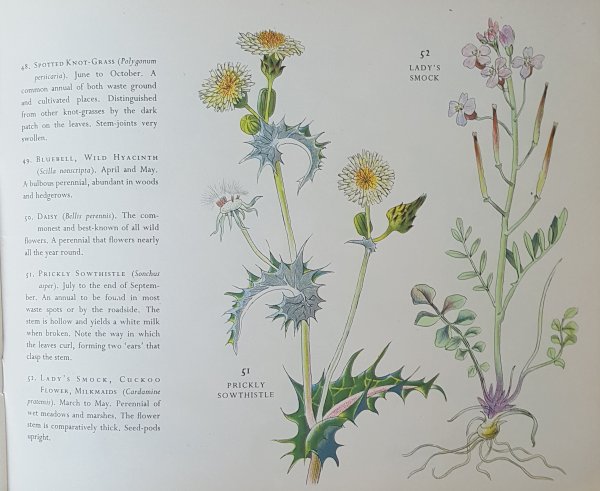
Written and illustrated by Chadwick this is the first edition printed April 1949 and it was reprinted a further four times making it the most reprinted of the four Paxton Chadwick Puffin Picture Books. As soon as you open the book it is clear why it was so popular, unlike any other Puffin Picture Book this one is almost full colour throughout (pages 2 and 3 which describe the structure of a flower are in black and white), normally half the illustrations would be in black and white and the pictures are beautiful. I particularly like the double page centre spread comparing a Great Mullein and a Foxglove see above. In total there are sixty one different plants illustrated and described giving their flowering season and if they are annual, biennial or perennial species. You also get the common English name along with the Latin and some more information as to how to identify the plant making it the best reference work on British wild flowers published by Penguin up to that point and not superseded until John Hutchinson and Edgar Hahnewald’s Wild Flowers in Colour was published by them in April 1958 which covered five hundred species.
This is the only one of the four books just to be illustrated and not written by Paxton Chadwick, but rather by Jean Gorvett, about whom I can find nothing, this is the only book she appears to have written and I have been unable to find any biographical details on the internet. Regardless of the difficulty of finding information about the author the book was first printed in February 1952, going on to be reprinted twice by Penguin and then re-appeared as a hardback in 1971 under the title of Life in Ponds in the USA by McGraw-Hill with a completely different cover of male and female mallards, which was taken from page 25 of this original softback edition.
We are now back to the normal layout of Puffin Picture Books, after the anomaly of ‘Wild Flowers’, so colour only appears on alternate double page spreads. The text is the same chatty style that was familiar from the books written by Chadwick himself and is clearly aimed at a child from about nine to twelve years of age whom has access to a decent sized pond and is interested in what can be found there and is looking for a beginners guide. The first section ‘How to Enjoy Ponds’ discusses how to catch various creatures and suggests a suitable net, various jars for examining your catches and of course don’t forget your wellington boots. We then go on through plants, molluscs, insects, larger animals, fish and finally birds such as ducks and moorhens that you could expect to encounter. The final section discusses how to stock an aquarium so you can continue your pond life watching on rainy days.
Like Wild Flowers the book received an NBL award despite, in my opinion, the least inspiring cover of any of the Puffin Picture Books but the book itself is excellent.
PP105 – Wild Animals in Britain
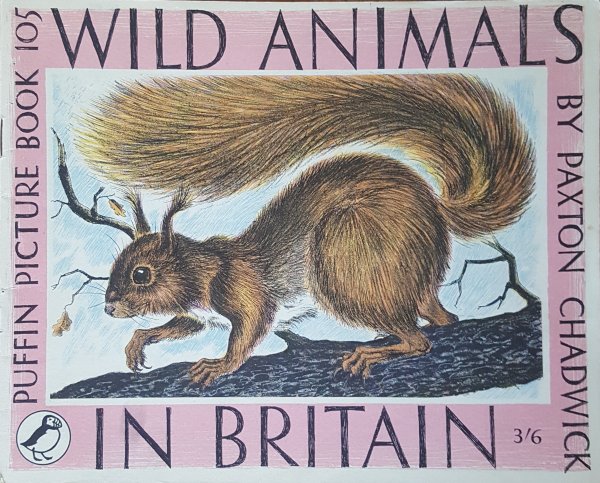
Again written and illustrated by Chadwick, Wild Animals in Britain was printed in April 1958 and was never reprinted. This was not uncommon with Puffin Picture books, indeed 66 of the 119 books issued in this series by Penguin were not reprinted, so the fact that his first two books went through multiple printings says a lot for how well received Chadwick’s books were. The title of this one is somewhat inaccurate as the only creatures included are mammals and reptiles but I suppose ‘Wild mammals and Reptiles in Britain’ is a bit wordy for a title. In all forty one species are illustrated, thirty five mammals and six reptiles ranging from the insectivores such as hedgehogs and shrews, through bats, rodents, hares and rabbits along with the bigger mammals such as badgers, foxes and various species of deer. Amongst the reptiles are the two snakes above, and there is a particularly fine painting of a grass snake on the rear cover. It’s a lovely book and the inclusion of brown on the pages that would normally be just black and white (as seen on the page with the snakes) just lifts the book above the normal format Puffin Picture Books.
PP116 – Life Histories
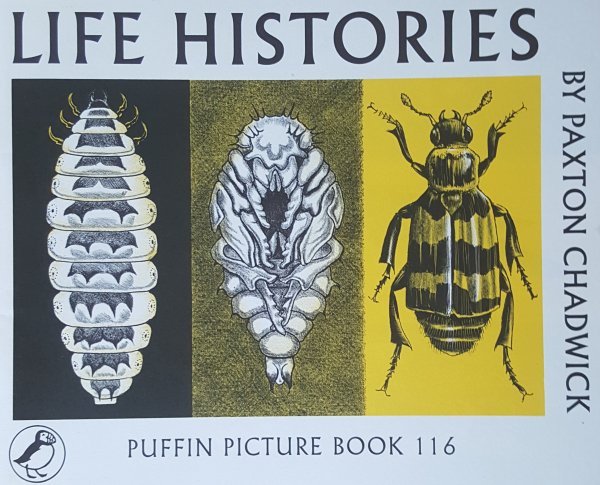
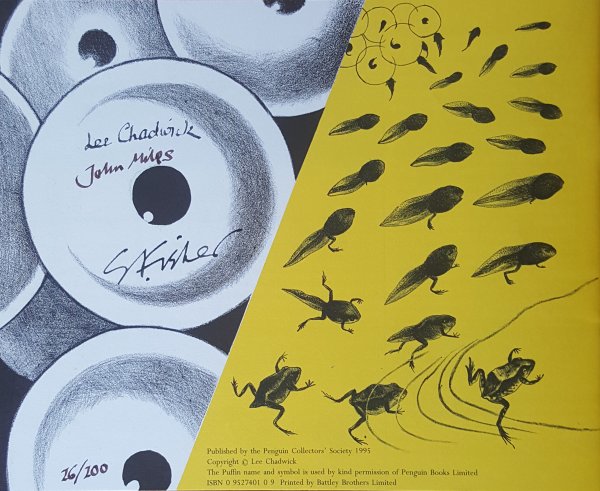
Written and illustrated by Chadwick this book was to be his final work as he died during its production which had started back in 1958 and was nearly complete by his death. Just how complete would become clear when the Penguin Collectors Society approached his widow, Lee Chadwick in the early 1990’s to see what, if anything, still survived. The final agreed text was known to exist in Bristol University archives and Lee confirmed that the plates were at The London College of Printing and when checked were found to be in excellent condition but needing some work before they could be used. This preparation of the plates was done by Sheila Fisher (nee Dorrell) who had been at the Manchester School of Art in the 1930’s when Chadwick had worked there and after the war became his assistant. However there was a further problem, the book needed to be properly designed and typeset in as sympathetic way as possible to the original 1960’s plans and here John Miles stepped in, he had been employed by Penguin back in the 1950’s as assistant to the head designer Hans Schmoller. By getting this remarkable group of people together, all of whom were in their seventies or eighties including Lee Chadwick to do some final editing the book was finally printed March 1996, some thirty five years after it had originally planned to be issued. There were just a thousand copies printed, the first one hundred of which were signed by Lee Chadwick, John Miles and Sheila Fisher. Penguin Books agreed to the edition having the original PP116 number assigned back in 1961. The book came with a twelve page booklet by Steve Hare entitled ‘The Life History of Life Histories’ which details the long gestation of this project and reprints sections of letters between Penguin Books and Paxton Chadwick regarding the work he was doing.
Conscious of the cost pressures that were signalling the end of Puffin Picture Books Chadwick designed the book to just use yellow and blue apart from the black text and line drawings but even so there would be just four more Puffin Picture Books produced after number 116. The creatures featured in this volume tend to be ones that undergo some sort of metamorphosis during their life cycle or have some elusive part of their existence such as eels and their trip to the Sargasso Sea so there is always something different about their entire life span. It makes it a very interesting read and such a pity that it never came out in the sixties for its target audience and that even now you are unlikely to find a copy due to its very limited print run.
The ultimate publication of Life Histories is a fitting tribute to Paxton Chadwick, an artist lost early at just fifty eight years old to an undiagnosed cancer.
To start off my latest August group of books, which this time is focused on natural history, I am beginning with a classic of the genre, Gilbert White’s The Natural History of Selborne first published in 1789, along with his Antiquities of Selborne, which initially was usually included but nowadays is largely omitted leaving just his famous work The Natural History. Both of these books consist of a series of letters, which in the case of Antiquities none of were never actually posted to anyone and in The Natural History several were also not posted but were instead created to match the rest of the content. The ones that were posted are to two different people over a period of almost two decades, but even these have been edited for publication so the whole is rather contrived. Gilbert White was the curate of Selborne on four separate occasions living in what was his grandfathers vicarage and his younger brother John, who is mentioned several times in the book as providing extra information was a vicar in Gibraltar. He is now famous for this book, which was one of the first true natural history volumes based on studies of wild fauna rather than dead examples. That is not to say White didn’t make use of freshly shot birds to complete his analysis but he was rare in studying live animals and how they reacted with the environment to give colour to his studies.
The book starts with forty four letters to the Welsh naturalist Thomas Pennant, the first nine of which were never posted and were written much later to form an introduction to the book when White decided to publish his notes on local wildlife and plants. These describe the village of Selborne and the surrounding countryside and so give a useful if somewhat tedious background to the observations that he then goes on to make. The second batch of sixty six letters are to English lawyer, naturalist and one time Vice President of The Royal Society the Honorable Daines Barrington and again several of these were never posted especially letters fifty six to sixty five, which are concocted from White’s daily journals and provide interesting details of weather extremes he has experienced in the village including winter temperatures of below zero degrees Fahrenheit (-18 degrees Centigrade) with ice forming below the beds in his house. These also include an account of the effect of a massive volcanic eruption in Iceland from June 1783 to February 1784 which killed around a quarter of the population of Iceland and left volcanic ash in the skies over Europe for months.
the peculiar haze, or smoky fog, that prevailed for many weeks in this island, and in every part of Europe, and even beyond its limits, was a most extraordinary appearance, unlike anything known within the memory of man … The sun, at noon, looked as blank as a clouded moon, and shed a rust-coloured ferruginous light on the ground, and floors of rooms; but was particularly lurid and blood-coloured at rising and setting.
Letter LXV
One of the frequent issues raised in the various letters is the possibility of bird migration, at the time this was merely a suggestion that it might happen with the majority view, including that of Barrington, being that birds that were not seen all year round hibernated through the winter even though no birds had ever been found in such a torpid state. White is in favour of migration but doesn’t believe that something as small and frail as a bird could travel long distances so keeps going back to the hibernation theory and indeed on at least one occasion caused a potential site for ‘sleeping’ birds to be dug up searching for them. Needless to say they found nothing. But his observations and attempts to understand the natural world from them was pioneering and one of the letters regarding the usefulness of earthworms was undoubtedly an influence on Charles Darwin a hundred years later when he wrote his monograph on the subject.
Four of the letters to Daines Barrington are in the form of monographs and were published in the Philosophical Transactions of The Royal Society which is the worlds oldest scientific journal, started in 1665, and still in print. These four letters are by their nature longer and more detailed than the others and concern four related bird species which attracted White’s particular attention. Letter XVI is about House Martins, letter XVIII discusses Swallows, Letter XX details the habits of Sand Martins and letter XXI deals with Swifts. These are excellent articles on the differences and similarities between the four species and were ground breaking observations at the time (December 1773 to September 1774). In my opinion the letters to Barrington tend to be more interesting than the ones to Pennant which are more deferential to the addressee as Pennant had published several books on natural history including a four volume British Zoology. It is noticeable however that although there have been at least three hundred editions of The Natural History of Selborne and it has never been out of print since first coming out in 1789 I cannot find any currently in print editions of any of Thomas Pennant’s works.
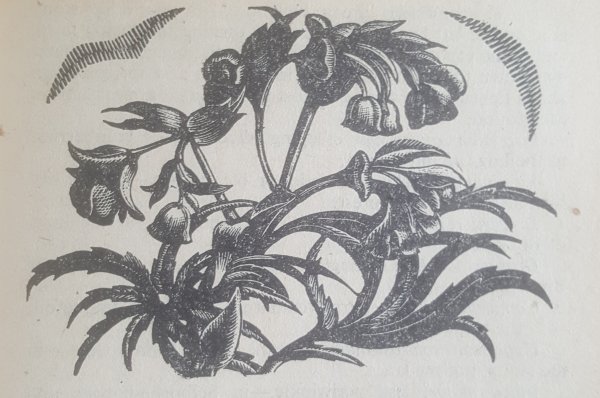
My copy is the Penguin Books first edition from March 1941, which was originally planned to be a part of a second set of Penguin Illustrated Classics following the original ten from May 1938 but this set never happened. However this explains why this book, along with Izaak Walton’s The Compleat Angler, which will be covered later this year, has lovely wood engravings within the text, some of which I have included above, unlike other Penguin Main Series books which are just plain text as these two were designed before the continuation of Illustrated Classics was shelved. The engravings in this volume are by the wonderful artist Clare Leighton who despite being born and brought up in England had moved to America by the time she did these pictures for Penguin and where she continued to live for the rest of her life, dying in 1989 at the age of ninety one.
I was introduced to Orwell in my first year at Grammar School, so aged eleven, when we studied Animal Farm and I’ve read a lot of his works since but somehow not included Down and Out in Paris and London which was his first book. I have no idea how I missed it especially as reading it now I loved the detailed descriptive narrative of his times in poverty in Paris and living amongst tramps around London. The writing is totally immersive and you feel with him as he lives hand to mouth, sometimes not eating for days at a time because he simply has no money left especially after all his meagre savings were stolen leaving him with just the few francs in his pocket. It is after this financial disaster that he seeks out an old friend Boris, who is a Russian émigré, and had often told him of the easy money to be made in tips as a waiter, but Boris had also fallen on hard times and together they scour the city looking for work and not finding it until after many days surviving by pawning their dwindling clothes supply they drop ‘lucky’ and get jobs in the hell of a kitchen of a hotel that Orwell leaves unnamed, just calling it X.
I was at work from seven in the morning till a quarter past nine at night; first at washing crockery, then at scrubbing the tables and floors of the employees’ dining-room, then at polishing glasses and knives, then at fetching meals, then at washing crockery again, then at fetching more meals and washing more crockery. It was easy work, and I got on well with it except when I went to the kitchen to fetch meals. The kitchen was like nothing I had ever seen or imagined—a stifling, low-ceilinged inferno of a cellar, red-lit from the fires, and deafening with oaths and the clanging of pots and pans. It was so hot that all the metal-work except the stoves had to be covered with cloth. In the middle were furnaces, where twelve cooks skipped to and fro, their faces dripping sweat in spite of their white caps. Round that were counters where a mob of waiters and plongeurs clamoured with trays. Scullions, naked to the waist, were stoking the fires and scouring huge copper saucepans with sand. Everyone seemed to be in a hurry and a rage. The head cook, a fine, scarlet man with big moustachios, stood in the middle booming continuously, ‘Ça marche deux oeufs brouillés! Ça marche un Chateaubriand aux pommes sautées!‘
Chapter X – Orwell was a plongeur, the lowest of the low in the kitchen hierarchy
Orwell was initially amazed at the squalor behind the baize doors that separated the patrons of the hotel from the kitchen staff, what absolutely had to be cleaned was but if it didn’t then rubbish and scraps simply built up in corners or hard to clean places. But this was nothing to the hideous conditions in the new start restaurant that Boris persuaded him to leave hotel X and join. Raw food was simply left on the bare floor as they had no larder and wiped down and cooked as needed. Cats and rats helped themselves to whatever they wanted and again what was left was served to the customers. He also went from working fourteen hours a day for six days to seventeen hours a day every day. Plates weren’t cleaned as they had no hot water just wiped down either with newspaper or on the clothes of the staff and yet the restaurant drew in customers and succeeded despite the filth in the kitchen. Orwell gives the impression that this was perfectly normal in Parisian restaurants, and it quite probably was, but he couldn’t cope with the excessive hours and after a couple of weeks quit and headed back to London after being told by a friend that there was a job for him looking after a congenital imbecile.
The second part of the book dealing with life in and around London was added after Orwell initially tried and failed to get a publisher for the Parisian part on its own under the title of “A Scullion’s Diary”. Adding the English section took the work from around 38,700 words to 66,400, which in this edition is 180 pages and a much more normal size for a book.
Needless to say the job when he got there didn’t exist, both the potential employers and the patient having gone abroad so Orwell is back to no money, nowhere to live and no job, so Orwell took to the streets living hand to mouth as a tramp. This section is very different to the first sixty percent of the book as it is less like a journal of his experiences, although you certainly get his experiences of homelessness in the London area, and more a diatribe against the Vagrancy Act of 1824 and the strict interpretations imposed which meant that not only was homelessness effectively criminalised but all forms of begging were not permitted and rough hostels introduced across the country known as spikes. These, mainly unsanitary, hostels did not allow anyone to stay for more than one night and you couldn’t return inside a month, in London you couldn’t go to more than two spikes inside a month. These rules meant that vagrancy was effectively enforced as the men, and it was nearly always men Orwell met only one female tramp in his time on the road, had to keep moving ten to twenty miles a day in search of a bed if they couldn’t afford even the worst bunkhouses to sleep in and it was a criminal offence to sleep in the open air. Astonishingly whilst looking up this act to write the blog I discovered that parts of the Act are still in force in England and Wales almost two hundred years after it was first passed, I feel every Member of Parliament should be made to read this book.
The book is notable for being the first appearance of the name George Orwell in print, up until then he had used his real name, Eric Blair, for the small number of articles he had published but he wanted to be ‘anonymous’ due to the poor conditions that he had endured in both Paris and outer London and didn’t want his family linked to this book. From then on however he wrote as Orwell, rarely using Eric Blair again. As for the veracity of the stories he tells here, he wrote in the introduction for the 1935 French edition “I think I can say that I have exaggerated nothing except in so far as all writers exaggerate by selecting. I did not feel that I had to describe events in the exact order in which they happened, but everything I have described did take place at one time or another.” The most obvious time distortion is that the times as a tramp around London occur after returning from France in the book whereas in reality this time was before he went to Paris in Spring 1928, as when he returned to London from Paris in December 1929 he went to live at his parents house.
My copy is the first Penguin Books edition from December 1940 and is in remarkably good condition for a wartime paperback printed on very poor quality paper yet it is still perfectly intact. This was the edition that really started interest in the book, as before then it was not a great seller. However despite 55,000 copies being printed in this edition it is a very scarce book and at the time of writing I cannot find any examples for sale on abebooks or biblio which are the two main international websites for secondhand books. Down and Out in Paris and London is of course easy to obtain, it is this first edition, possibly the first time it came out in paperback, that is so rare.
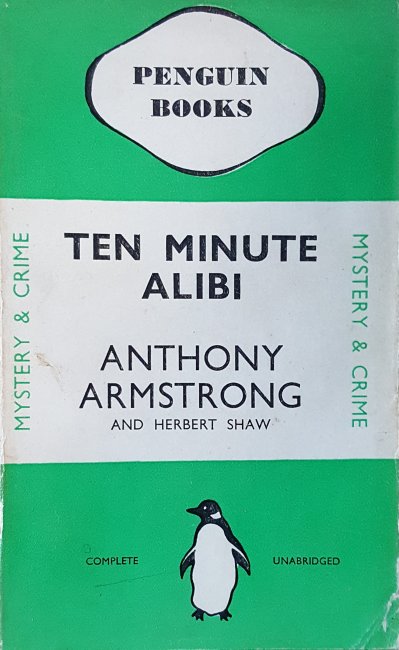
First published as a novel in 1934 ‘Ten Minute Alibi’ is based on the play of the same name by Anthony Armstrong and has presumably been adapted as a novel some time during its run in London by Herbert Shaw. I have to say presumably because there is nothing in the book to say what role Herbert Shaw had in writing it, or indeed any biographical details for him. The play was very successful playing across America and on Broadway it had 89 performances (from 17th October 1933 to January 1934) whilst in London’s West End, it had 857 performances (from 2nd January 1933 to 23rd February 1935) but having read it I can definitely say that the novel is less than riveting so not a good transformation by Shaw, I think I would have preferred to read the original play.
The plot however is interesting, Philip Sevilla appears to be a well to do club owner in London but he has a much more lucrative sideline in people trafficking, specifically innocent English women with few remaining family members whom he seduces before packing them off to South America to be forced to work as prostitutes. The way his operation works is spelled out with an example at the start of the book where we witness the downfall of Muriel Cartney. Having established that she has only a small number of people that would be particularly concerned if she disappeared Sevilla works his charms on her telling her that he is married but that his wife is in an insane asylum so he is desperately lonely and would marry her if he could get a divorce but that is unlikely due to his wife’s medical condition. Finally he persuades her to give up her job and rented apartment to join him in Paris where they can live, apparently as man and wife, without any of their London acquaintances being around to spot the lie and ruin her reputation.
Once in Paris he then appears to ‘accidentally’ run into his ‘friend’, in reality his business partner in the trafficking operation Jose Garcia, and starts to arrange the handover of Muriel. At first all is well and they stay in a lovely hotel in Paris apparently whilst he looks for something more permanent, this he would normally do for two to four weeks enjoying the nights with his victim before claiming that pressing business issues with the club means that he has to return to London to sort these out, Assuring Muriel that he would be back in a few days and that Garcia would look after her whilst he was away he would leave and never return just sending increasing worrying, and false, messages that the people he had put in charge of the club had ruined him and she was on her own but he had no money left to support her. Unwilling to return to England as a woman who had been living in sin Garcia then suggests that he has contacts in Buenos Aires where Muriel could get a new career on the stage and effectively start again and he would willingly accompany her there to see her settled in. Once in Argentina she would be handed over to the gangsters and pimps that would then keep her prisoner and force her into sex work. Sevilla meanwhile would pocket at least a thousand pounds for delivery of another victim.
This sounds all too modern, although nowadays it is women from poorer nations falsely promised legitimate work in the West only to arrive and be told that they need to pay back the enormously inflated cost of transporting them by working in the sex industry. I was surprised to see roughly the same process in a book written in the 1930’s, I’ve never seen it as a plot line in any other contemporary work and I can see why the shocking nature of the story would have generated publicity for the original play. Having spent the first twenty or so pages detailing the story of Muriel and through that Sevilla’s real means of earning big money we then move on to his planned next victim, Betty Findon and this is where the book really starts as Betty has a man who secretly loves her, trainee barrister Colin Derwent, and he will do anything to thwart Sevilla’s plans.
However this is also where the book started to lose my interest, the ongoing scenes between Betty and Sevilla, Sevilla and Colin, Sevilla and his manservant and other two handers would clearly work well on a stage but it’s all too bitty for a book. The dream sequence after Sevilla drugs Colin to prevent him seeing Betty to try to warn her again feels odd, and the means of how to kill Sevilla and still have an alibi by altering clocks so that he could be seen to be elsewhere at the same time revealed to Colin in his dream is all too complicated to work as it needs split second timing involving people who don’t know it involves split second timing. The plan involves Colin catching Sevilla at home and alone before taking Betty to Paris to replicate his previous modus operandi. However when Sevilla needs to be home for the first part of Colin’s alibi to work he’s out and when he does return it’s with Betty and the manservant is also there, both of which are not visible when Colin finally arrives to carry out his plan which involves claiming to have £1,500 to pay off Sevilla but in reality shooting him and staging it as a suicide.
I’m not going to go further into what happens in this review in case anyone fancies braving the rather clunky text for what is actually quite an unusual plotted story especially for the period. Maybe however see if you can find the play script rather than the novel. My copy is the 1938 Penguin first edition and whilst there may have been a reprint in the 1940’s this appears to be the last time the novel was published in English, which I think speaks volumes for its popularity. The play is actually easier, and cheaper, to find in various 1930’s anthologies.
This collection of three of Albert Camus’ essays was published by Penguin Books as part of their seventieth anniversary in 2005 and is a fascinating description of two cities and a town in Algeria, the country which was the birthplace of Camus. It is always interesting to read a locals perspective on places that you really want to visit especially if it is by a writer of the quality of Camus, and Algeria is the only country on the north African coast that I haven’t yet been to and this book moved it higher up the list of places to visit. This is the second book I have reviewed that is set in Algeria though, after Tartarin of Tarascon by Alphonse Daudet so clearly I need to go there sooner rather than later. As mentioned this has descriptions of a couple of cities, Algiers and Oran along with the archaeologically important town of Tipasa with its wonderful Roman ruins, the first essay concerns Algiers.
Summer in Algiers
Unlike the other two essays in this book, this is not a description of the place but the people of Algiers and especially the youth. He explains that here people start work and marry young and raise their children so that by their thirties men have largely done all that they have to do and it is a steady decline of their vigour that is all they have to look forward to. Summer in Algiers is a time of unrelenting heat so only the poor are left there, the rich decamp to more salubrious climes until the September rains bring relief. The young poor however gather on the beaches, for it is the culture of the body that reigns supreme and as Camus explains “Here intelligence has no place as in Italy” instead the men display their muscles and the girls their shapely legs in one fast summer before work, drudgery and motherhood claim them all far too early. It’s not a happy essay.
The Minotaur, or a stop in Oran
The longest, at 31 pages, of the three essays is possibly the most interesting, partly as I’d never heard of Oran despite it being the second largest city in Algeria, but mainly for the wonderful description of not just the town but also the people and what they do for work and fun, Camus worked here as a teacher for a while before ill health (tuberculosis) forced him to leave. The title’s reference to the Minotaur is an allusion to the labyrinthine network of streets in the city where it is easy to get lost and the walls of the old city which cut the centre off from both the desert behind but also the sea to the front. But everywhere there is the dust which seems to be the defining element for Camus whenever he thinks of Oran along with the odd collections of merchandise in the shops.
Here, presented in a casket of dust, is the contents of a shop window: frightful plaster models of deformed feet: a group of Rembrandt drawings ‘sacrificed at 150 francs each’, practical jokes, tricoloured wallets, an eighteenth century pastel, a mechanical donkey made of plush, bottles of Provence water for preserving green olives, and a wretched wooden virgin with an indecent smile. (So that no one can go away ignorant the ‘management’ has propped at its base a card saying ‘wooden virgin’).
There is also a detailed description of a boxing tournament, not just of the boxers but the crowd and building as well and a section on the construction of the new harbour walls which will eventually pull the city to face the sea, if not embrace it. It’s s great piece of closely observed travel writing although unlike the next essay it doesn’t make me want to go there.
Return to Tipasa
Tipasa is about seventy km from Algiers and had clearly been a regular destination when Camus was a child. He doesn’t care much for the modern town, it is the ancient Roman ruins that call to him and having looked up the town online I can see why, just follow the link here to Atlas Obscura. To his dismay on returning to the ruins as an adult decades later he finds them surrounded by barbed wire with a small number of designated entry points rather than the open site he remembered as a youth but once inside the magic returned and he revels in walking through the ‘bread-coloured stones’ feeling peace again and escape from the modern world as he does so.
I’d always been a bit wary of Camus, mainly because of his reputation as an existentialist writer, and having studied the works of his friend Jean Paul Satre at school that put me off that particular group of authors, but this short collection has made me want to read more Camus. He has a real gift for a phrase and an ability to take the reader to where he is writing about. I’ve explored several of the ruined Roman cities along the north African coast in both Tunisia and Libya and Return to Tipasa took me right back to those magical trips. There is a monument to Camus in amongst the ruins of ancient Tipasa which includes a quote from another of his essays set there ‘Wedding in Tipasa’
Je comprends ici ce qu’on appelle gloire : le droit d’aimer sans mesure.
I understand here what is called glory: the right to love without measure.
These two novellas by David Garnett include his first published work, Lady into Fox from 1923 with A Man in the Zoo coming out the following year. They are both fairly short, Lady into Fox being 24,514 words whilst A Man in the Zoo clocks in at 24,133 words. This undoubtedly explains why Penguin USA decided to combine the two in a book that is still only 135 pages long. Interestingly despite Garnett being English and several other later books by him being printed by Penguin UK I cannot find either of these stories in a UK released edition from Penguin Books. My copy is the Penguin USA first edition from December 1946 and it was later reprinted by Signet.
Garnett was a member of the Bloomsbury Group and indeed married Virginia Woolf’s niece Angelica Bell although she was then 23 years old and he was 50 which caused a considerable scandal. Although not as much as if it had been known at the time that in his twenties, and indeed during the time Angelica was born, he had had an, at that time illegal, homosexual relationship with her father, the artist Duncan Grant. As well as being a novelist he was heavily involved in the publishing scene in England being an original partner of the famous private press Nonesuch Press as well as being Literary Editor of the New Statesman for six years and a director of publishing house Rupert Hart-Davies. Along with his novels I have several of his factual works, of which he wrote many, including The Battle of Britain, written during WWII, and his edited collection of the letters of T.E. Lawrence, better known as Lawrence of Arabia. From what little I have read of his fiction though he tends to the surreal and this is especially the case in his best known work Lady into Fox. ‘Aspects of Love’ which he wrote in 1955 was subsequently turned into a hit musical by Andrew Lloyd-Webber with lyrics by Don Black and Charles Hart in 1989 although I doubt that many people know that David Garnett wrote the original work even though he is credited on the posters.
Lady into Fox
Right, this is definitely an odd story about a woman who spontaneously turns into a fox whilst out for a walk in the country with her husband. This happens within a few pages of the beginning and the tale concerns how she initially retains her personality and intelligence but that both of these gradually fade away as she spends more time as a vixen. Immediately after the transformation it is almost as if she doesn’t realise what has happened to her and when her husband takes her home she tries to dress herself and wants to sit at the table when eating, they even find a way for her to play cards together. He dismisses their servants so that they won’t find out what has happened and explains that she has had to go to London for some urgent reason, he even shoots their two dogs as they just howl and bark all the time as they are aware of a fox being in the house. The deterioration of her humanity is expressed most strongly by her sleeping arrangements, for the first few days she sleeps in the bed with her husband but gradually she moves to the foot of the bed and then to the floor, before refusing to go to the bedroom at all. It is quite clear that she is becoming wilder and that he cannot keep her even as a pet tame fox. She also starts trying to escape from the house and garden until realising that she cannot be happy in captivity he lets her loose into the countryside to exist as best she can. I won’t go into the rest of the story but suffice to say that although he eventually regains contact with her it doesn’t have a happy ending.
A Man in the Zoo
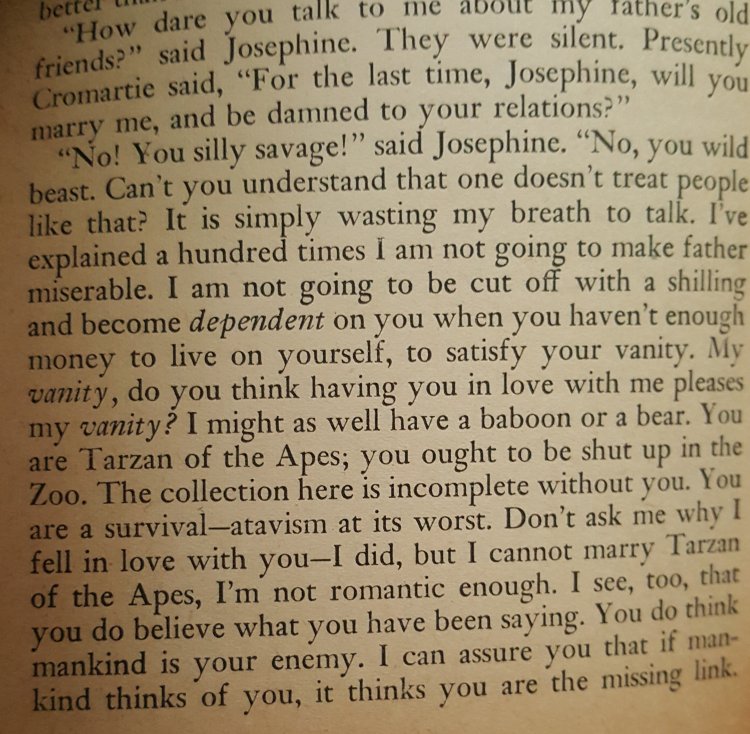
Another strange tale, but no metamorphosis is required this time. The story begins with Josephine Lackett and John Cromartie walking around London Zoo as they were wont to do on a pleasant weekend. The pair had been dating for some time and John was keen to marry Josephine but they are having a row about it as her father didn’t approve, presumably due to the lack of money on John’s behalf. I have selected below the salient part of this argument which becomes the turning point in the whole story.
The next morning John Cromartie wrote to the head of the zoo with the proposal that he should be exhibited in the great ape enclosure and thereby complete the collection. This suggestion was received by the committee running the zoo with considerable disagreement as to whether this would be appropriate but ultimately, because the main objector was disliked by a large part of the rest of the group, they agreed to the idea and a meeting was arranged with Cromartie. It was decided that he should be exhibited in ‘his natural state’ i.e. dressed in his own clothes and with a simply but well furnished living room with his books and a bedroom and bathroom both not on view to the public and that this should be laid out in the cage between an orangutan and the chimpanzee enclosure and so Cromartie moves in with the following written on the sign attached to his cage.
Homo Sapiens MAN This specimen, born in Scotland, was presented to the Society by John Cromartie, Esq. Visitors are re- quested not to irritate the Man by personal remarks.
The astonishment in the visitors later that day on finding a human displayed at the zoo was palpable and this started considerable debate not only amongst the public but in the newspapers as to the probity of the exhibit, which led to huge crowds coming to see him much to the irritation of the orangutan and chimpanzee on either side who suddenly found themselves largely ignored and without the extra titbits it was common to feed the animals at the time. The story progresses with Josephine coming to visit him several times, initially with fury in case she should be identified as his former girlfriend and determination that he had gone mad but gradually things develop and unlike Lady into Fox this does have a happy if somewhat unexpected ending.
Of the two novellas I definitely recommend ‘A Man in the Zoo’ as worth a read, less so ‘Lady into Fox’ although if you like tragedies that one might appeal. Both stories are now pretty well out of print (I have found some print on demand editions and they are also available on Kindle) however they can be read on Project Gutenberg. Lady into Fox is here, and A Man in the Zoo can be found here.
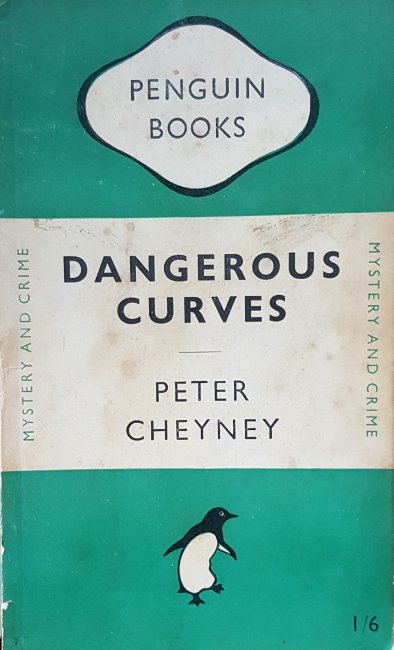
It’s three months since I last reviewed a crime book so definitely time for another one. In August 1949 Penguin Books published five of British writer’s Peter Cheyney crime books, of which I have four. This apparent keenness however clearly didn’t pay off as they don’t seem to have ever published any more of the at least forty more works by him and the five they did publish are long out of print. As I own four books but have never opened any of them it is definitely time to see what they are like and it turns out they chose across his styles, two books about American private detective Lemmy Caution, two about a London based private investigator named Slim Callaghan and one from what is known as his ‘Dark’ series which features various different lead characters. The first one I picked up was ‘Can Ladies Kill?’ one of the Lemmy Caution books but after around thirty pages I gave up on it. Caution is a cut price Philip Marlowe written in a poor version of ‘ American’ slang and consequently almost unreadable’
I like Raymond Chandler’s Marlowe stories and this was so obviously a bad knock-off that I almost gave up on Cheyney all together but decided to give him another chance and next on the shelf was ‘Dangerous Curves’ and this time it was a Slim Callaghan novel. Now Callaghan is still very much a Philip Marlowe character but transplanted into London so the terrible Americanish language of the Caution books is dropped, although women are habitually referred to as ‘dames’ and other Americanisms keep appearing. The change of language style makes it somewhat more a bearable read but despite his obvious popularity from the mid 1930’s until the 1950’s (Cheyney died in 1951 and his books largely died with him) Cheyney is not a great writer, being seemingly stuck in formulaic styles both in language and plots. I did however finish ‘Dangerous Curves’.
This time I stuck at it and was glad I did. Yes the characters are mainly ciphers based on the works of better writers but the plot was certainly original and had enough twists and turns to make the 256 pages it takes up worth reading. One thing that should be pointed out from the start though is the misogynistic nature of Cheyney’s writing. With the possible sole exception of Effe, Callaghan’s long suffering secretary and office receptionist, all the female characters are treated as dumb beings merely there for Callaghan to twist round his fingers and to do what he wants with. Effe does seem however to have some independence of character but even she is at Callaghans’ beck and call seemingly no matter what hour of day he needs her. The story line of ‘Dangerous Curves’ is quite complex and I’m not about to reveal it here but Callaghan definitely feels more like an American private investigator out of place in London but with all the contacts that you would expect to be in his home town. Who has been taking ‘The Mug’ for all his money and feeding him cocaine and heroin to keep him quiet whilst doing so? Eighty thousand pounds in the 1930’s was a huge sum to lose so no wonder The Mug’s father was interested in finding out, then all of a sudden The Mug (yes that is how he is referred to throughout the book) is found on a boat shot through the lung with the man who has been bleeding his bank balance dry dead at the desk opposite. What happened and why? And equally important when? These are the questions Callaghan needs to solve quickly and with enough proof to hand it over to Scotland Yard. As for the title of the book, the Dangerous Curves are those of The Mug’s young stepmother which so attract Callaghan that he also plans to bed her whilst sorting out the case. I told you Cheyney had a downer on his female characters…
Peter Cheyney has, mainly deservedly, been long out of print but in 2022 Dean Street Press published twenty four of his titles with 1940’s/50’s pulp paperback style covers. I can’t say I recommend them however, especially not the Lemmy Caution ones, there are far better crime writers than Cheyney and if you want the hard-boiled American detective just read the original and best, Raymond Chandler.
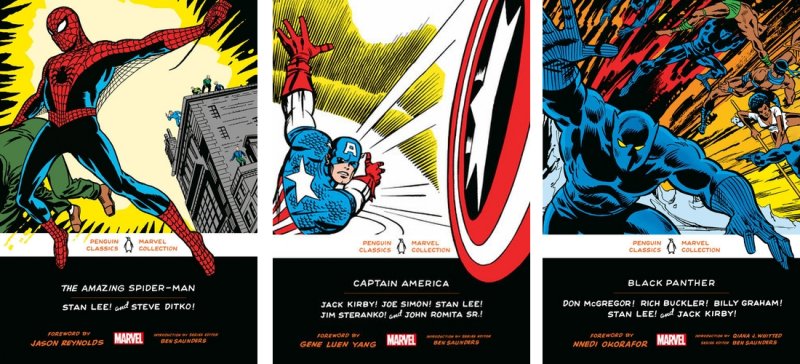
On the 14th June 2022 Penguin Books embarked on a new series of titles with three books each simultaneously printed in hardback and paperback. The paperbacks, as can be seen above, were designed to look like the current iteration of Penguin Classics but noticeably larger at 252mm tall and 180mm wide as opposed to the ‘normal’ size of Penguin Classics which are 198mm tall and 129mm wide. This larger size makes the reproduced comic books in each volume far more legible. The hardbacks are larger still at 272mm tall by 198mm wide, their covers are very different and have gold page edges on all three sides. The hardback covers are illustrated below as each book is discussed in this blog. It isn’t the size of the books that strikes the reader as different when you pick them up though, it’s the weight. At getting on for a kilo each for the paperbacks and even closer to two kilos for the hardbacks, this is due to the high quality paper used in order to do justice to the full colour pages throughout the almost four hundred pages making up each book, these are clearly not books for reading in bed.
All the books have the same introduction to the new collection as shown below:
It’s an interesting idea to class early Marvel comics as Penguin Classics, after all that series concept began in 1946 and 1947 with translations of Homer’s Odyssey, Guy de Maupassant’s short stories, Sophocles’ The Theban plays and Voltaire’s Candide in the first two years, quite what E V Rieu (the original series editor) would have made of these comic books appearing in Penguin Classics can only be surmised but it probably wouldn’t have been positive. Having said that, the introductory essays do indeed set the comic art in it’s historical and cultural context so at least some attempt to hold to Rieu’s principles for the series has been made.
The Amazing Spider-man
I was interested to see how these editions differed from the Folio Society curated volumes currently being produced, see their Spider-Man launch video here. Penguin have gone for a very different approach to their selection of comics to the Folio Society as with Penguin you get an almost contiguous run of early comics rather than a selection over the years by former Marvel editor Roy Thomas which is Folio’s take on the subject. So in this volume you get Spider-Man’s first appearance in Amazing Fantasy number 15 (August 1962) followed by the first four comics from The Amazing Spider-Man (March to September 1963). There then follows an essay about the characters development which also discusses comics five to eight and then the reproductions of the full comics continues with The Amazing Spider-Man comics nine and ten before another essay replacing issues then more reproductions and so on until the last comic included which is number nineteen from December 1964 by which time there have been twelve full reproductions. I actually really liked this way of doing it because at least you can follow story development rather than the more bitty Folio treatment and the three appendixes dealing with further aspects were really interesting as was the volume introduction by Ben Saunders. What you miss with the Penguin version rather than the Folio edition is a feel for where the character is going over the subsequent years however these are Penguin Classics after all so we should be looking at the early version of the character and even the hardbacks, at £40 are less than half the £95 of the Folio Society version.
Captain America
Captain America takes a similar way of selecting comics but with one major difference to the Spider-Man volume as although we get a reproduction of Captain America number one (March 1941) the rest of his largely propaganda driven World War II comic book stories are skipped. Because we get number one though we do at least get the famous cover illustration of Captain America punching Adolf Hitler. Instead we leap to Tales of Suspense number fifty nine (November 1964) and take the Captain from his relaunch including Tales of Suspense number sixty three (March 1965) which tells the origin story of Captain America. This had to be done as an entire generation had grown up without the character so who was this guy in the stars and stripes outfit? There are in total twenty two partial or complete reproductions of the comics, all but the first being Tales of Suspense which tended to have two, or more, separate stories in each edition and only the Captain America parts are reproduced here and he also didn’t appear in every edition so the last one included is number 113 (May 1969). Again unlike the Folio Society version we are focusing on one period of the characters existence rather than a more rounded overview and we also get essays that cover comics not included and provide more developmental background.
Black Panther
Unlike the other two, Black Panther originally appeared in another series entirely and has The Fantastic Four visiting Wakanda, home of The Black Panther, at his invitation only for him to launch an unexpected attack on them. This takes place in Fantastic Four numbers fifty two and fifty three (July and August 1966 respectively) both of which are in this volume. Despite the initially unfriendly approach, Black Panther and the Fantastic Four end up joining forces to attack an enemy of Wakanda and them ultimately encouraging him to continue fighting for good as Black Panther. We then leap to his next appearance, which is Jungle Action number six (September 1973) and have an uninterrupted series of comics from there to Jungle Action number twenty one (May 1976) this time with no explanatory essays replacing the comics. The appendices are very different as well, this time we get the essay written by Don McGregor as his introduction to Marvel Masterworks: Black Panther volume one and the typewritten plot synopsis originally created for Jungle Action number seven also by McGregor. This is a very interesting document as it shows how stories were developed before any artwork had been started.
The first three volumes of the Penguin Marvel Classics collection are excellent and anyone interested in comic books or the booming graphic novel market should seek them out.