The Frogs – Aristophanes

20181106 The Frogs

For November I’ve decided to read a selection of plays and the first one is The Frogs by Aristophanes. Normally I’m not a great fan of Ancient Greek dramas as you need a lot of knowledge of the gods and other characters involved but this translation is so readable I found myself laughing along as I read it. It was written in 405 BC and can be dated so precisely because it was created for drama competition as part of a festival honouring the god Dionysus in Athens where it took first place. Dionysus is one of the Greek gods with lots of jobs, according to the Wikipedia entry he is the god of the grape-harvest, wine making and wine, fertility, ritual madness, religious ecstasy, and theatre and it is in the latter one of these roles that a drama competition in his name becomes obvious.

The play tells the story of Dionysus deciding to travel to the underworld to bring back the playwright Euripedes who had died the previous year in order to rescue the arts in Athens back from the doldrums that he perceives it to be in. The first act sees Dionysus and his slave Xanthias on their journey, initially they visit Dionysus’s half brother Heracles for advice which causes him to collapse with laughter as Dionysus has decided to dress like Heracles with the lion head cloak and club but he really doesn’t have the build to carry off the look. Eventually they persuade Heracles to explain the route he used when he went to get the three headed dog Cerebus and they duly set off. When they meet Charon, the ferryman of the dead he agrees to take Dionysus and this is when he encounters the frog chorus who sing during the crossing. Despite the play being called The Frogs this is the only time they appear in it. After various encounters with people who think Dionysus is Heracles and either hate him for taking Cerebus or love him for it they finally reach the home of Pluto ruler of the Hades.

Act two takes place entirely at the Pluto’s house where they find Euripedes and also another dramatist Aeschylus who had died about 50 years earlier. These two had been arguing for the last year about which was the better writer and should therefore sit with Pluto for meals. Dionysus takes it onto himself to judge a contest between them and they take it in turns to be rude about the others works with the chorus commenting as though it was a fight with each man landing viscous blows on the other. This gives Aristophenes a chance to parody each of the two dramatists styles and throw in his own critical comments on both of them. Eventually Pluto gets fed up and decides to determine the winner via a special set of scales which can measure the weight of an argument. Each man gets to speak one line into the baskets on the scale and they are marked against one another with the scale, to Euripedes’s annoyance Aeschylus wins both attempts by mentioning heavier objects. In the end Dionysus decides to simply ask the two dramatists for advice to save Athens, Euripedes has lots of fine words but Aeschylus has more practical suggestions so instead of having Euripedes brought back to life he decides on Aeschylus. A final parting shot from Aeschylus is to insist that Sophocles should have the seat as the finest dramatist rather than Euripedes.

Translations of ancient Greek and Latin have become far ‘less stuffy’ over the last few decades and this can largely be thanks to Penguin Books who started their series of Penguin Classics in 1946 with the express intent of making the classics more approachable. Compare this extract from the Harvard Classics edition of 1909 which is available on Project Gutenberg, which deals with the god Dionysus rowing across the Styx with Charon and encountering the Frog chorus.  The specific translator is not given for this edition on the site as this was a massive group exercise resulting in 51 volumes of a wide selection of classic works.

FROG CHORUS
   Brekekekex, ko-ax, ko-ax!
   Brekekekex, ko-ax, ko-ax!
   We children of the fountain and the lake
   Let us wake
   Our full choir-shout, as the flutes are ringing out,
   Our symphony of clear-voiced song.
   The song we used to love in the Marshland up above,
   In praise of Dionysus to produce,
   Of Nysaean Dionysus, son of Zeus,
   When the revel-tipsy throng, all crapulous and gay,
   To our precinct reeled along on the holy
   Pitcher day.
   Brekekekex, ko-ax, ko-ax.

 DIONYSUS. O, dear! O dear! now I declare I've got a bump upon my rump.

The same passage from the 1964 translation by David Barrett printed by Penguin and reprinted in the edition I have been reading.

FROGS
   Brekeke-kex, ko-ax, ko-ax,
   Ko-ax, ko-ax, ko-ax!
   Oh we are the musical Frogs!
   We live in the marshes and bogs!
   Sweet, sweet is the hymn,
   That we sing as we swim,
   And our voices are known.
   For their beautiful tone,
   when on festival days
   We sing to the praise
   Of the genial god -
   And we don't think it odd
   When the worshipping throng,
   To the sound of our song,
   Rolls home through the marshes and bogs.
   Brekekex!
   Rolls home through the marshes and bogs.

 DIONYSUS. I don't want to row any more.

 FROGS. Brekekex!

 DIONYSUS. For my bottom is getting so sore.

As you can see the Penguin edition is considerable more ‘lively’ and the translator has almost turned to the poetic structure of the limerick in order to emphasise the comic nature of the play. This is a form that he will return to several times during the translation in some places using the limerick itself. The play is only 110 short pages so I read it in two sittings, the edition is from the Little Black Classics series by Penguin and is one of the most expensive of these books at £2. I’m looking forward to reading more from this series of titles in the coming months.
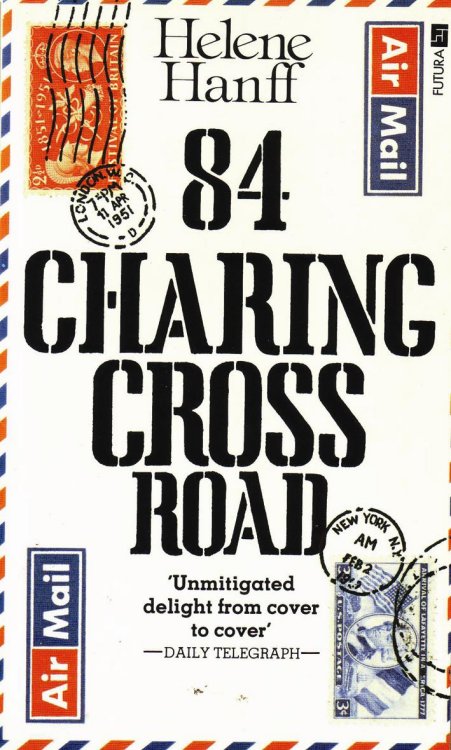
 

84 Charing Cross Road – Helene Hanff

Last week I went to see the play based on Helene Hanff’s best known work 84 Charing Cross Road at the Grand Theatre in Wolverhampton. There is a touring production currently travelling the UK with Stephanie Powers playing Helene and Clive Francis as Frank Doel. I first read the book in the early 80’s and have happy memories of that and seeing the film with Anne Bancroft and  Anthony Hopkins made in 1987 so it was a joy to see the play and how well it was done. I think that from now on that when reading the book I will always hear the letters as read by Stephanie Powers she gave a wonderful performance. Clive Francis was very good as Frank, but it’s very difficult to beat Anthony Hopkins, so I now have a weird mix of play and film in my head. You can see a clip from the film on youtube here.

20180605 Charing Cross Road

However this is a review of the book, it was first published by Grossman in the US in 1970 then by Andre Deutsch in the UK in 1971, the copy I currently have was printed by Time Warner Books in 2006. It has to be at least the third copy of this book I have owned as previous copies have disappeared over the years, as I either gave them away to people who I thought would love the book or just never got back a loaned volume. Like most editions nowadays in this copy the original book is paired with Hanff’s follow up work The Duchess of Bloomsbury Street which describes her journey to London for the UK launch of the original book. The first book itself simply consists of the letters between Hanff, who is in New York and Marx & Co. antiquarian booksellers based at number 84 Charing Cross Road. Initially they are quite business like, Hanff has seen an advert in the Saturday Review of Literature so on 5th October 1949 she first makes contact with the firm and pens a short note with a list of books she wants to see if they can supply them. but by the time of the last letter from the firm to Helene it is almost 20 years later on 8th January 1969.

There is no exposition, it is just the letters so all you know about Frank, Helene and the others who write occasional missives is what they include in the correspondence; but from this you really get involved in this developing two decade long friendship. By the end you feel you know them and the final few letters mean as much to you as they must have meant to Helene when they prompted her to compile the book, as she writes in Q’s Legacy.

“I have to write it.”

Then I went cold inside, I could only write it if I still had Frank’s letters. I’d begun saving them 20 years later because a tax accountant wanted a record of what I spent on books… The thin blue airmail letters with a rubber band round them took up no space, lying nearly flat under manuscripts in a back corner of one of six small cabinet drawers under my bookshelves. But year after year when I cleaned out the cabinets, I’d come on them and wonder why I was saving them. Sitting there that evening, I vividly remembered that when I had reorganised the cabinets a few weeks earlier I’d stood by the waste basket hefting the letters, debating whether to keep them or throw them out. I couldn’t remember which I’d done. And I was afraid to find out.

Fortunately she hadn’t thrown them out although they were only found after an agonising search

I carried the letters to the table and opened them – and snapshots of young families spilled out of them. Some were from Nora Doel, some were from one of the girls who worked in the shop, all of them were 10 or 15 years in the past … I found snapshots of Frank standing proudly beside his new secondhand car. I was laughing by this time, I poured another cup of coffee and settled down to read the letters.

By the time I went to bed I was positively happy, I was going to relive the lovely episode Marks & Co. had been in my life by making a short story of the correspondence.

20180605 Charing Cross Road 3

The letters get less formal as the years go on, by February 1952 Frank is writing to ‘Dear Helene’ as opposed to ‘Dear Miss Hanff’ which is how he starts off and whilst initially Frank’s letters are solely about the books or in response to gifts of food Helene sends to ration struck England, Helene’s become quite chatty very early on and she jokingly tells him off several times (these are just extracts from letters not full examples)

November 2, 1951

Dear Speed ___

You dizzy me, rushing Leigh Hunt and the Vulgate over here whizbang like that. You probably don’t realise it, but it’s hardly more than two years since I ordered them. You keep going at this rate you’re gonna give yourself a heart attack.

20180605 Charing Cross Road 4

Clearly remembering this letter many years later Frank was able to eventually get in a small riposte.

3rd May 1957

Dear Helene,

Prepare yourself for a shock. ALL THREE of the books you requested in your last letter are on their way to you and should arrive in a week or so. Don’t ask how we managed it – It’s just a part of the Marks service.

20180605 Charing Cross Road 2

Other members of staff at Marks & Co. also write to Helene, along with Dora (Frank’s wife) who initially just thanks her for the food she has sent but then also enters into a longer correspondence. What I really liked about the play was that the script really was just reading the letters to one another, the stage was split into Helene’s New York apartment on the left with the bookshop taking up roughly two thirds of the stage to the right. Almost all the letters in the book were read verbatim, in the film the letters are still the main part of the text but it is expanded to make it more cinematic and as you can see from the clip I included a link to above we even see other locations than the bookshop and the apartment.

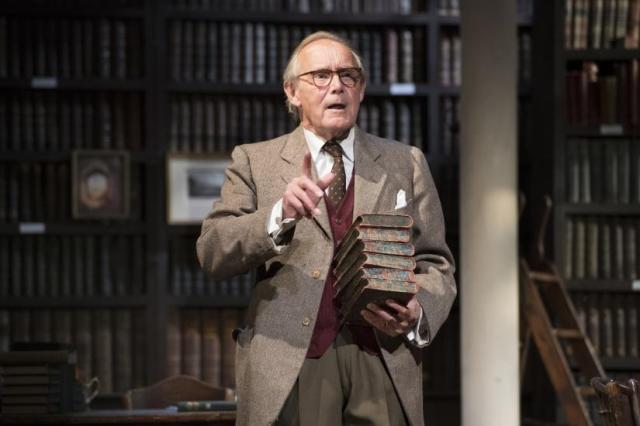
It’s very difficult to review this book without spoiling it for new readers but it is truly a delight to read and if you haven’t read it then please do so, then see the film and if possible catch it in the theatre. The images from the play are lifted from the Cambridge Arts Theatre website whose production this was.

The second book included in the paperback is The Duchess of Bloomsbury Street and this is more of a diary tracking Helene’s trip to the UK, all the people she meets and the various publicity events she goes to including a special opening up of the by now closed Marks & Co. shop on Charing Cross Road, so she did finally get to visit ‘her bookshop’ even if it was too late. The main signing event took place in Poole’s bookshop, next door in number 86. This diary runs from 17th June to 26th July 1971 and is considerably longer that the book it celebrates. Sadly the shop is now a McDonald’s burger place but there is a plaque outside commemorating the old bookshop and Hanff’s apartment on  305 E. 72nd Street has been named “Charing Cross House”.

For the really keen there is the third book in ‘the series’ which I quoted from above, Q’s legacy explains how, when it became clear she was not going to be able to afford any more than a year at college, she was in a library and she first came across Sir Arthur Quiller-Couch. She felt his books of essays and lectures taught her more than the first year had done and she was hooked. Q, as he was invariably known, introduced her to Walton, Newman, Milton and numerous others and she wanted to read more than just the extracts he quoted so was looking for a good bookshop when she saw that advert in the Saturday Review. If anyone is responsible for all that followed after that it is the now largely forgotten Q. Forgotten that is except by those of us who own a copy of his massive 1100 page work The Oxford Book of English Verse which for decades was the definitive collection, first published in 1900 and revised in 1939 to expand the selection up to 1918.

Under Milk Wood – Dylan Thomas

20180515 Milkwood 1

Yesterday was International Dylan Thomas day and marked the anniversary of the first ever performance of the great Welsh poet’s final work; Under Milk Wood. This show on 14th May 1953 was also the only time Thomas was recorded on stage giving any sort of performance of the work and sadly he was to die before the classic BBC recording starring Richard Burton was broadcast on the 25th January 1954. I have the vinyl recording of that original performance and it is playing now as I type this with Thomas’s distinctive voice taking four parts, that of 1st voice, Reverend Eli Jenkins, 2nd drowned and 5th drowned. The rest of the cast are Dion Allen, Allen F Collins, Roy Poole, Sada Thompson and Nancy Wickwire and between them they play the remaining 50 parts.

The recording was more accidental than intentional, there was a recording scheduled for 1954 with Caedmon but Thomas’s death prevented that happening. However somebody left a tape recorder at the front of the stage with the microphone probably nearer to Thomas than the other cast members mainly for their own use to record the first performance. As a single microphone on a device intended for amateur recordings it does remarkably well in picking up not only all the actors but also the audience and has left us with  a remarkable historical record. Caedmon therefore used this for their release of Under Milk Wood. The New York audience clearly didn’t know what to expect from this Welsh poet and you can hear them gradually realise that it is intentionally funny and the way the actors bounce partial sentences between themselves gives a delightful rhythm to the blank verse.

Under Milkwood is subtitled ‘A Play for Voices’ which sounds an odd description until you realise that it was intended to be a radio play for the BBC so there are no stage directions, it was always intended to be read by the cast not acted.

20180515 Milkwood 2

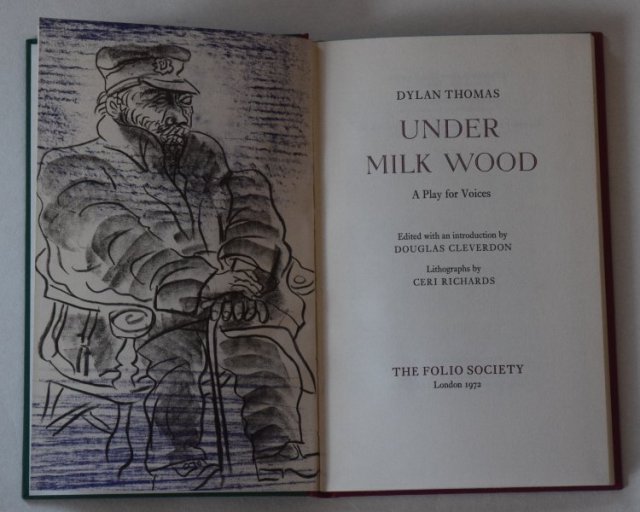
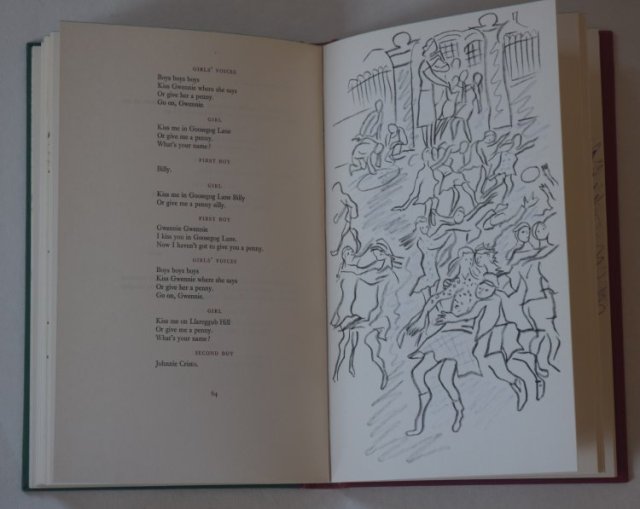
My printed copy is the 1972 Folio Society first edition of the work and, as usual for Folio, it is a lovely edition. It restores the text back to the original broadcast script with some extra lines which he left out originally, probably due to running time, added as an appendix. Although Thomas did deliver the script to the BBC he was still fiddling with it up to his death as he gave various readings in an attempt to earn enough money to pay off his debts, specifically a large back payment owed for income tax. So the typescripts are full of corrections and amendments and he never did come to what he regarded as a satisfactory conclusion to the piece, which had always been rushed as he only finished the ending included on the album minutes before they started the performance and kept changing this at subsequent performances.  As Douglas Cleverdon (the BBC producer of the 1954 broadcast version) notes in his introduction to the Folio edition.

Two stage readings of Under Milk Wood were scheduled for 24 and 25 October at the Kaufmann Auditorium, New York. Under a mixture of alcohol, sleeping pills and cortisone drugs, Dylan was already in a near state of collapse. He managed to write another page for the closing sequence of the script; to take part on the two readings, and to edit a shortened version for publication in the American magazine Mademoiselle. On 5 November he was taken to hospital in a coma, and died four days later.

If he had survived the play would undoubtedly have been further amended, on the back of one page of the manuscript is a section entitled “More Stuff for Actors to Say” and there are parts of the Caedmon recording that were subsequently removed so it was definitely still a work in progress at least as far as Thomas was concerned even after he had submitted the ‘final version’ to the BBC.

20180515 Milkwood 3

One final thing that should be mentioned is the setting of the play in a small Welsh village of Llareggub. This has the advantage of looking like a Welsh place name without being one, you don’t get a double g in Welsh. However anyone looking closely at the name and especially if you spell it backwards will see that here is another joke by Dylan Thomas. For this reason early editions of the script spell the village differently and even the Caedmon recording uses Lareggub when referring to the place in the notes. The fantasy author Terry Pratchett paid homage to Dylan Thomas when he named the equivalent of Wales on the Discworld Llamedos.

You can hear the first part of the performance I’m listening to on youtube here  It starts with Thomas as First Voice setting the scene.