The Holiday Train books – Peter Heaton

These three charming books were printed by Puffin Books in the 1940’s. They don’t seem to have been reprinted, not just by Puffin but by anyone, which bearing in mind that they are for very young readers, or more likely parents reading to young children, and their inherently fragile nature consisting of just eight sheets of paper, including the covers, folded and stapled in their centre makes finding them in good condition extremely difficult. Due to their rarity I have decided to include several double page spreads so that you can appreciate what a delight these little books (182mm x 110mm or 7.16 x 4.33 inches but so thin they are almost pamphlets) are. As implied the three books feature an anthropomorphic railway engine similar to the slightly later, and much more famous Railway Series by Wilbert Awdry and later his son Christopher which feature, amongst others, Thomas the Tank Engine, although that particular character isn’t in the first book which first appeared in May 1945.

The Holiday Train

Published in November 1944 as Baby Puffin number five, this introduces The Holiday Train as a character along with the love of his life The Little House which he passed every day whilst travelling up and down the line. Like the Puffin Picture Books, which were well established by then, the books were produced from plates normally cut direct by the artist, But Heaton was not a lithographer and didn’t know the technique so his drawings were converted in house by staff at the printers W.S. Cowell Ltd of Ipswich.
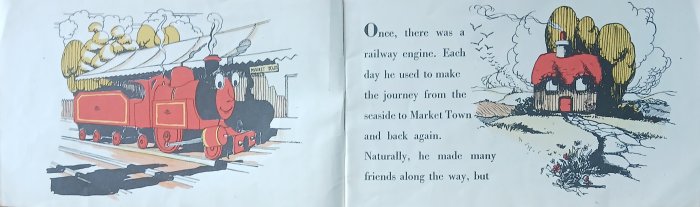
The story actually starts with the older engines, including The Holiday Train, being retired and going off to rest which he was happy about although he was really going to miss The Little House. But the seaside town where he had worked grew in popularity and population so the new engines couldn’t cope and it was decided to bring back the old locomotives.

As you can see above his return didn’t get off to a great start but soon all was well and The Holiday Train could renew his friendship with The Little House until…

The dreadful thing is a violent storm where a lightening strike hits The Little House and destroys it which sends The Holiday Train into depression at the loss of his friend. Trying to work out what to do to bring him back to normal the managers of the railway decide to get him to pull a special train, I love the expressions of the people on this next double page spread.

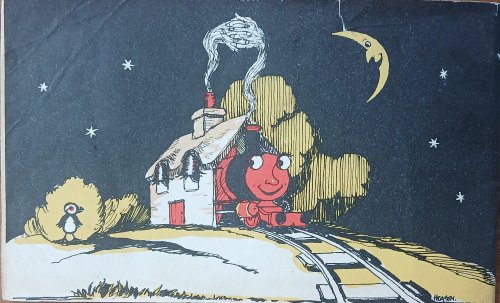
Of course The Holiday Train not only manages but sets a new record for the journey and as a reward it is decided to rebuild The Little House. I particularly like the puffin, the logo of the imprint, hiding behind a bush on the rear cover of the book as the Holiday Train settles down for the night in his new engine shed built from the ruins of The Little House.
The Holiday Train Goes to America

Published in June 1946 as Baby Puffin number six this takes the form of an international competition held in America between five locomotives from England against five from the USA which means of course crossing the Atlantic by ship. Which is a step up from the branch line antics of the first book, even if The Holiday Train is by far the smallest locomotive and is rather looked down on by the others. This book is very different to the other two, not only because of the use of four colour printing which allows for a full colour palate but also due to the much greater amount of text needed to tell a more complex story. This means a significantly smaller font is used, which along with the more literate style makes this definitely a book to be read to a small child rather than one they would read themselves.

Heaton makes full use of his extended colour range, it would have been difficult to do this book without the inclusion of blue. Speaking of which I’m sure the large blue loco called Blue Racer at the back of the left hand image above is a version of Mallard which at had broken the world speed record for a steam train in July 1938 by pulling seven coaches at a peak of 126 miles per hour, a record that still stands today. This can be better appreciated in a later picture where the streamlining of the LNER class A4 is shown, see below.

I love this picture of a seasick train, not a sentence I thought I would ever type, but Heaton manages to capture the abject misery of this condition so well on the face of the engine.

At last they arrive in New York and after being unloaded were welcomed to America and it appears that The Holiday Train runs on a narrower gauge that the mainline locomotives alongside him, which would somewhat explain his size difference. The two locos either side of him above are definitely giving him side-eye.
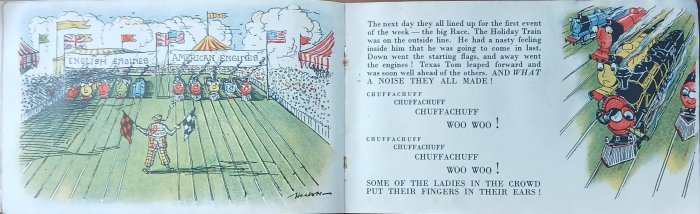
The three competitions are explained, a race, a beauty competition and a prize for the biggest engine which was almost certainly going to go to an American entrant as they are so much bigger than the locomotives from England. It didn’t look like The Holiday Train stood a chance in any of them. But there was a problem with the huge American engine Texas Tom who suddenly let out a lot of smoke obscuring the view for the other engines, but The Holiday Train is so small that he could see clearly under the dark cloud

and went on to win the race. I haven’t included the picture of the race itself but it does feature one of the errors Heaton made in his artwork as the green English train has vanished along with any tracks for him to run on. Another error is seen above as there is only one blue engine out of the ten and that is the Mallard lookalike but the loco shown above is missing the streamlining clearly depicted a few pages earlier. At the beauty contest there are again only nine tracks and no sign of the English green loco.
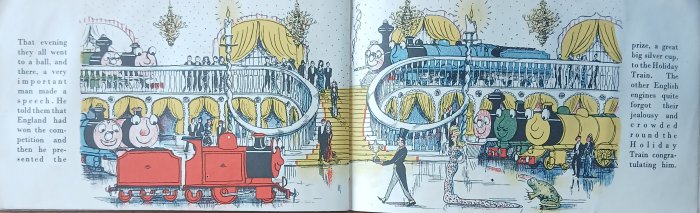
At the ball, where The Holiday Train is presented with the cup there are ten locos depicted but yet again Heaton has forgotten that one of the English locos is streamlined. It’s a fun story somewhat let down by the artistic faults, it is possible however that due to the age of the intended readership that this wasn’t noticed at the time by them, however it was spotted by Penguin management.

The Holiday Train Goes to the Moon

The last book in the series, not just of the Holiday Train but of Baby Puffins themselves as an imprint was published in April 1948 as the ninth Baby Puffin. Frankly this is the least interesting of the three titles, having a fairly simplistic story and a return to just red, yellow and black illustrations. It is noticeable that the scale between The Holiday Train and his engine shed formally The Little House has changed somewhat from the first book. In that the loco only just fitted in the picture on the back cover in the original title but now he is inside quite a roomy place with highly impractical curtains and a rug on the floor, see below.

The book tells the story of The Holiday Train being surprised by Carrumpus, a magical character who introduces himself saying “I come to visit trains when they get tired or overworked and cheer them up.” He does this by granting them a wish.

As you can see above The Holiday Train wishes he could fly and soon he has wonderful golden wings so he could fly around rather than running on rails.

Soon he decides to travel to the moon where he finds a railway, but not one like at home as here the carriages pull the locomotive rather than the other way round. But nevertheless The Holiday Train sets off to explore.

Arriving over the town of Lubbelium he sees some strange birds but suddenly Carrumpus notices the time, it’s almost midnight and the wish expires in a few minutes. Quickly The Holiday Train flies back to Earth and his home in The Little House.

It’s a pity that only nine different Baby Puffins were printed but I’m guessing that they were quite difficult for booksellers to display and sell them as they were so thin with no spine and usually were a horizontal format. With regard to the finishing of The Holiday Train books, by April 1948 the first book featuring Thomas the Tank Engine had appeared and he would go on to become enormously popular so did the world really need another anthropomorphic locomotive especially as Thomas and friends were somewhat more realistically drawn although not as delightfully whimsical. The rear cover of this last book has an appeal from Peter Heaton,

Dear Children,

As you know from reading my little books. I like having adventures. If you can tell me of any exciting places I could go to, write to me, care of Penguin Books, West Drayton, Middlesex, England

So clearly Heaton had no idea either that this would be the last anyone would see of The Holiday Train. Although he also wrote and illustrated the eighth Baby Puffin ‘Dobbish the Paper Horse’ Peter Heaton is probably best known to collectors of Penguin books for his Pelican titles dealing with a very different mode of transport, Sailing (first published June 1949) and Cruising (first published April 1952). He served in the Royal Navy during WWII on armed Merchant Navy vessels, corvettes and Motor Torpedo Boats ending up at the Admiralty and after the cancellation of the Baby Puffin series became friends with Penguin Books’ Managing Director, Allen Lane, regularly accompanying him on journeys on his boat. These trips led to the two factual books which made his name and which would be in print for several decades.

Professor Branestawm’s Treasure Hunt – Norman Hunter

And now for some nostalgia, I first read this book along with the first book in the series ‘The Incredible Adventures of Professor Branestawm’ when I was in Primary school aged about seven or eight years old. I never actually owned a copy of either book, simply reading the ones in the school library, but the other day I came across this copy, dated 1966, which is the same as the version I first read all those years ago at the end of the sixties. I had to have it and see if childhood memories of loving the books were anywhere near as good as with Elleston Trevor’s ‘Where’s Wumpus’. Sadly the adult me found the book a bit of a curate’s egg (good in parts) and some parts have not dated very well, but when it was good it was great fun.

For those unfamiliar with the absent minded professor and inventor of crackpot inventions Branestawm would be partly great fun to meet but also a complete danger to anyone around him as his inventions not only invariably go wrong but also quite frequently do so in catastrophic ways, often explosively. His jacket is fastened by safety pins, having lost its buttons many years ago, and he wears five pairs of spectacles, one set is specifically for looking for the other four whenever he loses them, which is frequently. His housekeeper, Mrs Flittersnoop, is often to be found residing at her sister Aggie’s house when the professor’s home has been rendered uninhabitable by one disaster or another. In this book one of the stories concerns the house burning down, amazingly not caused by one of Branestawm’s inventions but not helped by him trying to put the fire out by trying to smother the fire with a rug, which promptly caught fire, adding to the conflagration, and then throwing alcohol on the flames which of course made everything worse. This leads to him trying to invent automatic fire alarms which prove to be so sensitive that even the mayor’s cigar sets them off and the professor ultimately having to move in with Mrs Flittersnoop’s sister as well because so little of the house is still standing. Other regular characters are Colonel Dedshott of the Catapult Cavaliers who is always to be found in full regimental dress uniform complete with jangling medals, Mr Chintzbitz the owner of the furniture shop and Doctor Mumpzanmeasle, these names giving a hint of Hunter’s love of word play, which can sometimes get in the way of readability as you try to work out just what you have actually read.

‘The Incredible Adventures of Professor Branestawm’ was first published in 1933, whilst ‘Professor Branestawm’s Treasure Hunt’ originally came out in 1937, there then was a long hiatus before book three was released in 1970, with a further eleven being written between 1972 and 1983. I suspect the reprinting of the first two books by Puffin in 1947 and 1966 respectively and especially the subsequent 1969 television adaption did a lot to revive the character and prompt Norman Hunter to write more. I’ve never read any more than the first two and indeed didn’t even know they existed until I came to research this blog. Norman Hunter was born in 1899 and died, aged 95 in 1995

Cranes Flying South – Nikolay Karazin

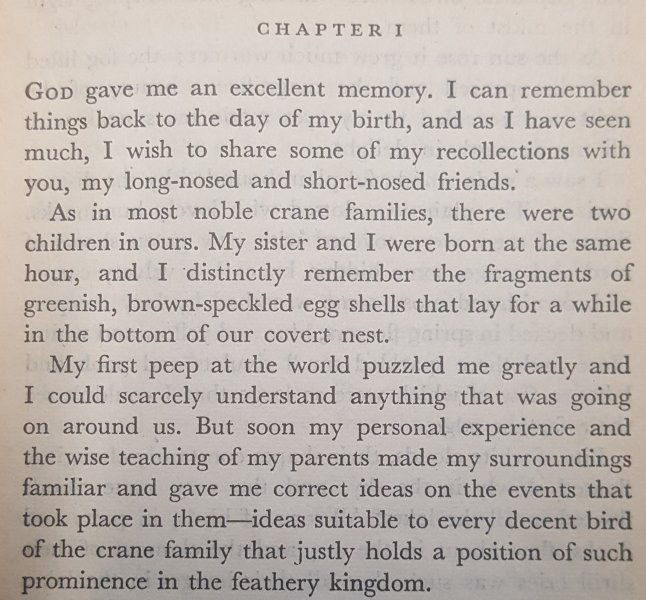
I knew nothing of this book or indeed its author before I picked up this copy a few days ago and there are no biographical details within the book either so onto the internet. Nikolay Karazin was a Russian soldier, artist and author of several books who was born in 1842 and died in 1908, he wrote and painted after retiring from the army and it is for his artwork that he is probably best known nowadays. I suspect the cover illustration is by him although no artist is credited. The English translation, by M.Pokrovsky, of his children’s book Cranes Flying South was first published in 1936 and this is the 1948 Puffin first edition. The book tells the story of the crane’s migration from the Ostashkovo marshes in north western Russia about halfway between Moscow and St Petersburg all the way over eastern Europe and Egypt following the Blue Nile to beyond Khartoum in Sudan, told from the point of view of a bird making his first long distance flight, as the book starts with him and his sister hatching.

His father, Clarion Trumpeter, is quite senior in the military like hierarchy supposed by Karazin to be normal in a colony of cranes especially during the migrations and in this he imposes his background. The story has them flying in structured triangles, which indeed they do, but regarding the stops on the way as camps with posted sentries and the discussions between senior cranes as to the best way to advance is rather more fanciful but does make for a good story. Amongst the other major characters is the Trifler, a crane known for his outrageously tall tales of his adventures and the leader of the colony Longnose the Wise. We never learn the name of our narrator or his sister, or indeed their mother but we are introduced to some of the cranes from another colony based in the Urals who join up as part of the massive flock taking part in the migration. On the way they also meet herons and storks both of which are regarded as inferior to the cranes, herons for their appetite as they will eat pretty well anything unlike the largely vegetarian cranes and storks for their relationship with man whilst cranes regard men as dangerous.

The journey south is full of incidents both with men hunting and also with bad weather which causes the loss of several cranes over open water when they get so exhausted by the buffeting winds but can find nowhere to safely land as cranes cannot swim. The descriptions of the route are also fascinating both the long slow journey over Russia and Ukraine then onto the mouth of the Danube before deciding to either cross the Mediterranean via a rest stop on Cyprus or skirting the coast from Turkey, Syria and Lebanon on their way to the Nile delta. Karazin had clearly read up on the ornithological knowledge at the time regarding the routes taken by cranes which seems to be largely correct according to the data I can find online. One particularly fun bit is near the end:

There are unimaginative persons unable to rise above the commonplace, who are generally very fond of ‘investigating’ things.
I am quite certain that several such persons, on reading of my travels will say: ‘How could he write it, when cranes have no ink and no paper?’
Such a remark will show, to say the least, a total lack of humour.

The book follows the full migration both to and from Sudan back to the breeding grounds in the Ostashkovo marshes and we get the full circle of life with our narrator pairing up with Blackneck, a crane originally from the Ural colony, and them having their own chicks. Sadly the book appears to be out of print but is quite easy to find second hand, it’s a lovely children’s story and worth seeking out.

The Midnight Folk – John Masefield

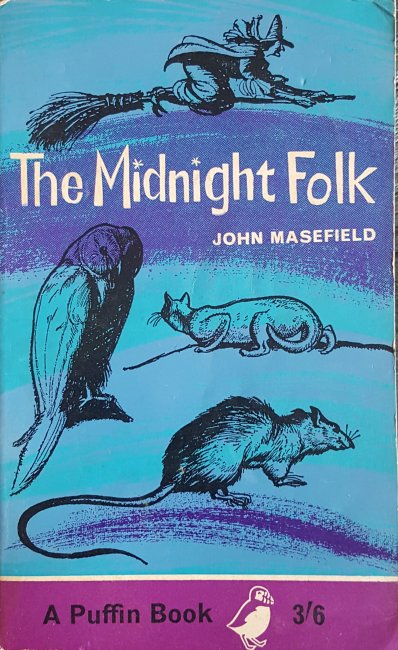
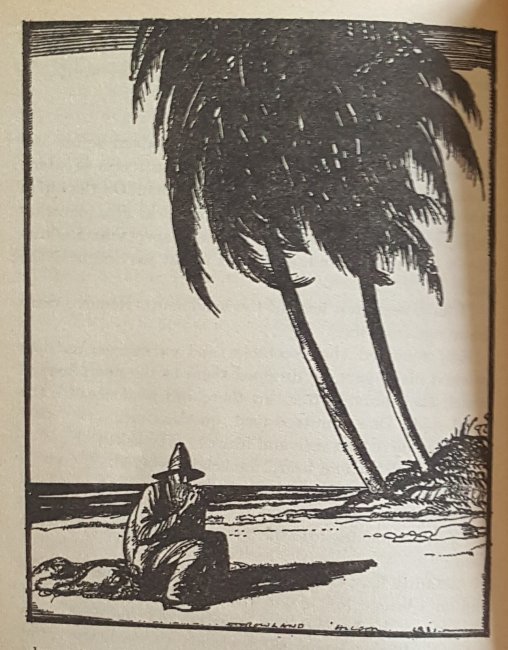
John Masefield was the UK Poet Laureate from 1930 to 1967 the second longest period of time of any of the holders of this office since its creation in 1668, he is only exceeded by Alfred, Lord Tennyson. However this book is not a collection of poems, but is instead a wonderfully imaginative work for children written in 1927 and still in print to this day. My copy was published in this Puffin edition in March 1963 and is beautifully illustrated by Rowland Hilder with not only large pictures but smaller images within the text. Masefield packs in the characters in this story from pirates, witches and wizards, talking animals, mermaids, King Arthur and his knights, moving and talking paintings, hidden treasure, a flying horse and even a crooked gamekeeper and his henchmen to name just a few. But so to our hero, nine year old Kay Harker who is trying to solve the mystery of the lost treasure with the help of some and the major hindrance of the others in this huge cast. He is apparently an orphan, no parents are mentioned except his mother in passing right at the end, and the large house he is living in is equally not very clear, did it belong to his parents or is it the property of his guardian who doesn’t live there? The only residents of the house other than Kay are the servants and his unpleasant governess, who turns out to be one of the coven of witches casting spells and causing mischief as they also search for the treasure.

The story positively races on as we alternate from Kay’s dreary schoolwork set by the governess and tedious meetings with her friends and his guardian to exciting overnight chases both on the ground and in the air on broomsticks or the flying horse which always find him fast asleep back in his bed just before the maid comes round to wake him up; but the mud on his slippers or other traces of the previous nights activities prove that this is not dreams. In many ways this reminded me of ‘The Cuckoo Clock’ which I included a few months ago as part of my look at the early days of Puffin Books, but the stories are far more fantastical than those by Mrs Moleworth in her Victorian adventure. The choice of words and the wide vocabulary used betray this book as the work of a significant poet who was to receive the highest honour for poetry in the country just three years later and the hunt for Kay’s great grandfather’s wrecked ship and the lost treasure he was trying to protect from a South American uprising is carried on in beautifully crafted adventure stories. Will Kay work out where it is before the wizard Abner Brown and the witches get to it and what will happen to the evil governess once Kay has worked out that she is one of the witches and therefore his enemy? Maybe a peek into the past will give the final clues.

Masefield wrote a sequel to this book in 1935 entitled ‘The Box of Delights’ which if anything is better known than this original story and has been adapted for radio, television, theatre and even as an opera by Robert Steadman with a libretto by Masefield. It was also available in Puffin Books in the 1960’s so I may see if I can track down a copy to match this edition, it’s been a really fun read.

Puffin Story Books – the beginning

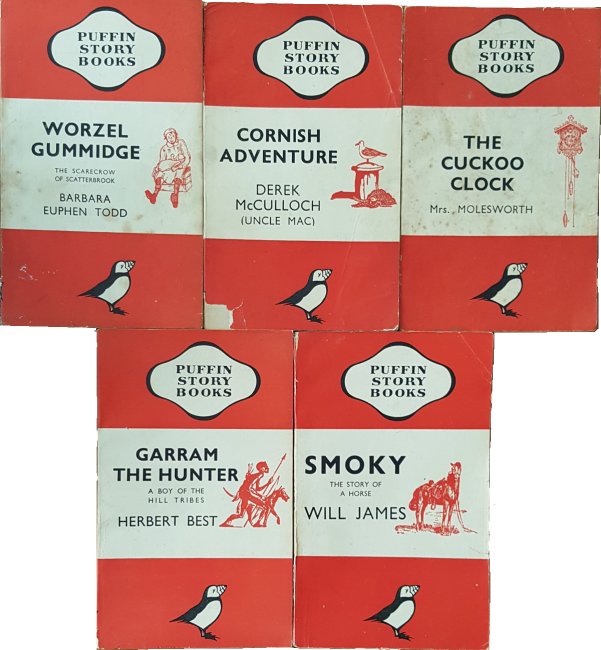
I somehow missed the eightieth anniversary of the start of Puffin Books last month as they launched in December 1941 but let’s somewhat belatedly look at how this massively important children’s imprint from Penguin Books started with five books, Worzel Gummidge, Cornish Adventure, The Cuckoo Clock, Garram the Hunter and Smoky and I have to say that the only one of these to have stood the test of time is Worzel Gummidge by Barbara Euphan Todd. I do have first editions of the Puffin books for all five so let’s take them in turn, starting each description with a quote from the title page where there is a brief introduction to the book.

Worzel Gummidge – Barbara Euphan Todd

This clever, fantastic story of the mysterious scarecrow who – when the mood took him – came to life and engaged in the funniest, and most alarming adventures, has become universally popular since the B.B.C. gave it to a wide and enthusiastic public.

The reference to the B.B.C. adaptation was a serialisation of the radio during Children’s Hour before the start of WWII and this was to just be the first of many adaptations that the book and its sequels have had over the years. I clearly remember the television version from 1979 to 1981 starring Jon Pertwee on ITV and there is a new TV adaptation running on the B.B.C. which started in 2019 starring Mackenzie Crook, which although I haven’t seen is introducing the character to a whole new generation. In the book two children, John and Susan, come to stay at the farm where Worzel is one of the scarecrows and start getting into all sorts of trouble as they are the only ones who see him move around and do things so they keep getting blamed for what he does. It’s a good story and you can see why Barbara Euphan Todd wrote nine sequels as Worzel Gummidge grew into a much loved character.

The book was first printed in 1936 and the Puffin edition is the first paperback, it is illustrated by Elizabeth Alldridge

Cornish Adventure – Derek McCulloch (Uncle Mac)

The setting, of small village, rocky cove and smuggler’s cave, is ideal for the plot that develops. The mystery breaks into the peaceful picture as the boy sails home on August morning with his fisherman friends

Derek McCulloch was best known as Uncle Mac on BBC radio where he presented Children’s Hour for seventeen years from 1933 but was also head of children’s broadcasting for the corporation throughout that time so would have been extremely familiar to his readers. It’s a classic children’s adventure yarn along the lines of Enid Blyton’s Secret Seven or Famous Five stories although these appeared much later than Cornish Adventure. ‘The boy’ referred to in the introduction is Clem and he is fifteen and has been coming to Cornwall through the summer holidays for the last five years and has got to know the local people over that time. He was out with a couple of fishermen collecting the crab pots when he spotted a dinghy going into a cave in the cliffs where they had never seen anyone before, what were the people doing there? Clem is determined to find out especially after swimming into the cave and finding it went back quite a way in the dark but he didn’t see the dinghy or the men.

The book is illustrated with drawings based on McCulloch’s own photographs but the artist who turned them into simple line drawings is not identified, it was first published in 1937.

The Cuckoo Clock – Mrs Molesworth

Griselda was only a little girl when her mother died, and she went to live in a big house with two great-aunts… She might have been lonely but for the cuckoo in the clock.

First published in 1877 and to my surprise still in print although no longer with Puffin, this book is definitely aimed at the younger reader; Griselda’s age isn’t given in the book but I’d guess at six or seven and Phil, the boy she meets near the end, is even younger and it is reasonable to assume that the target audience is around the same age as the protagonist in this case. Despite that it was a fun read with Griselda making friends with the cuckoo in the clock in scenes that could be interpreted as dreams except for the small invasions into real life afterwards such as finding the shoe from the land of the nodding mandarins in her bed (a large oriental cabinet in the room by the cuckoo clock turns out to be a gateway to where the carved figure live) or getting a message to Phil that she won’t be able to meet him the next day. The book is illustrated with several charming drawings by C E Brock.

Garram the Hunter – Herbert Best

Garram the boy is a fine vigorous character, cool-headed, bold and resolute, a skilful hunter, calculating his chances well and leaping swiftly into action. His adventures are lively and sometimes terrifying.

I probably enjoyed this book the most of the five I have read this week so it’s a disappointment to find that unlike the others it is long out of print with the Puffin version being the last I can find. Garram is the son of the chief of his tribe and is falsely accused of stealing and selling goats from one of the village elders by a rival for his fathers position. He manages to prove that the goats were in fact taken by a huge leopard but although this saves him at the time his enemy Sura continues to plot against both his father and him. Ultimately he is persuaded by The Rainmaker of the tribe to leave in order to protect his father as Sura would then fear his return as an adult to avenge any attack and so begins his adventures in lands beyond his tribes domain heading for the famous walled town of Yelwa, which is a real place, and where Garram would make his career before returning to his tribe and defeating his fathers rivals years later.

Despite being an American Herbert Best worked as an administrative officer for the British Civil Service in Nigeria and published several children’s books. First published in 1930, Garram the Hunter was shortlisted for the Newbery prize in 1931, the Puffin edition is illustrated with lino-cuts by Erick Berry which were ‘made on the spot’ so presumably in Nigeria and are the same as those in the hardback first edition rather than new illustrations for the Puffin book.

Smoky – Will James

Smoky is the story of a wild horse, told with exceptional vividness. It is also a real hot cowboy yarn, a grand adventure story told by a man who had lived in the saddle almost since infancy.

Well with an introduction like that who could fail to be intrigued? It is at many times a sad and yet ultimately fulfilling tale as Clint, who first trains Smoky after capturing him as a wild horse loses him to a horse thief. Smoky however, whilst perfectly obedient to Clint, will not allow the thief to ride him and is beaten repeatedly until eventually he lashes out and kills the thief. So begins his next life as an un-rideable bronco horse under the name of Cougar which eventually leads to career ending injuries. Sold off, this time as Cloudy he end up with yet another abusive owner who neglects and starves him before being spotted and recognised by Clint who eventually gets him back and nurses him back to health and a quiet retirement. Yeesh it was a hard read for a lot of the time.

Smoky is illustrated by the author although he isn’t credited in the book and it is easily the longest of the books in this set of five at 192 pages. Smoky won the Newbery medal for American children’s literature in 1927, a year after the book was first published, much to the surprise of Will James who considered it a book for adults, probably assuming the hard life Smoky has to be too upsetting for a younger readership.

Eleanor Graham was the series editor for Puffin Books from 1941, when they started, through to 1961 when she retired and was replaced by Kaye Webb. She did a remarkable job, especially dealing with paper rationing during the war and then building the imprint once paper started to become more available in the early 1950’s and adding titles such as Heidi, The Borrowers stories by Mary Norton and the first Moomin book. Webb inherited a series which by then ran to 150 titles which she was to vastly expand during her time in control including creating the Puffin Club and its associated annuals.

Puffin Annuals

At the beginning of 1967 Kaye Webb had launched the Puffin Club to great success, in fact more success than anticipated as demand for membership soared, which for a club dedicated to the children’s output of a publisher was unheard of. The quarterly magazine that members received was full of stories, reviews, puzzles and things to make and in 1974 it was decided to produce a larger version, for sale not just to club members, and make it an annual. This post is going up on the 1st December so just about when the annuals were hitting the shops when I was a child. I grew up in the 1960’s and 70’s, probably the heyday of the annual in the UK. What had started as simply a reprint of the weekly child’s magazine with The Boy’s Own and The Girl’s Own papers had expanded via The Rupert Annual (started in 1936 and still going strong) along with The Beano and Dandy comics and of course the much admired The Eagle annuals from 1950 to the late 1960’s all of which featured new material especially for the annual. TV shows got in on the act, Blue Peter has had an annual every year since 1964 and most other children’s shows followed suit especially Doctor Who. Even films spawned annuals, I have The Star Wars annual from 1977, the year of the first film. The Puffin Club had to have an annual, the problem was Penguin Books had never done anything like this before.

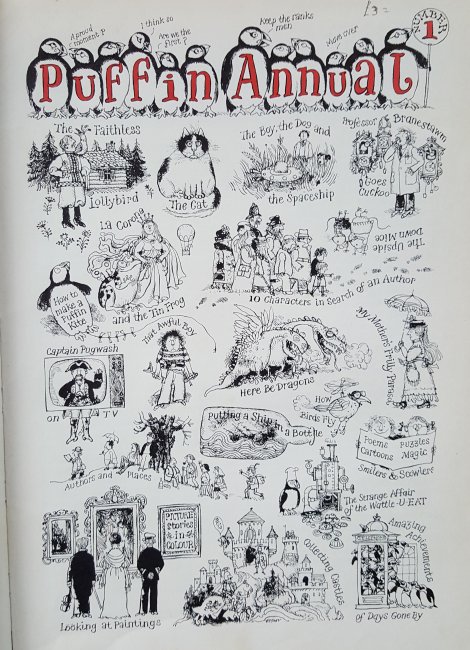
The title page of Puffin Annual number 1 gives a feel for the contents but also the style of the book, this was going to be fun and it really was going to have the look and feel of Puffin Post, the quarterly club magazine only in a much more durable hardback and the same size as all the other annuals out there competing for the eyes of children and the purses of their parents and grandparents, you could rarely go wrong with a Christmas gift of the annual relating to a favourite comic or TV show. This blog is going to be rather image heavy I want to give an impression of just what sort of publication these were.

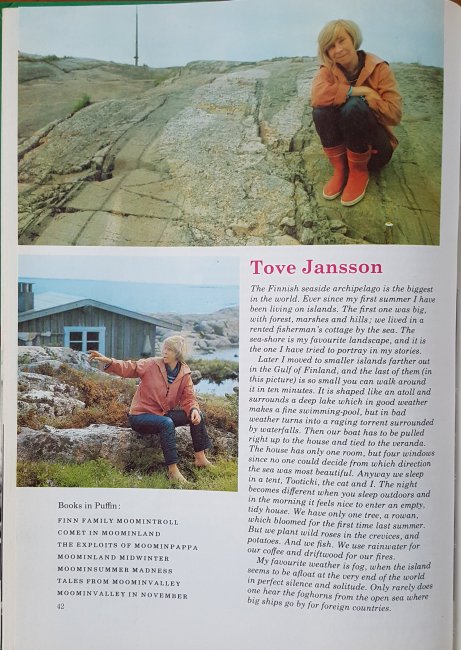
The contributors page of number one is a very impressive name check, including stories by Roald Dahl, Norman Hunter (Professor Branestawm), Tove Jansson (Moomins) and Michael Bond (Paddington Bear) but also artists and illustrators of numerous children’s books, and oddly the violinist Yehudi Menuhin and HRH The Prince of Wales both describe their favourite paintings. Puffin was definitely in the high brow end of the market and that was where it liked to be.

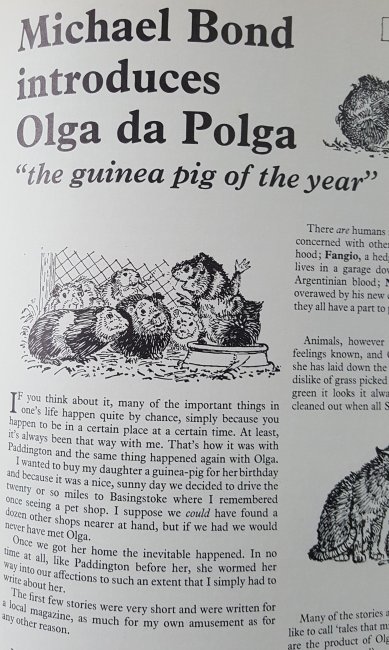
Michael Bond’s contribution was an introduction to his other, now largely neglected, character Olga da Polga who did get a series of books but never really caught on in the way Paddington Bear did. The thinking was sound, children can’t have a bear but they could, and did, have guinea pigs so maybe stories about their adventures would sell, well they sort of did but at a fraction of the sales of Paddington. Whilst Tove Jansson had a short story called The Cat, which she also illustrated.

Roald Dahl however could write about anything and children lapped it up. What you have probably noticed is the major failing of this first annual, there is very little colour. Despite the bright and enticing cover the contents are almost entirely black and white, but that was to change for the next year.

1975’s Puffin Annual was a very different beast to that of 1974. Still the same sort of mix in the contents (see below) but not just the cover had colours, this was much more in keeping with the competition and should have given the Puffin Annual every chance in the marketplace and it had to. This was Penguin’s first attempt at this section of the book business and it had to live or die on it’s performance, Penguin has a history of killing off series if they don’t perform and this was a much more expensive undertaking than the previous years effort. But again the list of people contributing and the variety of material was impressive.

Again though this is aimed squarely at children of better off families, no knockabout comic strips so loved by fans of The Beano or The Dandy, this is much more like a book than a comic but there are more things to do in this edition, not just games and instruction as to how to do simple magic tricks but also a model to cut out and make that takes up eight pages and illustrates one of the stories especially written for the annual.

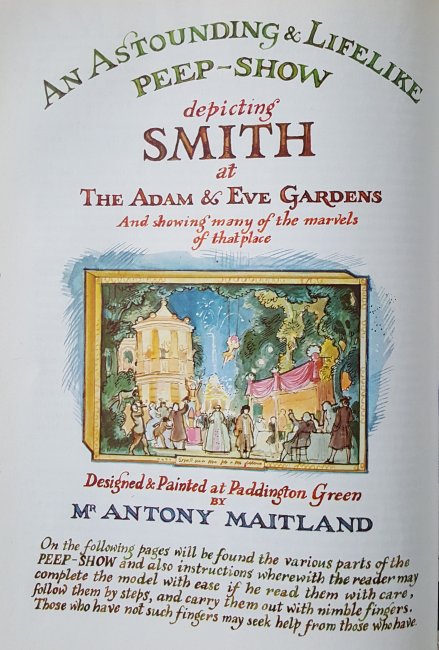
This is quite an elaborate model and includes basic instructions for fitting small bulbs so that it can be lit up at night. A peep show of the Adam and Eve Gardens in reality would have probably been far too much for a book aimed at children as by the time this park in London was closed down in the 18th century it was a haven for theft and prostitution. There is also a section on paintings although not as formal as the example in the first annual. This book has a lighter touch more in keeping with Puffin Post, I really need to do a blog about that magazine sometime next year.

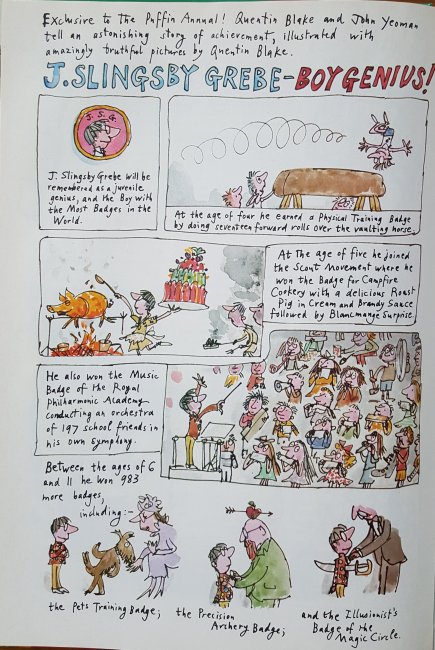
There are a couple of single page ‘introduce the author’ articles and of course lots of artwork by that stalwart of the original magazines, and favourite children’s illustrator, Quentin Blake, who drew the fun end papers which are also the index and also provided pictures for the story of J. Slingsby Grebe – Boy Genius.

This was such a dramatic improvement on the first annual, lightening up the tone and bringing in so much colour but had they done enough to save the Puffin Annual? 1976 would indicate that they hadn’t, when instead of the expected annual number 3 the rather oddly named Puffin’s Pleasure appeared in time for Christmas and styled itself as number one.

Now even a brief glance through this book shows that it was clearly intended to be the third annual, it was even assigned the catalogue reference number that such a book would have had. Annual number one was Puffin Story Book number 700, annual 2 was number 800 and this is number 900. So what happened? Well it appears that although the annuals were assigned to the Penguin scrapheap of failed series so much work had already gone into annual number three with writers and artists commissioned that it may as well be printed. Kaye Webb was apparently unhappy with the name Puffin’s Pleasure but calling this The First of its kind was wishful thinking as this was to be the only edition published.

The contents list is definitely varied and getting an author of the standing of Ursula Le Guin to supply a short story means that Webb and Bicknell certainly had ambition for their publication but it was not to be. There simply wasn’t a big enough market for such a book and Penguin’s lack of experience in such titles led to nervousness and not enough time would be allowed for an annual series to properly establish itself.

Ironically there is a four page article by Nicholas Fisk about the history of comics, the very things that were massively outselling this book and would therefore contribute to its demise. The popular astronomer Patrick Moore provided a single page on space oddities and there was a six page article about the history of the British Canal network.

All very worthy stuff but just who was this aimed at, it feels more like the target audience was the parents who were paying for it rather than the children who would hopefully enjoy it. I must admit reading these three books as an adult has been great fun, but would I have thought so when they came out and I was just leaving ‘young childhood’ and becoming a teenager? Possibly as I was a very bookish child, more often to be found curled up reading than playing outside, I know I didn’t have them as a child even though I was presumably exactly who they wanted as a reader.

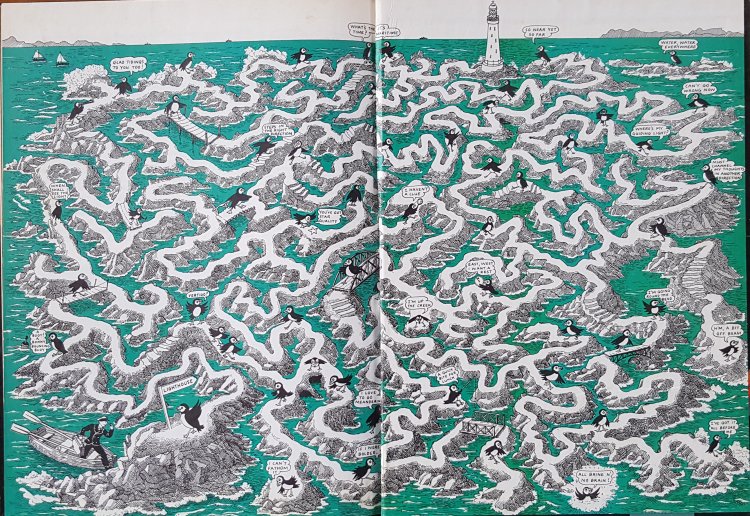
I’ll leave you with the very last item in Puffin’s Pleasure, a maze printed on the endpapers, see if you can get the lighthouse keeper from his rowing boat to the lighthouse, have fun.

Fairy Tales from the Isle of Man – Dora Broome

This is the first published edition from March 1951 by Puffin Books and includes twenty five tales, it is beautifully illustrated by John Harwood with six drawings inside along with the colour pictures on the front and back covers which I have included in this review. Harwood illustrated many children’s books including Aladdin and His Wonderful Lamp under the Porpoise imprint which I covered in an earlier blog. I love the way that instead of using the Puffin Books logo on the front cover he has instead added a puffin swimming in the sea alongside the merman and the baby mermaid, who is the subject of the final tale in the book.

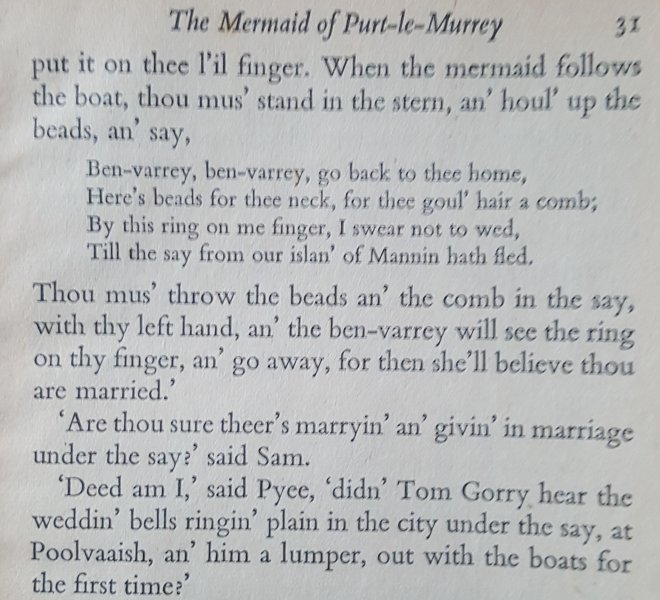
The book is initially quite difficult to get started with as it is written in form of dialect although fortunately all words in the Manx language are translated. You can see a sample of the text below and I found it much easier to follow when I read it out loud rather than simply reading as the rhythm of the language then makes more sense. You can guess what a lumper is from context, it seems to be similar to landlubber as Tom Gorry was on his first time out at sea with the fishing boats. Having said that a glossary at the back would have been interesting to bring together the various dialect words used through the book and confirm their exact meaning.

As you would expect from an island quite a few of the tales relate to the sea and the weird and wonderful creatures that apparently inhabit the watery realm, not just mermen and mermaids but evil such as the Glashtin who although a variety of water-horse comes in the form of a young man to drag unwary girls into the depths with him. Because of the history of the island the folk and fairy tales are influenced not only by nearby Celtic mythology and alongside that Irish christian myths such as St Patrick banishing the snakes from the Isle of Man as well as Ireland but there are also Norse origins as the island was a Viking stronghold for many years. It’s an interesting mix and the stories are told in a fun way that makes you keep reading once you have got into the swing of the language used.

One story I was a little surprised to be missing is that of the Fairy Bridge. The little people themselves are regularly referred to in the book with saucers of milk left out for them in many of the tales so that they are happy if they visit a cottage and don’t cause mischief but probably the best known link to them nowadays is the bridge and I was hoping for some background. Maybe there isn’t a specific tale but visitors to the island are even now encouraged to say hello to the fairies when crossing the bridge, which you would do quite easily as it is on the main A5 road from Douglas (the Isle of Man capital) to Port Erin in the south west of the island.

I read the book alongside a another volume ‘The Folklore of the Isle of Man’ by Margaret Killip which is one of the volumes comprising ‘The Folklore of the British Isles‘ and was first published by Batsford in 1975. This book gives a more rigorous and academic overview of the subject rather than simply retelling tales and it was interesting to look up the various creatures mentioned in the tales to get a deeper understanding of just what a Buggane or a Phynnodderee for example are and the powers each was believed to have. Bugganes feature in three of the tales and a Phynnodderee in two and this woodland spirit is depicted on the rear cover of the book.

Heidi – Johanna Spyri

I asked my Catalan friend Anna, who is an advocate for children and young adults reading around her country, to choose a children’s book from three titles that I have on my shelves, but have never read, for me to tackle this week and she chose Heidi. I have to say that I know very little about it other than it is Swiss, Heidi lives with her grandfather and she has a friend called Peter so it’s all going to be new to me. In fact I couldn’t even have told anyone the authors name until I looked it up for this blog, that is how little I know about it. The copy I have is by Puffin Books and was printed by them in November 1956, the translation from the original German is by Eileen Hall and the lovely cover illustration is by Cecil Leslie who also provided the drawings included within the book.

20191015 Heidi

Well that was an interesting read, I don’t know what I expected but this book definitely wasn’t it. For a start when we first encounter five year old Heidi she is being taken up the mountain by her aunt, whilst wearing most of her clothes on a hot summers day, so that she can be dumped on her grandfather who has no idea she is coming. Why is this happening? Well the aunt who has looked after her since she was orphaned at the age of one has been offered a job in Frankfurt which she wants to have and cannot take Heidi with her, so has to leave her with somebody, and the apparently cantankerous old man is the only option. He lives way up the mountain all alone, well away from the nearest village having distanced himself from them over the years so the villagers cannot believe that the aunt is planning on leaving Heidi there so far from anyone else, in the sole company of the man known to everyone (at least in this translation) as Uncle Alp. The handover does not go well…

“Good morning Uncle” said Detie. “I’ve brought you Tobias’s daughter, I don’t suppose you recognise her as you haven’t seen her since she was a year old”

“Why have you brought her here?” he demanded roughly.

“She’s come to stay with you Uncle” Detie told him coming straight to the point.  “I have done all I can for her these four years.  Now it’s your turn.”

“My turn is it?” snapped the old man, glaring at her. “And when she starts to cry and fret for you, as she is sure to do, what am I supposed to do then?”

“That’s your affair!” retorted Detie. “Nobody told me how to set about it when she was left on my hands a baby barely a year old. Goodness knows I had enough to do already looking after mother and myself. But now I’ve got to go away to a job. You’re the child’s nearest relative. If you can’t have her here, you can do what you like with her. But you’ll have to answer for it if she comes to any harm and I shouldn’t you’d want anything more on your conscience.”

Detie was really far from easy in her mind about what she was doing, which was why she spoke so disagreeably and she had already said more than she meant to.

The old man had got up at her last words. She was quite frightened by the way he looked at her, and took a few steps backward.

“Go back where you came from and don’t come here again in a hurry,” he said angrily, raising his arm.

Detie didn’t wait to be told twice.

And so the deed was done, and 12 pages into the 233 page book things were where I thought they should be, Heidi was on the mountain with her grandfather; although how we had reached this arrangement was a considerable surprise to me as I hadn’t known that she had just been abandoned there with him. However he turns out to be very kindly to her and all is well in the bucolic bliss that Spyri conjures up and I settled down to enjoy the tales of goat herding with Peter and descriptions of the high mountain pastures.  However just 35 pages later, two years in Heidi’s life have passed and Detie reappears to drag her away from the life she has come to know and love and dump her yet again on another unsuspecting household, this time in Frankfurt. Just what is going on with this book, and why isn’t Detie being investigated for child abandonment?? The well being and happiness of Heidi seems to be nowhere in her considerations and indeed once she has again abandoned Heidi and run away before anyone in the house could stop her she is never heard of again in the book.

Without giving away too much more of the plot there now follows roughly a hundred pages of Heidi having fun with Clara, the invalid girl she has been brought here to be the companion of, but at the same time getting more and more homesick and depressed about being trapped in the city far away from the Swiss mountainside and her grandfather whom she has come to love. Yet again this book is not what I expected. Eventually she becomes so unwell that she is sent back to Switzerland and the book finally takes the positive tone that I was looking forward to when I started it.

My one negative point about the book is that half way through religion really started to be pushed, the children have to say their prayers and later on when she gets back home hymns read to Peter’s blind Grandmother. I suppose it is a mark of the times when the book was written (1880) but equally I don’t remember other children’s books of the period being so proselytising to the point where it sometimes gets in the way of the narrative. This does seem to be an issue with her other books as well as the Deutsche Biographie states at the end of it’s summary of her life, translation below:

S.’s writings were already criticised during their lifetime because of the religious-conservative positions they represented as well as their tendency against women’s emancipation

Having raised the one negative that I found with the book I have to say that it was a great read, with more twists than I expected and I’m glad I have finally read it.

White Horses – Eric Ravilious

20190409 White Horses 1

Puffin Picture Books, an imprint of Penguin Books intended for children, started in December 1940 and ran until March 1965, although by then you were lucky to get one new title a year. In all 119 titles were published out of 120 that were given numbers, the missing title was 116 assigned to Life Histories by Paxton Chadwick and this was eventually printed by the Penguin Collectors Society in March 1996 under the guidance of Steve Hare. The story of the series appeared to be complete, but there were in the archives references to other titles that never even got as far down the path to publication that Life Histories had. One of these was Eric Ravilious’s White Horses. The beautiful watercolours of chalk figures and hills on the English chalk Downs intended for the book did exist but there appeared to be nothing more.

20190409 White Horses 4

Ravilious had been approached by Noel Carrington, editor of the Puffin Picture Book series to produce illustrations for a thirty two page landscape book of Downland figures back in 1939 and he was originally very enthusiastic about the project working of watercolours straight away. By the beginning of 1941 he had produced a dummy which showed the planned layout but by then commitments to the War Ministry left him no time to do more. Sadly on 28th August 1942 Ravilious was killed in an air crash whilst working as war artist in Iceland, the dummy of Downland Man (as Carrington referred to it)  disappeared and the planned book appeared to have died with him.

The story leaps to 2010 and the rediscovery of the dummy tucked away with other papers in the possession of Roland Collins. This critical evidence is now held at The Wiltshire Museum in Devizes and it is with their permission to make use of the document that the book I now have in front of me exists. Step forward Joe Pearson, owner of a small printing company in London, book and illustration collector and Penguin Books expert.

20190409 White Horses 2

Design For Today has, since its launch in 2015, already built up a reputation for producing fine examples of illustrated books based on Joe’s love of mid 20th century design, either reprints or more often using contemporary artists as inspired by the period as Joe is. As their website says…

Design For Today’s artists’ books are all designed, crafted and printed in the UK, using quality, sustainable materials and printed using the traditional processes of lithography, letterpress, screenprint, or linocut.  Editions are small, from 500 – 1500

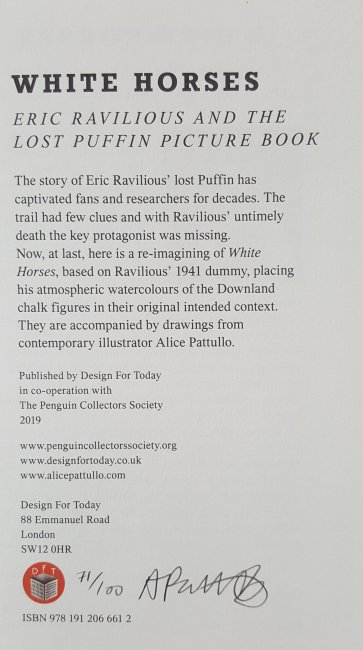
Joe had been hinting throughout 2018 that White Horses (as Ravilious titled the dummy) was a project he was working on; with Alice Pattullo commissioned to produce the black and white illustrations needed to complete the artwork as Ravilious had only ever done the colour pictures and Puffin Picture Books are a mix of both. The text of the final book is by Joe himself.

On the 31st December 2018 disaster struck, as the warehouse holding all of DFT’s stock, along with part of Joe’s own book collection and personal items, was burnt to the ground and nothing could be saved. White Horses is the first book to be launched after that loss of all of the back stock from the first years of the business and members of the Penguin Collectors Society are to receive a copy of the standard edition with their June mailing.

My copy of the limited edition version, which also includes a signed A3 print of one of the pictures by Alice, arrived the other day and it is an excellent piece of work not just well printed as I expected having quite a few of DFT’s products already, but entirely in the spirit of the Puffin Picture Book series.

20190409 White Horses 3

The double page spread above shows the sort of village that the creators of the earliest chalk carvings would have lived in at about 1500BC and this is the illustration that comes as the print with the limited edition book. The limited edition appears to have sold out already but standard copies of this beautiful book are available for £15 plus postage from Design For Today, anyone who like me loves Puffin Picture Books and/or the works of Eric Ravilious is sure to want one.