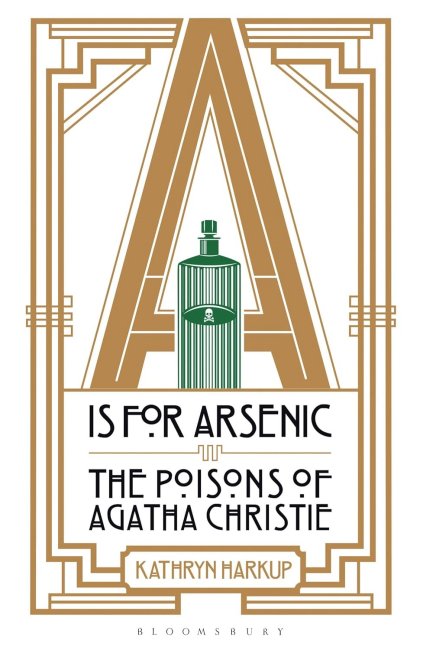
A series of essays inspired by books that I own, talking about their history, some reviews and also how they came to be on my shelves. With over 6,500 books here and several more arriving each week I doubt I'll ever be short of a topic.
The fourth week of August, and Cook only did three voyages of exploration so what to do here, well as the second voyage carried watches to test new ways of calculating longitude with varying levels of success as I will cover below it only seems fair to delve deeper into just what was being tested and why, fortunately Dava Sobel has written this excellent summary of just what was going on and how a group of astronomers colluded to keep John Harrison and his son William from winning the main prize.
As I said a couple of weeks ago “Cook had a watch made by Larcum Kendall which was a copy of that designed by John Harrison and alongside this a watch made by John Arnold, Ferneaux had two watches made by Arnold,” It may seem odd that the original clock by Harrison didn’t go on the 1772 voyage seeing as he was the one in line for the £20,000 prize (over £2.5 million for the modern equivalent according to the Bank of England inflation calculator) but the Board of Longitude were by then determined that he shouldn’t succeed and insisted that the original was effectively held hostage by them whilst a, hopefully inferior, copy was sent instead. But we are getting ahead of the story, let’s go back a few decades.
Dava Sobel presents the development of H4, the superb watch made by Harrison, by starting at the very beginning with explaining the problem of determining longitude. How far up or down the Earth you are is relatively easy to determine but longitude, how far round the Earth from your start point is a lot more difficult as you either need complex astronomical readings and their subsequent calculations and it could easily take four hours to work out where you roughly are using that method; or an accurate indication of the time in your home port to compare with local time which you could get from when the sun was highest in the sky which would be noon. Local time changes as you go round the world with a full twenty four hours representing a circumnavigation so an hour difference would be equivalent to fifteen degrees of longitude away from home. The problem was that no clock would work accurately on a ship due to temperature and humidity changes along with the movement of the ship and it had to be accurate as just a minute out would drastically alter the determination of longitude.
John Harrison, a self taught clock maker from the north of England starting to construct his first clocks back in 1713, a year before the Longitude Act setting out the prizes for determining longitude was passed. His clocks were, most unusually, mainly made of wood rather than the more common brass and most still exist with his fourth, the clock at Brocklesby Park, built in 1722 still running and telling excellent time today. Harrison’s first encounter with the Board of Longitude would be in 1730 when he went to London to present his early plans but he couldn’t find them as they had yet to meet due to no sensible proposal being sent for them to consider. That it took until 1773 for him to be finally awarded half the money he was fully entitled to and then only following intervention by the King is a scandal that Sobel covers so well in this book. Admittedly Harrison himself was partly to blame for the delay as he kept seeing improvements he could make and wanted but most of the problems were down to astronomers, especially Maskelyne, who were determined that solving longitude via lunar observations was the only way forward and as they were on the Board they kept changing the rules in order to prevent Harrison winning.
The story of the determination of longitude sounds like a fairly dry subject but it is anything but and this is one of the most interesting books I have read this year.
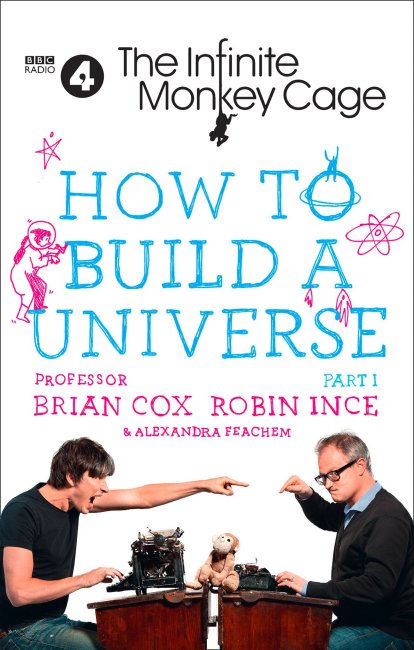
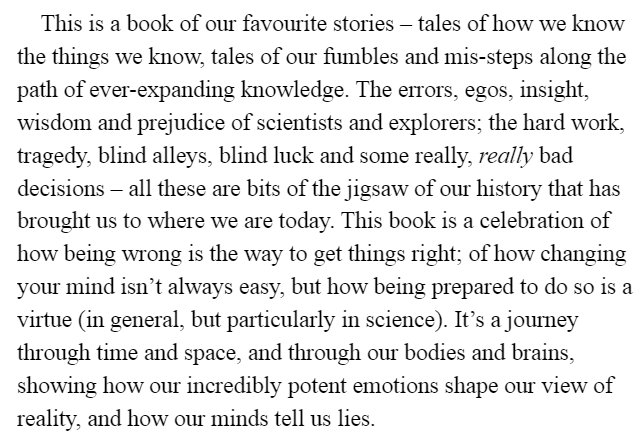
A book about science written by a non scientist, but somebody who has proved over many years his determination to try to get his head round complex scientific concepts after being completely turned off science at school. This is the second book by Robin Ince I have reviewed, the first being a joint venture with his friend Professor Brian Cox ‘How to Build a Universe‘ which I covered almost a year ago now and which promised a review of this book as I already owned it “in a couple of months or so”. Oh well it sadly got buried in the To Be Read pile but has now resurfaced and I’m so glad it has as it was a joy to read. Unlike the first book which appears to be mainly written by Brian Cox with interjections from Ince this, far longer, book at 390 pages excluding Cox’s introduction, is entirely the work of Robin Ince and as he explains at the start it was largely written during the first covid lock down in the UK in 2020. The book is based around over a hundred interviews he conducted during lock down with scientists in many fields who like him were pretty bored being stuck at home so were quite happy to talk about their various specialisms. His contacts with them grew out of not only The Infinite Monkey Cage radio show he does with Brian Cox (see review on How to Build a Universe) but also ‘The Cosmic Shambles Network‘ a largely science based website co-founded by Ince and Trent Burton which helped me through lock down with Ince’s regular videos from his book filled attic study providing much needed mental stimulation.
The book has twelve chapters all of which have an individual theme, although like his radio show with Brian Cox staying entirely on topic is not something that really happens. There is also an afterword as Ince didn’t want to finish with a chapter on the heat death of the universe, although quite appropriate for a finale it is rather depressing Having recently lost my father, something that has also recently happened to Ince, the chapter on death was probably the most difficult to read although ultimately as it provided food for thought it was also somewhat uplifting. Scientifically the most difficult and yet also possibly the most interesting, at least for me, was the chapter on the brain. My background is physics not neuroscience so this was well off my topic knowledge. But the important thing is that at all times I was interested in what Ince had to say, there isn’t a single formula in the book but that is sort of the point, you don’t have to be able to understand the formulas to get a reasonable overview of the topic being covered and its importance in a general understanding of ideas in physics, biology, cosmology, chemistry, neuroscience or whatever and it is all beautifully written.
What Ince also provides, although indirectly, is a reading list of works that will take you further or just sound interesting. For example I’ve never read anything by Bertrand Russell but now need to get hold of a copy of ‘Sceptical Essays’ as featured in the first chapter which covers doubt and uncertainty and also the spread of conspiracy theories. I have read works by physicist Carlo Rovelli but not ‘The Order of Time’ so that also makes it to the list. At the other end of the scale when Ince asked physicist Jon Butterworth about time he responded by quoting an author whose work I do own but have not yet read i.e. The Venerable Bede, an English monk who lived around 1300 years ago and wrote ‘The Ecclesiastical History of the English People’. After saying a couple of months and then taking eleven months to get round to reading this book I’m making no promises regarding Bede, whose great work has been sitting on my shelves for something like twenty years but I do keep spotting it and thinking I must get round to reading that sometime.
Ince has had plenty of interactions with astronauts both in the infinite Monkey Cage and Cosmic Shambles so the chapter on space exploration is packed with interesting anecdotes from people who have actually been into space including Helen Sharman, Chris Hadfield and one of the few Apollo astronauts still alive Rusty Schweickart, who flew on Apollo 9 in 1969. Ince has always been interested in space and as he says in this book he had always wanted to be an astronaut but as he says “The only things in the way of pursuing such an ambition have been an uneven temperament, a fear of small spaces, a fear of heights, a lack of dexterity, my total lack of any necessary qualifications, frequent fits of existential anxiety, general non specific anxiety and a deep existential worry about ever being too far from an effective flushing toilet.”
As a professional stand up comedian Robin Ince has had years of experience in organising his thoughts to communicate an idea although he self-deferentially claims several times in the book that his performance style is more a stream of consciousness rather than a well planned set piece. Read this book and discover the importance of being interested in just about everything, it’s good for the brain.
Based on the highly successful BBC Radio 4 series ‘The Infinite Monkey Cage’ this is science book like no other I have read. The radio show is also difficult to explain to people that haven’t listened to it, and you definitely should listen to it (link at the end of this blog) because it is co-hosted by on the one hand a Professor of Particle Physics at Manchester University and on the other a stand up comedian which is an extremely unlikely combination but works brilliantly. The look of the book matches the slightly anarchic structure of the radio show which in an early episode whilst discussing something completely different wandered onto the subject of “is a strawberry alive or dead?” They have come back to this subject on other occasions and I was pleased to see this being treated in the book as shown below:
The science for the most part is not overly challenging and the only really complex section is the largest, an eighty page chapter entitled ‘Recipe to Build a Universe’ which is almost entirely written by Brian Cox and as Robin writes:
This is the hard bit of the book. You may need a pencil to underline sections or just to occasionally jab into your leg or skull as you ask “but what does it all mean?” Don’t let this put you off
Page 80
In truth I have read so many books on this topic that it was relatively easy to follow and I largely sailed through this bit as it is so well written. Although a background of nuclear physics, coincidentally at Manchester University although six years before Brian went there to do his degree, possibly also helped. It also helped that the book is actually very funny especially during interplay between Cox and Ince, I laughed out loud at several sections and particularly a part written by Robin with increasingly irritated footnotes correcting him by Brian.
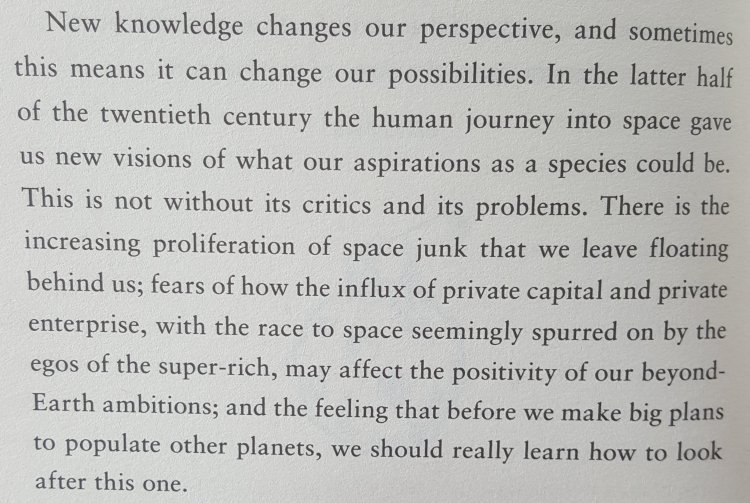
Other topics covered include the concept of infinity, space travel, the ultimate death of the universe and lots of things in between. In this way it is very similar to the radio show in that the main subject of a chapter, or indeed an episode, can be lost briefly if something interesting comes up as an aside. ‘Schrödinger’s strawberry’ (is it alive or is it dead) alluded to in the first chapter of this review is a prime case in point. You will learn a lot from this book but it won’t feel like it at the time unlike tackling something like Relativity by Albert Einstein or any of the four important science books I read one after another in August 2020. The style is easily approachable and the need for Brian to make sure that Robin is following the points as he makes them keeps the text grounded, although Robin Ince has now written his own science book ‘The Importance of Being Interested’ which I have a copy of so expect a review of that in a couple of months or so.
The radio show is just embarking on its twenty fourth series, some of the earlier ones only had four episodes but it now seems to have settled on six and all of them are available on the BBC website via this link. The shows on the site are usually the extended podcast versions rather than the original thirty (now forty five) minute broadcast. The usual format is that Brian Cox and Robin Ince are joined by two scientists who specialise in the subject selected for that episode and also another comedian who may have a science background but more often does not. A notable exception to this format, and an episode that is well worth listening to, was the astronaut special from series 22 where they were joined by astronauts Helen Sharman, Chris Hadfield, Nicole Stott and Apollo 9’s Rusty Schweickart. The book is great fun, the radio show even more so.
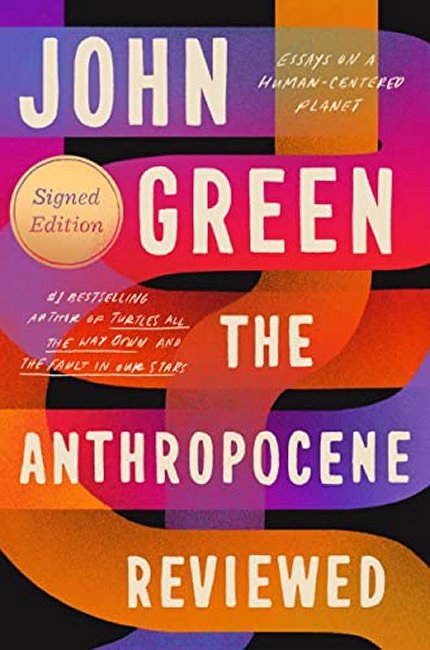
John Green wrote this book as the coronavirus pandemic took hold in 2020 and from his first review, the song You’ll Never Walk Alone which gets four and a half stars, through predictions of the end of humanity which he originally gives just one star to but adjusts as the pandemic spreads but humanity persists to four stars we can see how this series of essays is going to progress. The Anthropocene is an as yet short period of Earth history just two hundred and fifty thousand years where man has been, if not the dominant species, at least initially, a significant impact on the world. As this is a tiny temporal range compared to most other species, the elephant has been around for two and a half million years so ten times more, whilst the tuatara (a New Zealand reptile) has existed for a thousand times longer being found in archaeological remains two hundred and fifty million years old our dominance is unique. The book started out as a series of podcasts which can be found here and the audio book is read by John Green so appears similar to the podcast but in the book each topic is dealt with separately whilst the podcast almost always links two subjects in each broadcast. There are forty four separate essays included along with an introduction and a postscript so it comes in at a reasonably chunky 304 pages but because it is a series of disconnected essays it is an easy read.
I wrote that initial paragraph whilst starting to read the book but I quickly switched to the ten hour audio book in order to get the feel of the original podcast and discovered that there are three more entries on the audio book giving a total of forty seven. This is presumably a later edition of the book as the audio book came out in 2021, a year later than the original hardback but as one of the extras includes an audio file which clearly cannot be done in the book then maybe not. After originally deciding that nothing would get the perfect five stars in fact nine entries do receive that accolade, including one of the extra entries, the full list of these gives some indication of the randomness of the essays:
Sunsets – A quote from the review is “nothing is five stars because nothing is perfect but this is perfect”. From here on he feels more able to award five stars
Jerzy Dudek – Polish goalkeeper who played for Liverpool including the final of the UEFA Champions League in 2005
Harvey – The 1950 film staring James Stewart and a six and a half foot tall invisible white rabbit
Auld Lang Syne
The Hot Dogs of Baejarins Beztu Plysur – A famous Reykjavik hot dog stand
The Mountain Goats – A band that is easily the favourite of Green’s
Sycamore trees
“New Partner” – A song by Palace Music (Will Oldham)
The Smallpox vaccine (extra entry)
A few of these need a little explaining as to why he rated them with the maximum score because they are so personal to him. John Green is a supporter of the Liverpool football team and watched the 2005 final on television where his team were 3-0 down to A.C. Milan at the end of the first half only to score three goals of their own in the second half. This led to a penalty shootout where Dudek saved Andriy Shevchenko’s penalty and Liverpool won one of the most amazing comebacks. Fellow Pole, Pope John Paul II is quoted in the review for saying “Of all the unimportant things football is the most important” and Green concurs. Harvey was a film Green was recommended to watch by his then boss as he quit the firm to deal with his nervous breakdown which had left him unable to do anything, strangely enough the film actually helped Green on his way to recovery. Baejarins Beztu Plysur is a small chain of hot dog stands in Reykjavik, the name literally translates as The Town’s Best Hot Dogs and these were enjoyed during a short visit to the city with his wife and another couple, where he tried one on the day Iceland won their first Olympic team gold medal for men’s handball. Green really got into the Icelandic mood of celebration and loved the hot dog. The Mountain Goats is easily the shortest review where he basically just says this is his favourite band and has been for over twenty years with a quote he particularly likes “I’m going to make it through this year if it kills me”. With sycamore trees it is less clear quite why he rated them at five stars apart from talking about walking through a wood with his children and being especially struck by the beauty of the sycamore although this is preceded by a long section about his depression so it may be just he really needed something beautiful to focus on. “New Partner” is Green’s favourite song not by The Mountain Goats and has been for over twenty years, as part of the review he gives episodic stories about listening to the song over the years. The extra entry, smallpox vaccine, leads to a short history of the vaccine and also the covid vaccine that he had recently been to have. In 1796 Edward Jenner infected a young boy with cow pox as a protection against smallpox, as it was known that farmers with cows and especially people dairy maids were immune to smallpox, and gave the world the first vaccination (from vacca the Latin for cow).
At the other end of the scale only three entries get only one star and those are Staphylococcus Aureus, The Plague, or Black Death as it is probably better known and viral meningitis. Staphylococcus aureus is a bacteria John Green has been treated for and this section also features the development of antiseptics. In 2014 Green suffered from viral meningitis and had a headache worse than anything else he has had, extreme pain for a couple of weeks and a week in hospital, he recovered slowly but it kept returning in a less and less serious way for several years. I think it’s quite clear why all three of these only rate one star.
The weird variety of topics is both a positive and a negative to the book, you never know what is coming next, especially when listening to the audio book version as clearly you don’t have a list of contents and some of the essays appear to have only a passing relevance to the topic being discussed, for instance Our Capacity for Wonder is told via a review of The Great Gatsby. Some of the pieces are touching, others just odd, some tell stories that I already knew such as the discovery of the Lascaux cave paintings and the history of Monopoly giving The story of the theft of the game from its original inventor Elizabeth McGee by Charles Darrow, the person who patented it, sold it to Parker Brothers and became a millionaire. Some are new to me, such as the rise of Piggly Wiggly, an American supermarket chain operating in the American Southern and Midwestern regions and Hiroyuki Doi’s circle drawings which use thousands upon thousands of hand drawn circles to make up a complex design.
As mentioned there are three extra entries in the audio book version one of which is The Smallpox Vaccine which I have covered earler. The second one is Mortification where he describes his embarrassment after giving a talk in a high school when he gets to the end and ‘any questions?’ only for the first response to be ‘Are you aware your fly is open?’ After fixing this and going for another question there is just silence where before there were lots of hands in the air. The third is Kauaʻi ʻōʻō, a Hawaiian bird now believed to be extinct along with the other four species of ōʻō. By 1981 only one nesting pair was known to exist but female went missing after a hurricane in 1982. Includes final known recording of the single male pausing in his song for a female reply which never comes, this plaintive call is played three times in audio book.
I received this as a Christmas present and couldn’t be more pleased. I have been a fan of Adam Rutherford and Hannah Fry for several years after first hearing their Radio 4 and BBC World Service show ‘The Curious Cases of Rutherford and Fry’. Hannah Fry is an Associate Professor in the mathematics of cities from University College London whilst Adam Rutherford is a geneticist at the same university. Both of them have also done a significant amount of TV work and have written several books individually, this is the first time they have written together. For those not familiar with their radio programme they tackle a listener raised query each week with scientific rigour and a considerable amount of humour and this book reads like a continuation of their radio show. If you want to sample their programme, and I recommend you do so, then all the 115 episodes they have made in the five years since they started it are available here.
From the introduction of Complete Guide to Absolutely Everything – Abridged
At first the layout of the book is a little confusing, apart from the main text there are numerous ‘boxes’ that go into more detail on a point raised however these sometimes appear half way through not just paragraphs but often midway through a sentence so you have to read on and then go back to the box if you don’t want to lose your place. The boxes can be up to three pages long so leaping then back to where the main text was up to caused me to reread a few sections to make sure I was back up to speed, there are also numerous footnotes to keep up with. Once you get to grips with the odd layout though the book is great fun and bounces around the various scientific concepts that are covered with enough detail to provide an interesting learning experience without going too deep so that you feel the need to browse the internet to follow what is being said. This is very much like their radio show which is good as I tend to listen to that at half past two in the morning on the World Service when I can’t sleep but clearly am not about to get out of bed to check something.
The topics raised are definitely varied, from how you see things (touched on in two separate chapters) to a library that contains every piece of text ever, to does your dog love you, via how to calculate the circumference of the Earth and confirmation biases, with lots more besides those. You would think that with such a vast range of subjects it would just be a hodgepodge of ideas but instead it reads more as if the two authors were having a chat with you, in a pub maybe over a couple of drinks, now that would be fun. There is even a section which attempts to define the average reader of the book and I’m sorry to disappoint Rutherford and Fry but the only bit you got right for me was that I buy more than ten books a year (more like ten books a month). I would also have liked to be a bit more of Hannah Fry’s field of mathematics, there is definitely plenty from Adam Rutherford’s genetics although I appreciate that maths is a bit of a turn off for many readers so presumably that was deliberate.
The book was published by Bantam Press in October 2021 and as I write this it is currently on the Amazon UK lists 738 in Books, 2 in History of Science (Books), 3 in Biological Evolution and 3 in Cosmology so they definitely have a hit on their hands across multiple disciplines, and quite rightly so. Go buy the book you will definitely learn something new and via the comprehensive section on references you can then head off to go deeper into bits that catch your interest. I’m definitely going to be reading more about Jonathan Basilie’s version of Borge’s total library, the distortion of astronauts eyeballs, end of the world prophesies failing and dogs and their eyebrows. I knew nothing about Borge’s library or for that matter dog eyebrows before reading this book who knows what will strike you as interesting or at least odd enough to want to know more about.
Subtitled ‘A comedy of Maths Errors’ this book looks at mistakes not only with mathematics but also some dodgy computer programming and some problems that fall in between like the fact that an employee kept disappearing from the company database and it turns out that his name was Steve Null. I used to be a programmer and more importantly for this example a Database Analyst so immediately saw the problem here, empty fields which should be populated are counted as Null in a database so you would search for Null entries and delete the records as they are clearly not filled in correctly and could cause processing errors later down the line, this person was actually called Null so kept being deleted.
Matt Parker is the Public Engagement Mathematics Fellow at Queen Mary University of London, amongst many other things, and has made a career out of explaining mathematics to the general public both on youtube and in highly successful theatre based tours. He started out as a maths teacher in his native Australia but has lived in England for many years and built his online presence here. The book is not only informative regarding maths errors and possible pitfalls but includes several mathematical jokes in its layout such as starting at page 314 and counting down which is clearly not normal behaviour for a book. The choice of 314 is deliberate as Matt is well known for his annual calculations of pi in different ways on pi day (American format dates for the 14th of March gives 3.14) including one idea for this which uses the actual book I’m reviewing to calculate pi.
Other ways he plays with the normal structure of a book include having a chapter 9.49 between chapters 9 and 10, which appropriately covers problems with rounding errors, and the index which is surprisingly accurate as not only do you get the page with the entry on but as it is to five decimal places you get the location of the word you searched for.
Some of the errors I had come across before but surprisingly not many, this is a really well researched piece of work. One I hadn’t heard of in the past is now rapidly becoming my favourite mistake because it was so close to being right and then fell over at the final hurdle. There was a bridge being built between Switzerland and Germany and to save time it was decided to start from both sides and meet in the middle. Clearly this is a good idea but you do need to actually line up perfectly so the maths is even more vital than normal for an engineering project. There is a problem with matching heights and that is that they are calculated ‘above sea level’ now that wouldn’t be an issue if sea level was constant (it isn’t, the curvature of the Earth amongst other factors sees to that) but also Switzerland does not have a coast but via a fairly convoluted route uses the Mediterranean Sea as its base point. Germany does have a coast but a long way from Switzerland on the North Sea. The engineers thought of this however and correctly calculated the difference as 27cm, which is pretty impressive (a) to think of it and (b) to get it right but then added the 27cm to the wrong side so the bridge missed its joint by 54cm.
If this post intrigues you Matt has done a couple of lectures based around the book and this is the link to the one he gave at The Royal Institution in London last year. In it he goes through several examples in the book including a section near the end where his wife, space scientist Lucy Green, brings into the lecture hall what remains of a satellite blown to pieces and dumped in a swamp after a simple maths error. You can’t easily get a more dramatic, or indeed more expensive example of maths gone wrong than that. I bought the book from Matt on his website so it is signed by him and yes I have posted this a day late from my usual Tuesday and between 7pm and 8pm rather than 7am and 8am to show that getting a number wrong is all too common and Matt also left in three errors for exactly that reason.
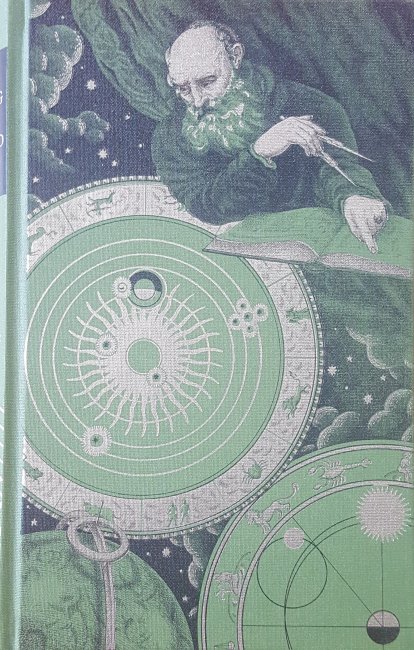
The final, and longest, book in my August reading marathon of important scientific works is also definitely the oldest and arguably the most significant in the leap of understanding passed on to those members of the public able to read a copy. Published originally in 1632 in Italian so that it was more accessible to the general public than it would have been if written in Latin it was immediately seen as an attack on the Catholic church as it presented as valid the then heretical Copernican system of the Sun at the centre of the Solar System rather than everything rotating around the Earth as taught by Aristotle and Ptolemy and adopted as clearly correct by the church as Earth should be the centre of Gods handiwork. Galileo was duly tried by the Inquisition and sentenced to life imprisonment at home and the book remained on the Catholic church’s list of banned works for over 200 years until 1835.
It is styled as a conversation over four days between three characters, Salviati is the instigator of the meetings and is clearly a Copernican, Simplicio is an adherent to Aristotelian and Ptolemaic systems and Sagredo is there initially to play devils advocate putting questions to both of the others but towards the end is obviously swayed by Salviati. Both Salviati and Sagredo are based on real people with those names who had been friends of Galileo but had both died many years before publication so could not be implicated by their names being used, whilst Simplicio appears to have got his name from the Italian word semplice which means simple minded. The choice of this name for the character backing the Ptolemaic system was also not lost on the Inquisition. Galileo was well aware that he was pushing at boundaries and originally got permission from the church to write a book about tides which grew into the final work covering far more than his original proposal, but even the characters acknowledge that this is potentially dangerous territory.
We are arguing for our own amusement, and are not obligated to any such strictness as one would be who was methodically treating a subject for professional reasons, with the intention of publishing it … it should be almost as if we had met to tell stories, so that it is permitted for me to relate anything which hearing yours may call to mind.
This edition was published by The Folio Society in 2013 using a translation originally done by Stillman Drake in 1953. It includes a modern introduction by Dava Sobel along with a foreword by Albert Einstein, which presumably dates back to the first publication of this translation. I did struggle a little with the verbose nature of the translation which whilst it may reflect Galileo’s original did also mean that I several times had to reread a sentence to make sure I followed the text correctly. This is not helpful when I was also trying to appreciate the leaps being made by Galileo whilst reminding myself that this was written decades before Newton formulated the Theory of Gravity so Galileo was truly groundbreaking in his explanations. His theoretically neutral but definitively pro-Copernican text starts from first principles with balls rolling down a slope to end up with not only the Earth rotating each 24 hours but also orbiting the Sun each year with the angle of the Earth’s axis also included to explain the equinoxes.
That is not to say that everything is correct as we would understand the cosmos now, Galileo has astronomical distances far too small, although much exceeding that of his contemporaries. A good example of this is the section of detailed calculations surrounding the two supernova that had been observed in the last few decades before he wrote the book. He is rightly dismissive of a book which aimed to prove that that these occurred within the orbit of the Moon so as to not disturb the changeless firmament which does so by carefully choosing between astronomical measurements of the period so as to find ones with sufficient error to support the authors position. However Galileo makes the same error in his selection by dismissing not only these examples but also any that would imply the nova occurred at an infinite distance from Earth which using the methods explained would actually have been the correct solution. Instead Galileo had decided that the stars were roughly six to eight times as far away as Saturn (then the furthest known planet) although some “could be two or three times further than that” to explain relative brightness and apparent size. He duly provides many pages of calculations regarding the sample set he has chosen, which are clearly there just to demolish the book and author he dislikes. Other ‘scientific’ books and papers from his time are likewise introduced and their methodology and reasoning torn apart. Galileo clearly wanted to leave no stone un-turned in his defence of Copernicus.
In the final section Galileo covers the subject that he originally stated was to be the main topic of the work, that is the tides and what causes them. Fortunately this makes up a tiny proportion of the whole book as sadly this is another area where he is in error by effectively ascribing them to the rotation of the Earth and the consequential ‘sloshing’ of the waters in the seas. The examples of mistakes given above are entirely understandable given the groundbreaking nature of the book and although I feel the translation could have been better this is still a book I thoroughly enjoyed as the insights presented by Galileo are not only good examples for today but give an understanding of the reasoning of the time and the turmoil between science and the Catholic church that would hold back scientific advances within its sphere of influence for decades if not centuries to come.
At over 206,000 words this is the second of the three large books for my August scientific reading marathon. I chose it in preference to The Origin of Species (first published 1859) for several reasons, including the fact that it is a lot more readable, but mainly because in this you can see Darwin slowly edging towards the theory that would make him famous. This is especially true of the second edition (1845, the first edition was in 1839, twenty years before his more famous work), the text of which is used for this book as Darwin altered sections in light of his research and developing thoughts. Another reason is that I love the work of Robert Gibbings who illustrated this Heritage Press volume. Although called a journal which implies a diary like approach, and yes most of the entries do have the date at their start, it is not chronological. We do bounce around a bit for a few years as The Beagle was on a nearly five year surveying mission so tends to revisit places several times and Darwin to make things clearer and avoid the obvious repetition has entries that may be months or years apart but which are put together because geographically they make more sense that way. It actually took me a while to realise what was going on and it was only when I stepped back a couple of pages to refresh my memory that I spotted that the entry there was two years after the one I was reading.
Throughout the text you can see Darwin edging towards evolution and the concept of gradual change in species. He also references many species which have the dubious distinction of being ‘described by Darwin but now extinct’ including a type of cattle in South America and on the Falkland Islands a species of wolf which he describes as a fox when he sees it and noted it’s decline.
Their numbers have rapidly decreased; they are already banished from that half of the island which lies to the eastward of the neck of land between St Salvador Bay and Berkeley Sound. Within a very few years after these islands shall have become regularly settled, in all probability this fox will be classed with the dodo, as an animal which has perished from the face of the Earth.
This may well be the earliest documented use of the dodo as a reference point for extinction of a species.
When you think of Darwin’s voyage then most people automatically think about the Galapagos Islands but in truth he spent very little time there arriving on 15th September and on his way to Tahiti by 20th October 1835. Just over a month out of a almost five year voyage and they take up in this edition twenty seven pages out of almost five hundred despite having more illustrations than most other sections. What we do get is a basic description of what have become known as Darwin’s finches as he realises that the bill shapes on different islands vary dramatically in order to make best use of the food supplies found there. Despite the giant tortoises being the most famous residents and symbol of the archipelago it was the finches that really drove his realisation of what became known as evolution. He is also one of the first people to accurately describe the marine iguanas found exclusive on these islands and notice their diet of seaweed rather then the belief up until then that they were after fish.
When reading the book one thing you notice is just how much time Darwin isn’t on board The Beagle, he goes off on long expeditions inland sometimes for weeks at a time whilst Captain Fitzroy is engaged on his duties creating charts for the admiralty. You therefore get long passages where he either makes circuits when the ship will be in one place for a period of time or he arranges to meet the vessel at a specified port further along the coast. The observations he makes away from the coastal areas add greatly to his geological studies and give fascinating diversions to life on board ship, but I suspect they are also inspired by his desire to be on solid ground due to the really bad seasickness he was prone to, which almost made him leave the expedition within a few weeks of the start. Science was greatly enhanced by his decision to keep going regardless but it was so close to being abandoned before he could make any of his discoveries.
Towards the end of the book the Beagle goes to the Keeling Islands and it is here that Darwin comes up with a theory for how coral islands and reefs are formed and ultimately writes another book on the subject. This is one of the few passages where the text becomes difficult to follow as he references maps from the other book without the reader of this volume having access to them, but there is enough for you to understand the process proposed. Other than this section the book is extremely readable even in this full form. Most versions printed nowadays, including the Penguin Classics edition are heavily edited and have more than 25% removed coming out at less than 150,000 words, which is still a substantial work but I would rather read a complete edition.
I bought this book in the July 2020 Folio Society sale specifically for this August science marathon which I have just realised I am reading in order of length. After the relatively short ‘The Double Helix’ last week I jump to the 432 pages of this volume, next weeks is a similar length and the final book to tackle is over 550 pages. If you are a regular reader of my blog you will know that I do a reading marathon each August, previously I have read multiple books each week but this year I have decided to tackle major scientific works at the rate of one a week when normally I would have interleaved them with shorter and easier works. So what is the importance of ‘The Elegant Universe? Well it was originally published in 1999 and is one of the first books to attempt to summarise the issues between Einstein’s relativity theories and quantum mechanics and then go on to explain a possible solution to their inconsistencies using String Theory to a readership that is not composed solely of physicists. The book was nominated for the Pulitzer Prize so definitely qualifies for my requirement to be a significant science work for this months readings and represents theoretical physics as I have previously read and reviewed the logical book for this subject namely Einstein’s own book on Relativity.
After a couple of brief introductions, one written in 2017 especially for this new edition, and a brief summary of the current understanding of elementary particles which makes up section one of the book Professor Greene dives straight in with two chapters on the General and Special Theories of Relativity, how these moved us on from the Newtonian Laws of Motion and the odd effects that are predicted by Einsteins equations. After this is a chapter giving a good introduction to Quantum Mechanics, which is a surprisingly easy read given the counter intuitive behaviours of forces and particles at this level of magnification. These are followed by a chapter entitled The Need for a New Theory where he looks specifically at the contradictions between Relativity and Quantum Mechanics and the problems that are faced by physicists trying to unite the two in the search for the Theory of Everything. These four chapters make up the second section of the book and cover ground I was already familiar with however I have not read up on String Theory so from here on the theoretical physics was all new.
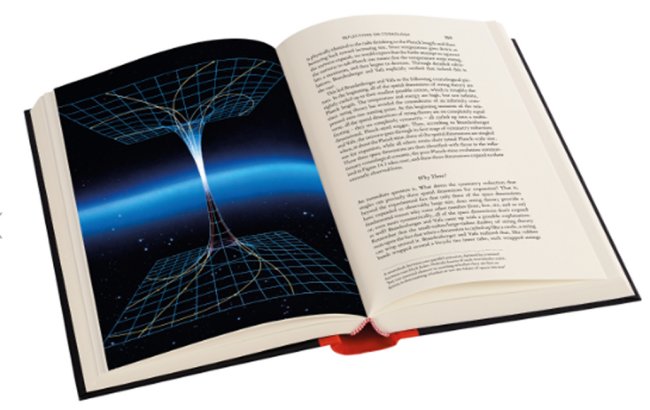
The chapters get ever more complicated as they try to explain the various aspects of String Theory, which by its very nature as the search for The Theory of Everything has to stretch from atomic level to cosmology. Professor Greene is very good at using analogies to express complex thoughts in a way the reader can approach them. For those who are fans of the Star Trek spin-off Deep Space Nine you will be pleased to find that String Theory allows for wormholes to exist. Spoiler alert – they probably don’t but at least there is some physics behind the idea as shown on the page spread above.
One potentially good way that the entire book is written is the ability of the reader to take it at their own pace and also to decide how deep they want to go. This is done by use of an extensive notes section at the back of the book which moves more complex discussions of points raised along with most of the mathematics out of the main body of the text. Now for me this became increasingly annoying as I had to keep two bookmarks to track where I was up to and to make skipping to the notes section easier but it does make the main text simpler to follow for the more lay reader who after all is probably the target audience.
Am I convinced by String Theory after finishing the book? The answer is probably no, there are far too many places where the solution to problems within the theory appear to be solved by the ‘with one giant leap our hero escapes’ methodology favoured by Flash Gordon short films from the 1930’s. Be it the ‘convenient’ choice of three holes in the six dimensions curved around a string so that the known three families of particles are predicted by approximate mathematical formulas. Or the super-symmetrical particles which are a cornerstone of most string theories (of which there are five versions which also doesn’t seem like a solid foundation) not being found as expected by the Large Hadron Collider so the assumptions of which they are based being changed so they ‘couldn’t have been discovered with current technology’ there are too many holes being papered over. Even assuming that the mathematics is finally worked out, and there is almost forty years of people trying, the idea that a mathematical model is also the physical construct is dubious to say the least and there is no need for the actual physical basis of the universe to match the mathematical representation for a theory to be valid in predicting motion and inter-reaction but String Theorists insist that this is the case.
Twenty years on from the book being written even those heavily involved in the physics back then are starting to have doubts about some of what is suggested. The most obvious candidate is super-symmetry. This is seen as one of the most important signatures that String Theory is correct and is number one on the list of things that ‘will prove or disprove the theory’ included in the book but few physicists now believe it is true as can be judged by this extract of a Royal Institution lecture by Dan Hooper, Head of the Theoretical Astrophysics Group at the Fermi National Accelerator Laboratory in the USA. Maybe String Theory will unravel, maybe it will be adapted to match experimental reality, who knows, but it is an fascinating subject and needs to be tackled to understand the fundamental basis of reality.
Read the book, it’s difficult, even with the solid background in Relativity and Quantum Mechanics that I have, but worth it. It will challenge your understanding of these subjects and that can only be a good thing, physics and mathematics rely on constantly pushing the boundaries and at least at the moment String Theory is the only game in town that attempts to mesh the Quantum Mechanics and what is happening at the smallest boundaries with Relativity and the physics of huge distances. It might be right, it might be wrong, but it will certainly push the boundaries of scientific endeavour for many years to come.
For this years August reading marathon I have decided to tackle four of the most significant science books that I have on my shelves. Unlike previous years where I have needed to read multiple books in a week this year I only have one at a time but because of their very nature these books are not something you can quickly get through and rush onto the next one, also two of them are over 500 pages in length. Three are published by the Folio Society and the other by Heritage Press in America who often produced books of a similar quality until they ceased publishing.
I’m starting with what is arguably the most significant scientific discovery of the twentieth century, the structure of DNA and how it could pass on genetic material. It is written by one of the three Nobel Prize winners for the discovery and provides a fascinating account of the race to be the first to crack how this mechanism worked and indeed what it was that did it. Now I freely admit that biology is easily my weakest science having dropped the subject at sixteen so was a little wary of this book and whether it was just going to go over my head but I need not have worried as Watson’s style pulls the reader along so that even in the technical parts I could keep up.
I hadn’t realised how quickly the science behind genetics changed in the early 1950’s or how competitive the search for the solution as to how genetic material was passed on became. Watson provides a good overview of the state of the science after the war where the general consensus was that the information had to be in proteins because they were more complex than DNA appeared to be so that had to be where something so important was encoded. Watson himself became interested in bacteriophages (phages for short) which are viruses which can have within them either DNA or the simpler RNA molecules surrounded by proteins and in 1951 started work at the Cavendish laboratory in Cambridge where he first met Francis Crick and the story begins. The original foreword which is included in this volume is by their departmental head Sir Lawrence Bragg who had himself won the Nobel Prize in 1915 for his work on X-Ray diffraction which was ultimately the way used to confirm the helical nature of DNA. Bragg says in his foreword regarding Watson’s style and tone in the book
He writes with Pepys like frankness. Those who figure in the book must read it in a very forgiving spirit. One must remember that his book is not a history, but an autobiographical contribution to the history which will someday be written. As the author himself says, the book is a record of impressions rather than historical facts.
Watson does indeed explain that he compiled the book from letters and diaries, which explains the large number of personal details such as dinners and his accommodation problems being included which all provide a more rounded narrative than the straight science. As for the Pepys like frankness, Bragg himself is subject to a few scathing comments especially when he specifically requires Crick and Watson to stop working on DNA and get on with what they were supposed to be doing. But his main target as a person obstructing their progress is Rosalind Franklin, a brilliant chemist and exponent of X-Ray crystalline photography and who took the images which ultimately confirmed Watson and Crick’s model. Franklin did not work with either Watson or Crick she was based in Kings College, London working with Maurice Wilkins or more accurately working against him according to this book as the two did not get on either personally or professionally so Watson’s impressions of her are strongly coloured by Wilkins’ opinions. Wilkins would ultimately share the Nobel prize with Crick and Watson in 1962, sadly Franklin had died of cancer in 1958 and posthumous prizes have only been awarded twice and have been specifically prohibited since 1974. Watson however has said that he thought she should have been included in 1962.
The tension mounts as Watson describes the various groups working on the genetic solution which ultimately comes down to three teams racing for the prize. Crick and Watson in Cambridge, Wilkins and Franklin in London and Linus Pauling in America. Ironically Pauling would also be a Nobel laureate in 1962 but he won the Peace prize for this campaign against nuclear testing. Wilkins and Franklin were the closest technically but due to their failure to work together were starting to trail but what really prompted Watson to get on with model building was Pauling who produced a paper which was close but which had a serious error in the chemistry and so produced the wrong result but Crick and Watson knew that once he realised his mistake it might be weeks rather than months before he fixed it and found the correct answer.
There have now been many more historical and less anecdotal accounts of the search for the structure of DNA, as predicted by Bragg in his introduction including another book by James Watson, which I also have, entitled DNA and written in 2003 to accompany a British TV series on DNA marking the fiftieth anniversary of the discovery. Watson was very young, only twenty four, when he and Crick made their breakthrough and that possibly also affected the style of this book. At the time of writing he is still alive, the only person involved who is, and at ninety two lives in his native America.
A better view of the cover design by Alice Stevenson based on a design by Gavin Morris.