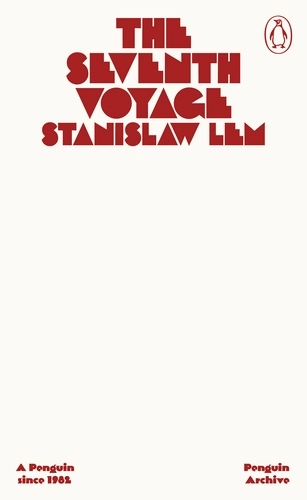
The Seventh Voyage – Stanislaw Lem

Polish author Stanislaw Lem is probably best known for his 1960’s science fiction masterpiece Solaris which has been adapted into a couple of films, in 1972 there was a Russian version and then fifty years later in 2002 James Cameron produced another in America. The Russian original is generally regarded as the better film although the latter is supposedly closer to the original book. This collection produced as part of Penguin Books 90th birthday celebrations consists of the short story ‘The Seventh Voyage’ (27 pages) along with a couple of short novellas, or longer short stories depending on how you define the categories, ‘Terminus’ (63 pages) and ‘The Mask’ (68 pages). I’ll review each one separately.

The Seventh Voyage

Well that was great fun, the story comes from a 1957 collection entitled The Star Diaries and despite being called The Seventh Voyage it is the first one in the collection which are different numbered journeys through space by Ijon Tichy as told by the equally fictional Professor Tarantoga. In this one Tichy encounters time loops after his spaceship is damaged and needing two people to effect the repairs decides to team up with one of his alternate selves to do the work. However all the various versions of himself seem to be a cross purposes and start fighting amongst themselves over who should have the one spacesuit to ensure that a future version can also have a suit on and also who can eat which bits of the limited rations.

Terminus

From Lem’s Book of Robots this story from 1961 is much more a ghost story rather than the humour of the first story although it is also clearly a work of science fiction. Pirx has just received command of an old spaceship and on first arrival at the spaceport was less than impressed with his ship with it’s visible rust internally and obvious patch jobs all over the place. Intrigued as to its history he searches for the ship’s log and finds out that the agent was not kidding when he said it was historic. In fact notorious would be closer to the mark as the ship was originally called Coriolanus and every space traveller knew that name and the disaster that befell it when it was caught in a meteor storm and so badly damaged that the crew were trapped in separate sections as the oxygen slowly ran out. All nineteen crew members died and the ship was assumed to be scrapped, but it was here, with its slapdash repairs to save money and barely capable of the run to Mars that Pirx had been assigned to do. Whilst exploring the ship after take-off Pirx notices that a pipe is vibrating and what is more it is doing so in Morse code and passing messages between the now dead crew calling for help as they slowly suffocate…

The Mask

This 1974 story can originally be found in the collection of Lem’s stories entitled Mortal Engines and we are this time in the realm of science fiction horror and it is a very strange but engaging tale. It is however very difficult to review without giving away the twists in the story, which is what the Wikipedia entry does within the first paragraph, you have been warned. The story starts with a nightmarish sequence where our first person narrator has no real idea what is going on or even who they are. This very quickly segues into what appears to be a regency royal ball, all crinolines and lace, but our narrator has no idea as to why she is there and still no clue as to their identity, is she recovering from amnesia, is she mad, or is there some other explanation? She is drawn to a mysterious stranger sitting alone in a window, but why and how can she know him better when she doesn’t even know herself? The explanation to these various questions is slowly revealed and the true horror of both their situations is a total surprise, unless that is you have sneaked a peek at Wikipedia, which I’m glad to say I only did to verify when this was first published after completing the story.

Although I knew the name Stanislaw Lem I have to admit that I hadn’t read any of his work before this book which was the main reason I bought a copy from this anniversary collection. I’m definitely going to read more, starting with Solaris of which I have seen the original Russian film version but never read the book.

Strata – Terry Pratchett

I have done several blogs about Pratchett but always tried to emphasise some of the less well known aspects of his work and this time I’m going back to his third novel, and the last before he created Discworld, which was to make him rightly famous. My copy is a signed first edition published by Colin Smythe Limited on the 15th June 1981 in a print run of just 1,001 copies, 850 of which were sold to Reader’s Union, and it is in this book that Terry first explored the concept of a flat world although not in this case borne on the back of a giant turtle; as he wrote at the time:

I am also working on another ‘discworld’ theme, since I don’t think I’ve exhausted all the possibilities in one book! 

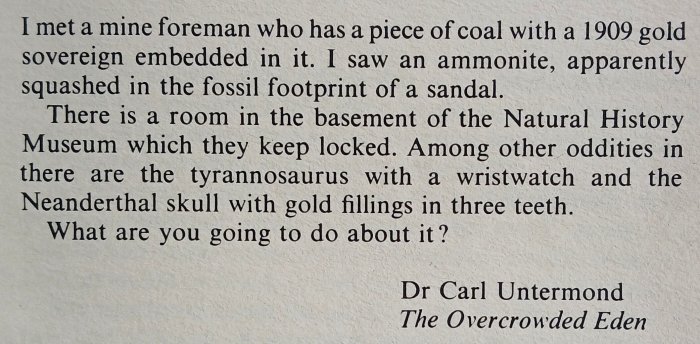
That theme would result in ‘The Colour of Magic’ first published on 24th November 1983 and it, along with the subsequent forty plus books, proved that he definitely hadn’t exhausted all the possibilities. But back to Strata which I must admit I hadn’t reread for at least thirty years, the story starts with a fake quote from an equally fake book that sets up the premise for the beginning of the plot:

Whilst it would undoubtedly fun to have developed more on this idea, instead Pratchett abandons the dubious fossil record concept quite quickly after explaining it was done via a huge device called a strata machine. This was invented to form fake sedimentary layers and their accompanying embedded fossils on newly created planets by a race known as the Spindle Kings who predated mankind by several million years and had also built Earth. A small number of these machines had been found buried on other planets and humans were now using them to terraform new planets for ongoing colonisation. There has been other galaxy wide races before the Spindle Kings such as The Wheelers and these had died out in turn leaving the present day to Humanity along with a few other sentient and space travelling races, specifically for this book, Kung and Shand. The main human character in the story is Kin Arad who had written a book called ‘Continuous Creation’ giving the history of the various galaxy creating races and this had made her famous so that she was approached by a man who claimed to have found a flat Earth out in a largely unvisited part of the galaxy and wanted to put together a small crew to explore it, this crew would consist of Kin Arad, Marco a representative of the Kung along with Silver a Shand. I can explain all this because it is dealt with in the first forty pages of the book and gives away nothing of the main story.

Anyone who has read Pratchett’s Discworld books will keep seeing references throughout the book, for example our three protagonists first meet in a bar called The Broken Drum and when we get to the flat world there is a rimfall, a continuous flow of the oceans off the edge, amongst other similarities. However the flat planet is recognisably the Earth with much the same continental pattern unlike Discworld and it works using technology, such as matter transference to replenish the seas, rather than magic which drives The Disc in the later books. Anyone who has read Discworld and wants to get an inkling of Pratchett’s ideas in creating it should probably read Strata, it is by no means as an accomplished work as certainly the Discworld novels from the fourth one onwards where Pratchett had more fully developed his skill as a storyteller but it is definitely worth a go and the twist at the end is a good one. It is definitely a science fiction story rather than a fantasy and is probably closer to Larry Niven’s Ringworld than to Pratchett’s Discworld series.

The Game-Players of Titan – Philip K Dick

The book is set sometime in the 22nd century, we know this as the year 2095 is mentioned as occurring in the past. Earth has been involved in a terrible war which has led to massive depopulation to between one and two million people over the entire globe, and due to radiation poisoning a significant reduction in fertility of the survivors. The planet is now administered by the Vugs, a race of telepathic beings from Saturn’s largest moon Titan who ended the conflict and whilst not seen as occupiers of Earth they are always around. Amongst the survivors are the maybe a couple of hundred thousand Bindmen, owners of huge swathes of cities and states and their non-B residents. The Bindmen play The Game putting title deeds to their properties and even their wives as stakes in the game which is encouraged by the Vugs who both love gambling and recognise that constant swapping of partners enhances the chances of a fertile couple meeting. The story starts with Pete Garden loosing not only his favourite property, the city of Berkeley in California, but also his wife Freya and to top it off has failed to throw a three which would allow him to take another wife. To make things more on edge Pete is already a drug addict and known suicide risk having attempted to take his own life on four previous occasions.

When Pete recovers from his latest low after losing the game he visits the winner and asks to buy back Berkeley only to find it has already been traded to an American East coast player called Jerome Luckman, a man who having won most of that side of the country was looking for a way in to play on the west coast and Berkeley was to be his opening stake. Pete meanwhile moves to another of his properties where he meets a telepathic non-B female resident who has been surprisingly lucky and has three offspring and he hopes to seduce her or possibly her prettier eighteen year old daughter. That evening though Pete throws a three and is immediately married to another partner just before Luckman arrives to play the game with Pretty Blue Fox as the game group in California is known and wins so consolidating his position.

But then there is a murder and The Game is going to completely change with everything you know, or think you know drastically altered…

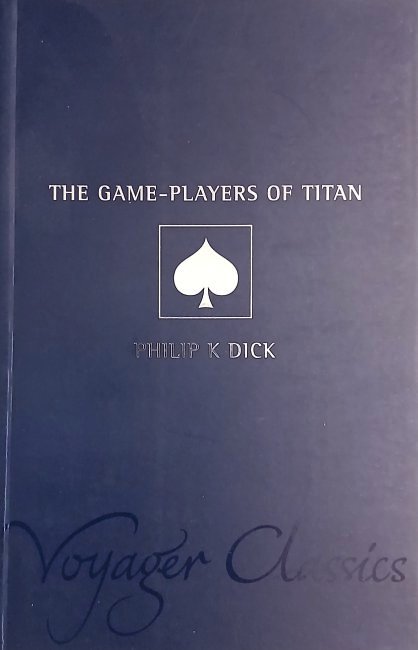
Voyager Classics was a relatively short lived series of science fiction and fantasy books from Harper Collins all with the same blue and silver cover design, with French flaps and a different small, but sort of appropriate, image in the box on the front along with the spine. In this case the ace of spades even though the game they play in the book, Bluff, is clearly a board game. At the time of writing Harper Collins still list two titles in this series on their website, however only one of these has this rather attractive cover design. The Game-Players of Titan is book ten of the thirty six listed titles at the start of the book and they must have all been released, or at least announced, simultaneously in 2001 as this is the first edition. The initial set includes the three Lord of the Rings novels along with The Silmarillion making Tolkien the most represented author, but Ray Bradbury, Stephen Donaldson, David Eddings and Kim Stanley Robinson each appear three times. Philip K Dick has one other titles in the first thirty six, ‘Counter-Clock World’.

As you can see from the title image the cover is rather glossy and difficult to photograph so I did a search on Google to see if I could find another image of the Voyager Classics edition. I did, but the title is subtly different, missing the ‘The’ and also the hyphen in Game-Players. I have no idea if this is a later erroneous edition or what but it is an interesting oddity.

Frankenstein – Mary Shelley

If anyone had asked me before last week if I had read Frankenstein I would have replied “yes” as I was certain that I had done so although many years ago. Yet when I started reading a few days ago it became clear that I had never read this thoroughly enjoyable book before as it was completely unfamiliar. I have of course seen several of the largely terrible films and memories of those must have blurred my recollections but the book is so very different to the various ‘adaptations’ and is well written especially bearing in mind this was the twenty year old Shelley’s first work of fiction. I was particularly keen to read the book this week as next month I will be reading the first four Penguin books to mark ninety years of Penguin and the first of those is Ariel by André Maurois, which is his biography of Mary’s husband the romantic poet Percy Bysshe Shelley.

I think a lot of people know the story of how Frankenstein came to be written, but if you don’t then Mary Wollstonecraft Godwin as she was then, was away in Geneva in 1816 with her soon to be husband, whom she had run away with at the age of sixteen despite the fact that he was already married, she was eighteen by now. Also in the group was Lord Byron and his private doctor John William Polidori and there came an evening with poor weather so they were ‘trapped’ inside and it was suggested that each person present should write a horror story. Byron started a tale but didn’t get very far, it was later published as ‘a fragment’, Shelley wrote what would ultimately be five short ghost stories, Polidori didn’t get anywhere with his own story, but would later pick up Byron’s fragment and write ‘The Vampyre’, the first ‘modern’ vampire story, published almost eighty years before Bram Stoker’s classic, Mary of course started Frankenstein. Two years later in 1818 it was finished and published, by which time Mary and Percy were married, at the end of 1816 just days after the suicide of his wife.

It was immediately apparent to me that I hadn’t read the book before from the unfamiliar opening, which consists of four letters from Robert Walton to his sister Margaret as he embarks on an Arctic voyage from Archangel in northern Russia to attempt to reach the North Pole. Not where I expected the book to begin. In the fourth letter however there was a hint of what I had anticipated.

a strange sight suddenly attracted our attention and diverted our solicitude from our own situation. We perceived a low carriage, fixed on a sledge and drawn by dogs, pass on towards the north, at the distance of half a mile; a being which had the shape of a man, but apparently of gigantic stature, sat in the sledge and guided the dogs. We watched the rapid progress of the traveller with our telescopes until he was lost among the distant inequalities of the ice.

Undoubtedly it’s the monster, but what is he doing on a dog sledge in the high Arctic? The next morning another sledge is spotted, this time in a bad way with just one dog still living and trapped on a shrinking ice floe. Its badly frostbitten occupant is encouraged to board the ship and collapses soon afterwards, however as he slowly recovers he starts to tell his story to Walton, who each evening writes down what the stranger has told him, eventually revealing his name as Victor Frankenstein and how he came to create the creature they had spotted earlier.

It was on a dreary night of November that I beheld the accomplishment of my toils. With an anxiety that almost amounted to agony, I collected the instruments of life around me, that I might infuse a spark of being into the lifeless thing that lay at my feet. It was already one in the morning; the rain pattered dismally against the panes, and my candle was nearly burnt out, when, by the glimmer of the half-extinguished light, I saw the dull yellow eye of the creature open; it breathed hard, and a convulsive motion agitated its limbs.

How can I describe my emotions at this catastrophe, or how delineate the wretch whom with such infinite pains and care I had endeavoured to form? His limbs were in proportion, and I had selected his features as beautiful. Beautiful! Great God! His yellow skin scarcely covered the work of muscles and arteries beneath; his hair was of a lustrous black, and flowing; his teeth of a pearly whiteness; but these luxuriances only formed a more horrid contrast with his watery eyes, that seemed almost of the same colour as the dun-white sockets in which they were set, his shrivelled complexion and straight black lips.

The different accidents of life are not so changeable as the feelings of human nature. I had worked hard for nearly two years, for the sole purpose of infusing life into an inanimate body. For this I had deprived myself of rest and health. I had desired it with an ardour that far exceeded moderation; but now that I had finished, the beauty of the dream vanished, and breathless horror and disgust filled my heart.

This is where I struggled somewhat with the plot as Frankenstein simply runs away into the night rather than confronting and possibly destroying his creation which would have been the most logical outcome, although shortening the book somewhat. Instead when he returns to his lodging he discovers the monster is gone and he doesn’t see or hear of it again for the next two years. For a year of that time the creature improbably lives undetected in a small room attached to a cottage occupied by probably the least curious family imaginable for it never occurs to them to go round the back of the house and look at the outbuilding and its eight foot tall inhabitant. We are further asked to believe that just by observing this family he learns from scratch to not only understand their spoken language but also to read with no tuition. However if we discard my objections to this plot device then when the tale is picked up again the creature has found the Frankenstein home in Geneva having walked from Ingolstadt (roughly halfway between Munich and Nuremburg) a distance of some 400 miles (650km) although again it is not clear how he has managed this feat. To say that the crossing of paths between the creator and his creation after all this time does not go well is an understatement but it is from here that the book becomes more enjoyable again leading up to the fateful denouement on the Arctic Sea.

If you haven’t read Frankenstein then you should, there is a lot more going on both in the plotting and social commentary, which is only appropriate from the daughter of radical thinker and novelist William Godwin. My copy is from the new Penguin Vintage Collector’s Classics series, which included this book in its first ten titles published in March 2025. They are a lovely series of books with foil embossed covers and marbled end papers along with matching sprayed edges. The first ten titles were split evenly between ‘Gothic’ and ‘Romantic’ novels and a great selection they are too.

Tarzan at the Earth’s Core – Edgar Rice Burroughs

Inspired by last week’s book and author Michael Moorcock’s evident liking in that volume of the work of Edgar Rice Burroughs, along with my recent purchase of my first book by that author the intriguingly titled Tarzan at the Earth’s Core I just had to take it off the shelf and give it a go. I’ll come to why I bought the book at the end of this blog, it wan’t because of any particular interest in Burroughs or indeed Tarzan though.

I knew Burroughs had created Tarzan along with the science fiction works featuring John Carter of Mars but that was as far as my knowledge of him went. It turns out Burroughs was rather more prolific than I had imagined and amongst his vast output there were twenty six Tarzan titles of which this is the thirteenth and he also wrote seven books about Pellucidar, his name for a land hidden inside a hollow Earth and this crossover book is the fourth of those. Unlike Jules Verne’s ‘Journey to the Centre of the Earth’ or Bruce Carter’s ‘The Perilous Descent’ Burroughs has his Earth interior concave on an interior surface of the Earth five hundred miles below the surface we know with a central sun so it is always noon regardless of where you are. He does however have it populated by dinosaurs and primitive man like Verne does.

It was odd starting with Tarzan thirteen as the character is nothing like the one I remember watching as a child in films on television played by Johnny Weissmuller forever swinging through the trees and having little to do with civilisation. The Tarzan in this book is just as happy back in England as Lord Greystoke as he is in the jungle he grew up in, indeed when he sets off on the adventure he is sharply dressed in a suit and tie. The book however starts with Tarzan in the jungle coming across an expedition which was actually designed to find him and try to persuade him to join the plan to rescue the Emperor of Pellucidar from the hands of the Korsars, first though he has to have Pellucidar explained to him which is useful for those of us reading about this series of books for the first time. Needless to say he does go and brings along ten of the native warriors who regard him as chief and these along with numerous engineers and other staff set off on a huge experimental airship nine hundred feet (275 metres) long to fly to the north pole and find the entrance to Pellucidar. The hole is so large that they fly the airship down to Pellucidar and land to reconnoitre and the next morning Tarzan is seen leaving the ship dressed as he would normally be in the jungle and heading for the nearest trees.

This is of course where the whole plan starts to go wrong. Tarzan feels at home in the trees, so much so that he isn’t paying full attention to his surroundings, steps into a trap and is captured by a group of gorilla people. After a couple of days the crew of the airship are concerned that he hasn’t returned and a search party is organised consisting of officers from the ship and the native people Tarzan brought with him, these however get caught up in a ambush by sabre tooth tigers on the various prey species in the jungle. After the massacre has finished all the crew and native people appear to be OK but are now no longer together and they cannot find their way back to the ship due to the un-moving sun which ruins their sense of direction. Eventually those left at the ship, after a period of several more days decide to use the light aircraft they brought with them to search for the others but this ends up crashing so stranding yet another member of the party. The book tells the stories of the various groups as they survive and search for each other and the airship with the help and hindrance of various Pellucidar inhabitants and is a great adventure story if you allow for the errors regarding the prehistoric animals they meet. Unfortunately this searching for each other takes up so much of the book that the final denouement of the rescue of the Emperor is a bit of a rushed let down. That said I enjoyed the book, not enough to search out any more Tarzan or Pellucidar books, but it was a pretty good if rather dated read.

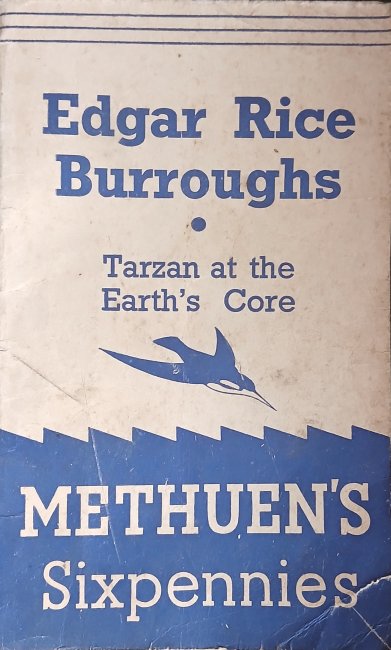
So why did I buy the book? Well it is all the fault of Jules Burt and an Instagram post of his where he talked about the difficult to find Methuen Sixpence’s, a very short lived attempt at being a competitor to Penguin Books, and that he had bought a complete run of the thirty seven titles from the Eric Gadd collection. This meant he had some spares which I then bought off him as I only had one example in my collection. Now I have enough to justify trying to complete the set myself even though I know they are rare due to poor quality wartime paper, they were published between 1939 and 1941, and not many of each title being printed in the first place. This explains the somewhat tatty condition of this example but frankly getting them in any condition is tricky.

The Stainless Steel Rat – Harry Harrison

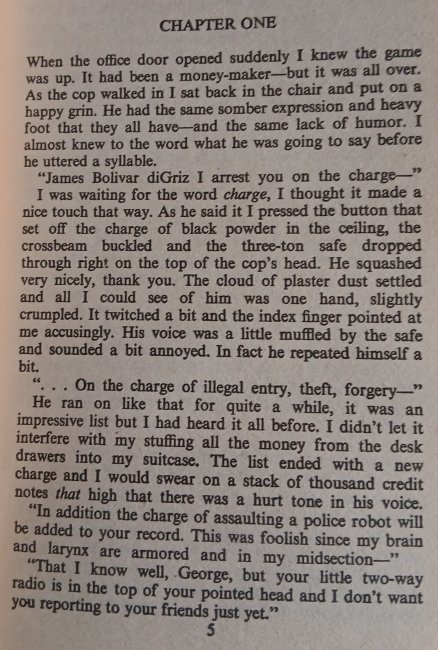
A few weeks back I featured a book written by Harry Harrison ghost writing as Leslie Charteris in the first ‘Saint’ book written by someone other than Charteris and that prompted me to look on the shelves for something where Harry Harrison was properly credited. That led me to a series of books I bought, and probably last read, back in the mid 1980’s and Harrison’s most famous creation The Stainless Steel Rat. There are a dozen books in the series and this was the first, it is based on a couple of short stories originally published in Astounding magazine in 1957 and 1960 which were linked and expanded to make the novel in 1961. The best way of introducing the character of Slippery Jim diGriz, alias The Stainless Steel Rat is to read the opening page of this book.

I like the way it is only revealed that the policeman is a robot after the safe is dropped on him, in fact The Stainless Steel Rat is proud of the fact that for all his criminal escapades he has never killed anyone. The stories are set in the distant future and on various planets far from our own, this is pure science fiction fantasy with a heavy dose of humour mixed in for good measure. As is stated in the page shown DiGriz is a career criminal, something of a rarity in this version of the future where children are scanned for any tendency to not be upright law abiding citizens and ‘corrected’ before adulthood. The crime he was committing at the beginning of the book was a simple one, rent a warehouse next to a government storage site, which is full of food but intended for emergencies so rarely visited, cut a hole in the wall and help himself to the goods, relabelling everything so it isn’t obvious it has come from the next door building. Using robots to do the work meant he could keep the money rolling in 24 hours a day without having to do any menial work himself.

Escaping from the police raid using a carefully planned route DiGriz soon starts another caper, this time the theft of an armoured car carrying the takings from a large department store, this is done in quite an ingenious way but this time someone was out thinking him every step of the way and he finds himself trapped. This is his first encounter with Special Corps, an interstellar police service headed by Harold Inskipp, who was a legendary criminal before DiGriz turned to crime and was assumed to be locked up somewhere as he hadn’t been heard of for years, instead he had been recruited to run Special Corps and now he wants DiGriz to add his special talents to the organisation.

I won’t go into too many details of the plot, it’s quite a short book, just over 150 pages, and can be read quite quickly, suffice to say that in the course of the novel DiGriz meets his future wife and mother of his twin sons although this won’t happen until the next book ‘The Stainless Steel Rat’s Revenge’, I have half of the Stainless Steel Rat books along with several other books by Harrison including one of his few books not to funny, Make Room! Make Room! which would be loosely adapted into the superb dystopian 1973 film Soylent Green, a very early warning on the dangers of the greenhouse effect and overpopulation. I have to admit that I prefer Harrison as a comedic writer with a strong streak of anti-authoritarianism thrown in.

The Time Machine – H G Wells

First published in 1895 The Time Machine largely created a whole new genre of fiction, for this was the first use of the phrase ‘time machine’ applied to a device to enable time travel and the first time such a machine was described. I bought my edition new in 1975 and because the title story is basically a novella, being just under one hundred pages long, the book also includes another of Wells’ short stories ‘The Man Who Could Work Miracles’, more of which later on in this review.

Throughout the book the main protagonist and inventor of the machine, is simply referred to as ‘The Time Traveller’, no other name is given and indeed only one of the characters we meet at the start and end of the story, which is set in what was then the present day, i.e. late Victorian London, is named, if we get anything for the others it is simply their professions. The story starts with ‘The Time Traveller’ hosting his weekly dinner club of friends and producing an intricate model of what he claims, to pretty well universal disbelief, is a time machine, placing it on a table he adjusts a lever and it vanishes. He then leads the incredulous small party into his laboratory and shows them the almost complete full size version. He explains that he will complete it in the next few days and will tell them all about his adventures at the following weekly gathering. He arrives late for this meal and is clearly dirty, injured and limping so he apologises, goes to wash and change and then after ravenously eating his fill heads off to the smoking room to tell his tale.

The story he tells of a journey into the far future to the year 802701 where he meets a race of small people called the Eloi who appear to have an idyllic lifestyle, eating the abundant fruit growing all around them, living in huge partially ruined buildings and having no need to work or otherwise stress themselves. It soon becomes clear however that they are terribly afraid of the dark. The Time Traveller however has a very specific and different fear, which is that in the morning when he goes back to his machine he finds that it has disappeared and he is therefore trapped in the future. The descriptions of how The Time Traveller gradually works out what the true and terrifying situation that the Eloi are in and the dangers posed by the subterranean Morlocks who had taken his machine is wonderfully done. You can see him slowly working out the real relationship, after several false starts, between the two races that have descended from man as he knew it and the disgust he feels at his conclusions until eventually he manages to retrieve his machine and escape.

The various radio, TV and film dramatisations of the book have varied wildly in their use of the original material so I recommend reading the story as Wells intended. It’s an extremely good tale and as I wrote at the start of this review it gave birth to a whole genre of travellers in time using a machine of some sort to do so.

The illustration on the cover is by Alan Lee now best known for his work as conceptual designer, with John Howe, on the Lord of the Rings and Hobbit films but is a book illustrator par excellence see the Folio Society limited edition of The Wanderer I reviewed back in early 2020. As I would expect from an artist with his attention to detail the machine and indeed the attacking Morlocks are exactly as described in the book.

The Man Who Could Work Miracles

Also set in late Victorian England, this story was first published in 1898, we have if anything a more amazing tale than ‘The Time Machine’ as we follow the misadventures of a man who unexpectedly finds he has developed miraculous powers. Mr Fotheringay starts the tale in a bar where an argument was unfolding regarding the impossibility of miracles to demonstrate his point he gets agreement that the oil lamp in front of them would not be able to continue functioning normally if it was upside down and then says “Turn upsy-down without breaking, and go on burning steady”. To everyone’s amazement, including his own, the lamp does exactly that, but he finds that he has to expend considerable mental effort to hold it like that so it soon crashes to the ground. This was his first miracle but would definitely not be his last.

Fotheringay experiments with his power when he returns home and in the morning continues outside with ever wilder attempts which he sometimes gets wrong by not wording exactly what he wants to happen precisely. Until when surprised by a policeman whom he had accidentally hit with his stick he sends him to Hades and then repents and decides to move him to San Francisco presumably because it is far away and marginally better than Hell. Ultimately, again whilst not considering his words fully, he causes massive death and destruction and realising his mistake for his last miracle returns everyone and everything back to the bar just before he upturned the lamp and also removes his ability to perform miracles. It’s a really fun story and again Wells is experimental in his style with a fantasy story set in his present day,

I always associate Wells with late Victorian times, possibly because of books like The Time Machine and War of the Worlds both of which were written in the 1890’s but he wrote throughout most of the first half of the twentieth century, dying in 1946 at the age of 79. Until writing earned him enough money to give up he mainly worked as a teacher, indeed he was A A Milne’s first science teacher. The Time Machine was his first novel but he had been writing short stories and journalistic articles for several years before that honing his skills that would make him a world famous author.

The Wind From the Sun – Arthur C. Clarke

This book contains all eighteen short stories Arthur C. Clarke wrote in the 1960’s, including one set in his beloved Sri Lanka where he had moved to from England in 1956 and resided there until his death at the grand old age of ninety in 2008. Although all the stories were written in the 1960’s the last two didn’t actually get published until the early 1970’s including probably the strongest of the works in the book ‘A Meeting With Medusa’. The title story ‘The Wind From the Sun’ is also one of my favourites from this, the sixth collection of short stories by Clarke, it’s original title was ‘Sunjammer’ and it is still occasionally published under that name but Clarke explains in the preface that he changed its title as fellow SciFi author Poul Anderson used the same title, and indeed the same concept of sailing the solar wind, almost simultaneously in early 1963. To add to the confusion, and this time not mentioned by Clarke, another SciFi writer, Jack Vance, also had the same idea and published a similar story ‘Gateway to Strangeness’ also known as ‘Sail 25’ although that came out in late 1962. All three men had come up with the same idea independently and had no idea of each others work and the time taken to get things into print more than allows for the disparate publishing dates.

Perhaps inspired by the co-incidences around ‘Sunjammer’ there is another short essay included in this book entitled ‘Herbert George Morley Roberts Wells Esq.’ which describes Clarke’s absolute conviction that a story called ‘The Anticipator’ was written by H.G. Wells and he had written as such in his single page short story ‘The Longest Science-Fiction Story Ever Told’ which precedes the Roberts/Wells essay in the collection. In fact ‘The Anticipator’ was written by Well’s contemporary Morley Roberts and in the essay he explains that the story is about a high quality writer who keeps having the plots of his stories hijacked by a hack writer and published just before his version comes out so that the general public assume that he is constantly plagiarising the less good author so it is somewhat appropriate that Clarke didn’t get the true authors name right. It happened again to Clarke in 1979 when his book ‘The Fountains of Paradise’ was published at the same time as Charles Sheffield’s ‘The Web Between The Worlds’ both of which are about the construction of a giant tower all the way up to geostationary orbit which would operate as a space elevator therefore removing the need for rockets to reach space. Both novels have a similar construction method using a robot called Spider, both towers are built by a engineer who had previously constructed the longest bridge in the world and there are several other identical, or near identical features including the engineers name beginning with M. Again neither author knew about the others work it was simply an idea whose time had come.

All but two of the stories in this collection take place within the Solar System, the exceptions being ‘Crusade’ and ‘Neutron Tide’ and most occur on the Earth or Moon. This is another feature of Clarke’s science fiction writing, not for him universe wide adventures or galaxies at war which a lot of his contemporaries wrote about. Clarke, for the most part, is a more grounded writer. That doesn’t mean they are less fantastical just less space opera and more extensions of the readers understanding. ‘Maelstrom II’ for example has a man on his way home from the Moon when the, normally freight carrying, railgun that he is using as a cheaper way to get back malfunctions so he doesn’t have enough speed to achieve escape velocity. Yes it’s science fiction but everything in the story is valid science.

Arthur C. Clarke had a first class degree in mathematics and physics from King’s College London and used his scientific training in his writing, always making sure, as much as possible, that any concepts he came up with had a valid scientific basis. This makes him one of the strongest writers of science fiction as opposed to fantasy, when Clarke describes the fall into the atmosphere of Jupiter in ‘A Meeting With Medusa’ or the astronomical observations in ‘Transit of Earth’, which has an astronaut on Mars watching Earth cross The Sun you can be sure that the figures used are as accurate as 1960’s science allowed. Clarke didn’t come up with the idea of geostationary orbit but he did write the first scientific paper describing how satellites placed there would be perfect for telecommunications.

It’s a fun set of short stories and I was surprised how well I remembered several of them from when I first read the book in the mid to late 1970’s.

Elisabeth Sladen the Autobiography

2005, My first day on the new job.

I took my place in front of my little paper sign and glanced around the table. And there, just across from me and down to my left, a face from my childhood leapt out from among the throng.
Sarah Jane Smith was quietly leafing through a script and composing herself for the afternoon ahead

If Sarah was here, there was nothing to worry about. Later that afternoon she would be calling me Doctor. The little eight-year-old in my head (who was frankly reeling at the fact I was in that room at all) was soothed, and of course thrilled, that the Doctor’s one true assistant was there to look out for him.

Extracts from the Foreword of this book by David Tennant

The final book in my August selection of Sci-fi autobiographies had to Elisabeth Sladen, best known for her role as Sarah Jane Smith in Doctor Who in the mid 1970’s, but who re-appeared in David Tennant’s fourth broadcast episode (but the third filmed) as the Doctor in 2005 and later went on to have her own programme ‘The Sarah Jane Adventures’ which ran for five series up until 2011. David Tennant was clearly a fan, and so was I, although not to the extent of having posters of her on his childhood bedroom walls as he did. This book was a joy to read and despite its 334 pages plus the foreword and acknowledgements from her daughter Sadie it positively flew past it is so well written. The final draft of the book was delivered for her to read through just before Christmas 2010 but family was always more important than work for Elisabeth so it was put in a drawer and she was always so tired recently. The scripts were coming through for series five of the Sarah Jane Adventures and she need to prioritise those before her own project but in February 2011 she was diagnosed with cancer and just two months later she died aged only sixty five. In a heart breaking final chapter her husband, Brian Miller, and her daughter describe picking the book up some months after her death and reading it, then deciding that it had to be published, I’m so glad they did.

The book is far more than her involvement with Doctor Who, Elisabeth was an established theatre actress for twenty years before getting the role that truly made her name and that part of her career is given proper coverage as she learnt her craft, met and married Brian and toured all over the country with occasional TV, radio and film parts. We also get her time post Doctor Who back in theatres and various TV roles as well as the times she spent in America on the convention circuit with her first Doctor, Jon Pertwee, where she was always a popular speaker. Unlike Tom Baker’s autobiography which I reviewed first in this brief series Sladen does focus on her time in Doctor Who. She was cast for the role by Barry Letts and also worked on the first two series of Tom Baker’s Doctor and frankly we learn more about the start of his time in the role from this book than in his own autobiography. The story continues up until she decides to retire from acting in the early 2000’s as the roles simply weren’t coming through, then in 2005 she gets a call from Russel T Davies who had restarted Doctor Who after more than fifteen years off the TV screens and suddenly she ended up busier than ever.

It’s a fascinating book and her memory for details going back decades adds a lot to the enjoyment of reading it but is sadly out of print. I bought my copy when it first came out and read it then and it was fun to get it back off the shelf eleven years later. Frankly I’ve been building up to this book all month, deliberately including Tom’s and Barry’s books and finishing with Elisabeth’s. I was eleven when her first Doctor Who story, ‘The Time Warrior’, was broadcast and she was in a total of eighty episodes in that first time in the role so for me she will always be, as David Tennant put it in his foreword ‘the Doctor’s one true assistant’ and so sadly taken from us when her career was blossoming all over again.

Who & Me – Barry Letts

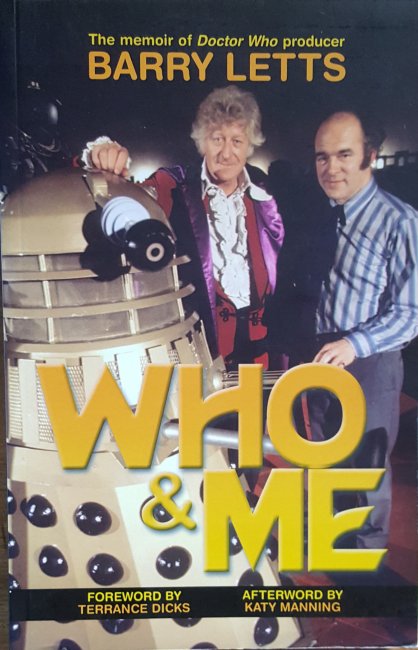
Barry Letts was an actor, writer, director and producer for decades, mainly for the BBC, and is most famous as the series producer of Doctor Who from Jon Pertwee’s second story in 1969 to Tom Baker’s first in 1974 returning as executive producer at the end of Baker’s long run in the part in 1980. He also directed several stories for Doctor Who starting with the Patrick Troughton story ‘The Enemy of the World’ and wrote others although this was done using pseudonyms as the BBC at the time did not approve of the series producer also writing episodes. The front cover shows Barry, in the striped shirt, and Jon Pertwee, in full costume as his dandy Doctor Who leaning on a dalek. Terrence Dicks, who wrote the foreword, was script editor on Doctor Who between 1968 and 1974 and these two men formed a strong partnership which drove the programme back out of the doldrums of the end of the Troughton era and up the viewing ratings. Katy Manning played Jo Grant, one of the Doctor’s companions during this period.

The book doesn’t only cover Doctor Who but delves back into Barry Letts’ decades long acting career and how he progressed into a writer, then director before finally being persuaded to be a producer, which he would only do if he was still allowed to direct the occasional story line. It is worth noting for anyone who only knows the modern re-invention of Doctor Who that back in the 1960’s there would be over forty episodes a year, every year, and stories would normally be told over four, five, six or even seven episodes rather than the at most two episode individual stories in modern Who. The workload was tremendous and Letts was responsible for improving the process by reducing the number of episodes to twenty five a year along with recording episodes in pairs so reducing the need for constantly building and taking down sets so allowing more time for recording along with other changes to scheduling.

Letts is brutally honest about his successes and failures over the years and readily admits things he got wrong such as his first directing job on ‘The Enemy of the World’ which lacked pace in numerous parts especially in the one surviving episode which definitely drags out the material. I watched this again after reading the book and can see why he really wasn’t happy about the end result. In complete contrast he was also responsible for possibly my favourite story of ‘classic Doctor Who’ which was ‘The Daemons’ which came to its climax around my ninth birthday and with it’s story about black magic and the raising of a demon absolutely enthralled and terrified me as a young child. It also has probably the best line for The Brigadier in all his appearances instructing one of his soldiers “Chap with the wings there, five rounds rapid!“. Along the way he explains a lot of what both the director and producer actually did on TV programmes of the time and this was really interesting as it a side of the making of TV that isn’t covered very often. He also covers the work of Terrence Dicks in just how a script comes to be agreed and written from the initial ideas to outlines, then initial script, leading to fine tuning with cuts and additions to make each episode not only the right length but also to maintain the flow of the story.

So here we are at the end of our second season which is where I always intended to end this first volume.

Start of chapter 22 of Who & Me

The final chapter of the book starts with the words above, but sadly Letts didn’t even live to see this volume get released as he died in October 2009 aged 84, shortly before publication, leading to a final short postscript by his family thanking people for their good wishes after his death was announced. The book was an interesting read and he dropped so many hints of things that he wanted to cover in a later volume eventually leading up to Tom Baker’s first story as Doctor Who which would have tied back nicely to the first book in my August Sci-fi autobiography readings. It is such a pity that the cancer he had been suffering from for years got him before he could even start on the second book as I’m sure we would have learnt a lot more about the jobs of producer and director.