The Nun – Denis Diderot

The story behind this book is as fascinating as the novel itself and it would probably be good to start there, because it all grew out of an elaborate practical joke which was based on a real incident. In 1758 a young nun, Marguerite Delamarre, tried to get herself extricated from the vows she had taken in a Paris convent and returned to the outside world. However it was almost impossible for this to happen at the time and she duly failed but not before it had become the talk of the city. She ended up living her entire life, presumably unhappily, in the convent. Her story suggested itself to Diderot and a group of his friends as a means of persuading another of their company who had retired to the countryside to come back to Paris. They duly started a correspondence with him in 1759 pretending to be Suzanne Simonin, a nun who had escaped the cloister but needed assistance to avoid being forcibly taken back. They also included fake letters from Madame Madin, who was known to both parties and was supposedly sheltering the girl. Unfortunately for the friends of M. de Croismare he fell for the story rather too well and offered Suzanne a place in his household, even going so far as to try to arrange transport for her. They were forced to claim she was ill and then when he became more insistent that he wanted to help her they made the illness more severe and killed her off.

In a postscript, eight years later M. de Croismare did come to Paris and met Madame Madin and was surprised to find that she knew nothing of the whole episode. The story should have ended as a practical joke but Diderot had by now been so fascinated by their tale of woe that he decided to write Suzanne’s autobiography from childhood to how she ended up in the convent and then to her escape and he worked on it through most of 1760 although with no intent to publish, however once he found out that the joke was exposed he did finally publish in 1770.

To provide a reason for Suzanne to be shut up in a convent from the age of sixteen she had two slightly older sisters but it was becoming clear that potential suitors for them were getting more interested in Suzanne so she was put out of the way. This decision by her father was driven more by his (correct) suspicion that he was not actually her biological father and he wanted to prevent her having any call on the families money. He therefore determined that she should be got rid of in the most convenient way and as the story of Marguerite Delamarre proved it was almost impossible in 18th century France for a girl to leave a convent once she had been made to take her vows. However at the first convent she was sent to Suzanne refused to take her vows and created a scene in the church for which she was punished and later taken to a second convent.

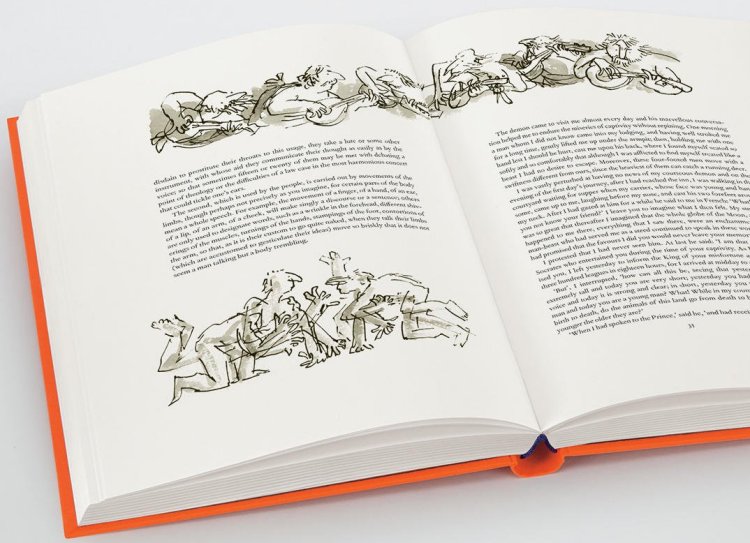
At this second convent she was persuaded to take her vows despite protesting she had no vocation to become a nun and so started a horrific experience of neglect, beatings, sleep deprivation, etc. as the Mother Superior had a sadistic side and was determined to beat and torture a vocation into the young girl. Several of the illustrations in the book are based around these episodes and it is the one failing of this edition that the artist appears to be mainly interested in the voyeuristic depictions of a naked and half naked Suzanne than a more balanced view of the plot and the other sufferings she endures at the hands of this Mother Superior and her coterie of similarly sadistic senior nuns.

Eventually she is assisted to go to a third convent and here although the beatings and humiliation are not present she becomes the object of affection of the lesbian Mother Superior much to the confusion of the innocent Suzanne. Diderot appears keen to heap all the exploitative possibilities of a cloistered group of women some of whom are driven half mad by the regime and being locked away from the outside world from such a young age. It is not an easy book to read as it is written entirely from Suzanne’s viewpoint, but I’m glad this session of French works has persuaded me to get it off the shelves.

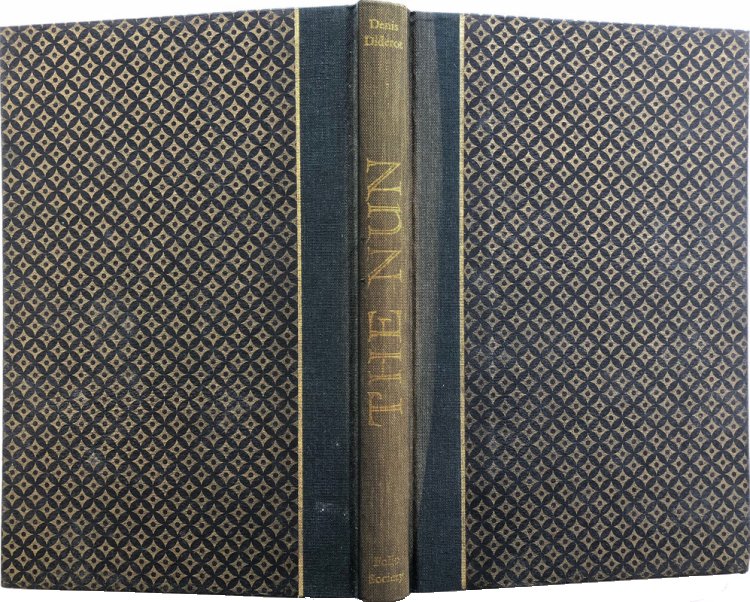
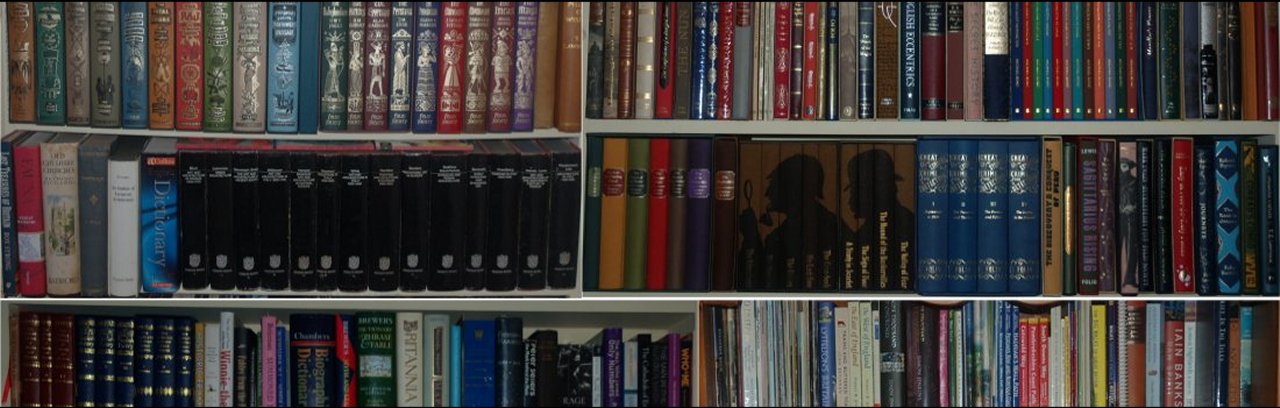
My copy is the Folio Society edition from 1972 and is notorious for its fading cloth spine, all copies I have ever seen are this badly faded, the rest of the book being protected by a slipcase. It is illustrated by Charles Mozley and translated by Leonard Tancock and is the fourth in my selection of books translated from French for August 2021.

Clochemerle – Gabriel Chevallier

Just possibly the most fun book I have read this year, it is delightfully written with the author taking the role of narrator and introducing us to the small Beaujolais town of Clochmerle and it’s comical inhabitants in the way of a consummate storyteller. Every character and place is beautifully described, and at length, so that you can fully realise in your minds eye each and every one of them. It is the third in my August book theme of ‘translated from French’ and it has been an absolute joy to read even though it clocks in at 320 pages.

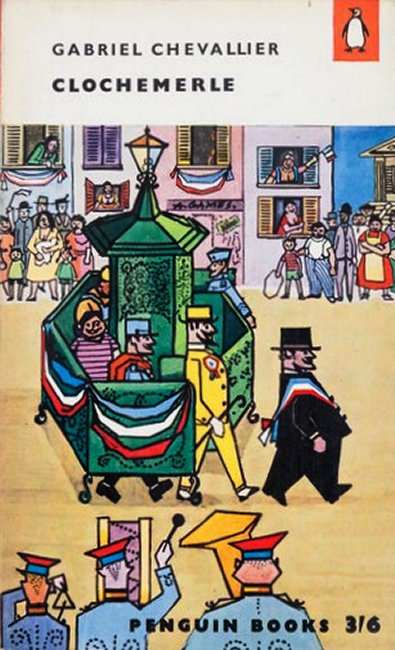
It all starts with the decision of the local mayor to bring progress to his sleepy town by building a public urinal and due to the odd geography of the place the best location is half way up the main street which places it firmly outside the church. Although not as indicated on the cover of this Penguin edition as it is placed not in the centre of a square but up against a wall adjacent to the Beaujolais Stores on an alley leading up to the church itself. To get a feel for the wonderful descriptions in the book let’s look at page one and the two men walking down the road from the square to where the urinal is to be situated.

One of these men, past fifty years of age, tall, far-haired, of sanguine complexion, could have been taken as a typical descendent of the Burgundians who formally inhabited the department of the Rhone. His face, the skin of which was dented by exposure to sun and wind, owed its expression almost entirely to his small, light grey eyes, which were surrounded by tiny wrinkles, and which he was perpetually blinking; this gave him an air of roguishness, harsh at times and at others friendly. His mouth which might have given indications of character that could not be read in his eyes, was entirely hidden by his drooping moustache, beneath which was thrust the stem of a short black pipe, smelling of a mixture of tobacco and of dried grape-skins, which he chewed at rather than smoked. Thin and gaunt, with long, straight legs, and a slight paunch which was more the outcome of lack of exercise than a genuine stoutness, the man gave the impression of a powerful physique. Although carelessly dressed from his comfortable, well-polished shoes, the good quality of the cloth of his coat, and the collar which he wore with natural ease on a week-day, you guessed that he was respected and well-to-do. His voice, and his sparing use of gesture were those of a man accustomed to rule.

And there we have a perfect pen-portrait of Barthélemy Piéchut, mayor of the town, a man of ambition to go far in the party and for which mayorality of a small provincial town was to be just a stepping stone. His fellow walker is Ernest Tafardel the schoolmaster and a far more devout republican than his friend although not destined to rise any higher than his current role. Against these two redoubtable men of the Third Republic there is the powerful Catholic Church although represented in Clochemerle by the Curé Ponosse a man who joined the priesthood for a quiet life and is definitely not the man for the crisis to come. However there is also the old maid, Mademoiselle Putet, full of religious fervour with nothing else to drive her forward now it had become quite clear she was destined to remain a Mademoiselle and untouched by the male sex rather than a married Madame. She it is that stirs up the trouble between the church and the state, initially over the urinal which as she lives by the church at the end of the alley where it is placed she sees as a personal affront to her dignity, but later as she interferes in the various goings on of the population.

The stage is set for a farcical ‘war’ between to two sides which is reflected in another conflict also in the location of the urinal between the two most attractive women in the town who run the Beaujolais Stores in the case of Judith and the bar of Torbayon in the case of Adéle which are directly opposite one another. Judith is well known for being free with her charms so to speak and Adéle flaunts hers rather than directly engaging in extra-marital affairs unlike Judith but this all changes when Judith’s particular favourite, who is staying at the Torbayon Inn, is taken ill and nursed by Adéle who takes advantage of his bed ridden state to discover exactly what she is missing in her own marriage. All this takes place in the long, hot summer of 1923 when tempers are getting frayed due to the heat and the annual fete is the cause of excessive drinking on all sides. The cast of minor characters is beautifully drawn and all have part to play in the ultimate fiasco and its resultant tragedy from the washerwomen of the lower town to the baroness in her chateau above the town, through the government officials more interested in cars and their private dealings and the military who can’t be bothered to intervene.

The book ends with an overview ten years after the calamities of 1923 by bringing us up to date with the happenings to most of the protagonists since then and all is well with most of them and the town now boasts three urinals, a great step forward indeed. There are apparently two sequels 1951’s Clochemerle Babylone and from 1963 Clochemerle-les-Bains both of which at least were available in Penguin so I can definitely see me hunting these out for future reading even if they are out of print which they appear to be.

Candide – Voltaire

What on Earth have I just read? I don’t really know what I was expecting from the fourth book issued in the Penguin Classics series, maybe a serious French novel, but it certainly wasn’t this surreal fantasy adventure. Penguin Classics started in 1946 with Homer’s Odyssey and then followed that with a collection of short stories by Guy de Maupassant and then the Theban plays by Sophocles, all solid classics as expected and then came this truly bizarre narrative at the end of 1947. This is the second of the blogs making up my August theme for 2021 which is ‘translated from French’, as I have already featured Boule de Suif and Other Stories by Maupassant I selected this book as the second French book in the Penguin Classics without knowing anything at all about it before I started reading this week.

The only book I can think of that has such fantastical episodes is Jonathan Swift’s Gulliver’s Travels and like that other classic this is a satirical parody, however unlike Swift’s book which is set in various fantasy lands Voltaire has set his amongst contemporary events and real people. The problem with both books is that they are over two hundred and fifty years old so the politics and philosophies they are parodying are long gone and the messages that would have been clear to readers at the time are obscure at best or completely lost to the modern reader. This if anything makes them even stranger. Still on with the review of the book in hand, which was first published in 1759.

As is my usual practice with books which have an introduction I didn’t read it first but after I had completed the novel. As usual I’m glad I did as the introduction not only gives away large parts of the plot whilst trying to explain the references it also totally reveals the ending. However the introduction is essential after reading the book because it answers so many questions the modern reader has, such as why does Professor Pangloss teach that this is “the best of all possible worlds” and anything that happens must ultimately be for the best despite the continuous disasters that surround him and his pupil Candide; including in Pangloss’s case being hung as part of a Portuguese auto-de-fe following the 1755 Lisbon earthquake which killed tens of thousands of people. It turns out that Voltaire was mercilessly sending up the Theodicy by Gottfried Leibniz which takes as it central premise that exact philosophy.

The book starts with Candide and Pangloss at the Baron Thunder-ten-tronckh’s country seat in Westphalia along with the Baron’s family, especially his seventeen year old daughter Cunégonde who Candide is madly in love with, all is well with the world. Cunégonde sees Pangloss making love with one of the maids and decides to entice Candide but this is seen by the Baron who kicks Candide out of the house before he can make a move. Candide is then captured by the Prussian army, press-ganged into service, flogged almost to death, made to fight in a war with the French and nearly executed before escaping to Holland, Here he meets Jacques the Anabaptist and then runs into Pangloss who is now a beggar with syphilis which he caught from the maid and who informs Candide that soon after he left the castle was over-run by the Prussians, Cunégonde was raped before her and all other inhabitants of the place were killed. Pangloss is cured of syphilis by Jacques, losing an eye and an ear during the treatment. We are now on page ELEVEN. The frenetic pace continues through the rest of the book along with the rapidly rising death toll and never ending coincidences and disasters surrounding the characters. Throughout it all Candide and Pangloss maintain the Leibnizian philosophy of this is the best of all worlds.

The other protagonists in the book are increasingly strange especially the ‘old woman’ whose tale is the most bizarre of all and acts as a balance to Candide as she certainly doesn’t believe that this is the best of all worlds after the life she has had. Starting as the illegitimate daughter of Pope Urban X and ending as a servant in Lisbon by the time she meets Candide, on the way seeing her mother drawn and quartered, becoming a slave and having a buttock cut off to feed starving Janissaries during a siege amongst other experiences. The surreal happenings to all the characters continue throughout the book which travels to South America and back to Europe via El Dorado dropping in at England just long enough to witness the execution of Admiral Byng for failing to prevent the fall of Minorca to the French and deciding that England was just too crazy a place to stay, which bearing in mind the things that had already befallen them by then was a pretty damning indictment.

I think I need to read Candide again in a few months just to fully resolve in my mind all that happens but if you like books at a mad pace then Candide is for you. I also have a copy as part of the Penguin Drop Caps series, translated by Theo Cuffe.

The Dutch Riveter : Edition 9 – Edited by West Camel

I picked this up from my local bookshop the other week and have been thoroughly entertained by this selection from modern Dutch writing and amazingly it’s free. This is volume 9 and was launched on the 17th March 2021 via an online event from the British Library. I’d never heard of The Riveter until Megan, the bookshop owner, suggested I might like to read it as she had had some copies dropped off at the shop a few days ago.

The Riveter is a free magazine devoted to riveting European literature in English. The idea is to make international writing popular and accessible to readers everywhere and to celebrate excellent translation and great books from the rest of Europe.

The Riveter was launched in 2017 by the European Literature Network. Professionally edited and published by a small dedicated team, it attracts support from a wide range of publishers, authors, translators, critics, academics – and readers. It has achieved acclaim with its special issues on Polish, Russian, Nordic, Baltic, Swiss, Queer, German, Romanian and Dutch literature in English.

From the website of the publisher https://www.eurolitnetwork.com/the-riveter/

It is mainly available online, follow the link in the citation above, but apparently print copies of the Dutch and Romanian versions are readily available in the UK and as I have greatly enjoyed this very professionally produced little volume, 120 pages, I will definitely be looking out for more as I prefer to read an actual book rather than on a screen. I’ll just pick out a few highlights for me:

Someone Who Means It, by Maartje Wortel. Translated by Sarah Welling and Margie Franzen. This short story, which was first printed in 2015, is appearing for the first time in English translation. It’s eleven pages long so represents almost ten percent of the total book but it’s worth the dominance of space it takes up. It’s a story of love and loss, jealousy and passion beautifully told and definitely makes me want to read more by Maartje.

Herman Kock gets one of the subsections, with an extract from his latest book Finse Dagen (Finnish Days) and a review of the most recent one to be fully translated into English, The Ditch. I quite enjoyed the three page extract from Finnish Days and was pretty convinced I wanted to get a copy of The Ditch whilst reading Max Easterman’s largely positive two page review right up until the excoriating final paragraph

Sadly, as the story progresses, Herman Koch doesn’t manage to meld these various strands into a convincing whole: they just don’t hang together. The analytical insight he brings to Robert Walter’s jealousy is dissipated in the final third of the book. The old prejudices about Sylvia’s unnamed country are laid bare, but in the end, the resolution of the story, in which the significance of the ‘ditch’ becomes clear, doesn’t work for me: it is a dying fall, a whimper, which left me wondering: why?

Well that’s one book that needn’t make it to my to be read pile then.

On the other hand Dutch poetry has a huge amount going for it and is well represented here with a two page introduction, twelve pages of poems and a two page review of a poetry collection. Poetry has to be the hardest style of literature to translate for not only does the translator have to manage the words but the flow of the words has to be right. The choice of poems is well done with a good mix of serious and lighthearted works with for me two stand outs from each of those categories. The excellent ‘My Skin’ by Dean Bowen is crying out to be read aloud, this is performance poetry written down and you can’t help reading it out loud to appreciate the rhythm of the words. on the other hand ‘Pitying the Reader’ by Menno Wigman will make any dedicated reader chuckle as we have all been there. I’ll just include the start of the poem here so you can see what I mean.

A book? From cover to cover? I lack the strength.
Even poetry – just thinking about it –
exhausts me now. I’ve overdosed on poems,
stare blindly at the pages of my books.
For many months I’ve had a reader’s block,

I’ve grown allergic to the alphabet.

The articles by translators on their job and the problems and joys of translating were fascinating, there is so much crammed into this slim volume but now I need more, I will have to see if can get other volumes in the series.

The one criticism I have of this otherwise excellent publication is the choice of a grey font on a grey background for the majority of the pages, this is clearly done for aesthetic reasons rather than for the practical as it makes reading more than a few pages at a time very tiring.

The Flemish section which has a salmon pink background is not much better either.

I’m astigmatic so have enough problems distinguishing between letters without the heavily reduced contrast that this choice by an unthinking design team has come up with. It’s not enough to put me off reading but it is a problem and they really should drop the background shades to improve readability.

Chekhov: A Life in Letters – edited by Gordon McVay

Rather than produce a standard biography, Gordon McVay has translated and edited a selection of letters from Anton Chekhov which give a wide view of his interests and career development from starting medical school in Moscow in 1879 through to his final letter in June 1904 written the day of his heart attack which would ultimately prove fatal four days later. There are extensive notes that put the letters into context and this has proved to be an excellent use of the material as Chekhov is a lively letter writer and travelled extensively so his correspondence is full of detailed descriptions of his experiences both good and bad. My copy is the Folio Society 1994 edition bound in black buckram and embossed with Chekhov’s signature across both covers. The book is currently available as a Penguin Classics edition. To give a feel for the letters I’ll selected a few extracts and will add them between paragraphs in this blog.

23 December 1888

That this represents just a tiny fraction of Chekhov’s letters is proven by the regular mention in the notes of a thirty volume Soviet edition and even that is not complete because it can only include those letters that were kept by the recipients. The Soviet edition is also censored to remove things they didn’t feel appropriate, such as his dalliance with a Japanese woman on his trip to Sakhalin, and anything judged not politically sound. The edition I have has 365 pages dedicated to the letters along with a useful 22 page introduction and an excellent index which made going back to find things I wanted to refer to very easy. That the Soviet edition is censored is actually quite appropriate as Chekhov complains many times about what the censors in his own time had done to his stories and plays, some of which he regarded as particularly badly damaged so that the sense of the play is lost.

In Siberia on his way to the island of Sakhalin 1890

In 1890 Chekhov travelled to the penal colony of Sakhalin to survey the conditions and interview prisoners for what he explains in various letters is a payback to medicine. It eventually took him three years to write up his findings to appear in ten parts in one of the serious journals and then more work to produce a somewhat longer book. Presumably he wrote letters from his months on Sakhalin but none of them are included in this collection however there are quite a few describing his massive journey by horse drawn carriages and river boats right across Russia as Sakhalin is as far east as it is possible to go and he started in Moscow. The extract above highlights that even then Siberia was a place of exile for people that had offended the state in someway but his observation that now they can say what they like as where else would they be sent is to the point. On Sakhalin he was only allowed to interview a small number of the political prisoners but he still produced a comprehensive report and oddly his health, which was never very good appeared to improve during his time away from Moscow and St Petersburg. Although he was a doctor he seemed to have a blind spot regarding his own tuberculosis which he suffered from for decades, describing many occasions of ‘blood spitting’ although he was never formally diagnosed until 1897.

4 July 1888

The letters are also often quite humorous which lightens the tone overall against some of the more serious pieces or times when things are just plain going wrong like his descriptions of the disastrous first performance of The Seagull in 1896 or when his health issues cause significant problems which was quite often. One of the more interesting features is the continuation of his career as a doctor even as his fame as a playwright and story writer grew dramatically. As can be seen below this devotion to medicine had serious implications in his ability to write of travel to oversee productions of plays and talk to his various publishers. By the early 1890’s he had purchased an estate in Melikhovo and become the local doctor in preference to renting a home in Moscow which he had done since arriving there to study as a doctor.

16 July 1892

By the mid 1890’s however he had started travelling extensively in Europe and correspondence from various Italian, French and German cities amongst other countries he passed through bring a different outlook to the letters, some places he loved others he was glad to see the back of. There is also a lot of letters to women throughout the book some of which he probably came close to marrying but in fact he was a confirmed bachelor until just three years before he died when he finally married an actress he had come to know from her performances in his plays. Oddly his letters to women, even the ones he was particularly close to, are rarely romantic and quite often have some slight barb to them. The ones to his future wife, Olga, are mainly about her performances rather than anything else even though they actually lived almost 1000 miles apart most of their married lives as she was in Moscow and he was in Yalta to get a better climate for his tuberculosis. Chekhov was much happier on his own, hence his long time avoidance of marriage and indeed living apart suited him well.

13 June 1890

The letters are great fun to read and show much more of Chekhov’s character than would be found in a biography. I don’t think I could cope with the full thirty volumes, even assuming they were available in English, but this selection made an excellent way to pass a few evenings this week.

A Guide to Happiness – Epicurus

EPICURE

Noun
A person who takes particular pleasure in fine food and drink.
‘they see themselves as epicures—delighting in food that is properly prepared’

Origin
Late Middle English (denoting a disciple of Epicurus): via medieval Latin from Greek Epikouros ‘Epicurus’.

Oxford English Dictionary

The definition above was the only thing I knew about Epicurus before I picked up this book which is an extract (minus the notes) from ‘The Epicurean Philosophers’ edited by John Gaskin and published by Everyman in 1995. Epicurus lived in Athens between 341 and 270 BC and unfortunately like Sappho, whom I featured last month, the vast majority of his works have been lost to history with just three complete letters along with some fragments and two collections of quotes making it to the present day out of the estimated three hundred works he is believed to written. He formed his own philosophical school, largely in opposition to the prevalent Platonic teachings of the day and unlike the majority of his contemporaries he allowed women to join, in fact he positively encouraged them.

The book starts with his most famous work ‘the letter to Menoeceus’ which is an excellent place to begin as this epistle summarises his teachings and is very much a guide from a master to a pupil. Much to my surprise though Epicurus himself would not be impressed by the definition that has been derived from his name with it’s implication of, if not a hedonistic lifestyle, at least one of the pursuit of luxuries. In the letter to Menoeceus he includes the following instruction:

Once the pain due to want is removed, plain flavours give us as much pleasure as an extravagant diet, while bread and water bring the greatest possible pleasure to the life of one in need of them. To become accustomed, therefore, to simple and inexpensive food gives us all we need for health, alerts a man to the necessary tasks of life and when at intervals we approach luxuries we are in a better condition to enjoy them.

This exhortation to a simple diet, indeed simplicity in all needs, is reiterated several times in the collections of quotes also included in the book. Yes a follower of Epicurus should take delight when they encounter something special but this should be a happy rarity not an object for living. He emphasises again and again that you should be happy with what you have or can achieve because desiring what you don’t have, and cannot possibly get, simply leads to unhappiness for no good reason. He does however say that you should strive to be free of pain by which he means not just physical pain but also the pain of want for food, drink and shelter. He is not in favour of the hermit or of deprivation of the body to find truth for the soul as some philosophies would have their followers do, indeed attendees to his school would eat simple meals whilst discussing the matters in hand.

The flesh cries out to be saved from hunger, thirst and cold. For if a man possess this safety and hopes to possess it, he might rival even Zeus in happiness.

Another vital aspect of Epicurean philosophy is the importance of friendship and the support of friends when needed. A follower should live wisely, justly and well if they wish to have a pleasant life, they should also seek out friends, not for what they can do for you now but from the benefit of mutual support at times of need and companionship at all other times.

It is not so much our friends’ help that helps us as the confidence of their help

All in all I found this book to be a fascinating read and indeed very different to what I was expecting from the definition that started this review. Epicurean philosophy seems like a very sound basis for living your life, lacking the want for excess and high on respect for your fellow man. It’s a pity he is now just associated with the enjoyment of fine wines and food. One final quotation emphasises this switch of emphasis from happiness with what you have to want for luxury that has happened over the millennia.

If you wish to make Pythocles rich, be not adding to his money but subtracting from his desires.

Come Close – Sappho

Sappho died over 2,500 years ago and in the intervening millennia almost all of her poetry has been lost. That she was highly regarded in her time can be seen from contemporaneous sources some of which regard her as the tenth muse ranking her amongst the gods themselves. But sadly she was neglected during the medieval period possibly due to the interpretation of the subject matter of much of her verse which didn’t fit into the strict moral compass of the catholic church and it was the church which performed much of the transcription from ancient texts to works that have lasted into our modern era. However excavations have uncovered fragments of her work even as recently as the last decade and we now have 650 lines of the estimated over 10000 she wrote. Apparently there were nine papyrus rolls of Sappho’s works held in the great library of Alexandria, the first one alone represented twice as much verse as we have available in the present day but those would have been lost in the fire and subsequent neglect whilst controlled by the Roman empire. That this book has roughly 450 lines makes it a positive bargain as it only cost 80p when first published in 2015 and now retails at £2 but still as it represents over two thirds of her extant output this is still money well spent. It is taken from the 2009 Penguin Classic book ‘Stung with Love: Poems and Fragments’ translated by Aaron Poochigian and simply collates the poems without any biographical information or analysis of the works which is the feature of the longer book.

Sappho wrote mainly lyric poetry, that is words designed to be accompanied by music, not songs as such but embellished by a tune, they tend to be in praise of heroic deeds of men and gods along with love songs praising a partner, or potential partner. It is her love poetry that is most famous and was most admired in antiquity but it is the belief that it specifically praises love of a woman for another woman that has given us the word sapphic for women attracted to women and also from her nationality as a resident of the Greek island Lesbos the word lesbian. Having said that this is not a collection of erotic verse, far from it, the lines are expected to be performed, these are expressions of love but nothing more explicit and make for a pleasant afternoon’s reading. It should be borne in mind as well that for the most part these are just fragments of poems, only two works are believed to be complete, so there may be much context that is lost. However I am in danger of writing a review that is longer than the entire book I have just read so let me finish with all we have left of one of the poems.

Stand and face me, dear; release
That fineness in your irises

May you bed down,
Head to breast, upon
The flesh
Of a plush
Companion

The Diving-Bell & the Butterfly – Jean-Dominique Bauby

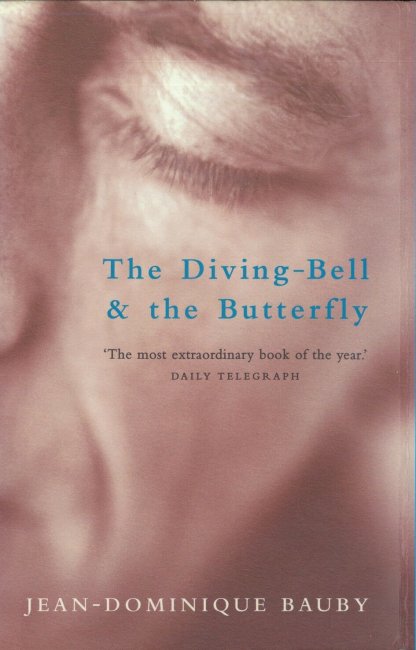
I first read this extraordinary book when it came out in 1997 and somehow it seems to be the perfect book to read again at the end of 2020 which has seen so much tragedy throughout the world. Jean-Dominique Bauby was editor in chief of Elle magazine in Paris when a brain stem trauma put him first in a coma and then as he comes round from that he is completely paralysed, able to move only his left eyelid, his mind however was still as active and alert as ever. Locked in Syndrome is fortunately rare but a book written from inside the prison of an body unable to move is even rarer, that the book is this good is probably unique. The diving-bell of the title refers to his immobile but still painful body whilst the butterfly represents his thoughts flying free, beyond the confines of his hospital room. The book was dictated by Bauby winking as letters were laboriously read out one at a time by his assistant, Claude Mendibil, and she then slowly composed the words and then checked that each one was correct. The chapters are short but each one took days, if not weeks, to dictate one letter at a time as Claude repeatably read out

E S A R I N T U L O M D P C F B V H C J Q Z Y X K W

The sequence of letters is not alphabetic as that would have taken too long, instead they are in order of frequency in French, by comparison in English the first twelve letters would be ETAOINSHRDLU.

The chapters vary in subject from hopeful, when he feels a little progress has been made or he is recounting a good day going along the seafront at Berck-sur-Mer, which is where the hospital is, in his wheelchair to sad when things are not going well or the small frustrations at his inability to communicate to all but a handful of people who can use his letter system, there are also two chapters recounting dreams he has had which are comic and moving at the same time. Because the chapters are short you can pick the book up whenever you have a spare few minutes and enjoy the next beautifully written passage and feel that you are catching up with his oh so slow progress. It should be a depressing read, but it isn’t, each small victory over his condition is celebrated and he is funny in the good times.

It is only in the penultimate chapter that Bauby addresses the events of Friday the 8th December 1995 when his life was completely turned upside down. As he says in the book he knew he needed to cover this but was avoiding it for as long as possible. The day starts so normally with time in the office before heading off to collect his son for a trip to the theatre and a meal before spending the weekend with him. He had separated from his wife a few months earlier and had not spent quality time with his son since then. Sadly soon after collecting Théophile in what was fortunately a chauffeur driven car he started to feel unwell and collapsed with the massive stroke that would put him in a coma for twenty days

Bauby died on the 9th March 1997 just two days after the first edition of this book was published in France and sixteen months after he first slipped into a coma but he left us a great book of tragedy and hope. In the final short chapter he was making slight progress with speech training and could grunt (his word) along to a simple tune and although this was a tiny step forward you feel his joy at this triumph over adversity but sadly he succumbed to pneumonia before getting much further.

Maigret Travels South – Georges Simenon

20200609 Maigret travels South

This book arrived in the post yesterday having taken almost fifty days to get here from the USA and it occurred to me that I have never actually read anything by Simenon. I wanted it as this is the first edition of the first Maigret book published by Penguin and came from the New York operation set up by Allen Lane and Ian Ballantine during WWII when transatlantic exports were not possible.  It was published in September 1945 whilst the UK parent company didn’t get to Maigret until January 1950 and this title would eventually appear in the UK in January 1952 printed along with nine others as part of the Simenon Million (10 books each in an edition of 100,000 published simultaneously).

Simenon’s novels are quite short so Penguin, along with other publishers, have normally put two together in one volume and this contains ‘Liberty Bar’ along with ‘The Madman of Bergerac’ and even then the book is only 250 pages. Both stories were translated by Geoffrey Sainsbury who translated several of the early Maigret novels printed by Penguin. As they are separate novels only linked by Maigret not being in his regular Paris haunts but much further south I will review them separately.

Liberty Bar

The seventeenth Maigret novel sees the great detective sent off on a murder investigation which apparently requires great tact, something he keeps repeating to himself whenever he gets frustrated by the progress of the case. It’s set in Cannes and Antibes and you can tell straight away that Maigret is not comfortable here. He makes no concession to the location wearing his black coat and bowler hat regardless of the heat and so dramatically stands out where presumably in Paris he would be much like anyone else in the capital. William Brown has been murdered is another mantra he keeps repeating, but his first problem is who was William Brown? Because without understanding that there is no way to work out what had actually happened and why.

My first surprise was nothing to do with the plot but how much alcohol is consumed right from Maigret’s arrival and introduction to the local detective whom immediately suggests going to a bar. Every time we see Boutigues he is either drinking or about to open a bottle and Maigret gets through plenty in his own right especially when he finds Liberty Bar. The characters we are introduced to are wonderfully drawn by Simenon, the four women in particular, the mistress, her mother, the alcoholic bar owner and the prostitute and the time when they finally meet at the funeral, which is engineered by Maigret whist he claims to not know anything about it, is poignant but also funny as they manoeuvre for precedence.

Right up until almost the end I had no idea who had done it and you are cleverly pointed into various dead end possible solutions. My first Maigret story was an absolute delight.

The Madman of Bergerac (Le Fou de Bergerac)

To my surprise the next novel included in this book was written earlier, being number fifteen in the Maigret series, but just emphasised that you really can read any of the seventy five novels plus numerous short stories pretty well in any order. If anything it was also a better story with Maigret solving the murders and the mysterious past of some of the most important characters in Bergerac all from his bed after being shot. I’m not really giving anything away here as that happens very early on in the novel and provides a reason for the Inspector not being able to see for himself what is going on but having to piece everything together from conversations in his room at the hotel where he goes to convalesce.  This plot device is fascinating as Simenon tells the reader Maigret’s thought processes as he slowly unravels the tangled web of lies and half truths surrounding the people he suspects.

The novel starts with Maigret having to go to Bordeaux just to tidy up some loose ends on another case and he takes the overnight train. However the upper bunk of the couchette he ends up in is occupied by a restless man whom in the middle of the night sits up, nervously pulls his patent leather boots over knitted grey wool socks, climbs down the ladder, slips out of the compartment leaving the door open and after waiting for the train to slow down jumps from the carriage. This wait had alerted Maigret as he hadn’t closed the door behind him so he saw him about to jump and got up and followed him being shot by the stranger when he realised he was being pursued.

Who was the mysterious man in grey socks? Why did he jump from the train? And is he anything to do with the murders of women who are strangled and then a long needle inserted in their hearts that has so rattled the town of Bergerac? All this Maigret solves from his bed in one of the best murder mysteries I have read for a long time.

One thing is certain I need to read more Maigret.

On Britain and Germany – Tacitus

20200505 On Britain and Germany

Back in January 1946 Penguin Books started a new series which is still going way beyond the dreams of the originators, that was Penguin Classics featuring all new translations of classic literature from around the world especially created for the series. They started in Greece with Homer’s Odyssey and the first Latin title was this one featuring two of the books by Tacitus, which was the fifth book in the series coming out in September 1948. On Britain and Germany is actually his two works Agricola and Germania and they were translated by Harold Mattingly who also wrote an extensive introduction along with the notes and glossary. His additional information in fact takes up almost half of the book at seventy six pages with Agricola being forty eight pages and Germania just forty.

Agricola

Representing Britain in this volume is Tacitus’s biography of his father in law Gnaeus Julius Agricola and whilst it does indeed include commentary on his seven years in charge of the conquest of most of Britain it does spends a significant amount of time back in Rome. Tacitus starts this work by stating that biographies are disapproved of in the current Roman society but that he will write this one anyway but unfortunately whatever his abilities as a historian way be revealed in his other works this is not a good example. He rarely states where any of the military actions he describes take place and his grasp of dates is also somewhat tenuous which makes working out what is going on quite tricky. He also has a rather odd idea as to the geography of Britain, stating that it is diamond shaped and not far from Spain with the island of Ireland being between the two countries.

This is where the text by Mattingly really comes into its own not only in the introduction, which prepares you for the lack of details but the notes which accompany almost every chapter clarify quite a lot of the text. One thing I really liked about this edition is that the notes are at the back of the book rather than at the bottom of the relevant pages, this allows the reader to more comfortably concentrate on the text and then pick up on the notes either as they go on or, as I did, complete Agricola and then read the notes. As stated above it is a fairly short biography so this is entirely practical.

Germania

Tacitus has barely started his description of Germania when he comes up with a sentence that I can safely assume is not one quoted by the German tourism authorities.

who would leave Asia, Africa or Italy to visit Germany, with its unlovely scenery, its bitter climate, its general dreariness to sense and eye, unless it were his home.

and a little later

The country in general, while varying somewhat in character, either bristles with woods or festers with swamps. It is wetter where it faces Gaul, windier where it faces Noricum and Pannonia.

He was remarkably polite about Britain in comparison, Noricum is modern Austria whilst Pannonia roughly equates to Hungary. After spending time being rude about the land he turns his attentions to the peoples and tribes of Germania, this is a place that includes not only present Germany but parts of France, Switzerland, the northern Netherlands and Poland. Beyond them is believed to be a great ocean rather than the Baltic Sea and the Romans seem to have almost no knowledge of Scandinavia. Rome appears to have only recently become aware of most of these peoples at the time of Tacitus and then only from contact through war so his descriptions of their lives are short of details and sometimes confused but he does discern a significant number of different tribes and kingdoms but does not ascribe what he would regard as civilisation to any of them other than the ones that have regular dealings with the Romans. His most damning assessment is applied right at the end of the short book with the little he has gathered regarding the Suiones (southern Swedes) and a neighbouring tribe that is only mentioned in Germania so is probably a misunderstanding by Tacitus of the same people or another part of Sweden.

Continuous with the Suiones are the nations of the Sitones. they resemble them in all respects but one – woman is the ruling sex. That is the measure of their decline, I will not say below freedom, but even below decent slavery.

Revisions

The book appears to have gained its original title in Penguin simply because it was translated soon after WWII finished and certainly in the notes Mattingly can be quite jingoistic at times for example in his opening line regarding Germania.

a detailed account of a great people that had already begun to be a European problem in the first century of our era, should still have a message for us in the twentieth.

It is clear that the choice of title was made to entice potential readers after the war whilst maybe calling it Agricola and Germania might not have done as much. Amazingly seventy four years after its first publication Mattingsly’s translation is still the one in the Penguin Classics catalogue, which now runs to well over a thousand titles, and most of the early titles have been completely replaced with updated translations. However it has been revised twice, initially presumably to replace the dated style of the introduction and notes but also to rename the book to the more useful ‘Agricola and Germania’ so that it is clearer what is actually included. The first revision was done by S.A. Handford and was published in October 1970, this book was renumbered from L5 to become L241 and the original version dropped. In 2009 it was revised again, this time by J.B. Rives and now has the ISBN 9780140455403 which makes it the equivalent of L540 when you breakdown the code and the Handford version is no longer available.

Conclusion

The book was very enjoyable and a good introduction to the works of Tacitus via two of his minor writings, what I now need to do is tackle his major works ‘The Annals’ and ‘The Histories’. Tacitus was a Roman senator so well placed to view the intrigues of the emperors and their rivals and this he covers in those more important works. Having the viewpoint from an insider of how the Roman empire was actually governed should be really interesting, I knew nothing about Tacitus before I read this book so I definitely need to find out more.