The Ship Beneath The Ice – Mensun Bound

Mensun Bound was the Director of Exploration for the two trips to the Weddell Sea where they ultimately found Endurance so he is ideally placed to tell the story of finding the wreck. In a decades long career as a marine archaeologist (he is now seventy years old) he has been involved in the discovery of many famous shipwrecks and he tells the story in the beginning of this book of being in a coffee shop with a friend ten years ago and how he came to be looking for Endurance.

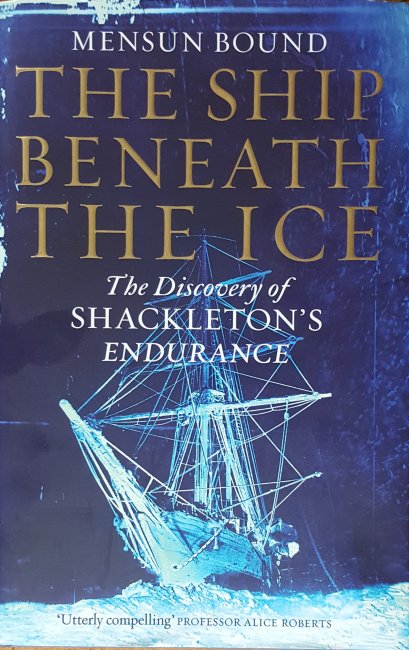
The book is actually two books, the first is about the unsuccessful 2019 expedition and was written by the author during the 2021 Covid lock down in Port Stanley, capital of The Falkland Islands which is where he was born. At the time he wrote it he never expected to get a chance to go back and try again so after 204 pages it ends with him and his team defeated. The second half of this volume recounts the unexpected return and the elation of success in 2022 and was written partly on his way back from Antarctica and completed at his home in Oxford. I’ll deal with the two parts separately. The combined book, the first section wasn’t printed independently, was first published by Macmillan in 2022 and my copy is the sixth impression which shows that this was a story a lot of people were interested in. The front cover features a famous floodlit night-time photograph taken by Frank Hurley of Endurance stuck in the ice shortly before she was finally sunk by the enormous pressure on the hull.

The Weddell Sea Expedition 2019

This trip was run under the auspices of Netherlands based The Flotilla Foundation and was mainly a scientific expedition with the search for Endurance added on the end once the data on climate change, species proliferation and ice core sampling in The Weddell Sea had been accumulated by the scientific team. Starting on the 1st January 2019 and in a day by day diary format Bound describes the work of the crew, discoveries made and provides comments as to Shackleton and his crew’s movements over a hundred years earlier. Like Bound I’ve been fascinated by Shackleton and his expeditions since an early age and have numerous books on Antarctic exploration a couple of which I have previously reviewed, see a list at the end of this blog. Most of January is dedicated to getting to Antarctica from South Africa and the scientific research which Bound wasn’t involved in so it is referred to but not in much depth. Where he does get involved is the use of the Remote Operated Vehicle (ROV) and the two Autonomous Underwater Vehicles (AUV). ROV’s are controlled via a long cable back to the ship, AUV’s are robots which operate on their own for hours on end before returning to the ship for downloading of the data they have gained, both have advantages. ROV’s provide a continuous stream of data back to the ship but are restricted by where the cable lets them go, AUV’s can go anywhere and as the search area in the Weddell Sea for Endurance was under the pack ice this was vital however they aren’t in communication with the ship so you don’t know what they found until they get back. The expedition was to have serious problems with both sorts.

It was the 25th January before the scientific work completed and the ship set out for the last ‘known’ position of Endurance, it’s latitude and longitude had been taken by its captain, Frank Worsley, just before it sank and he was one of the finest navigators at the time but working in very difficult conditions with no readily available flat horizon and very little sight of the sun due to poor weather, how accurate had he been? One of the AUV’s was no longer available after failing during the scientific surveys and on the way to Worsley’s position it was decided to do a test dive with the ROV to the depth of Endurance (approximately 3000 metres), just before it got there the ROV catastrophically failed, this was now the 30th January, time was running out and so was the equipment. It was decided to try to repair the ROV but this meant abandoning the voyage to the search area and heading off to the nearest ice airstrip to get parts which were going to be flown to them. This used up days of possible search time and ultimately failed as the plane couldn’t reach them due to bad weather. Finally deciding to just use the remaining AUV they went back to the search site with just fifty hours of possible dive time available before they had to leave or be locked in the ice just as Endurance had been. We will never know if the AUV found Endurance as it never returned from it’s dive, it also failed. This part of the book ends in dejection all round, but it’s still a fascinating story and if it had been published with no follow up I would still have really enjoyed the book, however better news is to follow.

The Endurance22 Expedition 2022

As can be told by the expedition title this was an all out attempt to find Endurance and was funded by the Falklands Maritime Heritage Trust. It is hardly giving anything away to say that they succeeded, news reports early last year went round the world that the ship was discovered and it’s plastered all over the front cover of the book. But that’s not to say there were no doubts as the days went on and very little was found. This time the brand new SAAB built autonomous vehicles were on armoured fibre optic cables so real time images were retrieved and if necessary the cables could be hauled back to retrieve the submarine. The ice conditions were a lot better for exploration as well with significant breaks so they were on station a couple of days earlier than planned and moving around was much less fraught but even so it looked like time was going to run out before the ship was discovered as the Antarctic winter was setting in and they were in to the last few days that they could remain on station before they found her. Again it is diary entry format so you can follow along with the highs and lows.

The ship was just three miles south from where Worsley had said she was and within the search box defined for the 2019 expedition by Mensun Bound which shows what a superb set of calculations both men had made but there was one very odd coincidence that was only spotted the day after the discovery and that was the date. Shackleton was buried on South Georgia on the 5th March 1922 after dying of a heart attack on his rather nebulous Quest expedition. Endurance was found on the 5th March 2022 exactly one hundred years later. It gets stranger, according to contemporary news reports his funeral service was at 3pm and allowing for a half hour service, regrouping of attendees and the twenty plus minutes to get the coffin from the chapel up to the graveyard they probably got there around 4pm, a few last words at the graveside and Shackleton was probably buried a few minutes after 4pm, Endurance was found at 4:04pm.

It’s a brilliant book, I was hooked all the way through and thoroughly recommend it as a read.

Other Antarctic blog entries

Biography of Tom Crean – who sailed with Scott and Shackleton and was one of the crew members of the James Caird, the lifeboat sailed from Elephant Isle to South Georgia to get help for the rest of the crew of Endurance.

Biography of Sir Ernest Shackleton – written by fellow Antarctic explorer Sir Ranulph Feinnes

Galápagos Diary – Hermann Heinzel and Barnaby Hall

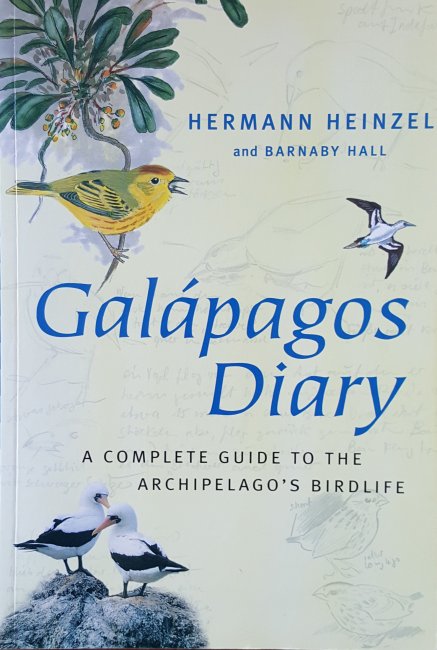
The fourth book in my natural history themed August reading material is a book I originally used as reference material. Although entitled Galápagos Diary, this book is far more than a journal of a 1995 trip round most of the islands in the Galápagos archipelago by artist and author Hermann Heinzel and teenage photographer Barnaby Hall. The book was first published in 2000 and you can see why it took so long to come out as it is a truly beautiful book, heavily illustrated with sketches and photographs. But the reason I bought this copy in 2002 is that I travelled to the Galápagos that year, to mark a significant birthday, and needed a guide to the wildlife, especially the birds. Heinzel I had already heard about as he has illustrated several ornithological volumes including the classic Collins handbook ‘Birds of Britain and Europe’. Originally born in Germany, Heinzel has lived for many years in France and knew Rod and Jenny Hall and their son Barnaby, Jenny and Barnaby had been to Galápagos in 1994 and Barnaby assured Heinzel that he had seen Cattle Egrets there which surprised the naturalist who suspected that what he had really seen was Great Egrets but Baranby was certain so they decided to go together during the school holidays the following year and so the expedition was planned. Not only to see if Cattle Egrets had indeed made it to the islands but also to attempt to see all the endemic species of birds to be found there.

The book is split into three sections, pages 1 to 158 cover the diary of their travels with lovely hand drawn maps showing where on each island they stopped, with drawings and photographs mainly done at the time. A sample page, seen above, deals with part of the time they spent travelling around one of the inhabited islands, San Christobel, the birds drawn by Heinzel are North American Bobolinks which as the name implies are visitors to the islands rather than endemic. Below is a page featuring what for me was the most surprising bird I saw in Galápagos, the endemic Galápagos Penguin. Bearing in mind the island group is on the equator I really wasn’t expecting to see penguins but these photographed by Barnaby on Bartolome, which is where I also spotted them, prove that sometimes animals are not where you think they should be.

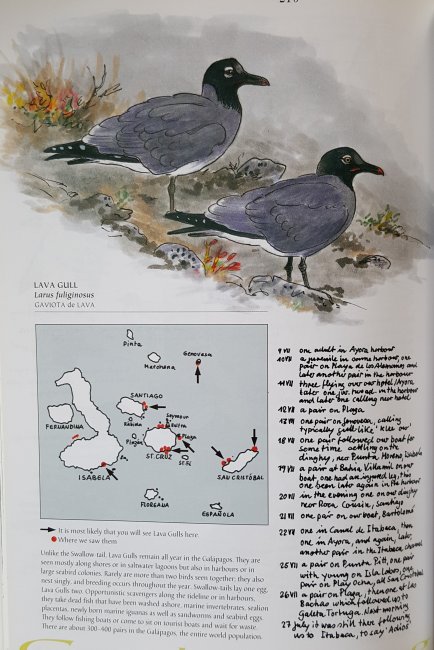
The next section is the species guide and takes up pages 159 to 261, this is entirely done by Hermann Heinzel using sketches and completed paintings of each of the endemic species, no photographs are used in this section. On this trip they failed to see just 3 of the 59 types of breeding species of bird on the islands, just the Marsh Owl, the Painted Rail and the rarest of all, the Mangrove Finch eluded them. In all they saw 66 species and they were all sketched by Heinzel and the three breeding birds they didn’t find had been seen and drawn by him on previous trips so it is a complete guide. Along with the drawings you get a map where they spotted the bird and notes relating to each sighting. The page below is for the Lava Gull, a bird that seems to be everywhere as you can tell by the notes which state that they saw examples on half the days they were in the Galápagos and I spotted them on multiple occasions.

The final section is a nine page checklist of Galápagos birds, both endemic and visitors which invites you to tick off species as you see them but I couldn’t bring myself to do so. It is not just a list but also includes which islands they are to be found on. Despite being able to fly, with the exception of the penguin and oddly the cormorant which has become flightless since arriving in the island group, the birds tend to stick to specific islands where their needs are best catered for. The islands have surprisingly different habitats even though they are a relatively small group and a tiny number of species can be seen from every island, even including those that can be expected to be seen going past.

It was a very useful book when in Galápagos and also later on trying to identify each bird I photographed. Perhaps surprisingly I have no memory of actually reading the diary at the time, I appear to have just used it as a guide to tell what I had been looking at. That is definitely a pity as it is an interesting read as well as a beautiful book.

If you are interested in the photographs I took in 2002 they can be found here:

San Cristobal and Bartolome

Santiago and Genovesa

Seymour and Santa Cruz

Life on Earth – David Attenborough

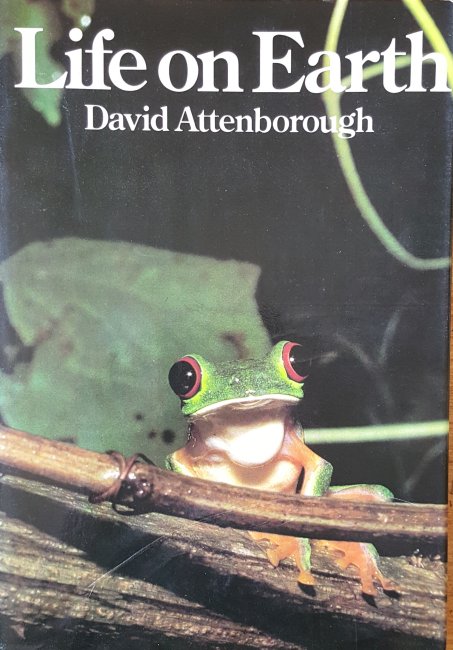
The first in a colossal series of adventures round the world and what would eventually be seen as an incredible lifetimes work is my third natural history book for August but really it is possibly the most significant book and programme series by Attenborough in his career as it totally changed both television’s view of natural history and the global influence of such programmes. Nobody, not even David Attenborough, foresaw back in the late 1970’s just where this would lead and that almost fifty years after he started planning Life on Earth that he would still be writing and presenting on huge television wildlife spectaculars. Attenborough had started out in television back in the mid 1950’s, always with a natural history theme to his work and after the massive success of Zoo Quest, which started in 1954 and which had Atttenborough as the presenter at short notice after the originally planned presenter fell ill, he became a familiar face on British television. In 1965 however his career took a different direction when he became controller of BBC2, one of the then just three TV channels in the UK and ultimately rose to Director of Programmes, taking over control of the output of both BBC channels in 1969. Amazingly despite the high pressure management role he now had he still managed to fit in presenting the occasional wildlife programme. In 1972 when offered the ultimate top job in British television, that of Director General of the BBC he declined and abruptly resigned.

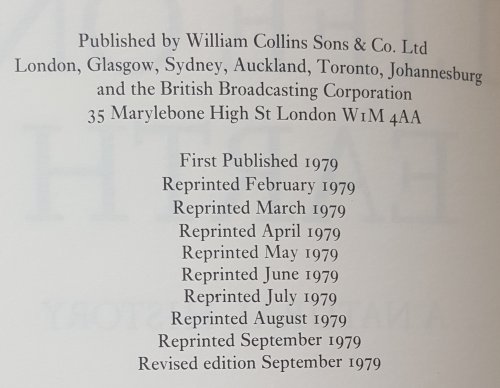
Why? Well he missed the hands on presenting role where he had made his name and after a short TV wildlife series in Asia he started planning an altogether more ambitious work ‘Life on Earth’ a series of thirteen 55 minute long programmes each of which would focus on one aspect of life and would try to tell as much of the whole story from the first single cellular creatures through to the incredible diversity of today. The series took years to film and was well in advance of anything seen before from any television channel anywhere in the world when it was first broadcast weekly between 16th January and 10th April 1979. It was an immediate hit and the accompanying book, which was released as the first episode was broadcast was already into its third reprint by the time the series had finished. My copy is the first revised edition and amazingly the tenth printing dated September 1979, just nine months after it first came out.

Back then you couldn’t record, or buy for watching again, TV programmes so you saw it when it was first broadcast and then all you had was the book and that probably explains the massive amount of reprints. Whilst reading this book again, for probably the first time in over forty years, I watched the entire series again on the DVD set that came out in 2003 and I have to say it has stood up remarkably well.

The book closely follows the structure of the television series with thirteen chapters each of which is dedicated to an episode, so we start with the first appearance of life three thousand million years ago and by the end of the first chapter get to the beginning of multicellular life. But this first chapter, like the first episode is also an introduction to the series and begins laying out just what a massive project it was to be. Reading and alternating watching the programmes made me appreciate how similar but also how different the two media are. The book can go into detail that watching a presenter speil through on screen would be potentially overbearing. With the video you want to concentrate on the wonderful pictures but in the book where there are a dozen or so images per chapter you want to get immersed in the words and can take in more information at one sitting, so the two formats complement one another.

What you also are aware of looking back from today is that Life on Earth whilst groundbreaking and feeling spacious at the time in giving almost twelve hours television and 311 pages in the book, feels nowadays like a rapid flit through its subject. Chapter eight of Life on Earth entitled ‘Lords of the Air’ covers the whole subject of birds in just thirty pages, I also have the book for the much later series ‘The Life of Birds’ (1998) which oddly takes the same total number (311) pages to cover just birds over ten chapters again mirroring the episodes of that TV series. So vastly more information and detail but ‘The Life of Birds’ and the other follow up series would not have existed if ‘Life on Earth’ had not been such a resounding worldwide success. The book is an interesting read and an excellent start for anyone who wants to get a grasp on the development of species and how our planet has become populated with countless different creatures. One point that should be made is that the emphasis is on creatures that are alive today, yes dinosaurs are mentioned and fossils shown but only on the way to modern examples. There is no specific chapter on the hundreds of millions of years that dinosaurs ruled the Earth. Frankly something had to go to get the vast subject still within the time frame for the television shows and you can’t go out and film dinosaurs so they are mainly dealt with in passing.

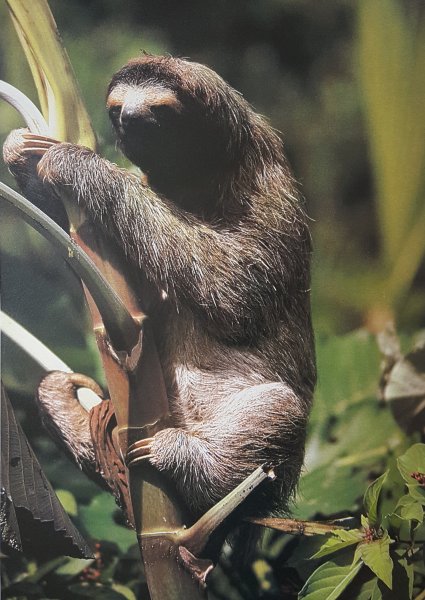
The book has lots of wonderful wildlife photographs inside and perhaps my favourite is the one above of a three toed sloth taken in Panama by David Attenborough himself, one of nineteen photos in the book that he took. The cover photo of a Panamanian Red-eyed Tree Frog, which became an icon of the series, was also taken by Attenborough. Reliving a television milestone which I remember watching enthralled back when I was a teenager has been a great experience, the book appears to be out of print at the current time but due to the huge numbers sold over the decades it is very easy to get a copy.

The Phantom Atlas – Edward Brooke-Hitching

Edward Brooke-Hitching is one of the researchers for the very popular and long running BBC quiz programme QI also known as the QI Elves and turned his love of unusual trivia into his first book ‘Fox Tossing, Octopus Wrestling and Other Forgotten Sports’. The Phantom Atlas was his second publication, coming out in November 2016 and very much draws on his love of maps and his own incredible collection of them. Since then he has done three more atlases, one of which ‘The Golden Atlas’ which illustrates famous explorers routes with contemporary maps, I also have in my library. This book however is particularly fascinating as it deals with places that don’t exist yet made it onto maps either in error or in some cases as deliberate fakes. The first of these I want to highlight from the book was one I already knew about and that is The Mountains of Kong.

As can be seen from the map above there is an apparently unbroken line of mountains running across the entire African continent and variations of these appeared on over forty maps by various different cartographers probably starting with James Rennell in 1798. The map illustrated here is by John Cary from 1805 and shows the Mountains of Kong running right across from almost the west coast to eastern Africa and the equally fictitious Mountains of the Moon which were believed to be the source of the River Nile. It was not until 1889 when Louis Gustave Binger gave a talk in Paris and explained that he had been to the site of the Mountains of Kong and not only were there no mountains but there wasn’t even a decent sized hill in sight. However of the over fifty places described and illustrated in detail in the book this is the only one I already knew about, a 6,000km range of mountains that were regularly mapped for almost a century without actually existing being possibly the largest geographical error you can get.

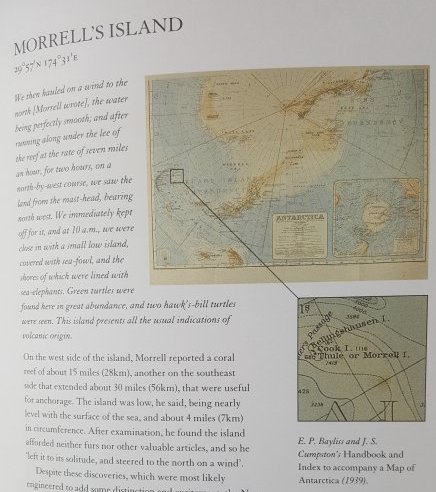
Most of the errors with islands that simply don’t exist is down to faulty navigation and the rediscovery of islands already mapped in their correct location but some are simply works of fiction including at least three islands ‘discovered’ by Benjamin Morrell, one of which he named after himself.

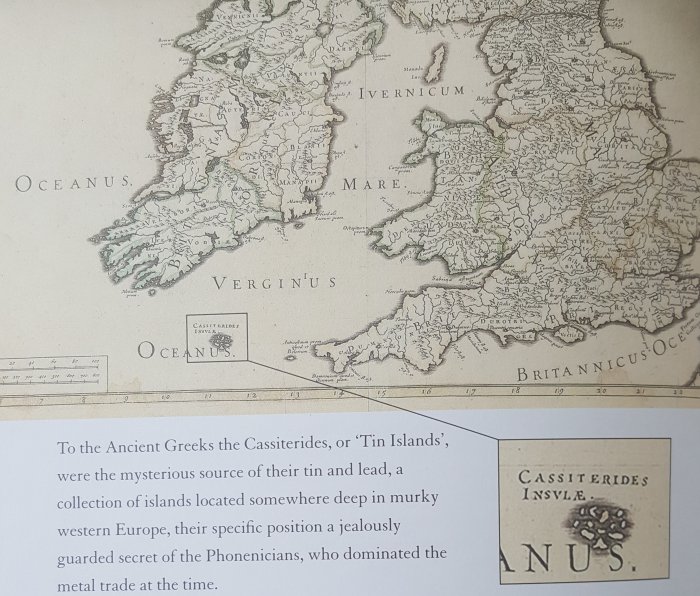
Morrell’s Island along with another of his fakes, Byers’s Island survived on charts for well over a century and both even made it through the British Admiralty’s 1875 cull of 123 islands from their charts that they didn’t believe existed although three of these turned out to exist after all. It is details like this that make Brooke-Hitching’s book so fascinating, he also has sections of the fabulous beasts included on various ancient maps such as Blemmyes a race of headless people with their faces in their chests that appear on the Nuremberg Chronicle map or the Sea Pig from The Carta Marina. It is the vast array of old maps illustrated in the book that are its prime interest to myself, I have a few old maps but nothing like the collection that Brooke-Hitching has to hand. One final example from the book shows just how far back this false history goes with the Cassiterides which the ancient Greeks believed were where the Phoenicians sourced their tin.

The map above is from 1694 and includes the Tin Islands as they became known as a somewhat enlarged and moved version of the Isles of Scilly which was pretty close to reality as the actual source was Cornwall, the English mainland county just to the east of these islands.

There are lots more examples of dodgy geography in the book which is well worth acquiring if you have any interest at all in maps, at over 250 pages it superbly covers its subject and from the acknowledgements at the back it is clear that Brooke-Hitching does indeed own a lot of the maps featured in his work. The book was published by Simon & Schuster who have also published Brooke-Hitching’s other works.

Into Iraq – Michael Palin

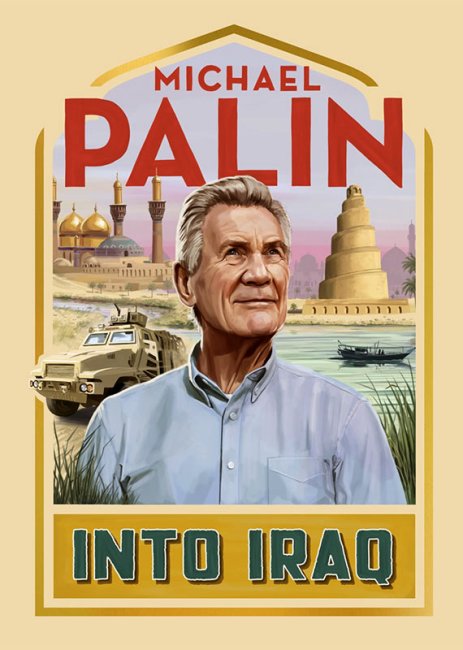
Michael Palin’s latest travel adventure took place March 2022 and consisted of a short (two week) trip to Iraq, he was after all seventy eight when he made the journey and the epic trips from the 1980’s and 90’s are probably behind him now but this was still a fascinating read. This was his first documentary travelogue since visiting North Korea in 2018 which was equally short and it is now eleven years since his last trip lasting multiple months which saw him explore Brasil. The book is beautifully illustrated and written in Palin’s easy to read diary format which he has honed over decades of doing such series for television although now they are for ITN and Channel 5 here in the UK rather than the earlier, and higher budget, trips for the BBC.

The book covers eighteen days travelling, although days one to four are in Turkey as he travels down to the Iraq border finally crossing over on the evening of the fourth day and day eighteen has him getting up at 5am to dash to the airport to leave so that doesn’t really count. On the way through Iraq following the River Tigris he gets to places I read about as a child, the ancient city of Ur and its famous ziggurat, Babylon and the astonishing minaret in Samarra which can be seen top right on the cover of the book. Like Palin I have wanted to visit these places for decades, and nearly went soon after returning from Iran in 1997 but various other destinations called to me more urgently and later it became too dangerous to go. From the descriptions in this book it looks like it may be becoming possible to be a relatively safe tourist in Iraq again, however he explains that major destinations such as Ur’s ziggurat and the site of Babylon were largely reconstructed over their original ruins during the time of Saddam Hussain. That doesn’t make them less impressive and the lower parts, certainly of the ziggurat, are genuinely thousands of years old so still worth a visit. It would be the endless waits at random checkpoints that they endured for seemingly little point other than to justify the existence of the checkpoint and the guards manning it, I doubt I have the patience for nowadays.

The book is quite short, just 171 pages and a lot of those have half and half text and photographs of the trip, I therefore read it in about two and a half hours. I would have liked more details especially on the life of the people coming out of decades of conflict. Palin was always good interacting with locals in previous documentaries and whilst I haven’t yet seen the TV series that this book accompanies, that is only three sixty minute episodes and those include adverts so I doubt you get much more insight. Having said that I really enjoyed the book and when I started it was difficult to put down, the urge to just read another chapter was always there and as each chapter was a days journey it felt even more like a diary and you felt you were progressing down Iraq along with the small team making the films.

Unlike his previous expeditions where he planned a lot of the journey himself and was very much an independent traveller, albeit with a TV crew in tow, this time Palin travelled with a company called Untamed Borders which means that a large part of his itinerary can be booked direct with them if you too fancy a trip to Iraq.

Tuffer’s Alternative Guide to The Ashes – Phil Tuffnell

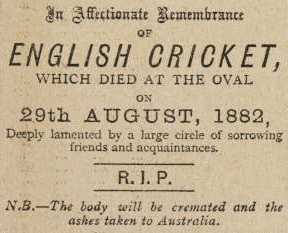
The 2023 Ashes Series is starting on Friday 16th June, for those of you who don’t follow cricket this is one of the oldest bilateral sports tournaments in the world, starting in 1877 and pits Australia versus England at cricket in a series of five day matches. It’s worth noting that it didn’t gain the name of ‘The Ashes’ until the ninth test match between the two sides, which took place in England in 1882 and which England somehow managed to lose from what should have been a winning position. This led to a mock obituary appearing in The Sporting Times on 2nd September 1882.

The urn containing ‘the ashes’ was presented to the captain of the touring England team in Australia that Christmas and is now kept at Lord’s Cricket Ground in London as it is extremely fragile, only rarely being removed from its glass display case for ceremonial occasions, and has only actually travelled to Australia twice in the intervening years. It isn’t the official trophy for the tournament but symbolises the rivalry between the two countries but replicas and images of this tiny, 6 inch (15cm), vase are to be seen whenever the two teams play each other and its silhouette can be seen on the front cover of this book between the words ‘The’ and ‘Ashes’.

This year there are five games to be played in June and July at various venues across England, five games is the most common number of matches but it does sometimes alter. Phil Tufnell played in five of these series and both his first and last test matches for England were against Australia. It should be noted that at the time the England team were pretty weak and the Australians very good so he never got near to being on the winning side in an Ashes series. Tufnell retired from playing serious cricket in 2003 and gained a job as a summariser on The BBC Test Match Special which he still does and he continued to play cricket for celebrity teams for many years after his official retirement.

I didn’t know what to expect from this book, but thought it would probably be descriptions of his experiences and whilst those do appear, the book is a whole lot more than that. In fact it is a highly entertaining look over the entire existence of the tournament from the first matches and includes the origin story of the Ashes urn but also lots of stories of players and games over the entire, almost 150 years, that England and Australia have faced each other on the cricket grounds in both countries. These range from when in 1903, back before aeroplanes existed and it would take three weeks by boat each way to get to the tour, the England team on their way out managed to lose a game of deck cricket against a team of female passengers. In 2001 The Australians hosted a charity function in Manchester and the first auction item was a chance to train with the team, bidding was slow as the room hadn’t really got going when they started this so a couple of Australian players decided to bounce the bids on a bit, which was fine until Steve Waugh ended up winning the auction and paying £500 to train with his own team-mates.

Scattered through the book are lists of ten players in various categories including, ten fast bowlers Tuffers was happy to have never faced, ten Ashes blockers and ten Ashes bashers amongst other selections. These are fun as it’s not just a list but reasons why. Chris Tavare is probably the best of the blockers that I have seen and he once spent ninety minutes at the crease without scoring anything at all and had on a different occasion taken two hours to score nine, not entertaining but incredibly frustrating for the Australian bowlers and winding them up led to mistakes.

My copy is the first edition hardback from 2013 published by Headline and I have to wonder why it has languished on my shelves for ten years its been a really fun read and here’s hoping for an equally fun summer of cricket.

Summer in Algiers – Albert Camus

This collection of three of Albert Camus’ essays was published by Penguin Books as part of their seventieth anniversary in 2005 and is a fascinating description of two cities and a town in Algeria, the country which was the birthplace of Camus. It is always interesting to read a locals perspective on places that you really want to visit especially if it is by a writer of the quality of Camus, and Algeria is the only country on the north African coast that I haven’t yet been to and this book moved it higher up the list of places to visit. This is the second book I have reviewed that is set in Algeria though, after Tartarin of Tarascon by Alphonse Daudet so clearly I need to go there sooner rather than later. As mentioned this has descriptions of a couple of cities, Algiers and Oran along with the archaeologically important town of Tipasa with its wonderful Roman ruins, the first essay concerns Algiers.

Summer in Algiers

Unlike the other two essays in this book, this is not a description of the place but the people of Algiers and especially the youth. He explains that here people start work and marry young and raise their children so that by their thirties men have largely done all that they have to do and it is a steady decline of their vigour that is all they have to look forward to. Summer in Algiers is a time of unrelenting heat so only the poor are left there, the rich decamp to more salubrious climes until the September rains bring relief. The young poor however gather on the beaches, for it is the culture of the body that reigns supreme and as Camus explains “Here intelligence has no place as in Italy” instead the men display their muscles and the girls their shapely legs in one fast summer before work, drudgery and motherhood claim them all far too early. It’s not a happy essay.

The Minotaur, or a stop in Oran

The longest, at 31 pages, of the three essays is possibly the most interesting, partly as I’d never heard of Oran despite it being the second largest city in Algeria, but mainly for the wonderful description of not just the town but also the people and what they do for work and fun, Camus worked here as a teacher for a while before ill health (tuberculosis) forced him to leave. The title’s reference to the Minotaur is an allusion to the labyrinthine network of streets in the city where it is easy to get lost and the walls of the old city which cut the centre off from both the desert behind but also the sea to the front. But everywhere there is the dust which seems to be the defining element for Camus whenever he thinks of Oran along with the odd collections of merchandise in the shops.

Here, presented in a casket of dust, is the contents of a shop window: frightful plaster models of deformed feet: a group of Rembrandt drawings ‘sacrificed at 150 francs each’, practical jokes, tricoloured wallets, an eighteenth century pastel, a mechanical donkey made of plush, bottles of Provence water for preserving green olives, and a wretched wooden virgin with an indecent smile. (So that no one can go away ignorant the ‘management’ has propped at its base a card saying ‘wooden virgin’).

There is also a detailed description of a boxing tournament, not just of the boxers but the crowd and building as well and a section on the construction of the new harbour walls which will eventually pull the city to face the sea, if not embrace it. It’s s great piece of closely observed travel writing although unlike the next essay it doesn’t make me want to go there.

Return to Tipasa

Tipasa is about seventy km from Algiers and had clearly been a regular destination when Camus was a child. He doesn’t care much for the modern town, it is the ancient Roman ruins that call to him and having looked up the town online I can see why, just follow the link here to Atlas Obscura. To his dismay on returning to the ruins as an adult decades later he finds them surrounded by barbed wire with a small number of designated entry points rather than the open site he remembered as a youth but once inside the magic returned and he revels in walking through the ‘bread-coloured stones’ feeling peace again and escape from the modern world as he does so.

I’d always been a bit wary of Camus, mainly because of his reputation as an existentialist writer, and having studied the works of his friend Jean Paul Satre at school that put me off that particular group of authors, but this short collection has made me want to read more Camus. He has a real gift for a phrase and an ability to take the reader to where he is writing about. I’ve explored several of the ruined Roman cities along the north African coast in both Tunisia and Libya and Return to Tipasa took me right back to those magical trips. There is a monument to Camus in amongst the ruins of ancient Tipasa which includes a quote from another of his essays set there ‘Wedding in Tipasa’

Je comprends ici ce qu’on appelle gloire : le droit d’aimer sans mesure.

I understand here what is called glory: the right to love without measure.

Albert Camus memorial in Tipasa

The Mid-Atlantic Companion – David Frost & Michael Shea

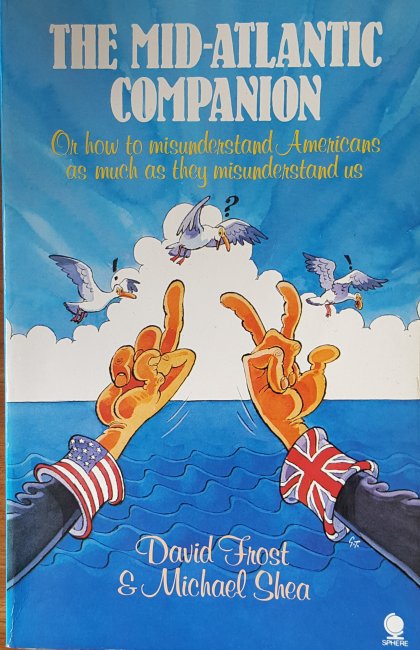
A friend is off to New York for the first time so it occurred to me to dig out this funny guide to the differences between America and the UK which originally came out in 1986. My copy is the first paperback edition from 1987, which is when I started regularly crossing the Atlantic to see my then girlfriend and found this full of handy hints. At the time David Frost was presenting TV programmes in both countries and commuted each week between London and New York, Michael Shea was a diplomat and Director of British Information Services in New York but when he wrote this book with Frost he was Press Secretary to Queen Elizabeth II. Both men therefore had extensive experience of the differences that you only appreciate really when you live in the country you are not native to.

The joy of this book is it’s not just the linguistic differences that they highlight but history, politics, food etc. are covered, if not comprehensively then at least enough to give a warning to the unwary. Back in 1887 Oscar Wilde said “We have really everything in common with America nowadays, except, of course, language.” and it is still very true today. I remember back in the early 1980’s Jane Fonda’s first workout video came out which included the surprising, to British female watchers at least, instruction to sit on the floor and bounce around on your fannies. Americans who don’t know what is wrong with that should know that a fanny moves from behind in America to the front and female only in the UK.

That passage gives some idea of the differences and fortunately the book is not as relentless as that all the way through, the book is equally fair, or unfair if you prefer, in dealing out warnings both for Brits going to America or Americans going to the UK so Brits are warned about the huge size of portions and the sweetness that pervades a lot of American food whilst Americans are equally warned about a lot of British food and heartily recommended to have breakfast three times a day. There are also specific chapters on London and, usefully for my friend, New York which includes a comment on street crime that “they even had a bank robber who got mugged on the way to the getaway car”. As for the cab drivers “Help wanted ads in NY papers claim you can get a cabby’s licence in three days. Most people are surprised they have been driving that long”.

Of course the book has dated, it is after all getting on for forty years old, however as both authors have been dead for a log time, Shea died in 2009 and Frost in 2013 there is no chance of an updated version. There are still enormous differences in language and culture between the UK and USA a lot of which are in this book and still relevant but there are new pitfalls for the unwary traveller to fall into and a new guide is probably called for.

A final thought from the politics section, which still seems relevant, at least in Donald Trump’s mind:

When the President does it, that means it’s not illegal

Richard Nixon

Round Ireland with a Fridge – Tony Hawks

British comedian Tony Hawks was first in Ireland back in 1989 as the writer of a song entered for an ill fated attempt at an international song contest, but whilst he was there he saw something odd on his way to the contest; a man hitch-hiking with a fridge. What was even odder, at least to Tony was the complete way that this was regarded as normal by his Irish companions. Over the years this became a favourite tale for Tony to bring up at parties until late in the nineteen nineties he got particularly drunk at a friends house and…

Now both men knew in their heart of hearts that a bet made when neither of them could remember it being set because they were both too drunk does not have to be honoured, but this one niggled at Hawks for a while until he decided to go for it and I’m very glad he did because the trip and the subsequent book are very funny. I first read the book soon after it came out in 1999 and loved it then so it was with a little trepidation that I got it off the shelf for a reread, would I still think it as good as I did then? I needn’t have worried the tale is still as brilliantly daft as I remembered it to be.

Hawks arrived in Dublin having done minimal preparation other than badly packing a rucksack and arranging with a friend in Ireland to be met at the airport by a friend of this friend along with his travelling companion for the next month. It was whilst explaining to this person, that he had never before, what he was planning on doing that the economic idiocy of the adventure starts to come clear. As he pays him the £130 for the fridge it is obvious that even if he succeeds he is already £30 down not counting the flights, accommodation costs, food etc that he will have to pay for on his journey but he had not counted on the friendliness of the Irish. At a suggestion of his friend he drops a note round at RTE, the national broadcaster, for Gerry Ryan who is the host of the popular breakfast radio show on the basis that breakfast radio is a perfect place to talk about hitch-hiking round Ireland with a fridge as this sort of programme is always looking for offbeat stories to fill up some time. Instead of just a short chat with Ryan on his show it turns into a regular feature with the radio programme regularly calling to find out where he had got to since they last spoke and before he had even got half way round Hawks was mildly famous as ‘Fridge Man’ throughout Ireland and people were waiting to see him turn up in their town and he was being covered by local papers across the country.

The book is not just funny though, in his tale Hawks introduces people who helped and the stories of their lives that he briefly touches on, people start signing the fridge and by the time he gets back to Dublin there is no room left of the two foot cube that had made it all the way round. On the way, the pair of them did all sorts of things including going surfing, fortunately there is photographic evidence of this to prove it, the fridge also got christened and became a folk hero, they even spent a night in a dog kennel when there was no room anywhere else. The book is a joy to read and I’m so glad I picked it back up again after more than twenty years. Hawks has written several books since this one, often with a theme of travelling with a specific purpose such as ‘Playing the Moldovans at Tennis’ where he tries to persuade all eleven members of the national football team to play him at tennis. Or ‘One Hit Wonderland’ where he travels around the world trying to have a second hit record, he had his first, and only previous success back in 1988 with ‘Stutter Rap’ which made the British top ten back in 1988. If you like your travelogues with an eccentric edge Tony Hawks is the man for you.

Hugh Fearlessly Eats It All – Hugh Fearnley-Whittingstall

It has been said that I will eat anything. This is, of course, nonsense. Medium Density Fibreboard soaked in paraffin served between two discs of foam rubber has never got me salivating (which is why I steer clear of McDonalds).

Start of chapter two

Hugh gained the sobriquet of Hugh Fearlessly Eats It All from a review of one of his books where he advocated eating as much of an animal as possible, no discarding of offal, if a pig has been killed to provide the diner with pork chops the least people can do is eat the rest of it with as little waste as can be managed. I am very much in agreement with him and regard most offal as a treat due to the flavours and textures that you would otherwise miss. I haven’t gone as far as Hugh’s keenness for brains and frankly his descriptions of the texture, which for him makes the dish, are quite off-putting to me.

This book, unlike the others I have by Hugh, is a collection of his journalism and whilst some of the articles are campaigning for various issues, especially regarding ‘nose to tail’ eating, others are very funny and even self deprecating. His own personal food business ‘River Cottage‘ barely gets a mention and whilst there are some recipes in the book they appear only rarely and always to illustrate a point in the article they are attached to. This is worth pointing out as most of his books are cookbooks, and one is my favourite which is his Meat book, nothing I have ever cooked from that book has failed to work or indeed been so complicated that I was immediately put off trying it. Having said that the journalism is a delight and being short articles it makes this a great book to dip into pretty well at random. Hugh started out as a sous chef in the kitchen of the famous River Island restaurant in Hammersmith, London but didn’t last long as a need to cut costs led to him being fired about eight months after joining them, he has never looked back, or indeed worked seriously in a professional kitchen since that date in August 1989. He moved to River Cottage in 1997 and presented his first TV series from there two years later and nowadays it is River Cottage rather than his journalism that most people think of, which is a pity because as I said earlier it’s very good.

The book is split into six sections with articles gathered thematically so for example the first part ‘Hard to Swallow’ includes pieces about McDonalds and Kentucky Fried Chicken, bemoaning the quality of their products and the Atkins diet pointing out the dangerous side effects of that regime. There are also articles about the poor standard of food in first class on Eurostar and other other similar topics. These sound like they could be hard work to read but rather they are quite entertaining, especially when he tries to replicate a Big Mac at home. Later sections dwell on travelling to try new foods and also his home life from childhood to his current family life at River Cottage, he is a very good writer, short articles are notoriously difficult to do especially if you are also raising an important point such as intensive farming without just banging on about it. No everybody can’t live the way he does and eat fresh home produced vegetables and meat but we can try to do the best we can afford’ Hugh has the advantage of coming from a wealthy family and sometimes he can be somewhat divorced from the realities of how most people live but having said that he comes over as a very likeable person and at some point I will get down to River Cottage to do one of his cookery courses.

One thing I think that is missing is which publication the articles originally appeared in, you get the month and year but not where. He had regular columns in Punch magazine and the Evening Standard and Sunday Times newspapers so I guess most are from those but it seems a strange omission.