Sentimental Journey – Laurence Sterne

To give the book its full (and misleading) title “A Sentimental Journey through France and Italy. Why misleading, well in the copy I read, which is 161 pages long, by page 143 he is still in Paris having travelled there from Calais on page 1, after that there is a rapid dash as far as Lyon which is where the book ends. Sterne undoubtedly intended to continue the tale in a further volume, as he had done numerous times with his much more famous novel regarding ‘The Life and Opinions of Tristram Shandy’ which eventually ran to nine volumes, but he died just three weeks after this book was first published in 1868.

20190924 Sentimental Journey 1

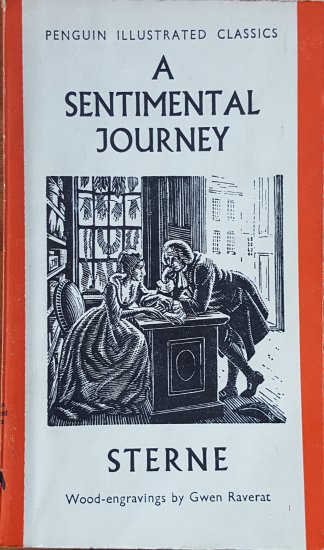
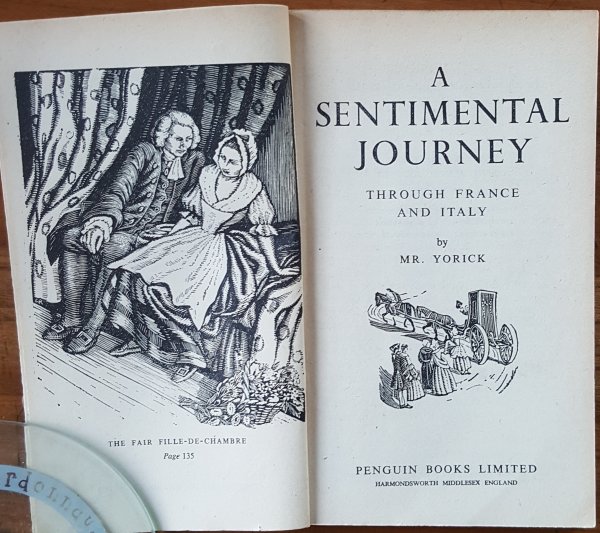
I have two copies of this book on my shelves, both there due to them being parts of separate book collections rather than a desire to own a copy of the novel but it did feel that it was time to tackle the book as it is regarded as a classic of English literature. That this is so is attested by the fact that the Folio Society edition I have read is only the fourteenth title produced by that publisher and came out in 1949. The other copy I have is from 1938 and was part of the ten books published by Penguin as Illustrated Classics which were their first attempt at a series of illustrated books, just three years after they started publishing. That two major publishers should select it so early in their existence suggests how much both companies rated the book and both editions are beautiful. The Folio Society copy is illustrated by Nigel Lambourne in lovely drawings that match well his cover design, see the picture of Maria further down this essay. The Penguin edition, in common with the other nine volumes published simultaneously, uses wood engravings in this case by a master of that art form Gwen Ravarat.
20190924 Sentimental Journey 2

And so to the tale itself… Well I have to admit that of all the books I have read so far for this blog this was the one I struggled with the most. Even though it is quite short (less than forty thousand words) it has taken over three weeks to read it as I kept putting it down after a few pages. Both the Maupassant short stories and The Pillow Book by Sei Shōnagon have been read and written about whilst I worked my way through A Sentimental Journey. There are two main reasons for this, firstly I couldn’t get on with Sterne’s style of writing and secondly it really needs a significantly better knowledge of French than I have so I have had to pause to translate sections before continuing if I really wanted to make sense of the narrative especially in the case of a letter which is important to the story but which is entirely in French. A random sample of the text, where Yorick (Sterne’s alter ego in the story) employs a servant is below.

La Fleur had set out early in life, as gallantly as most Frenchmen do, with serving for a few years; at the end of which, having satisfied the sentiment, and found, moreover, That the honour of beating a drum was likely to be its own reward, as it open’d no further track of glory to him,—he retired à ses terres, and lived comme il plaisoit à Dieu;—that is to say, upon nothing.

—And so, quoth Wisdom, you have hired a drummer to attend you in this tour of yours through France and Italy!—Psha! said I, and do not one half of our gentry go with a humdrum compagnon du voyage the same round, and have the piper and the devil and all to pay besides?  When man can extricate himself with an équivoque in such an unequal match,—he is not ill off.—But you can do something else, La Fleur? said I.—O qu’oui! he could make spatterdashes, and play a little upon the fiddle.—Bravo! said Wisdom.—Why, I play a bass myself, said I;—we shall do very well.  You can shave, and dress a wig a little, La Fleur?—He had all the dispositions in the world.—It is enough for heaven! said I, interrupting him,—and ought to be enough for me.—So, supper coming in, and having a frisky English spaniel on one side of my chair, and a French valet, with as much hilarity in his countenance as ever Nature painted in one, on the other,—I was satisfied to my heart’s content with my empire; and if monarchs knew what they would be at, they might be as satisfied as I was.

Another problem I had was the references to Tristram Shandy (which I have not read) including a whole section near the end of the book where Yorick goes off to comfort one of the characters from that novel thereby further muddying the narrative of this supposed travellers tale unnecessarily.

alas! I have but a few small pages left of this to crowd it into,—and half of these must be taken up with the poor Maria my friend, Mr. Shandy, met with near Moulines.

The story he had told of that disordered maid affected me not a little in the reading; but when I got within the neighbourhood where she lived, it returned so strong into the mind, that I could not resist an impulse which prompted me to go half a league out of the road, to the village where her parents dwelt, to enquire after her.

’Tis going, I own, like the Knight of the Woeful Countenance in quest of melancholy adventures.  But I know not how it is, but I am never so perfectly conscious of the existence of a soul within me, as when I am entangled in them.

The picture of the distraught Maria from the Folio edition is below.

20190924 Sentimental Journey 3

Enough of the negatives however, I persevered with the book rather than abandoning it because hidden behind the irritating (at least to me) overly stylistic writing is actually a pretty good story if only the first part of it. Laurence Sterne had indeed travelled through France and Italy in 1765, which was a couple of years after the Seven Years War had ended and he sets the story with Yorick making a similar trip but earlier so the conflict is actually still in progress. That it has no impact on his ability to travel through the country other than the need to get a passport authorising the journey, something Yorick had neglected to do before setting out thereby creating part of the story as he endeavours to obtain such a document before the police catch up with him, is surprising to modern readers. Although the title implies that this is a travel book do not expect any descriptions of places, rather it is a tale of his interactions with the people he meets, especially the ladies, and that is what makes it A Sentimental Journey.
20190924 Sentimental Journey 4

If you wish to read the novel for free then it is available on Project Gutenberg by following this link.

Don’t Tell Mum I Work on the Rigs – Paul Carter

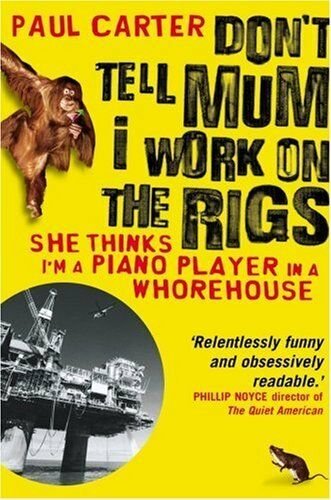
Or to give the book its full title “Don’t Tell Mum I Work on the Rigs: She Thinks I’m a Piano Player in a Whorehouse”. A series of real life stories of life on oil rigs around the world in some of the most dangerous places you could ever hope not to go to.

20190709 Don't tell Mum I work on the Rigs

Carter has written a really funny summary of some of his exploits in fifteen years working on oil rigs around the world and the scrapes he has got into whilst doing it. The book has a prologue with an extract from chapter nine which has him in business class on a scheduled flight from Port Moresby in Papua New Guinea; unfortunately with Amoebic Dysentery which strikes just after take-off. Now there is definitely nothing inherently funny about an explosive attack of dysentery, especially in a crowded aeroplane, but the way he writes about it is so vivid that you cannot help laughing at the situation.

The first chapter relates to his childhood and initial links to oil, He had a rough time in his early years with a domineering father who was in the RAF, eventually his mother left him taking the two children with her. She moved the family to Aberdeen and got a job in the oil industry where she would meet her second husband and subsequently got posted to Australia which is where Carter spent his adolescence and eventually some dead end jobs but he wanted to work on rigs. Ironically after his father left the RAF he also started working on rigs and Carter would sometimes meet people who had worked with him. As he says the work is all over the world but the actual people doing the work form a surprisingly small community and there are regular characters that keep turning up no matter where he is working.

In amongst the stories about offshore and land rigs, crazy holding accommodation and the horror stories you also get to learn a little about the oil business and definitely a lot about why being involved may be lucrative but also extremely dangerous. Carter has worked on all sorts and after proving his abilities has been freelance for four years at the time he covers in the book. He is obviously good enough at what he does to be wanted by numerous companies no matter what type of rig is involved.

20190709 Don't tell Mum I work on the Rigs 2

We go on a bounce around the world starting in Australia with a land rig in the Western Australia goldfields back in the early 1990’s where he learnt the trade as a labourer, or roughneck, and worked his way up and then mainly in the Asian oilfields. Apart from the dysentery, and the local wildlife trying to kill you this was relatively safe until it got to time away from the rig when men who work in a dangerous and frequently deadly job chill out by doing dangerous and sometimes deadly ways of not being at work. The wilder the country the more dangerous it was, not just from the locality but also the often poorly maintained equipment such as ancient helicopters.

Every time I read Upstream, an oilfield newspaper, there’s an article like this

Bumfuck Nowhere: all nine passengers and crew died yesterday, when a twelve seater Sikorsky helicopter operated by Doom Air crashed in a really big ball of flames shortly after take off from Bumfuck Nowhere regional airport. Witnesses say the helicopter fell for, oh wow, ages before vaporising into the jungle at 1592 miles an hour.

He also worked the Gulf and South America but the stand out awful places were Russia which  was cold, so very cold and really primitive and worst of the worst Nigeria which was so dangerous to work in that getting out alive was regarded as a bonus. Nowhere in Nigeria was without armed guards when not on the rig especially on the trip to and from the airport, his two predecessors for the job he had there had both been killed by fake taxi drivers before they had even made it to the camp for the first time.

But it’s not just about the oilfields you also get the ups and downs of his personal life and the surprising sideline he ended up doing which was in advertising in Sydney in his downtime between jobs. This is probably what honed his way with words and makes the book such a pleasure to read.

This is not a book for the easily shocked or offended, but you probably guessed that from the prologue so at least you have been warned. I loved it and need to get his follow up “This is Not a Drill”

The Royal Tour – Harry Price

20180925 Royal Tour 01

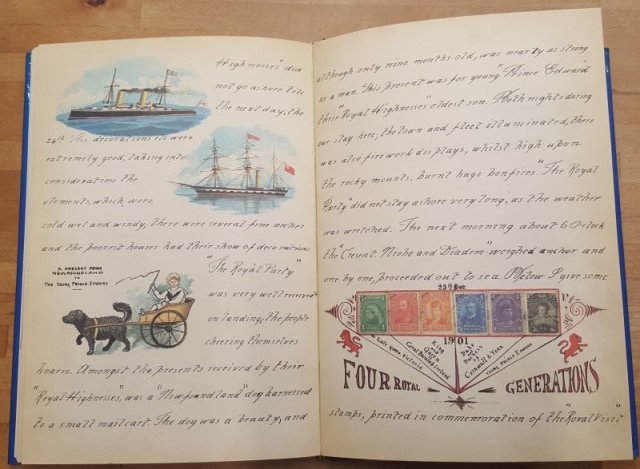
The facsimile of the diary kept by Petty Officer Harry Price on board the H.M.S. Ophir during the Royal Tour of 1901 was printed in 1980 by Webb & Bower of Exeter. Harry had died back in 1965 and it was his son Jack Price who showed it to the publisher and which led to the facsimile printing.  Sadly it’s no longer in print but it is readily available on the secondary market for just three or four pounds, which considering how attractive the book is has to be one of the great book buying bargains.

20180925 Royal Tour 02

Harry was a talented artist and had attended Birmingham School of Art before joining the Royal Navy where he rapidly progressed to Petty Officer before joining H.M.S. Ophir just in time for the nine month long world voyage of Prince George and Princess Mary. George held both titles of Duke of Cornwall and Duke of York hence the slightly odd description given and he would later become King George V on the death of his father in 1910.

20180925 Royal Tour 03

The tour was started just two months after the death of Queen Victoria and was probably seen as an opportunity to introduce the younger Royals to the Empire after the end of her sixty three year reign. The diary is in Harry’s handwriting just as he originally wrote it as the voyage was progressing and provides a fascinating view of the trip and the various onshore excursions he managed.

20180925 Royal Tour 04

According to the list at the front of the diary, the route was as follows: Portsmouth, Gibraltar, Malta, Port Said,Suez Canal, Aden, Colombo, Singapore, Albany, Melbourne, Sydney, Hawksbury River, Sydney, Auckland, Wellington, Lyttleton, Hobart, Adelaide, Albany, Freemantle, Mauritius, Durban, Simonstown, St Vincent, Quebec, Halifax, St. Johns and then back to Portsmouth.

20180925 Royal Tour 05

I am including pages in sequence as the trip progresses so we have already reached New Zealand where he comments on the weather on the right hand page above. The style is quite chatty and it is clear throughout the book that he is intending this to be a souvenir that he can show to other people rather than a private diary. To this end he records his personal experiences but as though telling the reader about them.

The sketch below was taken up the river, some fifteen miles above Christchurch where as you can see the scenery was most bewitching, but a hard frost setting in as the sun went down made matters a little bit disagreeable, to us, who only a short time ago, were under a scorching tropical sun.

The date at this point was the 27th June so midwinter in New Zealand.

20180925 Royal Tour 06

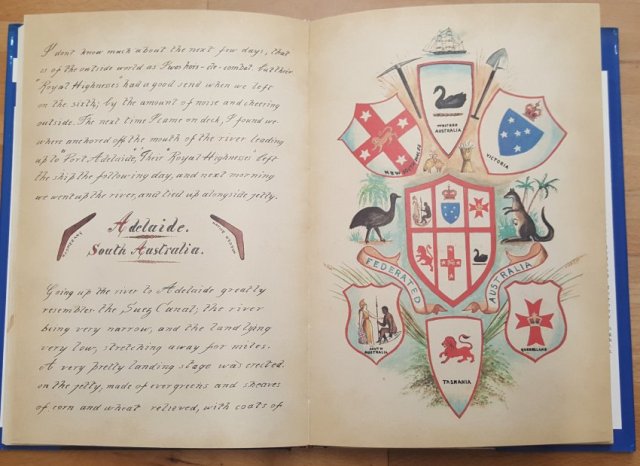
Returning to Australia Harry produced the very attractive full page picture of the various arms of the Australian states inspired by examples displayed along the banks of the Adelaide River, this time he didn’t get ashore but they did have ‘a visitors day’ where local townspeople could tour the ship and this proved so popular that they were almost overwhelmed by the numbers.

It is quite enough; when I say that quite a number of ladies fainted, and the bluejackets and marines had their handsfull

20180925 Royal Tour 07

I remember this book coming out and the original volume by Harry Price being shown on various TV programmes, the reproduction is extremely good but it can’t have been a particularly sound financial proposition for the publisher as it must have been expensive to print and it soon slipped from the list of titles they had available even though it clearly sold well judging by the number of copies available on abebooks. I bought my copy a few years later second-hand for £4, I know I wanted one at the time but I suspect it was beyond my teenage finances.

20180925 Royal Tour 08

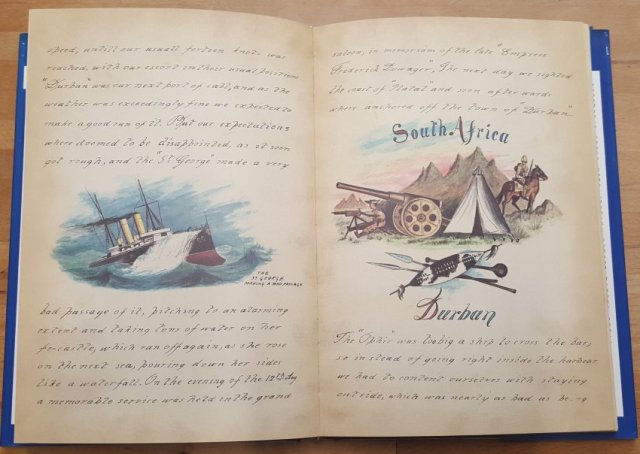
The crossing from Australia to Mauritius was surprisingly good for the Southern Indian Ocean but they hit bad weather crossing from there to South Africa as can be seen in Harry’s picture of their escort ship the St. George. It seems odd that South Africa was on the itinerary at all as the Boer War was in full progress with guerilla activity led by Louis Botha and Jan Christiaan Smuts in both the Eastern and Western Transvaal’s and Cape Colony respectively against the British occupation although by now the fighting really was going against the Boer forces. H.M.S. Ophir was protected by several British warships whilst in South African waters and the Royal couple had a significantly stronger armed guard with them whilst ashore whereas before the soldiers with them were largely ceremonial.

20180925 Royal Tour 09

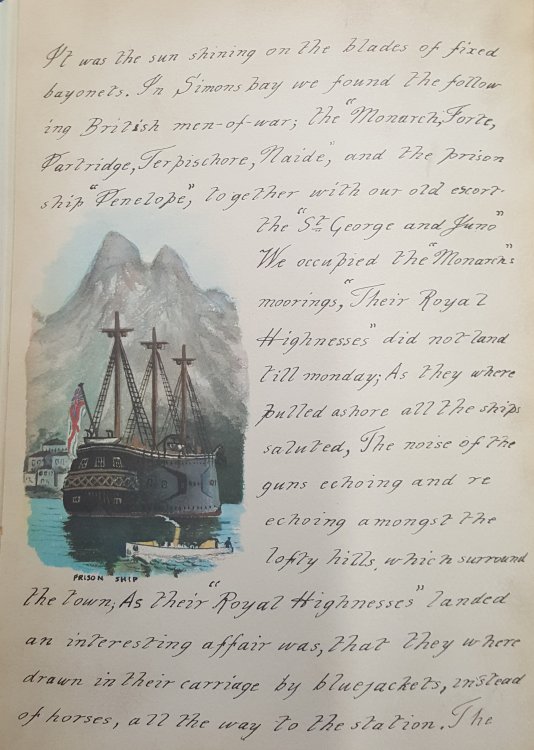
Harry Price even included an image of one of the POW ships moored off the coast, in total they spent less than two weeks in South Africa and three days of that was moving from Durban to Simonstown which was then (as now for the South African Navy) the main naval dockyard. They then set off for Canada via the Caribbean.

20180925 Royal Tour 10

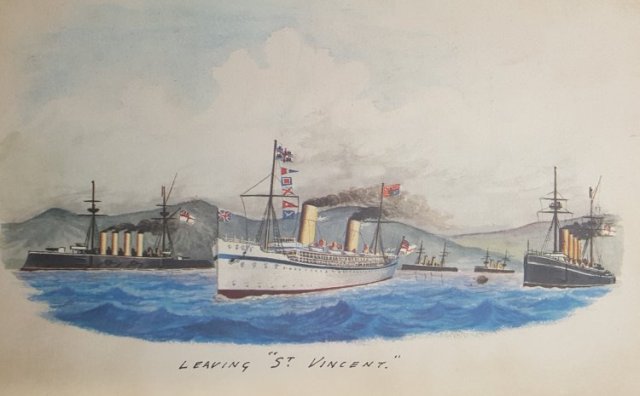
The strength of the Royal Navy at the time that the book was written can be judged by the fact that even leaving the small Caribbean island of St. Vincent there were four other naval ships available to escort the Ophir as it left the territory two of which are described as over 12,000 tonnes and in excess of 500 feet in length. There then followed a journey of ten days solid cruising up the eastern seaboard of the United States to Canada during which the American President William McKinley was assassinated and it is specifically mentioned that all the Royal Naval ships waiting for them in Quebec were also flying the American stars and stripes at half mast in respect.

20180925 Royal Tour 11

For the visit to Canada the Duke and Duchess disembarked and travelled for over a month via railway all over Canada. The Ophir waited for their return in Halifax, Nova Scotia and during that period was fully repainted and all needed repairs done. Discipline was clearly somewhat more relaxed than when the royal couple were aboard and this provided a break for the crew apart from their duties refurbishing the ship in dry dock.

20180925 Royal Tour 12

The final page I have included features a set of stamps issued in Canada to mark the royal visit and describes preparations to leave Canada and sail back for home. The book is a fascinating and beautiful historical document with almost every page decorated by Harry’s watercolours and one I like to pull off the shelves quite often, not just to read but sometimes just to enjoy the pictures.

Raw Spirit – Iain Banks

20180911 Raw Spirit

‘Hiya Banksie! Written any good books lately?’
‘Not if you believe certain critics, but I’m going to be writing one about whisky.’
‘A book about whisky?’
‘Yeah, malt whisky.’
‘You’re kidding!’
‘Not as such.’
‘This mean you’re going to have to do the “R” word?’
‘The “R” word? Oh! Research? Yeah basically. Goin to have to drive round Scotland, take trains, ferries, planes and such, go to distilleries, taste whiskies, that sort of -‘
‘And they’re going to pay you for this?’
‘They’ve already started.’
‘Right I see. D’you need a hand?’

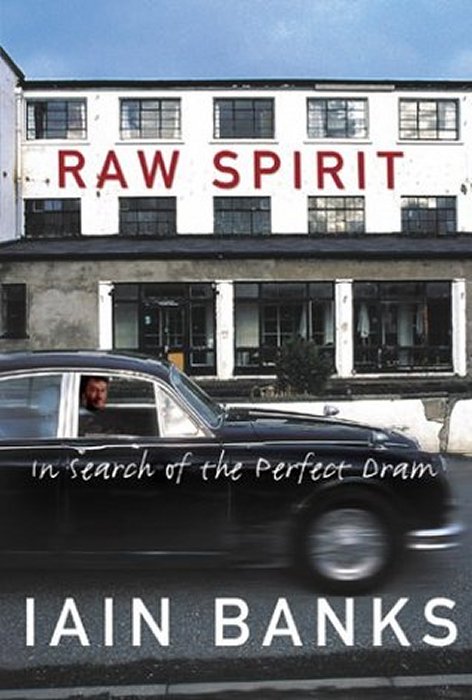
So begins Iain Banks’ Raw Spirit: In Search of a Perfect Dram and those people familiar only with Iain M Banks the gritty science fiction writer or his even grittier ‘normal’ fiction written as Iain Banks are in for a surprise as this is a genuinely funny book interspersed with rants about the Second Iraq war which had just started as he set of in search of the “R” word. As a fan of both Banks and whisky, purchasing this book when it came out did not take much consideration and I recently pulled it back off the shelves as later this year I’m doing my own trip round some distilleries and like Banks I’m starting with Islay.

Rereading the book was a surprise, my 14 year old memory of what was covered is clearly faulty, yes there is whisky aplenty and distilleries also get pretty good coverage but a large part of the book is really about Banks’ love affair with Scotland and its “Great Wee Roads” or GWRs as they are referred to throughout. There is a lot more said about getting to the distilleries (both the roads and vehicle chosen to make the journey) than there is covering them or their production. There is also a considerable amount of reminiscences of past holidays, fun times in out of the way properties and time spent with old friends. The book is really as close as we ever got to an autobiography by Banks who sadly died in 2013 from cancer aged just 59. If you want a book about whisky then you are really better off with Michael Jackson’s definitive tome, but if you want a book about the joy of travelling around Scotland looking for whiskies and the friendships and fellowships that it can engender then this is for you.

Let’s take a random chapter and breakdown the coverage of each subject, “12: Porridge and Scottishness, Football and Fireworks” has a total of 20 and a bit pages:

  • Porridge, why he doesn’t like it and other Scottish institutions such as kilts – 2½ pages
  • Six distilleries visited and their whiskies – 7 pages
  • Memories of Monty Python (he was an extra in one of the films)  – 1 page
  • Memories of blowing things up (fireworks with mates) – 4½ pages
  • Travelling – 1 page
  • The joys and tribulations of following Morton Football Club – 4 and a bit pages

That seems to be a pretty average hit rate for the theoretical subject of the book, although the travelling to whisky ration is normally higher than that, at least after you get past chapter one where Banks does stick more closely to his brief. That is not to say that I didn’t enjoy the book, I very much did so, it’s an easy read and you want to follow Banks around the country as he enjoys the scenery, samples whisky and chats with old mates. You feel by the end that the Raw Spirit of the title is more the spirit of Scottishness rather than Scotch and it’s good fun.

As a final note my copy is the first edition hardback printed by Century in 2003, that also appears to be the only Century edition as by 2004 it was a paperback with a completely different cover published by Arrow. Both of these are imprints of Penguin Random House.