The Crusades Through Arab Eyes – Amin Maalouf

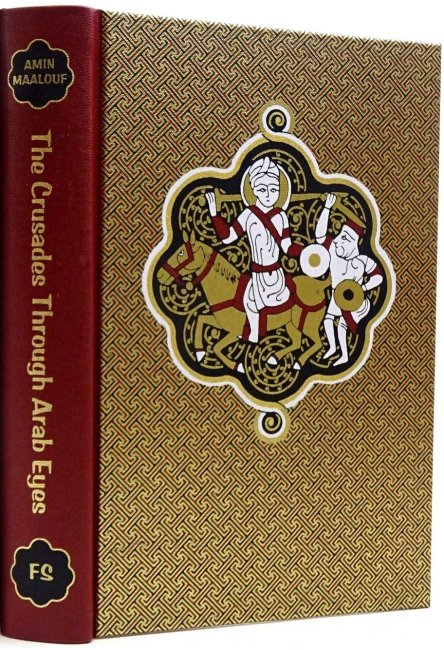
I’ve read several accounts of the Crusades but all from the perspective of the Christian west so it was fascinating to read this version from the Islamic side. The first thing you discover is that the invaders were not taking on established states, but rather what was mainly individually controlled cities and towns which were sometimes in loose alliances but more often were warring amongst themselves making them relatively easy prey for the more organised crusader forces. Certainly for the first hundred years or so of the crusader conflicts whenever an Islamic ruler died there would invariably not be a clear successor so internecine warfare would break out making the city and its surrounding territory ripe for conquest by not only the crusaders but also the neighbouring city states that were, in theory at least, on the same side. What the Islamic forces lacked was a leader that most of them would follow and this was why the crusaders found the invasion of the holy lands relatively easy in the beginning and with a couple of short lived exceptions this would be the case until the rise of the Kurdish officer Salah al-Din Yusef known in the west as Saladin, who had gone to Egypt with his father in 1173 as a young man despite having no appetite for warfare and ended up the effective ruler of Egyptian lands but still nominally under the control of Nur al-Din from Syria who had sent the army in the first place. The complex interrelationships between the various states and warlords with the added mix of a fanatical sect founded in the 1070’s by Hasan Ibn al-Sabbah who became known as the Assassins. Although these killers would operate independently they were often paid by various rivals, or even other family members to remove people in the way of their own rise to power. How these original assassins operated is described in the book.

Although the preparation was always conducted in the utmost secrecy, the execution had to take place in public, indeed before the largest possible crowd. That was why the preferred site was a mosque, the favourite day Friday, generally at noon. For Hasan, murder was not merely a way of disposing of an enemy, but was intended primarily as a twofold lesson for the public: first the punishment of the victim, and second, the heroic sacrifice of the executioner, who was called fida’I or ‘suicide commando’ because he was almost always cut down on the spot.

This constant warfare amongst the various states and cities lasted long into the Crusade period and the various parties rarely agreed on alliances to take on the invaders and when they did, at least initially had nothing that would allow them to ambush knights in armour as they had no equivalent defences so hadn’t developed weapons to defeat them. But the book is not all negative regarding the Islamic resistance there were leaders who could push back the Crusaders, at least temporarily, before Saladin and he had a bad habit, at least in a war leader, of being too merciful to those he defeated often simply sending them away, along with their armaments, leaving them free to attack again at a later date or surrendering territory in the hope of achieving a more lasting peace

The book is fascinating, especially if you have read any of the various western accounts of the period, I will be reading The Chronicle of the Crusades by Geoffrey of Villehardouin and Jean de Joinville at some point next year, the book is already on my shelves, and this will round off the overview of the Crusades I started with T.E Lawrence’s book on Crusader castles which I read at the start of this year. It’s a period of history I remember reading a lot about whilst at school both as set texts and independent study and this book has certainly given me a lot to think about with its alternative viewpoint.

Guerrilla Warfare – Che Guevara

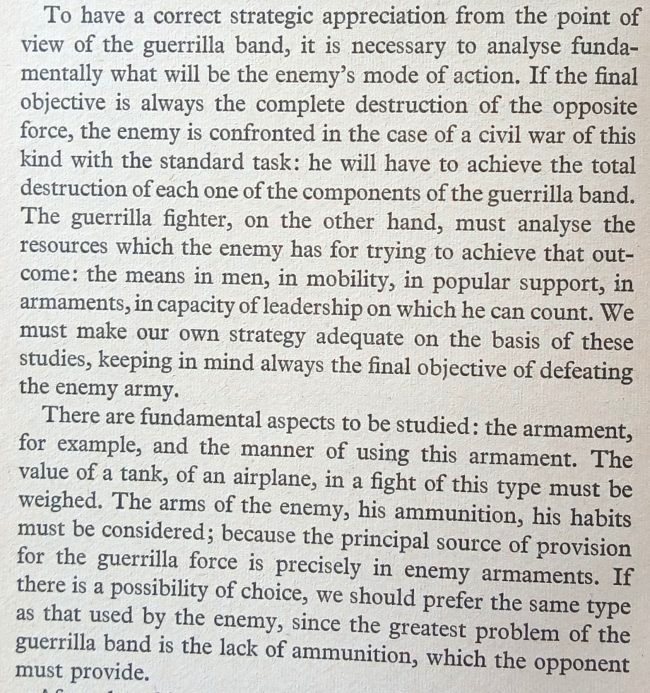
I have known of the existence of this book for many years and was somewhat confused that a book first published in the USA in 1961 and then in the UK by Pelican Books in 1969 was so elusive. I wanted it because I thought it would be a logical follow up of ‘The Motorcycle Diaries’ which I reviewed back in June 2022 and which very entertainingly covered a trip around South America by Guevara and his friend Alberto Granado whilst Guevara was studying to become a doctor. This book I assumed would cover his time as part of the Cuban revolution leading to his promotion as second in command below Fidel Castro and the ultimate overthrow of the Batista regime, But no I have since found out that a book I hadn’t previously heard of ‘Reminiscences of the Cuban Revolutionary War’, also written by Guevara and published in Pelican along with this book in 1969, performs that function. So what is ‘Guerrilla Warfare’ about? Well here we are probably coming to the reason it is so difficult to find, as it is basically a handbook on how to run a popular insurgency, from recruiting fighters to how to actually run a guerrilla band, feeding and clothing them, obtaining arms and proposed combat methodology. A look at the contents list gives an idea as to what to expect.

Despite not being what I expected the book is fascinating and gives an insight into the way a guerrilla band operates with some of the problems which come from operating in a secret way and some things that are different with a regular army. For example the chapters on warfare on favourable and unfavourable ground are diametrically opposite to a ‘normal’ army in that favourable ground for the guerrilla is the mountains and jungle where they can easily melt away or establish defensible positions whilst a regular army likes more open country where their heavy vehicles can move easily and this is precisely what a guerrilla army counts as unfavourable. Likewise armaments for a guerrilla fighter is largely restricted to rifles, preferably not fully automatic, and hand guns with homemade grenades or Molotov cocktails. The army on the other hand can utilise aircraft, tanks and tripod mounted machine guns which are too heavy to be easily moved by hand, which is usually how a guerrilla band would need to move them and quickly use far too much ammunition, which is always in short supply until they manage to capture more. Guevara explains that should a heavy machine gun be captured by all means use it but be prepared to abandon it if pressed as it is simply not worth the effort of carrying it away during combat. Guevara also says that a bazooka is an excellent guerrilla weapon let down by its size and the fact than a man can only just carry three shells any distance due to their weight and even then someone else has to carry the shoulder mounted launcher.

The need to capture ammunition also applies to most of the guns and rifles used by a guerrilla band, it is far easier to obtain these from the enemy than try to smuggle armaments in from outside, it also means that the ammunition is the same thus largely getting round the difficulties of supply. The section I have included below makes the distinction between a revolutionary and a terrorist in that a terrorist is indiscriminate in his targets unlike the more focused revolutionary. In another section Guevara also dismisses gangs of bandits as preying on the poor population whilst the revolutionary is there to support them, although he admits that the guerrillas will need food and clothing which the peasant agrarian economy must provide as they are the only practical source. But he explains that whenever possible this should be paid for either with cash or promissory notes which should be honoured as soon as possible. How likely this is to actually happen isn’t explained.

It should be pointed out that Guevara had a reputation as a ruthless fighter and unforgiving disciplinarian, executing deserters from his troops. But none of this is mentioned in this work which, whilst not glorifying Guevara as he isn’t mentioned by name, is more a guide on how to operate a revolutionary force at least in the context of 1950’s/60’s South American environment, which is almost certainly why it is no longer in print and copies are so difficult to come by. It was an unexpectedly interesting read and I have deliberately not included some of the more specific sections on armaments and tactics in this review.

Vietnam! Vietnam! – Felix Greene

This post is being published on the 29th April 2025, the day before the fiftieth anniversary of the surrender of South Vietnam and the ending of the Vietnam war, the Vietnamese by the way refer to it as the American war. The choice of this book amongst several that I have on the conflict was pretty well certain as over half the book consists of photojournalism and the balance a series of essays detailing in chronological order what led up to the war and the first ten years of the fighting. Even though Greene was a British journalist the book was first published in 1965 in America, with still eight more years of American involvement and beyond that two years of the slow push down the country by the North until they finally prevailed. That this book was written roughly half way through the war would have horrified its author who, at least partly, hoped that exposing just what was going on might have hurried the end. My copy is the 1967 British paperback edition by Penguin Books.

By going back to the French Indochina colonies pre WWII and taking the story of how America came to be fighting there the twenty two essays that make up the second half of the book largely follow a historical progression. So how did America get into this mess? Well it turns out that when the French were kicked out by the invading Japanese during WWII they were determined to regain control of their colonies just as the Vietnamese, along with the populations of Cambodia and Laos for that matter, saw an opportunity to gain independence at the end of the war. There was a short lived declaration of independence for all of Vietnam but the French did re-invade in 1946, however they needed American assistance, which was forthcoming as part of the anti-communist sentiment in American politics through the 1950’s and this led to them supporting the extremely unpopular puppet president Diem with ever increasing military power initially in the guise of ‘advisers’ and ‘trainers’. The French eventually gave up and left leaving the Americans, who by then were financing roughly three quarters of the military push and supplying arms despite the Geneva accords of 1954 which said that foreign forces should not be in Vietnam and there should be elections within two years leading to reunification of Vietnam. America and France, despite being signatories to these agreements had no intention of allowing them to happen.

Picture by Kyoichi Sawada – United Photo Industries (UPI)

And so we ended up with America fighting the Vietnamese under the guise of preventing North Vietnam gaining control of the south but in fact the National Liberation Front, known outside of the country as the Vietcong, set up in 1960 was entirely composed of people from the south who wanted the foreign forces out of their country and the weapons they used were almost entirely from deserters from the American backed Vietnamese troops.

I have been selective in which photos to use from the book as a lot of them are far more shocking than the example of American torture shown above and include the famous picture of the monk, Thich Quang Duc, sitting and burning in the road as he set fire to himself in protest at the ongoing conflict in June 1963. In truth the photographs are far more telling than the essays, especially when juxtaposed with quotes which clearly don’t match the images such as the destroyed houses below.

Photo by Felix Greene

There are clearly books that look back on the war with the benefit of hindsight which I could have reviewed but I was drawn to this work written during the middle of the conflict. It may not be the most dispassionate summary of what was going on but Greene was trying to make sense of what he witnessed whilst reporting and for that it is a fascinating book.

Top photo by Bob Ibrahim UPI, bottom photo un-credited UPI

I travelled the length of Vietnam in 2007-8 and was lucky to have three very different guides which could provide alternate viewpoints. Starting in the south the guide was an older gentleman who had lived through the defeat of the south a a civilian and could talk about the pulling out of the American forces and the advance of the troops from the north leading to the surrender. In central Vietnam our guide was an ex Vietcong fighter who still walked with a limp from a war injury sustained in Hue, whilst the north was explained by a man in his early twenties who had never known anything other than a unified country. I doubt it is possible to have such an interesting selection of guides nowadays fifty years on from the end of the conflict and I’m glad I went when I did.

Revolution Day – Rageh Omaar

This book, Rageh Omaar’s first, starts with him being the first BBC journalist allowed into Iraq after five years in September 1997. He had become the BBC Middle East correspondent that summer and had straight away applied for a visa for Iraq not really expecting it to be granted as anyone from the BBC was persona non grata in the country since the end of the Gulf War in 1991. But Omaar is not the white middle class reporter expected by the regime, rather he was born in Mogadishu, Somalia and speaks fluent Arabic so amazingly they let him in. The book would be fascinating enough if it just dealt with the next six years whilst Omaar gets to know Baghdad and develops friendships with not just his team but ordinary Iraqis, finds a regular tea shop and chats to locals providing an insight to daily life in a country few of us have had a chance to visit. Of course during that time Omaar only spent a few weeks or months at a time in Iraq, he had the entire Middle East to cover and in 2001 and 2002 he was in Afghanistan reporting on the fall of the Taliban, I’d love to read a book by him about that time as well. But at the end of 2002 he was back in Iraq as US President George Bush Jr and British Prime Minister Tony Blair falsely accused Saddam Hussain of having weapons of mass destruction that he would be willing to use and decided on regime change in Iraq as part of the Global War on Terror started following the attack on the Twin Towers in New York in September 2001, which Iraq had nothing to do with.

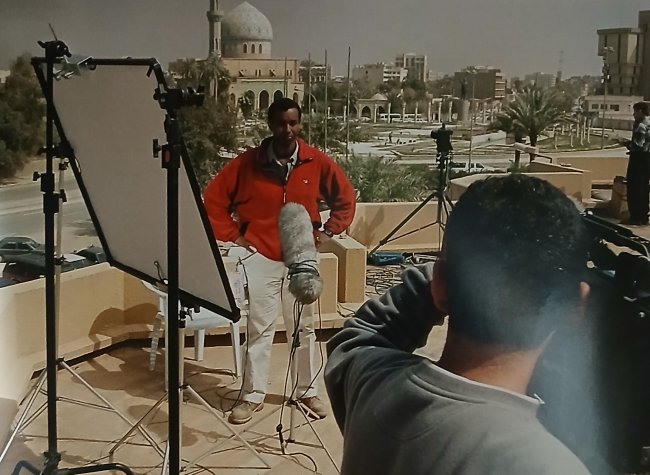
As 2003 began it became clear that despite the lack of a UN resolution supporting such action America was going to lead a coalition force including Britain in invading Iraq and journalists and their teams were given the opportunity to get out of the country. Despite it clearly being highly dangerous, especially for news teams from countries involved in the invasion, Omaar and a much reduced team decided to stay. The picture above is of them filming on top of the Palestine hotel in central Baghdad with the 14th of Ramadan mosque behind him during the invasion, just three days later they would be in the same place when the Americans bombed the hotel, the impact knocking them flat and killing at least one member of another news team. This is despite the much vaunted precision guided weaponry in use in the conflict and the location of the hotel and the use it was being made of by a lot of journalists still in the country being clearly flagged to the invading forces.

The descriptions of just how the news reports were made and transmitted from the middle of a conflict zone are really interesting and Omaar’s continuing ‘normal’ life in Baghdad interacting with ordinary people, still going to his favourite tea room etc. adds greatly to the story he is telling. I remember hearing him being interviewed from London on a satellite phone as bombs and missiles rained down around him but it is the calls made on the same phone to his wife and family afterwards to assure them he was OK that bring home the fragility of his and his crews existence at the time.

The book has an epilogue where he goes back to Iraq a few months after the invasion and speaks to Iraqi’s about how they are surviving after the conflict and the mismanagement of the country by the victors, who didn’t seem to have a plan for what to do afterwards, is well worth reading, as of course the whole book is.

A Shropshire Lad – A E Housman

I have lived in Shropshire for the past eleven years and have seen copies of A Shropshire Lad numerous times in various bookshops across the county but never bought it. I think mainly because I knew that Housman never visited Shropshire before writing this collection of poems celebrating the county and he only came here briefly after becoming permanently associated in the public’s mind with Shropshire so doubted that he would have much insight into this extremely beautiful part of England. Sure enough whilst reading it became clear that even geographic details, which he gleaned from a tourist guidebook whilst writing the poems in London, were incorrect but the poems are not really about Shropshire anyway but about war and the untimely death of youths both in conflict and otherwise, including suicide. It cannot be described as a cheery read.

Let’s tackle a couple of the poems with more glaring geographic issues first just to get these out of the way, starting with one of the few poems to have a title rather than just a number, XXVIII The Welsh Marches which starts

          High the vanes of Shrewsbury gleam
          Islanded in Severn stream;

Well Shrewsbury may be built in a loop of the river Severn but it certainly isn’t on an island, indeed Shrewsbury castle stands guard on the northern side of the river defending the land entrance to the town. The poem continues in it’s fourth verse with

          When Severn down to Buildwas ran
          Coloured with the death of man,

Buildwas is roughly seventeen miles (27½ km) from Shrewsbury and the river has a significant volume by then so there is no way that blood from a Saxon battle, which would have involved hundreds rather than tens of thousands of combatants at that period of history, would still be visible in the water by the time it got there. The most obvious error though is in poem LXI Hughley Steeple, I don’t even need to quote the poem as Hughley church has a timber framed belfry but it certainly doesn’t have a steeple. But that doesn’t stop Housman giving it one with a prominent weather vane on top, which it also doesn’t have.

Ludlow gets mentioned in five of the sixty three poems and Wenlock Edge, which is a nineteen mile (30 km) long escarpment appears twice. Although even in, probably the most famous poem from the set, known as ‘On Wenlock Edge’ although not actually titled, geography isn’t Housman’s strong point as it mentions the Roman city of Uriconium, the ruins of which are fifteen miles (24 km) from Wenlock Edge. But the poem is a really good example of the style of the collection and has been set numerous times to music, most notably by Ralph Vaughan Williams who included other poems from the set as well in his song cycle On Wenlock Edge.

          XXXI

          On Wenlock Edge the wood's in trouble;
           His forest fleece the Wrekin heaves;
          The gale, it plies the saplings double,
           And thick on Severn snow the leaves.

          'Twould blow like this through holt and hanger
           When Uricon the city stood:
          'Tis the old wind in the old anger,
           But then it threshed another wood.

          Then, 'twas before my time, the Roman
           At yonder heaving hill would stare:
          The blood that warms an English yeoman,
           The thoughts that hurt him, they were there.

          There, like the wind through woods in riot,
           Through him the gale of life blew high;
          The tree of man was never quiet:
           Then 'twas the Roman, now 'tis I.

          The gale, it plies the saplings double,
           It blows so hard, 'twill soon be gone:
          To-day the Roman and his trouble
           Are ashes under Uricon.

As said above most of the poems don’t concern Shropshire in particular but rather the perils of war and death. The collection was first published in 1896 but didn’t really start to sell in significant numbers until the start of the Second Boer War and massively rose again during the First World War when the death of young soldiers was so keenly felt across the country. The overall body count across the series of poems is surprisingly high and it is nearly always young men who are speaking from the grave (a common theme of the poems) to those yet to die. I don’t really know what I expected from the poems as I genuinely didn’t know anything about them apart from the title before I came to read the book but I can’t say they particularly appealed to me. There is however a brief glimpse or two of albeit grim humour amongst the largely unrelenting gloom.

          XXVII

          "Is my team ploughing,
           That I was used to drive
          And hear the harness jingle
           When I was man alive?"

          Ay, the horses trample,
           The harness jingles now;
          No change though you lie under
           The land you used to plough.

          "Is football playing
           Along the river shore,
          With lads to chase the leather,
           Now I stand up no more?"

          Ay, the ball is flying,
           The lads play heart and soul;
          The goal stands up, the keeper
           Stands up to keep the goal.

          "Is my girl happy,
           That I thought hard to leave,
          And has she tired of weeping
           As she lies down at eve?"

          Ay, she lies down lightly,
           She lies not down to weep:
          Your girl is well contented.
           Be still, my lad, and sleep.

          "Is my friend hearty,
           Now I am thin and pine,
          And has he found to sleep in
           A better bed than mine?"

          Yes, lad, I lie easy,
           I lie as lads would choose;
          I cheer a dead man's sweetheart,
           Never ask me whose.

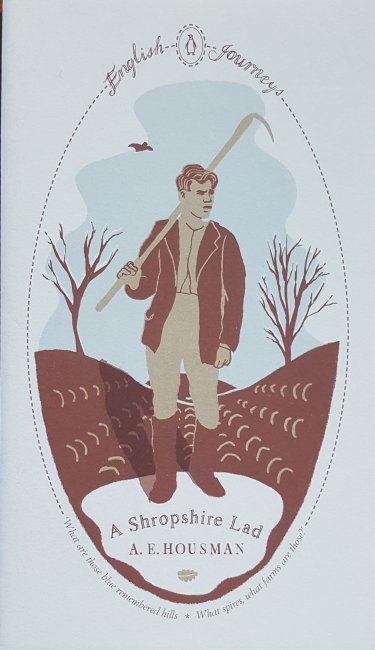
My copy is from the 2009 series of twenty books by Penguin called ‘English Journeys’ and I do have the complete set, all of which have very attractive covers. If there is any of these that you would like me to cover in a future blog entry then please send me a comment.

The Perilous Descent – Bruce Carter

20200526 Perilous Descent 1

I probably first read this book about forty years ago when I was the age it is most likely aimed at, what would now be classed as Young Adult by the publishing world, and I doubt I have read it since although the copy I have is still the one I had back then. I had no real interest in books as objects back then so never noticed that it is the first edition printed by The Bodley Head in 1952. The dust wrapper is missing, assuming I ever had one, which I doubt as I would have been careful with it even then and I would have bought the book from a second hand bookseller sometime in the mid to late 1970’s. I do know however that the picture on the wrapper was the same as the frontispiece reproduced above, with the title on the larger parachute and Bruce Carter on the smaller one.

Bruce Carter is the pseudonym of Richard Hough, which he used for the half dozen children’s books he wrote, with more than a hundred more titles in his own name which were mainly regarding ships or wartime escapades although he also wrote a few biographies. In 1952 he was working for The Bodley Head, hence his choice of publisher, and in the 1960’s he moved to Hamish Hamilton where he ultimately rose to the position of Managing Director of the children’s book division, Hamish Hamilton also published this book amongst others by him whilst he worked for them.

The Perilous Descent is a rollicking Boy’s Own adventure story apparently written in alternate chapters by the two Typhoon pilots Danny Black and Johnny Wild who were shot down at the start of the book on their way back to England ultimately ending up on a sand bar about a mile off the Dutch coast sometime in 1944. Hough was himself a Typhoon pilot in the war and had to make a forced landing after being hit during which he badly broke his leg which never properly healed although he lived until 1999. This first hand knowledge as to what the two protagonists would have with them regarding survival aids and how they could use the equipment they had certainly adds to the tale as they try to eke out their meagre rations after falling down a hole on the sand bar and into some mysterious tunnels. Ultimately the only way forward is down a huge cavern but fortunately they still have their parachutes so that is what is depicted in the frontispiece as they drop over 25,000 feet to the unknown world below.

20200526 Perilous Descent 2

The land and people they encounter far below the Earth are a strange mix of sixteenth century language, clothes and armaments along with futuristic cities and transport as can be seen in the image above, it is also not a friendly welcome. It turns out that a rebellion had recently occurred and they had been mistaken for some of the rebels, they soon manage to convince the Governor that they are nothing to do with the insurrection and are enlisted to take part in a surprise attack on the rebel stronghold. The story races along and I found myself reading longer sections in one go than I intended to and the denouement, which is foreshadowed in the introduction, has a nice twist right at the end.

The book appears to be no longer in print and I suspect that the Puffin Books edition that came out initially in 1958 and was still being reprinted up until at least 1977 was the last available publication. Children’s books related to the war fell out of fashion around then and although I have greatly enjoyed this nostalgic read I doubt the book would be a commercially viable publication nowadays.

Homage to Catalonia – George Orwell

This wasn’t the book I intended to read this week, but my friend and fellow book blogger Mixa in Barcelona (read her review here) saw a copy on my shelves and has tracked down a copy in Catalan so I thought it was probably about time to reread the book after a gap of about twenty years so that it would be fresh in my mind when she wants to talk about it. Nowadays Orwell (real name Eric Blair) is almost entirely known as a novelist and his journalism is largely and sadly neglected. Homage to Catalonia even started out being neglected. It was first printed on 23rd April 1938 and a year later by the start of WWII it had only sold around 900 copies and soon after went out of print. It would only be available sporadically until Penguin Books printed a copy in March 1962, since then it has never been out of print.

20181030 Homage to Catalonia 1

The book tells of Orwell’s experiences fighting in the Spanish Civil War as part of an international militia against the uprising of General Franco and he is very clear that this is the war as he saw it and for the most part it is a very readable account. There are two chapters where he attempts to make sense of the alphabet soup of political organisations and militias taking part and these are prefaced by clear warnings that it is about to get complicated, as shown in the below extract from paragraph two of chapter five…

At the beginning I had ignored the political side of the war, and it was only about this time that it began to force itself upon my attention. If you are not interested in the horrors of party politics. please skip; I am trying to keep the political parts of this narrative in separate chapters for precisely that purpose. But at the same time it would be quite impossible to write about the Spanish war from a purely military angle. It was above all things a political war.

What follows is a section I’m glad I read because I had to keep referring back to it to sort out in my mind the differences and indeed the similarities between PSUC, POUM, FAI, CNT, UGT, JCI, JSU and AIT all of which were political parties or trade unions or possibly both, it does get very confusing, especially as in theory they were all aligned against the Fascists of Franco but seemed to spend most of the time fighting and bickering amongst themselves. This was particularly true during the short lived Barcelona uprising that Orwell got caught up in by happening to be on leave from the front after 115 days and arrived back in the city just before it all got even more complicated. But I am getting ahead of myself lets get back to chapter one with Orwell arriving in Barcelona with his wife, intending to write about the war but actually enlisting as a member of the POUM militia within days of getting there.  His wife Eileen stayed in the Hotel Continental in Barcelona throughout their time in Spain whilst Orwell was fighting on a front line less than 170 miles away. The photo below is by Robert Capa and is part of the John Hillelson Agency collection and shows the sort of trenches Orwell would be in.

20181030 Homage to Catalonia 3

Initially Orwell writes of his surprise on arriving in Barcelona in December 1936 that unions and workers parties had taken over the city and everywhere he saw the red and black flag of the Anarchists who were in control. This appealed to the socialist principles that Orwell espoused and it was probably this that led him to opt to fight for them rather than simply report on the situation. Unfortunately for him later he chose the wrong set of initials to join up with, but as he had said above the internecine politics hadn’t registered with him at first and he effectively just joined the first group that would have him. The first chapter covers the ‘training’ or rather lack of it he received in the Lenin barracks the poor conditions and the largely useless equipment they were issued with, chapter two has him on his way to being posted to the front where he was finally issued with an ancient rifle.

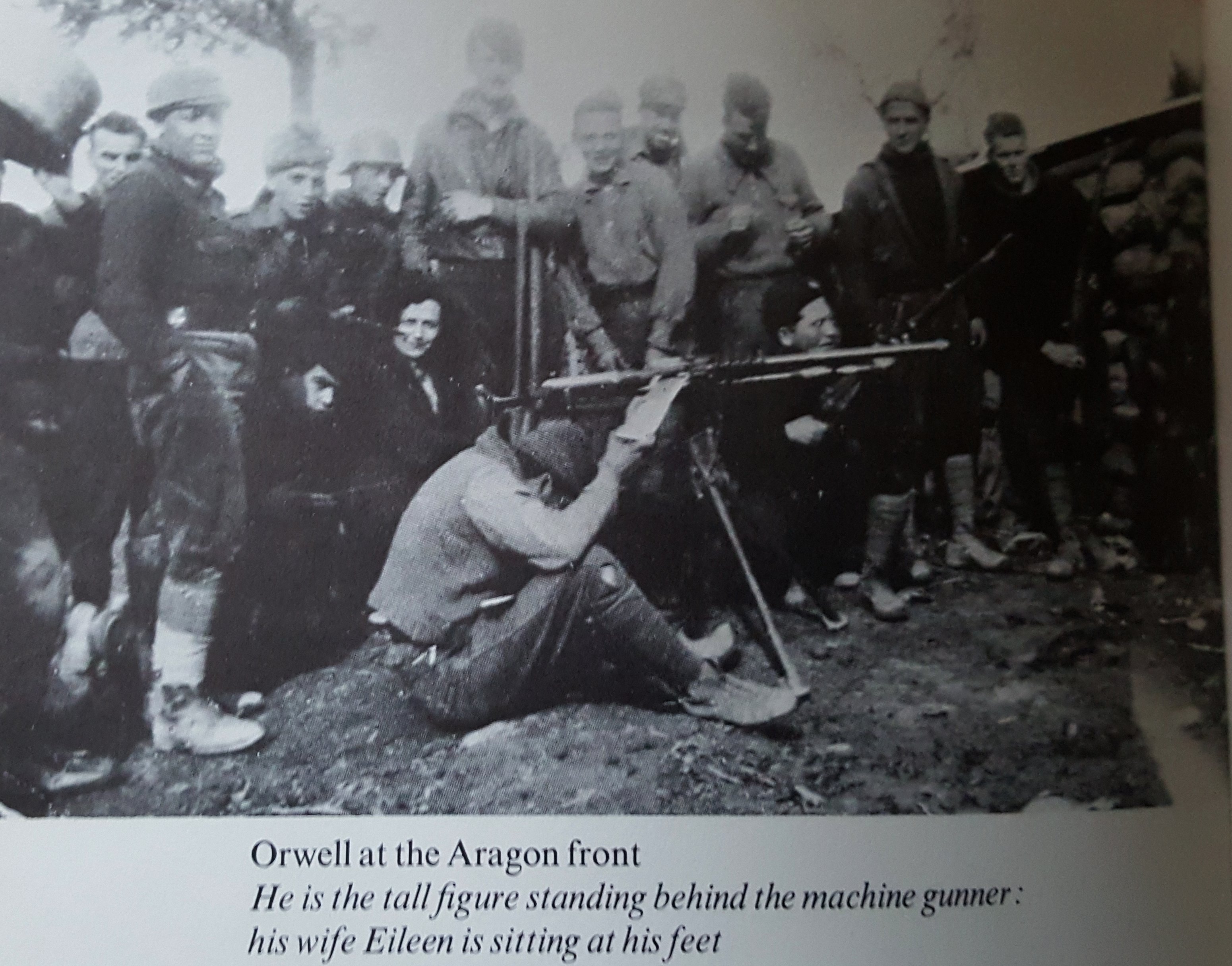
Chapters three and four tell of his time in the trenches above Zaragoza on the Aragon front, a place where the 6 foot 3 inch Orwell was clearly unsuited being head and shoulders taller than his fellow militiamen as can be seen in the photo below from the University College, London collection and reproduced opposite page 65 of my edition.

20181030 Homage to Catalonia 2

The time there was largely one of freezing temperatures, squalor and boredom, the two front lines were so far apart on opposite mountain tops that only by the merest chance could anyone be hit by firing from the opposition. What wounds and deaths did occur were mainly accidents of the sort you get when you hand unreliable weapons to 15 year old boys without showing them how to use them. The real oddity in the photo above though is that Eileen is there so she must have made a trip up from Barcelona although Orwell doesn’t mention her doing so in the book.

After the first of the political chapters, chapter six has him still bored at the front line

Meanwhile nothing happened, nothing ever happened. The English had got into the habit of saying that this wasn’t a war, it was a bloody pantomime.

and reflecting on the effect that the war was having on the local population who were largely trying to live their lives as best they could. In chapter seven Orwell finally sees some action, it was decided to crawl at night across the hundreds of yards of no man’s land and attack the fascist line. It did not go well and although they did get into the enemy trenches they were told to retreat before morning and that would be the only time he faced the enemy in actual combat. Chapter eight is very short and is largely concerned with preparations to go on leave back to Barcelona.

Chapters nine, ten and eleven all concern his badly timed break back in the city. On his return he discovered that the workers revolution had largely petered out and life had returned to a sort of normality with the war something happening in the distance.  However this was not to last long, the tensions between the various groups was about to explode onto the streets and on the 3rd of May fighting began, initially at the telephone exchange but rapidly spreading through the main thoroughfares.  Orwell is caught up in the middle of this but it rapidly becomes as much of a stalemate as the ‘fighting’ on the front. The various factions take up strategic positions and sort of agree amongst themselves to not shoot each other. These chapters for me are the most interesting of the book, the endless boredom of the front is at least improved here by not only the considerably more action but also the shortness of the time scale before it all came to an end.

Chapter twelve sees Orwell return to the front but this was to be for a very short time as he was soon wounded by a shot through the neck which saw him invalided out. By this time he was increasingly disillusioned by the war, what he had seen in Barcelona had convinced him that this was not the great and noble calling that he once thought it was and his choice of POUM was about to become a major problem. Whilst in hospital and then trying to get his discharge papers signed off POUM were picked on as the scapegoat for the fighting in Barcelona and all members were to be arrested and probably shot as traitors. As he describes it this was definitely untrue but it was a convenient fabrication to allow the other factions to re-unite behind. So as well as being wounded he was now a wanted man. In the last two chapters he and Eileen manage to escape Spain and he reflects on his experiences. His conclusions went strongly against the narrative being pushed in the socialist press in the UK which he also heavily criticised and this meant that getting the book published proved difficult as his normal publisher wouldn’t take it.

The book is a fascinating study of the realities of war, the long periods of tedium enlivened by occasional periods of firing from the trenches in the beginning of the book through the difficulties of conflict within a city and is also surprisingly funny in places as he enlivens the tale. All in all it deserves to be better known. When most people think of Orwell what usually comes to mind is 1984 or Animal Farm, try his reportage, it is definitely worth seeking out.

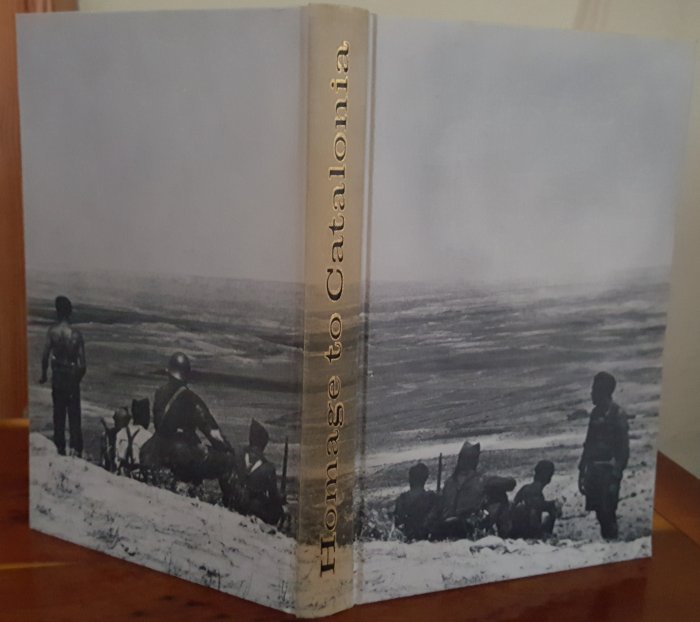
My copy is the 1970 Folio Society first edition which was popular enough to have two further reprints in 1972 and 1975 before dropping out of the Folio catalogue until 1998. It then re-appeared as part of a five volume set of Orwell’s reportage along with “Down and Out in Paris and London”, “The Road to Wigan Pier” and two volumes of journalism and essays. This set has as yet not been reprinted. Although bought second-hand and with a badly sunned spine and grubby covers that don’t want to clean, what I like about this edition is the inclusion of contemporary photographs of Orwell and other people mentioned in the book on the front line. Regrettably not any by Orwell himself because as he explains in the book his camera and photographs were all stolen or impounded along with his notes and press clippings at various different times whilst he was involved in the war. I have reproduced a couple of the photos from the book above. The cover illustration is a view of the battlefield near Belchite on the Aragon front and is from the Fox Photos Ltd collection.

How to Avoid Being Killed in a War Zone

20180703 War zone 01

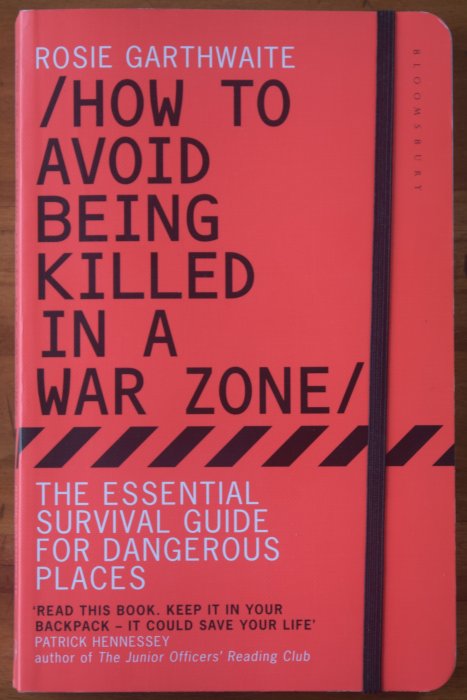
Rosie Garthwaite’s book sounds like it should be one of those parodies that are all too common nowadays but in fact it is deadly serious and has to be the one example on my bookshelves which legitimately uses the tag “It Could Save Your Life”. Mine is the first edition from 2011 published by Bloomsbury and is still available.

Of course for most people the best way to avoid being killed in a war zone is to make sure you never go to one however the book covers so much more that it becomes a highly entertaining and indeed useful addition to any bookshelf. Split into 15 sections which cover everything from planning, preparing and arriving on your trip through first aid and emergency medicine, keeping fit and surviving kidnapping amongst other things. It is part survival guide and part filled with anecdotes which illustrate the topic being covered. The range of people Rosie has spoken to in compiling the book is huge and covers top war reporters, members of the military, charity workers, a former Somali pirate and, in the case of kidnapping, Terry Waite who was a hostage negotiator in Lebanon for years before being kidnapped and held for hostage himself for almost 5 years.

Some things in the book you hope you will never need, like how to put on a flak jacket correctly, others like some of the tips on keeping safe in a crowd could be useful at any time, as she says

The best advice is to avoid street protests at all costs. Of course, that’s not always possible, sometimes they run into you. And sometimes you might join a small peaceful protest that turns into a riot. You might be in an ambulance waiting to deal with the fallout nearby. You might be involved as a protester when it all goes wrong.

You don’t need to be in a war zone, sometimes the streets of your home city can become surprisingly dangerous.

Anyone who has read books written by war reporters about their lives on the job would enjoy the anecdotes in this volume, Rosie herself works for Al Jazeera and recounts many stories of her journeys for work, mainly in Iraq, and a lot of the other reporters she quotes also work or have worked for that news organisation. There are also a good smattering of BBC, Sky, CNN and various (mainly British) newspaper writers along with people from Médecins Sans Frontières who also tend to be on the front line. It is interesting to read the different opinions of the journalists on how to survive, some like to blend in with the locals others prefer to stand out, there are advantages and disadvantages to both viewpoints. Blend in and you may get closer to the story but risk being mistaken for a spy, stand out and everyone knows who you are so you can get further up the chain of command, but you are also obvious if somebody is looking for a high profile target to attack.

The first aid section is particularly good and at 45 pages also the longest part, it takes you through a basic medical kit to pack if going somewhere where the local medical service may not be the best or if heading into wild country. A lot of this I have packed in the past, put it in a clearly marked container in your pack and make sure other people you are with know it’s there. There is no point carrying sterile medical items if they don’t get used because nobody knew and you can’t tell them for whatever reason at the time. It then has an A to Z of medical issues and what to do until somebody who really knows what they are doing arrives, CPR, recovery positions, slings, tourniquets, treating burns, dislocations, frostbite and sunburn amongst many others. One I really, really hope I don’t ever need is how to deliver a baby but you definitely don’t need to be in a war zone for that one.

I’m not a war correspondent and frankly wouldn’t want their job but I’ve been through armed official and unofficial checkpoints set up on strategic roads in Libya and Lebanon. One of the people who boarded the bus in Lebanon in 1996 with an AK-47 over his shoulder appeared to only be about 14, you just have to keep calm. I’ve also been very aware of being watched to see where I was going in Libya, Syria and Iran amongst other countries, bribed my way into Ceaușescu’s Romania back in 1987 as I didn’t have a visa and also used dollar bills in my passport on several borders where it simply made getting the right paperwork processed faster. I just wish Rosie had written this book 20 years earlier.