The First Penguin Handbooks

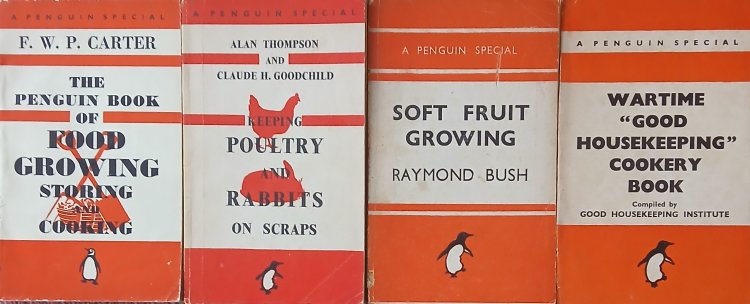
Last week saw the fiftieth anniversary of the end of the Vietnam War and this week sees the eightieth anniversary of VE Day, the end of the Second World War in Europe, as this post goes live on the 6th May 2025 two days before VE Day itself. Whilst last week I read Felix Greene’s excellent summary of the first half of the Vietnam War, this week I’m looking at eight books produced as part of the Penguin Specials series which were designed to help the population feed themselves during a time of food shortages and rationing. Penguin Specials were intended to be books dealing with issues of the day and they had rapidly multiplied during WWII with such titles as ‘Aircraft Recognition’, ‘Nazis in Norway’, ‘How Russia Prepared’, ‘Signalling for the Home Guard’ etc. The books were produced far quicker than titles in the other Penguin Series so that they were relevant to the issues of the day, but before the designation of some of them as handbooks there had also been some concerned with making best use of the food supplies however these were in the more usual red covers for Specials. These included ‘S90 The Penguin Book of Food Growing, Storing and Cooking’ (May 1941), ‘S101 Keeping Poultry and Rabbits on Scraps’ (January 1942), ‘S119 Soft Fruit Growing’ (December 1942) and ‘S127 Wartime Good Housekeeping Cookery Book’ (February 1943).
The dates shown below for most of these handbooks may seem quite late in the war for those of us born after the end of shortages and rationing, but it should be noted that general rationing in the UK continued until July 1954 although some items such as bread (1948) did come off rationing before then.

S132 Tree Fruit Growing – Apples – December 1943

Raymond Bush had already written one book for Penguin, as can be seen above, but the two handbooks detailing tree fruit growing took us to his main speciality which he had adopted following a bad accident in 1914 and being advised that an outdoor life would be better for his health than the poster design his company had been doing prior to the First World War. He was a commercial grower from 1915 up until 1935 when he started advisory work on the subject for various scientific committees. The book is a wide ranging guide to growing apple trees with notes where similar methods are appropriate for other fruits such as pears and almost a third of the book is dedicated to pests and how to get rid of them, but it is based on Bush’s determination that the wartime population should not be derived of wholesome fruit. As he says in his introduction “Well my amateur friends, once again you must sit back and watch the Ministry of Food collect most of the fruit to make jam go several times as far as it has any rights to go by the judicious addition of apple pulp, swedes, mangolds and what not. That is unless you grow your own fruit and make your own jam.”

S137 Preserves for all Occasions – April 1944

This book admits that it will soon become out of date as ingredients become more available after the war ut nevertheless it provide a lot of useful information on the varying ways of preserving food. Not just the expected jams and chutneys but syrups, bottling means of drying fruit, vegetables and herbs and how to store fresh produce for the longest time. Unlike other books on preserving that I own it doesn’t include recipes but instead concentrates on good techniques and means of avoiding common mistakes.

S138 Tree Fruit Growing – Pears, Quinces and Stone Fruits – December 1943

Volume 2 of Tree Fruit Growing concentrates much more on the individual varieties of a wider range of crops than I was expecting. I hadn’t realised that almonds were not true nuts but were in fact relative of the plum and peach where we eat the seed and discard the rest as a direct opposite to the two fruits. Bush admits to not having grown them himself and struggled to find any information but put together what he could. There is also a section on laying out an orchard and a substantial chapter on bees at the end along with the inevitable chapter on spraying for pests, a subject clearly on Bush’s mind a lot.

S140 Rabbit Farming – June 1944

Inspired by the success of ‘S101 Keeping Poultry and Rabbits on Scraps’ which as Goodchild explains in the introduction to this book was “giving all the practical hints I knew on rabbit keeping under wartime conditions in order that many newcomers could make a success of rabbit meat production”. This book on rabbit farming is however a very different work as it is aimed at a larger scale operation and includes use of the fur in coats and other clothes necessary to make a living from the business. Goodchild himself came from a long line of farmers and along with his partner ran the largest rabbit farm in England producing not just meat but from it’s manufacturing division coats, gloves and other assorted fur products. The photographs, presumably taken at his site near Crawley in south east England, show an extensive operation which must have been very useful to wartime food and clothing supplies.

S144 Poultry Farming – May 1945

The second of the books split off from ‘S101 Keeping Poultry and Rabbits on Scraps’ took almost a year longer to write than the first. Alan Thompson was amongst other things the editor of the monthly magazine ‘The Poultry Farmer’ which had started in 1874 as ‘The Fanciers Gazette’ and was eventually bought by the publishers of ‘Poultry World’ in 1968, so he was ideally suited to write the book. The book is not aimed at people wanting to keep a handful of chickens in their garden or allotment which was the point of S101 but instead those planning to run a commercial operation and early on mentions a figure of £2,000 (£73,500 in today’s money) for initial outlay if you want to have a hope of making a success of such a venture. The book goes into considerable detail not only on housing and selecting your chickens but also the finances of such an operation with several pages of photographs along with many line drawings to illustrate various points. My copy has clearly been well used.

S145 Trees, Shrubs and How to Grow Them – January 1945

Uniquely in this collection of eight books we have a title not covering food preparation or production and it is also, for me anyway, the least interesting of the titles. It goes into considerable detail about the various trees and shrubs in the UK, with guides as to what to plant and where, such as hedgerows and because Rowe is trying to impart so much information in a book just short of two hundred pages it is not particularly readable. That’s not to say it isn’t useful but just not for the general reader.

S146 The Vegetable Growers Handbook – Volume 1 – May 1945

All the other handbooks were commissioned by Penguin especially for this series and my copies are therefore true first editions whilst S146 and S147 are first editions in Penguin. The Vegetable Growers Handbook by civil servant Arthur J Simons however had first appeared in 1941 published by Bakers Nurseries Ltd of Codsall, Wolverhampton. Simons had written it during a period of quarantine he had undergone after contracting “a succession of childish but contagious diseases during the air raids”. In it you learn the basics of preparing the ground, improving the soil, using manure, compost and chemical fertilisers and this takes up the first third of the book. You then progress on what to grow, how to sow the seeds and raise the plants successfully initially in open ground and then a short section on using greenhouses and frames before a final chapter on pests and diseases and what to do about them. All in all a pretty comprehensive guide and I’m sure customers of Bakers Nurseries found it very useful.

S147 The Vegetable Growers Handbook – Volume 2 – May 1945

The second volume doesn’t have a first published date, but it doesn’t appear to be a Penguin original so I’m guessing this also first appeared from Bakers Nurseries. This volume deals specifically with the various crops you can grow, when to sow them and how to ensure a long cropping season with various vegetables ripening throughout many months. Like the first volume there are suggested plans for gardens or allotments to make maximum use of the space without wastage from gluts in certain weeks. Simons refers to letters he received after the first volume with suggestions which prompted this second book and despite the focus on wartime household needs these two books would even now be useful for a keen vegetable grower.

After the war it was decided to create a series of its own called Penguin Handbooks, the first new title of which was The Penguin Handyman which came out in November 1945 and was assigned the number PH9 with the obvious intention to move the existing eight books into this new series, however it all became more complicated than that, as it often does with Penguin Books. In fact PH1 is a 1945 reprint of ‘S119 Soft Fruit Growing’ but in the green cover of Penguin Handbooks rather than its original red. PH2 was assigned to the reprinted ‘S132 Tree Fruit Growing – Apples’ and PH3 became the reprint of ‘S138 Tree Fruit Growing – Pears, Quinces and Stone Fruits’, both of which are covered above and these would ultimately be combined into a single volume ‘PH83 Tree Fruit Growing’ in September 1962.

Despite the assumed plan of simply renumbering the existing handbooks into the gap left at the beginning of the new series we already have one book which hadn’t previously been issued as a handbook and just two of the originals occupying the first three numbers and this gets worse as numbers PH4 and PH5 were not in the end used and neither was PH8. This leaves just two numbers PH6 which became a reprint of ‘S145 Trees and Shrubs and How to Grow Them’ in 1951 and PH7 which combined S146 and S147 as the ‘Vegetable Grower’s Handbook’ in 1948.

Oddly ‘S137 Preserves for all Occasions’ did get reprinted as a ‘proper’ handbook as PH12 in July 1946, why they didn’t use one of the abandoned numbers I have no idea. ‘S140 Rabbit Farming’ and ‘S144 Poultry Farming’ were both discontinued in favour of their original base work ‘S101 Keeping Poultry and Rabbits on Scraps’ which came out as handbook PH14 in June 1949 making these two some of the most difficult to find Penguin Handbooks.

Modern Battle – Major Paul W Thompson (WWII Penguin versions)

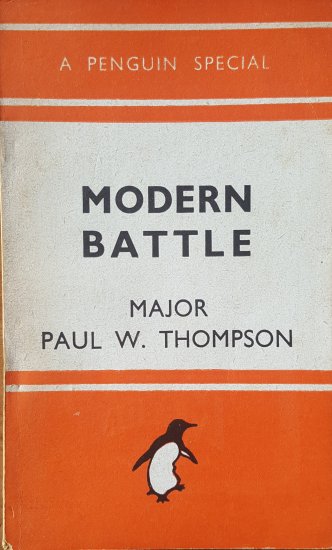
Inspired by the eightieth anniversary of the D-Day landings which was marked earlier this month I thought I’d look back on a book covering the start of the war. This is not a review of Modern Battle by Major Paul W Thompson, although it is a surprisingly interesting book which studies actual engagements between German and Allied troops in the early years of World War II so I will talk about it later in this blog. Rather I am looking at the various editions I have of the book and what these tell us about the war. Starting with The Forces Book Club edition published in October 1942, which is the second most difficult of the four versions to find as it as not sold to the public but rather only as packs supplied under subscription to military units, as described below on the inside front cover of this book. This explains why my copy has “C” Mess handwritten on the cover, sadly there is no further indication as to which battalion the mess (a place where military staff would eat and socialise) was associated with. Several of the other books I have from The Forces Book Club are ink stamped with the battalion or ship which had subscribed.

The rear cover gives a list of the first twenty books to make up, what was intended to be a substantial library for isolated units who otherwise would have little to read. The project however was a failure, partly down to the poor information regarding the existence of The Forces Book Club disseminated by the Ministry of Defence and partly due to the overly worthy choice of titles. The mystery and crime editions such as ‘Panic Party’ or ‘The Murders in Praed Street’ would undoubtably have been voraciously read but I can’t imagine Thomas Sharp’s volume on ‘Town Planning’ would have been as popular. Penguin did produce the 120 books needed to fulfil original subscriptions taken out, but in far lower numbers than expected and a lot of the books were subsequently rebound, initially as books to go to prisoner of war camps in Germany and later in the ‘normal’ covers these books would have had for general sale to the public.

The POW versions have the normal front cover but on the inside of this there is a replacement of the description of The Forces Book Club with some information regarding The Prisoner of War Book Service. Again the overall cost is three pounds for 120 books but this time even the more esoteric titles would probably have been read due to serious shortage of other reading material in the camps. All the remaining FBC titles appear to have been rebound as POW editions but they are all incredibly rare, I have a couple that, whilst popular as reading for the forces would definitely not been acceptable to the Germans i.e. ‘The Escaping Club’ and ‘The Tunnellers of Holzminden’ both of which deal with escapes from POW camps in the First World War and would therefore not pass the censors which probably explains why they have survived. I suspect that the company doing the rebinding simply did all the books without consideration as to the material they contained.

Books that didn’t make it out as FBC or POW editions were potentially rebound again as the main production run, so it is relatively common to find books that inside say they were printed for the Forces Book Club but in the ‘normal’ covers, rather than the one shown at the top of this blog. Speaking of which the first UK edition of the book in the Penguin Special cover from July 1942 can be seen below. All of the editions described so far have identical text inside with a foreword by Tom Wintringham, who had already written a couple of books published by Penguin including ‘English Captain’ and ‘New Ways of War’.

But we now come to a variant text as the book was also printed as a Penguin Special in America in association with The Infantry Journal, a company that already had distribution within the USA military and this has a new introduction by the editors of The Infantry Journal giving some background for their readership. This book was also published in July 1942, so just a few months after the Japanese attack on Pearl Harbour and the direct involvement of USA in the Second World War in December 1941. The original hardback first edition was published by W W Norton’s and Co. of New York earlier during 1941. A brief quote from the introduction to this Penguin American edition.

Modern Battle is based on a variety of source materials mainly from the professional military journals. Some of the accounts come from interviews with actual participants in the engagements described. Much of the background material is German, since the Nazi methods of warfare are those that have been most successful, and those that we need to know best as we work to find methods still better.

The copy I have is the third US edition from November 1942 by which time Paul Thompson had been promoted to Lieutenant Colonel. In the introduction there is an acknowledgement that the numerous included maps are drawn by Captain William H Brown of the US Army, who had also apparently been promoted, as in the July editions he is given as a Warrant Officer for the U.S. Coast Artillery Corps.

Now to the actual book. As alluded to above Thompson had access to German sources, presumably because America was not a combatant in WWII at the time he wrote the book, and these enable him to provide a comprehensive review of the various actions beyond anything available to a UK author. Of particular interest is the account of the aerial attack on Crete in May 1941 which is covered in the final chapter, which has a lot of information from German sources explaining how they went about the invasion which took just eleven days to complete despite the island being around 160 miles long. These alternative sources are evident throughout the book whether it be the German 10th army in Poland or the 1st Panzer division advancing on Aachen in 1940 and it makes the book a fascinating read as I have rarely come across information from outside Allied write ups.

Worrals of the W.A.A.F. – Capt. W E Johns

William Earl Johns is best known as the creator of James Bigglesworth, better known as Biggles, who featured in ninety eight books of adventure stories. Joan Worralson, aka Worrals, on the other hand appeared in just eleven books and the first three were finally republished in 2013 by Indiebooks after a long period out of print. Whilst it’s good to see these stories back in print I think it’s a pity that the cover illustrations are so childish with Worrals and Frecks depicted as apparently far younger than their actual age in the book which is eighteen and seventeen respectively. With that in mind I think I prefer the original dust wrapper from the first edition in 1941, although in that picture Worrals looks more in her early twenties.

W E Johns adopted the title Captain for his writing career although he never achieved that rank during actual service as a fighter pilot and later a flying instructor during WWI. Remaining in the R.A.F. after the war he was promoted to Flying Officer in 1920 whilst working as a recruiting officer, ultimately transferring to the reserves in 1927 before finally relinquishing his commission in 1931. The following year he wrote his first Biggles book ‘The Camels are Coming’, the title referring to the Sopwith Camel biplane rather than the bad tempered quadruped. His long career in the air force obviously informed his detailed descriptions of flying and the aircraft used, and you can be pretty sure that if Johns says a plane handles a specific way then it really did. The Women’s Auxiliary Air Force which had both Worrals and Betty Lovell, aka Frecks due to her freckled face, as members was founded in 1939 and during WWII it’s members performed various support roles to the R.A.F. including transferring aircraft between airfields and repair sites although this was a relatively uncommon function, most were employed in far more mundane duties. Worrels is therefore highly unusual in performing this task as this was actually a job for the Air Transport Auxiliary which eventually did employ around 100 women, but as a recruiting agent she apparently worked well.

The story begins with Worrals receiving a dressing down by the Squadron Leader for having gone out on a short training flight in a Reliant in contravention of standing orders which did not permit females to fly combat aircraft and she is to be punished along with the Flying Officer who flew with her by loss of leave and in his case a transfer to a forward airfield. Shortly afterwards the Squadron Leader rather shamefacedly asked her to fly the same plane as it needed moving and apparently with the transfer of Bill he had nobody left who had previously flown that make. All rather unlikely but it is really just a device to get Worrals, and Frecks as a passenger up in the air where they spotted a mysterious aircraft and received a general all planes message on the radio that it needed stopping. As the only plane in the vicinity Worrals engaged the other plane and luckily shot it down but not before seeing it swoop low over what appeared to be a golf course. If flying a combat aircraft without specific authorisation wasn’t bad enough before, then actually partaking in combat was very much forbidden, however Worrals managed to talk herself out of further punishment by pointing out that she was flying the only combat plane that had seen the mystery aircraft and otherwise it might have escaped. Worrals not only avoids further censure but gets her weekend leave reinstated.

Worrals decides to use her leave to do some unofficial investigation as she doesn’t think she was taken seriously over the activity at the golf course so taking Frecks with her they head off to the property only to be captured by German spies and the plot unfolds as they slowly work out what is happening during bouts of freedom as they alternatively escape and get recaptured a few times. The plot is well thought out and Johns certainly provides plenty of tension as the two women engage in a battle of wits with the Germans and although a few escapades somewhat stretch the readers credulity I had to remember that I was not the target readership which was largely teenage girls and young women during the war. Having said that I nevertheless enjoyed my first experience of Worrals, but I doubt I’ll read another. I read a lot of Biggles at around the age of ten and I can’t see me rereading any of those either. It was fun though and if you like what is now called Young Adult adventure stories then W E Johns has a lot to recommend him. Please be aware though that the books are very much of their time and although Worrals is largely UK based in all her books, Biggles travelled the world and often had a very 1930’s/40’s attitude to the people he found there.

With thanks to The Ironbridge Bookshop for the loan of the book so that I could try a Worrals rather than reading my extremely delicate and worryingly rare Penguin edition of Biggles Flies Again

Adolf Hitler My Part in his Downfall – Spike Milligan

Spike Milligan’s memoirs of his time in D Battery of the 56th Heavy Artillery during World War 2 are as he says in the preface accurate “All the salient facts are true, I have garnished some of them in my own manner, but the basic facts are, as I say, true”. I would say that most of the ‘garnishing’ is down to hindsight allowing more humour to come through than was probably the case at the time. Milligan kept a diary right trough his service years and kept in touch with many of the men he served with over the following years, not just at the annual D Battery dinner which he attended regularly, but also to cross-reference his own memories. He therefore used to get very annoyed with critics who, especially in the later volumes, accused him of making things up. The preface also says that it was planned to be a trilogy although ultimately he wrote seven volumes, of which I have the first four which cover his active service and were all written in the 1970’s. The remaining books “Where Have all the Bullets Gone?” (1985), “Goodbye Soldier” (1986) and “Peace Work” (1991) deal with his time being hospitalised after being wounded at Monte Cassino through to eventually being demobbed and the early days of his career in entertainment building on his skills honed as a trumpeter and guitar player in the battery, and later the NAAFI, bands.

This volume deals with the events from the outbreak of war in September 1939 through joining his regiment in June 1940 to his arrival in Algiers in January 1943. As you can tell from these dates he spent a large part of the war at various camps along the south east coast of England before finally being posted to North Africa to see active service where he worked as a signaller for the battery. As you would expect from a comedy writer of Milligan’s ability the stories of his military experiences are told with humour as are his various attempts at relationships with the opposite sex, some successful others less so, never rising above the dizzy heights of lance bombardier, and that only whilst in Europe, somewhat cramped his style with the ladies whom tended to prefer the officer class if available but he does document a few successes and their aftermath, the following section covers a couple of those successes and also gives a hint as to the style of the rest of the book.

“have been having it off in the back of a lorry, and I got carried away”. He doesn’t explain how Sergeant Hughes managed to get back from Hastings, presumably he didn’t care.

There are also a lot of descriptions of the banality of life in camp and the things that were done in order to relieve the boredom all of which are highly entertaining to read about. Milligan got jankers (disciplined for breach of regulations, usually being confined to barracks and assigned various menial jobs) on more than one occasion and describes his first punishment in the book. He was attempting to get coal up to his first floor barrack room by means of a bucket on a rope with the assistance of his good friend Harry Edgington, who loaded the bucket from the stores however this was on a day when fires were not permitted when there was a surprise inspection. Spike therefore stopped hauling on the rope but Harry misinterpreting this sudden pause yanked on the rope and pulled Spike backwards out of the window which was a bit of a giveaway.

A later section, on board the troop ship approaching Algeria gives a hint of the sort of humour that would make Spike Milligan famous whilst writing The Goon Show scripts for the BBC in the 1950’s with their lunatic extensions of logic.

It has been great fun reading this memoir again and I’m now inspired to read the other three that I have. I suspect the three final post active service volumes will be quite a bit darker as they will have to deal with his ongoing problems with mental health which saw him hospitalised several times.

To Bed with Grand Music – Marghanita Laski

At the end of September I visited the city of Bath in Somerset, England and there found the headquarters of Persephone Books, a small publishing company specialising in the works of various female authors from the twentieth century. They started twenty five years ago in 1998 and all their books are bound in this silver/grey design with an identical dust wrapper but the end papers are different in each book and you also get a bookmark which matches that volumes’ end papers. Also each book, regardless of length, is priced at £14 but with a deal of any three books for £36. Restricting myself to three from the one hundred and forty nine titles available was tricky but at least from this book, number 86 on their list, I seem to have chosen well. It was originally printed in 1946 with the author taking the pseudonym of Sarah Russell almost certainly due to the scandalous nature of the subject matter. For Mrs Deborah Robertson says goodbye to her husband Graham in the early part of of the war as he is posted to Egypt and after moping about at their marital home in the country for a while with their young son Timmy, leaves him in charge of the housekeeper during the week and gets a job in London to keep herself occupied and starts on a series of affairs.

In fact the first ‘affair’ would nowadays be regarded as rape as the man involved got her drunk and they ended up in bed together for what was definitely a one off occasion which Deborah was completely disgusted with. However she soon moves in with a friend and starts relationships deliberately this time, partly for the company but mainly for what she can get out of them and she does seem to do rather well for quite a long time. The first proper affair was with Joe, an American lieutenant with a wife back in the States and this lasted quite a while with Deborah even taking him back to her marital home for what turned out to be an uncomfortable weekend to meet Timmy and this relationship lasted until he was posted out of the UK. He is followed by another American lieutenant called Sheldon who didn’t last very long before she found a French member of the London embassy called Pierre. This is the time when Deborah decides that what she really wants is to be a ‘professional mistress’ and asks Pierre to teach her what men are looking for is their dalliances. Pierre agrees but is also repelled by the task so after a few more weeks takes her for a meal with Brazilian diplomat Luis Vardas and after enjoying the meal simply leaves her with him as her new partner. By the end of affair number six she is completely manipulative over her lovers as can be told from the below extract when she has decided to get rid of her first British lover Anthony.

After Anthony we no longer have a lover by lover account of her partners instead there is a succession of men about who we find out very little and presumably neither does Deborah, she simply sees them as a means to an end although she is by now overspending in order to keep up the appearances needed for the class of man she is aiming to attract. Chapter ten begins…

Geoffrey was succeeded by Martin and Martin by Nils from the Norwegian Navy. Usually Deborah managed to avoid any awkward interregnum by building one up before the last had faded away, but sometimes this would fail and a gap would yawn. Then Deborah would give a party.

At such a party she would invite several possible successors for her favours and pick one to work on. By now Deborah is thoroughly unlikable as a character but the book is written so well that it is difficult to put down. Laski was a lover of words and the novel is beautifully put together so even as the ‘only in it for herself’ nature of Deborah becomes more and more dominant the novel still draws the reader in. Laski wrote six novels, five of which have been published by Persephone Books but her love of words is mainly shown by the fact that she contributed over a quarter of a million illustrative quotations to the Oxford English Dictionary and was also a regular panellist for twelve years on the BBC game show ‘What’s My Line’. I’ve loved the book and will almost certainly pick one of her other novels in my next group of three Persephone publications.

The end papers and the bookmark are printed with a design entitled ‘Good Night Everybody’, from a silk scarf made by London based silk specialist Jacqmar around 1940 and held in a private collection.

The Albatross Press

I’ve been fascinated by The Albatross Press and their huge selection of books solely issued in the English language although printed and circulated only in continental Europe for well over twenty years, possibly thirty, from when I first became aware of their existence and the obvious influence the press had on Allen Lane when he came to found Penguin Books back in 1935. However until this book was published in 2017 information about Albatross was patchy at best and for my 250th blog I’ve decided to look again at my small Albatross collection along with reviewing Michele Troy’s excellent book. The Albatross Press books are difficult to find here in the UK as due to copyright restrictions they were not available in the UK, British Empire or the USA and indeed were seized by customs officials if anyone tried to bring them in, but they can be found occasionally and when I see one at a reasonable price I normally pick it up to add to my library. I’m going to split this blog into two sections, firstly a review of Michele Troy’s superb and phenomenally well researched book and then a piece about my collection which will give an idea as to the sort of titles published by Albatross from its foundation in 1932 until closing down soon after 1947. In fact it survived as an entity until 1955 but didn’t produce any new books in the 1950’s merely trying to sell its back stocks as it faced competition from a wave of American and British new paperback publishers all able to undercut Albatross prices.

Strange Bird – Michele K. Troy

As implied by the subtitle of this impressive volume 1932 was not a good year to start a publishing venture in Germany as Hitler along with his followers burgeoning censorship of books, sometimes for little reason, made operating there extremely difficult from his rise to power in 1933. Alongside the issues of Nazi interference as to what may or may not be published there was a significant problem with the business model for The Albatross Press and that was that there was already a well established publishing company issuing English language books on the continent and the German firm Tauchnitz had been in that market for over ninety years. The Albatross Press was an extremely complicated company, initially printing books in Italy and then moving that part of the business to Germany to get round Nazi regulations. European distribution was also run from Germany but the editorial team were in Paris whilst the funding came from Britain via a holding company in Luxembourg. It’s founding partners were John Holroyd-Reece a German born naturalised Brit who was half Jewish and German Max Christian Wegner who had recently been fired as Managing Director of Tauchnitz. Running the distribution from his existing company was another German, Kurt Enoch, who was also Jewish. You can see the problems that will rapidly start to accumulate under the rise of the Nazis. Holroyd-Reece also started numerous other publishing companies some of which owned shares in the other ones and it is frankly amazing that not only does Michele Troy explain this dense web of businesses but does so in a highly readable way.

Part of the reason for the complexity was a desire to present the company as German to Germans, British to the British and sufficiently international to confuse everyone else but you may wonder why there was not only a market for English language books on the continent and how such a market got started. Troy does her best to cover this as well, initially created by Tauchnitz partly in order to allow British and later American authors to obtain copyright for their works in Europe decades before international copyright was available. Well educated Europeans could also normally read English perfectly and having books in the original language is always seen as preferable to translations. By the mid to late 1930’s though the main thing that was driving the existence of Albatross and Tauchnitz, which by then Albatross had succeeded in getting editorial control over, was the need for foreign currency by Hitler’s government. This is another complicating aspect ably covered by Michele Troy as she digs into Nazi files and reveals the various sides trying to decide if Albatross, as a British firm, should be trading in Germany at all, especially when it turned out that the main British backer was also a Jew. Amazingly even after war broke out Albatross continued to trade until 1944 although it was largely concerned in selling it’s stored books.

What starts off as the history of a now largely forgotten publishing house turns into almost a detective story as she pieces together the surviving documentation despite both Albatross and Tauchnitz archives being destroyed during the war. The notes and citations alone run to fifty seven pages and the selected bibliography a further twelve pages. This is a major academic research project from the professor of English at Hillyer College at the University of Hartford and is well worth a read even if you have never heard of Albatross because it is so well written the story draws you in.

My collection of Albatross Press books

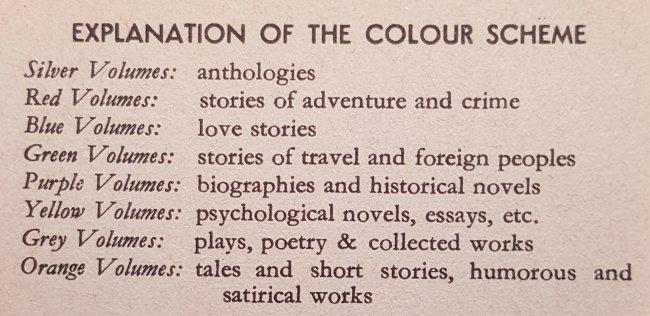
As has become clear to anyone reading my blog for a while I collect Penguin Books and have over 3,500 of them so Albatross are a logical side collection. The inspiration for Penguin Books was partly due to the press being named after a bird but mainly for the cheap but smart editions which are colour coded by subject matter, something that Allan Lane immediately adopted for his new enterprise. The chart shown below is from the dust wrapper of Memoirs of a Fox-hunting Man.

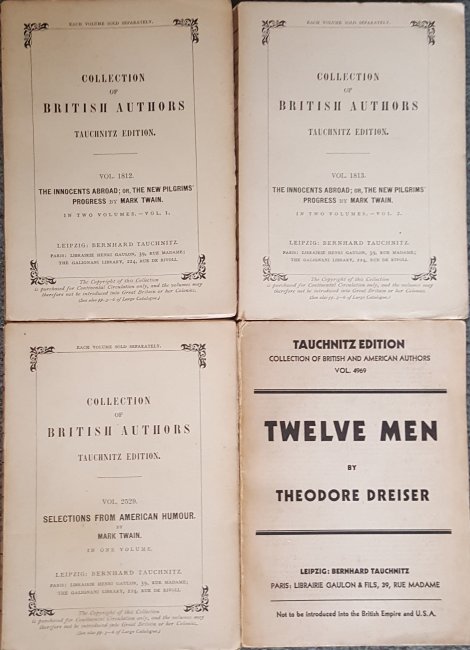
Troy explains the importance of Tauchnitz and if anything volumes from this publisher are even more difficult to find in the UK than Albatross, I just have four, three of which are from 1879 and 1880 and the final one, ‘Twelve Men’ is from 1930 so shows the plain typographical covers that the bright and colourful Albatross were going up against to attract customers.

I have managed to accumulate twenty three Albatross books, so roughly one a year since I started looking for them, and their immediate attraction is obvious even if the standardisation of colours is sometimes poor to say the least. Both ‘Journal’ and ‘The Arches of the Years’ are purple and ‘Journal’ isn’t faded as it is that shade on the spine and rear cover as well.

  • 16 – The Brothers printed in Italy in 193?
  • 19 – Ambrose Holt and Family printed in Germany in 1932
  • 31 – Apocalypse printed in Germany in 1932
  • 32 – The White Peacock printed in Germany in 1932
  • 52 – Journal printed in Germany in 1933
  • 203 – The Arches of the Years printed in Germany in 1934
  • 216 (Extra Volume) – All Men are Enemies printed in Germany in 1934
  • 236 – Pelican Walking printed in Germany in 1934
  • 240 – Unfinished Cathedral printed in Germany in 1934
  • 247 – Brief Candles printed in Germany in 1935
  • 260 – Music at Night printed in Germany in 1935
  • 310 – The Asiatics reprinted in Italy in 1947
  • 317 (Special Volume) – The Weather in the Streets reprinted in Italy in 1947
  • 326 (Extra Volume) – Aaron’s Rod printed in Germany in 1937
  • 359 – The Bridge printed by Collins in Scotland in 1938 as Les Editions Albatros, Paris
  • 377 – Juan in China printed in Germany in 1938
  • 390 (Extra Volume) – The Letters of D.H. Lawrence printed in Germany in 1938
  • 514 – Grandma Called it Carnal printed in Italy in 1947
  • 551 (Special Volume) – Operation Neptune printed in Holland in 1947
  • 556 (Special Volume) – English Saga printed in Holland in 1947
  • 558 – Siegfried’s Journey printed in Holland in 1947
  • 4802 – Lord Jim printed in Italy for Librairie Marcel Didier in 1947
  • 4975 – Memories of a Fox-Hunting Man printed in Italy for Librairie Marcel Didier in 1947

The massive leap in the numbering scheme for the last two books should not be taken to show thousands of new titles suddenly being released. Rather I suspect that this is to keep the Librairie Marcel Didier volumes well out of the numbering scheme of the existing Albatross Press books. Penguin did something similar when launching Penguin Inc in America during the war and starting their book numbering at 500. Penguin Inc’s managing director was Kurt Enoch having escaped the Nazi’s so this was his second publishing venture. In 1948 following disagreements with Allen Lane back at Penguin headquarters in England Penguin Inc was dissolved and Enoch started again with his third publishing firm this time as Signet and Mentor. As for the Extra and Special Volumes these are normally significantly thicker than ‘normal’ volumes and presumably had a higher price although 558 Siegfried’s Journey is a normal size so maybe Special Volumes had a different rule.

But why Albatross? Holroyd-Reece had several explanations but the one I find most persuasive is because the word is similar in a lot of European languages: Albatros in Catalan, Czech, Danish, Dutch, French, German and Spanish amongst many others, Albatro in Italian, Albatrosz in Hungarian and surprisingly Albatross in Estonian and those last two languages I know from personal experience are normally miles away from English. I’m still on the lookout for more volumes from The Albatross Press and have even added a sideline of want to be Albatross books including the Italian Corvi press, which is undated but numbered 4 in the series and looks to be from the 1930’s. This is a true polyglot of a title as it is a biography of a British Prime Minister written by a French politician and translated into Italian. Alongside is a book I picked up earlier this year in Budapest which is much later, 1979, but is clearly inspired by Albatross design and in this case is written in Hungarian but published in Bucharest, Romania. Fabre was a French naturalist and this is a translation of one of his books about insects.

All in all The Albatross Press produced some very attractive books from a wide range of significant authors so are well worth looking for and are a pleasant surprise when you do find one on a shelf in a second hand bookshop. As Michelle Troy’s incredibly well researched book proves they also had a fascinating history behind them.

Sailing to Freedom – Voldemar Veedam & Carl B. Wall

This beautiful volume was a gift from a friend in Estonia and tells the tale of sixteen people escaping from the Russians after the annexation of their country post WWII. This edition of the book was published as part of the 100th anniversary of Estonian independence in 2018 and includes a preface by the president of Estonia, Kersti Kaljulaid. Sadly that initial period of independence was snuffed out by the start of World War II with first the Russians then the Germans and finally the Russians again taking control, Estonia would not be independent again until the 20th August 1991. Estonians therefore celebrate two Independence Days, the 23rd February marking the first time they were their own state back in 1918 and the 20th August for the current and longest period of independence the country has had in the centuries it has existed.

During the early 1940’s the Russians instigated mass deportations of ethnic Estonians to Siberia and the majority of those sent there never survived to get back to their own country. To escape these deportations many Estonians sailed across the Baltic to Sweden where they were largely held in camps amongst these escapees were the heroes of this book. They were faced with yet another problem at the end of the war as Sweden was set to send the Estonians back to their own country and Soviet control.  In March 1945 Voldemar Veedam was sitting with his friend Harry Paalberg when the first of the letters from the Swedish foreign ministry were received by the refugees informing them that they were to be returned and the Soviets has assured the Swedish government that they would be safe. Needless to say the refugees in Sweden didn’t believe the Soviet assurances and it turned out to be a correct supposition as tens of thousands more Estonians were sent to their doom in Siberia during the 1950’s.

20191105 Sailing to Freedom 1

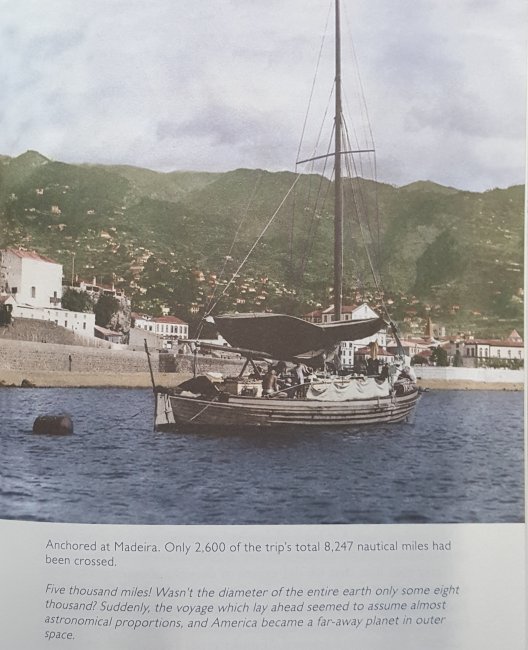
And so the plan was hatched between Voldemar and Harry to escape, this time from Sweden and try to get to the USA. They would need a boat and a few more people to man it and also help raise the money needed for the trip; this was going to be difficult enough never mind the gruelling ocean voyage. Money was tight and they couldn’t get more from family abroad as Swedish law severely limited the amount that could be sent to the refugees. In the end they managed to purchase a 36½ foot long (11.1m) by 13 foot wide (4m) sloop called Erma and an erratic diesel engine, but only by taking so many people into the escape attempt that the crew numbered twelve adults and four children. Working out how to get all those people on board with sufficient provisions and still be able to sail was a logistical nightmare. So much so that one of the recurring themes is the amazement of bystanders whenever they did manage to make it to a port as to how so many people were aboard. When they bought her Erma was over fifty years old and had been out of the water for years so leaked badly when she was refloated.

20191105 Sailing to Freedom 2

There was a massive amount of work needed to make Erma seaworthy and this took far longer than any of them hoped even with four men working up to sixteen hours a day rebuilding the boat to be able to get everyone on board. So much so that instead of the hoped for summer departure it drifted into the autumn and meant that they ended up crossing the Atlantic during November and December.  This undoubtedly increased the amount of bad weather they hit during the crossing and caused a lot of the delays which hit their rations hard. It really is a magnificent tale of daring-do and remarkable seamanship that they managed to get all the way making repairs to their tiny vessel whilst on the way.

20191105 Sailing to Freedom 3

When the book came out it appears from some of the blurbs reproduced from the old book covers that the trip was compared with that of Norwegian Thor Heyerdahl and his crew on the Kon-Tiki expedition whose book had been published a few years earlier. Somewhat unfairly I feel as his was a well funded trip (along with equipment from the US Army) with no pressure on him other than to prove his own theories. The sixteen people on the Erma had no such backup and made an amazing trip out of desperation to avoid the Soviet oppression in their homeland. I’m amazed that I haven’t come across this book before especially as it was clearly an international best seller in the 1950’s but checking on Amazon it appears that it is no longer in print apart from the edition I have now read which despite being in English does not appear to be available here. Thank you Christel for a fantastic gift which I have greatly enjoyed reading.

20191105 Sailing to Freedom 4
The cover of the first UK paperback edition

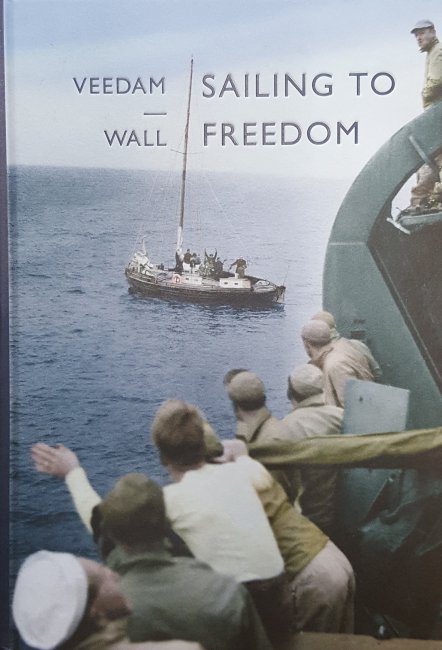
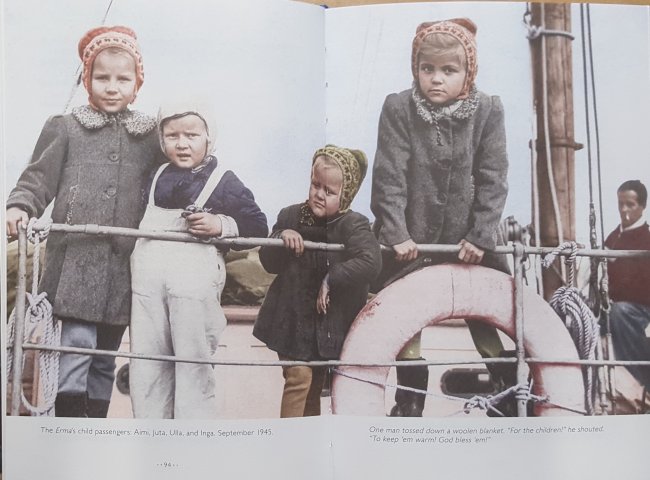
The copy I have was published by Eesti Mälu Instituut, The Estonian Institute of Historical Memory, and a beautiful job they have made of it. The colourised photos from the trip, a couple of which are reproduced above, are wonderfully atmospheric and the inclusion of lots of covers of previous editions appeals to me as a book collector as well as showing just how popular this book has been around the world. Surprisingly, to me at least, the book was originally written in English by Veedam with the assistance of Carl B Wall who was an American journalist. It was first published in a much shorter form as The Cruise of the Erma in the February 1947 edition of Readers Digest and subsequently expanded in 1952 to the text that is now used. The front cover photo was taken from the American patrol boat John P. Gray soon after they had found the Erma and re-provisioned them for the final few days journey to an American port and journeys end.

Below are some more international translations, including ones on the right where the cover designer has clearly not read the book and has no idea what sort of boat Erma actually was.

20191105 Sailing to Freedom 5