Fermat’s Last Theorem – Simon Singh

Published in 1997 as a follow up to a BBC documentary about the discovery of a proof of Fermat’s last theorem in 1994/5 this 362 page book takes a deep dive into the history of the theorem and the various attempts at a solution over the 358 years that it remained a mathematical puzzle. The joy of Pierre de Fermat’s last theorem is that it is very simple to understand but turned out to be incredibly difficult to prove. Anyone who has had Pythagoras’s theorem relating to the sides of a right angled triangle drummed into them at school will understand the basic concept. That theorem states that the square on the hypotenuse equals the sum of the squares on the other two sides or put simply in a diagram with the best known whole number solution as an example:

Fermat stated that although this clearly works for squared numbers, and indeed there are infinitely more combinations of whole number solutions (such as x = 5, y=12 and z=13 as 25 + 144 = 169) there are no whole number solutions if the power that you raise x, y and z to is greater than 2. Fermat stated that he had a proof, although he wrote this in the margin of his copy of the ancient Greek mathematician Diophantus’s Arithmetica and stated that ‘the proof was too large to fit in the margin’. Fermat was a mathematical genius but also extremely annoying as he would often taunt fellow mathematicians by writing to them that he had discovered a proof to some mathematical conjecture and challenge them to also find the solution and would rarely write down his own proofs in a rigorous manner. Certainly no example of Fermat proving his last theorem has ever been found. Fermat of course didn’t refer to it as his last theorem, it gained the name as slowly all his other conjectures were proved correct leaving just this one which would become notorious and also the driver of other mathematical insights as people tried to prove, or disprove, it over more than three and half centuries.

Let’s come back to that date of 1994/5 for the final proof. English mathematician Andrew Wiles had worked for many years on attempting a proof, but without admitting to his fellow mathematicians that he was working on it as it was seen as a waste of time and as a professor at Princeton University, New Jersey, USA it wouldn’t be appropriate to be seen to have an interest in the subject. However all that changed in the mid 1980’s when it was shown that Fermat’s last theorem would be effectively proved if there was a proof discovered to the seemingly unrelated Taniyama-Shimura conjecture. This conjecture deals with two extremely complex areas of mathematics and indicated that they were inter-related and indeed one could be used to solve problems in the other. These two concepts were elliptic curves, which were Wiles’s Phd speciality and modular forms, a four dimensional topological ‘structure’. Now I sort of understand the basics of elliptic curves but the use of modular forms is beyond me even with the basic description provided by Simon Singh in this book. Wiles saw this as a legitimate use of his time and would give him a proof of Fermat, which had fascinated him since he was ten years old, whilst working on a ‘genuine’ mathematical problem, the proof of Taniyama-Shimura. The problem was that this, like Fermat’s last theorem, was considered impossible to prove. He still decided to work in secret though and for many years came up against brick walls preventing his proof from working until in 1994 he took three lecture slots at a convention in Cambridge, England and under the deliberately opaque title of “Modular Forms, Elliptic Curves and Galois Representations” endeavoured to present his proof. The mathematical world was astounded and Wiles was hailed for his outstanding achievement, problems however were found during the rigorous checking before the proof could be published and it took several more months before Wiles finally fixed the error in his proof hence 1994/5 being given as the date of the solution. The 1994 proof was so close to being correct, but relied on another conjecture which it turned out wasn’t proved so proving this other theorem was what took the extra time.

Now it may well be, if you are still reading this blog, that you are thinking no way am I going to read this book it sounds far to complex but you would be wrong. Singh has done a remarkable job in not only summarising Andrew Wiles’s work and still making it approachable, but the history of the various attempts to solve Fermat is fascinating. I first read this book back in 1997 when it came out and have picked it off the shelves two or three times in the intervening decades and each time I love descriptions of the failed attempts and the progress, or otherwise, that they led to, along with the various other puzzles included which help to get your brain engaged in the problem. Each time I get that little bit further in understanding just what Wiles actually proved with the specific part of the Taniyama-Shimura conjecture (named after the two Japanese mathematicians who came up with it in 1957). Taniyama-Shimura would finally be proved for all variants in 2001 by four of Andrew Wiles’s former students and renamed The Modularity Theorem. A note on terminology conjectures are unproved but seem to work, theorems are fully proved

Give your brain a workout, I definitely recommend giving it a go.

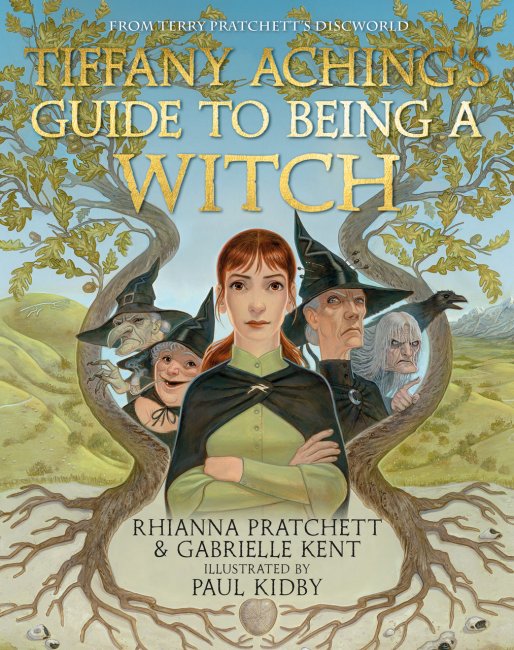
Tiffany Aching’s Guide to Being a Witch – Rhianna Pratchett & Gabrielle Kent

I’m writing this on Friday 10th November having received my copy of this book on the morning of its publication day, yesterday, and spent several happy hours reading it, finishing around 2:30pm yesterday afternoon. I think that tells you how much I enjoyed this first foray into her father’s literary world made by Rhianna and I hope that there will be more to come. When Sir Terry died Rhianna said that she would definitely not be continuing her father’s Discworld novels, and despite initial appearances this book does indeed stick to that line as it is another of the ancillary Discworld books such as Mrs Bradshaw’s Handbook, The World of Poo, the various atlases, or even the assorted diaries, maps, plays and guides all of which were written by people other than Terry Pratchett but based on his works with his approval and undoubted tinkering. Sadly Terry is no longer with us to give his blessings to this book but I’m sure he would have done so as Rhianna has stepped carefully into her father’s legacy with the assistance of Gabrielle Kent, whom I admit not knowing anything about other than she writes the Alfie Bloom series of childrens books, and the wonderful artwork of Paul Kidby who has signed my copy.

Based on the five ‘young adult’ Tiffany Aching books written by Terry , which include his final novel ‘The Shepherd’s Crown’, the book is beautifully designed as a guide to witchcraft by Tiffany but with apparently hand-written notes by other characters from these books such as witches Esme Weatherwax, Nanny Ogg, Miss Tick and the Feegle Rob Anybody along with additional notes from the witch Mrs Letice Earwig inserted so she can complain. Do you need to have read the books before reading this one? Frankly yes. Not only will you understand better what is being covered in the two hundred pages of this work but it basically consists of a huge number of spoilers for the other five books so you definitely don’t want to start here. Below is one of the pages from the main text (carefully chosen so as not to include any spoilers), all of which are full colour and covered in illustrations by Paul Kidby, it really is a pleasure to read the book and admire the artwork.

If you are intrigued by the illustration of the carved chalk figure behind the Feegle it is an accurate depiction of the 180 feet high (55 metres) Cerne Abbas Giant carefully censored by the appearance of the Feegle head to hide his most obvious feature and keep the book child friendly.

The text does contain a lot of original content but also consists of retelling, from Tiffany’s viewpoint, stories from the five Tiffany novels and also other tales from the Witches series of books going all the way back to the third Discworld title, ‘Equal Rites’ in 1987. Equal Rites told the story of Eskarina Smith, the only female wizard, whilst the forty first and final Discworld novel, ‘The Shepherds Crown’ in 2015, in a neat closing of a vast circle includes Geoffrey Swivel the only male witch, both of these characters feature in the new book. The pictures also go back over the decades with old illustrations intermingled with brand new work, some of the older depictions of the characters come from the now difficult to find calendars and diaries so it is good to see them re-used in a book where they can be appreciated by more people, Paul Kidby first started working with Terry back in 1993 doing artwork for the calendars and diaries and various other books but not the novel covers as these were the work of Josh Kirby, sadly Kirby died in 2001 and Kidby took over as the artist of choice by Terry for the novel covers and almost everything else and it is his depictions of the characters and places that are now most familiar to people.

I hope you enjoy the book as much as I did but make sure to read the five Tiffany Aching books first. These are, in order, ‘The Wee Free Men’ (2003) ‘A Hat Full of Sky’ (2004) ‘Wintersmith’ (2006), ‘I Shall Wear Midnight’ (2010) and ‘The Shepherd’s Crown’ (2015). You don’t need to have read any of the earlier Witches series of books before tackling these but they are good so why not? There is a final joke that I almost missed as it is on the back of the dust wrapper. Feegles will steal anything and here they are making off with the barcode block.

The Compleat Angler – Izaak Walton

First published in 1653, so 370 years old this year, my copy is the first Penguin edition from January 1940 and like the first book in the natural history theme for August which was Gilbert White’s ‘The Natural History of Selborne‘, it was intended to be part of the second series of Penguin Illustrated Classics which never happened. Only these two books made it as far as being illustrated, this one with lovely wood engravings by Gertrude Hermes, before the project was cancelled.

Born in Stafford (a town in the English Midlands) in 1593 Izaak Walton originally went into trade as an ironmonger in London and retired in 1644, aged just fifty one, moving back north to Staffordshire where he became a well known countryman and after the publication of this book in 1653 a famous angler. His retirement appears to be linked to the royalist loss in the English civil war as he was a staunch supporter of the King and London was probably uncomfortable for him during the Cromwellian period. Walton would live to be ninety, a remarkable age for the time, and he kept updating The Compleat Angler for a quarter of a century as he came up with things he felt he wanted to add. The book consists of a series of conversations between a Piscator (angler) and a Venator (hunter) along with other characters but these two are the main ones as the Piscator, clearly Walton himself, aims to teach the Venator the noble art of fishing and how to catch the various species of fish in the local rivers. At times the text can be a little tedious if, like myself, you aren’t a fisherman, for example there is a long section which describes various artificial flies used for catching trout and how these should be made, with which feathers, threads and other materials. However the book is largely enjoyable even if you aren’t an angler for its descriptions of country life and the songs and poems that a liberally spread throughout the text.

The Angler’s wish.

I in these flowery meads would be:
These crystal streams should solace me;
To whose harmonious bubbling noise
I with my Angle would rejoice:
  Sit here, and see the turtle-dove
  Court his chaste mate to acts of love:

Or, on that bank, feel the west wind
Breathe health and plenty: please my mind,
To see sweet dew-drops kiss these flowers,
And then washed off by April showers:
  Here, hear my Kenna sing a song;
  There, see a blackbird feed her young.

Or a leverock build her nest:
Here, give my weary spirits rest,
And raise my low-pitch'd thoughts above
Earth, or what poor mortals love:
  Thus, free from law-suits and the noise
  Of princes' courts, I would rejoice:

Or, with my Bryan, and a book,
Loiter long days near Shawford-brook;
There sit by him, and eat my meat,
There see the sun both rise and set:
There bid good morning to next day;
  There meditate my time away,
  And Angle on; and beg to have
  A quiet passage to a welcome grave.

It is these poems and songs along with various descriptive sections that Walton mainly added in his various iterations of the book, the technical sections of how to fish and suggestions as to how prepare the catch for the table are largely unchanged through the published versions. The book is split into five days, the first of which is quite short and is largely an introduction via a four mile walk between the Piscator, Venator and Auceps (a man with hawks) who compare the advantages and pleasures of hunting in water, on land and in the air. This is where the Venator decides to become the Piscator’s pupil therefore leading to the rest of the book however the Auceps is never referred to again after this opening chapter. From day two the lessons on fishing begin and the two men are occasionally joined by the Piscator’s brother, Peter, and his friend Coridon, along with a couple of milkmaids who turn up a couple of times and appear to be there mainly to sing some songs and a few other people who are mentioned just once.

It’s a somewhat odd book, being unsure if it is a technical manual on fishing or a book of songs and poetry with countryside tales. I suspect the first edition was much more the manual but as Walton kept adding to it, taking the book from the original thirteen to the final twenty one chapters over twenty three years it somewhat lost its way. It’s largely an interesting read for the fishing layman and I’m glad I’ve finally read it.

The Hills of Adonis – Colin Thubron

First published in 1968, Colin Thubron’s second book finds him still in the Middle East, his first book from the previous year ‘Mirror to Damascus’ covered his travels in Syria and for his third which came out in 1969 he stayed in the same geographical region with a book set in Israel entitled ‘Jerusalem’. None of these early works are particularly well known today, especially compared to his more recent travelogues, indeed the most recent publication of ‘The Hills of Adonis’ I can find is from fifteen years ago, whilst my copy was published in 1987 during the last few years of the Lebanese Civil War. Thubron spent four months walking around Lebanon, a country of just 4,036 square miles (10,452 square km) so slightly less than half the size of Wales or for Americans roughly the size of the two smallest states combined (Delaware and Rhode Island) so it was possible to cover most of the sights in the country on foot in this time frame.

Thubron weaves his way up the country from the southern border with Israel, which even in the mid 1960’s was already a dangerous place to be, up to the northern border with Syria visiting most of the significant places on the way. The first part of the book however is also concerned with a breakdown of the mythology prevailing ancient Lebanon and for me this was convoluted and unnecessary in the amount of detail and number of pages dedicated to it. Fortunately after the first few chapters Thubron largely drops the subject and proceeds to describe the history, geography and most importantly the people of this tiny but extremely culturally diverse country. This is where the book really gets into its stride although it can be difficult at times to determine if he is writing about the near or ancient history of a place, he does rather bounce around a lot. But the people he meets are fascinating and because he includes tiny villages as well as the metropolitan centres you start to get a feel for the various peoples, the Maronites and Druze, the remains of ancient and isolated monastic orders, the agricultural people of the mountains and the largely more prosperous people of the coastal regions especially as he moves further north.

In the late 1960’s, at the time Thubron was travelling in Lebanon, it was a place largely at peace. This was before the civil war which would destroy large parts of the country and kill around 150,000 people in the fifteen years from 1975 and Lebanon was still seen as a significant tourist destination in the region. This is what initially drew me to the book, a snapshot of a now long vanished time and place and whilst I was in Lebanon just six years after the civil war ended, the destruction of its once beautiful capital was all too evident when I was there and it would have been impossible to replicate Thubron’s journey as the south of the country was still occupied by Israel and would be until the year 2000. Reading the book and seeing what Lebanon was like, and unfortunately has no obvious way of getting back to, is depressing but at least here is a record of what has been lost.

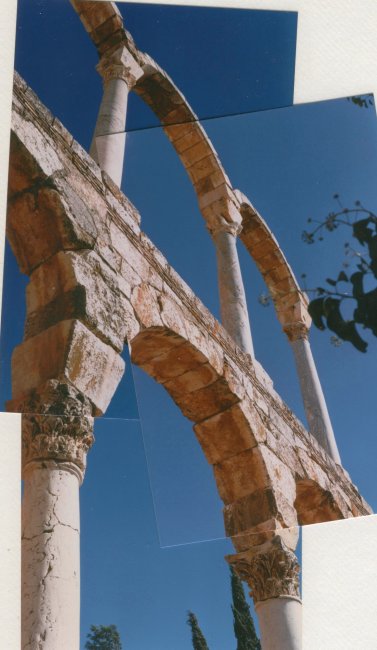
The cover picture, by Mark Entwhistle, is of the ruins of the palace in Anjar in the Bekaa region of Lebanon, which I photographed in September 1996, although from the opposite side of this particular surviving section. When Thubron got there the people were clutching radios tuned to Radio Cairo and waiting for war and he was deeply troubled by his experience there far from the peaceful scene depicted on the cover. Far from ‘driving the Israelis into the sea’ which is what everyone told him would happen the conflict that actually occurred turned out to be Six Days War where Israel defeated most of its neighbours in a series of decisive air strikes largely destroying the air forces of Egypt, Jordan and Syria in one day. But before then Thubron had left Lebanon and was presumably working on this book, which with all its faults is still an interesting read. Below are a couple of my pictures from Anjar.

a closer view of the arches

To Bed with Grand Music – Marghanita Laski

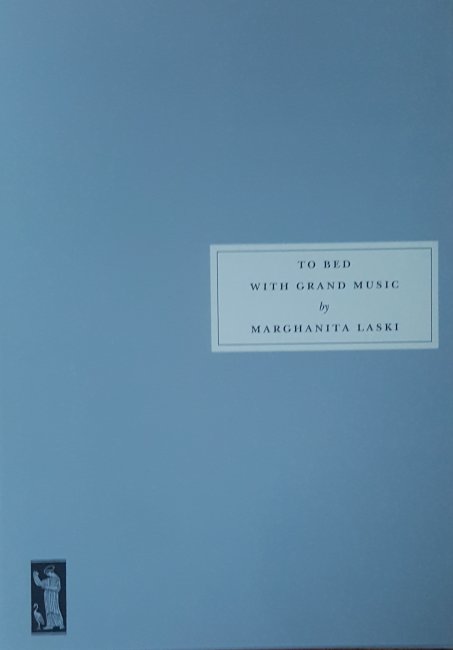
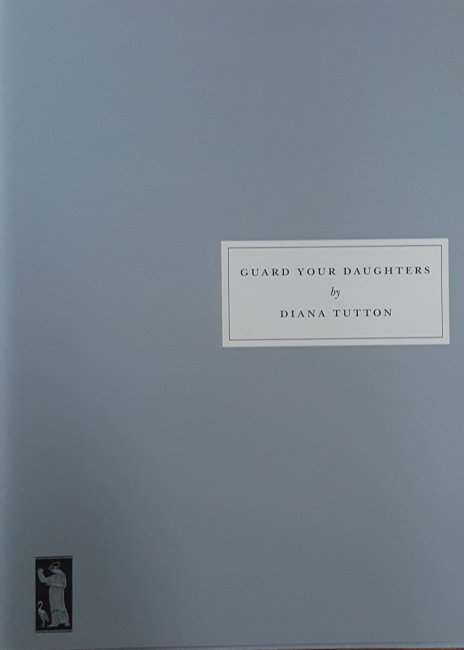
At the end of September I visited the city of Bath in Somerset, England and there found the headquarters of Persephone Books, a small publishing company specialising in the works of various female authors from the twentieth century. They started twenty five years ago in 1998 and all their books are bound in this silver/grey design with an identical dust wrapper but the end papers are different in each book and you also get a bookmark which matches that volumes’ end papers. Also each book, regardless of length, is priced at £14 but with a deal of any three books for £36. Restricting myself to three from the one hundred and forty nine titles available was tricky but at least from this book, number 86 on their list, I seem to have chosen well. It was originally printed in 1946 with the author taking the pseudonym of Sarah Russell almost certainly due to the scandalous nature of the subject matter. For Mrs Deborah Robertson says goodbye to her husband Graham in the early part of of the war as he is posted to Egypt and after moping about at their marital home in the country for a while with their young son Timmy, leaves him in charge of the housekeeper during the week and gets a job in London to keep herself occupied and starts on a series of affairs.

In fact the first ‘affair’ would nowadays be regarded as rape as the man involved got her drunk and they ended up in bed together for what was definitely a one off occasion which Deborah was completely disgusted with. However she soon moves in with a friend and starts relationships deliberately this time, partly for the company but mainly for what she can get out of them and she does seem to do rather well for quite a long time. The first proper affair was with Joe, an American lieutenant with a wife back in the States and this lasted quite a while with Deborah even taking him back to her marital home for what turned out to be an uncomfortable weekend to meet Timmy and this relationship lasted until he was posted out of the UK. He is followed by another American lieutenant called Sheldon who didn’t last very long before she found a French member of the London embassy called Pierre. This is the time when Deborah decides that what she really wants is to be a ‘professional mistress’ and asks Pierre to teach her what men are looking for is their dalliances. Pierre agrees but is also repelled by the task so after a few more weeks takes her for a meal with Brazilian diplomat Luis Vardas and after enjoying the meal simply leaves her with him as her new partner. By the end of affair number six she is completely manipulative over her lovers as can be told from the below extract when she has decided to get rid of her first British lover Anthony.

After Anthony we no longer have a lover by lover account of her partners instead there is a succession of men about who we find out very little and presumably neither does Deborah, she simply sees them as a means to an end although she is by now overspending in order to keep up the appearances needed for the class of man she is aiming to attract. Chapter ten begins…

Geoffrey was succeeded by Martin and Martin by Nils from the Norwegian Navy. Usually Deborah managed to avoid any awkward interregnum by building one up before the last had faded away, but sometimes this would fail and a gap would yawn. Then Deborah would give a party.

At such a party she would invite several possible successors for her favours and pick one to work on. By now Deborah is thoroughly unlikable as a character but the book is written so well that it is difficult to put down. Laski was a lover of words and the novel is beautifully put together so even as the ‘only in it for herself’ nature of Deborah becomes more and more dominant the novel still draws the reader in. Laski wrote six novels, five of which have been published by Persephone Books but her love of words is mainly shown by the fact that she contributed over a quarter of a million illustrative quotations to the Oxford English Dictionary and was also a regular panellist for twelve years on the BBC game show ‘What’s My Line’. I’ve loved the book and will almost certainly pick one of her other novels in my next group of three Persephone publications.

The end papers and the bookmark are printed with a design entitled ‘Good Night Everybody’, from a silk scarf made by London based silk specialist Jacqmar around 1940 and held in a private collection.

The Coronation of Haile Selassie – Evelyn Waugh

I’m planning on reading ‘Scoop’, Evelyn Waugh’s comic novel about the life of a foreign journalist in the coming months but remembered I had on the shelves an example of Waugh’s own time as a foreign reporter, namely his account of attending the coronation of Emperor Haile Selassie in Abyssinia, now Ethiopia. This occurred in 1930, eight years before he wrote ‘Scoop’ during which he was submitting stories for several newspapers in a freelance capacity. The main inspiration for ‘Scoop’ was when he was back in Abyssinia in 1935, this time on behalf of the Daily Mail covering the second Italo-Abyssinian war. Whilst he was not a great war reporter he did get plenty of material for his subsequent novel. But this link does make reading his stories about reporting in 1930 an ideal prelude to tackling ‘Scoop’.

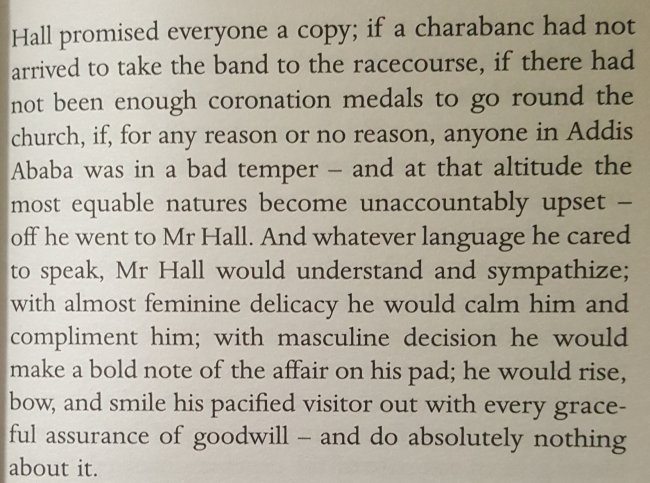
This Penguin 70 book is actually a couple of extracts from his 1931 travelogue ‘Remote People’, a book I’m now keen to track down to read more fully, but for now the two sections included here regarding the coronation and the apparently interminable journey to get home from it are all I have and I have loved the dry humour and observation of detail that are a trademark of his writing. He starts off by introducing a few of the people he has dealings with or are directly involved with the coronation or in several cases both in particular who was originally in Abyssinia as a trader but had somehow ended up as chief, and apparently only member of the bureau of foreign affairs and had an office in the centre of Addis Ababa, the country’s capital. Described as extremely handsome of German and Abyssinian descent he was also an excellent linguist and could apparently arrange anything even finding copies of the apparently non-existent coronation service…

In this last statement Mr Hall appears to be no different to anyone else Waugh has to deal with or indeed just observes. Addis had been the capital for almost forty years by then but large parts of it was still under construction. The hotel the British Marine band had been quartered in lacked a roof and building work all over the city was making very little progress as the workmen would apparently simply stop if they weren’t under constant supervision. Throw into this chaos the organisation of a coronation and the consequent arrival of foreign dignitaries along with the world media to cover it and the difficulties of communication both inside and outside the country and it’s a wonder anything progressed to any sort of a plan. This is where Waugh had an advantage over his fellow representatives of the press he didn’t have a daily newspaper to serve that needed something all the time he could wait and write accurately what happened unlike others he derided such as Associated Press which sent in totally fictitious accounts of the ceremony because of time constraints needing copy before it had even started. Mind you those members of the press that waited to get at least accurate reports of the first part of what turned out to be an interminable event discovered that the only telegraph office in the city had closed for the day so they couldn’t send their reports anyway.

The book doesn’t have any of Waugh’s actual reports in it, rather it is a diary of his experiences both in the lead up to and being at the coronation and the six days of feasting and celebration that followed for the royal family and the numerous tribal leaders that attended and it is at times both an important historical document and also extremely funny. The second account included in the book is entitled ‘First Nightmare’ and describes how Waugh attempted to get at least part way home with ships and trains being either cancelled, not turning up even when expected or even taken over by a Princess and her retinue who could just bounce all the passengers who had managed to find seats out of Abyssinia back out of them again. In all Waugh takes four days to go from Harar to Aden, a distance of 311 miles (500km) with numerous hold ups and false hopes of possible means of moving forward and you can feel his frustration building. At the time Aden was part of the British Empire and regular ships travelled back to the UK all he had to do was get there but it proved incredibly difficult.

I’ve really enjoyed this short book and am now looking forward to reading ‘Scoop’, probably early next year by the look of the planned reading list I already have for the rest of 2023.

Paddington Bear is 65 years old this week

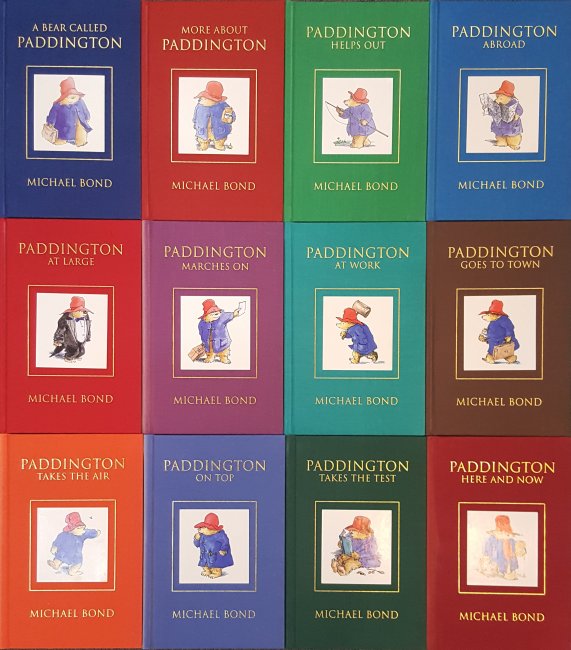
The first Paddington Bear book was published on the 13th October 1958 and Michael Bond went on to write fourteen collections of stories about him along with two specials featuring stories originally published in annuals for the children’s BBC television programme Blue Peter and fourteen other mainly single story picture books aimed at younger readers. The set I have is from The Folio Society and was published as a boxed collection in 2010. Unusually for a Folio edition it wasn’t published by them but rather by Harper Collins, Paddington’s usual publisher and it includes the twelve collections published up until that date in lovely cloth bound volumes. Sadly Michael Bond died in 2017 so there will be no more stories about this lovable bear, but I discovered whilst researching this blog that fittingly Bond is buried in Paddington Old Cemetery in London. The appearance of Paddington Bear in the Blue Peter Annuals came about because Bond was a BBC cameraman, including working on that TV series so he knew the presenters and could incorporate them into stories.

The first book ‘A Bear Called Paddington’ consists of eight connected short stories whilst the remaining thirteen main collections all have just seven each, meaning that there are ninety nine tales in the main block of books, along with those there were a further thirteen stories split across the two ‘Blue Peter’ collections and of course the single story books for small children, so there is a lot to read. The first eleven books were illustrated by Peggy Fortnum and it is her black and white images that came to epitomise the character of the bear as he tries to be helpful but invariably causes more trouble and disasters around him. She however retired from illustrating and the remaining three collections ‘Paddington Here and Now’, ‘Paddington Races Ahead’ and ‘Paddington’s Finest Hour’ were illustrated by R W Alley who clearly based his picture on those done by Peggy Fortnum to maintain consistency.

I’ve loved Paddington since I was a small child, having encountered him first in the Blue Peter annuals and as read out stories on the programme in the late 1960’s. There is just something so beguiling about his well meaning and always polite character and the ways he tries to adapt to his new home in London, which is so different from the Peruvian mountains where he originated from. On arriving at Paddington station having stowed away on a transatlantic ship he is met by the Brown family who take him home and effectively adopt him into their family. Helping him fit in is his great friend Mr Gruber, who owns an antique shop on Portobello Road and escaped from Hungary either to avoid WWII or the suppression of the 1956 Hungarian uprising, it is never made clear which, but this gives him useful insights into the problems of assimilation for Paddington. That makes the books sound heavier in tone than they are, whereas they are delightfully comic and clearly aimed at children, although there is plenty for an adult to enjoy. Rereading a few of the books for this review reminded me just how much I enjoyed the Paddington stories in my preteen-age years. The other major character is the Brown’s next door neighbour Mr Curry who is generally unpleasant to Paddington and always calls him Bear, unlike Mr Gruber who calls him Mr Brown. A lot of the stories have Mr Curry getting his comeuppance in some way or other.

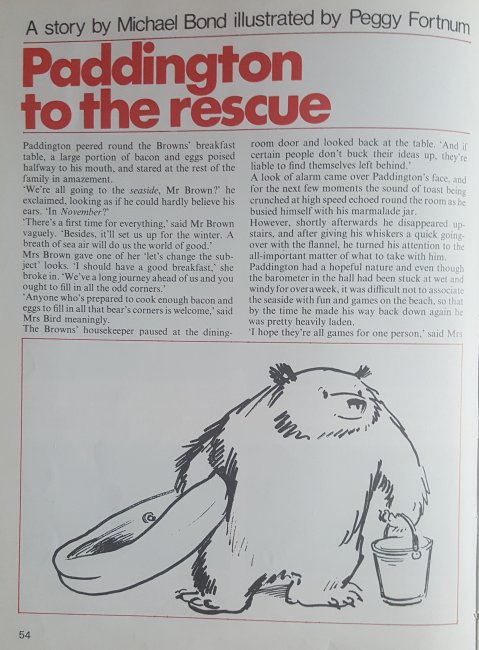
Above is the start of the Paddington story in the Fifth Blue Peter annual published in 1968 and this is how I first read Paddington stories and got to know the character, in this one he goes to the seaside and ends up in the lifeboat bought by the Blue Peter appeal that year. Of course the modern films from StudioCanal have brought a whole new audience to Paddington Bear, many of whom have probably not read the books. These adaptations are not based on specific books or tales but rather on the feel of the entire set of stories and they are a wonderful version with the various characters being very much as I imagined them from reading the books and I hope that they do encourage people to pick the books up and discover the vast range of adventures Paddington gets up to. The third film in the series started production earlier this year and it is due out in time for Christmas 2024, the original cast are back together and I hope that when it eventually gets dubbed into Ukrainian the original voice actor for Paddington in that language is available to repeat his performance from the first two movies, although Volodymyr Zelenskyy is rather busy being President nowadays.

Happy birthday on Friday Paddington.

I Wanna Be Yours – John Cooper Clarke

This is my three hundredth blog entry so I have decided to tackle what turned out to be a fascinating autobiography of the famous ‘punk poet’ which comes in at a pretty massive 470 pages, of which more later. Clarke is now seventy four and has lived a fairly unusual life, which he is extremely frank about in the book. This includes his many years as a heroin addict, indeed his descriptions of sometimes desperate attempts to get his next fix make up quite a lot of the last half of the book, it could have been a depressing read and it says a lot about his wordsmith skills that it isn’t. I first came across Clarke’s work when I went to university in Manchester in 1980 although sadly I never managed to see him perform. His famously stick thin physique was undoubtedly aided by the heroin but I hadn’t know until reading this book that at the age of eight he had had tuberculosis and probably shouldn’t have made it out of childhood in Salford, South Manchester. Clarke is brutally honest about his slide into addiction and the subsequent partial collapse of his career as getting the next fix became more important than anything else. He even took to avoiding his mother after she found out and he claimed to her to be getting help when in fact he was taking even more drugs and progressing to speedballs, cocaine and heroin mixed in one shot this is probably the lowest point of the narrative.

I was aware he had had a drug problem but the extent of it surprised me and I wasn’t really prepared for the story of a drug addict being the main part of the book rather than his climb to be performing and comparing at shows at the biggest clubs in Manchester. Thinking about it later I was also aware that he had largely disappeared for years after the late 1970’s, or at least I hadn’t heard of him for a long time until he reemerged to a larger public presence many years later and yet now plays sell out shows around the world. Indeed his 2024 fiftieth anniversary of performing tour, entitled ‘John Cooper Clarke: Get Him While He’s Alive!’ is already having to add extra dates due to demand for tickets.

There is also substantial coverage of his childhood and early years before starting to perform which was characterised by the poverty of growing up in Salford in the 1950’s and the extra problems due to his poor health. He worked as a bookies runner for a while whilst still at school before the police started to crack down on unlicensed bookmakers and going round taking bets and paying out winnings became too hot a job to continue. He was always looking for a way to earn some money but his apprenticeship on leaving school as a car mechanic eventually ended early due to both parties, employer and employee, recognising that he had absolutely no aptitude for anything mechanical. His desire to be a poet was strong even then but his father pointed out that nobody made any money at poetry until they were dead and it was only the arrival on the scene of the so called Mersey poets from Liverpool that proved that it was possible to make it a career. But it took a long time, and the assistance of Manchester club owner Bernard Manning, now a somewhat controversial figure, that eventually got him onto the stage and making some money at what he wanted to do.

As I wrote at the beginning of this review the book is 470 pages long, but by page 430 we have spent so much time on his childhood, youth and addictions we have still only reached 1985 and I was thinking that this was just the first half of a planned two volume autobiography. Instead Clarke basically sums up the remaining thirty seven years as: Met Evie (his wife), tried and eventually kicked heroin, rebuilt the career, started a family, gained an honorary doctorate from Salford University and nothing else much happened. Thirty seven years in forty pages, I’m pretty sure there is more to that period than that and as I had so enjoyed reading the first 430 pages, covering thirty six years since his birth in 1949, I was definitely set up for volume two.

If I have one criticism of the book it is Clarke’s excessive name dropping, usually in long, frankly tedious, lists of people or bands he has met or worked with, or maybe had worked in the past at a venue he was then working at, which I got into the habit of skipping as I got more into the book but as the last line of the book makes clear he isn’t bothered about criticism of the autobiography.

Any complaints, mail them to last Tuesday, when I might have cared.

The Picture of Dorian Gray – Oscar Wilde

Oscar Wilde’s only novel can famously be summarised as the story of a man who doesn’t appear to grow older, but rather the portrait of him ages on his behalf. But the copy I have is 256 pages long so it must be much more than the twenty word precis just given and indeed it is. I didn’t know what to expect when I pulled this book off the shelf as for some reason I have never read it before despite it being a famous work of literature and my owning this copy for at least fifteen years, but I definitely enjoyed it for it is beautifully written.

Yes the story of the painting ‘ageing’ rather than Dorian is there but that just scratches the surface, the picture shows all the corruption, not only of his increasing age, but also the collapse of his morality and does so in real time. So when he views the portrait, which he does regularly as time goes on even though he has it locked away in an attic so nobody else can see it, he can see the effects of his lifestyle boldly depicted on the canvas. Indeed when he kills a man blood starts to show on his hand in the portrait and appears to be dripping onto the floor within the painting from his fingers.

Dorian Gray is the only child from a very wealthy family so has no need to work instead he can just idle his way through life doing whatever he wants and because he can do this he does, dragging other people along with him. We see evidence of his moral dereliction many times through the book and his effect on his friends and lovers, one of his friends is depicted late in the book in an opium den hopelessly addicted and others commit suicide after being abandoned or blackmailed by him. Dorian however does not care about any of them even the social approbation that comes his way with people leaving rooms if he comes in or otherwise shunning his company means nothing to him for he has retained his youthful looks and that is all that he apparently needs. In his rejection of societal norms he is guided by the hedonistic dandy Lord Henry Wotton, whom he meets right at the beginning of the book at the studio of artist Basil Hallward whilst he is painting the titular full length picture. Henry becomes probably his only life long friend, apparently unconcerned about the depravity of Dorian’s life and loves and equally unfazed by Dorian’s never ending youthful looks or his occasional collecting manias. Due to his vast wealth Dorian can pursue any interest he wishes, collecting rare tapestries, perfumes, musical instruments or even jewels amongst other things, becoming an expert in this or that field before moving on and it is this money and knowledge that enabled him to stay accepted by at least part of London society.

Yes Dorian Gray is a repellent character, one that if he had really existed anyone would do well to avoid the company of, but Oscar Wilde’s writing is in contrast truly lovely. The pages just flew past whilst I was reading the book and as the story developed of Dorian’s spiral into vice the writing seemed to get better. It is. I suppose, part gothic horror and part social commentary upon the idle rich that Wilde spent so much time in the company of both in the city of his birth, Dublin, and London but I loved the book and can’t believe I have managed to not read it before. The final denouement, whilst the reader is expecting something of the sort, still had surprising details so Wilde kept me engrossed to the very last word and there are few books where that could be said.

Murder in the Basement – Anthony Berkeley

After the awful MC Beaton of a couple of weeks ago I felt that a decent murder mystery was called for. I normally only read a mystery and crime story about once every three months or so but Something Borrowed, Someone Dead was so dreadful I don’t think it counts so back to the heyday of crime novels, the 1930’s. I have several books by Anthony Berkeley Cox who wrote not only as Anthony Berkeley but as Francis Iles, A Monmouth Platts and A B Cox, but it is as Anthony Berkeley that he is, if at all nowadays, best known, especially for the ten amateur detective Roger Sheringham novels of which this is the eighth, first published in 1932. I chose it as it was the only Berkeley novel on my shelves I had not already read, although this is the first of his I have blogged about. He was one of the founders of The Detection Club, a group of then famous mystery writers including Agatha Christie and Dorothy L Sayers amongst others who use the meet for regular dinners, sadly several of the early members are largely forgotten including Berkeley whose books nowadays seem to be only reprinted by the British Library Crime Classics series which exists to spread the word regarding such authors.

Murder in the Basement is a classic of the genre in that the discovery of a body in the cellar of a newly occupied house in south London reveals that it was a woman, probably between twenty and thirty years old, five months pregnant but otherwise no distinguishing features as she had been buried for several months and decomposition had set in. The police then spend several chapters not really achieving very much until the chance discovery that a metal plate used to repair her femur after a break some years back was of an experimental type of which only a hundred or so were used before the material it was made from was abandoned as not really suitable for the job. This eventually leads to an identification of the body, as the only person to have that plate fitted that the police couldn’t locate but even then more work was needed to find more about her as she had changed her name to conceal her time in prison for theft. It is at this point that Roger Sheringham appears in the story, but not as the amateur detective but rather as somebody who had for a short while worked with the victim whilst doing a supply teacher role at a boys preparatory school just outside London where she had been the school secretary. The police want him to go back to the school and try to work out what had happened but Sheringham refuses to have anything to do with the case as he had made friends there and didn’t want to be working against his then colleagues.

The police soon decide on their suspect, one of the masters at the school, but cannot prove a case against him no matter how hard they try and they do trawl up some potentially damning but insufficient evidence for court. Sheringham stays out of the case but is kept up to date by the police in case he can be useful and ultimately solves the crime, but again without positive evidence that could be used in court. The lack of a suspect that can be prosecuted is unusual in a mystery novel but because of the way Berkeley concludes the book it is oddly a satisfying ending despite this.

I really enjoyed the book, as I have with the other Berkeley novels I’ve read and it’s a pity that he is so neglected nowadays. My copy is the 1947 Penguin Books first edition, I think Penguin published all of the Sheringham novels between 1936 and 1947 with several of them being extremely rare.