Sacred Britain – Martin Palmer and Nigel Palmer

OK let’s start off by saying this book is a little odd and although I’m sure it could be used in the way it appears to have designed I have never done so in the twenty four years I have owned it. The book lives in my car rather than on a bookshelf and the times I have referred to it are when I am away from home and for some reason have some spare time to do a little exploring. But lets get back to why I think it’s odd. Firstly it is sponsored by the World Wildlife Fund for Nature. Now why, coming up to the millennium, this charity thought it appropriate to involve itself in a project regarding sacred spaces is beyond me as apart a small reference to trees and plants commonly found in a British churchyard there appears to be nothing linking nature to this book. Secondly although there are ancient pilgrimage routes in Britain these have been largely ignored by the authors, apart from one route to Canterbury cathedral, and instead they have created their own routes linking various sites which are usually associated with a varied selection of faiths, including pagan, all in one journey. Even the journey to Canterbury which was a major Christian pilgrimage in medieval times especially for those unable for financial or time reasons to make the trip to the Holy Land the suggested journey in this book goes via an iron age fort, the remains of a 1000 year old synagogue, a druids grove and some neolithic burial mounds, none of which fit in with a Christian pilgrimage. The inclusion of some excellent churches, cathedrals and ruined abbeys does not really get away from the trip being an odd mish mash of sites. The third oddity is to do with the panel maps within the text of the routes which are all narrow vertical pictures regardless of the true geography and to my mind are also upside down. Now there are ‘proper’ maps as well but these are the ones that you have to hand so to speak.
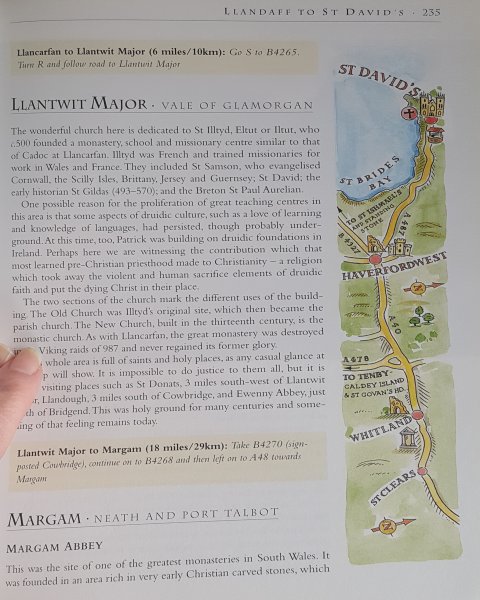
The example above shows what I mean, this is a journey TO St David’s and if you are going to ignore geographic orientation, north is to the right on this panel, then at least work down the picture to the destination not up. Also as you can see the text doesn’t actually refer to the map on the page, in fact that part of the journey is eight or nine pages further on, where there is no map but could easily have been one. The whole page layout throughout the book is as confusing as the selection of routes, you find yourself either inserting lots of bookmarks or constantly flipping between pages in an attempt to follow what is going on.

So why am I reading it this time, rather than dipping in for a specific locality which is my usual way of using the book? Well England is about to come out of what is the third and hopefully last lock down to prevent the spread of Covid 19 and I’m desperate to escape these four walls and go somewhere, in fact pretty well anywhere and I’m looking for inspiration. In all there are thirteen of these suggested journeys and they cover most of England, Scotland and Wales, the latter two will still be out of bounds next week but it should be possible to go somewhere in England if only for a day trip as overnight accommodation is still not easily available and won’t be for at least another month, probably longer. I’m not looking for a route but a destination preferably not too far away and if there is somewhere else interesting near to it then that would be a bonus. The one advantage of the route structure of the book is that places near one another are next to each other in the book so you can get happy accidents of two or three interesting places all in one go.

There are also sections that don’t stick to the routes but dot around by theme and one of these chapters on stone circles and tombs has probably inspired me to journey out on day trips more than any other and this is the only travel guide I own that specifically has a section on these ancient sites. So what to make of the book as a whole, well as I said at the beginning it’s odd and doesn’t really work in the way it was intended. It can also be infuriating due to the constant chopping and changing of pages to see what should be all together but it has earned its place in my car for when I have a spontaneous urge to go somewhere unplanned. It also has the advantage that it doesn’t matter that it is nearly a quarter of century old, which would be a serious handicap in most guide books as it is specifically pointing you to places that largely haven’t changed for centuries and will remain for years to come.

This book was originally published in 1997 by Piatkus in the UK and was reprinted in the USA in 2000 by Hidden Spring Books under the title ‘The Spiritual Traveller’. The sequence of some of the chapters are altered and suggestions of places to stay are added in the American edition but the books are to all intents and purposes the same.
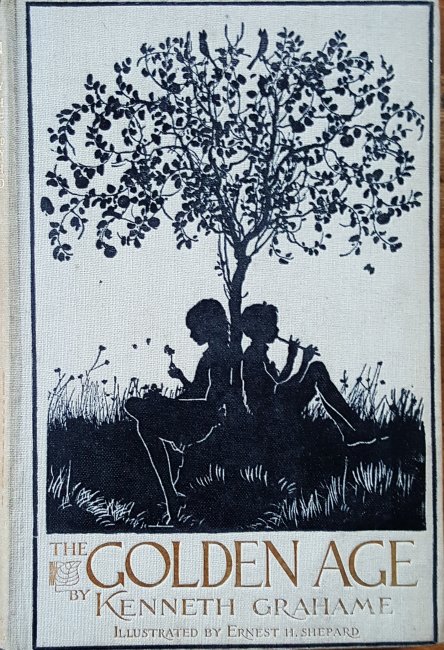
The Golden Age – Kenneth Grahame

Originally published in 1895 by The Bodley Head without any illustrations, my copy is also published by them and is the 1928 first edition illustrated by Ernest H Shepard who is probably best known for his Winnie the Pooh drawings for A A Milne’s classic children’s works. The book is simply beautiful even before you open it with the cover silhouette and text embossed into buckram covered boards. Kenneth Grahame of course is famous for his own children’s classic ‘The Wind in the Willows’ which was published thirteen years after ‘The Golden Age’ and was converted into the play ‘Toad of Toad Hall’ by Milne in 1929. Surprisingly after such a major hit with ‘The Wind in The Willows’, and despite living for another twenty four years after that, he published no more books and ‘The Golden Age’ is the second of just four other books he wrote before ‘The Wind in the Willows’.

Kenneth Graham was born in Edinburgh in 1859 but when he was only five years old his mother died and his father, who was probably alcoholic, couldn’t look after Kenneth and his three siblings so they were sent to live with their grandmother in a small village in Berkshire. This sudden change from the centre of a Scottish city to a rural English parish had a lasting effect on Grahame and his explorations as a child of the countryside surrounding him undoubtedly led decades later to ‘The Wind in the Willows’. His earlier writings, especially ‘The Golden Age’, feature a group of children having fun growing up in just such an idyllic environment written entirely from their point of view and are clearly fictionalised versions of his own life in the mid to late 1860’s in Cookham Dean. The book is made up of seventeen short stories and a prologue which refers to the, largely distant, adults as The Olympians and the children as the Illuminati because only they could see the pirates, knights, soldiers, wild animals etc. of their playing and truly enjoy themselves.

Looking back to those days of old, ere the gate shut to behind me, I can see now that to children with a proper equipment of parents these things would have worn a different aspect. But to those whose nearest were aunts and uncles, a special attitude of mind may be allowed. They treated us, indeed, with kindness enough as to the needs of the flesh, but after that with indifference (an indifference, as I recognise, the result of a certain stupidity), and therewith the commonplace conviction that your child is merely animal. … These elders, our betters by a trick of chance, commanded no respect, but only a certain blend of envy—of their good luck—and pity—for their inability to make use of it. Indeed, it was one of the most hopeless features in their character (when we troubled ourselves to waste a thought on them: which wasn’t often) that, having absolute licence to indulge in the pleasures of life, they could get no good of it.

From the opening paragraph of The Golden Age

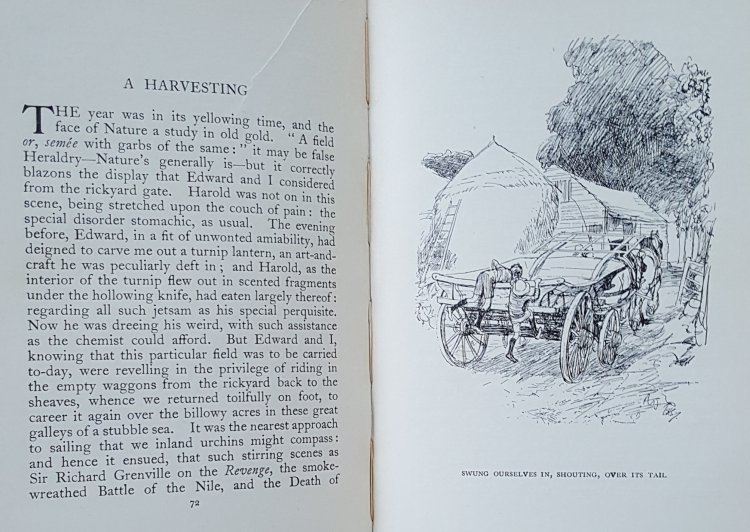
The stories are delightfully and really evoke a long gone period in mid-Victorian England, as well as harvest time depicted above they encounter mounted soldiers in one of the lanes all dressed up in regimental finery with red jackets and plume helmets so very different to the modern military. There are stories of Charlotte, the youngest girl, playing with her dolls and telling them off for misbehaving, the three boys are always in and out of the river or exploring the woods or generally being where and doing what they shouldn’t be, often in the company of Charlotte if not her elder sister Selina. The relatives the children were staying with were clearly quite well off, the house appears to be quite large and there are servants hence the opportunity for them to enjoy their childhood despite regular complaints about having to do schoolwork. For those wondering ‘dreeing his weird’ is a Scottish expression meaning to accept your fate, so clearly Harold had ended up with a tummy ache after all that raw turnip but had recognised that his illness was entirely his own fault so wasn’t complaining about it. None of Grahame’s actual brothers and sisters match the names of the children in the book or its sequel ‘Dream Days’ where Charlotte appears again in the short story ‘The Reluctant Dragon’ which of all of Grahame’s short stories is easily the best known although the rest of ‘Dream Days’ doesn’t really live up to this gentle fantasy.

The illustrations by Ernest H Shepherd are as charming as you would expect from this master of book illustration but for me the real joy in the book are his silhouettes, they are just so beautifully done and as can be seen above sometimes continue across a double page spread. The children are enjoying some ginger beer purchased with the reward for Edward being steadfast under the dentists attention and having a tooth removed that morning. The misunderstanding as to what corked wine meant with the subsequent worry about expanding pieces of cork being dangerous inside you is quite funny and behind Selina can be seen one of the children’s rabbits chosen as the “most self-respecting of the rabbits … let loose to grace the feast”.

The book is still easily available and as far as I can tell has never gone out of print in the 125 years since it was first published, maybe not very well known now but still worth searching out. I’ll leave the last word however to Kenneth Grahame himself.

Well! The Olympians are all past and gone. Somehow the sun does not seem to shine so brightly as it used; the trackless meadows of old time have shrunk and dwindled away to a few poor acres. A saddening doubt, a dull suspicion, creeps over me. Et in Arcadia ego—I certainly did once inhabit Arcady. Can it be that I also have become an Olympian?

Closing paragraph of the prologue to The Golden Age

The Sandman: Preludes & Nocturnes – Neil Gaiman

I’ve been a fan of Neil Gaiman’s writings for many years but I really don’t understand the reason for comics for adults so have stayed away from the creation that really launched Gaiman as a fantasy superstar writer, The Sandman series. Don’t get me wrong, I loved comics as a kid and have really enjoyed the nostalgia of the recent Folio Society triple set of Marvel reprints for what is known as the Gold, Silver and Bronze ages of comic books and reviewed the Silver Age edition almost a year ago here but I’ve never read a graphic novel or indeed been that interested in trying. I might have known that Gaiman would eventually draw me to a genre I have ignored for so long. Preludes and Nocturnes collates the first eight comics from The Sandman series which eventually ran to seventy five issues from January 1989 to March 1996.

The first comic deals with the capture of The Sandman, aka Morpheus, aka Dream in 1916 through a magical incantation that goes wrong. Roderick Burgess and his acolytes were actually trying to summon and capture Death and got instead the ruler of dreams. Frustrated by their prisoner clearly not being the right target and his refusal to say anything so they don’t know which powerful entity they have actually trapped they leave him in the magic circle hoping he will talk and be of use, but he simply sits there , biding his time, for seventy years, until he is accidentally released. After swiftly taking his revenge on the only mortal still alive who was involved in his capture he finds that his realm has gone to wrack and ruin in his absence and his three essential tools, his bag of sand, his helmet and his ruby talisman have gone missing and without them his powers are dramatically reduced.

The next six comics deal with his recovery of the missing artefacts, some of these stories work rather better than the others. The main failure is Passengers which tries too hard to make The Sandman part of the DC Comics universe by jamming other characters from that stable of superheroes and villains into the story line. Yes The Sandman is a DC character, initially created by Joe Simon and Mark Fleisher in 1974 in the traditional hero suit of close fitting top and tights but the Gaiman re-invention of the character fifteen years later doesn’t sit well amongst the costumed heroes and it just feels wrong, even Gaiman describes the attempt as “perhaps misguided”. These all come under the horror fantasy genre, especially 24 Hours which would definitely get an adults only certificate if it was filmed. The dark artwork if perfectly fitted to the story although the original artist left after just five comics and the design subtly changed at that point but not as much as it was going to do.

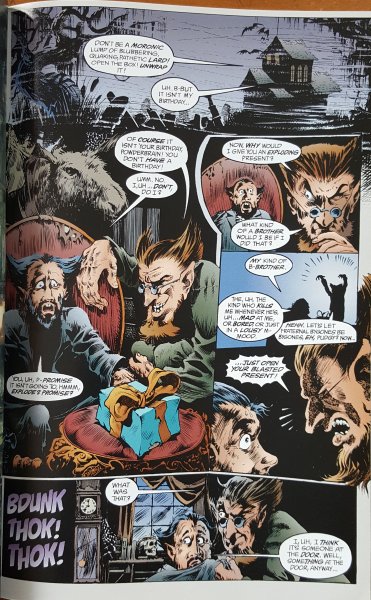
The page below is from the final comic in this volume, The Sandman now has his power restored and so his initial quest is complete. The resolution has come as an anticlimax and what he doesn’t know now is what to do next so is reduced to just sitting, feeding the pigeons in a park until his sister arrives to try to shake him out of his deep reverie. As you can see the artwork is very different in this comic which is effectively a codicil to the first seven, I actually enjoyed this episode more than those before it and this is the first slight hint of the existence of The Endless a group of seven siblings who are like gods (although there is no specific reference to the family this early on in The Sandman series). In the final panel of this comic, and the book, you see that The Sandman is back.

Did I enjoy reading this? Yes. Will I therefore purchase and read the rest? Probably not. It was fun to experience such a complex story in the comic format but I don’t feel the need to read more in this style. I am intrigued by the recent audio version being produced as a series of dramas by Dirk Maggs whose work in the field of adapting fantasy novels to audio dramas I greatly admire, so ironically I may well continue my experience of reading a graphic novel but in a format with no pictures.

Maverick in Madagascar – Mark Eveleigh

This is not my own lie. This is a lie that the ancestors told me

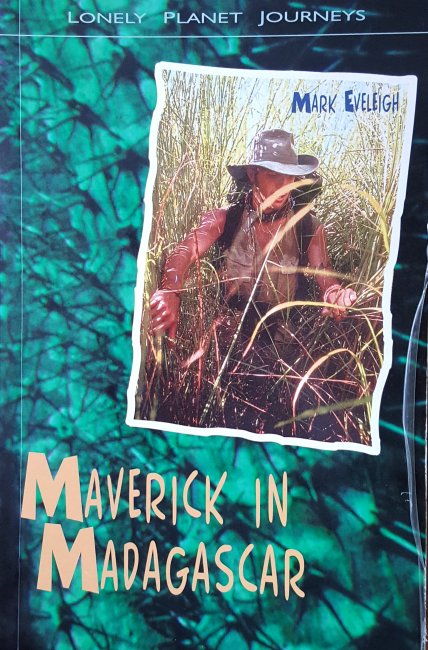
Mark Eveleigh opens his book with this traditional start to any story being told in Madagascar as he describes his plan to walk from north to south along the western coastline of the fourth largest island in the world and before you even get to that original plan you know that he doesn’t succeed because the maps at the very beginning of the book only show less than a quarter to that route. Instead there is a second map relating to Part II of the book where he heads across the middle of the country in a search for the Vazimba tribe who are a group of white pygmies not seen for decades or even centuries and this may be because the various tales relating to them describe them as alternately not short and not white. This is going to be a difficult hunt.

That his original plan was doomed almost from the start was due in part to the late rainy season which made the going even more difficult that it should have been and the fact that, despite his intention to purchase a horse as a pack animal for his equipment, all the horses in the north of the country appeared to have succumbed to a mysterious disease and died in the few months before he got there. Instead he decides to buy Jobi the bull zebu (a local breed of humped cattle) and despite warnings that nobody could drive a zebu that far decides to set off in the company, at least initially, of a couple of locals who were taking two cows for slaughter part way down the route he would have to follow,

Mark is an entertaining writer, particularly when describing his own discomforts, and there are plenty of those especially in Part II where he gets poisoned by various plants that he is walking through and has recurrences of the malaria he first caught in Indonesia whilst trying to avoid being shot by bandits. He is also an excellent photographer so it is somewhat disappointing that despite frequent references to taking photographs the format of the Lonely Planet Journey’s books doesn’t allow for pictures apart from on the cover as you so want a few pages of images especially when he describes a breathtaking view. He also clearly bonded with Jobi during his aborted trek and is genuinely upset when the walk has to be abandoned partly due to Jobi getting unwell so he sells him for a significant loss to a family that will take care of him rather than the higher offers from others where his lifespan is likely to be considerably shorter.

What stands out through the whole book is the welcoming and friendly nature of almost all the Malagasy people he meets, apart from the bandits, and their determination to share what little they have despite Madagascar being one of the poorest countries on Earth. Their astonishment that a Vazaha (literally outsider) has made it to their isolated village, quite probably the first white man that the children at least have ever seen, is an ongoing theme. Madagascar does have its tourist traps but they are few and far between and due to the danger of travelling especially in the zone rouge in the middle of the country tourists tend to be restricted to these small areas and mainly to an island off the west coast which Mark visits in order to complete paperwork and send letters but gets away from as quickly as possible. It’s a really good read and I definitely recommend it.

Lonely Planet Journeys was a relatively short lived series of travellers tales published by Lonely Planet between 1996 and 2002, I really enjoyed the eclectic selection and when it became clear the series was coming to an end I bought up as many different ones as I could find in my local bookshop and in all have twenty five titles. There doesn’t appear to be a definitive list of all the book published under this imprint, the LibraryThing list has forty seven titles but includes several books that were not actually part of the series so I’m guessing that I’m missing no more than ten actual books from the set, probably quite a bit fewer than that. This one has been sitting unread on my shelves for twenty years so it was about time I finally got round to picking it up. I have read most of the ones I have now but whilst checking the shelves for the date range and the tally of books there are at least two that I have no memory of reading so they will probably appear sometime in the next few months.

‘How it Works’ The Computer

This is a bit of fun really, it certainly isn’t a review of the book because any objective review would say that this book is no real use for understanding how computers work nowadays, but it is an insight into just how much technology has advanced since this book was written in 1971, so we are looking back fifty years. Before the days of computers in the home and decades before mobile phones and despite it being within my lifetime, as I bought this book new, it seems an unbelievably long time ago for technology. I was inspired to read it again after listening to Sir Tim Berners-Lee talking about the 32nd birthday of his invention of the World Wide Web which was celebrated last week. Actually this year (2021) marks the 30th anniversary of the Web being available to everyone rather than just the scientists at CERN which was where he was working at the time so it’s a good time to look back two decades before then to how computers started to be available to even a relatively small business although they were still wildly expensive.

This blog is going to be quite image intensive as I want to include several of the lovely illustrations by B H Robinson because they really tell the story to us nowadays far more than the informative but very technically dated text by David Carey. The first thing that strikes you is the sheer size of the equipment and then as you look further you realise that the two installations shown above don’t have any screens, the user interface is a teleprinter. The first ‘business’ computer I ever used didn’t have a screen either so I sympathise with the operator above, screens did exist but were quite scarce, certainly in the early 1970’s. It is also worth pointing out that the massive amount of cabinets lights and switches in the ‘large computer installation’ made up considerably less computing power than the mobile phone in my pocket.

Back then the sections of a computer were really obvious because they were separate huge cabinets or large pieces of equipment, nowadays everything is in one piece so it is actually easier to envisage how a computer works by looking at these old examples. To start with you need to get a programme and some data into the machine and that was a lot harder than it sounds. The example above uses a card punch followed by a card reader, yes the process was for data entry clerks to type everything into a machine that could produce thousands of pieces of cardboard each with a tiny part of the information and then carry the stack over to another machine (being very, very careful not to drop it because they have to be read in sequence) and then feed them in to load data into the computer.

Just how tedious this job was is shown above, and everything had to be verified because a single hole in the wrong place would make the entire stack useless until it was corrected. The amount of time taken to produce even the simplest programme or data source was unbelievable to those of us today. One way of getting round the danger of dropping several hundred cards, all of which look identical to a human, was to use paper tape instead, at least then it was just on a long reel although these also needed to be handled carefully as they could easily tear.

The main reason I have included the picture above is because it clearly shows a punched card. Each card consisted of eighty columns of numbers and each column could encode one letter or number, this blog entry consists of 7305 characters so would need a minimum of 92 cards to just hold the text; the pictures were not an option on machines like this back then, which I have to keep reminding myself is well within my lifetime as I was nine when this book was published. I say a minimum of 92 cards because I’m pretty certain words couldn’t wrap over cards so there would be blank space at the end of each card where a word wouldn’t fit.

To run a programme again you would need to reload the stack of cards and read them again unless you had a sufficiently large computer centre where you could have magnetic tape storage or even that modern wonder a disc storage device.

In the background you can see the five foot high magnetic tape cabinets, these were pretty quick in the day but nowadays the lag from a request for data and it actually arriving at the CPU (see later) makes them completely redundant, even more so than all the rest of the equipment shown. For example there would be an initial lag whilst the right part of the tape was found for the data needed and the book then explains that the tape could be read at up to 900 characters per second, now that figure is a little misleading as we are talking binary so just 0 or 1, to encode a letter or even a number other than 0 or 1 you need a lot more than one character, in fact you need 8 bits, otherwise known as a byte so reading this blog at 900 characters per second (111 letters per second) would take over a minute. Throughout the book Carey refers to storage in bits, presumably to make the numbers look big and impressive, even working in bytes is hopelessly outdated as we will see shortly.

Ah, disc storage, but just look at the size of the discs, 14 inches (35.5cm) across, six layers in a cumbersome disc pack, but at least you got lots of storage which was very quick to access. Quick yes but in today’s terms quite slow and 7.25 million characters per disc pack. Time for some maths again, lets work out just what that storage is in modern values.

  • 8 bits to the byte, 1024 bytes to the kilobyte, 1024 Kb to the megabyte. (Yes I know nowadays we just use 1000 for ease of calculation but in 1971 it was definitely 1024 as that is the relevant power of 2)
  • 7,250,000 bits = 906,250 bytes = 885 kilobytes = 0.864 megabytes
  • I would need eight complete disc packs to store one photograph taken by my phone, even assuming that such a thing was possible and I don’t even have a particularly up to date phone.

Actually that’s pretty good, the first computer I programmed for a company in the early 1980’s was an Osborne 1 which had 64 kilobytes of memory and two 90 kilobyte disc drives but I still managed to write a working insurance claims handling system for a parcel carrier on it.

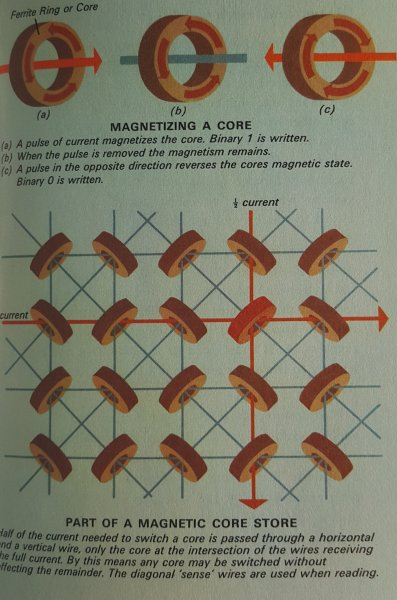
Back in 1971 whilst there were computer chips, machines were still filled with transistors soldered onto printed circuit boards alongside the fairly limited integrated circuits available. The memory often however hadn’t moved on from the horribly delicate magnetic core store shown above. This isn’t an analogy as to what is happening you really did have lots of tiny ferrite cores strung onto wires which could be magnetised on or off to signify 1 or 0. As you can imagine the amount of memory was therefore pretty limited although the book claims that it could get up to a million bits (122 Kb).

Output back then would mainly be to a printer or possibly a screen in an advanced setup, I don’t think we need a picture of what they look like.

I’ve greatly enjoyed this trip down memory lane and when I showed the book to a seventeen year old friend she was astonished at the size of the machines and the limits they had. The computer she carries around with her all the time is millions of times more capable than the equipment featured in the book and tens of thousands times cheaper as well when inflation is taken into account.

Ethan Frome – Edith Wharton

I had the story, bit by bit, from various people, each time it was a different story. If you know Starkfield Massachusetts, you know the post-office.If you know the post-office you must have seen Ethan Frome drive up to it, drop the reins on his hollow-backed bay and drag himself across the brick pavement to the white colonnade: and you must have asked who he was.

The opening of Ethan Frome draws the reader in immediately, who is Ethan Frome? Nobody seems to know yet everybody ‘knows’ him and as a reader you to already want to know about this mysterious character. The narrator seems determined to find out so lets keep reading, further down the first page he is described as “but the ruin of a man” with “lameness checking each step like the jerk of a chain”, what on earth had happened to him? After the opening preface in which the anonymous narrator gets to know a little more about Ethan Frome whilst employing him to drive a sleigh each day to and from the railway station as it is winter and the snow is feet deep. He is about to enter Ethan’s home after finally being defeated by the snow one evening trying to get back to town when suddenly the preface ends and the first chapter leaps back in time. The book drops the narrator and continues in the present tense but this is clearly the present for Ethan of almost two and a half decades ago.

Back then the Frome farm is in a bad way, very little money coming in and what there is being spent on remedies for his ‘ill’ wife. I put the word ill in quotes because it’s fairly clear that a lot of what is wrong with Zeena is psychosomatic although she probably does have some underlying illness but not a severe as she believes. The other occupant of the farmhouse is Mattie, Zeena’s cousin, whom they took in a year ago when her parents died and is supposedly helping around the house although she isn’t very practical. Over the seven years since their marriage Zeena has become more and more sour tempered and nagging and the arrival of Mattie into their household had initially given Ethan some relief from her constant complaints. Over the intervening months however his feelings for her had changed to something far more and it transpires that Mattie’s feelings for Ethan had also grown but it is obvious that Zeena had noticed this and resolves to send Mattie away which leads to the tragedy which is foreshadowed several times during the book. The development of the entirely platonic romantic relationship between Ethan and Mattie in the shadow of the terrible atmosphere at the farm is beautifully written, neither character will admit to their feelings for the other with its implications for Ethan and Zeena’s marriage which frankly had fallen apart years ago and they were only still together due to the impossibility of doing anything else given the dire financial position of the farm.

The final chapter returns to the narrator and what he finds in the Frome household when he enters and all I’m going to say about that is that it isn’t what I expected from the start of the book.

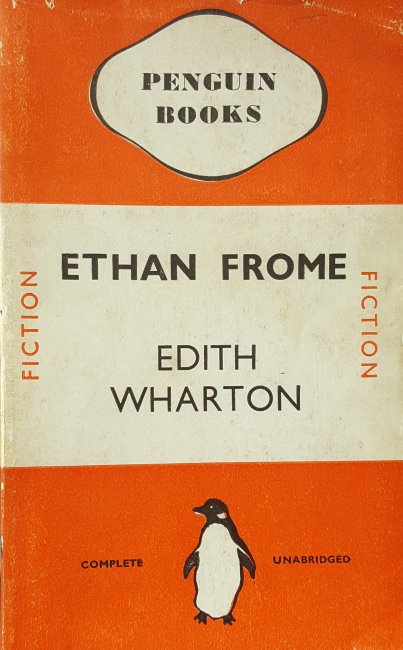
My copy is the first Penguin Books edition from November 1938, the book was first published in 1911 nine years before Wharton won the Pulitzer Prize for easily her best known work ‘The Age of Innocence” but by 1911 she had already published three full length novels, three shorter novellas, a couple of books of poetry, six volumes of short stories and even four non-fiction books, Wharton was clearly an experienced writer and this shows in her confident use of language and entirely believable dialogue in Ethan Frome. The book is now out of copyright and can be read or downloaded as an ebook from Project Gutenburg at this link.

The Ring – Stephen Fay & Roger Wood

Subtitled ‘Anatomy of an Opera’ this tells the story of the 1983 production of Wagner’s Ring Cycle at the theatre the composer had built for performances of his operas in Bayreuth in southern Germany and which is still run by his descendants. It starts with the 1980 announcement that Sir Peter Hall was to direct the four operas with Sir Georg Solti conducting, journalist Stephen Fay and photographer Roger Wood become involved right at the beginning and this gives a fascinating glimpse into how the production grew. The book isn’t the story of the Ring Cycle operas but rather a backstage look as to how they came to be performed in 1983, from initial meetings, through set and costume designs, rehearsals and ultimately the appearance on stage in front of an audience and it is lavishly illustrated with Woods excellent photographs. Frankly reading this book makes it amazing that start to finish it was managed in just three years. Bayreuth is unique amongst the worlds opera houses for many reasons but one particular feature is that whilst almost every other house starts with operas one and two in the first year and then introduces numbers three and four over the next one or two seasons Bayreuth always has all four from the start which is a massive undertaking.

Because this book is about the production effort you don’t need to know anything about The Ring Cycle to appreciate the book but it does help to understand the flow of the parts and the overall structure of what is going on. For anyone reading this who isn’t familiar with just how daunting a job this is I’ll just use this paragraph to summarise the task in hand. The cycle consists of four operas performed in sequence over four days/evenings and then repeated during the season, this would be a lot even with ‘normal’ operas but these are huge with large casts and long running times. Solti noted that a Beethoven symphony would have a score of roughly one hundred pages, his combined score for the four operas ran to well over two thousand pages, I have Solti’s famous recording of the cycle from 1958 on nineteen vinyl albums and the DVD recording I also have of Daniel Barenboim’s 1991 Bayreuth production has running times for the actual performances of Das Rheingold – 154 minutes, Die Walkure – 237 minutes, Siegfried – 244 minutes and Gotterdammerung – 270 minutes, a grand total of 15 hours and 5 minutes. Truly a musical marathon for all concerned, even the audience.

With so much needing to be done along with thirty six principal parts (several of which appear in more than one of the operas), a large chorus and numerous non-singing extras, a scratch orchestra put together for the season (the Festspeilehaus doesn’t have it’s own orchestra but draws players from various German orchestras who probably haven’t played together before) and limited time for rehearsals due to the need to do all of it in one go it is clear that this has lots of potential for disaster. Add in the conflicts between the various people involved along with all the back stage issues it’s remarkable it continues to happen and it’s this continuing rising tension that makes this book such a great read.

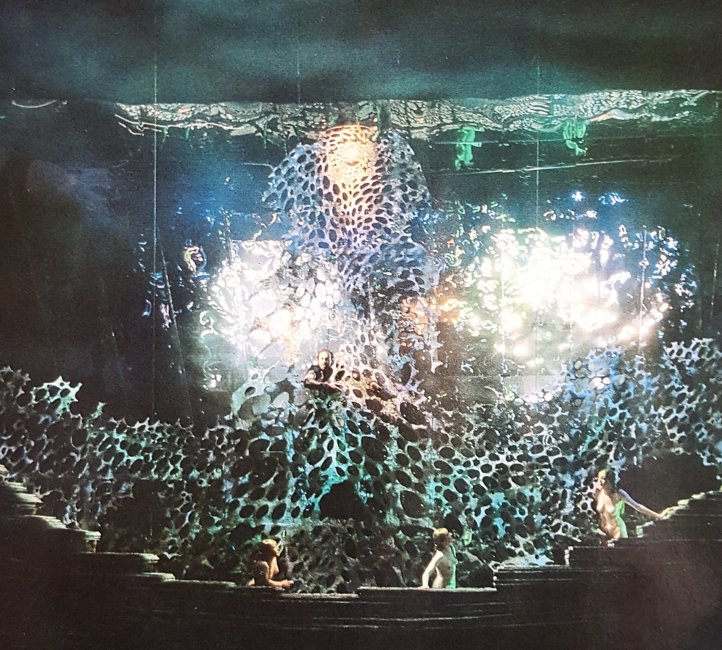
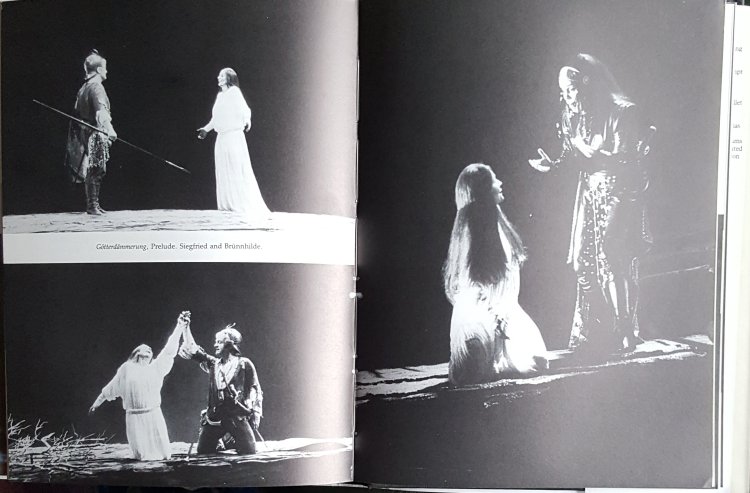
The spectacular set used for the start of Das Rheingold is depicted on the rear cover of the book as Alberich comes to steal the gold from the Rhinemaidens. Along with the writing of Stephen Fay the book is adorned with beautiful photographs by Roger Wood, probably one of the finest theatrical photographers of all time although my reproductions here don’t do justice to his work as they are quite glossy and difficult to re-photograph. To really appreciate them you need to read the book but as they make up such a significant part I felt I wanted to give some idea of what he did. There is a very good reason why the two men share the credits.

The fascination of the book comes from the quite often difficult relationships between the various protagonists, Solti had terrible problems with some members of the orchestra but also one principal singer in particular. Reiner Goldberg had been cast as Siegfried despite never having sung the role in the past and whilst he had promised to learn the part it rapidly became clear that on arrival for rehearsals he hadn’t done so, he also would not take stage direction and simply went off on his own way so causing tension with Hall as well. Nevertheless the two of them persevered with him far longer that they should have before eventually giving up when they had reached the dress rehearsals so just before the first proper performance. Manfred Jung was asked to replace him at almost no notice and could only do so because he had sung the part many times including the previous seasons of The Ring Cycle at Bayreuth. This however was only in the last few months before audiences would see what had been produced, the stressed relationship between Wolfgang Wagner, Richard Wagner’s grandson, who was running the theatre at the time and Sir Peter Hall had gone on for three years by now ever since Hall was chosen to direct. Hall was directing what would turn out to be easily the most expensive production of the cycle up to then and Wagner was having to pay for it. Wagner had also directed at least two complete cycles in his own right and had firm ideas as to how it should, and more importantly to him at least how it should not, be done. On top of this Wagner’s temper and Hall’s apparent calmness in face of it just wound Wagner up more exacerbated by the fact Wagner spoke no English and Hall hadn’t managed to learn any German so they had to use interpreters made the relationship particularly difficult altough highly entertaining to read about.

Solti did recognise that one of Hall’s particular troubles was Wagner. He took Hall aside one day in July nd asked if he could possibly say something pleasant to Wagner, to improve their relationship. Hall replied that he could think of nothing pleasant to say.

I was first properly introduced the The Ring via a TV version broadcast in May 1985 which was of the 1980 production which preceded the Solti/Hall version and was conducted by Pierre Boulez directed by Patrice Chereau, Introduced by Humphrey Burton broadcast on BBC 2 television and BBC Radio 3 over four consecutive Saturday evenings and I was amazed at the breadth of the concept. Reading this volume which gives just a hint of the three years work that goes into producing a cycle I am even more astonished by ‘the biggest work of art in the world’.

The Ghost of Thomas Kempe – Penelope Lively

Although Penelope Lively is nowadays best known for her books for adults, having been shortlisted for the prestigious Booker Prize three times and winning it in 1987, she started out as a children’s author and this was her fifth book. all of which had been aimed at children. The Ghost of Thomas Kempe was published in 1973 and won the Carnegie Medal, as best children’s book of the year which makes Lively the only author to win both of these major book prizes. Just for good measure she also won the Whitbread Children’s Book award in 1976 amongst other book prizes over the years.

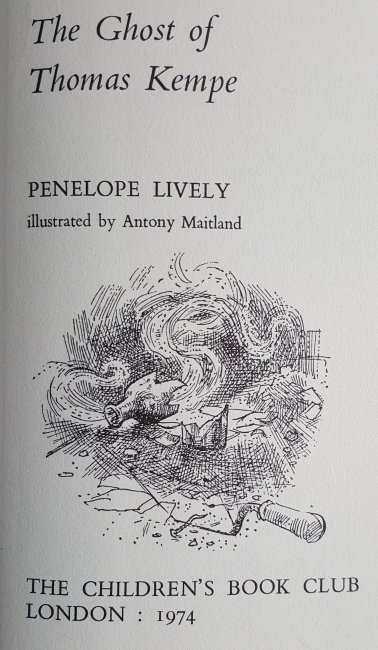
I was prompted to pick this book up however due to an instagram post I saw last week which featured the Puffin edition and brought back happy memories of reading it all those decades ago. I knew exactly where it was on the shelves so I had to get it out and those memories haven’t let me down, it is still a fun read. The story starts with workmen renovating East End Cottage in the growing small town of Ledsham before a new family are due to move in. As one of them removes a rotten piece of wood from under the windowsill in the attic room a small bottle falls out and smashes on the floor and unbeknown to them something, or someone is released. This is the featured illustration on the title page and gives an immediate indication of the delightful drawings by Antony Maitland used to illustrate the book.

The room is destined to be the bedroom for James and at first he is very happy to have such an interesting room, all odd angles, so much better than the normal shaped rooms occupied by his sister Helen and their parents. It’s not long however before things start to very badly wrong as Thomas Kempe makes his presence felt. Kempe was a sorcerer back in the last sixteenth and early seventeenth century and had lived at East End Cottage, now he is a poltergeist and a particularly annoying one, smashing items, slamming doors, along with throwing things at James when he won’t do what he wants, because the worst thing is the notes making it quite clear that he regards James as a particularly useless apprentice and is intent on making his life as difficult as possible. Unfortunately for James he appears to be the only person who knows what is really going on, his parents are very sensible and don’t believe in ghosts so suggesting that is the real cause of the problems is a non starter. James therefore becomes blamed for the disturbances and broken items and suspected of the vandalism in the town as Kempe writes abusive messages on doors, walls and fences all over the place making clear his dislike of modern times and the people living in ‘his’ village. What is James to do?

Fortunately for James he eventually meets Bert Ellison, builder and part time exorcist, and finally he has somebody who not only believes him but may be able to do something about the increasingly erratic ghost. The picture below shows Bert’s second attempt at exorcising Thomas Kempe, which unfortunately is no more successful than the first. But then again the reader knew this would fail for some reason as there is still far too much of the book to go. The story rattles along and all to soon I had finished with a satisfying conclusion. I doubt I have picked the book up, other than to transfer it from shelf to box and back to shelf over various house moves, in over forty years but it was still there when I wanted it and it’s been a very enjoyable read.

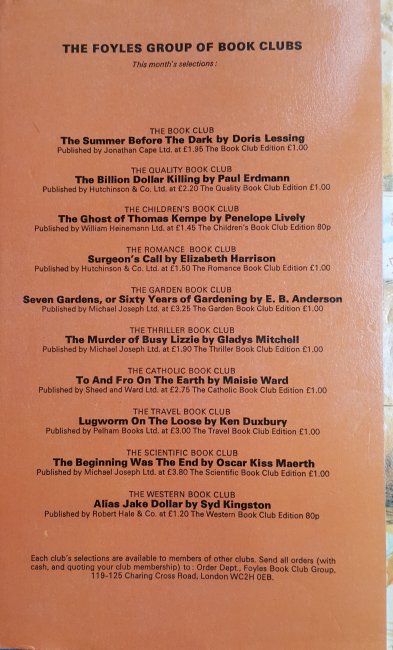
This is one of my few remaining books from the Foyles Children’s Book Club, that I was a member of from about the age of five or six up to at least twelve. I discussed the club in an earlier blog and I was either eleven or twelve when this book came out in the club edition in 1974, it doesn’t say which month so I don’t know for sure. These monthly books were really formative of my early reading and as can be seen below from the back cover of this edition they were a real bargain. You could also have books from any of the other clubs either as well, or I think instead, and it was around this time I broadened my reading by dabbling with the science and travel clubs as well before leaving the club as I discovered science fiction and would rather have the choice in my local book shop rather than a monthly book in the post. I am forever grateful to the Children’s Book Club though and I hope there is something similar still going on somewhere.

In Memoriam A.H.H. – Alfred, Lord Tennyson

By way of complete contrast with last weeks blog on happiness, this week I have read, to give the poem its full title, ‘In Memoriam Arthur H. Hallam’ by Alfred, Lord Tennyson which is his long eulogy to his fellow student at Cambridge university who died in 1833 of a brain haemorrhage aged just twenty two. He started writing almost immediately after Hallam’s death and kept adding to the work over the ensuing years until it was finally published in 1850 by which time it had grown to 725 four line verses (2,900 lines in total) split into 131 cantos along with a prologue and epilogue although these first and last blocks of verse were not called that by Tennyson himself but rather have gained those titles over the years. Not only did this, one of Tennyson’s greatest works, finally get published in 1850 but in November that year he became Poet Laureate, a title he held until his death in 1892 the longest time that anyone has held the post.

Although the poem was published in 1850 Tennyson was still not satisfied with it and continued to tinker meaning that there are several versions produced by him over the next forty years and indeed the version included in my copy, and what is now regarded as the definitive version, was the one further amended by his son Hallam Tennyson after the poets death. For such a long poem on such a sad subject it is surprisingly readable once you get into the rhythm of the work. Each of the verses take the rhyming format of A B B A, meaning that the first and fourth lines rhyme as do the second and third, although sometimes the rhyme is rather forced as can be seen in the very first verse of the prologue. The middle lines are fine as they pair ‘face’ with ’embrace’ but lines one and four are rather shaky pairing ‘love’ with ‘prove’, I’m not sure what accent you would need for that to work but it is rather jarring and doesn’t get the work off to a flying start.

Strong Son of God, immortal Love,
Whom we, that have not seen thy face,
By faith, and faith alone, embrace,
Believing where we cannot prove;

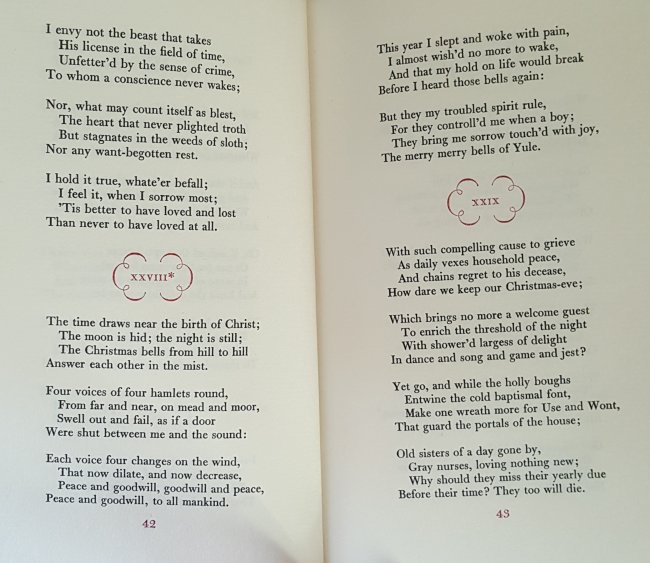
There is, as you would expect for a Victorian English work of literature, a Christian emphasis to a significant part of the poem, but probably less than you would imagine. Tennyson is far more concerned about getting his feelings, along with those of his sister Emily who was engaged to Arthur Hallam at the time of his death, onto paper than expressing a strong religious position and the work is all the more powerful for it. It includes a very famous quote as the last two lines of canto twenty seven which can be seen in the image below as the third verse on the left hand side.

“Tis better to have loved and lost than never to have loved at all’ actually shows Tennyson starting to come to terms with the loss of his friend and prospective brother in law and contrasts with the last lines of canto one ‘Behold the man who loved and lost, but all he was is overworn’. The rest of the text in the image above is part of the three cantos that deal with the first family Christmas after the death of Arthur Hallam, which eventually has the family able to sing together although somewhat reticently. Canto seventy eight deals with the following Christmas in 1834 where things are somewhat more normal although still strained and later in the poem he also covers the 1837 and 1838 Christmas festivities as he finds greater solace in his faith. The poem ends on a bright note with the marriage of another of his sisters, Cecilia, signifying the gradual coming to terms with loss of his friend.

Another famous line from the poem occurs in canto fifty six “Nature, red in tooth and claw” which came to be associated with the theory of natural selection as set out by Charles Darwin nine years later and indeed some parts of In Memoriam can be read as indicating that Tennyson was at least passingly familiar with the concept even then as he wrestles with his faith in the aftermath of his friends death. The quote isn’t entirely original to Tennyson but this is the first appearance of the full phrase.

My copy of the book is by the Folio Society and was printed in 1975. It is quarter bound in fine grained black leather with olive green cloth boards and printed on Abbey Mills antique laid paper which makes the whole book lovely to handle and a pleasure to read. The headings to the cantos are particularly attractive and the Bulmer typeface chosen for the text is very clear. It is pretty easy to get hold of this edition, at the time of writing there were four copies available on abebooks starting at just £6.60 plus postage. I probably still wouldn’t have picked it off the shelf if I hadn’t been in lock down due to coronavirus as a poem of almost three thousand lines is rather daunting, especially given the subject matter but it is definitely worth a read.

A Guide to Happiness – Epicurus

EPICURE

Noun
A person who takes particular pleasure in fine food and drink.
‘they see themselves as epicures—delighting in food that is properly prepared’

Origin
Late Middle English (denoting a disciple of Epicurus): via medieval Latin from Greek Epikouros ‘Epicurus’.

Oxford English Dictionary

The definition above was the only thing I knew about Epicurus before I picked up this book which is an extract (minus the notes) from ‘The Epicurean Philosophers’ edited by John Gaskin and published by Everyman in 1995. Epicurus lived in Athens between 341 and 270 BC and unfortunately like Sappho, whom I featured last month, the vast majority of his works have been lost to history with just three complete letters along with some fragments and two collections of quotes making it to the present day out of the estimated three hundred works he is believed to written. He formed his own philosophical school, largely in opposition to the prevalent Platonic teachings of the day and unlike the majority of his contemporaries he allowed women to join, in fact he positively encouraged them.

The book starts with his most famous work ‘the letter to Menoeceus’ which is an excellent place to begin as this epistle summarises his teachings and is very much a guide from a master to a pupil. Much to my surprise though Epicurus himself would not be impressed by the definition that has been derived from his name with it’s implication of, if not a hedonistic lifestyle, at least one of the pursuit of luxuries. In the letter to Menoeceus he includes the following instruction:

Once the pain due to want is removed, plain flavours give us as much pleasure as an extravagant diet, while bread and water bring the greatest possible pleasure to the life of one in need of them. To become accustomed, therefore, to simple and inexpensive food gives us all we need for health, alerts a man to the necessary tasks of life and when at intervals we approach luxuries we are in a better condition to enjoy them.

This exhortation to a simple diet, indeed simplicity in all needs, is reiterated several times in the collections of quotes also included in the book. Yes a follower of Epicurus should take delight when they encounter something special but this should be a happy rarity not an object for living. He emphasises again and again that you should be happy with what you have or can achieve because desiring what you don’t have, and cannot possibly get, simply leads to unhappiness for no good reason. He does however say that you should strive to be free of pain by which he means not just physical pain but also the pain of want for food, drink and shelter. He is not in favour of the hermit or of deprivation of the body to find truth for the soul as some philosophies would have their followers do, indeed attendees to his school would eat simple meals whilst discussing the matters in hand.

The flesh cries out to be saved from hunger, thirst and cold. For if a man possess this safety and hopes to possess it, he might rival even Zeus in happiness.

Another vital aspect of Epicurean philosophy is the importance of friendship and the support of friends when needed. A follower should live wisely, justly and well if they wish to have a pleasant life, they should also seek out friends, not for what they can do for you now but from the benefit of mutual support at times of need and companionship at all other times.

It is not so much our friends’ help that helps us as the confidence of their help

All in all I found this book to be a fascinating read and indeed very different to what I was expecting from the definition that started this review. Epicurean philosophy seems like a very sound basis for living your life, lacking the want for excess and high on respect for your fellow man. It’s a pity he is now just associated with the enjoyment of fine wines and food. One final quotation emphasises this switch of emphasis from happiness with what you have to want for luxury that has happened over the millennia.

If you wish to make Pythocles rich, be not adding to his money but subtracting from his desires.