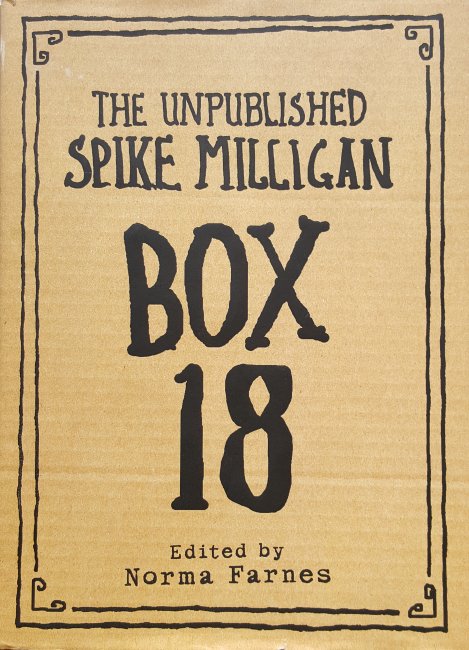
The Unpublished Spike Milligan Box 18 – Norma Farnes (Ed)

Norma was Spike’s agent, manager and friend for over thirty five years and as she explains in the introduction Spike had a comprehensive filing system based on numbered box files for work based items and lettered box files for personal things. Box 18 – IDEAS was a sort of dumping ground for things not finished or just ideas that would possibly be expanded later, every now and then he would go through it and pick out bits that he felt he could work on, sometimes they would go back in Box 18 untouched or partly modified others would make it through to completion, and some would just get discarded as unworkable. The problem with this book is that by definition anything in Box 18 was something that Spike didn’t regard as finished and frankly a large chunk of it shows why although there are definitely some gems hidden in here amongst the bits that really don’t work.

For those people reading this who aren’t familiar with the comic genius and deeply troubled man that was Spike Milligan he was born in 1918 and fought in Africa and then through Italy during WWII and was badly shell shocked during the conflict which would lead to frequent bouts of depression and more serious mental illness throughout the rest of his life. Despite this he was the leading light of 1950’s, 60’s and 70’s comedy in the UK as a founder and main script writer for the Goon Show and then his TV series Q which started in 1969. In fact in interviews included on the DVD’s of Q the Monty Python team recall seeing the first episodes and thinking that this was exactly what they had been planning, yet again Spike had got there first, The Pythons subsequently amended their format so that they didn’t appear to be copying Spike. He also wrote over eighty books including seven hilarious volumes of war diaries. Because of this pretty well everything that Spike thought should appear had done by the time of his death in 2002. I first came across his work whilst at primary school which a book of children’s poetry called a Dustbin of Milligan, I still have this rather battered due to being read almost to destruction paperback and have loved his writing ever since, still being able to quote the poems fifty years later.

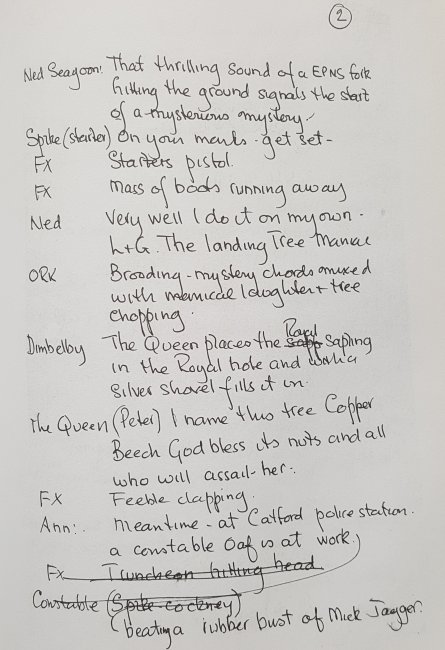
The photo above is of the Goons, Peter Sellars, Harry Secombe and Spike during what Norma believes is a rehearsal although clearly from the ages of the actors it was towards the end of their appearances together and one of the gems in this book is a script for a Goon show in Spike’s handwriting. You can see his mind at work with the crossings out and alterations, The Goons would be regarded as surreal even now, back in the 1950’s there was nothing like them anywhere but the pressure of not only appearing but also writing most of the material led to Spike having the fist of his manic depressive attacks which saw him frequently in mental hospitals from then onwards.
The final quarter of the book reproduces some of Spike’s letters and again you wonder why some were chosen although the spat with Harrods over a unpaid bill is somewhat amusing. This section, along with the first part which has pages of his diaries is also clearly not something that came from Box 18 in fact probably only about half of what is in the book could logically have come from the IDEAS box, the rest is abstracted from other files although a couple of diary pages are rather poignant as Spike is obviously going through a difficult time again

All in all this book is interesting for a Spike Milligan fan but there is so much more of his to explore for a newcomer to his work, definitely read the war diaries, or his numerous books of poetry but this is not the place to start. I must have over twenty of his books purchased over the years along with the DVD re-issue of the five series of Q and would recommend all of them ahead of this amalgamation of bits which has been sitting on my shelves for several years before I finally opened it this week, I think I need to pick up the diaries again to remind myself of what Spike’s writing properly finished to his own satisfaction could really be like.

Pobeda 1946: A Car Called Victory – Ilmar Taska

Set in the author’s native Estonia in the immediate aftermath of the Second World War as the Soviets tightened their grip over the Baltic states this, his first novel, grew out of a well received short story. The original is simply called Pobeda 1946, the addition of the subtitle mirrors the way that the original sections in Russian are dealt with in the translation, that is by providing an English translation immediately afterwards within the text rather than as a footnote as may have been expected. Pobeda’s were a luxury vehicle manufactured by the Molotov works in Gorky and were only available to senior apparatchiks such as the un-named security services (some derivation of KGB in Estonia) major who drives the one in the book. One of the interesting features about the book is that we never find out the names of several significant characters, specifically ‘the woman’ who is married to an ex WWII freedom fighter who is being hunted by the soviets, ‘the boy’, the woman’s six year old son who tries to make sense of what is happening as his parents disappear one by one and ‘the man’ the driver of the Pobeda who causes their disappearance and maintains an apparent friendship with the boy whilst using him to seek out his parents.

Dragged along in the aftermath of this is Joanna, the woman’s half sister who worked as an opera singer before the war and Alan who is employed by the BBC World Service radio as an announcer and who fell in love with Joanna in the 1930’s and now desperately wants to get her out of the country and into safety. The rising tensions of the interwoven stories of the adults and the bewilderment of the all too easily manipulated boy who just want to understand and find his parents whilst also wanting to help the man who he believes is his friend is really well told. The characters are totally believable and I found the book difficult to put down as I became engrossed in just what was going to happen next. I loved the fact that for the most part the story is told from the viewpoint of the boy, his confusion, and also his excitement over his experiences as the man tries to work out the best way to make use of him but which he sees as the mans goodwill towards him that doesn’t seem to work out right each time is a fascinating way to tell the story.

It is explained in the afterwords by the author and the translator that there is some of the authors own family story that provides the basis for the book. He was born in Siberia where his parents had been sent during Stalin’s forced repatriation of the people of the Baltic states and one of the other aspects dealt with in the book is the movement of people in the opposite direction. Joanna has a family from the Russian steppes forced upon her in her tiny flat and when she goes with the boy back to his parents property they find that another family has been moved into there as well. It was thought that if enough Russians were sent to Estonia, Latvia and Lithuania along with their natives being deported to Siberia then the ethnic balance would be sufficiently diluted so that these countries would quietly acquiesce to their amalgamation into the Soviets republics but this soviet aspiration never really happened. Despite this the Estonian population is still 24.7% ethnically Russian even so long after the movement of people took place, as is the population of Latvia. Lithuania presumably being further away received far fewer people as just 4.7% is ethnic Russian.

Definitely a book to read this year as the 20th August 2021 is the 30th anniversary of Estonian independence from the Soviet block, my copy was published by Nordic Press in 2018. Estonia has been invaded and become independent many times over the centuries hopefully 1991 will have been the last time they need to set a new Independence Day.

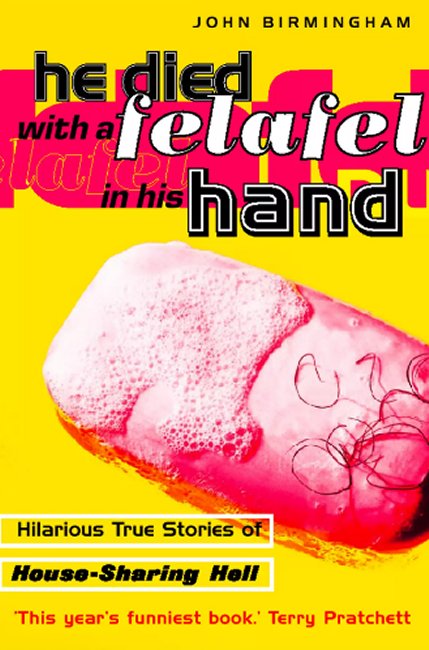
He Died with a Felafel in His Hand – John Birmingham

Firstly a warning, the book contains strong language and lots of stories of excessive drug and alcohol use and things that happen when that happens, but don’t let that put you off unless you really don’t think that it is suitable for you. That said this book is so incredibly funny and yet so believable that when Birmingham says that it all really happened to him you have to believe him, and it certainly could be true that he had eighty nine of the craziest people house share with him over the years. I know I wouldn’t last five minutes with any of them. Birmingham is an Australian and all the places he lived are in various Australian cities, starting with Brisbane but including Sydney, Melbourne and others over thirteen different properties. Sometimes he moved because he just wanted to, more often it was to get away from his housemates and at least once to avoid being killed by one of them. Because the book isn’t told sequentially and there is no timescale it’s difficult to tell over how long a period it all takes place but some properties he left really quickly whilst in others he was the last man standing.

Interspersed amongst the text are grey shaded passages written by other people who have also experienced Australian house sharing hell. These are a little confusing at first as they appear right in the middle of stories that Birmingham is telling about his own particular nightmare cohabitants. Initially I tried to read them as interludes but it soon became clear that it was easier to get to the end of whatever horror story we were in at the time and then go back and read the one or two extra bits I had skipped, There are also a few extras that are several pages long and in a different typeface to resemble typewritten sections which are too long to be the greyed inserts but clearly Birmingham thought were so funny they had to be included somehow, all these occur at the end of chapters with a full page greyed out intro.

Milo won the house competition for not changing out of his jeans. PJ and I dropped out at four and five weeks respectively, but Milo, who liked the feel of rotting denim – “It’s like a second skin!” – was pronounced the champion at ten weeks and told to have a bath or leave. It was an all-male house.

There are various comparisons of all-male and mixed sex house shares, being male Birmingham obviously has limited experiences of all female occupation, and the general consensus is that for sheer disgustingness nothing beats the all-male property especially if the occupancy level is well above that intended. Set against that for true angst you need to have at least one woman in there (males tend to descend into their own chilled out pit of squalor) and if two, or more, of the housemates are in a sexual relationship it’s probably time to get out of there fast before the whole thing implodes. The other thing that will definitely kill an otherwise happy house is the introduction of a junkie, not just for the drug taking but also for the petty thefts to feed the habit and the tendency to attract the attention of the police with consequences for all. The title of the book comes from the opening line and ‘He’ was named Jeffrey. Jeffrey had joined an otherwise happy house only recently but it turned out he was a junkie, he had died whilst watching TV after a night out where he had had probably one too many of his drug of choice that evening and had passed out and died whilst eating the said felafel, the yogurt dressing had run down over the puncture marks in his arm. It was apparently Birmingham’s first dead housemate, he doesn’t however say if it was his last.

Whilst looking this book up to make sure it was still in print, it is, I found that it had subsequently been made into a long running play, a film in 2001 and a graphic novel in 2004 so it’s popularity, especially in its native Australia, seems assured. John Birmingham is now an established writer of both fiction and non-fiction, this was his first book although he had written articles and stories for a few magazines before this.

Come Close – Sappho

Sappho died over 2,500 years ago and in the intervening millennia almost all of her poetry has been lost. That she was highly regarded in her time can be seen from contemporaneous sources some of which regard her as the tenth muse ranking her amongst the gods themselves. But sadly she was neglected during the medieval period possibly due to the interpretation of the subject matter of much of her verse which didn’t fit into the strict moral compass of the catholic church and it was the church which performed much of the transcription from ancient texts to works that have lasted into our modern era. However excavations have uncovered fragments of her work even as recently as the last decade and we now have 650 lines of the estimated over 10000 she wrote. Apparently there were nine papyrus rolls of Sappho’s works held in the great library of Alexandria, the first one alone represented twice as much verse as we have available in the present day but those would have been lost in the fire and subsequent neglect whilst controlled by the Roman empire. That this book has roughly 450 lines makes it a positive bargain as it only cost 80p when first published in 2015 and now retails at £2 but still as it represents over two thirds of her extant output this is still money well spent. It is taken from the 2009 Penguin Classic book ‘Stung with Love: Poems and Fragments’ translated by Aaron Poochigian and simply collates the poems without any biographical information or analysis of the works which is the feature of the longer book.

Sappho wrote mainly lyric poetry, that is words designed to be accompanied by music, not songs as such but embellished by a tune, they tend to be in praise of heroic deeds of men and gods along with love songs praising a partner, or potential partner. It is her love poetry that is most famous and was most admired in antiquity but it is the belief that it specifically praises love of a woman for another woman that has given us the word sapphic for women attracted to women and also from her nationality as a resident of the Greek island Lesbos the word lesbian. Having said that this is not a collection of erotic verse, far from it, the lines are expected to be performed, these are expressions of love but nothing more explicit and make for a pleasant afternoon’s reading. It should be borne in mind as well that for the most part these are just fragments of poems, only two works are believed to be complete, so there may be much context that is lost. However I am in danger of writing a review that is longer than the entire book I have just read so let me finish with all we have left of one of the poems.

Stand and face me, dear; release
That fineness in your irises

May you bed down,
Head to breast, upon
The flesh
Of a plush
Companion

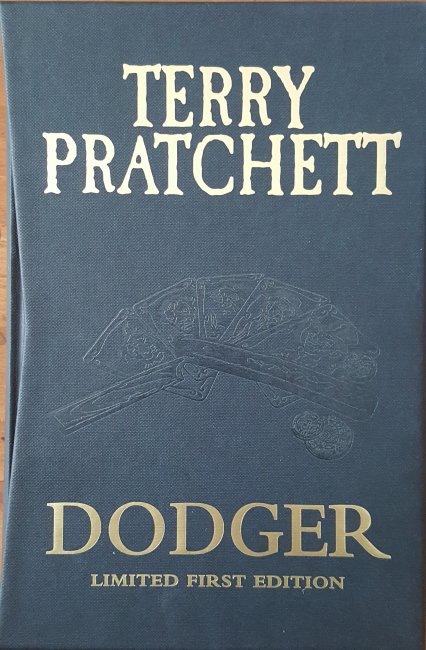
Dodger – Terry Pratchett

Having had my annual read of Charles Dickens’ classic ‘A Christmas Carol‘ I thought I would follow it with a book not written by Dickens but one where he appears as a character. Set in the early years of Victorian London various real people interact with the fictional Dodger and his compatriots including not only Dickens but Disraeli, Gladstone, Robert Peel, Joseph Bazalgette and Henry Mayhew to name but a few. Of these probably the least well known nowadays is Henry Mayhew whose monumental book ‘London Labour and the London Poor’ sits on my shelves just as it did on Terry Pratchett’s. Without this exhaustive, but surprisingly readable, study of the poor in Victorian London which did so much to raise awareness of the problems that beset them and ultimately helped to improve their lot I doubt if Pratchett would have produced such a leap from his ever popular Discworld series. The book is unusually dedicated not just to Terry’s wife Lyn but also to Henry Mayhew.

Dodger, the star of the book is the nickname of a tosher, a person who scours the sewers of London for things that have fallen or been washed down the drains and got caught up in the detritus down there. It was a step up from being a mudlark, someone who similarly looked for lost items or money but along the tidal banks of the Thames, mudlarks still exist but as a hobby rather than a career but toshing stopped after Bazalgette designed the new, more capable, sewer system for London. Right at the beginning of the story Dodger rescues an unknown woman from two men and his adventure, and rapid rise up the social tree begins as his heroism is recognised by Henry Mayhew and Charles Dickens who come along just afterwards. Dodger is an interesting character, clearly based on descriptions in Mayhew’s book but fleshed out by Pratchett in quite a believable way even if his subsequent adventures do stretch the imagination somewhat especially after his encounter with another fictional character from the period Sweeney Todd, the demon barber. It says a lot for Pratchett’s ability as an author that you are quite willing to allow for the speed of the plot and the people he gets to meet so quickly, and improbably for his social class.

The story fairly races along with Dodger and the young woman he rescued being dragged into an international crisis due to her unfortunate background and the reason she was trying to get away. Because of this however it is almost impossible to discuss more of the plot in this review as it would give too much away for future readers but it is a really fun read which I managed in one, fairly long, sitting but I didn’t want to put the book down until I finished. At the end Pratchett provides a short section on his use of actual and fantasy Victorian London

I have to confess ahead of the game that certain tweaks were needed to get people in the right place at the right time … but they are not particularly big tweaks, and besides, Dodger is a fantasy based on a reality. … This is a historical fantasy, and certainly not a historical novel. Simply for the fun of it, and also too, if possible, to get people interested in that era so wonderfully catalogued by Henry Mayhew and his fellows.

Because although I may have tweaked the positions of people and possibly how they might have reacted in certain situations, the grime, squalor and hopelessness of an underclass which nevertheless survived, often by a means of self-help, I have not changed at all. It was also, however, a time without such things as education for all, health and safety, and most of the other rules and impediments that we take for granted today. And there was always room for the sharp and clever Dodgers, male and female.

My copy is one of several ‘special editions’ produced when the book was first published on the 13th September 2012, this is the specially bound, stamped & numbered, slipcased edition limited to 3000 and sold exclusively by Waterstones, there was also various un-numbered ‘specials’:

  • 20000 copies exclusive to Waterstones with 500 for Australia with a special jacket and an extra section ‘The Wise Words of Solomon Cohen’ at the end.
  • 30000 copies for W.H. Smith along with 3000 for Easons with a bonus scene at end, Dodger goes to Bedlam to see Sweeney Todd. Both are the same except for different stickers on jacket.
  • 25000 copies exclusive to Tesco with post cards inside the front cover.
  • 6000 copies exclusive to Asda with a map of Dodger’s London at end.

This means that the ‘special editions’ outnumbered the ‘normal editions’ at publication in the UK of which there were 77000 copies. The ‘exclusive’ extra chapter in the edition for W.H. Smith and Easons was subsequently included in the UK paperback when this was published by Corgi on 26th September 2013. The Wise Words of Solomon Cohen do not appear to have been available in any other edition than the Waterstones special, they are not in my copy despite that also being a Waterstones exclusive. Bibliographic details are taken from the website of Terry Pratchett’s long time agent Colin Smythe which is a fount of knowledge on the subject of Terry’s works and is a fascinating read.

The Diving-Bell & the Butterfly – Jean-Dominique Bauby

I first read this extraordinary book when it came out in 1997 and somehow it seems to be the perfect book to read again at the end of 2020 which has seen so much tragedy throughout the world. Jean-Dominique Bauby was editor in chief of Elle magazine in Paris when a brain stem trauma put him first in a coma and then as he comes round from that he is completely paralysed, able to move only his left eyelid, his mind however was still as active and alert as ever. Locked in Syndrome is fortunately rare but a book written from inside the prison of an body unable to move is even rarer, that the book is this good is probably unique. The diving-bell of the title refers to his immobile but still painful body whilst the butterfly represents his thoughts flying free, beyond the confines of his hospital room. The book was dictated by Bauby winking as letters were laboriously read out one at a time by his assistant, Claude Mendibil, and she then slowly composed the words and then checked that each one was correct. The chapters are short but each one took days, if not weeks, to dictate one letter at a time as Claude repeatably read out

E S A R I N T U L O M D P C F B V H C J Q Z Y X K W

The sequence of letters is not alphabetic as that would have taken too long, instead they are in order of frequency in French, by comparison in English the first twelve letters would be ETAOINSHRDLU.

The chapters vary in subject from hopeful, when he feels a little progress has been made or he is recounting a good day going along the seafront at Berck-sur-Mer, which is where the hospital is, in his wheelchair to sad when things are not going well or the small frustrations at his inability to communicate to all but a handful of people who can use his letter system, there are also two chapters recounting dreams he has had which are comic and moving at the same time. Because the chapters are short you can pick the book up whenever you have a spare few minutes and enjoy the next beautifully written passage and feel that you are catching up with his oh so slow progress. It should be a depressing read, but it isn’t, each small victory over his condition is celebrated and he is funny in the good times.

It is only in the penultimate chapter that Bauby addresses the events of Friday the 8th December 1995 when his life was completely turned upside down. As he says in the book he knew he needed to cover this but was avoiding it for as long as possible. The day starts so normally with time in the office before heading off to collect his son for a trip to the theatre and a meal before spending the weekend with him. He had separated from his wife a few months earlier and had not spent quality time with his son since then. Sadly soon after collecting Théophile in what was fortunately a chauffeur driven car he started to feel unwell and collapsed with the massive stroke that would put him in a coma for twenty days

Bauby died on the 9th March 1997 just two days after the first edition of this book was published in France and sixteen months after he first slipped into a coma but he left us a great book of tragedy and hope. In the final short chapter he was making slight progress with speech training and could grunt (his word) along to a simple tune and although this was a tiny step forward you feel his joy at this triumph over adversity but sadly he succumbed to pneumonia before getting much further.

Elegy Written in a Country Churchyard and other poems – Thomas Gray

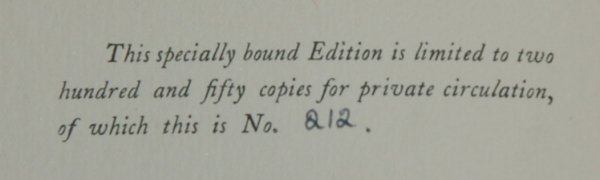
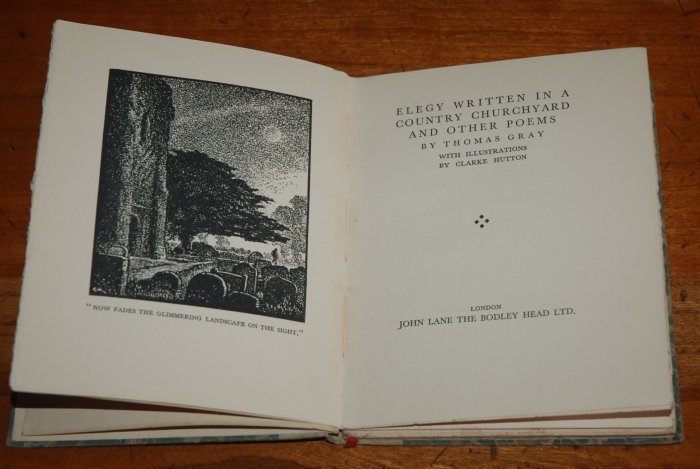
This Christmas I have chosen another of the Allen Lane Christmas books, in this case the first of them which was printed in a limited edition run of just 250 copies in 1928 with wood engravings by Clarke Hutton for Allen and Dick Lane to distribute as Christmas gifts. At the time the brothers were working at what was their uncle John Lane’s publishing house The Bodley Head in London and this book, unlike most of the others is published by The Bodley Head. John Lane had died in 1925 and Allen and Dick were now running the business when they revived his idea of a Christmas gift book which he had first done when he set up the company in 1887. My copy is slightly damp stained on the spine and foxed on the dedication page, but it is such a rare book that I was happy to be able to get this copy for my collection.

This collection is a slightly odd one for a Christmas gift as the three poems are certainly not full of the Christmas cheer. The Elegy is, by its nature, quite sombre as the poet reflects on the past lives of those in the graves around him. ‘Ode on a Distant Prospect of Eton College’ is also looking back to Gray’s own childhood there but also to the difficulties that will be faced by the current pupils as they grow up and enter the adult world. The final poem gives away its downbeat theme from its title ‘On a Favourite Cat, Drowned in a Tub of Gold Fishes’.

The only Christmas link to these works is that Gray was born on Boxing Day (26th December) 1716. Whilst he lived to be 54, he only published thirteen poems during his lifetime; his best known work is undoubtedly ‘Elegy Written in a Country Churchyard’ and this would go on to influence poets and other writers over the following centuries, not least Thomas Hardy who got his title of ‘Far From the Madding Crowd’ from the nineteenth stanza.

Far from the madding crowd’s ignoble strife,
Their sober wishes never learn’d to stray;
Along the cool sequester’d vale of life
They kept the noiseless tenor of their way.

Stanley Kubrick’s great anti war movie ‘Paths of Glory‘ also gets its title from this poem where the full line is ‘The paths of glory lead but to the grave’.

‘Ode on a Distant Prospect of Eton College’ consists of ten stanzas each of ten lines and is probably best known for its penultimate line which is the first use of the phrase ‘ignorance is bliss’ which sums up the happiness of the boys whilst they are at school as they are ignorant of the problems they will face as they grow up.

To each his suff’rings: all are men,
Condemn’d alike to groan,
The tender for another’s pain;
Th’ unfeeling for his own.
Yet ah! why should they know their fate?
Since sorrow never comes too late,
And happiness too swiftly flies.
Thought would destroy their paradise.
No more; where ignorance is bliss,
‘Tis folly to be wise

‘On a Favourite Cat, Drowned in a Tub of Gold Fishes’ is based on a true story and the cat apparently belonged to Horace Walpole who featured in a blog of mine from May this year about The Age of Scandal by TH White. It is basically a morality tale where the cat dies through its own greed and again has a famous line, although this time Gray is not the originator but has adapted a phrase created by William Shakespeare in The Merchant of Venice, ‘All that glisters is not gold‘. Thomas Gray’s version is the last line of this poem and sums up the cautionary tale extremely well.

From hence, ye beauties, undeceived,
Know, one false step is ne’er retrieved,
And be with caution bold.
Not all that tempts your wandering eyes
And heedless hearts, is lawful prize;
Nor all that glisters gold.

To repeat Allen and Dick, With Greetings and Best Wishes for the Coming Year. Merry Christmas.

Martian Time-Slip – Philip K Dick

Philip K Dick is probably best known, if people outside of Science Fiction readers have heard of him at all, as the author of the book that became the blockbuster film Blade Runner. Most of those people will probably also know that the original book has a strange title, fewer will know it is “Do Androids Dream of Electric Sheep?’. They might also know that the two Total Recall movies are based on Dick’s short story ‘We Can Remember if for You Wholesale’. Philip K Dick was one of the most original sci-fi writers of all time but totally sucked when it came to titles.

His standing in the field of science fiction was marked by the Millennium (part of Orion Publishing) SF Masterworks series as out of the first two dozen titles three of them are by Dick and no other author has more than one. This is the second of these titles, book number thirteen of SF Masterworks published in July 1999 and although I bought it then, along with a lot of the others from this first twenty four, I have never actually read it as it got left behind on the reading list in favour of other books from this series and then more books were bought and this ended up just sitting on my shelves. In total 73 titles were published in the series up to 2007 and it was relaunched in 2010 with a lot of reprints from the first series along with new titles, although sadly for the book collector, the books are no longer numbered. Martian Time-Slip is one of those in the reprints but oddly for a book set on Mars the cover picture is now tinged with blue rather than red.

I hesitate to actually call Martian Time-Slip science fiction though, it’s definitely fiction but there is little in the way of science, the Mars in this book has a breathable, if not great, atmosphere; the canals really are at least part filled with water and there are humanoid Martians called Bleekmen, more of them later. Trips to Mars take only a couple of days, ordinary clothes are fine for wandering about and agriculture is getting going amongst the various settlements, oh and it’s set in 1994. One of Dick’s other blind spots, apart from titles, was his inability to allow enough time for his fantasy to potentially become real, ‘Do Androids Dream of Electric Sheep?’ is set in 1992, although when it was filmed as Blade Runner in 1982 it was moved into the far future of 2019. But you don’t read Philip K Dick for the science, what you get is a really good story with complex interactions between interesting characters who are often broken in some way. That is certainly the case here with the two main characters being Manfred Steiner, an autistic teenager, and Jack Bohlen, a recovered, but now rapidly regressing as the book progresses, schizophrenic electrical goods repairman.

The other significant character is Arnie Kott, head of the Water Workers Union and therefore a very important man on Mars, who becomes obsessed with the idea that Manfred doesn’t interact with the world around him because he is in touch with the future instead and this could be valuable if only Jack can find a way to communicate with him via some sort of contraption. Unfortunately spending time with Manfred affects Jack’s already fragile mental state which is a pity as he also seems to be making some slight progress. This all comes to a head in a series of three chapters each of which cover the same evening at Arnie Kott’s house but the viewpoints in them become increasingly more chaotic and odd, this is the turning point in the novel and things suddenly progress in a wildly different direction. This method of telling a story is classic Philip K Dick, what is real, what is not? The repetition of the scenes in the house but seen from what becomes by the third time almost hallucinogenic standpoints reflects the inner turmoil of both Manfred’s and Jack’s lack of mental grip on what is happening around them and is surprisingly powerful.

The bleekmen are another powerful image in the book, the native people have been driven from the fertile lands by the settlers and are now either left to wander the deserts in search of water and sustenance or end up in servitude to the new masters of Mars. This is clearly Dick reflecting the treatment of native peoples here on Earth. Nobody appears to have made any attempt to understand their culture, they have just been pushed to the margins of society but after the evening at Kott’s house we get to find out a lot more about them via Kott’s servant Heliogabalus and the ultimate resolution of the book will come from him. It’s a fascinating read, maybe not Dick at his best that is probably either his alternate reality classic ‘The Man in the High Castle’ which looks at a position 15 years after the Axis powers defeat the Allies in WWII, or possibly ‘A Scanner Darkly’ where the main character is a drug addicted detective working on narcotics cases.

Whilst some of his many film adapted books and short stories do retain their original titles, ‘Minority Report’ and ‘A Scanner Darkly’ to name just two, Philip K Dick often seems to have given his best work the worst titles, ‘A Scanner Darkly’ is a case in point, it tells you nothing about the book and doesn’t actually make sense as a phrase. Looking through the complete list of his books at the front of this one I spotted his posthumously published (in 1984, Dick died in 1982 just months before Blade Runner was released) novel ‘The Man Whose Teeth Were All Exactly Alike’ now that is one to look out for.

My Life and Hard Times – James Thurber

Originally published in 1933, this is the first Penguin Books edition from July 1948 and the introduction printed inside the front cover made me want to read it.

James Thurber is America’s greatest genius of humour and is as much a phenomenon as the Grand Canyon; indeed, they might both be said to have a nightmare and fantastic unreality about them. Yet both are undeniably acts of nature, which delight as well as amaze. This volume – the first of his to appear in Penguins – contains some of his maddest stories, such as The Night the Bed Fell and The Day the Dam Broke, which will be the best of introductions to non-Thurber readers and a renewed delight to confirmed Thurberites.

With a build up like that how could I resist? Well I wish I had. All I can say is that in the intervening eighty seven years since the book was first published and seventy two years since that glowing introduction the humour has apparently evaporated. It felt very like reading old copies of Punch magazine where you find yourself wondering how anyone ever found any of this remotely funny. The tales are tedious in the extreme, I even tried reading them aloud in case they sounded better that way; they didn’t. Fortunately the book was only 135 pages long or it may have made it to my fairly short list of books I failed to finish.

Am I missing something? Maybe a confirmed Thurberite could comment and explain why his writing should be compared to the Grand Canyon. As far as I can see the only similarity is that both consist of a massive hole, one in the ground and the other in the four hours I spent reading and then writing about this humourless rubbish. I can sort of see what he is trying to do, the family situations that he writes about could be the basis of a theatrical farce but a large part of such a performance is the visuals and Thurber for the most part failed to enable me to envisage the scenes and when I did see in my minds eye the household running around in confusion I simply didn’t care about the characters or what happened to them.

There is also what can only be described as casual racism, especially in the section entitled ‘A Sequence of Servants’ where non-white characters are reduced to ridiculous stereotypes with ‘comedy accents’ all spelt out phonetically. It was a deeply uncomfortable read at times especially in this age of the Black Lives Matter campaigns and coming from an American author who was lauded in his time it simply emphasised the ingrained prejudices in an unsettling manner.

I really cannot recommend this book to anyone.

Puffin Annuals

At the beginning of 1967 Kaye Webb had launched the Puffin Club to great success, in fact more success than anticipated as demand for membership soared, which for a club dedicated to the children’s output of a publisher was unheard of. The quarterly magazine that members received was full of stories, reviews, puzzles and things to make and in 1974 it was decided to produce a larger version, for sale not just to club members, and make it an annual. This post is going up on the 1st December so just about when the annuals were hitting the shops when I was a child. I grew up in the 1960’s and 70’s, probably the heyday of the annual in the UK. What had started as simply a reprint of the weekly child’s magazine with The Boy’s Own and The Girl’s Own papers had expanded via The Rupert Annual (started in 1936 and still going strong) along with The Beano and Dandy comics and of course the much admired The Eagle annuals from 1950 to the late 1960’s all of which featured new material especially for the annual. TV shows got in on the act, Blue Peter has had an annual every year since 1964 and most other children’s shows followed suit especially Doctor Who. Even films spawned annuals, I have The Star Wars annual from 1977, the year of the first film. The Puffin Club had to have an annual, the problem was Penguin Books had never done anything like this before.

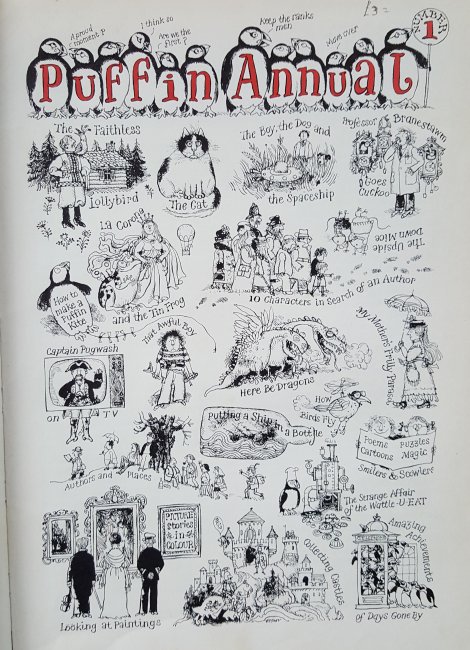
The title page of Puffin Annual number 1 gives a feel for the contents but also the style of the book, this was going to be fun and it really was going to have the look and feel of Puffin Post, the quarterly club magazine only in a much more durable hardback and the same size as all the other annuals out there competing for the eyes of children and the purses of their parents and grandparents, you could rarely go wrong with a Christmas gift of the annual relating to a favourite comic or TV show. This blog is going to be rather image heavy I want to give an impression of just what sort of publication these were.

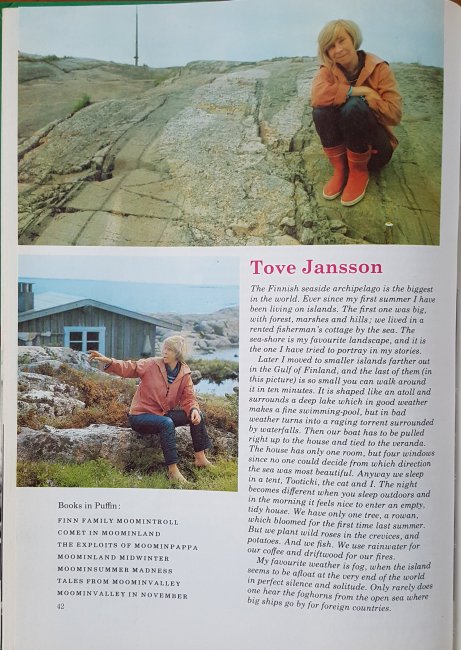
The contributors page of number one is a very impressive name check, including stories by Roald Dahl, Norman Hunter (Professor Branestawm), Tove Jansson (Moomins) and Michael Bond (Paddington Bear) but also artists and illustrators of numerous children’s books, and oddly the violinist Yehudi Menuhin and HRH The Prince of Wales both describe their favourite paintings. Puffin was definitely in the high brow end of the market and that was where it liked to be.

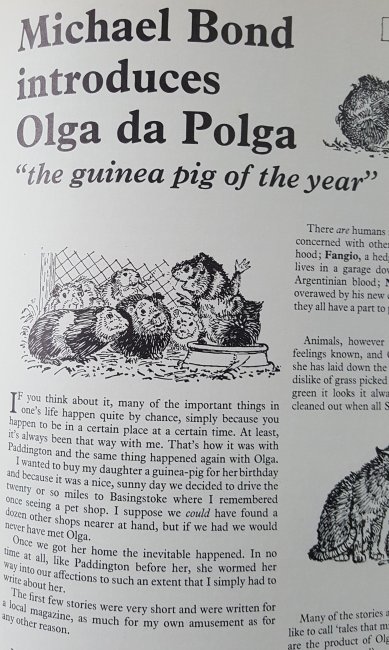
Michael Bond’s contribution was an introduction to his other, now largely neglected, character Olga da Polga who did get a series of books but never really caught on in the way Paddington Bear did. The thinking was sound, children can’t have a bear but they could, and did, have guinea pigs so maybe stories about their adventures would sell, well they sort of did but at a fraction of the sales of Paddington. Whilst Tove Jansson had a short story called The Cat, which she also illustrated.

Roald Dahl however could write about anything and children lapped it up. What you have probably noticed is the major failing of this first annual, there is very little colour. Despite the bright and enticing cover the contents are almost entirely black and white, but that was to change for the next year.

1975’s Puffin Annual was a very different beast to that of 1974. Still the same sort of mix in the contents (see below) but not just the cover had colours, this was much more in keeping with the competition and should have given the Puffin Annual every chance in the marketplace and it had to. This was Penguin’s first attempt at this section of the book business and it had to live or die on it’s performance, Penguin has a history of killing off series if they don’t perform and this was a much more expensive undertaking than the previous years effort. But again the list of people contributing and the variety of material was impressive.

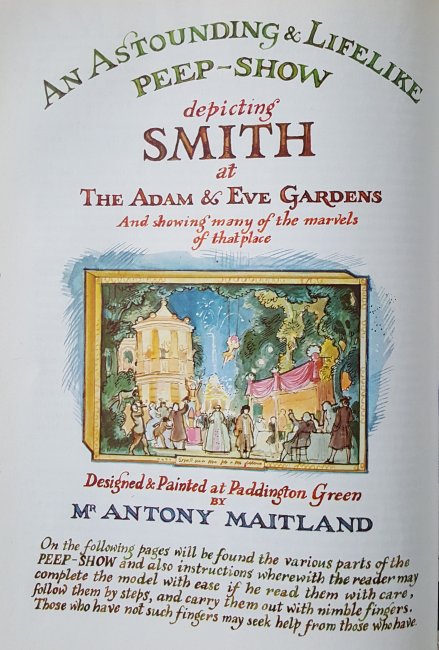
Again though this is aimed squarely at children of better off families, no knockabout comic strips so loved by fans of The Beano or The Dandy, this is much more like a book than a comic but there are more things to do in this edition, not just games and instruction as to how to do simple magic tricks but also a model to cut out and make that takes up eight pages and illustrates one of the stories especially written for the annual.

This is quite an elaborate model and includes basic instructions for fitting small bulbs so that it can be lit up at night. A peep show of the Adam and Eve Gardens in reality would have probably been far too much for a book aimed at children as by the time this park in London was closed down in the 18th century it was a haven for theft and prostitution. There is also a section on paintings although not as formal as the example in the first annual. This book has a lighter touch more in keeping with Puffin Post, I really need to do a blog about that magazine sometime next year.

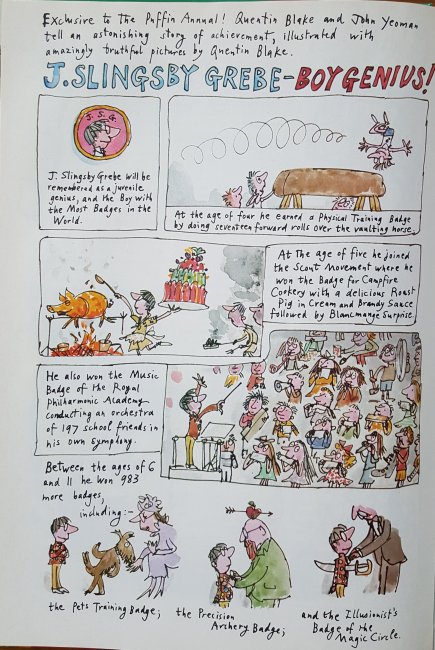
There are a couple of single page ‘introduce the author’ articles and of course lots of artwork by that stalwart of the original magazines, and favourite children’s illustrator, Quentin Blake, who drew the fun end papers which are also the index and also provided pictures for the story of J. Slingsby Grebe – Boy Genius.

This was such a dramatic improvement on the first annual, lightening up the tone and bringing in so much colour but had they done enough to save the Puffin Annual? 1976 would indicate that they hadn’t, when instead of the expected annual number 3 the rather oddly named Puffin’s Pleasure appeared in time for Christmas and styled itself as number one.

Now even a brief glance through this book shows that it was clearly intended to be the third annual, it was even assigned the catalogue reference number that such a book would have had. Annual number one was Puffin Story Book number 700, annual 2 was number 800 and this is number 900. So what happened? Well it appears that although the annuals were assigned to the Penguin scrapheap of failed series so much work had already gone into annual number three with writers and artists commissioned that it may as well be printed. Kaye Webb was apparently unhappy with the name Puffin’s Pleasure but calling this The First of its kind was wishful thinking as this was to be the only edition published.

The contents list is definitely varied and getting an author of the standing of Ursula Le Guin to supply a short story means that Webb and Bicknell certainly had ambition for their publication but it was not to be. There simply wasn’t a big enough market for such a book and Penguin’s lack of experience in such titles led to nervousness and not enough time would be allowed for an annual series to properly establish itself.

Ironically there is a four page article by Nicholas Fisk about the history of comics, the very things that were massively outselling this book and would therefore contribute to its demise. The popular astronomer Patrick Moore provided a single page on space oddities and there was a six page article about the history of the British Canal network.

All very worthy stuff but just who was this aimed at, it feels more like the target audience was the parents who were paying for it rather than the children who would hopefully enjoy it. I must admit reading these three books as an adult has been great fun, but would I have thought so when they came out and I was just leaving ‘young childhood’ and becoming a teenager? Possibly as I was a very bookish child, more often to be found curled up reading than playing outside, I know I didn’t have them as a child even though I was presumably exactly who they wanted as a reader.

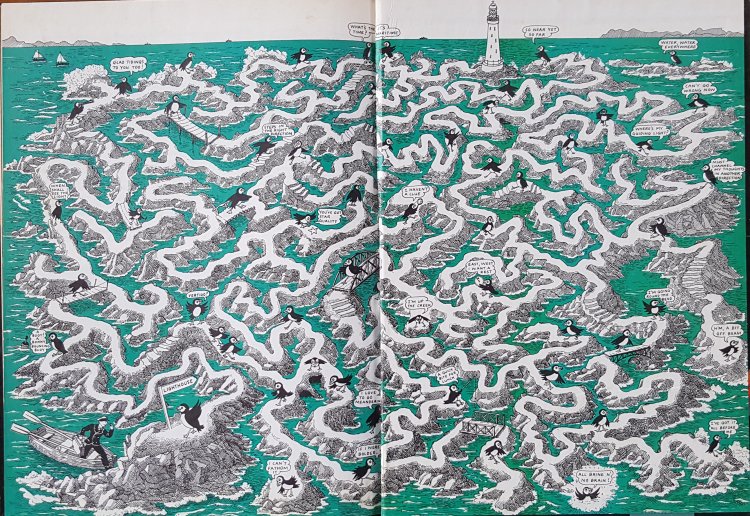
I’ll leave you with the very last item in Puffin’s Pleasure, a maze printed on the endpapers, see if you can get the lighthouse keeper from his rowing boat to the lighthouse, have fun.