Voyages to the Moon and the Sun – Cyrano de Bergerac

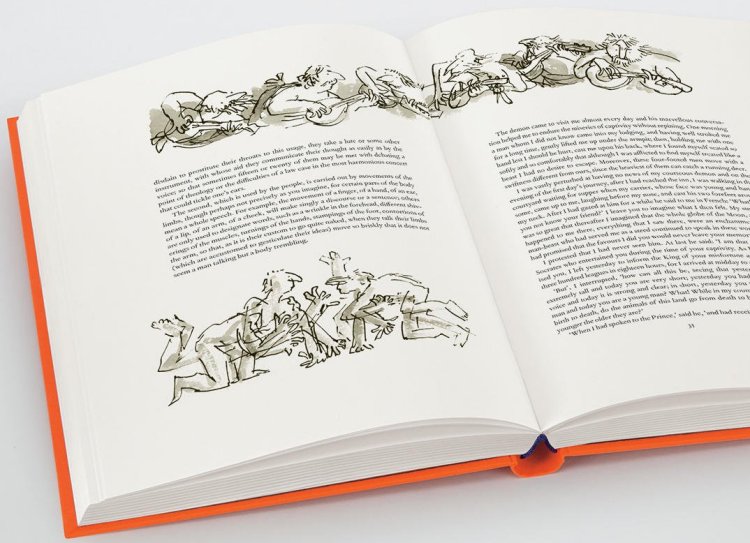
For a long time I believed that the author of this book wasn’t a real person but had been made up in some obscure French novel and that the character had lived on beyond the original work, so to find that Cyrano de Bergerac was not only real but an author as well as the famous soldier and duellist was a pleasant surprise. His life is however poorly documented, but this work can be dated reasonably well as it mentions the death of the philosopher Descartes, which happened in 1650 and de Bergerac himself died in 1654. My copy is the Folio Society edition published in 2018, illustrated by Quentin Blake and rounds off my selection of works translated from French that I have been reading throughout August. The illustrations to this blog were taken from the Folio Society web site entry on the book.

The book is in three sections so I’ll review it in the same way:

Journey to The Moon

The time that de Bergerac was writing in was a period of considerable scientific advancement as people moved away from the ancient Greek science towards the start of physics as we know it but there was much that was still up for debate such as if the Earth was the centre of the universe with everything else revolving around it. It is clear right from the start that de Bergerac had moved on from this notion and he understood that the Earth rotated, that the Moon orbited the Earth and that together they orbited the Sun. Journey to the Moon starts with the hero trying to reach the Moon by means of dew collected in jam jars. The reasoning is fair, dew rises in the morning so if you could collect enough of it and attach it to your body then it should take you with it, this he duly does and rises up into the air from Paris one morning. After a few hours he decides to land, releases the dew and is surprised to find it is still morning and he is in Canada as the Earth has rotated underneath him, de Bergerac didn’t consider that the atmosphere also rotates with the land beneath. Later he builds another machine this time powered by fireworks which does lift him to the Moon, leaving from Quebec.

The Moon he arrives at is however unrecognisable from the one we know as he finds the Garden of Eden there along with several old testament prophets and here the book starts to fail as he indulges in pages of theological arguments which drag the pace so much that I almost gave up at this point and began searching for another book to read, however I’m glad I persevered. Ultimately he leaves religion behind and goes on a fantastical exploration of his version of the Moon before returning to Earth by catching hold of the Devil on his way to deposit an inhabitant of the Moon to Hell and of course he has to pass the Earth on the way.

Journey to The Sun

For a long time it looked as if Journey to the Sun wasn’t actually going to get there, for the first twenty five pages it covers being persuaded to write up and publish Journey to the Moon and his subsequent denouncement as a sorcerer. Which leads to him being jailed, escaping and undertaking a very funny chase sequence which results in him accidentally running full circle and seeking shelter from his pursuers through the back door of the very jail he had escaped from. Eventually he builds a contraption which uses the power of sunlight via lenses to build up lift so that he can escape again, however he misjudges the power of his invention and instead of just rising and then landing again he is drawn all the way to the Sun and aims to land on a sun spot which he takes to be an area of land floating on the sun’s surface. The Sun in the book is not the flaming ball of gas that we understand but simply a larger globe that it is perfectly possible to traverse.

Eventually he meets a tiny king who with his subjects can transform themselves into anything they wish either singly or as a group to make something as large as a tree and in this tree is a Nightingale who leads him to the Kingdom of the Birds.

Story of the Birds

On arrival in the Kingdom of the Birds he is arrested and put on trial for the heinous crime of being a man and therefore a destroyer and killer of birds. Here de Bergerac demonstrates his ecological credentials and tries our hero for the damage mankind has done to the Earth and the wanton killing of bird life. He is ultimately sentenced to be eaten to death by insects but is reprieved when a parrot that he once set free from its cage speaks up in his defence.

Various adventures follow his release as he travels towards the Kingdom of Philosophers, although again de Bergerac gets distracted and spends pages retelling Greek myths without progressing with the story. Eventually this rather tedious section finishes and the hero continues on his way, meeting people from the Kingdom of Truth and the Kingdom of Lovers before the book suddenly finishes mid paragraph.

Overall I enjoyed the book but the large sections of ‘philosophising’ I could definitely have done without.

The Nun – Denis Diderot

The story behind this book is as fascinating as the novel itself and it would probably be good to start there, because it all grew out of an elaborate practical joke which was based on a real incident. In 1758 a young nun, Marguerite Delamarre, tried to get herself extricated from the vows she had taken in a Paris convent and returned to the outside world. However it was almost impossible for this to happen at the time and she duly failed but not before it had become the talk of the city. She ended up living her entire life, presumably unhappily, in the convent. Her story suggested itself to Diderot and a group of his friends as a means of persuading another of their company who had retired to the countryside to come back to Paris. They duly started a correspondence with him in 1759 pretending to be Suzanne Simonin, a nun who had escaped the cloister but needed assistance to avoid being forcibly taken back. They also included fake letters from Madame Madin, who was known to both parties and was supposedly sheltering the girl. Unfortunately for the friends of M. de Croismare he fell for the story rather too well and offered Suzanne a place in his household, even going so far as to try to arrange transport for her. They were forced to claim she was ill and then when he became more insistent that he wanted to help her they made the illness more severe and killed her off.

In a postscript, eight years later M. de Croismare did come to Paris and met Madame Madin and was surprised to find that she knew nothing of the whole episode. The story should have ended as a practical joke but Diderot had by now been so fascinated by their tale of woe that he decided to write Suzanne’s autobiography from childhood to how she ended up in the convent and then to her escape and he worked on it through most of 1760 although with no intent to publish, however once he found out that the joke was exposed he did finally publish in 1770.

To provide a reason for Suzanne to be shut up in a convent from the age of sixteen she had two slightly older sisters but it was becoming clear that potential suitors for them were getting more interested in Suzanne so she was put out of the way. This decision by her father was driven more by his (correct) suspicion that he was not actually her biological father and he wanted to prevent her having any call on the families money. He therefore determined that she should be got rid of in the most convenient way and as the story of Marguerite Delamarre proved it was almost impossible in 18th century France for a girl to leave a convent once she had been made to take her vows. However at the first convent she was sent to Suzanne refused to take her vows and created a scene in the church for which she was punished and later taken to a second convent.

At this second convent she was persuaded to take her vows despite protesting she had no vocation to become a nun and so started a horrific experience of neglect, beatings, sleep deprivation, etc. as the Mother Superior had a sadistic side and was determined to beat and torture a vocation into the young girl. Several of the illustrations in the book are based around these episodes and it is the one failing of this edition that the artist appears to be mainly interested in the voyeuristic depictions of a naked and half naked Suzanne than a more balanced view of the plot and the other sufferings she endures at the hands of this Mother Superior and her coterie of similarly sadistic senior nuns.

Eventually she is assisted to go to a third convent and here although the beatings and humiliation are not present she becomes the object of affection of the lesbian Mother Superior much to the confusion of the innocent Suzanne. Diderot appears keen to heap all the exploitative possibilities of a cloistered group of women some of whom are driven half mad by the regime and being locked away from the outside world from such a young age. It is not an easy book to read as it is written entirely from Suzanne’s viewpoint, but I’m glad this session of French works has persuaded me to get it off the shelves.

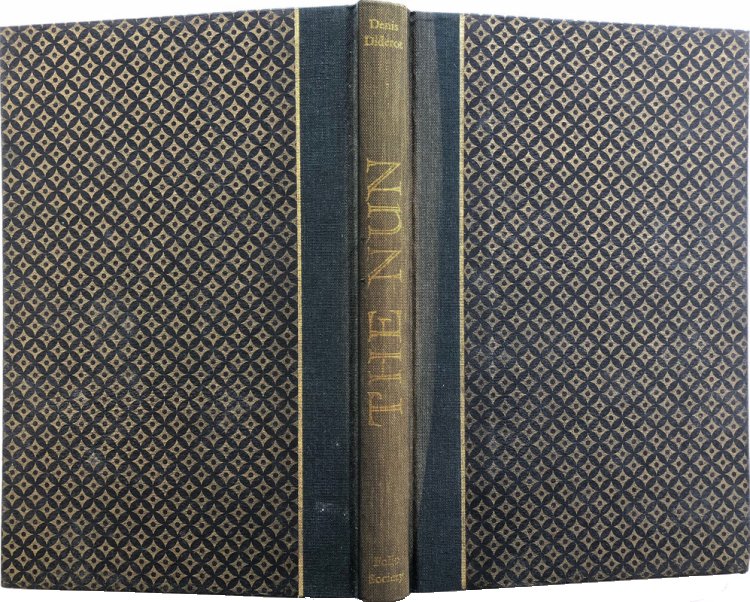
My copy is the Folio Society edition from 1972 and is notorious for its fading cloth spine, all copies I have ever seen are this badly faded, the rest of the book being protected by a slipcase. It is illustrated by Charles Mozley and translated by Leonard Tancock and is the fourth in my selection of books translated from French for August 2021.

Clochemerle – Gabriel Chevallier

Just possibly the most fun book I have read this year, it is delightfully written with the author taking the role of narrator and introducing us to the small Beaujolais town of Clochmerle and it’s comical inhabitants in the way of a consummate storyteller. Every character and place is beautifully described, and at length, so that you can fully realise in your minds eye each and every one of them. It is the third in my August book theme of ‘translated from French’ and it has been an absolute joy to read even though it clocks in at 320 pages.

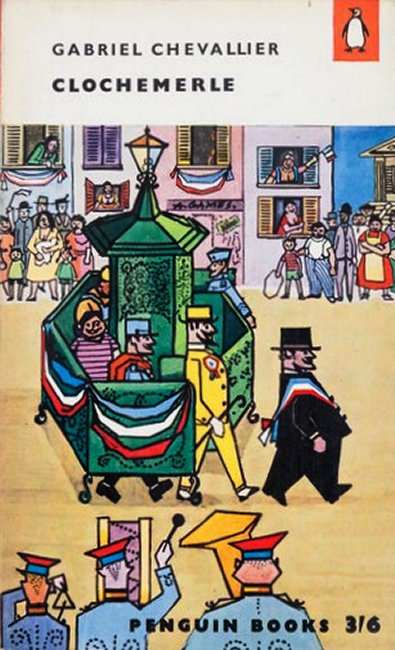
It all starts with the decision of the local mayor to bring progress to his sleepy town by building a public urinal and due to the odd geography of the place the best location is half way up the main street which places it firmly outside the church. Although not as indicated on the cover of this Penguin edition as it is placed not in the centre of a square but up against a wall adjacent to the Beaujolais Stores on an alley leading up to the church itself. To get a feel for the wonderful descriptions in the book let’s look at page one and the two men walking down the road from the square to where the urinal is to be situated.

One of these men, past fifty years of age, tall, far-haired, of sanguine complexion, could have been taken as a typical descendent of the Burgundians who formally inhabited the department of the Rhone. His face, the skin of which was dented by exposure to sun and wind, owed its expression almost entirely to his small, light grey eyes, which were surrounded by tiny wrinkles, and which he was perpetually blinking; this gave him an air of roguishness, harsh at times and at others friendly. His mouth which might have given indications of character that could not be read in his eyes, was entirely hidden by his drooping moustache, beneath which was thrust the stem of a short black pipe, smelling of a mixture of tobacco and of dried grape-skins, which he chewed at rather than smoked. Thin and gaunt, with long, straight legs, and a slight paunch which was more the outcome of lack of exercise than a genuine stoutness, the man gave the impression of a powerful physique. Although carelessly dressed from his comfortable, well-polished shoes, the good quality of the cloth of his coat, and the collar which he wore with natural ease on a week-day, you guessed that he was respected and well-to-do. His voice, and his sparing use of gesture were those of a man accustomed to rule.

And there we have a perfect pen-portrait of Barthélemy Piéchut, mayor of the town, a man of ambition to go far in the party and for which mayorality of a small provincial town was to be just a stepping stone. His fellow walker is Ernest Tafardel the schoolmaster and a far more devout republican than his friend although not destined to rise any higher than his current role. Against these two redoubtable men of the Third Republic there is the powerful Catholic Church although represented in Clochemerle by the Curé Ponosse a man who joined the priesthood for a quiet life and is definitely not the man for the crisis to come. However there is also the old maid, Mademoiselle Putet, full of religious fervour with nothing else to drive her forward now it had become quite clear she was destined to remain a Mademoiselle and untouched by the male sex rather than a married Madame. She it is that stirs up the trouble between the church and the state, initially over the urinal which as she lives by the church at the end of the alley where it is placed she sees as a personal affront to her dignity, but later as she interferes in the various goings on of the population.

The stage is set for a farcical ‘war’ between to two sides which is reflected in another conflict also in the location of the urinal between the two most attractive women in the town who run the Beaujolais Stores in the case of Judith and the bar of Torbayon in the case of Adéle which are directly opposite one another. Judith is well known for being free with her charms so to speak and Adéle flaunts hers rather than directly engaging in extra-marital affairs unlike Judith but this all changes when Judith’s particular favourite, who is staying at the Torbayon Inn, is taken ill and nursed by Adéle who takes advantage of his bed ridden state to discover exactly what she is missing in her own marriage. All this takes place in the long, hot summer of 1923 when tempers are getting frayed due to the heat and the annual fete is the cause of excessive drinking on all sides. The cast of minor characters is beautifully drawn and all have part to play in the ultimate fiasco and its resultant tragedy from the washerwomen of the lower town to the baroness in her chateau above the town, through the government officials more interested in cars and their private dealings and the military who can’t be bothered to intervene.

The book ends with an overview ten years after the calamities of 1923 by bringing us up to date with the happenings to most of the protagonists since then and all is well with most of them and the town now boasts three urinals, a great step forward indeed. There are apparently two sequels 1951’s Clochemerle Babylone and from 1963 Clochemerle-les-Bains both of which at least were available in Penguin so I can definitely see me hunting these out for future reading even if they are out of print which they appear to be.

Candide – Voltaire

What on Earth have I just read? I don’t really know what I was expecting from the fourth book issued in the Penguin Classics series, maybe a serious French novel, but it certainly wasn’t this surreal fantasy adventure. Penguin Classics started in 1946 with Homer’s Odyssey and then followed that with a collection of short stories by Guy de Maupassant and then the Theban plays by Sophocles, all solid classics as expected and then came this truly bizarre narrative at the end of 1947. This is the second of the blogs making up my August theme for 2021 which is ‘translated from French’, as I have already featured Boule de Suif and Other Stories by Maupassant I selected this book as the second French book in the Penguin Classics without knowing anything at all about it before I started reading this week.

The only book I can think of that has such fantastical episodes is Jonathan Swift’s Gulliver’s Travels and like that other classic this is a satirical parody, however unlike Swift’s book which is set in various fantasy lands Voltaire has set his amongst contemporary events and real people. The problem with both books is that they are over two hundred and fifty years old so the politics and philosophies they are parodying are long gone and the messages that would have been clear to readers at the time are obscure at best or completely lost to the modern reader. This if anything makes them even stranger. Still on with the review of the book in hand, which was first published in 1759.

As is my usual practice with books which have an introduction I didn’t read it first but after I had completed the novel. As usual I’m glad I did as the introduction not only gives away large parts of the plot whilst trying to explain the references it also totally reveals the ending. However the introduction is essential after reading the book because it answers so many questions the modern reader has, such as why does Professor Pangloss teach that this is “the best of all possible worlds” and anything that happens must ultimately be for the best despite the continuous disasters that surround him and his pupil Candide; including in Pangloss’s case being hung as part of a Portuguese auto-de-fe following the 1755 Lisbon earthquake which killed tens of thousands of people. It turns out that Voltaire was mercilessly sending up the Theodicy by Gottfried Leibniz which takes as it central premise that exact philosophy.

The book starts with Candide and Pangloss at the Baron Thunder-ten-tronckh’s country seat in Westphalia along with the Baron’s family, especially his seventeen year old daughter Cunégonde who Candide is madly in love with, all is well with the world. Cunégonde sees Pangloss making love with one of the maids and decides to entice Candide but this is seen by the Baron who kicks Candide out of the house before he can make a move. Candide is then captured by the Prussian army, press-ganged into service, flogged almost to death, made to fight in a war with the French and nearly executed before escaping to Holland, Here he meets Jacques the Anabaptist and then runs into Pangloss who is now a beggar with syphilis which he caught from the maid and who informs Candide that soon after he left the castle was over-run by the Prussians, Cunégonde was raped before her and all other inhabitants of the place were killed. Pangloss is cured of syphilis by Jacques, losing an eye and an ear during the treatment. We are now on page ELEVEN. The frenetic pace continues through the rest of the book along with the rapidly rising death toll and never ending coincidences and disasters surrounding the characters. Throughout it all Candide and Pangloss maintain the Leibnizian philosophy of this is the best of all worlds.

The other protagonists in the book are increasingly strange especially the ‘old woman’ whose tale is the most bizarre of all and acts as a balance to Candide as she certainly doesn’t believe that this is the best of all worlds after the life she has had. Starting as the illegitimate daughter of Pope Urban X and ending as a servant in Lisbon by the time she meets Candide, on the way seeing her mother drawn and quartered, becoming a slave and having a buttock cut off to feed starving Janissaries during a siege amongst other experiences. The surreal happenings to all the characters continue throughout the book which travels to South America and back to Europe via El Dorado dropping in at England just long enough to witness the execution of Admiral Byng for failing to prevent the fall of Minorca to the French and deciding that England was just too crazy a place to stay, which bearing in mind the things that had already befallen them by then was a pretty damning indictment.

I think I need to read Candide again in a few months just to fully resolve in my mind all that happens but if you like books at a mad pace then Candide is for you. I also have a copy as part of the Penguin Drop Caps series, translated by Theo Cuffe.

From the Earth to the Moon & Round the Moon – Jules Verne

These two novels by that early master of science fiction Jules Verne mark the start of my annual August reading block of books with a link between them and this year I have decided on ‘translated from French’ as my theme. The plan is to top and tail the five essays with these two and an even earlier pair of French science fiction novels with some more ‘classic’ works in between.

The two books were published four years apart, ‘From the Earth to the Moon’ in 1865 with ‘Round the Moon’ being serialised in 1869 then coming out in book form in 1870 but they really have to be read together to get anything like a satisfying resolution. I will also refer to the second book as ‘Round the Moon’ as that is the title in this edition, ‘Autour de la Lune’ is more commonly translated as ‘Around the Moon’. Although my book is just entitled ‘From the Earth to the Moon’ on the spine it does actually include both novels.

From the Earth to the Moon

The story is set in a fictional Baltimore Gun Club whose members had been developing ever more powerful cannons and artillery pieces during the recently concluded American Civil War. Disappointed that there was no longer an outlet for their talents following the cessation of hostilities the mood in the club had been somewhat downbeat until the President, Impey Barbicane, decides on an audacious plan, they would build a gun that could fire a projectile to the moon. The book then follows a series of progressions as the projectile becomes modified to become a capsule following the arrival of a Frenchman whom is determined to ride within it after hearing the worldwide publicity. It is quite difficult to avoid giving away a lot of the plot, especially as I also need to cover the second novel, but what is interesting is that Verne did some surprisingly accurate calculations and there are also some remarkable coincidences between the fictional trip and the Apollo program a century later including taking his crew up to three as not only does Frenchman Micheal Ardan go but so does Barbicane and his rival Captain Nicholl who had bet Barbicane that the project couldn’t be done.

Verne to his considerable credit correctly worked out escape velocity and realised that the optimum launch site whilst still remaining within the USA mainland is Florida due to it being the closest to the equator. He also gets the time taken to get to the moon remarkably close and therefore where the moon should be at the time of the launch. The dimensions of his capsule for the three men travelling in it is amazingly not far from that of the Apollo command module. What wouldn’t work is his launch method of a huge cannon barrel sunk into the Earth as the massive forces applying on them would simply crush the occupants regardless of the sprung beds and the quite ingenious water cushion that he came up with to soften the acceleration.

Round the Moon

It is in his much requested follow up novel that science quite literally goes out of the window. Verne needed to write a sequel as he leaves his heroes apparently orbiting the moon having being diverted off their intended route by a large asteroid that they encounter soon after leaving the Earth. Their original plan was to have settled in valleys on the Moon as it was assumed at the time that there may be an atmosphere surviving in the lowlands. In fact at the end of the first book it is not even known if they are still alive as the entire narrative takes place from the viewpoint of people on Earth. This second book instead takes us with the astronauts, picking up their side of the story from just before the launch. Unfortunately despite Verne’s cleverness in getting the launch almost right he then has his astronauts sitting down to eat ordinary meals washed down with bottles of wine and disposes of the rubbish by simply opening a window and throwing it out. To those of us reading the book now this is clearly nonsense and detracts from an otherwise excellent tale but for his Victorian era readers this was presumably perfectly reasonable.

That they used the planned means of safe landing on the Moon to manage to get back to Earth is reminiscent of Apollo 13 although in a completely different way and again even assuming that it was possible to survive the launch as depicted by Verne there is no way they could have survived the return journey and splashdown.

I first read these two short novels as a child in a rather nice illustrated edition which I borrowed from the local library. My current copy is from the International Collectors Library and has no illustrations, no publication date and not even the name of the actual publisher. There were over four hundred titles published by Doubleday as a discount line in America as ICL editions, almost all of which have fake leather look bindings and are designed to look expensive whilst actually being quite cheap. The real giveaway as to the cheapness is the poor quality of the paper which in this edition has been rough cut to resemble handmade paper but clearly isn’t. Rereading them I enjoyed these so much I think I ought to invest in a nicer copy which will perhaps encourage me to read them more often because despite their scientific shortcomings it is a really fun story.

Music, Food and Love – Guo Yue & Clare Farrow

Guo Yue was born in Beijing in 1958 so was eight years old when the Cultural Revolution began and this memoir is of a childhood through a period of turmoil as Chairman Mao ran his country into the ground from The Great Leap Forward in 1958 with the re-organisation of China into collectives dedicated to single products which largely failed and ignored the skilled workforce elsewhere who were now forced to do something different, usually badly, to the personality cult of the The Cultural Revolution. Yue was given this name as it means leap forward (Chinese names are family name first, then given name) to mark the year of his birth and the book largely follows his life from then until May 1982 when he left China to study music in London. As you can imagine because he was a child throughout most of the events this is not a usual book about China in those times, rather it is story of family life and survival in a period of extreme upheaval most of which made little sense to the small boy growing up in a two room home around a courtyard of an abandoned temple which was populated by various musicians who had been allocated rooms there in 1949 during another of Mao’s policies.

His overwhelming memories are of making music, cooking, eating and making what fun he could with his friends, politics only creeps in when it impacts his family, those also living in the courtyard or his school friends. His father died in 1964 and this obviously had a massive impact on the family not only emotionally but financially. His mother was a teacher and intellectual who spoke several languages which of course drew the ire of the People’s Army when the Cultural Revolution began and she was eventually bundled off into the countryside to work the land as a punishment for intelligence only reappearing for the occasional night to see how her six children were coping without parents and comfort her youngest, Yue. Eventually she was too exhausted and ill to continue to be in the fields and she was returned home but by then her health was broken.

Yue describes his neighbourhood and the various shops he would run errands to for his elder sisters to get the rationed ingredients they needed and cheap restaurants he would later gather at with friends in his teens before joining the army as a musician beautifully. The map at the start of the book helps you follow him around his local part of north eastern Beijing. You also register his bewilderment and things suddenly change at the whim of Chairman Mao and the changes again ten years after the start of the Cultural Revolution when Mao died and subsequent leaders unravelled the his immensely damaging policies. His fellow author is his wife Clare Farrow a writer and editor on various arts publications specialising in architecture.

One of the joys of the book is that it also includes recipes. At the end of most chapters there is a short list of dishes mentioned in the text and the final seventy pages consists of a quick guide to Chinese cookery and numerous recipes that have had minor tweaks to allow for the unavailability of some of the ingredients used in revolutionary China in London in 2006.

In September 2007 I was visiting my original home town of Nantwich in Cheshire, England to go to its excellent annual Food Festival where Guo Yue was one of the celebrity chefs doing a cookery demonstration, so I actually bought the book from him at the time and he signed it for me in both Pinyin Chinese and English. From memory he cooked two or three of the dishes featured in the book and as I had a front row seat I managed to try some. Sadly the festival has been cancelled again this year due to the uncertainties around what can and cannot be done done the pandemic but I hope to go again in 2022.

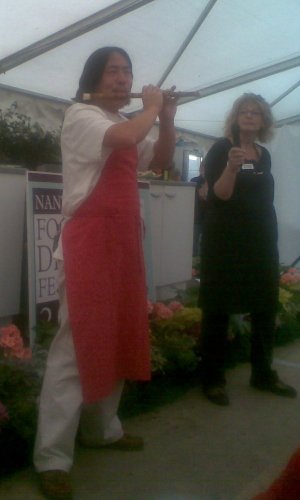
Yue also played one of his flutes at the end of the cooking demonstration. Apologies for the poor quality of the image but it was taken with only the natural light through a marquee roof using a mobile phone, which back in 2007 did not possess the camera quality of modern smart phones. In 2006 Guo Yue went back to Beijing to work on an album also called Music, Food and Love and you can see a video recorded then here.

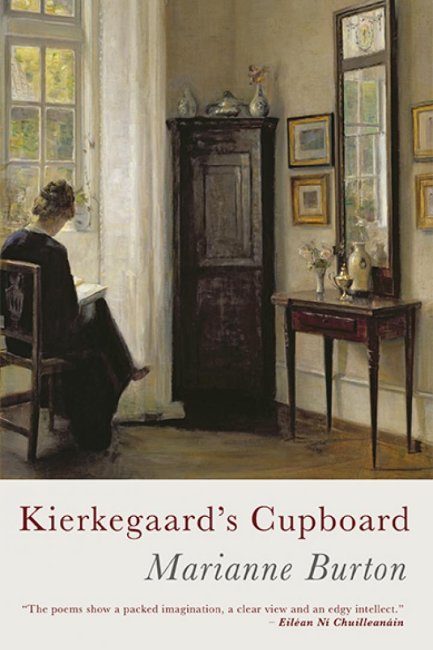
Kierkegaard’s Cupboard – Marianne Burton

A collection of poems inspired by the life and works of Danish philosopher and theologian Søren Kierkegaard, what an unusual idea and so it had to be bought and read if only for the concept. What I didn’t expect was just how readable Burton’s poetry is, and how difficult to put the book down proved to be. It is only a slim volume but I read it within a couple of hours of purchasing, this was helped by the fact that each poem is a variation on the sonnet form and at least retains the limit of fourteen lines even if Burton doesn’t keep to iambic pentameter and certainly not to the normal eight line, six line stanzas structure. This made it an ideal book to have with lunch as I could read a poem then have a bite of lunch or a swig of beer whilst thinking about it before diving back in to the next poem; which made for a very enjoyable, and enlightening, hour and a half in a very good pub.

The book is split into six sections, ‘Childhood’, ‘Regine’, ‘Writings’, ‘After the Corsair’, ‘The Moment’, ‘Death’ and there are fifty poems spread through these sections along with one extra right at the front entitled ‘How To Write A Preface’. As stated above all the poems have just fourteen lines but Burton manages to pack a lot into her self imposed constraint and each section has a short biographical note which introduces the poems to come and places their significance in the life of Kierkegaard. ‘Childhood’, ‘Writings’ and ‘Death’ are pretty self explanatory but the others need explaining if, like me, you don’t know much about Kierkegaard. Regine Olson was an eighteen year old whom Kierkegaard was briefly engaged to but he called the engagement off when he realised that marriage was not for him and he could only make her unhappy trapped in a relationship with him. He never got over the loss of her though and had a cupboard which contained all the letters and mementos of their year together and that is what gave this book its title. The Corsair was a Danish satirical magazine which lampooned Kierkegaard not just for his writings and beliefs but also his appearance and the lost relationship with Regine and the resultant publicity made him a figure of fun for a while. ‘The Moment’ refers to a series of tracts by Kierkegaard criticising the Danish Lutheran church. It should be noted here that in the only factual error I have found in the book Burton states that Regine was seventeen when she was engaged to Søren but she was born in January 1822 and they became engaged in September 1840 so she was definitely eighteen, Søren by the way was twenty seven at the time.

A lot of the poems are written in the first person so the book reads as though Kierkegaard himself is talking to us through the medium of verse. Three particularly intriguing poems all have the same title ‘It was Early Morning. Abraham Rose’, these are in ‘The Writings’ section of the book and tell three very different versions of the biblical story of Abraham preparing to sacrifice his son Isaac one after another. Kierkegaard had a strong personal religious belief but an often fractious relationship with the dominant church in Denmark and some of the strongest works in this collection are in ‘The Moment’ where Burton takes on his mantle in a critique of the state run religion and its materialistic clergy. I must look out for Burton’s first collection of poems ‘She Inserts the Key’ as this collection has whetted my appetite for more.

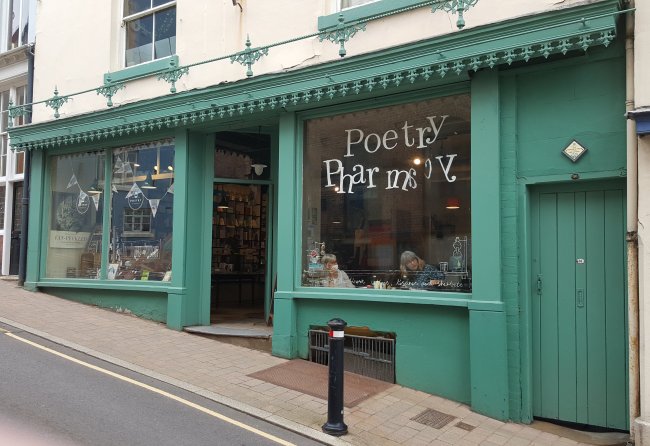
I purchased the book last month during a trip to the small Shropshire town of Bishop’s Castle where there is a quirky shop called Poetry Pharmacy, which mainly sells poetry but also has other interesting books and a small children’s section along with a coffee shop, it’s definitely worth a visit if you ever find yourself deep in rural Shropshire.

Death and the Dancing Footman – Ngaio Marsh

Part of the Ngaio Marsh million, one hundred thousand copies of each of ten books by Marsh published by Penguin Books in July 1949, this is one of the three books included that had not been published by Penguin prior to this collection. I have reviewed one of the other titles included, ‘Enter a Murderer’, back in August 2018 as part of the ‘first Penguin crime set‘ which were all first published by Penguin in August 1938. As I explained at the time:

New Zealand’s Ngaio Marsh was considered in her time to be one of the ‘Queens of Crime’ along with Agatha Christie, Dorothy L Sayers and Margery Allingham and is best known for her detective stories featuring Roderick Alleyn of the London Metropolitan Police. 

This is another of those Chief Detective Inspector Alleyn crime mysteries. As a general rule most crime novels of the 1930’s and 1940’s clock in at about 200 to 225 pages but this one is surprisingly long for the period at 315 pages in the Penguin edition and I have to say that it is a very slow starter with scene setting and character introductions meaning that it doesn’t really get going until around page 70. If I hadn’t been convinced of Marsh’s ability to spin a tale I might have given up before then but it is well worth hanging on in there. The story is a twist on the ‘locked room’ type of crime novel in that the victim and the murderer are from the fixed group of people we have been introduced to, in this case because the grand country house that they are all in is surrounded by impassable snowdrifts and even the phone lines are down so they can have no contact with the outside world. That it is established early on in the novel that Alleyn is taking a break in the nearest village to where the murder takes place allows Marsh to bring him in even though he is clearly out of his jurisdiction but he is the only policeman anyone can get hold of.

The premise of the story is that Jonathan Royal, the owner of Highfold, decides to give a house party and for his own amusement chooses a group of people who all, for one reason or another, have an antagonistic feeling regarding at least one of the other guests. It is implied that he is hoping for some sort of reconciliation in one or more of the disagreements but will be quite happy if this doesn’t happen and is confident in his ability as a host to at least hold the group together. It will be a sort of unscripted play and with this in mind he has also invited a neutral player. Aubrey Mandrake is an avant garde, if not surrealist playwright who knows none of the other guests, Royal has backed some of his plays and has now invited him to be the audience in his own experimental theatre. Due to the animosity between the guests each has has a reason for, if not murder, then at least wishing harm to another and all these various hostilities are explained right at the start of the book as Jonathan Royal brings Mandrake into his confidence as to what he has planned. The complicated relationships between the other seven guests and the need to go into detail about them is one of the reasons for the slow start and it is only later as the interactions unfold that you realise that you actually need all that information in order to keep track of the various goings on.

Much to my surprise I got the murderer right, well before the denouement, although not all the finer detail as to how it was done, or rather how the alibi was done. Alleyn of course regarded the solution as trivial and he had largely wrapped up the case in his mind within a couple of hours of arriving at Highfold, his problem was proving it especially without access to his usual fellow policemen. All in all an excellent read for a dull and rainy July weekend and I do like a good detective story as a means of giving your brain a workout.

As an aside, I did like that characters in this book are clearly readers of detective fiction, in particular Dorothy L Sayers’ very popular Lord Peter Wimsey tales. On page 206 of this edition they reference Busman’s Honeymoon which I reviewed in September 2020.

“Could Hart have set a second booby trap.” “Do you mean could he have done something with that frightful weapon that would make it fall on …? Is that what you mean?”
“Yes. I can’t get any further, though. I can’t think of anything”
“A ‘Busman’s Honeymoonish’ sort of contraption? But there are no hanging flower-pots at Highfold”

Death and the Dancing Footman was first published in 1942 although mine is the first Penguin edition from 1949. Busman’s Honeymoon had come out just five years earlier in 1937 but had clearly been a major seller if Marsh could so easily drop in a reference to it. There is a slight nod to the plot of Busman’s Honeymoon in the solution to this case although the hint taken from the murder method in that book in the quote above is also a diversion from the actual method in this one so it was clearly a much loved book by Marsh.

Kindred – Rebecca Wragg Sykes

Subtitled ‘Neanderthal Life, Love, Death and Art’ this book gives a comprehensive overview of not just what we know about Neanderthals but also how we got to this level of knowledge where such a book covering those topics and many more could be written. A superb piece of research that has deservedly been one of the science highlights of the last year, it only came out in the summer of last year and has yet to appear in paperback but my copy is already the seventh impression of the hardback which suggests excellent sales. The real surprise, to me at least, is just how much our knowledge of Neanderthals has advanced in the last two decades due to much better archaeological techniques which more accurately map the various strata of a dig and the positioning of thousands of objects but also from the DNA analysis that is now possible.

Although aimed at the interested amateur Sykes makes some assumptions regarding the knowledge of the reader in the terminology she uses. For example ‘analysing the calculus’ is not explained for well over a hundred pages from when it is first used. When it is defined it turns out to mean studying the teeth, or more specifically the residues built up on the teeth of the fossil remains rather than the obviously wrong, but entertaining until proved otherwise, that Neanderthals had somehow grasped differential mathematics. The complexity of various rock knapping techniques and how this helps define groups of Neanderthals who must therefore have interacted with each other is very well explained although I would have liked more diagrams to illustrate this to make the differences clearer. The last time I read a book on this subject was definitely over two decades ago so a vast amount of information in this book was new to me and as it is 380 pages long there is a huge quantity to take in.

It is very well written, and whilst the necessary vocabulary did sometimes have me checking on Google to make sure I understood this was a relatively rare occurrence as for the most part terms are explained as they are needed, with the obvious exception of calculus, however a small glossary at the back along with the detailed index would have been useful. Sykes can’t resist the occasional pun either such as ‘harvest the data’ when referring to gathering evidence of plant eating and this lightens the tone of what could have been in a lesser writers hands quite a dry study making it very readable and engaging.

The opening chapter deals with the slow growth of knowledge about Neanderthals from when they were first discovered just over 160 years ago and then through the book we are introduced to the 99 sites that remains have been discovered at right across not only Europe, which was their heartland but the ones in the near and far east which I had never heard about, there is a useful map on the front end papers which shows this spread. As you would expect from such an all encompassing subtitle Sykes attempts to not just document the artefacts found but also place them into context of the living, breathing people that used them. Just how would such a chipped rock be used? Were they making personal adornments? What can the spread of hearths (areas where a fire was lit rather than necessarily anything physically built) within a cave complex tell us about the size of the population using the shelter or the timescales that a place was used? How did they co-exist not just with each other within clan groups but with other clans and even Homo Sapiens when they appeared on the scene moving into Europe from their African homelands hundreds of thousands of years later? All of this and more is covered, it is definitely a book that will repay rereading in a few months to fully take in the sheer mass of information.

According to her introduction Sykes completed the book in June 2020 and hints at several, as yet unpublished, studies that she has clearly had access to meaning that this truly is as up to date as it was possible to be. But with the indicated speed of advances, especially in DNA analysis, either a revised and updated version or even a second volume must be a possibility in a few years time. Even the fact that she completed the book during lock down for the coronavirus pandemic becomes significant, we still don’t know why Neanderthals disappeared, was there perhaps a contagion brought by Homo Sapiens that further weakened the existing population, struggling as it was with climatic changes 40 thousand years ago as the continent swung from glaciation to warmer temperatures and back again. Of course they never truly went away, DNA analysis proves this, modern humans, at least outside those of African descent, have a small percentage of Neanderthal DNA and knowing this the story of this ‘lost’ people gains even more relevance today.

The one criticism that I do have is the unnecessary fanciful opening sections to each chapter in either prose or verse, lasting between a half and a full page of text, they add nothing to the rest of the work but fortunately can be easily skipped as they are in italic. Clearly influenced by Jean Auel and her very good Earth’s Children series of novels set in the time of the Neanderthals, I started off reading these chapter preambles but after chapter five just left them out.

Three Letters from The Andes – Patrick Leigh Fermor

In 1971 Patrick Leigh Fermor, already by then a respected travel writer, but still six years before he published his best known work ‘A Time of Gifts’, went with five friends to the Andes in Peru. This book consists of three long letters to his wife although he never actually posted the third one as he didn’t finish it until he was on his way home. The expedition was part of a trip organised by his fellow members of the Andean Society in London using privately chartered aircraft to get to and from Peru from London and Fermor’s friends were intent on exploring and scaling the peaks of a relatively unknown part of the Andes mountain range. If all this sounds expensive then it probably was but Fermor and his colleagues could certainly afford it, most of the party were highly experienced climbers:

  • Robin Fedden – Leader of this expedition, Deputy Director-General of Historic Buildings for The National Trust, a writer and diplomat
  • Renee Fedden – Robin’s wife and co leader of the expedition
  • Carl Natar – Ex world ski champion and London manager of famous jewellers Cartier for three decades
  • Andre Choremi – Lawyer and social anthropologist

Along with them were a couple of non climbers

  • Andrew Cavendish – 11th Duke of Devonshire and a keen amateur botanist looking for rare plants to grow at his stately home Chatsworth House in Derbyshire
  • Patrick Fermor – travel writer, just along to spend six weeks with his friends and explore the area with them.

The letters were not intended for publication, and it took twenty years before they were, after what Fermor describes as a general tidy up but not much. That these were originally just letters leads to the main criticism levelled at the book in that it is not as polished as his other works and it feels more like an old boys outing with irrelevant chit chat coming to the fore. Well yes, these are letters to his wife who knew most, if not all, the other people involved and recording the conversations between them is entirely right in that context. I quite like the chattiness of the style and I raced through the book, reading it in just two sessions, as I found it quite difficult to put down once I had started reading. It is full of beautiful descriptive passages as he tries to convey the beauty of the surroundings. To illustrate this I’m just going to open the book at random and quote whatever I find.

The mountains draw back of either side of an airy lift and fall of savannah. As our caravan picked its way over the edge and headed downhill, orange-flowered organ-cactus and myrtle and tamarisk rose up and the air began to smell of spice. There was a blazing sky of very pale blue.

From the second letter

You could almost be there, in just three short sentences Fermor has captured his environs perfectly and as I said this is literally a random sample, not a passage I had picked out in advance, opening the book anywhere will show his talent to take the reader with him which would be displayed fully in his masterpiece of travel writing, ‘A Time for Gifts’. After the climbing expedition the friends head off to Lake Titicaca where they end up in a terrible hotel and the sections covering their always exasperating dealings with the manager and the chef who appears to be incapable of even boiling an egg successfully are very funny. A sudden announcement that there is actually hot water for a change will have the group dive for the showers only for the water to turn icy cold just as they were starting to enjoy finally getting clean. You have to wonder if the manager was incompetent or simply didn’t care about the people staying there. It was only when Andrew in frustration at yet another rock hard egg for breakfast threw it across the dining room did conditions start to improve.

As usual with Fermor the book is thoroughly entertaining and I definitely recommend it.