I Hate and I Love – Catullus

A collection of forty three poems by Gāius Valerius Catullus, a Roman poet born in 84 BCE and who died in 54 BCE, but in his short life he wrote a number of poems, 116 of which have survived to the present day. Penguin published a complete volume translated by Peter Whigham which I don’t possess however this selection from that larger volume is part of the Penguin Little Black Classics all of which I purchased when they came out. Catullus’s poetry is normally categorised nowadays into three main subject types, those dealing with his friends, those about a woman he loves but refers to only as Lesbia rather than her real name which was probably Clodia Metelli and the rest are largely described as invective or works attacking other people, which was quite a popular style at the time. This volume is mainly poems in the ‘friends’ or ‘Lesbia’ categories with just seven of the ‘invective’ style represented although over fifty of the surviving works are categorised as ‘invective’. An example of the invective style is poem 43 which attacks the girlfriend of Formianus.

Apologies but photographing the poems without breaking the spine of the book has led to the distortions in the images. The next poem that I want to select to illustrate the tone of Catullus is one which describes his desire to travel now that the warmer weather is here. I have deliberately selected three of the shorter works although few are what we would regard as long, but the descriptions of personal experiences and desires is what marks Catullus as one of the writers known collectively as poetae nov or ‘new poets’ as poetry moved away from the epic heroic style favoured before then. The works of Catullus were almost lost to us completely as a single manuscript was found in the Chapter Library of Verona around seven hundred years ago. This document was copied twice before it was again mislaid and one of the copies was in its turn copied twice before being lost. So the 116 poems have come down the centuries due to these three surviving precious documents.
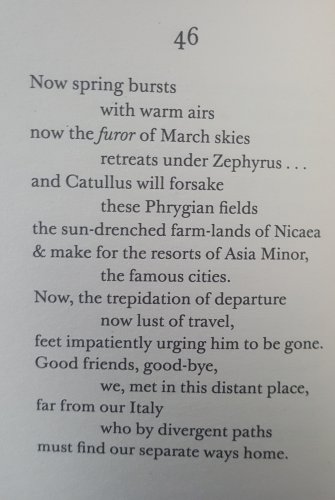
That one feels very modern with Catullus looking forward to a holiday in Turkey and hoping to meet up with friends there. For my third example it has to be one of the famous Lesbia poems although not the best known, which is poem 5, as that extends over a page in this edition so is difficult to include here. But poem 51 expresses his desire for Lesbia and how he feels when in her company although it is worth pointing out that poem 85 refers to her husband so Catullus was probably one of several men she had affairs with, including Rufus the subject of invective poem number 77 written after Catullus found out about their relationship.

A few others are quite ribald so I don’t feel I can put them on this blog. Although I have certainly enjoyed reading the collection it does nowadays probably need to come with a warning regarding adult themes, The title by the way is from the opening line of the very short poem 85, which is just two lines long:

I hate and I love. And if you ask me how.
I do not know. I only feel it, and I’m torn in two
Catallus 85 translated by Peter Whigham

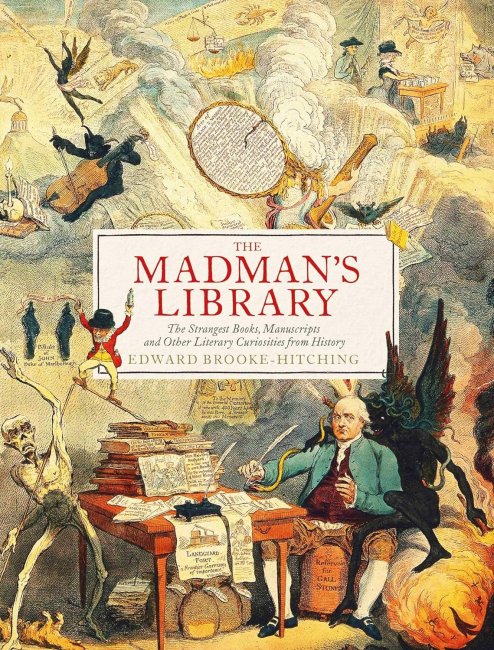
The Madman’s Library – Edward Brooke-Hitching

In July last year I wrote about the second book published by Edward Brooke-Hitching, ‘The Phantom Atlas‘, this more recent volume, first published in 2020 was a gift I received least Christmas, Brooke-Hitching is the son of an antiquarian book dealer and his love of books shines through in this guide to some of the oddest works ever produced from books like The Blood Quran which was written in beautiful calligraphy using around fifty pints of Iraqi dictator Sadsam Hussain’s blood as a major constituent of the ink in 1997 to ones that use arsenic as the dye for the covers so could literally kill the reader as the poison leaches from the boards. It is six years to the day since I started this blog and I think this book about books is an appropriate subject to mark this milestone of three hundred and fourteen articles and almost three hundred thousand words about books in my own library.

The book starts with a fascinating history of books and their precursors such as clay tablets or Sumerian foundation cones along with parchment scrolls including one that was used to wrap an Egyptian mummy. Then there are books that conceal other things such as one with a built in gun for self defence or astronomical equipment or objects that look like books but are actually boxes made from a specific wood with leaves and seeds from the tree inside them. I was reading about these and thinking it would be interesting to own one when the author pointed out the smell of decay that goes with them which somewhat put me off. There is also a long section on literary hoaxes such as biographies of people that didn’t exist or travel books of journeys that never happened several of which I am tempted to track down examples of.

There are further sections on books of the occult and religious oddities which include some of the strange animals depicted in medieval manuscripts and then examples of tiny and gigantic books. I have a love of tiny books, see my blog on the Lilliput Press so this section was particularly interesting and whilst I do have huge books such as the Folio Society’s Temple of Flora I don’t have anything like the atlas made for Charles II which is 1.76 metres tall and 2.3 metres wide when opened and is truly spectacular. There is a special mention in this section for the classic Audubon work ‘The Birds of America’ which exists in several editions but which is most prized for the version where all the birds are depicted life size which as this includes pelicans and flamingos gives some idea as to its immensity.

All in all this is a really interesting compendium of literary oddities, some of which I knew about but a lot that I didn’t and like the other books by Brooke-Hitching is again richly illustrated and it’s well worth a space on the shelf of anyone who loves books.

A Stroke of the Pen – Terry Pratchett

The first of the books I received for Christmas to be reviewed is this collection of stories written by Terry Pratchett whilst he was still learning his trade as a writer and working as a journalist for the Bucks Free Prres in Beaconsfield. These stories however were mainly written for the Bristol based Western Daily Press so Pratchett wrote under the pseudonym of Patrick Kearns, Kearns being his mothers maiden name. The stories were rediscovered by Pat and Jan Harkin during a massive trawl through the British Library newspaper archive in search of a story they knew existed ‘The Quest for the Keys’ and in doings o they came across the other works by an unknown writer Patrick Kearns that sounded and felt familiar as they used places and characters from the tales written by Pratchett for the Bucks Free Press under the name of Uncle Jim which have now been collected in four volumes, the fourth coming out after I wrote my original review of those books. Apparently the fourth book is to be the last but ‘A Stroke of the Pen’ adds another twenty short stories by the young Terry Pratchett for us to enjoy and yes they do feel like the Uncle Jim stories and indeed one of them, ‘Mr Brown’s Holiday Accident’ did originally appear in the Bucks Free Press as by Uncle Jim.

The scale of the archive work done by the Harkin’s can only be appreciated when you know that despite being very short each of the stories were published in multiple parts with the longest, and the only one to be credited to Terry Pratchett in the Western Daily Press, being ‘The Quest for the Keys’ which appeared in thirty six individual sections from 30th July to the 13th October 1984. Also nobody knew about Patrick Kearns as a pseudonym so it was only the style and content that tipped them off that here was an until then unknown source of Terry Pratchett works. Also although ‘The Quest for the Keys’ was known to exist, because of the way it was clipped from the newspaper and saved the dates and indeed the newspaper which printed it were lost so they had to go through four possible newspapers archives from the earliest probable date (1972) up until 1984, when Terry’s first Discworld novel, ‘The Colour of Magic’, was printed, in their search. Fortunately they decided to work forwards rather than back or they would have found ‘The Quest of the Keys’ a lot quicker and probably not stumbled on the works of Patrick Kearns.

Enough of the history, what of the stories themselves? Well I love the Uncle Jim stories and these are more of the same, indeed there are a couple of reworked Uncle Jim tales under the name of Patrick Kearns which provides confirmation, if any was needed, that this is indeed the same author. The first story included is clearly inspired by Roy Lewis’s ‘The Evolution Man’ with its stone age man main character discovering major advances such as fire. My personal favourite of the ones in this book however is ‘The Fossil Beach’ in which the curator of Blackbury museum is taken to the beach by a local geology student where they find a fossilised deckchair, radio and a copy of today’s newspaper in the mouth of a small dinosaur. How these all got there is a mystery they are determined to solve. Pratchett is clearly already a very competent fantasy writer by the time he wrote as Patrick Kearns, not as good as he would become but definitely worth reading.

Sadly I cannot recommend this hardback book as it currently exists, as it has been announced that there is a story missing from it which Colin Smythe, who had commissioned the Harkin’s to undertake their quest, accidentally omitted when he sent the text to the printers which means that the paperback, due out in April this year will be the complete book and anyone who has the hardback first edition, like mine, will have to buy the paperback as well in order to read the missing tale.

A.S.B. Glover – Tim Graham

Subtitled ‘The Unacknowledged Genius of Penguin’ this is part biography and part a collection of correspondence and it is the letters both to and from Glover that give the clearest picture of the character of the man. For those people not familiar with the name A.S.B. Glover, which I suspect is most of the people reading this blog, he was responsible for proof reading and editing several series for Penguin Books over a period of sixteen years especially the factual Pelicans as well as editing various books for other publishers. This was a role that ideally suited this remarkably erudite man who could read and write in multiple languages including Ancient Greek, Latin and Sanskrit and was also a renowned scholar in religious texts and the saints of the various Christian denominations and yet left school with no qualifications. Biographical details regarding Glover are difficult to find, he was born in 1895 as Alan McDougall and changed his name sometime in the 1920’s possibly due to his regular imprisonment during World War I as a conscientious objector under his original name. One thing that I definitely didn’t know about him that Tim mentions is that his body was covered in tattoos, including his face, although these facial ones were later removed leaving some scarring and that he may have earned a living for a time as a tattooed man in circuses. Tim cannot find any evidence of a McDougall or Glover working in such a role but it is entirely possible that he had yet another name that he worked under at the time.

He first came to the attention of the publishing world by sending numerous letters containing corrections to books they had recently published to the extent that Penguin realised that it would probably be cheaper to employ Glover to catch mistakes before they went to print rather than amend books for subsequent publication. I’ve mentioned before that you see more of Glover in his letters and the following example dealing with a matter close to his heart after his years in prison is a case in point.

The book by Trevor Gibbens never saw light of day despite Glover’s repeated attempts to get the author to finish it.

This book however is published in a limited run of just 600 copies by The Penguin Collectors Society and designed to look like a Pelican from the period Glover was in charge. At the time of writing this review it is available from the society for £12 plus postage, follow this link if interested. All in all it is an really good book about a fascinating man, who although he didn’t get on all the time with his colleagues and particularly not his boss, Allan Lane, was nevertheless essential to the accuracy and therefore the authority that Pelican Books established under his control.

The Haunted Man – Charles Dickens

The Haunted Man and The Ghost’s Bargain to give the book its full title is the fifth and final Christmas book by Charles Dickens. I have a copy as part of my collected volume of Christmas Books published by Gerald Duckworth Ltd in 2005 as part of their failed series of facsimile reproductions of the famed 1937 Nonesuch Press collected Dickens. I say failed as there was originally supposed to be twenty four volumes published at a rate of six a year from 2005 but six years later only twelve books had appeared (six in 2005, three more in 2008, and a final three in 2011) before the project was abandoned. The private Nonesuch Press Dickens was one of the finest editions of his collected works ever produced and was limited to just 877 sets, the odd number being due to the inclusion with each set of an original engraved steel plate from the first edition printed by Chapman and Hall Ltd. They had 877 plates in storage, all of which were purchased by Nonesuch and included in a box made to look like one of the books. As I don’t have the several thousand pounds needed to buy one of these sets nowadays, the Duckworth reprint looked like a good option until they stopped printing them. Happily they did include all five of the Christmas stories, combined in one large book as one of the first six volumes printed.

I must admit that apart from ‘A Christmas Carol’, which I read regularly and reviewed on Christmas Day five years ago, the other four Christmas tales by Dickens are ones I have rarely, if ever, dipped into. I’m pretty sure that I have never read ‘The Haunted Man’ before but I really enjoyed it now that I have finally done so. The story concerns a chemist, and lecturer in the subject, Mr Redlaw whose home and teaching establishment occupies part of an old educational building in a somewhat poor and rundown, but otherwise unidentified, part of London.

His dwelling was so solitary and vault-like,—an old, retired part of an ancient endowment for students, once a brave edifice, planted in an open place, but now the obsolete whim of forgotten architects; smoke-age-and-weather-darkened, squeezed on every side by the overgrowing of the great city, and choked, like an old well, with stones and bricks; its small quadrangles, lying down in very pits formed by the streets and buildings, which, in course of time, had been constructed above its heavy chimney stacks; its old trees, insulted by the neighbouring smoke, which deigned to droop so low when it was very feeble and the weather very moody;

From Chapter one: The Gift Bestowed

One of the joys of reading Dickens is his power of description, in a few words he has created a vision of the building occupied by Redlaw and his servants and I can see it clearly in my minds eye. The servants consist of a man and wife along with the mans aged father who continually, and comically, keeps repeating that he is eighty-seven whilst hanging the holly for Christmas Eve. But what of Redlaw, why are we concerned with him? Well he is the haunted man of the title and unusually, in an interesting twist of the traditional ghost story, he is haunted not by the dead but by himself, or at least a simulacrum of himself. Mr Redlaw is a troubled man, deeply wounded by the death of his sister and apparently unable to recover from that loss and it is to apparently offer succour that the phantom has appeared. It suggests that forgetfulness would be the best solution but it is not simple forgetfulness of his sister that is part of the gift it is so much more and the power to continually pass on this ‘gift’ even unwillingly. After great indecision Redlaw consents.

The second chapter appears at first to have abandoned Mr Redlaw as we move to the nearby Jerusalem Buildings, an even more rundown part of the neighbourhood, and the home of the Tetterby’s, A small man running a decrepit shop that has tried, and failed, to make money with all sorts of endeavours. Indeed the only thing that the Tetterby’s have succeeded in is the production of children, of which there are a great many and very little money to go round to support them leading to possibly my favourite and most typically Dickensian passage in the book, the description of their meal for Christmas Eve.

There might have been more pork on the knucklebone,—which knucklebone the carver at the cook’s shop had assuredly not forgotten in carving for previous customers—but there was no stint of seasoning, and that is an accessory dreamily suggesting pork, and pleasantly cheating the sense of taste. The pease pudding, too, the gravy and mustard, like the Eastern rose in respect of the nightingale, if they were not absolutely pork, had lived near it; so, upon the whole, there was the flavour of a middle-sized pig.

From Chapter two: The Gift Diffused

Into this poor but happy home comes Mr Redlaw in search of a student of his whom he has been told is unwell and lodging with the Tetterby’s but brought with him is his curse of forgetfulness of familial ties which leads to fractiousness of the children and more concerning wonders between themselves as to why Mr and Mrs Tetterby ever married each other. He spreads his contamination of discontent between the student and his carer before fleeing into the night so as not to cause more disagreements amongst those whom until his arrival were not just content but happy with their lot.

I’m going to say no more regarding the story except to recommend that you read it as it is wonderfully written, as I would expect from Dickens, and the denouement in chapter three is as unexpected as it is heart warming. If you can’t find a physical copy of the book it is available here on Project Gutenberg.

Merry Christmas

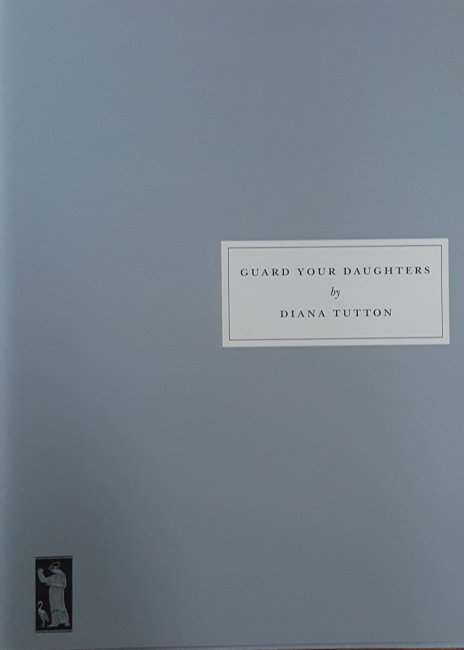
Guard Your Daughters – Diana Tutton

The second of the three Persephone books that I purchased from them at their own shop in Bath back in September this year. The first one I featured was ‘To Bed With Grand Music’ by Marghanita Laski which was also in their distinctive all grey binding and dust jacket. Persephone specialise in twentieth century female writers a large number of which have largely been forgotten nowadays, certainly I had never heard of Diana Tutton before buying this book. It turns out that this was Tutton’s second novel, but the first to be published, back in 1953 by Chatto and Windus, she would go on to write one more novel whilst living in Malaya in the early 1950’s before returning to the UK with her husband and apparently retiring from writing as I can find no other works by her other than these three novels. Guard your Daughters was easily her biggest hit and largely favourably reviewed at the time including by such literary luminaries as the future Poet Laureate John Betjeman who described it as ‘A really talented first novel’ in his review in the Daily Telegraph newspaper. Persephone Books have rather unusually included an afterword made up of contemporary reviews up to modern day blogs, I have to say that the more modern takes on the novel are nowhere near as complimentary as the reviews from the 1950’s and that I have to agree with them. Whatever ‘charm’ the book had when it first appeared has largely evaporated over the decades and I took weeks to read it despite it only being 250 pages long, picking up other books to read and review whenever I got totally fed up with the five Harvey sisters, their tedious father and their awful mother.

The father is apparently a famous mystery novelist although the pseudonym that he writes under is never mentioned and he spends most of his time in his study composing the books that have made him wealthy occasionally appearing to eat and in the evenings drink sherry before vanishing again to his room. The mother spends most of her time taking to her bed following whatever perceived slight she has objected to most recently and controlling her daughters to an obsessive degree so that none of them have ever been to school and are largely kept from any form of socialising, being effectively confined to the house except when needed to go on errands. As the book starts the eldest, Pandora, has escaped the oppressive atmosphere of the house by somehow getting married leaving behind her four sisters, in order of age, Thisbe, our narrator Morgan, Cressida and finally Teresa who is fifteen. The names are as pretentious as the girls are snobbish, seeing themselves as special because of their father and charmingly eccentric due to their odd existence cut off from the modern world without formal education, social life, telephone, or car rather than bizarre. The writing is all over the place as well with most things described in the present tense but then all of a sudden near the end of the book it’s Morgan looking back over the years at what had happened. Morgan is also not an interesting narrator which is another reason I kept putting the book down, frankly I didn’t care what these young women were doing in their extremely odd household where their mother did nothing other than flower arranging and having nervous collapses, leaving all the household duties to the girls, which are tediously described, and the one remaining servant who was mainly a cleaning lady as far as I could tell from her random appearances.

The girls attempts to add male company and presumably an escape from the house as Pandora managed are thwarted by the controlling interests of their parents but near the end of the book it looks like finally they may be set free. According to the Persephone Books website there was going to be a sequel where they did lead their own lives but this was unfinished. Frankly I’m happy Tutton never completed it, presumably she got as fed up with the Harvey sisters as I did.

Diana Tutton wrote a sequel in the late 1950s which, alas, was never published. It was called Unguarded Moments and its setting is London seven years after Mrs Harvey had a total breakdown and all the girls moved out: to freedom and their own lives. Morgan has married and had two children. In this novel, too, there is a dark side: one of her children disappears and is not found for a heart-stopping few hours.

Persephone Books website – see here

I will probably give this book away rather than find a home for it on the shelves as I’m unlikely to want to read it again, pity as I enjoyed Laski’s work and am really looking forward to the third book I bought in Bath which will be tackled sometime in the new year. As with the Laski there are patterned endpapers with a matching bookmark, this time it is taken from a 1953 printed cotton by Susie Cooper for Cavendish Textiles.

À rebours – Joris-Karl Huysmans

It was the strangest book that he had ever read. It seemed to him that in exquisite raiment, and to the delicate sound of flutes, the sins of the world were passing in dumb show before him. Things that he had dimly dreamed of were suddenly made real to him. Things of which he had never dreamed were gradually revealed.

It was a novel without a plot and with only one character, being, indeed, simply a psychological study of a certain young Parisian who spent his life trying to realise in the nineteenth century all the passions and modes of thought that belonged to every century except his own, and to sum up, as it were, in himself the various moods through which the world-spirit had ever passed, loving for their mere artificiality those renunciations that men have unwisely called virtue, as much as those natural rebellions that wise men still call sin.

The Picture of Dorian Gray (chapter 10) – Oscar Wilde

When I recently read ‘The Picture of Dorian Gray‘ I assumed that the book referred to as the inspiration of Gray’s sensual explorations and obsessions was simply a device invented by Wilde, so I was surprised to discover that in fact the book actually existed. Wilde confirmed that À rebours by Huysmans was the book during his failed libel trial against the Marquess of Queensbury in 1895, and I found that not only did it exist but that a copy was already on my shelves, and had been for probably twenty years although sadly neglected, in form of the Penguin Books translation of 1959 with its title translated as ‘Against Nature’, it is also known as ‘Against the Grain’.

Charles-Marie-Georges Huysmans, who wrote as Joris-Karl in a tribute to his father, was a career civil servant, author and art critic living in Paris between 1848 and 1907 and was far from the character of the aesthete, Des Esseintes, who is the ‘hero’ of Against Nature. I put the word hero in quotes advisedly as the Duc Jean Des Esseintes is far from heroic being “a frail young man of thirty, who was anaemic, with hollow cheeks, cold eyes of steely blue, a nose that turned up, but straight, and thin papery hands”. This then is the subject of the book with other characters reduced to mere cyphers as he keeps himself away from all other human contact as far as possible. Even arranging that his two servants rarely see him and they live in a sound deadening apartment in a separate part of the house so that their existence doesn’t impinge on the solitude and quiet so desired by their master. Huysmans is clearly highly educated and very well read as demonstrated by the third chapter of the book, in this edition at least as translations vary between the chapter breaks, which is largely a harangue on the Latin writers from Virgil, just before the Christian era, to the eighth century Anglo-Saxon ecclesiastical authors whilst featuring the Des Esseintes library.

It is only fair to add that, if his admiration for Virgil was anything but excessive, and his enthusiasm for Ovid’s limpid effusions exceptionally discrete, the disgust he felt for the elephantine Horace’s vulgar twaddle, for the stupid patter he keeps up as he simpers at his audience like a painted old clown was absolutely limitless.

Sallust, who is at least no more insipid than the rest, Livy who is pompous and sentimental Seneca who is turgid and colourless, Suetonius who is larval and lymphatic, Tacitus who with his studied concision, is the most virile, the most virile, the most sinewy of them all. In poetry, Juvenal, despite a few vigorous lines, and Persius, for all his mysterious innuendos both left him cold. Leaving aside Tibullus and Propertius, Quintilian and the two Plinies, Statius, Martial of Bilbilous, Terence even and Plautus whose jargon with its plentiful neologisms, compounds and diminutives attracted him, but whose low wit and salty humour repelled hm.

Translation by Robert Baldick – Penguin 1959

Well that just about sums up most of the famous ancient Roman writers and presumably these are not just the supposed opinions of Des Esseintes but that of the author as well, the denigration of the Latin poets and later biblical scholars continues for several more pages as he moves through history. Two more chapters near the end of the book perform similar attacks on French literature but as these concentrate on liturgical authors and what Huysmans himself describes as minor writers I found these far more difficult to read as I wasn’t familiar with the works discussed. Another chapter represents the Des Esseintes art collection where Huysmans has him own Gustave Moreau’s ‘Salome Dancing Before Herod’ and ‘The Apparition’ both of which are described at length along with prints by Dutch artist Jan Luyken of medieval torture scenes along with other works. We are now roughly a third of the way through the book and I can see the fascination that this book must have had for Oscar Wilde, the descriptions are sumptuous, if at times macabre, but the book is so unlike anything else I have read apart from the work that it clearly inspired, that of Dorian Gray. Here we have a character determined to absorb all they can from the great art and literature to the exclusion of anything and anyone else, a man with a fine eye to colour and the effects that different lighting has upon it and a determination to appreciate all that he sees as good. A man who lives almost entirely in artificial light as he wakes in the evening and breakfasts then does as he pleases before dining in the early hours and going to bed as the sun rises so what looks good by candlelight is an essential consideration.

Later chapters cover, amongst many other things, his fascinating, although short lived collection of hot house flowers, deliberately chosen to look fake in texture and colours in contrast to his existing man-made floral displays that are masterpieces of realism. A detailed account of his bedroom also features where again artifice triumphs over nature with fine materials displayed to mimic the austerity of a monks cell such as the yellow silk on the walls to represent the paint on plaster of his original subject. All in all I loved this book and I’m glad I read it after ‘The Picture of Dorian Gray’, its very obscurity up until then had caused me to bypass in my shelves until I was truly ready to read it. I must admit I expected a difficult read and was pleasantly surprised as to how quickly I was absorbed in the work and apart from the previously noted French literature issues the 200+ pages largely flew past. Admittedly with several pauses where I looked up various things such as some of the paintings or flowers itemised by Huysmans which I was not familiar with, but that he had piqued my interest with to make sure I fully appreciated the points he was making and the exactitude of his representations of them,

Carry On Jeeves – PG Wodehouse

There are times when only a PG Wodehouse will do. I’ve featured two of his books before on this blog, Summer Lightning back at the end of November 2019 and The Clicking of Cuthbert in September 2021, Summer Lightning is one of the Blandings Castle novels set in a stately home in Shropshire, whilst The Clicking of Cuthbert is a collection of short stories featuring golf. You can see from this description that there is a noticeable gap in my descriptions of the works of Wodehouse and that is the thirty five short stories and eleven novels that make up the Jeeves and Wooster canon. I do have all of these in three boxed sets from The Folio Society beautifully illustrated by Paul Cox, and I have chosen this book comprising of ten stories because it includes the appearance of the indomitable gentleman’s gentleman Jeeves into the life of wealthy dilettante Bertie Wooster. This story ‘Jeeves Takes Charge’, originally published in 1915, begins with Bertie very badly hungover when his new valet arrives from the agency:

I crawled off the sofa and opened the door. A kind of darkish sort of respectful Johnnie stood without.

‘I was sent by the agency, sir,’ he said. ‘I was given to understand that you required a valet.’

I’d have preferred an undertaker; but I told him to stagger in, and he floated noiselessly through the doorway like a healing zephyr. That impressed me from the start. Meadowes had had flat feet and used to clump. This fellow didn’t seem to have any feet at all. He just streamed in. He had a grave, sympathetic face, as if he, too, knew what it was to sup with the lads.

‘Excuse me, sir,’ he said gently.

Then he seemed to flicker, and wasn’t there any longer. I heard him moving about in the kitchen, and presently he came back with a glass on a tray.

‘If you would drink this, sir,’ he said, with a kind of bedside manner, rather like the royal doctor shooting the bracer into the sick prince. ‘It is a little preparation of my own invention. It is the Worcester Sauce that gives it its colour. The raw egg makes it nutritious. The red pepper gives it its bite. Gentlemen have told me they have found it extremely invigorating after a late evening.’

I would have clutched at anything that looked like a lifeline that morning. I swallowed the stuff. For a moment I felt as if somebody had touched off a bomb inside the old bean and was strolling down my throat with a lighted torch, and then everything seemed suddenly to get all right. The sun shone in through the window; birds twittered in the tree-tops; and, generally speaking, hope dawned once more.

‘You’re engaged!’ I said, as soon as I could say anything.

The hiring of Jeeves would prove to be the best thing Bertram Wooster would ever do and many a time Jeeves would get him out of terrible problems, often caused by Bertie’s friends although sometimes by Bertie himself. This book comprises of ten of the short stories an was first published in 1925 by Herbert Jenkins Ltd and as well as introducing us to Jeeves the stories are set around the first few novels. It isn’t necessary to have read the other stories before this collection although there are some spoilers regarding plots, most noticeably around Bertie’s interaction with the Glossop family which assumes that the reader is familiar with them. The odd thing is that although this collection includes the hiring of Jeeves, the collection of eighteen short stories (some of which were originally published in combination) in The Inimitable Jeeves was first published in 1923 and includes much of the appearances of Sir Roderick Glossop and his daughter Honoria whom Bertie gets engaged to twice only for Jeeves to successfully extricate him both times.

The other thing to bear in mind is that Wodehouse started writing about Jeeves and Wooster in 1915 and wrote his final novel about them, ‘Aunt’s Aren’t Gentlemen’, in 1974 so a spread of almost six decades but none of the characters age more than about five years over this period and the lifestyle of Bertie is firmly rooted in the 1910’s and 20’s. It also needs to be understood that the First World War doesn’t impinge on the books at all and it is easier to assume whilst reading them that almost the whole story line is set in the early 1920’s. The one obvious exception to this is the novel ‘Ring For Jeeves’ which is clearly set later and is the only Jeeves book which doesn’t feature Bertie Wooster.

Of the ten stories in ‘Carry On Jeeves’ four are set in New York where Bertie had taken refuge to avoid the wrath of his aunt Agatha and one in Paris where he is simply on holiday for a couple of weeks whilst the rest are in his native England. Wooster is sufficiently wealthy that he doesn’t have to work for a living so Wodehouse is free to place him wherever he fancies which includes hiring a house for an extended holiday by the coast. It is also clear that Bertie is not the brightest of chaps but then again neither are most of his friends, with the intellectual status being almost entirely given to Jeeves. Almost all the stories and novels are written from the perspective of Bertie but this collection includes the only one seen from Jeeves’s viewpoint ‘Bertie Changes His Mind’, where Jeeves is worried that he might be about to be let go by Bertie and is determined to make sure that this doesn’t happen. For Jeeves, despite his occasional disagreements with Bertie, largely over his sartorial choices, knows that his employer is one that is worth retaining especially compared to some of the others he has worked for.

I love the works of PG Wodehouse as his gentle comedies are invariably just the thing to brighten the day and they are beautifully written. You can read one of the various series such as Jeeves and Wooster, Blandings Castle or the Psmith stories or pick one of the numerous stand alone works that together comprise the around a hundred novels and collections of short stories along with over fifty plays and scripts that he wrote over more than seventy years, Indeed he was working on another Blandings novel when he died aged ninety three.

Fermat’s Last Theorem – Simon Singh

Published in 1997 as a follow up to a BBC documentary about the discovery of a proof of Fermat’s last theorem in 1994/5 this 362 page book takes a deep dive into the history of the theorem and the various attempts at a solution over the 358 years that it remained a mathematical puzzle. The joy of Pierre de Fermat’s last theorem is that it is very simple to understand but turned out to be incredibly difficult to prove. Anyone who has had Pythagoras’s theorem relating to the sides of a right angled triangle drummed into them at school will understand the basic concept. That theorem states that the square on the hypotenuse equals the sum of the squares on the other two sides or put simply in a diagram with the best known whole number solution as an example:

Fermat stated that although this clearly works for squared numbers, and indeed there are infinitely more combinations of whole number solutions (such as x = 5, y=12 and z=13 as 25 + 144 = 169) there are no whole number solutions if the power that you raise x, y and z to is greater than 2. Fermat stated that he had a proof, although he wrote this in the margin of his copy of the ancient Greek mathematician Diophantus’s Arithmetica and stated that ‘the proof was too large to fit in the margin’. Fermat was a mathematical genius but also extremely annoying as he would often taunt fellow mathematicians by writing to them that he had discovered a proof to some mathematical conjecture and challenge them to also find the solution and would rarely write down his own proofs in a rigorous manner. Certainly no example of Fermat proving his last theorem has ever been found. Fermat of course didn’t refer to it as his last theorem, it gained the name as slowly all his other conjectures were proved correct leaving just this one which would become notorious and also the driver of other mathematical insights as people tried to prove, or disprove, it over more than three and half centuries.

Let’s come back to that date of 1994/5 for the final proof. English mathematician Andrew Wiles had worked for many years on attempting a proof, but without admitting to his fellow mathematicians that he was working on it as it was seen as a waste of time and as a professor at Princeton University, New Jersey, USA it wouldn’t be appropriate to be seen to have an interest in the subject. However all that changed in the mid 1980’s when it was shown that Fermat’s last theorem would be effectively proved if there was a proof discovered to the seemingly unrelated Taniyama-Shimura conjecture. This conjecture deals with two extremely complex areas of mathematics and indicated that they were inter-related and indeed one could be used to solve problems in the other. These two concepts were elliptic curves, which were Wiles’s Phd speciality and modular forms, a four dimensional topological ‘structure’. Now I sort of understand the basics of elliptic curves but the use of modular forms is beyond me even with the basic description provided by Simon Singh in this book. Wiles saw this as a legitimate use of his time and would give him a proof of Fermat, which had fascinated him since he was ten years old, whilst working on a ‘genuine’ mathematical problem, the proof of Taniyama-Shimura. The problem was that this, like Fermat’s last theorem, was considered impossible to prove. He still decided to work in secret though and for many years came up against brick walls preventing his proof from working until in 1994 he took three lecture slots at a convention in Cambridge, England and under the deliberately opaque title of “Modular Forms, Elliptic Curves and Galois Representations” endeavoured to present his proof. The mathematical world was astounded and Wiles was hailed for his outstanding achievement, problems however were found during the rigorous checking before the proof could be published and it took several more months before Wiles finally fixed the error in his proof hence 1994/5 being given as the date of the solution. The 1994 proof was so close to being correct, but relied on another conjecture which it turned out wasn’t proved so proving this other theorem was what took the extra time.

Now it may well be, if you are still reading this blog, that you are thinking no way am I going to read this book it sounds far to complex but you would be wrong. Singh has done a remarkable job in not only summarising Andrew Wiles’s work and still making it approachable, but the history of the various attempts to solve Fermat is fascinating. I first read this book back in 1997 when it came out and have picked it off the shelves two or three times in the intervening decades and each time I love descriptions of the failed attempts and the progress, or otherwise, that they led to, along with the various other puzzles included which help to get your brain engaged in the problem. Each time I get that little bit further in understanding just what Wiles actually proved with the specific part of the Taniyama-Shimura conjecture (named after the two Japanese mathematicians who came up with it in 1957). Taniyama-Shimura would finally be proved for all variants in 2001 by four of Andrew Wiles’s former students and renamed The Modularity Theorem. A note on terminology conjectures are unproved but seem to work, theorems are fully proved

Give your brain a workout, I definitely recommend giving it a go.

Tiffany Aching’s Guide to Being a Witch – Rhianna Pratchett & Gabrielle Kent

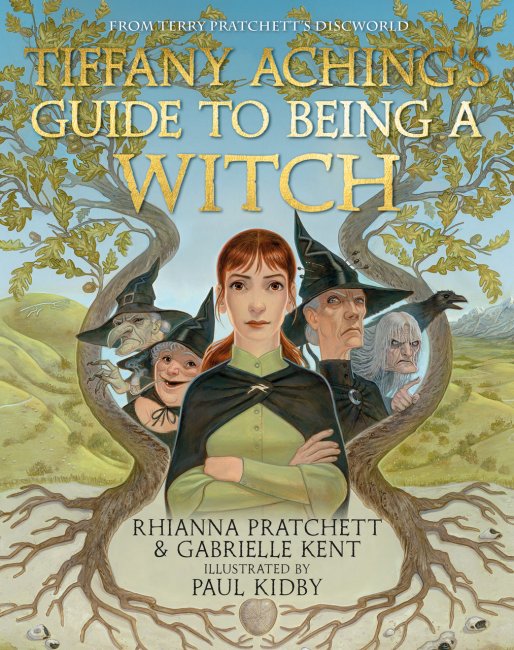
I’m writing this on Friday 10th November having received my copy of this book on the morning of its publication day, yesterday, and spent several happy hours reading it, finishing around 2:30pm yesterday afternoon. I think that tells you how much I enjoyed this first foray into her father’s literary world made by Rhianna and I hope that there will be more to come. When Sir Terry died Rhianna said that she would definitely not be continuing her father’s Discworld novels, and despite initial appearances this book does indeed stick to that line as it is another of the ancillary Discworld books such as Mrs Bradshaw’s Handbook, The World of Poo, the various atlases, or even the assorted diaries, maps, plays and guides all of which were written by people other than Terry Pratchett but based on his works with his approval and undoubted tinkering. Sadly Terry is no longer with us to give his blessings to this book but I’m sure he would have done so as Rhianna has stepped carefully into her father’s legacy with the assistance of Gabrielle Kent, whom I admit not knowing anything about other than she writes the Alfie Bloom series of childrens books, and the wonderful artwork of Paul Kidby who has signed my copy.

Based on the five ‘young adult’ Tiffany Aching books written by Terry , which include his final novel ‘The Shepherd’s Crown’, the book is beautifully designed as a guide to witchcraft by Tiffany but with apparently hand-written notes by other characters from these books such as witches Esme Weatherwax, Nanny Ogg, Miss Tick and the Feegle Rob Anybody along with additional notes from the witch Mrs Letice Earwig inserted so she can complain. Do you need to have read the books before reading this one? Frankly yes. Not only will you understand better what is being covered in the two hundred pages of this work but it basically consists of a huge number of spoilers for the other five books so you definitely don’t want to start here. Below is one of the pages from the main text (carefully chosen so as not to include any spoilers), all of which are full colour and covered in illustrations by Paul Kidby, it really is a pleasure to read the book and admire the artwork.

If you are intrigued by the illustration of the carved chalk figure behind the Feegle it is an accurate depiction of the 180 feet high (55 metres) Cerne Abbas Giant carefully censored by the appearance of the Feegle head to hide his most obvious feature and keep the book child friendly.

The text does contain a lot of original content but also consists of retelling, from Tiffany’s viewpoint, stories from the five Tiffany novels and also other tales from the Witches series of books going all the way back to the third Discworld title, ‘Equal Rites’ in 1987. Equal Rites told the story of Eskarina Smith, the only female wizard, whilst the forty first and final Discworld novel, ‘The Shepherds Crown’ in 2015, in a neat closing of a vast circle includes Geoffrey Swivel the only male witch, both of these characters feature in the new book. The pictures also go back over the decades with old illustrations intermingled with brand new work, some of the older depictions of the characters come from the now difficult to find calendars and diaries so it is good to see them re-used in a book where they can be appreciated by more people, Paul Kidby first started working with Terry back in 1993 doing artwork for the calendars and diaries and various other books but not the novel covers as these were the work of Josh Kirby, sadly Kirby died in 2001 and Kidby took over as the artist of choice by Terry for the novel covers and almost everything else and it is his depictions of the characters and places that are now most familiar to people.

I hope you enjoy the book as much as I did but make sure to read the five Tiffany Aching books first. These are, in order, ‘The Wee Free Men’ (2003) ‘A Hat Full of Sky’ (2004) ‘Wintersmith’ (2006), ‘I Shall Wear Midnight’ (2010) and ‘The Shepherd’s Crown’ (2015). You don’t need to have read any of the earlier Witches series of books before tackling these but they are good so why not? There is a final joke that I almost missed as it is on the back of the dust wrapper. Feegles will steal anything and here they are making off with the barcode block.