A series of essays inspired by books that I own, talking about their history, some reviews and also how they came to be on my shelves. With over 6,500 books here and several more arriving each week I doubt I'll ever be short of a topic.
In December 2019 I reviewed Gabriel García Márquez’s last collection of short stories ‘Strange Pilgrims‘. I love his work so was pleased to see that in March this year, on the 97th anniversary of his birth, his last novel was finally published in English, ten years after his death. According to the preface written by his children Márquez was not happy with what he had written and wanted it destroyed. Instead they simply put the manuscript on one side and almost ten years later read it again and decided that it was probable that the dementia he was suffering from, and which undoubtedly prevented him completing the novel, clouded his judgement as to the quality of the work.
At just 110 pages it is really more of a novella rather than a novel, especially when compared to his other far more weighty works, however I do agree with Rodrigo and Gonzalo that the book is definitely worth publishing even in this unfinished state. Originally planned as a set of five short (roughly 150 pages each) novels all of which would tell the story of Ana Magdalene Bach’s experiences during her annual visit to an unnamed island where her mother is buried. Instead we get six linked short stories all set around the 16th August, the anniversary of her mother’s death, where she travels to the island without her husband or children to tidy up and lay flowers on the grave.
We join Ana, at the start of the book, on her way to the grave having just got off the ferry, and this is clearly not the first time she has made the pilgrimage as she heads straight for a familiar taxi driver who by routine takes her to the flower stall where there is a pre-prepared bouquet of gladioli ready to be collected and then straight on to the cemetery returning later to the somewhat dilapidated hotel where she regularly stays the night before returning to the mainland the next day. But this is not to be the usual routine as she sips her gin in the bar after her evening meal she spots an intriguing stranger and invites him to join her. After a few more drinks she invites him to join her in her room and they make love. The next year on the ferry over to the island she is already looking forward to her night of passion with a stranger and by the time she is again sipping her gin is searching for the man she will choose, for this has already been added to her routine. The six visits detailed in the six chapters are sometimes successful in her hunt and sometimes not but the development of Ana and her relationship with her husband on her return to the mainland are fascinating as she becomes more and more convinced that he also has lovers and despite her own infidelity gets increasingly angry about it each year.
As well as the novella we get a translation of the original editor’s note from the Spanish edition written by Cristóbal Pera who had also edited Márquez’s autobiography. This is fascinating as it goes into the development of the novel, through the five main drafts along with a digital version maintained by his personal secretary Mónica Alonso and gives a glimpse as to how Márquez worked. The final published version is an amalgam of the fifth draft, heavily pen amended by Márquez, and the digital version which retained some of the earlier variants of the text, There are also four pages of the fifth draft manuscript showing hand written alterations both by Márquez and Alonso as she would read the pages to him and he would suggest changes as she read.
I’ll guarantee you won’t expect the highly original ending, I certainly didn’t, yet it perfectly rounded out Ana’s story. A final note of brilliance from the man described as “the greatest Colombian of all time” at the time of his death by the then president of Columbia, Juan Manuel Santos.
Inspired by the eightieth anniversary of the D-Day landings which was marked earlier this month I thought I’d look back on a book covering the start of the war. This is not a review of Modern Battle by Major Paul W Thompson, although it is a surprisingly interesting book which studies actual engagements between German and Allied troops in the early years of World War II so I will talk about it later in this blog. Rather I am looking at the various editions I have of the book and what these tell us about the war. Starting with The Forces Book Club edition published in October 1942, which is the second most difficult of the four versions to find as it as not sold to the public but rather only as packs supplied under subscription to military units, as described below on the inside front cover of this book. This explains why my copy has “C” Mess handwritten on the cover, sadly there is no further indication as to which battalion the mess (a place where military staff would eat and socialise) was associated with. Several of the other books I have from The Forces Book Club are ink stamped with the battalion or ship which had subscribed.
The rear cover gives a list of the first twenty books to make up, what was intended to be a substantial library for isolated units who otherwise would have little to read. The project however was a failure, partly down to the poor information regarding the existence of The Forces Book Club disseminated by the Ministry of Defence and partly due to the overly worthy choice of titles. The mystery and crime editions such as ‘Panic Party’ or ‘The Murders in Praed Street’ would undoubtably have been voraciously read but I can’t imagine Thomas Sharp’s volume on ‘Town Planning’ would have been as popular. Penguin did produce the 120 books needed to fulfil original subscriptions taken out, but in far lower numbers than expected and a lot of the books were subsequently rebound, initially as books to go to prisoner of war camps in Germany and later in the ‘normal’ covers these books would have had for general sale to the public.
The POW versions have the normal front cover but on the inside of this there is a replacement of the description of The Forces Book Club with some information regarding The Prisoner of War Book Service. Again the overall cost is three pounds for 120 books but this time even the more esoteric titles would probably have been read due to serious shortage of other reading material in the camps. All the remaining FBC titles appear to have been rebound as POW editions but they are all incredibly rare, I have a couple that, whilst popular as reading for the forces would definitely not been acceptable to the Germans i.e. ‘The Escaping Club’ and ‘The Tunnellers of Holzminden’ both of which deal with escapes from POW camps in the First World War and would therefore not pass the censors which probably explains why they have survived. I suspect that the company doing the rebinding simply did all the books without consideration as to the material they contained.
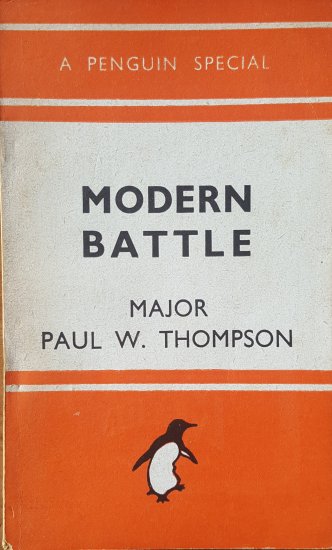
Books that didn’t make it out as FBC or POW editions were potentially rebound again as the main production run, so it is relatively common to find books that inside say they were printed for the Forces Book Club but in the ‘normal’ covers, rather than the one shown at the top of this blog. Speaking of which the first UK edition of the book in the Penguin Special cover from July 1942 can be seen below. All of the editions described so far have identical text inside with a foreword by Tom Wintringham, who had already written a couple of books published by Penguin including ‘English Captain’ and ‘New Ways of War’.
But we now come to a variant text as the book was also printed as a Penguin Special in America in association with The Infantry Journal, a company that already had distribution within the USA military and this has a new introduction by the editors of The Infantry Journal giving some background for their readership. This book was also published in July 1942, so just a few months after the Japanese attack on Pearl Harbour and the direct involvement of USA in the Second World War in December 1941. The original hardback first edition was published by W W Norton’s and Co. of New York earlier during 1941. A brief quote from the introduction to this Penguin American edition.
Modern Battle is based on a variety of source materials mainly from the professional military journals. Some of the accounts come from interviews with actual participants in the engagements described. Much of the background material is German, since the Nazi methods of warfare are those that have been most successful, and those that we need to know best as we work to find methods still better.
The copy I have is the third US edition from November 1942 by which time Paul Thompson had been promoted to Lieutenant Colonel. In the introduction there is an acknowledgement that the numerous included maps are drawn by Captain William H Brown of the US Army, who had also apparently been promoted, as in the July editions he is given as a Warrant Officer for the U.S. Coast Artillery Corps.
Now to the actual book. As alluded to above Thompson had access to German sources, presumably because America was not a combatant in WWII at the time he wrote the book, and these enable him to provide a comprehensive review of the various actions beyond anything available to a UK author. Of particular interest is the account of the aerial attack on Crete in May 1941 which is covered in the final chapter, which has a lot of information from German sources explaining how they went about the invasion which took just eleven days to complete despite the island being around 160 miles long. These alternative sources are evident throughout the book whether it be the German 10th army in Poland or the 1st Panzer division advancing on Aachen in 1940 and it makes the book a fascinating read as I have rarely come across information from outside Allied write ups.
Part biography part travelogue this is an interesting book in that it consists of notes that were taken at various times but which didn’t make it into a book, and Sepúlveda didn’t really know what to do with for a long time.
These notes, which I can’t think what to call, lay about on a shelf somewhere gathering dust. From time to time, looking for old photos or documents, I would come across them, and I confess that I read them with a mixture of tenderness and pride, because in these scribbled, or clumsily typed pages I had made an attempt to come to terms with two themes of capital importance, aptly defined by the Argentinian writer Julio Cortázar: understanding what it means to be human what it means to be an artist.
The book starts with memories of being a boy being taken round town by his grandfather, Sepúlveda was born in 1949 so this would be the mid to late 1950’s in Chile, being loaded up with soft drinks and ice-cream until he was desperate to empty his bladder and then taken to whatever church his grandfather had picked as that weeks target and made to urinate on the church door. This would of course be met with approbation by the priest of the church but his grandfather would defend his right to pee where he needed to and would get satisfaction from the insult to the church thus engendered. Eventually at the age of eleven he simply refused to do his grandfathers bidding and insisted on going to a proper toilet. Expecting to be punished for refusing to so his grandfathers bidding he is relieved, in more ways than one, to simply be taken to a bar and after finishing is given a book to read (one of the classics of social realism – Nikolay Ostrovsky’s How the Steel was Tempered) and made to promise to go on a journey inspired by the book and also to his grandfather’s birthplace of Martos in Spain.
After the comic start it was quite a shock to read the next chapter which deals with his time as a political prisoner in Chile as inspired by Ostrovsky he had joined the Young Communists so under the right wing dictatorship of General Pinochet he was regarded as a dangerous radical. The descriptions of the appalling conditions and the allusions to the electrical torture endured including the doctor who could tell how much electricity had been imposed when the victims were returned to the prison and could therefore judge what treatment each prisoner needed to recover are graphic yet needed to be told and I can see why Sepúlveda couldn’t think of what to do with his notes about these three years of his life.
After this the book becomes more of the travel book implied by it’s title with trips out of Chile and into various other South American countries with greater or lesser success in getting to his aimed for destination and the people he met on the way. Including a trip to Patagonia when he was finally allowed back into his home country after years of exile which was originally intended to have been with the British writer and explorer Bruce Chatwin, who had sadly died young and before Sepúlveda could go to Patagonia. This is one of the times the notes had actually been the basis of a book ‘Patagonia Express’ first published in 1995 in Spanish and then in 2004 in English translation. After reading this book I feel the need to get hold of this work and see what it ultimately became. There is a lot more travel writing beyond this trip in the book and I greatly enjoyed following Sepúlveda around the continent.
The penultimate chapter takes Sepúlveda to Spain and a fulfilment of a promise to his grandfather right at the start to visit Martos where he starts searching for anything his grandfather had told him about the place especially a drinking establishment called Hunter’s Bar. He goes to the pub in the central square to make enquiries but the landlord doesn’t recognise the name however older patrons point out that the bar he is in was known decades ago as Hunter’s Bar so he had inadvertently discovered where he was looking for within minutes of arrival. This then leads to him telling the tales as to why he was there only for the patrons to take him en masse to the local church to consult the priest for birth records. There they find not only his grandfather but also his grandfather’s brother who is still alive in the town. Taken to the man’s house he eventually overcomes his nervousness and we go full circle as he introduces himself to his great uncle, Don Angel.
It’s a good read, difficult at times with the description of his time in prison but uplifting so many times after this dark period and I’m glad I’ve read it. It is another of the short lived Lonely Planet Journeys series which as I’ve explained before I bought a lot of when it was clear the series was being discontinued and am only now sitting down to read.
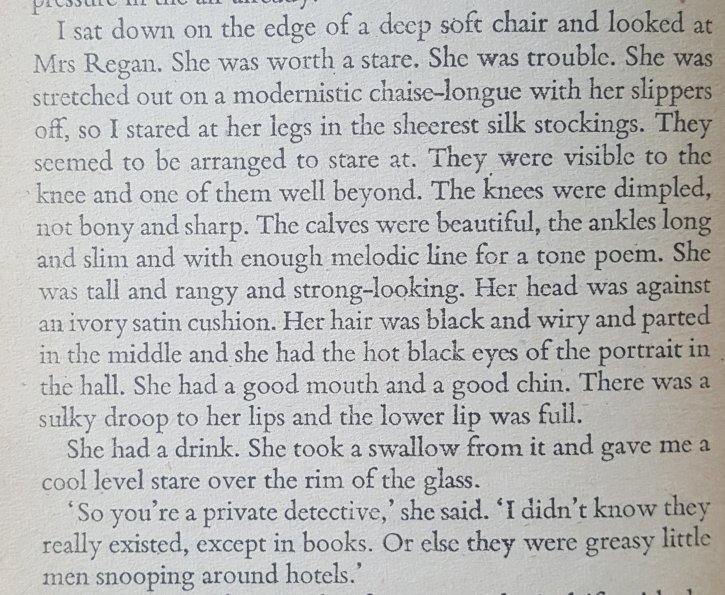
Rightly regarded as one of the finest writers of prose in crime fiction Raymond Chandler was admired by other writers as diverse as W H Auden and Evelyn Waugh. It is his descriptive passages that mark him out and make reading Chandler’s works so much fun even if sometimes his completion of plot lines just isn’t there. In this, his first novel, we never do find out who killed the chauffeur but it doesn’t really matter as the rest of the story is compelling and there are plenty of other crimes that do get fully sorted out. The Big Sleep is a remarkably accomplished work for a first novel, but by the time he wrote it in 1939 he had had short stories published many times over the previous six years, this is also the first appearance of his most famous character Philip Marlowe who appears in the first person so we see everything from his perspective. An example of Chandler’s descriptive writing is shown below, taken from a paperback copy of the novel I also have as I didn’t want to possibly damage the spine of the lovely leather bound edition I was reading.
Chandler was clearly influenced by Dashiell Hammett and his hard-boiled detectives such as Sam Spade in ‘The Maltese Falcon’ . The ‘hard-boiled’ genre is a very specific category of crime fiction featuring a sole detective fighting organised crime, usually in the US prohibition era and whilst this novel isn’t set in prohibition times, definitely not based on the amount of whiskey Marlowe gets through in this book alone, these is definitely organised crime in the shape of casino owner Eddie Mars and his main hit-man Canino. The plot is complex, so I can forgive Chandler not sorting out the chauffeur’s murder, with lots of characters sometimes working together but often double crossing one another. But we start with the elderly General Sternwood, who appears to have only a short time left to live, setting Marlowe on a case to find out about a blackmailer and stop him. Sternwood has two wayward daughters who keep appearing across Marlowe’s tracks in unexpected ways and the final denouement involving the two women was a complete surprise to me. I’m not going to go into any more of the plot which rapidly heads off in all sorts of directions and makes the book one of the most enjoyable I’ve read for a long time as I simply didn’t know what was going to happen next.
In 2005 ‘The Big Sleep’ was included in Time Magazine’s top 100 novels (the list isn’t ranked) and it also came 96th in Le Monde’s 100 books of the century compiled in 1999.
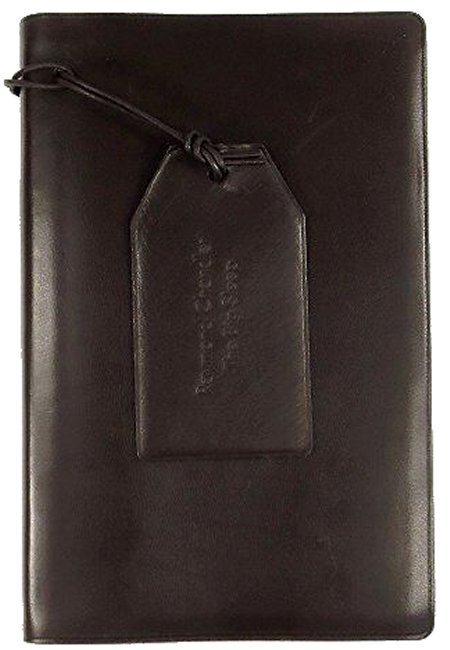
The edition that I read is from a set of six Penguin Classics designed in 2008 by Bill Amberg, the London based leather work studio, each book comes in a sturdy box with a belly band indicating which book is inside. The book itself is fully bound in a soft brown leather with a hole punched right through the cover and all the pages in the top left corner where a leather book mark is attached with the title and author embossed in it. The only thing marking the cover itself is the Penguin Books logo at the base of the spine. It is also incredibly difficult to photograph accurately. The leather cover overlaps the pages by a significant amount making it a yapp binding where over time and repeated reading the leather will fold over to totally encase the book. Each book was published in a limited edition of 1000 and priced at £50 per volume.
The local sixteen year old’s are sitting their English Literature exams this month and the set text play at least some of them are covering is Romeo and Juliet so I thought I would also give it a go although in a somewhat finer edition than they are using. I even found an appropriate quote by Romeo from Act 2, scene 2.
Love goes toward love as schoolboys from their books; But love from love, towards school with heavy looks.
This is going to be a different sort of blog to normal as reviewing Shakespeare feels strange, the Bard rarely puts a foot wrong, it’s quite possible to review a performance but the plays themselves are genuinely some of the finest literature in English. So instead I’m going to treat it a a school exercise and for the first section summarise the play picking up on significant points, before moving on to describe the very special edition I am reading.
Shakespeare sets up the emnity between the two families of Capulet’s and Montague’s right from the first scene where servants from the two houses confront one another in the street, draw weapons and come to blows before being stopped by Benvolio who is part of the Montague family and happens to be passing. However Tybalt (Capulet) then arrives and seeing Benvolio with his sword drawn assumes he is part of the fight and likewise draws his sword to attack Benvolio, various citizens then arrive with clubs and it is only the arrival of Escalus, Prince of Verona, who orders all weapons to be dropped and the fighters disperse that finally brings peace to the streets. So the position of the rival families is well established within the first half dozen pages, a Montague and a Capulet, and even their servants, can barely be allowed in close proximity without trouble starting. Yet by the end of the first act Romeo, son of the head of the Montague family had entered the Capulet household at a masked ball, which means he is initially not recognised, and this leads to the fateful meeting between him and Juliet, daughter of the head of the Capulet family, which will bring such tragedy upon them both.
Act two begins with Romeo deciding to dump his current girlfriend, Rosalind, and giving his friends, Benvolio and Mercutio, the slip to enter the garden of the Capulet home where he spies Juliet high up in the house and this leads to the famous balcony scene, of which more later. During their conversation Juliet agrees to consider marrying Romeo the next day, a headstrong decision partly due to impetuous youth, for she is still two weeks short of her fourteenth birthday and also partly following on from her mothers conversation with her earlier that day encouraging her to look for a husband, although she was thinking of Count Paris, who has already indicated his interest in Juliet to her father. This act concludes with Romeo talking to a friend who is also a friar who agrees to perform a secret ceremony so that they may present their status as a married couple as a fait accompli to the two families and possibly through this heal the rift between them.
Amazingly for a Shakespeare tragedy we are now roughly half way through the text and nobody has died yet, most unusual, but all that is about to change. Everyone knows that “the star-cross’d lovers” (yes this is where that phrase comes from) don’t make it to the end of the play but the body count starts in act three of the five. Romeo and Juliet are now married, but nobody knows yet, and Tybalt is hunting for Romeo to avenge the dishonour of him appearing at the Capulet masked ball. When he finds him in the company of Benvolio and Mercutio he challenges him, but Romeo will not fight a man who has within the hour become his cousin, even if he isn’t aware of the relationship. Mercutio draws on Romeo’s behalf and is mortally wounded by Tybalt who then runs away but soon returns whereupon Romeo kills him in revenge. So before the end of scene one of the third act we have two dead and Romeo exiled from Verona by the Prince for the death of Tybalt. Delaying his exit from Verona Romeo manages to spend the night with Juliet and consummate the marriage but in the morning leaves quickly before her father arrives and tells Juliet that she is to marry Paris in this very week, she refuses but does not dare explain why however her father is insistent and says he will drag her to the church if necessary. The act ends with Juliet going to Friar Laurence to consult him on the way forward.
Act four sees Juliet coming home and as agreed with Friar Laurence submits to her father and declares she will go go through with tomorrow’s marriage, however he has also provided her with a drug that will simulate death for forty two hours which she is to take when she goes to bed. This she duly does and is discovered the next day apparently a corpse which is believed by all. We have amazingly for Shakespeare got through another act without anyone actually dying but that is all going to change in act five, the final part of the play.
Act five is where all the action occurs however it starts in Mantua with Romeo seeing the arrival of his manservant and asking him news of Verona. Balthazar tells Romeo that Juliet is dead and distraught Romeo decides to buy poison so that he can also die. Meanwhile Friar Laurence receives his messenger who should have given Romeo a letter explaining what was really going on but has failed to deliver it. Friar Laurence decides to head for the vault where Juliet is lying to see what is going on. Romeo has meanwhile arrived at the vault and is seen by Paris who has also gone there to lay flowers by Juliet, thinking Romeo means to disturb the corpse he attacks him and is in turn killed by Romeo. Romeo breaks into the vault and takes Paris’s body in there, seeing Juliet apparently lifeless he drinks the poison to join her in death. Friar Laurence then arrives and finds the two men dead but Juliet coming round, she then sees the bodies and before Laurence can take her out of the vault grabs Romeo’s dagger and stabs herself. Making a total of five dead in the play, but no when the lords Montague and Capulet arrive Montague reveals that his wife had died that night of a broken heart due to Romeo’s banishment. Friar Laurence reveals to all that Rome and Juliet were actually married and the two families resolve to end their rivalry in memory of those they have lost. The play ends:
Prince. A glooming peace this morning with it brings. The sun for sorrow will not show his head. Go hence, to have more talk of these sad things; Some shall be pardon’d, and some punished; For never was a story of more woe Than this of Juliet and her Romeo.
Now let’s compare the two copies of the play provided in the box, The smaller version bound in buckram with the paper label is actually a good size (8¾˝ x 5¾˝) hardback edition of the relevant volume of The Oxford Shakespeare series of all the plays bound to complement the much larger Folio edition. This is the copy you turn to if you want the academic learning around the play. It is 450 pages long of which the first 134 pages are the introduction. The play itself is broken up with a huge number of notes explaining the text and reading it feels very much like being at school and analysing a play to within an inch of its life. I studied ‘To Kill a Mockingbird’ like this at school and whilst I’m sure it’s an excellent read I’ve never been able to bring myself to pick up a copy since. See below where you can see that Juliet barely gets going before being interrupted by half a page of double column notes.
In complete contrast the much larger Folio limited edition is in a very clear large font (16-point Baskerville with Caslon display) letterpress printed on over-size pages (14˝ x 10¾˝) on beautiful paper and with a complete absence of notes, which to quote The Folio Society at the time “Allows to text room to breathe”. This makes reading the play much more pleasurable, as not only looking gorgeous the book feels fantastic as well with the fine leather and hand marbled paper binding. Removing all the notes and introduction takes this edition down to 113 pages. Here is the same section in this version, it is of course part of the famous ‘balcony scene’.
I have sixteen of the plays in this format, the tragedies are bound in red, the comedies in green and the history plays are blue. I was tempted to get more but at £295 per play it was turning into a major investment so I just got a selection of my favourite works by Shakespeare. Even so with each box measuring 15˝ x 11˝ x 2¾˝ (38cm x 28cm x 7cm) the sixteen buckram bound boxes take up a lot of shelf space. If you are interested in the production process used to print this book have a look at these Folio Society videos on the production of the Letterpress Shakespeare firstly the printing process itself and this one on how the marbled papers were made.
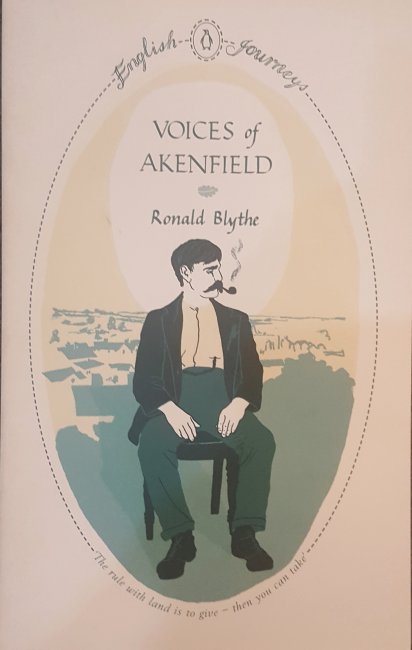
I recently watched the 1974 film Akenfield directed by Peter Hall which is based on Ronald Blythe’s best seller ‘Akenfield, Portrait of an English Village’, a book that has remained in print ever sine it was first published in 1969. The film covers three generations of people from the fictitious village of Akenfield in Suffolk including its most famous bucolic scenes of farming life that has long since disappeared and the horrors of losing so many men to the World Wars. It is particularly unusual in that there are no professional actors and no script just an eighteen page synopsis by Blythe with the people in the film making their own lines up as appropriate for the scene. The film was made at the weekends so as not to impinge on the actual working week of the people taking part and Blythe himself appears in it, playing the part of the vicar of Akenfeld, you can see the trailer here.
I loved the film and was sure that somewhere on the shelves was the book which was memorably reviewed by Jan Morris for the New York Times:
“Ronald Blythe lovingly draws apart the curtains of legend and landscape, revealing the inner, almost clandestine, spirit of the village behind. His book consists of a series of direct-speech monologues, delivered by forty-nine Suffolk residents, and interpretatively linked by the author. The effect is one of astonishing immediacy: it is as if those country people have looked up for a moment from their plow, lawnmower or kitchen sink, and are talking directly (and disturbingly frankly) to the reader. This is a brilliant and extraordinary book which raises disquieting second thoughts when the poetry has faded—as Mr. Blythe says, it is like a ‘strange journey through a familiar land.”
Sadly I couldn’t find it but I did locate the next best thing, a 126 page shortened version of the original 288 page Penguin Modern Classic from the set English Journeys which came out in 2009. This only has twenty one of the original forty nine interviews and the linking passages are largely missing but in the absence of the complete work it is an excellent substitute. The variety of people interviewed by Blythe is a cross-section of village life from a thatcher, blacksmiths and a wheelwright, a nurse, a couple of orchard workers and even one of the gardeners from the big house who describes the problems of working for the old couple that owned it and the professional pride that he got from a job well done. In fact there was a lot of pride in what people were doing right up until the younger generation and a tractor driver who no longer cared about straight furrows just how much land he could cover in a day, in total contrast to the horse ploughman who wanted everything just so.
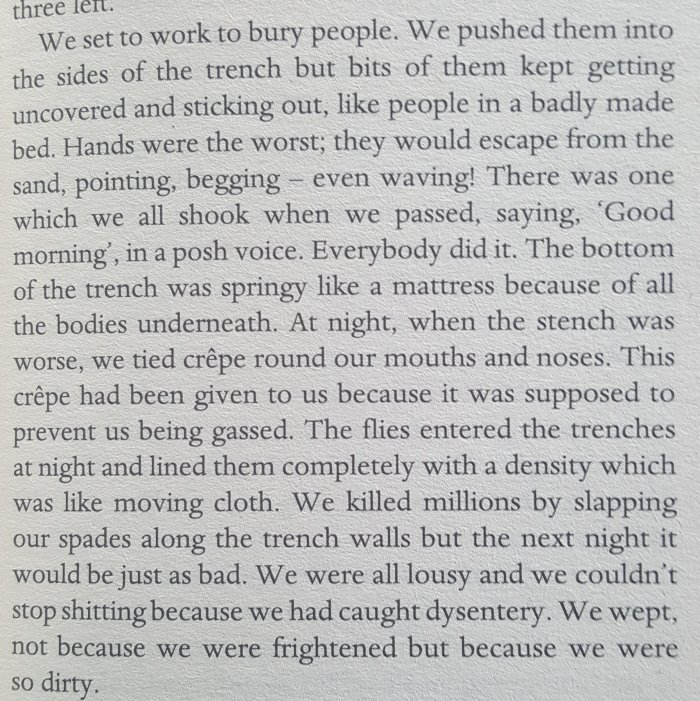
The saddest, and most difficult to read, interview was the first one in the book, Leonard Thompson age seventy one and listed as a farm worker but most of his narrative covers being called up in the First World War and having to go to The Dardanelles to fight the Turks before ending up on the Somme in the thick of the fighting. He describes first arriving in Turkey and asking about friends from the village who had gone before only to be told that they had all died in combat and then moving on to a trench which was full of corpses and stinking from the decomposition.
One of the more interesting interviews was with a saddler who admits “Our harness lasted forever, as you might say. It was our downfall, wasn’t it! We made these things so well that after a while they did us out of a living.” But even the wheelwright says that there were wagons around the village that were over a century old they were made that well that they never needed replacing. So different from modern products which have built in obsolescence, it was only the coming of tractors that would gradually drive those fine wooden wagons off the farm and into the history books. The retired district nurse describes arriving in Akenfield in 1925 and being the first medical professional that would actually turn out at a house as the local doctors weren’t interested in house calls, you had to go to them and be ready to pay or they wouldn’t see you at all. She saw it all from births to sitting up by a death bed as the person in it took their final breaths and had to work hard to gain the confidence of the people. She eventually covered nine villages and because of this was one of the few people with a car so she could get round but she was very struck by the poverty of the general population with large families in tiny properties so there would be five or six children sharing one bedroom with the latest baby in the other room with the parents.
The final person is appropriately William Russ, aged sixty one and the gravedigger. He started digging graves when he was just twelve years old, “People would look down into the hole and see a child”. One of the problems with his job was one I had never thought about and that was the high water table in Suffolk which meant that the graves would start filling up with water almost as soon a they were dug and coffins had to be held down with poles to stop them floating away until enough heavy soil was on top of them to force them down to the bottom of the grave.
All in all it’s a fascinating document of social history and I just need to keep hunting the shelves to find the full work although I have a feeling that I lent it to someone and never got it back. But I recommend either edition of Akenfield, or even the film, if you want a glimpse of a rural life that wasn’t that long ago but has now completely vanished.
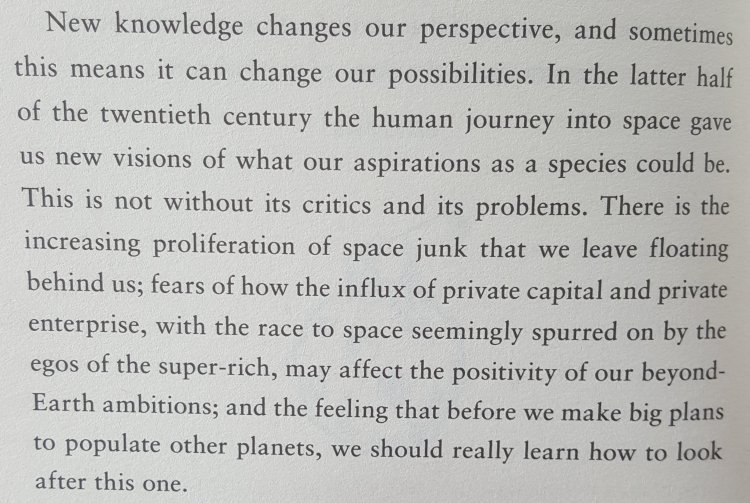
A book about science written by a non scientist, but somebody who has proved over many years his determination to try to get his head round complex scientific concepts after being completely turned off science at school. This is the second book by Robin Ince I have reviewed, the first being a joint venture with his friend Professor Brian Cox ‘How to Build a Universe‘ which I covered almost a year ago now and which promised a review of this book as I already owned it “in a couple of months or so”. Oh well it sadly got buried in the To Be Read pile but has now resurfaced and I’m so glad it has as it was a joy to read. Unlike the first book which appears to be mainly written by Brian Cox with interjections from Ince this, far longer, book at 390 pages excluding Cox’s introduction, is entirely the work of Robin Ince and as he explains at the start it was largely written during the first covid lock down in the UK in 2020. The book is based around over a hundred interviews he conducted during lock down with scientists in many fields who like him were pretty bored being stuck at home so were quite happy to talk about their various specialisms. His contacts with them grew out of not only The Infinite Monkey Cage radio show he does with Brian Cox (see review on How to Build a Universe) but also ‘The Cosmic Shambles Network‘ a largely science based website co-founded by Ince and Trent Burton which helped me through lock down with Ince’s regular videos from his book filled attic study providing much needed mental stimulation.
The book has twelve chapters all of which have an individual theme, although like his radio show with Brian Cox staying entirely on topic is not something that really happens. There is also an afterword as Ince didn’t want to finish with a chapter on the heat death of the universe, although quite appropriate for a finale it is rather depressing Having recently lost my father, something that has also recently happened to Ince, the chapter on death was probably the most difficult to read although ultimately as it provided food for thought it was also somewhat uplifting. Scientifically the most difficult and yet also possibly the most interesting, at least for me, was the chapter on the brain. My background is physics not neuroscience so this was well off my topic knowledge. But the important thing is that at all times I was interested in what Ince had to say, there isn’t a single formula in the book but that is sort of the point, you don’t have to be able to understand the formulas to get a reasonable overview of the topic being covered and its importance in a general understanding of ideas in physics, biology, cosmology, chemistry, neuroscience or whatever and it is all beautifully written.
What Ince also provides, although indirectly, is a reading list of works that will take you further or just sound interesting. For example I’ve never read anything by Bertrand Russell but now need to get hold of a copy of ‘Sceptical Essays’ as featured in the first chapter which covers doubt and uncertainty and also the spread of conspiracy theories. I have read works by physicist Carlo Rovelli but not ‘The Order of Time’ so that also makes it to the list. At the other end of the scale when Ince asked physicist Jon Butterworth about time he responded by quoting an author whose work I do own but have not yet read i.e. The Venerable Bede, an English monk who lived around 1300 years ago and wrote ‘The Ecclesiastical History of the English People’. After saying a couple of months and then taking eleven months to get round to reading this book I’m making no promises regarding Bede, whose great work has been sitting on my shelves for something like twenty years but I do keep spotting it and thinking I must get round to reading that sometime.
Ince has had plenty of interactions with astronauts both in the infinite Monkey Cage and Cosmic Shambles so the chapter on space exploration is packed with interesting anecdotes from people who have actually been into space including Helen Sharman, Chris Hadfield and one of the few Apollo astronauts still alive Rusty Schweickart, who flew on Apollo 9 in 1969. Ince has always been interested in space and as he says in this book he had always wanted to be an astronaut but as he says “The only things in the way of pursuing such an ambition have been an uneven temperament, a fear of small spaces, a fear of heights, a lack of dexterity, my total lack of any necessary qualifications, frequent fits of existential anxiety, general non specific anxiety and a deep existential worry about ever being too far from an effective flushing toilet.”
As a professional stand up comedian Robin Ince has had years of experience in organising his thoughts to communicate an idea although he self-deferentially claims several times in the book that his performance style is more a stream of consciousness rather than a well planned set piece. Read this book and discover the importance of being interested in just about everything, it’s good for the brain.
This volume consists of two of Plato’s dialogues, or reported conversations, featuring one of the leading sophists Protagoras and Meno, who was primarily a military leader although had also studied under several Sophists. The Sophists were a loose group of teachers on a wide range of moralistic as well as some practical subjects during the fifth century BC, teaching such things as philosophy, rhetoric and virtue along with mathematics and music. It is the teaching of virtue and whether this is even possible to be taught that most concerns these two dialogues and why they are commonly found together. Indeed Meno cuts straight to the question in the opening line of that dialogue.
Can you tell me Socrates – is virtue something that can be taught? Or does it come by practice? Or is it neither teaching nor practice that gives it to a man but natural aptitude or something else?
As can be seen from the above questions the other main character is Plato’s favourite subject, Socrates. In Protagoras the dialogue is reported by Socrates, whilst in Meno we are more directly involved as it is more like being there and listening in on the conversation. This is the second volume of Plato’s dialogues I have reviewed on this blog beginning about a year and a half ago with the most famous example The Symposium which also features Socrates. Socrates himself didn’t produce any writings so most of what we know of his teachings comes from two of his pupils, Plato and Xenophon, and it is believed that Plato didn’t start his works until after the death of Socrates even though they are all written as though contemporaneous with events although no dates are mentioned.
Protagoras
This meeting between Protagoras and Socrates covered by this piece can be fairly accurately dated to around 433 to 430BC when Protagoras would have been in his late fifties and very much the grand old statesman of the Sophists, highly respected and wealthy from his many years of speaking and lecturing whilst travelling round Greece. Socrates at this time would have been in his late thirties, The dating can be reasonably precise because Paralus and Xanthippus, the sons of Pericles are listed as present and they died of the plague in 429BC and Agathon (born around 448BC) is described as a youth. Whatever the precise date, it is before the birth of Plato (between 428 and 423BC)
The dialogue starts with Socrates visiting a friend and telling the story of the previous day when Hippocrates had called on him early in the morning very excited because he had found out that Protagoras was in Athens and demanding to go with him to hear him speak. Socrates, as ever, is doubtful of the wisdom of this and anyway it is far too early to go to the house where he knows Protagoras is staying. Instead he questions Hippocrates as to what he hopes to learn from the visit and discovers that he has no clear idea as to what would be gained, nevertheless he agrees to go. On seeing Protagoras with numerous people following him around the courtyard listening to his every word Socrates introduced himself and Hippocrates and asks Protagoras what Hippocrates could expect to learn if he became his pupil. At this Protagoras launches into a long speech broadly covering what he teaches, which is basically how to be a good and virtuous citizen. This speech is probably adapted by Plato from one of Protagoras’ books, now sadly lost apart from this fragment. Socrates then attempts to get Protagoras to define virtue, stating that he at least does not know what it is, this is typical Socrates where the admission of complete ignorance of a subject is key to the development of some sort of understanding through discussion.
Unfortunately this is where the dialogue largely runs out of steam as Socrates makes several attempts to get Protagoras to agree with a particular definition and when he cannot get him to the point he is aiming for drops that argument and picks up a different line of questioning. This makes for quite a ragged text which at times is difficult to follow as the reader cannot easily see what point Socrates is trying to make when he changes tack comparing one aspect of virtue with another such as wisdom and temperance or after that justice and temperance. The main sticking points between the two men seems to be the virtues of knowledge and courage. At the start of the dialogue Protagoras states that virtue can be taught and Socrates says it cannot at the end Socrates has come round to the idea that virtue is defined by knowledge, as after all it is in knowing the difference between good and bad that the virtuous can be determined and knowledge can definitely be taught. Protagoras however is unconvinced by this so the men seem to have swapped position during the discourse.
Meno
This occurs several decades after Protagoras in around 402BC. Again the people present allow for a pretty accurate date, Anytus is there and is described as having an important state position so it must be after 403BC and the restitution of the democracy, whilst Meno went to war in 401BC and never returned. Socrates is therefore in his late sixties and this time he is the respected thinker being consulted.
This is a much more satisfying dialogue as it is largely a discussion between the two men Socrates and Meno with Anytus only appearing near the end. Again the subject is the teaching of virtue and again Socrates starts by saying that unless virtue can be precisely defined then it cannot be taught whilst declaring himself ignorant as to what virtue may be. There is also an interesting discussion as to whether teaching is what it appears to be or rather it is the pupil being assisted to remember things that they were not aware that they already knew. This follows the concept that the soul is immortal and whilst between bodies it can explore and discover all things so it is merely a case of helping the soul within the body recover memories. This Socrates attempts to demonstrate using a slave of Meno’s who has had no mathematical training but who is brought to understand what happens to the length of each side of a square when doubling its area. Initially the slave says the side must also double but then realises that is a mistake. I think the argument that Socrates is not teaching as we understand the term during this exercise is highly debatable but Meno and by association Plato seem to agree with Socrates that the slave is simply being helped to remember.
The argument that virtue is knowledge is again raised and this time Socrates is not so sure although he goes back over some of the points in the previous dialogue. At this point Socrates and Meno are joined by the general Anytus and when he is asked his opinion of Sophists as teachers of virtue he professes considerable animosity towards the whole movement and the stupidity of the various people who had enriched Protagoras during his lifetime. During the brief time that he is with them Anytus gets angrier with Socrates in his apparent defence of the Sophists and perceived denigration of leading Athenians whom they agree were highly virtuous but which had according to Socrates distinctly opposite sons. Anytus would be one of the accusers of Socrates in the famous trial a few years later which led to his death by poison.
Ultimately Meno and Socrates agree that knowledge is not enough to be virtue and that virtue cannot be taught but is instead received via divine intervention and they separate with Socrates urging Meno to find Anytus and calm him down.
W K C Guthrie who translated the book was Laurence Professor of Ancient Philosophy at the University of Cambridge from 1952 to 1973 and master of Downing College, Cambridge from 1957 to 1972. He is best known for his six volume ‘History of Greek Philosophy’ the first volume of which was published in 1962. This Penguin Classics translation was first published in 1956.
A 100-page manuscript by Mr. Lipsky was the basis of the 1947 film “Kiss of Death,” starring Richard Widmark, and the full novel was published by Penguin that same year.
New York Times obituary – Eleazar Lipsky – February 15, 1993
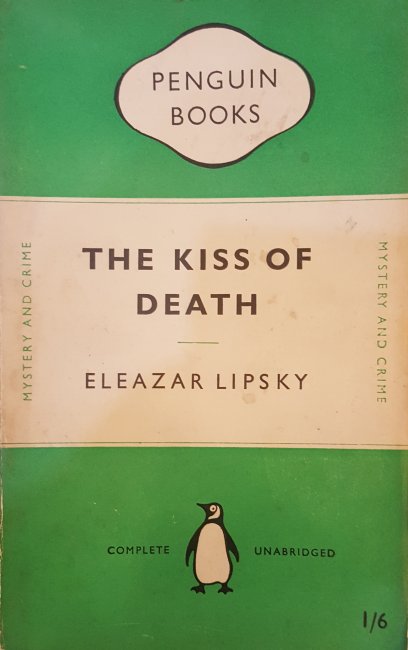
This is that first edition, published by the USA division of Penguin in August 1947, I also have the first UK Penguin edition, with a significantly less garish cover, from December 1949. see image at the end of this blog. Lipsky was by trade a lawyer and served as an assistant district attorney for Manhattan in the 1940’s, he later had a law practice in Manhattan and amongst other jobs served as legal counsel to the Mystery Writers of America. He was still practising law up to three weeks before his death at the age of eighty one from leukaemia. This solid background in law shows itself in his writing and you can be certain that the trial scenes and interactions with the Manhattan assistant district attorney in the book are procedurally accurate.
It’s an unusual crime novel as it is less concerned with the crime undertaken by Vanni Bianco and his mob then the repercussions of the act. Vanni is quickly captured and in the lead up to his trial D’Angelo, the assistant D.A. tries to persuade him to turn in the other members of his gang to avoid the mandatory thirty year jail sentence he faces for a fourth offence and this time involving a gun although it wasn’t fired during the robbery. Bianco refuses due to a code of honour and determines to do his time leaving his wife and children to be looked after by his gang. This however they fail to do and four years into his sentence word reached Bianco that his wife has died of tuberculosis brought on by cash shortages so she was looking after their daughters as well as she could to the detriment of her own health. The children were admitted into a home. This terrible situation strikes home at Bianco who determines to testify against his fellow criminals in an act of recrimination.
This is where the story totally changes tack as we follow Bianco into a new ‘career’ of stool pigeon being placed in prison cells with criminals where the D.A.’s office had insufficient evidence to see if he could get them to talk to him, an extremely dangerous role which could easily have got Bianco killed if he was suspected. It’s a very interesting aspect to the way of working of the District Attorney’s office and presumably is based on real life examples that Lipsky had during his professional career. I don’t remember reading a book dealing so specifically with the way the District Attorney would handle an informant of the type of Vanni Bianco. However I certainly didn’t see the final twist in the plot coming and it transforms the whole story in a completely believable but totally unexpected way.
As for the film mentioned in the obituary, it doesn’t really star Richard Widmark as claimed, as it was actually his debut. The film actually stars Victor Mature as Bianco and Brian Donlevy as D’Angelo with Widmark playing one of the criminals D’Angelo hopes Bianco will manage to get some more information on. I tried watching some of the movie and frankly wasn’t particularly impressed, unlike the book which was fast moving and a delight to read. It is nowadays sadly out of print but is pretty easy to track down on the second-hand market in either the USA or UK Penguin editions.
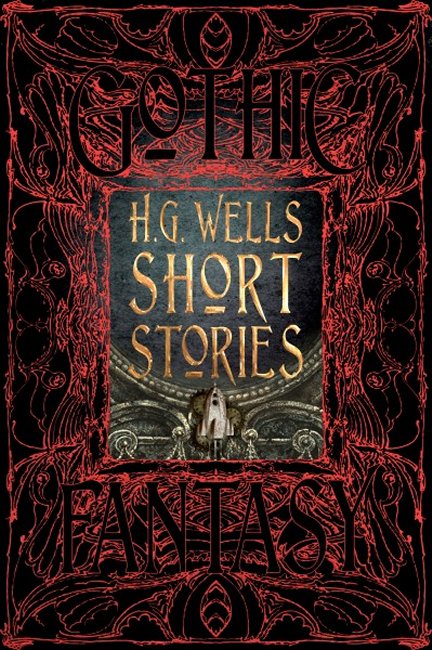
At 474 pages this is an excellent selection of the short stories and three of the short novels from the pen of H G Wells, a man most people think of as a Victorian science fiction writer but who was much more than that not only in output but also his timeline as he survived until after WWII, dying in 1946 at the age of seventy nine. So why is Wells so popularly thought of as being earlier than he truly was, well his best known works were certainly written during the Victorian era, such as ‘The Time Machine’ (1895), ‘The Island of Doctor Moreau’ (1896), ‘The Invisible Man’ (1897), and ‘The War of the Worlds’ (1898) however at the turn of the century he largely moved away from science fiction towards more contemporary novels such as ‘Kipps’ and ‘Tono-Bungay’ and later almost abandoned fiction altogether and produced his ‘A Short History of the World’ which attempted to summarise all of history into a single volume, I also have the earlier ‘The Outline of History’ in two illustrated volumes and the odd ‘Crux Ansata’ from 1943 which is basically a polemic against the Catholic Church.
This book was published by Flame Tree Publishing in 2017 and was the first of their Gothic and Fantasy series of books to be dedicated to just one author, closely followed by H P Lovecraft. Along with what would normally be regarded as short stories the collection includes three short novels, or novellas, ‘The Invisible Man’, ‘The Time Machine’ and ‘The Story of the Days to Come’. I have previously reviewed The Invisible Man as part of the August 2018 review of the first set of ten Penguin crime novels, and it was the inclusion of The Time Machine that prompted me to pick up this collection after last weeks ‘The H-Bomb Girl’ including as that does a time travelling character called Miss Wells which is clearly a reference to H G Wells. Along with these three novellas are thirty three short stories which vary from a simple crime caper ‘The Hammerpond Park Burglary’ through murder ‘The Cone’ amongst others and but the majority fall into the loose category of intriguing fantasy but I wouldn’t describe many of them as Gothic in the way that Lovecraft is definitely Gothic Fantasy, the one significant exception is ‘The Red Room’ which reads like a ghost story with a great twist at the end. I also have The Folio Society collection published in 1990 and which is based on the selection published by J.M. Dent and Sons in 1927 although that only has twenty two stories But even that shorter collection has seven stories not included in the Flame Tree edition and that still leaves over fifty short stories that I don’t have. as Wikipedia lists 94 short stories and the same number of novels or novellas.
That Wells was a prolific author is not in doubt and the quality of his writing can also not be underestimated, he was nominated for the Nobel Prize in Literature four times although never won it, frankly I suspect the judges regarded him as insufficiently high brow to be properly considered. But he was undoubtedly a popular writer from his earliest works and still sells well. I’ve really enjoyed reading some of the stories that I didn’t know and revisiting the ones I read many years ago. If you haven’t read Wells’ short stories then I heartily recommend them, no matter which collection, and there are many, that you manage to pick up.