The Frogs – Aristophanes

20181106 The Frogs

For November I’ve decided to read a selection of plays and the first one is The Frogs by Aristophanes. Normally I’m not a great fan of Ancient Greek dramas as you need a lot of knowledge of the gods and other characters involved but this translation is so readable I found myself laughing along as I read it. It was written in 405 BC and can be dated so precisely because it was created for drama competition as part of a festival honouring the god Dionysus in Athens where it took first place. Dionysus is one of the Greek gods with lots of jobs, according to the Wikipedia entry he is the god of the grape-harvest, wine making and wine, fertility, ritual madness, religious ecstasy, and theatre and it is in the latter one of these roles that a drama competition in his name becomes obvious.

The play tells the story of Dionysus deciding to travel to the underworld to bring back the playwright Euripedes who had died the previous year in order to rescue the arts in Athens back from the doldrums that he perceives it to be in. The first act sees Dionysus and his slave Xanthias on their journey, initially they visit Dionysus’s half brother Heracles for advice which causes him to collapse with laughter as Dionysus has decided to dress like Heracles with the lion head cloak and club but he really doesn’t have the build to carry off the look. Eventually they persuade Heracles to explain the route he used when he went to get the three headed dog Cerebus and they duly set off. When they meet Charon, the ferryman of the dead he agrees to take Dionysus and this is when he encounters the frog chorus who sing during the crossing. Despite the play being called The Frogs this is the only time they appear in it. After various encounters with people who think Dionysus is Heracles and either hate him for taking Cerebus or love him for it they finally reach the home of Pluto ruler of the Hades.

Act two takes place entirely at the Pluto’s house where they find Euripedes and also another dramatist Aeschylus who had died about 50 years earlier. These two had been arguing for the last year about which was the better writer and should therefore sit with Pluto for meals. Dionysus takes it onto himself to judge a contest between them and they take it in turns to be rude about the others works with the chorus commenting as though it was a fight with each man landing viscous blows on the other. This gives Aristophenes a chance to parody each of the two dramatists styles and throw in his own critical comments on both of them. Eventually Pluto gets fed up and decides to determine the winner via a special set of scales which can measure the weight of an argument. Each man gets to speak one line into the baskets on the scale and they are marked against one another with the scale, to Euripedes’s annoyance Aeschylus wins both attempts by mentioning heavier objects. In the end Dionysus decides to simply ask the two dramatists for advice to save Athens, Euripedes has lots of fine words but Aeschylus has more practical suggestions so instead of having Euripedes brought back to life he decides on Aeschylus. A final parting shot from Aeschylus is to insist that Sophocles should have the seat as the finest dramatist rather than Euripedes.

Translations of ancient Greek and Latin have become far ‘less stuffy’ over the last few decades and this can largely be thanks to Penguin Books who started their series of Penguin Classics in 1946 with the express intent of making the classics more approachable. Compare this extract from the Harvard Classics edition of 1909 which is available on Project Gutenberg, which deals with the god Dionysus rowing across the Styx with Charon and encountering the Frog chorus.  The specific translator is not given for this edition on the site as this was a massive group exercise resulting in 51 volumes of a wide selection of classic works.

FROG CHORUS
   Brekekekex, ko-ax, ko-ax!
   Brekekekex, ko-ax, ko-ax!
   We children of the fountain and the lake
   Let us wake
   Our full choir-shout, as the flutes are ringing out,
   Our symphony of clear-voiced song.
   The song we used to love in the Marshland up above,
   In praise of Dionysus to produce,
   Of Nysaean Dionysus, son of Zeus,
   When the revel-tipsy throng, all crapulous and gay,
   To our precinct reeled along on the holy
   Pitcher day.
   Brekekekex, ko-ax, ko-ax.

 DIONYSUS. O, dear! O dear! now I declare I've got a bump upon my rump.

The same passage from the 1964 translation by David Barrett printed by Penguin and reprinted in the edition I have been reading.

FROGS
   Brekeke-kex, ko-ax, ko-ax,
   Ko-ax, ko-ax, ko-ax!
   Oh we are the musical Frogs!
   We live in the marshes and bogs!
   Sweet, sweet is the hymn,
   That we sing as we swim,
   And our voices are known.
   For their beautiful tone,
   when on festival days
   We sing to the praise
   Of the genial god -
   And we don't think it odd
   When the worshipping throng,
   To the sound of our song,
   Rolls home through the marshes and bogs.
   Brekekex!
   Rolls home through the marshes and bogs.

 DIONYSUS. I don't want to row any more.

 FROGS. Brekekex!

 DIONYSUS. For my bottom is getting so sore.

As you can see the Penguin edition is considerable more ‘lively’ and the translator has almost turned to the poetic structure of the limerick in order to emphasise the comic nature of the play. This is a form that he will return to several times during the translation in some places using the limerick itself. The play is only 110 short pages so I read it in two sittings, the edition is from the Little Black Classics series by Penguin and is one of the most expensive of these books at £2. I’m looking forward to reading more from this series of titles in the coming months.

 

Under Milk Wood – Dylan Thomas

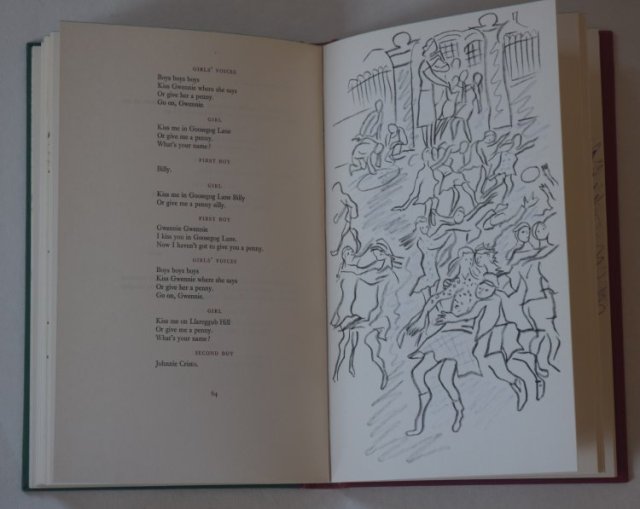
20180515 Milkwood 1

Yesterday was International Dylan Thomas day and marked the anniversary of the first ever performance of the great Welsh poet’s final work; Under Milk Wood. This show on 14th May 1953 was also the only time Thomas was recorded on stage giving any sort of performance of the work and sadly he was to die before the classic BBC recording starring Richard Burton was broadcast on the 25th January 1954. I have the vinyl recording of that original performance and it is playing now as I type this with Thomas’s distinctive voice taking four parts, that of 1st voice, Reverend Eli Jenkins, 2nd drowned and 5th drowned. The rest of the cast are Dion Allen, Allen F Collins, Roy Poole, Sada Thompson and Nancy Wickwire and between them they play the remaining 50 parts.

The recording was more accidental than intentional, there was a recording scheduled for 1954 with Caedmon but Thomas’s death prevented that happening. However somebody left a tape recorder at the front of the stage with the microphone probably nearer to Thomas than the other cast members mainly for their own use to record the first performance. As a single microphone on a device intended for amateur recordings it does remarkably well in picking up not only all the actors but also the audience and has left us with  a remarkable historical record. Caedmon therefore used this for their release of Under Milk Wood. The New York audience clearly didn’t know what to expect from this Welsh poet and you can hear them gradually realise that it is intentionally funny and the way the actors bounce partial sentences between themselves gives a delightful rhythm to the blank verse.

Under Milkwood is subtitled ‘A Play for Voices’ which sounds an odd description until you realise that it was intended to be a radio play for the BBC so there are no stage directions, it was always intended to be read by the cast not acted.

20180515 Milkwood 2

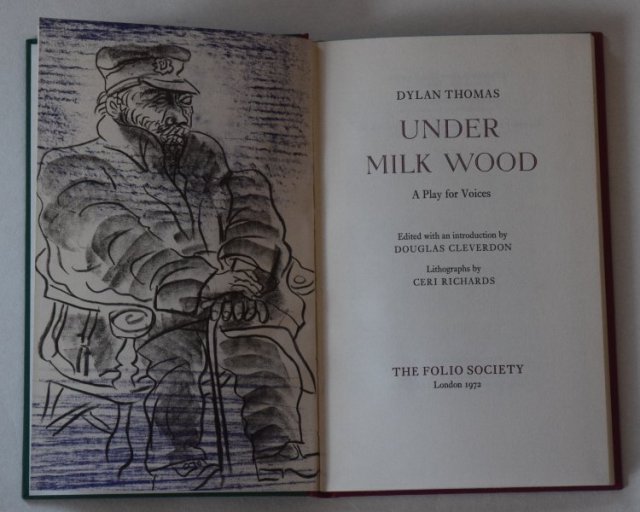
My printed copy is the 1972 Folio Society first edition of the work and, as usual for Folio, it is a lovely edition. It restores the text back to the original broadcast script with some extra lines which he left out originally, probably due to running time, added as an appendix. Although Thomas did deliver the script to the BBC he was still fiddling with it up to his death as he gave various readings in an attempt to earn enough money to pay off his debts, specifically a large back payment owed for income tax. So the typescripts are full of corrections and amendments and he never did come to what he regarded as a satisfactory conclusion to the piece, which had always been rushed as he only finished the ending included on the album minutes before they started the performance and kept changing this at subsequent performances.  As Douglas Cleverdon (the BBC producer of the 1954 broadcast version) notes in his introduction to the Folio edition.

Two stage readings of Under Milk Wood were scheduled for 24 and 25 October at the Kaufmann Auditorium, New York. Under a mixture of alcohol, sleeping pills and cortisone drugs, Dylan was already in a near state of collapse. He managed to write another page for the closing sequence of the script; to take part on the two readings, and to edit a shortened version for publication in the American magazine Mademoiselle. On 5 November he was taken to hospital in a coma, and died four days later.

If he had survived the play would undoubtedly have been further amended, on the back of one page of the manuscript is a section entitled “More Stuff for Actors to Say” and there are parts of the Caedmon recording that were subsequently removed so it was definitely still a work in progress at least as far as Thomas was concerned even after he had submitted the ‘final version’ to the BBC.

20180515 Milkwood 3

One final thing that should be mentioned is the setting of the play in a small Welsh village of Llareggub. This has the advantage of looking like a Welsh place name without being one, you don’t get a double g in Welsh. However anyone looking closely at the name and especially if you spell it backwards will see that here is another joke by Dylan Thomas. For this reason early editions of the script spell the village differently and even the Caedmon recording uses Lareggub when referring to the place in the notes. The fantasy author Terry Pratchett paid homage to Dylan Thomas when he named the equivalent of Wales on the Discworld Llamedos.

You can hear the first part of the performance I’m listening to on youtube here  It starts with Thomas as First Voice setting the scene.

First Folio: 2

Yesterday, 23rd April 2018, was the 402nd anniversary of the death of William Shakespeare and whilst we don’t have his date of birth, he was baptised 454 years ago on 26th April 1564 so this is a good week to look at his works. Monday was also the UNESCO recognised International World Book Day, as not only did Shakespeare die on the 23rd April 1616 but that is also the date that the great Spanish author Cervantes died and that is why the 23rd April (also St. George’s day) was chosen. Although they died on the same date, they didn’t die on the same day, Cervantes was 10 days earlier. Catholic Spain had already adopted the Gregorian calendar by then, however protestant England was still using the Julian calendar so there was a 10 day difference in dates between the two countries.

It may come as a surprise to most people but there isn’t a definitive version of most, if not all, of Shakespeare’s plays. The plays were documents under constant review as performances took place during his lifetime and numerous copies have survived until today. This means that modern performances can pick and choose sections from versions of the play being produced to create a suitable text for their needs. Also several of the plays are very long so now it is rare to see them performed complete, especially with falling audience attention spans. Some of the plays were published whilst Shakespeare was alive, but that was not through his doing and these are quite often inaccurate as either they were taken from actors notes or in extreme cases written down from memory by somebody in the audience. This means that we could easily have ended up with no accurate record of Shakespeare’s works at all if it wasn’t for two members of his main group of players John Heminges and Henry Condell.

The Lord Chamberlain’s Men later renamed The King’s Men in 1603 after James I came to the throne, were Shakespeare’s main troupe although other groups of actors are known to have performed his works. However these men worked most closely with Shakespeare and he was also an actor in the group so they knew his works intimately. Heminges and Condell along with Shakespeare are three of the nine men included in the Royal Patent that formally named the players The King’s Men so were significant individuals and good sources for the plays. The book is called the First Folio because it was the first edition of any of the plays to be printed folio sized, i.e. much larger than the quarto editions of individual plays that had appeared up until then and as said above were notoriously unreliable. A good example of this between a ‘bad quarto’ one probably written down by an audience member; a ‘good quarto’ one taken from actors notes or performance copies; and the First Folio can be seen here.

There are a total of 36 plays included in the First Folio out of the 38 existing works nowadays accepted as being by Shakespeare, ‘Pericles, Prince of Tyre’ and ‘The Two Noble Kinsmen’ are missing from the book. Both of these are regarded ny modern scholarship as collaborations rather than entirely by Shakespeare which may explain their absence. Eighteen plays had been published before the First Folio, however a few of these are notoriously unreliable so this was effectively the first appearance in print of over half of Shakespeare’s works and this was 7 years after his death. His modern reputation almost entirely relies on this single publication which perpetuates his work in a way he would never have expected especially due to his own reluctance to publish and therefore make his work available to other companies.

20180424 First Folio 1

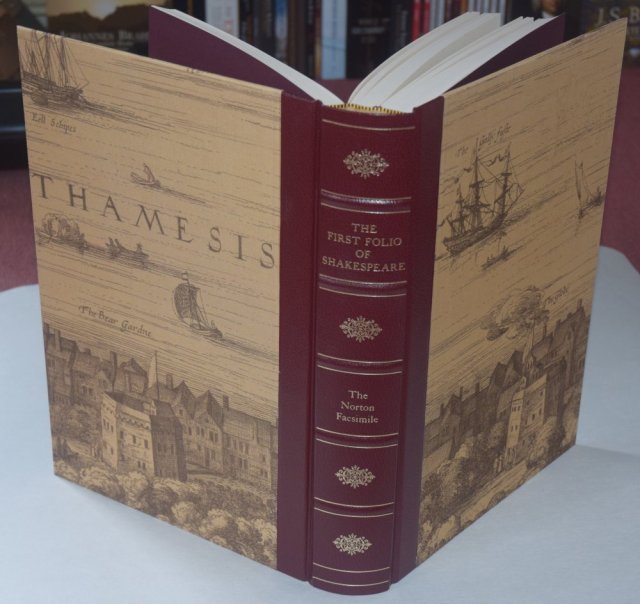
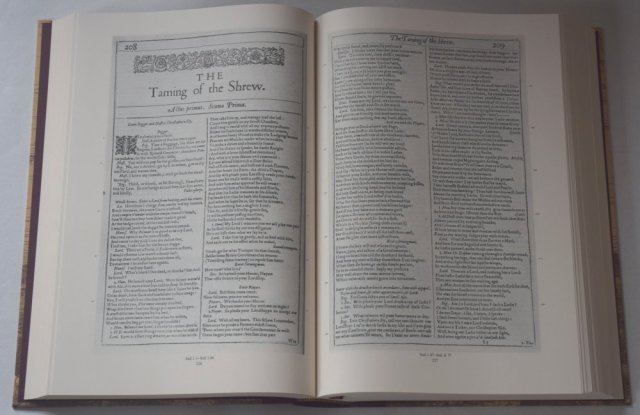
An original copy is worth a small fortune, one sold 12 years ago for £2.8 million and it must be worth considerably more now, so I clearly don’t own one of those. But mine is a lovely copy, quarter bound in leather, of the second edition of the Norton Facsimile. This volume was created with the assistance of the astonishing Folger Shakespeare Library in Washington D.C. which holds 82 out of the known 235 copies of the First Folio. Each page was selected as the best example (or sometimes the least worst) from their enormous collection. One of the major problems is the amount of show through the pages where you can read the type on the other side of the page through the side you are looking at and this made photographing the works for this edition especially difficult. Also it was decided that where possible the most correct version of the text was used as it was known that the original book was corrected during printing back in 1623 so copies vary as they were produced.

20180424 First Folio 2

As such the reproduction is remarkably legible and easy to read and makes for interesting contrasts with my other versions of Shakespeare’s texts, two complete sets and three partial sets where the plays are in individual volumes. Some of these will be covered in later blogs especially the amazing Folio Society Letterpress Edition, probably the finest edition of Shakespeare ever printed, and certainly one of the most expensive at £295 per play. The introduction to the second edition is surprisingly dismissive of the scholarship that led to the first edition pointing out several errors. It is interesting to note that a third edition is in progress and it is hoped that the editor of that work will be kinder to their predecessors.

20180424 First Folio 3

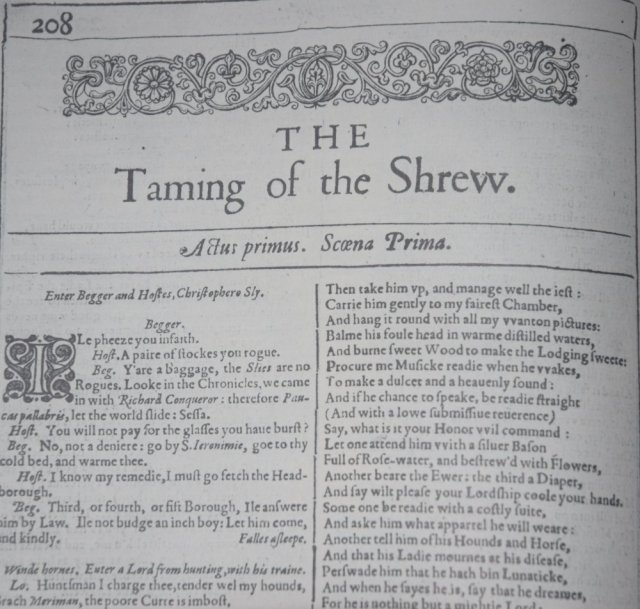
Seen above is the opening of The Taming of the Shrew, a play I fell in love with when I was very young and the first Shakespeare play that I bought a copy of when I just 11 years old. I still have that book in which I wrote my name, year and form name at the front of so I must have taken it to school at some point, which is how I know I was that young when I bought it. On that basis The Taming of the Shrew seems a good place to mark the end of this first essay of mine on Shakespeare’s works and I look forward to examining other editions I have in future writings.

20180424 First Folio 4

as for the title of this essay, that is explained in First Folio 1

The Devil’s Dictionary

20180327 Devil's Dictionary

Although now recognised as an American classic The Devil’s Dictionary by Ambrose Bierce was never originally intended to even become a book and certainly not intended to be read like one. It is, as the title implies, a dictionary; but full of alternative definitions, normally humorous, often satirical and sometimes it has to be said just plain strange at least to modern readers. But before looking at the book itself it is a good idea to know something about Bierce himself and how it came to be written and that is not as simple a task as it sounds as implied by the first sentence of the book summary in my copy.

The life of Ambrose Bierce is a tissue of facts embroidered with legend.

Normally at least birth and death dates of a well known journalist and author such as Ambrose Bierce would at least be known but although we know that he was born in 1842 the best that can be done for his death is ‘probably 1914’ when he went to Mexico during the revolution and was never heard of again.

But lets backtrack over what is known. In 1861 he enlisted in the 9th Indiana Infantry and fought in the American Civil War apparently with distinction and it was thought that he would go to a military academy after the war and make that his career but he was already interested in writing. So in 1866 he apparently ‘tossed a coin to decide whether to stay in the army or become a journalist. Journalism won the toss.’ By this time his army career had brought him to San Francisco, and that is where he started to teach himself what he needed to know; and started writing pieces some of which made it to print. In 1868 he got his first regular journalistic job and in a roundabout way this was to lead to the book I have. The job wasn’t journalism as such in that it didn’t involve factual reporting of news, instead it was a page in the San Francisco News Letter entitled ‘Town Crier’ which was a humorous and satirical view of life in the city and Bierce was set on his path to fame. He would over much of the rest of his life continue to write satire for numerous publications and by 1869 he had included his first multiple definition entry of what would eventually be a book although at the time it was probably just a useful space filler for the Town Crier page.

Over the ensuing thirty plus years Bierce continued his definitions in his various columns in publications not just in America but also in England where he lived for 3½ years in the 1870’s. They became increasingly popular and also much copied with Bierce sometimes entitling them The Devil’s Dictionary or later on The Cynic’s Dictionary until the idea of combining them into a book came to him in 1903. By the time of publication however not only had his idea been stolen but even the title of his column had been used by a competitor to publish their own set of definitions so he was forced to use the title The Cynic’s Word Book when it came out in 1906. Oddly it only included 521 definitions for the letters A to L with an intention to have a second volume covering M to Z later on, however it didn’t sell well enough for this plan to be realised.

And so it stayed as an unfinished work until 1911 when Bierce was working on his collected works and volume 7 was entitled The Devil’s Dictionary, this time covering the entire alphabet and with 1000 definitions, some of which were specially written for the book especially at the end of the alphabet because over all of his columns Bierce had only reached the word shoddy.

Shoddy: n. (vulgus) A term that expresses the status of a large part of our society, and furnishes a weakly page of matter to many of our time-serving dailies.

*Weakly is as written and implies a certain disdain for many of his less talented rivals producing similar columns for other newspapers.

The collected works was also a financial failure but The Devils Dictionary was recognised as probably his finest work and after his death went on to be published as a standalone volume by several companies and establish itself as a major work of American humour.

We then leap forward to 1963 when Ernest Jerome Hopkins, after a long career as a journalist, became Professor Emeritus of Journalism at Arizona State University and after discovering that the title didn’t actually come with any specific work decided to have another look at The Devils Dictionary and some strange gaps in the words chosen. It rapidly became clear that by no means all of the definitions Bierce had written for his various columns had made it into the published book, almost certainly because at the time of compiling he had been living on the Eastern seaboard of America and a lot of the early material was 3000 miles away in California and no copies would have existed in reference libraries where he was. Over the next few years Hopkins unearthed a further 851 definitions left out of the 1911 book and in 1967 the Enlarged Dictionary was published. My copy is the Penguin Classics edition, first issued under this imprint in 1985 although Penguin printed their first edition in 1971 in their main series.

To conclude let’s have a few definitions taken at random from the book, I have literally just opened the book and picked a word for each of these so it should give a flavour of the work as a whole, some are funny, some are sharp and some are odd, I’ll let you decide which are which. In the case of long definitions I have just included the first part, some go on a lot longer than others.

Edible: adj. Good to eat and wholesome to digest, as a worm to a toad, a toad to a snake, a snake to a pig, a pig to a man, and a man to a worm.


Bald: adj. Destitute of hair from hereditary or accidental causes – never from age.


Riddle: n. Who elects our rulers?


Miss: n. A title with which we brand unmarried women to indicate that they are in the market.


Insurance: n. An ingenious modern game of chance in which the player is permitted to enjoy the comfortable conviction that he is beating the man who keeps the table.


Dice: n. Small polka-dotted cubes of ivory, constructed like a lawyer to lie on any side, but commonly on the wrong one.


Fauna: n. A general name for the various beasts infesting any locality exclusive of domestic animals, travelling menageries and Democratic politicians.


Road: n. A strip of land along which one may pass from where it is too tiresome to be to where it is futile to go.

Persian Poets

In 1997 I was in Iran and in the Tehran museum saw fabulous hand painted pages from the great classics of Persian literature some of which were 1000 years old, so were contemporary with the great early medieval illuminated manuscripts produced by the monks in Western Europe that I was already familiar with. However these pages were on a different level being more miniature paintings surrounded by text rather than marginal images, a complete book would be a wonder of any age but few have survived intact.

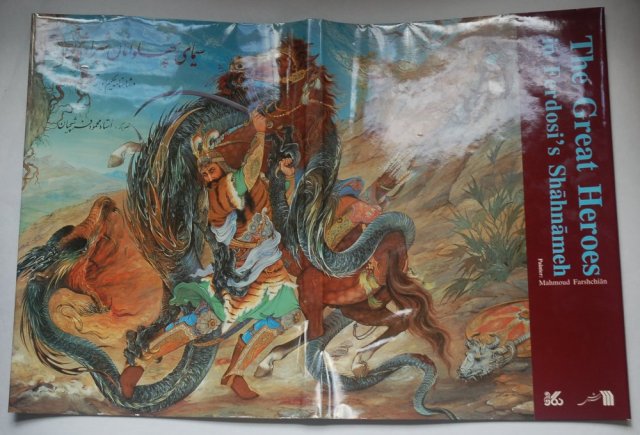
The great epic poem Shahnameh by Ferdosi (also Ferdowsi, Firdusi etc. Persian to English isn’t a precise transliteration) was one of the stars of the exhibition with several wonderful pages on display and at over 100,000 lines it is the longest poem ever written by one author. Written and revised between 997 and 1010AD the 1000 year old poem tells the tale of Persia from a mythological start and the creation of the world, through a time of legendary heroes to historical accounts up to around 750AD and the fall of the Sassanid rulers of Persia. Despite the age of the text it is still perfectly readable to modern Iranians whereas Geoffrey Chaucer (who lived roughly 400 years later) is about as far back in English that you can go and  have a reasonable chance of being able to understand the meaning. Regrettably I don’t read Persian so the text is beyond me but the illustrations made me yearn for a copy for myself. So along with a couple of rugs my souvenirs of Iran included a book in tribute to this great work and the ancient illustrations that so fascinated me on first seeing them.

20180220 Ferdosi 01

20180220 Ferdosi 10

The book was printed in 1991 and describes itself as a commemoration of the millennium of composing Shahnameh by Ferdosi. It was a few years early but the 1000 years have now passed and I’m glad it was early or I may not have been able to obtain this lovely, if somewhat large (42cm x 30cm), volume. The basic premise of the book is that 22 paintings by Mahmoud Farshchian done in the old style of Persian miniature art that I so admired would be used to illustrate sections from the heroic phase of the poem, it is written mainly in Persian with some English to explain the paintings.  The introductory pages are truly beautiful

and then we get into the main work which is the 22 modern interpretations of pages from the ancient works, I love the way that the pictures reach out beyond the frame. Click on the pictures to access full screen versions.

I have chosen 5 pages from the book to illustrate it and these are:

  • In his third labour, Rostam slays the dragon
  • Sohrab launches an offensive against Persia
  • Siavosh undergoes the ordeal by fire which Keykavus has arranged
  • Rostam sets Bijan free from the well where he has been imprisoned by order of the Turanian ruler
  • View of the Hunting Ground, with Bahram Gur talking to the harpist maiden

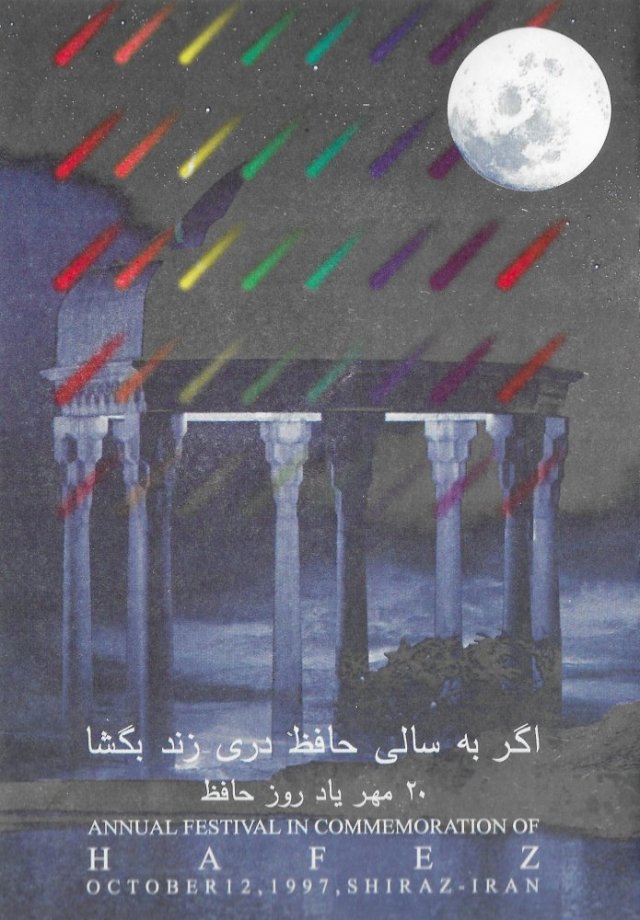
Ferdosi is not by any means the most famous of the Persian poets, that honour probably goes to Hafez and the annual Hafez festival was on when I arrived in his birthplace of Shiraz. He lived from 1315 to 1390 and like Ferdosi his name is more of an honorific, the difference is that we don’t know the real name of Ferdosi but Hafez was Khwāja Shams-ud-Dīn Muḥammad. Being called Hafez indicates somebody who has memorised the Koran, which apparently he did at a remarkably early age and that is the name with which he has gone down in posterity. Also on my bookshelves is the programme for the event.

20180220 Hafez 6

and I took several photographs at his mausoleum which is where recitals and singing of his poems were taking place. He is a much loved poet in Iran which is odd when you consider that most of his poems involve wine, love or the beauty of women; hardly the subjects that are approved of in conservative Iran.

There are fortunately several good English translations including Penguin paperbacks of Hafez’s works, and now Ferdosi has also been included in Penguin Classics so let us leave this blog post with some words by Hafez from The Penguin Little Black Classic “The nightingales are drunk”

With wine beside a gently flowing brook – this is best;

Withdrawn from sorrow in some quiet nook – this is best;

Our life is like a flower’s that blooms for ten short days

Bright laughing lips, a friendly fresh-faced look – this is best.


Penguin Drop Caps

In 2012 Penguin Books started a series of books for sale in the USA and Canada and it made use of their extensive back catalogue along with some newer modern classics in a handsome new style hardback binding. The tagline of the set is

It all begins with a letter

and the concept was to produce 26 titles where each letter of the alphabet was represented by the surname of the author. An interesting idea especially over the choice of names for some of the more difficult letters. What made the set a cohesive whole was the decision to have all the letters on the covers designed by one person, Jessica Hische, and for her to create an evocative set of designs. Adding the input of Penguin Art Director Paul Buckley we ended up with a rainbow of classic books which call to you from the shelves and look totally different to anything else I have. Good design has been the hallmark of Penguin Books from their beginning in 1935 and it’s good to see that tradition being respected in a modern set.

20180213 Drop Caps 1

Of course a set like this appeals to the collector part of me, especially when they are not officially available in the UK as I like a challenge, but it also harks back to the very first Penguin Books I initially accumulated, then decided to collect, which was the early (first 125) Penguin Classics.  Buying a set of books forces you to purchase authors you may not have been intending to buy or even to have heard of and once the book is on the shelf it would be remiss not to at least give the book a go. The first title is a case in point; Pride and Prejudice by Jane Austen is not a title that has ever appealed but I have to say that much to my surprise I’m really enjoying it. I have also read Madame Bovary, A Portrait of the Artist as a Young Man, Five Children and It, and Cannery Row so far and I’m looking forward to tackling authors I don’t know at all such as Willa Cather and Sigrid Undset.

The full list is as follows, with links to books reviewed in this blog:

A to F came out in 2012, G to P in 2013 and Q to Z in 2014 although I only started to collect these books towards the end of last year (2017) so the last 5 have only recently arrived and I didn’t buy them in alphabetical order but rather which 4 or 5 a month I could find at a sensible price.  Their official retail price varies on the copies I have between US $23 and $30 although the Canadian prices fluctuate much more widely between $24 and $40. The cheapest I found one in the UK was around £10 and had to spend up to £17 to get the last few I was missing.

20180213 Drop Caps 2

The spines are also attractive and make a bold statement on the shelf next to me as I write this, as can be seen in the picture above the page edges are also coloured to complement the cover and the rear cover has a short quote from the book that Penguin have turned into a parlour game

Mine is from Great Expectations:

Suffering has been stronger than all the other teaching, and has taught me to understand what your heart used to be.

and then A Portrait of the Artist as a Young Man

to forge in the smithy of my soul the uncreated conscience of my race

Not the cheeriest of quotes but I’m not going to let them put me off reading all these as they are lovely books with a clear font (Archer) as you would hope from a series that takes lettering seriously and a pleasure to pull off the shelf and sit down with.