Jorrocks’ Jaunts & Jollities – RS Surtees

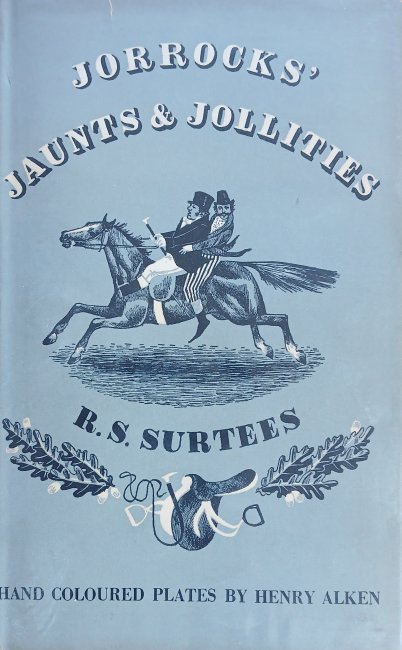
In 1949 The Folio Society decided to have a go at resurrecting the works of Robert Smith Surtees who had sadly dropped out of fashion since his heyday in the Victorian period with an edition of his first book, indeed his books used to be so well known that Virginia Woolf referred to this very title in the 1925 novel ‘Mrs Dalloway’ as her eponymous character was searching for a book suitable to take to a nursing home.

This late age of the world’s experience had bred in them all, all men and women, a well of tears. Tears and sorrows; courage and endurance; a perfectly upright and stoical bearing. Think, for example, of the woman she admired most, Lady Bexborough, opening the bazaar.

There were Jorrocks’ Jaunts and Jollities; there were Soapy Sponge and Mrs. Asquith’s Memoirs and Big Game Shooting in Nigeria, all spread open. Ever so many books there were; but none that seemed exactly right to take to Evelyn Whitbread in her nursing home.

Frankly if I was in a nursing home then Surtees may well be just the right author for my convalescence as the books are well written, with excellent observations on country life and Jorrocks is one of the great comic characters of the early Victorian age. This book was printed in only the third year of The Folio Society’s existence and was intended as a one off from this author in companion with a similarly designed edition of The Compleat Angler by Izaac Walton. However it was so popular that they subsequently published the remaining seven books by Surtees at the rate of one a year, making Surtees the first author to have their complete works published by the society.
John Jorrocks is described as a grocer in the book but as he operates out of his own warehouse rather than a shop he is probably a fairly wealthy wholesaler based in London. He is a keen fox hunter, riding with the Surrey hounds based at the small country town of Croydon about ten miles from central London. Anyone who knows Croydon nowadays, it has a population of around two hundred thousand and has been largely subsumed by Greater London, will find the rural descriptions of the place in the 1830’s difficult to imagine but this really was the case back then. Jorrocks’ regular companion is Mr Stubbs who is normally simply referred to as The Yorkshireman and one of the funniest passages in this book describes a ride from the middle of London by both of these gentlemen to join the hunt on a particularly foggy day in the city with the chaos they cause or get involved in. As Surtees is not well known nowadays I’m going to include a couple of examples of his style. The Yorkshireman never seems to have any money but is quite happy to live off Jorrocks as in this plan for a weekend trip.

“Now to business—Mrs. J—— is away at Tooting, as you perhaps knows, and I’m all alone in Great Coram Street, with the key of the cellar, larder, and all that sort of thing, and I’ve a werry great mind to be off on a jaunt—what say you?” “Not the slightest objection,” replied the Yorkshireman, “on the old principle of you finding cash, and me finding company.” “Why, now I’ll tell you, werry honestly, that I should greatly prefer your paying your own shot; but, however, if you’ve a mind to do as I do, I’ll let you stand in the half of a five-pound note and whatever silver I have in my pocket,” pulling out a great handful as he spoke, and counting up thirty-two and sixpence. “Very good,” replied the Yorkshireman when he had finished, “I’m your man;—and not to be behindhand in point of liberality, I’ve got threepence that I received in change at the cigar divan just now, which I will add to the common stock, so that we shall have six pounds twelve and ninepence between us.” “Between us!” exclaimed Mr. Jorrocks, “now that’s so like a Yorkshireman. I declare you Northerns seem to think all the world are asleep except yourselves;

Jorrocks also loves his food and drink and there are long descriptions of meals and consuming numerous bottles of wine and port in one sitting. I particularly enjoyed the contrast between the eating manners of the English and French when Jorrocks takes The Yorkshireman with him on a trip to Paris and the slow appearance of course after course in France confuses him rather than the everything on the table to start with which was then the preference in England and he assumes he is going to starve due to the lack of visible food. Early on in the book he invites The Yorkshireman round for breakfast before heading out to the hunt.

About a yard and a half from the fire was placed the breakfast table; in the centre stood a magnificent uncut ham, with a great quartern loaf on one side and a huge Bologna sausage on the other; besides these there were nine eggs, two pyramids of muffins, a great deal of toast, a dozen ship-biscuits, and half a pork-pie, while a dozen kidneys were spluttering on a spit before the fire, and Betsy held a gridiron covered with mutton-chops on the top; altogether there was as much as would have served ten people. “Now, sit down,” said Jorrocks, “and let us be doing, for I am as hungry as a hunter. Hope you are peckish too; what shall I give you? tea or coffee?—but take both—coffee first and tea after a bit. If I can’t give you them good, don’t know who can. You must pay your devours, as we say in France, to the ‘am, for it is an especial fine one, and do take a few eggs with it; there, I’ve not given you above a pound of ‘am, but you can come again, you know—waste not want not. Now take some muffins, do, pray. Batsey, bring some more cream, and set the kidneys on the table, the Yorkshireman is getting nothing to eat. Have a chop with your kidney, werry luxterous—I could eat an elephant stuffed with grenadiers, and wash them down with a ocean of tea; but pray lay in to the breakfast, or I shall think you don’t like it. There, now take some tea and toast or one of those biscuits, or whatever you like; would a little more ‘am be agreeable? Batsey, run into the larder and see if your Missis left any of that cold chine of pork last night—and hear, bring the cold goose, and any cold flesh you can lay hands on, there are really no wittles on the table.

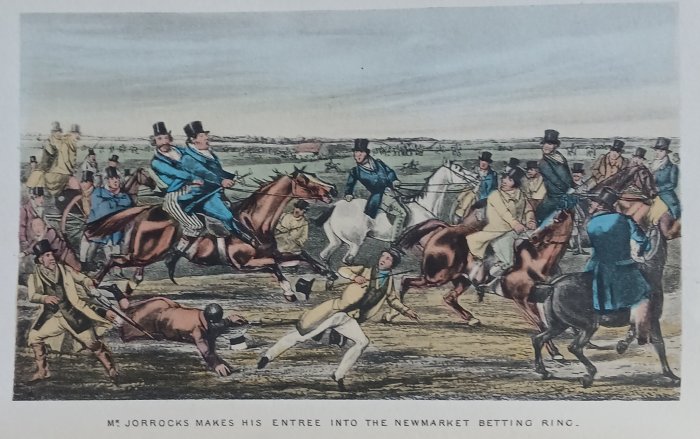
A note should be made regarding the fifteen colour plates included in the book as they were done by a technique that had largely disappeared by 1949. The plates, which are those by Henry Alken originally included in the book back in 1838, were in fact printed in monochrome and individually hand coloured by Maud Johnson who went on the do the same for the further seven volumes Folio printed of Surtees’ works. The Folio Society doesn’t include printing numbers for their books in the various bibliographies they have published but it can be imagined what a huge amount of work this involved for one person, but the effort was worth it as these illustrations really stand out. The pages for the prints are noticeably thicker and stiffer than the pages of text presumably to allow for Johnson’s use of watercolours to do the colouring without distorting the paper. Other than special very limited editions these eight volumes are the last books with hand coloured plates printed in England that I am aware of although I’d love to know of any others. The Folio Society continued to use the original plates throughout the series of reprints which was finally complete in 1956 with this being the only one illustrated by Alken, most of the others are done by John Leech.

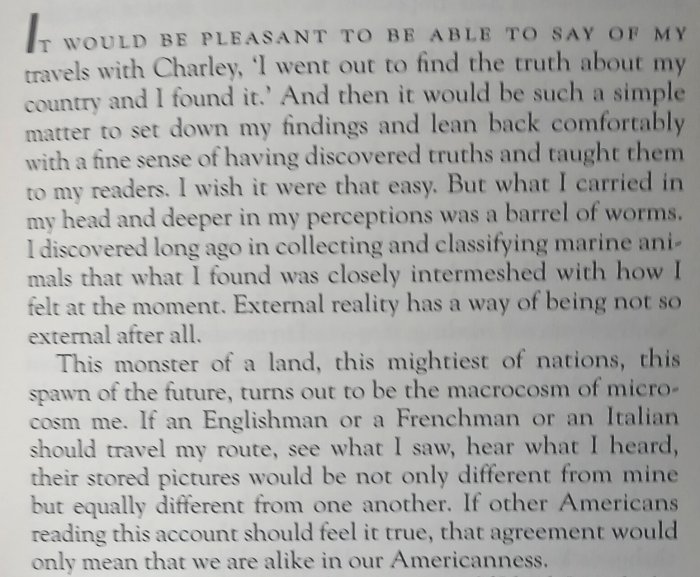
Travels with Charley – John Steinbeck

Towards the end of his life Steinbeck felt the need for one last adventure, this was 1960 and he would die of heart failure in 1968 aged just 66. His wife had long been concerned about his health and his heart condition, brought on by his heavy smoking had flared up several times in the preceding years and she was worried about his plans to travel right round the country in a converted camper van with his standard poodle, Charley, as theoretically his only companion. But Steinbeck wanted to reconnect with America, as he says at the beginning of the book:

The plan was to drive up from New York into Maine and explore the back roads of that sparsely populated state before heading along the Canadian border and into Canada by Niagara Falls, before coming back into the USA and travelling up through Illinois, Wisconsin and Minnesota then along the northernmost border to the coast, trying to stay off interstate freeways as much as possible. The first stumbling block was going into Canada with Charley, the Canadians were fine but, as is still the case, the USA border patrol were not, so Canada was dropped from the route. The less busy roads were also too slow so freeways appear more and more as the journey went on, but those kept him away from the people he wanted to talk to to see how their lives were changing so a sort of compromise was decided on where open countryside was driven through as often as practical.

The book when it came out in 1962 was a hit although it soon became clear that although Steinbeck had genuinely driven around the USA the text was less a travelogue than a carefully created artifice. That’s not to denigrate the book or the stories it tells, which are funny and at times distressing and provide considerable insights into how America had changed over the decades since Steinbeck had left his native California for the east coast and New York State. But it should be taken into consideration that Steinbeck was a great novelist, he was to win the Nobel prize for Literature just after this book came out, and probably couldn’t resist moving stories around and inventing dialogue to make his point. Also the actual trip was considerably more luxurious, and less lonely, than made out in the book, of the seventy five days he was away from home he spent forty five in hotels with his wife, Elaine, and on more than half of the remaining thirty days he either stayed in motels or trailer parks or parked the camper van at the home of friends. Steinbeck’s son, also called John, said that his father invented almost all of the dialogue whilst writing the book but frankly I don’t care, it’s a fun read and you do learn a lot about America on the turn of the 1950’s into the 1960’s.

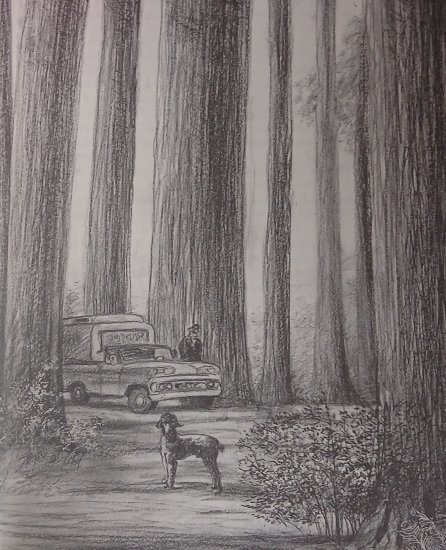
It is a very uneven travelogue anyway, by page 160 of the Folio Society edition I have we are in Seattle having left New York State and travelled along the US/Canadian border, so just one side of the rough rectangle planned for the journey. On that basis we should be looking at a four or five hundred page epic but instead it is only 241 pages in total, so over two thirds of the mileage is covered in a quarter of the pages and the detail in the first three quarters is lost in the remainder. That said I actually think the last quarter is the most important, as we have Steinbeck returning to search for his roots in California and finding that they are irretrievably lost. Cannery Row has been gentrified and he barely recognises the places of his childhood. Charley is also confused but that is mainly down to the visit to the giant redwoods which are so huge that he doesn’t seem to see them as trees and finds a small bush to mark instead.

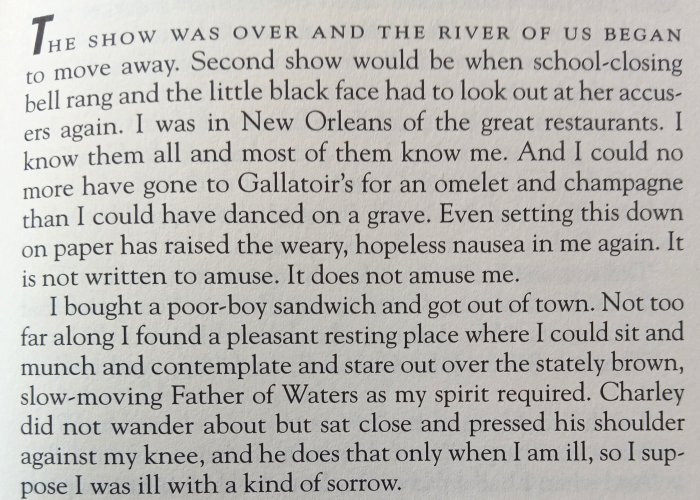
But it is pretty well the last section that is the most important of this ‘almost’ documentary and drives home Steinbeck’s dislike of some of what he found on his journey when he goes to New Orleans in search of ‘the Cheerleaders’. These frankly repellent middle aged white women gathered each day to scream abuse at six or seven year old children going or leaving school who just happened to be a different colour than they were. Steinbeck was appalled by them and the crowds they pulled together which meant the children needed police support just to go to school.

I’m going to leave it there.

Far From the Madding Crowd – Thomas Hardy

I have to admit that in the over three decades I have owned this book, as part of a set of six novels by Hardy from The Folio Society, I have attempted to read it at least three times. Initially when I bought it back in 1993 and then again probably ten years later, where according to the bookmark I found inside I made it to page 84 out of 413, this time I read and thoroughly enjoyed the book in just four days during the last week. I don’t know why I failed the first two times, some books you just have to be in the right frame of mind to appreciate them.

There are five main characters, I’ll tell as much of the start of the novel to set out how they stand with each other. Gabriel Oak who starts the novel as a farmer in good standing with two hundred sheep and a couple of sheepdogs, the younger of which would lead to his ruin by one night driving his entire flock over a cliff edge to their deaths, The sheep were not insured but by selling everything he owned he managed to cover his debts. Also appearing at the start of the book is Bethsheba Everdene, a young woman whom Oak falls in love with, pretty well at first sight, but she does not return his affection. She however soon leaves the vicinity, before Oak’s disaster with the sheep, and he knows not where she has gone. Oak, now penniless takes himself off to a hiring fair hoping to get a job as a bailiff (farm manager), failing to do so he reverts to his skill as a shepherd but still doesn’t get a job so decides to try the next fair in a nearby town. On his way he sees a hayrick on fire and endeavours to put it out, his bravery is soon noticed by the labourers on the farm as they race to his assistance and on the back of this he is offered the job as shepherd by Mistress Everdene who it turns out had inherited this very farm which is why she left the area where Oak was living. Still very much in love with Bethsheba but now so reduced in fortune as opposed to her meteoric rise he realises that he can never hope to gain her hand in marriage.

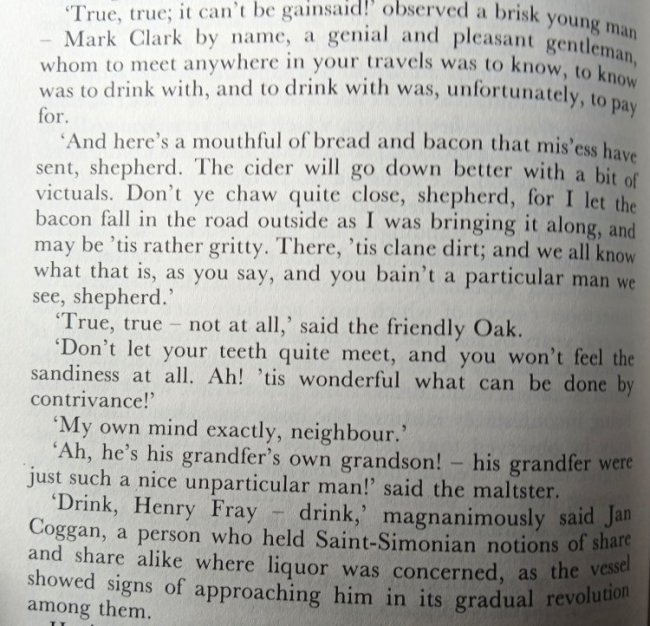
On coming into the village after the fire is extinguished he encounters the young Fanny Robin who it turns out has that night left the house where she was employed as a servant without telling anyone and is running away to her love, a Sergeant Troy in one of the local regiments who has promised to marry her. Troy however is an out and out cad as will become obvious as the book progresses. This leaves one more major character, the owner of the farm adjacent to Bethsheba Everdene’s, Mr Boldwood, I don’t think we ever find out his first name. In a moment of fecklessness Bethsheba sends Boldwood a valentine one year even though she doesn’t love him and this prompts the bachelor to look again at his neighbour and consider marriage for the first time in his life and this will lead to all sorts of problems as the book progresses. These five characters with their interrelationships drive the whole plot but around them the description of rural life and its nearness to poverty is brilliantly told by Hardy, take the following example, which also shows the expression of the local dialect which pervades the novel, this is just after Oak has been retained as shepherd after his heroics with the fire.

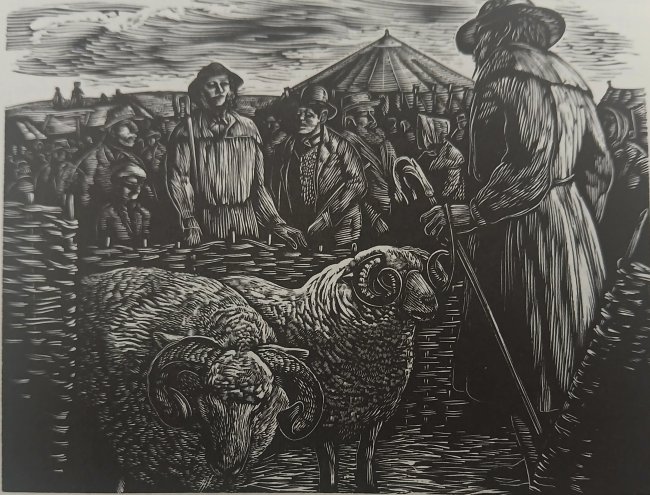
The book, like all Folio Society editions, is beautifully illustrated, this time with thirty one wood engravings by Peter Reddick who worked on all of their Thomas Hardy volumes, around twenty of them, making him the first artist to completely illustrate Hardy.

It was only at the end of the book that it dawned on me how young the major characters are, Gabriel Oak is one who is given a definite age, that of twenty eight at the start of the novel which covers the span of around four or possibly five years so he is thirty two or thirty three at the end of the story. There then becomes the slight problem of the age of Bethsheba Everdene caused by two statements by Gabriel which disagree. In chapter twenty nine – Particulars of a Twilight Walk he says he is six years older:

But in chapter fifty one – Bathsheba Talks with Her Outrider he says there is eight years between them and Bethsheba agrees:

As she agrees and she knows him better by now, as it is near the end of the book, I’m inclined to the eight year gap meaning she was twenty at the start of the novel and twenty four or twenty five at the end. Suddenly it dawned on me just how young she was when she inherited the farm and started running it by herself and that brings a new perspective to her fearlessness and possibly recklessness in deciding to do that. Mr Boldwood is described as ten years older than Oak so allowing for Oak’s approximations in the earlier passage we can say he is in his early forties by the end, which fits with his position as a confirmed bachelor early on in the narrative as he would hardly be described as such if much younger than his late thirties. Sergeant Troy is stated as twenty six at the end of the book and Fanny Robin is twenty, so she was just fifteen or sixteen when she started her relationship with Troy. However I can’t include a picture of where these ages come from without giving away a large part of the end of the book, which I don’t want to do.

I’m so glad I had another go at reading this book and I’m now not sure why it has taken me so long to finish it as I have greatly enjoyed this tale of Victorian life in south west England, so much so that I’m considering which one of the other six Hardy novels I own to tackle next.

Crusader Castles – T E Lawrence

Originally written as Lawrence’s thesis for his Bachelor of Arts degree in Modern History at Oxford University in 1910 this was his first time in the Middle East, a part of the world that would become forever linked to him during the First World War as he became famous as Lawrence of Arabia. It doesn’t only deal with Crusader castles however as the year before he had cycled extensively in France exploring the castles there and this is also made use of in his paper. The basis of the thesis is exploring the differences and similarities of European castles with those constructed in the Middle East as part of the Crusades to determine if the castle builders in the East took their inspiration from Byzantine castles they found there, as was the belief of scholars at the time, or if they were more heavily influenced by the western European castles they had left behind. Lawrence was firmly of the opinion that the European castles drove the design of the Crusader castles and his thesis was instrumental in changing the opinion of academics in the subject as it was so well researched and full of examples making his case, most of which hadn’t been studied first hand before, that it ultimately resulted in his First Class degree. This sounds like it could be quite a dry subject but actually it is surprisingly well written and one of his tutors encouraged him to get it published soon after it was submitted, however the sheer number of photographs and drawings, none of which could sensibly left out, would have made such a project financially unviable in the 1910’s.

One interesting feature of the book is the addition of Lawrence’s notes alongside the text from his planned revisions in the 1930’s, these sometimes add to the text but quite often are almost his thought processes regarding what he has written. The section of the book reproduced below, which is discussing the fortifications at Carcassonne in France shows both these types.

Sometimes the notes are somewhat ironic, where he either no longer agrees with what he wrote or how he wrote it, or even the references he cites. I have long had an interest in castles and architecture mainly from having been taken to most of the extant castles in Wales as a young boy with my family. I do love the chance to visit castles I haven’t been to before and a trip to the Levant in 1996 allowed me to follow, if only briefly, in Lawrence’s footsteps.

Below is one of my photographs of Krak des Chevaliers in Syria, described by Lawrence “as a finished example of the style of the Order (The Order of Knights of the Hospital of Saint John of Jerusalem, commonly known as the Knights Hospitaller) and perhaps the best preserved and most wholly admirable castle in the world”. This castle is truly enormous, as can be appreciated from the barely visible person standing on top of the Warden’s Tower, a place I had been an hour or so earlier. Lawrence dedicates many pages to this castle in the thesis with extensive descriptions, plans, photographs and drawings, the result of spending five days intensively studying the castle.

The book concludes with several of the letters Lawrence wrote during his travels in the UK and Europe, almost exclusively to his mother but dealing more with the architecture and military history he was learning about. These were originally published, with a foreword by his mother, as the second volume of the Golden Cockerel first edition of this work printed in 1936, a year after Lawrence’s untimely death in a motorcycle accident. But nowadays they are normally included with the main text in one volume as in this lovely Folio Society edition from 2010.

Memoirs From Beyond the Tomb – François-René de Chateaubriand

I was going to call this an autobiography, but it is so much more than the history of one man, for example there are over a hundred pages that detail the rise and fall of Napoleon from his early days in power when Chateaubriand was in various roles including Secretary to the Holy See until their split over the execution of the Duke of Enghien and then onwards to Moscow, exile to Elba, his return and ultimate defeat at Waterloo and final exile to St Helena. None of these later actions after his diplomatic roles ended involved Chateaubriand except as an observer on the impact in his beloved France. Chateaubriand is an excellent historian and writer but with considered views on the results of that history on himself, those around him and the wider public which add considerably to his narrative. But if you don’t know of him a section from his preface will give an idea of the breadth of his experience:

I have met nearly all the men who in my time have played a part, great or small, in my own country or abroad: from Washington to Napoleon, from Louis XVIII. to Alexander, from Pius VII. to Gregory XVI., from Fox, Burke, Pitt, Sheridan, Londonderry, Capo d’Istrias to Malesherbes, Mirabeau and the rest; from Nelson, Bolivar, Mehemet Pasha of Egypt to Suffren, Bougainville, La Pérouse, Moreau and so forth. I have been one of an unprecedented triumvirate: three poets of different interests and nationality, who filled, within the same decade, the post of minister of Foreign Affairs—myself in France, Mr. Canning in England, Señor Martinez de la Rosa in Spain. I have lived successively through the empty years of my youth and the years filled with the Republican Era, the annals of Bonaparte and the reign of the Legitimacy.

It should be pointed out at this point that this 2016 Folio edition is a reprint with some amendments of the abridged 1961 Hamish Hamilton Ltd. version, later a Penguin Classic, selected and translated by Robert Baldick and even at 367 pages doesn’t have room for Chateaubriand to encounter all the people listed above but it is still a substantial read covering an important part of French history from the Revolution through the entire time of Napoleon and beyond to the restoration of the Bourbons with Louis XVIII and Charles X and their subsequent fall. I have to admit that apart from the British view of Napoleon and the basic knowledge from school of the French Revolution I didn’t know much about this period of French history and Chateaubriand is in a unique position to expand my knowledge. As members of the nobility his eldest brother and wife were executed during the revolution and a lot of his family, including his mother were imprisoned, Chateaubriand was the tenth child, so as he was not seen as important at the beginning managed to escape France and lived in poverty in London, a time he writes about decades later in this book whilst a famous author and French Ambassador to the UK. The juxtaposition of his various positions through his life is one of the things that make the story so fascinating, he left the ambassadors role to become a member of the French government as Minister for Foreign Affairs in 1822.

I found myself constantly learning French history as I read Chateaubriand’s story of riches to rags, back to riches, obscurity to fame and a return to relative obscurity in his later life as he largely became a recluse trying to complete the four sets of volumes (there is a total of forty two ‘books’ each of which form part of a published volume) that this work became. as the range covered kept expanding and he was also busy with many other projects. Originally he planned for these books to be published fifty years after his death but in fact the first part appeared just a year after he died with the rest published the following year. This was to be his masterpiece and it is a fascinating read. It sealed his place as one of the founders of French romanticism and influenced French writers for decades.

The Third Voyage – Captain James Cook

Before his third, and final, voyage Cook was formally given the rank of Captain and was officially retired, assigned to Greenwich Hospital at the age of just forty seven. He accepted this transfer off active duty on the basis that he would be allowed to come back and this he duly did, taking command of the apparently refurbished HMS Resolution in 1776. This time he was tasked to head north in search of the fabled North-West Passage which would give a route above the top of Canada between the Atlantic and the Pacific oceans. This had been sought for many years starting from the north Atlantic, Cook’s instructions was to start off Alaska and see if the route could be discovered coming in the opposite direction. Charts at the time for this part of the world were poor to say the least with one of the maps showing Alaska as a giant island off the coast of Canada although the Danish explorer Vitus Bering had discovered the Strait that bears his name many decades earlier whilst in the employ of the Russian navy.

In the absence of any alternative route Cook headed south to go north as he first had to enter the Pacific. The first thing that strikes the reader as we head back to familiar territory of New Zealand, Tonga and Tahiti is that the book is written in a very different style compared to the first two voyages. Instead of the formal naval journal with each day detailed with position, wind speed, heading etc. we get a manuscript that is far more aimed at the lay reader where a lot of the technical information is dispensed with and it reads much more like a diary. I have checked this with the full 1784 first edition to make sure that this style is not just a creation of the abridgement and that book is also in this more readable style so Cook was clearly aiming at publication from the start. Sadly he was never to see the book come out as he was to die on this voyage and never return to England but the manuscript that was to be published was just 17 days behind when he died so he must have been constantly working on it whilst at sea.

Cook had another reason to go to the South Pacific and that was to return Omai, a native of one of the islands with Tahiti who had travelled back on HMS Adventure as part of Cook’s second voyage. Omai was the first Polynesian to visit Europe and had achieved celebrity status whilst he was there and his return was the publicly stated reason for the trip as the search for the North West Passage was kept secret. It took longer to get to the South Pacific than intended so Cook decided that by the time he headed north it would be too late to attempt the search so stayed in the southern summer before heading north the next year and on his way became the first European to encounter Hawaii, or the Sandwich Isles as he named them after the then First Lord of the Navy, Lord Sandwich. Cook’s two ships HMS Resolution and HMS Discovery, commanded by Captain Charles Clarke, arrived at an opportune time as the islanders believed that their god was due to arrive at pretty well the same time as Cook did so they were treated royally and the elaborate ceremonies are described in the journals. When he finally left to continue north he was somewhat later than the predicted date for the god’s departure and the islanders were getting a little annoyed that he had not gone according the the plan.

Cook then headed north sighting Oregon and then following the coast of Canada, all the way to the Bering Strait producing the first accurate maps he then went east across the top of Canada before being stopped by ice bu which time he had gone past 70 degrees north. Turning round he headed west and continued on that heading, mapping the Siberian coast of Russia before again being stopped and having to go back to the Bering Strait. By then it was September and nothing more could be done so far north so he decided to return to Hawaii where they had been so welcome. The ships stayed for a month and were again welcome but soon after leaving a mast broke and knowing nowhere else he could go to effect repairs Cook went back to Hawaii and this time he was definitely not expected, Lomo was supposed to appear then leave and not come back again so soon and relations between the islanders and the ship’s crew rapidly deteriorated leading to the killing of Cook.

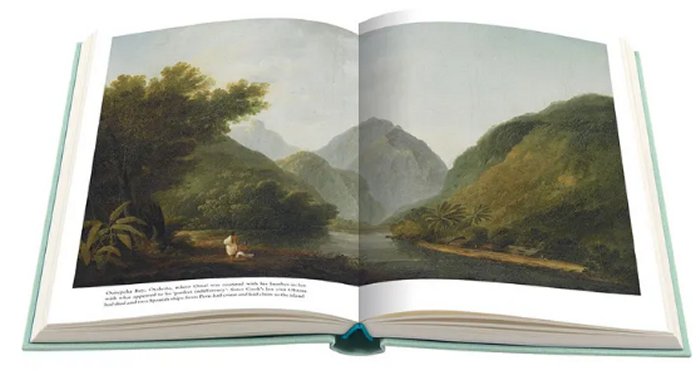
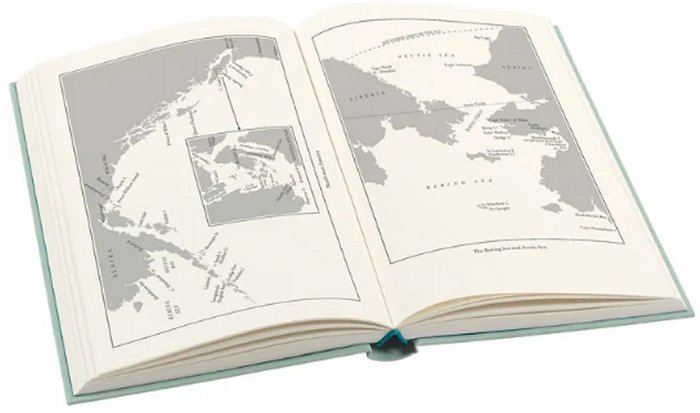
Now at this point the two versions of the book I have separate as the first edition is just two volumes in to a three volume set, the third volume being written by Captain King, whilst the Folio edition pretty well stops here presumably as the set is called the Journals of Captain Cook and he is now dead. The three books that make up the Folio set are however an excellent summary of what should in fact be a much larger nine volume set if you had the full version but it is no less good for that. Anyone interested in voyages of exploration should definitely read Cook and this is one of the most approachable editions being beautifully typeset and therefore a pleasure to read. One oddity of the images that I have used from the Folio Society web site is seen below as the picture of the included maps appears to show them in the middle of the book whilst they are in fact at the front of each volume.

The First Voyage – Captain James Cook

August is the month I read a theme and this year I have decided to tackle the journals written by James Cook describing his various voyages round the world. To do this I am starting off with the excellent abridged collection published by The Folio Society which is based on the JC Beaglehole version first published by The Hakluyt Society between 1955 and 1967. Beaglehole went back to Cook’s original manuscripts and ships logs and especially for the first voyage removed a lot of the extraneous material added by the Admiralty’s appointed editor which so annoyed Cook when he first saw the published work when he returned from his second voyage.

The barque HMS Endeavour set sail in August 1768 with 94 people aboard on what would be an almost three year voyage of exploration, both geographic and scientific as amongst the ships passengers were the eminent naturalist and Fellow of the Royal Society, Joseph Banks, and astronomer Charles Green specifically there to observe the transit of Venus from Tahiti. There were also other scientists to assist in the collection of specimens and a couple of artists, Sydney Parkinson and Alexander Buchan, sadly neither of which survived the trip. First port of call after leaving England was the island of Madeira for further provisions and where amongst other things they took on 3,032 gallons of wine (presumably the local fortified variety), twenty pounds of onions per man, 270 pounds of beef and amazingly a live bullock. I dread to think how killing the beast and its subsequent butchery were accomplished whilst crossing the Atlantic to Brazil on a crowded ship which was less than 100 feet (30 metres) long.

The first target destination was Tahiti for the observation of the transit of Venus due on Saturday 3rd June 1769 this was, as far as the Royal Society was concerned, the primary reason for the voyage because from this observation along with ones made in England and seven other locations around the Earth, it would be possible to accurately calculate for the first time the distance from the Earth to the Sun. Tahiti was chosen as one of the main points due to its distance from Europe, being the other side of the world therefore improved the accuracy of the calculation. By the time all the calculations were done the value was 93,726,900 miles, the modern value is 92,955,000 miles so remarkably close and within the variation of distance due to the fact the Earth does not orbit the Sun in a circle. Cook and his crew spent three months in Tahiti establishing a fortified base to make the observations from, this was necessary due to large amount of thefts that occurred from the natives who seemed to take things regardless of whether they were any use to them.

Leaving Tahiti the expedition was to search for the the legendary southern continent, but what they instead encountered was New Zealand, which had already been discovered by Abel Tasman the Dutch explorer. However over the next six months Cook would circumnavigate both the North and South Islands establishing that they were islands and mapping the coasts of them for the first time. Cook’s encounters with the Maori were fraught with disaster from the start with numerous native people being killed as they were deemed to pose a threat to either the ship or crew that landed in search of water, wood and fresh food. It is worth saying at this point that the quite small ship had by this time also taken on board some sheep as there are numerous mentions of grass being cut to feed them so it was not just the crew that needed sustenance. Cook’s interactions with the Maori people also seem to improve over the months there and there are far fewer documented fatal encounters beyond the initial landings.

After New Zealand Cook held a meeting to determine where they should go next and it was decided to sail west still looking for the southern continent. After sixteen days at sea they arrived at Australia, then called New Holland, and sailed up the north east coast of New South Wales and it is from Botany Bay that the animals shown in the plates above were seen. However whilst travelling up the coast disaster struck when on the 11th June 1770 the ship struck the Great Barrier Reef, which in this part of Australia comes very close to the shore, and was holed. After a few days they managed to get loose from the coral by dumping 40 or 50 tonnes of stores and the larger guns overboard. There then follows an interesting passage of around a month where Cook managed to beach the ship so that repairs could be undertaken and at least the large hole was repaired but the sheathing to protect the timbers was irreparable they also had considerable difficulty refloating the ship and getting back out of the trap they had found themselves in as the winds were against attempts to sail back south. Whilst trying to free themselves from a stretch of water deemed ‘The Labyrinth’ by Cook they finally managed, on 14th July 1770, to shoot one of the strange creatures spotted several times at a distance and therefore unidentifiable to find a odd animal.

The head, neck and shoulders was very small in proportion to the other parts; the tail was nearly as long as the body, thick near the rump and tapering towards the end; the fore legs were 8 inch long and the hind 22, its progression is by hopping or jumping 7 or 8 feet at each hop upon its hind legs only, for in this it makes no use of the fore, which seem to be only design’d for scratching in the ground etc. Its skin is cover’d with a short hairy fur of a dark mouse or grey colour. Excepting the head and ears which I thought was something like a hare’s it bears no sort of resemblance to any European animal I ever saw.

The entry for the 15th July includes the following observation “Today we din’d of the animal shott yesterday & thought it was excellent food”. So ended the first kangaroo examined by Europeans. The odd spelling is by the way directly from Cook’s journal, although a great seaman he was not highly educated and the spelling throughout the books is eccentric to say the least.

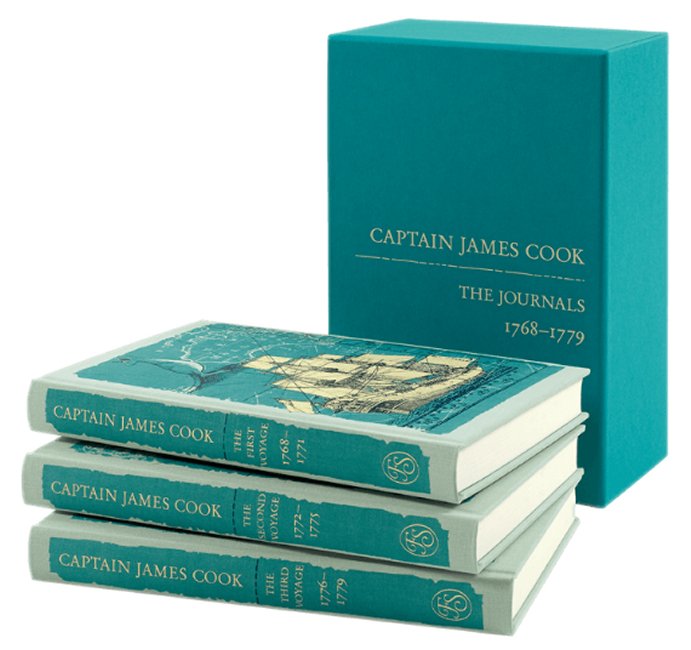
Above can be seen the Folio Society boxed set of the three voyages I am reading this month, I have the second printing from 2002.

Around the World in Eighty Days – Jules Verne

I could have sworn I read this book as a child, but as I continued reading nothing came back to my memory, of course I knew the basic plot, but as it is a very well known work I could have picked that up at any time however the more I read the less I recognised and I loved the full story. So how come I have clearly never read this before?

The base story, as I think everybody knows, is that Phileas Fogg, a man who notoriously goes nowhere other than to his home or club and whom is so punctual and set in his habits that you could set a watch by his movements raises the subject of the possibility of travelling around the world in just eighty days. When other members of the Reform Club are incredulous he agrees to wager the massive sum of £20,000 (£1.8 million in today’s money) that he can make such a journey and whats more without any prior planning for he will leave from the card game they are playing immediately. I also knew that he arrives back in London having been delayed and believes he has taken eighty one days and is financially ruined but is rescued by having crossed the international date line in an easterly direction and therefore has gained a day’s grace so makes it back to the club just in time. That is all I knew when I started the book, I had assumed that some travel disaster had occurred to delay him and was surprised by the true reason and knew nothing of the policeman, Fix, who had dogged his trail around the world in the mistaken belief that Fogg was the man who stole £55,000 from the Bank of England a few days before he set out on his journey.

I also knew nothing of Aouda who accompanies Fogg from India as I believed that his sole companion was his newly employed valet, the Frenchman Passepartout, whose name is the French for a master key which will enable you to go through any door in an establishment. Jules Verne must have spent a considerable amount of time pre-planning the trip as it is exquisitely timetabled, just how long each trip would take and how much time the travellers would have to make the next connection and how long they would have to wait if they missed such a rendezvous is all set out and is completely believable. Having sat down with railway and ship timetables to work out long over land and sea journeys in the past for my own holidays I am very aware just how complicated this could be before the age of the internet.

I loved the story, the development of the characters and the ingenious ways that Verne managed to keep them hearing ever onwards. Yes it is possible now to get round the world in less than a handful of days by simply getting on a plane, a mode of transport unavailable to Fogg back in 1873 when the novel was written and back in 1988 Michael Palin proved it was still possible to get round the world in eighty days without the use of aircraft, taking roughly the same amount of time as Fogg did in the novel. I heartily recommend this wonderful tale and I’m simply amazed that this was the first time I read it.

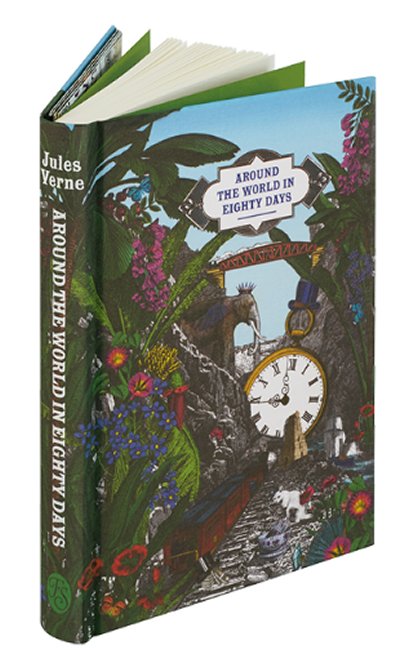
About the only thing I didn’t like about this Folio Society edition is the fold out map tucked into a pocket in the rear cover. It is unfortunately extremely difficult to read, which is a shame as clearly a lot of work had gone into it and it could also have been considerably improved by including a line indicating the path that Fogg and his companions took, definitely a missed opportunity there. The images in this blog were taken from the Folio Society website which I downloaded before the edition sold out and the book was removed from the site. As can be seen it is copiously illustrated with headings and tailpieces to each of the thirty seven chapters by Kristjana S Williams who also drew the map and the front cover.

Letters from Fairyland – Charles van Sandwyk

Charles van Sandwyk was born in South Africa and raised in Canada; he taught himself calligraphy and intaglio printing as a teenager, his first self-published book appeared when he was just twenty, and won a national award. Since then his work has been archived by the National Library of Canada and rightly so as his art is truly beautiful. Van Sandwyk has produced illustrations for several Folio Society editions but this is the first one I have bought whilst taking advantage of the end of year half price sale they were running which meant that I only paid £25 rather than the £50 original. However having now got a copy I’m thinking about the ones I have missed, such as the limited edition of Alice in Wonderland which was published by The Folio Society to mark the 150th anniversary of the first edition and sold out rapidly. Sadly I can’t see me being able to obtain original books by Van Sandwyk as they are produced in tiny numbers and are mainly snapped up by collectors in Canada so the Folio Society editions will have to do.

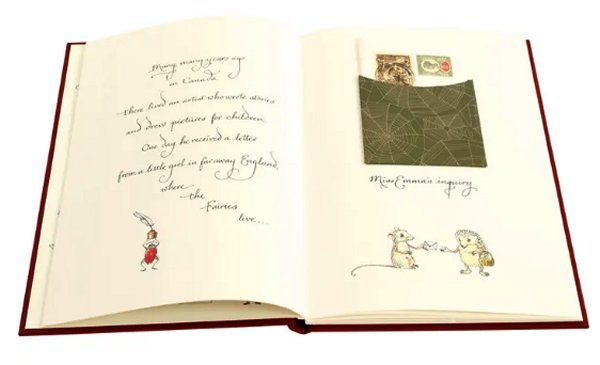
The story goes that many years ago a young artist living in Canada received, out of the blue, a letter from a nine year old English girl, Miss Emma Gladstone. Emma had read some books about fairies which the artist had published and she was writing to ask his advice about the little people who she sometimes could see out of the corner of her eye. She wanted to invite the fairies to come and live in her garden, but she did not know how to make contact with them. The pull out letter is included in a folder, just the first of several items that can be taken from the book and examined by the reader and this is one of the many charms of this edition which includes the gorgeous Modigliani Neve paper that it is printed on which resembles a heavy duty watercolour paper and perfectly sets the beautiful illustrations.

The artist replied with a letter to Miss Gladstone and the book goes on to tell the story of how he had received a summons from the Royal High Secretary to the King of the Fairies, commanding him to paint His Majesty’s portrait; how he had shrunk in size and travelled to Fairyland in a coach drawn by a mouse, and everything that happened to him there. The first edition of the book was published in an strictly limited edition of 200 copies which Van Sandwyk presented to members of an exclusive club, the High Branch Society, which unfortunately I have been unable to find out anything about. The double page spread above includes the finished portrait and an envelope containing fairy money which was apparently Van Sandwyk’s payment. The Folio edition explains that it is an expanded version of this original volume being twice the length but even so it is a very short book being just twenty four pages long, excluding the individual pull out items and it was this very shortness that made me originally hesitate to purchase it as it worked out at just over £2 a page. But it is so lovely that I should have really have got it sooner and treated it as an art purchase rather than a book.

Sadly the Folio Society sale has obviously tipped a few others into making the purchase so the stock of this, the 2020 first edition in this form has now sold out. If this little book has piqued your interest in Van Sandwyk’s work as much as it has mine then you may find the following link useful, I certainly had a great deal of fun exploring other works by this wonderful artist.

Carry On Jeeves – PG Wodehouse

There are times when only a PG Wodehouse will do. I’ve featured two of his books before on this blog, Summer Lightning back at the end of November 2019 and The Clicking of Cuthbert in September 2021, Summer Lightning is one of the Blandings Castle novels set in a stately home in Shropshire, whilst The Clicking of Cuthbert is a collection of short stories featuring golf. You can see from this description that there is a noticeable gap in my descriptions of the works of Wodehouse and that is the thirty five short stories and eleven novels that make up the Jeeves and Wooster canon. I do have all of these in three boxed sets from The Folio Society beautifully illustrated by Paul Cox, and I have chosen this book comprising of ten stories because it includes the appearance of the indomitable gentleman’s gentleman Jeeves into the life of wealthy dilettante Bertie Wooster. This story ‘Jeeves Takes Charge’, originally published in 1915, begins with Bertie very badly hungover when his new valet arrives from the agency:

I crawled off the sofa and opened the door. A kind of darkish sort of respectful Johnnie stood without.

‘I was sent by the agency, sir,’ he said. ‘I was given to understand that you required a valet.’

I’d have preferred an undertaker; but I told him to stagger in, and he floated noiselessly through the doorway like a healing zephyr. That impressed me from the start. Meadowes had had flat feet and used to clump. This fellow didn’t seem to have any feet at all. He just streamed in. He had a grave, sympathetic face, as if he, too, knew what it was to sup with the lads.

‘Excuse me, sir,’ he said gently.

Then he seemed to flicker, and wasn’t there any longer. I heard him moving about in the kitchen, and presently he came back with a glass on a tray.

‘If you would drink this, sir,’ he said, with a kind of bedside manner, rather like the royal doctor shooting the bracer into the sick prince. ‘It is a little preparation of my own invention. It is the Worcester Sauce that gives it its colour. The raw egg makes it nutritious. The red pepper gives it its bite. Gentlemen have told me they have found it extremely invigorating after a late evening.’

I would have clutched at anything that looked like a lifeline that morning. I swallowed the stuff. For a moment I felt as if somebody had touched off a bomb inside the old bean and was strolling down my throat with a lighted torch, and then everything seemed suddenly to get all right. The sun shone in through the window; birds twittered in the tree-tops; and, generally speaking, hope dawned once more.

‘You’re engaged!’ I said, as soon as I could say anything.

The hiring of Jeeves would prove to be the best thing Bertram Wooster would ever do and many a time Jeeves would get him out of terrible problems, often caused by Bertie’s friends although sometimes by Bertie himself. This book comprises of ten of the short stories an was first published in 1925 by Herbert Jenkins Ltd and as well as introducing us to Jeeves the stories are set around the first few novels. It isn’t necessary to have read the other stories before this collection although there are some spoilers regarding plots, most noticeably around Bertie’s interaction with the Glossop family which assumes that the reader is familiar with them. The odd thing is that although this collection includes the hiring of Jeeves, the collection of eighteen short stories (some of which were originally published in combination) in The Inimitable Jeeves was first published in 1923 and includes much of the appearances of Sir Roderick Glossop and his daughter Honoria whom Bertie gets engaged to twice only for Jeeves to successfully extricate him both times.

The other thing to bear in mind is that Wodehouse started writing about Jeeves and Wooster in 1915 and wrote his final novel about them, ‘Aunt’s Aren’t Gentlemen’, in 1974 so a spread of almost six decades but none of the characters age more than about five years over this period and the lifestyle of Bertie is firmly rooted in the 1910’s and 20’s. It also needs to be understood that the First World War doesn’t impinge on the books at all and it is easier to assume whilst reading them that almost the whole story line is set in the early 1920’s. The one obvious exception to this is the novel ‘Ring For Jeeves’ which is clearly set later and is the only Jeeves book which doesn’t feature Bertie Wooster.

Of the ten stories in ‘Carry On Jeeves’ four are set in New York where Bertie had taken refuge to avoid the wrath of his aunt Agatha and one in Paris where he is simply on holiday for a couple of weeks whilst the rest are in his native England. Wooster is sufficiently wealthy that he doesn’t have to work for a living so Wodehouse is free to place him wherever he fancies which includes hiring a house for an extended holiday by the coast. It is also clear that Bertie is not the brightest of chaps but then again neither are most of his friends, with the intellectual status being almost entirely given to Jeeves. Almost all the stories and novels are written from the perspective of Bertie but this collection includes the only one seen from Jeeves’s viewpoint ‘Bertie Changes His Mind’, where Jeeves is worried that he might be about to be let go by Bertie and is determined to make sure that this doesn’t happen. For Jeeves, despite his occasional disagreements with Bertie, largely over his sartorial choices, knows that his employer is one that is worth retaining especially compared to some of the others he has worked for.

I love the works of PG Wodehouse as his gentle comedies are invariably just the thing to brighten the day and they are beautifully written. You can read one of the various series such as Jeeves and Wooster, Blandings Castle or the Psmith stories or pick one of the numerous stand alone works that together comprise the around a hundred novels and collections of short stories along with over fifty plays and scripts that he wrote over more than seventy years, Indeed he was working on another Blandings novel when he died aged ninety three.