An Old Man’s Love – Anthony Trollope

Twenty years or so ago I collected all forty seven novels plus the autobiography of Anthony Trollope in the lovely edition printed by the Folio Society which was the first ever complete edition to be illustrated. These are now long out of print but can still be obtained easily on the second hand market. I admit to having bought them far faster than I have ended up reading them in order to complete the set at the time. I have now read over half but have decided for the purpose of this blog to tackle his final work of fiction, completed before he died in 1882. He was still working on The Landleaguers which was published as an unfinished work in 1893 oddly before An Old Man’s Love which didn’t actually get published until 1894. Both of these are amongst his less well known works, indeed I cannot find an edition of An Old Man’s Love currently in print. Trollope suffered a decline in popularity towards the end of his life and it took sixty or seventy years before his reputation as a great Victorian novelist was restored but even so only about half of his novels are read to any extent today.

20190611 An Old Man's Love

The vast majority of An Old Man’s Love is written as as you would expect although there are passages where the author is talking directly to the reader and Trollope can get quite chatty as in the opening paragraph to the third chapter when we are properly introduced to The Old Man’s love interest.

There is nothing more difficult in the writing of a story than to describe adequately the person of a hero or a heroine, so as to place before the mind of the reader any clear picture of him or her who is described. A courtship is harder still—so hard that we may say generally that it is impossible. Southey’s Lodore is supposed to have been effective; but let any one with the words in his memory stand beside the waterfall and say whether it is such as the words have painted it. It rushes and it foams, as described by the poet, much more violently than does the real water; and so does everything described, unless in the hands of a wonderful master. But I have clear images on my brain of the characters of the persons introduced. I know with fair accuracy what was intended by the character as given of Amelia Booth, of Clarissa, of Di Vernon, and of Maggie Tulliver. But as their persons have not been drawn with the pencil for me by the artists who themselves created them, I have no conception how they looked. Of Thackeray’s Beatrix I have a vivid idea, because she was drawn for him by an artist under his own eye. I have now to describe Mary Lawrie, but have no artist who will take the trouble to learn my thoughts and to reproduce them. Consequently I fear that no true idea of the young lady can be conveyed to the reader; and that I must leave him to entertain such a notion of her carriage and demeanour as must come to him at the end from the reading of the whole book.

But the attempt must be made, if only for fashion sake, so that no adventitious help may be wanting to him, or more probably to her, who may care to form for herself a personification of Mary Lawrie.

And so he continues to give a basic description of the young lady who finds herself an orphan and is taken in to the home of Mr Whittlestaff, initially as an act of kindness because he was a friend of the family and she had nowhere else to go. At the start of the book Mr Whittlestaff is fifty and Miss Lawrie is twenty five although we quickly leap about a year and a half to two years so that she is well settled in the house and Mr Whittlestaff decides to ask her to marry him. Now this she is willing to do, although in truth she loves another, a certain John Gordon who vanished from her life three years earlier without actually declaring his love for her but promising to one day return. Then, on the very day that she agrees to her engagement to William Whittlestaff, John Gordon does come back and arrives at Croker’s Hall intending now that he has made money in South Africa to ask her to marry him.

All this has occurred in the first forty or so pages of the book and so the stage is set for the rivalry between the two men for the hand of Miss Mary Lawrie which is to be played out in the grounds of Victorian manners. Some of the characters favour her becoming Mrs Whittlestaff and yet more favour Mrs Gordon and none are shy about coming forward with their opinion even in front of the three main characters. There are numerous twists and turns before the final conclusion and there is also a sub-plot concerning the housekeeper at Croker’s Hall and her drunken husband which also needs to be resolved in the 172 pages so there is a lot going on considering the relative shortness of this book in the grand scheme of Victorian novels.

Romance is not normally a genre that I would choose to read but I definitely enjoyed this story and whilst Trollope is clearly not at the height of his powers as he was in The Chronicles of Barchester books or the Palliser series, both of which consist of six novels each, it is well written and draws you into the tale of the love triangle.

The Book of Margery Kempe

The earliest autobiography in English and by that most marginalised section of the population in historical texts (especially medieval history) a woman.  The book is a remarkable document all the more so from the fact that it was ‘lost’ for many centuries. It was known to have existed because of a seven page extract published by Wynkyn de Worde circa 1501 but the original manuscript which dates back to the 1430’s was believed to no longer exist. However in 1934 a copy was found in the collection of an old Catholic family the Butler-Bowdens, it is not the original dictated by Margery (as she could neither read nor write) but certainly a very early copy and a remarkable survivor. The book was first published in 1936 and the manuscript was acquired by the British Library in 1980. It is split into two books, the first has eighty nine chapters but it turns out that the person she dictated that to had such terrible handwriting that nobody could read it. In the four years it took to find somebody to rewrite this main section she dictated another ten chapters that were added as book two.

My copy is the first Folio Society edition of 2004 and uses the edited, and updated from medieval English, version by professor Windeatt, which was first published by Penguin Books in 1980, it has a lovely cover by Chris Daunt who also provided a dozen engravings included within the text.

20190430 Margery Kempe 1

In the medieval period a woman was effectively the property of her husband and this is illustrated many times in the book such as within chapter 51 when Margery is in York

Then the worthy doctor said to her “Woman, what are you doing here in this part of the country?”
“Sir, I come on pilgrimage to offer here at St William’s shrine”
Then he went on “Do you have a husband?”
She said “Yes”
“Do you have a letter recording his permission?”
“Sir” she said “my husband gave me permission with his own mouth”

As well as the need to have permission we see here Margery’s habit of referring to herself in the third person, when she is not doing so then she uses ‘this creature’ as the usual term regarding herself. Margery had by this time travelled to Rome, Jerusalem and Santiago (Spain) on a couple of trips all without her husband. In fact he was probably enjoying the breaks from her presence as she has to be the most annoying person I have ever read about and frankly like a lot of her travelling companions I would also have spent a lot of time trying to get away from her.  On her way to Jerusalem from England her companions had abandoned her several times or insisted that she ate separately from them when she was present and in Italy they went so far as to book a ship across the Mediterranean and leave their lodgings without telling her in a desperate attempt to get away.

So why was she so irritating? Well Margery started having visions after her first child was born and would very loudly express them, calling out to all the members of the Holy Trinity and speaking to them as well as quite a few saints in churches dedicated to them. That she clearly believed that she was having these conversations is beyond doubt and she was no longer interested in anything else but aspects of her faith.

And those who knew of her behaviour previously and now heard her talk so much of the bliss of heaven said to her. “Why do you talk so of the joy that is in heaven? You don’t know it, and you haven’t been there any more than we have.” And they were angry with her because she would not hear or talk of worldly things as they did, and as she did previously.
And after this time she never had any desire to have sexual intercourse with her husband, for paying the debt of matrimony was so abominable to her that she would rather, she thought, have eaten and drunk the ooze and muck in the gutter than consent to intercourse, except out of obedience.
And so she said to her husband; “I may not deny you my body, but all the love and affection of my heart is withdrawn from all earthly creatures and set on God alone.

Alongside the visions she also took to weeping and crying whenever she was in a holy place or with a religious person regardless of rank and this would also be loud often involving throwing herself to the ground to bawl like a toddler. This naturally made her a difficult person to be around especially if you are trying to observe the peace of a holy site. When she got back from her pilgrimage to Jerusalem and Rome she would cry around fourteen times a day as she ‘remembered the passion’ as during a vision there she had seen herself with the body of Christ on the cross as though she had actually been present at the crucifixion.

For me, one of her most irritating features though is the total fixation on herself during the book. She travelled across Europe to Rome and onto Jerusalem taking well over eighteen months from late 1413 to Easter 1415 yet she records nothing of the places she went to or the trip itself. This journey alone would have made a fascinating book, she would certainly had a vast number of interesting experiences and a first hand record of Europe and the Holy Land from six centuries ago by an ‘ordinary’ woman as opposed to nobles and royalty would be invaluable to historians. She mentions that she spent twelve weeks in Venice before taking the boat to Jerusalem but that is it, who she met, where she went and what she saw during that time we learn nothing.

But that is not to say that book does not have a lot to recommend it, Margery’s responses to being challenged, even by the highest authority show a quick wit and can be quite funny and despite being frustrating at times to a modern reader, especially the passages where she is conversing with God I’m glad I read it. I’ll finish with a passage from chapter sixty which shows her at her feisty best…

There was a lady who wanted to have the said creature to a meal. And therefore, as decency required, she went to the church where this lady heard her service and where this creature saw a beautiful image of our lady called a pieta. And through looking at that pieta her mind was wholly occupied with the Passion of our Lord Jesus Christ and with the compassion of our Lady, St. Mary, by which she was compelled to cry out very loudly and weep very bitterly, as though she would have died.
Then the lady’s priest came to her, saying “Woman, Jesus is long since dead.”
When her crying had ceased, she said to the priest, “Sir, his death is as fresh to me as if he had died this same day, and so, I think, it ought to be to you and all Christian people, We ought always to remember his kindness, and always to think of the doleful death that he died for us.”

and that told him.

The Beach of Falesá – Robert Louis Stevenson

I saw that island first when it was neither night nor morning.  The moon was to the west, setting, but still broad and bright.  To the east, and right amidships of the dawn, which was all pink, the daystar sparkled like a diamond.  The land breeze blew in our faces, and smelt strong of wild lime and vanilla: other things besides, but these were the most plain

So begins The Beach of Falesá one of Robert Louis Stevenson’s lesser known tales which is set in his beloved South Pacific where he lived from 1888 until his sudden death in 1894 aged just forty four. He is buried in Samoa.

20190326 The Beach at Falesa 1

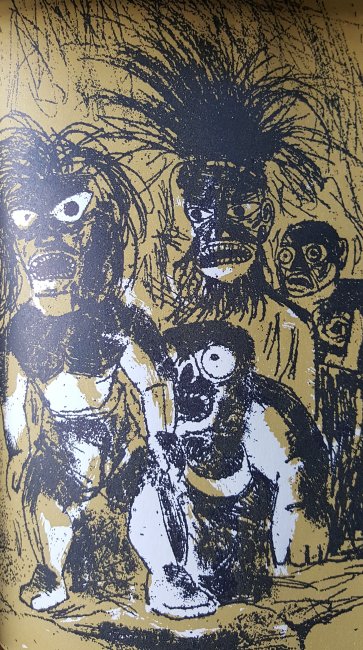
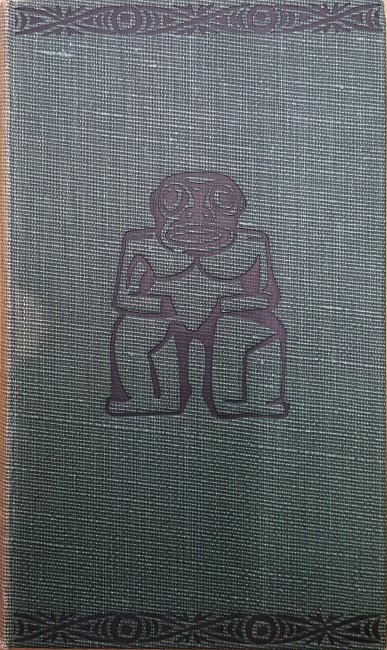
My edition of this book was published by The Folio Society in 1959 and is illustrated by the wonderful Clarke Hutton who also illustrated many of the Penguin and Puffin books on my shelves. At just under twenty nine thousand words it is more of a novella than a novel, although the Folio edition stretches it to 129 pages including a ten page introduction by H E Bates. The story was originally printed in the Illustrated London News and is normally published along with two much shorter stories (The Bottle Imp and The Isle of Voices) under the title of Island Nights Entertainments. The tale concerns the arrival of John Wiltshire to take up his post as a trader on the island to replace John Adams who had died in mysterious circumstances and how he finds out what is really going on.

Large parts of the book, specifically conversations between the Europeans and the natives are written in Pidgin English which can be off putting at first and it is also assumed that you know what several words that Stevenson would have understood actually mean. For example the main product that the trader is there to collect in payment for his goods is copra – the dried white meat of a coconut used to produce coconut oil. He also refers to the natives as Kanaka which is here used as a generic term for Pacific island workers but originally derives from the indigenous peoples of New Caledonia. Coconut is also spelt throughout as cocoanut which is now an archaic spelling.

20190326 The Beach at Falesa 2

On arrival Wiltshire meets another trader called Case who it turns out will be the main protagonist of the story and it is decided that Wiltshire should have a ‘wife’ to look after him on the island and a native girl Uma is tricked into the role by Case. Because she cannot read English the document that she treasures actually reads…

This is to certify that Uma, daughter of Fa’avao of Falesá, Island of —, is illegally married to Mr. John Wiltshire for one week, and Mr. John Wiltshire is at liberty to send her to hell when he pleases.

John Blackamoar.
Chaplain to the hulks.

Extracted from the Register
by William T. Randall,
Master Mariner.

This clearly indicates the contempt that the white people already on the island hold for the natives, Wiltshire, to his credit, quickly regrets the nature of this and when he meets the missionary gets him to do the marriage properly as he realises that he does love Uma.

20190326 The Beach at Falesa 3

One of the main problems with the book to modern readers is the casual racism which was so common at the time the book was written. The natives are looked upon as little more than children, in fact at one point Stevenson makes this explicit

It’s easy to find out what Kanakas think.  Just go back to yourself any way round from ten to fifteen years old, and there’s an average Kanaka.  There are some pious, just as there are pious boys; and the most of them, like the boys again, are middling honest and yet think it rather larks to steal, and are easy scared and rather like to be so.

Having said that Stevenson doesn’t portray any of the white men in a particularly positive way, Case is a particularly nasty piece of work and Captain Randall is a gin sodden wreck. The missionary is a reasonable character but Stevenson (through Wiltshire) makes it clear that he doesn’t approve of the work of the missionaries in the islands.

Stevenson nowadays is regarded more as a childrens’ author, with Kidnapped and Treasure Island being his best known works along with a book I still have from my early library A Child’s Garden of Verses. But this at least is definitely aimed at an adult readership.

Island Nights’ Entertainments is available to read on Project Guttenberg via this link

Relativity – Albert Einstein

20190305 Relativity 1

If you are going to read a book about relativity then why not go for the man who created the theories, after all as Einstein says himself in his preface…

The present book is intended, as far as possible, to give an exact insight into the theory of relativity for those readers who, from a general scientific and philosophical point of view, are interested in the theory, but are not conversant with the mathematical apparatus of theoretical physics. The work presumes a standard of education corresponding to that of a university matriculation and despite the shortness of the book, a fair amount of patience and force of will on the part of the reader.

Consider yourself warned.

The edition I have was published by The Folio Society in 2004 and has an introduction by Emeritus Rouse Ball Professor of Mathematics at Oxford University Roger Penrose.  Einstein originally wrote the book in 1916, just a year after he published his main paper on his General Theory of Relativity and eleven years after he had formulated his Special Theory of Relativity. Originally in German the translation is by Robert W. Lawson and he does an excellent job especially considering the complexities of the subject. Put simply the two theories deal with different things, the special theory is concerned with resolving issues between the laws of electromagnetism (specifically Maxwell’s equations) and those of motion as described in Newtonian mechanics, this becomes especially problematic as speeds approach the speed of light and time ceases to behave the way you would expect it to. The general theory on the other hand deals with gravitation and the forces between bodies caused by this. This is where the concept of warped space-time comes into place and the highly satisfying rubber sheet model which can easily demonstrate the basics of the idea and has become largely familiar to most students over the last century. It should be noted for anyone who watches the video is that the reason that the objects ultimately collide is due to friction between the balls and sheet, without that elliptical orbits would continue as we are familiar with planetary motion so this can only ever be a rough approximation of space-time curvature.

There are two ways of approaching an explanation of the theories of relativity, one book which I read several years ago does it very successfully and that is Why Does E=mc²? (And Why Should We Care?) by Professors Brian Cox and Jeff Forshaw which takes eight chapters and roughly 250 pages (depending on the edition) to cover the subject including the derivation of E=mc². Yes there is quite a lot of mathematics but there is also a large number of diagrams and descriptions in simpler terms in order to expand the readers understanding over a extended period and a short appendix in later editions to add more detail to a section that readers had queried. Einstein takes the other approach, with thirty two chapters over 132 pages (in this edition) so you approach quite complex theories and mathematics in small bite size chunks and you can reread the short chapters until you have grasped the concept being covered. There are also five appendices in a further fifty four pages which go into significantly more detail of the mathematical models and theories underpinning the two theories which are not needed by the casual reader but are there largely for completeness. In his introduction Penrose explains that part of the calculations done by Einstein in the book are no longer done that way as expressing time with a fourth dimensional axis based on imaginary numbers is seen as an unnecessary complexity when it can be done by clocks instead. This negates the need for one of the appendices which deals with Minkowski’s four dimensional space model using the square root of -1, other than as an example of Einstein’s thinking at the time.

There is no denying that some of the chapters can be difficult to get your head around the first time of reading, especially if like me you haven’t done theoretical physics at this level for over thirty five years, but it definitely worth the effort as Einstein gradually takes you through the maths. Starting with Euclidean Geometry (the first chapter which also looks at the concept of ‘truth’ for a mathematical axiom) and then pushing your understanding through relative movement of co-ordinate systems until you hit the Lorentz Transformation less than thirty pages later which gives you the basics needed to understand relativity by comparisons of motion within relative co-ordinates systems.

20190305 Relativity 2

With the introduction of Gaussian co-ordinates later on we can finally approach non-Euclidean geometry, which combined with Minkowski’s four dimensional space leads to the mathematics behind the general theory and warped space-time, which for now is how we understand gravity. The book is complex, but not unreasonably so, and the short sharp sections work as a way for the reader to grasp the overall concept in practical chunks. A century on this work still underpins our understanding of the cosmos and reading this book or the one by professors Cox and Forshaw, whichever you get on best with, is a good way to exercise the brain.

Of course there is still a lot of work to go before physics hits its ultimate goal of ‘the theory of everything’. Relativity is very good at explaining the very large but when you hit the realms of the very small quantum mechanics is just plain strange to the layman and even Einstein for a long time refused to believe most of the concepts behind that branch of physics. I do have a very good book on that subject as well which I will look at later this year.

The Temple of Flora

One of the most ambitious books ever printed was a publishing disaster twice over but also one of the most beautiful books about flowers that exists, even if in far fewer numbers than was intended by either of its publishers.

20190115 temple of flora 1The sheer size of the book can be glimpsed from the clamshell box that my Folio Society edition comes in. The book weighs in at 27½ lbs (12½ kg) so is definitely in literatures heavyweight division and at 22½” x 18¼” (57cm x 46½cm) is a true giant of a volume. The original was the brainchild of Robert Thornton in the second half of the 18th century and it rapidly attracted royal patronage from not just Queen Charlotte (wife of George III) but also her son the Prince of Wales and other members of the British royal family.

20190115 temple of flora 4

He sold it as a subscription edition from 1797 at a guinea per part (roughly £165 in today’s money) and there were planned to be lots of parts and he did keep going for several years. Thornton’s ambition was to create a botanical book that would be a National honour

which in Point of Magnificence is intended to exceed all other Works of a similar Nature on the Continent.

it was never to be finished…

20190115 temple of flora 5

but what he did get produced is magnificent, the flower paintings are of the finest detail and there were plans to have far more than the twenty nine that were ultimately produced before Thornton was driven into bankruptcy by the sheer scale of the venture. It has to be said that the text chosen is odd, lots of long and rambling poems rather than a scholarly text which would have been preferable in my view but it is the pictures that makes this incredible book.

20190115 temple of flora 6

There are long sections of text which presumably were intended to be broken up by the missing paintings but when you do get to the pictures the text doesn’t matter; what is important is the art, and in his way Thornton was trying to match the beauty of the flowers with literature which he perceived as equally beautiful. The fact that to modern readers the poems simply aren’t very good doesn’t mean that I don’t get a huge amount of pleasure from the book even if it is so unwieldy to actually get out and read.

20190115 temple of flora 7

The craftsmanship that went into each painting was unbelievable expensive, Thornton commissioned the best engravers and also used the new techniques of mezzotint and aquatint which allowed a true wash of colour to be reproduced rather than relying on cross-hatched engraving which had been the standard method up to that time. Quite often his artists would use all three techniques on the same plate which vastly increased the cost especially as after printing each print was hand coloured so every page is unique to the volume that it appears in.

20190115 temple of flora 8

You can properly judge the size of the book by the picture above which has a twelve inch (30cm) ruler resting on the open pages. The Folio Society edition that I have is the first time anyone had tried to reprint the book at its original size with all the plates in colour and as I hinted at in the opening sentence even the publishing experts of the Folio Society couldn’t make this book pay. They bought an original edition at auction and took it apart in order to do high resolution scans of each image before finally publishing this massive undertaking in 2008 in a planned edition of 1980 copies. The books were quarter bound in Nigerian goatskin with cloth on board sides with the front cover printed with a design taken from one of the pictures “The Night Blowing Cercus’.

20190115 temple of flora 3

Fortunately for the Society with fine limited edition books like this they bind them as customers place their order as orders did not flow in. Three and a half years later in June 2011 the Production Director wrote to all purchasers of the book explaining that the edition was being cut. Far from 1980 copies just 600 actually got bound and even then they were left with books to sell from the severely truncated limitation. The remaining 1380 sets of flower prints were sold off in a buckram and cloth portfolio as an un-numbered edition. Presumably the remainder of the pages including the five decorative (non floral) plates were pulped.

20190115 temple of flora 2

I doubt anyone will attempt to print this book at it’s original scale ever again. Collins had a go in 1951 but their edition is smaller and only twelve of the plates were colour. The Folio Society edition includes two extra loose plates intending for framing, Tulips and the Egyptian Lily both of which are shown above as they are bound within the book.

The Tempest – William Shakespeare

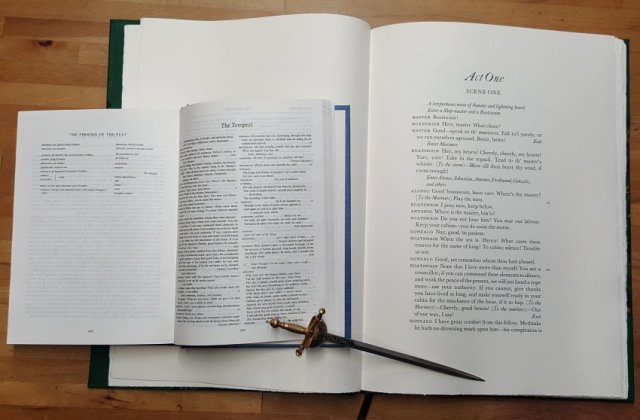
Continuing with my plan to read plays through November, I am now starting The Tempest. I have several copies of this play, partly due to the two complete sets of Shakespeare’s works I have, one of which I covered in an earlier essay, but I also have three copies of the play in individual volumes. One from the Oxford University Press, one by Penguin Books from 1937 and the copy that I have been reading which is the beautiful Folio Society letterpress edition from 2008.

20181120 The Tempest 1

This edition is bound in green goatskin leather, blocked in gold with hand-marbled paper sides and limited to 3750 numbered copies although not all of these appear to have been produced. The book is large (14˝ x 10¾˝ – 35½cm x 27cm) and the pages clear and easy to read. As the Folio Society themselves said about these volumes…

The starting point was the text. Rather than keep text and commentary together, we decided to put them into separate volumes. Out went the elements that clutter the page : footnotes and textual variants. All that was left was Shakespeare’s words.

We decided to have the text printed by letterpress in 16-point Baskerville. The type is set in hot metal and impressed on thick, mouldmade paper. The margins are generous – over 6 centimetres – to allow the words room to breathe.

The result is a simple, understated design that is a delight to read and a pleasure to hold.

Needless to say the books were expensive (£295 per play) but they did set out to produce the finest editions available and the ones I have are amongst the treasures of my library. A comparison between the Folio Society edition and my complete Oxford Shakespeare can be seen below and it’s obvious which is the better to read.

Enough about the book, as Shakespeare himself wrote in Hamlet “The play’s the thing” and this was the last play written by Shakespeare so I’m looking forward to reading it.

The play opens with a short scene set on a ship that is caught up in the eponymous tempest and looks as though it will probably sink. On board is Alonso the King of Naples and several courtiers including Antonio the Duke of Milan, the noblemen are however getting in the way of the seamen trying to save the vessel and frankly are just a nuisance. The rest of act one takes place on the island home of Prospero and his daughter Miranda, during which we find out that Prospero is the true Duke of Milan who was usurped by his brother Antonio with the help of King Alonso.

Prospero has somehow gained magical powers during his exile on the island and with the aid of the sprite Ariel he caused the foundering of the ship but also ensured that all aboard survived. The other occupant of the island is Caliban, the son of the witch Sycorax who is enslaved to Prospero and is described as half man, half beast. Ariel is also in servitude to Prospero but this is because he rescued him from a spell by Sysorax and Prospero has promised that when he regains dukedom so Ariel will be free to go on his way. Towards the end of the first act Ferdinand (King Alonso’s son) finds Prospero and Miranda and immediately falls in love with her, which is clearly Prospero’s plan to try to regain his dukedom.

Act two moves away from Prospero to follow up the other characters in two separate scenes. In the first one the other noblemen including King Alonso assume that they are the only survivors of the wreck although Gonzalo in particular is perplexed by the condition of their clothing which suggests that this was no ordinary maritime disaster.

…Our garments being, as they were drenched in the sea, not withstanding their freshness and gloss, being rather new-dyed than stained with salt water…

…Methinks our garments are now as fresh as when we put them on in Afric, at the marriage of the King’s fair daughter…

Ariel joins the group although he is invisible to them and by means of music causes some to fall asleep leaving Sebastian (Alonso’s brother) and Antonio. Antonio suggests to Sebastian that with Ferdinand dead the only thing stopping him doing what he did to Prospero and taking the kingdom of Naples for himself is Alonso himself who is conveniently asleep at his feet. Sebastian has drawn his sword to kill Alonso when Ariel reverses the charm and the others awake. Sebastian explains the drawn sword by saying he had heard noises and was preparing to defend the king.

The second scene takes us to the last remaining significant characters in the play Trinculo the court jester and Stephano the drunk butler who has managed to salvage a barrel of wine and is happily working his way through it. These two also believe themselves the only survivors and stumble across Caliban who sees them as a means of escaping his slavery by getting them to kill Prospero. His clownish attempts to get them to help him and the drunken antics of the other two are quite funny.

Act three keeps the three groups apart and sees us catching up with them in turn in separate scenes. All three scenes are quite short and we bounce from Ferdinand and Miranda who are now getting on very well and are talking of marriage. Then to Trinculo and Stephano who are convinced by Caliban to attack Prospero but are also now quite drunk and have also introduced Caliban to wine so this plot is clearly going nowhere. Finally the king and his party meet up with Ariel and with Prospero watching and commenting although invisible to the party he can see that his plans are working.

20181120 The Tempest 2

Both of the final acts are short single scene performances and act four sees things moving forward quickly. Prospero agrees to the marriage of Ferdinand and Miranda as they continue to express their love for each other and when they have left the stage he works with Ariel to ensure that the plot hatched by Caliban to get the two drunks to kill him will fail although by now none of the them are in a fit state to do anything sensible.

Finally the fifth act brings everyone together at last, Prospero draws a magic circle on the stage and lures the noblemen into it where he reveals who he really is but decides to forgive rather than punish them. He also reveals that the ship didn’t sink, instead it has been anchored off another part of the island with the crew charmed asleep, these are woken by Ariel and prepare for sailing as soon as possible. It isn’t clear what happens to Caliban, he presumably remains alone on the island but everyone else returns to Naples with Prospero renouncing his magic as he regains his dukedom.

The Tempest is grouped with the Comedies within Shakespeare’s canon however there is nothing particularly comedic about it, it is probably there because it certainly isn’t a History or Tragedy which are the only two other options. The light relief is provided by Trinculo and Stephano during their interaction with Caliban but this, as explained above, is largely self contained within scene two of acts two and three. I’m not a big fan of Shakespeare’s later mystical plays but this made for a pleasant evenings read and I’m surprised that I haven’t got round to reading it before. As usual for a Shakespeare play there are several quotes that have enriched the English language and gone on to be used even by those who don’t know where they were first created:-

Hell is empty. And all the devils are here.

Misery acquaints a man with strange bedfellows.

We are such stuff as dreams are made on

O brave new world

and the probable winner for the worst chat up line of all time is given to Ferdinand

Hast thou not dropped from heaven?

Note: The kingdom of Naples and the duchy of Milan sound odd to us now as Naples in particular appears far too small to be a kingdom, but in Shakespeare’s time both these houses existed. The kingdom lasted from 1282 to 1816 although from 1501 it was effectively a title only as control of Naples passed between France, Spain and Austria depending on which monarchy was in the ascendant at the time. As for the duchy of Milan that lasted from 1395 to 1814 although over the last century of this it was absorbed into the Austrian Hapsburg empire.

Homage to Catalonia – George Orwell

This wasn’t the book I intended to read this week, but my friend and fellow book blogger Mixa in Barcelona (read her review here) saw a copy on my shelves and has tracked down a copy in Catalan so I thought it was probably about time to reread the book after a gap of about twenty years so that it would be fresh in my mind when she wants to talk about it. Nowadays Orwell (real name Eric Blair) is almost entirely known as a novelist and his journalism is largely and sadly neglected. Homage to Catalonia even started out being neglected. It was first printed on 23rd April 1938 and a year later by the start of WWII it had only sold around 900 copies and soon after went out of print. It would only be available sporadically until Penguin Books printed a copy in March 1962, since then it has never been out of print.

20181030 Homage to Catalonia 1

The book tells of Orwell’s experiences fighting in the Spanish Civil War as part of an international militia against the uprising of General Franco and he is very clear that this is the war as he saw it and for the most part it is a very readable account. There are two chapters where he attempts to make sense of the alphabet soup of political organisations and militias taking part and these are prefaced by clear warnings that it is about to get complicated, as shown in the below extract from paragraph two of chapter five…

At the beginning I had ignored the political side of the war, and it was only about this time that it began to force itself upon my attention. If you are not interested in the horrors of party politics. please skip; I am trying to keep the political parts of this narrative in separate chapters for precisely that purpose. But at the same time it would be quite impossible to write about the Spanish war from a purely military angle. It was above all things a political war.

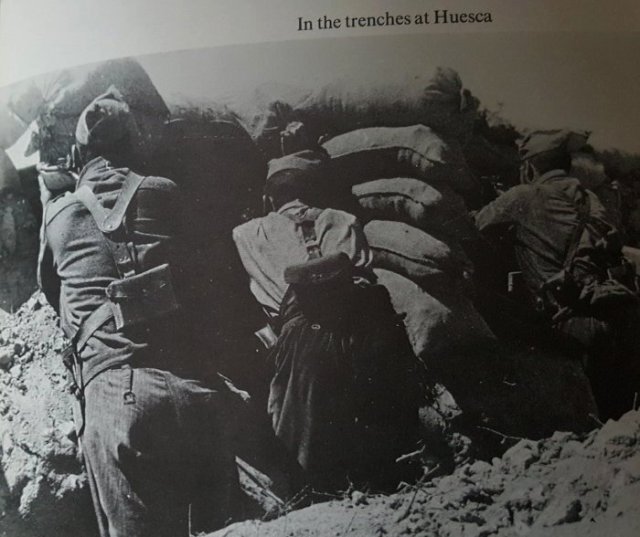
What follows is a section I’m glad I read because I had to keep referring back to it to sort out in my mind the differences and indeed the similarities between PSUC, POUM, FAI, CNT, UGT, JCI, JSU and AIT all of which were political parties or trade unions or possibly both, it does get very confusing, especially as in theory they were all aligned against the Fascists of Franco but seemed to spend most of the time fighting and bickering amongst themselves. This was particularly true during the short lived Barcelona uprising that Orwell got caught up in by happening to be on leave from the front after 115 days and arrived back in the city just before it all got even more complicated. But I am getting ahead of myself lets get back to chapter one with Orwell arriving in Barcelona with his wife, intending to write about the war but actually enlisting as a member of the POUM militia within days of getting there.  His wife Eileen stayed in the Hotel Continental in Barcelona throughout their time in Spain whilst Orwell was fighting on a front line less than 170 miles away. The photo below is by Robert Capa and is part of the John Hillelson Agency collection and shows the sort of trenches Orwell would be in.

20181030 Homage to Catalonia 3

Initially Orwell writes of his surprise on arriving in Barcelona in December 1936 that unions and workers parties had taken over the city and everywhere he saw the red and black flag of the Anarchists who were in control. This appealed to the socialist principles that Orwell espoused and it was probably this that led him to opt to fight for them rather than simply report on the situation. Unfortunately for him later he chose the wrong set of initials to join up with, but as he had said above the internecine politics hadn’t registered with him at first and he effectively just joined the first group that would have him. The first chapter covers the ‘training’ or rather lack of it he received in the Lenin barracks the poor conditions and the largely useless equipment they were issued with, chapter two has him on his way to being posted to the front where he was finally issued with an ancient rifle.

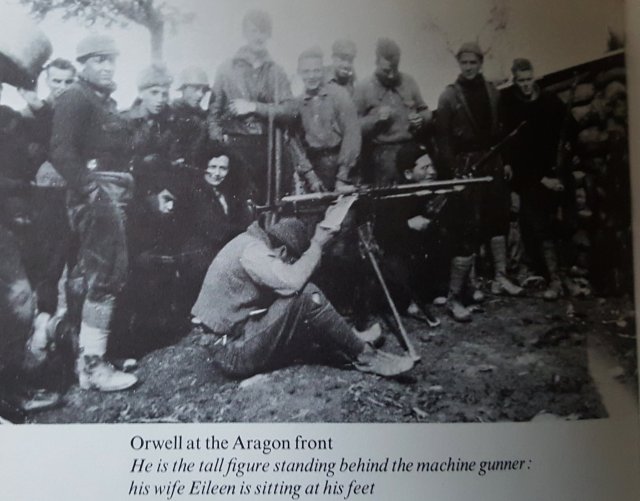
Chapters three and four tell of his time in the trenches above Zaragoza on the Aragon front, a place where the 6 foot 3 inch Orwell was clearly unsuited being head and shoulders taller than his fellow militiamen as can be seen in the photo below from the University College, London collection and reproduced opposite page 65 of my edition.

20181030 Homage to Catalonia 2

The time there was largely one of freezing temperatures, squalor and boredom, the two front lines were so far apart on opposite mountain tops that only by the merest chance could anyone be hit by firing from the opposition. What wounds and deaths did occur were mainly accidents of the sort you get when you hand unreliable weapons to 15 year old boys without showing them how to use them. The real oddity in the photo above though is that Eileen is there so she must have made a trip up from Barcelona although Orwell doesn’t mention her doing so in the book.

After the first of the political chapters, chapter six has him still bored at the front line

Meanwhile nothing happened, nothing ever happened. The English had got into the habit of saying that this wasn’t a war, it was a bloody pantomime.

and reflecting on the effect that the war was having on the local population who were largely trying to live their lives as best they could. In chapter seven Orwell finally sees some action, it was decided to crawl at night across the hundreds of yards of no man’s land and attack the fascist line. It did not go well and although they did get into the enemy trenches they were told to retreat before morning and that would be the only time he faced the enemy in actual combat. Chapter eight is very short and is largely concerned with preparations to go on leave back to Barcelona.

Chapters nine, ten and eleven all concern his badly timed break back in the city. On his return he discovered that the workers revolution had largely petered out and life had returned to a sort of normality with the war something happening in the distance.  However this was not to last long, the tensions between the various groups was about to explode onto the streets and on the 3rd of May fighting began, initially at the telephone exchange but rapidly spreading through the main thoroughfares.  Orwell is caught up in the middle of this but it rapidly becomes as much of a stalemate as the ‘fighting’ on the front. The various factions take up strategic positions and sort of agree amongst themselves to not shoot each other. These chapters for me are the most interesting of the book, the endless boredom of the front is at least improved here by not only the considerably more action but also the shortness of the time scale before it all came to an end.

Chapter twelve sees Orwell return to the front but this was to be for a very short time as he was soon wounded by a shot through the neck which saw him invalided out. By this time he was increasingly disillusioned by the war, what he had seen in Barcelona had convinced him that this was not the great and noble calling that he once thought it was and his choice of POUM was about to become a major problem. Whilst in hospital and then trying to get his discharge papers signed off POUM were picked on as the scapegoat for the fighting in Barcelona and all members were to be arrested and probably shot as traitors. As he describes it this was definitely untrue but it was a convenient fabrication to allow the other factions to re-unite behind. So as well as being wounded he was now a wanted man. In the last two chapters he and Eileen manage to escape Spain and he reflects on his experiences. His conclusions went strongly against the narrative being pushed in the socialist press in the UK which he also heavily criticised and this meant that getting the book published proved difficult as his normal publisher wouldn’t take it.

The book is a fascinating study of the realities of war, the long periods of tedium enlivened by occasional periods of firing from the trenches in the beginning of the book through the difficulties of conflict within a city and is also surprisingly funny in places as he enlivens the tale. All in all it deserves to be better known. When most people think of Orwell what usually comes to mind is 1984 or Animal Farm, try his reportage, it is definitely worth seeking out.

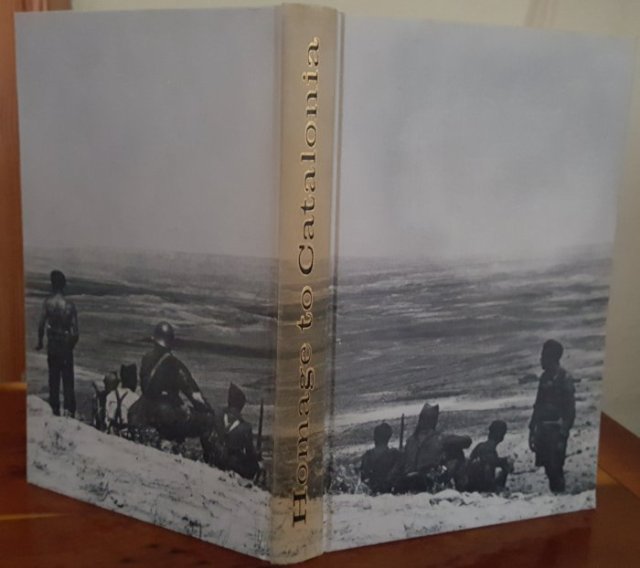
My copy is the 1970 Folio Society first edition which was popular enough to have two further reprints in 1972 and 1975 before dropping out of the Folio catalogue until 1998. It then re-appeared as part of a five volume set of Orwell’s reportage along with “Down and Out in Paris and London”, “The Road to Wigan Pier” and two volumes of journalism and essays. This set has as yet not been reprinted. Although bought second-hand and with a badly sunned spine and grubby covers that don’t want to clean, what I like about this edition is the inclusion of contemporary photographs of Orwell and other people mentioned in the book on the front line. Regrettably not any by Orwell himself because as he explains in the book his camera and photographs were all stolen or impounded along with his notes and press clippings at various different times whilst he was involved in the war. I have reproduced a couple of the photos from the book above. The cover illustration is a view of the battlefield near Belchite on the Aragon front and is from the Fox Photos Ltd collection.

Never Let Me Go – Kazou Ishiguro

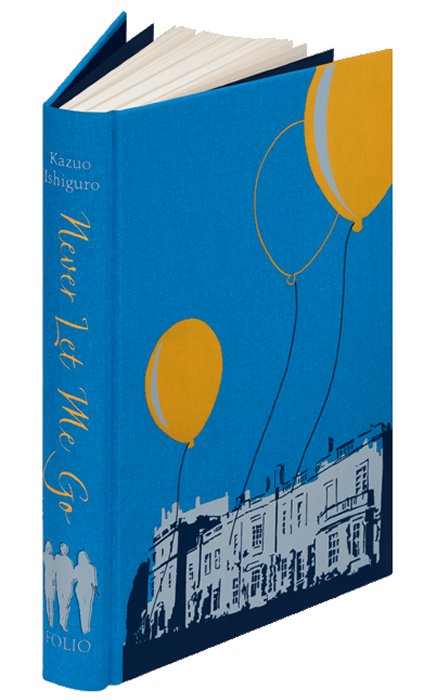
20181016 Never Let Me Go 1

Kazou Ishiguro was born in Japan but moved with his family to England when he was just five years old, as a result most of his novels and short stories are set in England and usually in the past. This allows him to reflect on his adopted homeland from the perspective of a outsider who is also an insider; his parents never expected to stay so long in England so he grew up in a Japanese speaking household even whilst attending English schools and colleges. The Remains of the Day which takes place in a English country house in the 1940’s is probably his best known work and this book is set in the 1980’s and 1990’s so initially it felt like familiar territory. Before starting to read Never Let Me Go I knew nothing about it and made a point (as I usually do) of not reading the introduction to this Folio Society edition so I was coming to the novel with no preconceptions.

20181016 Never Let Me Go 2

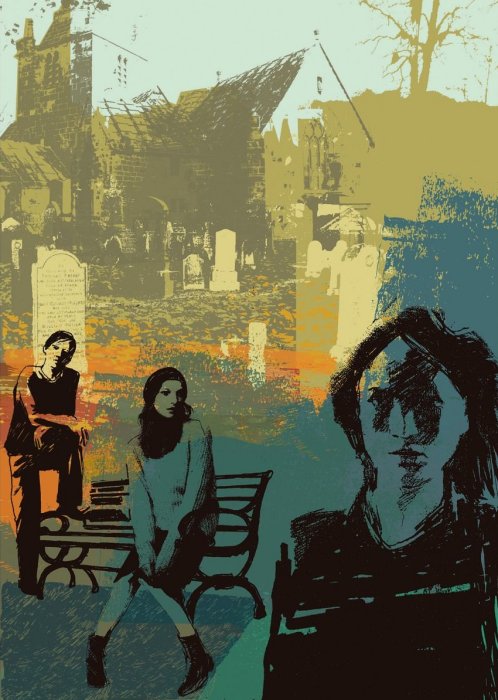
The stark illustrations by Kate Miller set the tone of the book straight away. I now know that this is Tommy and Kathy outside the sports pavilion at Hailsham school in a scene from the first chapter, later on we would be introduced to the other main character, Ruth. The novel is in three parts; the first, and longest section, is set at the school and initially it reads like any novel at a boarding school or it least it would do if it wasn’t for the haunting opening lines of the novel that hint at something that really isn’t right but clearly central to the work.

My name is Kathy H. I’m thirty-one years old, and I’ve been a carer now for over eleven years. That sounds long enough, I know, but actually they want me to go on for another eight months, until the end of this year. That’ll make it almost exactly twelve years.

The second section is set at ‘the Cottages’ an old farm where a group of the students get sent after leaving Hailsham and then the final section deals with Kathy’s time as a carer. The book is written in the first person as Kathy and we follow her reminiscences through her school-days and afterwards, all the way up until we get back to this opening line.  But just what is the role of a carer? Well it will take half the novel before that truly becomes clear and it turns out that I accidentally bought three dystopian novels as part of a block purchase from the Folio Society when I though I only had two. (The Drowned World by J G Ballard, covered last month and The Last Man by Mary Shelley which will be the subject of a later blog).

I’m so glad that I hadn’t read the introduction to this edition before reading the book as it completely gives the plot away and even discusses the highly significant scene near the end of the novel. This unfortunately is a major failing of the Folio Society, their books are lovely but the introductions should really be postscripts.  This review won’t go into too much detail about the plot simply because I want any reader to come at the novel fresh as I did and discover slowly through the hints that get more specific as the book progresses just exactly what is going on and if you haven’t read the book I really do recommend it and you don’t need to get the Folio edition, it is readily available in paperback.

The school sounds like a typical English Public School (that is private for the rest of the world), although gradually you realise that year eight are actually only eight years old, so is it some sort of orphanage? Ishiguro’s master stroke in the novel is just how slowly he lets the reader into the reality of the situation, even the students don’t know what the place is really about but there are dark hints. A bit later on it becomes clear that they cannot leave the site and have virtually no contact with the outside world other than the mysterious Madame who visits occasionally and takes away their best artworks; all very odd.

20181016 Never Let Me Go 3

The picture above is from a scene at the Cottages, Tommy and Ruth are now a couple, with Kathy feeling like an outsider and it is by now obvious most of what is going on although why is still a significant question and this wouldn’t be fully answered until the penultimate chapter. My theory at this point was largely correct but I had anticipated the final twist as to why they are there however without doing exactly what I criticised Claire Messud for in her introduction and giving away too much this is about as far through the plot that I can go.

Kazuo Ishiguro won the Nobel prize for literature in 2017 with a citation  “who, in novels of great emotional force, has uncovered the abyss beneath our illusory sense of connection with the world.” and this book certainly fits that description.

The Drowned World – J G Ballard

20180918 The Drowned World 1

This week I’ve been reading one of the classic dystopian novels; and a very early book to take the theme of climate change as it was written in 1962. The edition I have was printed by the Folio Society  in 2013, bound in full buckram and beautifully illustrated by James Boswell who also created the design blocked onto the cover in reflective metallic copper and gold ink. The copper coloured endpapers continue the bright design so appropriate for a book about the burning sun beating down on a flooded planet.

J G Ballard is best known for his apocalyptic stories where the world is viewed after a catastrophe, “The Drowned World” is his second novel and is preceded by “The Wind From Nowhere” where extreme winds are destroying the Earth and followed by “The Burning World” where pollution in the oceans eventually gets to such a level that it blocks the precipitation cycle leading to no more rain and deserts everywhere. “The Drowned World” is a novel about the aftermath of runaway global warming, the ice caps have melted flooding most of the rest of the world, and humanity has largely retreated to the Arctic zones. Dr Robert Kerans and his older colleague Dr Alan Bodkin are biologists attached to a military expedition tasked with exploring the drowned cities however it has become clear over time that the charts they have produced are going to be no use as the heat is just increasing so mankind will never recolonise the majority of the planet. The temperature in flooded London is well over 40 degrees centigrade by mid morning and the afternoon heat is unbearable. Kerans and Bodkin hatch a plan to stay behind when the expedition is due to leave; along with the enigmatic Beatrice Dahl who is still living in the penthouse that belonged to her parents.

20180918 The Drowned World 2

They are all having strange dreams about the sun and a desire to head south into the increasing heat without clearly understanding why this urgent need has overtaken them. The other members of the unit are also having the same dreams and this is one of the factors that leads the commander to decide to leave sooner than originally planned.

The London that the three characters are left in when they do elude the journey north is rapidly regressing to a revitalised Triassic period with giant iguanas, huge bats and insects recolonising the swamps and flooded lagoons of what was once the squares and thoroughfares of the city. Kerans has taken to living in the top floor suite of what was once The Ritz, Bodkin scuttled the science station over the top of The Planetarium, presumably the one in Greenwich, whilst Beatrice remains in her suite and here they are planning on lasting as long as they can until the fuel and food finally runs out after when they will abandon London and head south as their dreams are calling them.

The writing style is sparse almost lethargic and matches the slowness of the characters as the heat forces the them to do less and less and just reduce their lives to sleep and short expeditions to occasionally visit each other. The washed out illustrations by James Boswell also match this sense of oppressive heat as the reader gets drawn into this world. Mankind is losing, the planet is returning to a more primitive state and it is implied that so is man.

Of course it is all going to go wrong and halfway through the book it does and a heightened level of horror is injected into the book which carries us to the inevitable denouement as the characters mental states slowly collapse. It’s a brilliant book, Ballard wasn’t really appreciated in his own lifetime although since his death in 2009 his works are becoming more and more respected but as he himself said

For a writer, death is always a career move

Under Milk Wood – Dylan Thomas

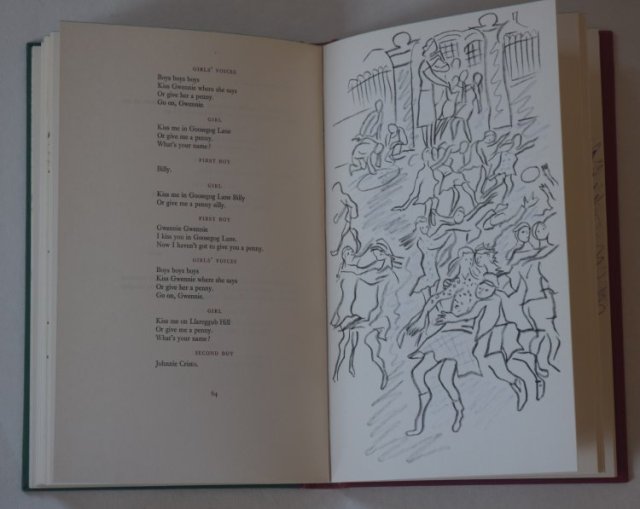
20180515 Milkwood 1

Yesterday was International Dylan Thomas day and marked the anniversary of the first ever performance of the great Welsh poet’s final work; Under Milk Wood. This show on 14th May 1953 was also the only time Thomas was recorded on stage giving any sort of performance of the work and sadly he was to die before the classic BBC recording starring Richard Burton was broadcast on the 25th January 1954. I have the vinyl recording of that original performance and it is playing now as I type this with Thomas’s distinctive voice taking four parts, that of 1st voice, Reverend Eli Jenkins, 2nd drowned and 5th drowned. The rest of the cast are Dion Allen, Allen F Collins, Roy Poole, Sada Thompson and Nancy Wickwire and between them they play the remaining 50 parts.

The recording was more accidental than intentional, there was a recording scheduled for 1954 with Caedmon but Thomas’s death prevented that happening. However somebody left a tape recorder at the front of the stage with the microphone probably nearer to Thomas than the other cast members mainly for their own use to record the first performance. As a single microphone on a device intended for amateur recordings it does remarkably well in picking up not only all the actors but also the audience and has left us with  a remarkable historical record. Caedmon therefore used this for their release of Under Milk Wood. The New York audience clearly didn’t know what to expect from this Welsh poet and you can hear them gradually realise that it is intentionally funny and the way the actors bounce partial sentences between themselves gives a delightful rhythm to the blank verse.

Under Milkwood is subtitled ‘A Play for Voices’ which sounds an odd description until you realise that it was intended to be a radio play for the BBC so there are no stage directions, it was always intended to be read by the cast not acted.

20180515 Milkwood 2

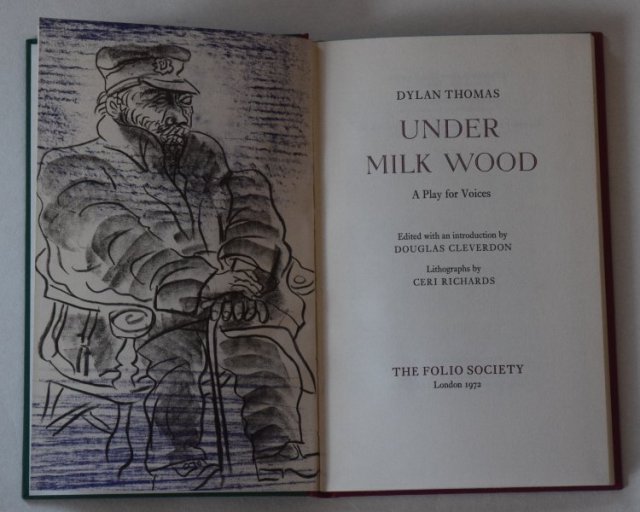
My printed copy is the 1972 Folio Society first edition of the work and, as usual for Folio, it is a lovely edition. It restores the text back to the original broadcast script with some extra lines which he left out originally, probably due to running time, added as an appendix. Although Thomas did deliver the script to the BBC he was still fiddling with it up to his death as he gave various readings in an attempt to earn enough money to pay off his debts, specifically a large back payment owed for income tax. So the typescripts are full of corrections and amendments and he never did come to what he regarded as a satisfactory conclusion to the piece, which had always been rushed as he only finished the ending included on the album minutes before they started the performance and kept changing this at subsequent performances.  As Douglas Cleverdon (the BBC producer of the 1954 broadcast version) notes in his introduction to the Folio edition.

Two stage readings of Under Milk Wood were scheduled for 24 and 25 October at the Kaufmann Auditorium, New York. Under a mixture of alcohol, sleeping pills and cortisone drugs, Dylan was already in a near state of collapse. He managed to write another page for the closing sequence of the script; to take part on the two readings, and to edit a shortened version for publication in the American magazine Mademoiselle. On 5 November he was taken to hospital in a coma, and died four days later.

If he had survived the play would undoubtedly have been further amended, on the back of one page of the manuscript is a section entitled “More Stuff for Actors to Say” and there are parts of the Caedmon recording that were subsequently removed so it was definitely still a work in progress at least as far as Thomas was concerned even after he had submitted the ‘final version’ to the BBC.

20180515 Milkwood 3

One final thing that should be mentioned is the setting of the play in a small Welsh village of Llareggub. This has the advantage of looking like a Welsh place name without being one, you don’t get a double g in Welsh. However anyone looking closely at the name and especially if you spell it backwards will see that here is another joke by Dylan Thomas. For this reason early editions of the script spell the village differently and even the Caedmon recording uses Lareggub when referring to the place in the notes. The fantasy author Terry Pratchett paid homage to Dylan Thomas when he named the equivalent of Wales on the Discworld Llamedos.

You can hear the first part of the performance I’m listening to on youtube here  It starts with Thomas as First Voice setting the scene.