Conrad’s Congo

In 1890 naturalised Briton, although Polish born, Captain Józef Teodor Konrad Korzeniowski left England to take command of the steamship Roi des Belges on the River Congo. He had gained his Master of the British Merchant Marine certificate four years earlier and had had a previous command of a ship called the Otago but this was to be his most significant position, at least as far as it’s mark on his later life. He had begun his maritime career back in 1875 as a trainee seaman on the barque Mont Blanc and had worked his way up the ranks on various vessels over the following years and hoped this would be a stepping stone to command of larger ships but it wasn’t to be. Amongst the possessions he took with him for an expected 3 years away in the Congo was a manuscript for a novel he was working on and it was this, along with the ill health that followed his African adventure that largely kept his away from future seagoing, would make the name of Joseph Conrad. ‘Almayer’s Folly’ was published in 1895, 15 months after he left his final marine post and a stream of novels and stories were to follow including the novella ‘Heart of Darkness’ based on his time in the Congo and published in 1899.

Although I will refer to Heart of Darkness several times during this essay, the book that has prompted me to write is ‘Conrad’s Congo’ published by the Folio Society in 2013 which gathers for the first time in one volume letters and diaries by Conrad relating to his ill-fated trip, along with the short story ‘An Outpost of Progress’ which also draws on his time in Congo. The book is bound in cloth blocked with a design by Neil Gower of the Roi des Belges steaming along the Congo. At 256 pages it is more than twice the length of Heart of Darkness and includes some fascinating contemporary photographs.

20180501 Conrads Congo 1

The Congo at the time was being run a private fiefdom by King Leopold II of Belgium and the astonishing cruelty against and exploitation of the people there was without parallel even amongst other colonies. It only started to be reigned in after the report into what was happening there by Roger Casement became public and eventually the Belgian government stripped Leopold of his autocratic control. It is estimated that of Congo’s 20 million population in 1880 this was roughly halved by 1920 mainly from famine and disease as all able bodied people were forced to work collecting ivory, rubber or other commodities to enrich Leopold meaning there was nobody to hunt, fish or plant crops. Part of Casement’s report is included as an appendix to the book and makes disturbing reading even though I already knew some of the background.
20180501 Conrads Congo 2

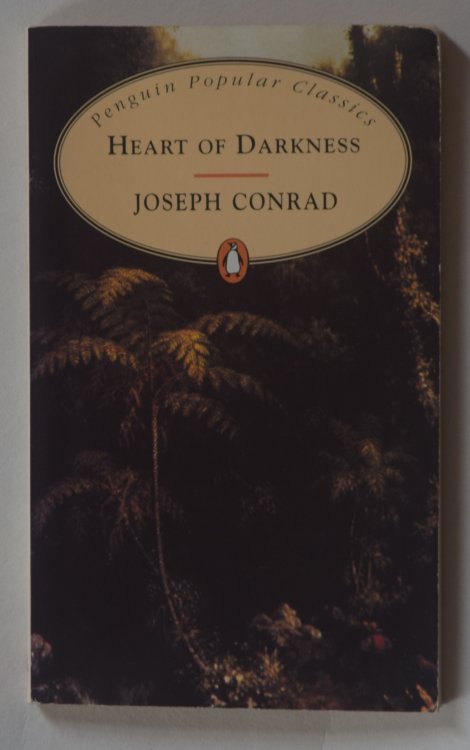
The cover of the Penguin Popular Classics edition  of Heart of Darkness was chosen by somebody who wanted a dark jungle view but managed to select not only the wrong country but even the wrong continent as the painting is a detail from Hunter in Brazilian Jungle by Marrin J Heade, so the plants growing are completely wrong for Africa.

Conrad’s Congo starts off with a series of letters initially with Albert Thys, deputy director of the Belgian Company of the Upper Congo as he tries to get a job with them then moves on to letters to his distant cousin (although referred to as uncle in the letters) Aleksander Poradowski then living in Belgium and when he dies soon after this correspondence starts the letters continue to his widow Marguerite (written to as aunt) and it is she that helps get him the captaincy he is looking for. In Heart of Darkness this is fictionalised in the tale told by Marlow (a thinly disguised Conrad) in which he says

“I am sorry to own I began to worry them. This was already a fresh departure for me. I was not used to get things that way, you know. I always went my own road and on my own legs where I had a mind to go. I wouldn’t have believed it of myself; but, then–you see–I felt somehow I must get there by hook or by crook. So I worried them. The men said ‘My dear fellow,’ and did nothing. Then–would you believe it?–I tried the women. I, Charlie Marlow, set the women to work–to get a job. Heavens! Well, you see, the notion drove me. I had an aunt, a dear enthusiastic soul. She wrote: ‘It will be delightful. I am ready to do anything, anything for you. It is a glorious idea. I know the wife of a very high personage in the Administration, and also a man who has lots of influence with,’ etc. She was determined to make no end of fuss to get me appointed skipper of a river steamboat, if such was my fancy.

Six months after approaching Thys, Conrad had his job and his letters to his ‘aunt’ continue through his voyage to the Congo talking about the trip but also his first impression of colonial Africa as he works his way along to coast encountering French ships. The letters hint at a growing romantic link between the two as the tone becomes more playful such as might be written between two lovers separated by distance. On arrival at Matadi he finds that the Roi des Belges is 200 miles away and there is no way to get there up the river due to the rapids between the coast and the station where the ship awaits him so Conrad is forced to walk to his boat and this is covered in ‘The Congo Diary’ which makes up the next section of the book. It is in this short work where he meets Roger Casement and we first read of the casual cruelty inflicted on the natives and hints as to the fate of the majority of the colonialists.

On the road today passed a skeleton tied up to a post. Also white man’s grave – no name. Heap of stones in the form of a cross.

The short Congo Diary is immediately followed with ‘The Up-river book’ which covers his first trip on the Roi des Belges and is largely technical notes presumably to assist him in future trips such as this part of the entry for the 3rd August 1890.

Always keep the high mountain ahead crossing over to the left bank. To port of highest mount a low black point. Opposite a long island stretching across. The shore is wooded –

As you approach the shore the black point and the island close in together – No danger – steering close to the mainland between the island and the grassy sandbank, towards the high mount.

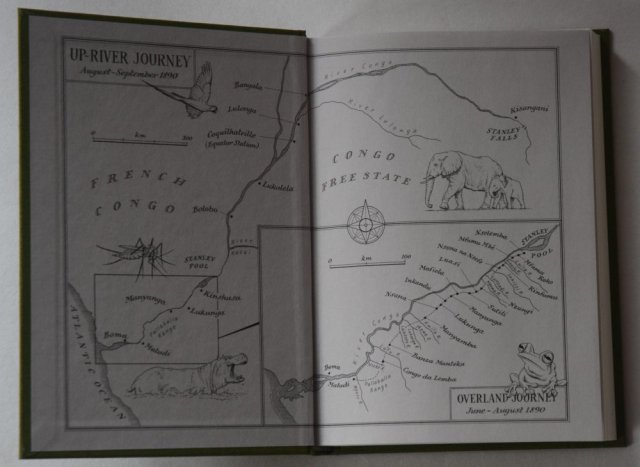
There are also numerous sketch maps of sections of the river which are also included in the Folio edition. The endpapers of this book have maps for both The Congo Diary and The Up-river Book so that you can follow the journeys.
20180501 Conrads Congo 3

Unlike in Heart of Darkness where Marlow on having walked to his boat just as Conrad did, the Roi des Belges was clearly ready to sail as they set off a couple of days after he arrived. In the story Marlow found his ship had sunk a few days earlier so was obliged to spend many months getting it out of the water and repaired before they could do anything. The enforced break affords Conrad the chance to set up his plot for the rest of the story and also to make various observations about the conditions the natives are under. In reality he was off from Kinshasa to Stanley Falls almost immediately. This section of the Folio book is frankly not very readable and in truth was not intended to be so as it is really just notes on the route to avoid the numerous sandbanks and rocky snags that litter the river. Conrad’s sketch maps are interesting with their dotted lines indicating the correct path between islands especially the long section dealing with the clearly complicated Lulanga river passage, this takes 7 maps and several pages of notes to get through so it must have had a justified reputation for difficulty in navigation.

At the end of The Up-river book we are back to a small section of correspondence as letters have caught up with Conrad at Stanley Falls. One of these is highly significant as the letter to Marguerite includes the first mention that he has been very ill with dysentery as well as fever (malaria) and that there is a mutual dislike between him and the manager of the station he is based at so there is little hope of any advancement in his career. It is quite clear from the letter that the manager of the station that Marlow finds himself at is modelled on the real Monsieur Delcommune. This is how Marlow describes him..

He was commonplace in complexion, in features, in manners, and in voice. He was of middle size and of ordinary build. His eyes, of the usual blue, were perhaps remarkably cold, and he certainly could make his glance fall on one as trenchant and heavy as an axe. But even at these times the rest of his person seemed to disclaim the intention. Otherwise there was only an indefinable, faint expression of his lips, something stealthy–a smile–not a smile–I remember it, but I can’t explain. It was unconscious, this smile was, though just after he had said something it got intensified for an instant. It came at the end of his speeches like a seal applied on the words to make the meaning of the commonest phrase appear absolutely inscrutable. He was a common trader, from his youth up employed in these parts–nothing more. He was obeyed, yet he inspired neither love nor fear, nor even respect. He inspired uneasiness. That was it! Uneasiness. Not a definite mistrust–just uneasiness–nothing more. You have no idea how effective such a… a… faculty can be. He had no genius for organizing, for initiative, or for order even. That was evident in such things as the deplorable state of the station. He had no learning, and no intelligence.

The last letter in this section is to the publisher Thomas Fisher Unwin who was acting as Conrad’s literary agent and mentions the short story ‘An Outpost of Progress’ based on his experience at the station which makes up the next section of the Folio volume.

20180501 Conrads Congo 4

Conrad would be invalided out of the Congo by the end of 1890 to the relief not only to himself but also to Delcommune who wanted rid of him, and never recovered his health. Malaria is one of those persistent diseases that keeps flaring back up and it would afflict him several times back in England. The remainder of the Folio book is letters he sent long after his return, including 3 to Roger Casement at the end of 1903 just before the Casement report was published in February 1904, along with extracts from articles he wrote, followed by 2 appendices. The first of these is a series of five short testaments about Conrad written by people who met him including John Galsworthy and Bertrand Russell and then finally the extracts from Casement’s report that was mentioned earlier.

All in all a fascinating book which gives an insight into the creation of Heart of Darkness and which even if you have never read the novella provides an overview of the awful situation in the Congo under Belgian control and it should be recommended if only for the historical record.

First Folio: 1

Mention the words First Folio to most book collectors and their initial thought will go to the first collection of Shakespeare’s plays printed in 1623; and indeed I will come to that in a later blog as I have a copy of the Norton facsimile. Hence this essay being entitled First Folio: 1, the facsimile will be covered in First Folio: 2 in a few weeks time.

So what is this one about then? Well in 1946 after being demobbed from WWII Charles Ede was looking for a way to make a hobby into a career. He had discovered the beauty of the pre war private presses whilst still a schoolboy, publishers such as William Morris and the Kelmscott Press. During the war he had started a collection of Kelmscott, Nonesuch and Golden Cockerel Press fine editions but these really were the preserve of the book buyer with a significant disposable income and well beyond the means of most people. What he had spotted was what he believed was a gap in the market, even if his friend, Christopher Sandford, then running The Golden Cockerel Press thought the gap was too small for anyone to make a business from it. What if somebody could print fine editions of books but at a price that more people could afford? In a quote I particularly love as it ties my two largest book collections together Sandford said

But life is full of wonders, and people like you do get away with things – like Lane and his Penguins – so thumbs up.

So Ede went for training at the London College of Printing and by October of the next year The Folio Society was born.

20180320 First Folio 01

The first title was a collection of short stories by Tolstoy, my copy has some damage to the dust jacket where somebody has clearly put a cup down on it but as you don’t often come by Folio’s first book with dust jacket I added it to my collection nevertheless. The tales included are:

  • The Raid
  • Two Hussars
  • Three Deaths
  • Polikushka
  • Two Old Men
  • The Death of Ivan Ilyitch

The idea was that books would be published at the rate of one a month and sold through standard booksellers, neither of which turned out to be the case. The first few titles did get sold that way but the retailers weren’t really interested in a new small publishing venture, so building on the idea of the Society part of the name Charles Ede by the end of 1947 decided to turn it into a club and sell only to members which added to the exclusive aspect of the books.


The first few years were hard and the Society survived by doing other things beyond the original plan such as private editions and selling manuscript pages along with fine art prints but slowly the subscriber base grew especially when the concept of a free presentation volume for members who agreed to purchase a minimum number of books each year was introduced in 1950.

To be frank part of the problem with the early years was that because of the ongoing paper rationing and the quality of what was available the first few books are not as good as Ede wanted, this is particularly clear with Tales by Tolstoy which was printed in Belgium to get round the shortage of paper but the actual printing as Ede himself noted in 1968 in the first Folio bibliography ‘Folio 21’

The printers, who only undertook the job as a favour, were not used to this type of work and the standard leaves a good deal to be desired.

20180320 First Folio 04

and as the above illustration from Three Deaths illustrates it really isn’t that good, the picture appears to be over-inked and lacks the lightness of touch that a line-blocked pen and ink sketch would have in later years. The paper also feels rough and not what you would expect from a fine edition.

The Folio Society did however manage to get out a total of three books in 1947 so the equivalent of one per month, something they were not to manage regularly until 1955 with 13 volumes and have never dropped below 12 in a year since then. The second was Trilby by George du Maurier which also became the first book from the society to be illustrated by the author, something that is still a rarity today.

20180320 First Folio 05

This book was much better quality than the Tolstoy edition, although also printed by Brepols in Belgium, and contains a 5 page appendix which prints for the first time in book form a section of the book which clearly describes the painter James Whistler and was presumably left out of earlier editions for legal reasons. The drawings by du Maurier are reproduced very well, this one is entitled ‘the soft eyes’

20180320 First Folio 07

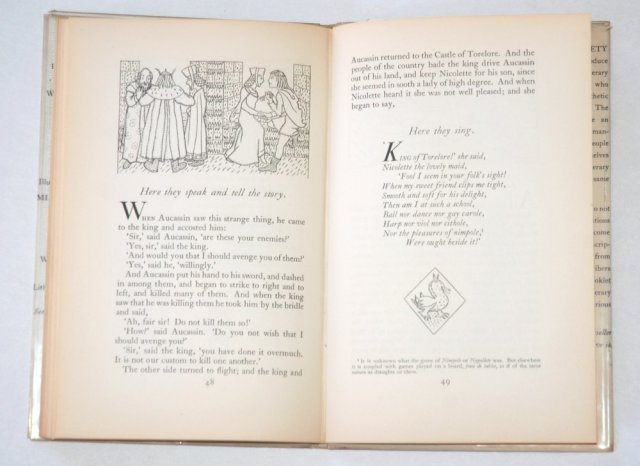
The first Folio Society book to be printed in the UK was book number 3 Aucassin & Nicolette, translated from Old French by F.W. Bourdillon and this was a real oddity. The first two books were traditional editions in paper dust jackets, this is a lot smaller at 8.9 x 5.8 inches (226 x 148 mm) and the jacket is transparent plastic printed in black with the title and illustrator information.

20180320 First Folio 08

The plastic wrapper has often got lost over the years or the text rubbed off, mine is in very good condition, the poor appearance in the photograph is due to glare off the plastic. The black print on the slippery plastic continues on the inside of the wrapper and again is prone to damage.


The title page gives a feeling of the book which is my favourite of the first three and gives the first real hint of Folio as a fine press publisher, at 10s 6d it cost the equivalent of just over £20 today which for a 60 page book is quite a lot but it is a lovely edition. The printer was the Chiswick Press who would go on to print many editions for Folio.

20180320 First Folio 11

What is noticeable to those people familiar with the production of the Folio Society today is that books all have dust jackets, the familiar slip cases did not become standard until 1959 although they had started to appear in 1956 and dust jackets were still used throughout the 1960’s although mainly for the subscribers presentation volume.

These three books in my collection are all first editions in Folio, in fact none of them were ever reprinted, the first book to make it to a second impression was Shakespeare’s Sonnets, originally printed in 1948 and reprinted 3 times in the next 42 years before being replaced by a completely new edition.

Last year the society reached it’s 70th birthday and a couple of years before that finally abandoned the membership concept that served it so well along with the idea of a free presentation volume other than the occasional diary or notebook to encourage buyers to spend more. Nowadays the website is open to everyone and you can just have one book if that is all you require. At the last count I have over 425 Folio books and still happily add more each year, the only years where I don’t own at least one example of that years publications are 1967 and 2006, so beware the Folio Society is definitely addictive…

Robert Hooke’s Micrographia

2nd January 1666

Thence to my bookseller’s and at his binders saw Hookes book of the Microscope which is so pretty that I presently bespoke it.

20th January 1666

so to my bookseller’s and there took home Hookes book of Microscopy, a most excellent piece, and of which I am very proud.

21st January 1666

Before I went to bed I sat up till 2 a-clock, in my chamber reading of Mr Hookes Microscopicall Observations, the most ingenious book that ever I read in my life.

I have to agree with Samuel Pepys, I have added this book to my library in the last week and like the celebrated diarist I have spent hours late into the night reading and looking at the wonderful illustrations. It is hard to imagine just how revolutionary a work it was in it’s time, nobody had seen anything like it before. Very few people had access to a microscope and very little had been printed with illustrations of what you could see with the use of one. Micrographia was the first book published by The Royal Society, just three years after the society had been granted it’s royal charter in 1662 making it the oldest scientific academy in the world. Pepys had become a fellow of the society on 16th February 1665 so knew Hooke and would have been well aware of the book before publication.

Now it may seem odd to write a review of a book that came out over 350 years ago but the edition published by The Folio Society is the first high quality version printed in the last 200 years and reproduces in full size the original plates including large fold out pages that are up to 2 feet (60cm) across. The book is consequently large at 13½” × 8¾” (34.3cm x 22.2cm) and quarter bound in leather. The cover is printed on cloth and based on the eye of a grey drone fly and was designed by Neil Gower.

20180305 Micrographia 1

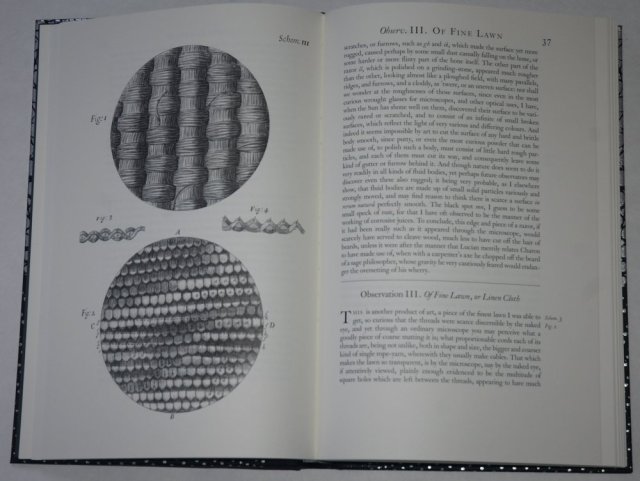
Inside the illustrations are the first thing to catch your eye but then the text pulls you in. Although this is primarily an important, and in its time ground breaking, scientific work Hooke wrote for the interested layman and even after all these centuries it is still an engaging story. Instead of just describing the illustrations he explains why and how he came to look at them in the first place, you get his first impressions and you can share in his sense of wonder at what is revealed.

20180305 Micrographia 2

A study of a piece of cloth to reveal the weave, the end of a pencil, a needle, nothing is beyond his inquiring mind and everything he looked at and wrote about was new to the reader who would not have had access to anything like this before.

20180305 Micrographia 3

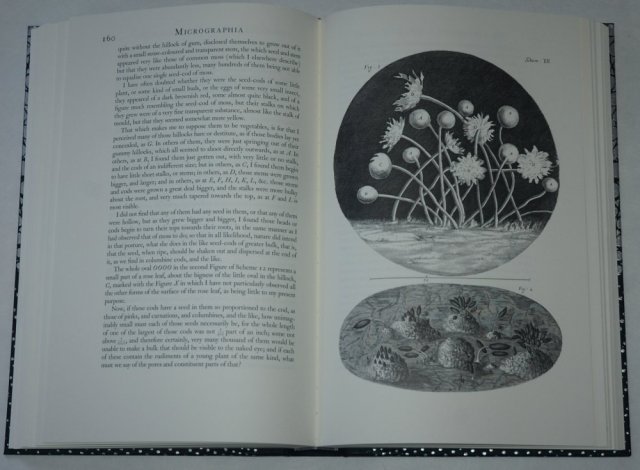
The picture above is of the black spots on the leaves of the rose bushes in his garden. To his surprise these turned out to be ‘tiny plants’ growing on the leaves themselves. Nowadays we understand what he is looking at but the text explains his reasoning that this is some sort of mould and the next thing he then examines is a blue mould on a book bound in leather from a sheep to see if his premise is valid. You learn with Hooke and it’s no surprise that Pepys found the book so fascinating.

20180305 Micrographia 4

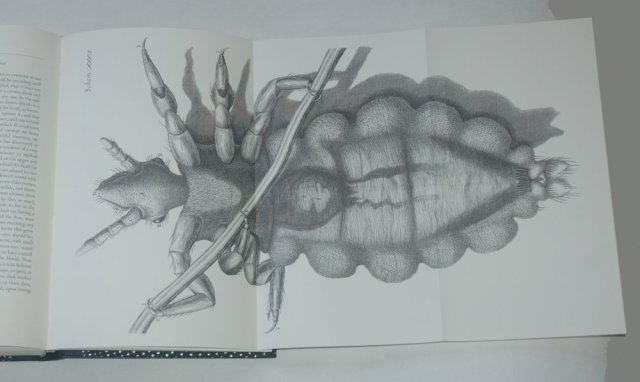
The large fold out plates are possibly the most famous pictures in the book and The Folio Society have reproduced pages from original 1st and 2nd editions (whichever were the best examples) held in the Bodleian Library in Oxford. There is also a small section at the end where Hooke turns his attention away from the very small to the very large and includes some observations he made with a telescope including an early map of part of the moon.

20180305 Micrographia 5

It really is a joy to own and read this book, which was published in 2017 in a limited edition of just 750 copies, mine is number 635. Whilst I love the normal production of The Folio Society and have over 400 books printed by them; it is their limited editions that are their crowning glory. Printed on the finest paper and treated as a work of art in their own right these books are rightly regarded as something special and Micrographia was the winner of the “Scholarly, Academic and Reference Book” category at The British Book Design & Production Awards 2017. A fantastic addition to any library.

There is a video of the book from The Folio Society on YouTube which  gives a better idea as to the size and beauty of this amazing work and this makes an interesting comparison to a video from The Bodleian Library about their first edition.


The Original Alice

Almost everyone knows the children’s tale Alice in Wonderland by Lewis Carroll either having read the book, or seen or heard, one of the many adaptations over the years.  Most readers will know that Alice was a real person, one of the daughters of Henry Liddell, dean of Christ Church college at Oxford and the stories were told to entertain her and her sisters.  They will also know that Lewis Carroll was really the reverend Charles Lutwidge Dodgson, a 24 year old mathematics lecturer at Christ Church when he first met the Liddell’s. But what is less well known is that when the stories were first written down they were intended to just be a one off book as a gift to Alice and the title was Alice’s Adventures Under Ground.

20170116 The Original Alice 4

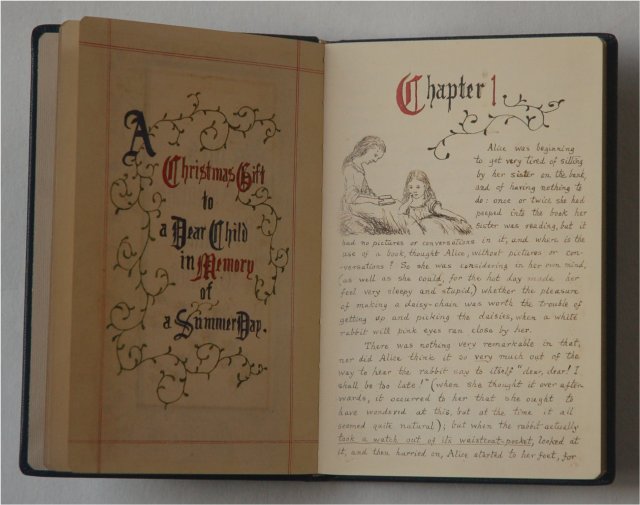
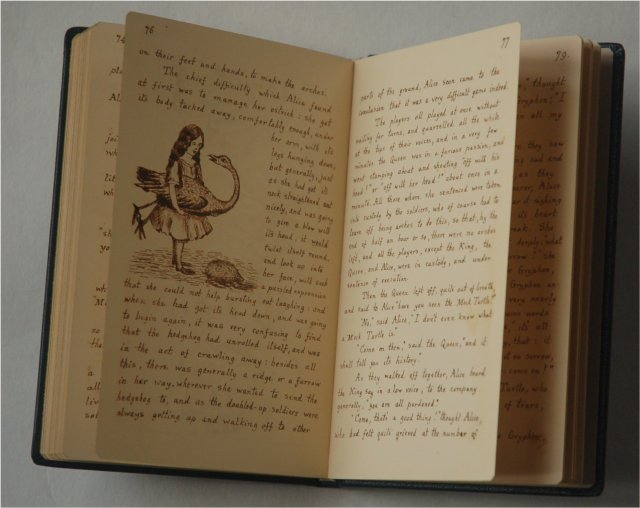
The book was handwritten and illustrated by Dodgson and was given to Alice for Christmas in 1864 when she was 12 years old, although he originally came up with most of the story when she was 10 on a trip up the river for a picnic. Alice treasured the little book for decades but eventually in 1928 at the age of 75 and now a widow needing money she sold it at auction for £15,000 (approximately £860,000 today). The book was bought by Dr Rosenbach, who was an American book dealer, and he subsequently sold it in the US.   The private collector who owned it died in 1948 and the book was again put up for auction this time making $50,000 (roughly $508,000 or £363,000 nowadays) and Dr Rosenbach was the top bidder at this auction as well.

20170116 The Original Alice 5

This time however was to be the last time it will ever come to the market. Several American benefactors led by book collector Lessing Rosenwald obtained the book in order to give it to Britain in thanks for the gallantry of the British people during the Second World War.  In November 1948 the book was brought on the liner The Queen Elizabeth across the Atlantic and presented to the British Museum with the Archbishop of Canterbury representing the country by receiving it.  The book is now part of the national collection (catalogue ref MS 45700).

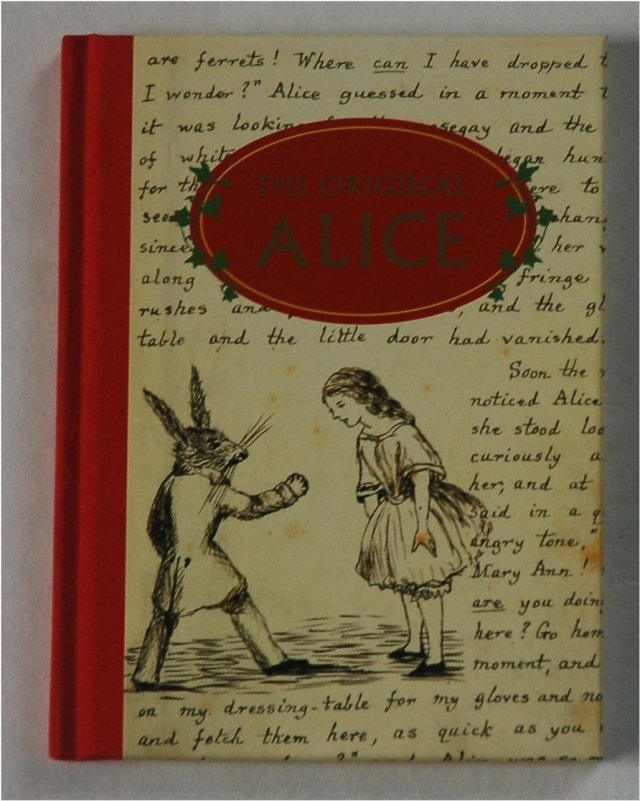
In 1997 The British Library published a book by Sally Brown entitled The Original Alice, which now sadly out of print but fairly easy to find on the second hand market.  This tells the story of how Alice came to be written and compares Alice’s Adventures Under Ground to Alice in Wonderland with examples as to how the books differ.

20170116 The Original Alice 1 The illustrations of the original book included here are from another out of print edition, a beautiful leather bound facsimile of the original produced in a limited edition run of just 3750 copies by the Folio Society in 2008, this is somewhat more tricky to track down but it is a beautiful thing to own and read.  It comes in a lovely box with a ribbon to lift the book out with.


Although he never intended publication Dodgson did pass the book to his friend, the children’s novelist George MacDonald, to cast his professional eye over, before giving it to Alice. MacDonald’s children so enjoyed the book that Dodgson was eventually persuaded to publish.  He significantly rewrote the tales, removing a lot of references that only really made sense to the Liddell family and adding Pig and Pepper along with The Mad Tea Party. These additions and revisions to the original text almost doubled the length and took the book up from 18000 to 35000 words.

Alice’s Adventures in Wonderland was finally published in November 1865 in an edition of 2000 copies but in a final twist these were withdrawn as the illustrator, John Tenniel, was unhappy with the quality of the reproductions of his pictures.  This makes the handful of copies that still exist one of the rarest of all children’s books.  The book was finally available to the public in 1866 and was an immediate success.  Alice’s Adventures Under Ground has been printed several times in the intervening 150 years but only the Folio Society have produced a true facsimile of the book with the leather binding and colour illustrations where appropriate, however it is worth searching out a copy of the text as first written as it gives a view of the story that Alice herself first heard and it is quite different to the text that we all know.