Sherlock Holmes – Arthur Conan Doyle – 3

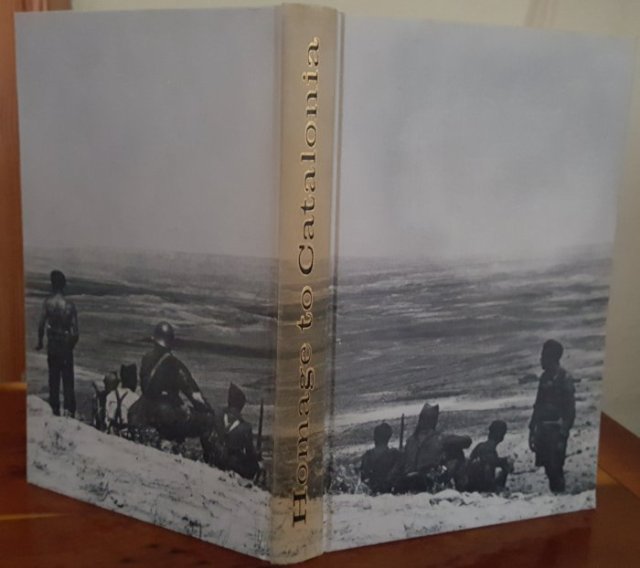
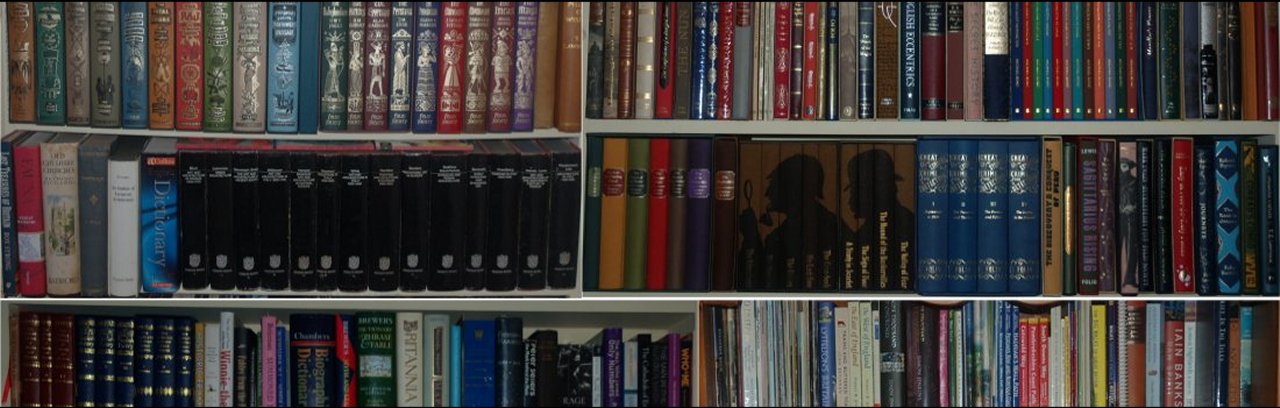
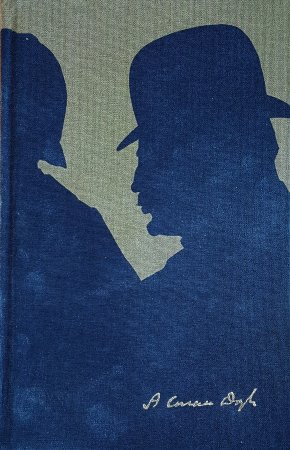
Part three of the reading marathon of the complete Sherlock Holmes stories by Sir Arthur Conan Doyle in an edition published by The Folio Society. The set consists of five volumes of short stories issued in 1993 and four volumes of novels which came out the following year. The series has a very attractive binding of an offset wrap around design on each book which makes the spines also display the image and appropriately the books are printed using the Baskerville font.

20190806 Sherlock Holmes 1

So far I have read the first two novels and the first two sets of short stories, this takes us up to the disappearance of Holmes in “The Final Problem” where Sherlock apparently fell to his death from the Reichenbach Falls whilst combating Professor Moriarty.  This had been printed in December 1893 and there the stories appeared to end. In August 1901 however a new Sherlock Holmes story appeared, although set before the events in “The Final Problem”; “The Hound of the Baskervilles” was serialised over the following eight months in the Strand magazine and by the end the clamour for more Holmes stories was irresistible regardless of how much Doyle claimed he didn’t want to write any more he had opened the floodgates and was swept along. Again there are minor spoilers below as it is difficult to review the stories without having them but no plot resolutions are included.
20190820 Sherlock Holmes 1

The Return of Sherlock Holmes

This consists of thirteen short stories originally printed in The Strand magazine between 1903 and 1904, the collection was first published in book form 1905 and the stories are as follows:

  • The Adventure of the Empty House
  • The Adventure of the Norwood Builder
  • The Adventure of the Dancing Men
  • The Adventure of the Solitary Cyclist
  • The Adventure of the Priory School
  • The Adventure of Black Peter
  • The Adventure of Charles Augustus Milverton
  • The Adventure of the Six Napoleons
  • The Adventure of the Three Students
  • The Adventure of the Golden Pince-Nez
  • The Adventure of the Missing Three-Quarter
  • The Adventure of the Abbey Grange
  • The Adventure of the Second Stain

Although Holmes had been away from print for eight years Dr. Watson makes it quite clear in “The Adventure of the Empty House” that he had actually vanished for just three years as this story is set in 1894. In this tale he explains his absence as he needed to be in hiding from members of Moriarty’s gang who wanted to avenge their leaders death, for indeed he had died in the incident at the falls at the end of the last book. To this end Holmes had been travelling the world, including a significant amount of time in Tibet in the guise of a Norwegian called Sigurdson. By the time he introduces himself to Watson again only one danger remains at large and he seeks assistance in dealing Colonel Moran who will probably try to assassinate him that very evening. The capture of Moran, in a more dramatic manner than Holmes intended, does indeed occur that night and the two men return to Baker Street to renew their friendship.

Also in the first tale we learn that Mary has died and Watson is again alone. At the start of “The Adventure of the Norwood Builder” Watson has been persuaded by Holmes to sell his medical practice and move back in to 221b Baker Street. So Doyle has got rid of the awkward plot narratives of the second set of short stories where one of them needed to go to fetch, or visit, the other before things could happen. All the stories where a date is identifiable are set after Holmes return and Watson comments that they represent a tiny fraction of the cases handled in the ten years since 1894. But again Doyle is clearly planning to stop writing about our favourite detectives as he has Watson explain at the start of “The Adventure of the Second Stain”.

I had intended “The Adventure of the Abbey Grange” to be the last of those exploits of my friend, Mr. Sherlock Holmes, which I should ever communicate to the public. This resolution of mine was not due to any lack of material, since I have notes of many hundreds of cases to which I have never alluded, nor was it caused by any waning interest on the part of my readers in the singular personality and unique methods of this remarkable man. The real reason lay in the reluctance which Mr. Holmes has shown to the continued publication of his experiences. So long as he was in actual professional practice the records of his successes were of some practical value to him; but since he has definitely retired from London and betaken himself to study and bee-farming on the Sussex Downs, notoriety has become hateful to him, and he has peremptorily requested that his wishes in this matter should be strictly observed.

It was only because the last tale had apparently been promised earlier that Holmes allows it to be told. The stories in this collection are nearly all good reads, only one as far as I am concerned, “The Adventure of the Missing Three-Quarter”, fails in this regard and as it is one of the shortest examples it doesn’t really let down the book as a whole. Speaking of length I should really have checked how many pages I have to read this week to maintain the schedule, this book is 311 pages, next comes 195 pages and then 241 making a total of 747 and I also have to write around 3000 words, this is tight.

Two of the stories, “The Norwood Builder” and “The Golden Pince-Nez” rely on very similar solutions to the big reveal although they are handled differently and both are excellent tales.  “The Norwood Builder” also has a reference to the uniqueness of fingerprints which Holmes states that he has heard of. This story is set in 1894 so this was very new at the time as it was only in 1892 that the first book on the possible use of fingerprints for criminal detection was published. “The Dancing Men” is another example of Holmes defeating an American gangland member in this case by breaking what is actually quite a simple cypher. We also have several tales that revolve around the English nobility, two of which “Charles Augustus Milverton” and “The Second Stain” are blackmail cases where a lady’s indiscreet letters from before her marriage are to be sent to her husband or else. These very much rely on the strict Victorian morals to make much sense nowadays as a basis for murder. “Black Peter” has an interesting misdirection in the clues presented to us whilst “The Three Students” has, as the title suggests, just three possible malefactors, in this case which of the three students took an opportunity to cheat by copying the paper for an exam they were about to sit.

All in all this was an excellent collection of stories but there will now be another, although shorter, break in Doyle writing any more Holmes and Watson tales as yet again he tries to bring the series to an end.
20190820 Sherlock Holmes 2

His Last Bow

Six of the stories included in this volume were originally printed in The Strand magazine between 1908 and 1913, one other from 1892 (the Cardboard Box) had appeared in the first edition of “The Memoirs of Sherlock Holmes” but was dropped from some further editions and the title story was first published by Collier’s in 1917; the complete collection was published in 1917 and with just eight tales it is the shortest of the anthologies:

  • The Adventure of Wisteria Lodge
  • The Adventure of the Cardboard Box
  • The Adventure of the Red Circle
  • The Adventure of the Bruce-Partington Plans
  • The Adventure of the Dying Detective
  • The Disappearance of Lady Frances Carfax
  • The Adventure of the Devil’s Foot
  • His Last Bow: The War Service of Sherlock Holmes

The book starts with a preface by Dr. Watson which reinforces his comments at the start of the previous volume.

The friends of Mr. Sherlock Holmes will be glad to learn that he is still alive and well, though somewhat crippled by occasional attacks of rheumatism. He has, for many years, lived in a small farm upon the Downs five miles from Eastbourne, where his time is divided between philosophy and agriculture. During this period of rest he has refused the most princely offers to take up various cases, having determined that his retirement was a permanent one. The approach of the German war caused him, however, to lay his remarkable combination of intellectual and practical activity at the disposal of the Government, with historical results which are recounted in His Last Bow. Several previous experiences which have lain long in my portfolio have been added to His Last Bow so as to complete the volume.

John H. Watson, M.D

These asides to the reader are great fun and add to the realism of the two characters. The self awareness of the two men, with Holmes regularly complaining in the stories about the ‘sensationalism’ in Watson’s writing up of his cases, is one of the things that make the Sherlock Holmes stories so different from anything else and make them far more engaging personalities. I’ve been looking forward to getting to this collection as ‘the Bruce-Partington Plans’ is one of my favourites of the tales.

The oddest part of this sequential reading is something I hadn’t noticed before and that is just how much the first few pages of ‘The Adventure of the Cardboard Box’ are almost identical to that of ‘The Resident Patient’ in the edition that I have. It appears that Doyle was rather fond of ‘the mind reading experiment’ that Holmes performs on Watson in that section and when the Cardboard Box was not included in subsequent editions of ‘The Memoirs’ collection he simply rewrote the start and tacked it onto the other story.  Whilst reading this volume just a few days later however it was immediately clear that I had read those four pages before, if with slight changes. Editions exist with both stories in the same book and when that is the case ‘the mind reading’ only happens in The Cardboard Box, this was confirmed by my Catalan friend Mixa as her copy does indeed have both tales. However on with the review of the stories as told in this volume.

The first story along with ‘The Red Circle’ feature Inspector Gregson of Scotland Yard whom we have only previously heard of at that rank in ‘The Greek Interpreter’ from ‘The Memoirs’, although he also is a main character in the first Holmes novel ‘A Study in Scarlet’. In that work he was really just a foil to Holmes’ brilliance as he is regularly being shown to be wrong in his deductions. In ‘The Greek Interpreter’ he was very much a bit part but now he has come on in leaps and bounds. In ‘Wisteria Lodge’ he follows his own enquiries, which in previous Holmes novels would result in whichever official detective is involved being shown the error of their ways before long, but in this case he works out the solution just as Holmes does. In ‘The Red Circle’ he is actually working on the same case but from a completely different angle and the two men only become aware of the others involvement at the denouement. Having a Scotland Yard detective proving to be just as good as Holmes at following the clues is a pleasant change so both stories have a lot to recommend them even before they prove to be excellent mysteries. The Cardboard Box is the weakest story in the collection which is probably why Doyle felt safe in extracting its start as he probably assumed it wouldn’t end up being reprinted. he had no expectation of writing more stories about Holmes when the book was published and it would be a shame to waste the best bit of the tale.

Next comes ‘the Bruce-Partington Plans’, I like this because there are two mysteries in one which have to be solved, who stole the plans and what did they do with them? along with how did the body of the main suspect, Arthur Cadogan West, come to be where it was found? The answer to the first proves to be rather simpler than the second but is also the last to be revealed. The structure of the short story draws the reader along in a very satisfying way. In ‘the Dying Detective’ Holmes already knows the solution to the case from the start and we instead follow his trap for the murderer and his explanation at the end is the first we get to know about what he has been working on. A very nice twist to the narrative structure which shows Doyle’s mastery of his craft at this stage of his career.

Another variant is seen in ‘The Disappearance of Lady Frances Carfax’ this time instead of Holmes being the detective he sends Watson off on a chase around Europe looking for the missing lady only to eventually become exasperated by his failure to catch up with her and have to get involved after all. They jointly rescue her, but with only minutes to go. ‘The Devil’s Foot’ is one of those tales which I thought we had seen the last of as it is based around a narcotic with unusual properties that Doyle has invented. This means that the reader can have no real feel for the story as the solution is hidden in a fantasy product.

Finally we come to the title story, written much later than the other works, it has Holmes pulled out of retirement a couple of years before the First World War by the urging of the Prime Minister to crack a German spy network before they can obtain military secrets which would assist them greatly in the expected conflict. This he duly does although only just in time as it takes him a lot of that time to infiltrate the organisation. It has a very different feel to any previous Holmes and Watson story and definitely gave the impression that Holmes will at last be allowed to disappear into retirement this time for good, although of course the existence of another volume on my shelf means that this wasn’t to happen.
20190820 Sherlock Holmes 3

The Case-Book of Sherlock Holmes

This consists of twelve short stories originally printed in various magazines between 1921 and 1927, the collection was first published in book form 1927 and the stories are as follows:

  • The Adventure of the Illustrious Client
  • The Adventure of the Blanched Soldier
  • The Adventure of the Mazarin Stone
  • The Adventure of the Three Gables
  • The Adventure of the Sussex Vampire
  • The Adventure of the Three Garridebs
  • The Problem of Thor Bridge
  • The Adventure of the Creeping Man
  • The Adventure of the Lion’s Mane
  • The Adventure of the Veiled Lodger
  • The Adventure of Shoscombe Old Place
  • The Adventure of the Retired Colourman

Doyle by this time has stopped having Watson saying this will be the last collection and instead wrote an introduction under his own name where he acknowledges the significance of the story arc and finally recognises that it hasn’t really detracted from what he sees as his more ‘serious’ work but there will be no more and this time he means it. Let us however start with what must be the worst of the Holmes stories in any collection ‘The Adventure of the Creeping Man’ just to get it out of the way. I have no compunction in revealing that this case is based on the nonsensical concept that the taking of extracts of monkey glands to ‘enhance an older man’s prowess with a much younger lady’ would either work or even more ridiculously lead to him acting like an ape and able to scale sheer walls with the aid of guttering and window ledges just like one and then running round on all fours dragging his knuckles on the ground. Doyle was clearly following one of his madder moments when he wrote this, much like his belief in spiritualism or fairies at the bottom of the garden.

That said the remaining eleven tales are very good. ‘The Adventure of the Three Garridebs’ takes back to familiar territory first trodden with the ‘Red Headed League’ where it is necessary to lure somebody out of their home in order to achieve a nefarious act but with again a twist to make the story interesting although as 33 years separate the writing of the stories it is only when reading them one after another that this becomes so obvious. Two of the tales are written by Holmes rather than Watson, the first ‘The Blanched Soldier’ is apparently because after criticising the good doctor’s style for many years and being told to “Try it yourself, Holmes!” he feels he really ought to have a go. The second, ‘The Lion’s Mane’ is because it occurs well after Holmes’ retirement to the South Coast and Watson is simply not around. Both cases are interesting, although ‘The Lion’s Mane’ has quite an obvious solution right at the beginning and the switching of the narrative style works surprisingly well although Holmes does complain that it makes the writing more difficult.

And here it is that I miss my Watson. By cunning questions and ejaculations of wonder he would elevate my simple art, which is but systematised common sense, into a prodigy. When I tell my own story I have no such aid.

The other eight cases presented in this final volume are all equally strong and mark a fitting end to the Holmes saga. I particularly enjoyed ‘Thor’s Bridge’ for its ingenious solution and ‘The Sussex Vampire’ also has much to recommend it. The final story was actually ‘Shoscombe Old Place’, printed in April 1927, forty years after the publication of ‘A Study in Scarlet’ and three years before the death of Sir Arthur Conan Doyle. He would write another novel and several stories and articles for The Strand magazine in the intervening years including an obituary of the cricketer W.G. Grace, but nothing more about his great detective.

Next week I will read the final two novels written well before this final set of stories but it seemed logical that once I had started on the short stories I would carry through to the end and Holmes is nothing but logical.
 

Sherlock Holmes – Arthur Conan Doyle – 2

Continuing reading the complete Sherlock Holmes stories by Sir Arthur Conan Doyle in an edition published by The Folio Society. The set consists of five volumes of short stories issued in 1993 and four volumes of novels which came out the following year. The series has a very attractive binding of an offset wrap around design on each book which makes the spines also display the image and appropriately the books are printed using the Baskerville font.

20190806 Sherlock Holmes 1

Last week I read the first two novels as these preceded the appearance of Holmes in short story format however it is now time to tackle the first twenty three short stories in volumes one and two of the set I have.  The first group of short stories is collectively titled…

20190813 Sherlock Holmes 1

The Adventures of Sherlock Holmes

This consists of twelve short stories and in this edition it also has a short introduction by Peter Cushing who played the part of Holmes many times both in film and on television. Originally printed in The Strand magazine between 1891 and 1892, the collection was first published in book form in 1892 and the twelve stories are as follows:

  • The Adventure of a Scandal in Bohemia
  • The Adventure of the Red Headed League
  • The Adventure of a Case of Identity
  • The Adventure of the Boscombe Valley Mystery
  • The Adventure of the Five Orange Pips
  • The Adventure of the Man with the Twisted Lip
  • The Adventure of the Blue Carbuncle
  • The Adventure of the Speckled Band
  • The Adventure of the Engineer’s Thumb
  • The Adventure of the Noble Bachelor
  • The Adventure of the Beryl Coronet
  • The Adventure of the Copper Beeches

I do not propose to review each story as that would make this blog excessively long and I am also concerned about revealing too much about the plots, but let’s look briefly at each, there may be small spoilers ahead but nothing that gives away solutions. However I do need to answer a question posed at the end of last weeks review, where is Watson? Straight away on the first page of Scandal in Bohemia we find

I had seen little of Holmes lately. My marriage had drifted us away from each other.

Watson had indeed moved out and Holmes was now living alone in Baker Street and for the most part the stories in this volume deal with cases after that separation. But the Speckled Band specifically mentions that it occurred before Watson’s marriage to Mary, but only now can Watson reveal it to the world as the lady concerned in the case had passed away. This story also includes the information that some seventy cases had been documented by Watson over the first eight years of his friendship with Holmes so Doyle was clearly already allowing for a significant number of stories to be eventually written even if he didn’t increase the time line any further. The last three tales also relate to the time before Watson’s marriage, The Noble Bachelor specifically states that it occurs a few weeks before he moves out whilst the other two are clearly set whilst the two men are sharing the apartment.

Going back to Scandal in Bohemia, this is the only time that Holmes would be defeated by a woman,  although later on in this book he also admits to three failures against male opponents.  Irene Adler not only bamboozles Holmes but has the nerve to speak to him whilst in disguise outside his own home. so he greatly admires her, keeping a picture of her in 221b Baker Street. The next three tales are a bit of a let down as it is obvious what is going on and who the respective culprits are well before the end however the Five Orange Pips, which is the first ‘old’ tale i.e. before Watson’s marriage and has interest as it is effectively Holmes versus The Ku Klux Klan or at least the remnants of its first incarnation. When Doyle wrote this story the KKK was a thing of the past having effectively died out in the mid 1870’s and it wouldn’t be revived until 1915.

The next three stories, along with the Copper Beeches are my favourites from this set with enough detail given to make it possible to reason along with Holmes as he solves the cases but with enough of a twist to make them interesting. The Engineers Thumb is another where Holmes fails to capture the perpetrators but you do still get a satisfactory resolution to the case however the solution to The Noble Bachelor revolves around the price of a hotel room being high, but it is just given as eight shillings, which a reader from over a century later simply has no idea if that is high, low or a median for London prices at the time. This leaves The Beryl Coronet which frankly has a ridiculous plot device that a banker is worried about a famous treasure being stolen from the safe in his bank so takes it home and locks it in a bureau which has such a poor lock that pretty well any key will spring the drawer, and having first shown it to everyone in the house.

On to the second volume of short stories.

20190813 Sherlock Holmes 2

The Memoirs of Sherlock Holmes

Again all the stories were originally printed in The Strand magazine, this time between 1892 and 1893; the collection was first published as a book in 1894 and there are eleven stories included as follows:

  • Silver Blaze
  • The Yellow Face
  • The Stockbroker’s Clerk
  • The Gloria Scott
  • The Musgrave Ritual
  • The Reigate Squires
  • The Crooked Man
  • The Resident Patient
  • The Greek Interpreter
  • The Naval Treaty
  • The Final Problem

I enjoyed this selection rather more than the first, it gets off to a great start with Silver Blaze which is a really good story about a murder and a missing racehorse although the denouement would certainly not be allowed in modern times and I doubt it would have been possible back in the 1890’s either. One of the joys of this collection is that unlike the first there is no obviously weak story, Doyle appears to have gained mastery of the difficult genre of mystery short stories. Considering that the entire tale from setting out the original position, through investigation and then to the conclusion has to be done in such a condensed manner, the eleven cases here average just over 8,100 words each, this is quite a challenge and that all of them work well says a lot about his improved abilities as a writer in this style over the first collection.

There are really just ten cases in this collection as The Final Problem is supposedly written by way of an obituary and description of how Holmes met his death at the Reichenbach Falls whilst fighting Professor Moriarty, but published two years after it happened.  Doyle must have realised that separating his two compatriots was not really a good idea so only three stories are set after Watson married Mary, these are The Stockbrokers Clerk, The Crooked Man and The Naval Treaty. There are also a couple of tales set before Holmes and Watson met (The Gloria Scott and The Musgrave Ritual) where Holmes is telling Watson about the cases which alters the narrative structure. The Gloria Scott is apparently the first ever case that Holmes was consulted on and he clearly enjoys telling the tale. The Musgrave Ritual is his third and is more of a treasure hunt rather than one of his more usual endeavours. I like this structure of the two men just discussing a case in their apartment and I hope there will be more like this in the further books. The other five tales are set during the time whilst the two men are sharing 221b Baker Street.

The Greek Interpreter marks the first appearance of Mycroft Holmes, Sherlock’s older and even more astute brother, and is technically another of his few failures as although he saves his client the protagonists get away. The Resident Patient also has the wanted men escape but at least we get to understand what and why they do what they do. Probably the weakest story included is The Stockbrokers Clerk and that would have been fine apart from the fact that the plot is quite similar to The Red Headed League, although the ultimate reason is different.

It is difficult to pick out a favourite, The Yellow Face has an interesting twist at the end and for a change Holmes is not dealing with a crime, just a mysterious circumstance. I also liked the Naval Treaty particularly as it is one of the few examples of Holmes showing a sense of humour along with an urge to be dramatic in his final reveal. I think these have to be joint favourites and as I said at the start of the review of The Memoirs the writing is definitely better than the first collection.

And there this reading marathon of the tales of Sherlock Holmes and Dr. Watson should have ended. Doyle made it quite clear in 1893 that he had no intention of writing any further stories about the duo which is why he killed off his hero in his Final Problem as he wanted his other works to be appreciated more.

However after a break of eight years Holmes would be back…

It remains for me to provide a link to my Catalan friend Mixa’s, reviews of my second weeks books which we read simultaneously. The Google created English translations are readable if not very good English but at least you get the feel for what she wrote.

The Adventures of Sherlock Holmes

Original Catalan

Translation to English via Google

The Memoirs of Sherlock Holmes

Original Catalan

Translation to English via Google


Sherlock Holmes – Arthur Conan Doyle – 1

Last August I completed a reading challenge of all ten books in the first Penguin Books crime set from 1938. So this month I have decided to also attempt more than the expected four books by tackling the complete Sherlock Holmes stories by Sir Arthur Conan Doyle as published by The Folio Society. The set consists of five volumes of short stories issued in 1993 and four volumes of novels which came out the following year. The series has a very attractive binding of an offset wrap around design on each book which makes the spines also display the image and appropriately the books are printed using the Baskerville font. My copies are well read and the titles on the short stories are badly worn, although looking at other examples in various bookshops this does seem to be a common feature of this particular edition.

20190806 Sherlock Holmes 1

Now although this looks like a logical reading order in fact Doyle wrote the first two novels “A Study in Scarlet” and “The Sign of Four” before he produced any short stories so in fact a better reading sequence is those books this week, followed by the short stories then finally the last two novels. Although novel number three “The Hound of the Baskervilles” is set during the time of the first two collections of short stories it didn’t actually come out until much later and it doesn’t affect time lines too much to leave the last two novels until the end as they both are looking back on past cases.

As last year I will be writing about each volume as I go along rather than waiting for completion so without further ado lets jump in with the first two novels

20190806 Sherlock Holmes 2

A Study in Scarlet

This is the first appearance of Holmes and Watson and originally appeared in print in the 1887 Beeton’s Christmas Annual before being published in book form in July 1888.

“Dr. Watson, Mr. Sherlock Holmes,” said Stamford, introducing us.

“How are you?” he said cordially, gripping my hand with a strength for which I should hardly have given him credit. “You have been in Afghanistan, I perceive.”

“How on earth did you know that?” I asked in astonishment.

“Never mind,” said he, chuckling to himself.

and so a partnership was born…

The book fairly rattles along, just ten pages in Holmes and Watson are ensconced in 221b Baker Street and Holmes has started his work much to the puzzlement of Watson. The two men are after all just sharing the property there is no indication that Watson would get involved in anything in fact he is specifically looking for a quiet life whilst recovering from his injuries from the war in Afghanistan. Watson however is intrigued as to what Holmes is up to and creates a list of attributes to try to work it out, these include him knowing nothing of literature, astronomy or philosophy, whilst other things such as botany (natural poisons anyway) or geology (soils and clays) were specialised in the extreme. Chemistry and sensational literature however he was a complete master of; none of these items seem to make any sense though.

Another few pages and Holmes again demonstrates his deductive reasoning and explains he is a consulting detective just as he gets a message from Sergeant Gregson of Scotland Yard asking him to come to Lauriston Gardens; Watson joins him and so starts his journals that the Holmes stories are supposedly taken from. The case, to Holmes anyway, is absurdly simple. In fact so simple that by the eightieth page he has apprehended the murderer with the help of his street urchin employees also known as The Baker Street Irregulars, and there is where the book starts to fall apart. For the next fifty two pages are back story. Doyle writes well with the dynamic of Holmes and Watson along with the bungling Gregson and Lestrade from Scotland Yard but over fifty pages without any of these characters whilst he ranges over the settlement of the Mormons in Salt Lake City and the inter-family rivalries just plods along especially after the pace of the first half of the book. It is not even written as though being told to our protagonists it is just an over long history.

We finally get back to Holmes, Watson, Gregson, Lestrade and their prisoner in 221b with just 22 pages left for Watson’s journal to wrap up and the murderer to explain how and why he did it. Very much a book of two halves but with enough promising material regarding the great detective to make a sequel inevitable.

20190806 Sherlock Holmes 3

The Sign of Four

The second time out for Holmes was in the February 1890 issue of Lippincott’s Monthly Magazine issued jointly in the UK and US, and by October of that year it had been published as a standalone book.

Sherlock Holmes took his bottle from the corner of the mantel-piece and his hypodermic syringe from its neat morocco case. With his long, white, nervous fingers he adjusted the delicate needle, and rolled back his left shirt-cuff. For some little time his eyes rested thoughtfully upon the sinewy forearm and wrist all dotted and scarred with innumerable puncture-marks. Finally he thrust the sharp point home, pressed down the tiny piston, and sank back into the velvet-lined arm-chair with a long sigh of satisfaction.

The opening paragraph of The Sign of Four shows Holmes the drug addict, in this case injecting a seven percent solution of cocaine much to the disgust of Dr. Watson. This was turned into a particularly powerful scene in “The Secret of Sherlock Holmes”, a play starring Jeremy Brett and Edward Hardwicke that I saw in 1988 at Wyndham’s Theatre in London’s West End. These two actors, for me at least, are the definitive Holmes and Watson and to see Brett as Holmes in silhouette at the back of the stage injecting into his arm before the lights were cut at the end of the scene is a dramatic act that has stayed with me for over 30 years.

As for the book itself it is much better written than the first although there is again a large section of back story at the end. This time it is much shorter than in “A Study in Scarlet” and rather than being a standalone tale it is given as Jonathan Small telling his involvement in the crimes at 221b Baker Street with Holmes, Watson and in this case Athelney Jones of the Yard. This is a considerable improvement as the three can react to Jonathan Small’s story and there is no massive disjointed section. This is also the first appearance of probably the most famous Holmes quote

How often have I said to you that when you have eliminated the impossible whatever remains, however improbable, must be the truth?

Still back to the beginning, Dr. Watson is trying to draw Holmes away from the cocaine over breakfast the next day when a young lady by the name of Miss Mary Morstan arrives and lays out a singular problem for the great man. Her father had returned to England eleven years ago and disappeared without trace however each year for the last six she has received a fine pearl from an anonymous benefactor and now she has had a letter from him desiring her to be at the Lyceum theatre and she can bring two companions. Naturally Holmes and Watson are willing to go but for very different reasons, Holmes to solve a puzzle but Watson has fallen for Miss Morstan almost immediately and in this state would do anything for her.

Without giving away the plot, the pearls are quickly revealed to be part of a large treasure and in searching for the remainder Holmes engages the use of a scent hound to follow a creosote trail left by one of the culprits from a house in Norwood after he stepped in some of this highly pungent liquid, and this provides one of the few bits of genuine humour in the books as the dog getting confused by crossing trails eventually comes to its mark…

On the dog raced through sawdust and shavings, down an alley, round a passage, between two wood-piles, and finally, with a triumphant yelp, sprang upon a large barrel which still stood upon the hand-trolley on which it had been brought. With lolling tongue and blinking eyes, Toby stood upon the cask, looking from one to the other of us for some sign of appreciation. The staves of the barrel and the wheels of the trolley were smeared with a dark liquid, and the whole air was heavy with the smell of creosote.

Sherlock Holmes and I looked blankly at each other, and then burst simultaneously into an uncontrollable fit of laughter.

Another funny passage occurs with Watson attempting to take Miss Morstan’s mind off the danger they may be in with some of his tales from Afghanistan.

To this day she declares that I told her one moving anecdote as to how a musket looked into my tent at the dead of night, and how I fired a double-barrelled tiger cub at it.

His tongue-tied behaviour is somewhat explained at the end of the book when less than a week after first meeting her he explains to Holmes that he will no longer be available to accompany him on adventures as

Miss Morstan has done me the honour to accept me as a husband in prospective.

Next week I start on the short stories first printed in The Strand Magazine between 1891 and 1893. Will Watson still be living with Holmes or are he and Mary setting up home together with him merely reporting from the sidelines?

An Old Man’s Love – Anthony Trollope

Twenty years or so ago I collected all forty seven novels plus the autobiography of Anthony Trollope in the lovely edition printed by the Folio Society which was the first ever complete edition to be illustrated. These are now long out of print but can still be obtained easily on the second hand market. I admit to having bought them far faster than I have ended up reading them in order to complete the set at the time. I have now read over half but have decided for the purpose of this blog to tackle his final work of fiction, completed before he died in 1882. He was still working on The Landleaguers which was published as an unfinished work in 1893 oddly before An Old Man’s Love which didn’t actually get published until 1894. Both of these are amongst his less well known works, indeed I cannot find an edition of An Old Man’s Love currently in print. Trollope suffered a decline in popularity towards the end of his life and it took sixty or seventy years before his reputation as a great Victorian novelist was restored but even so only about half of his novels are read to any extent today.

20190611 An Old Man's Love

The vast majority of An Old Man’s Love is written as as you would expect although there are passages where the author is talking directly to the reader and Trollope can get quite chatty as in the opening paragraph to the third chapter when we are properly introduced to The Old Man’s love interest.

There is nothing more difficult in the writing of a story than to describe adequately the person of a hero or a heroine, so as to place before the mind of the reader any clear picture of him or her who is described. A courtship is harder still—so hard that we may say generally that it is impossible. Southey’s Lodore is supposed to have been effective; but let any one with the words in his memory stand beside the waterfall and say whether it is such as the words have painted it. It rushes and it foams, as described by the poet, much more violently than does the real water; and so does everything described, unless in the hands of a wonderful master. But I have clear images on my brain of the characters of the persons introduced. I know with fair accuracy what was intended by the character as given of Amelia Booth, of Clarissa, of Di Vernon, and of Maggie Tulliver. But as their persons have not been drawn with the pencil for me by the artists who themselves created them, I have no conception how they looked. Of Thackeray’s Beatrix I have a vivid idea, because she was drawn for him by an artist under his own eye. I have now to describe Mary Lawrie, but have no artist who will take the trouble to learn my thoughts and to reproduce them. Consequently I fear that no true idea of the young lady can be conveyed to the reader; and that I must leave him to entertain such a notion of her carriage and demeanour as must come to him at the end from the reading of the whole book.

But the attempt must be made, if only for fashion sake, so that no adventitious help may be wanting to him, or more probably to her, who may care to form for herself a personification of Mary Lawrie.

And so he continues to give a basic description of the young lady who finds herself an orphan and is taken in to the home of Mr Whittlestaff, initially as an act of kindness because he was a friend of the family and she had nowhere else to go. At the start of the book Mr Whittlestaff is fifty and Miss Lawrie is twenty five although we quickly leap about a year and a half to two years so that she is well settled in the house and Mr Whittlestaff decides to ask her to marry him. Now this she is willing to do, although in truth she loves another, a certain John Gordon who vanished from her life three years earlier without actually declaring his love for her but promising to one day return. Then, on the very day that she agrees to her engagement to William Whittlestaff, John Gordon does come back and arrives at Croker’s Hall intending now that he has made money in South Africa to ask her to marry him.

All this has occurred in the first forty or so pages of the book and so the stage is set for the rivalry between the two men for the hand of Miss Mary Lawrie which is to be played out in the grounds of Victorian manners. Some of the characters favour her becoming Mrs Whittlestaff and yet more favour Mrs Gordon and none are shy about coming forward with their opinion even in front of the three main characters. There are numerous twists and turns before the final conclusion and there is also a sub-plot concerning the housekeeper at Croker’s Hall and her drunken husband which also needs to be resolved in the 172 pages so there is a lot going on considering the relative shortness of this book in the grand scheme of Victorian novels.

Romance is not normally a genre that I would choose to read but I definitely enjoyed this story and whilst Trollope is clearly not at the height of his powers as he was in The Chronicles of Barchester books or the Palliser series, both of which consist of six novels each, it is well written and draws you into the tale of the love triangle.

The Book of Margery Kempe

The earliest autobiography in English and by that most marginalised section of the population in historical texts (especially medieval history) a woman.  The book is a remarkable document all the more so from the fact that it was ‘lost’ for many centuries. It was known to have existed because of a seven page extract published by Wynkyn de Worde circa 1501 but the original manuscript which dates back to the 1430’s was believed to no longer exist. However in 1934 a copy was found in the collection of an old Catholic family the Butler-Bowdens, it is not the original dictated by Margery (as she could neither read nor write) but certainly a very early copy and a remarkable survivor. The book was first published in 1936 and the manuscript was acquired by the British Library in 1980. It is split into two books, the first has eighty nine chapters but it turns out that the person she dictated that to had such terrible handwriting that nobody could read it. In the four years it took to find somebody to rewrite this main section she dictated another ten chapters that were added as book two.

My copy is the first Folio Society edition of 2004 and uses the edited, and updated from medieval English, version by professor Windeatt, which was first published by Penguin Books in 1980, it has a lovely cover by Chris Daunt who also provided a dozen engravings included within the text.

20190430 Margery Kempe 1

In the medieval period a woman was effectively the property of her husband and this is illustrated many times in the book such as within chapter 51 when Margery is in York

Then the worthy doctor said to her “Woman, what are you doing here in this part of the country?”
“Sir, I come on pilgrimage to offer here at St William’s shrine”
Then he went on “Do you have a husband?”
She said “Yes”
“Do you have a letter recording his permission?”
“Sir” she said “my husband gave me permission with his own mouth”

As well as the need to have permission we see here Margery’s habit of referring to herself in the third person, when she is not doing so then she uses ‘this creature’ as the usual term regarding herself. Margery had by this time travelled to Rome, Jerusalem and Santiago (Spain) on a couple of trips all without her husband. In fact he was probably enjoying the breaks from her presence as she has to be the most annoying person I have ever read about and frankly like a lot of her travelling companions I would also have spent a lot of time trying to get away from her.  On her way to Jerusalem from England her companions had abandoned her several times or insisted that she ate separately from them when she was present and in Italy they went so far as to book a ship across the Mediterranean and leave their lodgings without telling her in a desperate attempt to get away.

So why was she so irritating? Well Margery started having visions after her first child was born and would very loudly express them, calling out to all the members of the Holy Trinity and speaking to them as well as quite a few saints in churches dedicated to them. That she clearly believed that she was having these conversations is beyond doubt and she was no longer interested in anything else but aspects of her faith.

And those who knew of her behaviour previously and now heard her talk so much of the bliss of heaven said to her. “Why do you talk so of the joy that is in heaven? You don’t know it, and you haven’t been there any more than we have.” And they were angry with her because she would not hear or talk of worldly things as they did, and as she did previously.
And after this time she never had any desire to have sexual intercourse with her husband, for paying the debt of matrimony was so abominable to her that she would rather, she thought, have eaten and drunk the ooze and muck in the gutter than consent to intercourse, except out of obedience.
And so she said to her husband; “I may not deny you my body, but all the love and affection of my heart is withdrawn from all earthly creatures and set on God alone.

Alongside the visions she also took to weeping and crying whenever she was in a holy place or with a religious person regardless of rank and this would also be loud often involving throwing herself to the ground to bawl like a toddler. This naturally made her a difficult person to be around especially if you are trying to observe the peace of a holy site. When she got back from her pilgrimage to Jerusalem and Rome she would cry around fourteen times a day as she ‘remembered the passion’ as during a vision there she had seen herself with the body of Christ on the cross as though she had actually been present at the crucifixion.

For me, one of her most irritating features though is the total fixation on herself during the book. She travelled across Europe to Rome and onto Jerusalem taking well over eighteen months from late 1413 to Easter 1415 yet she records nothing of the places she went to or the trip itself. This journey alone would have made a fascinating book, she would certainly had a vast number of interesting experiences and a first hand record of Europe and the Holy Land from six centuries ago by an ‘ordinary’ woman as opposed to nobles and royalty would be invaluable to historians. She mentions that she spent twelve weeks in Venice before taking the boat to Jerusalem but that is it, who she met, where she went and what she saw during that time we learn nothing.

But that is not to say that book does not have a lot to recommend it, Margery’s responses to being challenged, even by the highest authority show a quick wit and can be quite funny and despite being frustrating at times to a modern reader, especially the passages where she is conversing with God I’m glad I read it. I’ll finish with a passage from chapter sixty which shows her at her feisty best…

There was a lady who wanted to have the said creature to a meal. And therefore, as decency required, she went to the church where this lady heard her service and where this creature saw a beautiful image of our lady called a pieta. And through looking at that pieta her mind was wholly occupied with the Passion of our Lord Jesus Christ and with the compassion of our Lady, St. Mary, by which she was compelled to cry out very loudly and weep very bitterly, as though she would have died.
Then the lady’s priest came to her, saying “Woman, Jesus is long since dead.”
When her crying had ceased, she said to the priest, “Sir, his death is as fresh to me as if he had died this same day, and so, I think, it ought to be to you and all Christian people, We ought always to remember his kindness, and always to think of the doleful death that he died for us.”

and that told him.

The Beach of Falesá – Robert Louis Stevenson

I saw that island first when it was neither night nor morning.  The moon was to the west, setting, but still broad and bright.  To the east, and right amidships of the dawn, which was all pink, the daystar sparkled like a diamond.  The land breeze blew in our faces, and smelt strong of wild lime and vanilla: other things besides, but these were the most plain

So begins The Beach of Falesá one of Robert Louis Stevenson’s lesser known tales which is set in his beloved South Pacific where he lived from 1888 until his sudden death in 1894 aged just forty four. He is buried in Samoa.

20190326 The Beach at Falesa 1

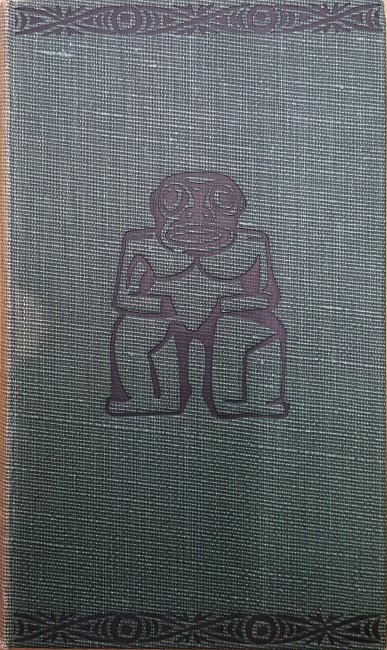
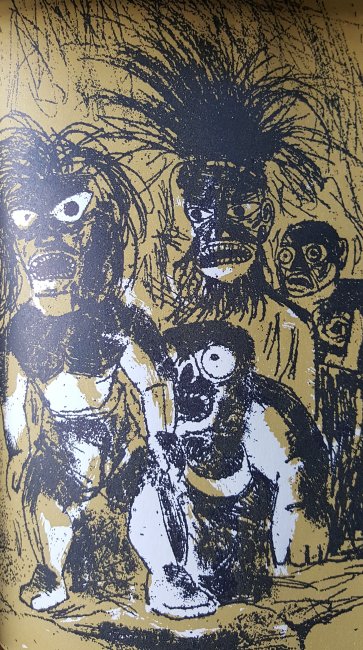
My edition of this book was published by The Folio Society in 1959 and is illustrated by the wonderful Clarke Hutton who also illustrated many of the Penguin and Puffin books on my shelves. At just under twenty nine thousand words it is more of a novella than a novel, although the Folio edition stretches it to 129 pages including a ten page introduction by H E Bates. The story was originally printed in the Illustrated London News and is normally published along with two much shorter stories (The Bottle Imp and The Isle of Voices) under the title of Island Nights Entertainments. The tale concerns the arrival of John Wiltshire to take up his post as a trader on the island to replace John Adams who had died in mysterious circumstances and how he finds out what is really going on.

Large parts of the book, specifically conversations between the Europeans and the natives are written in Pidgin English which can be off putting at first and it is also assumed that you know what several words that Stevenson would have understood actually mean. For example the main product that the trader is there to collect in payment for his goods is copra – the dried white meat of a coconut used to produce coconut oil. He also refers to the natives as Kanaka which is here used as a generic term for Pacific island workers but originally derives from the indigenous peoples of New Caledonia. Coconut is also spelt throughout as cocoanut which is now an archaic spelling.

20190326 The Beach at Falesa 2

On arrival Wiltshire meets another trader called Case who it turns out will be the main protagonist of the story and it is decided that Wiltshire should have a ‘wife’ to look after him on the island and a native girl Uma is tricked into the role by Case. Because she cannot read English the document that she treasures actually reads…

This is to certify that Uma, daughter of Fa’avao of Falesá, Island of —, is illegally married to Mr. John Wiltshire for one week, and Mr. John Wiltshire is at liberty to send her to hell when he pleases.

John Blackamoar.
Chaplain to the hulks.

Extracted from the Register
by William T. Randall,
Master Mariner.

This clearly indicates the contempt that the white people already on the island hold for the natives, Wiltshire, to his credit, quickly regrets the nature of this and when he meets the missionary gets him to do the marriage properly as he realises that he does love Uma.

20190326 The Beach at Falesa 3

One of the main problems with the book to modern readers is the casual racism which was so common at the time the book was written. The natives are looked upon as little more than children, in fact at one point Stevenson makes this explicit

It’s easy to find out what Kanakas think.  Just go back to yourself any way round from ten to fifteen years old, and there’s an average Kanaka.  There are some pious, just as there are pious boys; and the most of them, like the boys again, are middling honest and yet think it rather larks to steal, and are easy scared and rather like to be so.

Having said that Stevenson doesn’t portray any of the white men in a particularly positive way, Case is a particularly nasty piece of work and Captain Randall is a gin sodden wreck. The missionary is a reasonable character but Stevenson (through Wiltshire) makes it clear that he doesn’t approve of the work of the missionaries in the islands.

Stevenson nowadays is regarded more as a childrens’ author, with Kidnapped and Treasure Island being his best known works along with a book I still have from my early library A Child’s Garden of Verses. But this at least is definitely aimed at an adult readership.

Island Nights’ Entertainments is available to read on Project Guttenberg via this link

Relativity – Albert Einstein

20190305 Relativity 1

If you are going to read a book about relativity then why not go for the man who created the theories, after all as Einstein says himself in his preface…

The present book is intended, as far as possible, to give an exact insight into the theory of relativity for those readers who, from a general scientific and philosophical point of view, are interested in the theory, but are not conversant with the mathematical apparatus of theoretical physics. The work presumes a standard of education corresponding to that of a university matriculation and despite the shortness of the book, a fair amount of patience and force of will on the part of the reader.

Consider yourself warned.

The edition I have was published by The Folio Society in 2004 and has an introduction by Emeritus Rouse Ball Professor of Mathematics at Oxford University Roger Penrose.  Einstein originally wrote the book in 1916, just a year after he published his main paper on his General Theory of Relativity and eleven years after he had formulated his Special Theory of Relativity. Originally in German the translation is by Robert W. Lawson and he does an excellent job especially considering the complexities of the subject. Put simply the two theories deal with different things, the special theory is concerned with resolving issues between the laws of electromagnetism (specifically Maxwell’s equations) and those of motion as described in Newtonian mechanics, this becomes especially problematic as speeds approach the speed of light and time ceases to behave the way you would expect it to. The general theory on the other hand deals with gravitation and the forces between bodies caused by this. This is where the concept of warped space-time comes into place and the highly satisfying rubber sheet model which can easily demonstrate the basics of the idea and has become largely familiar to most students over the last century. It should be noted for anyone who watches the video is that the reason that the objects ultimately collide is due to friction between the balls and sheet, without that elliptical orbits would continue as we are familiar with planetary motion so this can only ever be a rough approximation of space-time curvature.

There are two ways of approaching an explanation of the theories of relativity, one book which I read several years ago does it very successfully and that is Why Does E=mc²? (And Why Should We Care?) by Professors Brian Cox and Jeff Forshaw which takes eight chapters and roughly 250 pages (depending on the edition) to cover the subject including the derivation of E=mc². Yes there is quite a lot of mathematics but there is also a large number of diagrams and descriptions in simpler terms in order to expand the readers understanding over a extended period and a short appendix in later editions to add more detail to a section that readers had queried. Einstein takes the other approach, with thirty two chapters over 132 pages (in this edition) so you approach quite complex theories and mathematics in small bite size chunks and you can reread the short chapters until you have grasped the concept being covered. There are also five appendices in a further fifty four pages which go into significantly more detail of the mathematical models and theories underpinning the two theories which are not needed by the casual reader but are there largely for completeness. In his introduction Penrose explains that part of the calculations done by Einstein in the book are no longer done that way as expressing time with a fourth dimensional axis based on imaginary numbers is seen as an unnecessary complexity when it can be done by clocks instead. This negates the need for one of the appendices which deals with Minkowski’s four dimensional space model using the square root of -1, other than as an example of Einstein’s thinking at the time.

There is no denying that some of the chapters can be difficult to get your head around the first time of reading, especially if like me you haven’t done theoretical physics at this level for over thirty five years, but it definitely worth the effort as Einstein gradually takes you through the maths. Starting with Euclidean Geometry (the first chapter which also looks at the concept of ‘truth’ for a mathematical axiom) and then pushing your understanding through relative movement of co-ordinate systems until you hit the Lorentz Transformation less than thirty pages later which gives you the basics needed to understand relativity by comparisons of motion within relative co-ordinates systems.

20190305 Relativity 2

With the introduction of Gaussian co-ordinates later on we can finally approach non-Euclidean geometry, which combined with Minkowski’s four dimensional space leads to the mathematics behind the general theory and warped space-time, which for now is how we understand gravity. The book is complex, but not unreasonably so, and the short sharp sections work as a way for the reader to grasp the overall concept in practical chunks. A century on this work still underpins our understanding of the cosmos and reading this book or the one by professors Cox and Forshaw, whichever you get on best with, is a good way to exercise the brain.

Of course there is still a lot of work to go before physics hits its ultimate goal of ‘the theory of everything’. Relativity is very good at explaining the very large but when you hit the realms of the very small quantum mechanics is just plain strange to the layman and even Einstein for a long time refused to believe most of the concepts behind that branch of physics. I do have a very good book on that subject as well which I will look at later this year.

The Temple of Flora

One of the most ambitious books ever printed was a publishing disaster twice over but also one of the most beautiful books about flowers that exists, even if in far fewer numbers than was intended by either of its publishers.

20190115 temple of flora 1The sheer size of the book can be glimpsed from the clamshell box that my Folio Society edition comes in. The book weighs in at 27½ lbs (12½ kg) so is definitely in literatures heavyweight division and at 22½” x 18¼” (57cm x 46½cm) is a true giant of a volume. The original was the brainchild of Robert Thornton in the second half of the 18th century and it rapidly attracted royal patronage from not just Queen Charlotte (wife of George III) but also her son the Prince of Wales and other members of the British royal family.

20190115 temple of flora 4

He sold it as a subscription edition from 1797 at a guinea per part (roughly £165 in today’s money) and there were planned to be lots of parts and he did keep going for several years. Thornton’s ambition was to create a botanical book that would be a National honour

which in Point of Magnificence is intended to exceed all other Works of a similar Nature on the Continent.

it was never to be finished…

20190115 temple of flora 5

but what he did get produced is magnificent, the flower paintings are of the finest detail and there were plans to have far more than the twenty nine that were ultimately produced before Thornton was driven into bankruptcy by the sheer scale of the venture. It has to be said that the text chosen is odd, lots of long and rambling poems rather than a scholarly text which would have been preferable in my view but it is the pictures that makes this incredible book.

20190115 temple of flora 6

There are long sections of text which presumably were intended to be broken up by the missing paintings but when you do get to the pictures the text doesn’t matter; what is important is the art, and in his way Thornton was trying to match the beauty of the flowers with literature which he perceived as equally beautiful. The fact that to modern readers the poems simply aren’t very good doesn’t mean that I don’t get a huge amount of pleasure from the book even if it is so unwieldy to actually get out and read.

20190115 temple of flora 7

The craftsmanship that went into each painting was unbelievable expensive, Thornton commissioned the best engravers and also used the new techniques of mezzotint and aquatint which allowed a true wash of colour to be reproduced rather than relying on cross-hatched engraving which had been the standard method up to that time. Quite often his artists would use all three techniques on the same plate which vastly increased the cost especially as after printing each print was hand coloured so every page is unique to the volume that it appears in.

20190115 temple of flora 8

You can properly judge the size of the book by the picture above which has a twelve inch (30cm) ruler resting on the open pages. The Folio Society edition that I have is the first time anyone had tried to reprint the book at its original size with all the plates in colour and as I hinted at in the opening sentence even the publishing experts of the Folio Society couldn’t make this book pay. They bought an original edition at auction and took it apart in order to do high resolution scans of each image before finally publishing this massive undertaking in 2008 in a planned edition of 1980 copies. The books were quarter bound in Nigerian goatskin with cloth on board sides with the front cover printed with a design taken from one of the pictures “The Night Blowing Cercus’.

20190115 temple of flora 3

Fortunately for the Society with fine limited edition books like this they bind them as customers place their order as orders did not flow in. Three and a half years later in June 2011 the Production Director wrote to all purchasers of the book explaining that the edition was being cut. Far from 1980 copies just 600 actually got bound and even then they were left with books to sell from the severely truncated limitation. The remaining 1380 sets of flower prints were sold off in a buckram and cloth portfolio as an un-numbered edition. Presumably the remainder of the pages including the five decorative (non floral) plates were pulped.

20190115 temple of flora 2

I doubt anyone will attempt to print this book at it’s original scale ever again. Collins had a go in 1951 but their edition is smaller and only twelve of the plates were colour. The Folio Society edition includes two extra loose plates intending for framing, Tulips and the Egyptian Lily both of which are shown above as they are bound within the book.

The Tempest – William Shakespeare

Continuing with my plan to read plays through November, I am now starting The Tempest. I have several copies of this play, partly due to the two complete sets of Shakespeare’s works I have, one of which I covered in an earlier essay, but I also have three copies of the play in individual volumes. One from the Oxford University Press, one by Penguin Books from 1937 and the copy that I have been reading which is the beautiful Folio Society letterpress edition from 2008.

20181120 The Tempest 1

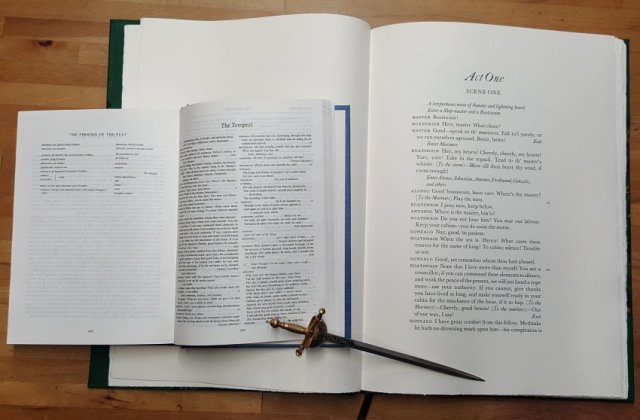
This edition is bound in green goatskin leather, blocked in gold with hand-marbled paper sides and limited to 3750 numbered copies although not all of these appear to have been produced. The book is large (14˝ x 10¾˝ – 35½cm x 27cm) and the pages clear and easy to read. As the Folio Society themselves said about these volumes…

The starting point was the text. Rather than keep text and commentary together, we decided to put them into separate volumes. Out went the elements that clutter the page : footnotes and textual variants. All that was left was Shakespeare’s words.

We decided to have the text printed by letterpress in 16-point Baskerville. The type is set in hot metal and impressed on thick, mouldmade paper. The margins are generous – over 6 centimetres – to allow the words room to breathe.

The result is a simple, understated design that is a delight to read and a pleasure to hold.

Needless to say the books were expensive (£295 per play) but they did set out to produce the finest editions available and the ones I have are amongst the treasures of my library. A comparison between the Folio Society edition and my complete Oxford Shakespeare can be seen below and it’s obvious which is the better to read.

Enough about the book, as Shakespeare himself wrote in Hamlet “The play’s the thing” and this was the last play written by Shakespeare so I’m looking forward to reading it.

The play opens with a short scene set on a ship that is caught up in the eponymous tempest and looks as though it will probably sink. On board is Alonso the King of Naples and several courtiers including Antonio the Duke of Milan, the noblemen are however getting in the way of the seamen trying to save the vessel and frankly are just a nuisance. The rest of act one takes place on the island home of Prospero and his daughter Miranda, during which we find out that Prospero is the true Duke of Milan who was usurped by his brother Antonio with the help of King Alonso.

Prospero has somehow gained magical powers during his exile on the island and with the aid of the sprite Ariel he caused the foundering of the ship but also ensured that all aboard survived. The other occupant of the island is Caliban, the son of the witch Sycorax who is enslaved to Prospero and is described as half man, half beast. Ariel is also in servitude to Prospero but this is because he rescued him from a spell by Sysorax and Prospero has promised that when he regains dukedom so Ariel will be free to go on his way. Towards the end of the first act Ferdinand (King Alonso’s son) finds Prospero and Miranda and immediately falls in love with her, which is clearly Prospero’s plan to try to regain his dukedom.

Act two moves away from Prospero to follow up the other characters in two separate scenes. In the first one the other noblemen including King Alonso assume that they are the only survivors of the wreck although Gonzalo in particular is perplexed by the condition of their clothing which suggests that this was no ordinary maritime disaster.

…Our garments being, as they were drenched in the sea, not withstanding their freshness and gloss, being rather new-dyed than stained with salt water…

…Methinks our garments are now as fresh as when we put them on in Afric, at the marriage of the King’s fair daughter…

Ariel joins the group although he is invisible to them and by means of music causes some to fall asleep leaving Sebastian (Alonso’s brother) and Antonio. Antonio suggests to Sebastian that with Ferdinand dead the only thing stopping him doing what he did to Prospero and taking the kingdom of Naples for himself is Alonso himself who is conveniently asleep at his feet. Sebastian has drawn his sword to kill Alonso when Ariel reverses the charm and the others awake. Sebastian explains the drawn sword by saying he had heard noises and was preparing to defend the king.

The second scene takes us to the last remaining significant characters in the play Trinculo the court jester and Stephano the drunk butler who has managed to salvage a barrel of wine and is happily working his way through it. These two also believe themselves the only survivors and stumble across Caliban who sees them as a means of escaping his slavery by getting them to kill Prospero. His clownish attempts to get them to help him and the drunken antics of the other two are quite funny.

Act three keeps the three groups apart and sees us catching up with them in turn in separate scenes. All three scenes are quite short and we bounce from Ferdinand and Miranda who are now getting on very well and are talking of marriage. Then to Trinculo and Stephano who are convinced by Caliban to attack Prospero but are also now quite drunk and have also introduced Caliban to wine so this plot is clearly going nowhere. Finally the king and his party meet up with Ariel and with Prospero watching and commenting although invisible to the party he can see that his plans are working.

20181120 The Tempest 2

Both of the final acts are short single scene performances and act four sees things moving forward quickly. Prospero agrees to the marriage of Ferdinand and Miranda as they continue to express their love for each other and when they have left the stage he works with Ariel to ensure that the plot hatched by Caliban to get the two drunks to kill him will fail although by now none of the them are in a fit state to do anything sensible.

Finally the fifth act brings everyone together at last, Prospero draws a magic circle on the stage and lures the noblemen into it where he reveals who he really is but decides to forgive rather than punish them. He also reveals that the ship didn’t sink, instead it has been anchored off another part of the island with the crew charmed asleep, these are woken by Ariel and prepare for sailing as soon as possible. It isn’t clear what happens to Caliban, he presumably remains alone on the island but everyone else returns to Naples with Prospero renouncing his magic as he regains his dukedom.

The Tempest is grouped with the Comedies within Shakespeare’s canon however there is nothing particularly comedic about it, it is probably there because it certainly isn’t a History or Tragedy which are the only two other options. The light relief is provided by Trinculo and Stephano during their interaction with Caliban but this, as explained above, is largely self contained within scene two of acts two and three. I’m not a big fan of Shakespeare’s later mystical plays but this made for a pleasant evenings read and I’m surprised that I haven’t got round to reading it before. As usual for a Shakespeare play there are several quotes that have enriched the English language and gone on to be used even by those who don’t know where they were first created:-

Hell is empty. And all the devils are here.

Misery acquaints a man with strange bedfellows.

We are such stuff as dreams are made on

O brave new world

and the probable winner for the worst chat up line of all time is given to Ferdinand

Hast thou not dropped from heaven?

Note: The kingdom of Naples and the duchy of Milan sound odd to us now as Naples in particular appears far too small to be a kingdom, but in Shakespeare’s time both these houses existed. The kingdom lasted from 1282 to 1816 although from 1501 it was effectively a title only as control of Naples passed between France, Spain and Austria depending on which monarchy was in the ascendant at the time. As for the duchy of Milan that lasted from 1395 to 1814 although over the last century of this it was absorbed into the Austrian Hapsburg empire.

Homage to Catalonia – George Orwell

This wasn’t the book I intended to read this week, but my friend and fellow book blogger Mixa in Barcelona (read her review here) saw a copy on my shelves and has tracked down a copy in Catalan so I thought it was probably about time to reread the book after a gap of about twenty years so that it would be fresh in my mind when she wants to talk about it. Nowadays Orwell (real name Eric Blair) is almost entirely known as a novelist and his journalism is largely and sadly neglected. Homage to Catalonia even started out being neglected. It was first printed on 23rd April 1938 and a year later by the start of WWII it had only sold around 900 copies and soon after went out of print. It would only be available sporadically until Penguin Books printed a copy in March 1962, since then it has never been out of print.

20181030 Homage to Catalonia 1

The book tells of Orwell’s experiences fighting in the Spanish Civil War as part of an international militia against the uprising of General Franco and he is very clear that this is the war as he saw it and for the most part it is a very readable account. There are two chapters where he attempts to make sense of the alphabet soup of political organisations and militias taking part and these are prefaced by clear warnings that it is about to get complicated, as shown in the below extract from paragraph two of chapter five…

At the beginning I had ignored the political side of the war, and it was only about this time that it began to force itself upon my attention. If you are not interested in the horrors of party politics. please skip; I am trying to keep the political parts of this narrative in separate chapters for precisely that purpose. But at the same time it would be quite impossible to write about the Spanish war from a purely military angle. It was above all things a political war.

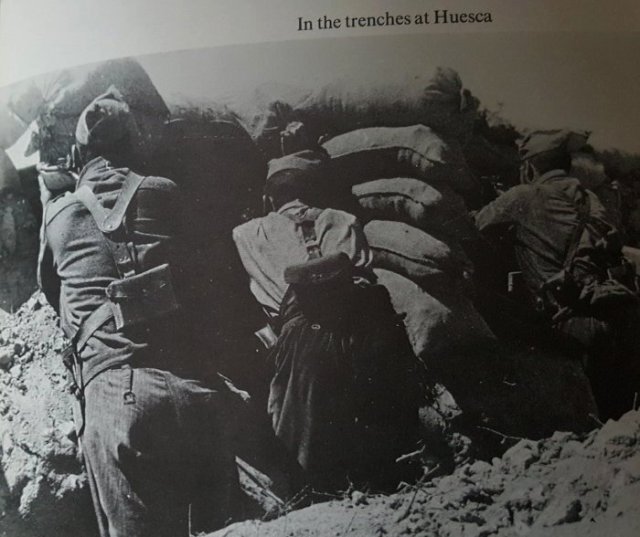
What follows is a section I’m glad I read because I had to keep referring back to it to sort out in my mind the differences and indeed the similarities between PSUC, POUM, FAI, CNT, UGT, JCI, JSU and AIT all of which were political parties or trade unions or possibly both, it does get very confusing, especially as in theory they were all aligned against the Fascists of Franco but seemed to spend most of the time fighting and bickering amongst themselves. This was particularly true during the short lived Barcelona uprising that Orwell got caught up in by happening to be on leave from the front after 115 days and arrived back in the city just before it all got even more complicated. But I am getting ahead of myself lets get back to chapter one with Orwell arriving in Barcelona with his wife, intending to write about the war but actually enlisting as a member of the POUM militia within days of getting there.  His wife Eileen stayed in the Hotel Continental in Barcelona throughout their time in Spain whilst Orwell was fighting on a front line less than 170 miles away. The photo below is by Robert Capa and is part of the John Hillelson Agency collection and shows the sort of trenches Orwell would be in.

20181030 Homage to Catalonia 3

Initially Orwell writes of his surprise on arriving in Barcelona in December 1936 that unions and workers parties had taken over the city and everywhere he saw the red and black flag of the Anarchists who were in control. This appealed to the socialist principles that Orwell espoused and it was probably this that led him to opt to fight for them rather than simply report on the situation. Unfortunately for him later he chose the wrong set of initials to join up with, but as he had said above the internecine politics hadn’t registered with him at first and he effectively just joined the first group that would have him. The first chapter covers the ‘training’ or rather lack of it he received in the Lenin barracks the poor conditions and the largely useless equipment they were issued with, chapter two has him on his way to being posted to the front where he was finally issued with an ancient rifle.

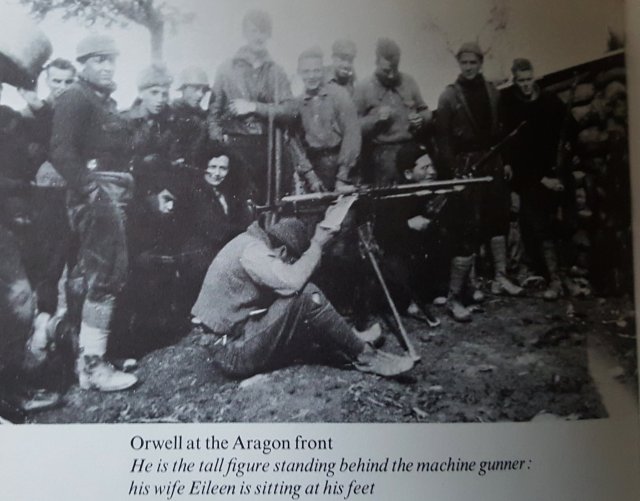
Chapters three and four tell of his time in the trenches above Zaragoza on the Aragon front, a place where the 6 foot 3 inch Orwell was clearly unsuited being head and shoulders taller than his fellow militiamen as can be seen in the photo below from the University College, London collection and reproduced opposite page 65 of my edition.

20181030 Homage to Catalonia 2

The time there was largely one of freezing temperatures, squalor and boredom, the two front lines were so far apart on opposite mountain tops that only by the merest chance could anyone be hit by firing from the opposition. What wounds and deaths did occur were mainly accidents of the sort you get when you hand unreliable weapons to 15 year old boys without showing them how to use them. The real oddity in the photo above though is that Eileen is there so she must have made a trip up from Barcelona although Orwell doesn’t mention her doing so in the book.

After the first of the political chapters, chapter six has him still bored at the front line

Meanwhile nothing happened, nothing ever happened. The English had got into the habit of saying that this wasn’t a war, it was a bloody pantomime.

and reflecting on the effect that the war was having on the local population who were largely trying to live their lives as best they could. In chapter seven Orwell finally sees some action, it was decided to crawl at night across the hundreds of yards of no man’s land and attack the fascist line. It did not go well and although they did get into the enemy trenches they were told to retreat before morning and that would be the only time he faced the enemy in actual combat. Chapter eight is very short and is largely concerned with preparations to go on leave back to Barcelona.

Chapters nine, ten and eleven all concern his badly timed break back in the city. On his return he discovered that the workers revolution had largely petered out and life had returned to a sort of normality with the war something happening in the distance.  However this was not to last long, the tensions between the various groups was about to explode onto the streets and on the 3rd of May fighting began, initially at the telephone exchange but rapidly spreading through the main thoroughfares.  Orwell is caught up in the middle of this but it rapidly becomes as much of a stalemate as the ‘fighting’ on the front. The various factions take up strategic positions and sort of agree amongst themselves to not shoot each other. These chapters for me are the most interesting of the book, the endless boredom of the front is at least improved here by not only the considerably more action but also the shortness of the time scale before it all came to an end.

Chapter twelve sees Orwell return to the front but this was to be for a very short time as he was soon wounded by a shot through the neck which saw him invalided out. By this time he was increasingly disillusioned by the war, what he had seen in Barcelona had convinced him that this was not the great and noble calling that he once thought it was and his choice of POUM was about to become a major problem. Whilst in hospital and then trying to get his discharge papers signed off POUM were picked on as the scapegoat for the fighting in Barcelona and all members were to be arrested and probably shot as traitors. As he describes it this was definitely untrue but it was a convenient fabrication to allow the other factions to re-unite behind. So as well as being wounded he was now a wanted man. In the last two chapters he and Eileen manage to escape Spain and he reflects on his experiences. His conclusions went strongly against the narrative being pushed in the socialist press in the UK which he also heavily criticised and this meant that getting the book published proved difficult as his normal publisher wouldn’t take it.

The book is a fascinating study of the realities of war, the long periods of tedium enlivened by occasional periods of firing from the trenches in the beginning of the book through the difficulties of conflict within a city and is also surprisingly funny in places as he enlivens the tale. All in all it deserves to be better known. When most people think of Orwell what usually comes to mind is 1984 or Animal Farm, try his reportage, it is definitely worth seeking out.

My copy is the 1970 Folio Society first edition which was popular enough to have two further reprints in 1972 and 1975 before dropping out of the Folio catalogue until 1998. It then re-appeared as part of a five volume set of Orwell’s reportage along with “Down and Out in Paris and London”, “The Road to Wigan Pier” and two volumes of journalism and essays. This set has as yet not been reprinted. Although bought second-hand and with a badly sunned spine and grubby covers that don’t want to clean, what I like about this edition is the inclusion of contemporary photographs of Orwell and other people mentioned in the book on the front line. Regrettably not any by Orwell himself because as he explains in the book his camera and photographs were all stolen or impounded along with his notes and press clippings at various different times whilst he was involved in the war. I have reproduced a couple of the photos from the book above. The cover illustration is a view of the battlefield near Belchite on the Aragon front and is from the Fox Photos Ltd collection.