The Rule of Benedict

Another book on my shelves simply because I bought all 127 titles in the Little Black Classics series by Penguin Books and it is only now when I decided to take it off the shelf and have a look at what I had that I realised the importance of the work I had in my hands. Somewhat enigmatically entitled The Rule of Benedict this turns out to be the set of rules written down by St Benedict for the correct running of the monasteries in the order he founded, The Benedictines, and was originally written in Latin around 540AD. A book of rules doesn’t sound like a good read but surprisingly I really enjoyed it and the insights it gives into the life of what were for all their ‘simple’ lives actually the most educated of the populace in early medieval times. A monk after all was expected to be able to read the bible and give readings during the various services of the day and very few people at the time could read they were also expected to be able to perform various duties within the monastery which was intended to be as self sufficient as possible so there would be the obvious gardeners, cooks, herbalists for medicine but also tailors, carpenters and furniture makers to maintain the clothes for the monks along with the contents of the monastery. Each monk would be allowed a minimum of ‘personal’ items such as a knife, needle and thread for running repairs, and two habits and a pair of shoes from the communal stock, they were assigned underwear only if they were sent on a journey away from the monastery of more than a day.

The first example I have selected from this set of rules is part of the instructions on humility which actually run to twelve steps. This gives a good overview of the structure of the rules regularly quoting from scripture to back up the instructions:

There is also guidance as to the structure of the hierarchies within the monastery with suggestions on how deans, priors and even the abbot should be appointed and in the case of deans and priors how they should be regulated and punished if they stray from the righteous life expected of them. I hadn’t realised before reading this book that a dean was responsible for ten monks under them with a prior being considerably more senior as they would normally only be one although also under the abbot however Benedict warns specifically about priors becoming self important due to their seniority.

Other people mentioned specifically are monks that become priests, these again should be watched to make sure they don’t fall into the sin of pride and also the porter of the monastery who should be as follows ‘A wise old man should be placed at the monastery gate, who will know how to take a message and give a reply and whose age means they will not be tempted to wander about’.

The rules are very much of their time as can be seen below, particularly the final sentence, this punishment is several times stipulated for children, although not exclusively for the young depending on the severity of the offence, It is preferred to one of the various levels of excommunication that could be extended to the adults in the community as children as assumed to not be sufficiently conscious of their religious obligations to be able to understand the punishment of excommunication.

The book also includes instructions for the induction of a new monk into the community which explains that they should be initially turned away and if they persist then subjected to ‘harsh treatment’. If they continue to try to join then they may be admitted, but only into the guest house for a few days where they will be watched over by a senior monk to make sure they are really seeking God. If they continue in their wish to become a monk then they can then enter the novices centre and after two months they should have this full set of rules read to them and told if they will abide by all of it then they can stay otherwise they can leave. If they stay there is a further period of six months during which ‘their patience should be tested’ and then the rules read to them again to accept or not. There then follows another four months of effective probation after which the rules are read to them again and only after they accept the rules for the third time can they be finally admitted as a monk and from that day not permitted to leave the monastery for any reason unless instructed by the abbot. Frankly I’m amazed they had anyone join.

This serendipitous purchase has proved to be a fascinating read which I wouldn’t have had if I hadn’t bought the full set of books, along with other ones from this collection that I have reviewed earlier which you can find using the tag ‘Little Black Classics’ below.

Short Stories – Fyodor Dostoyevsky

I’ve been meaning to read Fyodor Dostoyevsky for a long time but in common with a lot of other Russian novelists his books are somewhat daunting for a blog which appears every week, just checking my shelves I find:

  • ‘Crime and Punishment’ – 559 pages
  • ‘The Devils’ – 669 pages
  • ‘The Idiot’ – 661 pages
  • ‘The Brothers Karamazov’ – 2 volumes totalling 913 pages
  • and a volume containing two short stories and a novella ‘The Cossacks’ – 334 pages

It was then I spotted that I had two volumes from the Penguin Little Black Classics series which would give me an entry point to Dostoyevsky to see if I like him as an author. The first one is number 44 from this series ‘The Meek One’ which only has this one short story in it. The title is more usually translated as ‘A Gentle Creature’, and it is just 57 pages, still quite long for a short story, but a lot more approachable. Warning there are spoilers in this review if you want to read the stories first I cannot find ‘The Meek One’ but ‘White Nights’ is on Project Gutenberg here and ‘Bobok’ can be found here.

‘The Meek One’ begins with the un-named narrator contemplating the body of his equally un-named young wife laid out on a table in their home waiting for the undertaker to arrive the next day and we then go back over the story of how the two met and the short and largely unhappy marriage that they had. They had originally come into contact with one another as she would often come and pawn items in his pawnbrokers to raise money to advertise her services as a governess or more latterly almost any job to enable her to leave her two aunts. At the time of their marriage he was forty one and she just sixteen, however he regarded himself as her saviour from a planned marriage arranged by these aunts to a shopkeeper in his fifties who had killed his two previous wives whilst drunk and was looking for a third. The relationship between the couple seems to have deteriorated very quickly after the wedding and it is a sad story he tells of long silences and barely communicating through the winter including a time when she places a loaded gun to his head whilst thinking he was asleep but doesn’t pull the trigger. In the spring he makes an unexpected move to rescue the marriage suggesting a journey to France but it is whilst out getting the passports that she commits suicide.

Russian writing has an often undeserved reputation for gloominess and this short story doesn’t go any way to repudiate that impression, maybe the next book will have something more uplifting.

The second and third of Dostoyevsky’s short stories in volume 118 of the Penguin Little Black Classics series has ‘White Nights’ paired with ‘Bobok’. ‘White Nights’ is 86 pages long, ‘Bobok’ is the shortest at just 27 pages.

‘White Nights’ tells the story of a twenty something recluse in St Petersburg and yet again we don’t have his name, this lack of a name seems to increase the isolation of Dostoyevsky’s characters and this time he is pretty well the only un-named person in the story. He spends his days wandering around the city imagining having conversations with the people and even the houses he sees but in fact the only person he communicates with is his maid Matrona who is supposed to look after his apartment but hasn’t even removed the cobweb on the ceiling, mind you neither has he. One day whilst out on one of his aimless walks he sees a pretty young girl crying on a bridge and this time builds up the courage to approach her, however she evades him only to be threatened by an older passerby and our narrator steps in the save her. So begins the four days of happiness that he is to enjoy as they get to know one another, he explains that he is a lonely dreamer whilst she tells of a unhappy time living with her blind grandmother who pins their clothes together so that she can be sure Nastenka is not wandering off. She also tells of a lodger they had a year ago whom she fell in love with but who had to return to Moscow but promised to return and marry her when he left. The narrator rapidly also falls in love with her but agrees to carry a letter to a family who know the ex-lodger to see if he has returned and is still planning on restarting their relationship whilst secretly hoping that he has found somebody else in Moscow. The story is well written with the narrator regarding himself as the hero almost of a book of his life, indeed Nastenka rebukes him for telling his story almost as if he was reading it out. Sadly the ex-lodger does return and the narrator returns to his apartment downcast looking to another fifteen years of loneliness but Matrona does at least remove the cobweb.

‘Bobok’ is easily the strangest of the three stories and to my mind the best due to its originality, although it starts out normally enough with our narrator, this time with a name, Ivan Ivanych, going to the funeral of a distant relative and avoiding the lunch afterwards, takes to lying down on one of the long stones in the graveyard for a rest. All of a sudden he hears voices, muffled but intelligible, and wonders where they may be coming from. Gradually he realises that they are coming from the graves around him and it appears that the dead have a second short life in the grave where they can communicate with each other for two or three months, possibly up to six before they decompose too far. I loved this story as I hadn’t read anything like it before, The various conversations start off reflecting the status of the characters as they were before they died but gradually they decide to throw off their previous lives and simply talk to one another until they suddenly fall silent when they become aware he is listening. Another possible reason for our narrator hearing them is given in the opening lines of the story:

The day before yesterday Semyon Ardalyonovich suddenly comes out with: ‘And would you kindly tell me Ivan Ivanych will the day come when you’ll be sober?’

All three tales are taken from the Penguin Classics volume ‘The Gambler and Other Stories’ translated by Ronald Meyer which also includes the short stories ‘The Dream of a Ridiculous Man’, ‘A Christmas Party and a Wedding’ and ‘A Nasty Story’ along with its title novella ‘The Gambler’ which was actually written by Dostoyevsky in order to pay off his debts from losses at roulette.

I Hate and I Love – Catullus

A collection of forty three poems by Gāius Valerius Catullus, a Roman poet born in 84 BCE and who died in 54 BCE, but in his short life he wrote a number of poems, 116 of which have survived to the present day. Penguin published a complete volume translated by Peter Whigham which I don’t possess however this selection from that larger volume is part of the Penguin Little Black Classics all of which I purchased when they came out. Catullus’s poetry is normally categorised nowadays into three main subject types, those dealing with his friends, those about a woman he loves but refers to only as Lesbia rather than her real name which was probably Clodia Metelli and the rest are largely described as invective or works attacking other people, which was quite a popular style at the time. This volume is mainly poems in the ‘friends’ or ‘Lesbia’ categories with just seven of the ‘invective’ style represented although over fifty of the surviving works are categorised as ‘invective’. An example of the invective style is poem 43 which attacks the girlfriend of Formianus.

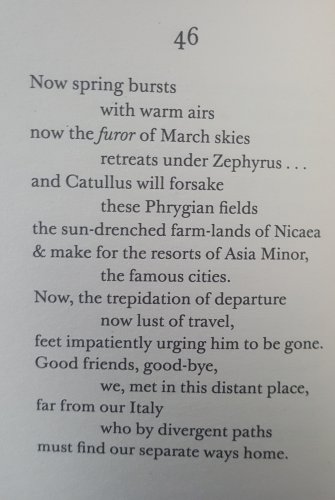
Apologies but photographing the poems without breaking the spine of the book has led to the distortions in the images. The next poem that I want to select to illustrate the tone of Catullus is one which describes his desire to travel now that the warmer weather is here. I have deliberately selected three of the shorter works although few are what we would regard as long, but the descriptions of personal experiences and desires is what marks Catullus as one of the writers known collectively as poetae nov or ‘new poets’ as poetry moved away from the epic heroic style favoured before then. The works of Catullus were almost lost to us completely as a single manuscript was found in the Chapter Library of Verona around seven hundred years ago. This document was copied twice before it was again mislaid and one of the copies was in its turn copied twice before being lost. So the 116 poems have come down the centuries due to these three surviving precious documents.

That one feels very modern with Catullus looking forward to a holiday in Turkey and hoping to meet up with friends there. For my third example it has to be one of the famous Lesbia poems although not the best known, which is poem 5, as that extends over a page in this edition so is difficult to include here. But poem 51 expresses his desire for Lesbia and how he feels when in her company although it is worth pointing out that poem 85 refers to her husband so Catullus was probably one of several men she had affairs with, including Rufus the subject of invective poem number 77 written after Catullus found out about their relationship.

A few others are quite ribald so I don’t feel I can put them on this blog. Although I have certainly enjoyed reading the collection it does nowadays probably need to come with a warning regarding adult themes, The title by the way is from the opening line of the very short poem 85, which is just two lines long:

I hate and I love. And if you ask me how.
I do not know. I only feel it, and I’m torn in two

Catallus 85 translated by Peter Whigham

The Yellow Wall-Paper – Charlotte Perkins Gilman

The story that provides the title of this collection of three short stories is easily Charlotte Perkins Gilman’s best known work, it is beautifully written and is also a very difficult read. It deals with the descent into madness of a woman who suffered from a severe bout of postpartum psychosis, a range of mental illnesses which occur soon after childbirth. Gilman was perfectly aware of how this could be as she suffered from very bad attack of some form of postpartum psychosis after the birth of her first child so the story can be seen as semi-autobiographical. Unfortunately for Gilman this collapse of her mental health wasn’t recognised by the medical profession back in 1885 when she had her daughter and she was largely seen as simply needing to pull herself together and rest and recuperate physically after the birth, but in fact she didn’t really start to recover her mental well being until 1888 by which time she had separated from her first husband and was resting in Rhode Island with a female friend.

It was in 1890 that she wrote The Yellow Wall-Paper and the story is told first person from the point of view of the unnamed female narrator as she gradually becomes more and more obsessed with the wallpaper in the bedroom she is in. At first all seems well, her husband, who is also a doctor ‘treating’ her condition has taken a large house in the country for three months to see if the air would help her recover from the psychosis she is suffering from but slowly she reveals to the reader, if not herself, the true position she is in. The room that he puts her in is a large one in the attic that has a bed screwed to the floor and initially no other furniture so some random pieces are brought up from the rooms below. There is also a gate at the top of the stairs up to this room so initially she assumes that the room had been for the children of a previous resident but it gradually becomes clear to the reader that she is a prisoner in this room, with its terrible, faded and partly pulled off the walls wallpaper. Oh the wallpaper, the pattern is odd, not quite matching and making a satisfying design but maddeningly elusive and the missing pieces along with the faded patches make finding the pattern even more difficult. The colour is also coming away from the paper, brushing up against it leaves yellow stains on your clothing and that blurring makes it even more difficult to interpret.

The colour is hideous enough, and unreliable enough, and infuriating enough, but the pattern is torturing.

She is also told to rest after meals and not to do any work, even writing is forbidden so she hides her notes on the changes of the wallpaper that she perceives in different lighting conditions. This was also the fate of Gilman herself, a writer told not to write and this greatly prolonged her own mental collapse. Gradually, as the weeks progress, our narrator starts to see movement behind the wallpaper and is convinced that some malevolent creature is behind the paper, small at first but the creature grows as the nights pass until she sees a woman loping behind the paper and determines to release her. This has to be one of the most disturbing short stories I have ever read, you are drawn totally into this woman’s world and you can feel the paranoia rising. The Yellow Wall-Paper is rightly regarded as a classic of feminist literature and a few years later Gilman sent a copy to her own doctor to try to persuade him away from the stifling treatment she had received at his hands.

The other two stories in the book are also interesting, ‘The Rocking Chair’ is another beautifully written story where two friends take rooms in an old property having been drawn to it by the sight of a beautiful young woman rocking in a chair by the window, but all is not as it seems. The girl is almost never seen by either of the two men although one catches a glimpse of her one day but both of them are convinced that the other has been talking to her, indeed they have each seen the other standing by her at the window when approaching the house. Both are disturbed at night by the incessant rocking of the chair which is in one of their rooms but both deny having been in the chair at night. What is going on and what will be the ultimate result of their gradual loss of friendship for each other as they refuse to believe the others story of not seeing the girl?

The final story is for me the weakest of the three, ‘Old Water’ is another story of obsession this time of a young poet for the daughter of an acquaintance. The daughter is however not in the least interested in him as she likes sports and the outdoor life and his attempts to join in with her simply highlights his inadequacies in her eyes. You know it isn’t going to end well but the final twist is unexpected but strangely satisfying as a conclusion.

I hadn’t heard of Charlotte Perkins Gilman before but I’ll definitely be reading more of her work.

The Book of Tea – Kakuzo Okakura

From the second series of Penguin Books little black classics this charming book was first published in 1906 and seems to have been in print for most of the time since with a succession of publishers bringing out editions over the years all over the world, this edition was published in 2016. Kakuzo Okakura was born in Yokohama in 1862 and lived his whole life in Japan although travelled extensively promoting Japanese arts and working to preserve traditional techniques at home. Unusually for a Japanese writer of the time he mainly wrote in English and this, his most famous work outside of Japan, is no exception thus helping to spread his insights into Japanese life and arts to a wider audience. This short (109 pages) book is ostensibly about tea but it is in reality so much more.

The opening chapter pulls no punches in his description of the misunderstandings between East and West and his conclusion that both sides see themselves as the height of enlightenment and the other as little better than barbarians

The beginning of the twentieth century would have been spared the spectacle of sanguinary warfare if Russia had condescended to know Japan better. What dire consequences to humanity lie in the contemptuous ignoring of Eastern problems? European imperialism, which does not disdain to raise the absurd cry of the Yellow Peril, fails to realise that Asia may also awaken to the cruel sense of the White Disaster.

Japan was unknown to the West until the sixteenth century and was therefore influenced by its neighbours, specifically China, where it got tea from originally, and its own cultural norms surrounding Taoism and Zen. Early in the seventeenth century and for two and a half centuries after that during the Edo period Japan had cut itself off from the rest of the world and only regained a place amongst other countries when forced to open up by the United States navy in 1854. This enforced isolationist policy meant that Japan had developed very differently from the West especially in aesthetic traditions and the importance of tea and the ceremonial around drinking it is one of these art forms unique to Japan and which goes back millennia. Okakura refers to Teaism which he sees as developing from Taoism but wrapped in the sacred nature of the tea ceremony and more specifically the tea house where the ceremony takes place. The dimensions and layout of the tea house is vitally important as is the simplicity of its construction and decoration. The separate entrance for the guests and the tea master leading to a room where the only decoration is in the tokonoma, an alcove where items can be displayed, and the choice of decoration is normally minimalist to western eyes, maybe a single flowering branch or a finely produced scroll or hanging. The idea of a matching tea service as seen in the west is anathema to the Japanese ceremony where if the kettle is round the jug for the water will be angular, contrast is important.

Okakura also gives a history of the three ways tea has been prepared, two of which had fallen out of fashion by the time the west discovered tea so we only have the third method using the steeping of leaves as our means of producing tea. Initially back in the fourth of fifth centuries there was a sort of pressed cake of powdered tea

the method of drinking tea at this stage was primitive in the extreme. The leaves were steamed, crushed in a mortar, made into a cake, and boiled together with rice, ginger, salt, orange peel, spices, milk, and sometimes with onions! The custom obtains at the present day among the Tibetans and various Mongolian tribes, who make a curious syrup of these ingredients.

Later on we have Luwuh in the middle of the eighth century who first wrote down and formalised the making of tea and this is the second method using finely powdered tea which was whisked with a bamboo whisk and Okakura extracts from ‘The Chaking’ his three volume book on tea

In the fifth chapter Luwuh describes the method of making tea. He eliminates all ingredients except salt. He dwells also on the much discussed question of the choice of water and the degree of boiling it. According to him, the mountain spring is the best, the river water and the spring water come next in the order of excellence. There are three stages of boiling: the first boil is when the little bubbles like the eye of fishes swim on the surface; the second boil is when the bubbles are like crystal beads rolling in a fountain; the third boil is when the billows surge wildly in the kettle. The Cake-tea is roasted before the fire until it becomes soft like a baby’s arm and is shredded into powder between pieces of fine paper. Salt is put in the first boil, the tea in the second. At the third boil, a dipperful of cold water is poured into the kettle to settle the tea and revive the “youth of the water.” Then the beverage was poured into cups and drunk. O nectar!

There is also a chapter on flowers in Okakura’s little book which given the significance of the decoration in the tokonoma and also in the garden approach to the tea house is not surprising however he turns it into almost a diatribe against the cruelty of people to flowers by picking them and watching them die in their homes. The book finishes with a chapter on tea masters of which the greatest of all is Sen no Rikyū (Rikiu in the book) from the sixteenth century who refined the tea ceremony and the tea room to how it is seen now and at the very end we have his final ever tea ceremony at the end of which he commits ritual suicide on the orders of his lord and master.

I’ve no idea what I expected from this book but it is much, much more than I could have thought. There is great insight into the Japanese traditions and the development over centuries of a culture so different to our own, it’s definitely worth seeking out.

Come Close – Sappho

Sappho died over 2,500 years ago and in the intervening millennia almost all of her poetry has been lost. That she was highly regarded in her time can be seen from contemporaneous sources some of which regard her as the tenth muse ranking her amongst the gods themselves. But sadly she was neglected during the medieval period possibly due to the interpretation of the subject matter of much of her verse which didn’t fit into the strict moral compass of the catholic church and it was the church which performed much of the transcription from ancient texts to works that have lasted into our modern era. However excavations have uncovered fragments of her work even as recently as the last decade and we now have 650 lines of the estimated over 10000 she wrote. Apparently there were nine papyrus rolls of Sappho’s works held in the great library of Alexandria, the first one alone represented twice as much verse as we have available in the present day but those would have been lost in the fire and subsequent neglect whilst controlled by the Roman empire. That this book has roughly 450 lines makes it a positive bargain as it only cost 80p when first published in 2015 and now retails at £2 but still as it represents over two thirds of her extant output this is still money well spent. It is taken from the 2009 Penguin Classic book ‘Stung with Love: Poems and Fragments’ translated by Aaron Poochigian and simply collates the poems without any biographical information or analysis of the works which is the feature of the longer book.

Sappho wrote mainly lyric poetry, that is words designed to be accompanied by music, not songs as such but embellished by a tune, they tend to be in praise of heroic deeds of men and gods along with love songs praising a partner, or potential partner. It is her love poetry that is most famous and was most admired in antiquity but it is the belief that it specifically praises love of a woman for another woman that has given us the word sapphic for women attracted to women and also from her nationality as a resident of the Greek island Lesbos the word lesbian. Having said that this is not a collection of erotic verse, far from it, the lines are expected to be performed, these are expressions of love but nothing more explicit and make for a pleasant afternoon’s reading. It should be borne in mind as well that for the most part these are just fragments of poems, only two works are believed to be complete, so there may be much context that is lost. However I am in danger of writing a review that is longer than the entire book I have just read so let me finish with all we have left of one of the poems.

Stand and face me, dear; release
That fineness in your irises

May you bed down,
Head to breast, upon
The flesh
Of a plush
Companion

The Communist Manifesto

20190514 The Communist Manifesto

I was first introduced to the works of Karl Marx at school. At the age of seventeen the teacher assigned to my year to teach the compulsory Religious Education class (oddly the only subject mandated by law in the UK) decided to take a VERY wide view of his brief. What he decided to do was, as we had already done many years of ‘normal’ RE classes, he would spend a term each on three significant thinkers of the modern age. This was interesting as philosophy was not available as a subject at my school so exposure to the three people he chose was a whole new concept for most of us. We started with Marx, then after Christmas moved on to Sigmund Freud and finally after Easter we reached Jean Paul Satre. We didn’t read The Communist Manifesto at the time (purchasing thirty copies might have been pushing the school governors a bit too much) but did discuss his ideas. I’ve owned this book for three years now so it seems about time I opened it.

A spectre is haunting Europe—the spectre of Communism. All the Powers of old Europe have entered into a holy alliance to exorcise this spectre: Pope and Czar, Metternich and Guizot, French Radicals and German police-spies.

OK that was not how I expected the book to start but all is explained further down the page. What is being pointed out is that Communism at the time was being blamed for all sorts of things without anyone really knowing what it does stand for so the decision was made to have a symposium of international Communists and come up with a manifesto which ultimately came to be written by Marx and Engels. By the way His Most Serene Highness The Prince of Metternich-Winneburg was Chancellor of the Austrian Empire and François Guizot was Prime Minister of France during the time the manifesto was written. It’s safe to assume that whilst almost everyone has heard of Karl Marx and probably to a lesser extent Friedrich Engels almost nobody knows who the two people mentioned in the opening paragraph are any more.

In fact the entire book is nothing like I expected as it isn’t a manifesto as we would now understand the word, which is a document that sets outs a party’s proposed policies and aims in the lead up to an election. Instead it relies more on the original Latin derivation manifestare (to make public) which also comes from manifestus (obvious). What the book is intended to do is make public and obvious the arguments for communism and against the current status quo as seen by Marx, Engels and their grouping that instigated the document. In doing so it is split into four sections after the initial introduction.

The first is entitled Bourgeois and Proletarians. This is an attempt by Marx and Engels to set out their view of the current situation and how we got there with the modern industrialist bourgeois making money out of the work and indeed the lives of their downtrodden workforce proletariat. The irony that Engels is the son of a wealthy industrialist with factories in Germany and England and that it is his money that finances not only his lifestyle but allows Marx to live for the rest of his life without having to do any actual physical work and instead spend a large amount of time writing his later magnum opus Das Kapital in the British Library reading room is completely lost on both of them.

The second section is headed Proletarians and Communists. This is the only section that actually includes anything that can be described as a policy plan in the entire book.

These measures will of course be different in different countries.

Nevertheless in the most advanced countries, the following will be pretty generally applicable.

1. Abolition of property in land and application of all rents of land to public purposes.

2. A heavy progressive or graduated income tax.

3. Abolition of all right of inheritance.

4. Confiscation of the property of all emigrants and rebels.

5. Centralisation of credit in the hands of the State, by means of a national bank with State capital and an exclusive monopoly.

6. Centralisation of the means of communication and transport in the hands of the State.

7. Extension of factories and instruments of production owned by the State; the bringing into cultivation of waste-lands, and the improvement of the soil generally in accordance with a common plan.

8. Equal liability of all to labour. Establishment of industrial armies, especially for agriculture.

9. Combination of agriculture with manufacturing industries; gradual abolition of the distinction between town and country, by a more equable distribution of the population over the country.

10. Free education for all children in public schools. Abolition of children’s factory labour in its present form. Combination of education with industrial production, &c., &c.

Of these the last one is probably the only non-contentious concept. The fourth is yet again an inability of Marx and Engels to recognise irony as both are emigrants to England from Germany but without Engels’ money they wouldn’t have had the leisure time to develop their theories. These policies have been tried to a greater or lesser extent several times by various countries. Sometimes, when taken literally, they have had disastrous consequences such as the application of numbers eight and nine by the Khmer Rouge in Cambodia which started with forced movement of population away from the cities to the land, regardless of whether it was good for agriculture and ultimately led to the genocide of millions.

Even Marx and Engels recognised the difficulty in selling several of these to the proletariat, why should they work hard if the state takes everything they earn above what is needed to live? Most of part two is made up of a question and answer format addressing such points.

Part three, Socialist and Communist Literature, is probably the oddest part of the manifesto. It seems to consist mainly of the authors rubbishing of other movements, they appear to have a particular dislike of German Socialism spending almost 8% of the entire manifesto in a diatribe about its failures.

The final section, with the unwieldy title of “Position of the Communists in relation to the various existing opposition parties”, is a quick bounce around Europe stating where the authors see the state of communism. The manifesto ends with probably the most well known quotes from it, even amongst people who have never read it.

In short, the Communists everywhere support every revolutionary movement against the existing social and political order of things.

In all these movements they bring to the front, as the leading question in each, the property question, no matter what its degree of development at the time.

Finally, they labour everywhere for the union and agreement of the democratic parties of all countries.

The Communists disdain to conceal their views and aims. They openly declare that their ends can be attained only by the forcible overthrow of all existing social conditions. Let the ruling classes tremble at a Communistic revolution.
The proletarians have nothing to lose but their chains.
They have a world to win.

WORKING MEN OF ALL COUNTRIES, UNITE!

Daphnis and Chloe – Longus

It wasn’t long after starting reading this short book that I really wanted to slap both the protagonists. It’s a love story starting with two orphan babies that are separately found on the island of Lesbos with mysterious items that imply some history or maybe a fate from the gods for them however this seems to be largely forgotten as the story progresses. The two children are raised by families a short distance apart and Daphnis ends up as a goatherd whilst Chloe is a shepherdess and they grow up looking after their flocks together and slowly fall in love. What made them so frustrating though was their total naivety regarding sex, they look after goats and sheep for goodness sake surely they have noticed something over the years?

The book was written around 200AD, presumably on Lesbos, by a writer called Longus about whom nothing at all is known. There appear to be no other works by him and he has left no trace in history other than this short novel. Nobody even knows if Longus was his name or a even a real person or just something that has become attributed to the story. Through the tale the two of them suffer various calamities from being abducted by an invading army (Chloe) to falling in a pit dug to catch wolves (Daphnis) as they slowly progress from looking at the other one naked and getting all soppy (both of them) to trying kissing (oh this takes them ages to get round to) and very slowly finding out about sex (again both as it’s that sort of book)

20190129 daphnis and chloe 1

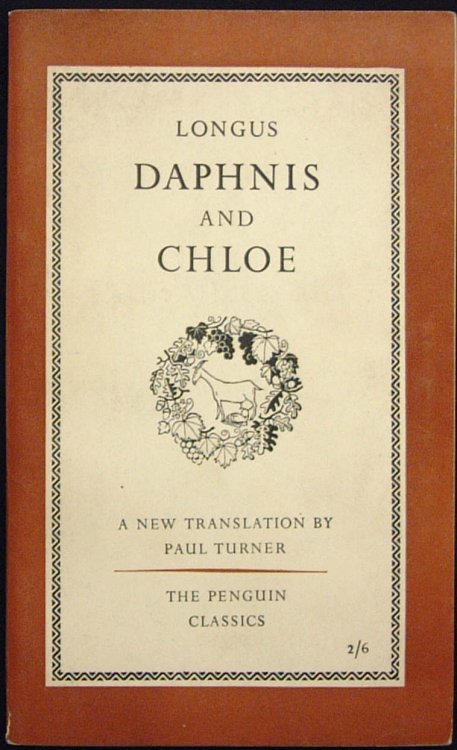
The main reason that I chose to read this though was to look again at translation and how styles have changed over the decades and this book is the only one where I have two different translations both printed by Penguin books but 55 years apart and where both translations are still in print. Above is the cover of the 2011 translation by Phiroze Vasunia when it was separated out as a single book in 2016 and below the original 1956 translation by Paul Turner.

20190129 daphnis and chloe 2

In ‘The Penguin Classics Book’ by Henry Elliot (review to come later) he writes

The 1968 reprint of Turner’s translation carried a notice “Former Penguin editions of this third century Greek novel, the prototype for all Arcadian love stories were we regret to say bowdlerised. Paul Turner has added the missing passages for this new edition on which the text is unexpurgated”

Now as I only have the 1956 original I cannot say what was put back in for the edition of 1968 but frankly the tale is not exactly controversial, certainly by today’s standards. In stating that I have to assume that the 2011 edition is not similarly censored but I cannot imagine that it would be. As I said at the start the story is so unrelated to sex that it defies belief for a large part of the book.

Along the way through the story they get increasing bad relationship advice, partly from men who want to have Chloe themselves and would be very happy to see Daphnis out of the way. It’s not really a give away to tell you that they do eventually get together, in the last few pages of the book and even their original parents are also revealed at this time. It is almost certainly the first example of a romance story and something that Mills and Boon would be very happy with nowadays, there are even pirates…

The Frogs – Aristophanes

20181106 The Frogs

For November I’ve decided to read a selection of plays and the first one is The Frogs by Aristophanes. Normally I’m not a great fan of Ancient Greek dramas as you need a lot of knowledge of the gods and other characters involved but this translation is so readable I found myself laughing along as I read it. It was written in 405 BC and can be dated so precisely because it was created for drama competition as part of a festival honouring the god Dionysus in Athens where it took first place. Dionysus is one of the Greek gods with lots of jobs, according to the Wikipedia entry he is the god of the grape-harvest, wine making and wine, fertility, ritual madness, religious ecstasy, and theatre and it is in the latter one of these roles that a drama competition in his name becomes obvious.

The play tells the story of Dionysus deciding to travel to the underworld to bring back the playwright Euripedes who had died the previous year in order to rescue the arts in Athens back from the doldrums that he perceives it to be in. The first act sees Dionysus and his slave Xanthias on their journey, initially they visit Dionysus’s half brother Heracles for advice which causes him to collapse with laughter as Dionysus has decided to dress like Heracles with the lion head cloak and club but he really doesn’t have the build to carry off the look. Eventually they persuade Heracles to explain the route he used when he went to get the three headed dog Cerebus and they duly set off. When they meet Charon, the ferryman of the dead he agrees to take Dionysus and this is when he encounters the frog chorus who sing during the crossing. Despite the play being called The Frogs this is the only time they appear in it. After various encounters with people who think Dionysus is Heracles and either hate him for taking Cerebus or love him for it they finally reach the home of Pluto ruler of the Hades.

Act two takes place entirely at the Pluto’s house where they find Euripedes and also another dramatist Aeschylus who had died about 50 years earlier. These two had been arguing for the last year about which was the better writer and should therefore sit with Pluto for meals. Dionysus takes it onto himself to judge a contest between them and they take it in turns to be rude about the others works with the chorus commenting as though it was a fight with each man landing viscous blows on the other. This gives Aristophenes a chance to parody each of the two dramatists styles and throw in his own critical comments on both of them. Eventually Pluto gets fed up and decides to determine the winner via a special set of scales which can measure the weight of an argument. Each man gets to speak one line into the baskets on the scale and they are marked against one another with the scale, to Euripedes’s annoyance Aeschylus wins both attempts by mentioning heavier objects. In the end Dionysus decides to simply ask the two dramatists for advice to save Athens, Euripedes has lots of fine words but Aeschylus has more practical suggestions so instead of having Euripedes brought back to life he decides on Aeschylus. A final parting shot from Aeschylus is to insist that Sophocles should have the seat as the finest dramatist rather than Euripedes.

Translations of ancient Greek and Latin have become far ‘less stuffy’ over the last few decades and this can largely be thanks to Penguin Books who started their series of Penguin Classics in 1946 with the express intent of making the classics more approachable. Compare this extract from the Harvard Classics edition of 1909 which is available on Project Gutenberg, which deals with the god Dionysus rowing across the Styx with Charon and encountering the Frog chorus.  The specific translator is not given for this edition on the site as this was a massive group exercise resulting in 51 volumes of a wide selection of classic works.

FROG CHORUS
   Brekekekex, ko-ax, ko-ax!
   Brekekekex, ko-ax, ko-ax!
   We children of the fountain and the lake
   Let us wake
   Our full choir-shout, as the flutes are ringing out,
   Our symphony of clear-voiced song.
   The song we used to love in the Marshland up above,
   In praise of Dionysus to produce,
   Of Nysaean Dionysus, son of Zeus,
   When the revel-tipsy throng, all crapulous and gay,
   To our precinct reeled along on the holy
   Pitcher day.
   Brekekekex, ko-ax, ko-ax.

 DIONYSUS. O, dear! O dear! now I declare I've got a bump upon my rump.

The same passage from the 1964 translation by David Barrett printed by Penguin and reprinted in the edition I have been reading.

FROGS
   Brekeke-kex, ko-ax, ko-ax,
   Ko-ax, ko-ax, ko-ax!
   Oh we are the musical Frogs!
   We live in the marshes and bogs!
   Sweet, sweet is the hymn,
   That we sing as we swim,
   And our voices are known.
   For their beautiful tone,
   when on festival days
   We sing to the praise
   Of the genial god -
   And we don't think it odd
   When the worshipping throng,
   To the sound of our song,
   Rolls home through the marshes and bogs.
   Brekekex!
   Rolls home through the marshes and bogs.

 DIONYSUS. I don't want to row any more.

 FROGS. Brekekex!

 DIONYSUS. For my bottom is getting so sore.

As you can see the Penguin edition is considerable more ‘lively’ and the translator has almost turned to the poetic structure of the limerick in order to emphasise the comic nature of the play. This is a form that he will return to several times during the translation in some places using the limerick itself. The play is only 110 short pages so I read it in two sittings, the edition is from the Little Black Classics series by Penguin and is one of the most expensive of these books at £2. I’m looking forward to reading more from this series of titles in the coming months.