Strange Pilgrims – Gabriel García Márquez

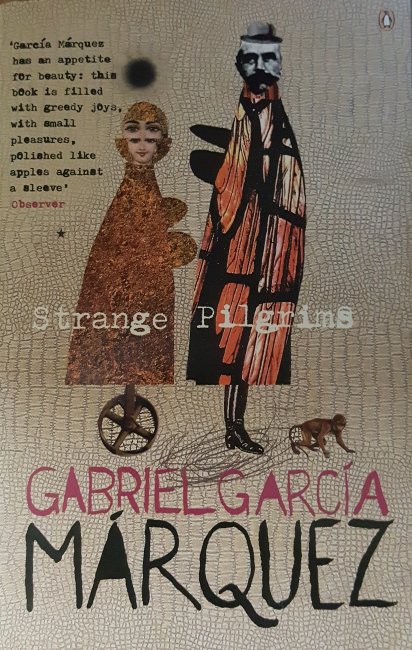
For my 100th post on this blog I have chosen one of the lesser known works by Gabriel García Márquez, in fact it is his last published collection of short stories. They were started during the 1970’s and 80’s but were not actually published until 1992 with an English translation appearing a year later. My copy is the Penguin books edition translated by Edith Grossman and published in 1994 with a bizarre cover by Matthew Richardson of Eastwing Design. The twelve tales are linked by being all about Latin American characters travelling or living in Europe, this was a familiar position for Márquez at the time as he lived in Barcelona for seven years in the 1970’s, going there after the success of his novel “One Hundred Years of Solitude”.

Born in Columbia, Márquez spent a lot of his life in Mexico, although his time in Europe clearly had a significant influence on these works. Awarded the Nobel Prize for Literature in 1982 he is probably best known for his novels, three of which are also on my shelves along with three more books of short stories. However because there are so many reviews of his novels such as “Love in the Time of Cholera”and “One Hundred Years of Solitude”  and also as I have a soft spot for well crafted short stories this collection had to be the one to read this week.
20191203 Strange Pilgrims

In the preface Márquez explains the long gestation of these stories, beginning with an exercise book in which he wrote sixty four tales none of which he was quite happy with, the dates each story was started is given after each one in the book and I have added this information as a date in brackets after each title below. He had several goes at rewriting but was never satisfied and the book was added to his papers to be looked at again when he might have a better idea how to work with the material. Unfortunately the exercise book got lost, presumably thrown out by accident, so he had a go at recreating them from memory. This reduced the total to about thirty and he is sanguine about this regarding the other half as clearly not good enough if he couldn’t remember how they went. The stories were still not right though and it was not until a final eight months of solid work finished the last ten included in this collection, which were all worked on simultaneously, that he finally had a book that he was happy to publish in the early 1990’s.

The twelve stories are each briefly reviewed below:-

Bon Voyage, Mr President (June 1979)

The first story concerns a familiar subject for Latin America, that of a deposed and exiled president finding treatment for illness in a foreign country, in this case Geneva in Switzerland. He is recognised by one of the ambulance drivers who comes from his original country and the driver plans along with his wife to get money from him by selling a fake insurance and funeral plan. The plot does not go as they intended and the development of the three characters makes an interesting twist.

The Saint (August 1981)

The Saint in the story is the incorruptible body of a seven year old girl from Columbia being taken round Rome by her father in an attempt to have her recognised as a saint. Well that is the initial premise anyway. In truth the story is more about the various characters staying in the hostel near the Vatican and their inter-reactions not only with each other, the saint and oddly the lion in the nearby zoo. The final two sentences of the tale though switch the meaning of the title in an unexpected way.

Sleeping Beauty and the Airplane (June 1982)

I’m not sure what to make of this story, it has a distinct voyeuristic tone that can be a little uncomfortable. The narrator sees a beautiful woman in Charles de Gaulle airport, Paris and then is pleased to see that he has the seat next to her on the plane to New York. The descriptions of watching her sleep next to him throughout the flight without any communication taking part between them throughout the journey makes odd reading.

I Sell My Dreams (March 1980)

Another tale regarding sleep, although this time the prophetic dreams of a Colombian woman who had come to Europe as a child and is first encountered by Márquez in Vienna. He sees her again many years later in Barcelona when he meets the Chilean poet Pablo Naruda and she is in the same restaurant and she is still making money from her dreams.

“I Only Came to Use the Phone” (April 1978)

The most disturbing story in the collection. A woman is driving on the way to Barcelona in a storm when her car breaks down. She is eventually picked up by a bus which drops her off at its destination so that she can use the phone. However the rest of the passengers are female mental patients and it is assumed at the asylum that she must also be a patient and she is prevented from calling her husband, sedated and admitted. The story describes her ultimate mental collapse as she tries and fails to explain her true situation.

The Ghosts of August (October 1980)

At less than four full pages this is the shortest work in the collection and is a really good ghost story, this time set in Tuscany and again involving a real person, in this case Venezuelan writer Miguel Otero Silva.

María dos Prazeres (May 1979)

Maria is a semi-retired prostitute in her seventies, originally from Manaus in Brazil but living for most of her life in the Gracia district of Barcelona. She now has only one client who has come to her weekly for decades and it is more a relationship than a business proposition. Convinced she is soon to die the story concerns her elaborate plans for her funeral and what is to happen with her belongings including her little dog afterwards. You really get to know her as the story unfolds and just as with other stories in this collection things suddenly change at the end.

Seventeen Poisoned Englishmen (April 1980)

The eponymous Englishmen are simply bit players in this tale of a Colombian widow who has travelled to Italy planning to see the Pope soon after the end of WWII. What it is more about is her reactions to post war Naples and her fears when she has to make her own way rather than the planned help she was expecting.

Tramontana (January 1982)

The Tramontana of the title is a persistent and powerful wind that the narrator of the tale experienced for three long days whilst staying in Cadaqués in Catalonia. He describes it as oppressive presence taking a personal affront to the presence of him and his family. It also clearly has a strong effect on all those who experience it.

Miss Forbes’s Summer of Happiness (1976)

Two young boys from Alta Guajira on the Colombian Caribbean coast are on the island of Pantelleria at the southern end of Sicily for a long summer holiday. For the first month they were with their parents and all was wonderful but they had left them in the care of a German governess called Miss Forbes whilst they went on a writers retreat elsewhere in the Mediterranean. She is very strict and the holiday had become intolerable to the boys, so much so that they resolve to kill her but the plot does not go as they intended…

Light is Like Water (December 1978)

This very short tale (around five pages) is positively surreal and again features two young boys around the ages that Márquez’s children would have been when he started to write it. As the narrator explains, he was asked how the light came on at a touch of the switch and replied “Light is like water, you turn the tap and out it comes”. Taking this seriously the boys break a bulb and sail a boat on the pool of light that cascades out of it despite being in an apartment on the fifth floor of a building in Madrid. But you should never play with liquid light.

The Trail of Your Blood in the Snow (1976)

Like the boys in ‘Light is Like Water’ the protagonists of this final tale are originally from Cartegena de Indias on the Colombian Caribbean coast but this time they are wealthy young adults recently married and travelling from Madrid to Paris overnight in a Bentley convertible that had been a wedding present. But Nena has cut her finger on a rose thorn and the bleeding will not stop.

A very enjoyable collection and if you have never read any Márquez it’s a good place to start. The stories do all feel that they belong together, possibly due to the simultaneous final rewriting yet are sufficiently different to highlight alternate aspects of his style. Highly recommended.

Cannery Row – John Steinbeck

Cannery Row in Monterey in California is a poem, a stink, a grating noise, a quality of light, a tone, a habit, a nostalgia, a dream.

20191112 Cannery Row

From the Penguin ‘Drop Caps’ series that I covered last year in a general review of all twenty six books, and I’m amazed that I had never read it before, the quote at the top is the opening line and immediately draws the reader in. What little Steinbeck I have read in the past I have thoroughly enjoyed, he really was a master wordsmith able to conjure totally believable characters with just a few sentences or even a handful of words and what characters he has populating Cannery Row and it was his “keen social perception” that he was awarded the Nobel Prize for Literature in 1962. There is a plot to the narrative but it is definitely secondary to the characterisations deployed. You really get to know marine biologist Doc and his lab/home, Mack and the boys at the Palace Flophouse and Grill (a rather grandly titled abandoned storage shed), Dora and her girls at the Bear Flag Restaurant (in reality a bordello), Lee Chong and his shop which seems to stock everything, albeit totally randomly, and the general human detritus living in whatever shelter they can find along the Row.

The people are poor but making the best of their situation, the time is the 1930’s during the Great Depression and times are hard. The main employers are the sardine canneries that give the area its name although the work depended on the arrival of the boats loaded with fish which also gives the area its distinctive odour. None of the characters are actually in employment at the canneries though, apart from when they need some money which they cannot get some other way. Lee Chong, Dora and Doc all have legitimate businesses in their own right. Lee’s grocery presumably would make money if his customers actually had any, what it mainly makes is debts which do mainly get paid off when he refuses to extend any more credit to somebody unless they actually part with some money to cover the backlog. Doc is the main character of the book, he owns Western Biological Laboratory, and if anyone in the US wanted a specimen of pretty well any sort of animal Doc would get it for them, eventually anyway. Dora as stated above owns the bordello and probably makes more money than any of the other characters but has to hand over large parts of it in ‘charity’ just to ensure that the authorities keep looking the other way. She is genuinely kind hearted though and looks after her staff who can’t work much due to age or infirmity, one breaks her leg during the book and there is no suggestion that because she can’t work she would lose her room or meals each day.

Mack and the boys at the flophouse, which they con Lee Chong out of at the start of the book, don’t work unless they have to, they have developed over the years a sense of contentment about their lives where they can get what little they need to survive somehow, even if it actually belongs to somebody else at the time. What they will do is get creatures for Doc at a fixed price that everybody knows because that’s more of an adventure than ‘working’ for a living. Despite their low grade criminality you can’t help but like them, they are more victims of their schemes than pretty well any one else and they are genuinely remorseful when things go badly wrong.

Even the bit parts are masterful, I particularly enjoyed the regular appearances of the old Chinaman as he wandered down to the sea and back each day; and like a minor character in a West End farce he always failed to interact with any of the major players whilst just walking through the narrative adding nothing to the plot apart from a comic interlude and a sense of wonder. Just what is it he is doing and why? It’s never explained.

The book revolves around Doc, his need for specimens and his love of classical music, his books and a quiet life. The plot, such as it is, involves Mack and the boys wanting to do ‘something nice for Doc’. They decide on a party so then need to raise some money to finance it, how they get the ‘money’ and the form it takes is really funny and the disaster of the party leads to real poignancy as the various characters reflect on how it went so horribly wrong and what to do to try to make it right. The book is brilliant and difficult to put down when you have started you just need to know more about the population of Cannery Row and apparently there is a sequel so I have to get a copy of that.

Ten Italian Folktales – Italo Calvino

20191022 Italian Folktales

As the title states there are ten tales included here and they are a wide mix so the best way to review the book is to look at each one in turn. Please note there will be the occasional spoiler but as these are folk tales it is entirely possible that you have come across the stories already or at least variants of them and it is those variants that I will mainly be referring to. The first story is Crack and Crook, this is one of the shortest tales and also one of the oddest included. It tells the story of two thieves who decide to team up to pull off a major robbery by tunnelling into the King’s treasury. They succeed in the attempt but this is where the story gets weird as the King, advised by another thief come up with stranger and stranger ways to identify the culprits. Story two is The Land Where One Never Dies which is basically a morality tale, the protagonist wishes to live forever but eventually discovers that he misses his family and local village.  Pome and Peel is another weird one as the title refers to two boys who were born after their mothers ate parts of a magic apple (one the flesh and the other the peel) and were inseparable throughout their lives until one wishes to marry a wizard’s daughter who puts a curse upon her when she runs away with the two men.

The Sleeping Queen is a strange variant of the classic Sleeping Beauty tale as it really seems to be two stories merged into one with the Sleeping Beauty part sandwiched between a morality tale. The middle bit has the castle surrounded by a motionless populace and in the castle is the Queen in her bed, however unlike the Perrault and Brothers Grimm versions of the story where she is awakened by a kiss, the Prince in this version gets into bed with her and she is awakened nine months later when she gives birth with everyone else starting to move again at the same time. This is much truer to the original version of the story from the fourteenth century where a princess gives birth to twins after her ‘rescuer’ leaves nine months earlier. But there is also the interwoven morality story in this tale about a blind King and his three sons who go off one after the other to find a cure for his blindness; but the two eldest abandon their quests when they find beautiful women that they fall in love with and decide to marry and forget all about the reason for their journeys. This leaves the youngest to complete the quest but he also gets betrayed by his feckless elder siblings before they get their comeuppance in their turn.

The next tale is The Enchanted Palace and this time a Prince gets lost in a forest whilst out hunting and finds a strange apparently deserted palace until a veiled lady with twelve maidservants suddenly appears, she dines and indeed sleeps with him all without saying a thing or removing her veil. It turns out she is under a curse and when he unwittingly breaks the terms of the spell she has of all things to go to Peterborough and be given as a prize in a jousting competition even though she is in fact the Queen of Portugal. That was a definite twist I hadn’t seen coming. After that is The King of Portugal’s Son so as the Italians clearly think the Portuguese Royal family are strange I was expecting something odd and wasn’t disappointed. It is difficult to summarise the plot of this one without giving too much away but yet again the twist in the end is well worth the reading of the story.

The two stories that follow are both very short, Apple Girl tells of a Queen who gives birth to an apple but inside the apple is a beautiful girl who escapes each day to bathe and do her hair before returning to the fruit until the spell is eventually broken. Joseph Ciufolo, Tiller-flautist is another short morality tale and is probably the weakest of the stories included.  There then follows Misfortune which is the tale of the youngest daughter of the Queen of Spain who is desperately unlucky and is cast out from her family to try to restore the luck of the rest of them. Eventually she meets and improves the temper of the grumpy witch who is controlling her fate thereby reviving her own fortune and that of her estranged family.

The final story in this selection is Jump into My Sack and this definitely felt familiar although I cannot place where I first heard it. It tells of a magic sack which will fill with anything the owner wishes and a stick which will do anything it is commanded to. Using these the hero of the story manages to have great wealth and use the powers for the betterment of others and even defeat the Devil.

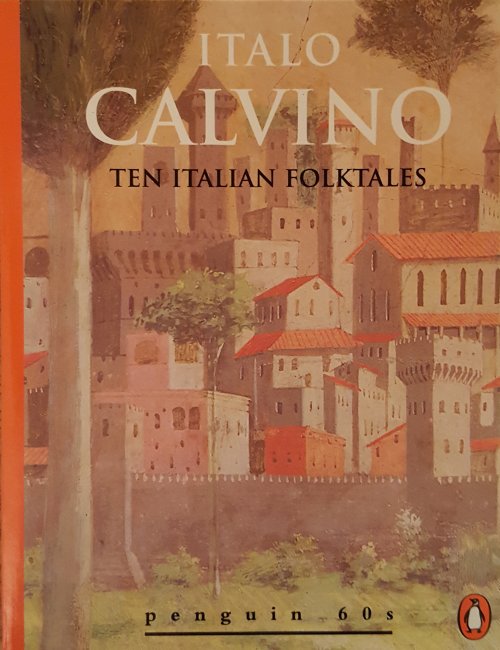
Italo Calvino was born in Cuba in 1923 to Italian parents but grew up in Italy after they returned to their home country before he was two years old. After WWII he became a journalist on a Communist newspaper and also started to write novels and short stories. These folk tales are a selection from the two hundred that Calvino collated in 1956 from collections of folklorists across Italy. Having read this book, which was published in 1995 as part of a set marking the 60th anniversary of the founding of Penguin Books, I definitely need to get hold of the full collection to be able to enjoy the others but for now this is the only work by Calvino on my shelves.

Heidi – Johanna Spyri

I asked my Catalan friend Anna, who is an advocate for children and young adults reading around her country, to choose a children’s book from three titles that I have on my shelves, but have never read, for me to tackle this week and she chose Heidi. I have to say that I know very little about it other than it is Swiss, Heidi lives with her grandfather and she has a friend called Peter so it’s all going to be new to me. In fact I couldn’t even have told anyone the authors name until I looked it up for this blog, that is how little I know about it. The copy I have is by Puffin Books and was printed by them in November 1956, the translation from the original German is by Eileen Hall and the lovely cover illustration is by Cecil Leslie who also provided the drawings included within the book.

20191015 Heidi

Well that was an interesting read, I don’t know what I expected but this book definitely wasn’t it. For a start when we first encounter five year old Heidi she is being taken up the mountain by her aunt, whilst wearing most of her clothes on a hot summers day, so that she can be dumped on her grandfather who has no idea she is coming. Why is this happening? Well the aunt who has looked after her since she was orphaned at the age of one has been offered a job in Frankfurt which she wants to have and cannot take Heidi with her, so has to leave her with somebody, and the apparently cantankerous old man is the only option. He lives way up the mountain all alone, well away from the nearest village having distanced himself from them over the years so the villagers cannot believe that the aunt is planning on leaving Heidi there so far from anyone else, in the sole company of the man known to everyone (at least in this translation) as Uncle Alp. The handover does not go well…

“Good morning Uncle” said Detie. “I’ve brought you Tobias’s daughter, I don’t suppose you recognise her as you haven’t seen her since she was a year old”

“Why have you brought her here?” he demanded roughly.

“She’s come to stay with you Uncle” Detie told him coming straight to the point.  “I have done all I can for her these four years.  Now it’s your turn.”

“My turn is it?” snapped the old man, glaring at her. “And when she starts to cry and fret for you, as she is sure to do, what am I supposed to do then?”

“That’s your affair!” retorted Detie. “Nobody told me how to set about it when she was left on my hands a baby barely a year old. Goodness knows I had enough to do already looking after mother and myself. But now I’ve got to go away to a job. You’re the child’s nearest relative. If you can’t have her here, you can do what you like with her. But you’ll have to answer for it if she comes to any harm and I shouldn’t you’d want anything more on your conscience.”

Detie was really far from easy in her mind about what she was doing, which was why she spoke so disagreeably and she had already said more than she meant to.

The old man had got up at her last words. She was quite frightened by the way he looked at her, and took a few steps backward.

“Go back where you came from and don’t come here again in a hurry,” he said angrily, raising his arm.

Detie didn’t wait to be told twice.

And so the deed was done, and 12 pages into the 233 page book things were where I thought they should be, Heidi was on the mountain with her grandfather; although how we had reached this arrangement was a considerable surprise to me as I hadn’t known that she had just been abandoned there with him. However he turns out to be very kindly to her and all is well in the bucolic bliss that Spyri conjures up and I settled down to enjoy the tales of goat herding with Peter and descriptions of the high mountain pastures.  However just 35 pages later, two years in Heidi’s life have passed and Detie reappears to drag her away from the life she has come to know and love and dump her yet again on another unsuspecting household, this time in Frankfurt. Just what is going on with this book, and why isn’t Detie being investigated for child abandonment?? The well being and happiness of Heidi seems to be nowhere in her considerations and indeed once she has again abandoned Heidi and run away before anyone in the house could stop her she is never heard of again in the book.

Without giving away too much more of the plot there now follows roughly a hundred pages of Heidi having fun with Clara, the invalid girl she has been brought here to be the companion of, but at the same time getting more and more homesick and depressed about being trapped in the city far away from the Swiss mountainside and her grandfather whom she has come to love. Yet again this book is not what I expected. Eventually she becomes so unwell that she is sent back to Switzerland and the book finally takes the positive tone that I was looking forward to when I started it.

My one negative point about the book is that half way through religion really started to be pushed, the children have to say their prayers and later on when she gets back home hymns read to Peter’s blind Grandmother. I suppose it is a mark of the times when the book was written (1880) but equally I don’t remember other children’s books of the period being so proselytising to the point where it sometimes gets in the way of the narrative. This does seem to be an issue with her other books as well as the Deutsche Biographie states at the end of it’s summary of her life, translation below:

S.’s writings were already criticised during their lifetime because of the religious-conservative positions they represented as well as their tendency against women’s emancipation

Having raised the one negative that I found with the book I have to say that it was a great read, with more twists than I expected and I’m glad I have finally read it.

The Evolution Man – Roy Lewis

Although my copy, published by Penguin in 1963 has the title ‘The Evolution Man’ this was not the original title; when the book was first published by Hutchinson in 1960 it was called ‘What We Did to Father’, it has also gone under the title of ‘Once Upon an Ice Age’. As far as I can tell it has been out of print since 1994 when it gained a further subtitle which because it rather gives away the ending I’m not going to repeat here.

20191001 The Evolution Man

The book is written from the point of view of Ernest one of the sons of Edward, the Evolution Man of the title. The family are Pleistocene ape-men in Africa and recently down from the trees, which is where his Uncle Vanya thinks they should all still be but Edward is determined that they must evolve. Part of the conceit of the book is that he is aware of the time periods that we now assign to history and worries that they may still be in the early Pleistocene and so have a long way to go rather than the mid to late period so are well on their way. The other part is that father achieves all the steps needed to lift them from scavenging apes just venturing onto the plains to the cusp of becoming the dominant species dragging his protesting family behind him. His first discovery is fire for warmth and defence against predators.

Fire – ‘How did fire work?’ ‘what I wanted was a small portable volcano’ ‘my only hope of finding the sort of limited family sized fire I wanted was to go up a volcano and chip a bit off’

Whilst telling the tale of how he brought fire from the volcano he accidentally invents ‘the heavy duty hunting spear with the fire hardened point’ by not paying attention to where his spear was when engrossed in the story. The fact that he instantly names it correctly and understands what he has got is entirely typical of the character. He is determined that humanity will progress and he won’t tolerate any back-sliding

The secret of modern industry lies in the intelligent utilisation of by-products,” he would remark frowning, and then in a bound he would seize some infant crawling on all fours, smack it savagely, stand it upright, and upbraid my sisters: “When will you realise that at two they should be toddlers? I tell you we must train out this instinctual tendency to revert to quadrupedal locomotion. Unless that is lost all is lost! Our hands, our brains, everything! We started walking upright back in the Miocene, and if you think I am going to tolerate the destruction of millions of years of progress by a parcel of idle wenches, you are mistaken. Keep that child on his hind legs, miss, or I’ll take a stick to your behind, see if I don’t.

All the family get caught up in this drive for progress, the youngest son Alexander uses burnt stick to draw uncle Vanya’s shadow one evening so inventing representative art. A little later on as Edward instantly understands what he has done they work together to draw a mammoth and soon after that the family kill a mammoth.  As this is perceived as cause and effect by the family, if not Edward, is this the start of religion? In another part of the book he demonstrates a basic grasp of genetics, or at least the need to widen as far as possible the genetic pool and get away from the natural trend for a small tribe to inbreed.

I should point out that the Roy Lewis who wrote this book is very different from the crime writer of the same name who has written over sixty books. Roy Lewis of The Evolution Man wrote only two works of fiction, he was a journalist and worked for The Economist and The Times in his long career, he also founded The Keepsake Press, a small private press.

To summarise the book I can do no better than to quote Sir Terry Pratchett from a article he wrote for the Washington Post published 7th April 2002

I first read The Evolution Man by Roy Lewis (in and out of print all the time — a Web search is advised!) in 1960. It contains no starships, no robots, no computers, none of the things that some mainstream critics think sf is about — but it is the hardest of hard-core science fiction, the very essence. It’s also the funniest book I have ever read, and it showed me what could be done.

I can only say I heartily agree.

Sentimental Journey – Laurence Sterne

To give the book its full (and misleading) title “A Sentimental Journey through France and Italy. Why misleading, well in the copy I read, which is 161 pages long, by page 143 he is still in Paris having travelled there from Calais on page 1, after that there is a rapid dash as far as Lyon which is where the book ends. Sterne undoubtedly intended to continue the tale in a further volume, as he had done numerous times with his much more famous novel regarding ‘The Life and Opinions of Tristram Shandy’ which eventually ran to nine volumes, but he died just three weeks after this book was first published in 1868.

20190924 Sentimental Journey 1

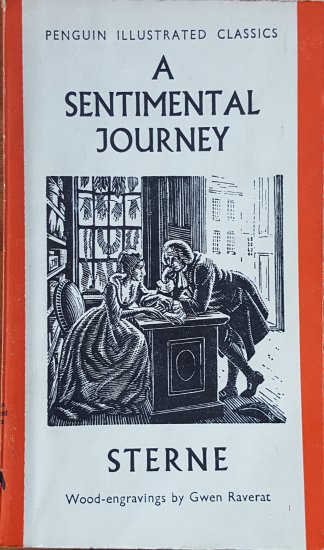
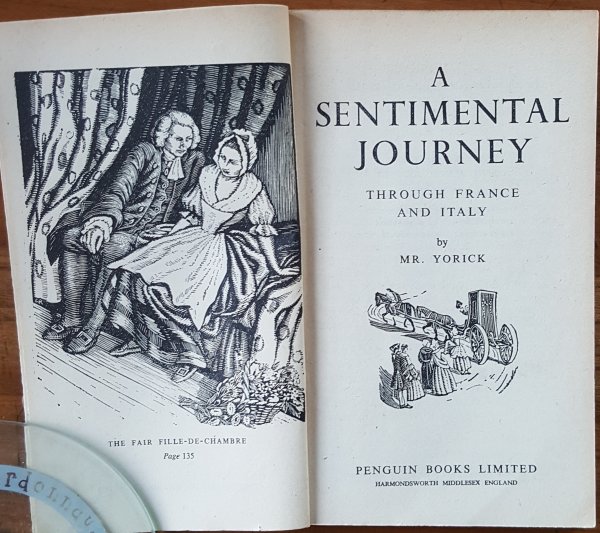
I have two copies of this book on my shelves, both there due to them being parts of separate book collections rather than a desire to own a copy of the novel but it did feel that it was time to tackle the book as it is regarded as a classic of English literature. That this is so is attested by the fact that the Folio Society edition I have read is only the fourteenth title produced by that publisher and came out in 1949. The other copy I have is from 1938 and was part of the ten books published by Penguin as Illustrated Classics which were their first attempt at a series of illustrated books, just three years after they started publishing. That two major publishers should select it so early in their existence suggests how much both companies rated the book and both editions are beautiful. The Folio Society copy is illustrated by Nigel Lambourne in lovely drawings that match well his cover design, see the picture of Maria further down this essay. The Penguin edition, in common with the other nine volumes published simultaneously, uses wood engravings in this case by a master of that art form Gwen Ravarat.

20190924 Sentimental Journey 2

And so to the tale itself… Well I have to admit that of all the books I have read so far for this blog this was the one I struggled with the most. Even though it is quite short (less than forty thousand words) it has taken over three weeks to read it as I kept putting it down after a few pages. Both the Maupassant short stories and The Pillow Book by Sei Shōnagon have been read and written about whilst I worked my way through A Sentimental Journey. There are two main reasons for this, firstly I couldn’t get on with Sterne’s style of writing and secondly it really needs a significantly better knowledge of French than I have so I have had to pause to translate sections before continuing if I really wanted to make sense of the narrative especially in the case of a letter which is important to the story but which is entirely in French. A random sample of the text, where Yorick (Sterne’s alter ego in the story) employs a servant is below.

La Fleur had set out early in life, as gallantly as most Frenchmen do, with serving for a few years; at the end of which, having satisfied the sentiment, and found, moreover, That the honour of beating a drum was likely to be its own reward, as it open’d no further track of glory to him,—he retired à ses terres, and lived comme il plaisoit à Dieu;—that is to say, upon nothing.

—And so, quoth Wisdom, you have hired a drummer to attend you in this tour of yours through France and Italy!—Psha! said I, and do not one half of our gentry go with a humdrum compagnon du voyage the same round, and have the piper and the devil and all to pay besides?  When man can extricate himself with an équivoque in such an unequal match,—he is not ill off.—But you can do something else, La Fleur? said I.—O qu’oui! he could make spatterdashes, and play a little upon the fiddle.—Bravo! said Wisdom.—Why, I play a bass myself, said I;—we shall do very well.  You can shave, and dress a wig a little, La Fleur?—He had all the dispositions in the world.—It is enough for heaven! said I, interrupting him,—and ought to be enough for me.—So, supper coming in, and having a frisky English spaniel on one side of my chair, and a French valet, with as much hilarity in his countenance as ever Nature painted in one, on the other,—I was satisfied to my heart’s content with my empire; and if monarchs knew what they would be at, they might be as satisfied as I was.

Another problem I had was the references to Tristram Shandy (which I have not read) including a whole section near the end of the book where Yorick goes off to comfort one of the characters from that novel thereby further muddying the narrative of this supposed travellers tale unnecessarily.

alas! I have but a few small pages left of this to crowd it into,—and half of these must be taken up with the poor Maria my friend, Mr. Shandy, met with near Moulines.

The story he had told of that disordered maid affected me not a little in the reading; but when I got within the neighbourhood where she lived, it returned so strong into the mind, that I could not resist an impulse which prompted me to go half a league out of the road, to the village where her parents dwelt, to enquire after her.

’Tis going, I own, like the Knight of the Woeful Countenance in quest of melancholy adventures.  But I know not how it is, but I am never so perfectly conscious of the existence of a soul within me, as when I am entangled in them.

The picture of the distraught Maria from the Folio edition is below.

20190924 Sentimental Journey 3

Enough of the negatives however, I persevered with the book rather than abandoning it because hidden behind the irritating (at least to me) overly stylistic writing is actually a pretty good story if only the first part of it. Laurence Sterne had indeed travelled through France and Italy in 1765, which was a couple of years after the Seven Years War had ended and he sets the story with Yorick making a similar trip but earlier so the conflict is actually still in progress. That it has no impact on his ability to travel through the country other than the need to get a passport authorising the journey, something Yorick had neglected to do before setting out thereby creating part of the story as he endeavours to obtain such a document before the police catch up with him, is surprising to modern readers. Although the title implies that this is a travel book do not expect any descriptions of places, rather it is a tale of his interactions with the people he meets, especially the ladies, and that is what makes it A Sentimental Journey.

20190924 Sentimental Journey 4

If you wish to read the novel for free then it is available on Project Gutenberg by following this link.

Boule de Suif and other stories – Guy de Maupassant

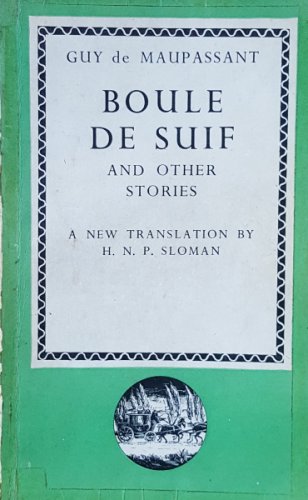
I have six volumes of short stories by Maupassant, three of which include his most famous tale Boule de Suif (literally ball of suet), and I have to admit that I haven’t read any of them. So in an effort to at least partly make amends I have picked one of the collections including Boule de Suif to read this week. The book I have chosen was the second title in the long running Penguin Classics publications and the fact that he was the second author chosen in this series, after Homer, suggests that the series editors regarded Maupassant highly. My copy is the first edition printed in 1946.

20190910 Boule de Suif

There are seventeen short stories in this collection, but in total the book is only 218 pages long. Given that Boule de Suif is easily the longest at 45 pages on its own it is clear that some of the tales are extremely short and this for me is where Maupassant is at his best. Most, like ‘The Minuet’, are beautifully written character sketches where in just a handful of pages you feel you understand the sadness of the retired ballet master and his wife whose only solace is the park where he can dance uninterrupted and he believes unseen early in the morning. Others, such as ‘The Model’ are considerably less sympathetic to the protagonists, in fact rarely is Maupassant in tune with his female characters although some like Boule de Suif herself are beautifully drawn.

So lets get back to the title story, Boule de Suif as implied above is the less than flattering nickname given to an somewhat overweight prostitute who manages to get herself on a coach leaving Rouen trying to escape the occupation during the Franco-Prussian war in 1870. The description of her in this translation is as follows:

The woman, one of those usually called “gay”, was famous for her youthful stoutness, which had earned her the nickname of Boule de Suif, the Dumpling. She was short and rotund, as fat as a pig, with puffy fingers constricted at the joints, like strings of miniature sausages: In spite of her shiny tightly stretched skin, and an enormous bust, which stuck out under her dress, she was nevertheless desirable, and was in fact much sought after, so attractive was her freshness. Her face was like a red apple, or a peony bud about to burst into flower. She had magnificent dark eyes, shaded by long thick lashes, and below a fascinating little mouth, moist to kiss, with tiny white teeth.

She was said moreover to possess many other attractions not visible to the eye.

Well you can certainly picture her from this sketch but I don’t think that she would have been very happy with the depiction. The story is very difficult to review without giving away too much but basically she is one of ten people on the coach in heavy snow which forces them into far closer proximity over a couple of days than any of them would like. Six are made up of two prosperous merchants along with the Comte de Bréville and their wives who regard themselves as far superior to all the others, there is also an idealist democrat who boasts of setting traps for the advancing Prussians but who would clearly rather escape than do anything risky now they are actually in his town. The party is completed by two nuns who take little part in the actual main story line. Suffice to say that Elisabeth Rousset aka Boule de Suif is treated shamefully by the rest of the characters and is frankly the only one to emerge with any credit at the end.

‘The Capture of Walter Schnapps’ is also set during the Franco-Prussian war and is about the only genuinely funny story in this collection, ‘The Deal’ is written to be funny but is too heavy handed in it’s telling to really succeed although it is possibly down to the translation rather than in the original French where it falls down. Back to Walter Schnapps though, he is an unhappy Prussian conscript who finds himself separated from his compatriots and resolves to become a prisoner of war to avoid further fighting and, more importantly for him, to get get better food than he is receiving. The problem is how to achieve this without getting shot in the process? The humour initially comes from his cowardice but towards the end it becomes a send up of wartime propaganda and all within nine pages.

I will just pick out two more of the tales included in this collection and these are both amongst the longest. ‘The Olive Grove’ is a dark story of a violent and arrogant past catching up with man who believes he has escaped it and does not end well for anyone. It is totally unlike all the other stories in this book and the contrast made it all the more striking. My final choice is also the final selection in the book ‘Madame Teller’s Establishment’, this was an absolute joy to read. Everyone in the story is so well described you feel you could have been with them on their trip. The story regards Madame Teller and her staff at her establishment which consists of five prostitutes and a waiter cum bouncer who looked after the rougher side of the house. She is invited to the confirmation of her niece and as she does not think that she can leave the business running in her absence, as she will need to be away overnight, she decides to take the five girls and the waiter with her to the little town where her brother lives. The resulting impact this has not only on her brothers town and the confirmation service but also back in her home where suddenly this well respected and frequented establishment closes without notice was beautifully told.

Well as I said at the beginning I have other collections of Maupassant and these will definitely be read soon after years of being neglected on my shelves and I heartily recommend him to you. There may be the occasional not very good story but they are all so short and surrounded by excellent alternatives that this hardly matters.

Lolly Willowes – Sylvia Townsend Warner

A radio programme I listen to regularly is BBC Radio 4’s “A Good Read”, it’s a book programme with a difference as rather than focusing on new works the presenter and her two guests each choose a book they like; they then read all three and finally meet up in the studio to discuss them. The last episode in June had novelist Nicci Gerrard pick an odd sounding book, but the title seemed familiar to me and sure enough it is on my shelves. Now from the discussion I have a slight idea as to what happens and it sounds intriguing, from the summary on the radio shows website we get.

Nicci’s favourite is Lolly Willowes by Sylvia Townsend Warner, a novel which takes a surprising turn halfway through and provokes a debate about the merits of sleeping in ditches

What’s not to like with a precis like that so here I go. My copy is the 1937 first Penguin Books edition, the first ever edition was by Chatto and Windus in 1926. It’s still in print although now as a Virago Modern Classic.

20190716 Lolly Willowes

The book tells the story of Laura Willowes, known to her nieces and nephews as Aunt Lolly and starts with the death of her father leading her to move in with one of her brothers and his wife in London. We then take a step back and learn about her childhood growing up in Somerset; her mother had died when she was in her teens and by the time her father died she was twenty eight, still a spinster and showing no signs of being interested in marriage. The Somerset family home would go to her other brother, James, and his wife and Lolly looks to settle into the role of the maiden aunt to both couples children. Life in the London home of Henry, Caroline and their two girls was undoubtedly respectable as befitting the late Victorian period, but also full of dull routine. So it continued for many years, through the Edwardian period and up to the First World War with even that failing to disturb Lolly’s routine much.

All begins to change in the winter of 1921 when Lolly whilst out shopping has ‘a revelation’, she is now forty seven and she needs a complete change out of London and back to the countryside. She buys a guidebook and map and announces that evening at a family get together that as the children are all grown up, she isn’t needed any more so she is moving to Great Mop in the Chilterns. Upon this apparently random decision the book pivots.

There are hints soon after she arrives about what is going on in the village, groups of villagers standing around in groups late in the evening, the fact that the place is strangely quiet after that. But she soon fits in to village life however without feeling that she is fully accepted. The arrival of her, now grown up, nephew further upsets her hopes of fitting in by his decision to also move to Great Mop.  But one evening Lolly finds a kitten in her room at her lodgings and suddenly her landlady wants to go for a walk late that evening and takes her to a remote field where most of the rest of the villagers can be found dancing and enjoying a witches sabbath.

Lolly realises that she also is a witch and that must have been what drew her to the village with the help of Satan who appears to her in the guise of a gamekeeper and also a gardener during the rest of the book. Now you can read the book as a mystical adventure but it really is a feminist novel about a woman finding herself and escaping her fusty background. She gets her independence from the family to whom she will always be just dependable old Aunt Lolly and realises just what she can become. In the last twenty or so pages where she is discussing this with Satan you could, apart from the setting obviously, be reading from works by the great feminist writers such as Virginia Woolf’s A Room of One’s Own. I’ll finish with an extract where Lolly is describing the position of women at the time which gives a good example of the quality of the writing as well.

women living and growing old, as common as blackberries, and as unregarded. I see them wives and sisters of respectable men, chapel members and blacksmiths. and small farmers and puritans…
Well there they are, there they are, child rearing, home-keeping, hanging washed dishcloths on currant bushes; and for diversion each other’s silly conversation, and listening to men talking in the way men talk and women listen. Quite different to the way women talk and men listen, if they listen at all. And all the time being thrust further down into dullness when the one thing that all women hate is to be thought dull. And on Sundays they put on plain stuff gowns and starched white coverings on their heads and necks – the Puritan ones did – and walked across the fields to chapel. and listened to the sermon. Sin and Grace and God and the – (she stopped herself just in time) and St Paul. All men’s things like politics and mathematics. Nothing for them except subjection and plaiting their hair. And on the way back they listened to more talk. Talk about the sermon, or war, or cock-fighting; and when they got back there were the potatoes to be cooked for dinner. It sounds very petty to complain about, but I tell you, that sort of thing settles down on one like a fine dust, and by and by the dust is age, settling down.

Porpoise Books

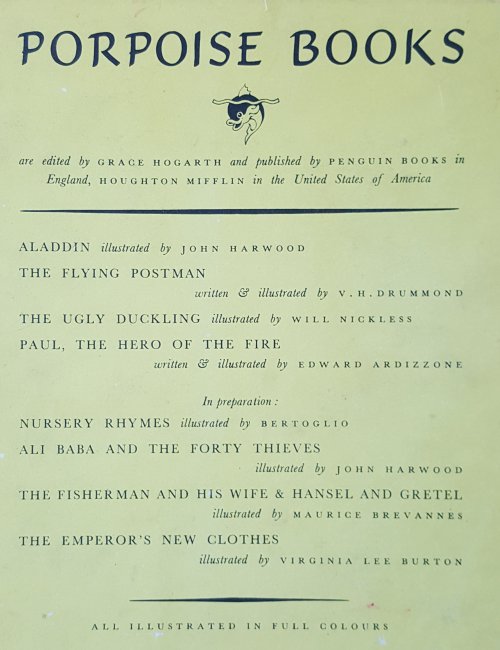
One of Penguin’s few publishing disasters was Porpoise Books which were all released in September 1948. Planned to be the first four in a series they totally failed to sell, probably due to the high price that these children’s hardbacks retailed at which was more than double Puffin story and picture books were at the time. It may well also be that hardback children’s books of this format were difficult to display in shops so were not stocked by many retailers in the first place. Most were pulped, although a large (but quantity unknown) number were apparently sent to New Zealand where they almost all vanished, but that is where they do occasionally turn up on the secondary market, two of mine came from there. For books printed as editions of 100,000 copies per title Porpoise are extremely rare but there are only four to collect if you fancy a challenge.

The books themselves are each forty eight pages long, eight and three quarters inches tall and seven inches wide (222mm x 180mm) and significantly very fragile, almost all examples that you find are missing their spines and although they were all issued with dust wrappers these have also tended to go missing in the seventy plus years since they were published. Of the ones in my collection only The Flying Postman is in poor condition with no dust wrapper and just over 50% of its spine surviving.

J1: Aladdin and his Wonderful Lamp – Traditional

20190702 Porpoise Books 1

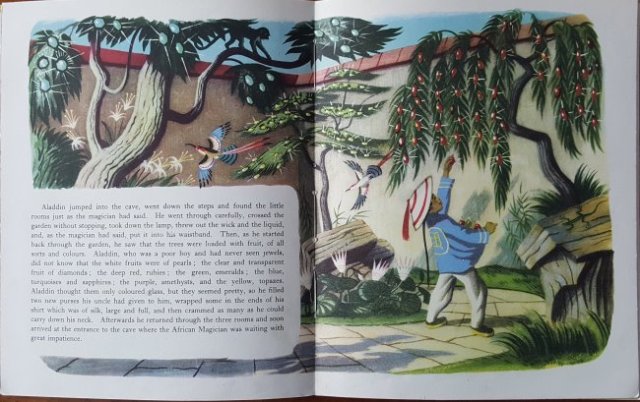
Printed by Chromoworks Ltd of Willesden, London and dated 1947 inside, although like the others it was not actually released until September 1948. No translator is given and it is described on the title page as ‘from the Arabian Nights Entertainment’. Penguin would not publish an edition of A Thousand and One Nights until August 1954, appropriately as book number 1001, although this was reissued just six months later as L64 in the classics series. However this is not the source of the text used here as Aladdin is not included in the original tales translated by N J Dawood, it being an 18th century addition to the book by French translator Antoine Galland when he produced the first European language edition in twelve volumes between 1704 and 1717.

20190702 Porpoise Books 2

The illustrations are by John Harwood who was also approached to produce Ali Baba and the Forty Thieves (another addition to 1001 Nights by Galland) for the second tranche of Porpoise Books.  His work with Penguin included what are now some of the rarest of their productions such as a couple of ‘Baby Puffins’ in 1944 and two Christmas themed cut out books from 1955 all of which are now pretty well impossible to find. He did also illustrate several Puffin Story books for Penguin so he continued to have a link with the company for many years.

J2: Paul, The Hero of the Fire – Edward Ardizzone

20190702 Porpoise Books 3

Printed by Van Leer apparently in England rather than their main presses in Amsterdam, Paul, The Hero of the Fire was written and illustrated by Edward Ardizzone and the Porpoise edition was its first appearance in print. This was the only Porpoise book to be reprinted by Penguin although that didn’t happen until March 1969 in a considerably cheaper format in the second set of books in the Picture Puffin paperbacks launched in October 1968. The book tells the story of a young boy who hears his parents talking about having to sell their house as the stock market has collapsed and they have no money to live as they do now. He loves living there so decides to run away and earn some money to help. Ending up in a circus he does get a job but one night a fire breaks out and Paul sees some panicking children which he gathers together to lead to safety, on the way they also save many of the animals. The newspapers declare him a hero and he is presented with a reward which enables his parents to keep the house.

20190702 Porpoise Books 4

I love the work of Edward Ardizzone, he was a prolific artist of books for children which is where I first came across his instantly recognisable style and I also own some of his prints from his time as a war artist in the 1940’s. He illustrated many books over the years for Penguin and was scheduled to be featured in his own volume under the Modern Painters series but sadly MP18 was never published.

J3: The Ugly Duckling – Hans Christian Anderson

20190702 Porpoise Books 5

Printed by Balding and Mansell Ltd. of Wisbech, Cambridgeshire and with the list of current and proposed titles on the back inner page rather than on the rear of the dust wrapper. The story is the classic by The Brothers Grimm about a swans egg that accidentally ends up in a duck nest and when the egg hatches of course the cygnet is treated as ‘an ugly duckling’ and teased by his apparent siblings. Eventually he runs away and is resigned to being lonely all his life on a lake but sees some swans who tell him what he really is. That moment is captured in the painting below.

20190702 Porpoise Books 6

For me this is the most beautiful of the Porpoise books, the watercolour illustrations by Will Nickless fit in perfectly with the tale. Although he illustrated several other children’s books I can’t find anything where he worked with Penguin again. It’s a pity as he is clearly a very talented artist and I would have liked to see more of his work in my Penguin collection.

J4: The Flying Postman – V H Drummond

20190702 Porpoise Books 7

Printed by The Haycock Press from Camberwell, London. Like Paul, The Hero of the Fire this appears to have been specially written and illustrated by Violet Drummond for Porpoise, the only other editions I can find are significantly later. It’s a distinctly off the wall story regarding a postman who delivers his mail by autogyro until one day he crashes into the local church tower causing lots of damage to his aircraft and needing the fire brigade to get him down. He is subsequently fired and takes up making ice-cream for a living but eventually manages to get his job back after the postmaster falls off his horse and is looked after the postman and his wife. Actually his job is dependant on the postmaster having six ice creams a day delivered to him which somewhat smacks of corruption and is very odd in a children’s tale.

20190702 Porpoise Books 8

The illustrations are just as offbeat as the story and like Nickless she does not appear to have any further dealings with Penguin beyond this one title.

As you can see above another odd feature of Porpoise books was that despite only four titles being published they were all printed by different printers. Also unusually for Penguin the books were not numbered or printed with a series code and it is only from later official catalogues from Penguin that we know that they were J1 to J4.

Grace Hogarth, the series editor, had high hopes for the series before publication and was well under way with negotiations for more titles including having commissioned some books so on the back of three of the dust wrappers (as mentioned above The Ugly Duckling wrapper doesn’t have a list but repeats the rear cover of the book) there was the tantalising hint of things to come.

20190702 Porpoise Books 9


The Communist Manifesto

20190514 The Communist Manifesto

I was first introduced to the works of Karl Marx at school. At the age of seventeen the teacher assigned to my year to teach the compulsory Religious Education class (oddly the only subject mandated by law in the UK) decided to take a VERY wide view of his brief. What he decided to do was, as we had already done many years of ‘normal’ RE classes, he would spend a term each on three significant thinkers of the modern age. This was interesting as philosophy was not available as a subject at my school so exposure to the three people he chose was a whole new concept for most of us. We started with Marx, then after Christmas moved on to Sigmund Freud and finally after Easter we reached Jean Paul Satre. We didn’t read The Communist Manifesto at the time (purchasing thirty copies might have been pushing the school governors a bit too much) but did discuss his ideas. I’ve owned this book for three years now so it seems about time I opened it.

A spectre is haunting Europe—the spectre of Communism. All the Powers of old Europe have entered into a holy alliance to exorcise this spectre: Pope and Czar, Metternich and Guizot, French Radicals and German police-spies.

OK that was not how I expected the book to start but all is explained further down the page. What is being pointed out is that Communism at the time was being blamed for all sorts of things without anyone really knowing what it does stand for so the decision was made to have a symposium of international Communists and come up with a manifesto which ultimately came to be written by Marx and Engels. By the way His Most Serene Highness The Prince of Metternich-Winneburg was Chancellor of the Austrian Empire and François Guizot was Prime Minister of France during the time the manifesto was written. It’s safe to assume that whilst almost everyone has heard of Karl Marx and probably to a lesser extent Friedrich Engels almost nobody knows who the two people mentioned in the opening paragraph are any more.

In fact the entire book is nothing like I expected as it isn’t a manifesto as we would now understand the word, which is a document that sets outs a party’s proposed policies and aims in the lead up to an election. Instead it relies more on the original Latin derivation manifestare (to make public) which also comes from manifestus (obvious). What the book is intended to do is make public and obvious the arguments for communism and against the current status quo as seen by Marx, Engels and their grouping that instigated the document. In doing so it is split into four sections after the initial introduction.

The first is entitled Bourgeois and Proletarians. This is an attempt by Marx and Engels to set out their view of the current situation and how we got there with the modern industrialist bourgeois making money out of the work and indeed the lives of their downtrodden workforce proletariat. The irony that Engels is the son of a wealthy industrialist with factories in Germany and England and that it is his money that finances not only his lifestyle but allows Marx to live for the rest of his life without having to do any actual physical work and instead spend a large amount of time writing his later magnum opus Das Kapital in the British Library reading room is completely lost on both of them.

The second section is headed Proletarians and Communists. This is the only section that actually includes anything that can be described as a policy plan in the entire book.

These measures will of course be different in different countries.

Nevertheless in the most advanced countries, the following will be pretty generally applicable.

1. Abolition of property in land and application of all rents of land to public purposes.

2. A heavy progressive or graduated income tax.

3. Abolition of all right of inheritance.

4. Confiscation of the property of all emigrants and rebels.

5. Centralisation of credit in the hands of the State, by means of a national bank with State capital and an exclusive monopoly.

6. Centralisation of the means of communication and transport in the hands of the State.

7. Extension of factories and instruments of production owned by the State; the bringing into cultivation of waste-lands, and the improvement of the soil generally in accordance with a common plan.

8. Equal liability of all to labour. Establishment of industrial armies, especially for agriculture.

9. Combination of agriculture with manufacturing industries; gradual abolition of the distinction between town and country, by a more equable distribution of the population over the country.

10. Free education for all children in public schools. Abolition of children’s factory labour in its present form. Combination of education with industrial production, &c., &c.

Of these the last one is probably the only non-contentious concept. The fourth is yet again an inability of Marx and Engels to recognise irony as both are emigrants to England from Germany but without Engels’ money they wouldn’t have had the leisure time to develop their theories. These policies have been tried to a greater or lesser extent several times by various countries. Sometimes, when taken literally, they have had disastrous consequences such as the application of numbers eight and nine by the Khmer Rouge in Cambodia which started with forced movement of population away from the cities to the land, regardless of whether it was good for agriculture and ultimately led to the genocide of millions.

Even Marx and Engels recognised the difficulty in selling several of these to the proletariat, why should they work hard if the state takes everything they earn above what is needed to live? Most of part two is made up of a question and answer format addressing such points.

Part three, Socialist and Communist Literature, is probably the oddest part of the manifesto. It seems to consist mainly of the authors rubbishing of other movements, they appear to have a particular dislike of German Socialism spending almost 8% of the entire manifesto in a diatribe about its failures.

The final section, with the unwieldy title of “Position of the Communists in relation to the various existing opposition parties”, is a quick bounce around Europe stating where the authors see the state of communism. The manifesto ends with probably the most well known quotes from it, even amongst people who have never read it.

In short, the Communists everywhere support every revolutionary movement against the existing social and political order of things.

In all these movements they bring to the front, as the leading question in each, the property question, no matter what its degree of development at the time.

Finally, they labour everywhere for the union and agreement of the democratic parties of all countries.

The Communists disdain to conceal their views and aims. They openly declare that their ends can be attained only by the forcible overthrow of all existing social conditions. Let the ruling classes tremble at a Communistic revolution.
The proletarians have nothing to lose but their chains.
They have a world to win.

WORKING MEN OF ALL COUNTRIES, UNITE!