A series of essays inspired by books that I own, talking about their history, some reviews and also how they came to be on my shelves. With over 6,500 books here and several more arriving each week I doubt I'll ever be short of a topic.
I first came across McGough in the late 1960’s as part of The Scaffold, a ‘band’ which was made up of him, John Gorman and Mike McGear and the first record I ever bought with my own money was their 1968 number one hit ‘Lily The Pink’. Only McGear was a musician having taken up the guitar at a young age like his brother Paul McCartney who was also in a bit of a band in the 1960’s. This meant that they usually appeared with session musicians, such as Reg Dwight (aka Elton John), Keith Moon, Paul McCartney and Jimi Hendrix making up the numbers for the recorded and occasional live performances, whilst Roger McGough read his poems and comedian John Gorman did various comic sketches as well as playing the piano. I wonder what happened to those various session musicians? McGough wrote almost all the lyrics for The Scaffold with McGear (who changed his name so as not to be seen to be riding on the coat tails of his elder brother) writing the music. Although the band broke up in 1977 they occasionally appear together, although all the members are well past retirement age. At 85 years old McGough is still the presenter of BBC Radio 4’s programme Poetry Please and is very much active on the British poetry scene.
This collection of some of McGough’s short poems, some of which are very short indeed, is part of a huge body of his works published in well over thirty volumes, with one, a collaboration with two other Liverpool poets entitled ‘The Mersey Sound’ not being out of print since it first appeared in 1967. Whilst he writes poems on all sorts of subjects it is probably for his comic verse that he is most known.
Writer’s Block
The excitement I felt as I started the poem. Disappeared on reaching the end of the fourth line.
McGough’s poetry is invariable upbeat and his distinctive accent makes his live performances a real pleasure, this is one of my favourites from his 2016 collection Poetry Pie just so that if you haven’t come across McGough before you can hear him in full flow. But I’m here to review this short book so back to the poems in here and one that starts off dark but still manages to have a happy ending.
Another Mid-Life Crisis
3am. Feeling like death and wanting to end it all I reach for the paracetamol will there be enough?
One by one I count them out. 72? Need more to be on the safe side. Rummaging around I add another 30. That should do it.
Take the first two with a glass of water. Feel better. Go back to bed. Fall asleep.
McGough has been a fixture on British TV and radio ever since the days of The Scaffold so I’ve grown up, and started growing old, with his poetry and I find myself hearing his voice as I read the book. It was a real joy to read the 79 short works in this volume and I love the cover illustration with famous poets as geographical features. I feel the need to end this review the same way as the book ends with a simple one liner based on President Truman’s famous desktop sign.
A five thousand year old story rediscovered on cuneiform tablets in the ruins of Nineveh in what is now Iraq back in the nineteenth century, this epic series of poems is probably the oldest piece of literature we have available to us today. This Penguin Classics edition is described as an English version rather than a translation because N.K. (Nancy Katharine) Sanders didn’t go back to the original cuniform or even later Assyrian texts but rather compiled the story from existing translations to provide a ‘readable’ rather than scholarly interpretation. The original tablets are damaged with a lot of them broken in bits with parts in different museums around the world and several sections are missing altogether, which makes the task of translating even more difficult that it should be. What Sanders has achieved is a knitting together of the various existing versions, which by definition also have large gaps or variant approximations as to what could have been the meaning of damaged sections. She also wrote an excellent introduction which is roughly as long as the surviving parts of the epic itself and which is highly necessary if the reader is to understand anything of the background to a story from 3000 BCE. This book is an original piece of work for Penguin Classics and my first edition is from 1960 and is a prose version of the original epic poem.
This version of the Epic of Gilgamesh is in seven parts and whilst they are mainly linked it cannot be called a continuous narrative, there may well be other sections still to be discovered even now on the tens of thousands cuneiform tablets or fragments thereof spread around the world in various museums, quite a few of which have yet to be translated, but let’s take the sections we have one by one.
The Coming of Enkidu
At the start of the tale Gilgamesh is the all powerful ruler of the city of Uruk (now Warka in Iraq) situated on the Euphrates river and his people were frightened of him because he had nobody to challenge him so he took everything and everyone he wanted.
But the men of Uruk muttered in their houses, ‘Gilgamesh sounds the tocsin for his amusement, his arrogance has no bounds by day or night. No son is left with his father, for Gilgamesh takes them all, even the children; yet the king should be a shepherd to his people. His lust leaves no virgin to her lover, neither the warrior's daughter nor the wife of the noble; yet this is the shepherd of the city, wise, comely, and resolute.'
A tocsin is an alarm bell and should only be used in emergencies to rouse the defences of the city, but clearly Gilgamesh found it amusing to just raise panic amongst his population. To counteract him the gods decided to create an equally powerful being, Enkidu, who would provide sufficient distraction for Gilgamesh so that his people were safer from his excessive desires. This they duly did and almost at first sight Gilgamesh and Enkidu became firm friends and the plan by the gods worked as they spent a lot of time together mainly outside of the city so peace largely reined in Uruk.
The Forest Journey
This is a tale of Gilgamesh and Enkidu heading off to a mighty forest in search of huge cedar trees for building materials in Uruk. The forest is guarded by the giant Humbaba and he several times intervenes to try to stop them cutting down the trees but without success. Eventually seeing that he cannot prevent the felling of the cedars he offers himself as the servant to Gilgamesh and will cut down the trees for him. Gilgamesh is all for this proposal but Enkidu insists that Gilgamesh should kill Humbaba instead and this he duly does before sailing away back down the Euphrates with his cargo of sweet smelling wood.
Ishtar and Gilgamesh, and the Death of Enkidu
Ishtar is the goddess of love, but also the goddess of war in the Sumerian mythology, an interesting combination and also why Gilgamesh is not particularly enamoured by her approach to him at the very start of this section
Gilgamesh Washed out his long locks and cleaned his weapons; he flung back his hair from his shoulders; he threw off his stained clothes and changed them for new. He put on his royal robes and made them fast. When Gilgamesh had put on the crown, glorious Ishtar lifted her eyes, seeing the beauty of Gilgamesh. She said, ‘Come to me Gilgamesh, and be my bridegroom; grant me seed of your body, let me be your bride and you shall be my husband.
Whilst it is clearly an honour for a man to be approached by a goddess in this way Gilgamesh is all too aware of the fates of previous mortals who had dallied with Ishtar which were not good and he doesn’t want to end up as a bird with a broken wing or transformed into a mole to give just two examples. In her rage at rejection Ishtar sends a mighty Bull of the Heavens to destroy Gilgamesh and his city but Gilgamesh kills it and in petulance she then persuades other gods to kill Enkidu and so deprive Gilgamesh of his companion.
The Search for Everlasting Life
In his despair at the death of his friend Gilgamesh takes to the wilderness, living off what he can hunt and wearing animal skins whilst determining to seek for the secret of eternal life. He has many adventures but is generally shunned due to his unkempt appearance until he finds a way to get to a man who already has to power to live forever. This section is somewhat confused either because sections of the story are missing or there is another story, which would have been well known five thousand years ago when this tale was first transcribed, which fills in gaps in the narrative and explains important details.
The Story of the Flood
We suddenly get a lurch away from the stories of Gilgamesh and deal instead with an ancient story of inundation at the instigation of the gods who are annoyed with the noise made by the humans on Earth. This section was the most fascinating to me as it is clearly the basis for the tale of Noah in the Bible only in this version the boat builder was Utnapishtim, a man of Shurrupak, son of Ubara-Tutu and it was the wrath of gods rather than god that caused the floods to exterminate the human race. There is also a proper crew rather than Noah and his family on their own looking after all the animals on board
Then was the launching full of difficulty; there was shifting of ballast above and below till two thirds was submerged. I loaded into her all that 1 had of gold and of living things, my family, my kin, the beast of the field both wild and tame, and all the craftsmen. I sent them on board, for the time that Shamash had ordained was already fulfilled when he said, "in the evening, when the rider of the storm sends down the destroying rain, enter the boat and batten her down." The time was fulfilled, the evening came, the rider of the storm sent down the rain. I looked out at the weather and it was terrible, so I too boarded the boat and battened her down. All was now complete, the battening and the caulking; so I handed the tiller to Puzur-Amurri the steersman, with the navigation and the care of the whole boat.
They sailed for many days and to determine if the flood waters were subsided set free birds to see if they returned, just as Noah does in the biblical version. In all the two stories align extremely well so Noah is clearly a rewriting of this more ancient tale which was itself lifted from a still more ancient Babylonian story.
The Return
Having found Utnapishtim, Gilgamesh is finally told that the reason he has eternal life is that he saved mankind and all the animals in his boat and was so rewarded by the gods who had regretted sending the floods when they saw the devastation. This means that he cannot tell Gilgamesh how to live forever because it was a gift of the gods not some potion or magic. Disappointed Gilgamesh decides to return to Uruk which he does without incident in a matter of two or three paragraphs.
The Death of Gilgamesh
This is by far the shortest section, and far from a heroes death in battle which you may have expected from the epic so far Gilgamesh appears to simply die of old age worn out by his travels.
Nancy Sanders was primarily an archaeologist and was involved in digs across Europe and the Middle East. She was born in 1914 and died, aged 101 in 2015, still living in the house she was born in. There is an interesting web site dedicated to her, which can be found here.
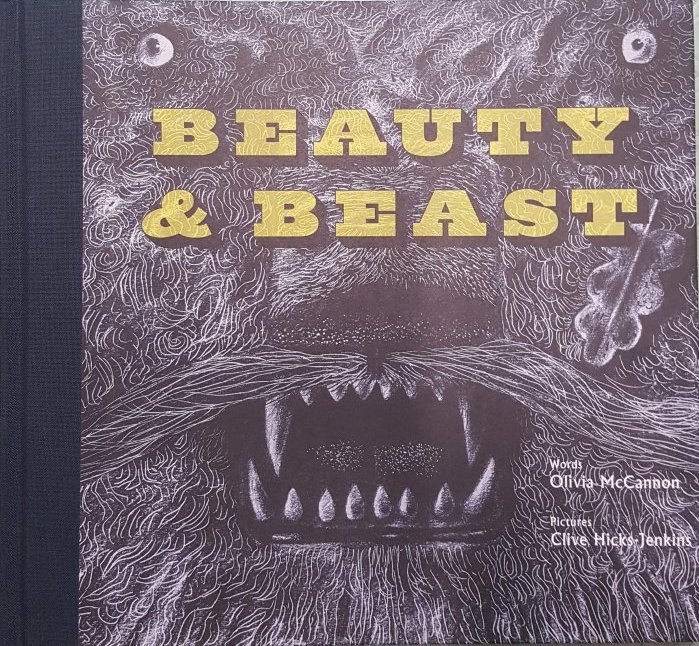
This week it’s the turn of another beautiful book published by the private press Design For Today and this time it is two books in one as if you buy the signed limited edition of the first one hundred copies, as I did, you get the hardback book along with a cut out and make toy theatre which includes a script so that you can perform the play. The total run of books is just 650 so 100 with the toy theatre and 550 without. I suspect that the toy theatre edition has probably sold out as my copy is number 85, but the standard edition appears to still be available on the Design For Today website, although the page relating to it is out of date as at the time I’m writing this it still refers to it being available for pre-order only.
The illustrations have been done by Clive Hicks-Jenkins who also illustrated another book I have from Design For Today, Hansel and Gretel retold by the current Poet Laureate Simon Armitage which I reviewed back in June 2019, his style is immediately distinctive and fits both these books beautifully. The words are by poet and translator, Olivia McCannon and don’t follow any previous version of Beauty and Beast that I am aware of which is one of the joys of the book in that you have no idea where the story is going. The book is wonderfully designed by Laurence Beck so this is definitely going to be an image heavy blog, I apologise in advance for the slightly distorted pictures but I really didn’t want to force the spine flat simply to get perfect pictures.
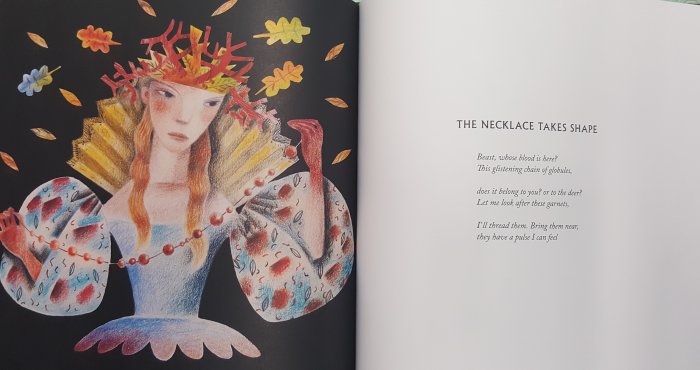
The text above is part of Beast’s thoughts as he carries the unconscious Beauty into his castle, as she has fainted at first sight of him. As you can see this is framed within a proscenium arch to echo the toy theatre that is also part of the production and has similarly been designed by Hicks-Jenkins. Pages are sometimes with black backgrounds and otherwise white, there are also many full page and double page illustrations, this truly is an art book showcasing the poetic words by McCannon. As I said above this is an original tale involving Beauty having to go to Beast after her father took a pomegranate fruit from Beast’s garden and then signing a contract to forfeit her in return for being allowed to leave Beast’s enchanted castle.
One unusual feature of the book is that so many of the images were done by Hicks-Jenkins before the text was written, sometimes many years before the book was even thought of, and are inspired by his reaction to the Jean Cocteau film ‘La Belle et la Bête‘ which Hicks-Jenkins first saw back in 1964 and which had a huge impact on him. The words and pictures were tied together between covid lock-downs here in the UK and in her introduction McCannon gives thanks to Joe Pearson, owner of Design For Today, for “keeping faith with a project that kept wanting to change”. Whilst the text is relatively short the amount of pictures and the need to combine them all into what is a truly lovely book must have been a highly complex exercise.
One of the double page spreads, in this case depicting Beauty travelling back to her father via interconnecting mirrors. Beast allows her to do this because her father is ill but she agrees that she must return within a week. Needless to say once she is back home the week passes so quickly that she overstays leading to the final tragedy of the story when she does finally return to Beast’s castle only to find him gravely ill from the despair that she may have left him forever. Unfortunately her two sisters see her travel back via the mirrors and realise that they too can go there, but they want to rob Beast of his treasure. Whilst they attack the castle and realise that it is well defended, Beauty cries over Beast, realising at last that she truly loves him.
Sadly Beast dies but Beauty resolves to stay at the Castle, the treachery of her sisters having repelled her from her original home. I loved the book, as have all the people I have shown it to so far. But as I mentioned at the beginning mine is one of the 100 copies that come with a toy theatre in its own folder that is contained with the book in a lovely slipcase made by Ludlow Bookbinders. I haven’t made the theatre but I am considering scanning and reprinting it onto card so that I can keep the original pages whilst also enjoying the theatre. I share with Joe Pearson a love of Pollocks toy theatres along with the scarce Penguin Books items that were designed to be used with them. You can read my short history of toy theatres in Britain based on a couple of the Penguin examples here. But for now here are some pictures of the flattened toy theatre that came with this lovely book, if I do get to make it then I will replace these with the replica.
Front cover of the folder
Inside
Rear cover showing some of the cutouts and the scenes that can be performed.
From the Phoenix Poetry 60 paperbacks of 1996 comes this great collection of Dylan Thomas poems featuring most of his most popular works other than ‘Under Milk Wood’ which I have covered in a previous blog back in 2018. There are thirty three poems in the collection including the brilliant ‘Do Not go Gentle into that Good Night’, a refusal to meekly accept death and of course the titular work ‘Fern Hill’ which describes an idyllic childhood, all life is here. What I love about Dylan Thomas is his wonderful sparse descriptive writing epitomised by the first poem in the book ‘Prologue’
This day winding down now
At God speeded summer's end
In the torrent salmon sun,
In my seashaken house
On a breakneck of rocks
Tangled with chirrup and fruit,
Froth, flute, fin, and quill
At a wood's dancing hoof,
By scummed, starfish sands
With their fishwife cross
Gulls, pipers, cockles, and snails,
Out there, crow black, men
Tackled with clouds, who kneel
To the sunset nets,
First 14 lines of Prologue by Dylan Thomas
This small book is an excellent introduction to the works of Thomas who despite being Welsh wrote only in English and the cover illustration is a lovely portrait of him by Augustus John which now hangs in the National Museum of Wales. Despite this being just a short collection it took me several days to read as I kept going back over the poems, savouring the words and pausing over particularly beautiful phrases that caught my imagination. The subject matters are often dark, and death is a frequent topic making him a difficult read at times but well worth persevering with. The powerful verse will pull you in even though I sometimes had to read a poem a few times to fully pick up the rhythm and appreciate it fully before I discovered that as part of his broadcasting career with the BBC a lot of his works are available on youtube being read by him such as this example of Fern Hill.
Sadly Thomas died in 1953 just two weeks after his 39th birthday, primarily from pneumonia although his heavy drinking could not have helped, and with his passing the world was deprived of arguably one of its finest poets who had only just finished his famous play for voices ‘Under Milk Wood’. I want to finish with extracts from the poem that first brought me to Dylan Thomas and which shows the raw power of his verse probably more than any other of his works.
Do not go gentle into that good night, Old age should burn and rave at close of day; Rage, rage against the dying of the light.
…
And you, my father, there on the sad height, Curse, bless, me now with your fierce tears, I pray. Do not go gentle into that good night. Rage, rage against the dying of the light.
First three and last four lines of Do not go gentle into that good night by Dylan Thomas
I have lived in Shropshire for the past eleven years and have seen copies of A Shropshire Lad numerous times in various bookshops across the county but never bought it. I think mainly because I knew that Housman never visited Shropshire before writing this collection of poems celebrating the county and he only came here briefly after becoming permanently associated in the public’s mind with Shropshire so doubted that he would have much insight into this extremely beautiful part of England. Sure enough whilst reading it became clear that even geographic details, which he gleaned from a tourist guidebook whilst writing the poems in London, were incorrect but the poems are not really about Shropshire anyway but about war and the untimely death of youths both in conflict and otherwise, including suicide. It cannot be described as a cheery read.
Let’s tackle a couple of the poems with more glaring geographic issues first just to get these out of the way, starting with one of the few poems to have a title rather than just a number, XXVIII The Welsh Marches which starts
          High the vanes of Shrewsbury gleam
          Islanded in Severn stream;
Well Shrewsbury may be built in a loop of the river Severn but it certainly isn’t on an island, indeed Shrewsbury castle stands guard on the northern side of the river defending the land entrance to the town. The poem continues in it’s fourth verse with
          When Severn down to Buildwas ran
          Coloured with the death of man,
Buildwas is roughly seventeen miles (27½ km) from Shrewsbury and the river has a significant volume by then so there is no way that blood from a Saxon battle, which would have involved hundreds rather than tens of thousands of combatants at that period of history, would still be visible in the water by the time it got there. The most obvious error though is in poem LXI Hughley Steeple, I don’t even need to quote the poem as Hughley church has a timber framed belfry but it certainly doesn’t have a steeple. But that doesn’t stop Housman giving it one with a prominent weather vane on top, which it also doesn’t have.
Ludlow gets mentioned in five of the sixty three poems and Wenlock Edge, which is a nineteen mile (30 km) long escarpment appears twice. Although even in, probably the most famous poem from the set, known as ‘On Wenlock Edge’ although not actually titled, geography isn’t Housman’s strong point as it mentions the Roman city of Uriconium, the ruins of which are fifteen miles (24 km) from Wenlock Edge. But the poem is a really good example of the style of the collection and has been set numerous times to music, most notably by Ralph Vaughan Williams who included other poems from the set as well in his song cycle On Wenlock Edge.
          XXXI

          On Wenlock Edge the wood's in trouble;
           His forest fleece the Wrekin heaves;
          The gale, it plies the saplings double,
           And thick on Severn snow the leaves.

          'Twould blow like this through holt and hanger
           When Uricon the city stood:
          'Tis the old wind in the old anger,
           But then it threshed another wood.

          Then, 'twas before my time, the Roman
           At yonder heaving hill would stare:
          The blood that warms an English yeoman,
           The thoughts that hurt him, they were there.

          There, like the wind through woods in riot,
           Through him the gale of life blew high;
          The tree of man was never quiet:
           Then 'twas the Roman, now 'tis I.

          The gale, it plies the saplings double,
           It blows so hard, 'twill soon be gone:
          To-day the Roman and his trouble
           Are ashes under Uricon.
As said above most of the poems don’t concern Shropshire in particular but rather the perils of war and death. The collection was first published in 1896 but didn’t really start to sell in significant numbers until the start of the Second Boer War and massively rose again during the First World War when the death of young soldiers was so keenly felt across the country. The overall body count across the series of poems is surprisingly high and it is nearly always young men who are speaking from the grave (a common theme of the poems) to those yet to die. I don’t really know what I expected from the poems as I genuinely didn’t know anything about them apart from the title before I came to read the book but I can’t say they particularly appealed to me. There is however a brief glimpse or two of albeit grim humour amongst the largely unrelenting gloom.
          XXVII

          "Is my team ploughing,
           That I was used to drive
          And hear the harness jingle
           When I was man alive?"

          Ay, the horses trample,
           The harness jingles now;
          No change though you lie under
           The land you used to plough.

          "Is football playing
           Along the river shore,
          With lads to chase the leather,
           Now I stand up no more?"

          Ay, the ball is flying,
           The lads play heart and soul;
          The goal stands up, the keeper
           Stands up to keep the goal.

          "Is my girl happy,
           That I thought hard to leave,
          And has she tired of weeping
           As she lies down at eve?"

          Ay, she lies down lightly,
           She lies not down to weep:
          Your girl is well contented.
           Be still, my lad, and sleep.

          "Is my friend hearty,
           Now I am thin and pine,
          And has he found to sleep in
           A better bed than mine?"

          Yes, lad, I lie easy,
           I lie as lads would choose;
          I cheer a dead man's sweetheart,
           Never ask me whose.
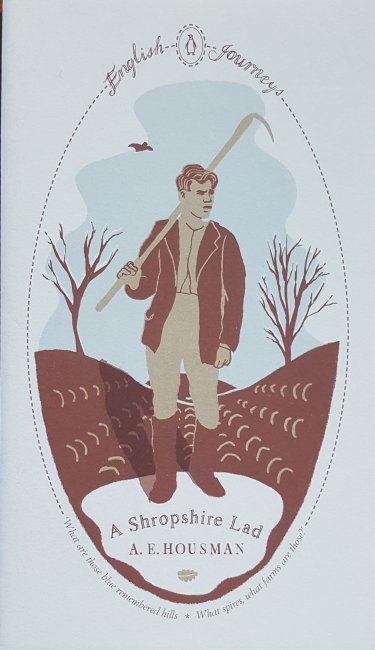
My copy is from the 2009 series of twenty books by Penguin called ‘English Journeys’ and I do have the complete set, all of which have very attractive covers. If there is any of these that you would like me to cover in a future blog entry then please send me a comment.
This prose translation of Rustaveli’s Georgian epic poem from the twelfth century by Katharine Vivian was praised by The Director of the Institute of the History of Georgian Literature in Tibilisi, A G Baramidze, as
an interesting attempt to render Rustaveli’s poem in prose – not to give a literal word by word translation, but rather a free rendering which may bring to the reader the contents of the poem and thus contribute greatly to Rustaveli’s popularity throughout the English-speaking world.
Prefatory note
The poem is seen as one of the greats of Georgian literature and Rustaveli is regarded there in much the same way as Shakespeare is here so it was a surprise on reading it that it doesn’t appear to have any action take place in Georgia. Instead Avtandil and his great love Tinatin are portrayed as coming from Arabia whilst Tariel and his love Nestan-Darejan are Indian. The story concerns how Avtandil and Tariel are separated from the loves of their lives and ultimately win their hands in marriage although in two very different ways. But let us start at the beginning because that is where the story is closest to Georgian history. The first chapters deal with Tinatin being raised to be Queen of Arabia by her father as he steps aside and this mirrors the ascension of Queen Thamar in Georgia who was monarch during Rustaveli’s lifetime and this is still seen as a golden age for Georgia. Avtandil is commander of Tinatin’s army and a favourite of her father Rostevan whilst Queen Thamar’s second husband was a highly successful military commander. From here onwards though the poem leads off on a mythical path.
One day whilst Rostevan and Avtandil were out hunting they see in the distance a knight on a black charger clad in a panther skin and when they get nearer it can be seen that he is weeping. Rostevan dispatches some of the soldiers with them to bring the knight to him but he seeing soldiers approach kills them assuming that they meant him harm. When the king attempts to get near the knight turns his horse and vanishes. Greatly intrigued by this mysterious knight and saddened by the loss of his men Rostevan sends Avtandil on a three year quest to find the knight in the panther skin. Now this is where the tale could have been padded out considerably in describing Avtandil’s journey, and the poem is already 200 pages long, but within a page we find ourselves near the end of the three years and all we are told is that he hadn’t found him, Rustaveli is clearly keen to get to the action.
Finally about to turn back and report failure Avtandil spies his quarry but remembering what happened to the last soldiers he saw approach the knight decides to track him rather than approach directly. He discovers his home in some caves and finally manages to talk to the woman who lives with him and persuades her to get the knight to talk to him. This knight turns out to be Tariel and king of one of the seven kingdoms of India and prospective heir to other six who are all held by one man, he is also maddened by grief. It turns out that he is desperately in love with Nestan-Darejan who is the daughter of the other king and she is in love with him but that he had killed the man who had been arranged to be her husband and fled the country to avoid the repercussions. Nestan-Darejan, once it was discovered that she was in on the plot was exiled in secret and Tariel had been looking for her ever since and this is where the story really begins to pick up.
The tale of how Avtandil returns to Arabia to report finding the knight and then heads back to him against the wishes of Rostevan, thereby making himself an outcast, but he does so in order to aid Tariel find Nestan-Darejan. The great quest he makes in this search (which this time is covered by the poem) and the ultimate success not only in defeating the many enemies he comes up against but also in rescuing her and into the arms of Tariel is the main part of the story. That all ends well for our heroes, including the other characters that assist them greatly is happily the result and the way the story builds in excitement is really well done. Avtandil and Tariel are endowed with mythical abilities in war and either singly or with a few hundred men are capable of taking on foes with considerably greater numbers whilst emerging with at worst a minor injury to themselves. This truly is a tale of the Heroic Age and what would probably have been a daunting read, a 200 hundred page poem is something to take care with, was transformed in Katharine Vivian’s prose to be a romp through a great story. Georgian literature is poorly represented in English translation so I am glad I finally took this book off the shelves.
The book was published by The Folio Society in 1977, unusually by using letterpress, and is bound in Princess Satin cloth with a very attractive device on the cover by Levan Tsutskiridze. Sadly for A G Baramidze’s hopes that this would spread the word about their great epic it was never reprinted and I cannot find Katharine Vivian’s translation being subsequently published by anyone else. In fact this appears to be the only English translation of Rustaveli’s masterwork ever printed in the UK.
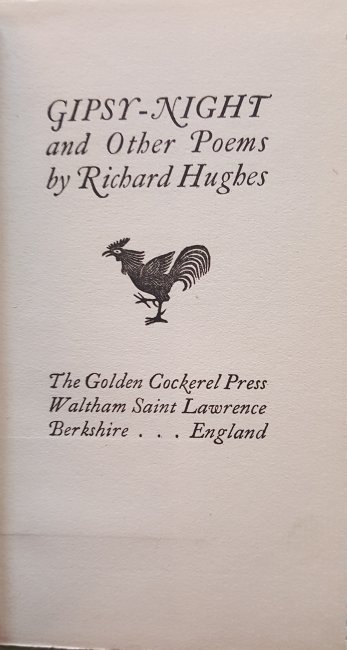
Printed this week in 1922, the year Hughes graduated from Oxford, this was his first book and remarkably it was selected to be only the eighth title printed by what would become recognised as one of the finest Private Press publishers, Golden Cockerel Press. The image above is of the title page as my copy is missing its dust wrapper but that is not surprising in the one hundred years since it was published as the wrapper was quite delicate. Only 750 copies of this book were published by Golden Cockerel and it is one of the just fifteen titles published under its control of the original founder, Harold ‘Hal’ Taylor before his recurrent bouts of tuberculosis which eventually killed him in 1924. Before his death the press was sold to artist and author Robert Gibbings who transformed the business into a publisher of finely illustrated editions and really made the name of Golden Cockerel over the next nine years producing seventy one titles in that period before he too sold the business on. The press went through another couple of owners before ultimately closing down in 1961.
As I said at the beginning Robert Hughes had not been published before this collection but just two years later he was to be commissioned by the BBC to write ‘Danger’ which became the first ever play written specifically for radio broadcast anywhere in the world. In 1929 he also wrote ‘A High Wind in Jamaica’ which was filmed in 1965 starring Anthony Quinn and James Coburn so it’s clear that Hal Taylor had recognised some early talent in this young author. Hughes would later become a good friend of Dylan Thomas and his first book of prose ‘A Portrait of The Artist as a Young Dog’ was written whilst staying with Hughes. But enough of the history behind the press and the author, what of the poems themselves? Well as you would probably expect for a first collection from somebody who was still only twenty one when the book was published it’s a bit of a mixed bag, I tended to prefer the longer pieces, but of the ones that are short enough to include within the blog The Ruin is probably my favourite and gives a good overview of his style.
The Ruin
Gone are the coloured princes, gone echo, gone laughter: Drips the blank roof: and the moss creeps after.
Dead is the crumbled chimney: all mellowed to rotting The wall-tints, and the floor-tints, from the spotting Of the rain, from the wind and slow appetite Of patient mould: and of the worms that bite At beauty all their innumerable lives.
—But the sudden nip of knives, The lady aching for her stiffening lord, The passionate-fearful bride And beaded pallor clamped to the torment-board, —Leave they no ghosts, no memories by the stairs? No sheeted glimmer treading floorless ways? No haunting melody of lovers’ airs, Nor stealthy chill upon the noon of days? No: for the dead and senseless walls have long forgotten What passionate hearts beneath the grass lie rotten.
Only from roofs and chimneys pleasantly sliding Tumbles the rain in the early hours: Patters its thousand feet on the flowers, Cools its small grey feet in the grasses.
Hughes doesn’t appear to have published another collection of poetry and apart from his plays wrote four novels although he was working on a fifth, which was supposed to be the final part of a trilogy, at the time of his death in 1976. Gipsy-Night and Other Poems itself is a good example of the work of a Private Press, using handmade paper and high quality letterpress printing and although it is dated the 24th March 1922 that is when printing was completed. The fact that only fifteen titles were published in the first three years gives some idea of the length of time it would take to print and bind the books using a relatively small hand press with often just two people working at a time. It was really a labour of love, Golden Cockerel never made much of a profit and some of the books in the Gibbings era definitely lost money despite their high initial purchase cost.
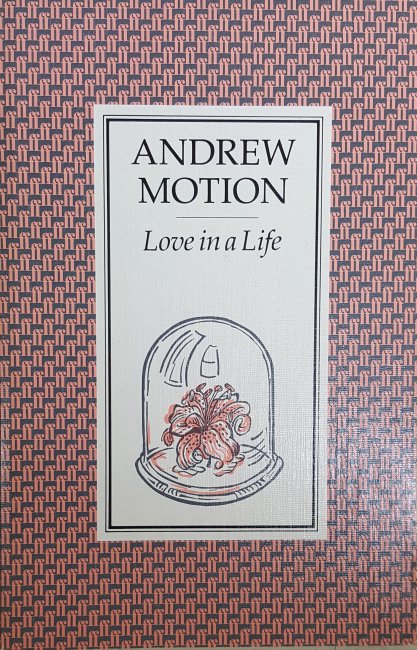
This is Andrew Motion’s sixth collection of poems and seemed an appropriate read for valentines day. Published by Faber and Faber in 1991, so eight years before he became Poet Laureate, it is a deeply personal selection of poetry largely telling stories from his two marriages (up until then) spread over multiple poems in a series of emerging themes. Again it is a book that has sat on my shelves for many years (presumably thirty as it is the first edition) and remained unopened until yesterday having constantly slipped down the ‘to be read’ pile for various reasons. Having now read it I am forced to wonder why it kept failing to make it to the top until thirty one years after I bought it. This was the first of Motion’s books to be published by Faber and Faber and they have gone on to publish most of his collections of poetry since then.
The wife referred to in the first verse is his second spouse, Jan Dalley, whom he had married in 1985 and had three children with including the twins mentioned, there are also poems referring to his first wife, Joanna Powell, that marriage ended in divorce in 1983. The second verse is considerably more tragic, Motion’s mother had a riding accident in 1969 when he was just seventeen and was in and out of a coma for the next nine years until she died in 1978, there are a few references to her in this collection. My favourite poem in the book is about his time with Joanna Powell and is called Toot Baldon where it is clear that he is still at work on his Masters degree when they married as he refers to himself as Edward Thomas, the poet whose work he analysed for this qualification and who he must have totally immersed himself in to get his MLitt after his first class honours degree from Oxford University.
The poems all have a strong narrative flow, he is definitely telling a story in each example particularly in the poem The Prague Milk Bottle which was written in spring 1989, so just a few months before the Velvet Revolution that saw the freeing of Czechoslovakia from the Soviet block, in this there is a repeated two line stanza
It’s not suppression It’s humiliation
Those two lines appear four times in the poem and give a powerful tension to the work as he details the woes of living in the country at the end of the communist regime and dedicates the poem to the Czech writer, his friend Ivo Smoldas.
Motion was the first poet to refuse to accept the post Laureate as a life long role and stipulated that he would only take the position for ten years, a situation that the poets that have followed him (Carol Ann Duffy and currently Simon Armitage) have also stuck to. Before him just eighteen people had held the position of Poet Laureate since its creation in 1631.
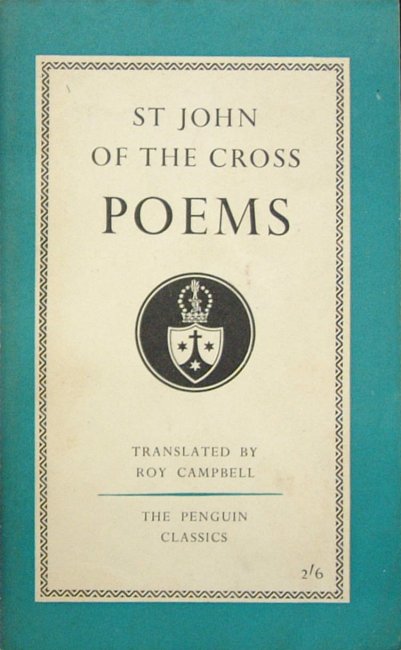
For this, the 200th post in this blog, I have chosen a Penguin Classic translation of the poetry of St. John of the Cross, the 16th century Spanish mystic christian and follower of Teresa of Ávila whose writings have also appeared in the Penguin Classics catalogue. The book is actually rather more than a translation as it is a parallel text edition with the original Spanish text on the left hand pages and the English on the right. Saint John (Juan de la Cruz in Spanish) was a Catholic priest and Carmelite friar involved in setting up religious houses in northern Spain but was also the greatest of the mystic poets in Spanish literature and indeed one of the giants of Spanish literature regardless of style or theme.
However, before discussing the poems, I would like to take a little time over the translator, much as the book does with a preface by his widow Mary Campbell. Roy Campbell was born in South Africa in 1901 and first came to England in 1919 where he met and married Mary in 1922 and they moved back to South Africa in 1925. He worked as an editor on a literary magazine whilst writing poetry but disagreed with the apartheid regime so moved back to London in 1927. On their return to England they fell in with the Bloomsbury Group and Mary started a lesbian affair with Vita Sackville-West at the same time as Virginia Woolf was also having an affair with Vita. Roy strongly, and reasonably, disapproved of his wife’s affair and to separate Mary and Vita the Campbell’s moved first to Provence and then to Toledo in Spain where Roy Campbell discovered the works of St John of the Cross and the couple converted to Roman Catholicism. It was in Toledo that St John had been imprisoned by rival Carmelite monks opposed to the very strict variant of the calling espoused by Teresa and John, he wrote most of his poems during his confinement. Roy Campbell, by the 1930’s, was becoming a well known poet in his own right and was fascinated by the poems of St John and whats more his heroic poetic style seemed ideally suited to the extant works of St John so he began work on a translation that was finally published by Harvill in 1951 and won the 1952 Foyle Prize. It is this verse translation that is reprinted in the 1960 Penguin first edition that I have, Roy Campbell having died in 1957 hence his widow penning the preface where she completely fails to mention the lesbian affair that took them to Spain in the first place.
The Spanish text is by Padre Silverio de Santa Teresa CD, and first appeared in an UK book in 1933 published by the Liverpool Institute of Hispanic Studies.Roy Campbell has done an excellent job of translating the poems as not only has he translated the text but found English words which allow the lines to largely scan and always rhyme as the originals do. A moments thought would tell you how difficult this is and why many poetry translations don’t attempt this.The longest work is ‘Songs between the soul and the bridegroom’ where the poem is in the form of a conversation between the two parts where God is gradually revealed to be the bridegroom that the soul or bride is conversing with. I really enjoyed this one as there is more time for development of the story within the poem as it goes on for seven pages, most are less than a page and a half and some are simply one verse.
Several of the poems use repetition of the last line of each verse such as ‘Song of the Soul that is Glad to Know God by Faith’ where each verse, apart from the eleventh, ends “Aunque es de noche” (Although it is night) although with this particular poem Campbell varies the last line between “Although by night” and “Though it be night” and I’m not sure why he made the change as reading it with “Although by night” seems to scan perfectly well with each verse. My favourite poem of the collection though is ‘Verses about the soul that suffers with impatience to see God’ and this is another where repetition of the last line of each verse is utilised although this time it is the sense of the last line that is repeated as the words vary between “Am dying that I do not die”, “And die because I do not die”, “The more I live the more must die” etc. culminating in the more hopeful “I live because I’ve ceased to die”.
I was surprised by how much I enjoyed this volume of poetry as I’m not remotely religious, let alone Catholic, so am clearly not the target audience. I suspect this is partly down to the way religion is handled in English schools where is is taught as a ‘normal’ subject and after all nobody asks you to believe in geography.
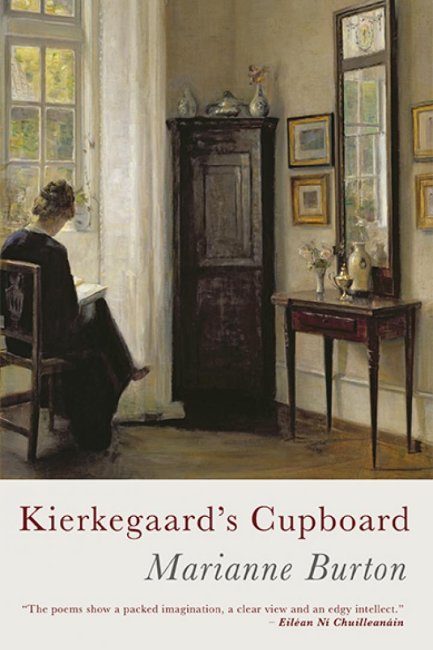
A collection of poems inspired by the life and works of Danish philosopher and theologian Søren Kierkegaard, what an unusual idea and so it had to be bought and read if only for the concept. What I didn’t expect was just how readable Burton’s poetry is, and how difficult to put the book down proved to be. It is only a slim volume but I read it within a couple of hours of purchasing, this was helped by the fact that each poem is a variation on the sonnet form and at least retains the limit of fourteen lines even if Burton doesn’t keep to iambic pentameter and certainly not to the normal eight line, six line stanzas structure. This made it an ideal book to have with lunch as I could read a poem then have a bite of lunch or a swig of beer whilst thinking about it before diving back in to the next poem; which made for a very enjoyable, and enlightening, hour and a half in a very good pub.
The book is split into six sections, ‘Childhood’, ‘Regine’, ‘Writings’, ‘After the Corsair’, ‘The Moment’, ‘Death’ and there are fifty poems spread through these sections along with one extra right at the front entitled ‘How To Write A Preface’. As stated above all the poems have just fourteen lines but Burton manages to pack a lot into her self imposed constraint and each section has a short biographical note which introduces the poems to come and places their significance in the life of Kierkegaard. ‘Childhood’, ‘Writings’ and ‘Death’ are pretty self explanatory but the others need explaining if, like me, you don’t know much about Kierkegaard. Regine Olson was an eighteen year old whom Kierkegaard was briefly engaged to but he called the engagement off when he realised that marriage was not for him and he could only make her unhappy trapped in a relationship with him. He never got over the loss of her though and had a cupboard which contained all the letters and mementos of their year together and that is what gave this book its title. The Corsair was a Danish satirical magazine which lampooned Kierkegaard not just for his writings and beliefs but also his appearance and the lost relationship with Regine and the resultant publicity made him a figure of fun for a while. ‘The Moment’ refers to a series of tracts by Kierkegaard criticising the Danish Lutheran church. It should be noted here that in the only factual error I have found in the book Burton states that Regine was seventeen when she was engaged to Søren but she was born in January 1822 and they became engaged in September 1840 so she was definitely eighteen, Søren by the way was twenty seven at the time.
A lot of the poems are written in the first person so the book reads as though Kierkegaard himself is talking to us through the medium of verse. Three particularly intriguing poems all have the same title ‘It was Early Morning. Abraham Rose’, these are in ‘The Writings’ section of the book and tell three very different versions of the biblical story of Abraham preparing to sacrifice his son Isaac one after another. Kierkegaard had a strong personal religious belief but an often fractious relationship with the dominant church in Denmark and some of the strongest works in this collection are in ‘The Moment’ where Burton takes on his mantle in a critique of the state run religion and its materialistic clergy. I must look out for Burton’s first collection of poems ‘She Inserts the Key’ as this collection has whetted my appetite for more.
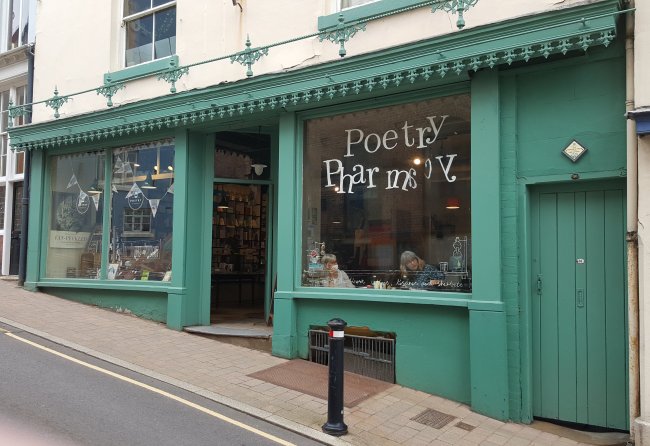
I purchased the book last month during a trip to the small Shropshire town of Bishop’s Castle where there is a quirky shop called Poetry Pharmacy, which mainly sells poetry but also has other interesting books and a small children’s section along with a coffee shop, it’s definitely worth a visit if you ever find yourself deep in rural Shropshire.














 Ramblings on my bookshelves