The Oxford English Dictionary

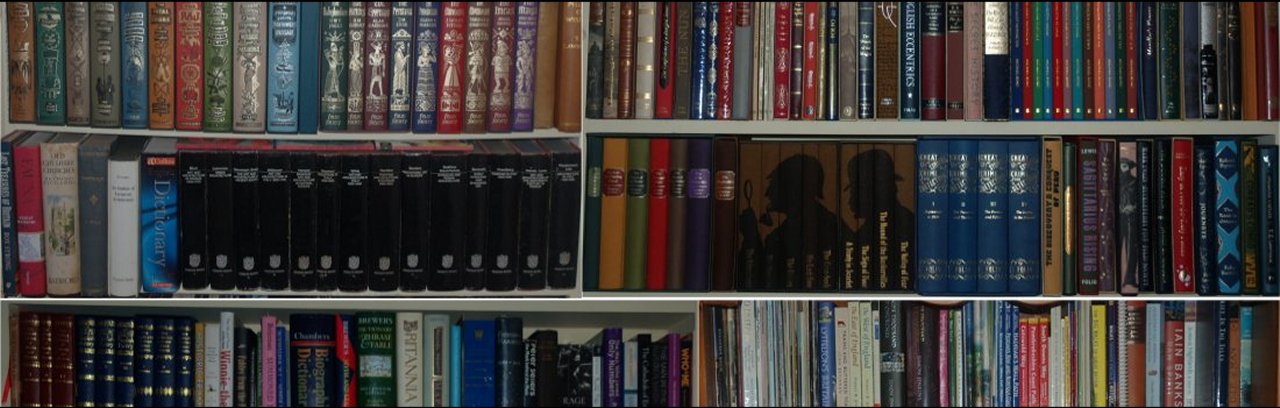
The complete OED is ninety years old this year so it a good opportunity to look both at my copy but also the history as to how this massive work came to be produced. Unlike almost all other dictionaries the complete OED is organised on historical principles, that is; it not only tells you the current meaning of a word, but also previous meanings over 1,000 years of English usage illustrated by quotations. This means that the over six hundred thousand words now in the dictionary are complemented by in excess of three million quotations.

20181023 OED 4

Although the first edition of the work was finally completed in 1928, work on it started much earlier and the decision to embark on the project actually goes back over seventy years before then to a meeting of the Philological Society of London in 1857. However nothing really happened after that, despite their resolution that existing English dictionaries were incomplete and not suitable for purpose. At the time the finest dictionary available for English had just passed its one hundredth birthday so it wasn’t unreasonable to see that A Dictionary of the English Language by Samuel Johnson was looking somewhat dated. That astonishing work by one man over seven years still ranks as one of the greatest single acts of scholarship and would remain the ultimate guide to the language for 173 years until the OED was completed by its large team of some two thousand compilers. Johnson himself defined dictionary compilers as follows:

Lexicographer: a writer of dictionaries; a harmless drudge that busies himself in tracing the original and detailing the signification of words

Actual work on the first edition of the OED didn’t start until 1879 when an arrangement had been reached with the Oxford University Press to publish and James Murray appointed as editor. The plan was to produce a four volume dictionary of some 6,400 pages and have it complete in ten years, this was to prove hopelessly optimistic. The dictionary was being written in alphabetical order so that the sections could be produced as they went along rather than waiting for completion but after five years the team had reached “Ant”, this was much more difficult than they had thought. In fact the first part of the dictionary did not see light of day until 1884 and ultimately by 1928, almost fifty years after starting, there would be 128 parts which were bound into ten volumes comprising 15,490 pages and over a quarter of a million entries. Unfortunately Murray died in 1915 so never saw his life’s work as a complete edition. The set was also very expensive, the cheapest binding cost 50 guineas (over £3,150 in today’s money) so it was definitely intended for institutions rather than members of the public.

20181023 OED 2

Completing the first edition was just the start, languages never stop evolving, especially English which is continually adding new words and meanings from across the world so the two remaining editors W.A. Craigie and C.T. Onions almost immediately started work on revisions for a second edition and also a supplement to keep the work up to date. By 1933 this supplement was produced and the original dictionary reset and reprinted in twelve volumes and there things stayed as far as printed editions were concerned until 1957 when it was decided to revise and expand the supplement. This became a four volume work in its own right, coming out between 1972 and 1986, but by then it had been decided to produce a second edition. This would merge not only the first edition with the supplements but include all the extra entries that had been compiled as the supplements were being published but which had missed their appropriate volume and whilst they were at it convert it to an electronic form for ease of future amendment.
20181023 OED 3

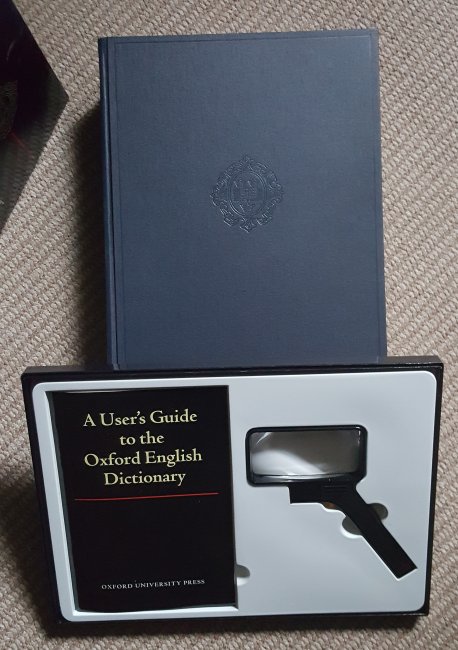
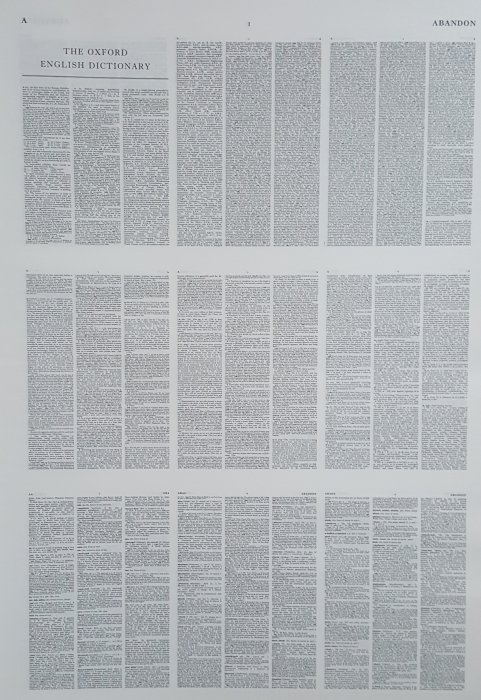
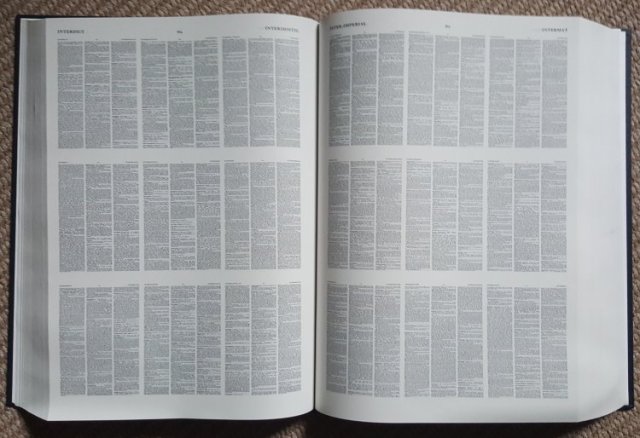
The second edition came out in 1989 and had grown to twenty volumes consisting of 21,730 pages with 291,500 entries and it is the ‘compact’ version of this edition that has illustrated this blog. This version, which I have had since it came out, reproduces all 21,730 pages as photo-reductions, nine to a page and is printed on very thin paper which allows for the 2,386 pages to be bound in one huge volume. It comes with a guide to using the dictionary, which also includes a very useful (at least for this essay) history of the publication and an absolutely essential magnifying glass with built in light so that you can actually read the text. Three volumes of ‘Additions’ came out in the 1990’s however not in ‘compact’ form, but in 2000 it was decided to abandon further updated print editions in favour of electronic updates and to move the dictionary online. The full twenty volume dictionary is still available in print for £845 or you can get the compact edition that I own for £400
20181023 OED 5

Although the third edition, should it ever achieve completion, will almost certainly never be sold as a printed edition as it is far more practical in the form it has now taken, the editors have already produced a preface which includes the following recognition that a lexicographers work is never done:

There are a number of myths about the Oxford English Dictionary, one of the most prevalent of which is that it includes every word, and every meaning of every word, which has ever formed part of the English language. Such an objective could never be fully achieved. The present revision gives the editors the opportunity to add many terms which have been overlooked in the past, but it should be understood that fully comprehensive coverage of all elements of the language is a chimera. That said, the content of the Dictionary is certainly comprehensive within reasonable bounds.

The second edition really was just the first edition with more entries (existing entries were not amended) however the work now being done on the third edition is going back and updating those early definitions, some of which haven’t changed since the 1880’s when the first part was published. This will bring the dictionary fully up to date and also deal with the difference in style for the first entries in the part of the alphabet to make everything consistent. Subscriptions to the online OED are normally £215 a year however for the 90th birthday celebration this has been cut to £90 for any subscription taken out before 31st March 2019.
20181023 OED 6

One of the fun things that can be done with new edition is free and I recommend signing up to the word of the day.  As I type this post it has come up with:

20181023 OED 1

and I think that sums up the joy of the OED, yes for anyone interested in the English language everything really is oojah-cum-spiff.

The Girl’s Own Paper

20181009 Girls Own Paper 01

Last week I wrote about The Boy’s Own Paper with it’s mix of tales about adventurers, swimming The Channel with Captain Webb, foreign countries and peoples, sport and other outdoors pursuits. All in all an exciting read for Victorian boys.  Well a year after it started the same publisher came up with The Girl’s Own Paper and the content was very different, reflecting the still held view that girls were effectively in training to be home-makers and certainly didn’t need, or want, tales of adventure. I don’t have as many copies of The Girl’s Own Paper but I can do the same as I did last week and look through the first ever issue from January 3rd 1880.

20181009 Girls Own Paper 02

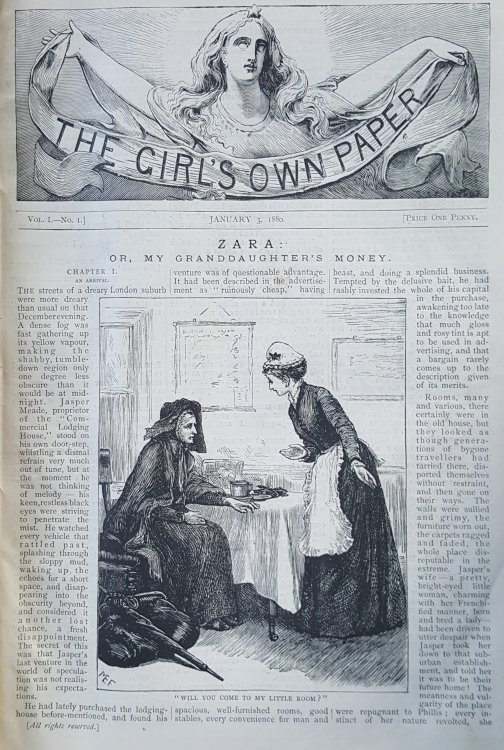
The front cover looks similar to the boy’s version only the masthead is somewhat less interesting, The drawing is based on the relief sculpture “The Spirit of Love and Truth” by Joseph Edwards and as such is entirely in tune with the Victorian attitude to girls. The story on the front is a long running part work, you can follow Zara for months as the magazine comes out each week. This is presumably because the serialised stories proved so popular in the boy’s version, this contrasts with the one off tale that appeared in their first edition but this was soon changed to serials in future examples. This opening section of the tale is a full four pages long.

Instead of tales of daring do with the dashing Captain Webb girls have the life of the young Princess Victoria which is altogether more refined and ladylike and also runs to almost three full pages. It is clearly intended to be an example of moral rectitude to inspire the readers and is pure hagiography as would be only expected really. The balance of the seventh page of the paper is occupied with The Girls Own Alphabet which is frankly dire and ends:

Woman is formed from girlhoods first plan –
Xantippe or Claudia, Queen Mary or Anne
Young friends to be happy, now learn to be wise
Zeal without knowledge is a head without eyes

20181009 Girls Own Paper 05

20181009 Girls Own Paper 06

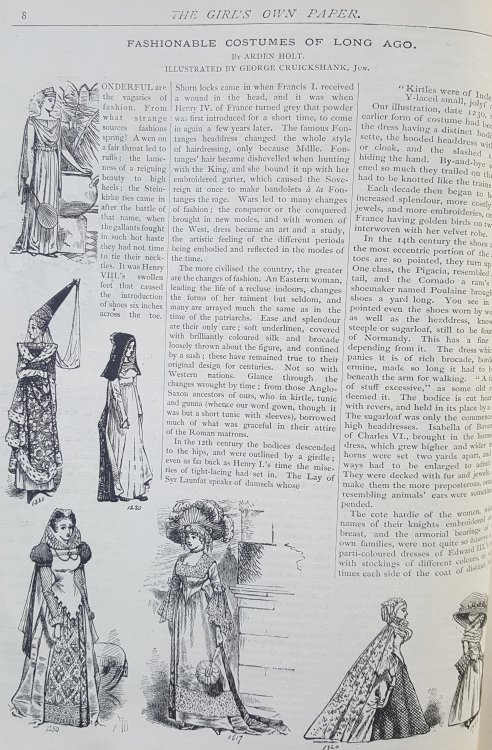
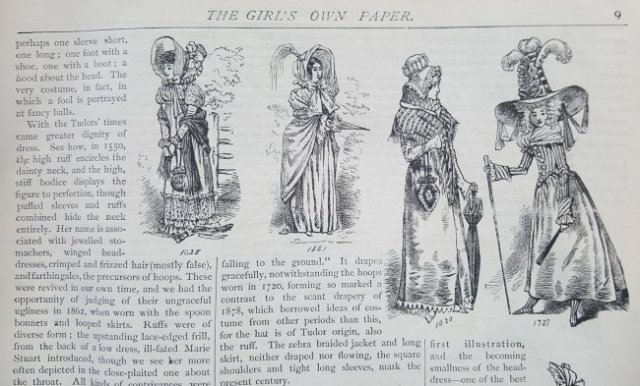
After the first seven pages consisting of the story plus Princess Victoria and the poem, an article on fashion though the ages was pretty well compulsory. A girl is naturally interested in dress styles and outfits so the next double page spread is concerned with this. The hat on the lady for 1787 on the far right of the second page is described as ‘more dressy’ it makes you wonder just how over the top an outfit had to be before it was queried.

and logically following on from that are long sections on needlework and of course cookery. As I said at the beginning the target audience are home-makers in preparation, if a woman of the time did work she would be a domestic servant or nanny if she was lucky and not forced into the extremely hard work of the mills or markets, the poorest though would not be frittering their money on something as ephemeral as this magazine, the readership could be relied upon to be at least middle class so housewife was the aim for almost all. The cookery class in this edition is about roasting and apart from the fact that it assumes you would be doing so over a fire rather than in an oven a lot of the advice would not be out of place in a modern cookery book. There then follows a couple of shorter stories before we reach..

20181009 Girls Own Paper 09

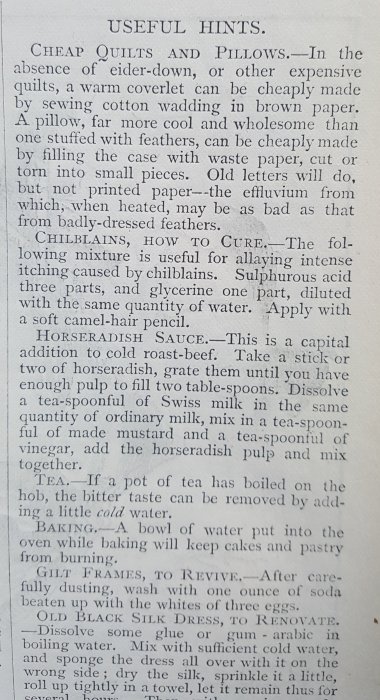
The Useful Hints sound initially as if they are envisaging a poorer reader and the chilblains remedy sounds positively dangerous, but soon normal service is resumed with hints for reviving gilt frames and renovating silk dresses. Now this is still a make do and mend mentality there is none of the waste of throwing away perfectly serviceable items so prevalent today, girls would be expected to have the skills needed to fix things regardless of their social standing, needlework was an expected ability and it would be surprisingly advanced.

Like last week I have looked forward to edition three of the Girls Own Paper to see what they are expected to be able to make; and again what would today be seen as an astonishing amount of craft is regarded as normal.

20181009 Girls Own Paper 10 - from edition 3

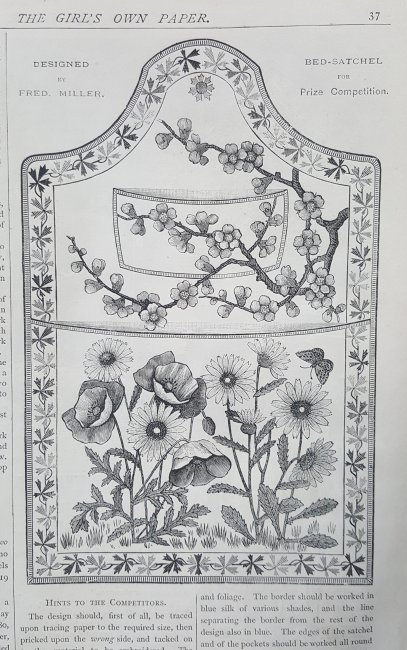
The bed satchel prize competition is for Crewel Work, a type of embroidery which uses wool, competitors had three months to complete the item, the winner to get two guineas and a second prize of one guinea. These are substantial prizes, the equivalent of almost £240 for the winner in today’s money. The work was to be 19¼ inches by 13 inches and use the pattern illustrated, it also had to be all the girls own work and this had to be stated in an accompanying letter written by a minister, teacher or parent. Colours are suggested in the hints section and the flowers named so that the correct shades would be used. No entrant would get their work back as

It is intended to present the well-worked satchels to the various hospitals and other charitable institutions for the use of poor patients, who will find them most handy for holding their nightdresses, pocket handkerchiefs, scent bottles, scissors etc.

The Boy’s Own Paper

20181002 Boys Own Paper 01

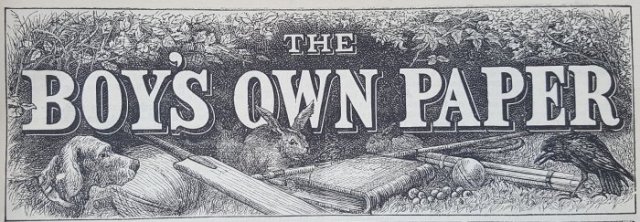
The Boys Own Paper started on Saturday January 18th 1879 and I have lots of early editions which have been bound into annual volumes and then after those a few examples of Boys Own Annual where the publisher reprinted the previous years editions in book form. The magazine was printed weekly and was full of exciting stories both fact and fiction, sports advice (later editions had articles on how to play cricket by WG Grace) along with things to do, most of which would be well beyond the target age group nowadays. The masthead reproduced above hinted at the wonders that would be found inside.

In exploring The Boys Own Paper I thought about taking my collection as a whole but decided that a more representative idea as to what a boy of 1879 would get from such a paper would be to just look at the very first issue which cost 1 penny back then which according to the Bank of England inflation calculator would be 50p nowadays so a very reasonable price as any equivalent today would be significantly more expensive.

20181002 Boys Own Paper 02

The front cover looks very promising but the game, described as football, is clearly what we would now call rugby. Indeed rugby football was commonly played in schools from the 1850’s following its creation at Rugby School in the 1830’s, Association Football (what we now think of as football) only had it’s rules set in 1863 and wasn’t as popular in schools even by 1879. The story concerns a boy, who picked for the team for the first time gets involved in a very close match which they only win right at the end, very much the sort of thing to catch the readers attention to the publication. The paper is 16 pages long and this tale takes up the initial 2½ pages. It was followed by a short poem and then the first part of what was to become a long running serial “Out with a Jack-Knife” and a much shorter series (just three parts) by Captain Webb, the first person to swim The English Channel.

The natural history column Out with a Jack-Knife proved especially popular and ran for a long time, in this first example it is 1½ pages long and describes finding various worms, centipedes and even glow-worms in a small overgrown garden area after first explaining that what you need is a proper British made jack-knife not one of those inferior foreign knives that include useless corkscrews, saws, things for getting stones out of horses hooves etc. British is best is a long running assumption in these magazines and this wouldn’t change right through until the magazine finally folded in 1967 after 2,511 issues, initially weekly and then monthly after WWI.

Captain Webb’s tale as to how he came to swim The Channel is full of self-deprecation as is appropriate for a Victorian gentleman. The final paragraph of the section reproduced above even says how difficult it is for him to write the piece because it is about himself but he did manage a page. Between the two sections came another page long article entitled “An Afghan Robber” which despite the unpromising title turns out to be a remarkably balanced piece of writing, especially for the time, which is actually quite complementary regarding the Koran and the Muslim faith in general.

20181002 Boys Own Paper 05

There then followed a series of stories, the most significant of which was “From Powder Monkey to Admiral”, this became a major storyline in future issues and by part four it was the front page tale. Subtitled “Or, the Stirring Days of the Royal Navy” this had it all for the boy looking for action and adventure in his reading and it would continue to be the front page story for most of the rest of the year and was always at least two pages in length, a significant proportion of  16 page publication.

Two shorter articles towards the end of the magazine are intriguing, I’m not sure if having read the piece about monkeys I was therefore expected to have one or more as a pet although it did lead me into that interpretation but I was more interested in the first column on Outdoor Pursuits entitled “Skating and Scuttling”. Skating I can understand, but deliberate sinking of ships as a pastime is definitely rather advanced for boys to be getting up to. It turns out that a ‘Scuttler’ is somebody who frankly is a nuisance out on the ice, dashing about without regard for other users and even worse can gather with others of their type to form conga lines spinning across the surface. The publication then has shorter and shorter articles until there is finally an essay writing competition based on a drawing with no caption.

I do want to include one item from issue three of The Boys Own Paper which gives some idea as to how advanced in skills boys were expected to be.

20181002 Boys Own Paper 08 - from edition 3

This is regarded as a project that “any lads with fair mechanical aptitude’ can make what is clearly a quite advanced craft. This isn’t a simple coracle or lash up raft, what we are looking at is a serious rowing boat and you are going to learn how to do it from your weekly boys magazine. I cannot imagine any publication aimed at this age group suggesting such a thing in the present day.

Well that was issue one of The Boys Own Paper in next weeks blog I’m going to look at issue one of The Girls Own Paper which came out a year later and what a contrast it is…

The Royal Tour – Harry Price

20180925 Royal Tour 01

The facsimile of the diary kept by Petty Officer Harry Price on board the H.M.S. Ophir during the Royal Tour of 1901 was printed in 1980 by Webb & Bower of Exeter. Harry had died back in 1965 and it was his son Jack Price who showed it to the publisher and which led to the facsimile printing.  Sadly it’s no longer in print but it is readily available on the secondary market for just three or four pounds, which considering how attractive the book is has to be one of the great book buying bargains.

20180925 Royal Tour 02

Harry was a talented artist and had attended Birmingham School of Art before joining the Royal Navy where he rapidly progressed to Petty Officer before joining H.M.S. Ophir just in time for the nine month long world voyage of Prince George and Princess Mary. George held both titles of Duke of Cornwall and Duke of York hence the slightly odd description given and he would later become King George V on the death of his father in 1910.

20180925 Royal Tour 03

The tour was started just two months after the death of Queen Victoria and was probably seen as an opportunity to introduce the younger Royals to the Empire after the end of her sixty three year reign. The diary is in Harry’s handwriting just as he originally wrote it as the voyage was progressing and provides a fascinating view of the trip and the various onshore excursions he managed.

20180925 Royal Tour 04

According to the list at the front of the diary, the route was as follows: Portsmouth, Gibraltar, Malta, Port Said,Suez Canal, Aden, Colombo, Singapore, Albany, Melbourne, Sydney, Hawksbury River, Sydney, Auckland, Wellington, Lyttleton, Hobart, Adelaide, Albany, Freemantle, Mauritius, Durban, Simonstown, St Vincent, Quebec, Halifax, St. Johns and then back to Portsmouth.

20180925 Royal Tour 05

I am including pages in sequence as the trip progresses so we have already reached New Zealand where he comments on the weather on the right hand page above. The style is quite chatty and it is clear throughout the book that he is intending this to be a souvenir that he can show to other people rather than a private diary. To this end he records his personal experiences but as though telling the reader about them.

The sketch below was taken up the river, some fifteen miles above Christchurch where as you can see the scenery was most bewitching, but a hard frost setting in as the sun went down made matters a little bit disagreeable, to us, who only a short time ago, were under a scorching tropical sun.

The date at this point was the 27th June so midwinter in New Zealand.

20180925 Royal Tour 06

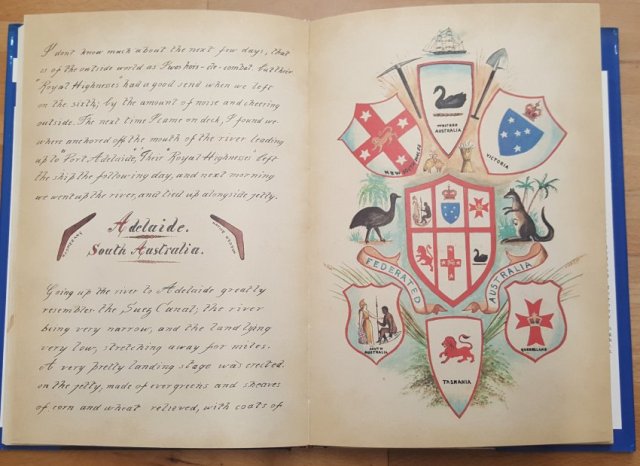
Returning to Australia Harry produced the very attractive full page picture of the various arms of the Australian states inspired by examples displayed along the banks of the Adelaide River, this time he didn’t get ashore but they did have ‘a visitors day’ where local townspeople could tour the ship and this proved so popular that they were almost overwhelmed by the numbers.

It is quite enough; when I say that quite a number of ladies fainted, and the bluejackets and marines had their handsfull

20180925 Royal Tour 07

I remember this book coming out and the original volume by Harry Price being shown on various TV programmes, the reproduction is extremely good but it can’t have been a particularly sound financial proposition for the publisher as it must have been expensive to print and it soon slipped from the list of titles they had available even though it clearly sold well judging by the number of copies available on abebooks. I bought my copy a few years later second-hand for £4, I know I wanted one at the time but I suspect it was beyond my teenage finances.

20180925 Royal Tour 08

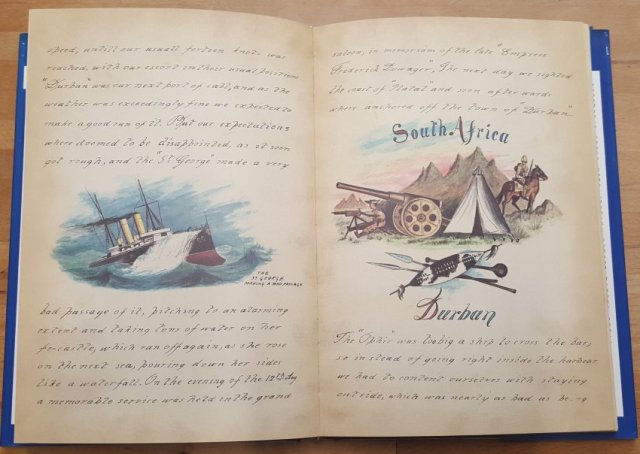
The crossing from Australia to Mauritius was surprisingly good for the Southern Indian Ocean but they hit bad weather crossing from there to South Africa as can be seen in Harry’s picture of their escort ship the St. George. It seems odd that South Africa was on the itinerary at all as the Boer War was in full progress with guerilla activity led by Louis Botha and Jan Christiaan Smuts in both the Eastern and Western Transvaal’s and Cape Colony respectively against the British occupation although by now the fighting really was going against the Boer forces. H.M.S. Ophir was protected by several British warships whilst in South African waters and the Royal couple had a significantly stronger armed guard with them whilst ashore whereas before the soldiers with them were largely ceremonial.

20180925 Royal Tour 09

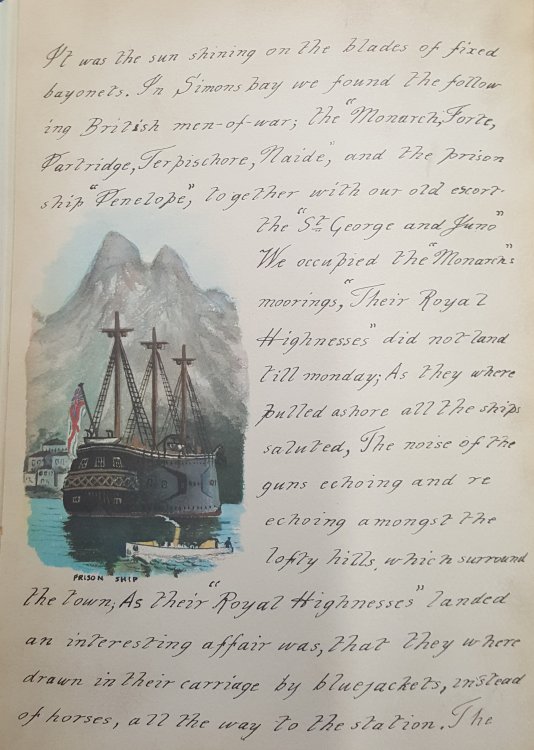
Harry Price even included an image of one of the POW ships moored off the coast, in total they spent less than two weeks in South Africa and three days of that was moving from Durban to Simonstown which was then (as now for the South African Navy) the main naval dockyard. They then set off for Canada via the Caribbean.

20180925 Royal Tour 10

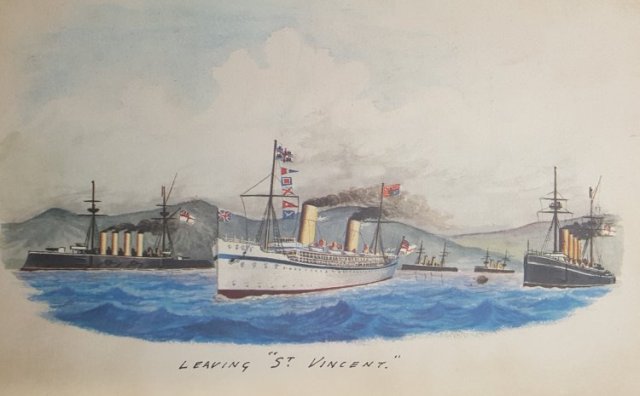
The strength of the Royal Navy at the time that the book was written can be judged by the fact that even leaving the small Caribbean island of St. Vincent there were four other naval ships available to escort the Ophir as it left the territory two of which are described as over 12,000 tonnes and in excess of 500 feet in length. There then followed a journey of ten days solid cruising up the eastern seaboard of the United States to Canada during which the American President William McKinley was assassinated and it is specifically mentioned that all the Royal Naval ships waiting for them in Quebec were also flying the American stars and stripes at half mast in respect.

20180925 Royal Tour 11

For the visit to Canada the Duke and Duchess disembarked and travelled for over a month via railway all over Canada. The Ophir waited for their return in Halifax, Nova Scotia and during that period was fully repainted and all needed repairs done. Discipline was clearly somewhat more relaxed than when the royal couple were aboard and this provided a break for the crew apart from their duties refurbishing the ship in dry dock.

20180925 Royal Tour 12

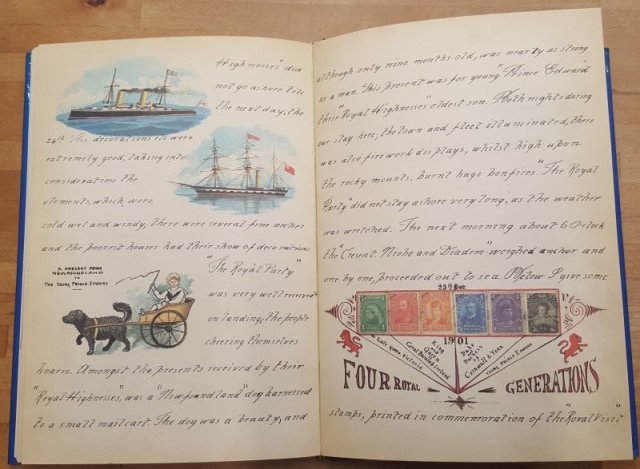
The final page I have included features a set of stamps issued in Canada to mark the royal visit and describes preparations to leave Canada and sail back for home. The book is a fascinating and beautiful historical document with almost every page decorated by Harry’s watercolours and one I like to pull off the shelves quite often, not just to read but sometimes just to enjoy the pictures.

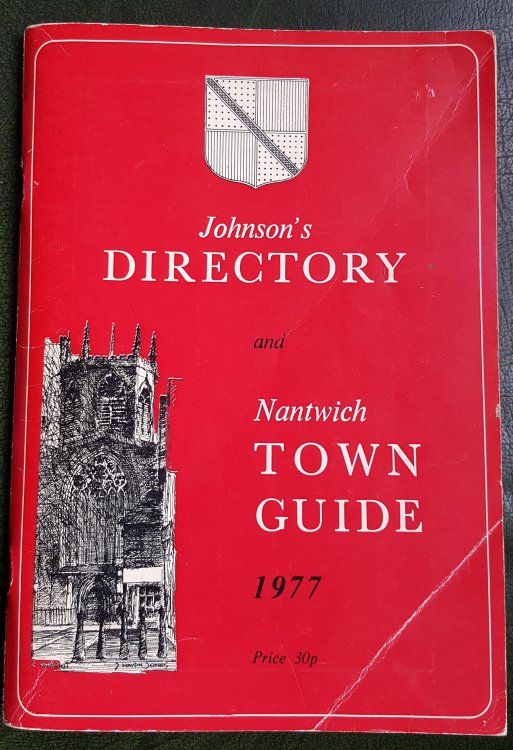
Johnson’s Directory

Johnson’s of Nantwich is one of the oldest still operating printers in the UK having been founded in 1827 by Thomas H Johnson and is still based on Oat Market in the heart of the town. The Almanack and Directory, that they started printing in the late 1800’s, lists the residents of the town by address, along with all public amenities along with their hours of opening, churches and other places of worship and the names of councillors not just for Nantwich but also the surrounding villages. The volumes are also packed with a fascinating collection of adverts and a “classified shopping index”, the title is in quotes at the head of this list, and there are also several articles on various subjects relating to the town. For a local historian this information is clearly invaluable, a genealogist would also find it useful for tracking addresses of people. I was born in Nantwich and can remember a lot of the businesses listed and can track my family moving house around the town as I read successive editions. I remember having copies of the Directory at home in the early 1970’s so as I’ve got older and more interested in local history trying to collect editions has become a challenge. They have never been particularly expensive but due to the ephemeral nature of the book they are surprisingly rare considering most households in Nantwich had a copy. At the time of writing there is only one edition available on abebooks.

According to John McMillan, the current Managing Director of Johnson’s, the 1977 edition that I have is the last year it was published, however establishing the first year is somewhat more problematic. 1977 was the 150th anniversary of the firm so there is a short article in the Directory on its history. This includes the lines:

In 1872 he printed and published the first edition of a publication that has become a household word in Nantwich and district – Johnson’s “Nantwich Almanack”, now known as Johnson’s Directory and Town Guide.

The Almanack, which cost a penny in the days before the First World War, has been published continuously for 89 years apart for a break caused by the production and paper problems of the Second World War.

Immediately there seems to be a problem with this description, this is the 1977 edition so 105 years after the specified first edition but is is also apparently the 89th year of publication. Further confusion is found in my 1938 copy (which says 1939 on the cover but internally describes itself as the 1938 edition and the 63rd year of publication). My next copy is the 1956 edition which is apparently the 68th year of publication, this implies a very long gap for WWII with possible production being 1938 (63rd), 1939 (64th), 1953 (65th), 1954 (66th), 1955 (67th) and then the next copy I have 1956 (68th). However this would fit in with the UK paper rationing period which started on the 1st June 1940 and which didn’t get removed until the Queens coronation in May 1953. It is reasonable to assume that as the Almanack and Directory would not be regarded as essential then Johnson’s would halt it for the entire period of rationing to preserve their paper supplies for other publications.

This clears up most of the sixteen year difference but not all of it. There wasn’t paper rationing during WWI but it is entirely possible that other priorities would mean that there was also a gap in publications during that conflict, until I manage to find an edition from before 1914 to confirm which publication year it claims to be that would remain a working hypothesis anyway. It is that or the recorded first publication year isn’t quite right, and if we take as correct the statement regarding continuous publication then stepping back from 1938 being the 63rd, the first would be in 1876 not 1872.  Enough of the history of publication lets look at some samples starting with my earliest…

1938 – 63rd year of publication

20180904 Johnsons Directory 01

The example I have has certainly been well used and a loop of string has been attached to the top of the spine so that it could be hung up, this was a book that was clearly referenced a lot and the owner wanted it handy. I really like the over the top cover design but it is when you get inside that it gets really interesting with some lovely adverts some of which can be seen below, click on the image to go to the page for that image and click there to see a larger version.

The book may have been one penny when it started but by 1938 it had risen to three pence, not too big an increase in over 60 years. The contents page gives a good idea of the spread of information available

20180904 Johnsons Directory 08

The entry for pages 43-45 Bands and Banks definitely catches the eye and is exactly what it suggests with 5 bands and the same number of banks listed. I wish The New Domain Syncopators still existed, they sound ideal for the Nantwich Jazz Weekend. As for the cheese fairs, there are 17 listed for Nantwich for 1938 and they coincided with the Thursday Market. Other entries of note include the social opportunities and I quite like the sound of Ye Olde Nantwich Giant Onion Society which includes a note under its entry that “this society has no connection with any other onion club”

20180904 Johnsons Directory 09

The directory followed the same format in all the copies I have, listing each street alphabetically and then by house number which business or householder could be found there.

1962 – 74th Year of publication

20180904 Johnsons Directory 10

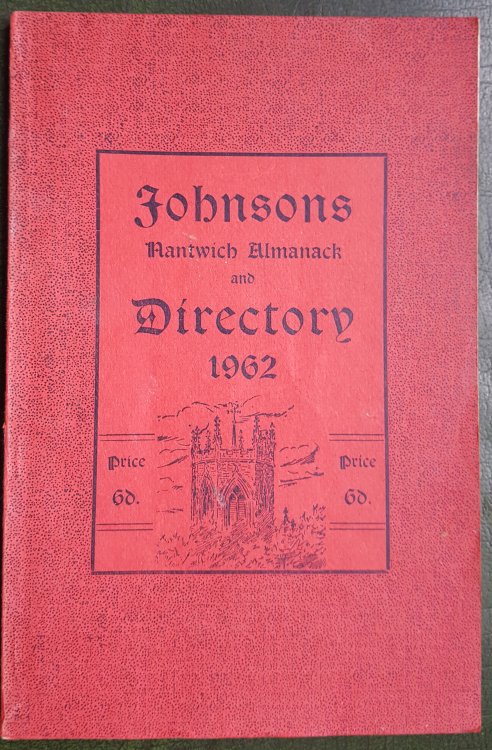
Post war the cover changed dramatically and the price doubled to sixpence, where it stayed right through the 1950’s and up to 1967. I chose the 1962 copy from my complete run from 1956 as this is the year I was born, so I can find my parents living on Whitehouse Lane or the Whitehouse Lane Estate as it was called in the directory because these houses were still being built and the lowest house number recorded is 39. Sadly Ye Olde Nantwich Giant Onion Society doesn’t appear to have survived and indeed the number of social and sporting clubs has dramatically reduced. the adverts are still very interesting though.

One fascinating section is the reprint from the 1932 directory called Old Nantwich which takes the form of an imagined stroll around the town describing people and places that the anonymous author passes. It is quite long so split into two parts each of twelve pages one in this edition and one that appeared in the 1963 copy. The inclusion of articles like these really adds to the books and they become more prevalent from this point onwards.

20180904 Johnsons Directory 18

There is also a three page write up about the church of St James in Audlem which continues a short series that had started the previous year with information about St Mary’s church in Acton.

1973 – Eighty-fifth year of publication

20180904 Johnsons Directory 19

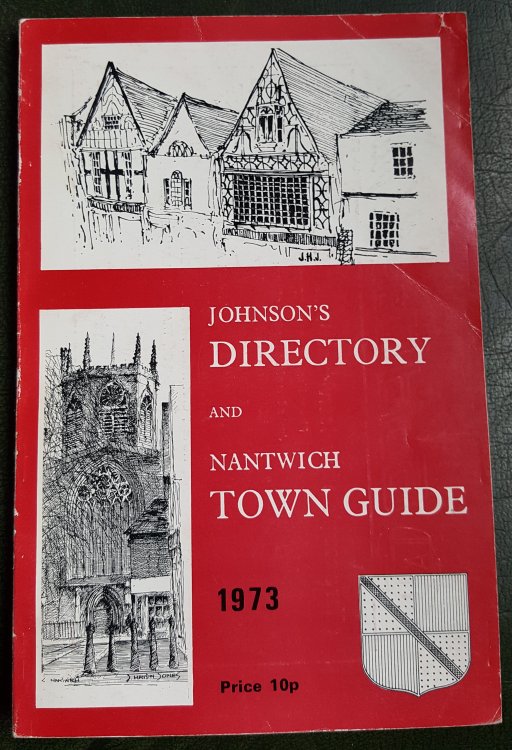
This year the cover was redesigned again, dropping the Almanack reference and now describing the publication as the Town Guide. There had been a few price rises in the intervening years from six pence in 1967, up 33% to eight pence in 1968, then again up 33% in 1969 to a shilling (twelve pence). In 1971 we had decimalisation of the currency and Johnson’s took the opportunity to increase the price again by 20% from five new pence (which is what a shilling became) to six pence. In 1972 it went up again by 33% to eight pence and as you can see in 1973 a further 20% increase occurred taking the price to ten pence. In just six years the price had quadrupled from six old pence (2½ new pence) to ten new pence.  This was undoubtedly due to several factors, one definitely being the reduction in the number of advertisers and those that were there are mainly typographical in design so I have just included a couple for businesses that I remember well. By now we had moved to another new build property on Broadway and this house was surrounded by lots of wooden panel fencing, which always seemed to be getting damaged leading to regular trips to Derek Copeland and I also found an advert from my first employer when I was a paper boy for Carringtons.

The production value of the book has also greatly increased. Taking the ‘Town Guide” part of the name seriously the articles included are significantly longer and illustrated. They start with a guide which runs from a brief history of the town to lists of general information such as the fact that there are 4148 inhabited dwellings in the town of which 1291 are Council owned and the population is 11666 (1971 census).

20180904 Johnsons Directory 22

Of more interest to myself who enjoys the local history, this edition also includes the second part of what is really a stand-alone book entitled “Nantwich – Saxon to Puritan”. The first thirty two pages had been included in the 1972 edition, this has pages 33 to 88

20180904 Johnsons Directory 23

and it is a really good read, very well researched with full bibliographies after each section. The final section; pages 89 to 120 are in the 1974 edition which also includes a note that the full text had been published in December 1972 as a stand alone book.

1977 – Eighty-ninth year of publication

20180904 Johnsons Directory 24

As noted above this is sadly the last edition of Johnson’s Directory and there was a final redesign for what turned out to be its swansong.  The price has again trebled from 1973 now up to thirty pence so it is now 24 times the price of my oldest copy from 1938 almost all of which has happened in the last ten years. Advertising has become rather static with most companies simply running the same advert for years on end, this doesn’t normally matter too much but because of this habit Chatwin’s the bakers are still making a point of a prize they won in 1963 with the obvious implications that they haven’t done anything similar over the intervening 14 years.

The article in this edition is the Johnson’s story that I quoted from at the start of this blog and in a way that is entirely fitting. The company is a Nantwich institution and it has been fascinating to go back through my collection of their products and remember companies that sadly have not managed to last as long as them along with a few that are still trading eighty years after they advertised in my oldest copy.

20180904 Johnsons Directory 28

In a future blog I intend to look at probably Johnson’s finest publication, Hall’s History of Nantwich and I’d like to finish with a quote from the frontispiece of that book

Thus times do shift; each thing his turne does hold

New things succeed as former things grow old

First Penguin crime set – part 3

20180815 Penguin 10 - part 1

The continuing exercise of reading all ten of the crime novels published by Penguin Books to mark reaching 150 titles. All the volumes I’m reading are the first edition, first impression copies published eighty years ago this month (August 1938). It’s been fun reading these old paperbacks so far and now I have just four to go, for part 1 see here, and part 2 is here. I’m writing this blog as I’m going along so the book is fresh in my mind as I write about it so lets see if I can get through the final four volumes in the coming week.

157 – The Mystery of Dr. Fu-Manchu – Sax Rohmer

Before opening this book I should say that this is the one I am least looking forward to. Although I’ve never read any of them the Fu-Manchu stories have never appealed possibly due to childhood memories of bad black and white films which I never watched to the end, or even half way through. Here’s hoping the book is better…

It wasn’t. It was everything I expected and worse, full of casual racism, extraordinary plot devices and ridiculous language I completed it only so that I could write this entry. Hopelessly jingoistic with the white race threatened by the yellow peril as it was regularly put, each chapter seemed to include another fantastical creation of poisons unknown to man, or traps created by mutant puffball mushrooms that react to light or other idiotic suggestions. The book fails on almost every level those rules suggested by A A Milne that I mentioned in the last blog with each time the ‘heroes’ get into trouble or a new murder is attempted yet another ‘fact’ is revealed just to get a solution with no pre-amble to involve the reader in the plot. Even more annoying is the constant xenophobia displayed by Rohmer where anyone who isn’t white is treated as a villain.

The language used also fails Milne’s tests with the servant of the first victim pointing out a way in with “Up yonder are the study windows sir” and the same sort of anachronistic rubbish is put in the mouths of several other characters. Nobody since Shakespeare has ever phrased a statement like that and he would have been writing a poetic play not accurately reporting actual language used.

Frankly avoid Sax Rohmer and I’m astonished to find that he is still in print.

158 – The Waxworks Murder – John Dickson Carr

What a dramatic improvement, Inspector Bencolin of the Paris Sûreté is a wonderful creation of a master of detective fiction. The plot is complex linking two murders of young women, a disreputable club in the area of Pigalle, itself a disreputable district of Paris, and Parisian high society. That an American, living in England, should write five novels about a detective in France is surprising, that they should be so atmospheric (at least on the evidence of this volume) is remarkable.  The Waxworks Murder (US title – The Corpse in the Waxworks) is the fourth Bencolin book, I also have the first (It Walks by Night) in the Penguin edition; however although Penguin published many other detective stories by Carr these mainly feature his best known detective Dr Gideon Fell.

Carr plays fair with the reader, there are lots of clues and as many red herrings, paths to enlightenment and just as many dead ends which makes the book my favourite of the ones so far, you really get a mental workout following the various strands of the plot. That the tension is literally maintained until the final sentence is also a tribute to the skill of the author and I can definitely say that I hadn’t worked out the solution until it was revealed and then as the bits I had missed were explained it all became clear. I loved that we were led by Carr to suspect yet another person in the last chapter before the denoument only to have that apparently logical step demolished by the detective a few pages later.

The tension builds as the book progresses and by the time I reached the last seventy five pages there was no way I was going to put it down until it was finished even though I really needed to be doing something else. I will have to try the Dr Fell stories after I have read It Walks by Night and then the Henry Merrivale tales that he wrote under the name of Carter Dickson. He may be a great mystery writer but he was rubbish at Pseudonyms

159 – The Dangerfield Talisman – J J Connington

J J Connington was actually the Scottish chemist Alfred Stewart who wrote over two dozen novels as Connington and several factual works under his own name. The Dangerfield Talisman is his fourth novel and unlike all the other books I am reading as part of this series it is a case of theft rather than murder that concerns the participants. Apart from that it is a classic British country house case that has been very well written with two separate but linked puzzles to be solved, what is the Dangerfield Secret and where is the Dangerfield Talisman?

What is also a lot of fun is that there isn’t a ‘detective’ figure as such, several of the house guests have a go at solving the problems and manage to rile the others by making unjustified accusations. This is not a gathering you would want to be part of. Having said that I was worried about the start of the book, there seemed to be a lot of interest in bridge (which is a card game I don’t play or even vaguely understand) and then a chess board diagram was added (which looked fairly straightforward but clearly wasn’t if it was to be the basis of part of the story). I had a horrible feeling that these games were going to be highly significant to the plot in which case I would be left without significant clues. In fact you don’t need to know anything about either game, the bridge games stop after a couple of chapters and the chess board only really comes into it’s own towards the end of the novel.  As for who took the Dangerfield Talisman I hadn’t a clue until it was revealed, not that there weren’t hints, just that I had not understood their significance. The Dangerfield Secret and more importantly the solution to it I had worked out though before it was explained.

Connington is definitely worth reading more of, five of his novels were published by Penguin and I have two others. One of the ones I’m missing is his science fiction book Nordenholt’s Million first published in 1923 and which is probably the earliest ecological disaster novel with a bacteria destroying farm crops around the world. Definitely one I’m going to seek out.

160 – Obelists at Sea – C Daly King

Last one… and the first question is what is an ‘obelist’? It turns out that King invented the word and defined it at the start of the book as “An obelist is a person who has little or no value”. Unfortunately when he re-used the word in two more novels “Obelists en Route” and “Obelists Fly High” he redefined it as “one who harbours suspicion”. At least if you are going to invent a word then be consistent. Penguin only printed this one book by C Daly King and at 312 pages of quite small print it’s easily the longest of the ten I have set myself to read, it is now Monday morning and I need to finish the book and complete this review for tomorrows post.

Well the plot was good and the conceal of the murderer was also well done but the writing style made getting through this book hard work. C Daly King was a psychologist and he made his detectives (for there is a group of them on their way to a conference on board the ship) also psychologists, although from differing branches and opinions. This could have worked well but King couldn’t resist putting in pages and pages of psychological exposition which was incredibly dull and just slowed the plot down dramatically. It was all completely unnecessary but you felt you had to read it in case there was a point to any of it. In fact there was virtually no point to the vast majority of this and even other characters in the book were bored of it eventually. But even then, after admitting that it was dull and largely confusing as they simply contradicted each other King couldn’t help himself from making some more pointed remarks about a branch of his own profession.  The book is split into six chapters, an introduction to the crime, one chapter for each of the four psychologists to try to solve it according to their own theories and practice and then a final chapter that finally explains what actually happened and why all four were wrong, although each had grasped part of the solution.

It’s a pity that this was the last of the set to read as it has let me down from the high quality of the previous two but it has been an interesting exercise although next time I set myself to read ten novels in one month I’ll start before the 12th.

First Penguin crime set – part 2

20180815 Penguin 10 - part 1

This continues a marathon reading session of all 10 of these books printed eighty years ago this month. I started late (the evening of the 12th) so I have less than a couple of days to read each book and write a short review. Part 1 covered books 151, 152 and 153 and can be seen here. As I read each book I’ll write a review on this blog and post on Tuesday next week as far as I’ve managed to get.

154 – The House on Tollard Ridge – John Rhode

Before reading this book I knew nothing about John Rhode and apart from a small black and white photograph of a man in late middle age smoking a pipe and a couple of glowing comments regarding his ability from two magazines printed on the dust wrapper there is nothing on the book to give me any idea about him. I decided to finish the book before finding out anything about the author.

The story was quite enjoyable although I was deeply suspicious of the person who turned out to be the murderer very early on in the book and none of the rather obvious red herrings put me off that train of thought as there was really only one person who could have controlled the events as they did. The main oddity of the book was that although it is 248 pages long Rhode’s amateur detective doesn’t appear until page 98 and up until then it reads as though Superintendent King from the local police force is the main character. When Dr Priestley does appear in the book it is only for a short while whilst explaining the case to him gives the author a chance to sum up what he has told us so far and it isn’t until page 172 that Priestley really comes into his own and starts to take apart the case made by Superintendent King. It is also at this point that it becomes clear that this isn’t Rhode’s first book about Priestley as other cases are mentioned, I’m guessing that the only other book by Rhode that was published by Penguin ‘The Murders in Praed Street’ is going to be one of them, I don’t own a copy and won’t be rushing to get it.

Finally looking up John Rhode, he turns out to be the pseudonym of Cecil John Charles Street MC OBE and from his Wikipedia entry he wrote a huge number of detective stories under several pseudonyms so he obviously had a readership in his day but he’s not for me.

155 – Murder at Crome House – G.D.H. and Margaret Cole

Now this should be interesting, I do have other books by G.D.H. Cole but they aren’t fiction, on my shelves are ‘Practical Economics’, ‘Socialism in Evolution’ and a couple of copies of ‘Persons and Periods’. Working with his wife however they jointly wrote crime novels and although I only have this one example and they were nowhere near as prolific as Cecil Street I was already aware of the existence of several other titles before I start reading this one.

Having now finished the book I can say that it is much better written than the previous example and considerably better at hiding the murderer until near the end, The tale is quite complex with more information about each of the possible suspects being revealed piecemeal as you follow the various parallel investigations with up to five people all going down different paths in trying to solve the crime and comparing notes regularly. At one point I had even half thought one of the people apparently investigating the murder was actually involved in the crime himself as each time he reported back his tales as to what had been done became more fantastic. Now that would have been an interesting twist, I wonder if there is a detective novel where the investigator turns out to be the murderer and is covering their tracks by apparently looking into the case?

I don’t have any other crime novels by the Cole’s but they don’t appear to have been ‘series writers’ with each book having different detectives however this is difficult to check as I cannot find any of their 29 joint works still in print. This is also the only one of their works to have been printed by Penguin so I’m not going to come across another as my collection of those increases. It is a pity that they have disappeared, maybe one of their books needs to be included in the excellent British Library series of crime stories that have been largely forgotten nowadays.

156 – The Red House Mystery – A.A. Milne

Yes that A.A. Milne, famous for Winnie the Pooh and the other characters from the Hundred Acre Wood, this is his only crime story and the only book in this block of ten that I have read before this exercise.

The story is well written and the denouement is properly hidden with enough clues to give it away when you re-read the book but not on first reading. Once you know what is happening then you get a different perspective and appreciate how well Milne was trying to help the reader in solving the murder but first time round you can guess but are unlikely to work it out. I loved the book as written by an author who knew how to write and could string his readers along as you slowly but surely reach the solution and the final twist is so good. If any of my readers are looking for a sadly now largely unknown detective novel in the true English country house murder style and have not read The Red House then I urge you to do so.

As a good counterpoint to this reading marathon Milne wrote a really good introduction to the 1926 edition, he wrote the book back in 1922 before he wrote any children’s books and was at the time best known as a playwright (and frankly he would have rather been known that way all his life).

I prefer that a detective story should be written in English. I remember reading one in which a peculiarly fascinating murder had been committed, and there was much speculation as to how the criminal had broken into the murdered man’s library. The detective however (said the author) “…was more concerned how the murderer had effected an egress.” It is, to me, a distressing thought that in nine-tenths of the detective stories of the world murderers are continually effecting egresses when they might just as well go out. The sleuth, the hero, the many suspected all use this strange tongue, and we may be forgiven for feeling that neither the natural excitement of killing the right man, nor the strain of suspecting the wrong one, is sufficient excuse for so steady a flow of bad language.

Of the great Love question opinions may be divided, but for myself I will have none of it. A reader, all agog to know whether the white substance on the muffins was arsenic or face powder, cannot be held up while Roland clasps Angela’s hand “a moment longer than the customary usages of society dictate.” Much might have happened in that moment, properly spent; footprints made or discovered; cigarette ends picked up and put in envelopes. By all means have Roland have a book to himself in which to clasp anything he likes, but in a detective story he must attend strictly to business.

For the detective himself I demand first that he be an amateur. In real life, no doubt, the best detectives are the professional police, but then in real life the best criminals are professional criminals.

He continues in much this vein for a while complaining that a man with a microscope is no detective at least not in fiction because he can see things his readers cannot and also explaining that ‘a Watson’ is invaluable. As perforce a literary detective has to run though the facts as they stand at various points and a conversation is much better than a  speech and far better than everything being sorted out in the last few pages. I have to agree with all of his points and he also manages to ensure that in his only detective story he holds to his principles, it’s definitely the best book so far.

Part 3 of this review is here

First Penguin crime set – part 1

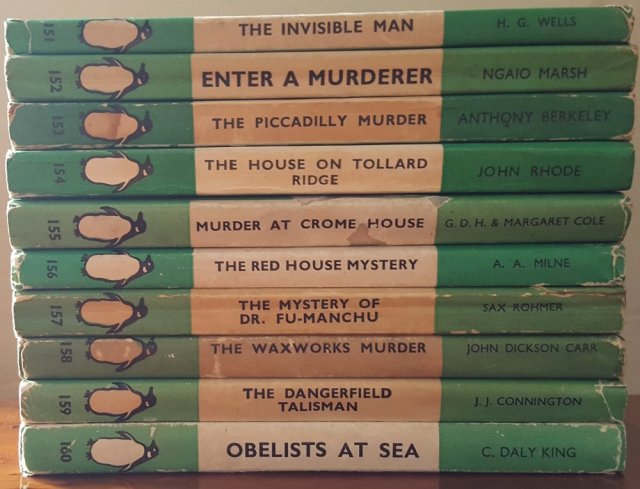
20180815 Penguin 10 - part 1I’m way too late in the month to start to attempt this (as I type this it is the evening of the 12th August) but I added a post to my Instagram feed earlier this month regarding it being the 80th anniversary of the first ‘Penguin 10’ and that I had all the books in first edition, first impression Penguin editions. Penguin Books started publishing in July 1935 and by July 1938 had printed book number 150. To celebrate this they next published ten Mystery and Crime novels in August 1938. This was the first time that all ten books published together were from the same genre although later they would do blocks of ten for the same author as well, most notably the Shaw million where 10 books by George Bernard Shaw were published simultaneously each in an edition of 100,000 copies in July 1946. I then added that I intended to read each of these eighty year old paperbacks the next month and gradually it has dawned on me that reading all of them this month would be more appropriate; so I have nineteen days to read ten novels and write something about them and as they are mystery and Crime stories I’ll be careful to not give away anything. I’ll start reading now and add reviews as I finish each book, so here goes…

151 – The Invisible Man – H.G. Wells

During my teenage years I read a lot of H.G. Wells, not just the famous books such as The Time Machine, The Island of Doctor Moreau, and War of the Worlds but his short stories and even his History of the World in two large hardback volumes so I assume I must have read The Invisible Man back then but I had no memory of it when I came to read it for this exercise. The story had slipped away as easily as the Invisible Man hoped to do. I suppose the many adaptations of the novella on TV and film and the borrowing of the original concept by other writers had also not helped but I was genuinely surprised by the story and the way that it is told. The book effectively starts near the end of the Invisible Man’s tale and the first half of the book is spent with him invisible (and with no explanation as to how this happened) arriving in the small village of Iping in West Sussex and then becoming an interesting and annoying tenant at The Coach and Horses Inn. He is wrapped in bandages and explains that he has been disfigured. From the number of chemical bottles he brings with him it is assumed that he had had some sort of accident whilst doing his research. His obsessive secrecy and short fuse temper soon become a problem and eventually after a few months, with his money running out, he is forced to leave the village but not before causing several injuries and leaving a trail of destruction.

He heads out onto the Downs (open countryside in this part of England) encounters a tramp and forces him to help him as they make their way south towards the coast. Eventually the tramp escapes and warns people about the Invisible Man before seeking refuge at a police station. The Invisible Man finds his way into the home of Dr Kemp, whom he recognises from studying at Oxford and this is where we find out all the back story as to how and why Griffin had become invisible as he introduces himself and tells his story to Kemp. His obvious criminal intent and apparent incipient madness worry Dr Kemp so that he also manages to raise the alarm with the police and the hunt is on…

The book was first written in 1897 however the Penguin edition states that it is from the re-issue of June 1926, I have been unable to find out if this is a revision of the original book or that if for some reason it had been out of print for some considerable time. Although Iping is indeed a real place the other two locations in the book (Port Stowe and Burdock) are both fictional.

152 – Enter a Murderer – Ngaio Marsh

New Zealand’s Ngaio Marsh was considered in her time to be one of the ‘Queens of Crime’ along with Agatha Christie, Dorothy L Sayers and Margery Allingham and is best known for her detective stories featuring Roderick Alleyn of the London Metropolitan police. Enter a Murderer is the second of thirty two novels she wrote about Chief Detective-Inspector Alleyn and is set in a theatre which is an environment very familiar to Marsh as she also worked as a theatre director. The crime is easy to describe, the final scene of the play being performed at the Unicorn Theatre involves one character threatening another with a gun, the gun is dropped when he realises that he cannot hope to escape, picked up by the original person being threatened and in an ensuing struggle goes off killing the original attacker. The gun was supposed to be loaded with dummy shells as it is seen being loaded in an earlier scene and blanks would still cause injury at such close range so in fact another gun is fired with blanks in the wings at the same time as the dummy shot in order to provide the correct noise. This is Marsh showing her theatrical knowledge as presumably she had seen this very trick done on stage. However the dummy shells have been replaced with real ones and the novel then revolves around ‘who replaced the bullets?’

The book is tightly written and numerous plot lines involving various romantic liaisons between the cast and supporting staff at the theatre along with an unresolved drug running episode from 6 years earlier are all interwoven. In the foreword Marsh is apparently consulting her own detective:-

FOREWORD
When I showed this manusript to my friend, Chief Detective-Inspector Alleyn of the Criminal Investigation Department. he said
“It’s a perfectly good account of the Unicorn case, but isn’t it usual in detective stories to conceal the identity of the criminal?”
I looked at him coldly.
“Hopelessly vieux jeu my dear Alleyn. Nowadays the identity of the criminal is always revealed in the early chapters.”
“In that case,” he said, “I congratulate you.”
I was not altogether delighted.

I must admit I didn’t get who it was until just over three quarters of the way through so I’m clearly not as good as her fictional detective, however I really liked the book and I will certainly be reading more Alleyn mysteries. One final thing that struck me early on though was when Alleyn was being particularly awkward about bossing people around and not telling them why he then apologises for being a bit Hitlerish. The book was written in 1935 just a year after Hitler came to power and 4 years before the start of WWII.

153 – The Piccadilly Murder – Anthony Berkeley

Whilst I quickly warmed to Inspector Alleyn that certainly could not be said of Ambrose Chitterwick, the amateur criminologist in Berkeley’s 1938 novel, who I really didn’t get on with almost from the first. Chitterwick was one member of the fictional Crimes Circle and it was he that solved the murder in probably Berkeley’s best known story “The Poisoned Chocolates Case”. The Crimes Circle was loosely based on The Detection Club which Berkeley had helped set up and included most of the famous pre-war crime writers such as H. C. Bailey, E. C. Bentley, G.K. Chesterton. Agatha Christie, G. D. H. Cole, Margaret Cole, Freeman Wills Crofts, R. Austin Freeman, Ronald Knox, Arthur Morrison, Baroness Emma Orczy,  John Rhode, Jessie Rickard, Dorothy L. Sayers, Henry Wade and Hugh Walpole. As can be seen from that list they are also well represented in this collection of ten books. Frankly I didn’t like Chitterwick in The Poisoned Chocolates Case and when I realised that this was a whole novel featuring him I wasn’t that impressed.

My poor opinion of the character seemed to be justified in the first half of the book and the obsequious chief of police also failed to ring true which made getting going at this story quite difficult. The second half of the book however made struggling with the first all worth while as the characters settled into more rounded individuals and the plot got gradually more interesting. I worked out who did it about two thirds of the way through the book as the red herrings were a bit too obvious and I can see why Berkeley hasn’t really stood the test of time as a crime writer and is now largely forgotten despite being a significant writer in the 1930’s. His work has dated rather badly and unlike Christie and Sayers for example he simply hasn’t got the style to morph into period pieces he just feels anachronistic.

There are no previous publication dates in the book so I’m assuming that the Penguin edition is the true first edition of this book making it one of the earliest books to be first printed by Penguin who up until then had been involved in paperback reprints of existing volumes.

Part 2 of this review can be found here

and Part 3 here

Save

The Complete McGonagall – the worlds worst poet

20180731 McGonagall 1

William McGonagall has gone down in history as the worst poet in the world and this book is a collection of almost every poem that can be reliably attributed to him. These have been published in various collections, but Duckworth have produced the most complete versions admittedly by creating extra volumes by merely selecting from the few books and pamphlets printed in the 1800’s along with some previously unpublished works. This book appears to combine an existing seven volumes into one but only two volumes were produced in McGonagall’s lifetime along with lots of single sheet poems sold as he was going along. In reality four of the listed volumes were created by Duckworth in the 1980’s and the three others were considerably shortened by them at the same time in order to provide works for the extra books.

I think we need an example from his first collection printed in 1890 just so that the uninitiated can get the measure of the man’s genius, this was his first poem, dated 1877 and is entitled “An Address to the Rev. George Gilfillan”

All hail to the Rev. George Gilfillan of Dundee,
He is the greatest preacher I did ever hear or see.
He is a man of genius bright,
And in him his congregation does delight,
Because they find him to be honest and plain,
Affable in temper, and seldom known to complain.
He preaches in a plain straightforward way,
The people flock to hear him night and day,
And hundreds from the doors are often turn’d away,
Because he is the greatest preacher of the present day.
He has written the life of Sir Walter Scott,
And while he lives he will never be forgot,
Nor when he is dead,
Because by his admirers it will be often read;
And fill their minds with wonder and delight,
And wile away the tedious hours on a cold winter’s night.
He has also written about the Bards of the Bible,
Which occupied nearly three years in which he was not idle,
Because when he sits down to write he does it with might and main,
And to get an interview with him it would be almost vain,
And in that he is always right,
For the Bible tells us whatever your hands findeth to do,
Do it with all your might.
Rev. George Gilfillan of Dundee, I must conclude my muse,
And to write in praise of thee my pen does not refuse,
Nor does it give me pain to tell the world fearlessly, that when
You are dead they shall not look upon your like again.

Gilfillan when hearing of the poem is reported to have said

“Shakespeare never wrote anything like this.”

which McGonagall took to be a compliment. This was the also the first example of what could be called the curse of being celebrated by McGonagall as a year later in 1878 he had cause to write two more poems about Gilfillan, entitled “Lines in Memoriam of the Late Rev. George Gilfillan” and “The Burial of the Reverend George Gilfillan”. He famously wrote in praise about the Bridge over the Silvery Tay only to subsequently write less that 2½ years later about “The Tay Bridge Disaster” This latter work is a good example of the unintended humorous nature of his works by forcing lots of facts into the poem without worrying if it then made any sense whatsoever and destroying any rhythm that may have been wanted. His need in poetry was to make it rhyme not scan and as long as a tenuous rhyme was achieved he appeared to be happy.

William McGonagall was born in 1825 in Ireland but came with his parents to Scotland as a very young child, indeed he claimed for a long time to have born in Edinburgh but the family soon settled in Dundee which he where he grew up. For the first fifty two years of his life he sometimes dabbled in acting but was by profession a weaver like his father until in 1877 the poetic urge struck him

I remember how I felt when I received the spirit of poetry. It was in the year of 1877, and in the month of June, when trees and flowers were in full bloom. Well, it being the holiday week in Dundee, I was sitting in my back room in Paton’s Lane, Dundee, lamenting to myself because I couldn’t get to the Highlands on holiday to see the beautiful scenery, when all of a sudden my body got inflamed, and instantly I was seized with a strong desire to write poetry, so strong, in fact, that in imagination I thought I heard a voice crying in my ears-
“WRITE! WRITE”
I wondered what could be the matter with me, and I began to walk backwards and forwards in a great fit of excitement, saying to myself– “I know nothing about poetry.” But still the voice kept ringing in my ears – “Write, write,” until at last, being overcome with a desire to write poetry, I found paper, pen, and ink, and in a state of frenzy, sat me down to think what would be my first subject for a poem.

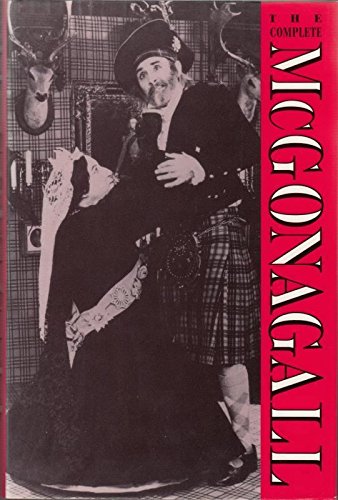
That he knew nothing about poetry was proved by the poem above, but whilst a poet can have a bad day, especially with their earliest works, McGonagall was if anything to get worse. There is a beauty in the total awfulness of his works that sucks the reader in, the Complete Works includes 247 poems and I have read it cover to cover several times. You just can’t believe what it is you are reading. The photo on the cover of the edition I have is of Spike Milligan as McGonagall and Peter Sellers as Queen Victoria as Milligan in particular popularised ‘The Great McGonagall’ from the 1960’s onwards and ensured that his body of work did not get neglected.

20180731 McGonagall 2

His works have been in constant print for many decades, above is the 1966 edition of More Poetic Gems published by David Winter and Sons in Dundee (who were his original publishers) and Gerald Duckworth and Co Ltd as a joint venture. Although appreciated now McGonagall died in poverty in 1902. He had eked out a living more as a sideshow than a poet from 1877 although it is clear that he regarded himself as a much put upon performer who was delivering great work to people who didn’t appreciate his ability. It was quite common for an audience to throw rotten fruit and vegetables and sometimes even fish at him whilst he was reciting, indeed the opening paragraph to the preface of his first published work ‘Poetic Gems’ includes the line

the first person to throw a dish of peas at me was a publican

It isn’t so much the fact that somebody threw a dish of peas at him as that this was just the first time…

Because he had no money when he died he was buried in an unmarked grave in Greyfriers kirkyard in Edinburgh, his grave received a nearby marker in 1999.

William McGonagall
Poet and Tragedian
“I am your gracious Majesty
ever faithful to Thee,
William McGonagall, the Poor Poet,
That lives in Dundee.”

I shall include one final poem and it’s one of the less well known ones “The Death of Captain Webb”. Webb was the first person to swim the English Channel (22 miles at its shortest point). He is something of a local hero here in Shropshire as he was born less than 5 miles from where I am sitting but died in a somewhat foolhardy attempt to swim across the rapids below Niagara Falls. The poem shows McGonagall at his prime, it was written in 1883 and has all his stylistic failings…

Alas brave Captain Webb has acted the part of a fool
By attempting to swim the mighty Niagara whirlpool,
Which I am sorry to say and to relate,
Has brought him to an untimely fate.

’Twas in the year Eighteen hundred and eighty-three,
With the people of America he did agree,
For $10,000, to swim through that yawning whirlpool;
But alas! He failed in doing so — the self-conceited fool.

Captain Webb, he courted danger for the sake of worldly gain
And the thought of gaining for himself — world wide fame;
And although many people warned him not to throw his life away,
He rushed madly to his fate without the least dismay.

Which clearly proves he was a mad conceited fool,
For to try to swim o’er that fearful whirlpool,
When he knew so many people had perished there,
And when the people told him so, he didn’t seem to care.

Had it not been for the money that lured him on
To the mighty falls of Niagara, he never would have gone
To sacrifice his precious life in such a dangerous way;
But I hope it will be a warning to others for many a long day.

On Tuesday the 24th of July, Webb arrived at the falls,
And as I view the scene in my mind’s eye, my heart it appalls
To think that any man could be such a great fool,
Without the help of God, to think to swim that great whirlpool;

Whereas, if he had put his trust in God before he came there,
God would have opened his blinded eyes and told him to beware;
But being too conceited in his own strength, the devil blinded his eyes,
And all thought of God and the people’s advice he therefore did despise.

But the man the forgets God, God will forget him;
Because to be too conceited in your own strength before God it is a sin;
And the devil will whisper in your ear — there’s no danger in the way,
And make you rush madly on to destruction, without the least dismay.

At half-past three o’clock Webb started for the river,
Which caus’d many of the spectators with fear to shiver,
As they wondered in their hearts if he would be such a fool
As to dare to swim through that hell — whirlpool.

Webb was received by the people with loud and hearty cheers;
And many a heart that day was full of doubts and fears;
A many a one present did venture to say –
“He only came here to throw his life away.”

The Webb entered a boat, in waiting, and was rowed by the ferry-man;
And many of the spectators seem’d to turn pale and wan;
And when asked by the boatman how much he’d made by the channel swim,
He replied $25,000 complete every dim.

Have you spent it all? Was the next question McCloy put to him,
No, answered Webb, I have yet $15,000 left, every dim;
“Then” replied McCloy, “You’d better spend it before you try this swim;”
Then the captain laugh’d heartily but didn’t answer him.

When the boat arrived at point opposite the “Maid of the Mist”
The captain stripped, retaining only a pair of red drawers of the smallest grist;
And at two minutes past four o’clock Webb dived from the boat;
While the shouts and applause of the crowd on the air seem’d to float.

Oh, Heaven! it must have been an awe inspiring sight,
To see him battling among that hell of waters with all his might,
And seemingly swimming with ease and great confidence;
While the spectators held their breath in suspense.

At one moment he was lifted high on the crest of a wave;
But he battled most manfully his life to save;
But alas! all his struggling prov’d in vain,
Because he drown’d in that merciless whirlpool God did so ordain.

He was swept into the neck of that hell — whirlpool,
And was whirl’d about in it just like a light cotton spool;
While the water fiend laughingly cried ”Ha! ha! you poor silly fool,
You have lost your life, for the sake of gain, in that hell — whirlpool

I hope the Lord will be a father to his family in their distress,
For they ought to be pitied, I really must confess;
And I hope the subscribers of the money, that lured Webb to his fate,
Will give the money to Mrs. Webb, her husband’s loss to compensate.

In the Tiffany Aching young adult series of books by Terry Pratchett the Pictsies or ‘Nac Mac Feegle’ are a race of 6 inch high beings that are more Scottish than it is probably possible to be. They have as their most feared tactic on the battlefield their Gonnagale who at times of greatest danger recites strange and terrible poetry which has the effect of reducing all that hear it to gibbering wrecks. The poems, and his title, are clearly based on the works of William McGonagall and are a tribute to the man whose writings approach genius by being so atrocious they reach round the spectrum of quality and get there from the other side.

Read him and weep

from laughter

The World As It Is – A book for Subscribers

20180710 The World as it is 1

Well actually The World as it was, as these books date from 1884 and provides a glimpse into history 130 years ago. However before looking at the book itself the main reason for selecting it is to expand on the subject of subscribers editions that I first touched on in Burghall’s Diary  That book in my collection was sold against a prospectus, ‘The World As It Is’ is a subscribers only book and helpfully whoever had the parts subsequently bound included the subscription page so we know how it was sold. After a lot of description as to the structure of the proposed two volumes the subscription page concludes as follows:

The Work will be handsomely printed on super-royal 8vo paper, and will be illustrated by above 300 engravings printed in the text; seventeen maps and diagrams printed in colours, ten coloured plates show some of the principal races of the earth and some remarkable natural phenomenons, and twenty-eight separate page engravings representing notable and remarkable localities in many lands. – making in all FIFTY-FIVE separately printed illustrations. It will be issued in Fourteen Parts, of 80 pages of letterpress, at 2s. each, or Seven Divisions in stiff paper covers at 4s. each, forming when completed two handsome large 8vo volumes. Whether viewed in the aspect of the wide range of its contents, of its educative value, its wealth of illustration, or its moderate price, this work will be found to be quite unique of its kind.

LONDON:  BLACKIE  &  SON,  49  &  50  OLD BAILEY,  EC;

GLASGOW, EDINBURGH AND DUBLIN

Capitalisation is as printed in the document, I have used bold to represent the parts highlighted in italics in the original, this is a Victorian marketing department going full tilt. For those not familiar with the abbreviations used 8vo is a standard paper size usually written as octavo. Standard octavo paper is 9 inches high by 6 inches wide (23cm x 15cm) The pages of the book are actually 9.7 inches high by 7.2 inches wide (24.6cm x 18.4cm) which is presumably where Blackie have come up with super-royal although both super octavo and royal octavo are larger than this.

The price is given as either 14 lots of 2s. or 7 lots of 4s. s. standing for shilling so a total of 28 shillings regardless of how you had the parts. Using the Bank of England inflation calculator (which unfortunately only goes up to 2016) this ‘moderate price’ was apparently more like £159.65 in 2016 or just over £168 by 2018 adding the extra 2 years inflation. Also bear in mind that like modern magazine part works you then need binders, in fact back then you definitely did as these were literally just loose pages, especially the illustrations, and came with instructions for the bookbinder as to where the pages should go. So you would buy the remarkably solid board covers available from Blackie and then pay a bookbinder to put it all together meaning you wouldn’t see any change out of the equivalent of at least £200 probably closer to £250 for your ‘moderate’ purchase. I bought the books in the mid 1980’s and according to the price still visible inside paid £2.50 for the pair at the time, the paint stains on the boards no doubt keeping the price well down. I remember the second hand bookshop where I bought them fondly, the proprietor wrote a year code letter next to the price in all his books, A for his first year of business, B for the second etc. he had been trading for getting on for 20 years by the time I bought this and if you could find anything in the shop coded A you could have it for free.

20180710 The World as it is 2

The books are really interesting although anyone looking at them and deciding to visit a place based on the information provided would definitely have a surprise coming; for example Swanston Street in Melbourne certainly looks different nowadays :

20180710 The World as it is 4

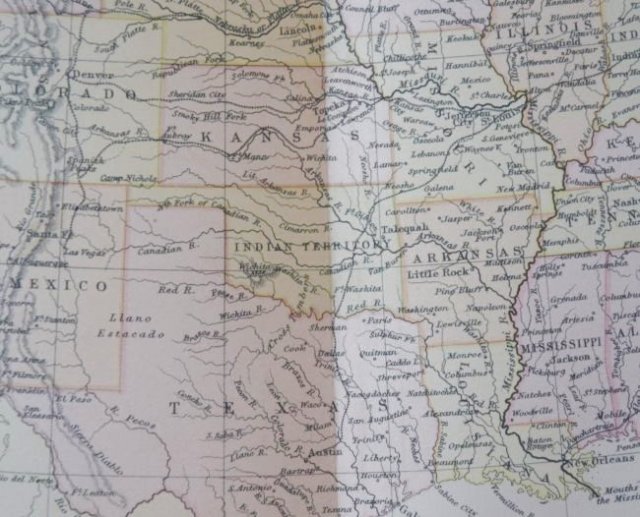
It’s the illustrations that I like so much and that first attracted me to these books, that and odd bits of history that you suddenly spot whilst scanning through. The United States of America is described  as a republic consisting of 38 states and 8 territories with an organised government, besides the Indian territory, the territory of Alaska and the District of Columbia. Seeing a map with Indian Territory clearly marked instead of Oklahoma emphasise the fact that the books pre-date the ‘land runs’ of settlers into the Indian lands and are a full 23 years before the Indian Territory ceased to exist altogether when the state was created in 1907.

20180710 The World as it is 5

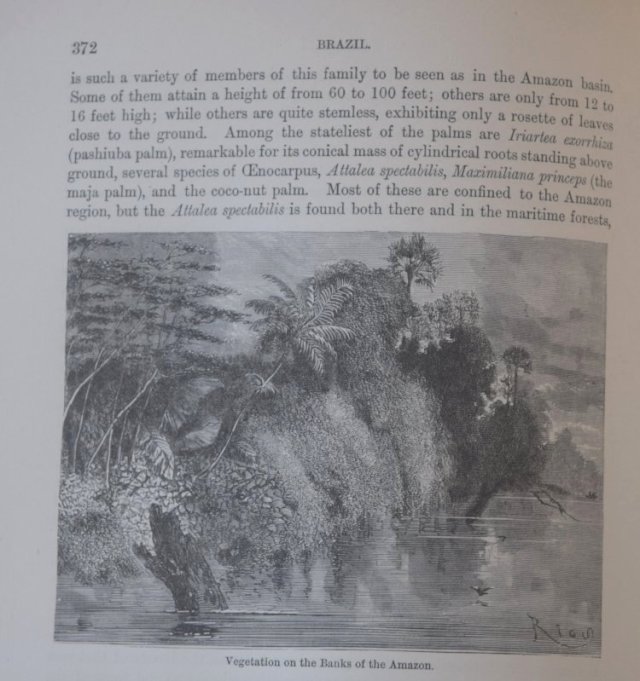
The smaller illustrations within the text are also beautiful steel engravings as these two pages show, one from the Amazon basin in Brazil and the other from the Transleithan Provinces of the Austrian Empire most of which is now the independent country of Hungary with the Transylvanian region making  up the western part of Romania. You do have to know some history to even start looking places up as they may well not be under the country you expect.

20180710 The World as it is 6

20180710 The World as it is 8

Budapest is described throughout this section as two cities Buda and Pesth (the extra h is how it is spelt in the book) and when you are there the city does feel like two distinct places even now.

The colour plates are not a strong point though, the artist who did these wasn’t really of the standard of the rest so they are a bit of a let down even though the colours are still strong, the best one by a long way is the one representing China:

20180710 The World as it is 7

The books provide a glimpse into a world that no longer exists and for that they are fascinating. In fact they document a world that was rapidly disappearing even as it was published, so I think I will conclude this essay with what is apparently a typical Dutch interior, but is definitely is a museum piece now.

20180710 The World as it is 3