Uncle Vania – Anton Chehov

Or is it Uncle Vanya by Anton Chekhov, that appears to be the more usual spelling at least currently but I have spelt it the way I have in the title to this essay as that is how the Penguin Classics edition of 1959 which I have been reading has it so I will stick with it throughout.

20181113 Uncle Vania 1

The first thing that strikes you reading the play is that for the first two acts Ivan Petrovich Voinitsky, whom his niece Sonia calls Uncle Vania, is largely an ensemble character and it is only in acts three and four that he comes to the front. The first act sets the dynamic tensions between the protagonists. There had clearly been a quiet routine in the house for many years with Sonia and Vania running the estate which had been her mothers dowry when she married professor Serebriakov. Sonia’s mother died some years ago and the professor has now retired to the estate from his home in the city and brought with him his second wife Yeliena who is just 27 years old, between them they have seriously upset the normal running of the household. To make things more complicated Astrov, the doctor who looks after the professor’s gout is attracted to Yeliena as is Vania, whilst Sonia is in love with Astrov. You just know it’s going to get messy and Vania is gloomy about the future as only a Russian can be…

Yeliena – What a lovely day … not too hot either

Voinitsky/Vania  – It would even be pleasant to hang oneself on a day like this…

There are four other characters in the play, all of which play minor roles so beyond the list below I won’t cover their actions.

  • Maryia Voinitskaia is Sonia’s grandmother/ Vania’s mother
  • Ilyia Ilyich Telyeghin was a local landowner but has lost all his money and now lives on the estate.
  • Marina an old children’s nurse
  • A workman – just needed to fill in such as fetching horses etc. when the main characters wouldn’t do such things.

Act two sees the complicated relationships become more strained. The doctor has been summoned but the professor won’t let him see him this means that he is yet again at the house and wants to spend time with Yeliena to convince her to leave the professor. Vania muses to himself that he missed his chance with Yeliena ten years ago

Voinitsky – [Alone] She’s gone! ten years ago I used to meet her at my sister’s house. She was seventeen then and I was thirty-seven. Why didn’t I fall in love with her then and ask her to marry me? It could have been done so easily! She would have been my wife now.

The professor meanwhile is in pain with the gout and frustrated with his existence at the estate where he feels he is wasting his time and doesn’t get on with anyone there.

Serebriakov – After devoting all my life to learning, after growing used to my study, to my lecture room, to esteemed colleagues – to find myself suddenly, for no reason at all in this crypt, to have to meet stupid people every day, to have to listen to their trivial conversation. I want to live; I love success, I like being a well known figure, I like creating a stir of the world, but here I feel an exile. To spend every minute regretting the past, watching others succeed, fearing death. I can’t! It’s more than I can bear.

Meanwhile Yeliena decides to at least try to make up with Sonia and during their talk admits that although she loved the professor when they married she soon realised her mistake but will remain true to him come what may. At the same time Sonia confesses her love for the doctor and asks Sonia to see if she can find out if he loves her.

Things come to a head in act three, Yeliena talks to the doctor about Sonia and he says he doesn’t love her but interprets the conversation as Yeliena using that as an excuse to talk to  him about love. he makes a clumsy pass at her during which he kisses her as she is pushing him away and this is seen by Vania who is just coming into the room at that point. Straight after this before anyone can settle the professor calls everyone together to say that he has decided to sell the estate and buy a villa in Finland for himself and Yeliena. At this Vania explodes with fury, the estate doesn’t belong to the professor but to Sonia and he has given no thought as to where the people who have always lived there might go and it is his family that should decide what to do with the estate as they paid for it

Voinitsky – The estate was originally bought for ninety-five thousand roubles. My father only paid seventy thousand and twenty-five thousand remained on mortgage. Now please do listen! This estate would never have been bought if I hadn’t given up my share of the inheritance in favour of my sister, whom I loved deeply. What’s more, I worked like an ox for ten years, and paid off the whole mortgage.

Serebriakov – I regret that I started this conversation.

Voinitsky – The estate is free from debt and in good condition simply because of my own efforts, and now that I’ve grown old, I’m to be kicked out!

Serebriakov – I don’t understand what you are driving at!

Voinitsky – For twenty-five years I’ve been managing this estate, I’ve been working and sending you money like the most conscientious bailiff you could have, and all this time you’ve never once thanked me for it. All this time – when I was young and now just the same –  I’ve been getting a salary of five hundred roubles a year from you, a pittance! and never once have you thought of adding a single rouble to it!

Serebriakov – Ivan Petrovich, how was I to know? I am not a practical man and I don’t understand anything about these matters. You could have added as much as you liked.

Voinitsky – Yes indeed, why didn’t I steal? Why don’t you all laugh at me now because I didn’t steal. It would have been fair enough and I shouldn’t now have been a pauper now!

The professor leaves the room shortly after this, soon followed by Vania and a shot is heard off stage then both men run into the room and Vania fires again, both shots miss, Vania drops the pistol and collapses into a chair as the act ends.

To be honest act four which is set the next day feels like a bit of a let down after the excitement of act three. It has been decided that the professor and Yeliena will leave straight away. With them going the doctor has no reason to still be there and he also leaves. Vania and Sonia sit down to work on the books of the estate which have been neglected whilst the professor has been there and all returns to how it was before.

I’ve seen the play performed, although that was many years ago, and thoroughly enjoyed it but this was the first time I had read the script. The book contains eight plays in all so I will be reading those later.
Homage to Catalonia – George Orwell

This wasn’t the book I intended to read this week, but my friend and fellow book blogger Mixa in Barcelona (read her review here) saw a copy on my shelves and has tracked down a copy in Catalan so I thought it was probably about time to reread the book after a gap of about twenty years so that it would be fresh in my mind when she wants to talk about it. Nowadays Orwell (real name Eric Blair) is almost entirely known as a novelist and his journalism is largely and sadly neglected. Homage to Catalonia even started out being neglected. It was first printed on 23rd April 1938 and a year later by the start of WWII it had only sold around 900 copies and soon after went out of print. It would only be available sporadically until Penguin Books printed a copy in March 1962, since then it has never been out of print.

20181030 Homage to Catalonia 1

The book tells of Orwell’s experiences fighting in the Spanish Civil War as part of an international militia against the uprising of General Franco and he is very clear that this is the war as he saw it and for the most part it is a very readable account. There are two chapters where he attempts to make sense of the alphabet soup of political organisations and militias taking part and these are prefaced by clear warnings that it is about to get complicated, as shown in the below extract from paragraph two of chapter five…

At the beginning I had ignored the political side of the war, and it was only about this time that it began to force itself upon my attention. If you are not interested in the horrors of party politics. please skip; I am trying to keep the political parts of this narrative in separate chapters for precisely that purpose. But at the same time it would be quite impossible to write about the Spanish war from a purely military angle. It was above all things a political war.

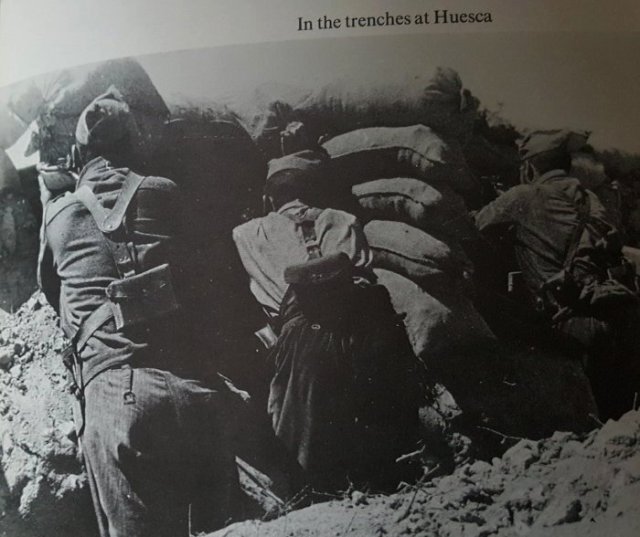
What follows is a section I’m glad I read because I had to keep referring back to it to sort out in my mind the differences and indeed the similarities between PSUC, POUM, FAI, CNT, UGT, JCI, JSU and AIT all of which were political parties or trade unions or possibly both, it does get very confusing, especially as in theory they were all aligned against the Fascists of Franco but seemed to spend most of the time fighting and bickering amongst themselves. This was particularly true during the short lived Barcelona uprising that Orwell got caught up in by happening to be on leave from the front after 115 days and arrived back in the city just before it all got even more complicated. But I am getting ahead of myself lets get back to chapter one with Orwell arriving in Barcelona with his wife, intending to write about the war but actually enlisting as a member of the POUM militia within days of getting there.  His wife Eileen stayed in the Hotel Continental in Barcelona throughout their time in Spain whilst Orwell was fighting on a front line less than 170 miles away. The photo below is by Robert Capa and is part of the John Hillelson Agency collection and shows the sort of trenches Orwell would be in.

20181030 Homage to Catalonia 3

Initially Orwell writes of his surprise on arriving in Barcelona in December 1936 that unions and workers parties had taken over the city and everywhere he saw the red and black flag of the Anarchists who were in control. This appealed to the socialist principles that Orwell espoused and it was probably this that led him to opt to fight for them rather than simply report on the situation. Unfortunately for him later he chose the wrong set of initials to join up with, but as he had said above the internecine politics hadn’t registered with him at first and he effectively just joined the first group that would have him. The first chapter covers the ‘training’ or rather lack of it he received in the Lenin barracks the poor conditions and the largely useless equipment they were issued with, chapter two has him on his way to being posted to the front where he was finally issued with an ancient rifle.

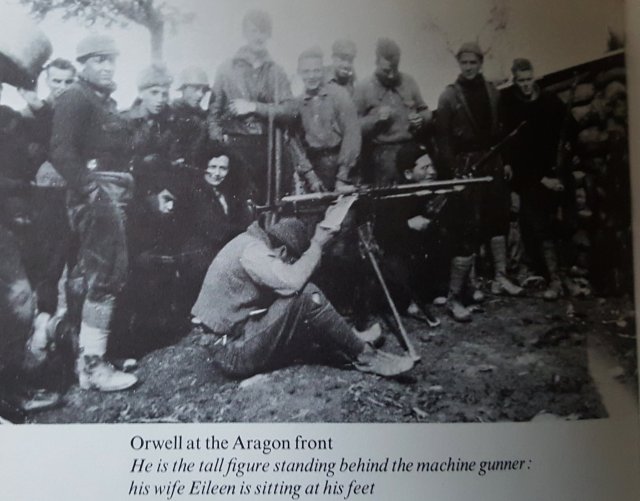
Chapters three and four tell of his time in the trenches above Zaragoza on the Aragon front, a place where the 6 foot 3 inch Orwell was clearly unsuited being head and shoulders taller than his fellow militiamen as can be seen in the photo below from the University College, London collection and reproduced opposite page 65 of my edition.

20181030 Homage to Catalonia 2

The time there was largely one of freezing temperatures, squalor and boredom, the two front lines were so far apart on opposite mountain tops that only by the merest chance could anyone be hit by firing from the opposition. What wounds and deaths did occur were mainly accidents of the sort you get when you hand unreliable weapons to 15 year old boys without showing them how to use them. The real oddity in the photo above though is that Eileen is there so she must have made a trip up from Barcelona although Orwell doesn’t mention her doing so in the book.

After the first of the political chapters, chapter six has him still bored at the front line

Meanwhile nothing happened, nothing ever happened. The English had got into the habit of saying that this wasn’t a war, it was a bloody pantomime.

and reflecting on the effect that the war was having on the local population who were largely trying to live their lives as best they could. In chapter seven Orwell finally sees some action, it was decided to crawl at night across the hundreds of yards of no man’s land and attack the fascist line. It did not go well and although they did get into the enemy trenches they were told to retreat before morning and that would be the only time he faced the enemy in actual combat. Chapter eight is very short and is largely concerned with preparations to go on leave back to Barcelona.

Chapters nine, ten and eleven all concern his badly timed break back in the city. On his return he discovered that the workers revolution had largely petered out and life had returned to a sort of normality with the war something happening in the distance.  However this was not to last long, the tensions between the various groups was about to explode onto the streets and on the 3rd of May fighting began, initially at the telephone exchange but rapidly spreading through the main thoroughfares.  Orwell is caught up in the middle of this but it rapidly becomes as much of a stalemate as the ‘fighting’ on the front. The various factions take up strategic positions and sort of agree amongst themselves to not shoot each other. These chapters for me are the most interesting of the book, the endless boredom of the front is at least improved here by not only the considerably more action but also the shortness of the time scale before it all came to an end.

Chapter twelve sees Orwell return to the front but this was to be for a very short time as he was soon wounded by a shot through the neck which saw him invalided out. By this time he was increasingly disillusioned by the war, what he had seen in Barcelona had convinced him that this was not the great and noble calling that he once thought it was and his choice of POUM was about to become a major problem. Whilst in hospital and then trying to get his discharge papers signed off POUM were picked on as the scapegoat for the fighting in Barcelona and all members were to be arrested and probably shot as traitors. As he describes it this was definitely untrue but it was a convenient fabrication to allow the other factions to re-unite behind. So as well as being wounded he was now a wanted man. In the last two chapters he and Eileen manage to escape Spain and he reflects on his experiences. His conclusions went strongly against the narrative being pushed in the socialist press in the UK which he also heavily criticised and this meant that getting the book published proved difficult as his normal publisher wouldn’t take it.

The book is a fascinating study of the realities of war, the long periods of tedium enlivened by occasional periods of firing from the trenches in the beginning of the book through the difficulties of conflict within a city and is also surprisingly funny in places as he enlivens the tale. All in all it deserves to be better known. When most people think of Orwell what usually comes to mind is 1984 or Animal Farm, try his reportage, it is definitely worth seeking out.

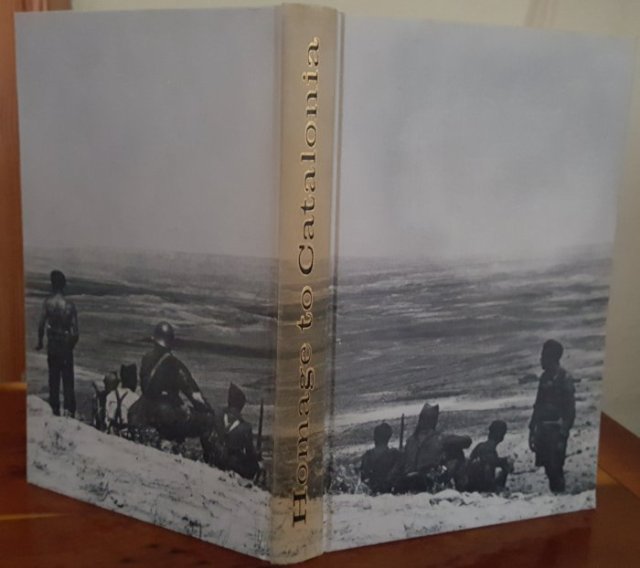
My copy is the 1970 Folio Society first edition which was popular enough to have two further reprints in 1972 and 1975 before dropping out of the Folio catalogue until 1998. It then re-appeared as part of a five volume set of Orwell’s reportage along with “Down and Out in Paris and London”, “The Road to Wigan Pier” and two volumes of journalism and essays. This set has as yet not been reprinted. Although bought second-hand and with a badly sunned spine and grubby covers that don’t want to clean, what I like about this edition is the inclusion of contemporary photographs of Orwell and other people mentioned in the book on the front line. Regrettably not any by Orwell himself because as he explains in the book his camera and photographs were all stolen or impounded along with his notes and press clippings at various different times whilst he was involved in the war. I have reproduced a couple of the photos from the book above. The cover illustration is a view of the battlefield near Belchite on the Aragon front and is from the Fox Photos Ltd collection.

Never Let Me Go – Kazou Ishiguro

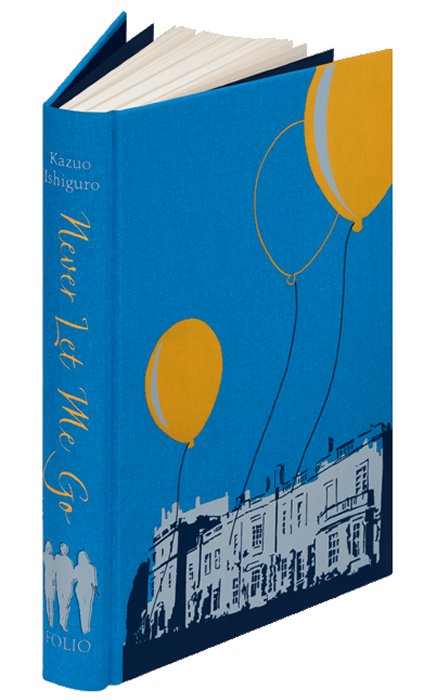
20181016 Never Let Me Go 1

Kazou Ishiguro was born in Japan but moved with his family to England when he was just five years old, as a result most of his novels and short stories are set in England and usually in the past. This allows him to reflect on his adopted homeland from the perspective of a outsider who is also an insider; his parents never expected to stay so long in England so he grew up in a Japanese speaking household even whilst attending English schools and colleges. The Remains of the Day which takes place in a English country house in the 1940’s is probably his best known work and this book is set in the 1980’s and 1990’s so initially it felt like familiar territory. Before starting to read Never Let Me Go I knew nothing about it and made a point (as I usually do) of not reading the introduction to this Folio Society edition so I was coming to the novel with no preconceptions.

20181016 Never Let Me Go 2

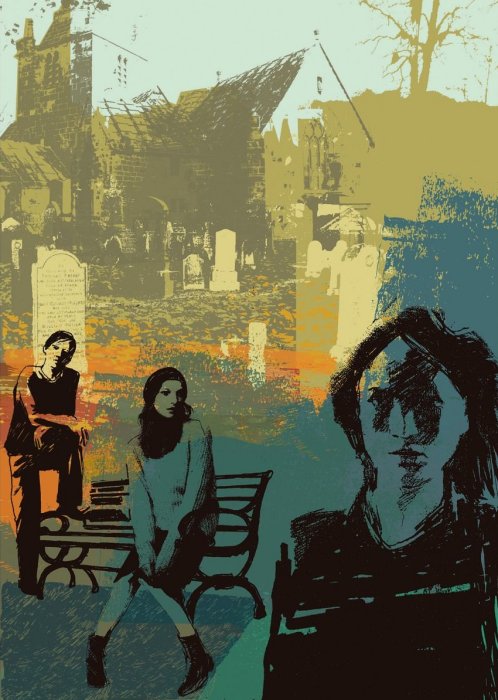
The stark illustrations by Kate Miller set the tone of the book straight away. I now know that this is Tommy and Kathy outside the sports pavilion at Hailsham school in a scene from the first chapter, later on we would be introduced to the other main character, Ruth. The novel is in three parts; the first, and longest section, is set at the school and initially it reads like any novel at a boarding school or it least it would do if it wasn’t for the haunting opening lines of the novel that hint at something that really isn’t right but clearly central to the work.

My name is Kathy H. I’m thirty-one years old, and I’ve been a carer now for over eleven years. That sounds long enough, I know, but actually they want me to go on for another eight months, until the end of this year. That’ll make it almost exactly twelve years.

The second section is set at ‘the Cottages’ an old farm where a group of the students get sent after leaving Hailsham and then the final section deals with Kathy’s time as a carer. The book is written in the first person as Kathy and we follow her reminiscences through her school-days and afterwards, all the way up until we get back to this opening line.  But just what is the role of a carer? Well it will take half the novel before that truly becomes clear and it turns out that I accidentally bought three dystopian novels as part of a block purchase from the Folio Society when I though I only had two. (The Drowned World by J G Ballard, covered last month and The Last Man by Mary Shelley which will be the subject of a later blog).

I’m so glad that I hadn’t read the introduction to this edition before reading the book as it completely gives the plot away and even discusses the highly significant scene near the end of the novel. This unfortunately is a major failing of the Folio Society, their books are lovely but the introductions should really be postscripts.  This review won’t go into too much detail about the plot simply because I want any reader to come at the novel fresh as I did and discover slowly through the hints that get more specific as the book progresses just exactly what is going on and if you haven’t read the book I really do recommend it and you don’t need to get the Folio edition, it is readily available in paperback.

The school sounds like a typical English Public School (that is private for the rest of the world), although gradually you realise that year eight are actually only eight years old, so is it some sort of orphanage? Ishiguro’s master stroke in the novel is just how slowly he lets the reader into the reality of the situation, even the students don’t know what the place is really about but there are dark hints. A bit later on it becomes clear that they cannot leave the site and have virtually no contact with the outside world other than the mysterious Madame who visits occasionally and takes away their best artworks; all very odd.

20181016 Never Let Me Go 3

The picture above is from a scene at the Cottages, Tommy and Ruth are now a couple, with Kathy feeling like an outsider and it is by now obvious most of what is going on although why is still a significant question and this wouldn’t be fully answered until the penultimate chapter. My theory at this point was largely correct but I had anticipated the final twist as to why they are there however without doing exactly what I criticised Claire Messud for in her introduction and giving away too much this is about as far through the plot that I can go.

Kazuo Ishiguro won the Nobel prize for literature in 2017 with a citation  “who, in novels of great emotional force, has uncovered the abyss beneath our illusory sense of connection with the world.” and this book certainly fits that description.

The Drowned World – J G Ballard

20180918 The Drowned World 1

This week I’ve been reading one of the classic dystopian novels; and a very early book to take the theme of climate change as it was written in 1962. The edition I have was printed by the Folio Society  in 2013, bound in full buckram and beautifully illustrated by James Boswell who also created the design blocked onto the cover in reflective metallic copper and gold ink. The copper coloured endpapers continue the bright design so appropriate for a book about the burning sun beating down on a flooded planet.

J G Ballard is best known for his apocalyptic stories where the world is viewed after a catastrophe, “The Drowned World” is his second novel and is preceded by “The Wind From Nowhere” where extreme winds are destroying the Earth and followed by “The Burning World” where pollution in the oceans eventually gets to such a level that it blocks the precipitation cycle leading to no more rain and deserts everywhere. “The Drowned World” is a novel about the aftermath of runaway global warming, the ice caps have melted flooding most of the rest of the world, and humanity has largely retreated to the Arctic zones. Dr Robert Kerans and his older colleague Dr Alan Bodkin are biologists attached to a military expedition tasked with exploring the drowned cities however it has become clear over time that the charts they have produced are going to be no use as the heat is just increasing so mankind will never recolonise the majority of the planet. The temperature in flooded London is well over 40 degrees centigrade by mid morning and the afternoon heat is unbearable. Kerans and Bodkin hatch a plan to stay behind when the expedition is due to leave; along with the enigmatic Beatrice Dahl who is still living in the penthouse that belonged to her parents.

20180918 The Drowned World 2

They are all having strange dreams about the sun and a desire to head south into the increasing heat without clearly understanding why this urgent need has overtaken them. The other members of the unit are also having the same dreams and this is one of the factors that leads the commander to decide to leave sooner than originally planned.

The London that the three characters are left in when they do elude the journey north is rapidly regressing to a revitalised Triassic period with giant iguanas, huge bats and insects recolonising the swamps and flooded lagoons of what was once the squares and thoroughfares of the city. Kerans has taken to living in the top floor suite of what was once The Ritz, Bodkin scuttled the science station over the top of The Planetarium, presumably the one in Greenwich, whilst Beatrice remains in her suite and here they are planning on lasting as long as they can until the fuel and food finally runs out after when they will abandon London and head south as their dreams are calling them.

The writing style is sparse almost lethargic and matches the slowness of the characters as the heat forces the them to do less and less and just reduce their lives to sleep and short expeditions to occasionally visit each other. The washed out illustrations by James Boswell also match this sense of oppressive heat as the reader gets drawn into this world. Mankind is losing, the planet is returning to a more primitive state and it is implied that so is man.

Of course it is all going to go wrong and halfway through the book it does and a heightened level of horror is injected into the book which carries us to the inevitable denouement as the characters mental states slowly collapse. It’s a brilliant book, Ballard wasn’t really appreciated in his own lifetime although since his death in 2009 his works are becoming more and more respected but as he himself said

For a writer, death is always a career move

Raw Spirit – Iain Banks

20180911 Raw Spirit

‘Hiya Banksie! Written any good books lately?’
‘Not if you believe certain critics, but I’m going to be writing one about whisky.’
‘A book about whisky?’
‘Yeah, malt whisky.’
‘You’re kidding!’
‘Not as such.’
‘This mean you’re going to have to do the “R” word?’
‘The “R” word? Oh! Research? Yeah basically. Goin to have to drive round Scotland, take trains, ferries, planes and such, go to distilleries, taste whiskies, that sort of -‘
‘And they’re going to pay you for this?’
‘They’ve already started.’
‘Right I see. D’you need a hand?’

So begins Iain Banks’ Raw Spirit: In Search of a Perfect Dram and those people familiar only with Iain M Banks the gritty science fiction writer or his even grittier ‘normal’ fiction written as Iain Banks are in for a surprise as this is a genuinely funny book interspersed with rants about the Second Iraq war which had just started as he set of in search of the “R” word. As a fan of both Banks and whisky, purchasing this book when it came out did not take much consideration and I recently pulled it back off the shelves as later this year I’m doing my own trip round some distilleries and like Banks I’m starting with Islay.

Rereading the book was a surprise, my 14 year old memory of what was covered is clearly faulty, yes there is whisky aplenty and distilleries also get pretty good coverage but a large part of the book is really about Banks’ love affair with Scotland and its “Great Wee Roads” or GWRs as they are referred to throughout. There is a lot more said about getting to the distilleries (both the roads and vehicle chosen to make the journey) than there is covering them or their production. There is also a considerable amount of reminiscences of past holidays, fun times in out of the way properties and time spent with old friends. The book is really as close as we ever got to an autobiography by Banks who sadly died in 2013 from cancer aged just 59. If you want a book about whisky then you are really better off with Michael Jackson’s definitive tome, but if you want a book about the joy of travelling around Scotland looking for whiskies and the friendships and fellowships that it can engender then this is for you.

Let’s take a random chapter and breakdown the coverage of each subject, “12: Porridge and Scottishness, Football and Fireworks” has a total of 20 and a bit pages:

  • Porridge, why he doesn’t like it and other Scottish institutions such as kilts – 2½ pages
  • Six distilleries visited and their whiskies – 7 pages
  • Memories of Monty Python (he was an extra in one of the films)  – 1 page
  • Memories of blowing things up (fireworks with mates) – 4½ pages
  • Travelling – 1 page
  • The joys and tribulations of following Morton Football Club – 4 and a bit pages

That seems to be a pretty average hit rate for the theoretical subject of the book, although the travelling to whisky ration is normally higher than that, at least after you get past chapter one where Banks does stick more closely to his brief. That is not to say that I didn’t enjoy the book, I very much did so, it’s an easy read and you want to follow Banks around the country as he enjoys the scenery, samples whisky and chats with old mates. You feel by the end that the Raw Spirit of the title is more the spirit of Scottishness rather than Scotch and it’s good fun.

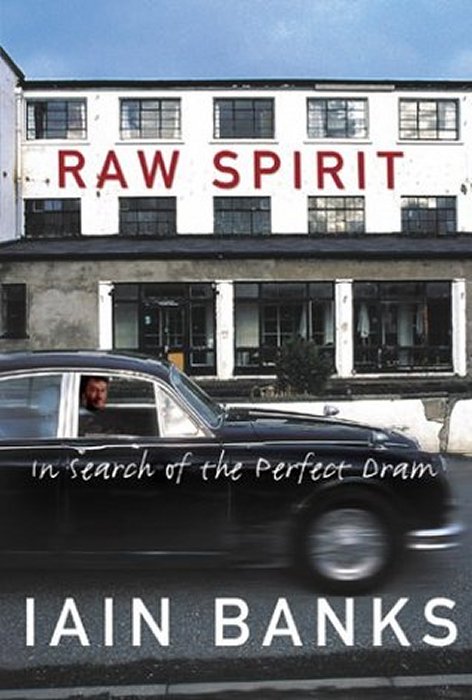
As a final note my copy is the first edition hardback printed by Century in 2003, that also appears to be the only Century edition as by 2004 it was a paperback with a completely different cover published by Arrow. Both of these are imprints of Penguin Random House.

First Penguin crime set – part 3

20180815 Penguin 10 - part 1

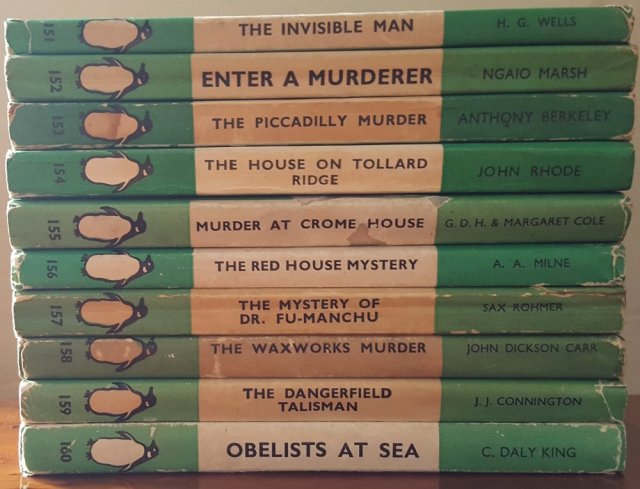
The continuing exercise of reading all ten of the crime novels published by Penguin Books to mark reaching 150 titles. All the volumes I’m reading are the first edition, first impression copies published eighty years ago this month (August 1938). It’s been fun reading these old paperbacks so far and now I have just four to go, for part 1 see here, and part 2 is here. I’m writing this blog as I’m going along so the book is fresh in my mind as I write about it so lets see if I can get through the final four volumes in the coming week.

157 – The Mystery of Dr. Fu-Manchu – Sax Rohmer

Before opening this book I should say that this is the one I am least looking forward to. Although I’ve never read any of them the Fu-Manchu stories have never appealed possibly due to childhood memories of bad black and white films which I never watched to the end, or even half way through. Here’s hoping the book is better…

It wasn’t. It was everything I expected and worse, full of casual racism, extraordinary plot devices and ridiculous language I completed it only so that I could write this entry. Hopelessly jingoistic with the white race threatened by the yellow peril as it was regularly put, each chapter seemed to include another fantastical creation of poisons unknown to man, or traps created by mutant puffball mushrooms that react to light or other idiotic suggestions. The book fails on almost every level those rules suggested by A A Milne that I mentioned in the last blog with each time the ‘heroes’ get into trouble or a new murder is attempted yet another ‘fact’ is revealed just to get a solution with no pre-amble to involve the reader in the plot. Even more annoying is the constant xenophobia displayed by Rohmer where anyone who isn’t white is treated as a villain.

The language used also fails Milne’s tests with the servant of the first victim pointing out a way in with “Up yonder are the study windows sir” and the same sort of anachronistic rubbish is put in the mouths of several other characters. Nobody since Shakespeare has ever phrased a statement like that and he would have been writing a poetic play not accurately reporting actual language used.

Frankly avoid Sax Rohmer and I’m astonished to find that he is still in print.

158 – The Waxworks Murder – John Dickson Carr

What a dramatic improvement, Inspector Bencolin of the Paris Sûreté is a wonderful creation of a master of detective fiction. The plot is complex linking two murders of young women, a disreputable club in the area of Pigalle, itself a disreputable district of Paris, and Parisian high society. That an American, living in England, should write five novels about a detective in France is surprising, that they should be so atmospheric (at least on the evidence of this volume) is remarkable.  The Waxworks Murder (US title – The Corpse in the Waxworks) is the fourth Bencolin book, I also have the first (It Walks by Night) in the Penguin edition; however although Penguin published many other detective stories by Carr these mainly feature his best known detective Dr Gideon Fell.

Carr plays fair with the reader, there are lots of clues and as many red herrings, paths to enlightenment and just as many dead ends which makes the book my favourite of the ones so far, you really get a mental workout following the various strands of the plot. That the tension is literally maintained until the final sentence is also a tribute to the skill of the author and I can definitely say that I hadn’t worked out the solution until it was revealed and then as the bits I had missed were explained it all became clear. I loved that we were led by Carr to suspect yet another person in the last chapter before the denoument only to have that apparently logical step demolished by the detective a few pages later.

The tension builds as the book progresses and by the time I reached the last seventy five pages there was no way I was going to put it down until it was finished even though I really needed to be doing something else. I will have to try the Dr Fell stories after I have read It Walks by Night and then the Henry Merrivale tales that he wrote under the name of Carter Dickson. He may be a great mystery writer but he was rubbish at Pseudonyms

159 – The Dangerfield Talisman – J J Connington

J J Connington was actually the Scottish chemist Alfred Stewart who wrote over two dozen novels as Connington and several factual works under his own name. The Dangerfield Talisman is his fourth novel and unlike all the other books I am reading as part of this series it is a case of theft rather than murder that concerns the participants. Apart from that it is a classic British country house case that has been very well written with two separate but linked puzzles to be solved, what is the Dangerfield Secret and where is the Dangerfield Talisman?

What is also a lot of fun is that there isn’t a ‘detective’ figure as such, several of the house guests have a go at solving the problems and manage to rile the others by making unjustified accusations. This is not a gathering you would want to be part of. Having said that I was worried about the start of the book, there seemed to be a lot of interest in bridge (which is a card game I don’t play or even vaguely understand) and then a chess board diagram was added (which looked fairly straightforward but clearly wasn’t if it was to be the basis of part of the story). I had a horrible feeling that these games were going to be highly significant to the plot in which case I would be left without significant clues. In fact you don’t need to know anything about either game, the bridge games stop after a couple of chapters and the chess board only really comes into it’s own towards the end of the novel.  As for who took the Dangerfield Talisman I hadn’t a clue until it was revealed, not that there weren’t hints, just that I had not understood their significance. The Dangerfield Secret and more importantly the solution to it I had worked out though before it was explained.

Connington is definitely worth reading more of, five of his novels were published by Penguin and I have two others. One of the ones I’m missing is his science fiction book Nordenholt’s Million first published in 1923 and which is probably the earliest ecological disaster novel with a bacteria destroying farm crops around the world. Definitely one I’m going to seek out.

160 – Obelists at Sea – C Daly King

Last one… and the first question is what is an ‘obelist’? It turns out that King invented the word and defined it at the start of the book as “An obelist is a person who has little or no value”. Unfortunately when he re-used the word in two more novels “Obelists en Route” and “Obelists Fly High” he redefined it as “one who harbours suspicion”. At least if you are going to invent a word then be consistent. Penguin only printed this one book by C Daly King and at 312 pages of quite small print it’s easily the longest of the ten I have set myself to read, it is now Monday morning and I need to finish the book and complete this review for tomorrows post.

Well the plot was good and the conceal of the murderer was also well done but the writing style made getting through this book hard work. C Daly King was a psychologist and he made his detectives (for there is a group of them on their way to a conference on board the ship) also psychologists, although from differing branches and opinions. This could have worked well but King couldn’t resist putting in pages and pages of psychological exposition which was incredibly dull and just slowed the plot down dramatically. It was all completely unnecessary but you felt you had to read it in case there was a point to any of it. In fact there was virtually no point to the vast majority of this and even other characters in the book were bored of it eventually. But even then, after admitting that it was dull and largely confusing as they simply contradicted each other King couldn’t help himself from making some more pointed remarks about a branch of his own profession.  The book is split into six chapters, an introduction to the crime, one chapter for each of the four psychologists to try to solve it according to their own theories and practice and then a final chapter that finally explains what actually happened and why all four were wrong, although each had grasped part of the solution.

It’s a pity that this was the last of the set to read as it has let me down from the high quality of the previous two but it has been an interesting exercise although next time I set myself to read ten novels in one month I’ll start before the 12th.

First Penguin crime set – part 2

20180815 Penguin 10 - part 1

This continues a marathon reading session of all 10 of these books printed eighty years ago this month. I started late (the evening of the 12th) so I have less than a couple of days to read each book and write a short review. Part 1 covered books 151, 152 and 153 and can be seen here. As I read each book I’ll write a review on this blog and post on Tuesday next week as far as I’ve managed to get.

154 – The House on Tollard Ridge – John Rhode

Before reading this book I knew nothing about John Rhode and apart from a small black and white photograph of a man in late middle age smoking a pipe and a couple of glowing comments regarding his ability from two magazines printed on the dust wrapper there is nothing on the book to give me any idea about him. I decided to finish the book before finding out anything about the author.

The story was quite enjoyable although I was deeply suspicious of the person who turned out to be the murderer very early on in the book and none of the rather obvious red herrings put me off that train of thought as there was really only one person who could have controlled the events as they did. The main oddity of the book was that although it is 248 pages long Rhode’s amateur detective doesn’t appear until page 98 and up until then it reads as though Superintendent King from the local police force is the main character. When Dr Priestley does appear in the book it is only for a short while whilst explaining the case to him gives the author a chance to sum up what he has told us so far and it isn’t until page 172 that Priestley really comes into his own and starts to take apart the case made by Superintendent King. It is also at this point that it becomes clear that this isn’t Rhode’s first book about Priestley as other cases are mentioned, I’m guessing that the only other book by Rhode that was published by Penguin ‘The Murders in Praed Street’ is going to be one of them, I don’t own a copy and won’t be rushing to get it.

Finally looking up John Rhode, he turns out to be the pseudonym of Cecil John Charles Street MC OBE and from his Wikipedia entry he wrote a huge number of detective stories under several pseudonyms so he obviously had a readership in his day but he’s not for me.

155 – Murder at Crome House – G.D.H. and Margaret Cole

Now this should be interesting, I do have other books by G.D.H. Cole but they aren’t fiction, on my shelves are ‘Practical Economics’, ‘Socialism in Evolution’ and a couple of copies of ‘Persons and Periods’. Working with his wife however they jointly wrote crime novels and although I only have this one example and they were nowhere near as prolific as Cecil Street I was already aware of the existence of several other titles before I start reading this one.

Having now finished the book I can say that it is much better written than the previous example and considerably better at hiding the murderer until near the end, The tale is quite complex with more information about each of the possible suspects being revealed piecemeal as you follow the various parallel investigations with up to five people all going down different paths in trying to solve the crime and comparing notes regularly. At one point I had even half thought one of the people apparently investigating the murder was actually involved in the crime himself as each time he reported back his tales as to what had been done became more fantastic. Now that would have been an interesting twist, I wonder if there is a detective novel where the investigator turns out to be the murderer and is covering their tracks by apparently looking into the case?

I don’t have any other crime novels by the Cole’s but they don’t appear to have been ‘series writers’ with each book having different detectives however this is difficult to check as I cannot find any of their 29 joint works still in print. This is also the only one of their works to have been printed by Penguin so I’m not going to come across another as my collection of those increases. It is a pity that they have disappeared, maybe one of their books needs to be included in the excellent British Library series of crime stories that have been largely forgotten nowadays.

156 – The Red House Mystery – A.A. Milne

Yes that A.A. Milne, famous for Winnie the Pooh and the other characters from the Hundred Acre Wood, this is his only crime story and the only book in this block of ten that I have read before this exercise.

The story is well written and the denouement is properly hidden with enough clues to give it away when you re-read the book but not on first reading. Once you know what is happening then you get a different perspective and appreciate how well Milne was trying to help the reader in solving the murder but first time round you can guess but are unlikely to work it out. I loved the book as written by an author who knew how to write and could string his readers along as you slowly but surely reach the solution and the final twist is so good. If any of my readers are looking for a sadly now largely unknown detective novel in the true English country house murder style and have not read The Red House then I urge you to do so.

As a good counterpoint to this reading marathon Milne wrote a really good introduction to the 1926 edition, he wrote the book back in 1922 before he wrote any children’s books and was at the time best known as a playwright (and frankly he would have rather been known that way all his life).

I prefer that a detective story should be written in English. I remember reading one in which a peculiarly fascinating murder had been committed, and there was much speculation as to how the criminal had broken into the murdered man’s library. The detective however (said the author) “…was more concerned how the murderer had effected an egress.” It is, to me, a distressing thought that in nine-tenths of the detective stories of the world murderers are continually effecting egresses when they might just as well go out. The sleuth, the hero, the many suspected all use this strange tongue, and we may be forgiven for feeling that neither the natural excitement of killing the right man, nor the strain of suspecting the wrong one, is sufficient excuse for so steady a flow of bad language.

Of the great Love question opinions may be divided, but for myself I will have none of it. A reader, all agog to know whether the white substance on the muffins was arsenic or face powder, cannot be held up while Roland clasps Angela’s hand “a moment longer than the customary usages of society dictate.” Much might have happened in that moment, properly spent; footprints made or discovered; cigarette ends picked up and put in envelopes. By all means have Roland have a book to himself in which to clasp anything he likes, but in a detective story he must attend strictly to business.

For the detective himself I demand first that he be an amateur. In real life, no doubt, the best detectives are the professional police, but then in real life the best criminals are professional criminals.

He continues in much this vein for a while complaining that a man with a microscope is no detective at least not in fiction because he can see things his readers cannot and also explaining that ‘a Watson’ is invaluable. As perforce a literary detective has to run though the facts as they stand at various points and a conversation is much better than a  speech and far better than everything being sorted out in the last few pages. I have to agree with all of his points and he also manages to ensure that in his only detective story he holds to his principles, it’s definitely the best book so far.

Part 3 of this review is here

First Penguin crime set – part 1

20180815 Penguin 10 - part 1I’m way too late in the month to start to attempt this (as I type this it is the evening of the 12th August) but I added a post to my Instagram feed earlier this month regarding it being the 80th anniversary of the first ‘Penguin 10’ and that I had all the books in first edition, first impression Penguin editions. Penguin Books started publishing in July 1935 and by July 1938 had printed book number 150. To celebrate this they next published ten Mystery and Crime novels in August 1938. This was the first time that all ten books published together were from the same genre although later they would do blocks of ten for the same author as well, most notably the Shaw million where 10 books by George Bernard Shaw were published simultaneously each in an edition of 100,000 copies in July 1946. I then added that I intended to read each of these eighty year old paperbacks the next month and gradually it has dawned on me that reading all of them this month would be more appropriate; so I have nineteen days to read ten novels and write something about them and as they are mystery and Crime stories I’ll be careful to not give away anything. I’ll start reading now and add reviews as I finish each book, so here goes…

151 – The Invisible Man – H.G. Wells

During my teenage years I read a lot of H.G. Wells, not just the famous books such as The Time Machine, The Island of Doctor Moreau, and War of the Worlds but his short stories and even his History of the World in two large hardback volumes so I assume I must have read The Invisible Man back then but I had no memory of it when I came to read it for this exercise. The story had slipped away as easily as the Invisible Man hoped to do. I suppose the many adaptations of the novella on TV and film and the borrowing of the original concept by other writers had also not helped but I was genuinely surprised by the story and the way that it is told. The book effectively starts near the end of the Invisible Man’s tale and the first half of the book is spent with him invisible (and with no explanation as to how this happened) arriving in the small village of Iping in West Sussex and then becoming an interesting and annoying tenant at The Coach and Horses Inn. He is wrapped in bandages and explains that he has been disfigured. From the number of chemical bottles he brings with him it is assumed that he had had some sort of accident whilst doing his research. His obsessive secrecy and short fuse temper soon become a problem and eventually after a few months, with his money running out, he is forced to leave the village but not before causing several injuries and leaving a trail of destruction.

He heads out onto the Downs (open countryside in this part of England) encounters a tramp and forces him to help him as they make their way south towards the coast. Eventually the tramp escapes and warns people about the Invisible Man before seeking refuge at a police station. The Invisible Man finds his way into the home of Dr Kemp, whom he recognises from studying at Oxford and this is where we find out all the back story as to how and why Griffin had become invisible as he introduces himself and tells his story to Kemp. His obvious criminal intent and apparent incipient madness worry Dr Kemp so that he also manages to raise the alarm with the police and the hunt is on…

The book was first written in 1897 however the Penguin edition states that it is from the re-issue of June 1926, I have been unable to find out if this is a revision of the original book or that if for some reason it had been out of print for some considerable time. Although Iping is indeed a real place the other two locations in the book (Port Stowe and Burdock) are both fictional.

152 – Enter a Murderer – Ngaio Marsh

New Zealand’s Ngaio Marsh was considered in her time to be one of the ‘Queens of Crime’ along with Agatha Christie, Dorothy L Sayers and Margery Allingham and is best known for her detective stories featuring Roderick Alleyn of the London Metropolitan police. Enter a Murderer is the second of thirty two novels she wrote about Chief Detective-Inspector Alleyn and is set in a theatre which is an environment very familiar to Marsh as she also worked as a theatre director. The crime is easy to describe, the final scene of the play being performed at the Unicorn Theatre involves one character threatening another with a gun, the gun is dropped when he realises that he cannot hope to escape, picked up by the original person being threatened and in an ensuing struggle goes off killing the original attacker. The gun was supposed to be loaded with dummy shells as it is seen being loaded in an earlier scene and blanks would still cause injury at such close range so in fact another gun is fired with blanks in the wings at the same time as the dummy shot in order to provide the correct noise. This is Marsh showing her theatrical knowledge as presumably she had seen this very trick done on stage. However the dummy shells have been replaced with real ones and the novel then revolves around ‘who replaced the bullets?’

The book is tightly written and numerous plot lines involving various romantic liaisons between the cast and supporting staff at the theatre along with an unresolved drug running episode from 6 years earlier are all interwoven. In the foreword Marsh is apparently consulting her own detective:-

FOREWORD
When I showed this manusript to my friend, Chief Detective-Inspector Alleyn of the Criminal Investigation Department. he said
“It’s a perfectly good account of the Unicorn case, but isn’t it usual in detective stories to conceal the identity of the criminal?”
I looked at him coldly.
“Hopelessly vieux jeu my dear Alleyn. Nowadays the identity of the criminal is always revealed in the early chapters.”
“In that case,” he said, “I congratulate you.”
I was not altogether delighted.

I must admit I didn’t get who it was until just over three quarters of the way through so I’m clearly not as good as her fictional detective, however I really liked the book and I will certainly be reading more Alleyn mysteries. One final thing that struck me early on though was when Alleyn was being particularly awkward about bossing people around and not telling them why he then apologises for being a bit Hitlerish. The book was written in 1935 just a year after Hitler came to power and 4 years before the start of WWII.

153 – The Piccadilly Murder – Anthony Berkeley

Whilst I quickly warmed to Inspector Alleyn that certainly could not be said of Ambrose Chitterwick, the amateur criminologist in Berkeley’s 1938 novel, who I really didn’t get on with almost from the first. Chitterwick was one member of the fictional Crimes Circle and it was he that solved the murder in probably Berkeley’s best known story “The Poisoned Chocolates Case”. The Crimes Circle was loosely based on The Detection Club which Berkeley had helped set up and included most of the famous pre-war crime writers such as H. C. Bailey, E. C. Bentley, G.K. Chesterton. Agatha Christie, G. D. H. Cole, Margaret Cole, Freeman Wills Crofts, R. Austin Freeman, Ronald Knox, Arthur Morrison, Baroness Emma Orczy,  John Rhode, Jessie Rickard, Dorothy L. Sayers, Henry Wade and Hugh Walpole. As can be seen from that list they are also well represented in this collection of ten books. Frankly I didn’t like Chitterwick in The Poisoned Chocolates Case and when I realised that this was a whole novel featuring him I wasn’t that impressed.

My poor opinion of the character seemed to be justified in the first half of the book and the obsequious chief of police also failed to ring true which made getting going at this story quite difficult. The second half of the book however made struggling with the first all worth while as the characters settled into more rounded individuals and the plot got gradually more interesting. I worked out who did it about two thirds of the way through the book as the red herrings were a bit too obvious and I can see why Berkeley hasn’t really stood the test of time as a crime writer and is now largely forgotten despite being a significant writer in the 1930’s. His work has dated rather badly and unlike Christie and Sayers for example he simply hasn’t got the style to morph into period pieces he just feels anachronistic.

There are no previous publication dates in the book so I’m assuming that the Penguin edition is the true first edition of this book making it one of the earliest books to be first printed by Penguin who up until then had been involved in paperback reprints of existing volumes.

Part 2 of this review can be found here

and Part 3 here

Save

Deep in the Forest – Estonian Fairy Tales

20180807 Deep in the Forest 1

I have recently been given a copy of this book and have thoroughly enjoyed it. The book is brand new (printed in English by Varrak Publishers Ltd in 2018) although it has an interesting story as to how it came about. What was almost this collection was originally put together by Risto Järv for a French publication “L’esprit de la forêt et autres contes estoniens” (The spirit of the forest and other Estonian tales) published by Éditions Corti in 2011, and was volume 46 of their Collection Merveilleux (Marvellous Collection) a series of books of folk tales and others legends from around the world. This French collection led to Varrak wanting to produce an edition in Estonian and whilst revising the book for this version some tales were dropped and others added to bring the total to one hundred. The Estonian book came out in 2015 with the title “Metsavaimu heategu. Sada eesti muinasjuttu metsast ja meist” (The Forest Spirit’s Deed. One Hundred Estonian Fairy Tales about the Forest and Us). The English edition I have been reading is basically the same as the Estonian although the order of the tales has been slightly altered.

The book is split into ten sections each of ten tales with a short introduction to each section providing some background to the stories you are about to read, this is especially important for non-Estonian readers as some understanding is needed as to the deep love they have of the forests of their country and the structure of the tales that have grown up around them featuring regular animal characters of bear, wolf, fox, hare and mouse all of whom can talk amongst themselves and also to those people who are willing to listen. Each of the animals have specific characteristics for example the fox is normally clever and deceitful but can also be fooled, the wolf on the other hand is not very clever and will fall for most ruses. Hare is often frightened by events and looks for others of his kind to shelter, bear is strong but like wolf not the brightest creature in the forest and can be persuaded to use his strength even if it will ultimately work against him. There are also numerous little old men and inhabitants of out of the way cottages who if they decide to help should certainly be listened to carefully because half the time they are probably forest sprites of some variety but, if you are very unlucky or unwary, could also be trying to trap you or even worse they could be Vanapagan himself.

Vanapagan is the most difficult to understand regular character in these tales for non-Estonians. He represents the devil but not in a way that would be recognised by most people outside Estonia, he is sometimes more of an annoyance than particularly evil and he can usually be outwitted with a bit of intelligent thinking. Most of the tales featuring him involve the human protagonist striking a deal with Vanapagan for some sort of time limited agreement. Often the humans realise that they are dealing with Vanapagan from the first but reckon to trick him out of completing the bargain and taking them to hell in the end. This they usually manage often with the assistance of one of the little old men that seem to always appear in the forest at times of need. If they don’t recognise Vanapagan then another character (either animal or human) that has fallen under his control will usually tell them and often suggest ways that they can alter their fate by escaping.

The book draws on a huge back catalogue of folk and fairy tales, in the Estonian Literary Museums folkloric archives alone there are roughly 15,000 fairy and folk tales which is the equivalent of one for every thousand people in the country. Most of the ones included in the book were recorded in the 1890’s but some were written down in this form within the last few years. Most of them are very short, just two or three pages long but there are a few longer ones and the selection tries to cover the major thematic groups. The ten sections are:

  • Setting out into the Forest
  • Creation Tales
  • Animals and Stories
  • Work and Wisdom
  • Men and Women
  • Unexpected Encounters
  • Orphans and Parental Mercy
  • Truth and Justice
  • Countering Vanapagan
  • Emerging from the Forest

As you can see the book is top and tailed by going in and eventually coming out of the forest which symbolises the whole Estonian tales structure that all the magical, strange and terrible things happen in the forest and the world outside of this magical place is largely unimportant and certainly far less interesting. The creation tales included are not ‘world tales’ as you might expect if you have read other mythologies but more like Kipling’s Just So stories so we discover ‘why aspen leaves flutter’, ‘how the cuckoo came to be’ and ‘why the tip of Fox’s tail is white’ amongst other things. Animals and Stories is largely about the main animal characters of the legends, whilst Work and Wisdom introduce us to morality tales usually where a character doesn’t do what they have been told is the correct way to behave and subsequently reaps the consequences.

The tales under the category of Men and Women are largely not flattering to either party but especially not the women who tend to be lazy or bad tempered or both and in their ill humour end up ruining the gains that had been made by magic or encounters with forest sprites by their menfolk. Unexpected Encounters include stories of meeting with both magical characters and in one case King Peter I of Russia that transform the lives of the protagonists. Orphans and Parental Mercy takes us away to something more akin to the dark original versions of Brothers Grimm’s fairy tales where orphans strive to rise from their misfortune or even those of Charles Perrault a century earlier. What you never get is the more child friendly style of somebody like Hans Christian Anderson, Estonian fairy tales should come with an Parental Guidance rating like films certainly when you hit Truth and Justice because the justice meted out can definitely be harsh. Countering Vanapagan is as the title suggests a group of tales where the hero of the story defeats Vanapagan with trickery often by successfully twisting the agreement between them to breaking point.

The folkloric traditions in Estonia are very important to the people there, who still have a strong link both to their forests and their mythologies, more so than in any other European country I have visited. Spending time in the countryside is ingrained in the Estonian people in a very spiritual way, being there within their woods and forests is good not just for the body but for the mind as well and most of the population will escape from the confines of the towns and cities as often as they can. As an outsider I can only get an impression of this deep love of their country but it is a powerful feeling and if you are lucky enough to be in the woods with Estonians then you can share it with them even if only briefly.

The Complete McGonagall – the worlds worst poet

20180731 McGonagall 1

William McGonagall has gone down in history as the worst poet in the world and this book is a collection of almost every poem that can be reliably attributed to him. These have been published in various collections, but Duckworth have produced the most complete versions admittedly by creating extra volumes by merely selecting from the few books and pamphlets printed in the 1800’s along with some previously unpublished works. This book appears to combine an existing seven volumes into one but only two volumes were produced in McGonagall’s lifetime along with lots of single sheet poems sold as he was going along. In reality four of the listed volumes were created by Duckworth in the 1980’s and the three others were considerably shortened by them at the same time in order to provide works for the extra books.

I think we need an example from his first collection printed in 1890 just so that the uninitiated can get the measure of the man’s genius, this was his first poem, dated 1877 and is entitled “An Address to the Rev. George Gilfillan”

All hail to the Rev. George Gilfillan of Dundee,
He is the greatest preacher I did ever hear or see.
He is a man of genius bright,
And in him his congregation does delight,
Because they find him to be honest and plain,
Affable in temper, and seldom known to complain.
He preaches in a plain straightforward way,
The people flock to hear him night and day,
And hundreds from the doors are often turn’d away,
Because he is the greatest preacher of the present day.
He has written the life of Sir Walter Scott,
And while he lives he will never be forgot,
Nor when he is dead,
Because by his admirers it will be often read;
And fill their minds with wonder and delight,
And wile away the tedious hours on a cold winter’s night.
He has also written about the Bards of the Bible,
Which occupied nearly three years in which he was not idle,
Because when he sits down to write he does it with might and main,
And to get an interview with him it would be almost vain,
And in that he is always right,
For the Bible tells us whatever your hands findeth to do,
Do it with all your might.
Rev. George Gilfillan of Dundee, I must conclude my muse,
And to write in praise of thee my pen does not refuse,
Nor does it give me pain to tell the world fearlessly, that when
You are dead they shall not look upon your like again.

Gilfillan when hearing of the poem is reported to have said

“Shakespeare never wrote anything like this.”

which McGonagall took to be a compliment. This was the also the first example of what could be called the curse of being celebrated by McGonagall as a year later in 1878 he had cause to write two more poems about Gilfillan, entitled “Lines in Memoriam of the Late Rev. George Gilfillan” and “The Burial of the Reverend George Gilfillan”. He famously wrote in praise about the Bridge over the Silvery Tay only to subsequently write less that 2½ years later about “The Tay Bridge Disaster” This latter work is a good example of the unintended humorous nature of his works by forcing lots of facts into the poem without worrying if it then made any sense whatsoever and destroying any rhythm that may have been wanted. His need in poetry was to make it rhyme not scan and as long as a tenuous rhyme was achieved he appeared to be happy.

William McGonagall was born in 1825 in Ireland but came with his parents to Scotland as a very young child, indeed he claimed for a long time to have born in Edinburgh but the family soon settled in Dundee which he where he grew up. For the first fifty two years of his life he sometimes dabbled in acting but was by profession a weaver like his father until in 1877 the poetic urge struck him

I remember how I felt when I received the spirit of poetry. It was in the year of 1877, and in the month of June, when trees and flowers were in full bloom. Well, it being the holiday week in Dundee, I was sitting in my back room in Paton’s Lane, Dundee, lamenting to myself because I couldn’t get to the Highlands on holiday to see the beautiful scenery, when all of a sudden my body got inflamed, and instantly I was seized with a strong desire to write poetry, so strong, in fact, that in imagination I thought I heard a voice crying in my ears-
“WRITE! WRITE”
I wondered what could be the matter with me, and I began to walk backwards and forwards in a great fit of excitement, saying to myself– “I know nothing about poetry.” But still the voice kept ringing in my ears – “Write, write,” until at last, being overcome with a desire to write poetry, I found paper, pen, and ink, and in a state of frenzy, sat me down to think what would be my first subject for a poem.

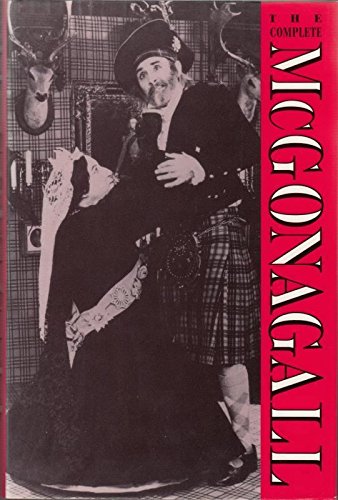
That he knew nothing about poetry was proved by the poem above, but whilst a poet can have a bad day, especially with their earliest works, McGonagall was if anything to get worse. There is a beauty in the total awfulness of his works that sucks the reader in, the Complete Works includes 247 poems and I have read it cover to cover several times. You just can’t believe what it is you are reading. The photo on the cover of the edition I have is of Spike Milligan as McGonagall and Peter Sellers as Queen Victoria as Milligan in particular popularised ‘The Great McGonagall’ from the 1960’s onwards and ensured that his body of work did not get neglected.

20180731 McGonagall 2

His works have been in constant print for many decades, above is the 1966 edition of More Poetic Gems published by David Winter and Sons in Dundee (who were his original publishers) and Gerald Duckworth and Co Ltd as a joint venture. Although appreciated now McGonagall died in poverty in 1902. He had eked out a living more as a sideshow than a poet from 1877 although it is clear that he regarded himself as a much put upon performer who was delivering great work to people who didn’t appreciate his ability. It was quite common for an audience to throw rotten fruit and vegetables and sometimes even fish at him whilst he was reciting, indeed the opening paragraph to the preface of his first published work ‘Poetic Gems’ includes the line

the first person to throw a dish of peas at me was a publican

It isn’t so much the fact that somebody threw a dish of peas at him as that this was just the first time…

Because he had no money when he died he was buried in an unmarked grave in Greyfriers kirkyard in Edinburgh, his grave received a nearby marker in 1999.

William McGonagall
Poet and Tragedian
“I am your gracious Majesty
ever faithful to Thee,
William McGonagall, the Poor Poet,
That lives in Dundee.”

I shall include one final poem and it’s one of the less well known ones “The Death of Captain Webb”. Webb was the first person to swim the English Channel (22 miles at its shortest point). He is something of a local hero here in Shropshire as he was born less than 5 miles from where I am sitting but died in a somewhat foolhardy attempt to swim across the rapids below Niagara Falls. The poem shows McGonagall at his prime, it was written in 1883 and has all his stylistic failings…

Alas brave Captain Webb has acted the part of a fool
By attempting to swim the mighty Niagara whirlpool,
Which I am sorry to say and to relate,
Has brought him to an untimely fate.

’Twas in the year Eighteen hundred and eighty-three,
With the people of America he did agree,
For $10,000, to swim through that yawning whirlpool;
But alas! He failed in doing so — the self-conceited fool.

Captain Webb, he courted danger for the sake of worldly gain
And the thought of gaining for himself — world wide fame;
And although many people warned him not to throw his life away,
He rushed madly to his fate without the least dismay.

Which clearly proves he was a mad conceited fool,
For to try to swim o’er that fearful whirlpool,
When he knew so many people had perished there,
And when the people told him so, he didn’t seem to care.

Had it not been for the money that lured him on
To the mighty falls of Niagara, he never would have gone
To sacrifice his precious life in such a dangerous way;
But I hope it will be a warning to others for many a long day.

On Tuesday the 24th of July, Webb arrived at the falls,
And as I view the scene in my mind’s eye, my heart it appalls
To think that any man could be such a great fool,
Without the help of God, to think to swim that great whirlpool;

Whereas, if he had put his trust in God before he came there,
God would have opened his blinded eyes and told him to beware;
But being too conceited in his own strength, the devil blinded his eyes,
And all thought of God and the people’s advice he therefore did despise.

But the man the forgets God, God will forget him;
Because to be too conceited in your own strength before God it is a sin;
And the devil will whisper in your ear — there’s no danger in the way,
And make you rush madly on to destruction, without the least dismay.

At half-past three o’clock Webb started for the river,
Which caus’d many of the spectators with fear to shiver,
As they wondered in their hearts if he would be such a fool
As to dare to swim through that hell — whirlpool.

Webb was received by the people with loud and hearty cheers;
And many a heart that day was full of doubts and fears;
A many a one present did venture to say –
“He only came here to throw his life away.”

The Webb entered a boat, in waiting, and was rowed by the ferry-man;
And many of the spectators seem’d to turn pale and wan;
And when asked by the boatman how much he’d made by the channel swim,
He replied $25,000 complete every dim.

Have you spent it all? Was the next question McCloy put to him,
No, answered Webb, I have yet $15,000 left, every dim;
“Then” replied McCloy, “You’d better spend it before you try this swim;”
Then the captain laugh’d heartily but didn’t answer him.

When the boat arrived at point opposite the “Maid of the Mist”
The captain stripped, retaining only a pair of red drawers of the smallest grist;
And at two minutes past four o’clock Webb dived from the boat;
While the shouts and applause of the crowd on the air seem’d to float.

Oh, Heaven! it must have been an awe inspiring sight,
To see him battling among that hell of waters with all his might,
And seemingly swimming with ease and great confidence;
While the spectators held their breath in suspense.

At one moment he was lifted high on the crest of a wave;
But he battled most manfully his life to save;
But alas! all his struggling prov’d in vain,
Because he drown’d in that merciless whirlpool God did so ordain.

He was swept into the neck of that hell — whirlpool,
And was whirl’d about in it just like a light cotton spool;
While the water fiend laughingly cried ”Ha! ha! you poor silly fool,
You have lost your life, for the sake of gain, in that hell — whirlpool

I hope the Lord will be a father to his family in their distress,
For they ought to be pitied, I really must confess;
And I hope the subscribers of the money, that lured Webb to his fate,
Will give the money to Mrs. Webb, her husband’s loss to compensate.

In the Tiffany Aching young adult series of books by Terry Pratchett the Pictsies or ‘Nac Mac Feegle’ are a race of 6 inch high beings that are more Scottish than it is probably possible to be. They have as their most feared tactic on the battlefield their Gonnagale who at times of greatest danger recites strange and terrible poetry which has the effect of reducing all that hear it to gibbering wrecks. The poems, and his title, are clearly based on the works of William McGonagall and are a tribute to the man whose writings approach genius by being so atrocious they reach round the spectrum of quality and get there from the other side.

Read him and weep

from laughter