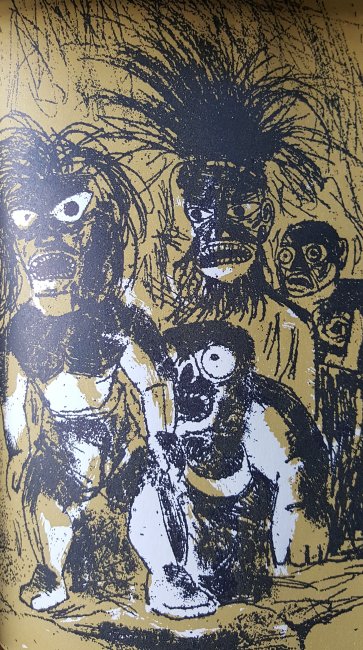
Where’s Wumpus – Elleston Trevor

Nowadays if Elleston Trevor is remembered at all it is for his 1964 novel The Flight of the Phoenix about a plane crash in the Libyan desert where the survivors eventually manage to build a new plane out of the wreckage of the old and fly to safety. The book has been turned into a film twice, once in 1965 starring James Stewart and Richard Attenborough and remade in 2004 starring Dennis Quaid. Born Trevor Dudley-Smith he eventually changed his name to Elleston Trevor which until then was one of his eleven pen names (including his real name) for his various books such as the nineteen volumes about the spy Quiller which he wrote under the name of Adam Hall written from 1965 with the last one published in 1996 one year after his death.

However I want to go back to 1948, as I have a couple of the children’s books he wrote then which were actually originally my mothers and specifically the third (and final) book in the Wumpus series, Where’s Wumpus.

20190317 Where's Wumpus 1

This has been my favourite book from childhood and it has been a joy rereading it this week. As you can see from the opening page the font is lovely and the spelling wonderfully eccentric and there are also several typesetting jokes later in the book to emphasise action. Wumpus is a koala living in a wood with his various friends Ole Bill Mole, Flip, or maybe Flap, the penguin (it depends on the day, if he is Flip today then he will be Flap tomorrow and vice versa), Hare-With-the-Careless-Air and Chipmunk (who first appears in this final book). The eight colour and forty eight black and white charming illustrations are by John McCail with the colour pages on higher quality paper and inset into the book. This is probably due to paper restrictions still applying after the war meaning that the paper used for the rest of the book isn’t suitable for colour printing.

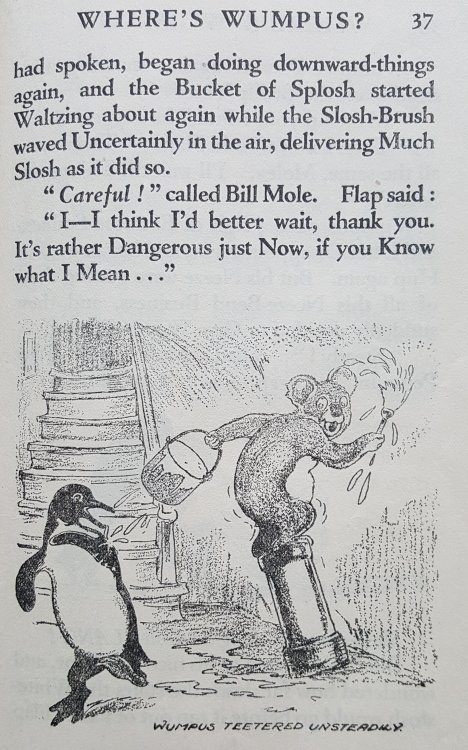
In the first part of the book Wumpus goes to visit Ole Bill Mole and after partaking of a large amount of ‘swish-roll’ is persuaded to help with the decorating that Bill had started. Unfortunately he had the only ladder so Wumpus ends up balanced precariously on the umbrella stand

But a Wumpus was now doing all he knew now to stay on top of the Brolly-stand which was trying to do a Rhumba while he did the Tango and the Bucket was going into an old-fashioned Waltz

At which point Flap (it being Tuesday) arrived and he tried to get down again…

20190317 Where's Wumpus 2

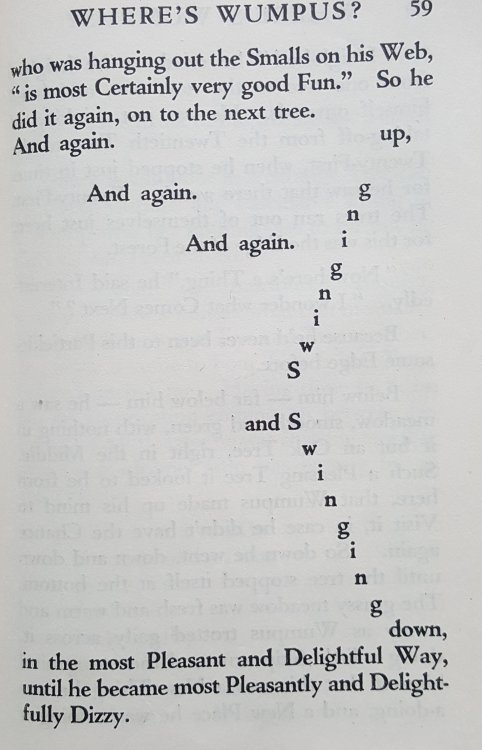
In a later story Wumpus discovers the joy of swinging between trees on a rope and the typesetting joins in the fun and games

20190317 Where's Wumpus 3

It was established early on in the book that there was a rung missing from the ladder leading down from The Wumpus Tree to the ground

So down he went, with a heigh and a ho (according to which rung of the ladder he was on) and when he came to the rung that wasn’t (because he’d forgotten to put a new one in yet) he murmured: “Careful Wump,” in a cautioning way, and managed to reach the ground without taking a run at it from half-way up the ladder (which would have been bouncy, not to mention most uncomfortablesome).

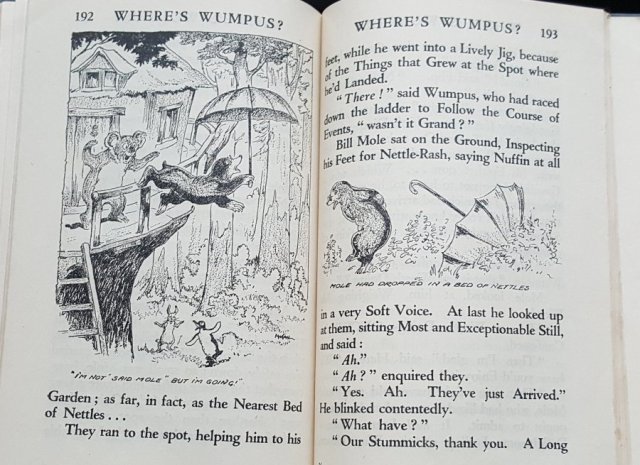
and about two thirds of the way through the book he decides to fix this particular problem even though it had started to rain leading to what appears to be a nasty accident…

20190317 Where's Wumpus 4

Instead it turns out that the umbrella acted like a parachute and so they all had a go at jumping off the balcony and floating to the ground, unfortunately Bill Mole, being the lightest, floated rather further than the rest and initially landed badly

20190317 Where's Wumpus 5

Later on it turns out that a gust of wind took him flying over the wood.

The whimsical nature of the book is just as much fun now as an adult as when I first read it aged about eight or nine, the Wumpus books are difficult to find nowadays but there is a copy of Where’s Wumpus available at the time of writing from a shop in Australia.

I do have another of Elleston Trevor’s children’s books which is also a first edition from 1948 and this is aimed at slightly older readers, probably early teens. This is illustrated with line drawings by David Williams and again printed by Gerald G. Swan. The tale is about a group of anthropomorphic animals that decide to go exploring and features an otter (called Potter), a badger (Old Stripe) and a squirrel (Skip). They try to interest other animals in the wood about coming with them but in the end it is just the three that head off down the river.

20190317 Where's Wumpus 6

They have all sorts of adventures on the trip including meeting up with a church mouse who joins them for a large part of the journey. As can be seen below the drawings are just as captivating as the ones in Where’s Wumpus but have a much more naturalistic style.

20190317 Where's Wumpus 7

The Secret Travellers is book five in the fifteen book series with the same characters which have become known as the Happy Glade (from the title of the first book) or Deep Wood (from the title of the third) series, confusingly the first two were written under the name of Trevor Dudley-Smith with the other thirteen being as Elleston Trevor hence the two different names for the series. These are all unfortunately also long out of print and difficult to find. I would love to see these available again as I’m sure they would find a readership but in the meantime I will enjoy my mother’s books and maybe I will find some of the other titles one day.

An Unsung Hero: the remarkable story of Tom Crean: Antarctic Explorer – Michael Smith

20190312 Tom Crean 1

Roald Amundsen, Robert Scott, Ernest Shackleton, Tom Crean. The first three Antarctic explorers listed are household names but Tom Crean is, as the title of the book implies, largely unknown. But he should be celebrated, as he took part in three of the main British Antarctic expeditions during what became known as The Heroic Age of Antarctic Exploration during the first two decades of the 20th century.  He  was with Scott and Shackleton on the Discovery Expedition from 1901 to 1904 which at the time set the record for furthest south at 82° 17′. He was then with Scott on his ill-fated Terra Nova expedition from 1910 to 1913 and Scott’s attempt on the South Pole, where he was beaten to it by Amundson and died on his way back to the ship. Crean was later with Shackleton on his failed Imperial Trans-Antarctic expedition on the Endurance from 1914 to 1917 where the Endurance sank early in the venture. Shackleton walked his men to Elephant island and then chose four to go with him for help in an open boat across over eight hundred miles of the South Atlantic to South Georgia and Crean was one of those who was part of possibly the greatest feat of seamanship seen in the last hundred years.

So why is he so barely known, apart from those of us with a fascination with Polar exploration? Well part of the reason is that Crean was really only semi-literate, so he left no diaries or any other documentation for posterity; he also never gave any interviews and the four medals he earned in the Antarctic weren’t displayed. Apparently he never even told his daughters about his exploits in Antarctica. The sole hint that here was a man with his background in exploration was that when he left the navy in 1920 he opened a pub in his home town of Annascaul in Southern Ireland which he called The South Pole Inn. The pub is still called that and in 2003 a statue of Crean was erected in the town, so maybe wider recognition is finally happening for this quiet and self-assuming man and it may well have been helped by this excellent book which was originally printed in 2001, my copy is the first paperback edition from 2002 also published by Headline.

Despite the lack of much documentary evidence from Crean himself Michael Smith has done an excellent job of research to piece together his life from lots of sources. Sixty six books are listed in the bibliography, quite a few I already have in my small Polar library and this list has pointed me to others that sound worth adding to my collection. There are also numerous letters, unpublished diaries and other documents that have been consulted. All this has made a beautifully illustrated book of over three hundred pages which tells not only the story of Tom Crean but also the expeditions that he took part in.  He was in the group of the last eight men on the Beardmore with Scott when he chose the last five to make the final push for the pole. That Scott decided not to chose him may well have been an error as Crean was still fit and strong unlike Oates who had an injured leg and Taffy Evans’ badly cut hand, both of which for reasons of his own Scott decided to take with him. That this undoubtedly saved Crean’s life and allowed him to continue his polar explorations with Shackleton a few years later. What can only be wondered is if Scott had taken the fitter Crean then would his party made it back to the food depot they were aiming for when they died on the ice. We will never know, Michael Smith makes it quite clear where his opinion lies:

Scott, it must be said, made two basic mistakes in selecting his final party to reach the pole. First, he chose the men at the wrong time and second he chose the wrong men.

Shackleton on the other hand greatly valued the taciturn and powerful Irishman, not only selecting him for the crew of the Endurance but picking him as one of the four to go for help with him in that open boat when the expedition became a rescue mission. I’ll cover this in a later blog as I have been in awe of that journey since first reading about it as a child. After returning from the expedition Crean joined the war effort and Shackleton encouraged him to get promotion, along with writing to the First Lord of the Admiralty personally recommending his promotion. This he duly got and after the war ended up with a reasonable pension, which along with money sent to him by Shackleton enabled him to open the South Pole Inn. Shackleton tried to convince Crean to join him again on a trip south but by this time he was a family man with two daughters and declined, his exploring days were behind him.

Michael Smith has written a hugely enjoyable book about one of the lesser known great Polar explorers and even if you know nothing about the history of the time it is well worth reading.

Relativity – Albert Einstein

20190305 Relativity 1

If you are going to read a book about relativity then why not go for the man who created the theories, after all as Einstein says himself in his preface…

The present book is intended, as far as possible, to give an exact insight into the theory of relativity for those readers who, from a general scientific and philosophical point of view, are interested in the theory, but are not conversant with the mathematical apparatus of theoretical physics. The work presumes a standard of education corresponding to that of a university matriculation and despite the shortness of the book, a fair amount of patience and force of will on the part of the reader.

Consider yourself warned.

The edition I have was published by The Folio Society in 2004 and has an introduction by Emeritus Rouse Ball Professor of Mathematics at Oxford University Roger Penrose.  Einstein originally wrote the book in 1916, just a year after he published his main paper on his General Theory of Relativity and eleven years after he had formulated his Special Theory of Relativity. Originally in German the translation is by Robert W. Lawson and he does an excellent job especially considering the complexities of the subject. Put simply the two theories deal with different things, the special theory is concerned with resolving issues between the laws of electromagnetism (specifically Maxwell’s equations) and those of motion as described in Newtonian mechanics, this becomes especially problematic as speeds approach the speed of light and time ceases to behave the way you would expect it to. The general theory on the other hand deals with gravitation and the forces between bodies caused by this. This is where the concept of warped space-time comes into place and the highly satisfying rubber sheet model which can easily demonstrate the basics of the idea and has become largely familiar to most students over the last century. It should be noted for anyone who watches the video is that the reason that the objects ultimately collide is due to friction between the balls and sheet, without that elliptical orbits would continue as we are familiar with planetary motion so this can only ever be a rough approximation of space-time curvature.

There are two ways of approaching an explanation of the theories of relativity, one book which I read several years ago does it very successfully and that is Why Does E=mc²? (And Why Should We Care?) by Professors Brian Cox and Jeff Forshaw which takes eight chapters and roughly 250 pages (depending on the edition) to cover the subject including the derivation of E=mc². Yes there is quite a lot of mathematics but there is also a large number of diagrams and descriptions in simpler terms in order to expand the readers understanding over a extended period and a short appendix in later editions to add more detail to a section that readers had queried. Einstein takes the other approach, with thirty two chapters over 132 pages (in this edition) so you approach quite complex theories and mathematics in small bite size chunks and you can reread the short chapters until you have grasped the concept being covered. There are also five appendices in a further fifty four pages which go into significantly more detail of the mathematical models and theories underpinning the two theories which are not needed by the casual reader but are there largely for completeness. In his introduction Penrose explains that part of the calculations done by Einstein in the book are no longer done that way as expressing time with a fourth dimensional axis based on imaginary numbers is seen as an unnecessary complexity when it can be done by clocks instead. This negates the need for one of the appendices which deals with Minkowski’s four dimensional space model using the square root of -1, other than as an example of Einstein’s thinking at the time.

There is no denying that some of the chapters can be difficult to get your head around the first time of reading, especially if like me you haven’t done theoretical physics at this level for over thirty five years, but it definitely worth the effort as Einstein gradually takes you through the maths. Starting with Euclidean Geometry (the first chapter which also looks at the concept of ‘truth’ for a mathematical axiom) and then pushing your understanding through relative movement of co-ordinate systems until you hit the Lorentz Transformation less than thirty pages later which gives you the basics needed to understand relativity by comparisons of motion within relative co-ordinates systems.

20190305 Relativity 2

With the introduction of Gaussian co-ordinates later on we can finally approach non-Euclidean geometry, which combined with Minkowski’s four dimensional space leads to the mathematics behind the general theory and warped space-time, which for now is how we understand gravity. The book is complex, but not unreasonably so, and the short sharp sections work as a way for the reader to grasp the overall concept in practical chunks. A century on this work still underpins our understanding of the cosmos and reading this book or the one by professors Cox and Forshaw, whichever you get on best with, is a good way to exercise the brain.

Of course there is still a lot of work to go before physics hits its ultimate goal of ‘the theory of everything’. Relativity is very good at explaining the very large but when you hit the realms of the very small quantum mechanics is just plain strange to the layman and even Einstein for a long time refused to believe most of the concepts behind that branch of physics. I do have a very good book on that subject as well which I will look at later this year.

The Art of Asking – Amanda Palmer

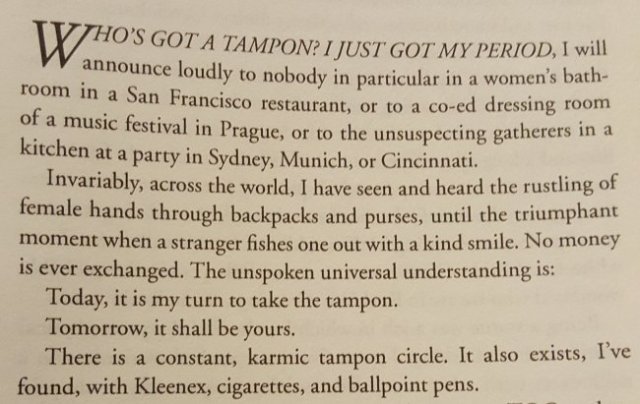
20190219 Art of Asking 1

So begins Amanda Palmer’s autobiographical self help book, but lets think about that statement. Is it an autobiography? Well sort of, it certainly tells you a lot about her life so far from childhood, to performance art (a lot of time as a living statue and what happened next) to having her own band(s) and marriage to the best selling author Neil Gaiman. So is it a self help book? It starts out like that certainly, but drifts somewhat from the premise of the title as the book progresses, so what is it? A cracking good read that is what it is… You will laugh, you will cry; boy will you cry; there are heart wrenching passages that make you wonder where the tissues are and then sections that make you laugh at the ridiculousness of the situation she finds herself in. Please also be aware there is strong language in the extracts selected from this book. Well actually there is strong language throughout the book which is why I couldn’t avoid it.

20190219 Art of Asking 2

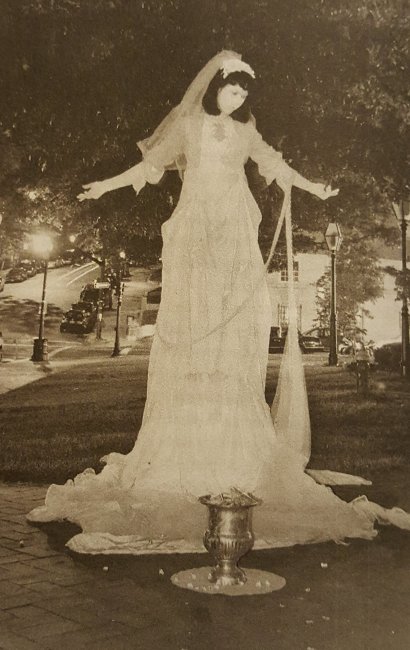
The single flower she is holding in the cover photo harks back to her time as the ‘eight foot bride’ actually she only stood 7½ feet on top of the milk crates but why ruin a good title. This was her first venture into public performance art and as a living statue she earned more than the job in the ice-cream parlour could ever pay, simply for standing still and when somebody gave her money she would give them a flower. The gift of the flower was vital, this she saw as a transaction, yes she was asking (albeit silently) for people to give her money but they did get a physical product in return, it was not a simple one way process.

20190219 Art of Asking 3

Through the book Amanda explores not just the idea of ‘asking’ but also the basis of relationships both personal and public. The relationship that she has with the fans of her band is clearly key to her existence and it is also obviously two way. There is a definite element of family, especially amongst the long standing fans, they know one another and look after one another and this is incredibly important and not only do the fans support one another but they support her and she supports them. It was one of the things that her one time label really didn’t understand. Outreach was for promotion of specific marketable products not for touchy feely bonding, but it was just this sort of direct contact that had built the band up n the first place. The email lists that she had built up over years became a not just a contact point but a meeting place for like minded souls.

20190219 Art of Asking 5

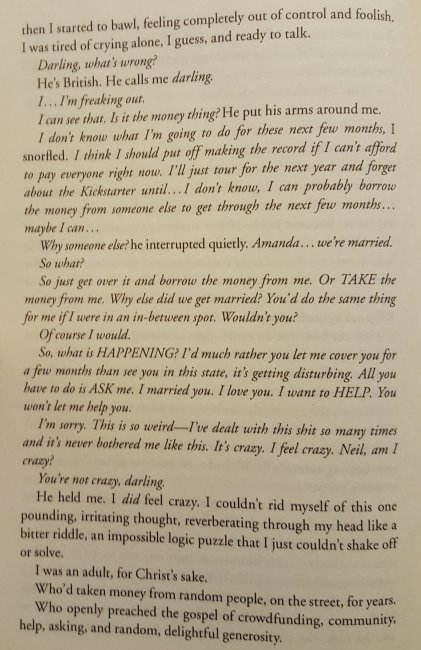
One thing explored at length in the book is how they came to be the first band to raise $1 million through crowd-sourcing to fund an album after they split with their existing label. The story of how they managed to get out of a notoriously complex and exploitative contact is also a tale of joy. She asked for money to record the album and the fans responded and then she hit a major personal problem which impacted her ability to fulfil the obligations of the money raised. A lifelong friend and confidant was unexpectedly very ill and she felt she couldn’t do what she needed to do for kickstarter and still be around for Anthony. This is where the book really gets hold of you and won’t let go, you become so involved in the drama of Anthony’s story which is just so unexpected from the book up to that point. But mixed up in this was her relationship with her husband Neil Gaiman and her inability to ask HIM for help.

20190219 Art of Asking 4

The amount of money involved whilst significant was not a major issue for a writer with the earning capacity of Neil Gaiman, but that was not the point for Amanda. As somebody who had valued her independence since a child this was just one step too far, or so it seemed at the time. There is then a long section where she comes to terms with the issue and whilst not resolving it comes to realise that there is only one logical way to progress, to get commitments not just to the crowd funded record but to the fans and to Anthony and to Neil sorted out. She has to ask, even though it is the most difficult (yet paradoxically the easiest because she knows the answer will be yes) for the money to cover her gap in finances. It should be explained here that that Neil and Amanda run completely separate financial positions, although married they have separate accounts, their own homes (in the case of Neil Gaiman several) and this independence is essential at least for Amanda, we cannot tell Neil’s position from the book.

20190219 Art of Asking 6

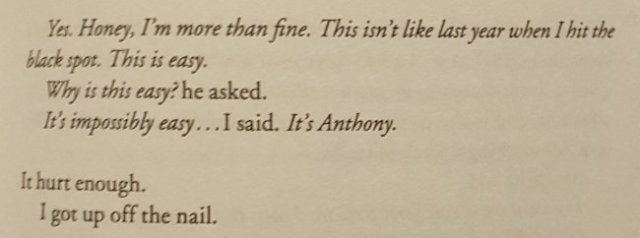
That last line in the image above reflects back to a passage early on in the book from a conversation between Anthony and Amanda. In an allegorical statement there is a dog howling outside and Amanda asks what the problem is. Anthony explains that the dog is sitting on a nail and whilst uncomfortable is still not driven to over-ride a natural laziness to move because it doesn’t hurt enough yet.

There is one section of the book that felt personally relevant to me and that was a short part dealing with an aspect of Amanda’s relationship with her mother. She was a top computer programmer, technical and systems analyst and that was also my background. Nobody outside my circle understood that this is an art and what’s more in can be a beautiful art, you can approach it as a technical problem and come up with a working methodology but treating it as an art you will produce a beautiful and probably more resilient and better result. You are composing a solution but nobody can see it or even if they could most would not appreciate the beauty of the resolution that you craft. This was something that Amanda had also not appreciated as teenager

20190219 Art of Asking 7

But to return to Anthony as the book repeatedly does, she needed money so that she could stay with Anthony as he continued his ever more debilitating medical treatments and this time she went straight to Neil

20190219 Art of Asking 8

Epilogue

The book ends with Anthony sort of recovering and sort of not, the book was published in 2014, I wanted to know more and found the following, don’t read it until you have read the book.

http://journal.neilgaiman.com/2015/06/existing-in-pause.html

Brother Cadfael – Ellis Peters

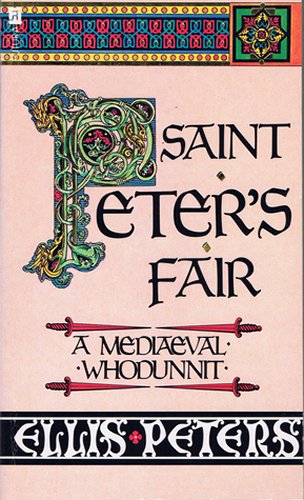
Finding myself abroad last week, but having fallen and badly sprained my ankle so forced into inactivity, I picked up a copy of the Brother Cadfael Omnibus volume two which my host owned. I chose this because I have the Cadfael stories in their individual volumes at home so if I didn’t finish a book then I could do so on my return. Omnibus volume two consists of books four to six of the series i.e. Saint Peters Fair, The Leper of Saint Giles and The Virgin in the Ice and I finished the first two and got most of the way through The Virgin in the Ice which I have now completed. I have read all twenty one of the books in the series several times so knew I was in for a fun time even though I could remember most of the plots.

20190212 Brother Cadfael 1

For those people unfamiliar with the stories Brother Cadfael (the name is Welsh and pronounced Kad-vile) is a monk at the Abbey of Saint Peter and Saint Paul in Shrewsbury, Shropshire and the books are almost all set from 1137 to 1145 during the civil war between King Stephen and his cousin Empress Maud for control of the English crown. The one exception is A Rare Benedictine which is actually a collection of three short stories exploring Cadfael’s life before the first book going back as far as 1120 when he was a crusader. This book is also not included in the standard numbering of the series, it should be number sixteen but is skipped in the sequence by most publishers and when the omnibus editions were put together it was assigned the final place in volume seven further emphasising that it is not really part of the story arc. Apart from that the books follow on from each other so this is one series where it really does pay to read them in order. The character is a herbalist within the monastery and is seen by his superiors as a useful link to the secular powers such as the sheriff and especially his deputy Hugh Beringer due to the long time he spent in the world before withdrawing to the monastic life. His knowledge of herbs and remedies is also very useful both within the abbey and to the town and the surrounding area and this leads him to be involved in poisonings and murders as the basis of a lot of the plots.

I would be very surprised if the Estonian medieval detective tales of Apothecary Melchior tales by Indrek Hargla  were not heavily influenced by the Cadfael stories as although they are set a couple of hundred years later the two characters are very similar in skills and ways of approaching crime.

20190212 Brother Cadfael 2

Ellis Peters was one of the pseudonyms used by Edith Pargeter for her in excess of seventy five books along with dozens of short stories written between 1936 and her death in 1995. She lived almost her entire life within 5 miles of where I now reside being born in the small village of Horsehay and dying just 3½ miles from there in the town of Madeley at the age of eighty two, so she was very much a local celebrity round here. There is even a window dedicated to her memory in Shrewsbury abbey (about fifteen miles from here) and the Cadfael trails around Shrewsbury are still a popular tourist draw to the town. As well as a novelist she was a historian and translator and it is her historical interests that adds so much character to the books. Numerous real people are mentioned including the two abbots and the prior of the abbey who were indeed there when she says they were

20190212 Brother Cadfael 3

The covers I have included are from my own copies, there are numerous sets of covers that you can get the books in, I particularly like this version although it is mildly annoying as you cannot get all the books in exactly the same format as the publishers (Futura) decided to change it to include the book number on the cover near the end of the series which messed up the design. However the ‘parchment’ background with decorated lettering I think is very satisfying for books set in a medieval monastery. The books have fallen out of popularity since Pargeter’s death and the TV series which ran in the late 1990’s but they are well worth a read and you will also learn quite a but about ‘The Anarchy’, a period of English history that also doesn’t seem to be known about in modern times.

Sourcery (book proof) – Terry Pratchett

20190205sourcery1

The fifth Discworld novel by Terry Pratchett was published on 26th May 1988, before that however Gollanz released a sample for book reviewers and this was the only time that the book proof of one of Terry’s works was not the complete book. Instead what you got was just the first 61 pages and an essay from Terry explaining Discworld as it was still not well known. It is this short essay that makes this book so interesting as it has never been reprinted so you can only read it is you are one of the lucky few people that own a copy. It is not known exactly how many were printed but the proofs of books four and six in the series were both only of circa 100 copies produced so it is not unreasonable to assume that it is also the case for this example. The poor production value of what is basically a pamphlet with what looks like a bad black and white photocopy of the cover for an author who was not then famous would also suggest that not all of the printed editions were kept.

When Sourcery was printed for real the first edition (see below) ran to 7,600 copies, ten years later Carpe Jugulum (printed 5th November 1998) would have a first edition print run of 160,000 in the UK alone although the proof for that book was still only 148 examples. Pratchett UK book proof collecting takes a lot of looking to find copies and they are all rare.

20190205sourcery2

But back to the sample book proof, the essay inside describes how Terry saw the Discworld at the time, over the years this evolved and it is fascinating to read his views then, just four and a half years after the first book in a series that would eventually run to forty two novels, along with numerous other books, maps, plays etc. that added to the Discworld universe. The essay is headed

An Introduction to the series, composed by the Author, and included to make this special preview sample of Sourcery even more valuable as a collector’s item

In it he gives this description of why he invented Discworld in the first place

 It was created as an antidote to all those trilogies whose worthy heroes stagger across three volumes in order to do whatever it is that the fates have decreed that a hero must do. But fairy tales and folklore and all the feedstocks of fantasy have been dragged into it, and the humour gently teased out of them by the simple process of taking them seriously and staffing them with real people. This is very unfair on them, because it is like turning loose a large herd of cows in a small pottery.

This was indeed the case in the early Discworld books, the story is played for laughs and there is a strong sense of parody about the writing particularly in the ones up to and including Sourcery. The name of the novel by the way is also a joke and is deliberately spelled that way rather than Sorcery. The concept is that the eighth son of an eighth son is automatically a wizard of power but if he then goes on to have children each son would be as powerful as any existing wizard and if he has an eighth son then he would be a wizard squared and be all powerful with access to the source of all raw magic on the Disc hence a Sourcerer rather than a sorcerer. This duly happens and wizards start building towers to fight with one another, laying waste to the lands and peoples between; does this remind you of any three volume series by any chance? Pratchett specifically mentions Tolkien a little later.

Thus on the Discworld, wizards smoke. Nothing new about this Tolkien revealed to the world that wizards smoke. But on the Disc they really smoke, you can tell a wizard by his golden fingers, stained beard, tendency to cough when walking upstairs and, in the dark, by his little red glow.

The book goes on the amplify to the ridiculous numerous tropes of the fantasy novels up until then, barbarian heroes that are either like Cohen at 87 years old and sometimes needs to be carried off by the young maidens he has just rescued from sacrifice or patently unsuited for the role they have chosen such as Nijel who is far too polite for this sort of thing with his battle cry of “Erm, excuse me”. The book is very funny especially if you are well read in the sort of books that Pratchett is mercilessly parodying.

People keep asking for maps of the Disc, on the basis that all fantasy world have to have a map, but I retreat into my Somerset bunker and refuse on the ground that I may decide to move places around a bit if it makes a better joke.

As stated above there are now maps not just of the Disc itself but also specific regions but they weren’t created by Terry, instead Stephen Briggs eventually convinced him that it could be mapped, starting with the city of Ankh-Morpork and eventually the whole world and yes it did prove difficult because there wasn’t a map when the books were written and the lost continent of XXXX had to have a huge extension added just so that one of the books worked. The later books are also less parody of fantasy novels and more a humorous parody of life on Earth, back then Pratchett could never have seen where his work would take him and the millions of books he would sell, indeed he was somewhat bemused that it was as popular as it was even then.

the evolution of the books into a cult has rather perplexed me.

20190205sourcery3

At the time of writing there is a copy available on Abebooks should you be interested at a quite reasonable (considering its rarity) £225

Daphnis and Chloe – Longus

It wasn’t long after starting reading this short book that I really wanted to slap both the protagonists. It’s a love story starting with two orphan babies that are separately found on the island of Lesbos with mysterious items that imply some history or maybe a fate from the gods for them however this seems to be largely forgotten as the story progresses. The two children are raised by families a short distance apart and Daphnis ends up as a goatherd whilst Chloe is a shepherdess and they grow up looking after their flocks together and slowly fall in love. What made them so frustrating though was their total naivety regarding sex, they look after goats and sheep for goodness sake surely they have noticed something over the years?

The book was written around 200AD, presumably on Lesbos, by a writer called Longus about whom nothing at all is known. There appear to be no other works by him and he has left no trace in history other than this short novel. Nobody even knows if Longus was his name or a even a real person or just something that has become attributed to the story. Through the tale the two of them suffer various calamities from being abducted by an invading army (Chloe) to falling in a pit dug to catch wolves (Daphnis) as they slowly progress from looking at the other one naked and getting all soppy (both of them) to trying kissing (oh this takes them ages to get round to) and very slowly finding out about sex (again both as it’s that sort of book)

20190129 daphnis and chloe 1

The main reason that I chose to read this though was to look again at translation and how styles have changed over the decades and this book is the only one where I have two different translations both printed by Penguin books but 55 years apart and where both translations are still in print. Above is the cover of the 2011 translation by Phiroze Vasunia when it was separated out as a single book in 2016 and below the original 1956 translation by Paul Turner.

20190129 daphnis and chloe 2

In ‘The Penguin Classics Book’ by Henry Elliot (review to come later) he writes

The 1968 reprint of Turner’s translation carried a notice “Former Penguin editions of this third century Greek novel, the prototype for all Arcadian love stories were we regret to say bowdlerised. Paul Turner has added the missing passages for this new edition on which the text is unexpurgated”

Now as I only have the 1956 original I cannot say what was put back in for the edition of 1968 but frankly the tale is not exactly controversial, certainly by today’s standards. In stating that I have to assume that the 2011 edition is not similarly censored but I cannot imagine that it would be. As I said at the start the story is so unrelated to sex that it defies belief for a large part of the book.

Along the way through the story they get increasing bad relationship advice, partly from men who want to have Chloe themselves and would be very happy to see Daphnis out of the way. It’s not really a give away to tell you that they do eventually get together, in the last few pages of the book and even their original parents are also revealed at this time. It is almost certainly the first example of a romance story and something that Mills and Boon would be very happy with nowadays, there are even pirates…

Enter The Saint – Leslie Charteris

Just before Christmas I purchased a collection of ‘Saint’ books partly as a nostalgia feast. I had grown up a small boy watching Roger Moore as Simon Templar aka The Saint on television; a series that eventually had almost 120 episodes and ran from 1962 to 1969, so I only saw the later ones unless earlier episodes were repeated. It was through playing The Saint that Moore was offered the role of James Bond, a similar action hero, although the Saint ran his own ‘organisation’ and was more of a Robin Hood character being happy to use criminal means to get the results he wants. The Saint also pre-dates Bond by twenty five years with his first appearance in ‘The Saint Meets the Tiger’ dating from 1928 whilst ‘Casino Royale’ which marks Bond’s debut was published in 1953.

20190108 enter the saint

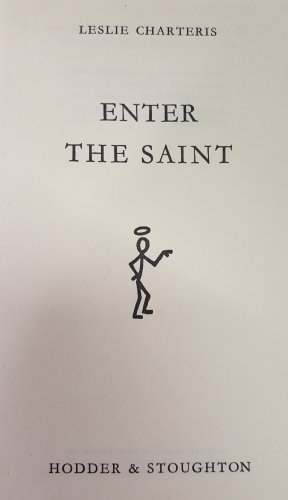
The collection I bought was a bit of a bargain at £20 plus postage for thirty books, half of which were hardbacks (only two with dust wrappers) and most printed in the 1950’s. In later years Charteris was dismissive about Meets the Tiger and regarded Enter The Saint as the first ‘proper’ Saint book; an attitude that was followed in the most recent reprint of the titles in 2013/4 by Mulholland which left out Meets the Tiger completely so that is why I am starting my reading of the books with this one. My copy is the 1957 hardback from Charteris’s long time British publisher Hodder and Stoughton, it’s missing its wrapper and has clearly been well read in the sixty years since it was printed so looks nothing like the edition I have used to illustrate this article as it has plain blue board covers (not very photogenic). The picture is actually a beautiful first edition copy currently for sale by Lucius Books in York for £2940, so not a copy I’ll be purchasing any time soon but lovely to see. Below is the title page from my copy featuring the calling card of the Saint.

20190108 enter the saint 2

In total there were fifty Saint books printed in the UK during Charteris’s lifetime although only the first thirty six were written by him, after that numerous other authors (including science fiction writer Harry Harrison) actually wrote the books, with Charteris mainly reducing his role to editor although his name continued to be the main (and sometimes only) one on the cover. All but five of the ones I got last year are from the first thirty six. Most of the books are collections of novellas or short stories and Enter the Saint is a good example consisting of three novellas.

I – The Man who Was Clever – 67 pages

MR “SNAKE” GANNING was neither a great criminal nor a pleasant character, but he is interesting because he was the first victim of the organisation led by the man known as the Saint, which was destined in the course of a few months to spread terror through the underworld of London – that ruthless association of reckless young men, brilliantly led, who worked on the side of the law and who were yet outside the law.

So begins the first tale in this book and quite an introduction it is and within three pages Snake had duly become that first victim. This however was just a minor diversion for the Saint from the main events of this story. He is working to disrupt a cocaine smuggling business run by a crooked gambling club owner and whilst at it help out a young man who had become a victim of their illegal casino to the tune of thousands of pounds.  This he duly achieves with a mixture of guile and outright violence whichever is appropriate at the time. The Saint is a highly accomplished and powerful fighter but not above throwing a chair to improve the odds when throwing a punch is out of range.

II – The Policeman with Wings – 57 pages

The second story provides more of a leading role for one of Templar’s ‘associates’, Roger Conway, part time manager of the Golden Eagle Hotel in St. Marychurch near Torquay in Devon. That he is also a part time member of the Saint’s organisation is not so well known. Roger had met a young lady in Torquay who told him an odd tale about her uncle. He had recently been offered a lot of money for his house and when he turned it down a shot had been fired at him in the garden and the brakes of his car tampered with. He had been driven off by a policeman a few days ago, ostensibly to give a statement, but policeman, car and uncle had vanished and the police had confirmed that none of their officers had visited him to do any such thing. Why does somebody want the house so much and is the young lady safe now that she is the only person living there? Cue dramatic car chases, kidnapping, diamonds and the appearance of a very nasty piece of work known as Spider, for such a short novella it certainly packs a lot in.

III – The Lawless Lady – 59 pages

This story features another of the Saint’s lieutenants, in this case Dicky Tremayne, and also gives some idea as to the long term planning that the Saint was willing to use to put a criminal out of business whilst at the same time obtaining a significant sum for charity less his 10% for ‘professional fees’. This operation is something that Dicky has been working on for a year and we join the action just a few days before the main crime is to be committed. The plot that Tremayne and Templar are to counter is quite ingenious; the gang led by Audrey Perowne has set up a fake private cruise for a group of wealthy businessmen, Dicky has been working for the gang across Europe gathering potential victims. Their plan is to take the men and their wives, who would of course all be looking to outdo one another with the level of jewellery on display whilst the men are ready to spend big in Marseilles and Monte Carlo part way through the trip and then rob and dump them somewhere remote. Back in 1930 this may well have been a valid option but nowadays with modern communication methods this really has dated badly. Nevertheless can Dicky maintain his cover within the gang and how will the Saint turn the tables? It’s all very exciting…

Charteris himself was an interesting character, born Leslie Charles Bowyer-Yin in 1907 in Singapore (then a British colony) he was educated at a private school in the north of England and went to Kings College Cambridge but left after a year when he started to get published. In 1926 he changed his surname by deed-poll to Charteris. and in 1932 he moved to America, or at least tried to, but being half Chinese he was blocked from residency by the Oriental Exclusion Act so had to keep leaving when his six month visa expired all this whilst working on films and radio series about The Saint. At the end of 1942 a law was passed in the US specifically so that Charteris and his daughter Patricia could live in America and in 1946 he became an American citizen. Near the end of his life he moved back to England with his fourth wife and died aged 85 in 1993.

I’m going to continue working my way through the other books I bought at the same time as the year goes on although unless one strikes me as particularly interesting I expect this will be the only time I write about The Saint on this blog. Seek him out if you like uncomplicated thrillers now that he is available again in quantity for the first time since the mid 1980’s although do bear in mind that the early books are very much of their time and feel rather dated now. Charteris was himself well aware of this and kept intending to do rewrites but in the end decided to leave them as period pieces.

Robin Philipson – Elizabeth Cumming

This is the first of my ‘what I got for Christmas’ posts and this book was a wonderful surprise from some very good friends. I first saw Robin’s art at their home and loved it straight away so that I have bought several pieces over the ensuing years, some of which I am using to illustrate this essay rather than images from the book itself.

20190101 Robin Philipson 1

Sir Robin Philipson RA RSA FRSE RSW to give him his proper title was a major name in Scottish art through the second half of the 20th century; not only as a creator of beautiful works but as a teacher for many decades at the Edinburgh College of Art. There have been a couple of biographies before, along with pamphlets to accompany exhibitions, but this is easily the most comprehensive biography so far. Cummings has spoken to lots of members of Robin’s family including his widow Diana and also his nephew who gave me this lovely book.

20190101 Robin Philipson 2

As this was a Christmas present it is appropriate to start with a couple of Robin’s Christmas cards on my walls. What can be immediately seen is his bold use of colour, as Dr Cumming says in her book.

…colour was always a principle tool in Robin’s art, and it evolved throughout his career; he was one of Scotland’s major colourists. It was this as much as technical experiment which drove all his work; whether easel painting, printmaking or his involvement in textile enterprises…

Robin produced a Christmas card every year from the late 1960’s, not only painting the original but also printing the cards, en masse they look fantastic, I only have three but hope to add others to my collection as time goes on.

The book’s cover picture is entitled Brenda Spring Portrait, she was his first wife, they married in 1949 a couple of years after he took up his first role as lecturer at the Edinburgh College, and he painted her several times. The Summer and Winter portraits are also included in the book along with a very interesting study for the Spring portrait. One of the joys of this volume is the inclusion of studies for works along with pictures of Robin in his studio which gives an opportunity to see how he went about some of his pieces.

The book is split into several sections, part one looks at his early life and how he came to be in Scotland in the first place; he was born in Cumbria in 1916. Part two is the longest and takes us from starting teaching and his marriage to Brenda, to his discovery of the joys of print making and the introduction of three of his main themes, cock fighting, kings and cathedrals.

20190101 Robin Philipson 4

My largest piece and one that hangs above my desk can be seen above, limited to 50 and signed by Robin it is also my favourite in it’s bold use of colour and dynamism of the subject.

20190101 Robin Philipson 5

The book is copiously illustrated and includes a significant number of works that are held in private collections so not generally seen, it also gives me a chance to roughly date the art I have collected as style and themes develop through the book as we move through Robin’s career.

He designed the posters and programme covers for the Edinburgh Festival in both 1958 and 1959, the book includes examples of both programmes and in my collection I have an original (and highly fragile) poster for 1959 which is a really good example of his style at the end of the 1950’s.

Part three takes us from the early death of Brenda from a brain tumour in 1960 which led to a period where very few works were produced and those that did appear are dark and angry in tone to meeting Thora Clyne who was to become his second wife in 1962. This seems to have led to a blossoming of Robin’s art and he also took up the appointment of head of Drawing and Painting in the early 1960’s so became very busy.

20190101 Robin Philipson 3
I have a couple of versions of Peasant, which dates from 1958 and are different sizes, only one of which is signed, I really like this happy character and he also hangs above my desk where I am writing this.

He did manage to fit in a trip to Colorado in the summer of 1963 as a visiting Professor of Art in Colorado. During this time he became influenced by native paintings and also Mexican churches, there is a truly beautiful painting of a yellow altar towards the end of that section.

The fourth section of the books sees another theme emerging in Robin’s art as we complete the 1960’s and that is depictions of crucifixion. This is a logical extension of his works depicting church interiors , specifically rose windows, and the altars he had started painting in the early part of the decade. Again Cummings takes us through the change in his art against the changes happening in his life and explains how they fit together.

The fifth part covers most of the 1970’s, from his surgery for colonic cancer whilst on a trip to France to study tapestries through his divorce from Thora and marriage to Diana. This was a period not only of great creativity and more new themes to his work such as ‘human kind’ which depict inter-racial couples in various settings to his numerous paintings of ‘women of pleasure’; but also of much greater recognition in the world outside of the Scottish Art scene. He became president of the Royal Scottish Academy, a post he held for a decade and from that a fellow of the Royal Academy in London. In 1976 he was knighted for services to art and all whilst heading up the Drawing and Painting department at the Edinburgh College of Art. He would continue to have bouts of illness throughout this period but his workload and artistic output hardly seemed to let up.

The final section deals with the last fourteen years of Robin’s life up to his death in 1992, this was still a highly busy and productive time with yet another theme to his art appearing, the wonderfully delicate poppy still life paintings.

20190101 Robin Philipson 7

I have a couple of these prints, both signed, as my representations of this period and there are three originals reproduced in the book with various backgrounds which demonstrate his total mastery of colour. Sadly the cancer first detected in the 1970’s was to claim him just when it looked like he was reaching another peak in his creativity. I have more pictures by him than I have used in this short review and am always looking for more to add to my small collection especially now I have seen some of the works in this beautifully illustrated book.

All in all this is a major retrospective of the life and work of a man who became very important figure in Scottish art for several decades and hopefully it will help raise his profile again twenty five years after his death. The main body of the book (excluding chronology, notes and index) is 138 pages long, sixty nine of which are made up of full page (and indeed double page) illustrations and a large proportion of the text pages also have a picture or two on them, this really is a magnificent review of Robin’s works and for the most part is extremely readable. My one criticism is the impression you get that Cummings wants to prove she has done her research which leads to whole paragraphs which seem to consist of nothing but lists of names and dates which you hit like boulders in the stream of an otherwise flowing tale. Having said that I very much enjoyed the book and will finish this overview with my only Philipson original, a small pastel still life.

20190101 Robin Philipson 6

The Best of Robert Service

THE SPELL OF THE YUKON

I wanted the gold, and I sought it;
   I scrabbled and mucked like a slave.
Was it famine or scurvy—I fought it;
   I hurled my youth into a grave.
I wanted the gold, and I got it—
   Came out with a fortune last fall,—
Yet somehow life’s not what I thought it,
   And somehow the gold isn’t all.

No! There’s the land. (Have you seen it?)
   It’s the cussedest land that I know,
From the big, dizzy mountains that screen it
   To the deep, deathlike valleys below.
Some say God was tired when He made it;
   Some say it’s a fine land to shun;
Maybe; but there’s some as would trade it
   For no land on earth—and I’m one.

So begins the opening poem of this selection; I fell in love with Service’s verses and the land that inspired them at the same time over twenty years ago. Robert Service was an English born poet and novelist who emigrated to Canada at the age of twenty one and ended up in Whitehorse, Yukon nine years later in 1904 working as a bank clerk. Although he had been writing verse since before he left England it was the environs of Whitehorse and the gold prospectors that he would meet there that inspired him to write his most famous works and it was these that first introduced me to Service. Although “The Best of Robert Service” includes works from several of his books I want to concentrate on the ones that were taken from his first book “Songs of a Sourdough”, this is for two reasons, firstly I bought the book in Whitehorse before setting off to kayak down the Yukon river in 1995 following the trail of the gold prospectors from Service’s day and secondly I want to cover another of his books in a later blog as it has an interesting structure.

20181218 Robert Service 1

So why write about this book now? Well this is the 50th essay I have written for this blog so that brought the subject of gold to mind and frankly I’ve been meaning to write about it for some time. Songs of a Sourdough was an immediate hit, Service had intended it to be a small privately printed volume which he was going to give to friends and family but the printers that it was sent to loved it so much that they wanted to publish it properly and it went to numerous editions within the first year. He would eventually make over one hundred thousand dollars (more then two and a half million today) just from his first book and he became one of the richest authors of his day. Service can justifiably be compared to Rudyard Kipling, like him he was enormously popular but the critics of the day were rather sniffy about his work as they regarded his verse as little more than doggerel.  His most famous work is probably

The Cremation of Sam McGee

There are strange things done in the midnight sun
By the men who moil for gold;
The Arctic trails have their secret tales
That would make your blood run cold;
The Northern Lights have seen queer sights,
But the queerest they ever did see
Was that night on the marge of Lake Lebarge
I cremated Sam McGee.

Now Sam McGee was from Tennessee, where the cotton blooms and blows.
Why he left his home in the South to roam ’round the Pole, God only knows.
He was always cold, but the land of gold seemed to hold him like a spell;
Though he’d often say in his homely way that “he’d sooner live in hell.”

On a Christmas Day we were mushing our way over the Dawson trail.
Talk of your cold! through the parka’s fold it stabbed like a driven nail.
If our eyes we’d close, then the lashes froze till sometimes we couldn’t see;
It wasn’t much fun, but the only one to whimper was Sam McGee.

And that very night, as we lay packed tight in our robes beneath the snow,
And the dogs were fed, and the stars o’erhead were dancing heel and toe,
He turned to me, and “Cap,” says he, “I’ll cash in this trip, I guess;
And if I do, I’m asking that you won’t refuse my last request.”

Well, he seemed so low that I couldn’t say no; then he says with a sort of moan:
“It’s the cursèd cold, and it’s got right hold till I’m chilled clean through to the bone.
Yet ’tain’t being dead—it’s my awful dread of the icy grave that pains;
So I want you to swear that, foul or fair, you’ll cremate my last remains.”

A pal’s last need is a thing to heed, so I swore I would not fail;
And we started on at the streak of dawn; but God! he looked ghastly pale.
He crouched on the sleigh, and he raved all day of his home in Tennessee;
And before nightfall a corpse was all that was left of Sam McGee.

There wasn’t a breath in that land of death, and I hurried, horror-driven,
With a corpse half hid that I couldn’t get rid, because of a promise given;
It was lashed to the sleigh, and it seemed to say: “You may tax your brawn and brains,
But you promised true, and it’s up to you to cremate those last remains.”

Now a promise made is a debt unpaid, and the trail has its own stern code.
In the days to come, though my lips were dumb, in my heart how I cursed that load.
In the long, long night, by the lone firelight, while the huskies, round in a ring,
Howled out their woes to the homeless snows— O God! how I loathed the thing.

And every day that quiet clay seemed to heavy and heavier grow;
And on I went, though the dogs were spent and the grub was getting low;
The trail was bad, and I felt half mad, but I swore I would not give in;
And I’d often sing to the hateful thing, and it hearkened with a grin.

Till I came to the marge of Lake Lebarge, and a derelict there lay;
It was jammed in the ice, but I saw in a trice it was called the “Alice May.”
And I looked at it, and I thought a bit, and I looked at my frozen chum;
Then “Here,” said I, with a sudden cry, “is my cre-ma-tor-eum.”

Some planks I tore from the cabin floor, and I lit the boiler fire;
Some coal I found that was lying around, and I heaped the fuel higher;
The flames just soared, and the furnace roared—such a blaze you seldom see;
And I burrowed a hole in the glowing coal, and I stuffed in Sam McGee.

Then I made a hike, for I didn’t like to hear him sizzle so;
And the heavens scowled, and the huskies howled, and the wind began to blow.
It was icy cold, but the hot sweat rolled down my cheeks, and I don’t know why;
And the greasy smoke in an inky cloak went streaking down the sky.

I do not know how long in the snow I wrestled with grisly fear;
But the stars came out and they danced about ere again I ventured near;
I was sick with dread, but I bravely said: “I’ll just take a peep inside.
I guess he’s cooked, and it’s time I looked”; … then the door I opened wide.

And there sat Sam, looking cool and calm, in the heart of the furnace roar;
And he wore a smile you could see a mile, and he said: “Please close that door.
It’s fine in here, but I greatly fear you’ll let in the cold and storm—
Since I left Plumtree, down in Tennessee, it’s the first time I’ve been warm.”

There are strange things done in the midnight sun
By the men who moil for gold;
The Arctic trails have their secret tales
That would make your blood run cold;
The Northern Lights have seen queer sights,
But the queerest they ever did see
Was that night on the marge of Lake Lebarge
I cremated Sam McGee.

After three years in Whitehorse, he was transferred to the bigger branch in Dawson City which had been the centre of the gold rush, here he got to know more of the veteran prospectors and gained more tales to feed into his poetry. The Cremation of Sam McGee was based on a real incident that he heard about and apparently he composed the work that night. After a year the bank wanted him to move back to Whitehorse as manager of the branch but by now he was earning a good living as a poet so quit and became a full time writer from that point on. Service was not only a poet, he wrote several novels and lived most of his life in France after moving there as a journalist in 1913. After the war he enjoyed the high life as a wealthy author around Paris The book that features in this essay was published in Canada by McGraw-Hill Ryerson who sound like a character from one of his works and there are 101 poems featured giving a good overview of his output.

Sadly Robert Service seems to have slipped from the public conciousness nowadays, certainly I had never heard of him before picking the book up as something to read around the camp fire on the trip Dave and I made all those years ago, so just to give a feel of the beauty of the place where we went several days without seeing another human I’ll finish with some of the photos we took starting with me paddling at the front of the kayak. You can see why the place inspired Robert Service.

20181218 Robert Service 8

On the shore of Lake Labarge

20181218 Robert Service 3

More Lake Lebarge (it’s a very big lake)

20181218 Robert Service 4

Bald Eagle by the Thirty Mile River

20181218 Robert Service 5

Trappers hut at Hootalinqua

20181218 Robert Service 6

Cyr’s dredge, an abandoned gold dredging machine, when it broke it was just too expensive to fix or take back from the river so it has sat there for decades.

20181218 Robert Service 7