The Moomins and the Great Flood – Tove Jannson

Most people who know Tove Jansson’s wonderful Moomin books have come across the eight books starting with Comet in Moominland (1946) and ending with Moominvalley in November (1970), a smaller number of people will have seen the five picture books for younger readers (1952 – 1993) only four of which have been translated into English and which will probably be featured in a blog on here sometime next year. Fewer still will have seen the long running cartoon strip which I covered in a previous blog. And then there is the subject of today’s post.
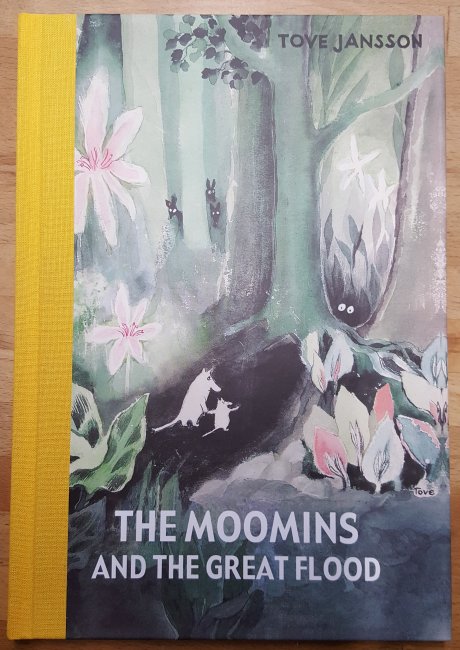
20181211 Moomin and the Great Flood 1

The Moomins and the Great Flood has a very odd history it began life in 1939 at the start of WWII when twenty five year old Swedish speaking, Finnish born artist Tove Jansson, faced with a lack of inspiration for her work decided to try writing something. As she herself said in 1991

It was the winter of war, in 1939. One’s work stood still; it felt completely pointless to try to create pictures.

Perhaps it was understandable that I suddenly felt an urge to write down something that was to begin with “Once Upon a Time.”

Inspiration didn’t really strike with the written word either and the part written story was put away to be largely forgotten until she showed it to a friend in 1945 who encouraged Tove to finish it as a children’s book and do some illustrations to see if it would sell. The original title in Swedish is Småtrollen och den stora översvämningen or Small trolls and the Great Flood and although the following eight books became hugely popular all over the world from the 1950’s and have spawned a massive merchandising industry this first appearance was rather neglected. The book was out of print for a long time and did not get translated until 2005 when a limited edition copy was produced in English for the 60th anniversary of it’s first publication. This translation however was printed in Finland and was not widely available outside that country, the edition I have is printed by Sort Of Books in 2012 and is the first copy that is easy to obtain.
20181211 Moomin and the Great Flood 2

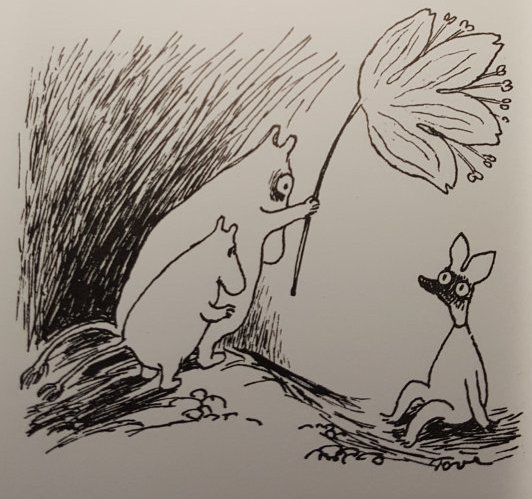
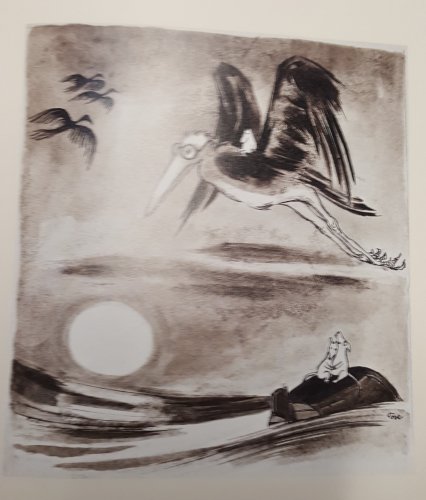
So why was this book missed out when the others took off, well the first thing you notice is that it doesn’t seem to be very consistent with the others, this is clearly Tove finding her way with the characters. Here the Moomins are absolutely tiny as can be seen in the picture above where Moominmamma and Moomintroll encounter Sniff for the first time, although he is never named in this book being referred to as ‘the little creature’ throughout. The flower that Moominmamma is holding is far bigger than she is, now it has to be said that nowhere in any of the other books is a size given for Moomins but I was really surprised to see this picture as in the later illustrations Moomins and the other characters are normally interacting with things that are to the same scale as themselves so I had never thought about how tall they are before. A later picture in this book shows Moomintroll riding on a stork looking for survivors of the flood
20181211 Moomin and the Great Flood 3

and this also shows him as very small. The other difference is the lack of recognisable characters, apart from Moominpappa who only makes an appearance at the end only Sniff, Moomintroll and Moominmamma and the Hattifatteners are ones we know, no Snork Maiden, Snufkin, Hemulen etc. all these wouldn’t appear until Comet in Moominland.

The back story given in this book that Moomins lived with House Trolls in peoples homes and would be behind the tall stoves that used to be so common in Scandinavia and they didn’t like central heating as there was no nice warm place to hide.

“Did the people know we were there?” asked Moomintroll

“Some did,” said his mother “They felt us mostly as a cold draught on the back of their necks sometimes – when they were alone”

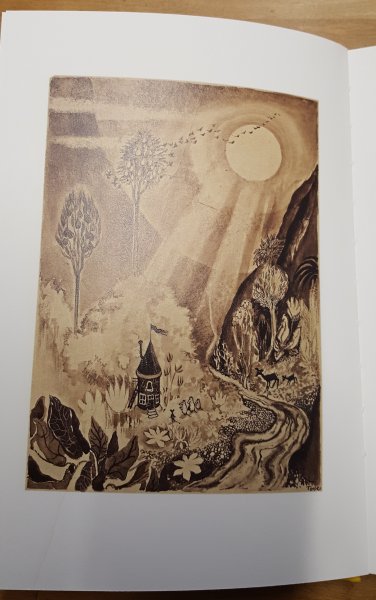
As far as I can remember this is the only time an interaction with humans is mentioned in any of the books. Ultimately after numerous adventures they find Moominpappa although he has lost the house that he built as it was washed away in the floods only to find it again in a different place that became Moominvalley. The house is shaped like an old stove as a memory of the way Moomins used to live and the next book continues the story from this point.
20181211 Moomin and the Great Flood 4

It’s a pity that although the book is now available in English as well as the original Swedish that there don’t appear to be other translations yet so the worldwide Moomin fans are still largely unaware of how the Moomins started, the full page pictures are beautiful and so unlike any of the books to come after this and deserve to be appreciated everywhere.
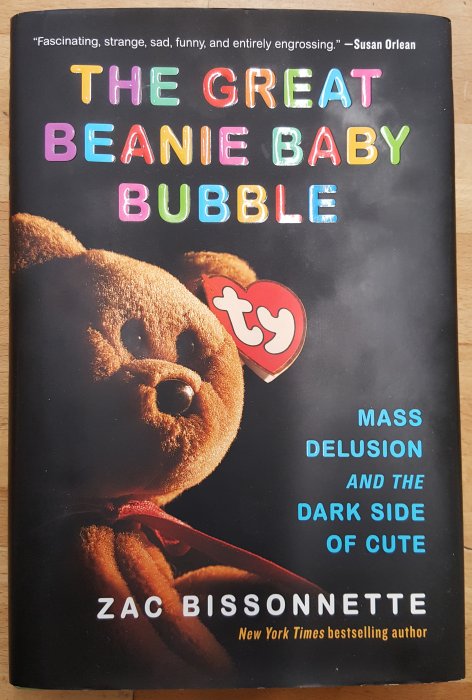
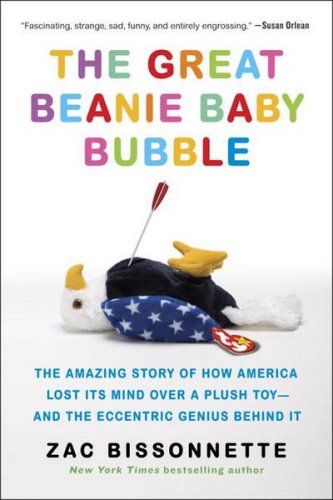
The Great Beanie Baby Bubble – Zac Bissonnette

20181106 Beanie Baby 1

The subtitle on the cover of this 2015 Penguin hardback first edition is no longer featured on the current paperback edition as can be seen below. The change of illustration to a bald eagle toy shot with an arrow is, if anything, more disturbing than the staring bear on the original cover.  I miss the line about mass delusion though as it really sums up the book in just eight words.

Although I now own one of the largest specialist teddy bear shops in the UK I first discovered the world of collectable bears right at the end of the Beanie craze and never started collecting them, as I was far more interested in the products of the Steiff company at the time. I do have a small number, but only of penguins, puffins and a pelican to sit on the shelves with the book series of the same names. This book therefore was an instant purchase when it came out, I knew some of the history but really wanted to know what and how it happened. How could a $5 toy sell for $10000 just a few short months after it was released? Talking to my staff members who had worked in the shop for many years before I took over and remembered the queues outside if word got round there was a delivery there was clearly something special, a self perpetuating dream that here was an investment for all as the initial outlay could be so small.

Bissonnette does a remarkable job in following the history from right at the beginning and tells the story of Ty Warner, a man who can genuinely be called a self made billionaire and who is still the sole owner of Ty Inc. and his rise from failed actor to a man worth in excess of $2.4 billion. Warner himself is notoriously difficult to approach and will not give interviews but Bissonnette has managed to talk to a wide range of people ranging from his estranged sister to ex-girlfriends along with people who worked at Ty Inc. and numerous significant collectors. What shines through is a ruthless perfectionist never happy with anything that he doesn’t personally totally approve. All the designs were by Ty and he would go through huge amounts of fabric, eyes, etc. to get the look he wanted. Checking the posture of a cuddly to get it sitting just right and rejecting anything that was not to his high standards. The reason why Beanie Babies took off initially was down to this attention to detail they really were very well made, especially for the price.

20181106 Beanie Baby 2

The problems began when collectors started to deal in a secondary market and convinced themselves that what they had was an ever appreciating asset. This has happened before, the most famous example being Tulip Mania in the Netherlands in the 1630’s. Individual bulbs would sell for more than the price of a house at the height of the bubble but the only thing holding them at that price was the bubble itself and when enough people realised this and stopped buying in March 1637 it suddenly collapsed. Much the same happened with Beanies, there was no real reason for the high prices, yes some were limited but there was still a lot of them around and Ty Inc. stoked the fever by creating artificial shortages to boost the price. Stock would be held back from one part of the world creating demand for what was seen as a rare item only for the blockage to be released and the market flooded. They did this several times and this contributed to the crash as people stopped believing in rarities so were not willing to pay the high prices.

A lot of people lost a significant amount of money, especially those who got caught up in the craze just before it all fell apart at the start of the year 2000, some people did make money from the early days and if they got out in time they did OK. The only person to make a lot of money was Ty Warner. He later would plead guilty to tax evasion and be fined $53 million but as he personally made over $1 billion from the business I doubt that bothered him particularly and as Bissonnette points out in the book the day after the judgement there were workmen painting the gates to his $150 million mansion gold.

This is a really good book, not just of interest to bear collectors but for anyone with an interest in boom and bust economics or just human psychology. The story of Ty Warner himself is fascinating and very well written in this account.

Hedda Gabler – Henrik Ibsen

The first thing you notice when you pick up Hedda Gabler is that there is no character of that name in the cast list. Gabler was her maiden name but at the start of the play she is just returning from honeymoon having married Jörgen Tesman so she is referred to in the cast as Hedda Tesman. As Ibsen himself wrote:

The title of the play is Hedda Gabler. My intention in giving it this name was to indicate that Hedda as a personality is to be regarded rather as her father’s daughter than her husband’s wife. It was not really my intention to deal in this play with so called problems. What I principally wanted to do was to depict human beings, human emotions and human destinies upon a groundwork of certain social conditions and principles of the present day.

(Excerpt from letter to Moritz Prozor, December 4, 1890)

20181127 Hedda Gabler 1

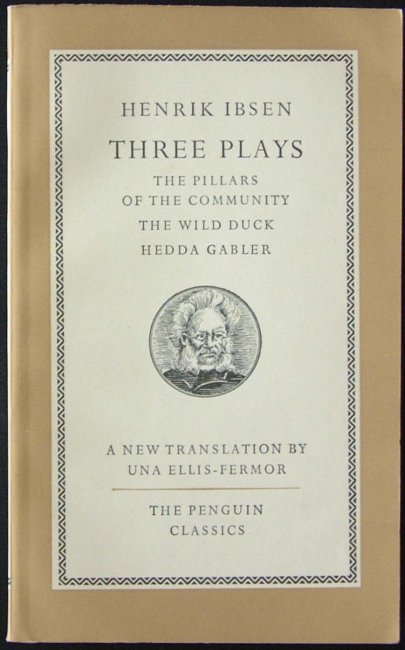
The edition I have read is the Penguin Classic translated by Una Ellis-Fermor printed in 1950, she also translated a further collection of Ibsen’s plays for Penguin in 1958 entitled The Master Builder and other plays. When Penguin came to reprint this 1950 book it was retitled Hedda Gabler and other plays to match the later edition. In both volumes Ellis-Fermor describes the translations as ‘readers versions’. By which she means that although the plays could be performed from her translation her intention was to produce works that a reader would find comfortable to read. One thing I have definitely discovered during this month of reading plays is that although when performed on the stage a play can be a wondrous thing and transport you to worlds of imagination; when you sit and read them they are somewhat less satisfying. They were never intended to be read as literature after all, however Ellis-Fermor has, whilst retaining the structure of a play, made it so it can easily be read as a novella (102 pages in this version).

The play is in four acts all of which take place in the Tesman’s new home which has been purchased and furnished whilst they were away on their six month honeymoon under the supervision of Jörgen’s aunt Juliane. She has even put some of her own money into the purchase when finances became tight. It is clear the Jörgen needs the professorship that is available in order to finance is new life as a married man especially as Hedda appears to have quite expensive tastes. For her part Hedda is already bored of the marriage, Jörgen appears to be more interested in his work and books than her and the ‘honeymoon’ was really an extended research trip. There is a funny passage of dialogue near the beginning of act one where Juliane has clearly planned the layout of the house with two empty rooms to be used as nurseries and children’s bedrooms and Jörgen really can’t understand and thinks they are for his library extension and no matter how she hints at Hedda being possibly pregnant Jörgen just doesn’t twig.

When Hedda does finally appear on stage she is deliberately rude to Juliane and makes it clear that she doesn’t like the way the place has been decorated, Juliane leaves and in her place Mrs Thea Elvsted arrives with news of Ejlert Lövborg, Jörgen’s presumed rival for the professorship especially as he has published a book whilst they have been away on honeymoon. It is at this point that the complex relationships between the characters start to be explained. Thea was in a brief relationship with Jörgen before he met Hedda and she had also been at school with Hedda where she had been bullied by her. Hedda, for reasons of her own makes out that they were school friends and gets Jörgen out of the way to talk about Ejlert who Thea had moved in with after leaving her husband. Thea tells Hedda that she is worried about Ejlert as he has gone back to his old ways (presumably drinking) and that he had been threatened by a previous partner with a gun and she thinks he may meet her again. Hedda reassures her that no woman would do such a thing but as Thea leaves she goes to a cabinet and pulls out her fathers pistols as the first act closes.

Act two begins with Hedda firing one of her guns towards Judge Brack as he comes to visit Jörgen who is out at the time, she is clearly not mentally stable but as the play continues her instability revolves around a desire to totally control somebody else and it seems she is set on it being Ejlert. Whilst waiting Brack makes it clear that he also desires a relationship with Hedda although she is not at all keen on the idea. Jörgen returns and is soon followed by Ejlert at his invitation, once they actually meet Ejlert explains that he doesn’t want the professorship as he has a new book he is working on. Whilst Jörgen and Brack are talking in another room Ejlert tries to renew his relationship with Hedda and she sees that he can be the one she can control. Thea arrives towards the end of the act and the two woman settle down for the evening after Hedda has persuaded Ejert to accompany Jörgen and Brack on their planned night out with him to return at 10pm to escort Thea home.

Act three is set the next morning, both ladies are in front of the now cooling fire, Ejlert obviously didn’t return to take Thea home but when Jörgen comes in he is carrying Ejlert’s manuscript of his new book and is very excited about how good it is. He had seen Ejlert drop it in the street and picked it up but hadn’t returned it as he was afraid he would lose it again. However Jörgen gets a message that his other aunt is dying so needs to leave urgently. Ejlert meanwhile is convinced he has destroyed the book and arrives to tell Thea who is horrified as she had worked tirelessly on the book with him and leaves almost immediately. Ejlert left with Hedda is even more under her spell than when they were a couple and she seeing this as her chance to prove that she can control somebody presses him to commit suicide and gives him one of her pistols before he leaves. Afterwards she burns the manuscript.

The final act is very short and takes place soon after the previous scene. It turns out that Ejlert had gone from the Tesman house to the home of another previous girlfriend and there had died from a gunshot wound to the chest, Hedda thinks he shot himself in the heart (a truly romantic gesture) but no Judge Brack explains to her that the gun appears to have gone off accidentally and that he recognised the pistol thus insuring his power over her. Thea also reveals that she has the original notes from their work together so Jörgen and her start work to reconstruct the lost masterpiece. Knowing that her plans have failed and instead she is the one controlled Hedda retires to the other room and shoots herself which is where the play ends.

Hedda through out the play is depicted as a materialistic, narcissistic character, thoroughly unlikeable but someone who has drawn the three men to her in their own way. Jörgen has a wife who will help him progress in Norwegian society. Brack sees someone he can control and therefore use as he wishes. Only Ejlert Lövborg really loves her but she doesn’t reciprocate this love and he is apparently blind to the love from Thea Elvsted which could have made them both so happy.

At the end of the play you hope that Thea and Jörgen can get together as a couple during their work in resurrecting the lost manuscript. Finding through their shared loss a rekindling of the love they had in the past. Surely something good can come out of the tragedies.

The Tempest – William Shakespeare

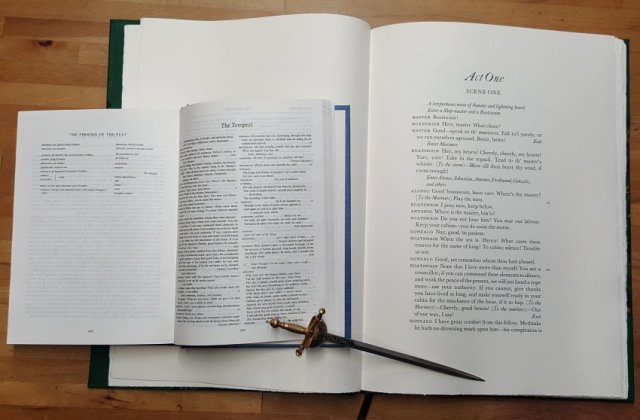
Continuing with my plan to read plays through November, I am now starting The Tempest. I have several copies of this play, partly due to the two complete sets of Shakespeare’s works I have, one of which I covered in an earlier essay, but I also have three copies of the play in individual volumes. One from the Oxford University Press, one by Penguin Books from 1937 and the copy that I have been reading which is the beautiful Folio Society letterpress edition from 2008.

20181120 The Tempest 1

This edition is bound in green goatskin leather, blocked in gold with hand-marbled paper sides and limited to 3750 numbered copies although not all of these appear to have been produced. The book is large (14˝ x 10¾˝ – 35½cm x 27cm) and the pages clear and easy to read. As the Folio Society themselves said about these volumes…

The starting point was the text. Rather than keep text and commentary together, we decided to put them into separate volumes. Out went the elements that clutter the page : footnotes and textual variants. All that was left was Shakespeare’s words.

We decided to have the text printed by letterpress in 16-point Baskerville. The type is set in hot metal and impressed on thick, mouldmade paper. The margins are generous – over 6 centimetres – to allow the words room to breathe.

The result is a simple, understated design that is a delight to read and a pleasure to hold.

Needless to say the books were expensive (£295 per play) but they did set out to produce the finest editions available and the ones I have are amongst the treasures of my library. A comparison between the Folio Society edition and my complete Oxford Shakespeare can be seen below and it’s obvious which is the better to read.

Enough about the book, as Shakespeare himself wrote in Hamlet “The play’s the thing” and this was the last play written by Shakespeare so I’m looking forward to reading it.

The play opens with a short scene set on a ship that is caught up in the eponymous tempest and looks as though it will probably sink. On board is Alonso the King of Naples and several courtiers including Antonio the Duke of Milan, the noblemen are however getting in the way of the seamen trying to save the vessel and frankly are just a nuisance. The rest of act one takes place on the island home of Prospero and his daughter Miranda, during which we find out that Prospero is the true Duke of Milan who was usurped by his brother Antonio with the help of King Alonso.

Prospero has somehow gained magical powers during his exile on the island and with the aid of the sprite Ariel he caused the foundering of the ship but also ensured that all aboard survived. The other occupant of the island is Caliban, the son of the witch Sycorax who is enslaved to Prospero and is described as half man, half beast. Ariel is also in servitude to Prospero but this is because he rescued him from a spell by Sysorax and Prospero has promised that when he regains dukedom so Ariel will be free to go on his way. Towards the end of the first act Ferdinand (King Alonso’s son) finds Prospero and Miranda and immediately falls in love with her, which is clearly Prospero’s plan to try to regain his dukedom.

Act two moves away from Prospero to follow up the other characters in two separate scenes. In the first one the other noblemen including King Alonso assume that they are the only survivors of the wreck although Gonzalo in particular is perplexed by the condition of their clothing which suggests that this was no ordinary maritime disaster.

…Our garments being, as they were drenched in the sea, not withstanding their freshness and gloss, being rather new-dyed than stained with salt water…

…Methinks our garments are now as fresh as when we put them on in Afric, at the marriage of the King’s fair daughter…

Ariel joins the group although he is invisible to them and by means of music causes some to fall asleep leaving Sebastian (Alonso’s brother) and Antonio. Antonio suggests to Sebastian that with Ferdinand dead the only thing stopping him doing what he did to Prospero and taking the kingdom of Naples for himself is Alonso himself who is conveniently asleep at his feet. Sebastian has drawn his sword to kill Alonso when Ariel reverses the charm and the others awake. Sebastian explains the drawn sword by saying he had heard noises and was preparing to defend the king.

The second scene takes us to the last remaining significant characters in the play Trinculo the court jester and Stephano the drunk butler who has managed to salvage a barrel of wine and is happily working his way through it. These two also believe themselves the only survivors and stumble across Caliban who sees them as a means of escaping his slavery by getting them to kill Prospero. His clownish attempts to get them to help him and the drunken antics of the other two are quite funny.

Act three keeps the three groups apart and sees us catching up with them in turn in separate scenes. All three scenes are quite short and we bounce from Ferdinand and Miranda who are now getting on very well and are talking of marriage. Then to Trinculo and Stephano who are convinced by Caliban to attack Prospero but are also now quite drunk and have also introduced Caliban to wine so this plot is clearly going nowhere. Finally the king and his party meet up with Ariel and with Prospero watching and commenting although invisible to the party he can see that his plans are working.

20181120 The Tempest 2

Both of the final acts are short single scene performances and act four sees things moving forward quickly. Prospero agrees to the marriage of Ferdinand and Miranda as they continue to express their love for each other and when they have left the stage he works with Ariel to ensure that the plot hatched by Caliban to get the two drunks to kill him will fail although by now none of the them are in a fit state to do anything sensible.

Finally the fifth act brings everyone together at last, Prospero draws a magic circle on the stage and lures the noblemen into it where he reveals who he really is but decides to forgive rather than punish them. He also reveals that the ship didn’t sink, instead it has been anchored off another part of the island with the crew charmed asleep, these are woken by Ariel and prepare for sailing as soon as possible. It isn’t clear what happens to Caliban, he presumably remains alone on the island but everyone else returns to Naples with Prospero renouncing his magic as he regains his dukedom.

The Tempest is grouped with the Comedies within Shakespeare’s canon however there is nothing particularly comedic about it, it is probably there because it certainly isn’t a History or Tragedy which are the only two other options. The light relief is provided by Trinculo and Stephano during their interaction with Caliban but this, as explained above, is largely self contained within scene two of acts two and three. I’m not a big fan of Shakespeare’s later mystical plays but this made for a pleasant evenings read and I’m surprised that I haven’t got round to reading it before. As usual for a Shakespeare play there are several quotes that have enriched the English language and gone on to be used even by those who don’t know where they were first created:-

Hell is empty. And all the devils are here.

Misery acquaints a man with strange bedfellows.

We are such stuff as dreams are made on

O brave new world

and the probable winner for the worst chat up line of all time is given to Ferdinand

Hast thou not dropped from heaven?

Note: The kingdom of Naples and the duchy of Milan sound odd to us now as Naples in particular appears far too small to be a kingdom, but in Shakespeare’s time both these houses existed. The kingdom lasted from 1282 to 1816 although from 1501 it was effectively a title only as control of Naples passed between France, Spain and Austria depending on which monarchy was in the ascendant at the time. As for the duchy of Milan that lasted from 1395 to 1814 although over the last century of this it was absorbed into the Austrian Hapsburg empire.

Uncle Vania – Anton Chehov

Or is it Uncle Vanya by Anton Chekhov, that appears to be the more usual spelling at least currently but I have spelt it the way I have in the title to this essay as that is how the Penguin Classics edition of 1959 which I have been reading has it so I will stick with it throughout.

20181113 Uncle Vania 1

The first thing that strikes you reading the play is that for the first two acts Ivan Petrovich Voinitsky, whom his niece Sonia calls Uncle Vania, is largely an ensemble character and it is only in acts three and four that he comes to the front. The first act sets the dynamic tensions between the protagonists. There had clearly been a quiet routine in the house for many years with Sonia and Vania running the estate which had been her mothers dowry when she married professor Serebriakov. Sonia’s mother died some years ago and the professor has now retired to the estate from his home in the city and brought with him his second wife Yeliena who is just 27 years old, between them they have seriously upset the normal running of the household. To make things more complicated Astrov, the doctor who looks after the professor’s gout is attracted to Yeliena as is Vania, whilst Sonia is in love with Astrov. You just know it’s going to get messy and Vania is gloomy about the future as only a Russian can be…

Yeliena – What a lovely day … not too hot either

Voinitsky/Vania  – It would even be pleasant to hang oneself on a day like this…

There are four other characters in the play, all of which play minor roles so beyond the list below I won’t cover their actions.

  • Maryia Voinitskaia is Sonia’s grandmother/ Vania’s mother
  • Ilyia Ilyich Telyeghin was a local landowner but has lost all his money and now lives on the estate.
  • Marina an old children’s nurse
  • A workman – just needed to fill in such as fetching horses etc. when the main characters wouldn’t do such things.

Act two sees the complicated relationships become more strained. The doctor has been summoned but the professor won’t let him see him this means that he is yet again at the house and wants to spend time with Yeliena to convince her to leave the professor. Vania muses to himself that he missed his chance with Yeliena ten years ago

Voinitsky – [Alone] She’s gone! ten years ago I used to meet her at my sister’s house. She was seventeen then and I was thirty-seven. Why didn’t I fall in love with her then and ask her to marry me? It could have been done so easily! She would have been my wife now.

The professor meanwhile is in pain with the gout and frustrated with his existence at the estate where he feels he is wasting his time and doesn’t get on with anyone there.

Serebriakov – After devoting all my life to learning, after growing used to my study, to my lecture room, to esteemed colleagues – to find myself suddenly, for no reason at all in this crypt, to have to meet stupid people every day, to have to listen to their trivial conversation. I want to live; I love success, I like being a well known figure, I like creating a stir of the world, but here I feel an exile. To spend every minute regretting the past, watching others succeed, fearing death. I can’t! It’s more than I can bear.

Meanwhile Yeliena decides to at least try to make up with Sonia and during their talk admits that although she loved the professor when they married she soon realised her mistake but will remain true to him come what may. At the same time Sonia confesses her love for the doctor and asks Sonia to see if she can find out if he loves her.

Things come to a head in act three, Yeliena talks to the doctor about Sonia and he says he doesn’t love her but interprets the conversation as Yeliena using that as an excuse to talk to  him about love. he makes a clumsy pass at her during which he kisses her as she is pushing him away and this is seen by Vania who is just coming into the room at that point. Straight after this before anyone can settle the professor calls everyone together to say that he has decided to sell the estate and buy a villa in Finland for himself and Yeliena. At this Vania explodes with fury, the estate doesn’t belong to the professor but to Sonia and he has given no thought as to where the people who have always lived there might go and it is his family that should decide what to do with the estate as they paid for it

Voinitsky – The estate was originally bought for ninety-five thousand roubles. My father only paid seventy thousand and twenty-five thousand remained on mortgage. Now please do listen! This estate would never have been bought if I hadn’t given up my share of the inheritance in favour of my sister, whom I loved deeply. What’s more, I worked like an ox for ten years, and paid off the whole mortgage.

Serebriakov – I regret that I started this conversation.

Voinitsky – The estate is free from debt and in good condition simply because of my own efforts, and now that I’ve grown old, I’m to be kicked out!

Serebriakov – I don’t understand what you are driving at!

Voinitsky – For twenty-five years I’ve been managing this estate, I’ve been working and sending you money like the most conscientious bailiff you could have, and all this time you’ve never once thanked me for it. All this time – when I was young and now just the same –  I’ve been getting a salary of five hundred roubles a year from you, a pittance! and never once have you thought of adding a single rouble to it!

Serebriakov – Ivan Petrovich, how was I to know? I am not a practical man and I don’t understand anything about these matters. You could have added as much as you liked.

Voinitsky – Yes indeed, why didn’t I steal? Why don’t you all laugh at me now because I didn’t steal. It would have been fair enough and I shouldn’t now have been a pauper now!

The professor leaves the room shortly after this, soon followed by Vania and a shot is heard off stage then both men run into the room and Vania fires again, both shots miss, Vania drops the pistol and collapses into a chair as the act ends.

To be honest act four which is set the next day feels like a bit of a let down after the excitement of act three. It has been decided that the professor and Yeliena will leave straight away. With them going the doctor has no reason to still be there and he also leaves. Vania and Sonia sit down to work on the books of the estate which have been neglected whilst the professor has been there and all returns to how it was before.

I’ve seen the play performed, although that was many years ago, and thoroughly enjoyed it but this was the first time I had read the script. The book contains eight plays in all so I will be reading those later.

The Frogs – Aristophanes

20181106 The Frogs

For November I’ve decided to read a selection of plays and the first one is The Frogs by Aristophanes. Normally I’m not a great fan of Ancient Greek dramas as you need a lot of knowledge of the gods and other characters involved but this translation is so readable I found myself laughing along as I read it. It was written in 405 BC and can be dated so precisely because it was created for drama competition as part of a festival honouring the god Dionysus in Athens where it took first place. Dionysus is one of the Greek gods with lots of jobs, according to the Wikipedia entry he is the god of the grape-harvest, wine making and wine, fertility, ritual madness, religious ecstasy, and theatre and it is in the latter one of these roles that a drama competition in his name becomes obvious.

The play tells the story of Dionysus deciding to travel to the underworld to bring back the playwright Euripedes who had died the previous year in order to rescue the arts in Athens back from the doldrums that he perceives it to be in. The first act sees Dionysus and his slave Xanthias on their journey, initially they visit Dionysus’s half brother Heracles for advice which causes him to collapse with laughter as Dionysus has decided to dress like Heracles with the lion head cloak and club but he really doesn’t have the build to carry off the look. Eventually they persuade Heracles to explain the route he used when he went to get the three headed dog Cerebus and they duly set off. When they meet Charon, the ferryman of the dead he agrees to take Dionysus and this is when he encounters the frog chorus who sing during the crossing. Despite the play being called The Frogs this is the only time they appear in it. After various encounters with people who think Dionysus is Heracles and either hate him for taking Cerebus or love him for it they finally reach the home of Pluto ruler of the Hades.

Act two takes place entirely at the Pluto’s house where they find Euripedes and also another dramatist Aeschylus who had died about 50 years earlier. These two had been arguing for the last year about which was the better writer and should therefore sit with Pluto for meals. Dionysus takes it onto himself to judge a contest between them and they take it in turns to be rude about the others works with the chorus commenting as though it was a fight with each man landing viscous blows on the other. This gives Aristophenes a chance to parody each of the two dramatists styles and throw in his own critical comments on both of them. Eventually Pluto gets fed up and decides to determine the winner via a special set of scales which can measure the weight of an argument. Each man gets to speak one line into the baskets on the scale and they are marked against one another with the scale, to Euripedes’s annoyance Aeschylus wins both attempts by mentioning heavier objects. In the end Dionysus decides to simply ask the two dramatists for advice to save Athens, Euripedes has lots of fine words but Aeschylus has more practical suggestions so instead of having Euripedes brought back to life he decides on Aeschylus. A final parting shot from Aeschylus is to insist that Sophocles should have the seat as the finest dramatist rather than Euripedes.

Translations of ancient Greek and Latin have become far ‘less stuffy’ over the last few decades and this can largely be thanks to Penguin Books who started their series of Penguin Classics in 1946 with the express intent of making the classics more approachable. Compare this extract from the Harvard Classics edition of 1909 which is available on Project Gutenberg, which deals with the god Dionysus rowing across the Styx with Charon and encountering the Frog chorus.  The specific translator is not given for this edition on the site as this was a massive group exercise resulting in 51 volumes of a wide selection of classic works.

FROG CHORUS
   Brekekekex, ko-ax, ko-ax!
   Brekekekex, ko-ax, ko-ax!
   We children of the fountain and the lake
   Let us wake
   Our full choir-shout, as the flutes are ringing out,
   Our symphony of clear-voiced song.
   The song we used to love in the Marshland up above,
   In praise of Dionysus to produce,
   Of Nysaean Dionysus, son of Zeus,
   When the revel-tipsy throng, all crapulous and gay,
   To our precinct reeled along on the holy
   Pitcher day.
   Brekekekex, ko-ax, ko-ax.

 DIONYSUS. O, dear! O dear! now I declare I've got a bump upon my rump.

The same passage from the 1964 translation by David Barrett printed by Penguin and reprinted in the edition I have been reading.

FROGS
   Brekeke-kex, ko-ax, ko-ax,
   Ko-ax, ko-ax, ko-ax!
   Oh we are the musical Frogs!
   We live in the marshes and bogs!
   Sweet, sweet is the hymn,
   That we sing as we swim,
   And our voices are known.
   For their beautiful tone,
   when on festival days
   We sing to the praise
   Of the genial god -
   And we don't think it odd
   When the worshipping throng,
   To the sound of our song,
   Rolls home through the marshes and bogs.
   Brekekex!
   Rolls home through the marshes and bogs.

 DIONYSUS. I don't want to row any more.

 FROGS. Brekekex!

 DIONYSUS. For my bottom is getting so sore.

As you can see the Penguin edition is considerable more ‘lively’ and the translator has almost turned to the poetic structure of the limerick in order to emphasise the comic nature of the play. This is a form that he will return to several times during the translation in some places using the limerick itself. The play is only 110 short pages so I read it in two sittings, the edition is from the Little Black Classics series by Penguin and is one of the most expensive of these books at £2. I’m looking forward to reading more from this series of titles in the coming months.


Homage to Catalonia – George Orwell

This wasn’t the book I intended to read this week, but my friend and fellow book blogger Mixa in Barcelona (read her review here) saw a copy on my shelves and has tracked down a copy in Catalan so I thought it was probably about time to reread the book after a gap of about twenty years so that it would be fresh in my mind when she wants to talk about it. Nowadays Orwell (real name Eric Blair) is almost entirely known as a novelist and his journalism is largely and sadly neglected. Homage to Catalonia even started out being neglected. It was first printed on 23rd April 1938 and a year later by the start of WWII it had only sold around 900 copies and soon after went out of print. It would only be available sporadically until Penguin Books printed a copy in March 1962, since then it has never been out of print.

20181030 Homage to Catalonia 1

The book tells of Orwell’s experiences fighting in the Spanish Civil War as part of an international militia against the uprising of General Franco and he is very clear that this is the war as he saw it and for the most part it is a very readable account. There are two chapters where he attempts to make sense of the alphabet soup of political organisations and militias taking part and these are prefaced by clear warnings that it is about to get complicated, as shown in the below extract from paragraph two of chapter five…

At the beginning I had ignored the political side of the war, and it was only about this time that it began to force itself upon my attention. If you are not interested in the horrors of party politics. please skip; I am trying to keep the political parts of this narrative in separate chapters for precisely that purpose. But at the same time it would be quite impossible to write about the Spanish war from a purely military angle. It was above all things a political war.

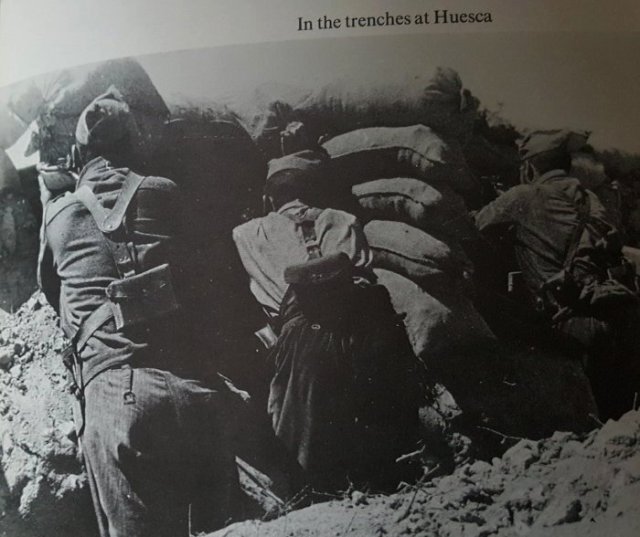
What follows is a section I’m glad I read because I had to keep referring back to it to sort out in my mind the differences and indeed the similarities between PSUC, POUM, FAI, CNT, UGT, JCI, JSU and AIT all of which were political parties or trade unions or possibly both, it does get very confusing, especially as in theory they were all aligned against the Fascists of Franco but seemed to spend most of the time fighting and bickering amongst themselves. This was particularly true during the short lived Barcelona uprising that Orwell got caught up in by happening to be on leave from the front after 115 days and arrived back in the city just before it all got even more complicated. But I am getting ahead of myself lets get back to chapter one with Orwell arriving in Barcelona with his wife, intending to write about the war but actually enlisting as a member of the POUM militia within days of getting there.  His wife Eileen stayed in the Hotel Continental in Barcelona throughout their time in Spain whilst Orwell was fighting on a front line less than 170 miles away. The photo below is by Robert Capa and is part of the John Hillelson Agency collection and shows the sort of trenches Orwell would be in.

20181030 Homage to Catalonia 3

Initially Orwell writes of his surprise on arriving in Barcelona in December 1936 that unions and workers parties had taken over the city and everywhere he saw the red and black flag of the Anarchists who were in control. This appealed to the socialist principles that Orwell espoused and it was probably this that led him to opt to fight for them rather than simply report on the situation. Unfortunately for him later he chose the wrong set of initials to join up with, but as he had said above the internecine politics hadn’t registered with him at first and he effectively just joined the first group that would have him. The first chapter covers the ‘training’ or rather lack of it he received in the Lenin barracks the poor conditions and the largely useless equipment they were issued with, chapter two has him on his way to being posted to the front where he was finally issued with an ancient rifle.

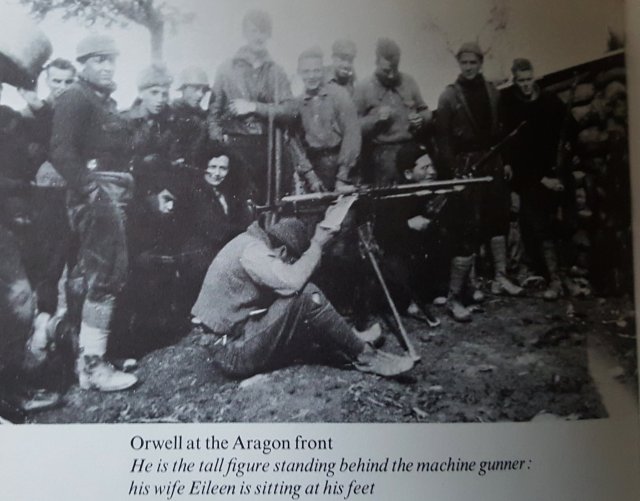
Chapters three and four tell of his time in the trenches above Zaragoza on the Aragon front, a place where the 6 foot 3 inch Orwell was clearly unsuited being head and shoulders taller than his fellow militiamen as can be seen in the photo below from the University College, London collection and reproduced opposite page 65 of my edition.

20181030 Homage to Catalonia 2

The time there was largely one of freezing temperatures, squalor and boredom, the two front lines were so far apart on opposite mountain tops that only by the merest chance could anyone be hit by firing from the opposition. What wounds and deaths did occur were mainly accidents of the sort you get when you hand unreliable weapons to 15 year old boys without showing them how to use them. The real oddity in the photo above though is that Eileen is there so she must have made a trip up from Barcelona although Orwell doesn’t mention her doing so in the book.

After the first of the political chapters, chapter six has him still bored at the front line

Meanwhile nothing happened, nothing ever happened. The English had got into the habit of saying that this wasn’t a war, it was a bloody pantomime.

and reflecting on the effect that the war was having on the local population who were largely trying to live their lives as best they could. In chapter seven Orwell finally sees some action, it was decided to crawl at night across the hundreds of yards of no man’s land and attack the fascist line. It did not go well and although they did get into the enemy trenches they were told to retreat before morning and that would be the only time he faced the enemy in actual combat. Chapter eight is very short and is largely concerned with preparations to go on leave back to Barcelona.

Chapters nine, ten and eleven all concern his badly timed break back in the city. On his return he discovered that the workers revolution had largely petered out and life had returned to a sort of normality with the war something happening in the distance.  However this was not to last long, the tensions between the various groups was about to explode onto the streets and on the 3rd of May fighting began, initially at the telephone exchange but rapidly spreading through the main thoroughfares.  Orwell is caught up in the middle of this but it rapidly becomes as much of a stalemate as the ‘fighting’ on the front. The various factions take up strategic positions and sort of agree amongst themselves to not shoot each other. These chapters for me are the most interesting of the book, the endless boredom of the front is at least improved here by not only the considerably more action but also the shortness of the time scale before it all came to an end.

Chapter twelve sees Orwell return to the front but this was to be for a very short time as he was soon wounded by a shot through the neck which saw him invalided out. By this time he was increasingly disillusioned by the war, what he had seen in Barcelona had convinced him that this was not the great and noble calling that he once thought it was and his choice of POUM was about to become a major problem. Whilst in hospital and then trying to get his discharge papers signed off POUM were picked on as the scapegoat for the fighting in Barcelona and all members were to be arrested and probably shot as traitors. As he describes it this was definitely untrue but it was a convenient fabrication to allow the other factions to re-unite behind. So as well as being wounded he was now a wanted man. In the last two chapters he and Eileen manage to escape Spain and he reflects on his experiences. His conclusions went strongly against the narrative being pushed in the socialist press in the UK which he also heavily criticised and this meant that getting the book published proved difficult as his normal publisher wouldn’t take it.

The book is a fascinating study of the realities of war, the long periods of tedium enlivened by occasional periods of firing from the trenches in the beginning of the book through the difficulties of conflict within a city and is also surprisingly funny in places as he enlivens the tale. All in all it deserves to be better known. When most people think of Orwell what usually comes to mind is 1984 or Animal Farm, try his reportage, it is definitely worth seeking out.

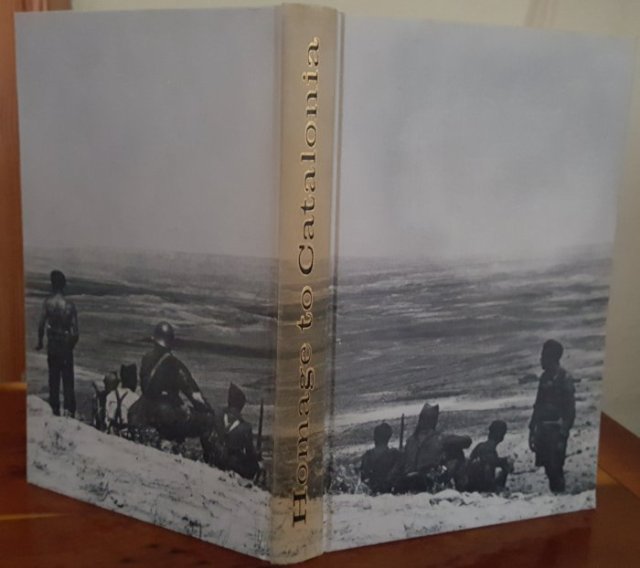
My copy is the 1970 Folio Society first edition which was popular enough to have two further reprints in 1972 and 1975 before dropping out of the Folio catalogue until 1998. It then re-appeared as part of a five volume set of Orwell’s reportage along with “Down and Out in Paris and London”, “The Road to Wigan Pier” and two volumes of journalism and essays. This set has as yet not been reprinted. Although bought second-hand and with a badly sunned spine and grubby covers that don’t want to clean, what I like about this edition is the inclusion of contemporary photographs of Orwell and other people mentioned in the book on the front line. Regrettably not any by Orwell himself because as he explains in the book his camera and photographs were all stolen or impounded along with his notes and press clippings at various different times whilst he was involved in the war. I have reproduced a couple of the photos from the book above. The cover illustration is a view of the battlefield near Belchite on the Aragon front and is from the Fox Photos Ltd collection.

The Oxford English Dictionary

The complete OED is ninety years old this year so it a good opportunity to look both at my copy but also the history as to how this massive work came to be produced. Unlike almost all other dictionaries the complete OED is organised on historical principles, that is; it not only tells you the current meaning of a word, but also previous meanings over 1,000 years of English usage illustrated by quotations. This means that the over six hundred thousand words now in the dictionary are complemented by in excess of three million quotations.

20181023 OED 4

Although the first edition of the work was finally completed in 1928, work on it started much earlier and the decision to embark on the project actually goes back over seventy years before then to a meeting of the Philological Society of London in 1857. However nothing really happened after that, despite their resolution that existing English dictionaries were incomplete and not suitable for purpose. At the time the finest dictionary available for English had just passed its one hundredth birthday so it wasn’t unreasonable to see that A Dictionary of the English Language by Samuel Johnson was looking somewhat dated. That astonishing work by one man over seven years still ranks as one of the greatest single acts of scholarship and would remain the ultimate guide to the language for 173 years until the OED was completed by its large team of some two thousand compilers. Johnson himself defined dictionary compilers as follows:

Lexicographer: a writer of dictionaries; a harmless drudge that busies himself in tracing the original and detailing the signification of words

Actual work on the first edition of the OED didn’t start until 1879 when an arrangement had been reached with the Oxford University Press to publish and James Murray appointed as editor. The plan was to produce a four volume dictionary of some 6,400 pages and have it complete in ten years, this was to prove hopelessly optimistic. The dictionary was being written in alphabetical order so that the sections could be produced as they went along rather than waiting for completion but after five years the team had reached “Ant”, this was much more difficult than they had thought. In fact the first part of the dictionary did not see light of day until 1884 and ultimately by 1928, almost fifty years after starting, there would be 128 parts which were bound into ten volumes comprising 15,490 pages and over a quarter of a million entries. Unfortunately Murray died in 1915 so never saw his life’s work as a complete edition. The set was also very expensive, the cheapest binding cost 50 guineas (over £3,150 in today’s money) so it was definitely intended for institutions rather than members of the public.

20181023 OED 2

Completing the first edition was just the start, languages never stop evolving, especially English which is continually adding new words and meanings from across the world so the two remaining editors W.A. Craigie and C.T. Onions almost immediately started work on revisions for a second edition and also a supplement to keep the work up to date. By 1933 this supplement was produced and the original dictionary reset and reprinted in twelve volumes and there things stayed as far as printed editions were concerned until 1957 when it was decided to revise and expand the supplement. This became a four volume work in its own right, coming out between 1972 and 1986, but by then it had been decided to produce a second edition. This would merge not only the first edition with the supplements but include all the extra entries that had been compiled as the supplements were being published but which had missed their appropriate volume and whilst they were at it convert it to an electronic form for ease of future amendment.

20181023 OED 3

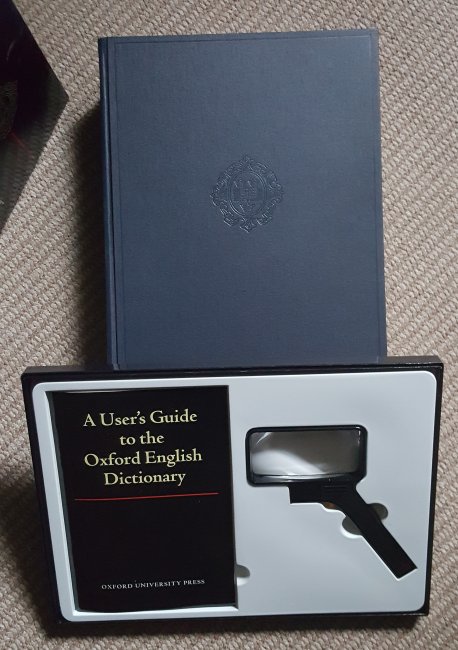
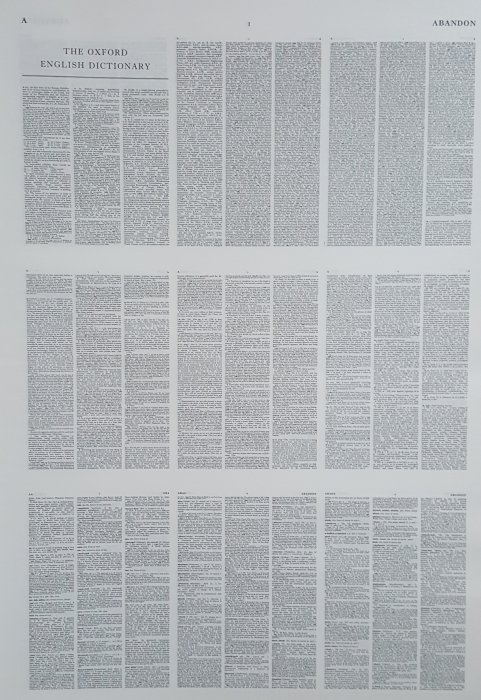
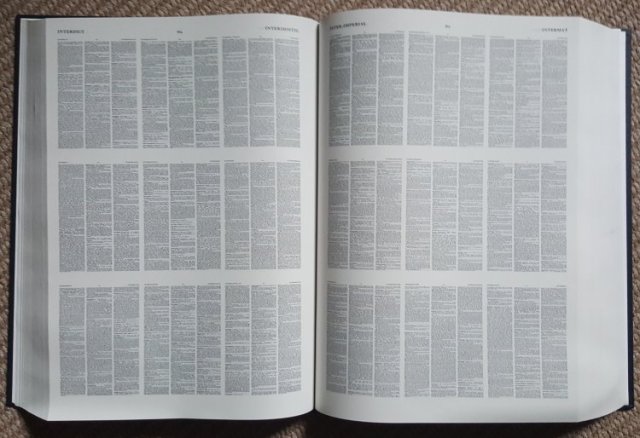
The second edition came out in 1989 and had grown to twenty volumes consisting of 21,730 pages with 291,500 entries and it is the ‘compact’ version of this edition that has illustrated this blog. This version, which I have had since it came out, reproduces all 21,730 pages as photo-reductions, nine to a page and is printed on very thin paper which allows for the 2,386 pages to be bound in one huge volume. It comes with a guide to using the dictionary, which also includes a very useful (at least for this essay) history of the publication and an absolutely essential magnifying glass with built in light so that you can actually read the text. Three volumes of ‘Additions’ came out in the 1990’s however not in ‘compact’ form, but in 2000 it was decided to abandon further updated print editions in favour of electronic updates and to move the dictionary online. The full twenty volume dictionary is still available in print for £845 or you can get the compact edition that I own for £400

20181023 OED 5

Although the third edition, should it ever achieve completion, will almost certainly never be sold as a printed edition as it is far more practical in the form it has now taken, the editors have already produced a preface which includes the following recognition that a lexicographers work is never done:

There are a number of myths about the Oxford English Dictionary, one of the most prevalent of which is that it includes every word, and every meaning of every word, which has ever formed part of the English language. Such an objective could never be fully achieved. The present revision gives the editors the opportunity to add many terms which have been overlooked in the past, but it should be understood that fully comprehensive coverage of all elements of the language is a chimera. That said, the content of the Dictionary is certainly comprehensive within reasonable bounds.

The second edition really was just the first edition with more entries (existing entries were not amended) however the work now being done on the third edition is going back and updating those early definitions, some of which haven’t changed since the 1880’s when the first part was published. This will bring the dictionary fully up to date and also deal with the difference in style for the first entries in the part of the alphabet to make everything consistent. Subscriptions to the online OED are normally £215 a year however for the 90th birthday celebration this has been cut to £90 for any subscription taken out before 31st March 2019.

20181023 OED 6

One of the fun things that can be done with new edition is free and I recommend signing up to the word of the day.  As I type this post it has come up with:

20181023 OED 1

and I think that sums up the joy of the OED, yes for anyone interested in the English language everything really is oojah-cum-spiff.

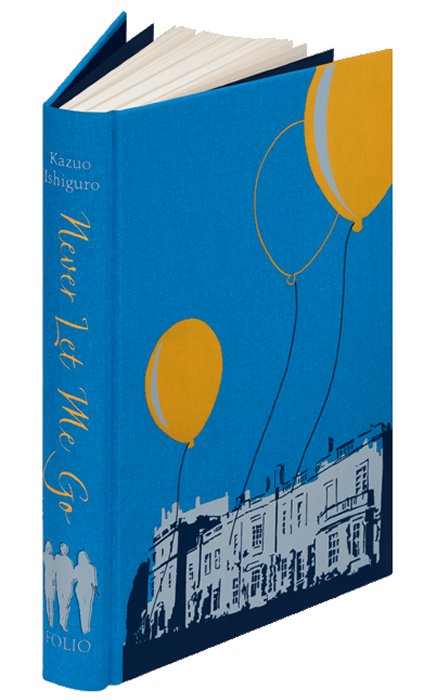
Never Let Me Go – Kazou Ishiguro

20181016 Never Let Me Go 1

Kazou Ishiguro was born in Japan but moved with his family to England when he was just five years old, as a result most of his novels and short stories are set in England and usually in the past. This allows him to reflect on his adopted homeland from the perspective of a outsider who is also an insider; his parents never expected to stay so long in England so he grew up in a Japanese speaking household even whilst attending English schools and colleges. The Remains of the Day which takes place in a English country house in the 1940’s is probably his best known work and this book is set in the 1980’s and 1990’s so initially it felt like familiar territory. Before starting to read Never Let Me Go I knew nothing about it and made a point (as I usually do) of not reading the introduction to this Folio Society edition so I was coming to the novel with no preconceptions.

20181016 Never Let Me Go 2

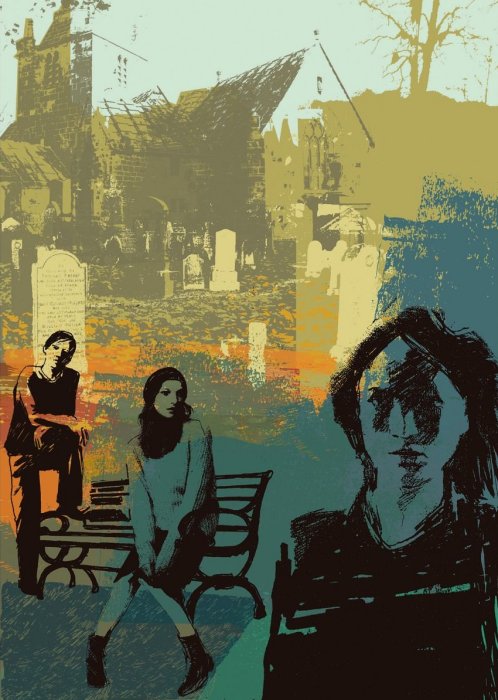
The stark illustrations by Kate Miller set the tone of the book straight away. I now know that this is Tommy and Kathy outside the sports pavilion at Hailsham school in a scene from the first chapter, later on we would be introduced to the other main character, Ruth. The novel is in three parts; the first, and longest section, is set at the school and initially it reads like any novel at a boarding school or it least it would do if it wasn’t for the haunting opening lines of the novel that hint at something that really isn’t right but clearly central to the work.

My name is Kathy H. I’m thirty-one years old, and I’ve been a carer now for over eleven years. That sounds long enough, I know, but actually they want me to go on for another eight months, until the end of this year. That’ll make it almost exactly twelve years.

The second section is set at ‘the Cottages’ an old farm where a group of the students get sent after leaving Hailsham and then the final section deals with Kathy’s time as a carer. The book is written in the first person as Kathy and we follow her reminiscences through her school-days and afterwards, all the way up until we get back to this opening line.  But just what is the role of a carer? Well it will take half the novel before that truly becomes clear and it turns out that I accidentally bought three dystopian novels as part of a block purchase from the Folio Society when I though I only had two. (The Drowned World by J G Ballard, covered last month and The Last Man by Mary Shelley which will be the subject of a later blog).

I’m so glad that I hadn’t read the introduction to this edition before reading the book as it completely gives the plot away and even discusses the highly significant scene near the end of the novel. This unfortunately is a major failing of the Folio Society, their books are lovely but the introductions should really be postscripts.  This review won’t go into too much detail about the plot simply because I want any reader to come at the novel fresh as I did and discover slowly through the hints that get more specific as the book progresses just exactly what is going on and if you haven’t read the book I really do recommend it and you don’t need to get the Folio edition, it is readily available in paperback.

The school sounds like a typical English Public School (that is private for the rest of the world), although gradually you realise that year eight are actually only eight years old, so is it some sort of orphanage? Ishiguro’s master stroke in the novel is just how slowly he lets the reader into the reality of the situation, even the students don’t know what the place is really about but there are dark hints. A bit later on it becomes clear that they cannot leave the site and have virtually no contact with the outside world other than the mysterious Madame who visits occasionally and takes away their best artworks; all very odd.

20181016 Never Let Me Go 3

The picture above is from a scene at the Cottages, Tommy and Ruth are now a couple, with Kathy feeling like an outsider and it is by now obvious most of what is going on although why is still a significant question and this wouldn’t be fully answered until the penultimate chapter. My theory at this point was largely correct but I had anticipated the final twist as to why they are there however without doing exactly what I criticised Claire Messud for in her introduction and giving away too much this is about as far through the plot that I can go.

Kazuo Ishiguro won the Nobel prize for literature in 2017 with a citation  “who, in novels of great emotional force, has uncovered the abyss beneath our illusory sense of connection with the world.” and this book certainly fits that description.

The Girl’s Own Paper

20181009 Girls Own Paper 01

Last week I wrote about The Boy’s Own Paper with it’s mix of tales about adventurers, swimming The Channel with Captain Webb, foreign countries and peoples, sport and other outdoors pursuits. All in all an exciting read for Victorian boys.  Well a year after it started the same publisher came up with The Girl’s Own Paper and the content was very different, reflecting the still held view that girls were effectively in training to be home-makers and certainly didn’t need, or want, tales of adventure. I don’t have as many copies of The Girl’s Own Paper but I can do the same as I did last week and look through the first ever issue from January 3rd 1880.

20181009 Girls Own Paper 02

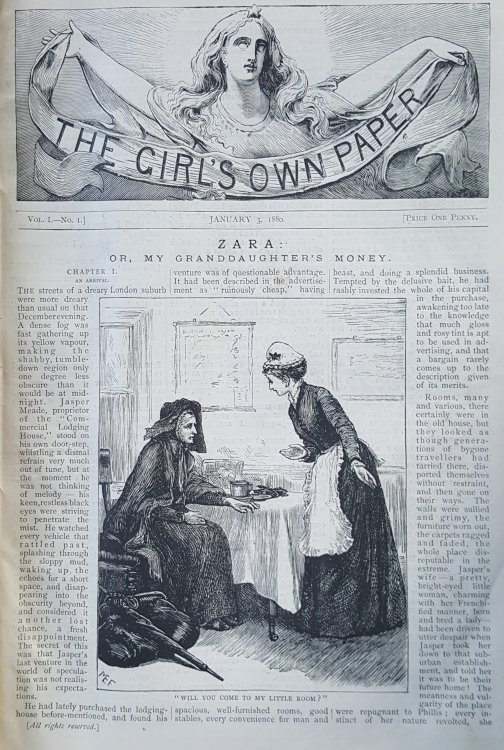
The front cover looks similar to the boy’s version only the masthead is somewhat less interesting, The drawing is based on the relief sculpture “The Spirit of Love and Truth” by Joseph Edwards and as such is entirely in tune with the Victorian attitude to girls. The story on the front is a long running part work, you can follow Zara for months as the magazine comes out each week. This is presumably because the serialised stories proved so popular in the boy’s version, this contrasts with the one off tale that appeared in their first edition but this was soon changed to serials in future examples. This opening section of the tale is a full four pages long.

Instead of tales of daring do with the dashing Captain Webb girls have the life of the young Princess Victoria which is altogether more refined and ladylike and also runs to almost three full pages. It is clearly intended to be an example of moral rectitude to inspire the readers and is pure hagiography as would be only expected really. The balance of the seventh page of the paper is occupied with The Girls Own Alphabet which is frankly dire and ends:

Woman is formed from girlhoods first plan –
Xantippe or Claudia, Queen Mary or Anne
Young friends to be happy, now learn to be wise
Zeal without knowledge is a head without eyes

20181009 Girls Own Paper 05

20181009 Girls Own Paper 06

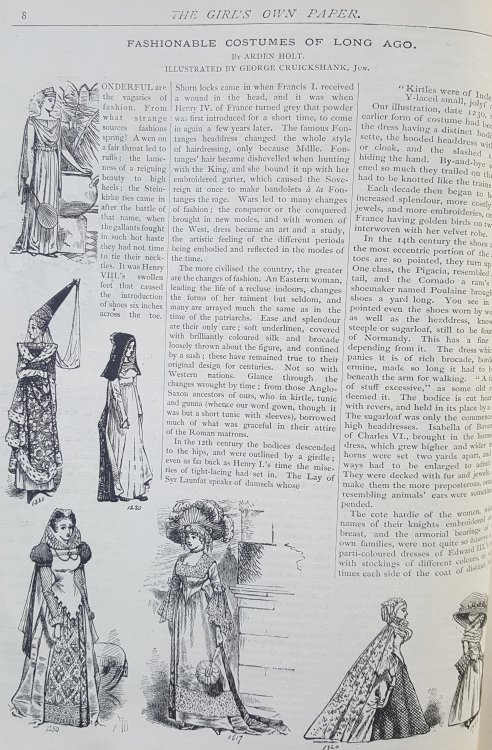
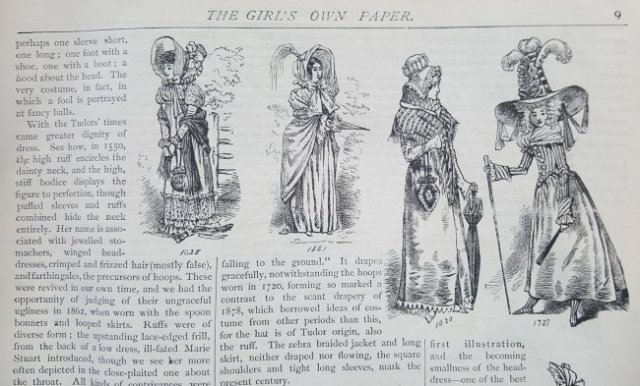
After the first seven pages consisting of the story plus Princess Victoria and the poem, an article on fashion though the ages was pretty well compulsory. A girl is naturally interested in dress styles and outfits so the next double page spread is concerned with this. The hat on the lady for 1787 on the far right of the second page is described as ‘more dressy’ it makes you wonder just how over the top an outfit had to be before it was queried.

and logically following on from that are long sections on needlework and of course cookery. As I said at the beginning the target audience are home-makers in preparation, if a woman of the time did work she would be a domestic servant or nanny if she was lucky and not forced into the extremely hard work of the mills or markets, the poorest though would not be frittering their money on something as ephemeral as this magazine, the readership could be relied upon to be at least middle class so housewife was the aim for almost all. The cookery class in this edition is about roasting and apart from the fact that it assumes you would be doing so over a fire rather than in an oven a lot of the advice would not be out of place in a modern cookery book. There then follows a couple of shorter stories before we reach..

20181009 Girls Own Paper 09

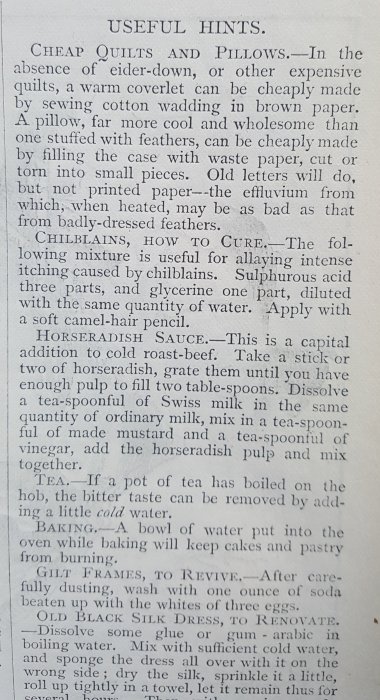
The Useful Hints sound initially as if they are envisaging a poorer reader and the chilblains remedy sounds positively dangerous, but soon normal service is resumed with hints for reviving gilt frames and renovating silk dresses. Now this is still a make do and mend mentality there is none of the waste of throwing away perfectly serviceable items so prevalent today, girls would be expected to have the skills needed to fix things regardless of their social standing, needlework was an expected ability and it would be surprisingly advanced.

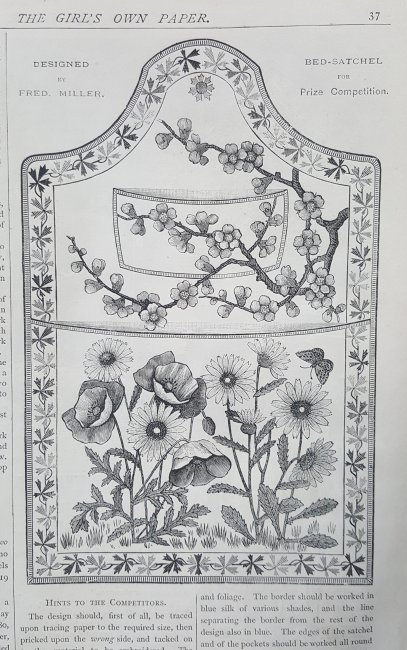
Like last week I have looked forward to edition three of the Girls Own Paper to see what they are expected to be able to make; and again what would today be seen as an astonishing amount of craft is regarded as normal.

20181009 Girls Own Paper 10 - from edition 3

The bed satchel prize competition is for Crewel Work, a type of embroidery which uses wool, competitors had three months to complete the item, the winner to get two guineas and a second prize of one guinea. These are substantial prizes, the equivalent of almost £240 for the winner in today’s money. The work was to be 19¼ inches by 13 inches and use the pattern illustrated, it also had to be all the girls own work and this had to be stated in an accompanying letter written by a minister, teacher or parent. Colours are suggested in the hints section and the flowers named so that the correct shades would be used. No entrant would get their work back as

It is intended to present the well-worked satchels to the various hospitals and other charitable institutions for the use of poor patients, who will find them most handy for holding their nightdresses, pocket handkerchiefs, scent bottles, scissors etc.