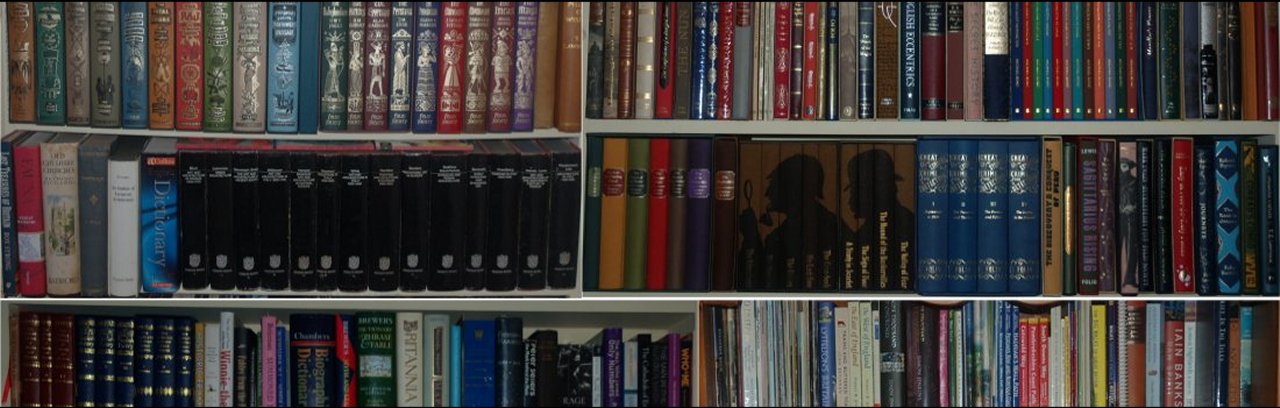
Robert Hooke’s Micrographia

2nd January 1666

Thence to my bookseller’s and at his binders saw Hookes book of the Microscope which is so pretty that I presently bespoke it.

20th January 1666

so to my bookseller’s and there took home Hookes book of Microscopy, a most excellent piece, and of which I am very proud.

21st January 1666

Before I went to bed I sat up till 2 a-clock, in my chamber reading of Mr Hookes Microscopicall Observations, the most ingenious book that ever I read in my life.

I have to agree with Samuel Pepys, I have added this book to my library in the last week and like the celebrated diarist I have spent hours late into the night reading and looking at the wonderful illustrations. It is hard to imagine just how revolutionary a work it was in it’s time, nobody had seen anything like it before. Very few people had access to a microscope and very little had been printed with illustrations of what you could see with the use of one. Micrographia was the first book published by The Royal Society, just three years after the society had been granted it’s royal charter in 1662 making it the oldest scientific academy in the world. Pepys had become a fellow of the society on 16th February 1665 so knew Hooke and would have been well aware of the book before publication.

Now it may seem odd to write a review of a book that came out over 350 years ago but the edition published by The Folio Society is the first high quality version printed in the last 200 years and reproduces in full size the original plates including large fold out pages that are up to 2 feet (60cm) across. The book is consequently large at 13½” × 8¾” (34.3cm x 22.2cm) and quarter bound in leather. The cover is printed on cloth and based on the eye of a grey drone fly and was designed by Neil Gower.

20180305 Micrographia 1

Inside the illustrations are the first thing to catch your eye but then the text pulls you in. Although this is primarily an important, and in its time ground breaking, scientific work Hooke wrote for the interested layman and even after all these centuries it is still an engaging story. Instead of just describing the illustrations he explains why and how he came to look at them in the first place, you get his first impressions and you can share in his sense of wonder at what is revealed.
20180305 Micrographia 2

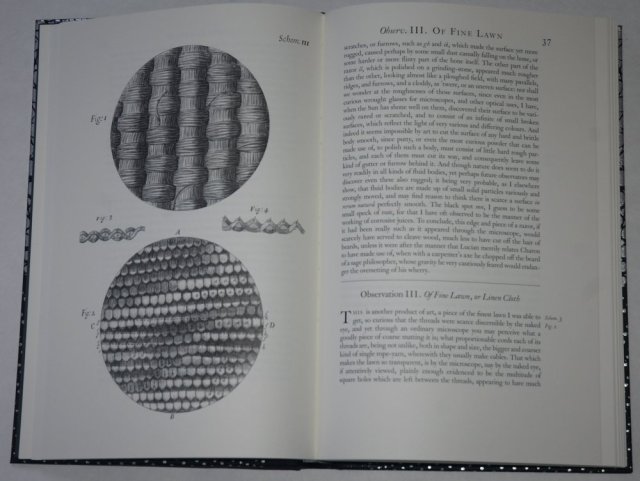
A study of a piece of cloth to reveal the weave, the end of a pencil, a needle, nothing is beyond his inquiring mind and everything he looked at and wrote about was new to the reader who would not have had access to anything like this before.
20180305 Micrographia 3

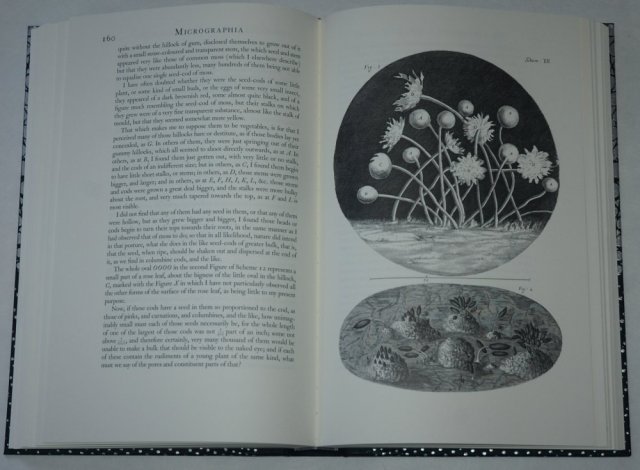
The picture above is of the black spots on the leaves of the rose bushes in his garden. To his surprise these turned out to be ‘tiny plants’ growing on the leaves themselves. Nowadays we understand what he is looking at but the text explains his reasoning that this is some sort of mould and the next thing he then examines is a blue mould on a book bound in leather from a sheep to see if his premise is valid. You learn with Hooke and it’s no surprise that Pepys found the book so fascinating.
20180305 Micrographia 4

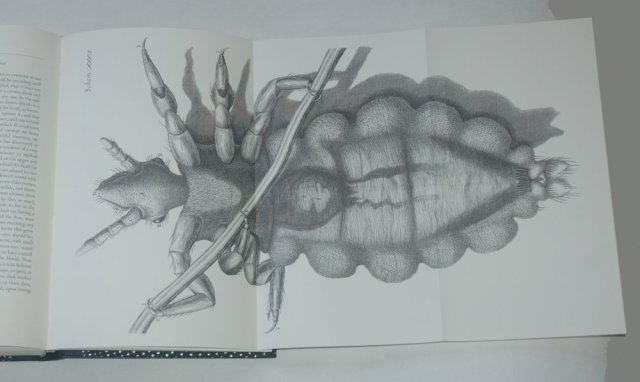
The large fold out plates are possibly the most famous pictures in the book and The Folio Society have reproduced pages from original 1st and 2nd editions (whichever were the best examples) held in the Bodleian Library in Oxford. There is also a small section at the end where Hooke turns his attention away from the very small to the very large and includes some observations he made with a telescope including an early map of part of the moon.

20180305 Micrographia 5

It really is a joy to own and read this book, which was published in 2017 in a limited edition of just 750 copies, mine is number 635. Whilst I love the normal production of The Folio Society and have over 400 books printed by them; it is their limited editions that are their crowning glory. Printed on the finest paper and treated as a work of art in their own right these books are rightly regarded as something special and Micrographia was the winner of the “Scholarly, Academic and Reference Book” category at The British Book Design & Production Awards 2017. A fantastic addition to any library.

There is a video of the book from The Folio Society on YouTube which  gives a better idea as to the size and beauty of this amazing work and this makes an interesting comparison to a video from The Bodleian Library about their first edition.


Uncle Jim

20180227 Uncle Jim 1

Back in 1965 a teenage apprentice journalist started work at the Bucks Free Press, then as now, the local newspaper covering the Buckinghamshire area, places such as High Wycombe, Beaconsfield, Marlow, Gerrards Cross etc. The newspaper had started over 100 years earlier and there was nothing really to suggest that this new trainee was much different to the many that had gone before him except that 2 years earlier at the age of 15 he had had his first story printed in Science Fantasy magazine (volume 20, number 60), more of that particular magazine in a later blog because that is also on my shelves.

The Bucks Free Press had a section called Children’s Circle (the image at the top is scanned from a 1966 copy) which had stories and birthday wishes aimed at younger readers all of which were apparently written by Uncle Jim, the general nom de plume of whoever was tasked to write them and it seemed logical to give the job to the new starter who had already proved he liked to write stories. In the coming years he would write over 80 tales as Uncle Jim nearly all of which were split over several weeks to keep the kids coming back for more, whilst also working as a journalist covering all the things that a local paper needs to do, he saw his first dead body within a week of starting.

The name of this young chap – Terence David John Pratchett, later to become Sir Terence, knighted for services to literature in 2009, or just Terry for those of us lucky enough to have met or indeed spent time in bars late at night with him. Because Terry always had time for his fans and we loved him for it.

Dsc_0558

Now trying to find local newspapers from over 50 years ago is largely a fruitless task so the first time I saw some of these stories from Terry’s early days was on a website started by the Bucks Free Press in association with the Friends of High Wycombe Libraries in June 2010, which posted 2 of them and the first 4 parts of what would become Terry’s first novel The Carpet People. They indicated that they intended to make them all available before they were told to stop quite quickly after the site was started as Terry owned the copyright. The site never actually added any more work and was eventually taken down by the end of 2012. What they did have on the site though was a partially useful list that showed the first time Terry wrote as Uncle Jim was published on the 8th October 1965 and the last they listed was 20th December 1968, in total there were 167 parts listed making up 47 distinct stories. The earliest was a 12 part story that eventually led to The Carpet People, the next longest were 2 stories, one in 1966 and one in 1968 which needed 8 parts and there were 7 stories that were completed in just one part.

These figures are however known to be incomplete as even the article on the Bucks Free Press website announcing the launch of the site in 2010 states that his last appearance as Uncle Jim was in 1970 and there were some 250 episodes, however they do provide an insight into the first 3 years of Terry’s work on this column and the way the stories were split. In fact there were 247 parts written by Terry between 8th October 1965 and 17th July 1970 making up the 80+ stories but apart from going to Beaconsfield library and reading their newspaper archive that seemed to be the end of being able to access these stories far less being able to have Uncle Jim wish you a happy birthday.

20180227 Uncle Jim 2

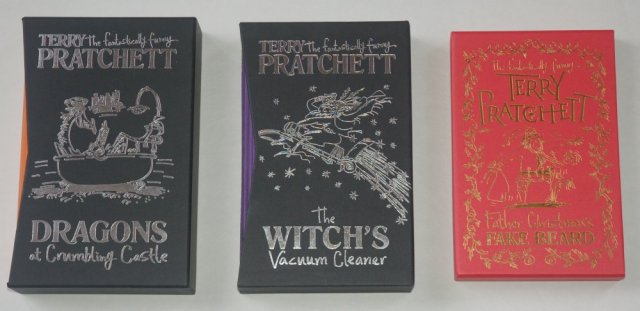
However as can be seen from the image of the books above there have now been 3 collected volumes and I have all 6 of them. Yes you read that right, each one has come out as a standard edition alongside a collectors version.

Dsc_0560

Dsc_0559

So lets make a comparison of the available volumes:

Dragons at Crumbling Castle – published 2014

  • Standard edition – Dust wrapper – 14 stories, two of which went to make up The Carpet People but are here presented as 2 separate works and an introduction.
  • Collectors edition – Slipcase – 16 stories, the two extras being ‘The Wergs Invasion of Earth’ and ‘Bason and the Hugonauts’. There is also a different, significantly longer, introduction; commentaries after each story written by Terry and a colour print tucked inside.

The Witch’s Vacuum Cleaner – published 2016

  • Standard edition – Dust wrapper – 14 stories and an introduction
  • Collectors edition – Slipcase – 16 stories, the two extras being ‘Johnno, the Talking Horse’ and ‘The Wild Knight’. Commentaries after the stories were written by Terry’s assistant Rob Wilkins as Terry had sadly passed away in March 2015 and there was also a postscript added by Rob by way of a eulogy to his boss and friend. Again a colour print was included as a loose insert.

Father Christmas’s Fake Beard – published 2017

  • Standard edition – Dust Wrapper – 11 stories, including one of the stories from The Dragons at Crumbling Castle, ‘Father Christmas goes to Work at the Zoo’.
  • Collectors edition – Slipcase – Identical text to the standard edition but on better paper and all the illustrations are in colour. No other extras

This means that 42 (or 41 if you regard the two parts of The Carpet People as 1 piece) have now been published which is roughly half of what appeared in the newspaper all those years ago.

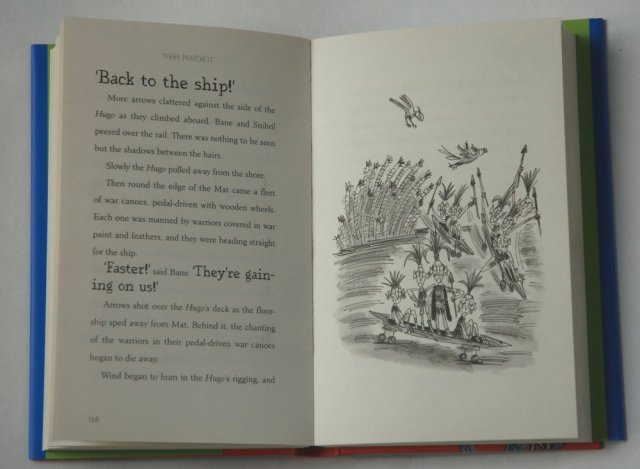
The books are great fun, the pages are covered in typographical games, at one point when the lights go out in a story the next two pages are white text on black, and there are numerous uses of other fonts and text sizes to emphasise the action.

Dsc_0562

The colour edition of Father Christmas’s Fake Beard is also a joy to own, the original looks great but the colour just looks fantastic.

Dsc_0564

During Terry’s tenure as Uncle Jim a lot of the stories are centred on the fictional county of Gritshire, its county town of Blackbury with surrounding towns like East Slate and Umbridge (on the river Um) and the notorious Even Moor where strange things happen in the wild places. The characters gradually develop over the stories so you really feel that there is such a community where odd events occur almost every day and almost feel sorry for the largely incompetent county councillors who just seem to invite disaster with their every plan for improvement. I suspect that this was Terry letting his main job. which included reporting on local government decisions. drift into his fantastical imagination.

I shall finish with the two prints from the collectors editions. The one on the right of Sir Terry as a knight in armour includes his actual coat of arms as ably described in this Wikipedia entry. Let’s hope to see more of these wonderful stories from Terry aka Uncle Jim being published in the future, after all there is still 50% of the work unavailable apart from in frustratingly difficult to obtain old newspapers.

Dsc_0565

Persian Poets

In 1997 I was in Iran and in the Tehran museum saw fabulous hand painted pages from the great classics of Persian literature some of which were 1000 years old, so were contemporary with the great early medieval illuminated manuscripts produced by the monks in Western Europe that I was already familiar with. However these pages were on a different level being more miniature paintings surrounded by text rather than marginal images, a complete book would be a wonder of any age but few have survived intact.

The great epic poem Shahnameh by Ferdosi (also Ferdowsi, Firdusi etc. Persian to English isn’t a precise transliteration) was one of the stars of the exhibition with several wonderful pages on display and at over 100,000 lines it is the longest poem ever written by one author. Written and revised between 997 and 1010AD the 1000 year old poem tells the tale of Persia from a mythological start and the creation of the world, through a time of legendary heroes to historical accounts up to around 750AD and the fall of the Sassanid rulers of Persia. Despite the age of the text it is still perfectly readable to modern Iranians whereas Geoffrey Chaucer (who lived roughly 400 years later) is about as far back in English that you can go and  have a reasonable chance of being able to understand the meaning. Regrettably I don’t read Persian so the text is beyond me but the illustrations made me yearn for a copy for myself. So along with a couple of rugs my souvenirs of Iran included a book in tribute to this great work and the ancient illustrations that so fascinated me on first seeing them.

20180220 Ferdosi 01

20180220 Ferdosi 10

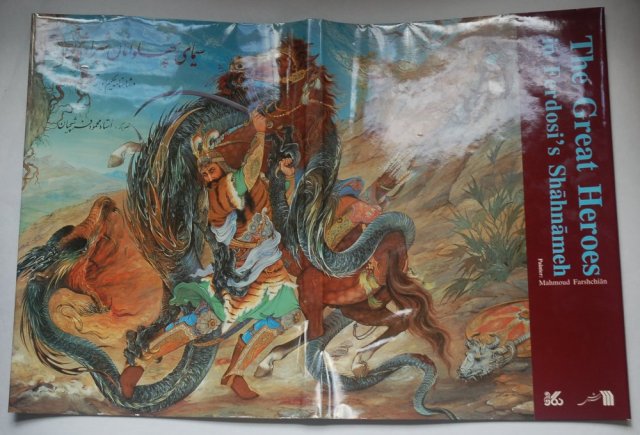
The book was printed in 1991 and describes itself as a commemoration of the millennium of composing Shahnameh by Ferdosi. It was a few years early but the 1000 years have now passed and I’m glad it was early or I may not have been able to obtain this lovely, if somewhat large (42cm x 30cm), volume. The basic premise of the book is that 22 paintings by Mahmoud Farshchian done in the old style of Persian miniature art that I so admired would be used to illustrate sections from the heroic phase of the poem, it is written mainly in Persian with some English to explain the paintings.  The introductory pages are truly beautiful

and then we get into the main work which is the 22 modern interpretations of pages from the ancient works, I love the way that the pictures reach out beyond the frame. Click on the pictures to access full screen versions.

I have chosen 5 pages from the book to illustrate it and these are:

  • In his third labour, Rostam slays the dragon
  • Sohrab launches an offensive against Persia
  • Siavosh undergoes the ordeal by fire which Keykavus has arranged
  • Rostam sets Bijan free from the well where he has been imprisoned by order of the Turanian ruler
  • View of the Hunting Ground, with Bahram Gur talking to the harpist maiden

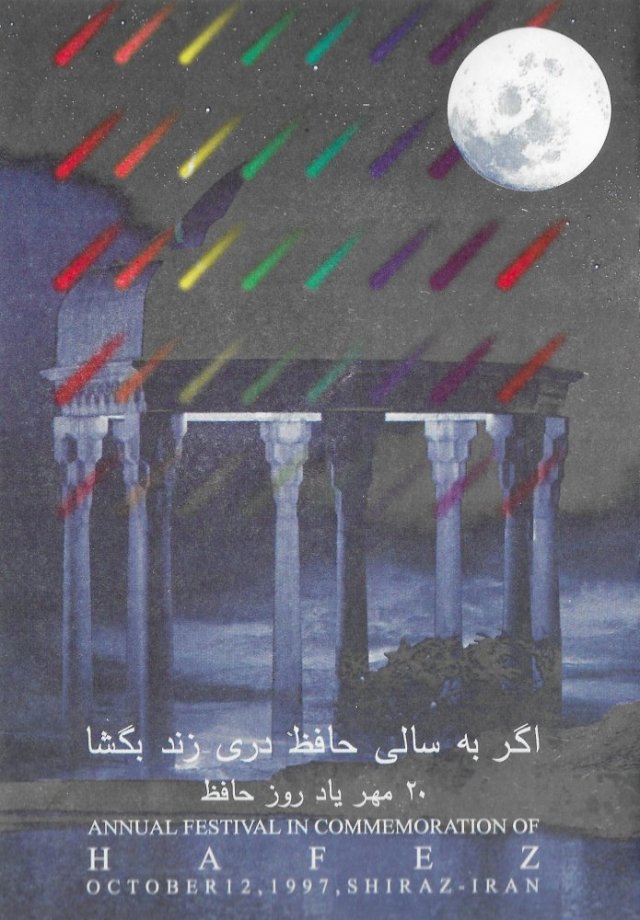
Ferdosi is not by any means the most famous of the Persian poets, that honour probably goes to Hafez and the annual Hafez festival was on when I arrived in his birthplace of Shiraz. He lived from 1315 to 1390 and like Ferdosi his name is more of an honorific, the difference is that we don’t know the real name of Ferdosi but Hafez was Khwāja Shams-ud-Dīn Muḥammad. Being called Hafez indicates somebody who has memorised the Koran, which apparently he did at a remarkably early age and that is the name with which he has gone down in posterity. Also on my bookshelves is the programme for the event.

20180220 Hafez 6

and I took several photographs at his mausoleum which is where recitals and singing of his poems were taking place. He is a much loved poet in Iran which is odd when you consider that most of his poems involve wine, love or the beauty of women; hardly the subjects that are approved of in conservative Iran.

There are fortunately several good English translations including Penguin paperbacks of Hafez’s works, and now Ferdosi has also been included in Penguin Classics so let us leave this blog post with some words by Hafez from The Penguin Little Black Classic “The nightingales are drunk”

With wine beside a gently flowing brook – this is best;

Withdrawn from sorrow in some quiet nook – this is best;

Our life is like a flower’s that blooms for ten short days

Bright laughing lips, a friendly fresh-faced look – this is best.


Penguin Drop Caps

In 2012 Penguin Books started a series of books for sale in the USA and Canada and it made use of their extensive back catalogue along with some newer modern classics in a handsome new style hardback binding. The tagline of the set is

It all begins with a letter

and the concept was to produce 26 titles where each letter of the alphabet was represented by the surname of the author. An interesting idea especially over the choice of names for some of the more difficult letters. What made the set a cohesive whole was the decision to have all the letters on the covers designed by one person, Jessica Hische, and for her to create an evocative set of designs. Adding the input of Penguin Art Director Paul Buckley we ended up with a rainbow of classic books which call to you from the shelves and look totally different to anything else I have. Good design has been the hallmark of Penguin Books from their beginning in 1935 and it’s good to see that tradition being respected in a modern set.

20180213 Drop Caps 1

Of course a set like this appeals to the collector part of me, especially when they are not officially available in the UK as I like a challenge, but it also harks back to the very first Penguin Books I initially accumulated, then decided to collect, which was the early (first 125) Penguin Classics.  Buying a set of books forces you to purchase authors you may not have been intending to buy or even to have heard of and once the book is on the shelf it would be remiss not to at least give the book a go. The first title is a case in point; Pride and Prejudice by Jane Austen is not a title that has ever appealed but I have to say that much to my surprise I’m really enjoying it. I have also read Madame Bovary, A Portrait of the Artist as a Young Man, Five Children and It, and Cannery Row so far and I’m looking forward to tackling authors I don’t know at all such as Willa Cather and Sigrid Undset.

The full list is as follows, with links to books reviewed in this blog:

A to F came out in 2012, G to P in 2013 and Q to Z in 2014 although I only started to collect these books towards the end of last year (2017) so the last 5 have only recently arrived and I didn’t buy them in alphabetical order but rather which 4 or 5 a month I could find at a sensible price.  Their official retail price varies on the copies I have between US $23 and $30 although the Canadian prices fluctuate much more widely between $24 and $40. The cheapest I found one in the UK was around £10 and had to spend up to £17 to get the last few I was missing.

20180213 Drop Caps 2

The spines are also attractive and make a bold statement on the shelf next to me as I write this, as can be seen in the picture above the page edges are also coloured to complement the cover and the rear cover has a short quote from the book that Penguin have turned into a parlour game

Mine is from Great Expectations:

Suffering has been stronger than all the other teaching, and has taught me to understand what your heart used to be.

and then A Portrait of the Artist as a Young Man

to forge in the smithy of my soul the uncreated conscience of my race

Not the cheeriest of quotes but I’m not going to let them put me off reading all these as they are lovely books with a clear font (Archer) as you would hope from a series that takes lettering seriously and a pleasure to pull off the shelf and sit down with.

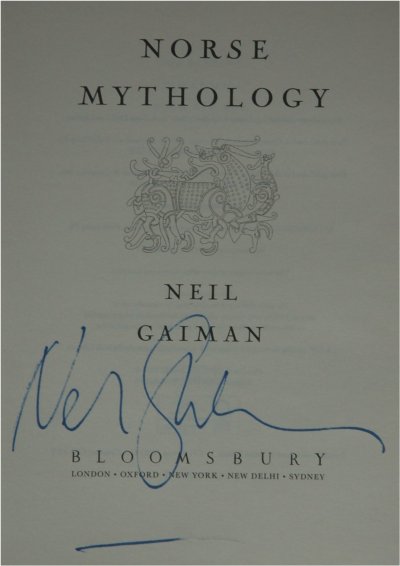
Norse Mythology – Neil Gaiman

20170206 Norse mythology 1

Neil Gaiman’s Norse Mythology is a retelling of the Old Norse myths in a straightforward style aimed at the young adult market. He begins with a brief introduction to Odin, Thor and Loki and then the other characters that populate the myths are explained as we meet them.  The book has had a small number of poor reviews on Amazon, but mainly by people who were expecting a Neil Gaiman story rather than an introduction to the Norse mythology and were therefore disappointed not to find one. For me however it took me back to my childhood in the 1960’s and 70’s reading childrens’ magazines such as Look and Learn and World of Wonder, both of which regularly dipped into mythologies from around the world for features or retellings.

The dustwrapper is beautiful, featuring Thor’s hammer Mjollnir against a background of stars but how many people have taken this off to find the hammer again on the cover of the book

20170206 Norse mythology 2

There are 15 tales included, ranging in length from 3 to 23 pages, so this can be dipped into as a quick read over a period of a few days, but equally it doesn’t take long to read the whole thing. They are easily approachable, avoiding the temptation to explain everything with additional notes which can be a failing in editions aimed at adults which can fall into a scholastic tone. As Neil himself says in his introduction

As I retold these myths, I tried to imagine myself a long time ago, where the stories were first told, during the long winter nights perhaps, under the glow of the Northern Lights, or sitting outside in the small hours, awake in the unending daylight of midsummer, with an audience of people who wanted to know what else Thor did, and what the rainbow was, and how to live their lives, and where bad poetry comes from.

And that I think is the essence of Neil’s book, they feel like they are tales as told to an audience rather than pinned to the page like a specimen butterfly, they have a narrative flow and it doesn’t matter that Yggdrasil and the nine worlds is only 3 pages long, it tells you what you need to know and that information will illuminate later tales.

The book is of course just a brief introduction to the huge body of Norse tales and it would be nice to think that readers today will be inspired, as I was all those years ago with the magazines, to explore further and then maybe try some of the Icelandic sagas which I have enjoyed over the intervening years. More of those I think in a later blog. So thank you Neil for reminding me of the pleasure I got when I first encountered the Norse myths when I was 6 or 7 years old and the joy they still give me.

20170206 Norse mythology 3

Footnote: I thought the UK hardback cover was beautiful and then saw the American paperback due out next month…

20170206 Norse mythology 4

The Things We See

One of the joys of collecting Penguin Books is the wide variety of titles and series that they published over the years and especially exploring the ones that failed to take off.  There are more dead ends and random corners to explore in Penguins first 15 years of publishing than in a M.C. Escher painting. One of these was the well intentioned but ultimately seriously curtailed series The Things We See, book one of which is shown below.  They were assigned the letter code E to distinguish them from other Penguin series so E1 became Indoors and Out.

When I first started collecting Penguin, well before the advent of the internet and its ease of tracking down items around the world, I came to think of these as The Things We Don’t See as I so rarely came across one in a shop on my searches although they are not in fact that scarce and you can certainly pick up examples for £5 to £10 nowadays quite easily.

The Things We See was intended to be a departure from the normal Penguin style. Hardback books each of 64 pages, printed on art paper and significantly larger than their normal paperback production at 220mm tall x 182mm wide and looking at design of everyday objects. This had been touched on via several Pelican books (Penguins factual imprint) but the desire was to produce a series of high quality books on all aspects of the subject. Unfortunately they immediately hit several problems. The main one being the major paper shortage immediately after WWII in 1946 when the series was supposed to start along with the relatively high purchase cost at 3 shillings and sixpence, just over £7 today which sounds good until you realise that it is 3½ times the price of a ‘normal’ Penguin or Pelican at the time. A small number of Indoors and Out did make it on sale in 1946 as a special pre-issue publication but the majority arrived in 1947. It was intended as the introduction to the series and carried an impressive list of titles in preparation to give an idea of the intended scope:

  • Houses by Lionel Brett
  • Furniture by Gordon Russell
  • Radios and other appliances by R.D. Russell
  • Pottery and glass by A.B. Hollowood
  • Lettering and Printing by John Tarr
  • Advertising by Ashley Havinden
  • Shop Windows and exhibitions by Misha Black
  • Gardens by Lady Allen of Hurtwood
  • Public Transport by Christian Barman
  • Private Cars by Humphrey Hague
  • Ships by David Pye
  • Aircraft by Christopher Nicholson

Other projected titles given, but with no author, so presumably not as advanced in production were Toys, Domestic Equipment, Shops and Cinemas, The Things We Wear. This would have given the E series an initial list of 17 titles however only 7 were ever printed, the ones in bold above being the remaining 6 to come out.

1947 was a good year for The Things We See as 3 more titles made it out that year. E4 Pottery and Glass was the next to appear as can be seen from the list of titles on the back which still has E2 and E3 as ‘in preparation’ and the list of titles has already been considerably cut back as it rapidly became clear that a) there was not enough paper and b) they weren’t selling very well. Only E1 was ever produced in hardback all the others are softback editions at the lower price of 2 shilling and sixpence, representing a 28% price cut; although this appears to have been a last minute decision as the old price is blocked out in black and the new overprinted on the inside flap of the dustwrapper. As can be seen on the rear cover of E3 Furniture; shown above; there is a long overprint removing the line

Titles already published:price 3/6 each

The rear of E2 Houses is the same as E3.  So what do the books look like inside? Well lets open E4 Pottery and Glass.

20170130 The Things We See 09

They are very attractive photogravure printed volumes with lots of photographic illustrations, it is clear that these would have been expensive to produce so the dramatic cut in price cannot have helped the viability of the series as a whole.  That these books are still around was down to Penguins policy of just holding onto something until it eventually sold. Unlike a lot of publishers that would probably have pulped a lot of unsold stock to make way for new titles Penguin, under Allen Lane at least, very rarely did this. The next two titles to appear were E5 Public Transport in 1949 and E6 Ships in 1950, both still priced as 2 shillings and sixpence.

20170130 The Things We See 05

These two are probably my favourites from the series, they are very readable and the illustrations invoke the era they come from so well

20170130 The Things We See 10

20170130 The Things We See 12

Ships has a quote from The Architectural Press on the inside of the dustwapper, which turned out to be completely wrong:

To judge from the first few volumes the series called The Things We See ought to prove the most successful of all the contributions made by Penguin Books to visual education. Well designed, well illustrated and well printed they are remarkably cheap by any standard. Moreover the author of each has been given his head, within the limits imposed by considerations of space, and by bringing his heart too has produced a highly readable essay which is all the better for being in some degree a profession of personal faith.

Sadly there was only to be one more title produced and for that we had to wait another 3 years.  1953 saw E7 Gardens by Lady Allen of Hurtwood and Susan Jellicoe. The latter author was not mentioned in the original plan for the book so possibly she was drafted in to make sure this book actually came out.  The price however had doubled to 5 shillings and the eye design cover was abandoned to make the book look more attractive to a post austerity public.

All the titles were relaunched with photographic dustwrappers over the top of the unsold stock dating back up to 6 years. Only E3 Furniture was actually reprinted with revisions for this relaunch all the rest were just what was still sitting in the warehouse so there must have been a highly tedious exercise in removing all the old wrappers and putting new ones on. Only Furniture and Gardens have photographic covers under the wrapper all the others retain the old eye cover.

20170130 The Things We See 08Several illustrations in Furniture were replaced as part of the revised edition and its price was increased to 3 shillings and sixpence alongside E1 Inside and Out which had never been reduced in price, the others stayed at the lower price.

20170130 The Things We See 11

This is from the revised edition, only the birch bed (top left) was in the original 1947 book, the new pictures show a far more contemporary look in order to update the subject.

Presumably the books continued to slowly sell and the relaunch managed to clear some of the backlog of books making the effort of recovering all of the old stock worthwhile. Penguin meanwhile had other ambitious projects to handle by then and The Things We See was left to slowly fade away.  A sad end to what could have been a most interesting set of books.

Why not get hold of some, they are cheap enough, and enjoy, what is after all, a 70 year old series and therefore now significant in studying the history of design not just from their contents but also from the design of the books themselves. Three of the titles E1, E6 and E7 won design awards from the National Book League when they were published so were recognised as significant pieces of work even then.

The Diary of a Bookseller – Shaun Bythell

For my entry this week I’ve decided to review a book I was given at Christmas and thoroughly enjoyed, The Diary of a Bookseller by Shaun Bythell.

20170123 The Diary of a Bookseller

Shaun is the notoriously curmudgeonly owner of the largest second hand bookshop in the Scotland which goes by the wonderfully simple name of The Bookshop. Not The Wigtown Bookshop (which is where it is) or Bythells’ Books, no it’s just The Bookshop, direct and to the point just like its owner. His website name is similarly one to be envied by anyone in the trade www.the-bookshop.com. The book takes a very simple starting point “to write things down as they happened in the shop” and develops into an entertaining story of how a year passed for Shaun and his equally eccentric staff.  It starts randomly on Wednesday 5th February 2014 and finishes on Wednesday 4th February 2015 (this entry is as far as I can remember the only time the year is specified).

As the owner of a specialist retail business in a small town myself the interactions with customers, or at least people who wander into the shop, move stock around and then leave without buying anything, that Shaun documents are all to familiar.

Tuesday 8th April

At 10:15am a woman walked in and roared, I am in my element! Books! then continued to shout questions at me for an hour whilst she waddled about the shop like a ‘stately goose’ as Gogol describes Sobakevich’s wife in Dead Souls. Predictably she didn’t buy anything.

Few things are more guaranteed than when somebody you have never seen before in the shop and expresses huge enthusiasm on entering is that they won’t buy anything.

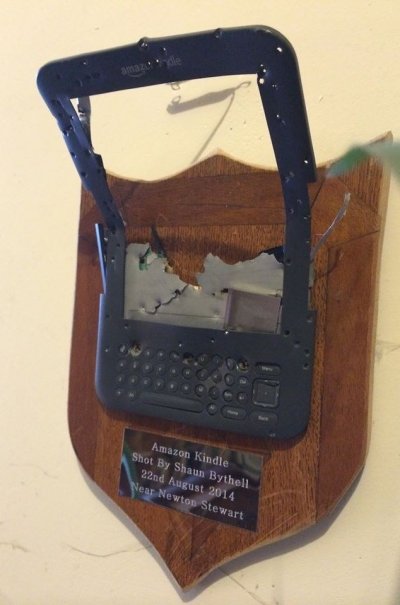
Shaun also has a dislike, no that’s the wrong word, hatred would be better, of Kindles and this is referred to several times in the book even to the point of shooting one and mounting the remains on the wall in his shop like a hunting trophy.

20170123 The Diary of a Bookseller 2

This is totally understandable for somebody who makes their living selling books (well maybe not the shooting part) you can’t after all trade the contents of a Kindle but as somebody who loves books I also dislike the impersonal nature of reading on a screen. I found the photo on pinterest so don’t know who originally took it so I apologise in advance for unacknowledged copyright.

However I don’t want to give the idea that the book is just full of Shaun complaining, sometimes he is having a great time, although usually this is whilst he isn’t actually in the shop. Wigtown is Scotlands’ book town, based on the idea by Richard Booth in Hay on Wye, gathering bookshops together to make the place a specific destination for book lovers all over the world and The Bookshop was the first of what is now 13 independent retailers in the town.  It is also home to a book festival at the end of September which is documented in the book.  The Bookshop hosts ‘The Writers Retreat’ a place where guest speakers at the festival can escape to good food and drink and to chat amongst themselves and this leads to more stories being told. There is clearly a lot of effort put into the festival and I really ought to go, but maybe not this year as I suspect a lot of readers of this book have had the same idea.

Tuesday 25th March

Shortly after Andrew had left an extremely rude old woman demanded a copy of Simon Sebag Montefiore’s biography of Stalin. We had one in the Russia section which she brought to the counter. It was an unusually pristine copy in a mint jacket, clearly unread – original price £25. She asked how much it was, I pointed to the sticker that says £6.50. She pushed it away from her and turned; walking out muttering, ‘Too expensive’. I’m pretty sure she’ll be back so I re-priced it at £8.50.

I loved the book and can’t recommend it more, you don’t have to be a bookseller or even a shopkeeper of any sort to get a lot of pleasure from it.

By the way I checked and yes you can get it on Kindle, Shaun is presumably furious…

The Original Alice

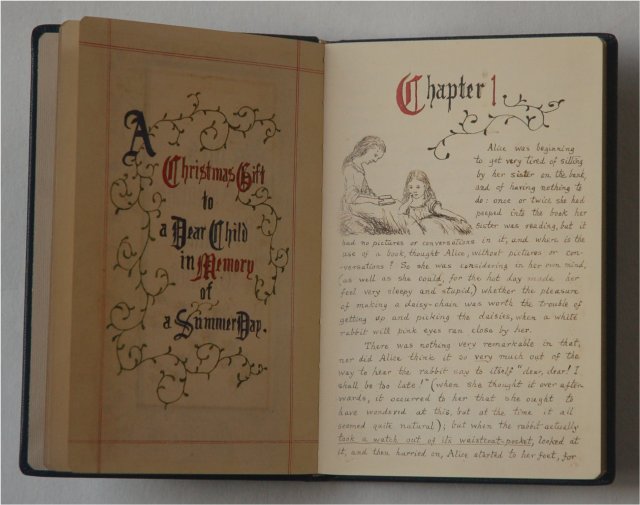
Almost everyone knows the children’s tale Alice in Wonderland by Lewis Carroll either having read the book, or seen or heard, one of the many adaptations over the years.  Most readers will know that Alice was a real person, one of the daughters of Henry Liddell, dean of Christ Church college at Oxford and the stories were told to entertain her and her sisters.  They will also know that Lewis Carroll was really the reverend Charles Lutwidge Dodgson, a 24 year old mathematics lecturer at Christ Church when he first met the Liddell’s. But what is less well known is that when the stories were first written down they were intended to just be a one off book as a gift to Alice and the title was Alice’s Adventures Under Ground.

20170116 The Original Alice 4

The book was handwritten and illustrated by Dodgson and was given to Alice for Christmas in 1864 when she was 12 years old, although he originally came up with most of the story when she was 10 on a trip up the river for a picnic. Alice treasured the little book for decades but eventually in 1928 at the age of 75 and now a widow needing money she sold it at auction for £15,000 (approximately £860,000 today). The book was bought by Dr Rosenbach, who was an American book dealer, and he subsequently sold it in the US.   The private collector who owned it died in 1948 and the book was again put up for auction this time making $50,000 (roughly $508,000 or £363,000 nowadays) and Dr Rosenbach was the top bidder at this auction as well.

20170116 The Original Alice 5

This time however was to be the last time it will ever come to the market. Several American benefactors led by book collector Lessing Rosenwald obtained the book in order to give it to Britain in thanks for the gallantry of the British people during the Second World War.  In November 1948 the book was brought on the liner The Queen Elizabeth across the Atlantic and presented to the British Museum with the Archbishop of Canterbury representing the country by receiving it.  The book is now part of the national collection (catalogue ref MS 45700).

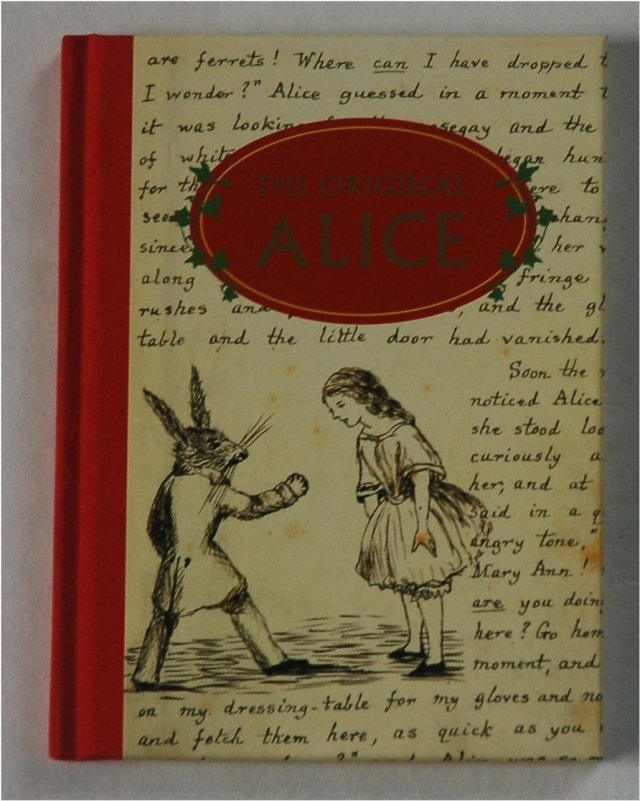
In 1997 The British Library published a book by Sally Brown entitled The Original Alice, which now sadly out of print but fairly easy to find on the second hand market.  This tells the story of how Alice came to be written and compares Alice’s Adventures Under Ground to Alice in Wonderland with examples as to how the books differ.

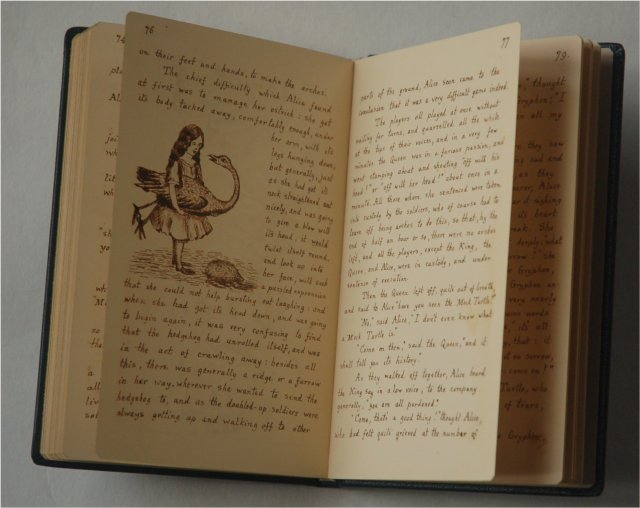
20170116 The Original Alice 1 The illustrations of the original book included here are from another out of print edition, a beautiful leather bound facsimile of the original produced in a limited edition run of just 3750 copies by the Folio Society in 2008, this is somewhat more tricky to track down but it is a beautiful thing to own and read.  It comes in a lovely box with a ribbon to lift the book out with.


Although he never intended publication Dodgson did pass the book to his friend, the children’s novelist George MacDonald, to cast his professional eye over, before giving it to Alice. MacDonald’s children so enjoyed the book that Dodgson was eventually persuaded to publish.  He significantly rewrote the tales, removing a lot of references that only really made sense to the Liddell family and adding Pig and Pepper along with The Mad Tea Party. These additions and revisions to the original text almost doubled the length and took the book up from 18000 to 35000 words.

Alice’s Adventures in Wonderland was finally published in November 1865 in an edition of 2000 copies but in a final twist these were withdrawn as the illustrator, John Tenniel, was unhappy with the quality of the reproductions of his pictures.  This makes the handful of copies that still exist one of the rarest of all children’s books.  The book was finally available to the public in 1866 and was an immediate success.  Alice’s Adventures Under Ground has been printed several times in the intervening 150 years but only the Folio Society have produced a true facsimile of the book with the leather binding and colour illustrations where appropriate, however it is worth searching out a copy of the text as first written as it gives a view of the story that Alice herself first heard and it is quite different to the text that we all know.

Welcome

1894 - Lane Christmas Book- The Life of Sir Thomas Bodley- 2 title pageWelcome to my book shelves, home to some 6500 volumes dating back to the mid 1700’s right up to the present day. I’m going to use these as the basis for short essays or reviews not just of these books but where ever they wish to take me.  The aim is to pick a book, or group of books each week and look at its significance, or just tell a tale as to why it has found itself here.

The Life of Sir Thomas Bodley featured with this first article is a good entry point as the Bodliean Library in Oxford takes its name from Sir Thomas who came to its rescue in the 1590’s and put it finally in the secure position it now holds as one of the worlds greatest libraries. So immediately we have a book leading to more books

When John Lane founded his publishing company in 1887 he chose to call it The Bodley Head in honour of Sir Thomas and for Christmas 1894 printed a very small number of copies of Bodley’s autobiography as gifts to friends and people who had helped set up the business.  Very few of these books have survived the intervening 123 years but it’s an interesting work that should perhaps be better known.

I have two copies of ‘The Life’ one still in the original card covers and one rebound in boards and this also includes the original compliments slip from John Lane.

My main interest in The Bodley Head however is in one of his employees in the 1930’s, Allen Lane, who went on to found a far more famous publishing company namely Penguin Books, which now owns The Bodley Head imprint and uses it for non-fiction titles.

Well over 2000 of my books are Penguins and I specialise in the first 10 years of the company 1935 to 1945 which led to some fascinating books and stories about how they came about as the firm struggled with wartime restrictions but also the greater need amongst the population at home and also servicemen/women for something to read.  More to come about those in future entries to this blog…