War – Sebastian Faulks

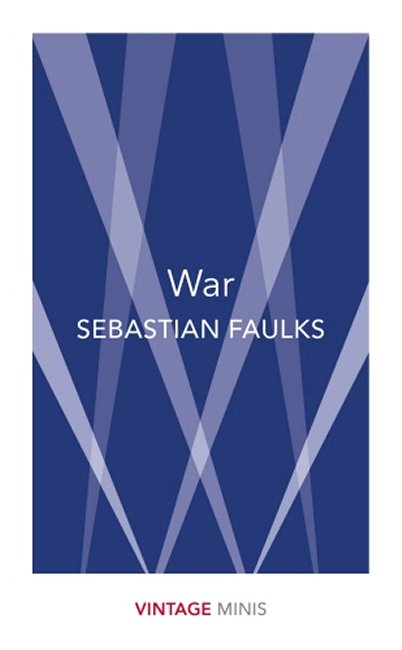
I mentioned on last weeks blog that the Agatha Christie didn’t last the week in Belgium however I did have a backup, although it turned out not to be as expected. I spotted War by Sebastian Faulks in a bookshop just before I left and thought it would be appropriate as I was based in Ypres for the week so surrounded by battlefields and cemeteries for the war dead of, mainly, combatants of World War One. I’ve been meaning to read something by Faulks for some time as his reputation led me to expect great things and I wasn’t to be disappointed in that regard. But if I had looked more closely I probably wouldn’t have bought this book as it turned out to be extracts from three of his novels, ‘Birdsong’, ‘Where My Heart Used to Beat’ and ‘A Week in December’ but at least it gave me a chance to try his works, which is presumably the idea. The books cover three different periods, ‘Birdsong’ is set during World War One, ‘Where My Heart Used to Beat’ is World War Two and ‘A Week in December’ is modern times Muslim jihad terrorism in London.

Let’s start with ‘Birdsong’, the extract is forty five pages of an over five hundred page work first published in 1994 and whilst the novel focuses on, Stephen Wraysford, a young officer in the Great War, the extract in ‘War’ deals largely with Private Jack Firebrace, an ex miner who is tunnelling out from the trenches through no man’s land to undermine or bomb the German positions. This is of course extremely dangerous, not just from possible collapse of the damp soil but from enemy shelling and the ever present possibilities of meeting German’s coming the other way. The book is wonderfully written, it’s no surprise to discover that it is probably Faulk’s best known work as the extract drew me in to the claustrophobic existence of the tunnellers and the awful conditions in the trenches. The first paragraph of the extract gives a feel for the novel:

JACK FIREBRACE lay forty-five feet underground, with several hundred thousand tons of France above his face. He could hear the wooden wheezing of the the feed that pumped air through the tunnel. Most of it was exhausted by the time it reached him. His back was supported by a wooden cross, his feet against the clay, facing towards the enemy. With an adapted spade, he loosened quantities of soil into a bag which he passed back to Evans, his mate, who then crawled away in the darkness. Jack could hear the hammering of timbers being used to shore up the tunnel further back, though where he worked, at the face, there was no guarantee that the clay would hold.

After a hard days digging Jack was expecting a rest but was put on guard duty instead due to shortage of men. However exhaustion overtook him and he fell asleep where he was discovered and condemned to be shot at dawn for desertion of duty such was the black and white horror of World War One.

The extract that follows from ‘Where My Heart Used to Beat’ is fifty eight pages from three hundred and fifty so more representative and roughly a sixth of the entire original book, which first appeared in 2016. The action in the extract takes a first person narrative of a newly commissioned officer during World War Two who is part of the British Expeditionary Force, that strange time before it was known as the British army in WWII and is forced to retreat to Dunkirk for the great small boats rescue. On his way specifically mentioning passing through Poperinge, just a few miles from where I was sitting in Ypres reading the book and where we had been the day before. This sudden intrusion into my modern experience was remarkably evocative as I imagined the hardship of the troops passing through the now lovely fields in this part of Flanders. Again it is beautifully written and when the unit are back in combat, this time fighting their way through Italy to Monte Cassino in the push to get the Germans out of Italy you really feel you are alongside the men as you are totally pulled into the narrative.

The third extract from ‘A Week in December’ is just twenty eight pages out of four hundred and the book was first published in 2009 but set in December 2007. The book itself is a satirical dealing with the money men of the City of London that were about to pull everything down in the great financial crash of 2008 and focuses on seven characters with the main one being the hedge fund manager John Veals. However the extract doesn’t mention him of five of the others being instead the story of Hassan al-Rashid whose Muslim faith has got him involved in extremism to the point that he agrees to be part of a bombing of a London hospital. I’m intrigued how this fits into the entire work so I’ll almost certainly have to read the full book at some point but of the three ‘Birdsong’ is top of my list to search out closely followed by ‘Where My Heart Used to Beat’, I definitely need to read more Sebastian Faulks.

The Dutch Riveter : Edition 9 – Edited by West Camel

I picked this up from my local bookshop the other week and have been thoroughly entertained by this selection from modern Dutch writing and amazingly it’s free. This is volume 9 and was launched on the 17th March 2021 via an online event from the British Library. I’d never heard of The Riveter until Megan, the bookshop owner, suggested I might like to read it as she had had some copies dropped off at the shop a few days ago.

The Riveter is a free magazine devoted to riveting European literature in English. The idea is to make international writing popular and accessible to readers everywhere and to celebrate excellent translation and great books from the rest of Europe.

The Riveter was launched in 2017 by the European Literature Network. Professionally edited and published by a small dedicated team, it attracts support from a wide range of publishers, authors, translators, critics, academics – and readers. It has achieved acclaim with its special issues on Polish, Russian, Nordic, Baltic, Swiss, Queer, German, Romanian and Dutch literature in English.

From the website of the publisher https://www.eurolitnetwork.com/the-riveter/

It is mainly available online, follow the link in the citation above, but apparently print copies of the Dutch and Romanian versions are readily available in the UK and as I have greatly enjoyed this very professionally produced little volume, 120 pages, I will definitely be looking out for more as I prefer to read an actual book rather than on a screen. I’ll just pick out a few highlights for me:

Someone Who Means It, by Maartje Wortel. Translated by Sarah Welling and Margie Franzen. This short story, which was first printed in 2015, is appearing for the first time in English translation. It’s eleven pages long so represents almost ten percent of the total book but it’s worth the dominance of space it takes up. It’s a story of love and loss, jealousy and passion beautifully told and definitely makes me want to read more by Maartje.

Herman Kock gets one of the subsections, with an extract from his latest book Finse Dagen (Finnish Days) and a review of the most recent one to be fully translated into English, The Ditch. I quite enjoyed the three page extract from Finnish Days and was pretty convinced I wanted to get a copy of The Ditch whilst reading Max Easterman’s largely positive two page review right up until the excoriating final paragraph

Sadly, as the story progresses, Herman Koch doesn’t manage to meld these various strands into a convincing whole: they just don’t hang together. The analytical insight he brings to Robert Walter’s jealousy is dissipated in the final third of the book. The old prejudices about Sylvia’s unnamed country are laid bare, but in the end, the resolution of the story, in which the significance of the ‘ditch’ becomes clear, doesn’t work for me: it is a dying fall, a whimper, which left me wondering: why?

Well that’s one book that needn’t make it to my to be read pile then.

On the other hand Dutch poetry has a huge amount going for it and is well represented here with a two page introduction, twelve pages of poems and a two page review of a poetry collection. Poetry has to be the hardest style of literature to translate for not only does the translator have to manage the words but the flow of the words has to be right. The choice of poems is well done with a good mix of serious and lighthearted works with for me two stand outs from each of those categories. The excellent ‘My Skin’ by Dean Bowen is crying out to be read aloud, this is performance poetry written down and you can’t help reading it out loud to appreciate the rhythm of the words. on the other hand ‘Pitying the Reader’ by Menno Wigman will make any dedicated reader chuckle as we have all been there. I’ll just include the start of the poem here so you can see what I mean.

A book? From cover to cover? I lack the strength.
Even poetry – just thinking about it –
exhausts me now. I’ve overdosed on poems,
stare blindly at the pages of my books.
For many months I’ve had a reader’s block,

I’ve grown allergic to the alphabet.

The articles by translators on their job and the problems and joys of translating were fascinating, there is so much crammed into this slim volume but now I need more, I will have to see if can get other volumes in the series.

The one criticism I have of this otherwise excellent publication is the choice of a grey font on a grey background for the majority of the pages, this is clearly done for aesthetic reasons rather than for the practical as it makes reading more than a few pages at a time very tiring.

The Flemish section which has a salmon pink background is not much better either.

I’m astigmatic so have enough problems distinguishing between letters without the heavily reduced contrast that this choice by an unthinking design team has come up with. It’s not enough to put me off reading but it is a problem and they really should drop the background shades to improve readability.