McCarthy’s Bar – Pete McCarthy

The eight rule of travel states: “Never Pass A Bar That Has Your Name On It”

For someone with roots in the west of Ireland, even though he was born in England, McCarthy spent a lot of time during his childhood in Ireland and was familiar with just how ubiquitous the McCarthy name was in the west and so how many bars there were with his name. As this is being posted on New Years Eve being in a bar is an ideal subject.

20191231 McCarthy's Bar

A little background on Pete McCarthy first, he originally made his name as a comedian but where I first came across him was as the presenter of Travelog, a Channel 4 (UK television) quirky travel programme which started in 1990 and then from his numerous appearances on BBC Radio 4 shows both comedy and travel based. Sadly he died of cancer in 2004 aged only 52 and left us just two books to enjoy his gently humorous writing. McCarthy’s Bar was the first and was published in 2000, my copy is the paperback from 2001. The book starts on St Patrick’s Day and “McCarthy’s Bar was heaving”, he goes on to describe not only his own steadily more drunken state but that of the very international clientele of pub and his growing realisation that he really felt Irish, the punchline at the end of the chapter is typically Pete McCarthy.

Outside I stood under the green neon shamrock and looked up at the sign. ‘McCarthy’s’ it said. ‘Hungary’s top Irish pub’.

I turned up my collar. Budapest can still be quite chilly in March.

Sod this I thought. Next year I’ll go to Ireland.

Sadly McCarthy’s in Budapest no longer exists, but it is commemorated by the fact that next year he did go to Ireland and provided this wonderfully funny and also at time deeply thought provoking book as he sees how Ireland has changed since he was there as a child each summer holiday on the family farm, whilst visiting as many bars called McCarthy’s as he could find. There are two trips covered in the book, the first one uses a hire car for a week to set up a much longer trip using a beaten up old Volvo which he buys in England for less than the cost of hiring the original car for the week, cue a very funny passage which deals with the trials, tribulations and surprising hidden costs of hiring a car.

By the trip with the Volvo he has got into his stride with the style of the book and he also has a plan beyond the original premise of just travelling which is to finish with a pilgrimage to St Patrick’s Purgatory a notoriously difficult three days of fasting and prayer on an island in a lake in County Donegal. There is no real explanation as to why he chooses to do this, visiting all the pubs with your name on them makes sense as a plan for a trip round Ireland but as to why he wants to do the three days at the end not even McCarthy seems clear with the reasoning other than he picked up the leaflet about it and decided to go.

Another series of locations soon become obvious in the narrative, McCarthy is fascinated by the multitude of ancient stone circles and other monuments that litter the countryside in Ireland and regular diversions are planned to visit them between evenings (and quite often nights) in the various pubs. He examines the uneven way Ireland has become wealthy from the mid 1990’s with the Celtic Tiger boom and the huge increase in tourism outside of Dublin that has come with it, so there is a lot more to the book than simply funny stories. However there are plenty of those and one of my favourites concerns the town of Bunratty and the castle with the Folk Park. The park includes various buildings created to represent Irish history and a ‘pub’ called Durty Nellies where it turns out that at night the locals go to so as to avoid all the tourists that now fill their traditional bars. Creating the odd situation that the real pubs in town cater for the tourists and the fake pub in the theme park, which is aimed at tourists, is where you will find the actual locals at least after the park is officially closed anyway.

There are several laugh out loud sections and I loved the short passage on his trip to Killarney racecourse which he went to on the advice of his severely out of date guide which was written by William Makepeace Thackeray a hundred and fifty years earlier.

At the end of an astonishing long line of bookies is a chap called McCarthy. I go straight over and put £5 at five to one on a horse whose name closely resembles a TV executive I’d like to see run two and a half miles jumping fences while a fierce little Irish bloke whipped him.

The horse lost, but it’s a good story. That also applies to all the other stories in the book even including the three days on Station Island in Lough Derg where he manages to inject humour into purgatory.

The pub doorway featured on the cover is that of MacCarthy’s Bar in Castletownbere, County Cork owned and run by Adrienne MacCarthy, the ‘a’ drops in and out of spelling Mac quite frequently in both Ireland and Scotland. However the sign was photoshopped for the cover to reflect the spelling of Pete’s surname. The nun by the way is not really in holy orders but one of the barmaids dressed up for the photoshoot. There is a really good write up about the real bar and the effect it had and continues to have on the business in the Irish Times from December 2014.

Summer Lightning – P G Wodehouse

A certain critic – for such men, I regret to say, do exist – made the nasty remark about my last novel that it contained ‘all the old Wodehouse characters under different names’. He has probably by now been eaten by bears, like the children who made mock of the prophet Elisha: but if he still survives he will not be able to make a similar charge against Summer Lightning. With my superior intelligence, I have outgeneralled the man this time by putting in all the old Wodehouse characters under the same names. Pretty silly it will make him feel, I rather fancy.

The opening paragraph of the preface by Wodehouse to Summer Lightning is typical of the humour of the man and is a perfect example of why I love his works. I don’t care that you can often recognise bits of previous characters in some new ones. Frankly the world of which he writes of stately homes in the country and clubs in London all populated by the most bizarre yet oddly believable characters is what I’m looking for when I pick up one of his books. Of invariably rich and often foolish young men, sensible young women, wildly eccentric uncles and terrifying aunts is the Wodehouse world made and the occasional sensible male character such as Jeeves, the gentleman’s gentleman in the Wooster stories or Beach the butler at Blandings merely highlight the craziness going on around them by being a beacon of solidity. They are an escape from reality to a time and place that probably only ever existed in Wodehouse’s fertile brain but which is instantly recognisable as 1920’s England and could be nowhere else.

20191126 Summer Lightning 1

Summer Lightning is part of the series of books and short stories that relate to the goings on at Blandings Castle and was originally published in 1929. For those people who only know Wodehouse through the ever popular Jeeves and Wooster stories we are introduced to a whole new collection of odd characters and yet more bizarre plots in this series of books. Summer Lightning is not the first in the series but it is a perfectly good place to begin as you are introduced to the population of the castle very well and don’t need the earlier volumes to know the dynamic between them. Head of the family and, theoretically at least, in charge of the castle is Lord Emsworth who would be quite happy if left alone with his library, the castle grounds and of course the love of his life, his prize pig The Empress. In reality the castle is run by his sister Lady Constance who as châtelaine makes certain that things actually get done, as long as they are what she wants doing. The two do not exactly get on and Lord Emsworth usually gets bullied into at least starting some of the things his sister plans although usually by his absent-mindedness they rarely end up as she intended. The other constant inhabitant of the castle is the butler Beach who invariably gets caught up in the shenanigans of the various family members and guests there.

As the novel starts there are three other significant people in residence, one of Lord Emsworth’s nieces Millicent Threepwood, his newly appointed secretary Hugo Carmody (who is secretly engaged to Millicent) and his brother Galahad Threepwood who is writing his scandalous (and possibly slanderous) memoirs. You can already see two plot lines that will be developed. Later on add in Ronald Fish who is one of Lord Emsworth’s nephews, a friend of Hugo Carmody who he ran a failed nightclub with and whom Lady Constance hopes will marry his cousin Millicent, along with Sue Brown, a chorus girl in a London theatre, who is engaged to Ronald but would definitely be regarded as unsuitable by the family and things really start to get mixed up. Throw in pig-napping, mistaken identity, rivalry with the neighbour Sir Gregory Parsloe-Parsloe, more pig-napping and a detective brought in who is also in love with Sue Brown although she dislikes him and it becomes quite complicated. Having said that Wodehouse is a master of this and you can always follow the various machinations of the characters as each tries to get to their desired outcome with greater or lesser success.

Beautifully illustrated by Paul Cox this 2004 edition of Summer Lightning is published by The Folio Society and as well as this stand alone volume it is available as part of a boxed set of six books which between them make up roughly half of Wodehouse’s output about Blandings Castle and it’s inhabitants. I now live within four or five miles of where the Blandings books are set in north Shropshire. Precisely which place gave Wodehouse his inspiration is not known but journey times and the fact that The Wrekin can be seen from the castle means that it has to be round here, local newspapers mentioned in the books although fictional also refer to local towns. The most likely house that the prototype for Blandings is Apley Hall and the sheer scale of this property fits in well with the descriptions of the castle in the books. This local link is what has encouraged me to re-read the books set round here and this had led to me exploring more of his works since moving to the area. He wrote over 70 novels and well over 200 short stories so is remarkably prolific and is possibly even more popular now than he was in his lifetime with a 1000 strong membership of the P G Wodehouse Society and deservedly so. His books are great fun, now which one shall I read next?

Ars Amatoria – Ovid

Much better known for his work Metamorphosis, Ovid also produced this treatise on the technique for finding and importantly keeping the love of your life. That it also includes hints for hiding infidelity and some of the advice is a little too true to life for some of its readers two thousand years ago probably didn’t help when he fell out of favour with the Emperor and was exiled from Rome for the final sixteen years of his life.

20191119 Ars Amatoria 1

As the lovely Folio Society edition that I have is quarter bound in leather with a plain brown cover I have chosen not show the outside as it is rather dull but instead to have three extracts with the drawings by Victor Reinganum which decorate most of the pages, including the opening shown above where Ovid sets out what he hopes to achieve. The book was published in 1965 and uses the translation by B.P. Moore originally published by Blackie & Son Ltd. The font used is Poliphilus 13 point and I think suits the text admirably well. Unusually for Folio the book was reprinted just two years later which attests to its popularity.

The work consists of three short books, the first two are aimed at men trying to find a partner and get her interest (book 1) and then Ovid looks at how to keep her (book 2). The third book was written slightly later and is aimed at women looking for a man. Despite being over two thousand years old much of the advice given by Ovid is as good today as it was in Roman times. The first, and most obvious, but still got wrong many times, is that if you want to meet a woman then it is best to go to where they are, don’t hang around in places with your male friends, go to the parks or theatres. But remember you are not there just to watch the play.

20191119 Ars Amatoria 3

When you have found ‘the one’ then how to make sure she knows you are not only interested but are looking for more than just a friend is covered next, and then once a relationship has started make sure that she knows that she is the only one for you.

20191119 Ars Amatoria 2

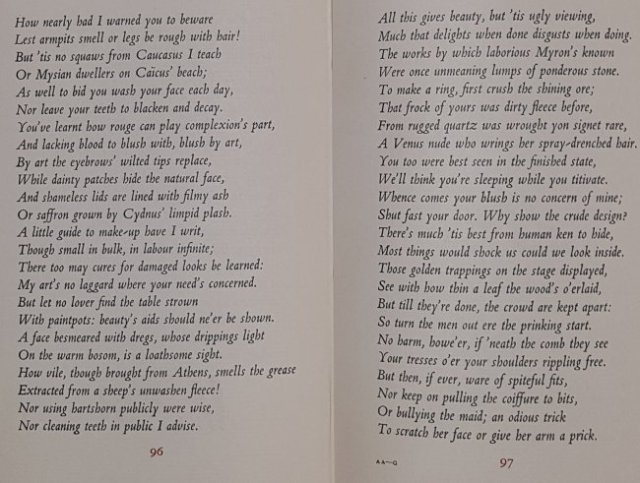
The third book, for women hoping to secure a man, repeats the suggestion from the first book to go where they are although it point out that the sensible men that are also looking for women (and have read the earlier treatise) will be where she already is, so maybe start at the theatre. However there is also beauty advice, such as for make-up (basically don’t overdo it, use enough to enhance not redefine) and hair (pick a style that suits your face shape). The words about makeup are particularly poignant when you consider the very basic types available at the time which would degrade quite quickly in the Italian sun. I love the suggestion in the passage shown below that the morning beauty routine is best done away from the gaze of the man the lady is hoping to attract, after all why should he know what she has done to enhance her beauty.

20191119 Ars Amatoria 4

I don’t want to give the impression that Ovid is just covering beauty tips, there is much the same sort of advice given to the ladies as to the men in how to attract a mate and even what to do when you have got him. How to arrange messages between you when things are still not publicly known and you don’t want anyone else to know. This also applies to illicit trysts when secrecy is vital and he is not shy of making this clear in his text.

Overall the book(s) are a fun read and in places could be lifted straight into the advice columns of today. It’s a fascinating glimpse into an ancient past that perhaps is not that ancient after all.

A note on the translation used is probably useful here at the end of the review. Clearly Moore updated some parts, there are two references to cars for instance when leaving the vehicles as period would have been far less jarring. There are other lines where I felt the intrusion of the modern was out of place and disturbed the flow of the text. Having said that the translation is very readable apart from these examples and the deliberate attempt to keep notes to an absolute minimum (just two pages at the back which mainly name the character referred to when a reader in 2AD would have simply known who it was) makes it more a reading pleasure rather than an academic exercise. There is a translation available at Project Gutenberg which dates from 1885 but this is in prose rather than the verse employed by Moore and is a lot less fun to read so overall I’m glad I have this edition.

Wishful Drinking – Carrie Fisher

Hi, I’m Carrie Fisher and I’m an alcoholic

And this is a true story.

The start of Carrie Fisher’s first memoir certainly sets out her stall all too well. This is going to be a roller coaster ride through the highs and lows of her life told with self deprecating humour honed by telling much of the material covered in the book in a hit one woman show which premiered in 2006. The copy of the book I have is the 2008 first edition published by Simon and Schuster.

20191029 Wishful Drinking 1

The daughter of film star Debbie Reynolds and singer Eddie Fisher, Carrie grew up in a far from normal household. Her father left when she was two when he started an affair with Elizabeth Taylor, who was also married at the time. Reynolds married again a couple of years later to a millionaire business man (who later lost all his money along with Reynolds’ due to bad business decisions and gambling) but he was Carrie and her brother Todd’s step father through most of their childhood. The book is quite open about this time in her life, how they only saw their mother occasionally, her step father even less often and her biological father about once a year. From the descriptions of the two children spending time with Reynolds’s clothes as they smelt of her when they couldn’t be with her and the times she was around spending as much time as possible in her presence they clearly missed having her in their lives.

By her mid to late teens Carrie had discovered alcohol and drugs, mainly marijuana at this stage and was what would become her life long addictions to both had started. This could have been a really dark book but the humorous way she addresses this along with her later mental health problems (she was bipolar) makes you laugh along with her even when she is describing really low points.

Okay, have it your way. I’m a drug addict.

You know how they say religion is the opiate of the masses? Well I took masses of opiates religiously.

or talking about her committal to a mental hospital a couple of years after giving birth to her daughter.

I was invited to go to a mental hospital. And you know, you don’t want to be rude, so you go. Okay, I know what you must be thinking – but this is a very exclusive invitation.

I mean, hello – have you ever been invited to a mental hospital?

So you see, it’s exclusive. It’s sort of like an invitation to the White House – only you meet a better class of people in the mental hospital.

The reader is introduced to Fishers fragile mental state right at the beginning of the book as she discusses the electroconvulsive therapy she has undergone and the effects it has had on her, including sporadic memory loss but she has also gained a re-awakening of things she has done which had been lost in the fog of drugs, drink and mental imbalance. This enabled her to create the stage show which led to this book.

Yes there is a section about Star Wars, but it’s quite a short one, and surprisingly nothing about her later career as one of the top Hollywood script doctors where she fixed scripts for various TV shows and films, including working for George Lucas. She got the role as Princess Leia at just nineteen years old and you get the impression that she is slightly irked that Lucas owns the image rights to the character including a throw away wry comment that every time she looks in the mirror she owes him a dollar. All those t-shirts, posters, dolls, figurines (large small and Lego) earn money for Lucasfilms not Carrie Fisher and it still seems odd to her that Leia became a sex symbol ‘while being chained to a giant slug’.

One afternoon in Berkeley I found myself walking into a shop that sold rocks and gems.

“Oh my God aren’t you…” the salesman behind the counter exclaimed.

And before he could go any further. I modestly said “Yes, I am”

“Oh my God! I thought about you every day from when I was twelve to when I was twenty-two.”

And instead of asking what happened at twenty-two, I said “Every Day?”

He shrugged and said “Well four times a day.”

Welcome to the land of too much information.

In the book there is a lot of information and a lot of it is dark but there is never too much and it is a great read while she takes us through her fascinating life.

The Evolution Man – Roy Lewis

Although my copy, published by Penguin in 1963 has the title ‘The Evolution Man’ this was not the original title; when the book was first published by Hutchinson in 1960 it was called ‘What We Did to Father’, it has also gone under the title of ‘Once Upon an Ice Age’. As far as I can tell it has been out of print since 1994 when it gained a further subtitle which because it rather gives away the ending I’m not going to repeat here.

20191001 The Evolution Man

The book is written from the point of view of Ernest one of the sons of Edward, the Evolution Man of the title. The family are Pleistocene ape-men in Africa and recently down from the trees, which is where his Uncle Vanya thinks they should all still be but Edward is determined that they must evolve. Part of the conceit of the book is that he is aware of the time periods that we now assign to history and worries that they may still be in the early Pleistocene and so have a long way to go rather than the mid to late period so are well on their way. The other part is that father achieves all the steps needed to lift them from scavenging apes just venturing onto the plains to the cusp of becoming the dominant species dragging his protesting family behind him. His first discovery is fire for warmth and defence against predators.

Fire – ‘How did fire work?’ ‘what I wanted was a small portable volcano’ ‘my only hope of finding the sort of limited family sized fire I wanted was to go up a volcano and chip a bit off’

Whilst telling the tale of how he brought fire from the volcano he accidentally invents ‘the heavy duty hunting spear with the fire hardened point’ by not paying attention to where his spear was when engrossed in the story. The fact that he instantly names it correctly and understands what he has got is entirely typical of the character. He is determined that humanity will progress and he won’t tolerate any back-sliding

The secret of modern industry lies in the intelligent utilisation of by-products,” he would remark frowning, and then in a bound he would seize some infant crawling on all fours, smack it savagely, stand it upright, and upbraid my sisters: “When will you realise that at two they should be toddlers? I tell you we must train out this instinctual tendency to revert to quadrupedal locomotion. Unless that is lost all is lost! Our hands, our brains, everything! We started walking upright back in the Miocene, and if you think I am going to tolerate the destruction of millions of years of progress by a parcel of idle wenches, you are mistaken. Keep that child on his hind legs, miss, or I’ll take a stick to your behind, see if I don’t.

All the family get caught up in this drive for progress, the youngest son Alexander uses burnt stick to draw uncle Vanya’s shadow one evening so inventing representative art. A little later on as Edward instantly understands what he has done they work together to draw a mammoth and soon after that the family kill a mammoth.  As this is perceived as cause and effect by the family, if not Edward, is this the start of religion? In another part of the book he demonstrates a basic grasp of genetics, or at least the need to widen as far as possible the genetic pool and get away from the natural trend for a small tribe to inbreed.

I should point out that the Roy Lewis who wrote this book is very different from the crime writer of the same name who has written over sixty books. Roy Lewis of The Evolution Man wrote only two works of fiction, he was a journalist and worked for The Economist and The Times in his long career, he also founded The Keepsake Press, a small private press.

To summarise the book I can do no better than to quote Sir Terry Pratchett from a article he wrote for the Washington Post published 7th April 2002

I first read The Evolution Man by Roy Lewis (in and out of print all the time — a Web search is advised!) in 1960. It contains no starships, no robots, no computers, none of the things that some mainstream critics think sf is about — but it is the hardest of hard-core science fiction, the very essence. It’s also the funniest book I have ever read, and it showed me what could be done.

I can only say I heartily agree.

Sentimental Journey – Laurence Sterne

To give the book its full (and misleading) title “A Sentimental Journey through France and Italy. Why misleading, well in the copy I read, which is 161 pages long, by page 143 he is still in Paris having travelled there from Calais on page 1, after that there is a rapid dash as far as Lyon which is where the book ends. Sterne undoubtedly intended to continue the tale in a further volume, as he had done numerous times with his much more famous novel regarding ‘The Life and Opinions of Tristram Shandy’ which eventually ran to nine volumes, but he died just three weeks after this book was first published in 1868.

20190924 Sentimental Journey 1

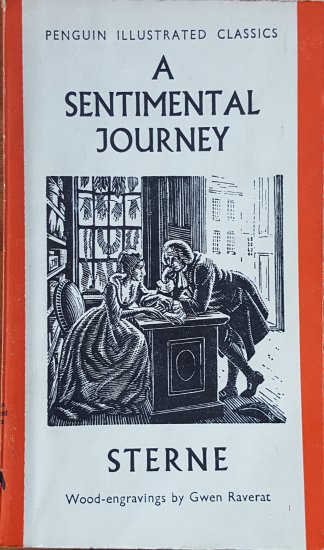
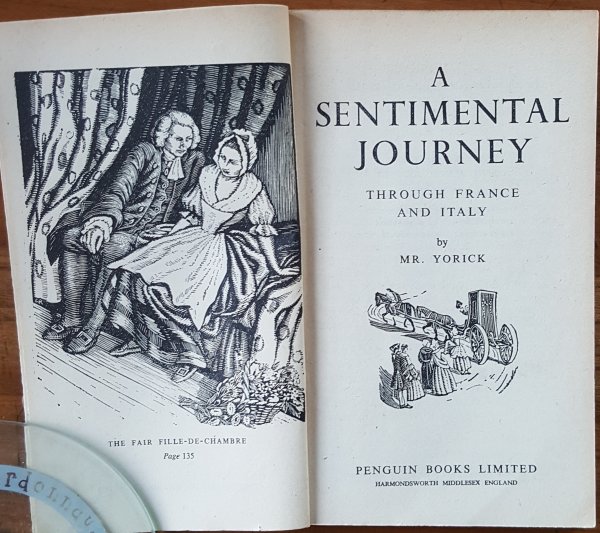
I have two copies of this book on my shelves, both there due to them being parts of separate book collections rather than a desire to own a copy of the novel but it did feel that it was time to tackle the book as it is regarded as a classic of English literature. That this is so is attested by the fact that the Folio Society edition I have read is only the fourteenth title produced by that publisher and came out in 1949. The other copy I have is from 1938 and was part of the ten books published by Penguin as Illustrated Classics which were their first attempt at a series of illustrated books, just three years after they started publishing. That two major publishers should select it so early in their existence suggests how much both companies rated the book and both editions are beautiful. The Folio Society copy is illustrated by Nigel Lambourne in lovely drawings that match well his cover design, see the picture of Maria further down this essay. The Penguin edition, in common with the other nine volumes published simultaneously, uses wood engravings in this case by a master of that art form Gwen Ravarat.

20190924 Sentimental Journey 2

And so to the tale itself… Well I have to admit that of all the books I have read so far for this blog this was the one I struggled with the most. Even though it is quite short (less than forty thousand words) it has taken over three weeks to read it as I kept putting it down after a few pages. Both the Maupassant short stories and The Pillow Book by Sei Shōnagon have been read and written about whilst I worked my way through A Sentimental Journey. There are two main reasons for this, firstly I couldn’t get on with Sterne’s style of writing and secondly it really needs a significantly better knowledge of French than I have so I have had to pause to translate sections before continuing if I really wanted to make sense of the narrative especially in the case of a letter which is important to the story but which is entirely in French. A random sample of the text, where Yorick (Sterne’s alter ego in the story) employs a servant is below.

La Fleur had set out early in life, as gallantly as most Frenchmen do, with serving for a few years; at the end of which, having satisfied the sentiment, and found, moreover, That the honour of beating a drum was likely to be its own reward, as it open’d no further track of glory to him,—he retired à ses terres, and lived comme il plaisoit à Dieu;—that is to say, upon nothing.

—And so, quoth Wisdom, you have hired a drummer to attend you in this tour of yours through France and Italy!—Psha! said I, and do not one half of our gentry go with a humdrum compagnon du voyage the same round, and have the piper and the devil and all to pay besides?  When man can extricate himself with an équivoque in such an unequal match,—he is not ill off.—But you can do something else, La Fleur? said I.—O qu’oui! he could make spatterdashes, and play a little upon the fiddle.—Bravo! said Wisdom.—Why, I play a bass myself, said I;—we shall do very well.  You can shave, and dress a wig a little, La Fleur?—He had all the dispositions in the world.—It is enough for heaven! said I, interrupting him,—and ought to be enough for me.—So, supper coming in, and having a frisky English spaniel on one side of my chair, and a French valet, with as much hilarity in his countenance as ever Nature painted in one, on the other,—I was satisfied to my heart’s content with my empire; and if monarchs knew what they would be at, they might be as satisfied as I was.

Another problem I had was the references to Tristram Shandy (which I have not read) including a whole section near the end of the book where Yorick goes off to comfort one of the characters from that novel thereby further muddying the narrative of this supposed travellers tale unnecessarily.

alas! I have but a few small pages left of this to crowd it into,—and half of these must be taken up with the poor Maria my friend, Mr. Shandy, met with near Moulines.

The story he had told of that disordered maid affected me not a little in the reading; but when I got within the neighbourhood where she lived, it returned so strong into the mind, that I could not resist an impulse which prompted me to go half a league out of the road, to the village where her parents dwelt, to enquire after her.

’Tis going, I own, like the Knight of the Woeful Countenance in quest of melancholy adventures.  But I know not how it is, but I am never so perfectly conscious of the existence of a soul within me, as when I am entangled in them.

The picture of the distraught Maria from the Folio edition is below.

20190924 Sentimental Journey 3

Enough of the negatives however, I persevered with the book rather than abandoning it because hidden behind the irritating (at least to me) overly stylistic writing is actually a pretty good story if only the first part of it. Laurence Sterne had indeed travelled through France and Italy in 1765, which was a couple of years after the Seven Years War had ended and he sets the story with Yorick making a similar trip but earlier so the conflict is actually still in progress. That it has no impact on his ability to travel through the country other than the need to get a passport authorising the journey, something Yorick had neglected to do before setting out thereby creating part of the story as he endeavours to obtain such a document before the police catch up with him, is surprising to modern readers. Although the title implies that this is a travel book do not expect any descriptions of places, rather it is a tale of his interactions with the people he meets, especially the ladies, and that is what makes it A Sentimental Journey.

20190924 Sentimental Journey 4

If you wish to read the novel for free then it is available on Project Gutenberg by following this link.

The Unadulterated Cat – Terry Pratchett

20190903 The unadulterated cat 1

One of Terry Pratchett’s least well known books, The Unadulterated Cat is an odd mix of cat lovers companion, a parody of the Campaign for Real Ale, and a heavy dose humour about the joys (or otherwise) of owning a cat. It is illustrated by Gray Jolliffe whose style completely fits in with the text and as discussed below is one of the reasons why I would recommend the later editions over the first. So what is it all about then? Well the opening lines give a pretty good guide.

Far too many people these days have grown used to boring mass-produced cats which may bounce with health and nourishing vitamins but aren’t a patch on the good old cats you used to get. The Campaign for Real Cats wants to change all that by helping people recognise Real Cats when they see one.

Hence this book.

The Campaign for Real Cats is against fizzy keg cats

That last line is a definite reference to CAMRA which as an organisation prefers ‘proper’ cask conditioned ales over anything in a pressurised keg. That used to a reasonable position but nowadays a lot of craft brewers are producing some wonderful keg beers. However on with the review, or at least Pratchett’s idea as to what a Real Cat is…

For example: real cats have ears that look like they’ve been trimmed with pinking shears; real cats never wear flea collars… or appear on Christmas cards… or chase anything with a bell in it; real cats do eat quiche. And giblets. And butter. And anything else left on the table, if they think they can get away with it. Real cats can hear a fridge door opening two rooms away…

Anyone who has ever owned a cat, or gained a cat they didn’t intend to, or indeed have been owned by a cat will recognise most, if not all, of the situations described in the book. Just a selection of chapter titles will give a feel for what is covered.

  • How to get a cat
  • Types of cat
  • Naming cats
  • Illnesses
  • Feeding cats
  • Training and disciplining the Real Cat
  • Games cats play
  • Schrodinger cats
  • The cat in history

etc.

That types of cat includes ‘Black cats with white paws’ and ‘Boot faced cats’ is a hint that this is not a book that regards pedigree highly. Training cats is also not something that can be done well apart from using a litter tray anyway as Pratchett points out

You think it’s the cat turning up obediently at the back door at ten o’clock obediently for its dinner. From the cats point, a blob on legs has been trained to take a tin out of the fridge every night.

If you have a sense of humour and own a cat, or frankly even if you don’t then read this book, it will definitely give you a laugh.

20190903 The unadulterated cat 2

Note of variations between editions

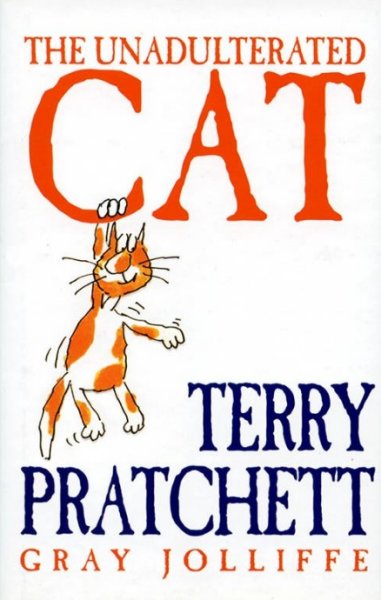
I have two distinct versions of this book. The original first edition was a paperback published by Victor Gollancz in 1989 and is shown at the top of this review. I also have the first hardback edition, also published by Victor Gollancz, but not until 2002, pictured above, and this, along with two intermediate paperback editions, Gollancz in 1992 and Vista in 1997 are all described as ‘revised editions’ so what is different?

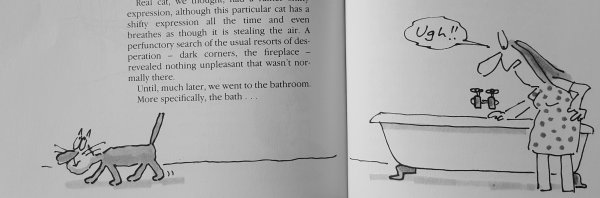
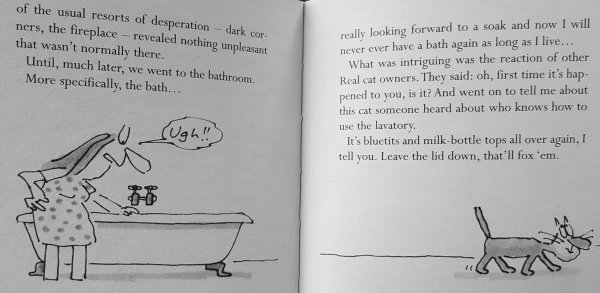
Well the initial obvious difference is the covers and the sizes of the two books I have, the first edition is 242mm tall by 172mm wide and the revised hardback is 185mm by 120mm. Partly due to this size differential the first edition is 96 pages as opposed to the 159 pages in the hardback. It appears the text is unchanged, unless there are minor corrections that I haven’t spotted, but the illustrations are significantly different between my two editions. There are a lot more of them in the later edition, which also adds to the page count, and those carried over from the original are sometimes in different places in relation to the text. There is one example of a mirrored version being used. Original version of what can happen if you accidentally leave your real cat in the house when you think it is outside is first.

20190903 The unadulterated cat 3

20190903 The unadulterated cat 4

Another where the text is amended, apparently to clarify a joke that I think was already quite clear, original to the left

And two illustrations are dropped altogether, along with the front cover of the original which didn’t make it into the revised edition. In the first case the mink coat cartoon was replaced

In the second example there is no illustration at this point in the text in the revised edition.

20190903 The unadulterated cat 9

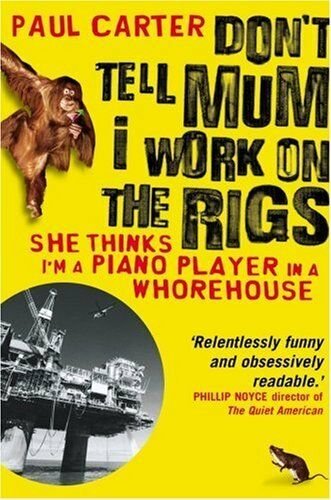
Don’t Tell Mum I Work on the Rigs – Paul Carter

Or to give the book its full title “Don’t Tell Mum I Work on the Rigs: She Thinks I’m a Piano Player in a Whorehouse”. A series of real life stories of life on oil rigs around the world in some of the most dangerous places you could ever hope not to go to.

20190709 Don't tell Mum I work on the Rigs

Carter has written a really funny summary of some of his exploits in fifteen years working on oil rigs around the world and the scrapes he has got into whilst doing it. The book has a prologue with an extract from chapter nine which has him in business class on a scheduled flight from Port Moresby in Papua New Guinea; unfortunately with Amoebic Dysentery which strikes just after take-off. Now there is definitely nothing inherently funny about an explosive attack of dysentery, especially in a crowded aeroplane, but the way he writes about it is so vivid that you cannot help laughing at the situation.

The first chapter relates to his childhood and initial links to oil, He had a rough time in his early years with a domineering father who was in the RAF, eventually his mother left him taking the two children with her. She moved the family to Aberdeen and got a job in the oil industry where she would meet her second husband and subsequently got posted to Australia which is where Carter spent his adolescence and eventually some dead end jobs but he wanted to work on rigs. Ironically after his father left the RAF he also started working on rigs and Carter would sometimes meet people who had worked with him. As he says the work is all over the world but the actual people doing the work form a surprisingly small community and there are regular characters that keep turning up no matter where he is working.

In amongst the stories about offshore and land rigs, crazy holding accommodation and the horror stories you also get to learn a little about the oil business and definitely a lot about why being involved may be lucrative but also extremely dangerous. Carter has worked on all sorts and after proving his abilities has been freelance for four years at the time he covers in the book. He is obviously good enough at what he does to be wanted by numerous companies no matter what type of rig is involved.

20190709 Don't tell Mum I work on the Rigs 2

We go on a bounce around the world starting in Australia with a land rig in the Western Australia goldfields back in the early 1990’s where he learnt the trade as a labourer, or roughneck, and worked his way up and then mainly in the Asian oilfields. Apart from the dysentery, and the local wildlife trying to kill you this was relatively safe until it got to time away from the rig when men who work in a dangerous and frequently deadly job chill out by doing dangerous and sometimes deadly ways of not being at work. The wilder the country the more dangerous it was, not just from the locality but also the often poorly maintained equipment such as ancient helicopters.

Every time I read Upstream, an oilfield newspaper, there’s an article like this

Bumfuck Nowhere: all nine passengers and crew died yesterday, when a twelve seater Sikorsky helicopter operated by Doom Air crashed in a really big ball of flames shortly after take off from Bumfuck Nowhere regional airport. Witnesses say the helicopter fell for, oh wow, ages before vaporising into the jungle at 1592 miles an hour.

He also worked the Gulf and South America but the stand out awful places were Russia which  was cold, so very cold and really primitive and worst of the worst Nigeria which was so dangerous to work in that getting out alive was regarded as a bonus. Nowhere in Nigeria was without armed guards when not on the rig especially on the trip to and from the airport, his two predecessors for the job he had there had both been killed by fake taxi drivers before they had even made it to the camp for the first time.

But it’s not just about the oilfields you also get the ups and downs of his personal life and the surprising sideline he ended up doing which was in advertising in Sydney in his downtime between jobs. This is probably what honed his way with words and makes the book such a pleasure to read.

This is not a book for the easily shocked or offended, but you probably guessed that from the prologue so at least you have been warned. I loved it and need to get his follow up “This is Not a Drill”

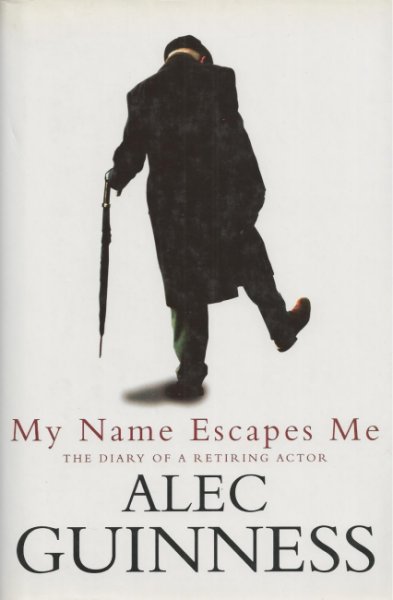
My Name Escapes Me – Alec Guinness

20190528 My Name Escapes Me

Subtitled “The diary of a retiring actor” this book takes us from the 1st January 1995 to the 6th June 1996. 1995 is treated rather episodically with large gaps in the diary but there are much more frequent entries for 1996 at least as far as that year goes. The book is quite a gentle read, ideal for a quiet afternoon where you just want something to entertain rather than educate. Guinness is in his eighties by the time he wrote this and effectively has retired although he does do a couple of very small parts for films and a short voice-over during the 18 months of the diary.

There are the expected reminiscences scattered through, not just of stage and screen but also of his conversion to Roman Catholicism forty years earlier. Through most of the book his wife Merula is having problems getting about leading to hip surgery and a long slow recovery and he clearly dotes on her, with various changes of plan wrapped around her current health. He is an inveterate name dropper and chides himself several times in the diary for long convoluted stories he tells at dinner parties probably boring everyone else in the process, a habit Merula sometimes curtails by commenting, with the punchline that he is slowly working up to, during the story. People expect actors, especially ones of his seniority, to be able to talk in public but Guinness is quite clear several times that having him give a speech is doomed to failure from the start, it always has been and age has not improved his ability.

One running commentary relates to the Star Wars films and the fan mail, usually with photographs they want signing that he gets all the time.  As in this entry from 16th December 1995 which gives a good flavour of the style of the book.

Today I have felt querulous. Behaviour has been spiky; largely due, I think, to our affable postman dutiful pushing piles of junk mail through the letterbox daily. It gets worse near Christmas. The rubbish, the charity appeals (often in duplicate) and worst of all, the photographs from Star Wars demanding autographs. They mostly come from America and as often as not enclose a stamped addressed envelope – the stamps being US stamps are useless her. The English usually make their demand without photograph, envelope, stamp or money. The nation has got acclimatized to asking something for nothing. Bills in the post are welcome in comparison. It’s mean and hard of me but from 1 January 1996 I am resolved to throw it all in the waste bin unopened (bills excepted, of course); I no longer have the energy to assist teenagers in their idiotic, albeit lucrative, hobby.

He makes a good point here, that a lot of the signed pictures are probably destined for Ebay or some such autograph trading site, where they would make a significant profit for the person who sent them and that is the reason for the contact in the first place. This is something that Sir Terry Pratchett was also somewhat wary of, threatening to sign any book where no dedication was requested “To Ebay purchaser”. Terry does actually make a slight appearance in the book in the 13th June 1995 entry where Guinness praises the Jungle Quest episode from the previous night which featured Terry and his PA Rob in Borneo with Orang Utans.

The diary ends on the 56th birthday of their son Matthew (also an actor) soon after a much needed holiday at Lake Como, not just to mark his birthday but also the anniversary of the Normandy invasion in 1945. Guinness was in the opposite side of Europe, in Italy, at the time having taken part in the attacks on Sicily and Italy several days before, designed not only to take that area but also to divert German military forces away from Dunkirk.

It’s a good read, if a little light, and has an excellent index which reveals that Alan Bennett is mentioned twelve times, The National Theatre four times whilst the National Lottery gets five. Shakespeare or his plays are name checked forty five times whilst the second highest is his wife Merula at twenty nine (although much longer entries) and third comes dogs at twenty one times. I think this says a lot for his priorities. Sir Alec Guinness died in August 2000 and Merula only lived another couple of months afterwards.

The Plagiarist in the Kitchen – Jonathan Meades

I first came across Jonathan Meades through his highly idiosyncratic TV documentaries where he was always dressed as shown on the cover of this volume, all in black with black sunglasses. He would talk direct to the camera whilst totally ignoring something going on behind him or alternatively somebody else would be talking to the camera and he would appear in the background apparently having little connection to what was being said. The films looked spontaneous precisely because they weren’t, everything was tightly scripted and performed with an artifice unique to Meades. The person on screen was not Meades as he really was it was Meades acting a character of himself and presenting the sort of intelligent TV that rarely gets made today. I later found out that The Times newspaper had employed him as a restaurant critic for fifteen years so seeing that in 2017 he had written a cookbook made searching that out imperative. How would the Jonathan Meades I knew and loved from his many programmes approach cooking. The answer, it turned out, was uniquely and also filled with his dry wit, in short exactly as I hoped.

20190521 The Plagiarist in the Kitchen 1

Meades explains the title by stating that all recipes are theft, they all come from somebody, even if you add to or alter them in some way, there is really only so many ways to cook something and they have all been done. This is more than a cookbook it is a cookery philosophy and also assumes that the reader has an understanding of cooking in that a lot of the recipes don’t actually have quantities to the ingredients. The only times that quantities are given is when it is essential to get the balance right such as avoiding a sloppy batter, or getting the right balance of flavours such as with gayettes (French style faggots). Other than that there may be hints, such as don’t use too much celery or carrot in a mirepoix because both can dominate. Some of the recipes can barely be called such.

20190521 The Plagiarist in the Kitchen 2

Simplicity is everything. But when he needs a more complex approach it can also be found here, cassoulet for instance takes four pages, most of which is actually involved with cooking the dish.  What you definitely do get is a healthy dose of advice, such as his instructions for making risotto.

What you do with the rice is more important than where it comes from
What you do is keep patient
What you do is stay put whilst it’s cooking
What you don’t do is slip outside for a gasper with the other snoutcasts
What you don’t do is include wine. It adds nothing

Do not get carried away stirring, cooking is not therapy

One of the joys of the book are Meades epigrams, which can be pearls of wisdom or just plain funny. Just a few from the section on oils will give a flavour of what to expect

  • Extra-virgin might be a desirable quality in nuns … but applied to olive oil it is close to meaningless
  • Various degrees of chastity have spread to other oils
  • Duck fat – Much cheaper than goose fat and virtually indistinguishable.
  • Toasted sesame – Asian dishes are for consuming, not for preparing. It is futile to steal what you can’t understand
  • Beef dripping – Delicious on toast … Good for chips and Yorkshire pudding and anything else that comes from north of the Trent

20190521 The Plagiarist in the Kitchen 3

The recipes are definitely practical and I will certainly be cooking a few with the exception of the fig and ham tart which ends

Leave to cool
Taste
Chuck in bin

This was Meades attempt a creating a dish and as he says the reasoning behind it appeared sound at the start but…

Only the doltishly insentient, the immemoriously recidivist, the sociopathic and the smug regret nothing. I no doubt belong, in this instance, to one of those unhappy categories by not regretting having invented this dish. I do not regret it because it was a warning. Never create when you can steal. Never enter a restaurant that advertises its ‘cuisine d’auteur’ or ‘creative cooking’.

But definitely do read this book.