White Horses – Eric Ravilious

20190409 White Horses 1

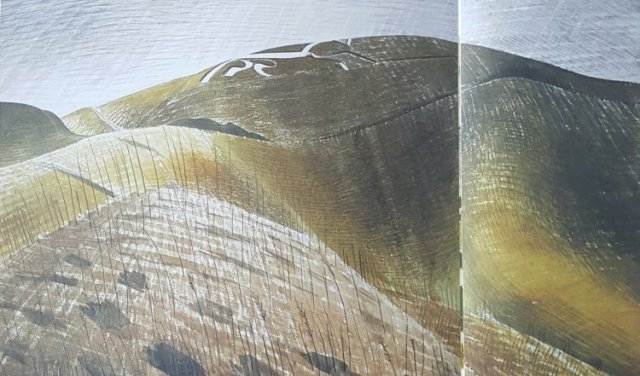
Puffin Picture Books, an imprint of Penguin Books intended for children, started in December 1940 and ran until March 1965, although by then you were lucky to get one new title a year. In all 119 titles were published out of 120 that were given numbers, the missing title was 116 assigned to Life Histories by Paxton Chadwick and this was eventually printed by the Penguin Collectors Society in March 1996 under the guidance of Steve Hare. The story of the series appeared to be complete, but there were in the archives references to other titles that never even got as far down the path to publication that Life Histories had. One of these was Eric Ravilious’s White Horses. The beautiful watercolours of chalk figures and hills on the English chalk Downs intended for the book did exist but there appeared to be nothing more.

20190409 White Horses 4

Ravilious had been approached by Noel Carrington, editor of the Puffin Picture Book series to produce illustrations for a thirty two page landscape book of Downland figures back in 1939 and he was originally very enthusiastic about the project working of watercolours straight away. By the beginning of 1941 he had produced a dummy which showed the planned layout but by then commitments to the War Ministry left him no time to do more. Sadly on 28th August 1942 Ravilious was killed in an air crash whilst working as war artist in Iceland, the dummy of Downland Man (as Carrington referred to it)  disappeared and the planned book appeared to have died with him.

The story leaps to 2010 and the rediscovery of the dummy tucked away with other papers in the possession of Roland Collins. This critical evidence is now held at The Wiltshire Museum in Devizes and it is with their permission to make use of the document that the book I now have in front of me exists. Step forward Joe Pearson, owner of a small printing company in London, book and illustration collector and Penguin Books expert.

20190409 White Horses 2

Design For Today has, since its launch in 2015, already built up a reputation for producing fine examples of illustrated books based on Joe’s love of mid 20th century design, either reprints or more often using contemporary artists as inspired by the period as Joe is. As their website says…

Design For Today’s artists’ books are all designed, crafted and printed in the UK, using quality, sustainable materials and printed using the traditional processes of lithography, letterpress, screenprint, or linocut.  Editions are small, from 500 – 1500

Joe had been hinting throughout 2018 that White Horses (as Ravilious titled the dummy) was a project he was working on; with Alice Pattullo commissioned to produce the black and white illustrations needed to complete the artwork as Ravilious had only ever done the colour pictures and Puffin Picture Books are a mix of both. The text of the final book is by Joe himself.

On the 31st December 2018 disaster struck, as the warehouse holding all of DFT’s stock, along with part of Joe’s own book collection and personal items, was burnt to the ground and nothing could be saved. White Horses is the first book to be launched after that loss of all of the back stock from the first years of the business and members of the Penguin Collectors Society are to receive a copy of the standard edition with their June mailing.

My copy of the limited edition version, which also includes a signed A3 print of one of the pictures by Alice, arrived the other day and it is an excellent piece of work not just well printed as I expected having quite a few of DFT’s products already, but entirely in the spirit of the Puffin Picture Book series.

20190409 White Horses 3

The double page spread above shows the sort of village that the creators of the earliest chalk carvings would have lived in at about 1500BC and this is the illustration that comes as the print with the limited edition book. The limited edition appears to have sold out already but standard copies of this beautiful book are available for £15 plus postage from Design For Today, anyone who like me loves Puffin Picture Books and/or the works of Eric Ravilious is sure to want one.

Storm – George R Stewart

Way out here they got a name
For rain and wind and fire
The rain is Tess, the fire’s Joe
And they call the wind Maria

Maria blows the stars around
And sends the clouds a-flyin’
Maria makes the mountain sound
Like folks were up there dyin’

Maria, Maria
They call the wind Maria

Lyrics from probably the best known song from Paint your Wagon, the 1951 musical by Alan Jay Lerner and Frederick Loewe and the song was inspired by the book that is the subject of this review. For Stewart names his storm Maria and gave rise to the whole idea of naming cyclones and hurricanes. In a later edition Stewart addresses the issue of how to pronounce Maria, originally he was thinking of Ma-Ree-Ah but changed his mind as he though she needed the harder sound of Ma-Rye-Ah so Lerner and Loewe were correct in rhyming the name with ‘fire’. Maria is very much the heroine of the book, to such an extent that the usual disclaimer at the start of a novel is in this case:-

The characters of this book – including Maria – are imaginary.

The book was first published in 1941 by Random House in the US, my copy is the Fighting Forces Penguin Special numbered S238 printed in June 1944 part of a series of books printed for American troops during WWII in a collaboration between The American Infantry Journal and the British Penguin Books. Almost all of the titles from this joint venture were factual and dealt with aspects of the war such as aircraft recognition, army handbooks, military history and exploits during the conflict. There were a total of three novels included though

  • S211 The Good Soldier Schweik by Jaroslav Hasek
  • S219 The Moon is down by John Steinbeck
  • S238 Storm by George R Stewart

An excellent selection of titles and one I will probably come back to in future articles for this site.

20190226 Storm

The structure of the novel is unusual, there are twelve chapters, one for each day of the storm and within the chapters there are numbered sections each of which follow a particular group of characters. These range from the meteorologists, to the telephone company repair crews, the dispatcher at air traffic control, railway workers and for myself the most interesting group which is the snow plough crews charged with keeping route 40 over the Donner Pass clear of snow.  Theirs is probably the best written story in the book and you really get to feel for their struggle to keep the road open. There are also various groups of travellers on roads, ships and trains that we keep track of and sometimes a section just deals with one incident on one day so we never hear of the characters involved again. Some of these people survive the storm, some don’t, but we follow their story in their own episodes as the book progresses, it’s like watching numerous daily soap operas before the days of binge-watching where you have to wait until the next day to find out what happens but meantime here is another story to keep track of. At the peak of the storm, through days six to nine, there are fourteen or fifteen separate stories being told in this manner for each day.

Stewart casually mentions small incidents at the beginning of the book that later become major hazards like a piece of wood falling off the back of a lorry, or somebody shooting at a junction box for a bit of fun and these later on are shown to have consequences far beyond their initial triviality. Likewise we follow Maria from a small squall off the coast of Japan across the Pacific and see her interacting with other weather systems some of which divert her route others of which strengthen and then after twelve days ultimately destroy her. During the time she gives birth to other storms and affects places right across North and Central America. One issue with the book is that in order to make sense of it you really do need a good functional knowledge of the geography of the US to follow what is going on and this may be one reason for the apparent lack of an edition in print at the moment. Fortunately I have travelled extensively across America so do know the relationship between most of the places mentioned but it could be confusing if you don’t have that knowledge. The book was a best seller in the 1940’s and 50’s so it’s a pity that it is now largely forgotten especially considering its two influences on contemprary culture beyond the books own boundaries.

As stated at the start of this blog when Stewart decided to have one of his characters (the Junior Meteorologist) name the storm this was not something that was done at the time. The JM, as he is referred to throughout the book, is somewhat ashamed of his habit of naming storms and when halfway through the story he accidentally calls the storm Maria whilst talking to his boss he is mortified. His boss however quite likes the idea and the book is cited as the main influence on the decision of the United States Weather Bureau to start naming storms using women’s names in 1953. Maria was not part of the original series of names but was added in tribute to the book and is now officially retired after Hurricane Maria killed over 3000 people in 2017.

As for its impact on music you can hear Bryn Terfel singing They Call the Wind Maria by clicking here.


Daphnis and Chloe – Longus

It wasn’t long after starting reading this short book that I really wanted to slap both the protagonists. It’s a love story starting with two orphan babies that are separately found on the island of Lesbos with mysterious items that imply some history or maybe a fate from the gods for them however this seems to be largely forgotten as the story progresses. The two children are raised by families a short distance apart and Daphnis ends up as a goatherd whilst Chloe is a shepherdess and they grow up looking after their flocks together and slowly fall in love. What made them so frustrating though was their total naivety regarding sex, they look after goats and sheep for goodness sake surely they have noticed something over the years?

The book was written around 200AD, presumably on Lesbos, by a writer called Longus about whom nothing at all is known. There appear to be no other works by him and he has left no trace in history other than this short novel. Nobody even knows if Longus was his name or a even a real person or just something that has become attributed to the story. Through the tale the two of them suffer various calamities from being abducted by an invading army (Chloe) to falling in a pit dug to catch wolves (Daphnis) as they slowly progress from looking at the other one naked and getting all soppy (both of them) to trying kissing (oh this takes them ages to get round to) and very slowly finding out about sex (again both as it’s that sort of book)

20190129 daphnis and chloe 1

The main reason that I chose to read this though was to look again at translation and how styles have changed over the decades and this book is the only one where I have two different translations both printed by Penguin books but 55 years apart and where both translations are still in print. Above is the cover of the 2011 translation by Phiroze Vasunia when it was separated out as a single book in 2016 and below the original 1956 translation by Paul Turner.

20190129 daphnis and chloe 2

In ‘The Penguin Classics Book’ by Henry Elliot (review to come later) he writes

The 1968 reprint of Turner’s translation carried a notice “Former Penguin editions of this third century Greek novel, the prototype for all Arcadian love stories were we regret to say bowdlerised. Paul Turner has added the missing passages for this new edition on which the text is unexpurgated”

Now as I only have the 1956 original I cannot say what was put back in for the edition of 1968 but frankly the tale is not exactly controversial, certainly by today’s standards. In stating that I have to assume that the 2011 edition is not similarly censored but I cannot imagine that it would be. As I said at the start the story is so unrelated to sex that it defies belief for a large part of the book.

Along the way through the story they get increasing bad relationship advice, partly from men who want to have Chloe themselves and would be very happy to see Daphnis out of the way. It’s not really a give away to tell you that they do eventually get together, in the last few pages of the book and even their original parents are also revealed at this time. It is almost certainly the first example of a romance story and something that Mills and Boon would be very happy with nowadays, there are even pirates…

A Christmas Carol – Charles Dickens

Scrooge! a squeezing, wrenching, grasping, scraping, clutching, covetous, old sinner! Hard and sharp as flint, from which no steel had ever struck out generous fire; secret, and self-contained, and solitary as an oyster. The cold within him froze his old features, nipped his pointed nose, shrivelled his cheek, stiffened his gait; made his eyes red, his thin lips blue; and spoke out shrewdly in his grating voice. A frosty rime was on his head, and on his eyebrows, and his wiry chin. He carried his own low temperature always about with him; he iced his office in the dog-days; and didn’t thaw it one degree at Christmas.

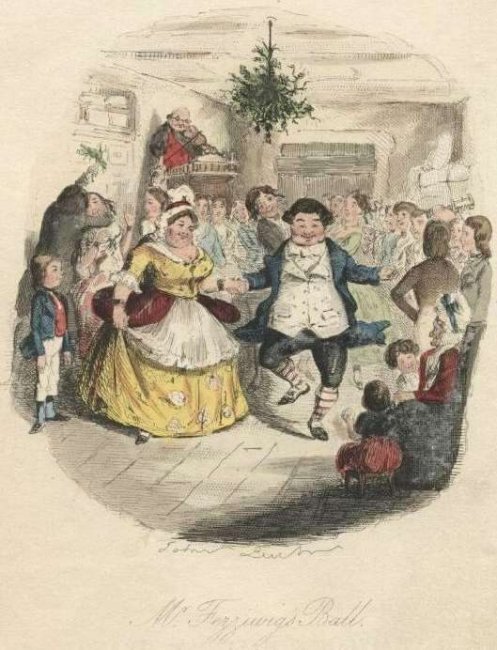
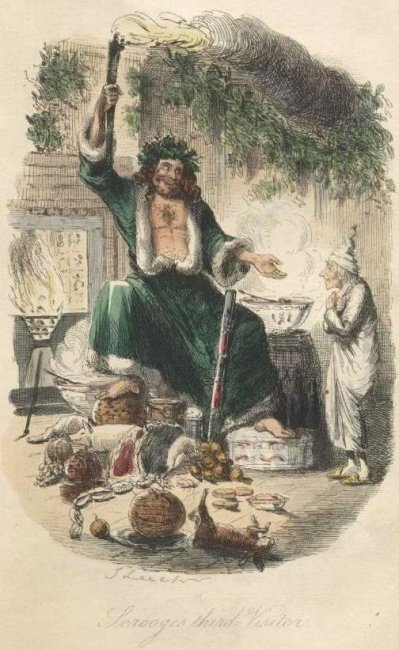
As I post every Tuesday and 25th December 2018 is a Tuesday then there seems only one book that could be covered for the post going live that day. It’s become an annual tradition for me, I read A Christmas Carol every December and usually watch the 1951 Alistair Sim film Scrooge as well, which for my taste captures the flavour of the book best, it is also the most copied sometimes shot for shot in subsequent adaptations. If you want to see it you may need to buy the DVD as they are pretty good at taking down versions on youtube but at the time of writing this was working. It is particularly good at visualising the original John Leech illustrations, each of which are seen within the film. Now it does take several liberties with the original including inventing a character and moving another from one position to another but it does it without messing with the moral of the tale and it can be excused for adding back story to what is actually barely a novella at 28,857 words or just seventy five pages in the classic Nonsuch Press edition in order to make a film.

20181225 Christmas Carol1

It’s not unreasonable to describe Dickens as the father of the modern Christmas, in his five Christmas books if he didn’t actually invent ‘traditions’ he did at least popularise family gatherings with turkey or goose and revived the moribund celebrations that had come to exemplify his time as people moved to the cities and families spread out losing contact. The Christmas tree was introduced to the UK from Germany by Prince Albert but it was Dickens referring to it in one of his other Christmas books and Leech’s etchings of fir branches decorating the house for the Ghost of Christmas Present that really spread the idea. The hale and hearty feast, the family gathering and the spirit of Christmas (dressed in green as this is before Coca Cola turned things red) a roaring fire and welcome to all, this is what Dickens has given us.

20181225 Christmas Carol2

This isn’t an attempt to review the book, pretty well everyone knows the story and if you don’t you can read it for free on Project Gutenberg. The tale of a miser who comes to understand what Christmas is all about with the assistance of the ghost of his business partner and three spirits representing the past, present and future is the quintessential story for this time of year. The tale of why those that can help others should help others, especially at this time of year is one that bears regular retelling. I have two copies, one is the King Penguin edition which makes a good attempt to look like the original edition and I also have the Duckworth Press volume of all five Christmas Stories.

The original book was published 175 years ago today as I write this, coming out on 19th December 1843 and had sold out by Christmas Eve, it went on to be published in ever increasing numbers but Dickens never made much money from the printed editions. The printing cost was too high for the retail price that Dickens himself insisted on for him to make anything much. It was only when he took it to theatres and read the book as a performance that he started to cover the costs and actually profit from his work.

There is no better way to finish than as Dickens himself ended A Christmas Carol

He became as good a friend, as good a master, and as good a man, as the good old city knew, or any other good old city, town, or borough, in the good old world. Some people laughed to see the alteration in him, but he let them laugh, and little heeded them; for he was wise enough to know that nothing ever happened on this globe, for good, at which some people did not have their fill of laughter in the outset; and knowing that such as these would be blind anyway, he thought it quite as well that they should wrinkle up their eyes in grins, as have the malady in less attractive forms. His own heart laughed: and that was quite enough for him.

He had no further intercourse with Spirits, but lived upon the Total Abstinence Principle, ever afterwards; and it was always said of him, that he knew how to keep Christmas well, if any man alive possessed the knowledge. May that be truly said of us, and all of us! And so, as Tiny Tim observed, God bless Us, Every One!

Hedda Gabler – Henrik Ibsen

The first thing you notice when you pick up Hedda Gabler is that there is no character of that name in the cast list. Gabler was her maiden name but at the start of the play she is just returning from honeymoon having married Jörgen Tesman so she is referred to in the cast as Hedda Tesman. As Ibsen himself wrote:

The title of the play is Hedda Gabler. My intention in giving it this name was to indicate that Hedda as a personality is to be regarded rather as her father’s daughter than her husband’s wife. It was not really my intention to deal in this play with so called problems. What I principally wanted to do was to depict human beings, human emotions and human destinies upon a groundwork of certain social conditions and principles of the present day.

(Excerpt from letter to Moritz Prozor, December 4, 1890)

20181127 Hedda Gabler 1

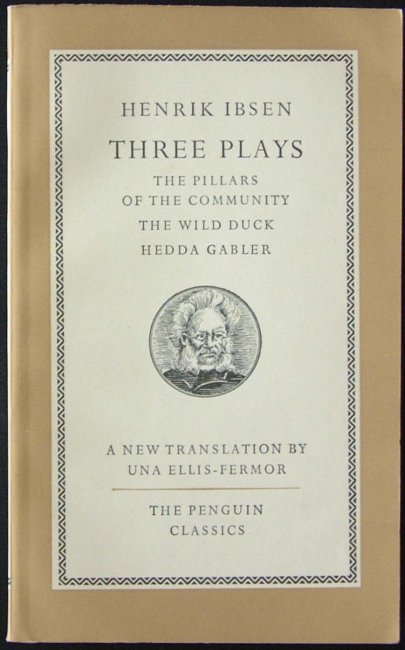
The edition I have read is the Penguin Classic translated by Una Ellis-Fermor printed in 1950, she also translated a further collection of Ibsen’s plays for Penguin in 1958 entitled The Master Builder and other plays. When Penguin came to reprint this 1950 book it was retitled Hedda Gabler and other plays to match the later edition. In both volumes Ellis-Fermor describes the translations as ‘readers versions’. By which she means that although the plays could be performed from her translation her intention was to produce works that a reader would find comfortable to read. One thing I have definitely discovered during this month of reading plays is that although when performed on the stage a play can be a wondrous thing and transport you to worlds of imagination; when you sit and read them they are somewhat less satisfying. They were never intended to be read as literature after all, however Ellis-Fermor has, whilst retaining the structure of a play, made it so it can easily be read as a novella (102 pages in this version).

The play is in four acts all of which take place in the Tesman’s new home which has been purchased and furnished whilst they were away on their six month honeymoon under the supervision of Jörgen’s aunt Juliane. She has even put some of her own money into the purchase when finances became tight. It is clear the Jörgen needs the professorship that is available in order to finance is new life as a married man especially as Hedda appears to have quite expensive tastes. For her part Hedda is already bored of the marriage, Jörgen appears to be more interested in his work and books than her and the ‘honeymoon’ was really an extended research trip. There is a funny passage of dialogue near the beginning of act one where Juliane has clearly planned the layout of the house with two empty rooms to be used as nurseries and children’s bedrooms and Jörgen really can’t understand and thinks they are for his library extension and no matter how she hints at Hedda being possibly pregnant Jörgen just doesn’t twig.

When Hedda does finally appear on stage she is deliberately rude to Juliane and makes it clear that she doesn’t like the way the place has been decorated, Juliane leaves and in her place Mrs Thea Elvsted arrives with news of Ejlert Lövborg, Jörgen’s presumed rival for the professorship especially as he has published a book whilst they have been away on honeymoon. It is at this point that the complex relationships between the characters start to be explained. Thea was in a brief relationship with Jörgen before he met Hedda and she had also been at school with Hedda where she had been bullied by her. Hedda, for reasons of her own makes out that they were school friends and gets Jörgen out of the way to talk about Ejlert who Thea had moved in with after leaving her husband. Thea tells Hedda that she is worried about Ejlert as he has gone back to his old ways (presumably drinking) and that he had been threatened by a previous partner with a gun and she thinks he may meet her again. Hedda reassures her that no woman would do such a thing but as Thea leaves she goes to a cabinet and pulls out her fathers pistols as the first act closes.

Act two begins with Hedda firing one of her guns towards Judge Brack as he comes to visit Jörgen who is out at the time, she is clearly not mentally stable but as the play continues her instability revolves around a desire to totally control somebody else and it seems she is set on it being Ejlert. Whilst waiting Brack makes it clear that he also desires a relationship with Hedda although she is not at all keen on the idea. Jörgen returns and is soon followed by Ejlert at his invitation, once they actually meet Ejlert explains that he doesn’t want the professorship as he has a new book he is working on. Whilst Jörgen and Brack are talking in another room Ejlert tries to renew his relationship with Hedda and she sees that he can be the one she can control. Thea arrives towards the end of the act and the two woman settle down for the evening after Hedda has persuaded Ejert to accompany Jörgen and Brack on their planned night out with him to return at 10pm to escort Thea home.

Act three is set the next morning, both ladies are in front of the now cooling fire, Ejlert obviously didn’t return to take Thea home but when Jörgen comes in he is carrying Ejlert’s manuscript of his new book and is very excited about how good it is. He had seen Ejlert drop it in the street and picked it up but hadn’t returned it as he was afraid he would lose it again. However Jörgen gets a message that his other aunt is dying so needs to leave urgently. Ejlert meanwhile is convinced he has destroyed the book and arrives to tell Thea who is horrified as she had worked tirelessly on the book with him and leaves almost immediately. Ejlert left with Hedda is even more under her spell than when they were a couple and she seeing this as her chance to prove that she can control somebody presses him to commit suicide and gives him one of her pistols before he leaves. Afterwards she burns the manuscript.

The final act is very short and takes place soon after the previous scene. It turns out that Ejlert had gone from the Tesman house to the home of another previous girlfriend and there had died from a gunshot wound to the chest, Hedda thinks he shot himself in the heart (a truly romantic gesture) but no Judge Brack explains to her that the gun appears to have gone off accidentally and that he recognised the pistol thus insuring his power over her. Thea also reveals that she has the original notes from their work together so Jörgen and her start work to reconstruct the lost masterpiece. Knowing that her plans have failed and instead she is the one controlled Hedda retires to the other room and shoots herself which is where the play ends.

Hedda through out the play is depicted as a materialistic, narcissistic character, thoroughly unlikeable but someone who has drawn the three men to her in their own way. Jörgen has a wife who will help him progress in Norwegian society. Brack sees someone he can control and therefore use as he wishes. Only Ejlert Lövborg really loves her but she doesn’t reciprocate this love and he is apparently blind to the love from Thea Elvsted which could have made them both so happy.

At the end of the play you hope that Thea and Jörgen can get together as a couple during their work in resurrecting the lost manuscript. Finding through their shared loss a rekindling of the love they had in the past. Surely something good can come out of the tragedies.

Uncle Vania – Anton Chehov

Or is it Uncle Vanya by Anton Chekhov, that appears to be the more usual spelling at least currently but I have spelt it the way I have in the title to this essay as that is how the Penguin Classics edition of 1959 which I have been reading has it so I will stick with it throughout.

20181113 Uncle Vania 1

The first thing that strikes you reading the play is that for the first two acts Ivan Petrovich Voinitsky, whom his niece Sonia calls Uncle Vania, is largely an ensemble character and it is only in acts three and four that he comes to the front. The first act sets the dynamic tensions between the protagonists. There had clearly been a quiet routine in the house for many years with Sonia and Vania running the estate which had been her mothers dowry when she married professor Serebriakov. Sonia’s mother died some years ago and the professor has now retired to the estate from his home in the city and brought with him his second wife Yeliena who is just 27 years old, between them they have seriously upset the normal running of the household. To make things more complicated Astrov, the doctor who looks after the professor’s gout is attracted to Yeliena as is Vania, whilst Sonia is in love with Astrov. You just know it’s going to get messy and Vania is gloomy about the future as only a Russian can be…

Yeliena – What a lovely day … not too hot either

Voinitsky/Vania  – It would even be pleasant to hang oneself on a day like this…

There are four other characters in the play, all of which play minor roles so beyond the list below I won’t cover their actions.

  • Maryia Voinitskaia is Sonia’s grandmother/ Vania’s mother
  • Ilyia Ilyich Telyeghin was a local landowner but has lost all his money and now lives on the estate.
  • Marina an old children’s nurse
  • A workman – just needed to fill in such as fetching horses etc. when the main characters wouldn’t do such things.

Act two sees the complicated relationships become more strained. The doctor has been summoned but the professor won’t let him see him this means that he is yet again at the house and wants to spend time with Yeliena to convince her to leave the professor. Vania muses to himself that he missed his chance with Yeliena ten years ago

Voinitsky – [Alone] She’s gone! ten years ago I used to meet her at my sister’s house. She was seventeen then and I was thirty-seven. Why didn’t I fall in love with her then and ask her to marry me? It could have been done so easily! She would have been my wife now.

The professor meanwhile is in pain with the gout and frustrated with his existence at the estate where he feels he is wasting his time and doesn’t get on with anyone there.

Serebriakov – After devoting all my life to learning, after growing used to my study, to my lecture room, to esteemed colleagues – to find myself suddenly, for no reason at all in this crypt, to have to meet stupid people every day, to have to listen to their trivial conversation. I want to live; I love success, I like being a well known figure, I like creating a stir of the world, but here I feel an exile. To spend every minute regretting the past, watching others succeed, fearing death. I can’t! It’s more than I can bear.

Meanwhile Yeliena decides to at least try to make up with Sonia and during their talk admits that although she loved the professor when they married she soon realised her mistake but will remain true to him come what may. At the same time Sonia confesses her love for the doctor and asks Sonia to see if she can find out if he loves her.

Things come to a head in act three, Yeliena talks to the doctor about Sonia and he says he doesn’t love her but interprets the conversation as Yeliena using that as an excuse to talk to  him about love. he makes a clumsy pass at her during which he kisses her as she is pushing him away and this is seen by Vania who is just coming into the room at that point. Straight after this before anyone can settle the professor calls everyone together to say that he has decided to sell the estate and buy a villa in Finland for himself and Yeliena. At this Vania explodes with fury, the estate doesn’t belong to the professor but to Sonia and he has given no thought as to where the people who have always lived there might go and it is his family that should decide what to do with the estate as they paid for it

Voinitsky – The estate was originally bought for ninety-five thousand roubles. My father only paid seventy thousand and twenty-five thousand remained on mortgage. Now please do listen! This estate would never have been bought if I hadn’t given up my share of the inheritance in favour of my sister, whom I loved deeply. What’s more, I worked like an ox for ten years, and paid off the whole mortgage.

Serebriakov – I regret that I started this conversation.

Voinitsky – The estate is free from debt and in good condition simply because of my own efforts, and now that I’ve grown old, I’m to be kicked out!

Serebriakov – I don’t understand what you are driving at!

Voinitsky – For twenty-five years I’ve been managing this estate, I’ve been working and sending you money like the most conscientious bailiff you could have, and all this time you’ve never once thanked me for it. All this time – when I was young and now just the same –  I’ve been getting a salary of five hundred roubles a year from you, a pittance! and never once have you thought of adding a single rouble to it!

Serebriakov – Ivan Petrovich, how was I to know? I am not a practical man and I don’t understand anything about these matters. You could have added as much as you liked.

Voinitsky – Yes indeed, why didn’t I steal? Why don’t you all laugh at me now because I didn’t steal. It would have been fair enough and I shouldn’t now have been a pauper now!

The professor leaves the room shortly after this, soon followed by Vania and a shot is heard off stage then both men run into the room and Vania fires again, both shots miss, Vania drops the pistol and collapses into a chair as the act ends.

To be honest act four which is set the next day feels like a bit of a let down after the excitement of act three. It has been decided that the professor and Yeliena will leave straight away. With them going the doctor has no reason to still be there and he also leaves. Vania and Sonia sit down to work on the books of the estate which have been neglected whilst the professor has been there and all returns to how it was before.

I’ve seen the play performed, although that was many years ago, and thoroughly enjoyed it but this was the first time I had read the script. The book contains eight plays in all so I will be reading those later.

The Frogs – Aristophanes

20181106 The Frogs

For November I’ve decided to read a selection of plays and the first one is The Frogs by Aristophanes. Normally I’m not a great fan of Ancient Greek dramas as you need a lot of knowledge of the gods and other characters involved but this translation is so readable I found myself laughing along as I read it. It was written in 405 BC and can be dated so precisely because it was created for drama competition as part of a festival honouring the god Dionysus in Athens where it took first place. Dionysus is one of the Greek gods with lots of jobs, according to the Wikipedia entry he is the god of the grape-harvest, wine making and wine, fertility, ritual madness, religious ecstasy, and theatre and it is in the latter one of these roles that a drama competition in his name becomes obvious.

The play tells the story of Dionysus deciding to travel to the underworld to bring back the playwright Euripedes who had died the previous year in order to rescue the arts in Athens back from the doldrums that he perceives it to be in. The first act sees Dionysus and his slave Xanthias on their journey, initially they visit Dionysus’s half brother Heracles for advice which causes him to collapse with laughter as Dionysus has decided to dress like Heracles with the lion head cloak and club but he really doesn’t have the build to carry off the look. Eventually they persuade Heracles to explain the route he used when he went to get the three headed dog Cerebus and they duly set off. When they meet Charon, the ferryman of the dead he agrees to take Dionysus and this is when he encounters the frog chorus who sing during the crossing. Despite the play being called The Frogs this is the only time they appear in it. After various encounters with people who think Dionysus is Heracles and either hate him for taking Cerebus or love him for it they finally reach the home of Pluto ruler of the Hades.

Act two takes place entirely at the Pluto’s house where they find Euripedes and also another dramatist Aeschylus who had died about 50 years earlier. These two had been arguing for the last year about which was the better writer and should therefore sit with Pluto for meals. Dionysus takes it onto himself to judge a contest between them and they take it in turns to be rude about the others works with the chorus commenting as though it was a fight with each man landing viscous blows on the other. This gives Aristophenes a chance to parody each of the two dramatists styles and throw in his own critical comments on both of them. Eventually Pluto gets fed up and decides to determine the winner via a special set of scales which can measure the weight of an argument. Each man gets to speak one line into the baskets on the scale and they are marked against one another with the scale, to Euripedes’s annoyance Aeschylus wins both attempts by mentioning heavier objects. In the end Dionysus decides to simply ask the two dramatists for advice to save Athens, Euripedes has lots of fine words but Aeschylus has more practical suggestions so instead of having Euripedes brought back to life he decides on Aeschylus. A final parting shot from Aeschylus is to insist that Sophocles should have the seat as the finest dramatist rather than Euripedes.

Translations of ancient Greek and Latin have become far ‘less stuffy’ over the last few decades and this can largely be thanks to Penguin Books who started their series of Penguin Classics in 1946 with the express intent of making the classics more approachable. Compare this extract from the Harvard Classics edition of 1909 which is available on Project Gutenberg, which deals with the god Dionysus rowing across the Styx with Charon and encountering the Frog chorus.  The specific translator is not given for this edition on the site as this was a massive group exercise resulting in 51 volumes of a wide selection of classic works.

FROG CHORUS
   Brekekekex, ko-ax, ko-ax!
   Brekekekex, ko-ax, ko-ax!
   We children of the fountain and the lake
   Let us wake
   Our full choir-shout, as the flutes are ringing out,
   Our symphony of clear-voiced song.
   The song we used to love in the Marshland up above,
   In praise of Dionysus to produce,
   Of Nysaean Dionysus, son of Zeus,
   When the revel-tipsy throng, all crapulous and gay,
   To our precinct reeled along on the holy
   Pitcher day.
   Brekekekex, ko-ax, ko-ax.

 DIONYSUS. O, dear! O dear! now I declare I've got a bump upon my rump.

The same passage from the 1964 translation by David Barrett printed by Penguin and reprinted in the edition I have been reading.

FROGS
   Brekeke-kex, ko-ax, ko-ax,
   Ko-ax, ko-ax, ko-ax!
   Oh we are the musical Frogs!
   We live in the marshes and bogs!
   Sweet, sweet is the hymn,
   That we sing as we swim,
   And our voices are known.
   For their beautiful tone,
   when on festival days
   We sing to the praise
   Of the genial god -
   And we don't think it odd
   When the worshipping throng,
   To the sound of our song,
   Rolls home through the marshes and bogs.
   Brekekex!
   Rolls home through the marshes and bogs.

 DIONYSUS. I don't want to row any more.

 FROGS. Brekekex!

 DIONYSUS. For my bottom is getting so sore.

As you can see the Penguin edition is considerable more ‘lively’ and the translator has almost turned to the poetic structure of the limerick in order to emphasise the comic nature of the play. This is a form that he will return to several times during the translation in some places using the limerick itself. The play is only 110 short pages so I read it in two sittings, the edition is from the Little Black Classics series by Penguin and is one of the most expensive of these books at £2. I’m looking forward to reading more from this series of titles in the coming months.


First Penguin crime set – part 3

20180815 Penguin 10 - part 1

The continuing exercise of reading all ten of the crime novels published by Penguin Books to mark reaching 150 titles. All the volumes I’m reading are the first edition, first impression copies published eighty years ago this month (August 1938). It’s been fun reading these old paperbacks so far and now I have just four to go, for part 1 see here, and part 2 is here. I’m writing this blog as I’m going along so the book is fresh in my mind as I write about it so lets see if I can get through the final four volumes in the coming week.

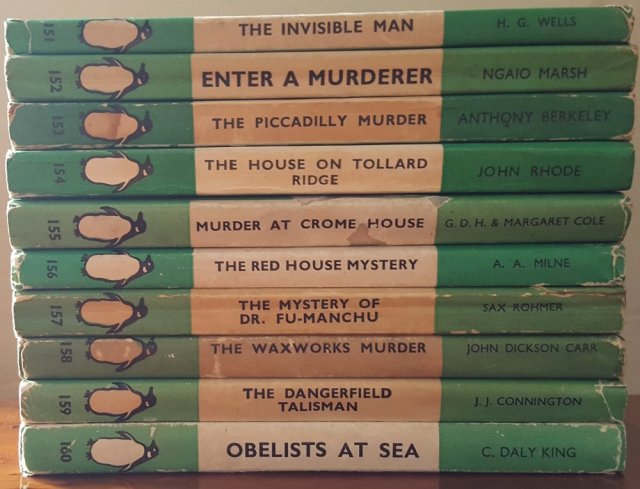
157 – The Mystery of Dr. Fu-Manchu – Sax Rohmer

Before opening this book I should say that this is the one I am least looking forward to. Although I’ve never read any of them the Fu-Manchu stories have never appealed possibly due to childhood memories of bad black and white films which I never watched to the end, or even half way through. Here’s hoping the book is better…

It wasn’t. It was everything I expected and worse, full of casual racism, extraordinary plot devices and ridiculous language I completed it only so that I could write this entry. Hopelessly jingoistic with the white race threatened by the yellow peril as it was regularly put, each chapter seemed to include another fantastical creation of poisons unknown to man, or traps created by mutant puffball mushrooms that react to light or other idiotic suggestions. The book fails on almost every level those rules suggested by A A Milne that I mentioned in the last blog with each time the ‘heroes’ get into trouble or a new murder is attempted yet another ‘fact’ is revealed just to get a solution with no pre-amble to involve the reader in the plot. Even more annoying is the constant xenophobia displayed by Rohmer where anyone who isn’t white is treated as a villain.

The language used also fails Milne’s tests with the servant of the first victim pointing out a way in with “Up yonder are the study windows sir” and the same sort of anachronistic rubbish is put in the mouths of several other characters. Nobody since Shakespeare has ever phrased a statement like that and he would have been writing a poetic play not accurately reporting actual language used.

Frankly avoid Sax Rohmer and I’m astonished to find that he is still in print.

158 – The Waxworks Murder – John Dickson Carr

What a dramatic improvement, Inspector Bencolin of the Paris Sûreté is a wonderful creation of a master of detective fiction. The plot is complex linking two murders of young women, a disreputable club in the area of Pigalle, itself a disreputable district of Paris, and Parisian high society. That an American, living in England, should write five novels about a detective in France is surprising, that they should be so atmospheric (at least on the evidence of this volume) is remarkable.  The Waxworks Murder (US title – The Corpse in the Waxworks) is the fourth Bencolin book, I also have the first (It Walks by Night) in the Penguin edition; however although Penguin published many other detective stories by Carr these mainly feature his best known detective Dr Gideon Fell.

Carr plays fair with the reader, there are lots of clues and as many red herrings, paths to enlightenment and just as many dead ends which makes the book my favourite of the ones so far, you really get a mental workout following the various strands of the plot. That the tension is literally maintained until the final sentence is also a tribute to the skill of the author and I can definitely say that I hadn’t worked out the solution until it was revealed and then as the bits I had missed were explained it all became clear. I loved that we were led by Carr to suspect yet another person in the last chapter before the denoument only to have that apparently logical step demolished by the detective a few pages later.

The tension builds as the book progresses and by the time I reached the last seventy five pages there was no way I was going to put it down until it was finished even though I really needed to be doing something else. I will have to try the Dr Fell stories after I have read It Walks by Night and then the Henry Merrivale tales that he wrote under the name of Carter Dickson. He may be a great mystery writer but he was rubbish at Pseudonyms

159 – The Dangerfield Talisman – J J Connington

J J Connington was actually the Scottish chemist Alfred Stewart who wrote over two dozen novels as Connington and several factual works under his own name. The Dangerfield Talisman is his fourth novel and unlike all the other books I am reading as part of this series it is a case of theft rather than murder that concerns the participants. Apart from that it is a classic British country house case that has been very well written with two separate but linked puzzles to be solved, what is the Dangerfield Secret and where is the Dangerfield Talisman?

What is also a lot of fun is that there isn’t a ‘detective’ figure as such, several of the house guests have a go at solving the problems and manage to rile the others by making unjustified accusations. This is not a gathering you would want to be part of. Having said that I was worried about the start of the book, there seemed to be a lot of interest in bridge (which is a card game I don’t play or even vaguely understand) and then a chess board diagram was added (which looked fairly straightforward but clearly wasn’t if it was to be the basis of part of the story). I had a horrible feeling that these games were going to be highly significant to the plot in which case I would be left without significant clues. In fact you don’t need to know anything about either game, the bridge games stop after a couple of chapters and the chess board only really comes into it’s own towards the end of the novel.  As for who took the Dangerfield Talisman I hadn’t a clue until it was revealed, not that there weren’t hints, just that I had not understood their significance. The Dangerfield Secret and more importantly the solution to it I had worked out though before it was explained.

Connington is definitely worth reading more of, five of his novels were published by Penguin and I have two others. One of the ones I’m missing is his science fiction book Nordenholt’s Million first published in 1923 and which is probably the earliest ecological disaster novel with a bacteria destroying farm crops around the world. Definitely one I’m going to seek out.

160 – Obelists at Sea – C Daly King

Last one… and the first question is what is an ‘obelist’? It turns out that King invented the word and defined it at the start of the book as “An obelist is a person who has little or no value”. Unfortunately when he re-used the word in two more novels “Obelists en Route” and “Obelists Fly High” he redefined it as “one who harbours suspicion”. At least if you are going to invent a word then be consistent. Penguin only printed this one book by C Daly King and at 312 pages of quite small print it’s easily the longest of the ten I have set myself to read, it is now Monday morning and I need to finish the book and complete this review for tomorrows post.

Well the plot was good and the conceal of the murderer was also well done but the writing style made getting through this book hard work. C Daly King was a psychologist and he made his detectives (for there is a group of them on their way to a conference on board the ship) also psychologists, although from differing branches and opinions. This could have worked well but King couldn’t resist putting in pages and pages of psychological exposition which was incredibly dull and just slowed the plot down dramatically. It was all completely unnecessary but you felt you had to read it in case there was a point to any of it. In fact there was virtually no point to the vast majority of this and even other characters in the book were bored of it eventually. But even then, after admitting that it was dull and largely confusing as they simply contradicted each other King couldn’t help himself from making some more pointed remarks about a branch of his own profession.  The book is split into six chapters, an introduction to the crime, one chapter for each of the four psychologists to try to solve it according to their own theories and practice and then a final chapter that finally explains what actually happened and why all four were wrong, although each had grasped part of the solution.

It’s a pity that this was the last of the set to read as it has let me down from the high quality of the previous two but it has been an interesting exercise although next time I set myself to read ten novels in one month I’ll start before the 12th.
First Penguin crime set – part 2

20180815 Penguin 10 - part 1

This continues a marathon reading session of all 10 of these books printed eighty years ago this month. I started late (the evening of the 12th) so I have less than a couple of days to read each book and write a short review. Part 1 covered books 151, 152 and 153 and can be seen here. As I read each book I’ll write a review on this blog and post on Tuesday next week as far as I’ve managed to get.

154 – The House on Tollard Ridge – John Rhode

Before reading this book I knew nothing about John Rhode and apart from a small black and white photograph of a man in late middle age smoking a pipe and a couple of glowing comments regarding his ability from two magazines printed on the dust wrapper there is nothing on the book to give me any idea about him. I decided to finish the book before finding out anything about the author.

The story was quite enjoyable although I was deeply suspicious of the person who turned out to be the murderer very early on in the book and none of the rather obvious red herrings put me off that train of thought as there was really only one person who could have controlled the events as they did. The main oddity of the book was that although it is 248 pages long Rhode’s amateur detective doesn’t appear until page 98 and up until then it reads as though Superintendent King from the local police force is the main character. When Dr Priestley does appear in the book it is only for a short while whilst explaining the case to him gives the author a chance to sum up what he has told us so far and it isn’t until page 172 that Priestley really comes into his own and starts to take apart the case made by Superintendent King. It is also at this point that it becomes clear that this isn’t Rhode’s first book about Priestley as other cases are mentioned, I’m guessing that the only other book by Rhode that was published by Penguin ‘The Murders in Praed Street’ is going to be one of them, I don’t own a copy and won’t be rushing to get it.

Finally looking up John Rhode, he turns out to be the pseudonym of Cecil John Charles Street MC OBE and from his Wikipedia entry he wrote a huge number of detective stories under several pseudonyms so he obviously had a readership in his day but he’s not for me.

155 – Murder at Crome House – G.D.H. and Margaret Cole

Now this should be interesting, I do have other books by G.D.H. Cole but they aren’t fiction, on my shelves are ‘Practical Economics’, ‘Socialism in Evolution’ and a couple of copies of ‘Persons and Periods’. Working with his wife however they jointly wrote crime novels and although I only have this one example and they were nowhere near as prolific as Cecil Street I was already aware of the existence of several other titles before I start reading this one.

Having now finished the book I can say that it is much better written than the previous example and considerably better at hiding the murderer until near the end, The tale is quite complex with more information about each of the possible suspects being revealed piecemeal as you follow the various parallel investigations with up to five people all going down different paths in trying to solve the crime and comparing notes regularly. At one point I had even half thought one of the people apparently investigating the murder was actually involved in the crime himself as each time he reported back his tales as to what had been done became more fantastic. Now that would have been an interesting twist, I wonder if there is a detective novel where the investigator turns out to be the murderer and is covering their tracks by apparently looking into the case?

I don’t have any other crime novels by the Cole’s but they don’t appear to have been ‘series writers’ with each book having different detectives however this is difficult to check as I cannot find any of their 29 joint works still in print. This is also the only one of their works to have been printed by Penguin so I’m not going to come across another as my collection of those increases. It is a pity that they have disappeared, maybe one of their books needs to be included in the excellent British Library series of crime stories that have been largely forgotten nowadays.

156 – The Red House Mystery – A.A. Milne

Yes that A.A. Milne, famous for Winnie the Pooh and the other characters from the Hundred Acre Wood, this is his only crime story and the only book in this block of ten that I have read before this exercise.

The story is well written and the denouement is properly hidden with enough clues to give it away when you re-read the book but not on first reading. Once you know what is happening then you get a different perspective and appreciate how well Milne was trying to help the reader in solving the murder but first time round you can guess but are unlikely to work it out. I loved the book as written by an author who knew how to write and could string his readers along as you slowly but surely reach the solution and the final twist is so good. If any of my readers are looking for a sadly now largely unknown detective novel in the true English country house murder style and have not read The Red House then I urge you to do so.

As a good counterpoint to this reading marathon Milne wrote a really good introduction to the 1926 edition, he wrote the book back in 1922 before he wrote any children’s books and was at the time best known as a playwright (and frankly he would have rather been known that way all his life).

I prefer that a detective story should be written in English. I remember reading one in which a peculiarly fascinating murder had been committed, and there was much speculation as to how the criminal had broken into the murdered man’s library. The detective however (said the author) “…was more concerned how the murderer had effected an egress.” It is, to me, a distressing thought that in nine-tenths of the detective stories of the world murderers are continually effecting egresses when they might just as well go out. The sleuth, the hero, the many suspected all use this strange tongue, and we may be forgiven for feeling that neither the natural excitement of killing the right man, nor the strain of suspecting the wrong one, is sufficient excuse for so steady a flow of bad language.

Of the great Love question opinions may be divided, but for myself I will have none of it. A reader, all agog to know whether the white substance on the muffins was arsenic or face powder, cannot be held up while Roland clasps Angela’s hand “a moment longer than the customary usages of society dictate.” Much might have happened in that moment, properly spent; footprints made or discovered; cigarette ends picked up and put in envelopes. By all means have Roland have a book to himself in which to clasp anything he likes, but in a detective story he must attend strictly to business.

For the detective himself I demand first that he be an amateur. In real life, no doubt, the best detectives are the professional police, but then in real life the best criminals are professional criminals.

He continues in much this vein for a while complaining that a man with a microscope is no detective at least not in fiction because he can see things his readers cannot and also explaining that ‘a Watson’ is invaluable. As perforce a literary detective has to run though the facts as they stand at various points and a conversation is much better than a  speech and far better than everything being sorted out in the last few pages. I have to agree with all of his points and he also manages to ensure that in his only detective story he holds to his principles, it’s definitely the best book so far.

Part 3 of this review is here

First Penguin crime set – part 1

20180815 Penguin 10 - part 1I’m way too late in the month to start to attempt this (as I type this it is the evening of the 12th August) but I added a post to my Instagram feed earlier this month regarding it being the 80th anniversary of the first ‘Penguin 10’ and that I had all the books in first edition, first impression Penguin editions. Penguin Books started publishing in July 1935 and by July 1938 had printed book number 150. To celebrate this they next published ten Mystery and Crime novels in August 1938. This was the first time that all ten books published together were from the same genre although later they would do blocks of ten for the same author as well, most notably the Shaw million where 10 books by George Bernard Shaw were published simultaneously each in an edition of 100,000 copies in July 1946. I then added that I intended to read each of these eighty year old paperbacks the next month and gradually it has dawned on me that reading all of them this month would be more appropriate; so I have nineteen days to read ten novels and write something about them and as they are mystery and Crime stories I’ll be careful to not give away anything. I’ll start reading now and add reviews as I finish each book, so here goes…

151 – The Invisible Man – H.G. Wells

During my teenage years I read a lot of H.G. Wells, not just the famous books such as The Time Machine, The Island of Doctor Moreau, and War of the Worlds but his short stories and even his History of the World in two large hardback volumes so I assume I must have read The Invisible Man back then but I had no memory of it when I came to read it for this exercise. The story had slipped away as easily as the Invisible Man hoped to do. I suppose the many adaptations of the novella on TV and film and the borrowing of the original concept by other writers had also not helped but I was genuinely surprised by the story and the way that it is told. The book effectively starts near the end of the Invisible Man’s tale and the first half of the book is spent with him invisible (and with no explanation as to how this happened) arriving in the small village of Iping in West Sussex and then becoming an interesting and annoying tenant at The Coach and Horses Inn. He is wrapped in bandages and explains that he has been disfigured. From the number of chemical bottles he brings with him it is assumed that he had had some sort of accident whilst doing his research. His obsessive secrecy and short fuse temper soon become a problem and eventually after a few months, with his money running out, he is forced to leave the village but not before causing several injuries and leaving a trail of destruction.

He heads out onto the Downs (open countryside in this part of England) encounters a tramp and forces him to help him as they make their way south towards the coast. Eventually the tramp escapes and warns people about the Invisible Man before seeking refuge at a police station. The Invisible Man finds his way into the home of Dr Kemp, whom he recognises from studying at Oxford and this is where we find out all the back story as to how and why Griffin had become invisible as he introduces himself and tells his story to Kemp. His obvious criminal intent and apparent incipient madness worry Dr Kemp so that he also manages to raise the alarm with the police and the hunt is on…

The book was first written in 1897 however the Penguin edition states that it is from the re-issue of June 1926, I have been unable to find out if this is a revision of the original book or that if for some reason it had been out of print for some considerable time. Although Iping is indeed a real place the other two locations in the book (Port Stowe and Burdock) are both fictional.

152 – Enter a Murderer – Ngaio Marsh

New Zealand’s Ngaio Marsh was considered in her time to be one of the ‘Queens of Crime’ along with Agatha Christie, Dorothy L Sayers and Margery Allingham and is best known for her detective stories featuring Roderick Alleyn of the London Metropolitan police. Enter a Murderer is the second of thirty two novels she wrote about Chief Detective-Inspector Alleyn and is set in a theatre which is an environment very familiar to Marsh as she also worked as a theatre director. The crime is easy to describe, the final scene of the play being performed at the Unicorn Theatre involves one character threatening another with a gun, the gun is dropped when he realises that he cannot hope to escape, picked up by the original person being threatened and in an ensuing struggle goes off killing the original attacker. The gun was supposed to be loaded with dummy shells as it is seen being loaded in an earlier scene and blanks would still cause injury at such close range so in fact another gun is fired with blanks in the wings at the same time as the dummy shot in order to provide the correct noise. This is Marsh showing her theatrical knowledge as presumably she had seen this very trick done on stage. However the dummy shells have been replaced with real ones and the novel then revolves around ‘who replaced the bullets?’

The book is tightly written and numerous plot lines involving various romantic liaisons between the cast and supporting staff at the theatre along with an unresolved drug running episode from 6 years earlier are all interwoven. In the foreword Marsh is apparently consulting her own detective:-

FOREWORD
When I showed this manusript to my friend, Chief Detective-Inspector Alleyn of the Criminal Investigation Department. he said
“It’s a perfectly good account of the Unicorn case, but isn’t it usual in detective stories to conceal the identity of the criminal?”
I looked at him coldly.
“Hopelessly vieux jeu my dear Alleyn. Nowadays the identity of the criminal is always revealed in the early chapters.”
“In that case,” he said, “I congratulate you.”
I was not altogether delighted.

I must admit I didn’t get who it was until just over three quarters of the way through so I’m clearly not as good as her fictional detective, however I really liked the book and I will certainly be reading more Alleyn mysteries. One final thing that struck me early on though was when Alleyn was being particularly awkward about bossing people around and not telling them why he then apologises for being a bit Hitlerish. The book was written in 1935 just a year after Hitler came to power and 4 years before the start of WWII.

153 – The Piccadilly Murder – Anthony Berkeley

Whilst I quickly warmed to Inspector Alleyn that certainly could not be said of Ambrose Chitterwick, the amateur criminologist in Berkeley’s 1938 novel, who I really didn’t get on with almost from the first. Chitterwick was one member of the fictional Crimes Circle and it was he that solved the murder in probably Berkeley’s best known story “The Poisoned Chocolates Case”. The Crimes Circle was loosely based on The Detection Club which Berkeley had helped set up and included most of the famous pre-war crime writers such as H. C. Bailey, E. C. Bentley, G.K. Chesterton. Agatha Christie, G. D. H. Cole, Margaret Cole, Freeman Wills Crofts, R. Austin Freeman, Ronald Knox, Arthur Morrison, Baroness Emma Orczy,  John Rhode, Jessie Rickard, Dorothy L. Sayers, Henry Wade and Hugh Walpole. As can be seen from that list they are also well represented in this collection of ten books. Frankly I didn’t like Chitterwick in The Poisoned Chocolates Case and when I realised that this was a whole novel featuring him I wasn’t that impressed.

My poor opinion of the character seemed to be justified in the first half of the book and the obsequious chief of police also failed to ring true which made getting going at this story quite difficult. The second half of the book however made struggling with the first all worth while as the characters settled into more rounded individuals and the plot got gradually more interesting. I worked out who did it about two thirds of the way through the book as the red herrings were a bit too obvious and I can see why Berkeley hasn’t really stood the test of time as a crime writer and is now largely forgotten despite being a significant writer in the 1930’s. His work has dated rather badly and unlike Christie and Sayers for example he simply hasn’t got the style to morph into period pieces he just feels anachronistic.

There are no previous publication dates in the book so I’m assuming that the Penguin edition is the true first edition of this book making it one of the earliest books to be first printed by Penguin who up until then had been involved in paperback reprints of existing volumes.

Part 2 of this review can be found here

and Part 3 here

Save