Trains and Buttered Toast – John Betjeman

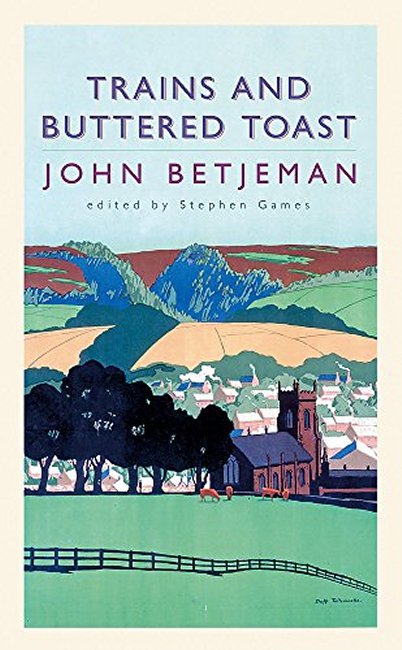
This selection of Betjeman’s radio talks was first published in 2006, twenty two years after the Poet Laureate died and for anyone unfamiliar with Sir John’s prose work this compilation edited and selected by Stephen Games is an excellent introduction. The talks range in date from 17th February 1932 to 6th July 1975 although it should be noted that this last one, concerning the great hymn writer Isaac Watts, is an extreme outrider in the selection and the second most recent is from 1952 so the vast majority are from the 1930’s and 40’s. I grew up listening to Betjeman on the radio or watching him on television extolling the virtues and vices of architecture he either liked or loathed and of course travelling around Britain, preferably by train and introducing me to poetry. It is only when writing this article that I realise that he has been dead for forty two years as of next month and wonder how many people know of or read him today? He was a man of forthright opinions, although always expressed in a polite manner as befits a much loved gentleman of the old school, and his statue in St Pancras railway station is fitting as he campaigned so hard to save this wonderful building. For me the most successful of the forty eight talks are the ones concerning places rather than people, there are twelve biographical works in the book including one autobiographical snippet about Christmas and the final talk is a bit of an oddity in a book as it is entitled ‘John Betjeman reads a selection of his own poetry’ which clearly he doesn’t in this case although the explanations as to why he chose specific works and a little insight into them is well worth reading. A line from the 1937 article on Swindon gives a hint as to why I loved the talks about places:

Swindon is full of good hearts and ugly houses – and it’s the ugly houses I’m going to talk about.

Sir John must have received some remonstrations about this talk as in later essays he says some nice things about Swindon, although not too nice, he doesn’t change his overall position, but does at least find some parts of the city to like. It puts me in mind of his poem Slough, also written in 1937 which begins:

Come, friendly bombs, and fall on Slough
It isn’t fit for humans now,

He was obviously having a bad time with urban planners in 1937. However it’s not by any means a negative book, there is much to celebrate and Sir John does so, highlighting amongst other the beauty and history of the out of the way parts of Exeter and the joys of returning to England during World War II in his brief breaks from being British press attaché in Dublin after being rejected for active service.Even just reciting the names of villages brings him comfort in 1943 appreciating the words in the spirit of a true poet, and yes all of them are real, I’ve been to several of these:

To think of the names is to feel better – Huish Episcopi, Whitchurch Canonicorum, Willingale Spain, Tickencote, Bourton-on-the-Hill, Iwerne Minster, Piddletrenthide, South Molton, Wotton, Norton, Evenlode, Fairford, Canons Ashby, Bag Enderby, Kingston Bagpuize.

The biographical works are mainly split into two sections ‘Eccentrics’ and ‘Christian Soldiers’, which I think tells you a lot about the selection, however in the ‘Christian Soldiers’ section is a talk on St Petroc, the patron saint of Cornwall where Betjeman manages to give a presentation of a man that he freely admits at the beginning virtually nothing is known, The inclusion of Pugin by Sir John is not surprising if only for his detailing on The Houses of Parliament in London and the Irish eccentric Adolphus Cooke Esq. of Cookesborough would be funny if it wasn’t ultimately so tragi

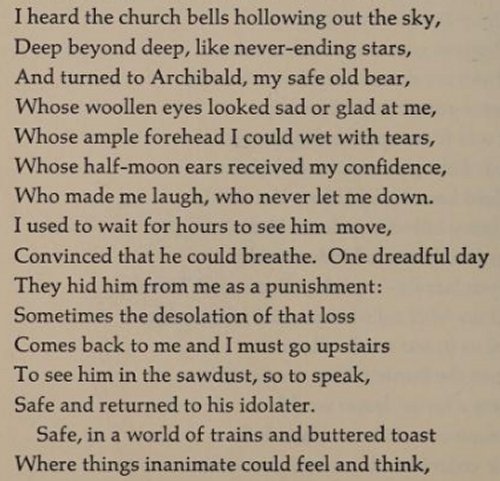
The title of the book comes from an early part of Betjeman’s autobiographical poetic work ‘Summoned by Bells‘ and relates to the comfort he found as a pre-school age child in his teddy bear Archibald. Indeed the words ‘Buttered Toast’ appear five times in this work which says a lot about the simple pleasures that Sir John would fondly celebrate.
There will be more of John Betjeman’s travels around Britain in August as part of my annual summer theme.
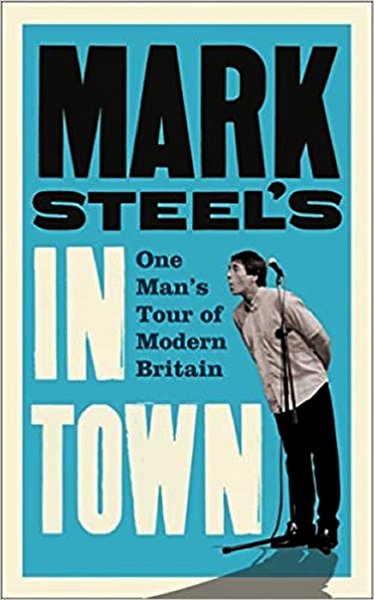
Mark Steel’s in Town – Mark Steel

Mark Steel is a stand up comedian that started a BBC Radio 4 radio show called Mark Steel’s in Town back in March 2009 where he travels to towns in the UK and builds a routine about the place and people for a one off show played in that town. He has deviated slightly over the years and two shows have come from outside the UK, namely Gibraltar and most recently Malta (broadcast February 2019) both of which he found more British than a lot of the places he had been to before. This book, published by Fourth Estate in 2011, is adapted from his travels in the first two series along with other towns and cities that he did as part of his stand up tours which weren’t recorded for the BBC shows. The idea is to gently poke fun at the place he is in and during the radio show he also includes interviews with locals which highlight the oddities and history of the location.

The idea for the show grew out of a frustration that all towns are starting to look the same, you know that such and such a shop will be on that corner there, next to a legion of other similar shops, there is no real way to tell if you are in Taunton or Norwich when you are in the main shopping area as the same retailers are in roughly the same place no matter where you are. What Mark does is celebrate what makes a place different from anywhere else and the fact that he does it in such a funny way has made his series last over a decade. Presumably he would be working on series ten if it wasn’t for the coronavirus that makes such a project impossible.

In this book Mark bounces around Britain from Penzance in the far south west with its outdoor swimming pool which has a cannon built into one side of it; to Kirkwall on Orkney which is just about as far north as you can go and still be in the UK where he encounters a pram shop which is also a fully stocked off licence, presumably on the basis that drinking too much of some of the stock may lead you to needing the other half of the shop nine months later. In between he visits the concrete hippo of Walsall, the rabbits that must not be mentioned of Portland and the bonfire societies of Lewes amongst lots of others. He isn’t put off dealing with harder issues either such as ‘The Troubles’ in Northern Ireland when he went to Andersontown or the chronic unemployment and deprivation in Merthyr Tydfil in South Wales. You really can learn a lot about the UK, its geography and history from these short essays.

All in all it is a delightfully eccentric tour of the UK only marred by his use of the ‘f’ word on several occasions which makes it unsuitable for younger readers, but frankly they aren’t the audience he is aiming at. It is a pity though as the language is unnecessary because Steel has a wonderful turn of phrase and is genuinely funny and he is much more careful with his broadcast versions. All fifty four episodes of the Radio 4 show are currently available on BBC Sounds and are well worth a listen.

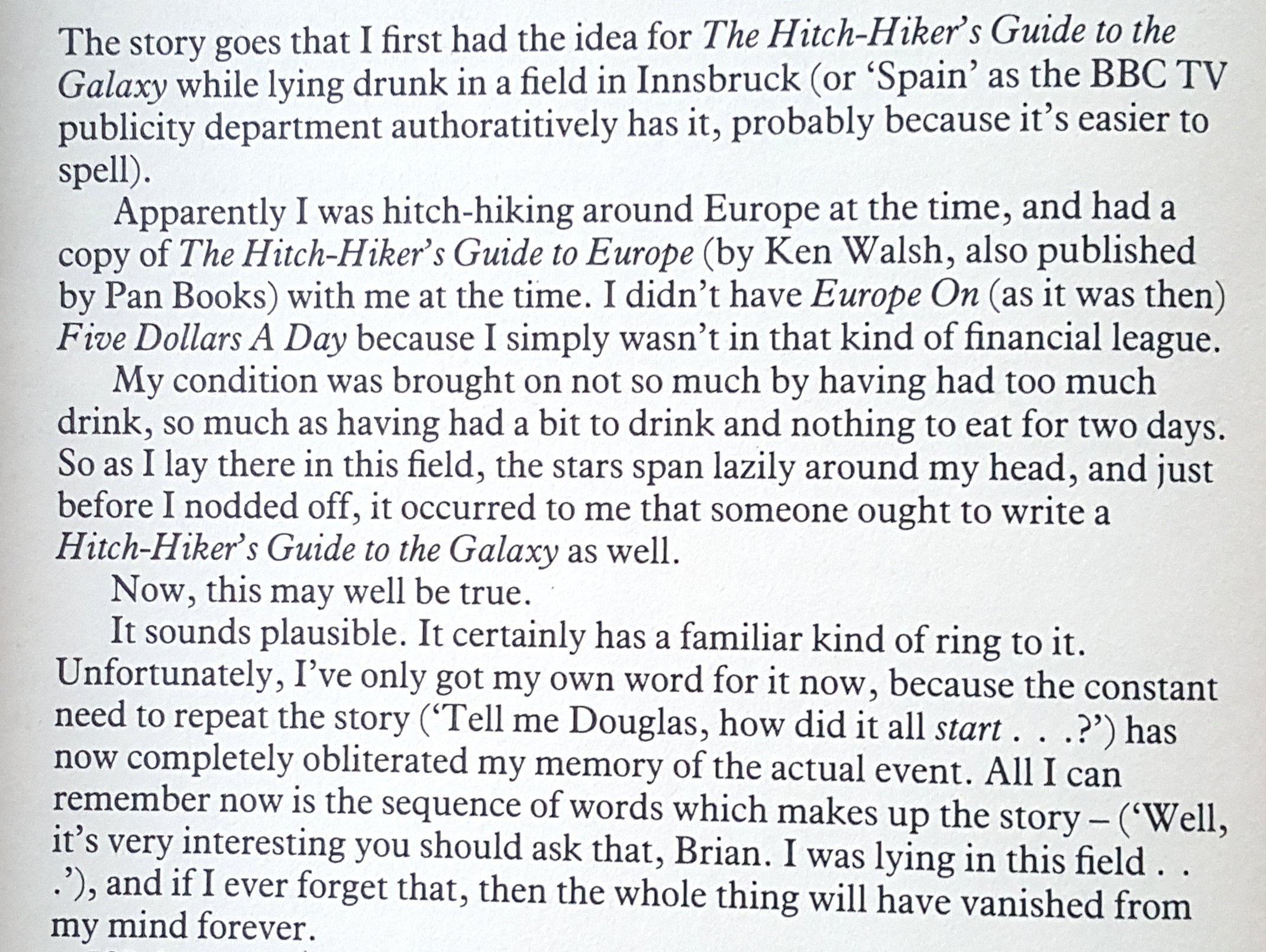
The Hitch-Hiker’s Guide to the Galaxy Original Radio Scripts – Douglas Adams

The very first broadcast of The Hitch-Hiker’s Guide to the Galaxy was on the 8th March 1978 so this coming Sunday it will be 42 years since that date and as anyone who has read H2G2 will know 42 is a very important number, it is after all The Answer.

20200303 H2G2 1

That is, the answer to Life, the Universe and Everything. Knowing that to be The Answer leads to the next problem. What is The Question? That unfortunately the great supercomputer Deep Thought couldn’t tell us.

My copy of the scripts is the first edition and was published by Pan Books in 1985 by which time Hitch-Hikers had become a massive success as a series of books, a play, a couple of records, a video game, a TV series, and even a towel, but for some reason it had taken seven years for the original material to be available as a book. I remember the impact those initial broadcasts had, there had been nothing like this before and I, along with many others, was hooked. The book contains all the scripts up to that point so the original six part series first broadcast in March and April 1978, the Christmas special from the same year and the second five part series first broadcast in January 1980. They were so amazingly popular that by the end of 1984 the first series had been repeated five times, the Christmas special six times and the second series had already had four repeats in as many years. Douglas died on the 11th May 2001, aged just 49,  having extended the book series to five and later on these extra three books would (in a reverse of the original process) be converted to radio scripts but what we are concerned with here is Douglas Adams own work rather than the later adaptations even though these were wonderfully done and largely utilised the original cast. But why The Hitch-Hikers Guide to the Galaxy?

20200303 H2G2 4

I have deliberately put this blog into the ‘Book Tales’ category rather than a review because frankly there are plenty of reviews of H2G2 and me adding another would be pointless and probably impossible so I would rather look at how this highly improbable phenomenon came to exist in the first place. Although clearly the book would be very enjoyable with just the scripts each episode is also followed with footnotes that explain what was going on during the production or some interesting facts about some aspect of the script itself. They also include a list of the music sources for each episode where you can check and go “oh yes of course it was, why didn’t I recognise it the first time”. The signature tune for example is from Journey of the Sorcerer by The Eagles, apparently many of the people who wrote in asking what it was were surprised to find that they already had the album it came from. Surprisingly large amounts of the other music used is by Hungarian composer György Ligeti. It is these extra nuggets of information that make this book so much fun. As for the included text Geoffrey Perkins wrote in his introduction.

These scripts include numerous alterations, amendments and additions, often made during recording, which helped to make a little more sense of the whole thing and gave us something to do while we were waiting for Douglas to come up with the next page.

and

Douglas is the only person I know who can write backwards. Four days before one of the Hitch-Hiker’s recordings he had written only eight pages of script. He assured me he could finish it on time. On the day of the recording, after four days of furious writing, the eight pages had shrunk to six.

This he explains is that Douglas was a perfectionist and if he spotted something that could be improved he would do that rather than create the next new part. Douglas himself freely admits in his foreword that he was a champion procrastinator and could come up with excuses for not writing far easier than he could come up with the actual ideas themselves.

20200303 H2G2 2

His inability to get things written on time is a constant theme of the footnotes, with scripts frequently being delivered to the actors whilst they were actually recording the episode. These would often be typed by Douglas on ‘snappies’ small booklets of quite flimsy perforated paper with carbon paper between them so he could dash out and hand them new pages of script as they were working. This led to a belief amongst the cast that he was reduced to typing the scripts on lavatory paper as his small office was next to the toilets at the studios. It all got a bit critical with the final episode of the second series, Jonathan Pryce was cast to play the Ruler of the Universe but when he arrived for the recording Douglas hadn’t actually written that bit yet so he played Zarniwoop and the voice of the Autopilot instead. The Ruler (who didn’t know he was) was ultimately played by Stephen Moore who also played Marvin the Paranoid Android along with a couple of other characters. More delays with this episode meant that it was still being edited twenty minutes before it was due to be broadcast but in a studio three miles away from where it needed to be to get on air. They made it but only just…

At the end of the first series, i didn’t really expect with any confidence that anyone would want me to do any more, so I brought the story to a very definite close. This then caused me huge problems getting the story going again for the second series. At the end of the second series I knew I would be asked to do more and deliberately left the ending open so that the next series could get off the ground straight away. Of course, we never did a third series.

Douglas Adams 1985

Happy 42nd birthday Hitch-Hiker’s Guide to the Galaxy, I’ll raise a Pan Galactic Gargle Blaster to you on Sunday with a shot of That Old Janx Spirit to chase it down and I will definitely make sure I know where my towel is.

If none of that last sentence makes any sense then go and read the scripts, or the books, or both it doesn’t really matter which but go and read them, then you too can aspire to being a hoopy frood, you’ll thank me for it…