Jorrocks’ Jaunts & Jollities – RS Surtees

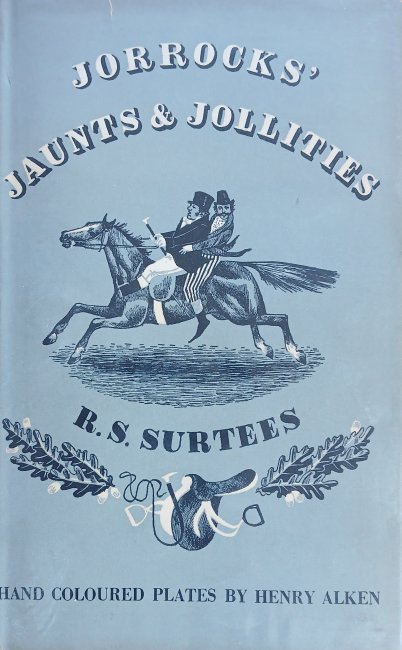
In 1949 The Folio Society decided to have a go at resurrecting the works of Robert Smith Surtees who had sadly dropped out of fashion since his heyday in the Victorian period with an edition of his first book, indeed his books used to be so well known that Virginia Woolf referred to this very title in the 1925 novel ‘Mrs Dalloway’ as her eponymous character was searching for a book suitable to take to a nursing home.

This late age of the world’s experience had bred in them all, all men and women, a well of tears. Tears and sorrows; courage and endurance; a perfectly upright and stoical bearing. Think, for example, of the woman she admired most, Lady Bexborough, opening the bazaar.

There were Jorrocks’ Jaunts and Jollities; there were Soapy Sponge and Mrs. Asquith’s Memoirs and Big Game Shooting in Nigeria, all spread open. Ever so many books there were; but none that seemed exactly right to take to Evelyn Whitbread in her nursing home.

Frankly if I was in a nursing home then Surtees may well be just the right author for my convalescence as the books are well written, with excellent observations on country life and Jorrocks is one of the great comic characters of the early Victorian age. This book was printed in only the third year of The Folio Society’s existence and was intended as a one off from this author in companion with a similarly designed edition of The Compleat Angler by Izaac Walton. However it was so popular that they subsequently published the remaining seven books by Surtees at the rate of one a year, making Surtees the first author to have their complete works published by the society.

John Jorrocks is described as a grocer in the book but as he operates out of his own warehouse rather than a shop he is probably a fairly wealthy wholesaler based in London. He is a keen fox hunter, riding with the Surrey hounds based at the small country town of Croydon about ten miles from central London. Anyone who knows Croydon nowadays, it has a population of around two hundred thousand and has been largely subsumed by Greater London, will find the rural descriptions of the place in the 1830’s difficult to imagine but this really was the case back then. Jorrocks’ regular companion is Mr Stubbs who is normally simply referred to as The Yorkshireman and one of the funniest passages in this book describes a ride from the middle of London by both of these gentlemen to join the hunt on a particularly foggy day in the city with the chaos they cause or get involved in. As Surtees is not well known nowadays I’m going to include a couple of examples of his style. The Yorkshireman never seems to have any money but is quite happy to live off Jorrocks as in this plan for a weekend trip.

“Now to business—Mrs. J—— is away at Tooting, as you perhaps knows, and I’m all alone in Great Coram Street, with the key of the cellar, larder, and all that sort of thing, and I’ve a werry great mind to be off on a jaunt—what say you?” “Not the slightest objection,” replied the Yorkshireman, “on the old principle of you finding cash, and me finding company.” “Why, now I’ll tell you, werry honestly, that I should greatly prefer your paying your own shot; but, however, if you’ve a mind to do as I do, I’ll let you stand in the half of a five-pound note and whatever silver I have in my pocket,” pulling out a great handful as he spoke, and counting up thirty-two and sixpence. “Very good,” replied the Yorkshireman when he had finished, “I’m your man;—and not to be behindhand in point of liberality, I’ve got threepence that I received in change at the cigar divan just now, which I will add to the common stock, so that we shall have six pounds twelve and ninepence between us.” “Between us!” exclaimed Mr. Jorrocks, “now that’s so like a Yorkshireman. I declare you Northerns seem to think all the world are asleep except yourselves;

Jorrocks also loves his food and drink and there are long descriptions of meals and consuming numerous bottles of wine and port in one sitting. I particularly enjoyed the contrast between the eating manners of the English and French when Jorrocks takes The Yorkshireman with him on a trip to Paris and the slow appearance of course after course in France confuses him rather than the everything on the table to start with which was then the preference in England and he assumes he is going to starve due to the lack of visible food. Early on in the book he invites The Yorkshireman round for breakfast before heading out to the hunt.

About a yard and a half from the fire was placed the breakfast table; in the centre stood a magnificent uncut ham, with a great quartern loaf on one side and a huge Bologna sausage on the other; besides these there were nine eggs, two pyramids of muffins, a great deal of toast, a dozen ship-biscuits, and half a pork-pie, while a dozen kidneys were spluttering on a spit before the fire, and Betsy held a gridiron covered with mutton-chops on the top; altogether there was as much as would have served ten people. “Now, sit down,” said Jorrocks, “and let us be doing, for I am as hungry as a hunter. Hope you are peckish too; what shall I give you? tea or coffee?—but take both—coffee first and tea after a bit. If I can’t give you them good, don’t know who can. You must pay your devours, as we say in France, to the ‘am, for it is an especial fine one, and do take a few eggs with it; there, I’ve not given you above a pound of ‘am, but you can come again, you know—waste not want not. Now take some muffins, do, pray. Batsey, bring some more cream, and set the kidneys on the table, the Yorkshireman is getting nothing to eat. Have a chop with your kidney, werry luxterous—I could eat an elephant stuffed with grenadiers, and wash them down with a ocean of tea; but pray lay in to the breakfast, or I shall think you don’t like it. There, now take some tea and toast or one of those biscuits, or whatever you like; would a little more ‘am be agreeable? Batsey, run into the larder and see if your Missis left any of that cold chine of pork last night—and hear, bring the cold goose, and any cold flesh you can lay hands on, there are really no wittles on the table.

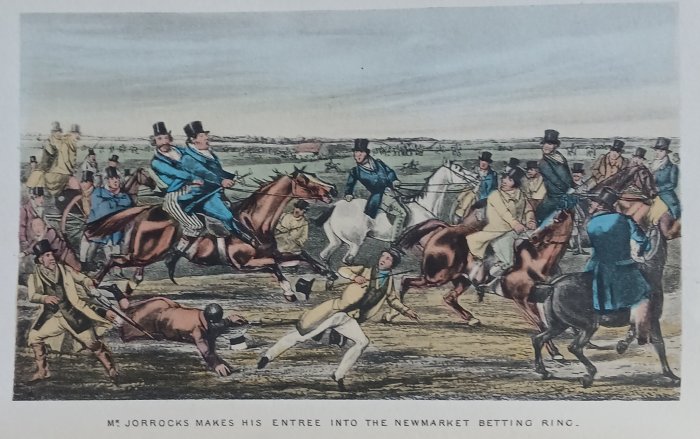
A note should be made regarding the fifteen colour plates included in the book as they were done by a technique that had largely disappeared by 1949. The plates, which are those by Henry Alken originally included in the book back in 1838, were in fact printed in monochrome and individually hand coloured by Maud Johnson who went on the do the same for the further seven volumes Folio printed of Surtees’ works. The Folio Society doesn’t include printing numbers for their books in the various bibliographies they have published but it can be imagined what a huge amount of work this involved for one person, but the effort was worth it as these illustrations really stand out. The pages for the prints are noticeably thicker and stiffer than the pages of text presumably to allow for Johnson’s use of watercolours to do the colouring without distorting the paper. Other than special very limited editions these eight volumes are the last books with hand coloured plates printed in England that I am aware of although I’d love to know of any others. The Folio Society continued to use the original plates throughout the series of reprints which was finally complete in 1956 with this being the only one illustrated by Alken, most of the others are done by John Leech.

The Mirror of Ink – Jorge Luis Borges

2005 was Penguin Books seventieth anniversary and to mark the occasion they published seventy books at £1.50 each which were largely extracts from other works in their vast back catalogue as is this one although this is collated from several collections of short stories. With Borges though, as he is mainly a writer of short stories, you ended up with seven complete works in the book and as an introduction to his literary output this book is excellent. The art of writing a short story is extremely difficult as in a short space you must not only have a beginning, a middle, and an end but also express an idea or indeed several which will leave the reader satisfied and in all seven of these Borges has proved himself well able to meet those aims. Knowing that he was Argentinian I was expecting South American themes but instead the first two ‘The Mirror of Ink’ and ‘The Lottery in Babylon’ are set in the Middle East, the third ‘The Library of Babel’ could frankly be anywhere and everywhere. The fourth ‘The Theme of the Traitor and the Hero’ is in Ireland, ‘The Witness’ is probably medieval England, ‘Ragnarok’ could also be anywhere, whilst the final story ‘Blue Tigers’ is based in rural India. A linking theme, if there is one, is the somewhat mystical and fantastic ideas behind all of these stories, that and the definite quality of the prose. I hadn’t read any of Jorge Luis Borges before this slim volume and indeed this is the only book of his work that I possess but I definitely need to read more.

Sadly Borges suffered from fading eyesight for many years and became blind at the end of the 1950’s however he continued to write, dictating stories initially to his mother who took on the role of his secretary until her death. The last two stories in this book were written after his blindness and there is certainly no diminution of the power of his writing. I just want to pick out a couple of the stories that I particularly enjoyed:

‘The Library of Babel’ is an exploration of the concepts of infinity in that the library described contains all possible books that are exactly 410 pages long with a fixed format of forty lines per page and eighty characters per line where a character is one of twenty two letters of the alphabet, a full stop, a comma or a space and all combinations of these appear at least once in one of the infinite series of books stored in the apparently infinite number of replicating hexagonal galleries that make up the library. The concept of a library that because it has all combinations of the twenty five characters and therefore contains books of apparently complete nonsense but must also due to randomness have every book that could possibly exist expressing every theme and also arguing both for and against every idea is beguiling. The impossibility of ever finding a specific work is also clearly spelled out along with some of the oddities of infinite series in that a revolution in the past had destroyed countless volumes but that this didn’t matter because books survived elsewhere in the library which differed from the vandalised editions by as little as a punctuation mark somewhere within them.

‘Blue Tigers’ also drew me in with a weird mathematical theme, the tigers are not flesh and blood but a collection of odd blue disks that the narrator finds on top of the plateau of a sacred hill. These discs are uncountable, initially he thought he had around ten of them but when examining them found far more. Sometimes there would be as little as three but holding these few and then letting them fall could reveal hundreds. The narrator spends nights trying to find a pattern to the ever increasing, and decreasing, quantities without any success and eventually, to save his sanity, he gives them to a blind beggar who seems to understand in someway that he is the fitting custodian.

Naturally the four mathematical operations – adding, subtracting, multiplying and dividing – were impossible. The stones resisted arithmetic as they did the calculation of probability. Forty disks, divided, might become nine, those nine in turn divided might yield three hundred. I do not know how much they weighed, I did not has recourse to a scale, but I’m sure their weight was constant, and light. Their colour was always the same blue.

As 2005 was the seventieth anniversary it is clear that this year (2025) is the ninetieth and again Penguin have marked their birthday with a set of books, this time ninety of them at £5.99 each, some of which will be featured in this blog as the year goes on. The actual anniversary is the end of July so I am dedicating my August theme this year to the first four Penguin titles, which I will be reading in their first Penguin editions something I don’t do often due to the fragility of these ninety year old paperbacks.

Holy Terrors – Arthur Machen

it’s a riff on Arthur Machen’s “The Great God Pan,” which is one of the best horror stories ever written. Maybe the best in the English language. Mine isn’t anywhere near that good, but I loved the chance to put neurotic behavior—obsessive/compulsive disorder—together with the idea of a monster-filled macroverse. That was a good combination. As for Machen vs. Lovecraft: sure, Lovecraft was ultimately better, because he did more with those concepts, but “The Great God Pan” is more reader-friendly. And Machen was there first. He wrote “Pan” in 1895, when HPL was five years old.

The above quote is by Stephen King and if anyone can judge a horror story then he is probably the man, it can be found on his website here as part of one of his ‘self interviews’. Sadly I don’t have a copy of ‘The Great God Pan’ as this is the only book I have by Arthur Machen, which is actually the pen name of Welsh fantasy and horror writer Arthur Llewellyn Jones. Even Lovecraft regarded Machen as a great in the horror story genre naming him amongst the four modern masters of the style and he was highly influential in the development of Lovecraft’s Cthulhu stories. This book consists of fourteen short stories which whilst none of them are of the horror genre give a glimpse of the abilities of this popular writer many of whose works are still in print almost eighty years after his death. Indeed several bear the mark of another writer who came later that of Roald Dahl and his ‘Tales of the Unexpected’.

As is often the case with collections of short stories the better examples are the longer ones, especially in this set, the final tale of which, that I will also come to last, is excellent. The stories range from a story about a clergyman who vanishes without trace from his home for six weeks only to re-appear exactly as he was last seen by his housekeeper working at his desk and with no feeling that he had stepped away for more than a few minutes. One story I particularly enjoyed is ‘The Tree of Life’ which tells of a seriously unwell man running the lands of his estate from his sick bed by communicating his wishes via his land agent. The ending of the tale completely upends the story so far but in a completely believable manner. ‘The Bright Boy’ and ‘The Happy Children’ are the closest we get to horror in this collection with the first story of a man with the appearance of a boy and the odd occurrences that happen in the vicinity of the house where he lives with his supposed parents. The happy children tells however of a journalist unexpectedly coming across the spirits of dead children in the streets of a Yorkshire town before they process up to the abbey ruins. There is also the story an unspecified ceremony being performed at a strange stone in the woods that I wish was longer as the atmosphere is so well created and then it stops leaving me wanting more and ‘The Soldiers Rest’ where it gradually becomes clear what sort of rest he is having. All of these are wonderfully written but it is the final story of this collection along with one that is sadly missing that cement Machen in his position as a truly great writer of short stories never mind his horror novels.

The one that is missing is ‘The Bowmen’ which was first published on 14th September 1914 and tells the story of a horde of phantom bowmen from the Battle of Agincourt, five centuries earlier, which came to the aid of British troops at the Battle of Mons. This story, as it was published in The Evening News newspaper which Machen worked for at the time became believed as true and is the foundation of The Angel of Mons and evidence of divine intervention on behalf of the British soldiers. No matter how often Machen tried to say that he made it up he was rarely believed and the tale was spread around the world as fact. The story that completes this set is however ‘The Great Return’ and this is the first published story telling of the existence of the Holy Grail in modern times and the miracles that occur along with its reappearance. The story which along with Machen’s novel taking the same theme ‘The Secret Glory’, which he had already written by then but which wasn’t published until 1922, would clearly influence writers such as Dan Brown in his Da Vinci Code and George Lucas with Indiana Jones amongst others.

You can find out more about Machen via ‘The Friends of Arthur Machen‘ an international literary society dedicated to the works of this remarkable author.

Short Stories – Fyodor Dostoyevsky

I’ve been meaning to read Fyodor Dostoyevsky for a long time but in common with a lot of other Russian novelists his books are somewhat daunting for a blog which appears every week, just checking my shelves I find:

  • ‘Crime and Punishment’ – 559 pages
  • ‘The Devils’ – 669 pages
  • ‘The Idiot’ – 661 pages
  • ‘The Brothers Karamazov’ – 2 volumes totalling 913 pages
  • and a volume containing two short stories and a novella ‘The Cossacks’ – 334 pages

It was then I spotted that I had two volumes from the Penguin Little Black Classics series which would give me an entry point to Dostoyevsky to see if I like him as an author. The first one is number 44 from this series ‘The Meek One’ which only has this one short story in it. The title is more usually translated as ‘A Gentle Creature’, and it is just 57 pages, still quite long for a short story, but a lot more approachable. Warning there are spoilers in this review if you want to read the stories first I cannot find ‘The Meek One’ but ‘White Nights’ is on Project Gutenberg here and ‘Bobok’ can be found here.

‘The Meek One’ begins with the un-named narrator contemplating the body of his equally un-named young wife laid out on a table in their home waiting for the undertaker to arrive the next day and we then go back over the story of how the two met and the short and largely unhappy marriage that they had. They had originally come into contact with one another as she would often come and pawn items in his pawnbrokers to raise money to advertise her services as a governess or more latterly almost any job to enable her to leave her two aunts. At the time of their marriage he was forty one and she just sixteen, however he regarded himself as her saviour from a planned marriage arranged by these aunts to a shopkeeper in his fifties who had killed his two previous wives whilst drunk and was looking for a third. The relationship between the couple seems to have deteriorated very quickly after the wedding and it is a sad story he tells of long silences and barely communicating through the winter including a time when she places a loaded gun to his head whilst thinking he was asleep but doesn’t pull the trigger. In the spring he makes an unexpected move to rescue the marriage suggesting a journey to France but it is whilst out getting the passports that she commits suicide.

Russian writing has an often undeserved reputation for gloominess and this short story doesn’t go any way to repudiate that impression, maybe the next book will have something more uplifting.

The second and third of Dostoyevsky’s short stories in volume 118 of the Penguin Little Black Classics series has ‘White Nights’ paired with ‘Bobok’. ‘White Nights’ is 86 pages long, ‘Bobok’ is the shortest at just 27 pages.

‘White Nights’ tells the story of a twenty something recluse in St Petersburg and yet again we don’t have his name, this lack of a name seems to increase the isolation of Dostoyevsky’s characters and this time he is pretty well the only un-named person in the story. He spends his days wandering around the city imagining having conversations with the people and even the houses he sees but in fact the only person he communicates with is his maid Matrona who is supposed to look after his apartment but hasn’t even removed the cobweb on the ceiling, mind you neither has he. One day whilst out on one of his aimless walks he sees a pretty young girl crying on a bridge and this time builds up the courage to approach her, however she evades him only to be threatened by an older passerby and our narrator steps in the save her. So begins the four days of happiness that he is to enjoy as they get to know one another, he explains that he is a lonely dreamer whilst she tells of a unhappy time living with her blind grandmother who pins their clothes together so that she can be sure Nastenka is not wandering off. She also tells of a lodger they had a year ago whom she fell in love with but who had to return to Moscow but promised to return and marry her when he left. The narrator rapidly also falls in love with her but agrees to carry a letter to a family who know the ex-lodger to see if he has returned and is still planning on restarting their relationship whilst secretly hoping that he has found somebody else in Moscow. The story is well written with the narrator regarding himself as the hero almost of a book of his life, indeed Nastenka rebukes him for telling his story almost as if he was reading it out. Sadly the ex-lodger does return and the narrator returns to his apartment downcast looking to another fifteen years of loneliness but Matrona does at least remove the cobweb.

‘Bobok’ is easily the strangest of the three stories and to my mind the best due to its originality, although it starts out normally enough with our narrator, this time with a name, Ivan Ivanych, going to the funeral of a distant relative and avoiding the lunch afterwards, takes to lying down on one of the long stones in the graveyard for a rest. All of a sudden he hears voices, muffled but intelligible, and wonders where they may be coming from. Gradually he realises that they are coming from the graves around him and it appears that the dead have a second short life in the grave where they can communicate with each other for two or three months, possibly up to six before they decompose too far. I loved this story as I hadn’t read anything like it before, The various conversations start off reflecting the status of the characters as they were before they died but gradually they decide to throw off their previous lives and simply talk to one another until they suddenly fall silent when they become aware he is listening. Another possible reason for our narrator hearing them is given in the opening lines of the story:

The day before yesterday Semyon Ardalyonovich suddenly comes out with: ‘And would you kindly tell me Ivan Ivanych will the day come when you’ll be sober?’

All three tales are taken from the Penguin Classics volume ‘The Gambler and Other Stories’ translated by Ronald Meyer which also includes the short stories ‘The Dream of a Ridiculous Man’, ‘A Christmas Party and a Wedding’ and ‘A Nasty Story’ along with its title novella ‘The Gambler’ which was actually written by Dostoyevsky in order to pay off his debts from losses at roulette.

Short Stories – H G Wells

At 474 pages this is an excellent selection of the short stories and three of the short novels from the pen of H G Wells, a man most people think of as a Victorian science fiction writer but who was much more than that not only in output but also his timeline as he survived until after WWII, dying in 1946 at the age of seventy nine. So why is Wells so popularly thought of as being earlier than he truly was, well his best known works were certainly written during the Victorian era, such as ‘The Time Machine’ (1895), ‘The Island of Doctor Moreau’ (1896), ‘The Invisible Man’ (1897), and ‘The War of the Worlds’ (1898) however at the turn of the century he largely moved away from science fiction towards more contemporary novels such as ‘Kipps’ and ‘Tono-Bungay’ and later almost abandoned fiction altogether and produced his ‘A Short History of the World’ which attempted to summarise all of history into a single volume, I also have the earlier ‘The Outline of History’ in two illustrated volumes and the odd ‘Crux Ansata’ from 1943 which is basically a polemic against the Catholic Church.

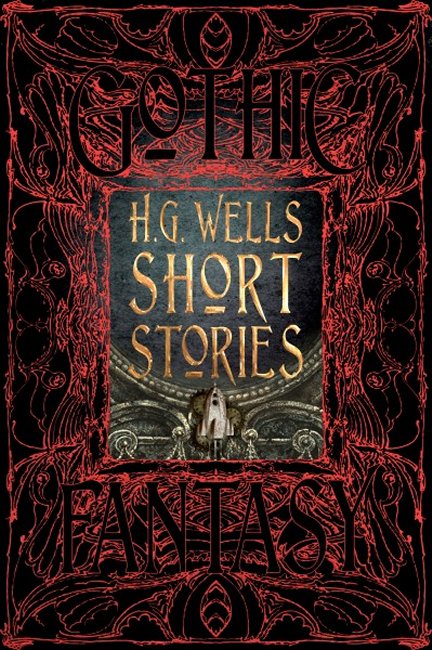
This book was published by Flame Tree Publishing in 2017 and was the first of their Gothic and Fantasy series of books to be dedicated to just one author, closely followed by H P Lovecraft. Along with what would normally be regarded as short stories the collection includes three short novels, or novellas, ‘The Invisible Man’, ‘The Time Machine’ and ‘The Story of the Days to Come’. I have previously reviewed The Invisible Man as part of the August 2018 review of the first set of ten Penguin crime novels, and it was the inclusion of The Time Machine that prompted me to pick up this collection after last weeks ‘The H-Bomb Girl’ including as that does a time travelling character called Miss Wells which is clearly a reference to H G Wells. Along with these three novellas are thirty three short stories which vary from a simple crime caper ‘The Hammerpond Park Burglary’ through murder ‘The Cone’ amongst others and but the majority fall into the loose category of intriguing fantasy but I wouldn’t describe many of them as Gothic in the way that Lovecraft is definitely Gothic Fantasy, the one significant exception is ‘The Red Room’ which reads like a ghost story with a great twist at the end. I also have The Folio Society collection published in 1990 and which is based on the selection published by J.M. Dent and Sons in 1927 although that only has twenty two stories But even that shorter collection has seven stories not included in the Flame Tree edition and that still leaves over fifty short stories that I don’t have. as Wikipedia lists 94 short stories and the same number of novels or novellas.

That Wells was a prolific author is not in doubt and the quality of his writing can also not be underestimated, he was nominated for the Nobel Prize in Literature four times although never won it, frankly I suspect the judges regarded him as insufficiently high brow to be properly considered. But he was undoubtedly a popular writer from his earliest works and still sells well. I’ve really enjoyed reading some of the stories that I didn’t know and revisiting the ones I read many years ago. If you haven’t read Wells’ short stories then I heartily recommend them, no matter which collection, and there are many, that you manage to pick up.

A Stroke of the Pen – Terry Pratchett

The first of the books I received for Christmas to be reviewed is this collection of stories written by Terry Pratchett whilst he was still learning his trade as a writer and working as a journalist for the Bucks Free Prres in Beaconsfield. These stories however were mainly written for the Bristol based Western Daily Press so Pratchett wrote under the pseudonym of Patrick Kearns, Kearns being his mothers maiden name. The stories were rediscovered by Pat and Jan Harkin during a massive trawl through the British Library newspaper archive in search of a story they knew existed ‘The Quest for the Keys’ and in doings o they came across the other works by an unknown writer Patrick Kearns that sounded and felt familiar as they used places and characters from the tales written by Pratchett for the Bucks Free Press under the name of Uncle Jim which have now been collected in four volumes, the fourth coming out after I wrote my original review of those books. Apparently the fourth book is to be the last but ‘A Stroke of the Pen’ adds another twenty short stories by the young Terry Pratchett for us to enjoy and yes they do feel like the Uncle Jim stories and indeed one of them, ‘Mr Brown’s Holiday Accident’ did originally appear in the Bucks Free Press as by Uncle Jim.

The scale of the archive work done by the Harkin’s can only be appreciated when you know that despite being very short each of the stories were published in multiple parts with the longest, and the only one to be credited to Terry Pratchett in the Western Daily Press, being ‘The Quest for the Keys’ which appeared in thirty six individual sections from 30th July to the 13th October 1984. Also nobody knew about Patrick Kearns as a pseudonym so it was only the style and content that tipped them off that here was an until then unknown source of Terry Pratchett works. Also although ‘The Quest for the Keys’ was known to exist, because of the way it was clipped from the newspaper and saved the dates and indeed the newspaper which printed it were lost so they had to go through four possible newspapers archives from the earliest probable date (1972) up until 1984, when Terry’s first Discworld novel, ‘The Colour of Magic’, was printed, in their search. Fortunately they decided to work forwards rather than back or they would have found ‘The Quest of the Keys’ a lot quicker and probably not stumbled on the works of Patrick Kearns.

Enough of the history, what of the stories themselves? Well I love the Uncle Jim stories and these are more of the same, indeed there are a couple of reworked Uncle Jim tales under the name of Patrick Kearns which provides confirmation, if any was needed, that this is indeed the same author. The first story included is clearly inspired by Roy Lewis’s ‘The Evolution Man’ with its stone age man main character discovering major advances such as fire. My personal favourite of the ones in this book however is ‘The Fossil Beach’ in which the curator of Blackbury museum is taken to the beach by a local geology student where they find a fossilised deckchair, radio and a copy of today’s newspaper in the mouth of a small dinosaur. How these all got there is a mystery they are determined to solve. Pratchett is clearly already a very competent fantasy writer by the time he wrote as Patrick Kearns, not as good as he would become but definitely worth reading.

Sadly I cannot recommend this hardback book as it currently exists, as it has been announced that there is a story missing from it which Colin Smythe, who had commissioned the Harkin’s to undertake their quest, accidentally omitted when he sent the text to the printers which means that the paperback, due out in April this year will be the complete book and anyone who has the hardback first edition, like mine, will have to buy the paperback as well in order to read the missing tale.

Carry On Jeeves – PG Wodehouse

There are times when only a PG Wodehouse will do. I’ve featured two of his books before on this blog, Summer Lightning back at the end of November 2019 and The Clicking of Cuthbert in September 2021, Summer Lightning is one of the Blandings Castle novels set in a stately home in Shropshire, whilst The Clicking of Cuthbert is a collection of short stories featuring golf. You can see from this description that there is a noticeable gap in my descriptions of the works of Wodehouse and that is the thirty five short stories and eleven novels that make up the Jeeves and Wooster canon. I do have all of these in three boxed sets from The Folio Society beautifully illustrated by Paul Cox, and I have chosen this book comprising of ten stories because it includes the appearance of the indomitable gentleman’s gentleman Jeeves into the life of wealthy dilettante Bertie Wooster. This story ‘Jeeves Takes Charge’, originally published in 1915, begins with Bertie very badly hungover when his new valet arrives from the agency:

I crawled off the sofa and opened the door. A kind of darkish sort of respectful Johnnie stood without.

‘I was sent by the agency, sir,’ he said. ‘I was given to understand that you required a valet.’

I’d have preferred an undertaker; but I told him to stagger in, and he floated noiselessly through the doorway like a healing zephyr. That impressed me from the start. Meadowes had had flat feet and used to clump. This fellow didn’t seem to have any feet at all. He just streamed in. He had a grave, sympathetic face, as if he, too, knew what it was to sup with the lads.

‘Excuse me, sir,’ he said gently.

Then he seemed to flicker, and wasn’t there any longer. I heard him moving about in the kitchen, and presently he came back with a glass on a tray.

‘If you would drink this, sir,’ he said, with a kind of bedside manner, rather like the royal doctor shooting the bracer into the sick prince. ‘It is a little preparation of my own invention. It is the Worcester Sauce that gives it its colour. The raw egg makes it nutritious. The red pepper gives it its bite. Gentlemen have told me they have found it extremely invigorating after a late evening.’

I would have clutched at anything that looked like a lifeline that morning. I swallowed the stuff. For a moment I felt as if somebody had touched off a bomb inside the old bean and was strolling down my throat with a lighted torch, and then everything seemed suddenly to get all right. The sun shone in through the window; birds twittered in the tree-tops; and, generally speaking, hope dawned once more.

‘You’re engaged!’ I said, as soon as I could say anything.

The hiring of Jeeves would prove to be the best thing Bertram Wooster would ever do and many a time Jeeves would get him out of terrible problems, often caused by Bertie’s friends although sometimes by Bertie himself. This book comprises of ten of the short stories an was first published in 1925 by Herbert Jenkins Ltd and as well as introducing us to Jeeves the stories are set around the first few novels. It isn’t necessary to have read the other stories before this collection although there are some spoilers regarding plots, most noticeably around Bertie’s interaction with the Glossop family which assumes that the reader is familiar with them. The odd thing is that although this collection includes the hiring of Jeeves, the collection of eighteen short stories (some of which were originally published in combination) in The Inimitable Jeeves was first published in 1923 and includes much of the appearances of Sir Roderick Glossop and his daughter Honoria whom Bertie gets engaged to twice only for Jeeves to successfully extricate him both times.

The other thing to bear in mind is that Wodehouse started writing about Jeeves and Wooster in 1915 and wrote his final novel about them, ‘Aunt’s Aren’t Gentlemen’, in 1974 so a spread of almost six decades but none of the characters age more than about five years over this period and the lifestyle of Bertie is firmly rooted in the 1910’s and 20’s. It also needs to be understood that the First World War doesn’t impinge on the books at all and it is easier to assume whilst reading them that almost the whole story line is set in the early 1920’s. The one obvious exception to this is the novel ‘Ring For Jeeves’ which is clearly set later and is the only Jeeves book which doesn’t feature Bertie Wooster.

Of the ten stories in ‘Carry On Jeeves’ four are set in New York where Bertie had taken refuge to avoid the wrath of his aunt Agatha and one in Paris where he is simply on holiday for a couple of weeks whilst the rest are in his native England. Wooster is sufficiently wealthy that he doesn’t have to work for a living so Wodehouse is free to place him wherever he fancies which includes hiring a house for an extended holiday by the coast. It is also clear that Bertie is not the brightest of chaps but then again neither are most of his friends, with the intellectual status being almost entirely given to Jeeves. Almost all the stories and novels are written from the perspective of Bertie but this collection includes the only one seen from Jeeves’s viewpoint ‘Bertie Changes His Mind’, where Jeeves is worried that he might be about to be let go by Bertie and is determined to make sure that this doesn’t happen. For Jeeves, despite his occasional disagreements with Bertie, largely over his sartorial choices, knows that his employer is one that is worth retaining especially compared to some of the others he has worked for.

I love the works of PG Wodehouse as his gentle comedies are invariably just the thing to brighten the day and they are beautifully written. You can read one of the various series such as Jeeves and Wooster, Blandings Castle or the Psmith stories or pick one of the numerous stand alone works that together comprise the around a hundred novels and collections of short stories along with over fifty plays and scripts that he wrote over more than seventy years, Indeed he was working on another Blandings novel when he died aged ninety three.

Paddington Bear is 65 years old this week

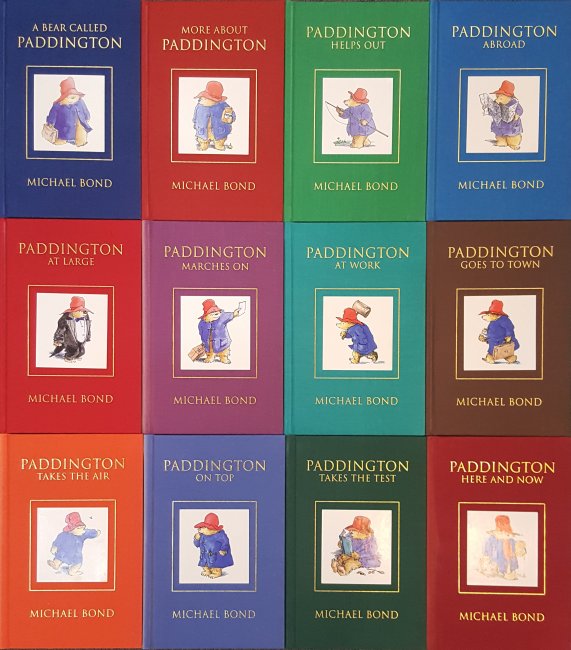
The first Paddington Bear book was published on the 13th October 1958 and Michael Bond went on to write fourteen collections of stories about him along with two specials featuring stories originally published in annuals for the children’s BBC television programme Blue Peter and fourteen other mainly single story picture books aimed at younger readers. The set I have is from The Folio Society and was published as a boxed collection in 2010. Unusually for a Folio edition it wasn’t published by them but rather by Harper Collins, Paddington’s usual publisher and it includes the twelve collections published up until that date in lovely cloth bound volumes. Sadly Michael Bond died in 2017 so there will be no more stories about this lovable bear, but I discovered whilst researching this blog that fittingly Bond is buried in Paddington Old Cemetery in London. The appearance of Paddington Bear in the Blue Peter Annuals came about because Bond was a BBC cameraman, including working on that TV series so he knew the presenters and could incorporate them into stories.

The first book ‘A Bear Called Paddington’ consists of eight connected short stories whilst the remaining thirteen main collections all have just seven each, meaning that there are ninety nine tales in the main block of books, along with those there were a further thirteen stories split across the two ‘Blue Peter’ collections and of course the single story books for small children, so there is a lot to read. The first eleven books were illustrated by Peggy Fortnum and it is her black and white images that came to epitomise the character of the bear as he tries to be helpful but invariably causes more trouble and disasters around him. She however retired from illustrating and the remaining three collections ‘Paddington Here and Now’, ‘Paddington Races Ahead’ and ‘Paddington’s Finest Hour’ were illustrated by R W Alley who clearly based his picture on those done by Peggy Fortnum to maintain consistency.

I’ve loved Paddington since I was a small child, having encountered him first in the Blue Peter annuals and as read out stories on the programme in the late 1960’s. There is just something so beguiling about his well meaning and always polite character and the ways he tries to adapt to his new home in London, which is so different from the Peruvian mountains where he originated from. On arriving at Paddington station having stowed away on a transatlantic ship he is met by the Brown family who take him home and effectively adopt him into their family. Helping him fit in is his great friend Mr Gruber, who owns an antique shop on Portobello Road and escaped from Hungary either to avoid WWII or the suppression of the 1956 Hungarian uprising, it is never made clear which, but this gives him useful insights into the problems of assimilation for Paddington. That makes the books sound heavier in tone than they are, whereas they are delightfully comic and clearly aimed at children, although there is plenty for an adult to enjoy. Rereading a few of the books for this review reminded me just how much I enjoyed the Paddington stories in my preteen-age years. The other major character is the Brown’s next door neighbour Mr Curry who is generally unpleasant to Paddington and always calls him Bear, unlike Mr Gruber who calls him Mr Brown. A lot of the stories have Mr Curry getting his comeuppance in some way or other.

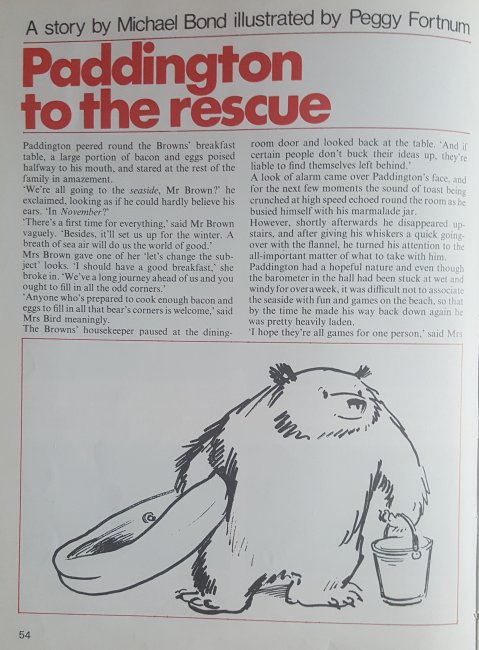
Above is the start of the Paddington story in the Fifth Blue Peter annual published in 1968 and this is how I first read Paddington stories and got to know the character, in this one he goes to the seaside and ends up in the lifeboat bought by the Blue Peter appeal that year. Of course the modern films from StudioCanal have brought a whole new audience to Paddington Bear, many of whom have probably not read the books. These adaptations are not based on specific books or tales but rather on the feel of the entire set of stories and they are a wonderful version with the various characters being very much as I imagined them from reading the books and I hope that they do encourage people to pick the books up and discover the vast range of adventures Paddington gets up to. The third film in the series started production earlier this year and it is due out in time for Christmas 2024, the original cast are back together and I hope that when it eventually gets dubbed into Ukrainian the original voice actor for Paddington in that language is available to repeat his performance from the first two movies, although Volodymyr Zelenskyy is rather busy being President nowadays.

Happy birthday on Friday Paddington.

The Club of Queer Trades – G K Chesterton

The Club of Queer Trades is an organisation that only admits members who earn their living from a unique perspective. Having come up with this concept Chesterton wrote six excellent short stories based around a narrator called Charlie “Cherub” Swinburne, his friend, and retired judge, Basil Grant and Basil Grant’s younger brother Rupert Grant who is a private detective. Between them they experience several odd encounters with The Club.

In the individual reviews below I’m just going to set up the unusual story in each one to avoid giving away the queer trade and the denouement of each tale.

The Tremendous Adventures of Major Brown

Major Brown is a perfectly respectable retired military gentleman whose passion is growing ever increasing varieties of pansies so when he is encouraged by a vendor of such plants to look over a wall near where he lives and sees spelt out in a bed of pansies “Death to Major Brown” he is more than a little perturbed. He enters the house, finds a rather unusually decorated room and speaks for a while with a somewhat enigmatic woman before hearing a noise and confronting a large man in the cellar, they fight and Major Brown comes away with the mans coat as the man himself escapes. Totally confused by his experiences the Major comes to consult Rupert Grant, who suggests that they should go to the address found on an envelope in one of the coats pockets. When they do this, instead of the confrontation expected by Rupert, the Major is simply presented with an invoice.

The Painful Fall of a Great Reputation

This story is quite a bit simpler than the first in that it revolves around a character called Mr Wimpole who has developed a reputation as a great wit at dinner parties in London if a rather cruel one as witnessed by Basil and Charlie when they pay a call on Lord Beaumont one evening. They are still in the hallway when after a gale of laughter from the dining room Sir Walter Cholmondeliegh emerges.

“Now, my dear chap,” began Lord Beaumont hastily.

“I tell you, Beaumont, I won’t stand it,” exploded the large old gentleman. “I won’t be made game of by a twopenny literary adventurer like that. I won’t be made a guy. I won’t—”

Upon being calmed down and re-entering the dining room it is clear from another bout of laughter that Cholmondeliegh had been made a fool of again.

But what is really going on here? It’s not what it seems to be.

The Awful Reason of the Vicar’s Visit

Rupert was dressing for dinner, for he was due to go out with Basil when the Reverend Ellis Shorter unexpectedly called on him, apparently at the suggestion of Major Brown. He had a very strange tale of being set upon and forcibly being dressed as an old woman and made to commit a crime at gun point by a group of five apparently old women who were in reality cross dressed younger men. The vicar was bald headed and with substantial whiskers but these were concealed by the poke bonnet he was forced to wear, the abduction was apparently carefully planned. He had only finally escaped from them when they walked past a policemen and he pretended to be drunk so that the officer would take an interest in what was going on.

All this took a long time to explain as the Rev. Shorter was very unlike his name and was surprisingly long winded in telling his tale so that there was no chance for Rupert to go to his acquaintances home for dinner and indeed Basil would probably be already back at his home so he suggested going to see him only to find that he had also not made it to the meal as he had been called on by an elderly vicar with an unbelievable tale. Just what was going on? Basil had already worked it out.

The Singular Speculation of the House-Agent

Lieutenant Drummond Keith was an interesting character and like Major Brown a retired military man but not as successful in rising through the ranks as the Major, this means that he is also quite poor and like a lot of the poor moved around London from rented property to rented property struggling to find one he can both afford and enjoy. He had few possessions indeed we are introduced to him by means of this small collection of items.

He carried from house to house and from parish to parish a kit which consisted practically of five articles. Two odd-looking, large-bladed spears, tied together, the weapons, I suppose, of some savage tribe, a green umbrella, a huge and tattered copy of the Pickwick Papers, a big game rifle, and a large sealed jar of some unholy Oriental wine. These always went into every new lodging, even for one night; and they went in quite undisguised, tied up in wisps of string or straw, to the delight of the poetic gutter boys in the little grey streets.

I had forgotten to mention that he always carried also his old regimental sword. But this raised another odd question about him. Slim and active as he was, he was no longer very young. His hair, indeed, was quite grey, though his rather wild almost Italian moustache retained its blackness, and his face was careworn under its almost Italian gaiety. To find a middle-aged man who has left the Army at the primitive rank of lieutenant is unusual and not necessarily encouraging. With the more cautious and solid this fact, like his endless flitting, did the mysterious gentleman no good.

We meet the Lieutenant as he calls on and also borrows £100 from Basil who seems to regard him as a good friend, and he then says he is heading to his house agent. Rupert however is not convinced that Drummond is all that he seems and insists on going to the agent with him much to the irritation of Drummond who nevertheless acquiesces. After a short meeting with Mr Montmorency regarding his new property they leave and Drummond is caught up in a street brawl which Rupert incorrectly accuses him of instigating. The policeman who takes his address later reports that there is no such house as The Elms, Buxton Common, near Purley, Surrey. So where is our mysterious Lieutenant? Basil is sure he can find him.

The Noticeable Conduct of Professor Chadd

This story is an outlier, as I fail to see how Professor Chadd would raise an income from his eccentricity so he cannot be regarded as a member of The Club. Indeed the professor had invented a new language where he expressed himself via dance, nowadays interpretive dance is well known but this may be the first time it is described in literature.

The Eccentric Seclusion of the Old Lady

In this final tale Rupert and Charlie are walking along a quiet road in London when they hear a female voice from a basement saying “When shall I get out? When shall I get out? Will they ever let me out?” Upon being rebuffed by the gentlemen living in the house they determine to return with Basil who doesn’t seem in the least concerned regarding the lady in the cellar and appears to strike up friendly terms with the two homeowners. Rupert and Charlie are concerned however and decide to take the men prisoner whilst they rescue the woman. This they duly due in an unintentionally comic manner with Basil assisting in the conflict but when they make their way down to the basement the lady refuses to leave her captivity and it is only when Basil also descends that she agrees to go.

This story has a surprise ending, set several months after the apparent end of the tale where it is finally revealed whose queer trade had led to the locking up of the old lady and the reason for her initial refusal to be rescued. I loved this final twist so I’m not about to give it away here.

The short stories originally appeared in Harpers Weekly between December 1903 and July 1904 before being first published as a collection by Harper and Brothers in 1905. My copy is the Penguin Books first edition from October 1946 which is in remarkably good condition for a paperback book that is approaching its 77th birthday and which is printed on the fairly poor paper stock still in use this close to the end of the war. I have previously reviewed one of Chesterton’s earliest novels ‘The Napoleon of Notting Hill‘ written in 1904 but which was set in 1984 and which inspired George Orwell to also set his classic dystopian novel published in 1948 in the same year. Almost a hundred years after its first publication The Club of Queer Trades is still in print which I suggest says a lot for its quality and I have to agree. Chesterton wrote many superb books along with hundreds of short stories, several of which have disappeared out of print over the years but his best are still easily available. At some point in the future I will cover the five volumes, plus a few uncollected tales, of Father Brown short stories for which he is nowadays most famous but I recommend him as one of those rare authors where if ever you encounter one of his books it is almost certainly worth reading. Oh and as for Professor Chick and his own new trade, he is never mentioned again after the introduction so I have no idea what he did.
The Wind From the Sun – Arthur C. Clarke

This book contains all eighteen short stories Arthur C. Clarke wrote in the 1960’s, including one set in his beloved Sri Lanka where he had moved to from England in 1956 and resided there until his death at the grand old age of ninety in 2008. Although all the stories were written in the 1960’s the last two didn’t actually get published until the early 1970’s including probably the strongest of the works in the book ‘A Meeting With Medusa’. The title story ‘The Wind From the Sun’ is also one of my favourites from this, the sixth collection of short stories by Clarke, it’s original title was ‘Sunjammer’ and it is still occasionally published under that name but Clarke explains in the preface that he changed its title as fellow SciFi author Poul Anderson used the same title, and indeed the same concept of sailing the solar wind, almost simultaneously in early 1963. To add to the confusion, and this time not mentioned by Clarke, another SciFi writer, Jack Vance, also had the same idea and published a similar story ‘Gateway to Strangeness’ also known as ‘Sail 25’ although that came out in late 1962. All three men had come up with the same idea independently and had no idea of each others work and the time taken to get things into print more than allows for the disparate publishing dates.

Perhaps inspired by the co-incidences around ‘Sunjammer’ there is another short essay included in this book entitled ‘Herbert George Morley Roberts Wells Esq.’ which describes Clarke’s absolute conviction that a story called ‘The Anticipator’ was written by H.G. Wells and he had written as such in his single page short story ‘The Longest Science-Fiction Story Ever Told’ which precedes the Roberts/Wells essay in the collection. In fact ‘The Anticipator’ was written by Well’s contemporary Morley Roberts and in the essay he explains that the story is about a high quality writer who keeps having the plots of his stories hijacked by a hack writer and published just before his version comes out so that the general public assume that he is constantly plagiarising the less good author so it is somewhat appropriate that Clarke didn’t get the true authors name right. It happened again to Clarke in 1979 when his book ‘The Fountains of Paradise’ was published at the same time as Charles Sheffield’s ‘The Web Between The Worlds’ both of which are about the construction of a giant tower all the way up to geostationary orbit which would operate as a space elevator therefore removing the need for rockets to reach space. Both novels have a similar construction method using a robot called Spider, both towers are built by a engineer who had previously constructed the longest bridge in the world and there are several other identical, or near identical features including the engineers name beginning with M. Again neither author knew about the others work it was simply an idea whose time had come.

All but two of the stories in this collection take place within the Solar System, the exceptions being ‘Crusade’ and ‘Neutron Tide’ and most occur on the Earth or Moon. This is another feature of Clarke’s science fiction writing, not for him universe wide adventures or galaxies at war which a lot of his contemporaries wrote about. Clarke, for the most part, is a more grounded writer. That doesn’t mean they are less fantastical just less space opera and more extensions of the readers understanding. ‘Maelstrom II’ for example has a man on his way home from the Moon when the, normally freight carrying, railgun that he is using as a cheaper way to get back malfunctions so he doesn’t have enough speed to achieve escape velocity. Yes it’s science fiction but everything in the story is valid science.

Arthur C. Clarke had a first class degree in mathematics and physics from King’s College London and used his scientific training in his writing, always making sure, as much as possible, that any concepts he came up with had a valid scientific basis. This makes him one of the strongest writers of science fiction as opposed to fantasy, when Clarke describes the fall into the atmosphere of Jupiter in ‘A Meeting With Medusa’ or the astronomical observations in ‘Transit of Earth’, which has an astronaut on Mars watching Earth cross The Sun you can be sure that the figures used are as accurate as 1960’s science allowed. Clarke didn’t come up with the idea of geostationary orbit but he did write the first scientific paper describing how satellites placed there would be perfect for telecommunications.

It’s a fun set of short stories and I was surprised how well I remembered several of them from when I first read the book in the mid to late 1970’s.