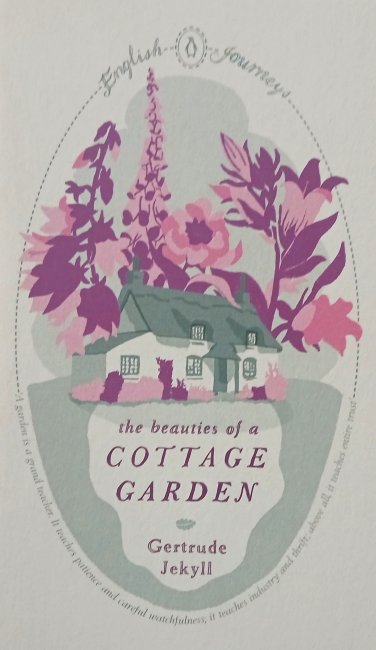
It is now March and thoughts turn to the great outdoors as the weather slowly improves with the first hints of spring. Sadly I no longer have a garden of my own so I get my joy vicariously from the woodlands that make up the sides of the gorge where I live and the gardens I pass on strolls through the town. I miss the small garden I had at my last house and am determined that my next move will bring a little bit of land back under my control. Until then I can dream and read books like this one by Jekyll or The Garden by Vita Sackville-West which I reviewed eight years ago at around this time, thoroughly enjoying its evocative poetry. ‘The beauties of a Cottage Garden’ is ten extracted chapters from Gertrude Jekyll’s classic 1899 work ‘Wood and Garden’ which was her first book and is a good introduction to her somewhat opinionated style and also the scale that she normally worked on in designing gardens for other people, of which she did over four hundred several of which can still be visited. A quotation is I think appropriate here:
The large lawn space I am supposing stretches away a good distance from the house and is bounded on the south and west by fine trees: away beyond that is all wild wood. On summer afternoons the greater part of the lawn expanse is in cool shade, while winter sunsets show through the tree stems. Towards the south-east the wood would pass into shrub plantations, and further still into garden and wild orchard. At the end of the lawn would be the brilliant parterre of bedded plants, seen both from the shaded lawn and the terrace, which at the end forms part of the design.
and so she goes on… The book starts with her growing love of plants and gardens from a young age with her own section of her parents garden and how she learnt what worked and what didn’t by practical application and reading standard references of the time (the 1850’s) her own works have become reference works for horticulture even up to today and it is Jekyll we have to thank for promoting the blend of colours in a planted border much as an artist draws together various paints to gain an effect greater than the individual parts. The chapter on flower shows clearly displays her distaste for the artificially contrived ways of presenting flowers at such events at her time, that this chapter is entitled ‘The Worship of False Gods’ speaks volumes in itself. She is also scathing with regard to ‘novelties’ especially the late Victorian love of dwarf varieties of plants she would much rather extend to their full beauty. “When a Zinnia has a hard, stiff, tall flower with a great many rows of petals piled up one on top another, and when its habit is dwarfed to a mean degree of squatness, it looks to me both ugly and absurd”, and as for messing with the natural balance of colours well she is not happy to say the least. She also has much to say regarding ill-educated gardeners of large estates who are stuck in their ways and are not willing to accept the idea of the masters of those properties.
Yes Gertrude Jekyll is a product of her time but nobody could deny her influence and her writing is definitely entertaining both for and against trends and fads in gardens and plants. Her own home has recently been purchased by The National Trust, not only for its important gardens but also for the house itself designed by the great architect Edward Lutyens whom she worked with many times to create grounds for his various houses across the country. Together they became one of the leading lights of the Arts and Crafts movement which flourished largely between 1880 and 1920. An interesting article from The National Trust on the thoughts on preservation of her home and especially its garden can be read here.
 Ramblings on my bookshelves
I would love to read this, she is so influential as you say, the ideal of the English Country Garden!
LikeLike