Orlando – Virginia Woolf – part 2

This blog follows on from Part 1 but goes through the entire plot line so should not be read if you have not previously read the book or do not mind knowing what happens.

The book is split into six chapters and each is effectively a stand alone tale dealing with a specific period in Orlando’s life. The first chapter makes perfect sense as you read it, Orlando is a boy when Queen Elizabeth I visits his fathers’ great house and so captivates Her Majesty that he is invited to court towards the end of her reign, where he grows up to be a young man about town and is still around the court when James I becomes king after the death of Elizabeth. By the end of this chapter you are happily reading a novel set in the time of the Stuarts where Orlando has loved and lost the Russian noblewoman Sasha and you are wondering what will befall him next.

Chapter two has him exiled from court due to the scandal with Sasha and spending time back in the family house attempting to write great works but being unsatisfied with them all and holding parties. This is a not so subtle reference to Virginia’s lover Vita Sackville-West who is also trying to write ‘a great work’ but Virginia doesn’t rate her as an author and doesn’t believe she is capable of achieving this ambition. Orlando also at this time meets Romanian Arch-duchess Harriet who attempts to seduce him but without success. Ultimately Orlando is getting bored stuck at home so that he requests a job from the King and is sent as ambassador to Turkey. This is also a reference to Vita as she lived in Constantinople (as it was then) when her husband was sent to the embassy there from 1912 to 1914.

If you know English history a few comments in the book may be ringing bells by now but the storyline still flows without many issues. The third chapter deals with his time in Turkey initially as ambassador but then the book takes a dramatic swerve. There are a few pages that read like sections of an ancient Greek play, with Purity, Chastity and Modesty introduced as characters parading through his bedroom with trumpet calls and overblown narrative until Orlando finally awakes as a woman. As a plot twist it is certainly unusual and gets odder as people seem relatively unfazed by the change and as the embassy had been attacked during an uprising whilst Orlando slept he/she goes off to live with gypsies for a while. This last part is again a link to Vita who had a highly romanticised view of the Romany people as free living and unconstrained by the pressures of modern life. The book has her living with them for a while and then realising that she is really an interloper and misses the green lands of her home, this is Woolf pointing out to Vita that for all she may fantasise about the gypsy life she would not cope with the reality.

Chapter four has her decide to return to London and her home in Kent where she again meets the Arch-duchess who reveals herself to actually be Arch-duke Harry and this time as a man tries to seduce the now female Orlando with much the same result. Again nobody appears to be surprised by this. She throws herself into London society and meets many famous writers before taking to disguises to explore the seedier side of London to stop life getting too dull. By the end of this chapter the aspect of the book that was ringing bells earlier has now been made explicit but without any explanation, I’ll get to it later.  The fifth chapter takes place entirely in the great house without providing much detail as to what goes on. By the end however the court cases started when she returned from Turkey as a woman and caused all sorts of issues with who owned what and if she really was Orlando are settled although they have used up most of her fortune and she marries somebody she has barely got to know just in time for him to leave to go to sea.

The book ends with her finally finishing her great work “The Oak Tree” and it being praised and even winning a prize before her husband returns to her from foreign climes and she rushes to greet him.

20180529 Orlando 3

This cover is a bit problematic for me as the inclusion of the aircraft gives away the one aspect I left out in the summary above and that is the time travelling aspect of the novel. You start reading the book and it is clearly set at the end of the 1500’s with the reign of Elizabeth I coming to an end. Orlando is mentioned several times lying under the tree so what is the plane doing there?

In fact you slowly become aware of the drift of history through the book. As stated above Orlando was clearly a young man at the end of Elizabeth’s reign and much later on in the book we discover that the poem he has been working on since boyhood is dated 1586, so that would probably place him as born in around 1575, Elizabeth died in 1603 and we know he was at court during her reign for a period of years. The next monarch mentioned is James I (1603 to 1625) during whose time Orlando is largely banished from court after his relationship with Sasha at the frost fair. There were two of these during his reign (1608 and 1621) so Orlando is roughly 33 or 46 at this point. The first of these sounds more likely from his behaviour so let us say he retires to his country house in 1608, this is all quite plausible up to this part of the novel.

The next time period mentioned is when he goes to be Ambassador to Turkey after getting tired of being at home. I’m not surprised he was getting bored by then as the Monarch he asks for the job is King Charles II (he is described as being with his mistress Nell Gwyn so we know which Charles we are talking about). His reign was from 1660 to 1685 and he started his relationship with Gwyn in 1668 so as a minimum Orlando is now 93 and has spent at least the last 60 years holding parties at home. This is the first time that the time-scale appears to have stretched, as up until he goes home in 1608 it is quite believably a tale about a late Elizabethan gentleman, nobody appears to be surprised by this and he is still clearly a young man in the novel. Charles II is still on the throne when Orlando is made a Duke and subsequently changes sex. We then hit her time with the gypsies and this is also clearly several decades. On return to England she sees the dome of the new St Paul’s cathedral (consecrated 1697) and the captain of the ship refers to the late William III (died 1702) so we are now in the reign of Queen Anne (1702 to 1707) and this is explicitly stated later in the book as Orlando enters society as a young and eligible woman at the age of 130!

At last a positive date… Well sort of. There is a mention of 16th June 1712 being a Tuesday, it was actually a Thursday but never mind, it is the first specific date in the novel and this is when Orlando decides to quit society only to decide not to the next day due to an invitation that she really wanted to go to. There she meets Alexander Pope and through him various other writers such as Swift who quotes from Gulliver’s Travels, a book printed in 1726 so time is still moving on apace. She sees Johnson and Boswell (circa 1770’s) and chapter four concludes with the dawning of 1st January 1800 with a dark cloud over London. Chapter five includes a statement that she had been working on the poem “The Oak Tree”

… for close on 300 years now. It was time to make an end.

so that takes us up to the 1860’s. This is another huge leap in the time line of the book as it is only 8 pages into the chapter. It’s an odd chapter, using damp weather as a metaphor for the changes in society through the Victorian age, no more gay parties and bright lights, now the houses are cluttered and cold, the people withdrawn and everything is dark and covered up as society becomes more straight-laced and women are expected to be ‘the little woman at home’ safely married off. It’s also no wonder the court proceedings have used most of her fortune, they would have started in the early 1700’s and concluded roughly 160 years later as Lord Palmerston and Gladstone are mentioned with the court documents and Palmerston died in 1865. It is worth noting however that it does leave Orlando with the house, which as I stated in the previous essay on the book Vita specifically didn’t get as she was a woman so maybe this is a put in as a solace to Vita that although it may take 160 years a woman will eventually inherit what would be hers by right if she had been a man.

The sixth, and final, chapter brings us to the present day, well 1928 which is when the book was written anyway. It begins slightly before then at the end of the Victorian age as she finally gets her poem The Oak Tree published with the help of Nicholas Greene but most of the chapter is set on the 11th October 1928 starting in London with a very confused shopping trip. She drives out of London to the great house in Kent and is there as her husband finally comes home this time by aeroplane whilst she lies under the tree as she used to as a boy centuries earlier

It is not only Orlando who straddles time in the novel, several of the fictional characters fail to grow old with her, the Arch-Duchess/duke is also mentioned in chapter five as married and settled in Romania so he is also as old as Orlando and others survive well beyond a normal lifespan such as Nicholas Greene, the poet and critic who first met Orlando in the Elizabethan age and meets her again in the Victorian. Sasha from the frost fair in 1608 is also glimpsed during the shopping trip in 1928 and is described as late middle aged. Orlando’s husband, Shelmerdine, is also timeless, at least since coming into contact with Orlando, for they meet and marry in the 1860’s when her court cases have completed but he is clearly still only in middle age by 1928.

The book is complex and at times infuriating as it leaps about but still an enjoyable read, I’ve also had quite a bit of fun reading through it again trying to identify all the historical events that can be dated for this essay.

Orlando – Virginia Woolf – part 1

HE – FOR THERE could be no doubt about his sex, though the fashion of the time did something to disguise it – was in the act of slicing at the head of a Moor which swung from the rafters. It was the colour of an old football, and more or less the shape of one save for the sunken cheeks and a strand or two of coarse, dry hair, like the hair of a coconut.

The opening two sentences of Orlando certainly make you want to know more… Just what is going on here?

Virginia Woolf’s best known work is 90 years old this year so it seems appropriate to write about it now. The book is strange reading it now; it must have been extraordinary to readers back in 1928 with it’s bizarre plot twist halfway through. Although for me it’s what Woolf does with the character of Orlando before and after that point that is interesting rather than the twist itself but it must have been quite a jump for the casual reader in 1928. I have split this blog into two because I really want to be able to discuss the plot line and that will require me to include a lot of spoilers so this part talks generally about the book and part two will summarise the plots within it and contain the spoilers, so if you haven’t read Orlando this blog is perfectly safe.

20180529 Orlando 1

Although it is a short novel (just over 200 pages) there is a lot packed into the book and part of the conceit of it is that it claims to be biography. Virginia writes in first person as the biographer and frequently employs the literary equivalent of the theatrical trick of ‘breaking the fourth wall’ by talking directly to the reader about the difficulties of finding material to work from in compiling the biography. There is even a short index at the back as you would expect in such a work. One particular passage near the end of the book sums up this stylistic method rather well.

It was now November. After November comes December. Then January, February, March and April. After April comes May. June, July, August follow. Next is September. Then October, and so behold, here we are back at November again, with a whole year accomplished.

This method of writing biography, though it has its merits, is a little bare, perhaps, and the reader, if we go on with it, may complain that he can recite the calendar for himself and so save his pocket whatever sum the Hogarth Press may think proper to charge for this book.

As can be seen ‘the biographer’ can be quite chatty to the reader but also quite pompous, these brief interludes give you time to absorb wherever the plot has suddenly taken us next, but it is also Virginia’s way of ridiculing historical biographers who she clearly thought took themselves far too seriously.

From the way she writes about it Woolf was clearly also not a fan of ‘Society’, that endless round of functions and engagements that the upper classes seemed so devoted to right up to her time. There are many disparaging passages in the book about this foolish waste of time and money where nothing seems to be done or said that was memorable. She is also less than enamoured by her own profession of writing, or at least the majority of what was being written at the time, one particularly favourite quote of mine from the book is.

For it is rash to walk into a lion’s den unarmed, rash to navigate the Atlantic in a rowing boat, rash to stand on one foot on the top of St. Paul’s, it is still more rash to go home alone with a poet.

The book is definitely an oddity, so many different things happen and great numbers of historical characters are introduced and yet there is the constancy of the huge family house which is used to pull Orlando back to normality when things get too strange only to bore after a while and lead into another adventure. It really becomes one of the characters in the story and is the solid anchor around which the shifting tale is woven.

20180522 Orlando 4

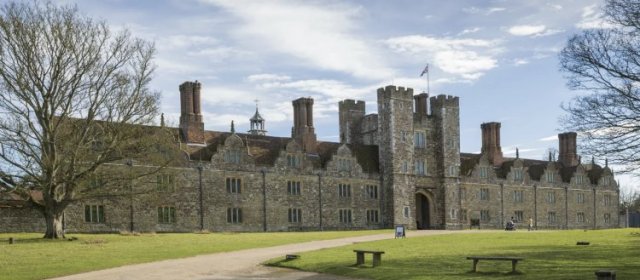
The house featured in the book is clearly based on Knole in Kent, one of the largest houses in England; and one I know well, as it is 17 miles from where I used to live at the end of the 1990’s. It was the family home of Vita Sackville-West and like her house at Sissinghurst it is now owned by the National Trust. I used to go there regularly to explore the 1,000 acre park or wander round the house, it has according to Vita 365 rooms just as Orlando’s vast house does; although she also said that “I do not know that anyone has ever troubled to verify it”. The house was also the source of great sadness for Vita as if she had been born a man she would have inherited it as her parents only child but as a woman she was passed over in favour of her cousin. As explained in my previous blog about Vita, she and Virginia were lovers for many years and there is a lot of Vita’s family history interwoven in the book.

The dig at writers and specifically poets mentioned above was also somewhat aimed at Vita who was clearly not in Virginia’s league and for all that she loved her Virginia really didn’t rate her as a poet or author. There is also, at the start of the final chapter some discussion as to whether it is even proper for a married woman to be a writer. Clearly it is fine for an unmarried female to dabble in writing for her own amusement and also what is marriage anyway…

She was married true: But if one’s husband was always sailing round Cape Horn was it marriage? If one liked him, was it marriage? If one liked other people, was it marriage? And finally, if one still wished, more than anything in the whole world, to write poetry, was it marriage? She had her doubts.

Both Virginia and Vita were married throughout their relationship and Vita in particular took other lovers at the same time both male and female. Orlando was written at what is now recognised as the peak of their love for each other when both were also at their creative best, probably feeding inspiration off each other. It was also a time of female emancipation in Britain, 1928 was not only when this book was written but it was also the year that woman finally gained full voting equality with men and more pointedly a couple of pages later Woolf includes the line…

as long as she thinks of a man, nobody objects to a woman thinking

I struggled initially with the plot of the book (see part 2) but I’m glad I persevered, this is the first of Woolf’s novels I have read although I had read her best known feminist work ‘A Room of One’s Own’ and ‘The Common Reader’ before. Maybe it’s time to get that copy of ‘To The Lighthouse’ off the shelves where it has languished for a few years.

20180529 Orlando 2

Of equal interest, to me at least, is the background to the three copies of the novel that I possess and two of whose covers have punctuated this essay. The top one is the first Penguin Books edition (number 381) from July 1942 and therefore published under wartime restrictions. This meant that fewer copies were printed than might have been the case before the war and also that the paper quality is poor to say the least, making the book quite fragile.

The second cover at first glance look to be the same, but this was printed in Cairo in 1943 for the troops fighting on the African front. This explains the price in piastres printed on the cover. If possible these books, there were 20 titles printed in English and 1 in French as part of this programme, are even more fragile than the ones produced in England at the same time and few have survived their time in the Africa campaign. Books for the troops were in short supply, especially in Africa and as any soldier will tell you a culture of ‘hurry up, and wait’ means that there is a lot of quick movement followed by long periods of not a lot apparently happening so any reading material was eagerly seized upon. Quite what the troops made of this very strange book is not recorded, I can think of many more suitable novels from Penguins extensive catalogue which would have been a lot more popular.

The third copy I have is the American Penguin edition from April 1946 and this being far more capable of surviving having its pages turned is the copy I read for these essays. However as the illustrated cover includes a massive spoiler for the book I have used this in part 2 of my discussion of Orlando. There is also an interesting tale behind this imprint. Penguin wanted to sell books in America during the war but clearly shipping books across the Atlantic was out of the question, as was using up the paper ration that they had been allocated on books which would not then end up on sale in the UK so they sought an agent to produce the books for them. They settled on Ian Ballantine and he originally printed books that looked like their UK equivalent but soon switched to illustrated covers to appeal more to the American reader. In the end under his control over 180 titles were printed in the US as either Penguin or Pelican before in 1948 Penguin Books withdrew from this enterprise as they could now export again. The titles were re-branded as Signet (for the Penguins) and Mentor (for the Pelicans) and Ian Ballantine with his wife Betty continued to publish under those brands before also creating Bantam, New English Library and of course Ballantine books. The Ballantine book group was acquired by Random House in 1973 which in turn merged into Penguin Random House in 2013 thereby bringing the story full circle.

The World As It Is – A book for Subscribers

20180710 The World as it is 1

Well actually The World as it was, as these books date from 1884 and provides a glimpse into history 130 years ago. However before looking at the book itself the main reason for selecting it is to expand on the subject of subscribers editions that I first touched on in Burghall’s Diary  That book in my collection was sold against a prospectus, ‘The World As It Is’ is a subscribers only book and helpfully whoever had the parts subsequently bound included the subscription page so we know how it was sold. After a lot of description as to the structure of the proposed two volumes the subscription page concludes as follows:

The Work will be handsomely printed on super-royal 8vo paper, and will be illustrated by above 300 engravings printed in the text; seventeen maps and diagrams printed in colours, ten coloured plates show some of the principal races of the earth and some remarkable natural phenomenons, and twenty-eight separate page engravings representing notable and remarkable localities in many lands. – making in all FIFTY-FIVE separately printed illustrations. It will be issued in Fourteen Parts, of 80 pages of letterpress, at 2s. each, or Seven Divisions in stiff paper covers at 4s. each, forming when completed two handsome large 8vo volumes. Whether viewed in the aspect of the wide range of its contents, of its educative value, its wealth of illustration, or its moderate price, this work will be found to be quite unique of its kind.

LONDON:  BLACKIE  &  SON,  49  &  50  OLD BAILEY,  EC;

GLASGOW, EDINBURGH AND DUBLIN

Capitalisation is as printed in the document, I have used bold to represent the parts highlighted in italics in the original, this is a Victorian marketing department going full tilt. For those not familiar with the abbreviations used 8vo is a standard paper size usually written as octavo. Standard octavo paper is 9 inches high by 6 inches wide (23cm x 15cm) The pages of the book are actually 9.7 inches high by 7.2 inches wide (24.6cm x 18.4cm) which is presumably where Blackie have come up with super-royal although both super octavo and royal octavo are larger than this.

The price is given as either 14 lots of 2s. or 7 lots of 4s. s. standing for shilling so a total of 28 shillings regardless of how you had the parts. Using the Bank of England inflation calculator (which unfortunately only goes up to 2016) this ‘moderate price’ was apparently more like £159.65 in 2016 or just over £168 by 2018 adding the extra 2 years inflation. Also bear in mind that like modern magazine part works you then need binders, in fact back then you definitely did as these were literally just loose pages, especially the illustrations, and came with instructions for the bookbinder as to where the pages should go. So you would buy the remarkably solid board covers available from Blackie and then pay a bookbinder to put it all together meaning you wouldn’t see any change out of the equivalent of at least £200 probably closer to £250 for your ‘moderate’ purchase. I bought the books in the mid 1980’s and according to the price still visible inside paid £2.50 for the pair at the time, the paint stains on the boards no doubt keeping the price well down. I remember the second hand bookshop where I bought them fondly, the proprietor wrote a year code letter next to the price in all his books, A for his first year of business, B for the second etc. he had been trading for getting on for 20 years by the time I bought this and if you could find anything in the shop coded A you could have it for free.

20180710 The World as it is 2

The books are really interesting although anyone looking at them and deciding to visit a place based on the information provided would definitely have a surprise coming; for example Swanston Street in Melbourne certainly looks different nowadays :

20180710 The World as it is 4

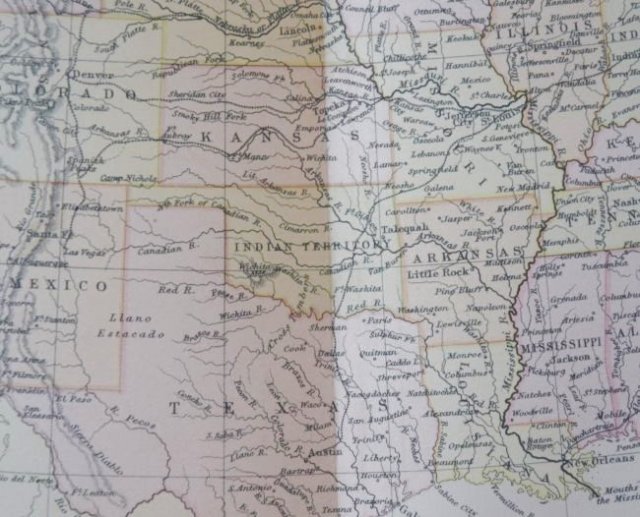
It’s the illustrations that I like so much and that first attracted me to these books, that and odd bits of history that you suddenly spot whilst scanning through. The United States of America is described  as a republic consisting of 38 states and 8 territories with an organised government, besides the Indian territory, the territory of Alaska and the District of Columbia. Seeing a map with Indian Territory clearly marked instead of Oklahoma emphasise the fact that the books pre-date the ‘land runs’ of settlers into the Indian lands and are a full 23 years before the Indian Territory ceased to exist altogether when the state was created in 1907.

20180710 The World as it is 5

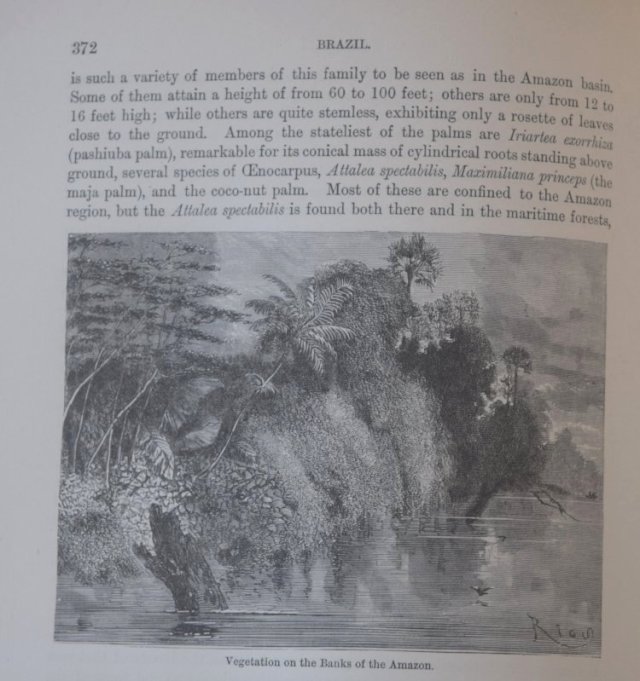
The smaller illustrations within the text are also beautiful steel engravings as these two pages show, one from the Amazon basin in Brazil and the other from the Transleithan Provinces of the Austrian Empire most of which is now the independent country of Hungary with the Transylvanian region making  up the western part of Romania. You do have to know some history to even start looking places up as they may well not be under the country you expect.

20180710 The World as it is 6

20180710 The World as it is 8

Budapest is described throughout this section as two cities Buda and Pesth (the extra h is how it is spelt in the book) and when you are there the city does feel like two distinct places even now.

The colour plates are not a strong point though, the artist who did these wasn’t really of the standard of the rest so they are a bit of a let down even though the colours are still strong, the best one by a long way is the one representing China:

20180710 The World as it is 7

The books provide a glimpse into a world that no longer exists and for that they are fascinating. In fact they document a world that was rapidly disappearing even as it was published, so I think I will conclude this essay with what is apparently a typical Dutch interior, but is definitely is a museum piece now.

20180710 The World as it is 3

How to Avoid Being Killed in a War Zone

20180703 War zone 01

Rosie Garthwaite’s book sounds like it should be one of those parodies that are all too common nowadays but in fact it is deadly serious and has to be the one example on my bookshelves which legitimately uses the tag “It Could Save Your Life”. Mine is the first edition from 2011 published by Bloomsbury and is still available.

Of course for most people the best way to avoid being killed in a war zone is to make sure you never go to one however the book covers so much more that it becomes a highly entertaining and indeed useful addition to any bookshelf. Split into 15 sections which cover everything from planning, preparing and arriving on your trip through first aid and emergency medicine, keeping fit and surviving kidnapping amongst other things. It is part survival guide and part filled with anecdotes which illustrate the topic being covered. The range of people Rosie has spoken to in compiling the book is huge and covers top war reporters, members of the military, charity workers, a former Somali pirate and, in the case of kidnapping, Terry Waite who was a hostage negotiator in Lebanon for years before being kidnapped and held for hostage himself for almost 5 years.

Some things in the book you hope you will never need, like how to put on a flak jacket correctly, others like some of the tips on keeping safe in a crowd could be useful at any time, as she says

The best advice is to avoid street protests at all costs. Of course, that’s not always possible, sometimes they run into you. And sometimes you might join a small peaceful protest that turns into a riot. You might be in an ambulance waiting to deal with the fallout nearby. You might be involved as a protester when it all goes wrong.

You don’t need to be in a war zone, sometimes the streets of your home city can become surprisingly dangerous.

Anyone who has read books written by war reporters about their lives on the job would enjoy the anecdotes in this volume, Rosie herself works for Al Jazeera and recounts many stories of her journeys for work, mainly in Iraq, and a lot of the other reporters she quotes also work or have worked for that news organisation. There are also a good smattering of BBC, Sky, CNN and various (mainly British) newspaper writers along with people from Médecins Sans Frontières who also tend to be on the front line. It is interesting to read the different opinions of the journalists on how to survive, some like to blend in with the locals others prefer to stand out, there are advantages and disadvantages to both viewpoints. Blend in and you may get closer to the story but risk being mistaken for a spy, stand out and everyone knows who you are so you can get further up the chain of command, but you are also obvious if somebody is looking for a high profile target to attack.

The first aid section is particularly good and at 45 pages also the longest part, it takes you through a basic medical kit to pack if going somewhere where the local medical service may not be the best or if heading into wild country. A lot of this I have packed in the past, put it in a clearly marked container in your pack and make sure other people you are with know it’s there. There is no point carrying sterile medical items if they don’t get used because nobody knew and you can’t tell them for whatever reason at the time. It then has an A to Z of medical issues and what to do until somebody who really knows what they are doing arrives, CPR, recovery positions, slings, tourniquets, treating burns, dislocations, frostbite and sunburn amongst many others. One I really, really hope I don’t ever need is how to deliver a baby but you definitely don’t need to be in a war zone for that one.

I’m not a war correspondent and frankly wouldn’t want their job but I’ve been through armed official and unofficial checkpoints set up on strategic roads in Libya and Lebanon. One of the people who boarded the bus in Lebanon in 1996 with an AK-47 over his shoulder appeared to only be about 14, you just have to keep calm. I’ve also been very aware of being watched to see where I was going in Libya, Syria and Iran amongst other countries, bribed my way into Ceaușescu’s Romania back in 1987 as I didn’t have a visa and also used dollar bills in my passport on several borders where it simply made getting the right paperwork processed faster. I just wish Rosie had written this book 20 years earlier.

King Penguins

Although the longest essay I have written here so far, this is just a brief introduction to a very attractive series of books produced by Penguin from 1939 to 1959. Covering a vast array of subjects with (for the most part) excellent illustrations in both black and white and colour they make up a mini reference library all on their own.

20180626 King Penguins 01Starting a new series of illustrated hard back books just as war had broken out was clearly just bad timing for Penguin Books, they had been planned for months and the first two were ready to go for November 1939. That the series not only survived the subsequent paper rationing but flourished for a further 74 volumes until 1959 was nothing short of a miracle. Almost all the books have the same format, a monograph on the specialist subject which may also include black and white line illustrations or photographs, followed by a series of colour plates. The monograph averages about 30 pages; although Ur by Sir Leonard Woolley has only 18 and at the extreme opposite A Book Of English Clocks by R.W. Symonds has 74 pages of text. Likewise the colour plates were intended to be on 16 pages, this also varies but by no means as much as the texts as this was easily the most expensive part of each production so costs were closely monitored.
20180626 King Penguins 03

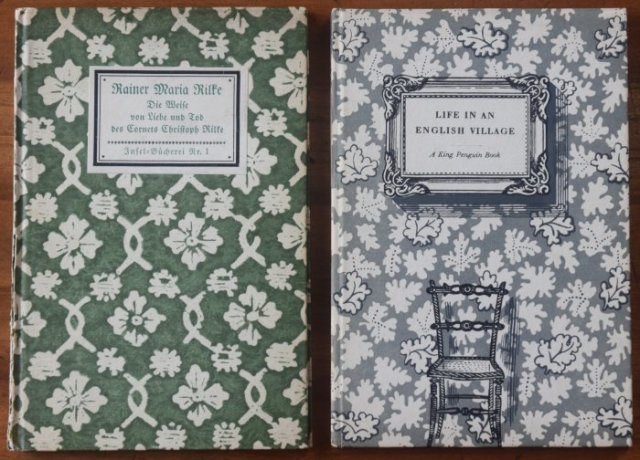
Kings were inspired by the German Insel Bucherei printed by Insel Verlag, these beautiful art books had started in 1912 and by the time Penguin launched their Kings there were roughly 500 Insels already available and their catalogue would eventually reach 1,400 different titles. Fortunately for my bookshelves Kings stop at number 76 although there are a few variations to collect as well but my complete set of the first editions is shown in the picture at the top of this essay. One of the most striking aspects of that picture is the wide variety of covers and the design of these was seen as one of the most important aspects of the series. After all they have to draw the potential purchaser in, especially as these were initially priced at one shilling or twice the price being charged for the normal Penguin paperbacks. Unfortunately this didn’t last very long as the price very quickly doubled as it became clear that they were more expensive to do right that initially anticipated and Alan Lane wanted them to be done as well as Penguin could manage. This meant that they really had to look striking so the original house style on the first five was quickly dropped.

Only seventeen Kings were ever reprinted or revised, so with almost all of them the first edition is the only example available and on average 20,000 were printed of each title, although A Book of Toys sold over 55,000 copies. This means that Kings are not normally particularly rare; but are scarce enough to make the hunt trying to collect them all interesting. Some such as Magic Books From Mexico were recognised as niche interests from the start so the print runs were commensurately smaller. In the case of this book however even these apparently didn’t sell and there is a rumour that a large number of them had their plates removed and put under glass in the type of coffee table very popular in the 1960’s and 70’s.

20180626 King Penguins 04

K1 – British Birds on Lake, River and Stream by Phyllis Barclay-Smith – Nov 1939
K2 – A Book of Roses by John Ramsbottom – Nov 1939
K3 – A Book of Ships by Charles Mitchell – Sept 1941
K4 – Portraits of Christ by Ernst Kitzinger & Elizabeth Senior – Feb 1941
K5 – Caricature by E.H. Gombrich & E. Kris – Feb 1941

The first five Kings produced under the editorship of Elizabeth Senior are highly distinctive, although the actual printing quality is not as good as it might be given the intention to emulate the Insel books. However as you can see from the dates of first publication this was not a time for finesse, wartime restrictions soon caused problems with the series meaning that a large proportion of K3, K4 and K5 were bound in soft card covers cut flush to the internal pages as well as the overlapping boards normally used for Kings. The Book of Ships in the picture above is one of these soft back editions and as can be seen is consequently slightly smaller than the other four. K1 is the first of these volumes to use plates from John Gould‘s famous work The Birds of Great Britain, the other being K19 Garden Birds. A Book of Roses (K2) also makes use of a famous earlier work for the plates, in this case Redouté‘s Les Roses. The other three volumes use 16 colour plates from a mixture of sources and along with these there are several black and white images within the text. K1 and K2 only have the 16 colour plates along with a single black and white portrait of Gould and Redouté respectively.

Sadly Elizabeth Senior was killed in an air raid in 1941 and editorial control of the series passed to Nikolaus Pevsner
20180626 King Penguins 05

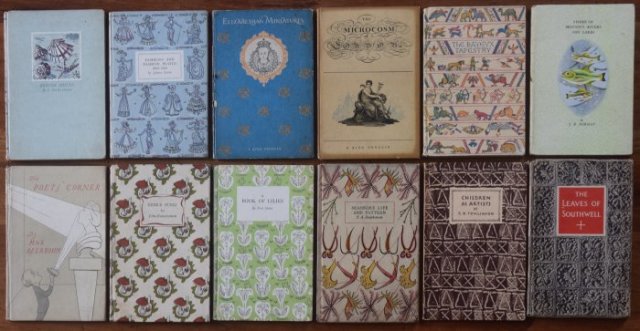
K6 – British Shells by F. Martin Duncan – June 1943
K7 – Fashions and Fashion Plates 1800-1900 by James Laver – June 1943
K8 – Elizabethan Miniatures by Carl Winter – June 1943
K9 – The Microcosm of London by John Summerson – June 1943
K10 – The Bayeux Tapestry by Eric Maclagan – Dec 1943
K11 – Fishes of Britain’s Rivers and Lakes by J.R. Norman – Dec 1943
K12 – The Poets’ Corner by John Rothenstein – Dec 1943
K13 – Edible Fungi by John Ramsbottom – July 1944
K14 – A Book of Lilies by Fred Stoker – Dec 1943
K15 – Seashore Life and Pattern by T.A. Stephenson – July 1944
K16 – Children as Artists by R.R. Tomlinson – Dec 1944
K17 – The Leaves of Southwell by Nikolaus Pevsner – Dec 1945

After the fairly dull cover design of the first five with its fussy white banding round the spine it is a relief to see the variety produced in the next dozen. Half of them have that Insel Bucherei look with the title and author appearing on a reproduction of the paste down labels quite common on quality books from the previous 100 or so years. Unlike Insel books this is actually part of the printed design rather than an extra slip, but it does give a touch of class to the book. The first few are experimenting with alternate cover styles and Fishes of Britain’s Rivers and Lakes is a very attractive design by Charles Paine, I’m less impressed with the cover of Microcosm of London with it’s overly florid text done by Walter Grimmond. Having said that Microcosm is the first of the Ackermann editions in Kings. Rudolph Ackermann was a bookseller and printer in London in the early 1800’s and his books and prints sold well making him known for the quality of his images which captured not only cityscapes like this along with K59 Cambridge and K69 Oxford but also the images documenting the start of the railway age some of which are included in K56 Early British Railways and for further variation K46 Highland Dress, all plates of which were originally printed by Ackermann.

Other notable books in this block of twelve are K10 The Bayeux Tapestry with 8 pages of colour plates and 40 pages of black and white photographs which at the time were some of the best images available in print. K13 Edible Fungi is beautifully illustrated by Rose Ellenby who also did its pair K23 Poisonous Fungi. Like Elizabeth Senior, Nikolaus Pevsner got one of his own titles in this block with K17 The Leaves of Southwell which has 32 pages of lovely black and white photographs of the capitals and columns in the chapter house at the Minster of Southwell in Nottinghamshire.
20180626 King Penguins 06

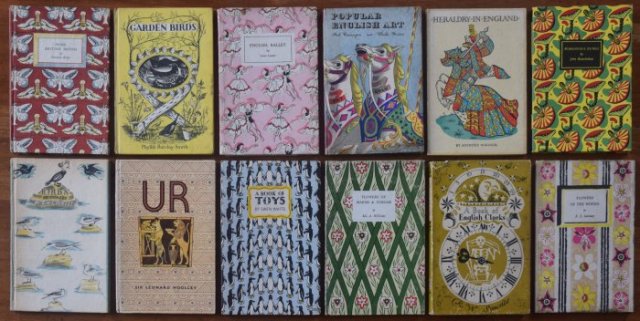
K18 – Some British Moths by Norman Riley – May 1945
K19 – Garden Birds by Phyllis Barclay-Smith – May 1945
K20 – English Ballet by Janet Leeper – Dec 1944
K21 – Popular English Art by Noel Carrington – Dec 1945
K22 – Heraldry in England by Anthony Wagner – Nov 1946
K23 – Poisonous Fungi by John Ramsbottom – Dec 1945
K24 – Birds of the Sea by R.M. Lockley – Dec 1945
K25 – Ur: The First Phases by Sir Leonard Woolley – May 1947
K26 – A Book of Toys by Gwen White – Dec 1946
K27 – Flowers of Marsh and Stream by Iola A. Williams – Nov 1946
K28 – A Book of English Clocks by R.W. Symonds – May 1947
K29 – Flowers of the Woods by Sir E.J. Salisbury – Apr 1947

Apart from the obviously wonderfully choice of getting somebody called Leeper to write a book about ballet this is a delightful mix of titles. K18 British Moths goes back to the first two Kings by using prints from an old classic book on the subject, in this case by Moses Harris from the mid 1700’s. K21 Popular English Art is an eclectic mix from  drawings of Windsor chairs to colour images of a jug, ship’s figurehead and even a pub interior all done by Clarke Hutton who like Noel Carrington who wrote the text is probably best known to Penguin collectors for their work on Puffin Picture books. Birds of the Sea is also illustrated by an artist in Puffin Picture Books, R.B. Talbot Kelly who created the PP52 Paper Birds which was a cut out book now rarely seen in one piece along with the beautiful PP65 Mountain and Moorland Birds.

One of my favourite King Penguins comes next, K26 A Book of Toys by Gwen White, it’s one of the oddities in the range as it deviates from the plan of a monograph and plates being illustrated all the way through much more like a small hardback Puffin Picture Book with the handwritten text drawn directly onto the plates and not typeset; and what is not to like about a cover with dozens of toy penguins. K27 is let down badly by the quality of the printing of the colour plates, K28 is frankly a mess with far too much jammed into the book which would have been better expanded as a Pelican Book and dropped from this series but K29 rescues this block with some lovely if rather flat coloured plates.

20180626 King Penguins 07

K30 – Wood Engravings by Thomas Bewick by John Rayner – Apr 1947
K31 – English Book Illustration 1800-1900 by Philip James – Sept 1947
K32 – A Christmas Carol by Charles Dickens – Dec 1946
K33 – Russian Icons by David Talbot Rice – Oct 1947
K34 – The English Tradition in Design by John Gloag – Oct 1947
K35 – A Book of Spiders by W.S. Bristowe – Sept 1947
K36 – Ballooning by C.H. Gibbs-Smith – Nov 1948
K37 – Wild Flowers of the Chalk by John Gilmour – Dec 1947
K38 – Compliments of the Season by L.D. Ettlinger & R.G. Holloway – Dec 1947
K39 – Woodcuts of Albrecht Durer by T.D. Barlow – Sept 1948
K40 – Edward Gordon Craig by Janet Leeper – Oct 1948
K41 – British Butterflies by E.B. Ford – Oct 1951

The first two of this block make a great pair, they have a similar design with high quality illustrations right through the text as well as the plates at the back and K39 Woodcuts of Durer goes well with the both of them. That brings us to another King Penguin oddity. K32 A Christmas Carol is almost a facsimile of the original first edition of this Dickens classic, it doesn’t count as a true facsimile as the font used is Monotype Modern, it being the closest available to match the original. The very interesting Russian Icons by David Talbot Rice is another book let down by the poor quality of the printing of the plates, it also has a correction slip pasted over credit for the cover illustration. William Grimmond is credited on the page with Enid Marx pasted over the top. The English Tradition in Design has 72 pages of black and white photographs, the cover of this book does tend to fade badly, probably more than any other King Penguin whilst Wild Flowers of the Chalk, Compliments of the Season and British Butterflies all go back to the original internal plan with a monograph followed by 16 plates which was now becoming a rarity in the series, even if only the last one had a suitable cover design.
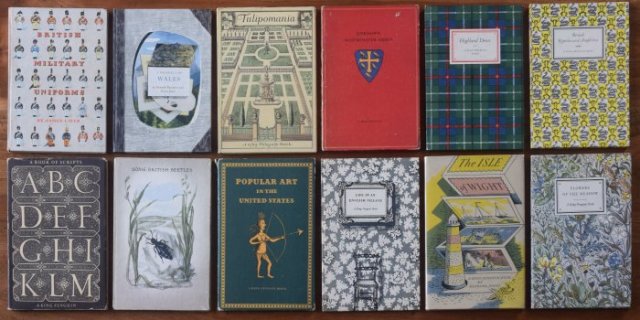
20180626 King Penguins 08

K42 – British Military Uniforms by James Laver – Oct 1948
K43 – A Prospect of Wales by Gwyn Jones – Sept 1948
K44 – Tulipomania by Wilfrid Blunt – Oct 1950
K45 – Unknown Westminster Abbey by Lawrence E. Tanner – Nov 1948
K46 – Highland Dress by George F. Collie – Aug 1948
K47 – British Reptiles and Amphibia by Malcolm Smith – June 1949
K48 – A Book of Scripts by Alfred Fairbank – Nov 1949
K49 – Some British Beetles by Geoffrey Taylor – June 1949
K50 – Popular Art in the United States by Edwin O. Christensen – June 1949
K51 – Life in an English Village by Noel Carrington – June 1949
K52 – The Isle of Wight by Barbara Jones – July 1950
K53 – Flowers of the Meadow by Geoffrey Grigson – June 1950

By now Swiss designer Jan Tschichold was firmly in control of the Penguin house style, he had started with tidying up the look of the major series and setting firm rules not just on typography but also strict design specifications, his influence can now be seen in the Kings. His re-imposition of the original plan of monograph with 16 plates continued with these dozen, just two don’t fit this general structure although the number of plates did get up to 22 for some. The two that don’t fit are K45 Unknown Westminster Abbey along with K48 A Book of Scripts, K45 is very similar in structure to K17 The Leaves of Southwell which makes sense as these are covering much the same field just a different building. A Book of Scripts is another King oddity, concentrating as it does on fine handwriting and to do this it needs lots of illustrations, it also is the only King Penguin to be revised/reprinted four times. Beyond that record it was later greatly enlarged and printed in February 1969 as a large format Pelican (A973) which also went to several reprints.

Largely this gives an idea as to what Kings could have been if there had been more money, better quality printing and greater control on the design from the beginning. The problem was the price that they now had to be sold at. From 1940 to 1949 they had been either 2 or 2½ shillings, by 1952 the price had rocketed and they were just under 4½ shillings and two years later they had reached 5 shillings. They are truly lovely books though, watercolours by Kenneth Rowntree show Wales at its best with K43, Edward Bawden took on the English village (K51) in his distinctive style whilst Barbara Jones not only beautifully illustrated K52 The Isle of Wight but unusually also wrote the monograph. Tulipomania uses plates by Alexander Marshall from a collection from the 1650’s and now in the Royal collection in Windsor. These are some of the most vibrant flower paintings in the King series and makes this a highly desirable book in its own right. The other great joy of this dozen is K49 Some British Beetles illustrated by Vere Taylor.

20180626 King Penguins 09

K54 – Greek Terracottas by T.B.L. Webster – Apr 1951
K55 – Romney Marsh by John Piper – May 1950
K56 – Early British Railways by Christian Barman – May 1950
K57 – A Book of Mosses by Paul W Richards – July 1950
K58 – A Book of Ducks by Phyllis Barclay-Smith – Apr 1951
K59 – Ackermann’s Cambridge by Reginald Ross Williamson – June 1951
K60 – The Crown Jewels by Oliver Warner – June 1951
K61 – John Speed’s Atlas of Tudor England and Wales by E.G.R. Taylor – June 1951
K62 – Medieval Carvings in Exeter Cathedral by C.J.P. Cave – May 1953
K63 – A Book of Greek Coins by Charles Seltman – Nov 1952
K64 – Magic Books from Mexico by C.A. Burland – Feb 1953
K65 – Semi-Precious Stones by N. Wooster – May 1953

Jan Tschichold only lasted a couple of years in his role at Penguin but in that time he completely revolutionised the house style. His replacement was the German Hans Schmoller, he took Tschichold’s templates and refined them further. In this batch we can see the continuation of the original Insel inspired cover designs with fake paste-down label on the majority. The cover of K61 John Speed’s Atlas is based on an old copy which is highly appropriate for this collection of county maps from 1627, the title reflects the usual name for this group of maps although they were not actually by the great Tudor English cartographer but rather his Dutch contemporary Pieter van den Keere. The cover of K63 A Book of Greek Coins is another Walter Grimmond design, he did fifteen in all and only two (K59 Ackermann’s Cambridge and K64 Magic Books from Mexico) come close to looking like the original plan. A further oddity of K63 is one of the coins on the cover, which are intending to show the development of the Britannia figure all the way from an original Greek version to the present day. Grimmond includes a penny with the date 1952 in the bottom left as that was the printing date of the book, however no pennies were actually minted that year as there were plenty already in circulation.

K55 Romney March written and illustrated by the artist John Piper is a very attractive volume, although his sketches illustrating the section on churches in the area are for me more compelling than the 16 colour plates at the back. Also sticking strictly to the 16 plates rule are K57, K58, K60, K64 and K65 with K58 A Book of Ducks and K65 Semi-Precious Stones being particularly fine. K62 Medieval Carvings in Exeter Cathedral continues the style set by the other three books in this sub series of medieval carvings (K17, K45 and K72) all of which have a large collection of black and white photographs, by in this case having 64 pages of them. One extra oddity that should be covered at this point is the soft back Mexican reprint of K64 by Ediciones LARA produced in 1966 to coincide with the Mexico Olympics, although not printed by Penguin it was fully authorised by them as stated  inside.

20180626 King Penguins 10

K66 – Birds of La Plata by W.H. Hudson & R. Curle – Apr 1952
K67 – Mountain Birds by R.A.H. Coombes – Nov 1952
K68 – Animals in Staffordshire Pottery by Bernard Rackham – Sept 1953
K69 – Ackermann’s Oxford by H.M. Colvin – Mar 1954
K70 – The Diverting History of John Gilpin by William Cowper – Nov 1953
K71 – Egyptian Paintings by Nina M Davies – May 1954
K72 – Misericords by M.D. Anderson – Oct 1954
K73 – The Picture of Cricket by John Arlott – May 1955
K74 – Woodland Birds by Phyllis Barclay-Smith – Nov 1955
K75 – Monumental Brasses by James Mann – Nov 1957
K76 – The Sculpture of the Parthenon by P.E. Corbett – July 1959

The final batch of Kings took a long time to come out certainly compared to the rapid fire production of earlier years. K66 Birds of La Plata is the only bird book in the series not to feature British birds but rather those of South America following an interest Sir Allen Lane (the founder of Penguin) had developed during his time in that continent at the end of WWII whilst trying to launch Penguin Books there. K70 John Gilpin has also strong links to Lane as it is a heavily reduced in size version of a book he had privately printed as a limited edition Christmas gift the previous year. To emphasise the unusual nature of K66, K67 Mountain Birds is actually called British Mountain Birds inside.

Again 16 colour plates is the norm with only John Gilpin (as a reprint of an existing book), K72 Misericords with lots of photographs (as noted above to match others in the sub series) and the final two books K75 Monumental Brasses and K76 The Sculpture of the Parthenon not matching that pattern. K71 Egyptian Paintings is a little disappointing, the colours are very muted in the reproductions and don’t have the vibrancy of the original tomb paintings. All three bird books are lovely things and would with their compatriots through the Kings make a very attractive collection on their own with the advantage that with the exception of K66 La Plata they are all quite easy to find. K75 Monumental Brasses was a surprise when I first got a copy, I was expecting more black and white photographs but instead this book is illustrated with drawings that have been coloured a pale yellow and very nice they are too as they are certainly clearer that photographs might have been. This is particularly true of the final book in the set; K76 is a sad end to a great series, the photographs are poorly printed compared to previous works and the text is hardly a gripping read

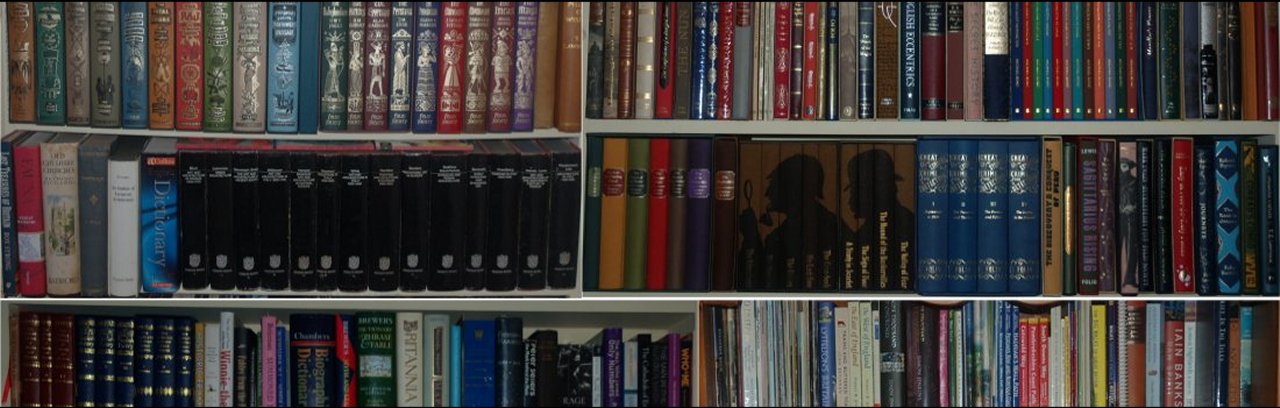
The animation below showing some of the wonderful plates from various King Penguins was done for a talk on the Gentle Art of Penguin Collecting given by myself and Megan Prince at The 2018 Hay Independence celebrations. I hope this inspires a collector or two out there to take a look at the 76 King’s almost 60 years after the last one was printed, they are well worth dipping into.

20180626 King Penguins 02


When I was Very Young – A.A. Milne

Although nowadays best known for his stories about his son Christopher Robin and his toys Winnie The Pooh and all the other characters in the Hundred Acre Wood, Alan Alexander Milne would rather be known for his other books and plays. He wrote a surprisingly good crime novel (The Red House Mystery) and over 3 dozen plays along with several books of non-fiction. When I was Very Young is one of his rarest works as the only publication of it is the limited edition from The Fountain Press printed in 1930. Just 842 copies were produced and all were signed by Milne on the limitation page at the back of the book, my copy is number 38. The book comes in a plain card slipcase rather than a dust wrapper although this easily damaged and is often missing from copies for sale

20180619 When I was Very Young 1

The book consists of five short biographical stories from Milne’s childhood which are written in the first person and probably true as the facts that it is possible to check are accurate, such as H.G. Wells being his science teacher at his first school, where his father was head-master. In the book his two older brothers are called David and John (in reality David Barrett Milne and Kenneth John Milne) and the age differences are correct along with the description of all three having blue eyes and golden hair. There are several illustrations by Ernest Shepard and the pages have the feel of handmade paper with rough edges. It’s short, here are only 23 pages of text along with 2 title pages, one page with the copyright information and the limitation page at the back so it definitely only takes a few minutes to read.

20180619 When I was Very Young 2

All of Milne’s Christopher Robin books were also printed as deluxe editions along with several of his plays and other works some of which were also released as signed limited editions. Milne, or at least his agent in America assuming he had one, also seemed to go in for special editions only sold in the USA so there are numerous varieties of some of his titles to collect especially limited editions and pre-signed signed copies. When I was Very Young was not even the first short book by Milne in being initially issued exclusively as such a volume, in 1929 The Fountain Press released The Secret and Other Stories in an edition of 742. The Secret has however since been printed in unlimited modern editions leaving When I was Very Young alone in not being available to a wider readership.

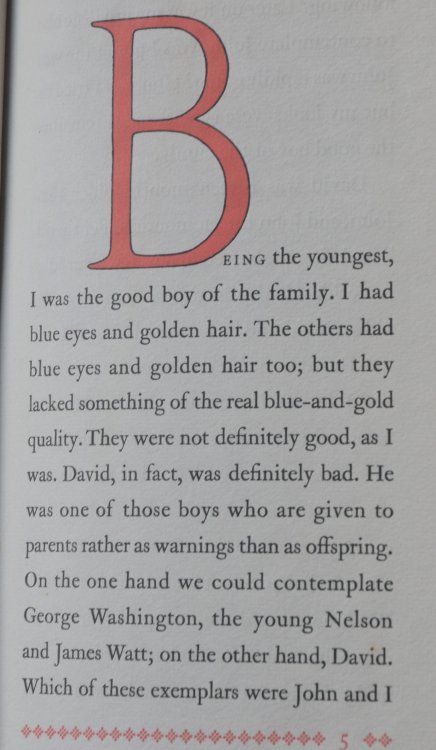
The first page sets the scene

20180619 When I was Very Young 3

After this introduction to the boys David isn’t mentioned in the first two tales, it is clear that Alan and John were close playmates though and the two boys shared a bed for many years but David, as the eldest, presumably had his own room. The first tale is a bit odd as it relates to an apparently shared dream of the two boys when they were about 5 years old for them to wake up one morning and find that everyone else in the world was dead.

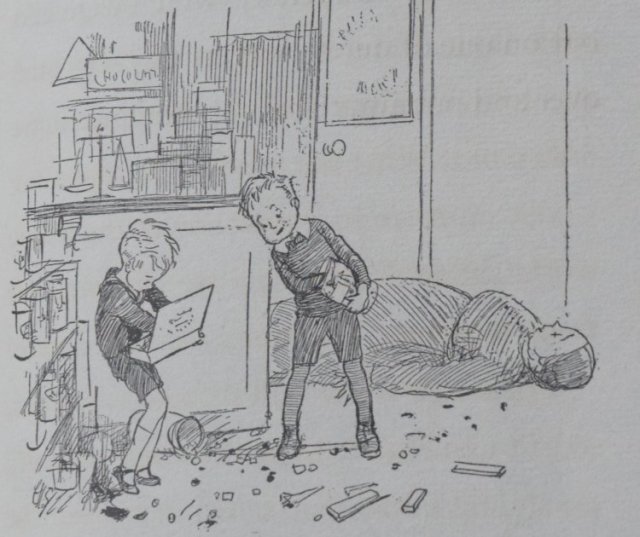
As soon as we woke up we should know that it had happened; the absence of the governess from our morning toilet, the discovery of her body in the passage between her room and ours – these would be the first signs. Having explored all over the house to make sure that the thing had been done properly, and that there really were no survivors to say “Don’t” we would then proceed to such-and-such, a sweetshop, step over the body of the proprietress and have our first proper breakfast.

There then follows a drawing by Shepard with the boys eating chocolates and sweets in the shop with the corpse in the background.

20180619 When I was Very Young 4

Not exactly the gentle Winnie the Pooh type tale you might expect! The second story is considerably less disturbing but none the less would be surprising to us nowadays. The two boys had collected various mineral samples and decided that they wanted to show them to somebody at the Geological Museum (then in Jermyn Street). By now it was 1890 and they were 8 and 9 years old and living in St Johns Wood, which is about 3½ miles (5½ km) from the museum. However their father seemed quite happy to let them go on their own as long as they ‘asked a policeman to help them cross Piccadilly Circus’, one of the most busy and therefore dangerous junctions in the city. They manage the trip, meet the curator who spends time with them looking at their small collection and also shows them round the museum and on their way back buy some matches to strike in their bedroom at night after the lights had gone out.

Two very short reminiscences follow, both featuring all three boys, in the first, inspired by a book called The Golden Key they put on an impromptu (and unscripted) play which turns out to be very short and in the second again after being inspired by a book they decide to be sailors and having lined up in front of their father David explains this to him. After consideration their father explains that “There will be examinations to pass”, at this David promptly gives up on the idea.

The final story moves us forward in time again to 1896 when ‘John’ and Alan were both at Westminster Public School and Alan was 14. Although they were boarding students they were allowed out at weekends providing they had somewhere to stay and this one weekend they were staying at the home of some elderly friends of their father. They had found a firework left over from the bonfire night celebrations and decided to extract the gunpowder from it. After a while a fairly disappointing quantity of powder was tipped out…

20180619 When I was Very Young 7

I don’t know why Milne always refers to his brother as John rather than Kenneth or Ken in this short volume, particularly as he always calls him Ken in his book It’s Too Late Now: The Autobiography of a Writer published in 1939 and dedicated as follows; 1880-1929 To the memory of KENNETH JOHN MILNE who bore the worst of me and made the best of me.

Oddly David is called Barry in the autobiography so Alan does like to confuse his readers.

20180619 When I was Very Young 5

The signed limitation page at the back of the book

20180619 When I was Very Young 6

Dovetail – Bernard Pearson

He’s a craftsman, not just good with his hands, an artist, an artisan, the man you go to when you need something a bit special. Years of making wonderful objects have given him an eye for beauty and the skill to create it and if he can’t do it then he knows a man who can. But now he’s older and no longer hale and hearty and the body won’t let his hands do what they could do before. The old comfortable clothes and wreathes of pipe smoke still mark out the well known local character but a new chapter is beginning.

20180612 Dovetail 1

I could be writing about Bill Sawyer, the main character in Bernard Pearson’s first novel but in reality that was a shorthand portrait of Bernard himself. I’ve known him for over 20 years now and have handed over more money for things he’s made than I care to think about, beautiful finely detailed sculptures, unusual candles and interesting pottery figurines by him decorate my home and I wouldn’t have it any other way. Unfortunately he can’t sculpt any more, he can’t hold the tools long enough and steady enough for the work, but he can tell stories and what wonderful tales he tells, and has told over many years and many, many more pints of strong Somerset cider and so the new chapter begins…

Dovetail isn’t Bernard’s first foray into print, fourteen years ago he collaborated with Terry Pratchett to produce The Discworld Almanak, the first book to exist in our world that was specifically mentioned as an existing publication in Terry’s Discworld series of novels. Since then, with his wife Isobel, and the team at The Discworld Emporium in Wincanton there has been several other books and diaries set within Terry’s fantastical imaginary world. Towards the end of his life Terry told Bernard to try writing something of his own and this first novel is the result. It’s not high literature, it’ll never make the Man Booker short list, or even the long list for that matter but that isn’t what Bernard or indeed his readers are aiming for. What he has produced is a cracking good read with the eye to detail that distinguished his sculptures now turned to give depth to the characters and draw you along through the book as you get to know them and the twists and turns of the dodgy antique furniture trade.

As stated above, Bill Sawyer is a craftsman, one of the best, a man who can repair something old so that an expert wouldn’t know he had touched it or, if the need arises, can make something centuries old that didn’t exist last month. Known throughout the trade in the UK his fame, and skill, is about to get him into a lot of trouble and he wants to retire. He’s ill, just how ill is revealed as you read through the book, and it’s going to affect not only his work on this last unwanted project but his ability to protect those he cares for and he so desperately needs to be able to do that.

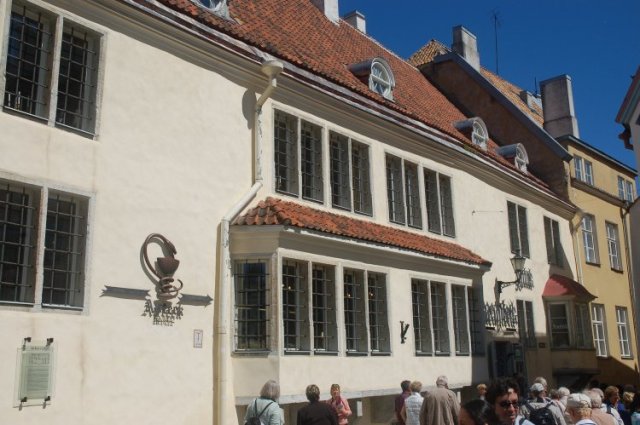
The book starts with a fire, one of many on the 5th of November, which is bonfire night here in the UK, a date redolent of history and violence, then jumps back three months as the remaining 345 pages tell the story of how and why the conflagration came about and you very quickly want to know the how, why and especially the who of that particular inferno. It’s a genuine page turner, I found it difficult to put down even when sleep was the obvious thing to do at that time of night.
20180612 Dovetail 2

Bernard used to be a policeman as a young man and knows about evidence and how untrustworthy it can be and how experts can be fooled especially when they don’t want to be (oh the stories). Actually he probably knows more about how to do all sorts of things you are not supposed to do at a police house without senior officers finding out than just about anyone alive but that really is another story. He’s a teller of tall tales, always has been, always will be and because they always contain a solid foundation of truth they are all the better for it. God knows what nugget from his memory was the foundation for this story, maybe I’ll find out one day over some cider, maybe I won’t, but I don’t mind as long as he writes some more.

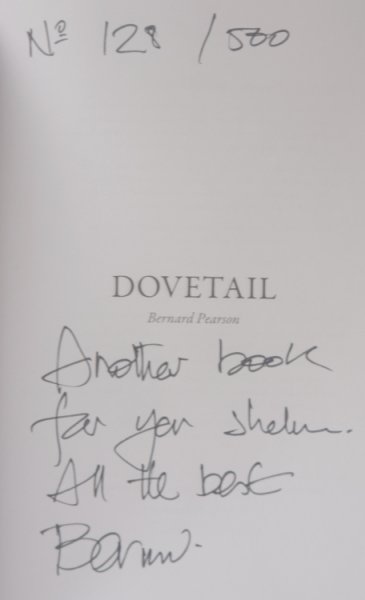
The book is self published and available from No 41 Publishers which is presumably Bernard himself (or more likely Isobel as easily the most organised of the two) as 41 High Street is the address of the Emporium. My copy is dedicated and numbered although this isn’t really a limited edition book. All my limited edition sculptures by Bernard (and there are quite a lot) are number 128 of however many were produced even when there was less than 128 made…

20180612 Dovetail 3

The photograph of Bernard is by Len Brook, another artist of my acquaintance and a photographer of considerable skill who also has a few tales he can tell.

84 Charing Cross Road – Helene Hanff

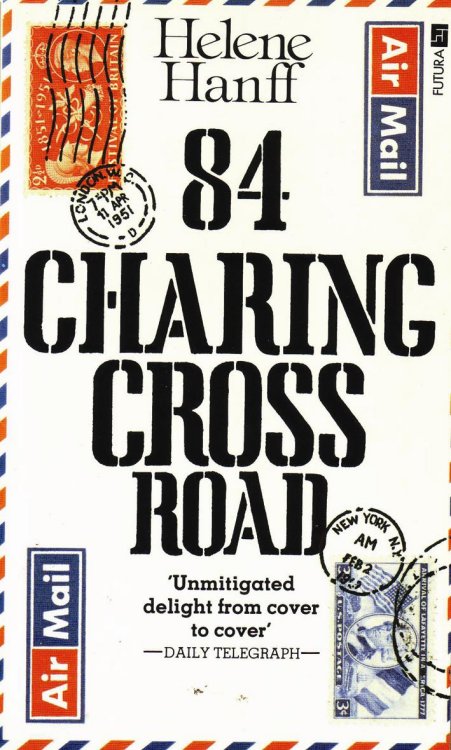
Last week I went to see the play based on Helene Hanff’s best known work 84 Charing Cross Road at the Grand Theatre in Wolverhampton. There is a touring production currently travelling the UK with Stephanie Powers playing Helene and Clive Francis as Frank Doel. I first read the book in the early 80’s and have happy memories of that and seeing the film with Anne Bancroft and  Anthony Hopkins made in 1987 so it was a joy to see the play and how well it was done. I think that from now on that when reading the book I will always hear the letters as read by Stephanie Powers she gave a wonderful performance. Clive Francis was very good as Frank, but it’s very difficult to beat Anthony Hopkins, so I now have a weird mix of play and film in my head. You can see a clip from the film on youtube here.

20180605 Charing Cross Road

However this is a review of the book, it was first published by Grossman in the US in 1970 then by Andre Deutsch in the UK in 1971, the copy I currently have was printed by Time Warner Books in 2006. It has to be at least the third copy of this book I have owned as previous copies have disappeared over the years, as I either gave them away to people who I thought would love the book or just never got back a loaned volume. Like most editions nowadays in this copy the original book is paired with Hanff’s follow up work The Duchess of Bloomsbury Street which describes her journey to London for the UK launch of the original book. The first book itself simply consists of the letters between Hanff, who is in New York and Marx & Co. antiquarian booksellers based at number 84 Charing Cross Road. Initially they are quite business like, Hanff has seen an advert in the Saturday Review of Literature so on 5th October 1949 she first makes contact with the firm and pens a short note with a list of books she wants to see if they can supply them. but by the time of the last letter from the firm to Helene it is almost 20 years later on 8th January 1969.

There is no exposition, it is just the letters so all you know about Frank, Helene and the others who write occasional missives is what they include in the correspondence; but from this you really get involved in this developing two decade long friendship. By the end you feel you know them and the final few letters mean as much to you as they must have meant to Helene when they prompted her to compile the book, as she writes in Q’s Legacy.

“I have to write it.”

Then I went cold inside, I could only write it if I still had Frank’s letters. I’d begun saving them 20 years later because a tax accountant wanted a record of what I spent on books… The thin blue airmail letters with a rubber band round them took up no space, lying nearly flat under manuscripts in a back corner of one of six small cabinet drawers under my bookshelves. But year after year when I cleaned out the cabinets, I’d come on them and wonder why I was saving them. Sitting there that evening, I vividly remembered that when I had reorganised the cabinets a few weeks earlier I’d stood by the waste basket hefting the letters, debating whether to keep them or throw them out. I couldn’t remember which I’d done. And I was afraid to find out.

Fortunately she hadn’t thrown them out although they were only found after an agonising search

I carried the letters to the table and opened them – and snapshots of young families spilled out of them. Some were from Nora Doel, some were from one of the girls who worked in the shop, all of them were 10 or 15 years in the past … I found snapshots of Frank standing proudly beside his new secondhand car. I was laughing by this time, I poured another cup of coffee and settled down to read the letters.

By the time I went to bed I was positively happy, I was going to relive the lovely episode Marks & Co. had been in my life by making a short story of the correspondence.

20180605 Charing Cross Road 3

The letters get less formal as the years go on, by February 1952 Frank is writing to ‘Dear Helene’ as opposed to ‘Dear Miss Hanff’ which is how he starts off and whilst initially Frank’s letters are solely about the books or in response to gifts of food Helene sends to ration struck England, Helene’s become quite chatty very early on and she jokingly tells him off several times (these are just extracts from letters not full examples)

November 2, 1951

Dear Speed ___

You dizzy me, rushing Leigh Hunt and the Vulgate over here whizbang like that. You probably don’t realise it, but it’s hardly more than two years since I ordered them. You keep going at this rate you’re gonna give yourself a heart attack.

20180605 Charing Cross Road 4

Clearly remembering this letter many years later Frank was able to eventually get in a small riposte.

3rd May 1957

Dear Helene,

Prepare yourself for a shock. ALL THREE of the books you requested in your last letter are on their way to you and should arrive in a week or so. Don’t ask how we managed it – It’s just a part of the Marks service.

20180605 Charing Cross Road 2

Other members of staff at Marks & Co. also write to Helene, along with Dora (Frank’s wife) who initially just thanks her for the food she has sent but then also enters into a longer correspondence. What I really liked about the play was that the script really was just reading the letters to one another, the stage was split into Helene’s New York apartment on the left with the bookshop taking up roughly two thirds of the stage to the right. Almost all the letters in the book were read verbatim, in the film the letters are still the main part of the text but it is expanded to make it more cinematic and as you can see from the clip I included a link to above we even see other locations than the bookshop and the apartment.

It’s very difficult to review this book without spoiling it for new readers but it is truly a delight to read and if you haven’t read it then please do so, then see the film and if possible catch it in the theatre. The images from the play are lifted from the Cambridge Arts Theatre website whose production this was.

The second book included in the paperback is The Duchess of Bloomsbury Street and this is more of a diary tracking Helene’s trip to the UK, all the people she meets and the various publicity events she goes to including a special opening up of the by now closed Marks & Co. shop on Charing Cross Road, so she did finally get to visit ‘her bookshop’ even if it was too late. The main signing event took place in Poole’s bookshop, next door in number 86. This diary runs from 17th June to 26th July 1971 and is considerably longer that the book it celebrates. Sadly the shop is now a McDonald’s burger place but there is a plaque outside commemorating the old bookshop and Hanff’s apartment on  305 E. 72nd Street has been named “Charing Cross House”.

For the really keen there is the third book in ‘the series’ which I quoted from above, Q’s legacy explains how, when it became clear she was not going to be able to afford any more than a year at college, she was in a library and she first came across Sir Arthur Quiller-Couch. She felt his books of essays and lectures taught her more than the first year had done and she was hooked. Q, as he was invariably known, introduced her to Walton, Newman, Milton and numerous others and she wanted to read more than just the extracts he quoted so was looking for a good bookshop when she saw that advert in the Saturday Review. If anyone is responsible for all that followed after that it is the now largely forgotten Q. Forgotten that is except by those of us who own a copy of his massive 1100 page work The Oxford Book of English Verse which for decades was the definitive collection, first published in 1900 and revised in 1939 to expand the selection up to 1918.

Incunabula

20180529 Incunabula 1

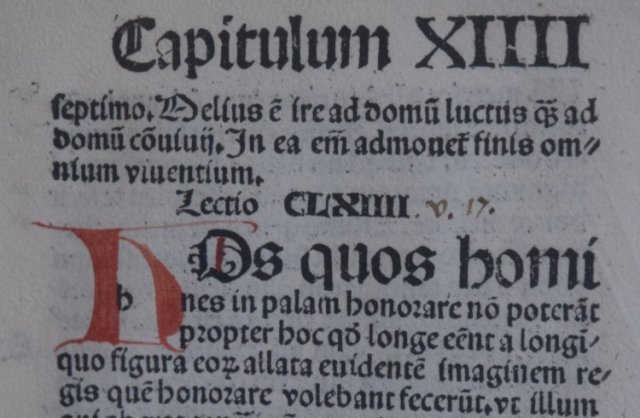
A bit of an oddity for this blog, but as this is framed and on the wall by my desk it seemed wrong not to discuss this piece of history. I only have one page, a complete book would be well beyond my means so this is my only example of an incunable; that is a book printed up to the year 1500. The Latin term incunabula is translatable as cradle so is appropriate to relate to works from the birth of printing. Johannes Gutenberg, inventor of the printing press, started in 1450 in Mainz, Germany, and in 1452 he completed work on his most famous production, what is now known the world over as the Gutenberg Bible. Nowadays we think of printing as mass production, and in a way for its time this was the case however just 180 copies of the bible were printed by Gutenberg so each book printed in this period would only have had tiny numbers produced. This is printing but not as we know it.

In Britain printing didn’t arrive until William Caxton set up his printing press in 1476 at Westminster, initially intending to print his own translations of books. He had started printing in Bruges, Belgium having learnt how to do it in Cologne, but came back to England in order to meet demand for his books. His first title ultimately became his most famous however and he will be forever associated with Chaucer’s Canterbury Tales.

According to the Incunabula Short Title Catalogue; maintained by the British Library; in the first 50 years of printing just under thirty thousand different editions of various titles were printed in 18 different countries in a total of 282 printing towns. The ISTC as it is known is an attempt to catalogue every known incunabula, it is almost complete and makes a fantastic reference database for this period. My page is from Super sapientiam Salomonis, a commentary on the books of the Wisdom of Solomon by Robertus Holkot. It was printed by Heinrich Gran in 1494 in the town of Hagenau, which was in Germany then but is now part of France. According to the ISTC there are 104 copies of the book held in institutions around the world, one of which has been scanned and made available on the internet. My page can therefore be seen here in the copy of the complete work held in Munich via the MDZ (Das Münchener DigitalisierungsZentrum) an archive started in 1997 and which provides an unrivalled collection especially of early works in a digital form.

20180529 Incunabula 2

One immediate difference can be seen between my page and the digital copy and that is in the red letter h in the top left. This is because this page has been rubricated, that is the red letter has been hand written by a scribe who would have been employed specifically to add red letters to printed texts as indeed they would have done to handwritten manuscripts before the introduction of the printing press. These specialists were responsible for the beautiful initial lettering in medieval texts and their skill lasted for several decades after printing took over, hand embellishing the basic printed works which could only be in a single colour and it does mean that every copy is different. Rubrication is from the Latin rubico which means ‘to colour red’ and the red letter used to indicate something special gave us the phrase ‘a red letter day’ which is a date of particular importance as these days would be marked on the ecclesiastical calendar in red rather the usual black.

I bought my page from a small shop in the world’s first book town, Hay On Wye, roughly 20 years ago. Back then there was a shop that specialised in ancient bibles and other old books and they just had a few loose pages from different incunabula for sale. Sadly the shop no longer exists but I’m very pleased I bought this as an example of printing history, it is after all 524 years old and one of the oldest man made objects I possess. The paper isn’t actually as grey as it appears in the photographs. The page is framed and behind glass so I couldn’t use flash because all I would have got would be glare off the glass. The true colour is much closer to the digital image from Munich.

Apothecary Melchior

20180515 Melchior 6

The Apothecary Melchior series by Indrek Hargla is pretty well unknown in the UK but very popular in his native Estonia. He is probably best known there for his fantasy and ‘alternative history’ stories but Melchior is Hargla’s foray into medieval crime making him the closest Estonian equivalent of Ellis Peters here in the UK with her Brother Cadfael tales. The Melchior novels are set in the capital, Tallinn, in the early 1400’s as the city was going through a massive building programme, with the city walls mostly constructed along with some of the significant buildings but others parts are clearly still being worked on including the main square.

Although there are now six novels in the series only two have so far been translated into English and are published by Peter Owen however as can be seen from the covers these don’t look like part of a series. It seems an odd choice by the publisher to make them look so unlike and they are also translated by different people.

  • … and the Mystery of St. Olaf’s Church – Original title Apteeker Melchior ja Oleviste mõistatus published 2010 – translated in 2015 by Adam Cullen
  • … and the Ghost of Rataskaevu Street – Original title Apteeker Melchior ja Rataskaevu viirastus published 2010 – translated in 2016 by Christopher Moseley

I was first introduced to the books by my Estonian friend who gave me the second book for my birthday last year, it had to be book two as she couldn’t find a translation of the first one in Estonia. One of the problems I have found with translations from Estonian is their variable quality; so whilst I enjoy the books I have read in translation, quite often I find myself having to reread sections to be sure I have understood what is being said. This was not a problem with The Ghost of Rataskaevu Street, I sat and read it quite quickly, especially on the one day when out in the Estonian countryside there was just torrential rain so getting out and enjoying the area was not possible. Unfortunately the translation of The Mystery of St. Olaf’s Church is not as good so this may explain the change of translator for the second novel. The book is still perfectly readable but the flow of the narrative seems forced at times and I’m inclined to blame the translator rather than the author here as Hargla had been writing for many years before these books and they both came out in the same year so it’s not a case of the original authorship style changing.  My friend also loves the series and I doubt she would have if she had started with this one.

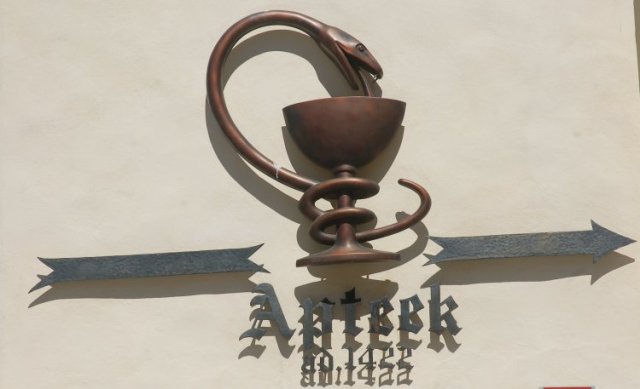
Melchior is in the classic tradition of the amateur sleuth who finds himself drawn into mysteries and providing assistance to the city authorities and through him we learn about the power conflicts in the city as the Teutonic knights in their castle are slowly losing control to the expanding city council along with the rivalries between the various religious bodies that still held enormous influence at the time. Whilst reading it, the first book appears to be misnamed for a long time, as very little appears to happen at St Olaf’s and it is only at the conclusion that the church’s role in the story is explained. At the start the book seems like a simple mystery as to who murdered one of the knights in the castle itself. Melchior gets involved due to his specialist knowledge as an apothecary making him one of the few scientifically trained people in the city and he sees it initially as a way of currying favour with the city fathers who need the murder solving quickly to keep the knights happy. In turn he looks for their assistance in opening the main city pharmacy which would catapult him up the social standings in Tallinn. The book is set in 1409, thirteen years before such a pharmacy was actually opened in the city so we know he isn’t going to get anywhere with that plan soon. Without giving any of the plot away, the story moves around the city introducing each of the power brokers in the place and ultimately reaches a denouement at St Olaf’s at the other end of Pikk, one of the longest streets in Tallinn.

The Ghost of Rataskaevu Street starts out much closer to home for Melchoir as this is where his home and small shop are situated. The tale is darker than the first book with rivalries between senior families leading to some pretty horrific situations for some of the protagonists, it is also more character driven than the first. We see a greater strata of the city’s population from the highest nobles of the Merchant Guilds to shop and bar keepers, sailors, servants and serfs. The Guilds are now getting more powerful, as would be the case all over Europe at this time but especially in the Hanseatic League which included Estonia and whose merchants controlled large parts of international trade in Northern Europe. By 1419 which is when this book is set they had recently built a guild house in the centre of the city and this alongside the City Hall was where power was slowly drifting away from the knights in their castle on Toompea Hill. The families involved in the story are senior guild members and this makes solving the crimes more difficult as Melchior must be very careful not to annoy the very people he is investigating.

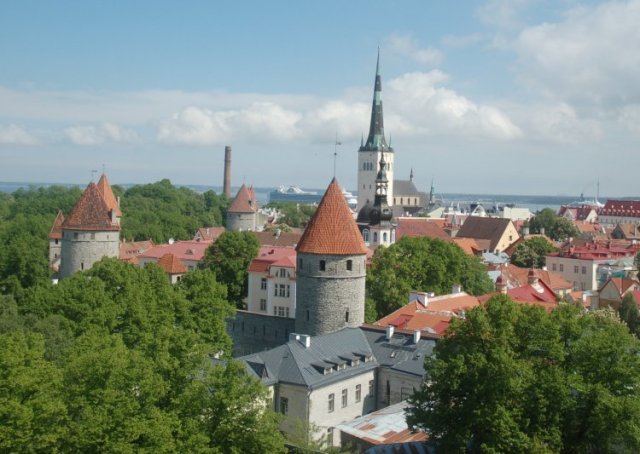
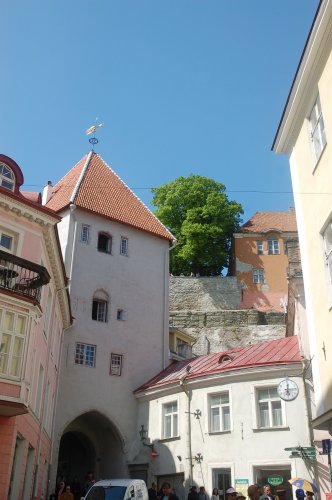
One of the joys of reading the books after visiting Tallinn is that most of the places mentioned are still standing and the city looks much as it did 700 years ago, except obviously a lot cleaner that it would have been at the time.

A general view of the city from the castle on Toompea

20180515 Melchior 7

The Long Leg gateway, entrance to the castle seen from the end of Rataskaevu Street

20180515 Melchior 3

St Olaf’s church on Pikk

20180515 Melchior 4

The Guild Hall

20180515 Melchior 8

and finally the Apothecary in the main square that Melchior so wants to found. As said above this opened in 1422 and it is now the oldest still working pharmacy in the world.

20180515 Melchior 5

Seek out the Melchior stories, I hope that Peter Owen will get round to the others soon.

According to a chart in the i newspaper last week Estonian’s spend more time on average reading books than any other nation in Europe and Estonian authors certainly produce a wide range of work which I will be dipping into again in future blogs.