When I was Very Young – A.A. Milne

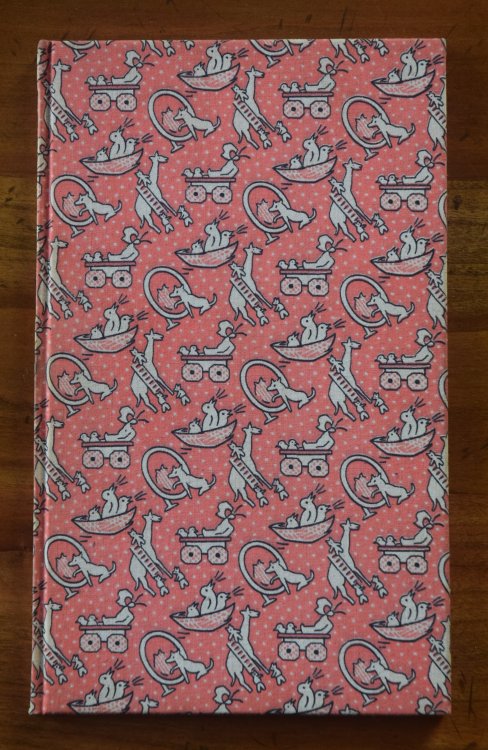
Although nowadays best known for his stories about his son Christopher Robin and his toys Winnie The Pooh and all the other characters in the Hundred Acre Wood, Alan Alexander Milne would rather be known for his other books and plays. He wrote a surprisingly good crime novel (The Red House Mystery) and over 3 dozen plays along with several books of non-fiction. When I was Very Young is one of his rarest works as the only publication of it is the limited edition from The Fountain Press printed in 1930. Just 842 copies were produced and all were signed by Milne on the limitation page at the back of the book, my copy is number 38. The book comes in a plain card slipcase rather than a dust wrapper although this easily damaged and is often missing from copies for sale
20180619 When I was Very Young 1

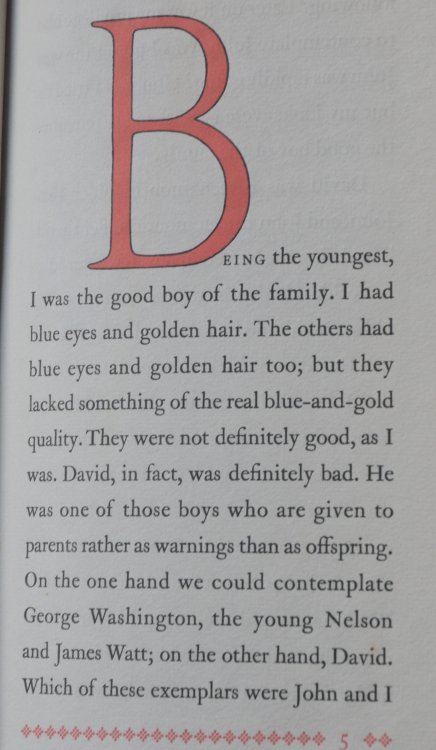
The book consists of five short biographical stories from Milne’s childhood which are written in the first person and probably true as the facts that it is possible to check are accurate, such as H.G. Wells being his science teacher at his first school, where his father was head-master. In the book his two older brothers are called David and John (in reality David Barrett Milne and Kenneth John Milne) and the age differences are correct along with the description of all three having blue eyes and golden hair. There are several illustrations by Ernest Shepard and the pages have the feel of handmade paper with rough edges. It’s short, here are only 23 pages of text along with 2 title pages, one page with the copyright information and the limitation page at the back so it definitely only takes a few minutes to read.

20180619 When I was Very Young 2

All of Milne’s Christopher Robin books were also printed as deluxe editions along with several of his plays and other works some of which were also released as signed limited editions. Milne, or at least his agent in America assuming he had one, also seemed to go in for special editions only sold in the USA so there are numerous varieties of some of his titles to collect especially limited editions and pre-signed signed copies. When I was Very Young was not even the first short book by Milne in being initially issued exclusively as such a volume, in 1929 The Fountain Press released The Secret and Other Stories in an edition of 742. The Secret has however since been printed in unlimited modern editions leaving When I was Very Young alone in not being available to a wider readership.

The first page sets the scene
20180619 When I was Very Young 3

After this introduction to the boys David isn’t mentioned in the first two tales, it is clear that Alan and John were close playmates though and the two boys shared a bed for many years but David, as the eldest, presumably had his own room. The first tale is a bit odd as it relates to an apparently shared dream of the two boys when they were about 5 years old for them to wake up one morning and find that everyone else in the world was dead.

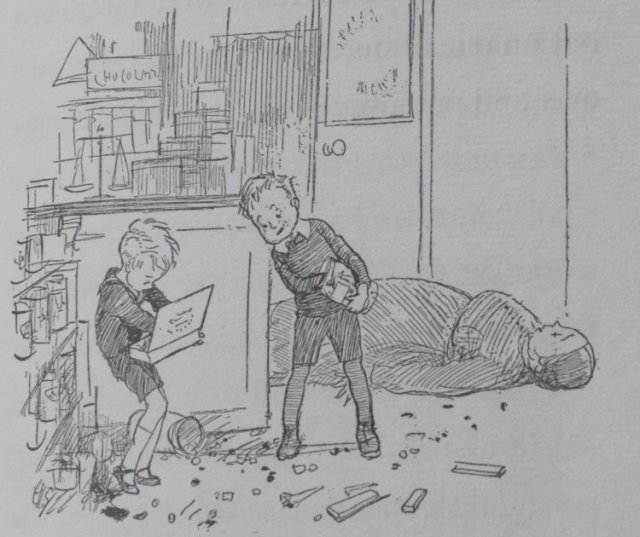
As soon as we woke up we should know that it had happened; the absence of the governess from our morning toilet, the discovery of her body in the passage between her room and ours – these would be the first signs. Having explored all over the house to make sure that the thing had been done properly, and that there really were no survivors to say “Don’t” we would then proceed to such-and-such, a sweetshop, step over the body of the proprietress and have our first proper breakfast.

There then follows a drawing by Shepard with the boys eating chocolates and sweets in the shop with the corpse in the background.
20180619 When I was Very Young 4

Not exactly the gentle Winnie the Pooh type tale you might expect! The second story is considerably less disturbing but none the less would be surprising to us nowadays. The two boys had collected various mineral samples and decided that they wanted to show them to somebody at the Geological Museum (then in Jermyn Street). By now it was 1890 and they were 8 and 9 years old and living in St Johns Wood, which is about 3½ miles (5½ km) from the museum. However their father seemed quite happy to let them go on their own as long as they ‘asked a policeman to help them cross Piccadilly Circus’, one of the most busy and therefore dangerous junctions in the city. They manage the trip, meet the curator who spends time with them looking at their small collection and also shows them round the museum and on their way back buy some matches to strike in their bedroom at night after the lights had gone out.

Two very short reminiscences follow, both featuring all three boys, in the first, inspired by a book called The Golden Key they put on an impromptu (and unscripted) play which turns out to be very short and in the second again after being inspired by a book they decide to be sailors and having lined up in front of their father David explains this to him. After consideration their father explains that “There will be examinations to pass”, at this David promptly gives up on the idea.

The final story moves us forward in time again to 1896 when ‘John’ and Alan were both at Westminster Public School and Alan was 14. Although they were boarding students they were allowed out at weekends providing they had somewhere to stay and this one weekend they were staying at the home of some elderly friends of their father. They had found a firework left over from the bonfire night celebrations and decided to extract the gunpowder from it. After a while a fairly disappointing quantity of powder was tipped out…

20180619 When I was Very Young 7

I don’t know why Milne always refers to his brother as John rather than Kenneth or Ken in this short volume, particularly as he always calls him Ken in his book It’s Too Late Now: The Autobiography of a Writer published in 1939 and dedicated as follows; 1880-1929 To the memory of KENNETH JOHN MILNE who bore the worst of me and made the best of me.

Oddly David is called Barry in the autobiography so Alan does like to confuse his readers.

20180619 When I was Very Young 5

The signed limitation page at the back of the book

20180619 When I was Very Young 6

Moomins: The Comic Strip

20180508 Moomins 4

Tove Jansson wrote her first Moomin book ‘The Moomins and the Great Flood’ (original Swedish title Småtrollen och den stora översvämningen) during WWII and it was published in 1945, Småtrollen translates as small troll. By the second book ‘Comet in Moominland’ (1946) the original Swedish title has Mumintrollet rather than Småtrollen and the Moomins had truly arrived. Interestingly those of us reading the Moomin stories in English didn’t get the first book until 2005 as a 60th anniversary limited edition which is a distinctly odd way to have it’s first English translation.

My younger brother read the Moomins in the early 1970’s as a child but they somehow passed me by, I remember the covers of his books but I don’t think I ever opened them. The first time I really became aware of the Moomins was when I lived in Stockholm whilst subcontracting on IT systems for Swedish company Dagab in the mid 1990’s. By then in Scandinavia you could hardly turn a corner in a shopping area without encountering the familiar white characters and a recent visit showed that the interest is even greater now.

20180508 Moomins 2

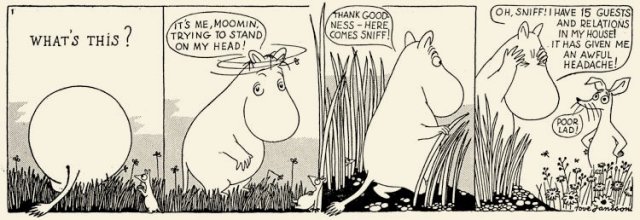
My interest was taken by the comic strip versions rather than the books, these were originally written and illustrated by Tove from 1954 for the Evening News in the UK and this gave them a huge following. By 1957 however workload from what Tove regarded as her ‘real’ career as an artist meant that she got her younger brother Lars involved and from 1960 he took over as sole writer and artist until the strip finally ended in 1975. Despite not really being a fan of comic strips or graphic novels I love the simple drawings and the tightness of script imposed by the comic strip format to the Moomin tales and if anything I prefer the work by Lars to Tove as there is more humour although the drawings are not as precise. Suggesting this however is probably heresy to true ‘Moominites’. The first strip was published on 20th September 1954, but before that the Evening News ran teaser panels for a week such as the one at the top of this blog.

20180508 Moomins 1

Since 2006 Canadian publisher Drawn and Quarterly had been issuing collections of the cartoon strips at the rate of roughly one a year, although volume 10 came out in August 2015 and nothing since. Emails and attempts to contact the company via their facebook page regarding further volumes have been ignored. After all they have still only reached 1964 of what was described as ‘The Complete Lars Jansson Comic Strip’ and there would still need to be 8 to 10 (difficult to tell how they would choose to split the cartoons into the books) more volumes to complete the set. It is important at this point to emphasise that the comic strip stories are not retelling the nine books by Tove, what we have here is 73 more Moomin tales, 14 of which are by Tove, 7 by the brother and sister in combination and 52 by Lars, so there are 32 Moomin stories written after 1964 that are not currently in print and therefore not available to purchase and read.

20180508 Moomins 3

Although I have tagged this essay as “children’s books” and certainly they can be, and are, read by children it is easy to forget how dark a lot of the subject matters covered are, not just in the books but also in the comic strips. From the very first comic strip story where it becomes clear that Moomintroll believes himself to be an orphan and is being put upon by lots of other characters taking advantage of his good nature it is clear that this is not just a simple tale for children. After the end of the series of strips making up ‘Moomin and the Brigands’ he finds his parents when they rescue him whilst he is trying to drown himself to get away from the hordes of people making his life miserable that have eventually driven him from his own home.

20180508 Moomins 6

Charles Sutton from Associated Newspapers recognised the more adult possibilities in one of his letters to Tove before the strips were finally commissioned and it is clear that she took this advice to heart when she signed the contract for 7 years worth of cartoons.

It has come to my mind, that your “Moomin” family could make an interesting comic strip, which would not necessarily be aimed at children. It is obvious that the Moomin family appeals to children, but we think these wonderful creatures could be used in comic strip form to satirise our so-called civilised lifestyle.

The Moomin cartoon feature film ‘Moomins on the Riviera’ released in 2014 was based on the third comic strip tale written and illustrated by Tove in 1955, rather than one of her books. This meant that the story was new to most of the people who saw it, as the books are far better known, even though the comic strips were syndicated widely through Europe. In line with the less childlike cartoons Moominpappa at one point has a terrible hangover and Moomintroll himself becomes extremely jealous of Snorkmaiden’s admirers and is not impressed by her tiny bikini which actually looks very daring despite the fact that normally, like Moomintroll, she doesn’t wear any clothes at all. You can see the trailer for the film here.

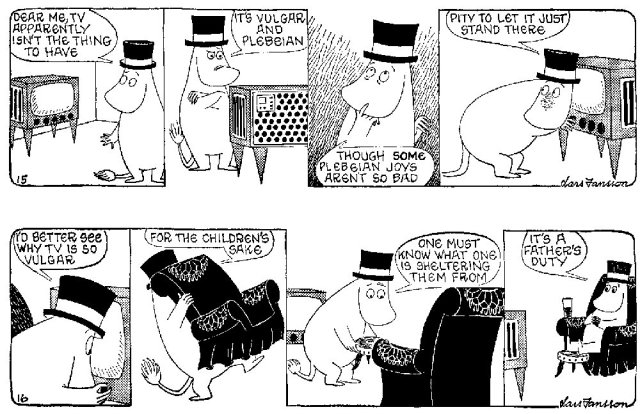
As an example of Lars Jansson’s work the cartoon below shows Moominpappa being as selfless as ever and willing to put himself out for the good of the family…

20180508 Moomins 5

This story has him become totally obsessed with the television and it controls his life (along with all the family as they have to do what he sees as correct according to the adverts) for a while until he finally is brought back to reality.

Hopefully Drawn and Quarterly will eventually start issuing the books again, but until then at least we have access to 10 volumes covering 41 tales. As an aside to this blog, there was a fascinating documentary about the life and work of Tove Jansson which includes an interview with Lars and also his daughter Sophia, who now controls the vast Moomin empire, made by the BBC in 2013. At the time of writing this blog it is still available on youtube.

Uncle Jim

20180227 Uncle Jim 1

Back in 1965 a teenage apprentice journalist started work at the Bucks Free Press, then as now, the local newspaper covering the Buckinghamshire area, places such as High Wycombe, Beaconsfield, Marlow, Gerrards Cross etc. The newspaper had started over 100 years earlier and there was nothing really to suggest that this new trainee was much different to the many that had gone before him except that 2 years earlier at the age of 15 he had had his first story printed in Science Fantasy magazine (volume 20, number 60), more of that particular magazine in a later blog because that is also on my shelves.

The Bucks Free Press had a section called Children’s Circle (the image at the top is scanned from a 1966 copy) which had stories and birthday wishes aimed at younger readers all of which were apparently written by Uncle Jim, the general nom de plume of whoever was tasked to write them and it seemed logical to give the job to the new starter who had already proved he liked to write stories. In the coming years he would write over 80 tales as Uncle Jim nearly all of which were split over several weeks to keep the kids coming back for more, whilst also working as a journalist covering all the things that a local paper needs to do, he saw his first dead body within a week of starting.

The name of this young chap – Terence David John Pratchett, later to become Sir Terence, knighted for services to literature in 2009, or just Terry for those of us lucky enough to have met or indeed spent time in bars late at night with him. Because Terry always had time for his fans and we loved him for it.

Dsc_0558

Now trying to find local newspapers from over 50 years ago is largely a fruitless task so the first time I saw some of these stories from Terry’s early days was on a website started by the Bucks Free Press in association with the Friends of High Wycombe Libraries in June 2010, which posted 2 of them and the first 4 parts of what would become Terry’s first novel The Carpet People. They indicated that they intended to make them all available before they were told to stop quite quickly after the site was started as Terry owned the copyright. The site never actually added any more work and was eventually taken down by the end of 2012. What they did have on the site though was a partially useful list that showed the first time Terry wrote as Uncle Jim was published on the 8th October 1965 and the last they listed was 20th December 1968, in total there were 167 parts listed making up 47 distinct stories. The earliest was a 12 part story that eventually led to The Carpet People, the next longest were 2 stories, one in 1966 and one in 1968 which needed 8 parts and there were 7 stories that were completed in just one part.

These figures are however known to be incomplete as even the article on the Bucks Free Press website announcing the launch of the site in 2010 states that his last appearance as Uncle Jim was in 1970 and there were some 250 episodes, however they do provide an insight into the first 3 years of Terry’s work on this column and the way the stories were split. In fact there were 247 parts written by Terry between 8th October 1965 and 17th July 1970 making up the 80+ stories but apart from going to Beaconsfield library and reading their newspaper archive that seemed to be the end of being able to access these stories far less being able to have Uncle Jim wish you a happy birthday.

20180227 Uncle Jim 2

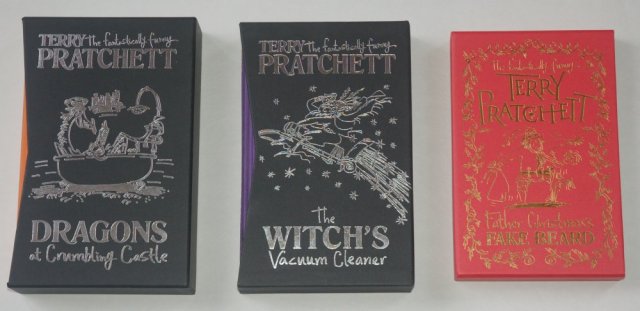
However as can be seen from the image of the books above there have now been 3 collected volumes and I have all 6 of them. Yes you read that right, each one has come out as a standard edition alongside a collectors version.

Dsc_0560

Dsc_0559

So lets make a comparison of the available volumes:

Dragons at Crumbling Castle – published 2014

  • Standard edition – Dust wrapper – 14 stories, two of which went to make up The Carpet People but are here presented as 2 separate works and an introduction.
  • Collectors edition – Slipcase – 16 stories, the two extras being ‘The Wergs Invasion of Earth’ and ‘Bason and the Hugonauts’. There is also a different, significantly longer, introduction; commentaries after each story written by Terry and a colour print tucked inside.

The Witch’s Vacuum Cleaner – published 2016

  • Standard edition – Dust wrapper – 14 stories and an introduction
  • Collectors edition – Slipcase – 16 stories, the two extras being ‘Johnno, the Talking Horse’ and ‘The Wild Knight’. Commentaries after the stories were written by Terry’s assistant Rob Wilkins as Terry had sadly passed away in March 2015 and there was also a postscript added by Rob by way of a eulogy to his boss and friend. Again a colour print was included as a loose insert.

Father Christmas’s Fake Beard – published 2017

  • Standard edition – Dust Wrapper – 11 stories, including one of the stories from The Dragons at Crumbling Castle, ‘Father Christmas goes to Work at the Zoo’.
  • Collectors edition – Slipcase – Identical text to the standard edition but on better paper and all the illustrations are in colour. No other extras

This means that 42 (or 41 if you regard the two parts of The Carpet People as 1 piece) have now been published which is roughly half of what appeared in the newspaper all those years ago.

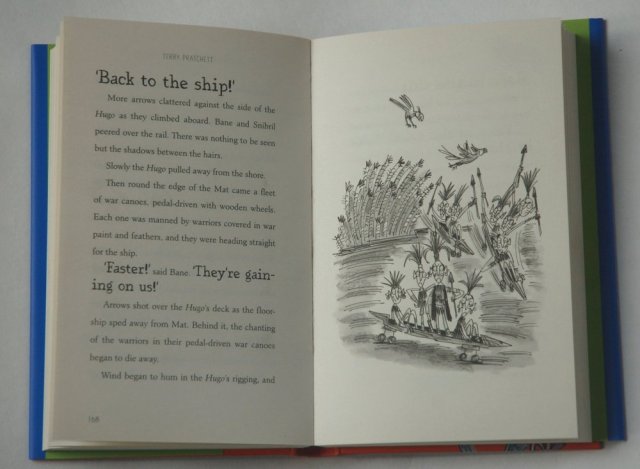
The books are great fun, the pages are covered in typographical games, at one point when the lights go out in a story the next two pages are white text on black, and there are numerous uses of other fonts and text sizes to emphasise the action.

Dsc_0562

The colour edition of Father Christmas’s Fake Beard is also a joy to own, the original looks great but the colour just looks fantastic.

Dsc_0564

During Terry’s tenure as Uncle Jim a lot of the stories are centred on the fictional county of Gritshire, its county town of Blackbury with surrounding towns like East Slate and Umbridge (on the river Um) and the notorious Even Moor where strange things happen in the wild places. The characters gradually develop over the stories so you really feel that there is such a community where odd events occur almost every day and almost feel sorry for the largely incompetent county councillors who just seem to invite disaster with their every plan for improvement. I suspect that this was Terry letting his main job. which included reporting on local government decisions. drift into his fantastical imagination.

I shall finish with the two prints from the collectors editions. The one on the right of Sir Terry as a knight in armour includes his actual coat of arms as ably described in this Wikipedia entry. Let’s hope to see more of these wonderful stories from Terry aka Uncle Jim being published in the future, after all there is still 50% of the work unavailable apart from in frustratingly difficult to obtain old newspapers.

Dsc_0565