Billy Chyldish, or Childish as it is spelt in my copy of his second novel from 1997 ‘Notebooks of a Naked Youth’, is ridiculously prolific with his Wikipedia page listing well over a hundred albums of music and almost a hundred books, including over seventy collections of poetry. He is also an artist win excess of a thousand works produced and a film maker, although he is not without controversy and this book does contain sexually explicit text which I’m not going to reprint here. The reason I’m reviewing it is not for its contents, although I have read it, but for the fascinating story of its existence. Chyldish or Childish was christened Steven John Hamper and has gone by various names including William Charlie Hamper, Bill Hamper, Bill Hamper-Childish, Guy Hamper, Jack Ketch, Gus Claudius and Danger Bill Henderson although I first came across him as the long time partner of British artist Tracy Emin in the 1980’s and his was the largest name (as Billy Childish) in her 1995 artwork ‘Everyone I Have Ever Slept With 1963-1995’.
The book was originally published as Selected Poems (Billy Childish) in presumably tiny numbers, as a fine hand bound edition by Tangerine Press of Tooting in November 2009, they normally produce between fifty and seventy five copies. This was followed the next month by a B format soft back limited edition of five hundred by art gallery and dealers L-13 of Clerkenwell in what was described as ‘The Penguin Classic Art’ edition, presented as a homage to Selected Poems of D.H. Lawrence (released in March 1950 as Penguin Poets D11).
Penguin Books took considerable umbrage at this production and obtained a court order to require destruction of the print run.
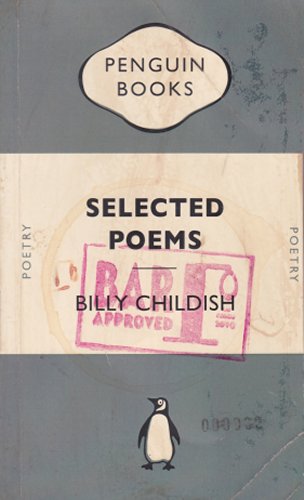
L-13 unsurprisingly decided to turn this into a performance art event, for quite a while they were the main source for art by Bristol graffiti artist Banksy amongst others. and this was too good an opportunity to miss. Of the five hundred copies most were burnt by Billy Childish at what guests were told was a launch event on 21st January 2010, which was well covered by the press including New Musical Express who had a reporter there. With 113 copies surviving but heavily amended, ‘artistically altered’, to get round the restrictions of the court order. This surviving version of the first paperback edition is stamped in red ink inside “This book is NOT authorised by Penguin and is NOT for RESALE” and stamped in red ink on the front cover ‘BAR APPROVED’ (British Art Resistance) with an image of Childish’s gallows monogram dated 2010; it is further stamped at the bottom right of the front cover with an edition number out of 113 and a ‘L-13 editions’ stamp on the rear cover, again in red ink; the covers were further deliberately aged and defaced.These were presumably given away along with various A4 colour copies of photographs of the book burning. with a limited edition A3 poster, headed:
Penguin Book Burning
Dumb Insolence
act 1
21-01-10
L-13
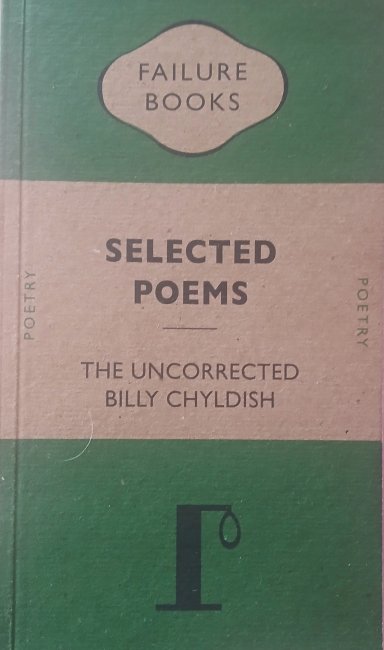
This brings us to the copy I have which is the third version and Childish continued his taunting of Penguin Books by basing the cover on a Penguin Crime cover with ‘Failure Books’ replacing ‘Penguin Books’ in the ogee at the top of the front and Childish’s gallows logo replacing the Penguin. This time just a hundred copies were printed and mine is number five making a grand total of about three hundred existing copies spread over three separate printings. As far as I know no other editions of this work exist.
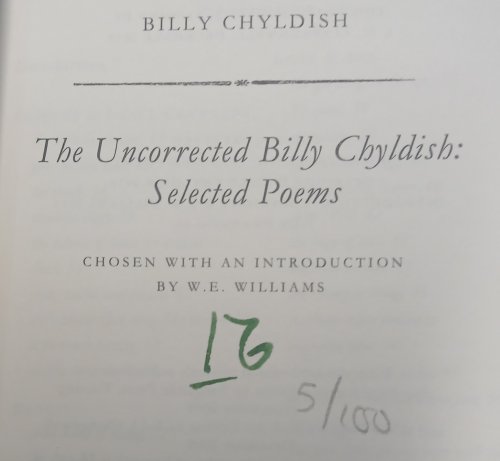
It can be seen from the title page above that the poems are apparently chosen be W.E. Williams and he also ‘wrote’ the introduction. Sir William Emrys Williams was chief editor of Penguin Books from 1936 to 1965 and edited the Penguin Poetry series however he didn’t have any involvement with this book partly because he wouldn’t have wanted to have anything to do with it, but mainly because he had been dead for thirty three years by the time it came out.
Childish is dyslexic and the works included in the book are with uncorrected spellings, hence the subtitle. There are poems dealing with his violent father and the childhood sexual abuse he endured with a friend of his fathers along with various relationships over the years. But I’ll finish with a couple of examples of his work from this collection which don’t feature any of those themes which make his work so difficult to read, but somehow engaging, as he explores his life experiences both good and bad. So here is ‘with poems that sting like wasps’
i was in love
with truth
but
not love
with poems that sting like wasps
and
mad men in the sway of false godsi have been stung
so i too will sting
and
so i stung myself
because truth without love
is the worst type of lyingbut
all along
secretly
within this shell
i always loved love
and now i forgive all
and
see that even a wasp is nothing but
a little winged tigerFollowed by ‘a big soft dog of a poet’
im no hard man
im a big soft dog of a poet
desperate for people to like me
a damaged broken dog of a poet
a half-man pierced by arrowsmore sensitive than a sschoolgirl
more prone to upsets
alive with vengeneces
more dangerous than a wounded wolf
telling tails on self and others then whining for mercyan angry chimp of a poet
rageing thru the jungle
hanging upside down
thirsty for monkey brainsa living thieving rat of a poet
who hates poetry
who will not be a poet for you
for your mother your lover or anyonea lovable kitten of a poet
tigerish and selfish
whose verses are as harmless as milkan ant of a poet
acid-mouthed and creeping
the type of charlatan who will deny
hes wearing a hat whilst wearing a hat


